D-dimer test: normal levels, high results, next steps
D-dimer shows your body is breaking down a blood clot. Here's the normal cutoff, the common reasons it runs high, and when a result is urgent.
D-dimer is a protein fragment that shows up in your blood when your body breaks down a blood clot. It only forms after a clot has been built and then taken apart. So a low D-dimer is one of the best tools doctors have to rule out a dangerous clot, and a high D-dimer is a signal to look closer, not a diagnosis.12
The short version
- Normal: under 500 ng/mL FEU on most tests (the same number as 0.50 mg/L FEU). Over age 50, many labs use your age × 10 instead, so the cutoff is 700 at age 70.342
- High is common, and a clot is only one cause. Older age, recent surgery or injury, pregnancy, infection, cancer and liver disease all raise it.35 The usual next step is an ultrasound or a CT scan.2
- Urgent: sudden trouble breathing, chest pain or a racing heartbeat, or a leg that is swollen, painful, warm or red. Get care right away, whatever your D-dimer shows.5
- Check the unit. Labs report D-dimer in FEU or in DDU, and the FEU number is about twice the DDU number for the same blood. Compare results only in the same unit.64
What D-dimer is
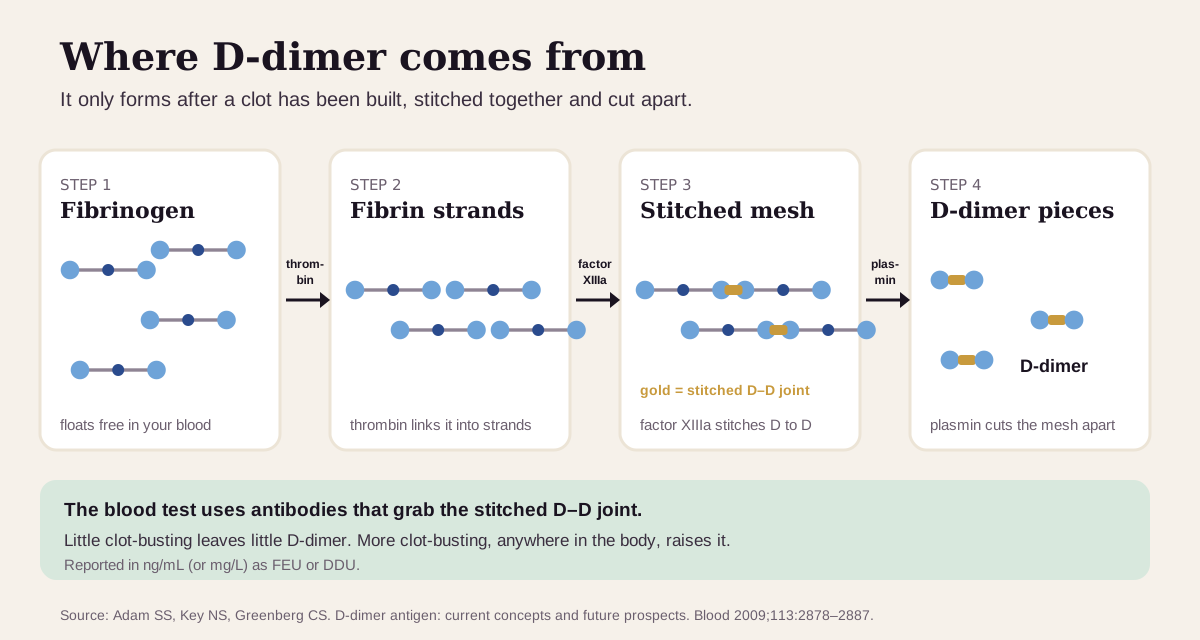
Your body seals a leak in three steps and cleans up in a fourth. The enzyme thrombin turns fibrinogen, a protein dissolved in your blood, into sticky strands of fibrin. Factor XIII then stitches those strands together into a firm mesh. Later, the enzyme plasmin cuts the mesh apart, and the cut pieces that still carry the stitched joints are D-dimer.1
Because all four steps have to happen first, D-dimer is a footprint of a clot that formed and is being cleared. Healthy people carry a little: in a study of 17,359 healthy Italian adults, three in four were under 221 ng/mL, with a middle value of 98 ng/mL in that group.7
Doctors mostly order it when someone might have a deep vein thrombosis (DVT, a clot in a leg vein) or a pulmonary embolism (PE, a clot that has traveled to the lungs). Together they're called venous thromboembolism, or VTE. The American Society of Hematology (ASH) recommends starting with a D-dimer when the chance of a lung clot is low (5% or less) or intermediate (about 20%). A result under the cutoff ends the search; a high one leads to a scan. When the chance is high (50% or more), doctors go straight to the scan.2
What's a normal D-dimer?
Most labs flag a result at or above 500 ng/mL FEU. Labcorp's range is 0.00–0.49 mg/L FEU, and Quest's cutoff is 0.5 µg/mL FEU: the same line, written in different units.34 Quest reports only this cutoff, with no usual "reference range", because the test's job is to help rule out a clot.4
Healthy people usually sit far below it. In the MOLI-SANI study of 17,359 healthy adults, three in four were under 221 ng/mL.7
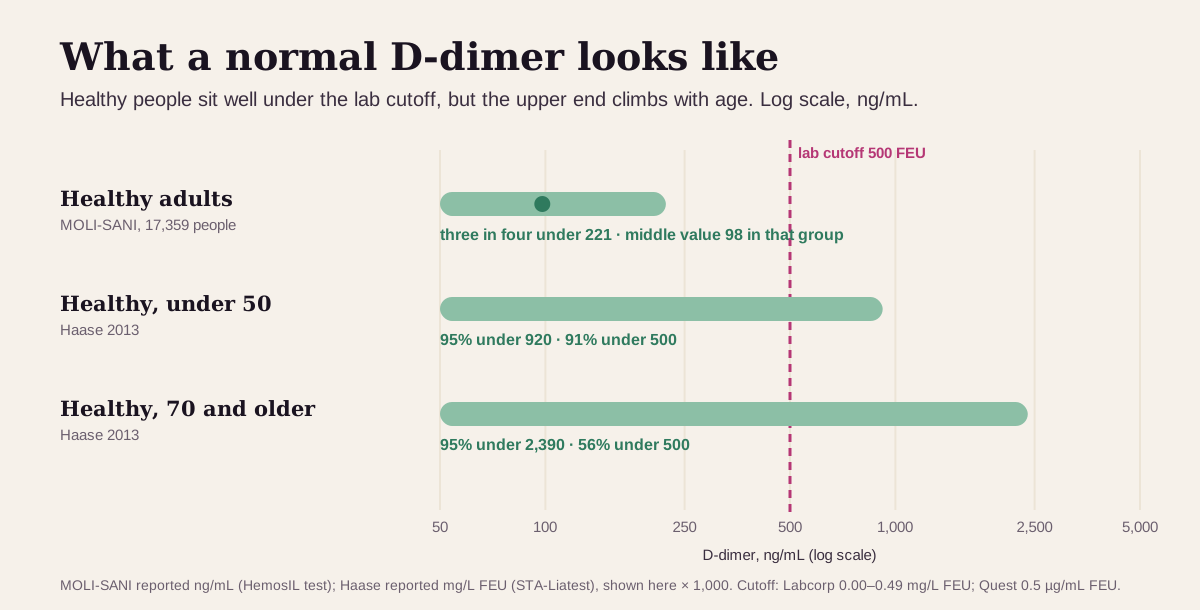
D-dimer rises with age. In a Danish study of 1,352 adults from the general population, the upper limit for healthy people rose from 0.92 mg/L FEU under age 50 to 2.39 at 70 and older. The share under the 0.5 cutoff fell from 91% to 56%.8 Labcorp notes that healthy men aged 75 to 79 run about twice as high as men aged 60 to 64.3 That's why ASH and many labs use an age-adjusted cutoff after 50: your age × 10 ng/mL FEU.23
Men and women are close. The Danish study found only minor differences between the sexes, so one cutoff is used for both.8
Pregnancy raises it steadily. In 102 healthy pregnant women, 99% were above 500 in the third trimester.9
"Optimal" D-dimer: what health optimizers aim for
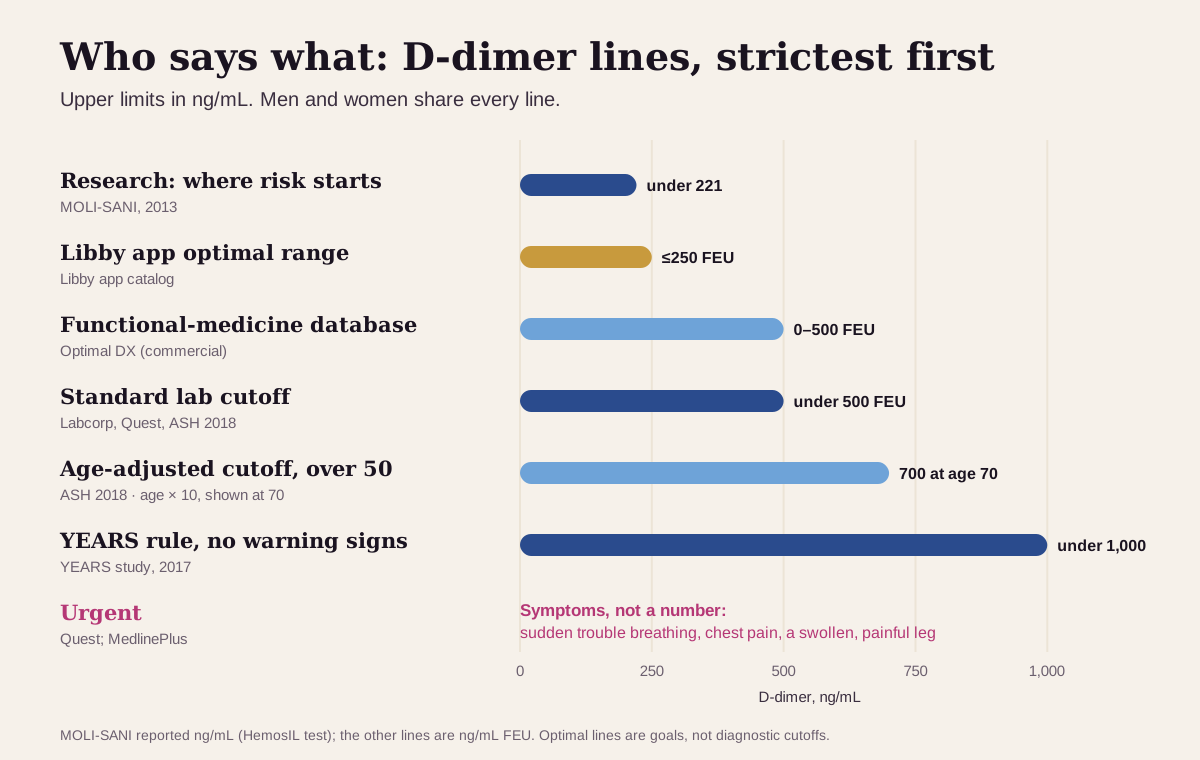
For D-dimer, optimal means low. Population studies show risk starting to climb well under the lab's cutoff, and the Libby app draws its optimal line at half of it. Here's who uses which number, from strictest to loosest:
| Target | Men and women | Who uses it |
|---|---|---|
| Research: where risk starts | under 221 ng/mL | MOLI-SANI: death risk rose only above this line, in healthy adults7 |
| Libby app optimal range | 250 ng/mL FEU or less | The optimal range shown in the Libby app, close to the MOLI-SANI line |
| Functional-medicine database | 0–500 ng/mL FEU | Optimal DX lists the lab cutoff as its "optimal" range10 |
| Standard lab cutoff | under 500 ng/mL FEU | Labcorp, Quest and the ASH guideline342 |
| Age-adjusted cutoff (over 50) | age × 10 (700 at age 70) | ASH guideline, for outpatients over 50212 |
| YEARS rule, no warning signs | under 1,000 ng/mL | A hospital rule for suspected lung clots, scored by a clinician11 |
| Urgent | symptoms, not a number | Quest sets no critical value; the symptoms decide45 |
Why the low targets aren't just a trend:
- In MOLI-SANI, 17,359 healthy adults followed for about 4 years, death risk was flat below 221 ng/mL. Above it, risk rose 1.06, 1.45 and 1.97 times across the top quarter, doubling above about 312. The U.S. MESA study saw risk start at a similar line, 210.7
- In two U.S. cohorts followed for 8 years, people in the top fifth of D-dimer had 4.2 times the odds of a future clot in a leg or lung, compared with the bottom fifth (age-adjusted).13
- After blood thinners stop for a first unexplained clot, a positive D-dimer goes with a recurrence rate of 8.9% a year, versus 3.5% with a negative one.14
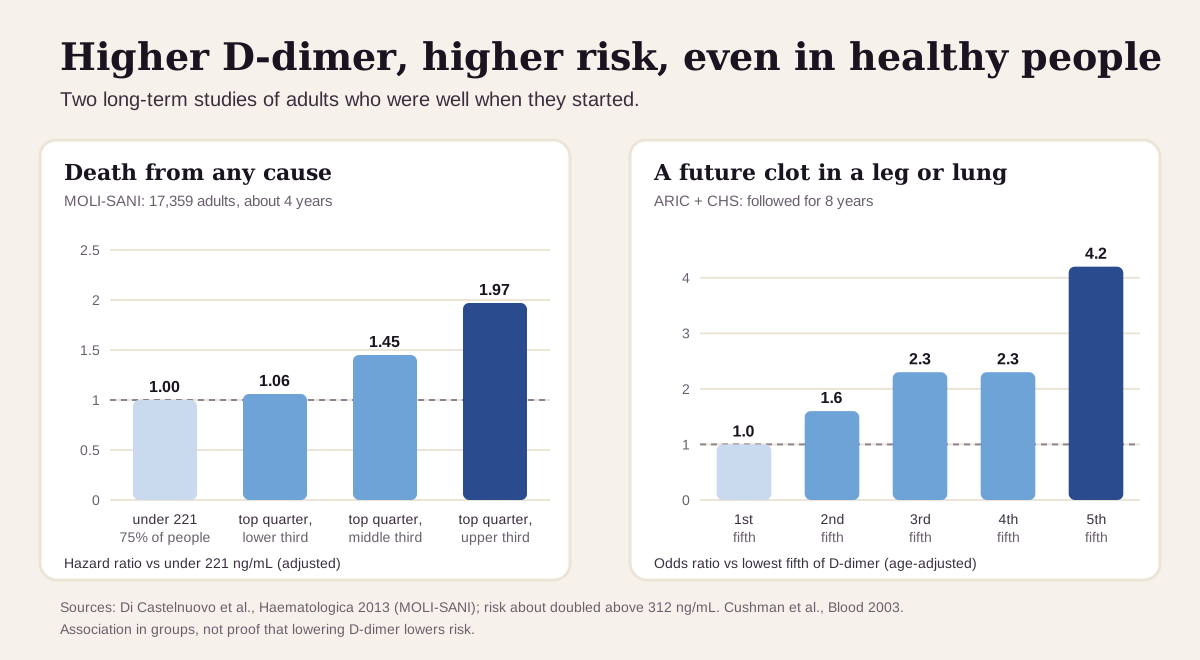
Keep "optimal" in perspective: these are patterns in large groups. The MOLI-SANI authors present about 210–220 ng/mL as a candidate "high risk" line for future research, not a treatment target.7 There's no penalty for being very low, either: in MOLI-SANI, risk was the same across every level below 221.7
What a high D-dimer usually means
A high D-dimer means your body is building and breaking down more clot than usual, somewhere. The number alone can't say where or why. That's why ASH advises against diagnosing a lung clot from a positive D-dimer alone; the next step is usually an ultrasound of the leg or a CT scan of the lungs.23
Most high results come from something other than a clot. In large emergency studies of people checked for a lung clot, 13% to 19% had one.1112 And in people over 80 who had no clot, 85% still had a D-dimer above 500.15
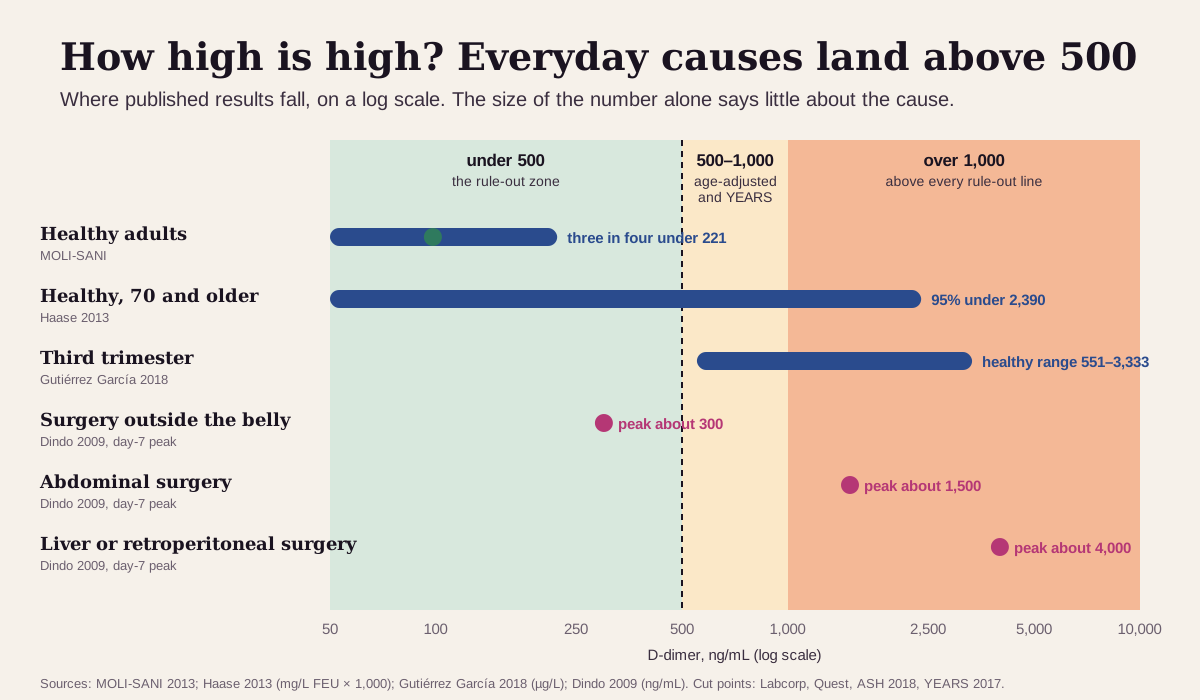
The usual suspects
- Older age. D-dimer climbs steadily after 50, which is why age-adjusted cutoffs exist.82
- Recent surgery or injury. Labcorp lists trauma or surgery in the past four weeks.3 After abdominal surgery, D-dimer peaked around day 7 at about 1,500 ng/mL and took about 25 days to fall back under the cutoff.16
- Pregnancy. It rises every trimester and is above 500 in almost everyone by the third.9
- Infection and inflammation. Sepsis, pneumonia and severe skin infections raise it,3 and so can rheumatoid arthritis and heart disease.5
- Being in the hospital or stuck in bed. Positive results are so common in hospital patients that ASH calls the test of limited use there.2 MedlinePlus lists being immobile as a cause.5
- Cancer and liver cirrhosis, both on Labcorp's list of causes other than a clot.3
The ones that need action
- A clot in a leg or a lung. D-dimer rises more than 100-fold during an acute DVT.13 Imaging confirms it.2
- DIC (disseminated intravascular coagulation), widespread clotting during a severe illness that uses up platelets and clotting factors. It shows up as a pattern (see neighbors).1718
- Less common: aortic aneurysm and sickle cell disease.3
Get emergency care for sudden trouble breathing, chest pain or a racing heartbeat. Get prompt care for a leg that is swollen, painful, warm, or red or darker than the other. Go whatever your D-dimer shows, and whatever an earlier test showed.5
D-dimer reads best next to its neighbors
D-dimer tells you clot-busting is busy. The clotting tests beside it (platelet count, fibrinogen, PT/INR and aPTT) show whether the body is also using up its clotting supplies, as in DIC, whether the clotting times are stretching as the liver fails, or whether everything is simply running high, as in pregnancy.171920
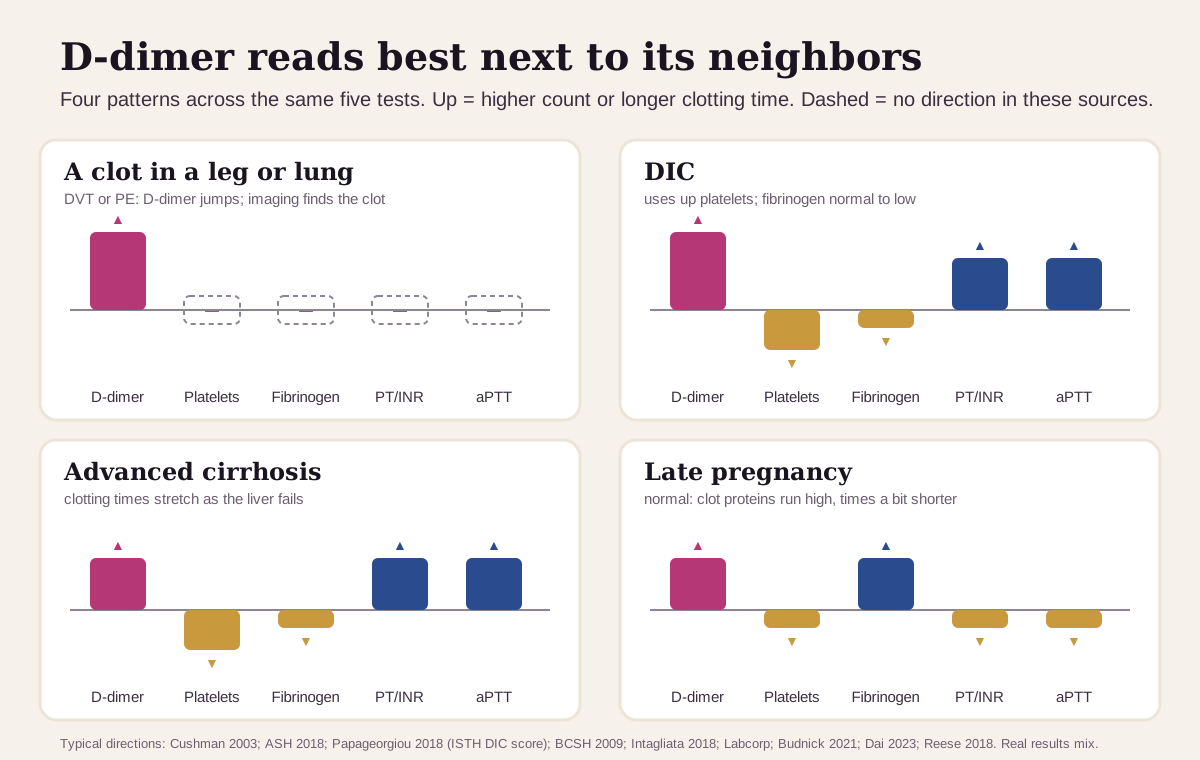
| If you see… | It often points to… |
|---|---|
| D-dimer high, with a swollen leg or trouble breathing | a possible clot: an ultrasound or CT scan is the usual next step25 |
| D-dimer high, platelets falling, PT and aPTT longer, fibrinogen normal or low, in someone seriously ill | DIC. In a person with an illness that can trigger it, the ISTH score adds up D-dimer, platelets, fibrinogen and PT; 5 points or more means DIC1718 |
| D-dimer high, platelets low, PT/INR and aPTT long, in someone with cirrhosis | advanced liver disease: the clotting times stretch as the liver fails193 |
| D-dimer and fibrinogen high, PT and aPTT a little shorter, in pregnancy | normal pregnancy: both peak in the third trimester20 |
Platelets also run a little lower in a healthy pregnancy: an average of 251,000 per µL in the first trimester, versus 273,000 in women who aren't pregnant.22
How fast D-dimer changes
D-dimer clears in hours, but the source can keep making more. After surgery it keeps climbing for about a week, then falls by about 6% a day. From a peak of 1,500, that takes about two and a half weeks, so it gets back under 500 around day 25.16
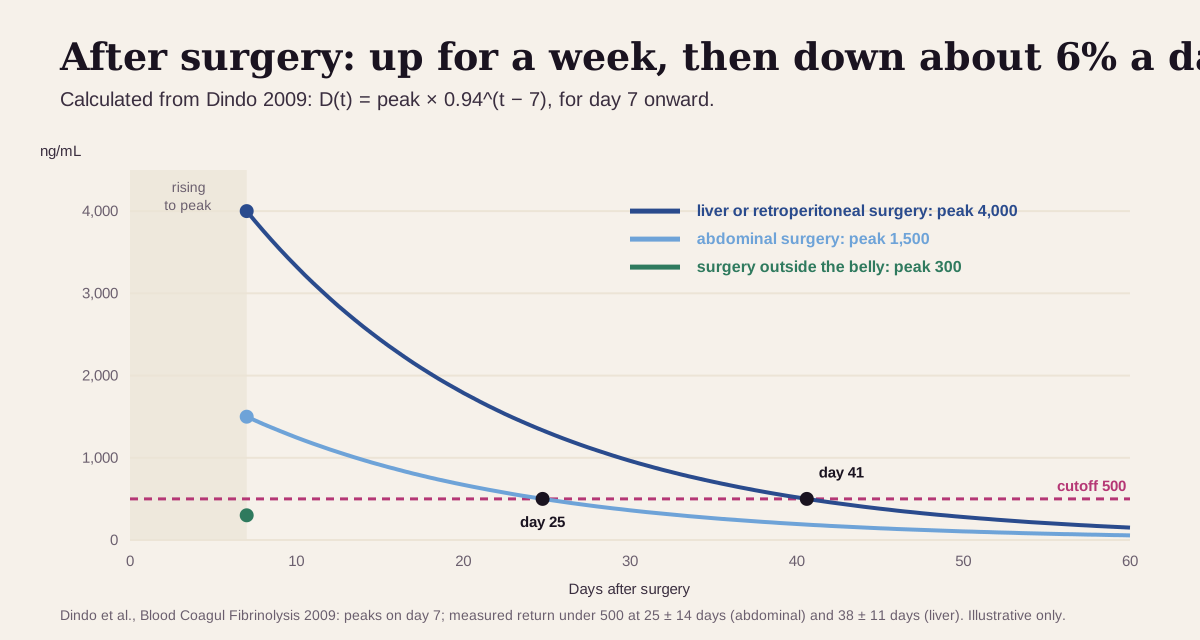
What that means in practice:
- Blood thinners lower it quickly. One analysis estimated a 25% drop within 24 hours of starting heparin.23 In 418 people checked for a leg clot, 68% had a lower D-dimer after taking rivaroxaban, and 36 went from positive to negative. Two of those 36 had a clot on ultrasound.24 Tell the team if you've taken a blood thinner before the test.
- It swings from week to week. In healthy adults, D-dimer varied by about 21% on its own. Two results need to differ by about 60% before the change is likely real.25
- Trends beat snapshots. Compare results in the same unit, ideally from the same lab, because FEU and DDU numbers differ about twofold.6
Going deeper: units and how doctors pick the cutoff
FEU vs DDU. Both measure the same fragments but are calibrated differently. FEU compares them to the fibrinogen they came from; DDU estimates the weight of the D-dimer piece itself, which is about half as heavy. That's why an FEU number is about twice the DDU number: Quest puts 1.0 µg/mL FEU equal to 0.5 µg/mL DDU.64
Why age-adjusted cutoffs work. With the fixed 500 cutoff, the share of people without a clot who test negative falls from 57.6% at ages 51–60 to 14.7% over 80. Age-adjusting raises those to 62.3% and 35.2%, while still catching more than 97% of clots.15 In the ADJUST-PE study, it let doctors rule out a lung clot without a scan in 29.7% of people 75 and older with a low or moderate chance of one, up from 6.4%.12
The YEARS rule. A clinician checks three things: signs of a leg clot, coughing up blood, and whether a lung clot is the most likely diagnosis. With none of them, the cutoff is 1,000 ng/mL; with any, it's 500. That avoided a CT scan in 48% of patients, versus 34% with the older approach. Of the people sent home without a clot diagnosis, 0.61% had one in the next 3 months.11 A pregnancy version avoided CT in 39% of pregnant women, from 65% in the first trimester to 32% in the third.26
Questions worth asking
- Was my result in FEU or DDU, and what cutoff does this lab use?
- Does an age-adjusted cutoff apply to me?
- How likely was a clot before the test, and do I need an ultrasound or a CT scan?
- Could recent surgery, an injury, an infection, pregnancy or a medicine explain it?
- Had I taken a blood thinner before the blood draw?
- Should my platelets, fibrinogen, PT and aPTT be checked alongside it?
FAQ
What is a normal D-dimer level? Under 500 ng/mL FEU (0.50 mg/L FEU) on most tests. Over age 50, many labs use your age × 10 as the cutoff.342
Does a high D-dimer mean I have a blood clot? Not by itself. It means clotting and clot breakdown are busier than usual. A clot is one cause; age, surgery, pregnancy, infection, cancer and liver disease are common others. An ultrasound or a CT scan usually decides.23
Why is D-dimer high in pregnancy? It rises naturally through pregnancy: 99% of healthy women are above 500 by the third trimester.9 Doctors use a pregnancy version of the YEARS rule.26
When is a high D-dimer an emergency? When it comes with symptoms: sudden trouble breathing, chest pain, a racing heartbeat, or a swollen, painful leg. No single number is an emergency on its own; Quest sets no critical value.54
This guide is for education. It can't diagnose you or replace care from a clinician who knows your history.
Footnotes
-
Adam SS, Key NS, Greenberg CS. D-dimer antigen: current concepts and future prospects. Blood. 2009;113(13):2878–2887. How thrombin, factor XIIIa and plasmin form D-dimer, and its main use in ruling out clots. PubMed ↩ ↩2 ↩3
-
Lim W, Le Gal G, Bates SM, et al. American Society of Hematology 2018 guidelines for management of venous thromboembolism: diagnosis of venous thromboembolism. Blood Adv. 2018;2(22):3226–3256. The U.S. hematology guideline: D-dimer first at low or intermediate probability, imaging first at high probability, no diagnosis from D-dimer alone, and the age × 10 cutoff. PMC ↩ ↩2 ↩3 ↩4 ↩5 ↩6 ↩7 ↩8 ↩9 ↩10 ↩11 ↩12 ↩13 ↩14 ↩15 ↩16 ↩17
-
Labcorp. D-Dimer (test 115188). Reference range 0.00–0.49 mg/L FEU, the age/100 cutoff table, the list of conditions that raise D-dimer without a clot, and the ~8-hour half-life. Labcorp is a commercial clinical laboratory. labcorp.com ↩ ↩2 ↩3 ↩4 ↩5 ↩6 ↩7 ↩8 ↩9 ↩10 ↩11 ↩12 ↩13 ↩14 ↩15 ↩16 ↩17 ↩18 ↩19
-
Quest Diagnostics. D-Dimer, Quantitative: FAQ (test 8659), version 4, 2022. Cutoff 0.5 µg/mL FEU, no reference interval and no critical value, and 1.0 µg/mL FEU = 0.5 µg/mL DDU. Quest is a commercial clinical laboratory. questdiagnostics.com ↩ ↩2 ↩3 ↩4 ↩5 ↩6 ↩7 ↩8 ↩9 ↩10 ↩11 ↩12
-
National Library of Medicine. D-Dimer Test. MedlinePlus. Updated April 11, 2024. Symptoms of DVT and PE, and causes of a high result other than a clot. MedlinePlus ↩ ↩2 ↩3 ↩4 ↩5 ↩6 ↩7 ↩8
-
Thachil J, Longstaff C, Favaloro EJ, et al. The need for accurate D-dimer reporting in COVID-19: Communication from the ISTH SSC on fibrinolysis. J Thromb Haemost. 2020;18(9):2408–2411. Defines FEU and DDU; FEU is about twofold DDU. PMC ↩ ↩2 ↩3
-
Di Castelnuovo A, de Curtis A, Costanzo S, et al. Association of D-dimer levels with all-cause mortality in a healthy adult population: findings from the MOLI-SANI study. Haematologica. 2013;98(9):1476–1480. 17,359 healthy Italian adults followed for a median 4.2 years; median D-dimer 98 ng/mL below the 221 line. PMC ↩ ↩2 ↩3 ↩4 ↩5 ↩6 ↩7 ↩8 ↩9 ↩10
-
Haase C, Joergensen M, Ellervik C, et al. Age- and sex-dependent reference intervals for D-dimer: evidence for a marked increase by age. Thromb Res. 2013;132(6):676–680. 1,352 Danish adults aged 23–93. PubMed ↩ ↩2 ↩3 ↩4 ↩5
-
Gutiérrez García I, Pérez Cañadas P, Martínez Uriarte J, et al. D-dimer during pregnancy: establishing trimester-specific reference intervals. Scand J Clin Lab Invest. 2018;78(6):439–442. 102 healthy pregnant women; third-trimester range 551–3,333 µg/L. PubMed ↩ ↩2 ↩3 ↩4
-
Optimal DX. Biomarkers of Inflammation and Oxidation: D-dimer. Undated; accessed September 23, 2026. Lists an optimal range of 0.00–0.50 µg/mL FEU (0–500 ng/mL FEU), the same as its standard range. A commercial source, listed as what functional-medicine practitioners use. optimaldx.com ↩ ↩2
-
van der Hulle T, Cheung WY, Kooij S, et al. Simplified diagnostic management of suspected pulmonary embolism (the YEARS study): a prospective, multicentre, cohort study. Lancet. 2017;390(10091):289–297. 3,465 patients; 13% had PE. PubMed ↩ ↩2 ↩3 ↩4
-
Righini M, Van Es J, Den Exter PL, et al. Age-adjusted D-dimer cutoff levels to rule out pulmonary embolism: the ADJUST-PE study. JAMA. 2014;311(11):1117–1124. 3,346 patients with suspected PE; prevalence 19%. PubMed ↩ ↩2 ↩3
-
Cushman M, Folsom AR, Wang L, et al. Fibrin fragment D-dimer and the risk of future venous thrombosis. Blood. 2003;101(4):1243–1248. ARIC and Cardiovascular Health Study participants followed for 8 years; odds of a first clot by fifth of D-dimer. PubMed ↩ ↩2 ↩3 ↩4
-
Verhovsek M, Douketis JD, Yi Q, et al. Systematic review: D-dimer to predict recurrent disease after stopping anticoagulant therapy for unprovoked venous thromboembolism. Ann Intern Med. 2008;149(7):481–490. Seven studies, 1,888 patients. PubMed ↩
-
Schouten HJ, Geersing GJ, Koek HL, et al. Diagnostic accuracy of conventional or age adjusted D-dimer cut-off values in older patients with suspected venous thromboembolism: systematic review and meta-analysis. BMJ. 2013;346:f2492. 13 cohorts, 12,497 patients. PMC ↩ ↩2
-
Dindo D, Breitenstein S, Hahnloser D, et al. Kinetics of D-dimer after general surgery. Blood Coagul Fibrinolysis. 2009;20(5):347–352. 154 patients; peak on day 7, then 6.0% clearance per day. PubMed ↩ ↩2 ↩3 ↩4
-
Papageorgiou C, Jourdi G, Adjambri E, et al. Disseminated Intravascular Coagulation: An Update on Pathogenesis, Diagnosis, and Therapeutic Strategies. Clin Appl Thromb Hemost. 2018;24(9 suppl):8S–28S. Includes the ISTH overt-DIC score (platelets, fibrin markers such as D-dimer, fibrinogen, PT). PMC ↩ ↩2 ↩3 ↩4
-
Levi M, Toh CH, Thachil J, Watson HG. Guidelines for the diagnosis and management of disseminated intravascular coagulation. British Committee for Standards in Haematology. Br J Haematol. 2009;145(1):24–33. Prolonged PT and aPTT and low fibrinogen in DIC. PubMed ↩ ↩2 ↩3
-
Intagliata NM, Argo CK, Stine JG, et al. Concepts and Controversies in Haemostasis and Thrombosis Associated with Liver Disease: Proceedings of the 7th International Coagulation in Liver Disease Conference. Thromb Haemost. 2018;118(8):1491–1506. PT/INR and aPTT prolonged in cirrhosis in step with liver failure; low platelets. PMC ↩ ↩2 ↩3
-
Dai J, Mao P, Pu C, et al. Trimester-specific reference intervals and profile of coagulation parameters for Chinese pregnant women with diverse demographics and obstetric history: a cross-sectional study. BMC Pregnancy Childbirth. 2023;23(1):421. D-dimer and fibrinogen rise through pregnancy; PT and aPTT shorten. PMC ↩ ↩2 ↩3
-
Budnick IM, Davis JPE, Sundararaghavan A, et al. Transfusion with Cryoprecipitate for Very Low Fibrinogen Levels Does Not Affect Bleeding or Survival in Critically Ill Cirrhosis Patients. Thromb Haemost. 2021;121(10):1317–1325. In critically ill patients with cirrhosis, low fibrinogen reflected how sick they were. PubMed ↩
-
Reese JA, Peck JD, Deschamps DR, et al. Platelet Counts during Pregnancy. N Engl J Med. 2018;379(1):32–43. 4,568 uncomplicated pregnancies compared with 8,885 women who were not pregnant. PMC ↩ ↩2
-
Couturaud F, Kearon C, Bates SM, Ginsberg JS. Decrease in sensitivity of D-dimer for acute venous thromboembolism after starting anticoagulant therapy. Blood Coagul Fibrinolysis. 2002;13(3):241–246. PubMed ↩
-
Mohamad H, Fronas SG, Jørgensen CT, et al. The effect of rivaroxaban on the diagnostic value of D-dimer in patients with suspected deep vein thrombosis. Thromb Res. 2022;216:22–24. PubMed ↩
-
Ercan Ş, Ercan Karadağ M. Establishing biological variation for plasma D-dimer from 25 healthy individuals. Scand J Clin Lab Invest. 2021;81(6):469–474. Within-person variation 21.2%; reference change value 60.4%. PubMed ↩
-
van der Pol LM, Tromeur C, Bistervels IM, et al. Pregnancy-Adapted YEARS Algorithm for Diagnosis of Suspected Pulmonary Embolism. N Engl J Med. 2019;380(12):1139–1149. PubMed ↩ ↩2
Educational content, not medical advice.Libby is a personal record tool, not a medical service — it doesn't diagnose, treat, or prescribe. Reference ranges vary by lab and by person. Talk to a qualified healthcare professional about your results.
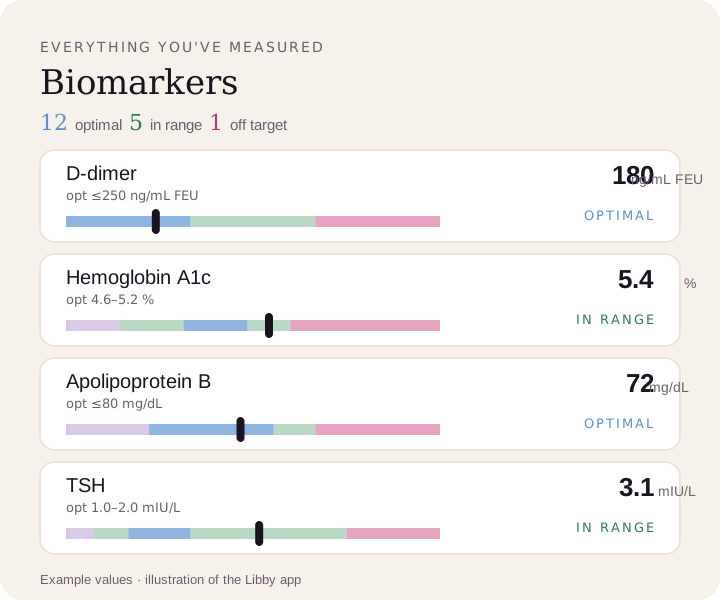
Compare your results to optimal ranges.
Upload a lab PDF or a photo of your report. Libby puts every marker on your lab's range and the optimal range, and tracks your trends over time.
View your D-dimer ›