ESR blood test: normal levels, high causes, and next steps
ESR (sed rate) tracks inflammation. Here's a normal ESR by age and sex, the common reasons it runs high, how to read it with CRP, and when it's urgent.
ESR (erythrocyte sedimentation rate) measures how fast your red blood cells sink to the bottom of a tall tube of blood. Inflammation fills the blood with large, sticky proteins that make red cells clump, and clumps sink faster. So a high ESR usually signals inflammation somewhere in the body, though anemia, kidney disease and pregnancy can raise it too. The rest of your results help show what's going on.12
The short version
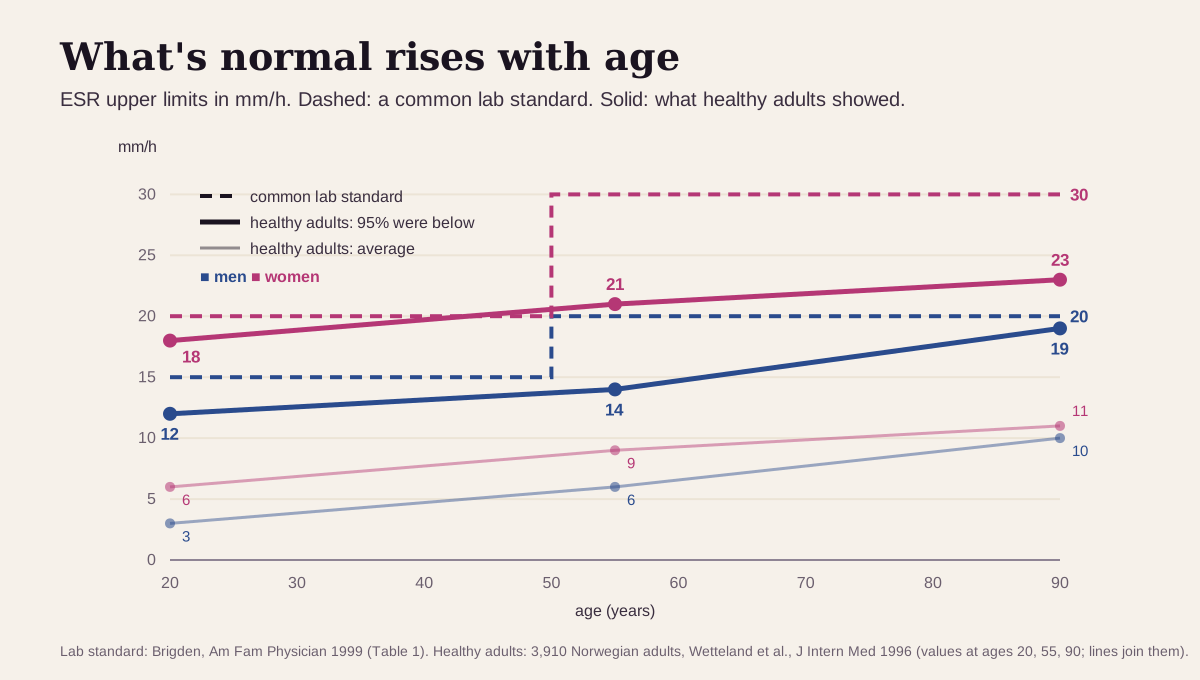
- Normal: check the upper limit on your report. A common lab standard is up to 15 mm/h for men and 20 for women under 50, and 20 and 30 over 50.2 ESR rises with age and runs higher in women.3
- Mildly high is common. The usual reasons are an infection (current or recently treated), anemia, kidney disease, arthritis or another inflammatory condition, pregnancy, older age and extra body weight.245
- Very high (100 mm/h or more) almost always has a findable cause, most often infection, an autoimmune disease or cancer. It needs prompt follow-up.67 Any change in vision, especially with a new headache or jaw pain after age 50, needs care right away.8
- ESR is the slow inflammation test. CRP rises within hours; ESR takes a day or two to rise and weeks to settle.7
What ESR is
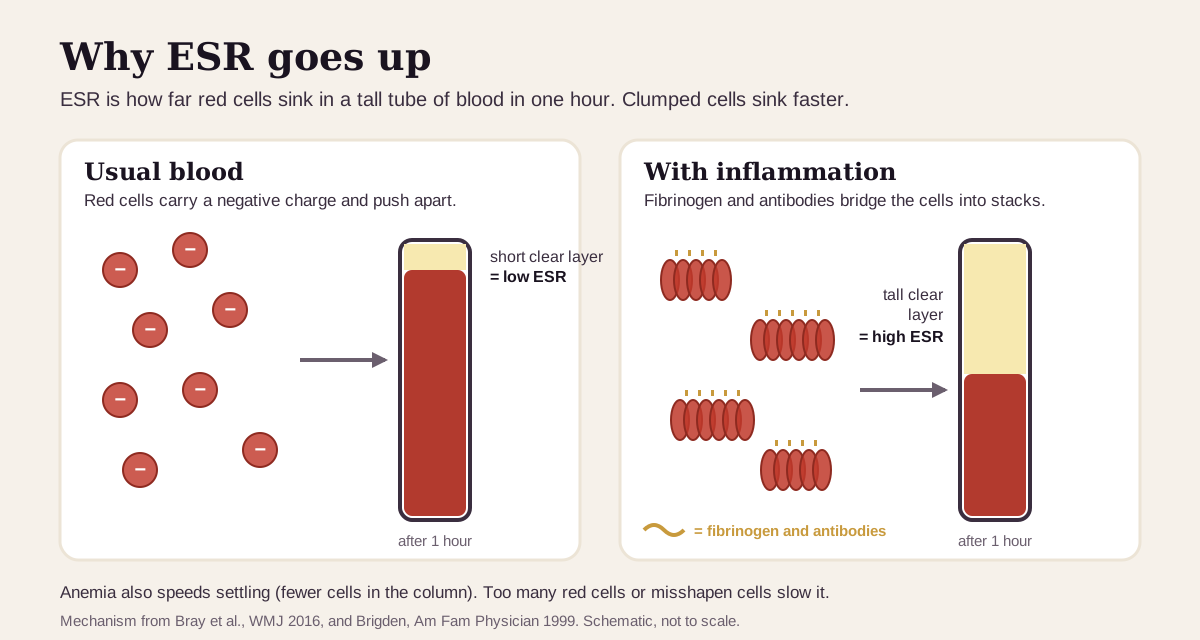
ESR is one of the oldest blood tests still in routine use. The lab stands a tube of blood, treated to keep it from clotting, upright for one hour and measures how many millimeters the red cells have fallen.2 The Westergren method is the gold standard, though most labs now use faster automated versions of it.9
Red cells carry a negative electrical charge on their surface, so they push each other apart and settle slowly. Large proteins such as fibrinogen (a clotting protein) and immunoglobulins (antibodies) cancel that push. The cells then stack up like coins, a formation called rouleaux, and sink faster.7 Inflammation raises those proteins, which is why ESR tracks inflammation.4
Clinicians order ESR when they suspect an inflammatory condition, for example with an unexplained fever, weight loss, joint stiffness, or neck and shoulder pain. They also use it to follow conditions such as polymyalgia rheumatica and giant cell arteritis.12 Canada's laboratory-medicine specialists advise against using it as a general screening test in people without symptoms; for spotting fresh inflammation, CRP is the better first test.10
What's a normal ESR?
Start with the range printed on your own report. Labs use different methods and set their own ranges.29
Two facts shape every range: ESR rises with age, and it runs higher in women.35
- A widely used lab standard puts the upper limit at 15 mm/h for men and 20 for women under 50, and at 20 and 30 over 50.2
- In 3,910 healthy Norwegian adults, the average ESR was about 3 mm/h for men and 6 for women at age 20, rising to 10 and 11 at age 90. Only 5% of these healthy people went above 12–19 mm/h (men) or 18–23 mm/h (women), depending on age. About 76% of everyone tested was under 9.3
- In a Spanish study of 1,472 adults, women's median ESR was twice men's, and people over 65 had twice the median of people aged 18 to 35.5
Pregnancy raises ESR a lot. In 1,019 healthy pregnant women, the normal range was 18–48 mm/h in the first half of pregnancy and 30–70 in the second half. With anemia it ran higher still: 21–62 and 40–95.11 A result that would look high in anyone else can be normal in pregnancy.
"Optimal" ESR: what health optimizers aim for
Functional-medicine practitioners and longevity clinics aim well below a lab's upper limit. Here's the full ladder, from strictest to loosest:
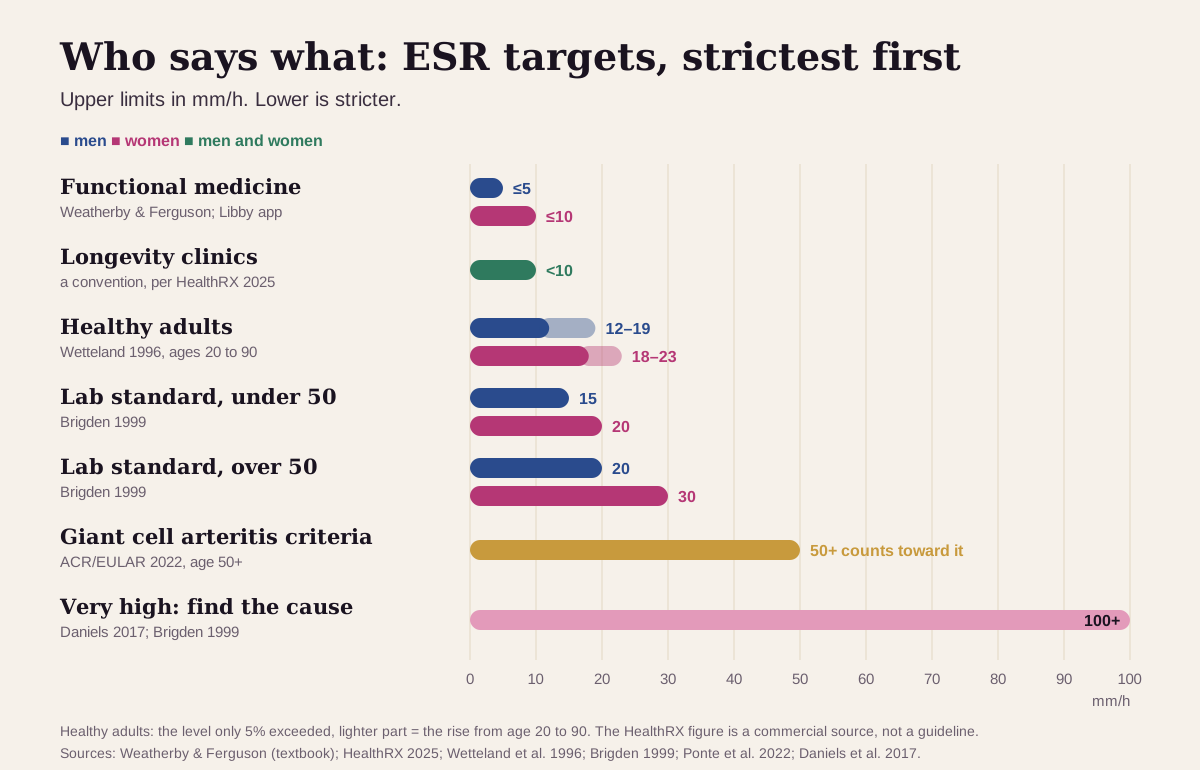
| Target | Men | Women | Who uses it |
|---|---|---|---|
| Strictest (functional medicine) | 5 mm/h or less | 10 mm/h or less | The standard functional-medicine textbook range,12 and the optimal range shown in the Libby app |
| Longevity-clinic convention | under 10 mm/h | under 10 mm/h | A cutoff "promoted in some longevity-medicine materials," which HealthRX calls a convention rather than a guideline13 |
| Research "healthy" limit | 12–19 mm/h | 18–23 mm/h | The level only 5% of healthy Norwegian adults went above, from age 20 to 903 |
| Common lab standard | up to 15 (under 50) or 20 (over 50) | up to 20 (under 50) or 30 (over 50) | A widely used reference table2 |
| Rheumatology criteria | 50 or more | 50 or more | One of several items that count toward classifying giant cell arteritis, in people 50 and older14 |
| Urgent | 100 or more | 100 or more | Almost always has an identifiable cause: see a clinician promptly67 |
Why the low targets exist:
- In the Rotterdam Study, 5,226 older adults (average age 70) were followed for about 15 years. After adjusting for other risk factors, an ESR of 20–50 mm/h came with a 23% higher risk of death, and an ESR over 50 with an 89% higher risk, compared with an ESR under 20. Even in people over 75 with no other illnesses, an ESR over 20 carried a 29% higher risk.15
- The Norwegian researchers wrote that a personal ESR that climbs faster with age than the population curve "should be taken seriously, even when each reading is below the population-based reference limits."3
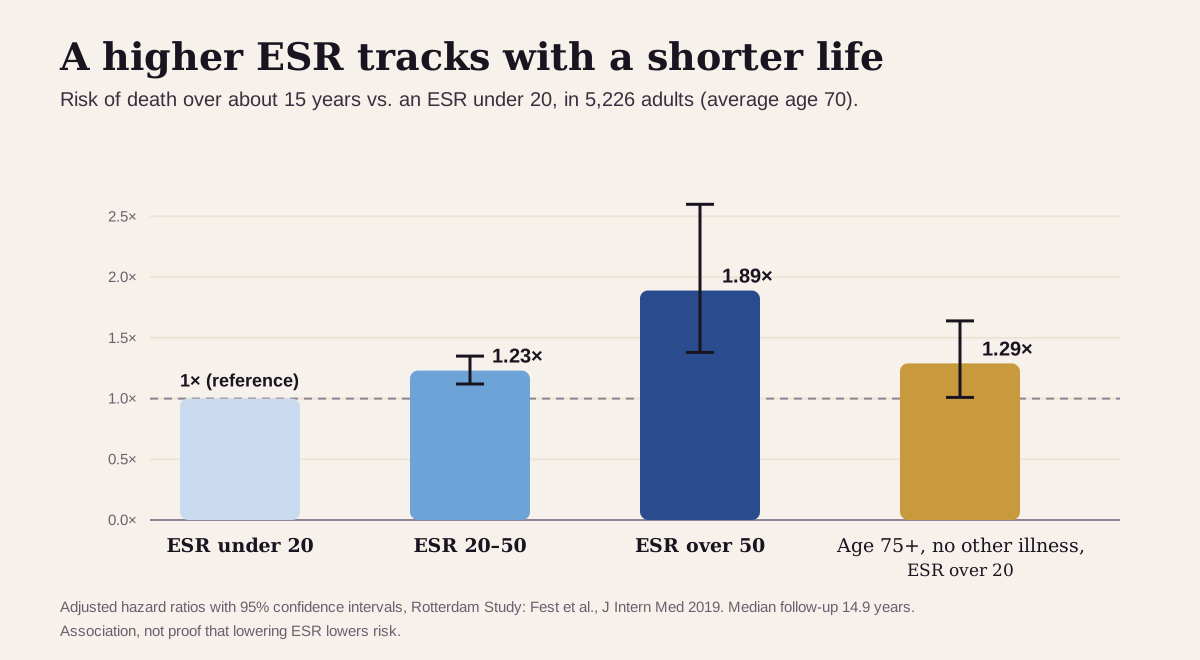
Keep "optimal" in perspective. The outcome data compare an ESR above 20 with one below it; no study has tested whether bringing an ESR from 12 down to 5 changes anything. A low ESR is also no all-clear, since some people with real inflammation have a normal result.1 The most useful habit is to watch your own trend on the same lab, and read ESR next to CRP.3
What a high ESR usually means
The size of the rise is the first clue. Mild rises are common and often have everyday explanations. Very high values almost always mean a real illness.26
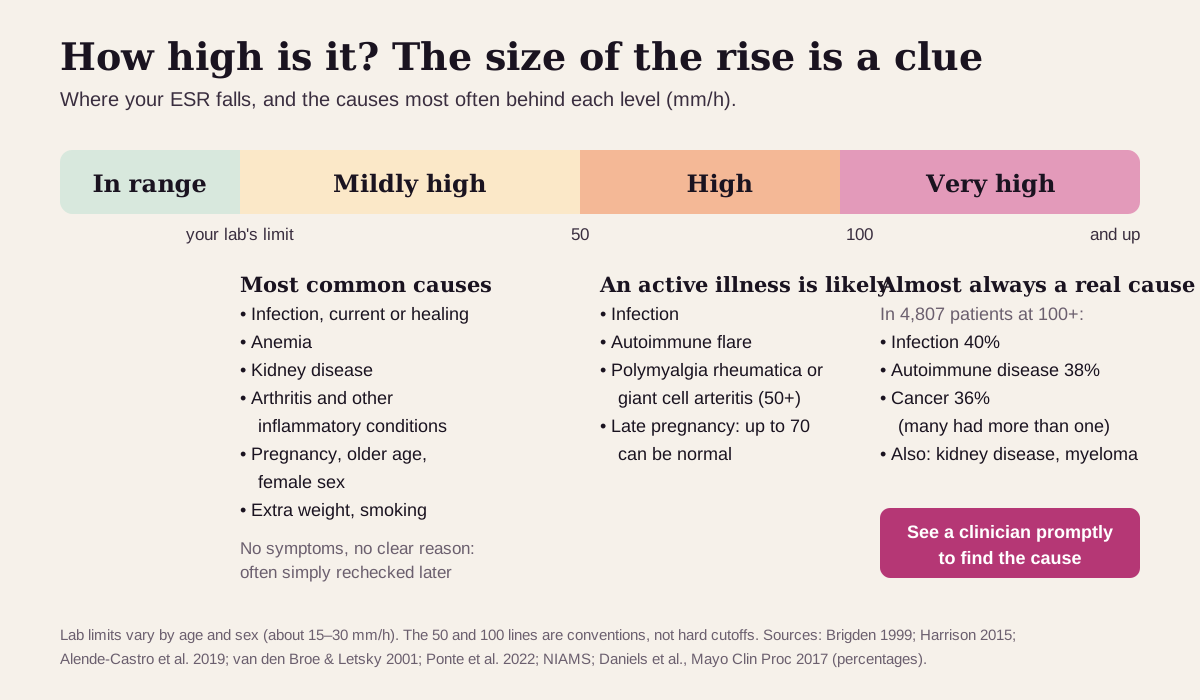
Mildly high (above your lab's limit, under 50): common
The usual suspects:
- An infection, current or recently treated. ESR lags behind recovery, so it can stay up for weeks after treatment starts (see how fast it changes).716
- Anemia. With fewer red cells in the tube, the ones left settle faster, so anemia raises ESR even without inflammation.24
- Kidney disease. It raises ESR while leaving CRP alone.417
- Arthritis and other inflammatory conditions, such as rheumatoid arthritis and inflammatory bowel disease.1
- Age, sex and pregnancy. Older adults and women run higher, and pregnancy raises ESR a lot.311
- Extra body weight and smoking. Both were linked to a higher ESR in a population study, and light drinking and regular exercise to a lower one.5
- Lab factors: a warm sample or a tilted tube reads falsely high.2
With no symptoms and no obvious reason, a mildly high ESR is usually repeated after a few months rather than chased with a big workup. That's the advice of a classic family-medicine review.2
High (50–99): an active illness is likely
In one study of 142 long-term-care residents whose health had changed, the chance of a new disease was 66% with an ESR over 50, versus 7% under 20.2 Common culprits are an infection or a flare of an autoimmune disease,1 and, after age 50, polymyalgia rheumatica (aching and stiffness in the shoulders and hips) or giant cell arteritis (inflamed arteries in the head).8 In giant cell arteritis, the average ESR in one series was over 90, and it was above 30 in 99% of cases.2 An ESR of 50 or more counts toward classifying giant cell arteritis, alongside symptoms, imaging or a biopsy.14 In the second half of pregnancy, up to 70 can be normal.11
Very high (100 or more): almost always a real cause
In 4,807 Mayo Clinic patients with an ESR of 100 or more, the leading causes were infection (40%), autoimmune disease (38%) and cancer (36%), and many had more than one. Almost everyone had an identifiable cause.6 Kidney disease and myeloma, a cancer of antibody-making cells, are also on the list. That's why a blood and urine protein test (electrophoresis) is part of the usual workup.2
Get care right away for any change in vision, such as double vision or vision loss, especially with a new headache, scalp tenderness or jaw pain when chewing after age 50. Giant cell arteritis can cause permanent vision loss within hours or days.8 Don't wait for an ESR result: clinicians act on the symptoms.2
Is a low ESR a problem?
Rarely. Most labs set the lower limit at zero, so a low number usually reads as normal.2 An unusually low ESR can come from too many red cells (polycythemia), misshapen red cells as in sickle cell disease, low fibrinogen, a very high white-cell count, or heart failure. Lab issues such as a clotted or jostled sample can also lower it.217 A normal or low ESR can sit alongside real inflammation, so clinicians read it with your symptoms and CRP.1
ESR reads best next to its neighbors
Because so much besides inflammation moves ESR, the other results on the same report help explain it. CRP is the test most often paired with it.14
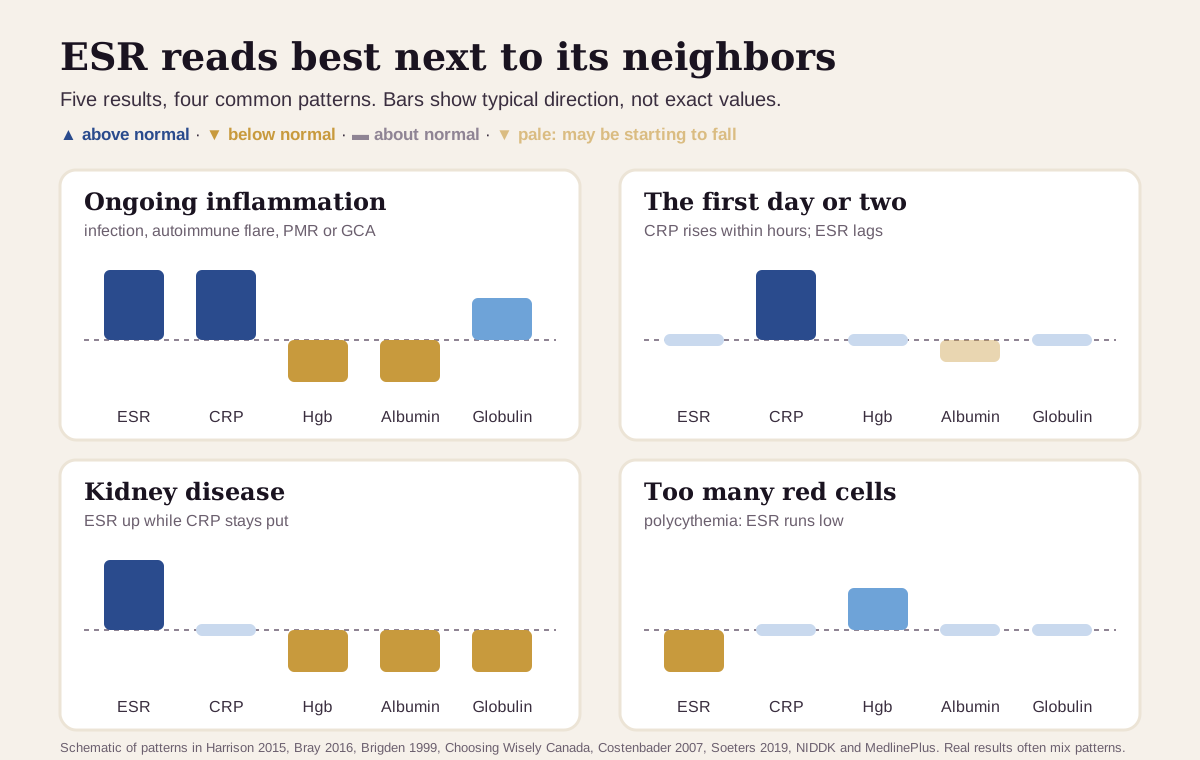
| If you see… | It often points to… |
|---|---|
| ESR and CRP both up, often with lower hemoglobin and albumin | ongoing inflammation: an infection, an autoimmune flare, polymyalgia rheumatica or giant cell arteritis |
| CRP up, ESR still normal | an early or minor process. Usually an infection, sometimes other tissue damage such as a heart attack or a blood clot |
| ESR still up, CRP back to normal | recovery: in children treated for a bone infection, CRP was normal within a week and ESR took about three |
| ESR up, CRP normal, with low hemoglobin or albumin | often something other than a flare: anemia, kidney disease, low albumin or a cancer. A low-grade infection can do it too |
| ESR very high with high globulin or total protein | too much antibody protein, as in myeloma. A protein electrophoresis test checks for it |
| ESR low with high hemoglobin | too many red cells (polycythemia) |
In one hospital study of 2,069 people who had both tests on the same day, 55 had a high ESR with a low CRP. Infection, kidney problems and low albumin were the factors linked to that mismatch.17 Behind the pattern cards: anemia of inflammation typically develops slowly with ongoing infection, autoimmune disease or kidney disease,19 albumin can start to fall within hours of a severe illness and then moves opposite to CRP,18 globulins run high with autoimmune disease or myeloma,20 and a high hemoglobin can be a sign of polycythemia.21
How fast ESR changes
ESR is slow in both directions. CRP can rise within 4–6 hours and peaks in about two days. ESR starts to rise 24–48 hours after inflammation begins and can take weeks to return to normal.7
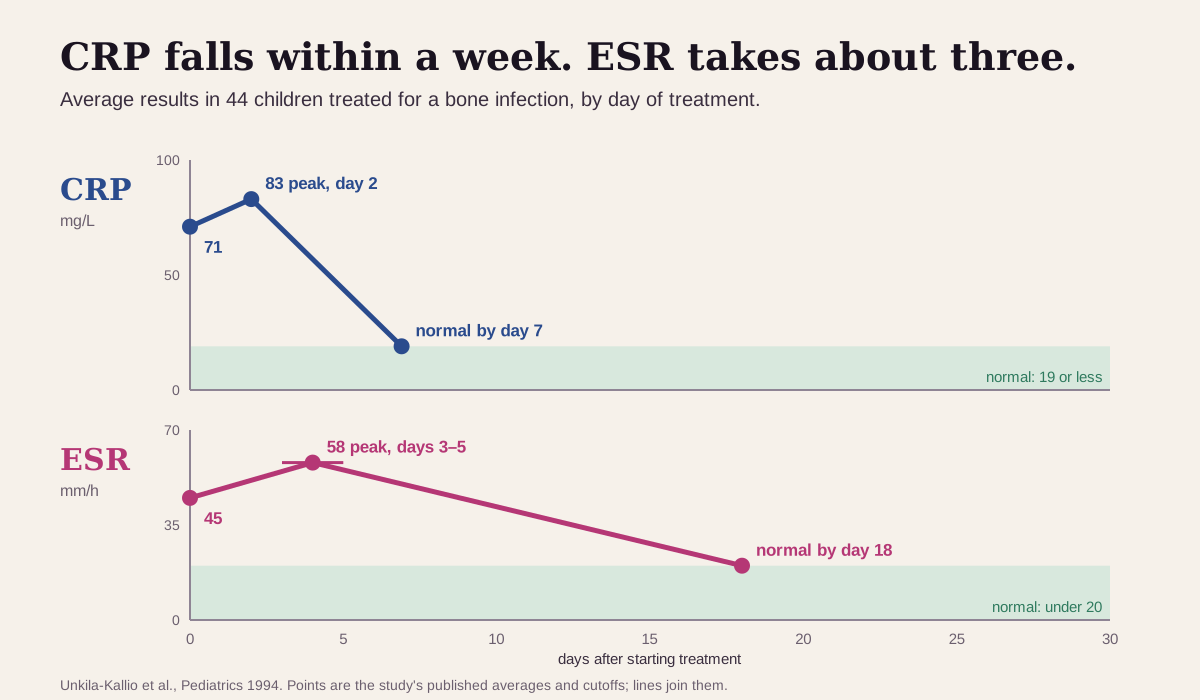
What that means in practice:
- Early in an illness, CRP is the better test. In the first 24 hours, CRP is often up while ESR is still normal.102
- After you recover, ESR lingers. In the children above, CRP was back to normal in about 7 days and ESR in about 18.16 Once antibody levels have risen, ESR can take weeks to months to settle.4
- Treatment moves it within days. When steroids are started for polymyalgia rheumatica or giant cell arteritis, ESR usually drops within a few days.2
- Trends beat snapshots. Compare results from the same lab, since methods differ, and watch whether your own baseline is creeping up with the years.93
Going deeper: why red cells settle faster
ESR is a physical measurement, the speed of a falling column of cells, and several separate forces feed into it:
- Proteins that bridge cells. The more fibrinogen in the blood, the higher the ESR.2 Immunoglobulins and alpha globulins add to it, and the albumin level plays a part too.47
- How many red cells there are. In anemia, plasma flows up past fewer cells, so the clumps fall faster. Large red cells (macrocytes) also settle faster. With too many red cells, the stacks pack loosely and ESR drops.2
- Red-cell shape. Sickle cells, spherocytes and other irregular cells stack poorly, which slows settling.27
- The method. A survey of more than 6,000 labs found that only 28% still used the classic Westergren tube. Newer instruments could differ from Westergren by up to 142%, and from each other by up to 42%.9 That's why a jump after switching labs may reflect the method, not you.
Questions worth asking
- How far above my lab's limit is my ESR, and what is my CRP?
- Could anemia, kidney function, pregnancy or my age explain part of it?
- Do my hemoglobin, albumin and globulin fit an inflammation pattern?
- If my ESR is very high, should I have a protein electrophoresis test?
- I'm over 50 with headaches, jaw pain or shoulder stiffness. Could this be giant cell arteritis or polymyalgia rheumatica?
- When should we repeat it, on the same lab, and what would change the plan?
FAQ
What is a normal ESR? It depends on your lab, your age and your sex. A common standard is up to 15 mm/h for men and 20 for women under 50, and 20 and 30 over 50.2
What is the most common cause of a high ESR? Infection is the leading cause of very high values. Milder rises often come from anemia, kidney disease, pregnancy, older age or extra weight, as well as inflammatory conditions such as arthritis.625
What's the difference between ESR and CRP? CRP is a single protein that rises within hours and falls within days. ESR reflects several proteins and your red cells, so it moves more slowly and more things affect it.47
When is a high ESR urgent? An ESR of 100 or more almost always has a cause and needs prompt follow-up. Any change in vision, especially with a new headache or jaw pain after 50, needs care right away.678
This guide is for education. It can't diagnose you or replace care from a clinician who knows your history.
Footnotes
-
National Library of Medicine. Erythrocyte Sedimentation Rate (ESR). MedlinePlus. Last updated December 2, 2024. What the test measures, why it's ordered, and the conditions linked to high and low results. MedlinePlus ↩ ↩2 ↩3 ↩4 ↩5 ↩6 ↩7 ↩8
-
Brigden ML. Clinical utility of the erythrocyte sedimentation rate. Am Fam Physician. 1999;60(5):1443–1450. The source for the common lab reference table (after Böttiger and Svedberg, 1967), the factors that raise and lower ESR, the giant cell arteritis and "sickness index" figures, and the workup of a very high ESR. PubMed · AAFP ↩ ↩2 ↩3 ↩4 ↩5 ↩6 ↩7 ↩8 ↩9 ↩10 ↩11 ↩12 ↩13 ↩14 ↩15 ↩16 ↩17 ↩18 ↩19 ↩20 ↩21 ↩22 ↩23 ↩24 ↩25 ↩26 ↩27 ↩28 ↩29 ↩30
-
Wetteland P, Røger M, Solberg HE, Iversen OH. Population-based erythrocyte sedimentation rates in 3910 subjectively healthy Norwegian adults. J Intern Med. 1996;240(3):125–131. Averages and upper limits by age and sex; 76% under 9 mm/h. PubMed ↩ ↩2 ↩3 ↩4 ↩5 ↩6 ↩7 ↩8 ↩9 ↩10
-
Harrison M. Erythrocyte sedimentation rate and C-reactive protein. Aust Prescr. 2015;38(3):93–94. What drives ESR besides inflammation, why ESR and CRP disagree, and why CRP responds faster. PMC ↩ ↩2 ↩3 ↩4 ↩5 ↩6 ↩7 ↩8 ↩9 ↩10
-
Alende-Castro V, Alonso-Sampedro M, Vazquez-Temprano N, et al. Factors influencing erythrocyte sedimentation rate in adults: New evidence for an old test. Medicine (Baltimore). 2019;98(34):e16816. 1,472 randomly selected adults; age, sex, weight, smoking, alcohol and exercise. PMC ↩ ↩2 ↩3 ↩4 ↩5
-
Daniels LM, Tosh PK, Fiala JA, et al. Extremely Elevated Erythrocyte Sedimentation Rates: Associations With Patients' Diagnoses, Demographic Characteristics, and Comorbidities. Mayo Clin Proc. 2017;92(11):1636–1643. 4,807 patients with an ESR of 100 mm/h or more. PubMed ↩ ↩2 ↩3 ↩4 ↩5 ↩6 ↩7 ↩8
-
Bray C, Bell LN, Liang H, et al. Erythrocyte Sedimentation Rate and C-reactive Protein Measurements and Their Relevance in Clinical Medicine. WMJ. 2016;115(6):317–321. Red-cell charge and bridging proteins; CRP rises within 4–6 hours, ESR within 24–48 hours and takes weeks to normalize. PubMed ↩ ↩2 ↩3 ↩4 ↩5 ↩6 ↩7 ↩8 ↩9 ↩10 ↩11 ↩12 ↩13
-
National Institute of Arthritis and Musculoskeletal and Skin Diseases. Polymyalgia Rheumatica and Giant Cell Arteritis. NIH. Last reviewed February 2022. Symptoms, and why vision changes need care right away. NIAMS ↩ ↩2 ↩3 ↩4
-
Kratz A, Plebani M, Peng M, et al. ICSH recommendations for modified and alternate methods measuring the erythrocyte sedimentation rate. Int J Lab Hematol. 2017;39(5):448–457. The international hematology standards body on Westergren and newer methods. PubMed ↩ ↩2 ↩3 ↩4
-
Canadian Association of Medical Biochemists. Medical Biochemistry: recommendations. Choosing Wisely Canada. Advises against ESR as a screening test; CRP rises first and clears within a day or so of the source being removed. Choosing Wisely Canada ↩ ↩2 ↩3
-
van den Broe NR, Letsky EA. Pregnancy and the erythrocyte sedimentation rate. BJOG. 2001;108(11):1164–1167. 1,019 healthy pregnant women; ranges by half of pregnancy and anemia. PubMed ↩ ↩2 ↩3
-
Weatherby D, Ferguson S. Blood Chemistry and CBC Analysis: Clinical Laboratory Testing from a Functional Perspective. 2nd ed. Bear Mountain Publishing; 2004. ISBN 978-0976136712. Widely used functional-medicine reference, and the source of the optimal ESR range in the Libby app (5 mm/h or less for men, 10 or less for women). ↩ ↩2
-
HealthRX.com Editorial Team. ESR At-Home and Finger-Prick Options: Normal Range, Optimal Targets, and What Your Result Means. Updated January 28, 2025. Describes an "under 10 mm/hr" cutoff promoted in longevity-medicine materials as a convention, not a guideline. A commercial source, listed as what the optimizer community uses. healthrx.com ↩ ↩2
-
Ponte C, Grayson PC, Robson JC, et al. 2022 American College of Rheumatology/EULAR classification criteria for giant cell arteritis. Ann Rheum Dis. 2022;81(12):1647–1653. ESR of 50 mm/h or more (or CRP of 10 mg/L or more) scores 3 points in a research classification model for people 50 and older. PubMed ↩ ↩2 ↩3 ↩4
-
Fest J, Ruiter R, Mooijaart SP, et al. Erythrocyte sedimentation rate as an independent prognostic marker for mortality: a prospective population-based cohort study. J Intern Med. 2019;285(3):341–348. The Rotterdam Study: 5,226 adults, median follow-up 14.9 years. PubMed ↩ ↩2
-
Unkila-Kallio L, Kallio MJ, Eskola J, Peltola H. Serum C-reactive protein, erythrocyte sedimentation rate, and white blood cell count in acute hematogenous osteomyelitis of children. Pediatrics. 1994;93(1):59–62. Day-by-day CRP and ESR in 44 children after treatment began. PubMed ↩ ↩2 ↩3
-
Costenbader KH, Chibnik LB, Schur PH. Discordance between erythrocyte sedimentation rate and C-reactive protein measurements: clinical significance. Clin Exp Rheumatol. 2007;25(5):746–749. 2,069 same-day ESR and CRP results. PubMed ↩ ↩2 ↩3
-
Soeters PB, Wolfe RR, Shenkin A. Hypoalbuminemia: Pathogenesis and Clinical Significance. JPEN J Parenter Enteral Nutr. 2019;43(2):181–193. Albumin falls as CRP rises in inflammation. PMC ↩ ↩2
-
National Institute of Diabetes and Digestive and Kidney Diseases. Anemia of Inflammation or Chronic Disease. NIH. Which conditions cause it, and how slowly it develops. NIDDK ↩ ↩2
-
National Library of Medicine. Total Protein and Albumin/Globulin (A/G) Ratio. MedlinePlus. Last updated October 20, 2024. What albumin and globulins are, and the conditions linked to high and low levels. MedlinePlus ↩ ↩2
-
National Library of Medicine. Hemoglobin Test. MedlinePlus. Last updated October 27, 2024. High hemoglobin can be a sign of polycythemia vera, lung or heart disease, or sleep apnea. MedlinePlus ↩ ↩2
Educational content, not medical advice.Libby is a personal record tool, not a medical service — it doesn't diagnose, treat, or prescribe. Reference ranges vary by lab and by person. Talk to a qualified healthcare professional about your results.
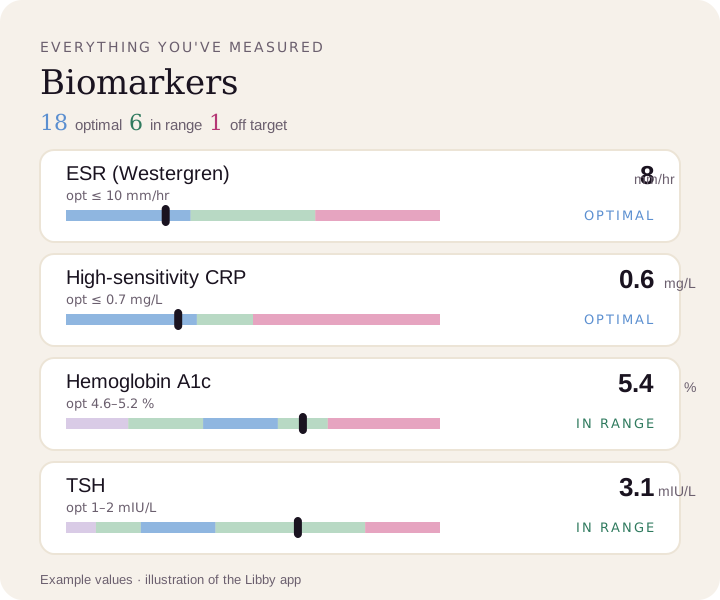
Compare your results to optimal ranges.
Upload a lab PDF or a photo of your report. Libby puts every marker on your lab's range and the optimal range, and tracks your trends over time.
View your ESR ›