Folate blood test: normal levels, low causes, next steps
Folate is the B vitamin cells use to build DNA. Here's what a normal level is, why it runs low or high, how to read it with B12, and when to act.
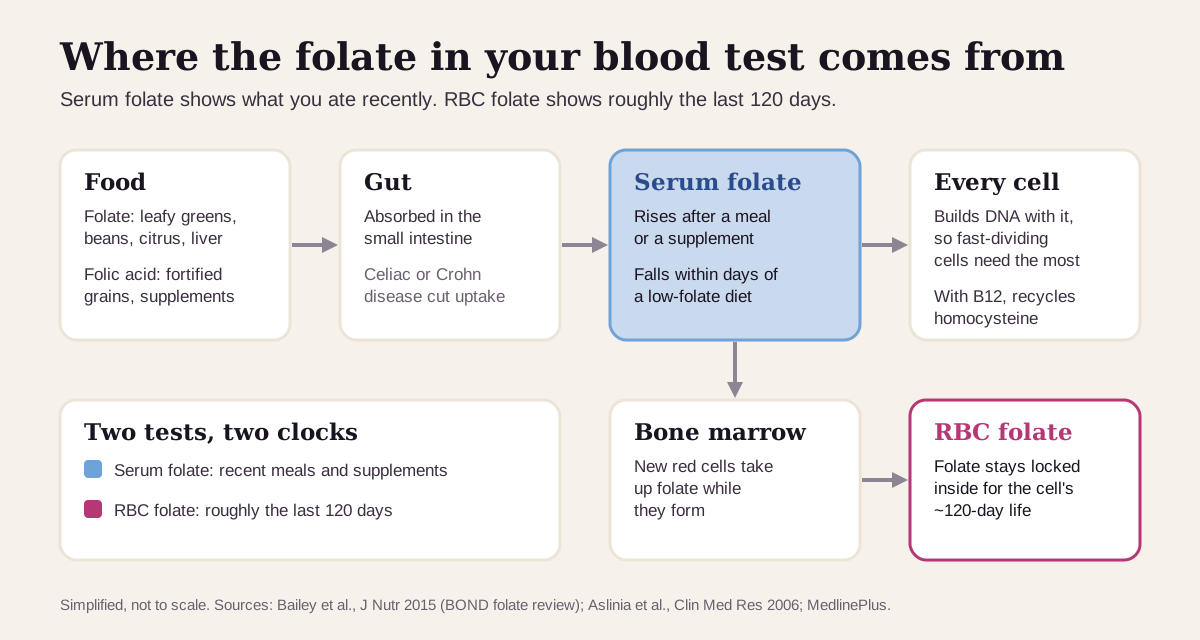
Folate (vitamin B9) is the B vitamin your cells use to build DNA, and a folate blood test shows how much you have on board. Serum folate reflects what you've eaten in the last few days. RBC (red blood cell) folate reflects roughly the last 120 days.1 Low folate has become uncommon in the U.S. since grains were fortified, and when it shows up, the usual reasons are heavy drinking, a thin diet, a gut problem, certain medicines or pregnancy.12
The short version
- Normal: check your lab's floor. Labs put it around 3 to 6 ng/mL for serum folate (Labcorp: above 3.0; ARUP: 5.9 or more).3 The optimal range in the Libby app is 10–30 ng/mL.4
- Low (under about 3 to 4 ng/mL) usually means low intake, heavy drinking, malabsorption (celiac or Crohn disease), certain medicines, or the higher need of pregnancy.21
- High usually means a folic acid supplement or fortified meal before the test. In one hospital study, 64% of patients with a result above 25.7 ng/mL had taken folic acid before the draw.5 Low vitamin B12 can push serum folate up too.6
- Always read it with B12. Both deficiencies make red cells large and raise homocysteine. Low B12 also raises MMA and can harm nerves, which folic acid alone won't fix.71 Numbness, tingling or balance trouble needs prompt care.8
What folate is
Folate is vitamin B9. The natural form is in leafy greens, beans, citrus fruit, eggs and liver. Folic acid is the stable form in supplements and, in the U.S., in enriched grain products, which have been fortified with 140 µg per 100 g of grain since 1998.29
Your cells use folate to carry single carbon atoms. That's how they make the building blocks of DNA, and, together with vitamin B12, how they turn homocysteine back into the amino acid methionine.16 Cells that divide fast feel a shortage first. That's why the classic sign shows up in the blood count: red cells come out large and immature, a condition called megaloblastic anemia.62 (More on the chemistry at the end.)
There are two folate tests:
- Serum folate (or plasma folate) is the folate circulating in your blood right now. It is the first marker to change, and a meal or supplement pushes it up.16
- RBC folate is the folate locked inside red cells when they formed. It reflects the preceding 120 days, the life of a red cell, and tracks the folate stored in your liver.1
British hematology guidelines call serum folate the first-line test and rate it as useful for diagnosis as RBC folate.8
What's a normal folate?
Start with the range printed on your own report. Labs use different methods, so their floors differ:103
- Labcorp: serum folate above 3.0 ng/mL.
- ARUP Laboratories: 3.9 or less is deficient, 4.0–5.8 is "indeterminate", and 5.9 or more is normal. Its RBC folate floor is 366 ng/mL.
- MedlinePlus gives 2.7–17.0 ng/mL as a typical serum range.
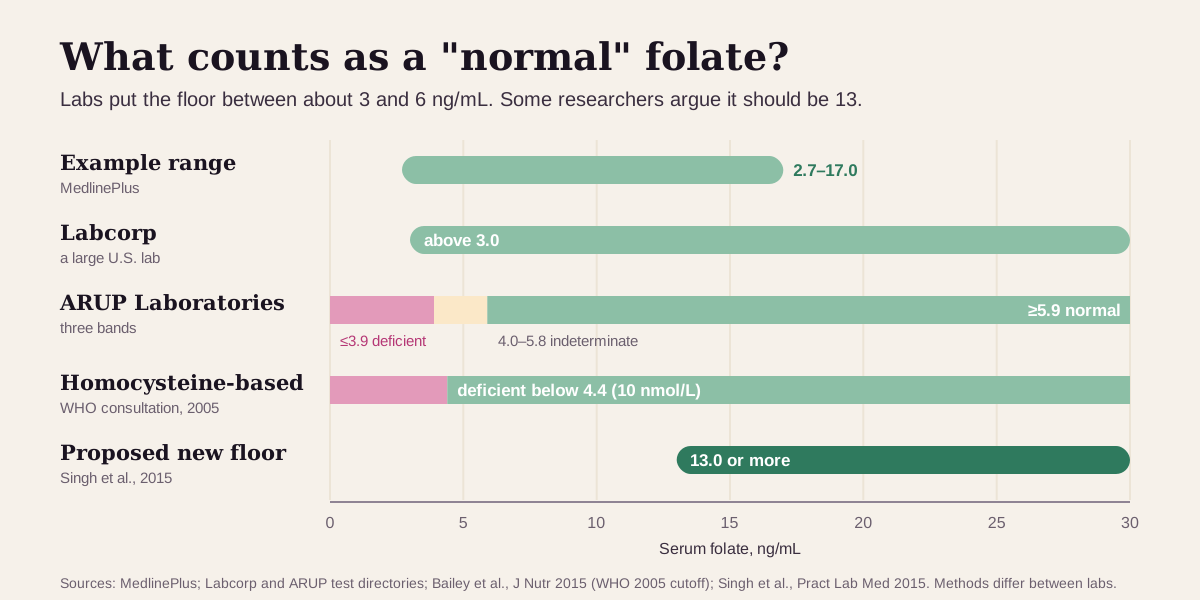
The floors have moved over time. The old cutoff of 3 ng/mL came from 1960s experiments that marked the point of "negative folate balance". A 2005 WHO consultation moved to a cutoff based on when homocysteine starts to rise: serum below 10 nmol/L (4.4 ng/mL) and RBC below 340 nmol/L (150 ng/mL).1 Some pathologists go further. Singh and colleagues argued that labs should raise the "normal" serum floor to 13.0 ng/mL, the level linked to the best protection against neural tube defects.5
Fortification changed the picture. Before it, about 24% of Americans had a low serum folate by the homocysteine-based cutoff. Since fortification, it's 1% or fewer in every group studied.1 The same ranges apply to men and women: none of these sources set separate limits by sex.
"Optimal" folate: what health optimizers aim for
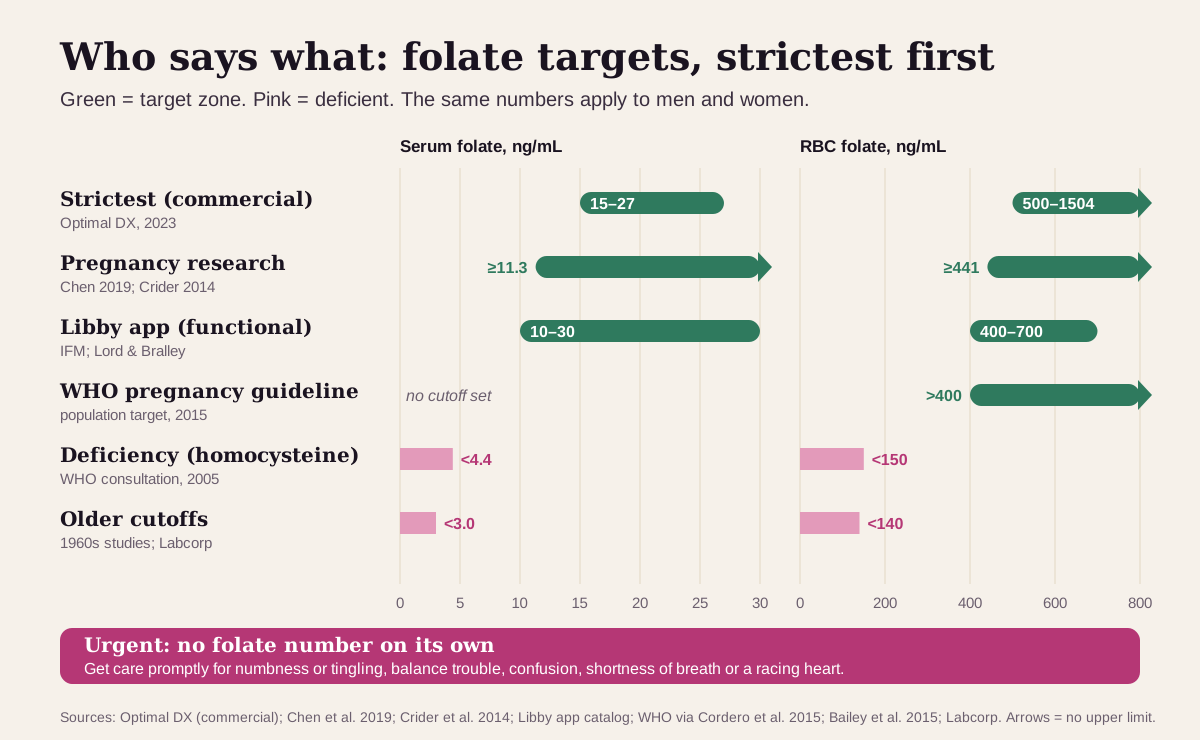
Functional-medicine practitioners and testing companies aim well above a lab's floor. Here's the full ladder, from strictest to loosest:
| Target | Serum folate | RBC folate | Who uses it |
|---|---|---|---|
| Strictest (commercial) | 15–27 ng/mL | 500–1,504 ng/mL | Optimal DX's published optimal ranges11 |
| Pregnancy research | 11.3 ng/mL or more | about 441–574 ng/mL (1,000–1,300 nmol/L) | CDC researchers' estimates for the fewest neural tube defects1213 |
| Functional medicine | 10–30 ng/mL | 400–700 ng/mL | The functional-medicine ranges from IFM and Lord & Bralley,414 and the optimal range shown in the Libby app |
| WHO pregnancy guideline | none set | above 400 ng/mL (906 nmol/L) | WHO, for women of reproductive age, as a population target9 |
| Deficiency (homocysteine-based) | under 4.4 ng/mL | under 150 ng/mL | The 2005 WHO consultation cutoffs1 |
| Older lab standard | under 3.0 ng/mL | under 140 ng/mL | 1960s cutoffs,1 still Labcorp's serum floor3 |
| Urgent | no single number | no single number | Numbness, tingling, balance trouble, confusion, breathlessness: get care promptly815 |
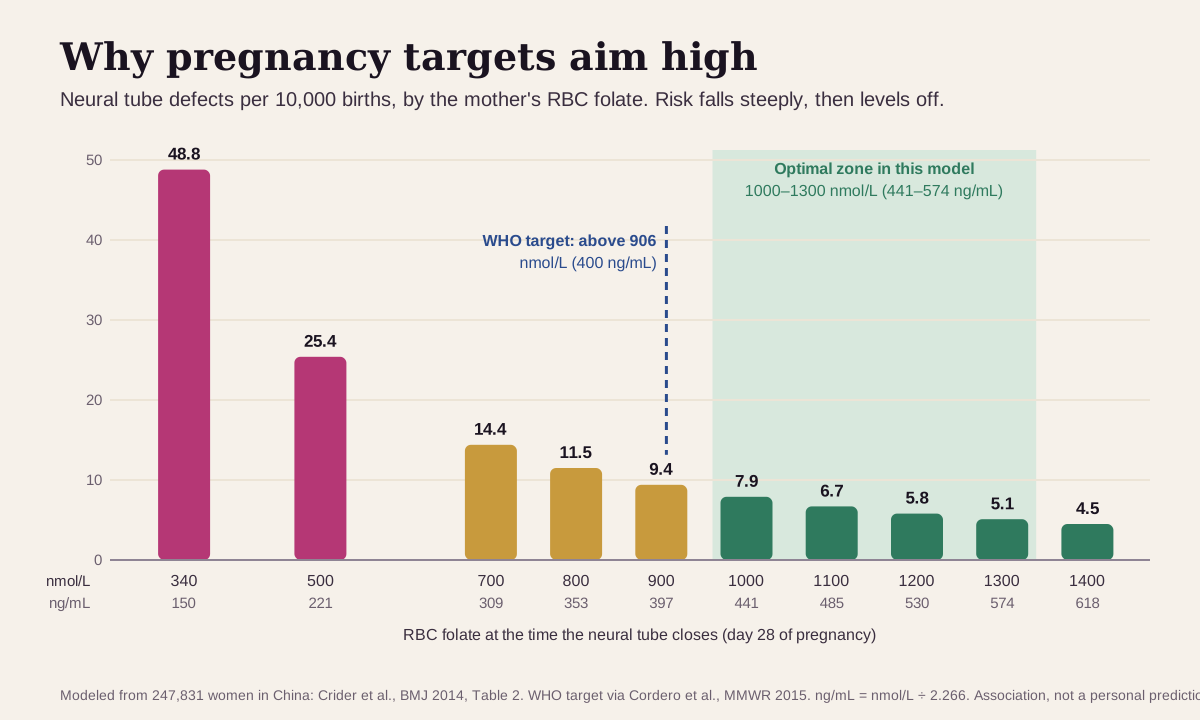
Why the high targets exist: pregnancy. The neural tube, which becomes the baby's brain and spine, forms in the first month of pregnancy. Low folate at that point raises the risk of defects like spina bifida.9
- CDC researchers modeled 247,831 women in China. At an RBC folate of 500 nmol/L (221 ng/mL), the estimated risk was 25.4 neural tube defects per 10,000 births. At 1,000 nmol/L it was 7.9, and at 1,300 it was 5.1. Above about 1,300–1,500, extra folate added little.13
- An earlier Irish study found 66 per 10,000 below 340 nmol/L and 8 per 10,000 above 906 nmol/L. WHO's target uses the same 906 line.139
- After U.S. fortification, neural tube defects fell from 10.7 to 7.0 per 10,000 live births.9
Keep "optimal" in perspective. These targets come from pregnancy research, and WHO uses its 400 ng/mL line to judge populations, not to predict one woman's risk.9 Outside pregnancy, the payoff is smaller: in trials with more than 44,000 people, B vitamins that lowered homocysteine made no difference to heart attacks or deaths, with a small drop in strokes (4.3% vs 5.1%).16 More is also not free. The adult upper limit for folic acid is 1,000 µg a day, set because high doses can fix the anemia of B12 deficiency while the nerve symptoms stay.1 CDC says the recommended amount of folic acid won't delay spotting a B12 deficiency.17
What a low folate usually means
How far below the floor you are is the first clue, and the neighbors are the second.
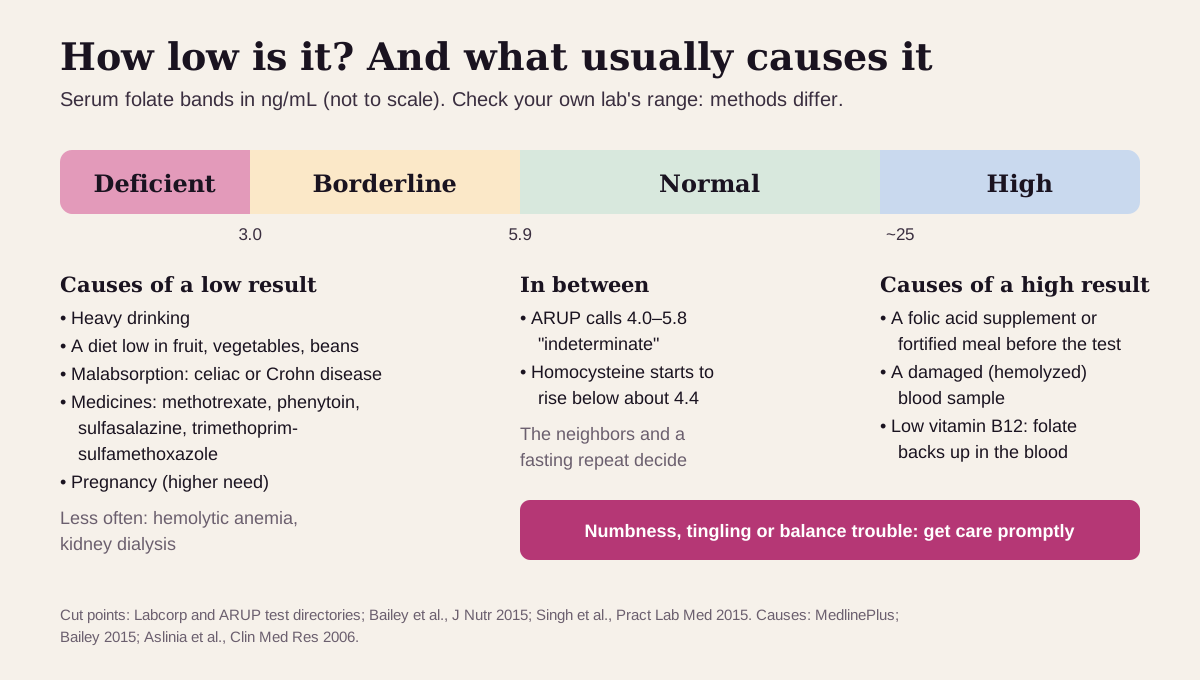
The usual suspects, roughly in order of how often they come up:
- Heavy drinking. In Western countries, alcohol is a common cause of low folate. It cuts intake and absorption, reduces what the liver stores, and increases what the kidneys lose.1
- A diet short on fruit, vegetables and beans. Overcooking destroys folate too. Blood levels drop after only a few weeks of a low-folate diet.2
- Malabsorption. Celiac disease and Crohn disease both reduce how much folate the gut takes up.21
- Medicines. Methotrexate, phenytoin, sulfasalazine and trimethoprim-sulfamethoxazole are common examples.21 Keep taking a prescribed medicine and bring your full list, supplements included, to your clinician.
- Pregnancy. The need rises from 400 µg a day to 600 µg.2 The U.S. Preventive Services Task Force recommends 400–800 µg of folic acid daily for anyone who could become pregnant, starting at least a month before conception and continuing through the first 2–3 months.18
- Less common: hemolytic anemia (fast red-cell turnover uses up folate) and kidney dialysis.2
Symptoms, when there are any, are vague: tiredness, irritability, diarrhea, a smooth sore tongue, dizziness or a racing heart.215
Get prompt care if a low folate or large red cells come with numbness or tingling in your hands or feet, balance trouble, confusion, shortness of breath or a pounding heart. These can mean B12 deficiency or a significant anemia, and guidelines say treatment should start without delay to protect the nerves.815 If you're pregnant or trying, raise a low result with your clinician right away.18
What a high folate usually means
- Something you took before the test. In a study of 5,313 samples, 64% of patients with a serum folate above 25.7 ng/mL had their blood drawn after taking folic acid.5 That's why fasting samples are recommended; MedlinePlus advises no food or drink for 6 hours.110
- A damaged sample. Red cells hold far more folate than serum, so a hemolyzed (burst-cell) sample reads falsely high. Labs reject them.13
- Low B12. Without B12, folate gets stuck in the form that circulates in serum, so serum folate tends to run high.6 See the neighbors below.
Folate reads best next to its neighbors
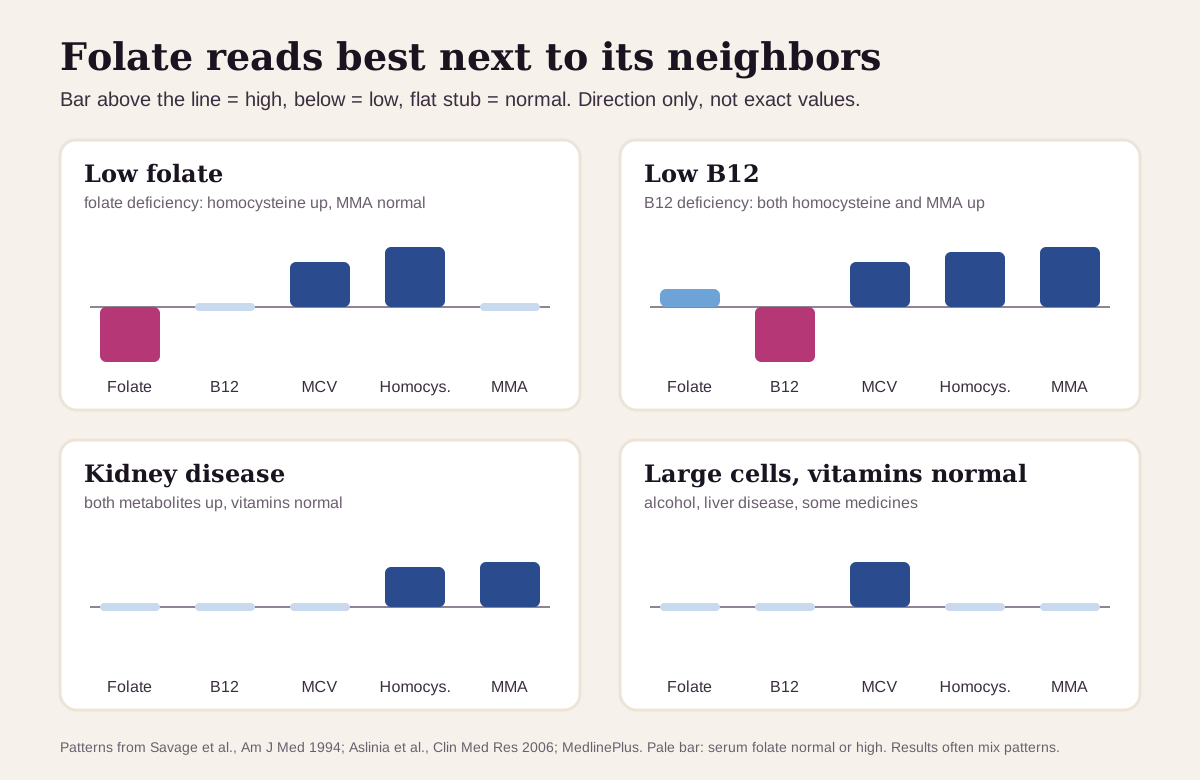
Folate rarely travels alone. The pattern across folate, B12, red-cell size and two "metabolites" (homocysteine and MMA) sorts the common causes:76
| If you see… | It often points to… |
|---|---|
| Low folate, high MCV, high homocysteine, normal MMA | folate deficiency: in one large series, homocysteine was high in 91% of episodes of folate deficiency and MMA in only 12%, nearly all from kidney problems or low blood volume76 |
| Low B12, high MCV, high homocysteine and MMA, serum folate normal or high | B12 deficiency: MMA was high in 98% of episodes and homocysteine in 96%76 |
| Homocysteine and MMA both high, vitamins and MCV normal | kidney disease, which raises both whatever your vitamin levels6151 |
| High MCV with normal folate, B12, homocysteine and MMA | large red cells from another cause: alcohol, liver disease or a medicine6 |
Two more patterns worth knowing:
- A low RBC folate can be a B12 clue. About 60% of people with pernicious anemia, a common cause of B12 deficiency, have a low RBC folate, probably because red cells need B12 to take up folate.67
- Iron deficiency can hide a folate problem. Low iron makes red cells small and low folate makes them large. MCV is an average, so it can understate the problem, while the blood smear shows both sizes and the RDW (the spread of cell sizes) runs high.6
How fast folate changes
Serum moves in days. RBC folate takes months. Serum folate can fall within days of a low-folate diet and rises after a meal.6 RBC folate reflects the red cells made over the past 120 days, and body stores cover about 2–3 months.1
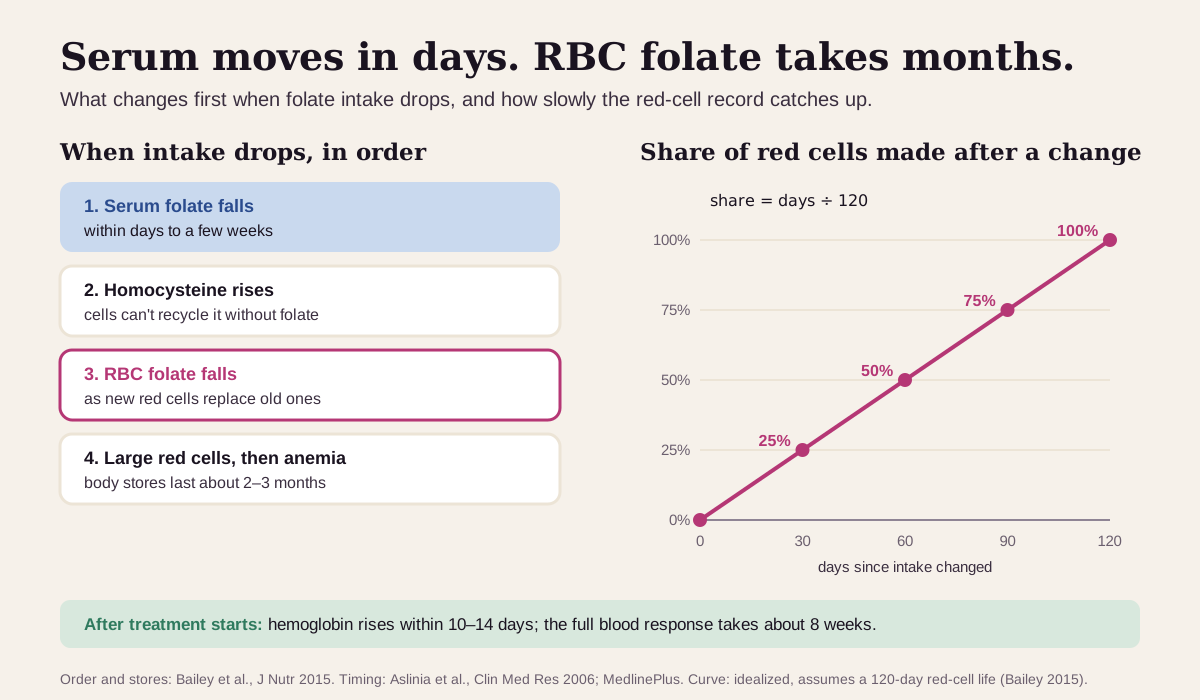
What that means in practice:
- Treatment works fast on the blood count. Hemoglobin usually rises within 10–14 days of starting treatment, and the full response takes about 8 weeks.6
- Results wobble on their own. In 22 young women tested four times over 12 weeks, serum folate varied by about 20% and RBC folate by about 16% from test to test. A change had to reach about 61% (serum) or 50% (RBC) to count as real.19
- Trends beat snapshots. Test fasting, at the same lab, and compare the same test (serum with serum, RBC with RBC).110
Going deeper: what folate does inside a cell
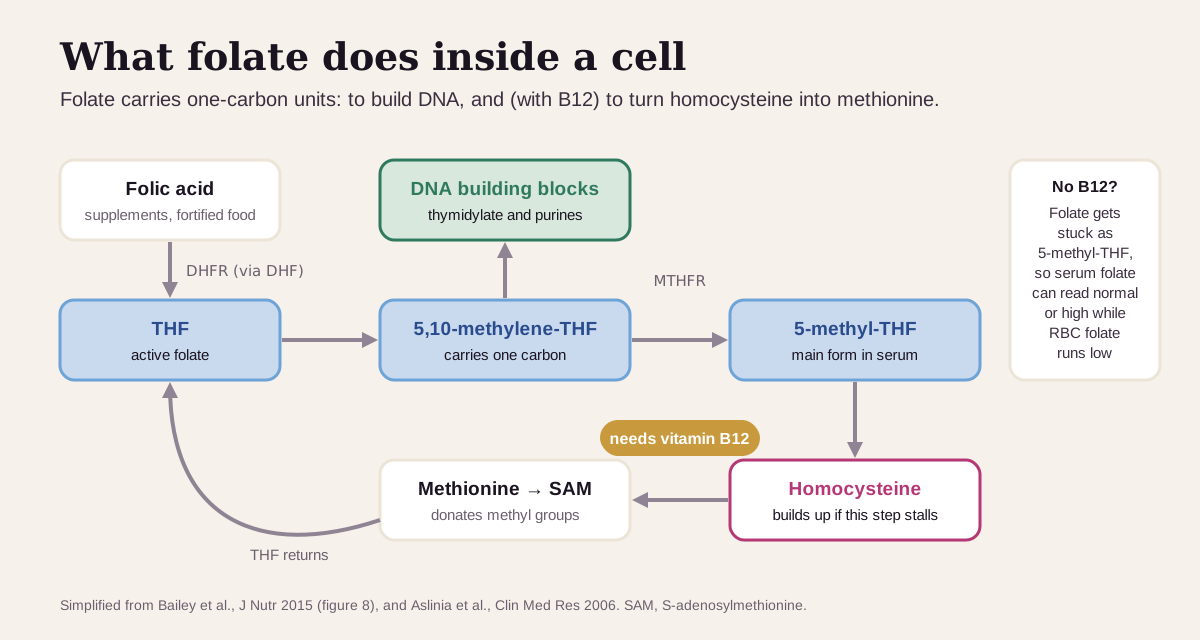
Folic acid is inactive until an enzyme called DHFR converts it to THF (tetrahydrofolate). THF picks up single carbon atoms and hands them on: to make thymidylate and purines, the DNA building blocks, and, after the enzyme MTHFR turns it into 5-methyl-THF, to homocysteine.1
That last step runs on vitamin B12. It turns homocysteine into methionine, which becomes SAM, a molecule that donates methyl groups for many reactions, and it frees THF to go around again.16 When B12 is missing, folate piles up as 5-methyl-THF, often called the "methyl trap". That explains two things in the neighbors table: homocysteine rises in both deficiencies, and serum folate can look fine in B12 deficiency.6
MTHFR variants change this cycle a little. People with two copies of the common 677T variant average about 16% lower blood folate. CDC says they can still process folic acid, and the variant is no reason to avoid it.17
Questions worth asking
- Was this serum or RBC folate, and was I fasting when it was drawn?
- How far below (or above) the lab's range is it?
- What do my B12, MCV, homocysteine and MMA show next to it?
- Could alcohol, a gut condition or any of my medicines be involved?
- If I'm planning a pregnancy, am I taking 400–800 µg of folic acid?
- When should we recheck it, and with which test?
FAQ
What is a normal folate level? Most labs set the serum folate floor between 3 and 6 ng/mL (Labcorp: above 3.0; ARUP: 5.9 or more). The optimal range in the Libby app is 10–30 ng/mL.34
What causes low folate? The usual reasons are heavy drinking, a diet low in fruit, vegetables and beans, malabsorption such as celiac or Crohn disease, medicines such as methotrexate or phenytoin, and the higher need of pregnancy.12
Can a supplement make my folate test high? Yes. Serum folate rises after a folic acid supplement or a fortified meal. In one study, 64% of results above 25.7 ng/mL were drawn after a supplement.5 Fasting before the test helps.1
Is serum or RBC folate the better test? Serum folate is the first-line test and reflects recent intake. RBC folate reflects the past 120 days and is the one WHO uses for pregnancy targets.819
This guide is for education. It can't diagnose you or replace care from a clinician who knows your history.
Footnotes
-
Bailey LB, Stover PJ, McNulty H, et al. Biomarkers of Nutrition for Development—Folate Review. J Nutr. 2015;145(7):1636S–1680S. The expert review behind the serum and RBC time windows, the historical and WHO deficiency cutoffs, the order of depletion, body stores, the causes of low folate, the folic acid upper limit, hemolysis and fasting, and the one-carbon pathway. PMC ↩ ↩2 ↩3 ↩4 ↩5 ↩6 ↩7 ↩8 ↩9 ↩10 ↩11 ↩12 ↩13 ↩14 ↩15 ↩16 ↩17 ↩18 ↩19 ↩20 ↩21 ↩22 ↩23 ↩24 ↩25 ↩26 ↩27 ↩28 ↩29 ↩30 ↩31 ↩32
-
National Library of Medicine. Folate deficiency. MedlinePlus Medical Encyclopedia. Reviewed July 9, 2025. Causes, symptoms, food sources and intake needs. MedlinePlus ↩ ↩2 ↩3 ↩4 ↩5 ↩6 ↩7 ↩8 ↩9 ↩10 ↩11 ↩12 ↩13 ↩14
-
Labcorp. Folate (Folic Acid), Serum, test 002014; ARUP Laboratories. Folate, Serum (0070070) and Folate, RBC (0070385). Test directories of a commercial laboratory (Labcorp) and a nonprofit reference laboratory (ARUP), with reference ranges and specimen rules. Labcorp; ARUP serum; ARUP RBC ↩ ↩2 ↩3 ↩4 ↩5 ↩6 ↩7 ↩8
-
Institute for Functional Medicine. Clinical practice guidelines and Advanced Practice Modules (range as recorded in the Libby app's marker catalog; member-only modules not opened for this article). Source of the serum folate optimal range of 10–30 ng/mL. https://www.ifm.org ↩ ↩2 ↩3 ↩4
-
Singh G, Hamdan H, Singh V. Clinical utility of serum folate measurement in tertiary care patients: Argument for revising reference range for serum folate from 3.0 ng/mL to 13.0 ng/mL. Pract Lab Med. 2015;1:35–41. 5,313 samples from 4,448 patients. PMC ↩ ↩2 ↩3 ↩4 ↩5 ↩6
-
Aslinia F, Mazza JJ, Yale SH. Megaloblastic anemia and other causes of macrocytosis. Clin Med Res. 2006;4(3):236–241. Causes of large red cells, how serum and RBC folate behave, MMA and homocysteine, kidney effects, and response to treatment. PMC ↩ ↩2 ↩3 ↩4 ↩5 ↩6 ↩7 ↩8 ↩9 ↩10 ↩11 ↩12 ↩13 ↩14 ↩15 ↩16 ↩17 ↩18 ↩19 ↩20 ↩21
-
Savage DG, Lindenbaum J, Stabler SP, Allen RH. Sensitivity of serum methylmalonic acid and total homocysteine determinations for diagnosing cobalamin and folate deficiencies. Am J Med. 1994;96(3):239–246. 434 episodes of B12 deficiency and 123 of folate deficiency. PubMed ↩ ↩2 ↩3 ↩4 ↩5 ↩6
-
Devalia V, Hamilton MS, Molloy AM; British Committee for Standards in Haematology. Guidelines for the diagnosis and treatment of cobalamin and folate disorders. Br J Haematol. 2014;166(4):496–513. The British hematology guideline: serum folate is the first-line test, and treatment should not wait when symptoms are strong. PubMed ↩ ↩2 ↩3 ↩4 ↩5
-
Cordero AM, Crider KS, Rogers LM, Cannon MJ, Berry RJ. Optimal Serum and Red Blood Cell Folate Concentrations in Women of Reproductive Age for Prevention of Neural Tube Defects: World Health Organization Guidelines. MMWR Morb Mortal Wkly Rep. 2015;64(15):421–423. CDC's summary of the WHO guideline: RBC folate above 400 ng/mL (906 nmol/L) as a population target, no serum threshold, fortification rules and the fall in neural tube defects. PMC ↩ ↩2 ↩3 ↩4 ↩5 ↩6 ↩7 ↩8
-
National Library of Medicine. Folate - test. MedlinePlus Medical Encyclopedia. Reviewed February 3, 2025. The 2.7–17.0 ng/mL example range and the 6-hour fast. MedlinePlus ↩ ↩2 ↩3 ↩4
-
Optimal DX. Vitamin Biomarkers: Serum Folate; Vitamin Biomarkers: RBC Folate. May 15, 2023 (updated November 2, 2023). States optimal ranges of 15–27 ng/mL (serum) and 500–1,504 ng/mL (RBC). A commercial source, listed as what the optimizer community uses. Serum; RBC ↩ ↩2
-
Chen MY, Rose CE, Qi YP, et al. Defining the plasma folate concentration associated with the red blood cell folate concentration threshold for optimal neural tube defects prevention: a population-based, randomized trial of folic acid supplementation. Am J Clin Nutr. 2019;109(5):1452–1461. A plasma folate of 25.5 nmol/L (11.3 ng/mL) matched WHO's RBC target in 1,673 women. PMC ↩ ↩2
-
Crider KS, Devine O, Hao L, et al. Population red blood cell folate concentrations for prevention of neural tube defects: Bayesian model. BMJ. 2014;349:g4554. Modeled risk at each RBC folate level (Table 2), and the Irish observations. PMC ↩ ↩2 ↩3 ↩4 ↩5
-
Lord RS, Bralley JA. Laboratory Evaluations for Integrative and Functional Medicine. 2nd ed. Metametrix Institute; 2008. ISBN 978-0967394947. Widely used functional-medicine reference, and the source of the RBC folate optimal range of 400–700 ng/mL in the Libby app's catalog. ↩ ↩2
-
National Library of Medicine. Homocysteine Test. MedlinePlus. Updated July 1, 2025. Symptoms of low B12 or folate, and conditions such as chronic kidney disease that raise homocysteine. MedlinePlus ↩ ↩2 ↩3 ↩4 ↩5
-
Martí-Carvajal AJ, Solà I, Lathyris D, Dayer M. Homocysteine-lowering interventions for preventing cardiovascular events. Cochrane Database Syst Rev. 2017;8(8):CD006612. PMC ↩
-
Centers for Disease Control and Prevention. MTHFR Gene Variant and Folic Acid Facts (updated July 16, 2026) and Folic Acid Safety, Interactions, and Health Outcomes (updated July 15, 2026). MTHFR; Safety ↩ ↩2
-
U.S. Preventive Services Task Force. Folic Acid Supplementation to Prevent Neural Tube Defects: Preventive Medication. August 1, 2023. USPSTF ↩ ↩2
-
McArthur JO, Tang H, Petocz P, Samman S. Biological variability and impact of oral contraceptives on vitamins B6, B12 and folate status in women of reproductive age. Nutrients. 2013;5(9):3634–3645. Within-person variation and reference change values, Table 1. PMC ↩
Educational content, not medical advice.Libby is a personal record tool, not a medical service — it doesn't diagnose, treat, or prescribe. Reference ranges vary by lab and by person. Talk to a qualified healthcare professional about your results.
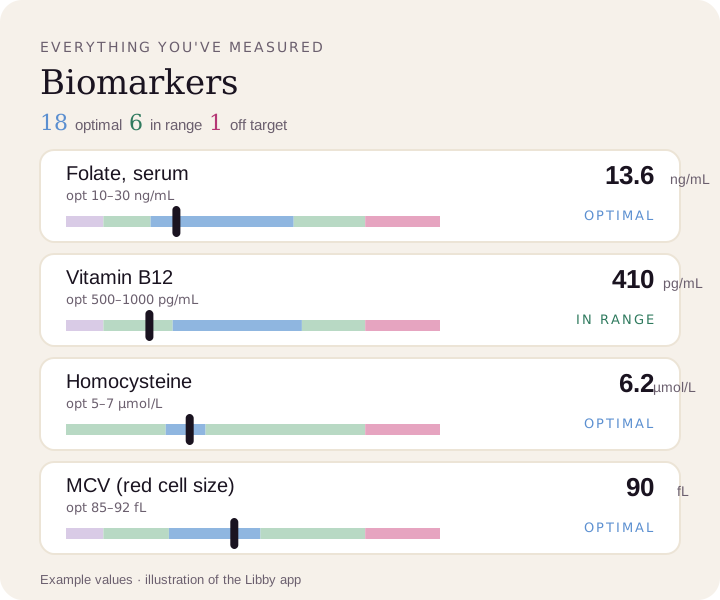
Compare your results to optimal ranges.
Upload a lab PDF or a photo of your report. Libby puts every marker on your lab's range and the optimal range, and tracks your trends over time.
View your folate ›