FSH blood test: normal levels, high and low causes
FSH is your brain's signal to the ovaries or testes. See normal levels by sex and cycle phase, what high or low FSH usually means, and how to read it.
FSH (follicle-stimulating hormone) is the signal your brain sends to your ovaries or testes to grow eggs or make sperm. The pituitary gland releases it, and the ovaries and testes answer with hormones that turn it back down. So a high FSH usually means the pituitary is pushing harder because the ovaries or testes have slowed, and a low FSH usually means the signal itself has been turned down.1
The short version
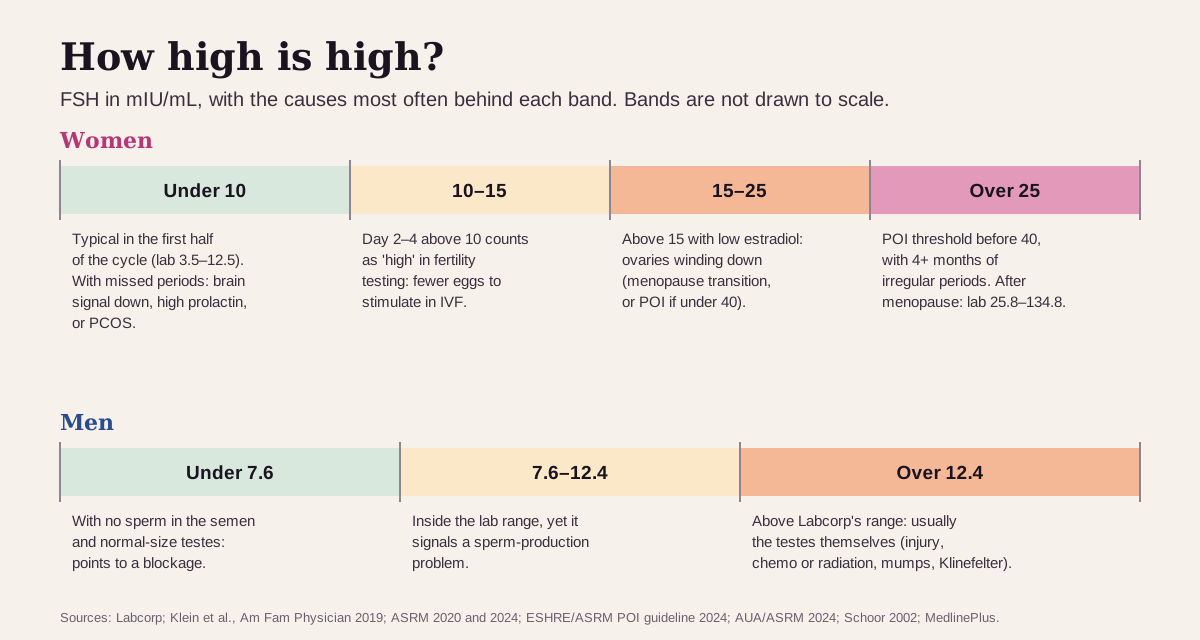
- Normal depends on your sex and the day you test. Labcorp's ranges are 1.5–12.4 mIU/mL for adult men, 3.5–12.5 in the first half of the menstrual cycle and 25.8–134.8 after menopause.2
- High FSH usually means the ovaries or testes are winding down or damaged. In women the most common reason is the menopause transition. Before 40, an FSH above 25 with at least 4 months of irregular periods defines premature ovarian insufficiency (POI).3 In men, FSH above about 7.6 signals a problem making sperm.4
- Low or normal FSH with missed periods points to the brain turning the signal down: under-eating, hard training or stress, a high prolactin, or hormone medicines.51
- FSH is a signal, not an egg count. A high early-cycle FSH predicts fewer eggs in IVF, yet in one study of 750 women it made no difference to the odds of getting pregnant naturally.67
What FSH is
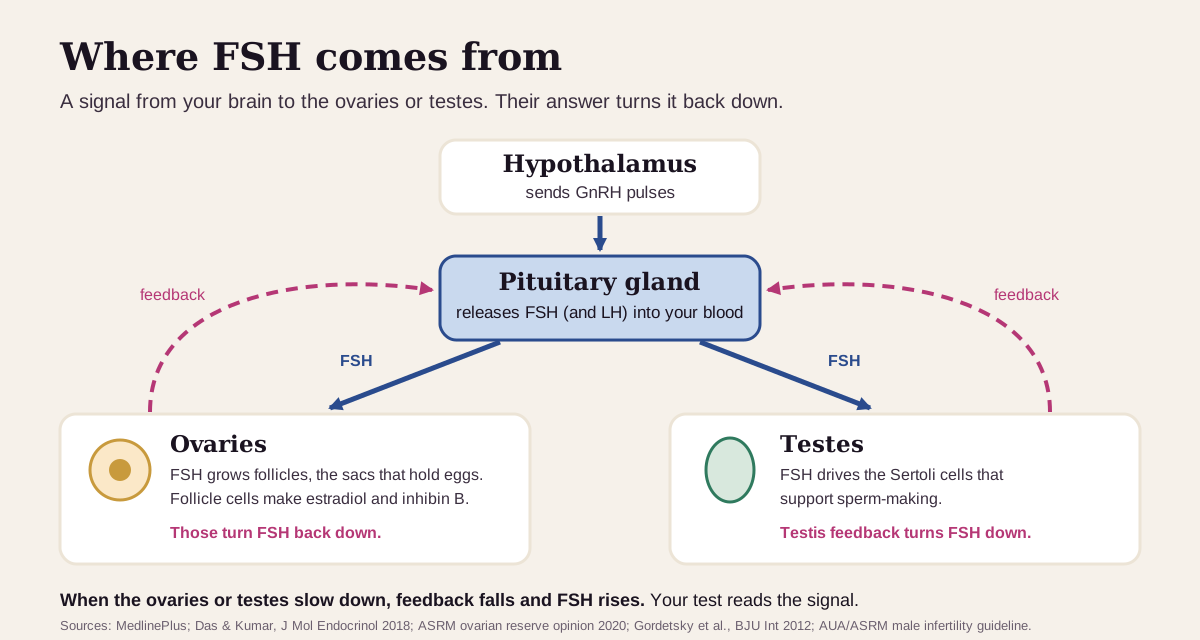
FSH is a hormone made by the pituitary gland, a pea-sized gland at the base of your brain. The hypothalamus, just above it, sets the pace with pulses of a releasing hormone called GnRH. The pituitary answers with FSH and its partner, luteinizing hormone (LH).1
- In the ovaries, FSH grows follicles, the small fluid-filled sacs that each hold an egg, and gets an egg ready for ovulation.1 The growing follicles make estradiol and inhibin B, which tell the pituitary to ease off.6
- In the testes, FSH acts on Sertoli cells, the cells that support sperm-making, and helps set how much sperm the testes make.81 Feedback from the testes turns FSH back down, which is why FSH tracks sperm production.9
That feedback loop is the key to reading the test. When the ovaries or testes slow down, their feedback fades and FSH rises. When the brain or pituitary turns its signal down, FSH falls.1
FSH is usually ordered together with LH and estradiol or testosterone: for irregular or missing periods, trouble getting pregnant, a low sperm count, puberty that starts early or late, or a suspected pituitary problem.1
What's a normal FSH?
Start with the range printed on your report, and the date of your last period. FSH has different normal ranges for men, for each phase of the menstrual cycle and after menopause.2
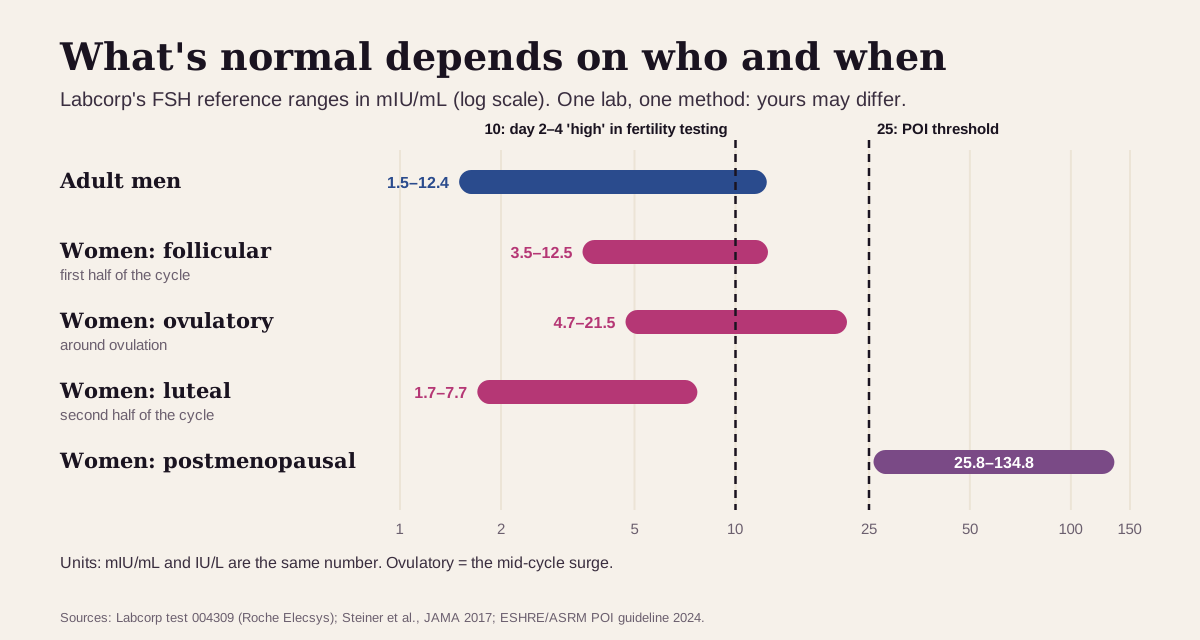
- Adult men: 1.5–12.4 mIU/mL.
- Women, first half of the cycle (follicular phase): 3.5–12.5. Around ovulation: 4.7–21.5, when FSH surges with LH. Second half (luteal phase): 1.7–7.7.
- After menopause: 25.8–134.8.2
That's why fertility clinics time the test. They draw FSH on day 2, 3 or 4 of the cycle, together with estradiol. An early rise in estradiol can push a high FSH down into the normal range, so the two are read as a pair.6 Different lab methods track each other closely but can give different absolute numbers, so compare results from the same lab when you can.6
In children, FSH is low until puberty starts, then climbs along with the sex hormones.1
"Optimal" FSH: what health optimizers aim for
For FSH, "lower is better" has a real basis inside the normal range. In men, a lower FSH goes with better sperm production. In women, a lower early-cycle FSH goes with more eggs left to recruit.96 Here's the ladder of upper limits, from strictest to loosest:
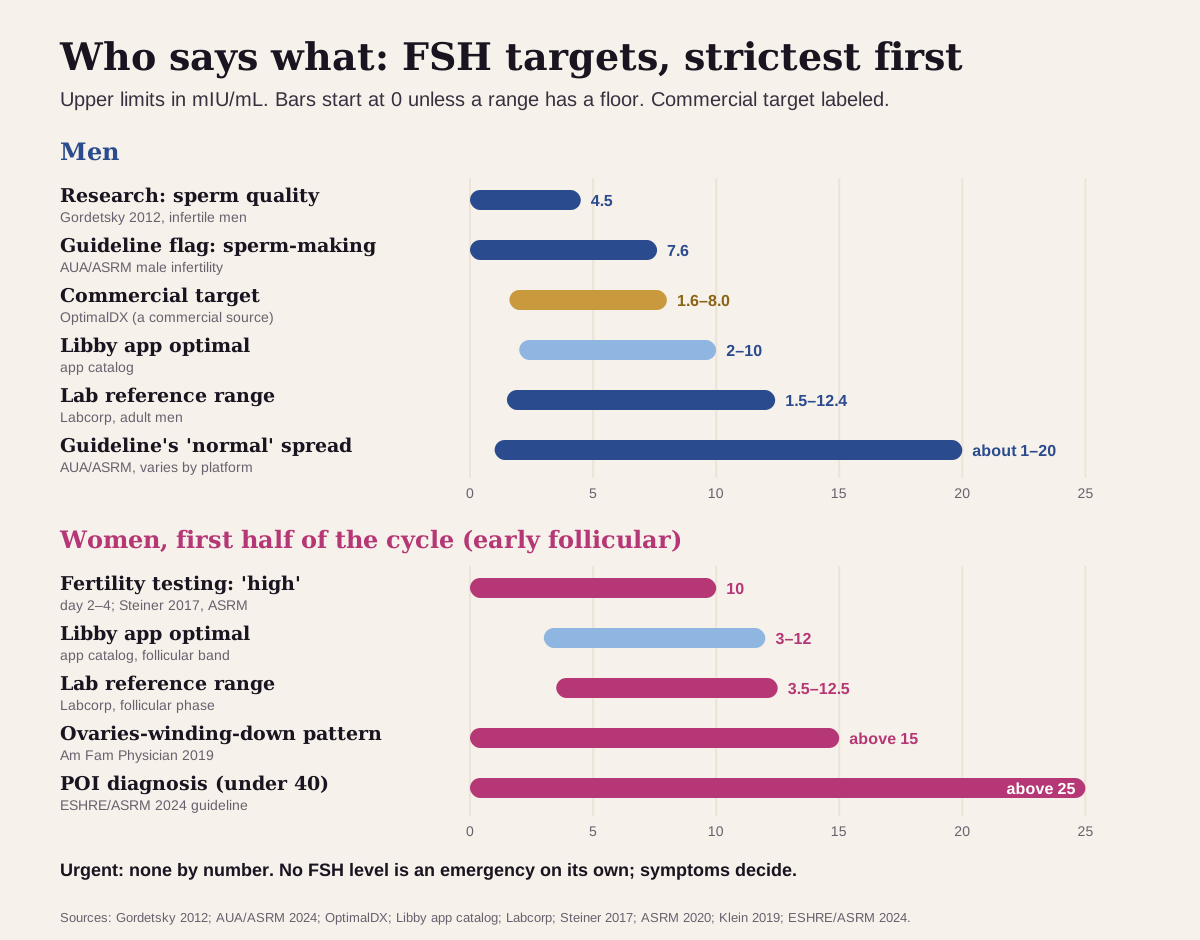
| Target | Men | Women (first half of cycle) | Who uses it |
|---|---|---|---|
| Research: sperm quality | 4.5 or less | none set | Gordetsky et al.: in infertile men, FSH above 4.5 went with worse sperm counts and shape9 |
| Guideline flag: sperm-making | about 7.6 or less | none set | AUA/ASRM male infertility guideline4 |
| Strictest commercial target | 1.6–8.0 | none published | OptimalDX's optimal range for men10 |
| Fertility-testing cutoff | none set | 10 or less (day 2–4) | FSH above 10 counts as "high" in fertility research76 |
| Functional range (Libby app) | 2–10 | 3–12 | The optimal range shown in the Libby app; the women's band is a first-half-of-cycle band11 |
| Lab reference range | 1.5–12.4 | 3.5–12.5 | Labcorp, the lab range the app also uses2 |
| Ovaries-winding-down pattern | none set | above 15 | The menopause and POI pattern in a family-medicine review5 |
| POI diagnosis (under 40) | none set | above 25 | International POI guideline, with 4+ months of irregular periods3 |
| Urgent | none by number | none by number | Symptoms decide: see the box below |
Why the low targets exist:
- Men: in Gordetsky's clinic study, men with FSH above 7.5 were 5 to 13 times as likely to have abnormal semen results as men under 2.8, depending on the measure.9 In 153 men with no sperm in their semen, 89% of those with a sperm-making problem had FSH above 7.6 or small testes.12
- Women: a high early-cycle FSH is a specific sign of a low egg supply (diminished ovarian reserve), and egg-supply tests predict how many eggs an IVF cycle retrieves.6
The same marker hits a hard limit for natural fertility:
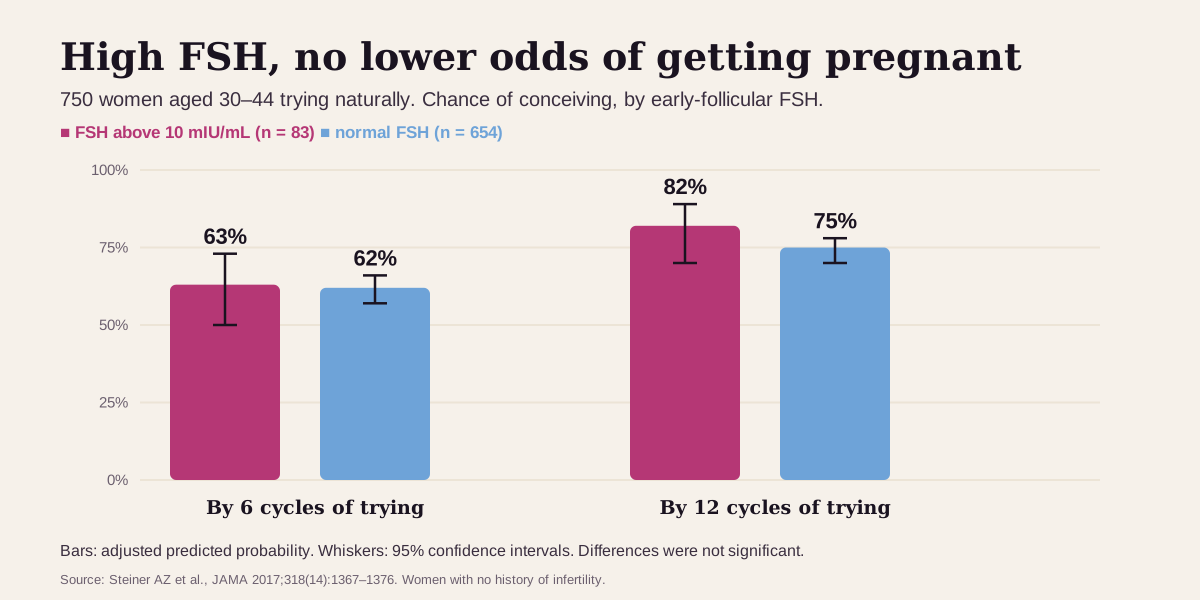
In 750 women aged 30–44 trying to conceive naturally, those with an FSH above 10 were just as likely to get pregnant by 6 cycles (63% vs 62%) and by 12 cycles (82% vs 75%).7 The American Society for Reproductive Medicine (ASRM) calls egg-supply markers poor predictors of fertility beyond what age already tells you.6
Keep "optimal" in perspective: FSH is a signal, not a score you train. A low FSH on hormonal birth control or testosterone reflects those hormones switching the signal off, not healthier ovaries or testes.34 And the Libby app's women's band is a first-half-of-cycle band, so a result from mid-cycle or after menopause will read high against it.112
What a high or low FSH usually means
The direction is the first clue. FSH goes up when the ovaries or testes stop answering, and down when the brain or pituitary stops asking.1
High FSH in women
The usual suspects, most common first:
- The menopause transition. FSH starts climbing years before the last period, and after menopause Labcorp's range is 25.8–134.8.132 If you're 45 or older with typical symptoms, NICE advises identifying perimenopause and menopause from your symptoms and periods, without an FSH test.14
- Premature ovarian insufficiency (POI). This is the ovaries winding down before 40. It affects an estimated 3.5% of women. The diagnosis needs at least 4 months of irregular or missed periods plus an FSH above 25, and the test is repeated after 4–6 weeks if the picture is unclear.3
- Damage to the ovaries from chemotherapy, radiation or autoimmune disease.1
- Less common: Turner syndrome, ovaries that never developed normally, and ovarian tumors.1
High FSH in men
- A problem making sperm. An FSH above about 7.6, even inside the lab range, points to trouble in sperm production. The AUA/ASRM guideline recommends FSH and testosterone for infertile men with a low or zero sperm count, small testes, low libido or erection problems.4
- Damage to the testes from chemotherapy or radiation, mumps, injury or autoimmune disease.1
- Less common: Klinefelter syndrome (an extra X chromosome) and germ cell tumors.14
Low or normal FSH with symptoms
When periods stop, pregnancy is the first thing to rule out.5 After that, about 35% of cases start in the hypothalamus and 17% in the pituitary, compared with 40% in the ovaries, per the ASRM.15 When FSH and LH are low or normal and estradiol is low, the usual reasons are:
- Under-eating, hard training or stress, often in combination. This is called functional hypothalamic amenorrhea.16
- A high prolactin, from medicines such as antipsychotics, pregnancy, or a small pituitary tumor.5
- Hormone medicines. Hormonal birth control, including pills, shots and long-acting methods, can lower FSH.3 NICE advises against using FSH to identify menopause on combined pills or high-dose progestins.14 In men, testosterone or anabolic steroids shut down FSH and sperm production.4
- Less common: pituitary or hypothalamus disease, including tumors and inherited conditions such as Kallmann syndrome.1
Get prompt care if an abnormal FSH comes with new headaches, vision problems, or nausea and vomiting, which can signal a pituitary tumor;17 a painless lump or swelling in a testicle;18 or signs of puberty before age 8 in girls or 9 in boys.1 If you're under 40 and your periods have stopped for 4 months, book a visit rather than waiting: POI affects bone and heart health, and hormone therapy is suggested to protect bone density.3
FSH reads best next to its neighbors
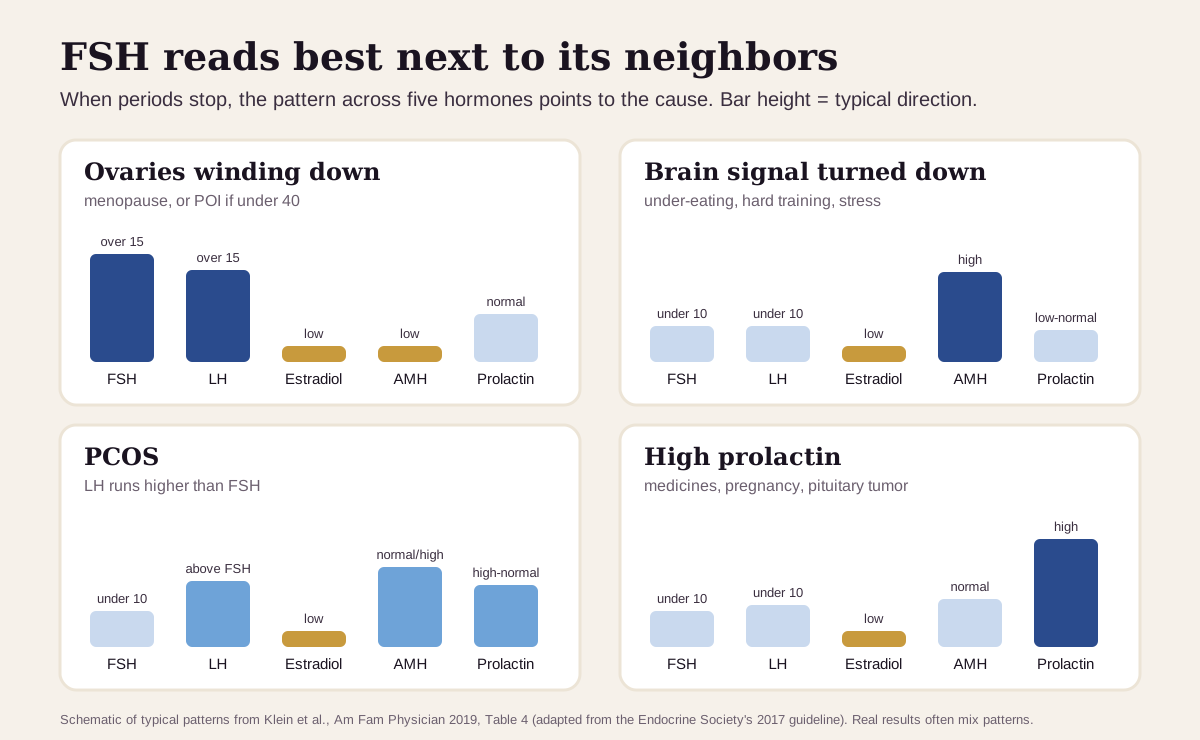
FSH is almost always read with LH, estradiol and prolactin. For the egg supply, AMH (anti-Müllerian hormone) has largely replaced FSH.6 When periods stop, the pattern across all five usually points to the cause:5
| If you see… | It often points to… |
|---|---|
| FSH and LH both high (over 15), estradiol and AMH low | the ovaries winding down: the menopause transition, or POI if you're under 4053 |
| FSH and LH low or normal (under 10), estradiol low, prolactin not high | the brain turning the signal down: under-eating, hard training or stress516 |
| LH higher than FSH, AMH normal or high, testosterone high or high-normal | PCOS (polycystic ovary syndrome)5 |
| Prolactin high, FSH and LH under 10 | high prolactin: medicines, pregnancy or a pituitary tumor5 |
| Men: FSH above 7.6 or small testes, no sperm in the semen | a sperm-making problem: 89% of men with one had this pattern in one study124 |
| Men: FSH 7.6 or less or normal-size testes, no sperm in the semen | a blockage: 96% of men with one had this pattern in the same study124 |
| Men: FSH and LH low, testosterone low | the pituitary or hypothalamus under-signaling4 |
| Men: FSH and LH low while taking testosterone or anabolic steroids | the medicine switching the signal off, which can also stop sperm production4 |
How fast FSH changes
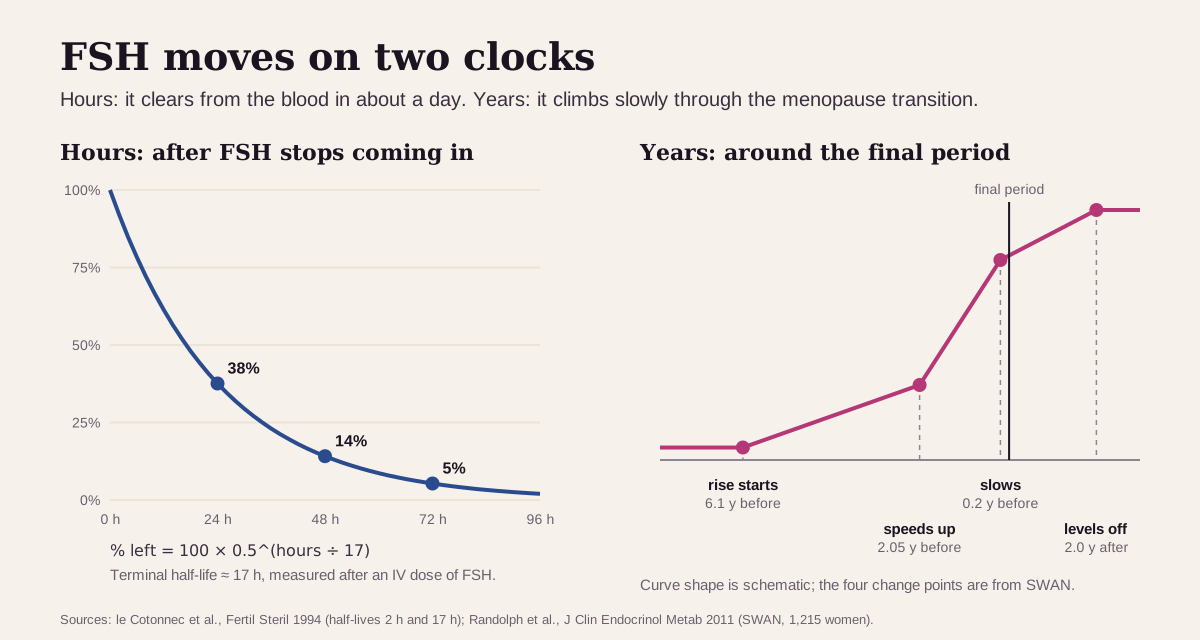
FSH moves on two clocks.
- Hours to days. FSH clears from the blood with a terminal half-life of about 17 hours, after a faster first phase of about 2 hours, measured after an IV dose of FSH.19 It also swings across each menstrual cycle, with a surge around ovulation.2
- Years. In the SWAN study of 1,215 women, FSH started rising about 6 years before the final period, sped up about 2 years before, and leveled off about 2 years after.13
What that means in practice:
- Time the test if you have periods. A day 2–4 sample is the one fertility clinics compare, paired with estradiol.6
- One FSH is a snapshot. FSH varies within and between cycles, which limits a single result, and bigger swings between cycles suggest a lower egg supply.6
- In men, FSH is steady. In 38 healthy men tested weekly for 10 weeks, FSH varied about 8% around each man's own average, but 59% between men. A change of more than 21% up or 17.5% down is bigger than ordinary week-to-week noise.20
- Trends beat snapshots. An FSH that climbs over several tests tells a different story than one that bounces in place.13 Compare results from the same lab when you can, because methods differ.6
Going deeper: how FSH is built and read
FSH is a glycoprotein: two protein chains coated with sugars. Its alpha chain is shared with LH, TSH (thyroid-stimulating hormone) and the placental hormones; its beta chain is unique to FSH and gives it its job.8
The sugar coat varies, so FSH circulates as a family of slightly different forms. That mix and its fairly long half-life make FSH's pulses hard to see in blood samples.8 Labcorp notes that FSH and LH are both released in pulses, which is why some protocols pool samples drawn 15–30 minutes apart.2
The feedback chemistry has two sides. Inhibin, made by the follicle cells in response to FSH, turns FSH production down, and activin turns it up.8
The LH-to-FSH ratio. In PCOS, LH typically runs higher than FSH (a ratio above 1). In menopause and POI, FSH runs higher than LH (a ratio below 1).5 AMH, made by small follicles, stays fairly steady through the cycle, which is one reason it has taken over from FSH as the egg-supply test.6
Questions worth asking
- Which day of my cycle was this drawn on, and which range applies to me?
- What did my LH, estradiol and prolactin show next to it?
- Could birth control, hormone therapy, testosterone or another medicine be affecting it?
- If I'm under 40 and my periods have changed, should we check for POI and repeat the FSH?
- For fertility: would an AMH test or an ultrasound follicle count add more than FSH?
- For men: what did my semen analysis show, and should we check testosterone too?
FAQ
What is a normal FSH level? It depends on your sex and, for women, the day of your cycle. Labcorp's ranges are 1.5–12.4 mIU/mL for adult men, 3.5–12.5 in the first half of the cycle, and 25.8–134.8 after menopause.2
What does a high FSH mean? Usually that the ovaries or testes have slowed down, so the pituitary is pushing harder. In women that's most often the menopause transition; before 40 it can mean POI. In men it usually points to a problem making sperm.134
Does a high FSH mean I'm infertile? Not necessarily. In a study of 750 women aged 30–44 trying naturally, those with FSH above 10 got pregnant at the same rate as women with normal FSH. A high FSH does predict fewer eggs in an IVF cycle.76
What FSH level means menopause? After menopause, FSH usually sits above about 25; Labcorp's postmenopausal range is 25.8–134.8. If you're 45 or older with typical symptoms, NICE advises identifying menopause from your periods and symptoms instead of an FSH test.214
This guide is for education. It can't diagnose you or replace care from a clinician who knows your history.
Footnotes
-
National Library of Medicine. Follicle-Stimulating Hormone (FSH) Levels Test. MedlinePlus. What FSH does in women, men and children, why it's ordered, and the conditions linked to high and low levels. MedlinePlus ↩ ↩2 ↩3 ↩4 ↩5 ↩6 ↩7 ↩8 ↩9 ↩10 ↩11 ↩12 ↩13 ↩14 ↩15 ↩16 ↩17 ↩18
-
Labcorp. Follicle-stimulating Hormone (FSH), test 004309. Roche electrochemiluminescence assay. Reference ranges: adult male 1.5–12.4 mIU/mL; female follicular 3.5–12.5, ovulatory 4.7–21.5, luteal 1.7–7.7, postmenopausal 25.8–134.8. Labcorp is a commercial laboratory; these are also the lab ranges the Libby app uses. labcorp.com ↩ ↩2 ↩3 ↩4 ↩5 ↩6 ↩7 ↩8 ↩9 ↩10 ↩11 ↩12 ↩13
-
Panay N, Anderson RA, Bennie A, et al. Evidence-based guideline: premature ovarian insufficiency. Hum Reprod Open. 2024;2024(4):hoae065. The international guideline from ESHRE, ASRM, CRE-WHiRL and the International Menopause Society: at least 4 months of disordered cycles plus FSH above 25 IU/L; prevalence 3.5%; repeat FSH after 4–6 weeks if uncertain; hormonal contraceptives may lower FSH; hormone therapy to optimize bone density. PMC ↩ ↩2 ↩3 ↩4 ↩5 ↩6 ↩7 ↩8 ↩9 ↩10 ↩11
-
Brannigan RE, Hermanson L, Kaczmarek J, et al. Updates to Male Infertility: AUA/ASRM Guideline (2024). J Urol. 2024;212(6):789–799. The American Urological Association and ASRM guideline (published 2020, amended 2024): who should have FSH tested, FSH above about 7.6 mIU/mL signals abnormal sperm production, and testosterone suppresses FSH and sperm output. AUA · PubMed ↩ ↩2 ↩3 ↩4 ↩5 ↩6 ↩7 ↩8 ↩9 ↩10 ↩11 ↩12 ↩13 ↩14
-
Klein DA, Paradise SL, Reeder RM. Amenorrhea: A Systematic Approach to Diagnosis and Management. Am Fam Physician. 2019;100(1):39–48. Table 4, adapted from the Endocrine Society's 2017 guideline, gives the FSH, LH, estradiol, AMH and prolactin patterns used here; also the common causes of high prolactin. AAFP ↩ ↩2 ↩3 ↩4 ↩5 ↩6 ↩7 ↩8 ↩9 ↩10 ↩11 ↩12 ↩13
-
Practice Committee of the American Society for Reproductive Medicine. Testing and interpreting measures of ovarian reserve: a committee opinion. Fertil Steril. 2020;114(6):1151–1157. Day 2–4 FSH with estradiol, "a specific, but not sensitive, test", assay differences, cycle-to-cycle variability, and the limits for predicting pregnancy. PubMed · ASRM ↩ ↩2 ↩3 ↩4 ↩5 ↩6 ↩7 ↩8 ↩9 ↩10 ↩11 ↩12 ↩13 ↩14 ↩15 ↩16
-
Steiner AZ, Pritchard D, Stanczyk FZ, et al. Association Between Biomarkers of Ovarian Reserve and Infertility Among Older Women of Reproductive Age. JAMA. 2017;318(14):1367–1376. 750 women aged 30–44; FSH above 10 mIU/mL vs normal: 63% vs 62% conceived by 6 cycles, 82% vs 75% by 12. PMC ↩ ↩2 ↩3 ↩4 ↩5 ↩6 ↩7
-
Das N, Kumar TR. Molecular regulation of follicle-stimulating hormone synthesis, secretion and action. J Mol Endocrinol. 2018;60(3):R131–R155. Shared alpha chain, FSH receptors on granulosa and Sertoli cells, the inhibin–activin loop, and why FSH pulses are hard to detect. PMC ↩ ↩2 ↩3 ↩4 ↩5
-
Gordetsky J, van Wijngaarden E, O'Brien J. Redefining abnormal follicle-stimulating hormone in the male infertility population. BJU Int. 2012;110(4):568–572. Infertile men at one clinic: FSH above 4.5 IU/L linked to abnormal sperm concentration and shape; above 7.5, five to thirteen times the risk of men under 2.8. PubMed ↩ ↩2 ↩3 ↩4 ↩5 ↩6
-
OptimalDX. Hormone Biomarkers: Follicle-Stimulating Hormone (FSH) in Men. Updated September 28, 2024. Lists a standard range of 1.40–12.00 mIU/mL and "The ODX Range: 1.60 – 8.00 mIU/mL". A commercial source, listed as what the optimizer community uses. optimaldx.com ↩ ↩2
-
Libby Health app marker catalog: FSH optimal range 2–10 mIU/mL for men and 3–12 mIU/mL for women (a follicular-phase band), with lab ranges 1.5–12.4 and 3.5–12.5. The catalog attributes the optimal bands to Endocrine Society clinical practice guidelines (various publications); no single guideline stating these numbers was identified for this article. Endocrine Society ↩ ↩2 ↩3
-
Schoor RA, Elhanbly S, Niederberger CS, Ross LS. The role of testicular biopsy in the modern management of male infertility. J Urol. 2002;167(1):197–200. 153 men with no sperm in the semen: 89% with a sperm-making problem had FSH above 7.6 mIU/mL or a testis 4.6 cm or shorter; 96% with a blockage had FSH 7.6 or less or a longer testis. PubMed ↩ ↩2 ↩3 ↩4
-
Randolph JF Jr, Zheng H, Sowers MR, et al. Change in follicle-stimulating hormone and estradiol across the menopausal transition: effect of age at the final menstrual period. J Clin Endocrinol Metab. 2011;96(3):746–754. SWAN: 1,215 women; FSH rise began 6.10 years before the final period, accelerated at 2.05, decelerated at 0.20, stable 2.00 years after. PMC ↩ ↩2 ↩3 ↩4
-
National Institute for Health and Care Excellence. Menopause: identification and management (NG23). Recommendations 1.3.1 to 1.3.6: identify menopause without laboratory tests at 45 and over; no FSH test for menopause on combined hormonal contraception or high-dose progestogen. NICE ↩ ↩2 ↩3
-
Practice Committee of the American Society for Reproductive Medicine. Current evaluation of amenorrhea: a committee opinion. Fertil Steril. 2024;122(1):52–61. Causes of secondary amenorrhea: hypothalamus 35%, anterior pituitary 17%, ovary 40%. PubMed ↩
-
Gordon CM, Ackerman KE, Berga SL, et al. Functional Hypothalamic Amenorrhea: An Endocrine Society Clinical Practice Guideline. J Clin Endocrinol Metab. 2017;102(5):1413–1439. Often associated with stress, weight loss, excessive exercise, or a combination. PubMed ↩ ↩2
-
National Library of Medicine. Pituitary Tumors. MedlinePlus. Symptoms include headaches, vision problems, and nausea and vomiting. MedlinePlus ↩
-
National Library of Medicine. Testicular Cancer. MedlinePlus. Symptoms may include a painless lump or swelling in either testicle. MedlinePlus ↩
-
le Cotonnec JY, Porchet HC, Beltrami V, et al. Clinical pharmacology of recombinant human follicle-stimulating hormone (FSH). I. Comparative pharmacokinetics with urinary human FSH. Fertil Steril. 1994;61(4):669–678. 12 women given IV FSH; initial and terminal half-lives of about 2 and 17 hours. PubMed ↩ ↩2
-
Itkonen O, Jonker N, Aarsand AK, et al. The European biological variation study (EuBIVAS): Biological variation data for testosterone, follicle stimulating hormone, prolactin, luteinizing hormone and dehydroepiandrosterone sulfate in men. Clin Chim Acta. 2024;555:117806. 38 men sampled weekly for 10 weeks; FSH within-person variation 8.05%, between-person 58.88%, reference change −17.5% / +21.2%. PubMed ↩
Educational content, not medical advice. Libby is a personal record tool, not a medical service — it doesn't diagnose, treat, or prescribe. Reference ranges vary by lab and by person. Talk to a qualified healthcare professional about your results.
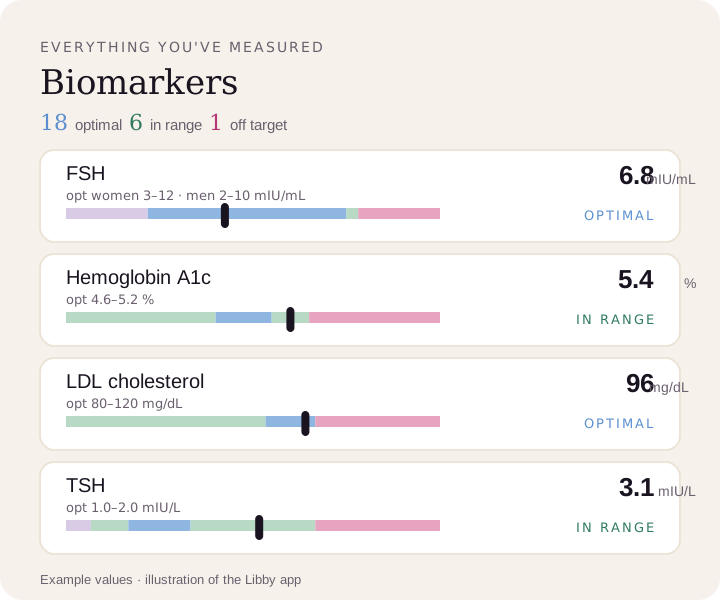
Compare your results to optimal ranges.
Upload a lab PDF or a photo of your report. Libby puts each marker on your lab's range and, where the app has one, an optimal range, and tracks your trends over time.
View your FSH ›