GGT blood test: normal levels, high causes, and next steps
GGT is a liver and bile-duct enzyme. What a normal level is, why it runs high, how to read it with ALP, and when a high result is urgent.
GGT (gamma-glutamyl transferase) is an enzyme that sits on the surface of your liver and bile-duct cells. Its blood level rises when bile backs up, when alcohol or certain medicines switch on more of the enzyme, and with fatty liver. That makes GGT one of the most sensitive liver tests, and a handy tiebreaker: it shows whether a high alkaline phosphatase (ALP) is coming from your liver or from your bones.123
The short version
- Normal: check the range on your report. Men run higher than women. Mayo Clinic Laboratories uses 8–61 U/L for men and 5–36 U/L for women.1 The optimal range in the Libby app is lower: 10–25 U/L for men and 8–20 U/L for women.4
- Mildly high is common. The usual reasons are extra weight and fatty liver, alcohol, and medicines that switch on the enzyme.3
- Very high (5 to 30 times normal) usually means bile is blocked, or heavy drinking. A high GGT with yellow skin or eyes needs prompt care.123
- High ALP with a normal GGT points to bone. When both are high, the liver or bile ducts are the likely source.15
What GGT is
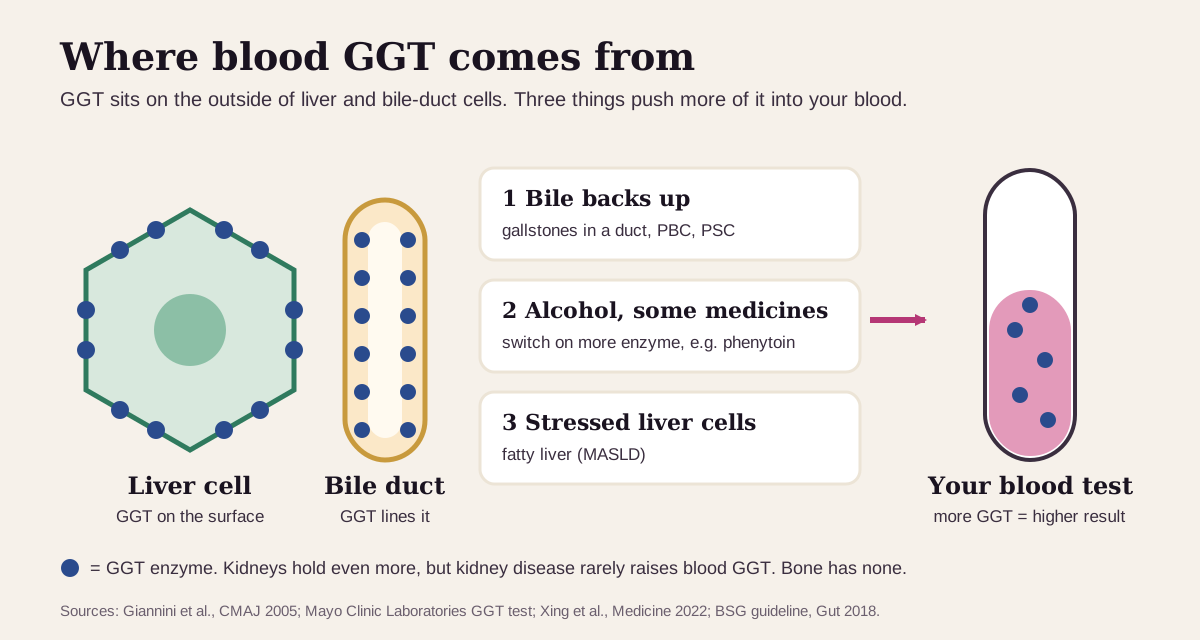
GGT is an enzyme anchored to the outside of cells. Its everyday job is recycling glutathione, one of your body's main antioxidants: GGT breaks glutathione apart outside the cell so the cell can take the pieces back in and rebuild it.8 (More on the chemistry at the end.)
Your kidneys hold the most GGT, followed by the liver. Kidney disease rarely raises blood GGT, though, so the GGT in your blood comes mainly from the liver and bile ducts.17 Bone has none. That's why GGT can tell a liver ALP from a bone ALP.3
GGT rises in three main ways: bile backing up in the liver, alcohol and some medicines inducing (switching on) more of the enzyme, and stressed liver cells, as in fatty liver.27 The British Society of Gastroenterology (BSG) includes it in the first set of liver tests it recommends.3
What's a normal GGT?
Start with the range printed on your own report. GGT ranges differ between labs and between populations more than AST and ALT ranges do.6
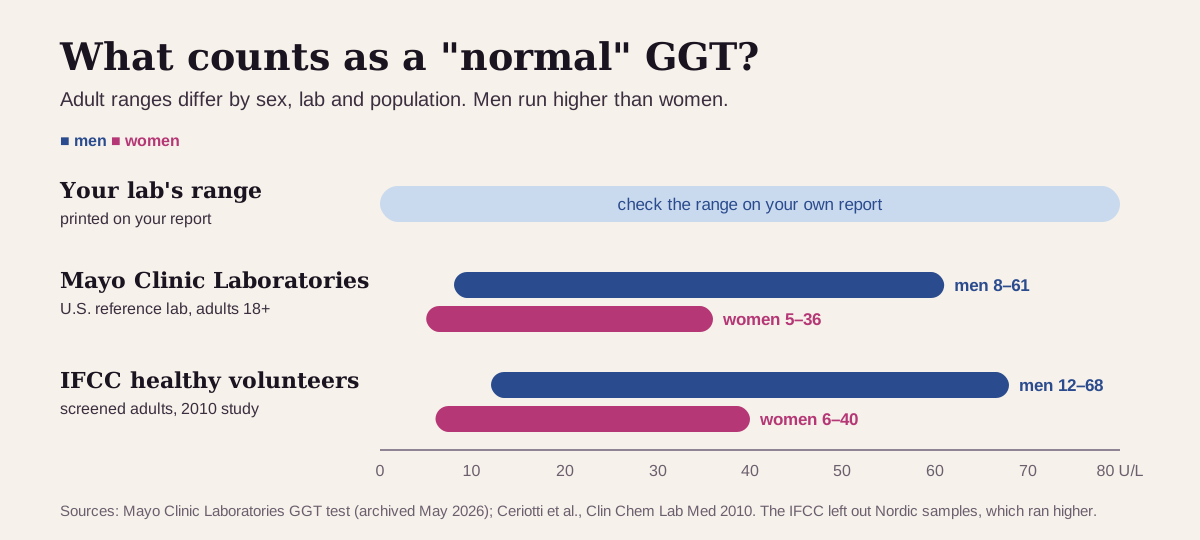
- Mayo Clinic Laboratories uses 8–61 U/L for men and 5–36 U/L for women aged 18 and over.1 The same numbers are the reference range in the Libby app's marker catalog.
- An international study by the IFCC (the International Federation of Clinical Chemistry), in carefully screened healthy adults, found 12–68 U/L for men and 6–40 U/L for women. Samples from the Nordic countries ran higher and were left out, and the authors concluded that one worldwide GGT range is unlikely.6
Men run higher than women in every source above.16 GGT is also flagged often: adding it to a standard liver panel roughly doubles the share of adults with an abnormal result, from about 15% to 30%.3
"Optimal" GGT: what health optimizers aim for
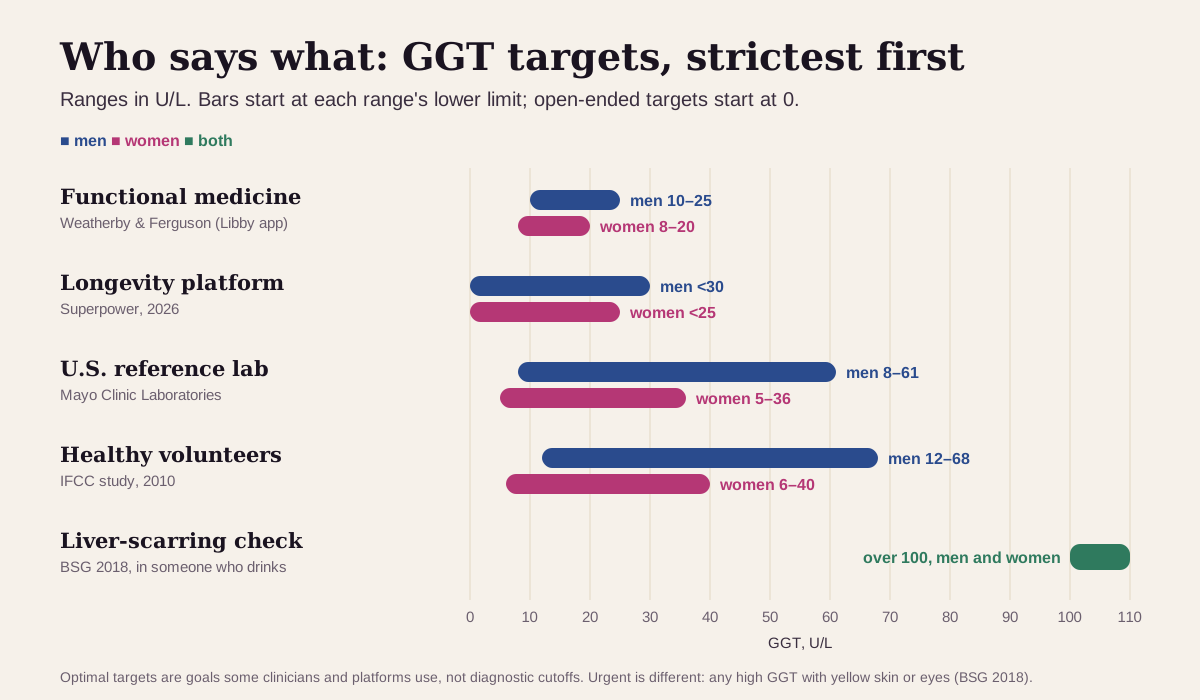
Functional-medicine practitioners and longevity platforms aim well below a lab's upper limit. Here's the full ladder, from strictest to loosest:
| Target | Men | Women | Who uses it |
|---|---|---|---|
| Functional medicine | 10–25 U/L | 8–20 U/L | The optimal range shown in the Libby app, recorded from the functional-medicine textbook by Weatherby & Ferguson4 |
| Longevity platform | under 30 U/L | under 25 U/L | Superpower's guide, describing what many practitioners target9 |
| U.S. reference lab | 8–61 U/L | 5–36 U/L | Mayo Clinic Laboratories' adult range1 |
| Healthy volunteers, international study | 12–68 U/L | 6–40 U/L | The IFCC reference-interval study6 |
| Check for liver scarring | over 100 U/L in someone who drinks | over 100 U/L in someone who drinks | British Society of Gastroenterology3 |
| Urgent | any high GGT with yellow skin or eyes | any high GGT with yellow skin or eyes | The BSG calls for immediate referral for unexplained jaundice3 |
For GGT, the app's functional range is stricter than the commercial target, so it sits at the top of the ladder.
Why aim low?
- In a study of 4,088 Korean men followed for 4 years, those with a GGT of 10–19 U/L had 8 times the risk of developing diabetes compared with men under 9 U/L. At 20–29 it was 13.3 times, and over 50 it was 25.8 times, after adjusting for other risk factors.10
- A 2013 pooled analysis of 7 cohorts and 273,141 people found that those in the top quarter of GGT had 1.52 times the risk of dying from cardiovascular disease, and 1.56 times the risk of dying from any cause, compared with the bottom quarter.11
- The BSG calls a raised GGT one of the best predictors of dying from liver disease.3
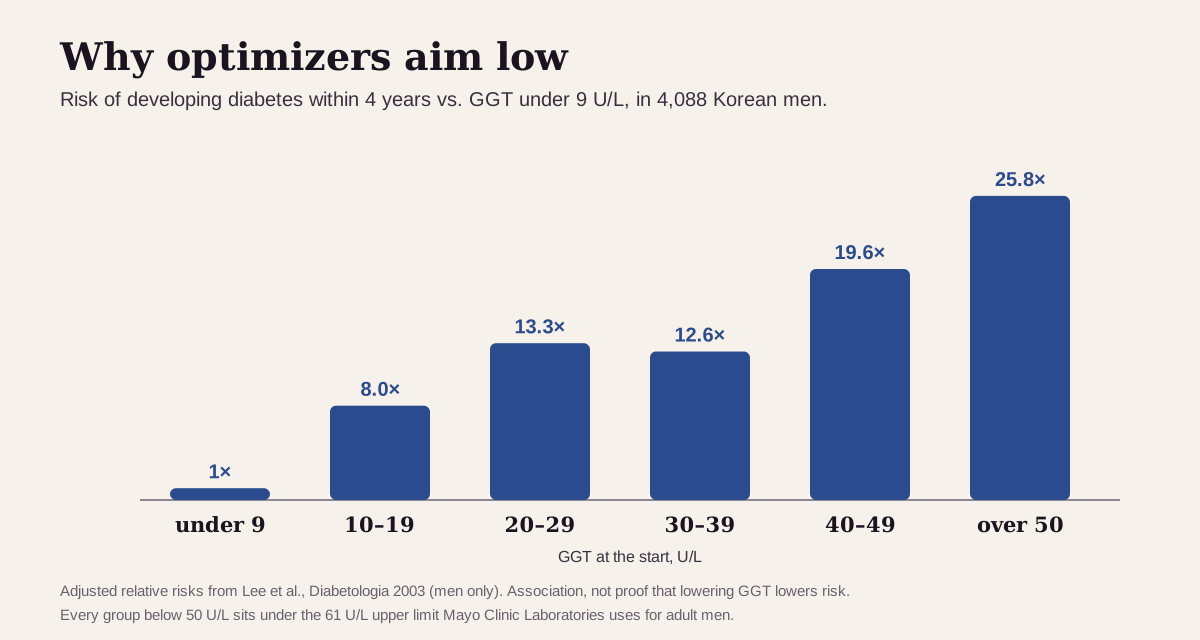
Keep "optimal" in perspective. GGT works more like a smoke alarm than the fire. A genetic study of 8,611 Dutch adults found no sign that a naturally higher GGT raises diabetes risk (a causal relative risk of 0.96). The authors concluded that the link most likely comes from other factors that travel with a high GGT, and that drugs aimed at lowering GGT itself are unlikely to prevent diabetes.12 So a GGT of 35 is a reason to look at your weight, alcohol, medicines and liver fat, and a low GGT is usually good news.10
What a high GGT usually means
The size of the rise, and what ALP is doing next to it, are the first clues.21
Mildly high: common, usually slow-moving
The usual suspects, which the BSG names as GGT's most common causes:3
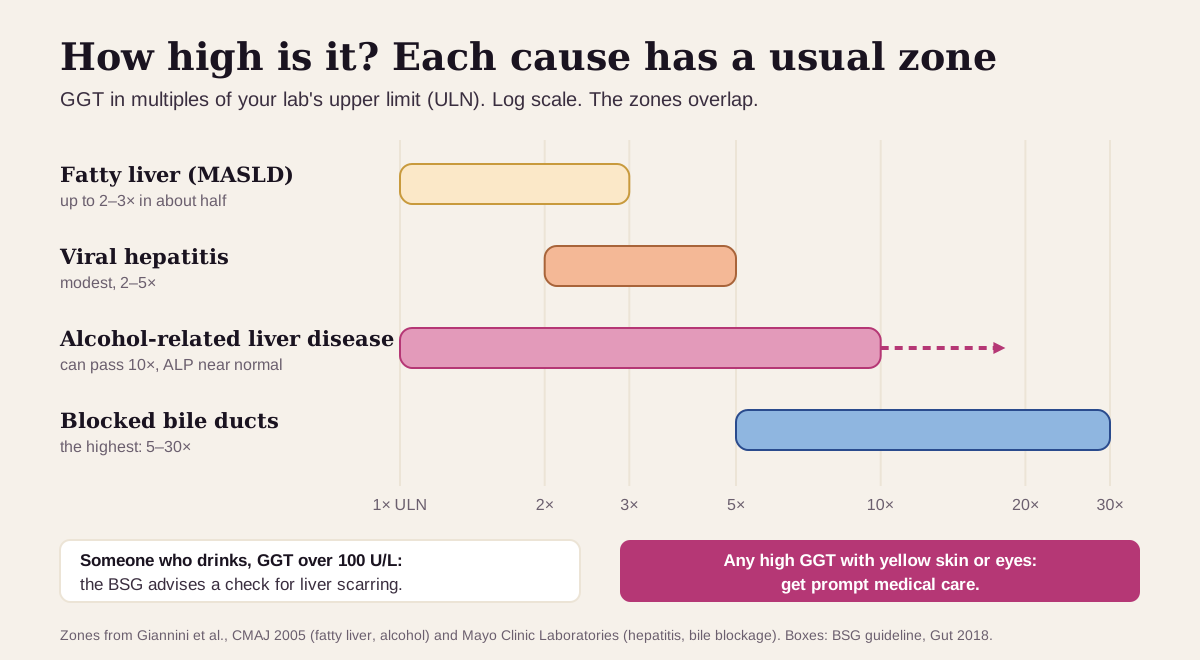
- Extra weight and fatty liver disease. Fatty liver, now called MASLD (metabolic dysfunction-associated steatotic liver disease),13 is the most common cause of mildly abnormal liver tests in Western countries. It affected about 23% of U.S. adults in national survey data. In about half of people with it, GGT runs up to 2–3 times the upper limit, usually alongside a mildly raised ALT.2
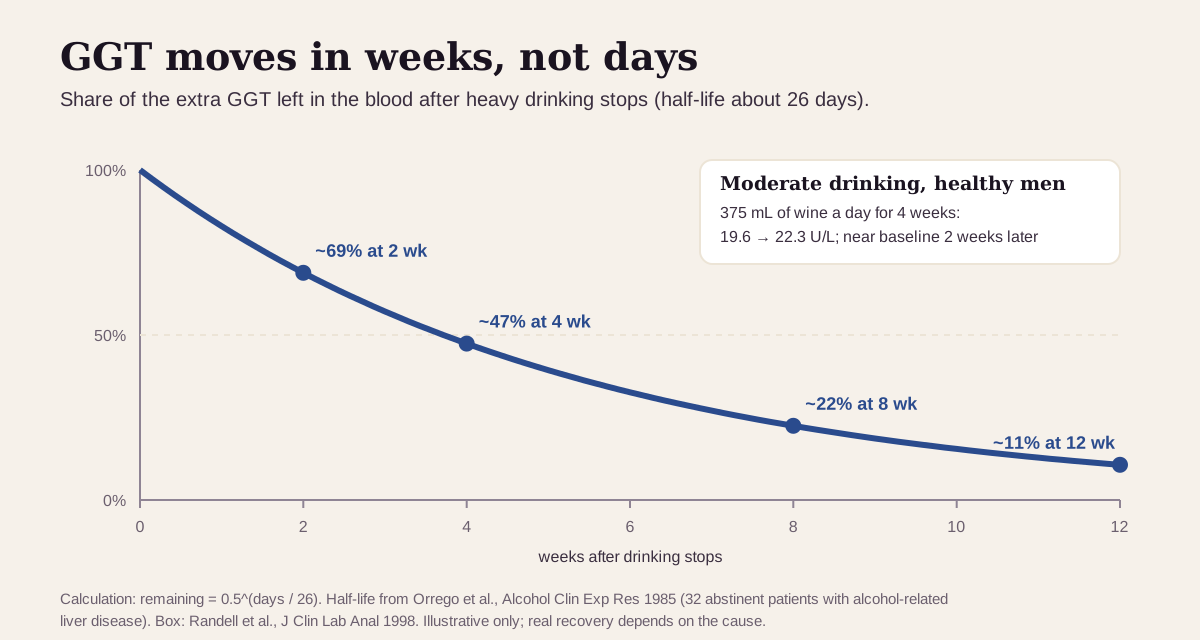
- Alcohol. Regular drinking raises GGT, and most people with alcohol use disorder have a high GGT.5 Even moderate drinking moves it: in healthy men who drank 375 mL of wine a day (about half a bottle) for 4 weeks, average GGT rose from 19.6 to 22.3 U/L.14
- Medicines. Some drugs switch on the enzyme itself, especially the seizure medicines phenytoin and phenobarbital, and oral contraceptives.21 Don't stop a prescribed medicine on your own. Bring your full list, supplements included, to your clinician.
- Smoking and meals. Smoking also affects the result, and GGT dips after meals, so you may be asked to fast before the test.5
- Less common causes: viral hepatitis, pancreatitis, diabetes, heart failure, kidney failure and chronic lung disease (COPD). GGT can also stay up for weeks after a heart attack.52
Very high: blocked bile or heavy drinking
GGT climbs highest when bile is blocked inside or below the liver, to 5 to 30 times normal, according to Mayo Clinic Laboratories.1 Gallstones in a bile duct, primary biliary cholangitis (PBC), primary sclerosing cholangitis (PSC) and some drug reactions are the classic causes, and ALP usually rises with it.3 In alcohol-related liver disease, GGT can pass 10 times the upper limit while ALP stays normal or near normal.2
In a 2022 study of 408 hospital patients, the median GGT was 62 U/L in fatty liver, 180 in PBC, 218 in drug-induced liver injury and 317 in alcohol-related liver disease, with a lot of overlap.7
Get prompt care if a high GGT comes with yellow skin or eyes (jaundice), belly pain or swelling, nausea and vomiting, or severe itching.5 The BSG calls for immediate referral when jaundice has no clear explanation.3
GGT reads best next to its neighbors
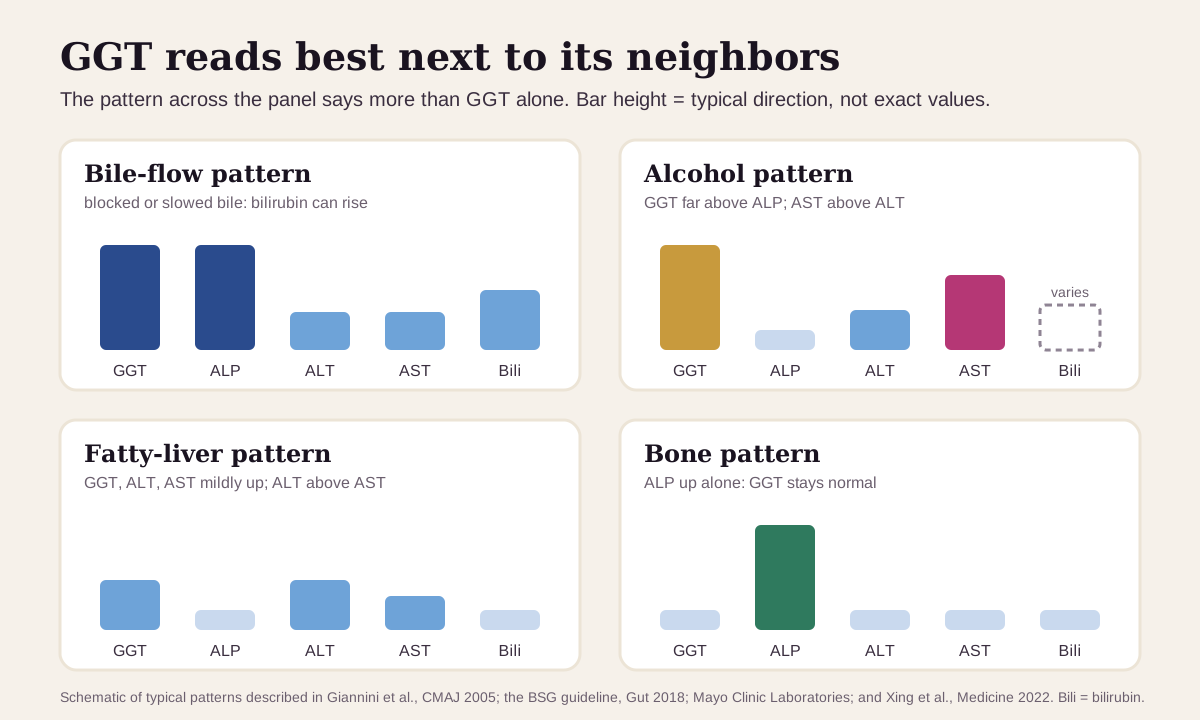
GGT is sensitive but unspecific. The pattern across ALP, ALT, AST and bilirubin usually shows where it's coming from:23
| If you see… | It often points to… |
|---|---|
| GGT and ALP both up, ALT and AST only mildly up, sometimes bilirubin too | a bile-flow ("cholestatic") pattern: a gallstone in a duct, PBC or PSC, a medicine reaction, or a congested liver, as in heart failure325 |
| GGT up far more than ALP, AST higher than ALT | alcohol. A GGT/ALP ratio above 2.5 fits the pattern, and in one classic study AST was more than twice ALT in 70% of people with alcohol-related liver disease2 |
| GGT, ALT and AST mildly up, ALT above AST, ALP normal | fatty liver (MASLD)27 |
| ALP up, GGT normal | bone rather than liver: growth in teenagers, vitamin D deficiency, or Paget's disease. In late pregnancy, the placenta makes ALP too312 |
| GGT up, other liver tests normal | the most common causes of a raised GGT: extra weight, alcohol, or a medicine that switches on the enzyme31 |
Is a low GGT a problem?
Usually no. In the Korean study, men with the lowest GGT (under 9 U/L) had the lowest diabetes risk.10 The exception is in children: a few inherited bile disorders back up bile while GGT stays low or normal, so specialists read a low GGT differently there.3
How fast GGT changes
GGT moves in weeks, not days. When people with alcohol-related liver disease stopped drinking, their GGT fell with a half-life of about 26 days.15 In the wine study, 2 weeks without alcohol brought GGT almost back to where it started.14 When bile is blocked, GGT rises earlier than ALP, AST and ALT, and stays up longer.1
What that means in practice:
- A single mildly high result needs context. Mention recent drinking, new medicines or supplements, and whether you fasted when you get tested.5
- A level that stays high is worth working up. In UK data behind the BSG guideline, 84% of abnormal liver tests were still abnormal a month later, and 75% after two years. The guideline favors looking for the cause over simply repeating the test.3
- Trends beat snapshots. In healthy adults, GGT varies about 8.9% from week to week within one person, but about 41.7% from person to person.16 Your own baseline tells you more than a population range. Compare results from the same lab, since GGT methods and ranges differ.6
Going deeper: what GGT actually does
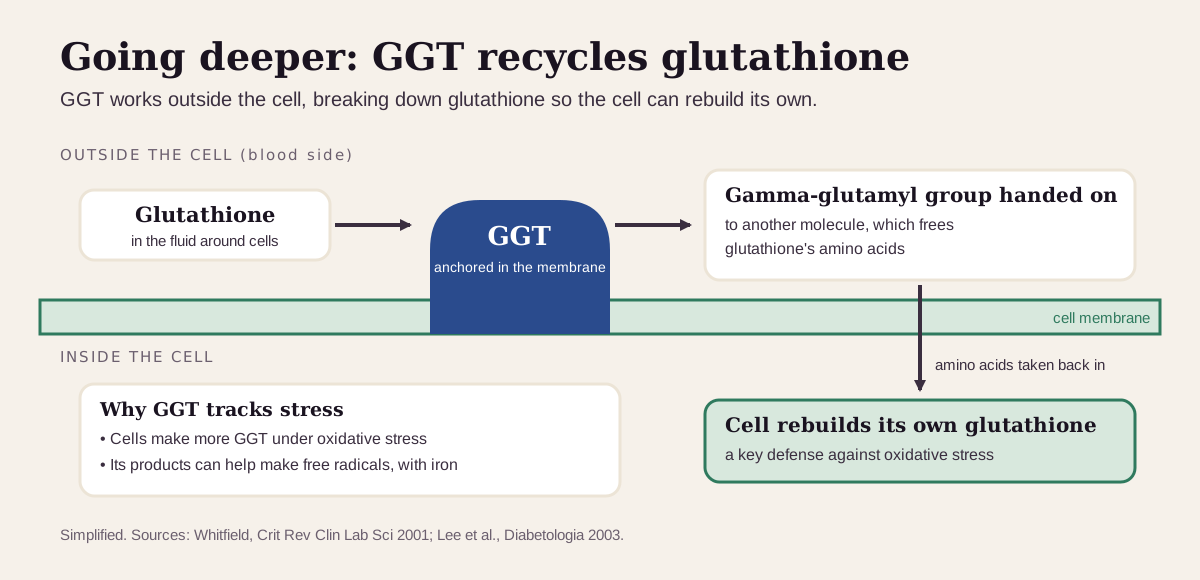
GGT is a transferase: it moves a gamma-glutamyl group from one molecule onto another. Lab tests measure it exactly that way.1 In the body, its main target is glutathione in the fluid around cells. Breaking it down makes glutathione's amino acids available for the cell to rebuild its own glutathione, a key defense against oxidative stress.8
That's why researchers read GGT as a stress signal as well as a liver test. Cells make more of it when they're under oxidative stress, and it can be released by several kinds of cell stress.10 The reaction's products can also help generate free radicals, especially when iron is around. Whitfield's review weighs how far these roles explain GGT's links with heart disease, type 2 diabetes and stroke.8
In the liver, GGT sits on the cell surface facing the blood and on the lining of the bile ducts. Bile backing up, injury and growth of the bile-duct lining, and extra production all push more of it into the blood.7 Because the enzyme is so sensitive and so unspecific, GGT is best read as part of a pattern.2
Questions worth asking
- How far above the upper limit is my GGT, and what did my ALP show next to it?
- Could my drinking, even if it's moderate, be part of this?
- Could any of my medicines or supplements be raising it?
- Do I have fatty-liver risk factors, and would a liver-scarring test help?
- If my ALP is high too, should my bile ducts be checked with an ultrasound?
- When should we repeat it, and can it be at the same lab?
FAQ
What is a normal GGT level? It depends on your lab's range. Mayo Clinic Laboratories uses 8–61 U/L for adult men and 5–36 U/L for adult women.1
What is the most common cause of a high GGT? Extra weight with fatty liver, alcohol, and medicines that switch on the enzyme are the most common causes, according to the British Society of Gastroenterology.3
Does alcohol raise GGT? Yes. Most people with alcohol use disorder have a high GGT,5 and about half a bottle of wine a day for 4 weeks nudged it up in healthy men.14 After drinking stops, it falls over weeks.15
When is a high GGT urgent? Get prompt care when it comes with yellow skin or eyes, belly pain or swelling, or vomiting. Very high levels usually mean blocked bile or heavy drinking and need a prompt workup.135
This guide is for education. It can't diagnose you or replace care from a clinician who knows your history.
Footnotes
-
Mayo Clinic Laboratories. Test ID GGT: Gamma-Glutamyltransferase, Serum. Adult reference values, clinical information and interpretation. Opened as the Internet Archive copy of 15 May 2026, because the live page blocks scripted access. Archived page · Live page ↩ ↩2 ↩3 ↩4 ↩5 ↩6 ↩7 ↩8 ↩9 ↩10 ↩11 ↩12 ↩13 ↩14 ↩15 ↩16 ↩17 ↩18 ↩19 ↩20 ↩21 ↩22
-
Giannini EG, Testa R, Savarino V. Liver enzyme alteration: a guide for clinicians. CMAJ. 2005;172(3):367–379. doi:10.1503/cmaj.1040752. The source for GGT's tissues and enzyme induction, GGT up to 2–3 times the upper limit in about half of fatty-liver patients, over 10 times in alcohol-related liver disease with a GGT/ALP ratio above 2.5, the AST/ALT pattern, and ALP's placental and bone sources. PMC ↩ ↩2 ↩3 ↩4 ↩5 ↩6 ↩7 ↩8 ↩9 ↩10 ↩11 ↩12 ↩13 ↩14 ↩15 ↩16 ↩17
-
Newsome PN, Cramb R, Davison SM, et al. Guidelines on the management of abnormal liver blood tests. Gut. 2018;67(1):6–19. doi:10.1136/gutjnl-2017-314924. The British Society of Gastroenterology guideline: GGT's most common causes, its use to confirm a liver source of ALP, the cholestatic pattern, the over-100 U/L trigger in people who drink, and the urgent-referral rule for jaundice. PMC ↩ ↩2 ↩3 ↩4 ↩5 ↩6 ↩7 ↩8 ↩9 ↩10 ↩11 ↩12 ↩13 ↩14 ↩15 ↩16 ↩17 ↩18 ↩19 ↩20 ↩21 ↩22
-
Weatherby D, Ferguson S. Blood Chemistry and CBC Analysis: Clinical Laboratory Testing from a Functional Perspective. Bear Mountain Publishing; 2004. ISBN 978-0976136712. A widely used functional-medicine reference. The Libby app's marker catalog records its optimal GGT range as 10–25 U/L for men and 8–20 U/L for women (range as recorded in the app's catalog; the book was not opened for this article). ↩ ↩2 ↩3
-
National Library of Medicine. Gamma-glutamyl Transferase (GGT) Test. MedlinePlus. Last updated July 29, 2024. Causes of a high GGT, the ALP comparison, what affects the result, and symptoms of liver disease. MedlinePlus ↩ ↩2 ↩3 ↩4 ↩5 ↩6 ↩7 ↩8 ↩9
-
Ceriotti F, Henny J, Queraltó J, et al. Common reference intervals for aspartate aminotransferase (AST), alanine aminotransferase (ALT) and γ-glutamyl transferase (GGT) in serum: results from an IFCC multicenter study. Clin Chem Lab Med. 2010;48(11):1593–1601. doi:10.1515/CCLM.2010.315. 765 screened adults in Milan, Beijing, Bursa and the Nordic countries; GGT intervals 12–68 U/L (men) and 6–40 U/L (women). PubMed ↩ ↩2 ↩3 ↩4 ↩5 ↩6 ↩7 ↩8
-
Xing M, Gao M, Li J, et al. Characteristics of peripheral blood Gamma-glutamyl transferase in different liver diseases. Medicine (Baltimore). 2022;101(1):e28443. doi:10.1097/MD.0000000000028443. 408 hospital patients with PBC, drug-induced liver injury, alcohol-related liver disease or fatty liver. PMC ↩ ↩2 ↩3 ↩4 ↩5 ↩6 ↩7
-
Whitfield JB. Gamma glutamyl transferase. Crit Rev Clin Lab Sci. 2001;38(4):263–355. doi:10.1080/20014091084227. A major review of GGT's physiology, clinical uses and links to heart disease and diabetes. PubMed ↩ ↩2 ↩3 ↩4
-
Superpower. GGT Levels: Understanding Your Results. Published April 18, 2026; updated August 31, 2026. Says many practitioners target GGT below 25 U/L for women and below 30 U/L for men. A commercial source, listed as what the optimizer community uses. superpower.com ↩ ↩2
-
Lee DH, Ha MH, Kim JH, et al. Gamma-glutamyltransferase and diabetes: a 4 year follow-up study. Diabetologia. 2003;46(3):359–364. doi:10.1007/s00125-003-1036-5. 4,088 healthy Korean men working at a steel company, examined in 1994 and 1998. PubMed ↩ ↩2 ↩3 ↩4 ↩5 ↩6
-
Du G, Song Z, Zhang Q. Gamma-glutamyltransferase is associated with cardiovascular and all-cause mortality: a meta-analysis of prospective cohort studies. Prev Med. 2013;57(1):31–37. doi:10.1016/j.ypmed.2013.03.011. PubMed ↩
-
Nano J, Muka T, Ligthart S, et al. Gamma-glutamyltransferase levels, prediabetes and type 2 diabetes: a Mendelian randomization study. Int J Epidemiol. 2017;46(5):1400–1409. doi:10.1093/ije/dyx006. 8,611 adults from the Rotterdam Study plus large genetic consortia. PubMed ↩
-
Rinella ME, Lazarus JV, Ratziu V, et al. A multisociety Delphi consensus statement on new fatty liver disease nomenclature. Hepatology. 2023;78(6):1966–1986. doi:10.1097/HEP.0000000000000520. The statement that renamed NAFLD as MASLD. PMC ↩
-
Randell E, Diamandis EP, Goldberg DM. Changes in serum carbohydrate-deficient transferrin and gammaglutamyl transferase after moderate wine consumption in healthy males. J Clin Lab Anal. 1998;12(2):92–97. 375 mL of wine a day for 4 weeks, then 2 weeks without alcohol. PMC ↩ ↩2 ↩3
-
Orrego H, Blake JE, Israel Y. Relationship between gamma-glutamyl transpeptidase and mean urinary alcohol levels in alcoholics while drinking and after alcohol withdrawal. Alcohol Clin Exp Res. 1985;9(1):10–13. doi:10.1111/j.1530-0277.1985.tb05038.x. Half-life of 26 days in 32 patients who stayed abstinent for 8 weeks. PubMed ↩ ↩2 ↩3
-
Carobene A, Røraas T, Sølvik UØ, et al. Biological variation estimates obtained from 91 healthy study participants for 9 enzymes in serum. Clin Chem. 2017;63(6):1141–1150. doi:10.1373/clinchem.2016.269811. The European Biological Variation Study: weekly samples for 10 weeks. PubMed ↩
Educational content, not medical advice. Libby is a personal record tool, not a medical service — it doesn't diagnose, treat, or prescribe. Reference ranges vary by lab and by person. Talk to a qualified healthcare professional about your results.
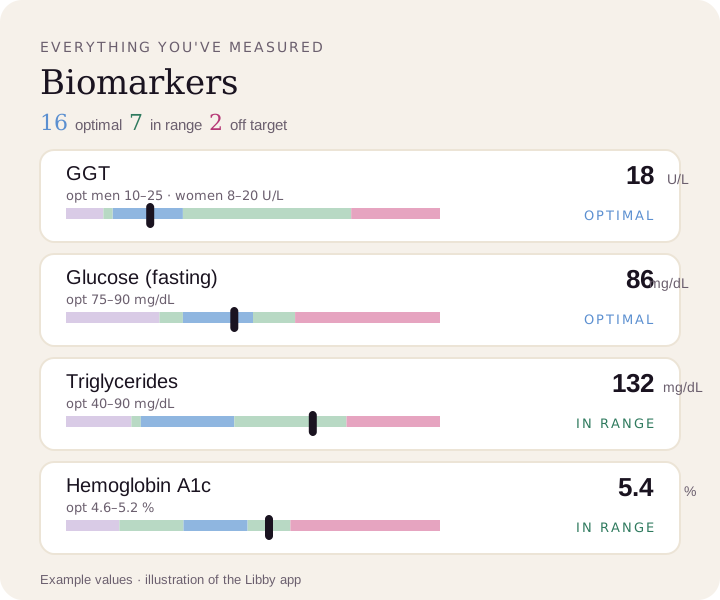
Compare your results to optimal ranges.
Upload a lab PDF or a photo of your report. Libby shows every marker against its reference range and the optimal range, and tracks your trends over time.
View your GGT ›