Lipase test: normal levels, high causes, and next steps
Lipase is the pancreas's fat-digesting enzyme. Here's what a normal level is, what high and low results usually mean, and when a high lipase is urgent.
Lipase is an enzyme your pancreas makes to digest fat, and the blood test measures the small amount that spills into your bloodstream. When the pancreas is inflamed, lipase floods the blood, which makes it the go-to test for acute pancreatitis. Slower kidneys, diabetes, some medicines and other belly problems can push it up too.123
The short version
- Normal: use the range on your report. Labcorp's adult range is 13–78 U/L for men and 14–72 U/L for women (14–85 U/L after age 70). Other labs use different methods and ranges.45
- Mildly high (under 3 times your lab's upper limit) has many causes beyond pancreatitis: slower kidneys, diabetes, some medicines, and gallbladder or bowel problems.362
- Over 3 times your lab's upper limit with severe upper-belly pain is one of the markers of acute pancreatitis. That needs care now.1
- Lipase stays high for 8–14 days after an attack, much longer than amylase, so it's the better test if you get checked late.61
What lipase is
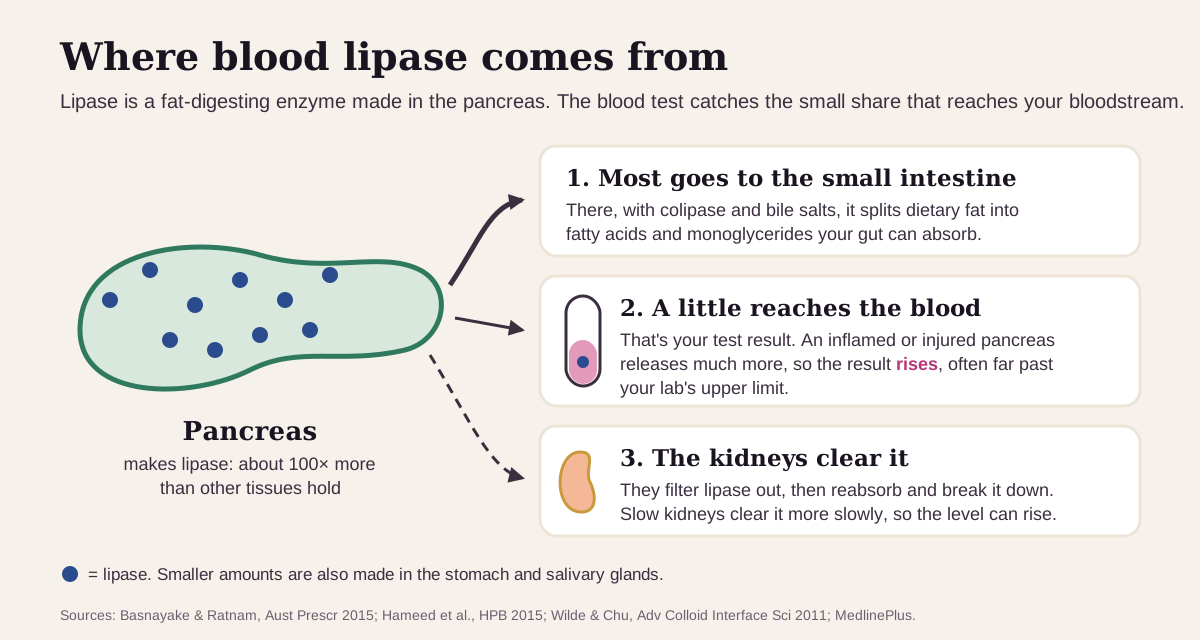
Lipase is a digestive enzyme. After a meal, your pancreas releases it into the small intestine, where it splits dietary fat (triglycerides) into fatty acids and monoglycerides small enough to absorb. It works with a helper protein called colipase and with bile salts.7 (More on the chemistry at the end.)
Your pancreas holds about 100 times more lipase than other tissues such as the duodenum, stomach, fat tissue and lung. That's why a big rise in blood lipase points so strongly at the pancreas.6 Smaller amounts are made in the stomach and salivary glands.2
Only a little lipase normally reaches your blood. Your kidneys filter it out, then reabsorb and break it down, so kidney function matters when you read the number.3 Clinicians usually order lipase when someone has belly pain that could come from the pancreas, often spreading to the back.2
What's a normal lipase?
Start with the range printed on your own report. Lipase tests measure the enzyme's activity, and methods differ: in one comparison, two lab methods gave results that differed by a factor of 2.39 until they were calibrated the same way.8
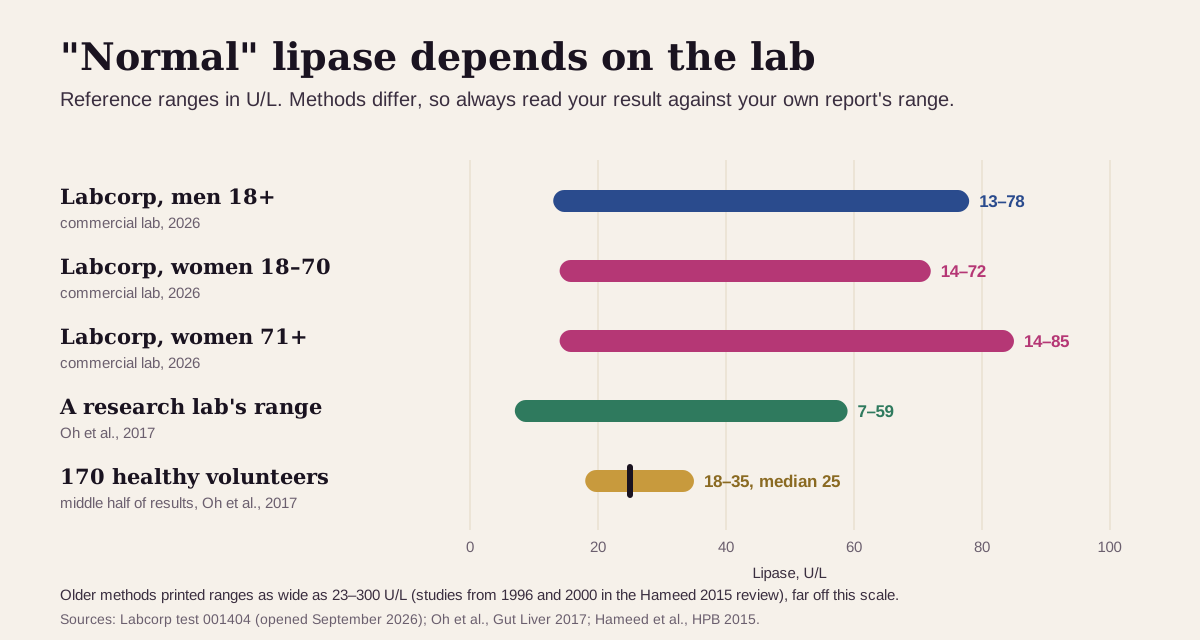
- Labcorp, a large U.S. lab, uses 13–78 U/L for men and 14–72 U/L for women aged 18–70, rising to 14–85 U/L for women over 70.4
- The lab in a 2017 Indiana study used 7–59 U/L. Among its 170 healthy volunteers, the median lipase was 25 U/L, and the middle half of results ran from 18 to 35.5
- Older methods printed ranges as wide as 23–300 U/L.3
Men and women run close. Labcorp's upper limit is a little higher for men (78) than for women aged 18–70 (72), and highest for women over 70 (85).4 Pregnancy shifts lipase a little: in a French study of 103 pregnant women, lipase was lower in the first trimester (48.6 vs 59.2 IU/L in matched women who weren't pregnant) and similar later in pregnancy.9
"Optimal" lipase: what health optimizers aim for
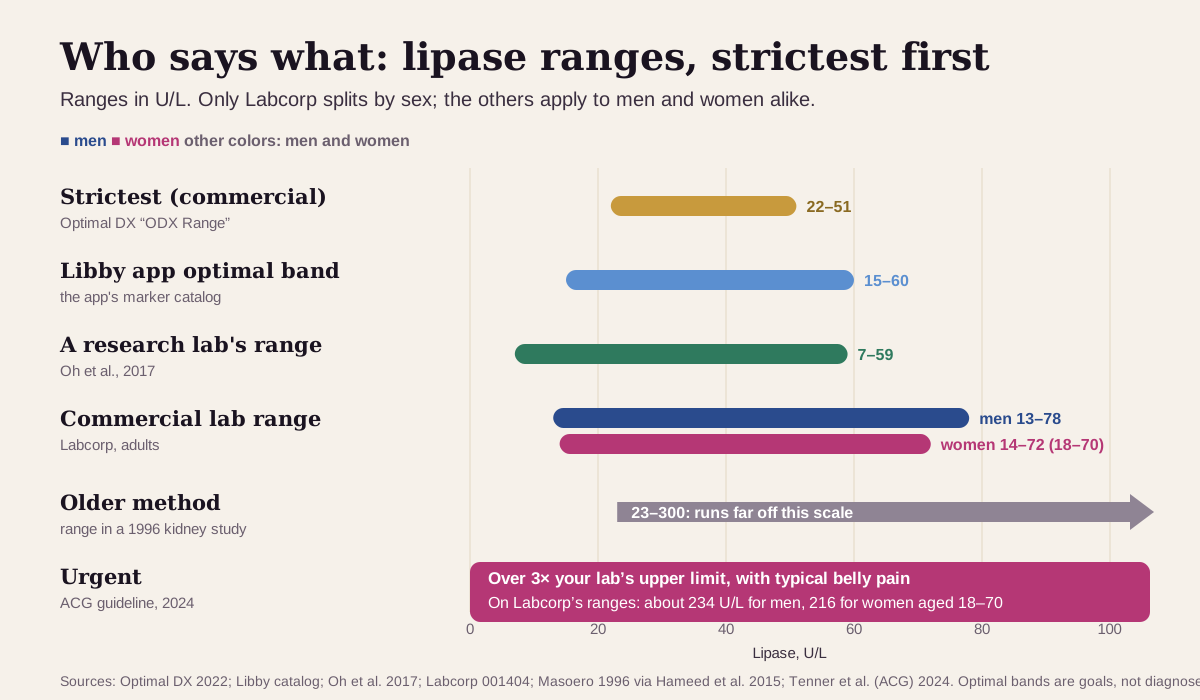
Guidelines care about one lipase number: 3 times the upper limit, the pancreatitis line. Functional-medicine sources narrow the lab range from both ends, mostly to flag a low lipase. Here's the ladder, from strictest to loosest:
| Target | Men | Women | Who uses it |
|---|---|---|---|
| Strictest (functional-medicine database) | 22–51 U/L | 22–51 U/L | Optimal DX's published "ODX Range"10 |
| Libby app optimal band | 15–60 U/L | 15–60 U/L | The optimal range the Libby app shows for lipase11 |
| Research reference range | 7–59 U/L | 7–59 U/L | The Indiana lab in Oh et al.; healthy median 255 |
| Commercial lab range | 13–78 U/L | 14–72 U/L (14–85 after 70) | Labcorp, adults4 |
| Older method | 23–300 U/L | 23–300 U/L | A 1996 kidney study, tabulated in the Hameed review3 |
| Urgent | over 3× your lab's upper limit | over 3× your lab's upper limit | With typical upper-belly pain: get care now1 |
Why optimizers set a floor:
- In the Indiana study, median lipase fell step by step as chronic pancreatitis (long-term damage to the pancreas) advanced: 25 U/L in healthy volunteers, 20 in moderate and 15 in severe early disease, and 10 once the pancreas had calcified. The best cutoffs were 20 U/L for early disease and 15 U/L for calcified disease, the same number as the floor of the Libby app's band.5
- A 2020 review of 20 studies and 20,916 people found lower lipase in people with type 1 and type 2 diabetes than in healthy people.12
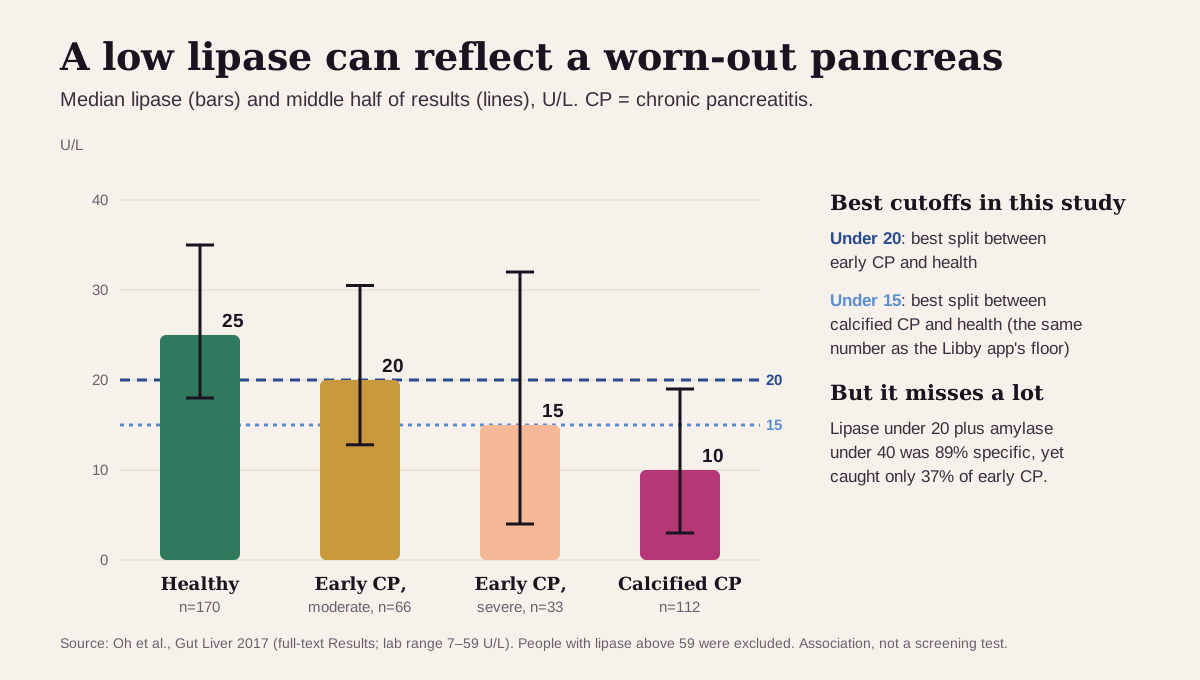
Keep "optimal" in perspective. A low lipase was fairly specific but missed a lot of disease: lipase under 20 plus amylase under 40 was 89% specific, yet caught only 37% of early chronic pancreatitis.5 No study has shown that moving lipase within its range improves health. At the top end, what matters is the size of the rise and whether you have symptoms, which is the next section.
What a high lipase usually means
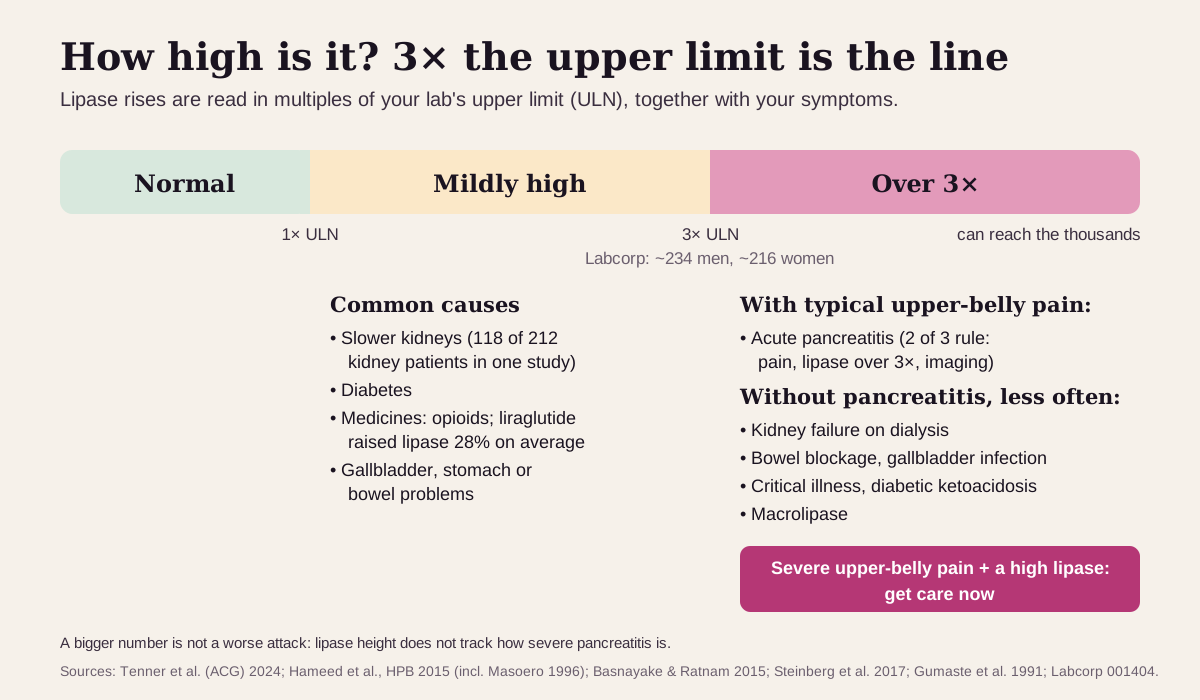
The size of the rise, and whether you have belly pain, are the first clues. Clinicians compare lipase with your lab's upper limit (ULN).1
Over 3× with belly pain: acute pancreatitis
Acute pancreatitis is diagnosed when 2 of these 3 are present: typical belly pain, amylase or lipase over 3 times the upper limit, and typical changes on a scan. The pain usually sits in the upper middle or upper left belly, is constant, and often spreads to the back. The American College of Gastroenterology (ACG) prefers lipase over amylase: it's more specific and stays high longer.1 On Labcorp's ranges, 3 times the limit is about 234 U/L for men and 216 U/L for women aged 18–70.4
The usual causes of acute pancreatitis, according to the ACG:1
- Gallstones: 40–70% of attacks. A stone blocks the shared opening of the bile and pancreatic ducts.
- Alcohol: 25–35%.
- Very high triglycerides: about 5%. The ACG counts triglycerides as the cause when they're above 1,000 mg/dL.
- Less common: a few medicines (azathioprine, 6-mercaptopurine and didanosine clearly can), high calcium, infections, and ERCP, a scope procedure on the bile and pancreatic ducts. Pancreatitis follows 1–30% of ERCPs.
The height of the rise tells you little about the attack. Once pancreatitis is diagnosed, the ACG sees no reason to keep checking lipase, because it has no relationship to severity, outlook, or when to eat or go home.1 And a normal-looking lipase can miss one kind: in 26 people with pancreatitis from very high triglycerides, 2 had a lipase in the normal range and 11 were under 3 times the limit.15
Get care now if you have severe or worsening pain or tenderness in your upper belly, nausea and vomiting, fever or chills, a fast heartbeat, shortness of breath, or yellow skin or eyes, whatever your lipase says.16
Mildly high (under 3×): many causes beyond pancreatitis
The usual suspects:
- Slower kidneys. Your kidneys clear lipase, so reduced kidney function raises it. In one study of 212 people with kidney disease, 118 had a raised lipase and 13 were over 3 times the limit, most of them on dialysis.3 In another, lipase stayed normal until kidney filtering (creatinine clearance) fell below about 50 mL/min.17
- Diabetes. Diabetes appears on the usual lists of causes of a raised lipase, and the ACG notes that people with diabetes may need a higher cutoff than 3× before lipase points to pancreatitis.123 (On average, though, lipase runs slightly lower in diabetes; see the optimal section above.12)
- Medicines. Opioids such as codeine, water pills and several other drugs can raise lipase.62 In the LEADER trial of 9,340 people with type 2 diabetes, the GLP-1 drug liraglutide raised lipase by 28% on average compared with placebo, and those rises predicted later pancreatitis less than 1% of the time.13 Keep taking prescribed medicines unless your clinician changes them, and bring your full list, supplements included.
- Other belly problems. An inflamed gallbladder, a stomach ulcer, and a blocked or damaged bowel can all raise lipase.62
- Less common: macrolipase, where lipase is bound into a complex too big for the kidneys to filter, so the level stays high for weeks without pancreatitis (one case reached 3,764 U/L).318 Also critical illness, diabetic ketoacidosis, and some cancers of the gut and liver.3
Lipase reads best next to its neighbors
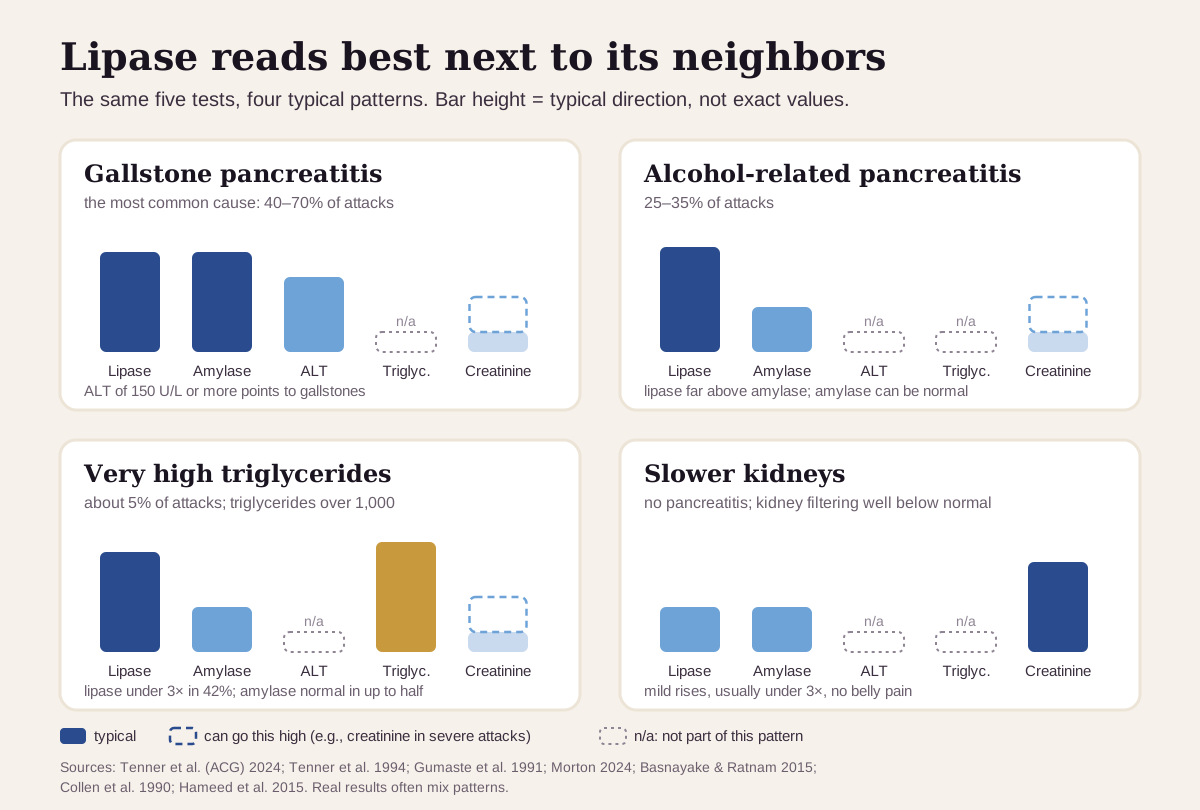
Lipase alone says the pancreas may be involved. The pattern with amylase, ALT, triglycerides and creatinine often says why:
| If you see… | It often points to… |
|---|---|
| Lipase and amylase both over 3×, ALT 150 U/L or higher, with belly pain | gallstone pancreatitis: in a pooled analysis, an ALT of 150 or more meant gallstones 95% of the time19 |
| Lipase far higher than amylase (a ratio over 2, counting each as a multiple of its upper limit) | alcohol-related pancreatitis in a small 1991 study,14 or an attack a few days old, since amylase clears first1 |
| Pancreatitis with triglycerides over 1,000 mg/dL, gallstones and alcohol ruled out | triglyceride-driven pancreatitis; lipase can stay under 3× and amylase can read normal1156 |
| Lipase mildly high, creatinine high, no belly pain | slower kidney clearance173 |
| Lipase high for weeks, no symptoms, other tests normal | macrolipase or a medicine31813 |
Ordering amylase on top of lipase adds little: most guidelines don't recommend the pair, because it barely raises the chance of catching pancreatitis.6
Is a low lipase a problem?
Usually it's just a low-normal number. A lipase below your lab's range can mean the pancreas is making less enzyme, as in long-standing chronic pancreatitis or cystic fibrosis.25 Low lipase is also more common in diabetes.12 Mention a low result if you also have greasy, foul-smelling stools, weight loss, or belly pain that keeps coming back: those are signs of chronic pancreatitis.16
How fast lipase changes
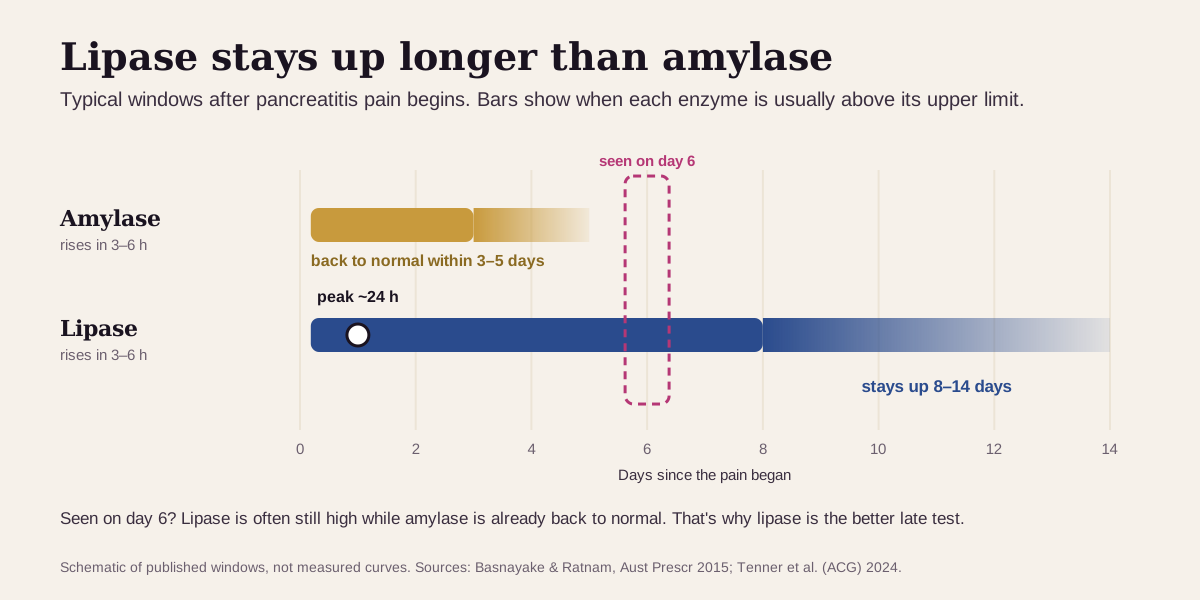
Lipase lingers. After pancreatitis begins, it rises within 3–6 hours, peaks at about 24 hours, and stays high for 8–14 days, because your kidney tubules reabsorb it. Amylase rises just as fast but is usually back to normal within 3–5 days.61
What that means in practice:
- Lipase is the better test if you get checked late. Seen on day 5 or later, lipase may still be high when amylase has already settled.6
- In a stable person, lipase barely moves. In 91 healthy adults tested weekly for 10 weeks, each person's lipase varied by about 7.7% from week to week, while people differed from one another by about 24%.20 So a clear change in your own numbers means more than where you sit against other people.
- Compare results from the same lab, because methods and ranges differ.84
- Ask about fasting. Some labs ask you to fast for 8–12 hours before a lipase test.2
Going deeper: what lipase actually does
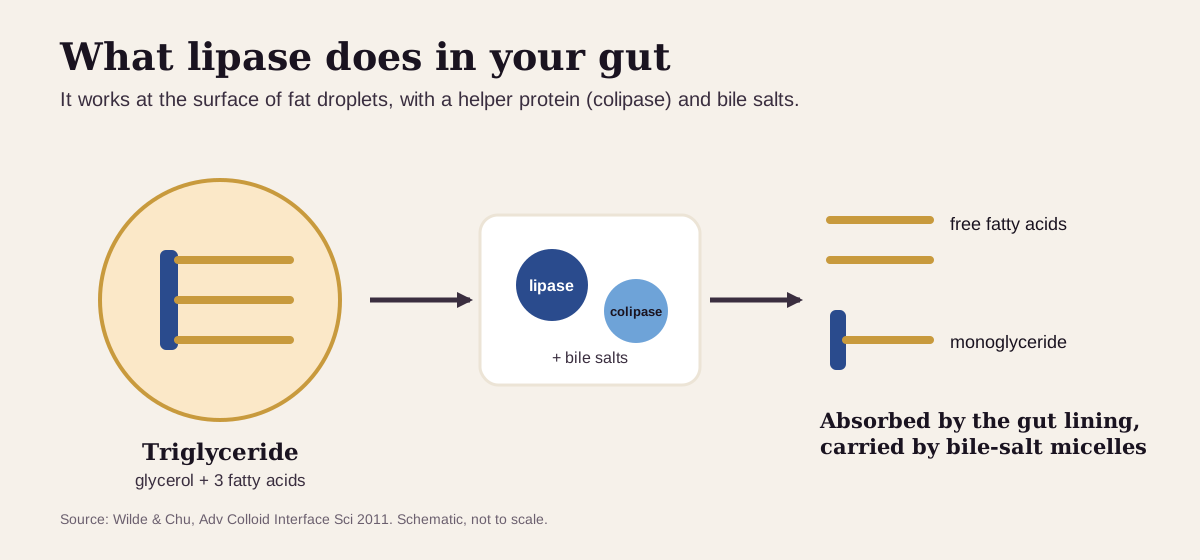
Pancreatic lipase cuts fatty acids off the glycerol backbone of a triglyceride. It only works at the surface of a fat droplet, where it teams up with colipase, a small helper protein, and with bile salts. Pancreatic lipase does most of the fat digestion in your gut. Its products, free fatty acids and monoglycerides, are packed by bile salts into tiny carriers called mixed micelles and absorbed by the gut lining.7
Your kidneys handle lipase in two steps: the filters (glomeruli) remove it from the blood, and the tubules reabsorb most of it and break it down.3 That reabsorption is why lipase lingers after an attack, and why slower kidneys can raise it.6
The lipase/amylase ratio. In a 1991 study of 51 people with acute pancreatitis, dividing lipase by amylase, each counted as a multiple of its own upper limit, separated alcohol-related attacks (ratio over 2) from the others, mostly gallstones.14
Lipase/amylase ratio = (lipase ÷ lipase ULN) ÷ (amylase ÷ amylase ULN)
Questions worth asking
- How many times above the upper limit is my lipase?
- Do my symptoms, and a scan if I've had one, fit pancreatitis?
- What do my ALT, triglycerides and kidney tests show next to it?
- Could any of my medicines, including diabetes drugs, be raising my lipase?
- If my lipase stays high without symptoms, should we check for macrolipase?
- When should we repeat it, and what would change the plan?
FAQ
What is a normal lipase level? It depends on your lab. Labcorp uses 13–78 U/L for men and 14–72 U/L for women aged 18–70 (14–85 after 70).4
What lipase level means pancreatitis? Over 3 times your lab's upper limit, together with typical upper-belly pain or typical scan findings. On Labcorp's ranges, that's about 234 U/L for men and 216 U/L for women aged 18–70.14
Can you have a high lipase without pancreatitis? Yes. Slower kidneys, diabetes, some medicines, other belly problems and macrolipase can all raise it, sometimes past 3 times the limit.3
Is lipase or amylase better for pancreatitis? Lipase. It's more specific to the pancreas and stays high for 8–14 days, versus 3–5 days for amylase.16
This guide is for education. It can't diagnose you or replace care from a clinician who knows your history.
Footnotes
-
Tenner S, Vege SS, Sheth SG, Sauer B, Yang A, Conwell DL, Yadlapati RH, Gardner TB. American College of Gastroenterology Guidelines: Management of Acute Pancreatitis. Am J Gastroenterol. 2024;119(3):419–437. doi:10.14309/ajg.0000000000002645. The U.S. gastroenterology society's guideline: the 2-of-3 diagnosis, lipase preferred, cause percentages, the 1,000 mg/dL triglyceride line, creatinine as a severity sign, and no role for serial lipase. PMC ↩ ↩2 ↩3 ↩4 ↩5 ↩6 ↩7 ↩8 ↩9 ↩10 ↩11 ↩12 ↩13 ↩14 ↩15 ↩16 ↩17 ↩18
-
National Library of Medicine. Lipase Tests. MedlinePlus. What the test measures, where lipase is made, common causes of high and low results, medicines that affect it, and fasting. MedlinePlus ↩ ↩2 ↩3 ↩4 ↩5 ↩6 ↩7 ↩8 ↩9 ↩10
-
Hameed AM, Lam VW, Pleass HC. Significant elevations of serum lipase not caused by pancreatitis: a systematic review. HPB (Oxford). 2015;17(2):99–112. doi:10.1111/hpb.12277. 58 studies of lipase over 3× without pancreatitis, kidney handling of lipase, and the Masoero 1996 kidney study (212 patients, 118 with raised lipase, 13 over 3×; lab normal range 23–300 U/L). PMC ↩ ↩2 ↩3 ↩4 ↩5 ↩6 ↩7 ↩8 ↩9 ↩10 ↩11 ↩12 ↩13 ↩14 ↩15 ↩16 ↩17 ↩18
-
Labcorp. Lipase (test 001404). Opened September 23, 2026. Reference ranges by age and sex: men 18 and older 13–78 U/L; women 18–70, 14–72 U/L; women 71 and older, 14–85 U/L. A commercial lab's published range. labcorp.com ↩ ↩2 ↩3 ↩4 ↩5 ↩6 ↩7 ↩8 ↩9 ↩10 ↩11
-
Oh HC, Kwon CI, El Hajj II, Easler JJ, Watkins J, Fogel EL, McHenry L, Sherman S, Zimmerman MK, Lehman GA. Low Serum Pancreatic Amylase and Lipase Values Are Simple and Useful Predictors to Diagnose Chronic Pancreatitis. Gut Liver. 2017;11(6):878–883. doi:10.5009/gnl17066. 170 healthy volunteers and 211 people with chronic pancreatitis; lab range 7–59 U/L. Medians and cutoffs from the full-text Results. PMC ↩ ↩2 ↩3 ↩4 ↩5 ↩6 ↩7 ↩8 ↩9
-
Basnayake C, Ratnam D. Blood tests for acute pancreatitis. Aust Prescr. 2015;38(4):128–130. doi:10.18773/austprescr.2015.043. The time course (rise in 3–6 h, peak at 24 h, raised 8–14 days), the 100-fold tissue concentration, the causes table, and the case against ordering amylase with lipase. PMC ↩ ↩2 ↩3 ↩4 ↩5 ↩6 ↩7 ↩8 ↩9 ↩10 ↩11 ↩12 ↩13 ↩14 ↩15
-
Wilde PJ, Chu BS. Interfacial & colloidal aspects of lipid digestion. Adv Colloid Interface Sci. 2011;165(1):14–22. doi:10.1016/j.cis.2011.02.004. Lipase works at the oil-water interface with colipase and bile salts, making fatty acids and monoglycerides carried in mixed micelles. PubMed ↩ ↩2 ↩3
-
Lessinger JM, Dourson JL, Férard G. Importance of standardization of lipase assays by using appropriate calibrators. Clin Chem. 1996;42(12):1979–1983. Two methods differed by a mean ratio of 2.39 before common calibration. PubMed ↩ ↩2
-
Karsenti D, Bacq Y, Bréchot JF, Mariotte N, Vol S, Tichet J. Serum amylase and lipase activities in normal pregnancy: a prospective case-control study. Am J Gastroenterol. 2001;96(3):697–699. doi:10.1111/j.1572-0241.2001.03607.x. 103 pregnant and 103 matched non-pregnant women. PubMed ↩
-
Optimal DX. Enzyme Biomarkers: Pancreatic Lipase. ODX Research; published August 2022, updated November 2023. States a "Standard Range" of 13–60 U/L and an "ODX Range" of 22–51 U/L. A commercial source, listed as what the optimizer community uses. optimaldx.com ↩ ↩2
-
Libby Health. Marker catalog: lipase, reviewed September 23, 2026. The app's optimal band for lipase is 15–60 U/L and its lab range 11–82 U/L; the optimal band is a curated range with no textbook or study attached to it yet. A commercial source (our own app). libby.health ↩ ↩2
-
Ko J, Cho J, Petrov MS. Low serum amylase, lipase, and trypsin as biomarkers of metabolic disorders: A systematic review and meta-analysis. Diabetes Res Clin Pract. 2020;159:107974. doi:10.1016/j.diabres.2019.107974. 20 studies, 20,916 participants. PubMed ↩ ↩2 ↩3
-
Steinberg WM, Buse JB, Ghorbani MLM, Ørsted DD, Nauck MA; LEADER Steering Committee and Trial Investigators. Amylase, Lipase, and Acute Pancreatitis in People With Type 2 Diabetes Treated With Liraglutide: Results From the LEADER Randomized Trial. Diabetes Care. 2017;40(7):966–972. doi:10.2337/dc16-2747. 9,340 patients; lipase +28% vs placebo; positive predictive value under 1%. PubMed ↩ ↩2 ↩3
-
Gumaste VV, Dave PB, Weissman D, Messer J. Lipase/amylase ratio. A new index that distinguishes acute episodes of alcoholic from nonalcoholic acute pancreatitis. Gastroenterology. 1991;101(5):1361–1366. 51 patients in two phases; lipase up to 31,153 U/L; a ratio over 2 pointed to alcohol. PubMed ↩ ↩2 ↩3 ↩4
-
Morton A. Serum lipase in acute pancreatitis associated with hypertriglyceridaemia. Intern Med J. 2024;54(3):491–493. doi:10.1111/imj.16330. 26 patients: lipase normal in 2 (7.7%) and under 3× in 11 (42%). PubMed ↩ ↩2 ↩3
-
National Institute of Diabetes and Digestive and Kidney Diseases. Symptoms & Causes of Pancreatitis. NIH; last reviewed November 2017. The "seek care right away" symptom list and the signs of chronic pancreatitis. NIDDK ↩ ↩2
-
Collen MJ, Ansher AF, Chapman AB, Mackow RC, Lewis JH. Serum amylase in patients with renal insufficiency and renal failure. Am J Gastroenterol. 1990;85(10):1377–1380. 128 people with creatinine clearance under 90 mL/min; lipase and amylase stayed normal above 50 mL/min. PubMed ↩ ↩2 ↩3
-
Taes YE, Louagie H, Yvergneaux JP, De Buyzere ML, De Puydt H, Delanghe JR, Lott JA. Prolonged hyperlipasemia attributable to a novel type of macrolipase. Clin Chem. 2000;46(12):2008–2013. A macrolipase case in which lipase rose to 3,764 U/L while amylase returned to normal. PubMed ↩ ↩2
-
Tenner S, Dubner H, Steinberg W. Predicting gallstone pancreatitis with laboratory parameters: a meta-analysis. Am J Gastroenterol. 1994;89(10):1863–1866. An ALT of 150 IU/L or more (about 3× elevation) in acute pancreatitis had a 95% positive predictive value for gallstones. PubMed ↩ ↩2
-
Carobene A, Røraas T, Sølvik UØ, et al. Biological Variation Estimates Obtained from 91 Healthy Study Participants for 9 Enzymes in Serum. Clin Chem. 2017;63(6):1141–1150. doi:10.1373/clinchem.2016.269811. Lipase within-person variation 7.7%, between-person 23.8%. PubMed ↩
Educational content, not medical advice. Libby is a personal record tool, not a medical service — it doesn't diagnose, treat, or prescribe. Reference ranges vary by lab and by person. Talk to a qualified healthcare professional about your results.
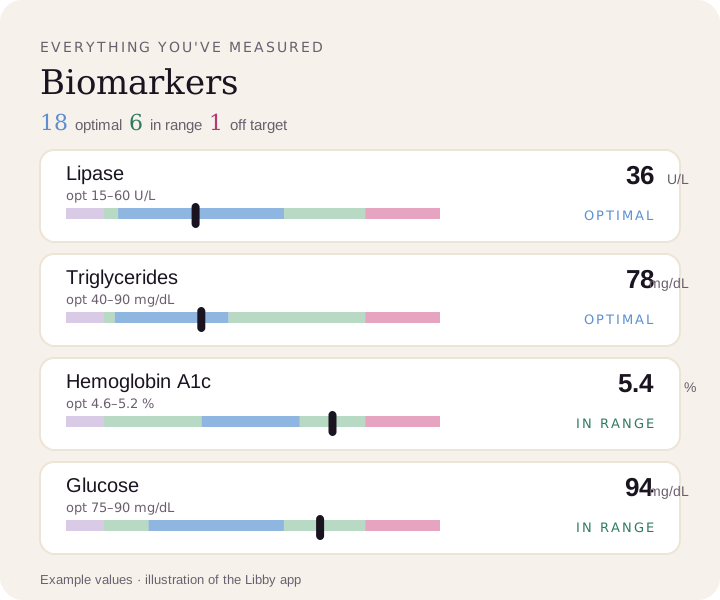
Compare your results to optimal ranges.
Upload a lab PDF or a photo of your report. Libby puts every marker on your lab's range and, where one exists, the optimal range, and tracks your trends over time.
View your lipase ›