Monocyte percentage: what a high or low result means
Monocyte percentage is the share of your white cells that are monocytes. Here's the normal range, why it can run high while the count is fine, and when to act.
Your monocyte percentage is the share of your white blood cells that are monocytes, about 5 in every 100 in a typical adult.1 Because it's a share, it moves when your monocytes change and also when any other white cell changes. That's why it reads best next to your absolute monocyte count, the actual number of monocytes in your blood.23
The short version
- Normal: check the range on your report. Textbooks put monocytes at 2–8% of white cells.1 The CDC's national survey lab uses 4.4–13.5% for men and 3.8–11.6% for women aged 19–65.4 The optimal range in the Libby app is 4–8%.5
- High percentage, normal count: another white cell is usually low. A common time to see it is recovery: after chemotherapy, monocytes start climbing back about 2 days before neutrophils do.6
- High percentage and high count: usually a recent infection or inflammation. The usual step is to repeat the test once you're well.7 Specialists look closer when monocytes stay at 10% or more and 0.5 × 10⁹/L or more for months.8
- The key distinction: the percentage is a share and the absolute count is a number. Specialists use the two together, and a flagged percentage with a normal count is often about your other white cells.83
What monocyte percentage is
Monocytes are one of the five main kinds of white blood cell. They kill germs, boost the immune response and clear away dead cells.2 A blood differential sorts your white cells into those five kinds and reports each one as a percentage, an absolute count, or both.2
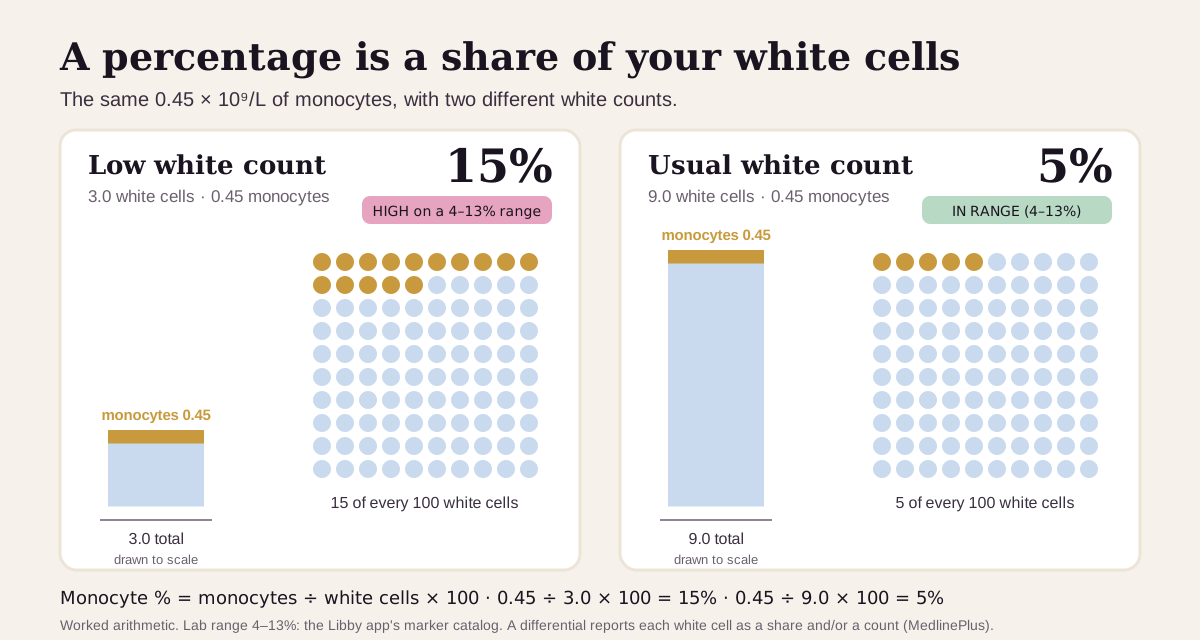
The percentage answers "what share of my white cells are monocytes?" The absolute count answers "how many monocytes are in each microliter of blood?" One formula ties them together:
Monocyte % = absolute monocytes ÷ white blood cells × 100
So a monocyte percentage can rise for two reasons: more monocytes, or fewer of everything else. MedlinePlus puts it plainly: a rise in one kind of white cell lowers the percentages of the others.3 Neutrophils make up the biggest share, 40–60% by MedlinePlus's figures, so they move the monocyte percentage most;3 the neutrophil percentage guide covers that side of the see-saw.
What's a normal monocyte percentage?
Start with the range printed on your own report. Ranges differ by lab, analyzer, age and sex, and pregnancy shifts them.49
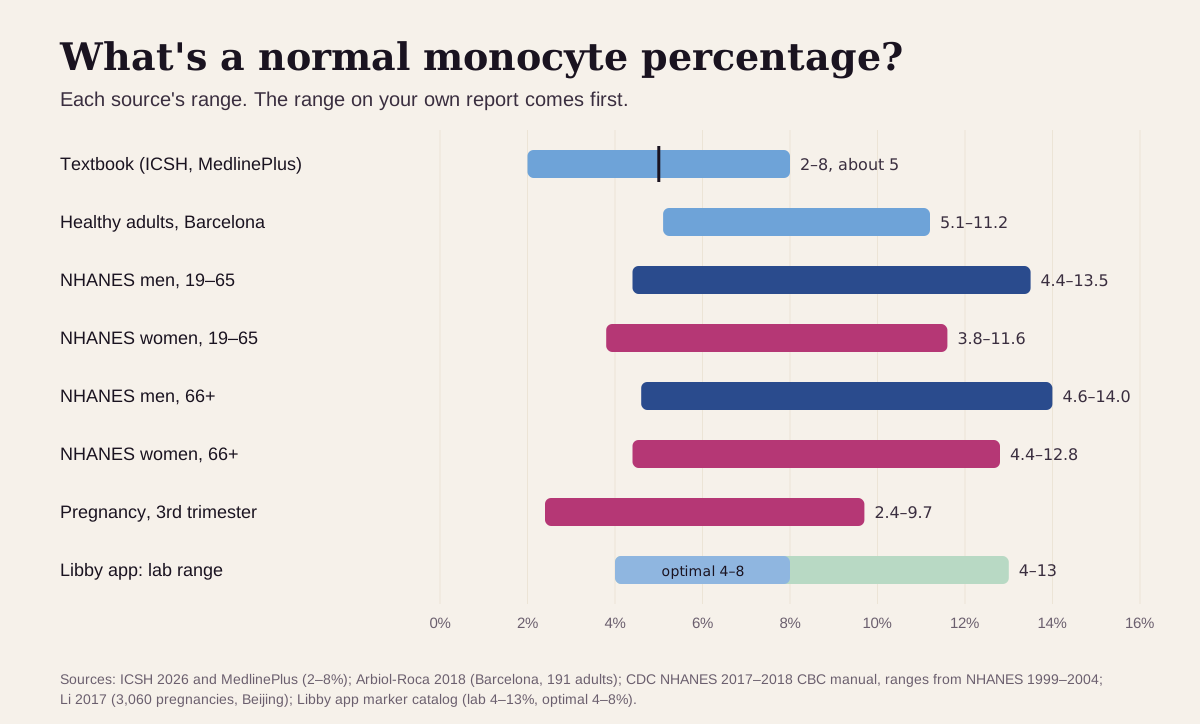
- Textbooks: monocytes make up about 5% of white cells, usually 2–8%, according to the International Council for Standardization in Haematology (ICSH).1 MedlinePlus gives the same 2–8%.3
- U.S. survey ranges: the CDC's NHANES laboratory uses 4.4–13.5% for men and 3.8–11.6% for women aged 19–65, and 4.6–14.0% and 4.4–12.8% from age 66. These are the middle 95% of results from NHANES 1999–2004.4
- Healthy adults on a modern analyzer: in 191 healthy adults in Barcelona, the range was 5.1–11.2%, with one range for men and women.10
- Pregnancy: in 3,060 healthy pregnancies in Beijing, the range was 2.4–9.7% by the third trimester.9
Modern lab ranges run higher at the top than the textbook 8%. That's one reason the same 10% can be flagged on one report and pass on another.
"Optimal" monocyte percentage: what health optimizers aim for
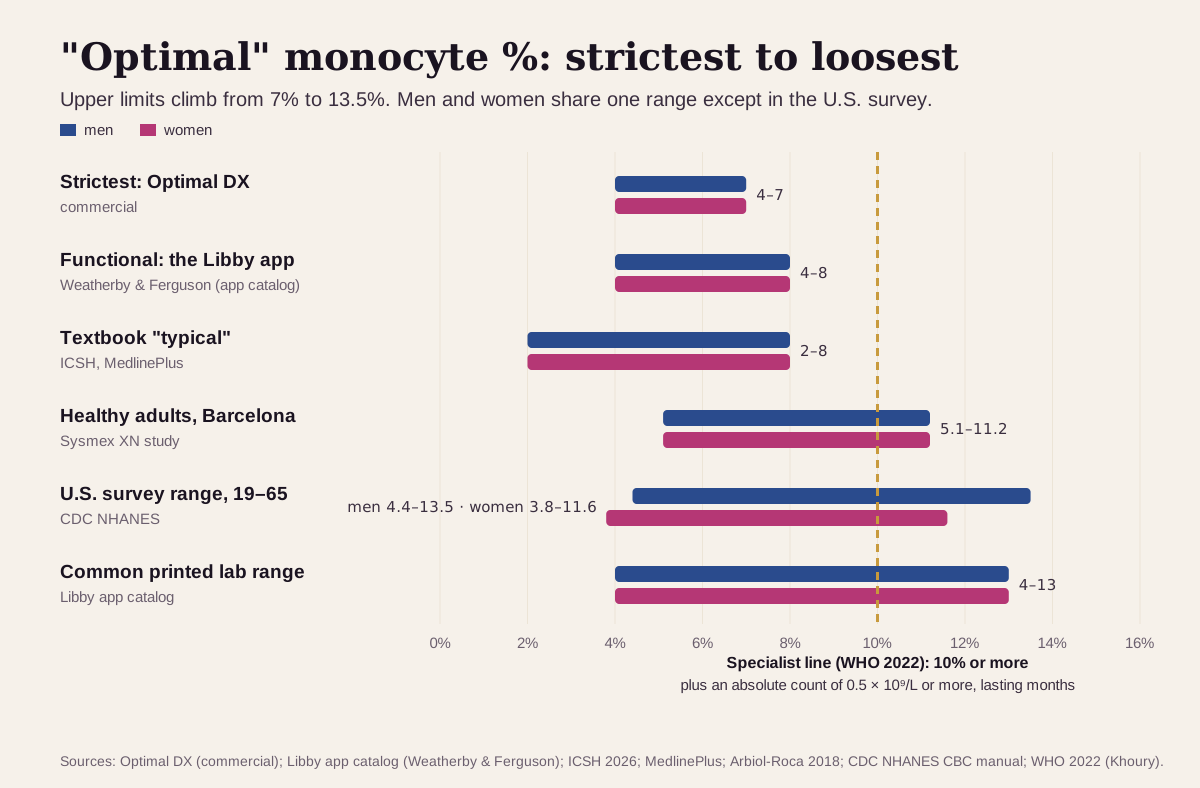
Functional-medicine practitioners aim for the lower half of the lab range. Here's the full ladder, from strictest to loosest:
| Target | Men | Women | Who uses it |
|---|---|---|---|
| Strictest (functional-medicine software) | 4–7% | 4–7% | Optimal DX, a functional blood-chemistry software company tied to textbook author Dicken Weatherby11 |
| Functional medicine | 4–8% | 4–8% | The optimal range shown in the Libby app, whose catalog credits it to the Weatherby & Ferguson textbook5 |
| Textbook "typical" | 2–8% | 2–8% | ICSH and MedlinePlus13 |
| Healthy adults, modern analyzer | 5.1–11.2% | 5.1–11.2% | Barcelona reference study10 |
| U.S. survey range (ages 19–65) | 4.4–13.5% | 3.8–11.6% | CDC NHANES laboratory4 |
| Common printed lab range | 4–13% | 4–13% | The lab range in the Libby app's catalog; Optimal DX lists the same "standard range"11 |
| Specialist line | 10% or more, with 0.5 × 10⁹/L or more, lasting months | same | WHO 2022 entry criterion for CMML, a rare blood cancer; the diagnosis also needs marrow or genetic findings8 |
What the evidence behind lower targets actually measured:
- Heart risk tracks the absolute count. In the EPIC-NL study of 14,362 Dutch adults followed for 11.4 years, a monocyte count of 0.8 × 10⁹/L or more carried 1.48 times the cardiovascular risk of a count of 0.2–0.8.13
- The share on its own carried no clear signal. When the same researchers looked at monocytes relative to the total white count, which is what a percentage does, the link lost statistical significance.13
- The percentage matters most at the top. The WHO requires monocytes of 10% or more together with an absolute count of 0.5 × 10⁹/L or more before specialists consider CMML.8
Keep "optimal" in perspective. A 9% with a normal absolute count and a normal white count sits above the app's optimal band, yet the number of monocytes is ordinary; the other white cells set the share. The number to watch over time is the absolute count, with the percentage as its companion.138
What a high monocyte percentage usually means
Your absolute count is the first clue. Read it on the same report, or multiply your white count by your monocyte percentage and divide by 100. Then find your box:
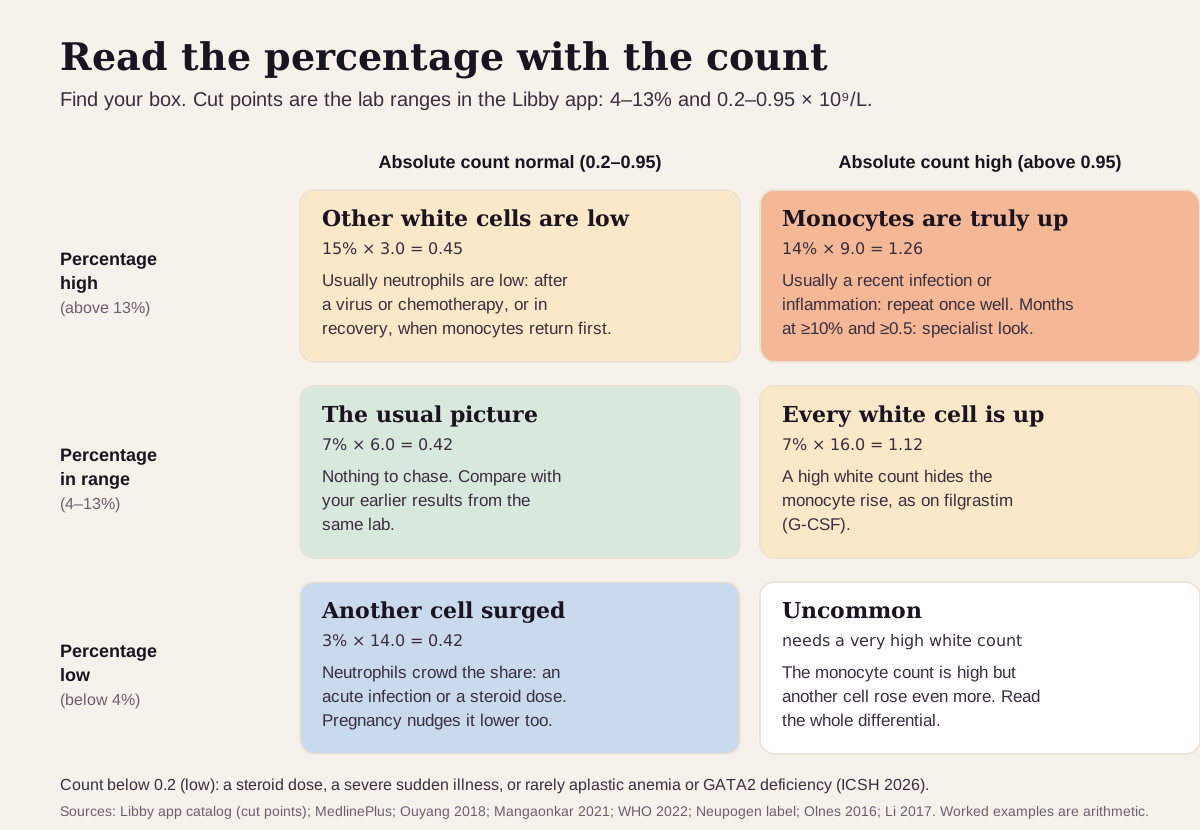
High percentage, normal count: the other white cells are low
This pattern is usually about neutrophils:
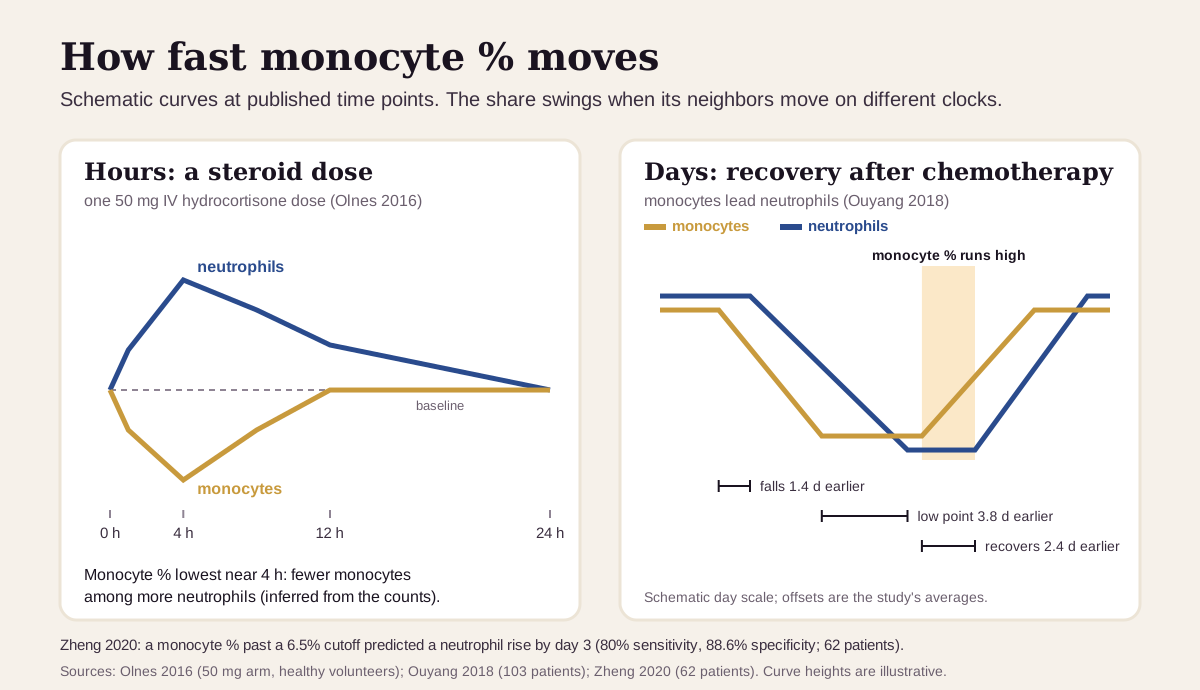
- Recovery. After chemotherapy, monocytes lead neutrophils back. In 103 patients, monocytes hit their low point 3.8 days earlier than neutrophils and started climbing 2.4 days earlier.6 In another study of 62 patients with very low neutrophils, a monocyte percentage past a 6.5% cutoff predicted that neutrophils would start rising by the third day (80% sensitivity, 88.6% specificity).16 In that window, a rising monocyte percentage is a sign that neutrophils are about to follow.
- Illnesses and medicines that lower neutrophils. The flu and other viral infections, and chemotherapy, lower the neutrophil percentage, which lifts the others.3
- After an acute infection. A monocyte result taken during or just after an illness is hard to read. Mayo Clinic specialists advise repeating the count once the acute inflammation has passed.7
High percentage and high count: monocytes are truly up
- A recent infection or inflammation. In one Swiss emergency department, more than a quarter of patients had a high monocyte count, most often those with infections or breathing illnesses. Again, the practical step is to repeat it once you're well.7
- Other reactive causes: viral and parasitic infections, tuberculosis, autoimmune disease, trauma, cigarette smoking and some medicines.13
- Rare but important: a rise that lasts. When monocytes stay at 10% or more of white cells and 0.5 × 10⁹/L or more with no clear cause, specialists look for a clonal marrow condition such as CMML.8 In one study, gene changes turned up in 79% of people whose monocytosis had lasted more than 2 years.1
Normal percentage, high count: everything is up
A normal percentage can hide a high absolute count when your whole white count is up. On filgrastim (G-CSF, a white-cell booster), monocyte counts rise with the dose while the percentage stays in the normal range, because neutrophils and the total white count rise too.14
Get prompt care if a high monocyte result comes with recurrent fevers, night sweats, weight loss you can't explain, bone pain or an enlarged spleen, or if your report also shows anemia or low platelets.7 A report that flags blasts or other abnormal cells goes to a pathologist, and labs phone the most serious findings straight to your clinician.17
What a low monocyte percentage usually means
A low or falling percentage usually means another white cell surged:
- An acute infection, inflammation or acute stress raises neutrophils, which shrinks every other share.3
- A steroid dose. In healthy volunteers given one 50 mg dose of intravenous hydrocortisone, neutrophils peaked at 4 hours while monocytes hit their low point, so the monocyte share fell from both sides. Monocytes were back by 12 hours and neutrophils by 24.15
- Pregnancy. In the Beijing study, the median monocyte percentage was 5.3% in pregnancy versus 6.3% in nonpregnant women, even though the median absolute count was higher (0.50 vs 0.36 × 10⁹/L).9
- Rare: monocytes that stay low on repeat tests, as with aplastic anemia or the inherited condition GATA2 deficiency.1
Monocyte percentage reads best next to its neighbors
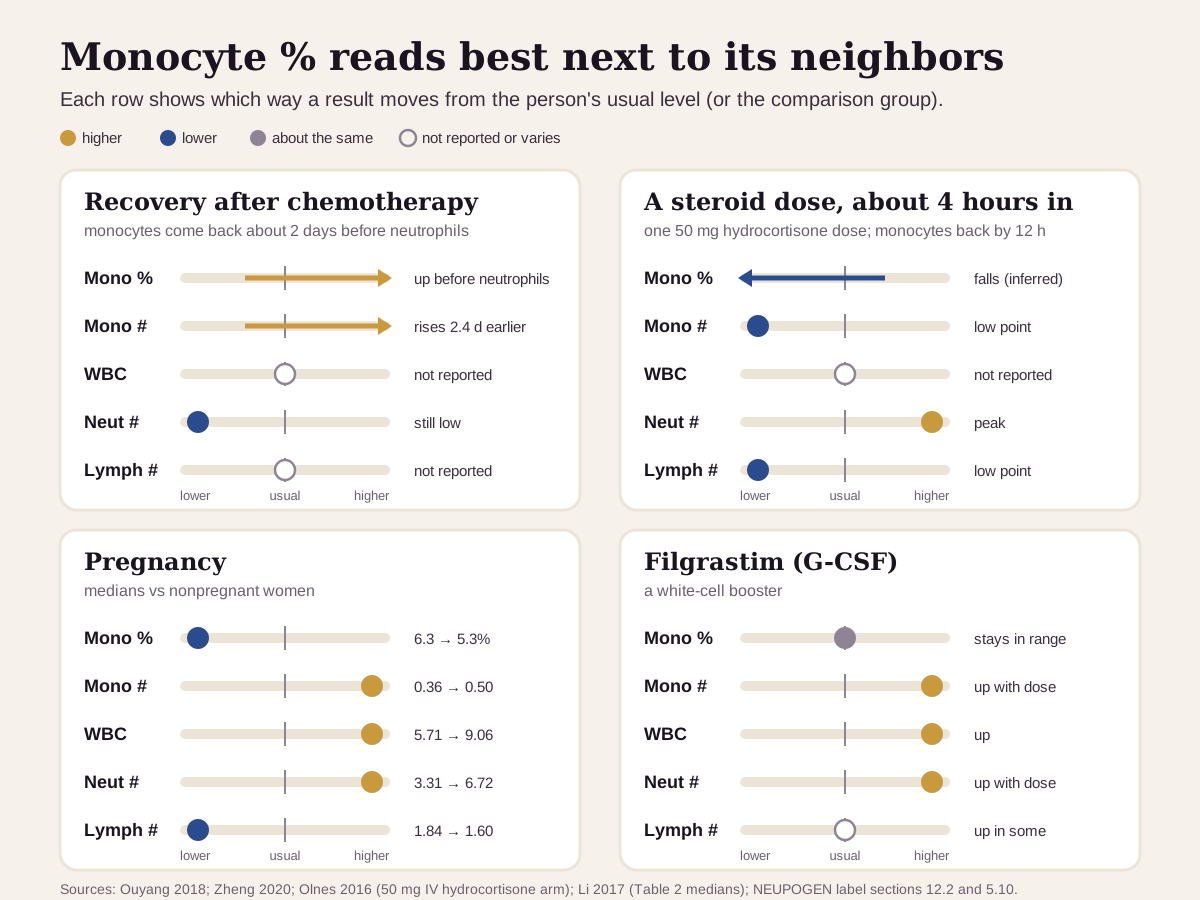
The pattern across your white-cell results says more than the percentage alone. Here are four common ones, each read across the same five results:
| If you see… | It often points to… |
|---|---|
| Monocyte % and count climbing while neutrophils are still low | marrow recovery, for example after chemotherapy: monocytes lead neutrophils back by about 2 days616 |
| Monocyte % and count down, neutrophils up, lymphocytes down | a single steroid dose in the past day; after 50 mg of hydrocortisone, monocytes were back by 12 hours and neutrophils by 2415 |
| Monocyte % down while the monocyte count, white count and neutrophils are up and lymphocytes are down | pregnancy9 |
| Monocyte % normal while the monocyte count, white count and neutrophils are up | G-CSF (filgrastim) treatment14 |
How fast monocyte percentage changes
The percentage moves as fast as its fastest neighbor. Monocytes last only 1 to 3 days in the blood,1 and neutrophils can peak within 4 hours of a steroid dose,15 so the share can swing within a day.
What that means in practice:
- Hours: a steroid dose moves neutrophils and monocytes in opposite directions. Mention recent steroids when you get tested.15
- Days: recovery after chemotherapy. A high percentage while neutrophils climb back is expected.616
- Months: a persistent rise. The older WHO definition of persistent monocytosis used 3 months.7
- Small moves are within the machine's margin. In the CDC's NHANES lab, the analyzer passes its repeatability check if 10 runs of the same blood land within 3.2 percentage points of each other for monocytes.4 A shift from 6% to 8% on its own sits inside that allowance.
- Trends beat snapshots. Compare results from the same lab, and read the percentage and absolute count together each time.
Going deeper: how the analyzer gets to a percentage
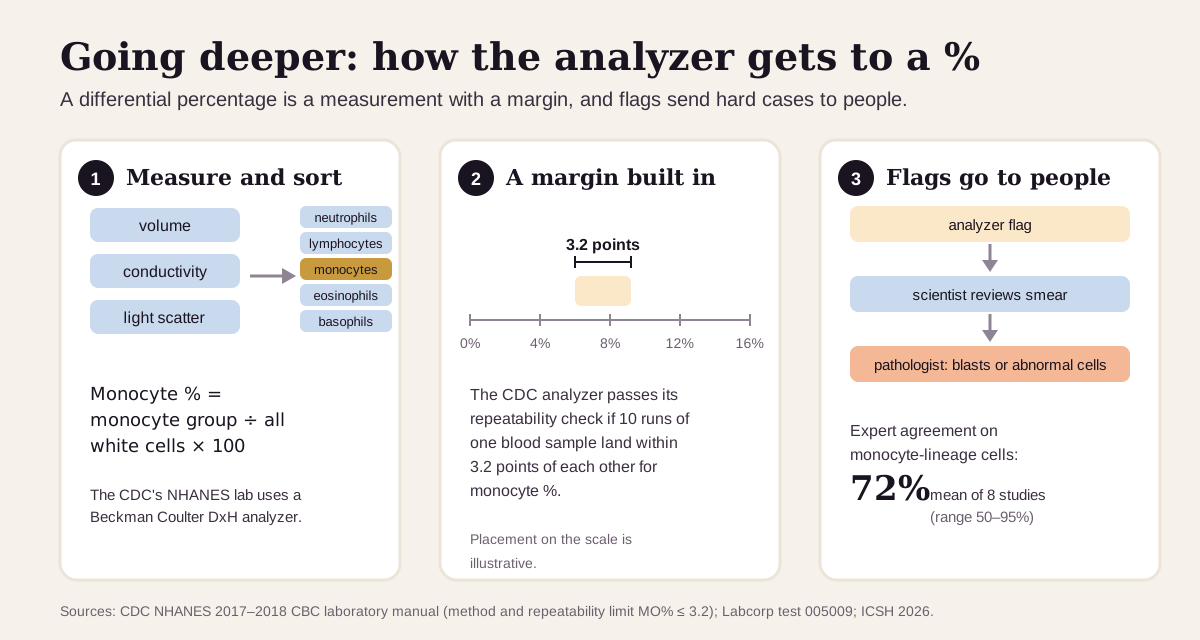
Most labs count the differential on an automated analyzer. The CDC's NHANES analyzer, a Beckman Coulter DxH, measures three things about every white cell that passes its sensor: volume, electrical conductivity and light scatter. It sorts each cell into one of five groups from those signals.4 Your monocyte percentage is the monocyte group's share of the total.
When the machine meets cells it can't sort cleanly, it flags the sample. At Labcorp, a large commercial lab, a flag sends the sample to a laboratory scientist for a smear review, and abnormal cells such as blasts go on to a pathologist.17 Human review has its own spread: across eight studies, experts agreed on monocyte-lineage cells 72% of the time on average, from 50% to 95%.1
Put together, a differential percentage is an estimate with a margin. That's why specialists pair it with the absolute count and a repeat test before acting on a borderline value.87
Questions worth asking
- What's my absolute monocyte count, and is it in range?
- Is my monocyte percentage high because monocytes are up, or because my neutrophils are low?
- Was I sick, recovering, on steroids or on a white-cell booster around the time of the test?
- Should we repeat the blood count once I'm well, and when?
- If it stays high, is it at 10% or more and 0.5 × 10⁹/L or more?
- Would a blood smear review help?
FAQ
What is a normal monocyte percentage? Textbooks give about 2–8% of white cells, and many lab ranges run up to about 13%. Check the range on your own report.14
Why is my monocyte percentage high but my absolute count normal? Usually another white cell, most often neutrophils, is low, so monocytes make up a bigger share. It's common while recovering from an illness or chemotherapy.36
Is a high monocyte percentage after an infection normal? It's common. Infections raise monocytes, and a result taken during or soon after an illness is hard to read. The usual step is to repeat the count once you've recovered.71
Can a high monocyte percentage mean leukemia? Rarely. Specialists consider CMML when monocytes stay at 10% or more and 0.5 × 10⁹/L or more for months, together with marrow or genetic findings.8
This guide is for education. It can't diagnose you or replace care from a clinician who knows your history.
Footnotes
-
Zini G, Chang YH, d'Onofrio G, et al. ICSH Recommendations for Monocyte Cell Lineage Morphologic Identification, Nomenclature Harmonization, and Utilization as a Biomarker. Int J Lab Hematol. 2026;48(1):12–25. The international hematology standards council's review: monocytes about 5% (2–8%) of blood white cells, a 1–3 day blood lifespan, reactive causes, the ≥10% and ≥0.5 × 10⁹/L criteria, and expert agreement on monocytic cells. PMC ↩ ↩2 ↩3 ↩4 ↩5 ↩6 ↩7 ↩8 ↩9 ↩10 ↩11 ↩12 ↩13 ↩14
-
National Library of Medicine. Blood Differential. MedlinePlus. What monocytes do, and that a differential reports each white cell as an amount and/or a percentage. MedlinePlus ↩ ↩2 ↩3
-
National Library of Medicine. Blood differential test. MedlinePlus Medical Encyclopedia. Reviewed February 3, 2025. Monocytes 2% to 8%; a rise in one white cell lowers the percentages of the others; causes of a high monocyte percentage and a low neutrophil percentage. MedlinePlus ↩ ↩2 ↩3 ↩4 ↩5 ↩6 ↩7 ↩8 ↩9 ↩10 ↩11 ↩12 ↩13
-
National Center for Health Statistics. Complete Blood Count Laboratory Procedure Manual, NHANES 2017–2018. Centers for Disease Control and Prevention. Tables 6-5 and 6-6 (monocyte percent reference ranges by sex and age, from NHANES 1999–2004), the analyzer's volume, conductivity and light-scatter method, and the repeatability limit for monocyte percent. CDC ↩ ↩2 ↩3 ↩4 ↩5 ↩6 ↩7 ↩8 ↩9 ↩10
-
Weatherby D, Ferguson S. Blood Chemistry and CBC Analysis: Clinical Laboratory Testing from a Functional Perspective. 2nd ed. Bear Mountain Publishing; 2004. ISBN 978-0976136712. Widely used functional-medicine reference. The Libby app's marker catalog credits its 4–8% optimal range for monocyte percentage to this book and uses 4–13% as the lab range (ranges as recorded in the app's catalog; book not opened for this article). Weatherby's own Optimal DX page lists 4–7% as optimal. ↩ ↩2 ↩3 ↩4 ↩5 ↩6
-
Ouyang W, Liu Y, Deng D, Zhou F, Xie C. The change in peripheral blood monocyte count: A predictor to make the management of chemotherapy-induced neutropenia. J Cancer Res Ther. 2018;14(Suppl):S565–S570. 103 patients; monocytes fell 1.39 days, bottomed out 3.81 days and recovered 2.36 days earlier than neutrophils. PubMed ↩ ↩2 ↩3 ↩4 ↩5 ↩6 ↩7 ↩8
-
Mangaonkar AA, Tande AJ, Bekele DI. Differential Diagnosis and Workup of Monocytosis: A Systematic Approach to a Common Hematologic Finding. Curr Hematol Malig Rep. 2021;16(3):267–275. A Mayo Clinic review: marrow recovery and acute infections as transient causes, the advice to repeat the count once acute inflammation resolves, warning signs, and the older 3-month WHO definition. PMC ↩ ↩2 ↩3 ↩4 ↩5 ↩6 ↩7 ↩8
-
Khoury JD, Solary E, Abla O, et al. The 5th edition of the World Health Organization Classification of Haematolymphoid Tumours: Myeloid and Histiocytic/Dendritic Neoplasms. Leukemia. 2022;36(7):1703–1719. CMML's first prerequisite: persistent absolute (≥0.5 × 10⁹/L) and relative (≥10%) monocytosis. PMC ↩ ↩2 ↩3 ↩4 ↩5 ↩6 ↩7 ↩8 ↩9
-
Li A, Yang S, Zhang J, Qiao R. Establishment of reference intervals for complete blood count parameters during normal pregnancy in Beijing. J Clin Lab Anal. 2017;31(6):e22150. 3,060 healthy pregnancies and 483 nonpregnant women; median monocyte percentage 5.3% vs 6.3% while the median count rose from 0.36 to 0.50 × 10⁹/L. PMC ↩ ↩2 ↩3 ↩4 ↩5 ↩6 ↩7
-
Arbiol-Roca A, Imperiali CE, Montserrat MM, et al. Reference intervals for a complete blood count on an automated haematology analyser Sysmex XN in healthy adults from the southern metropolitan area of Barcelona. EJIFCC. 2018;29(1):48–54. 191 healthy adults; monocytes 5.1–11.2%, one range for both sexes. PMC ↩ ↩2 ↩3 ↩4
-
Optimal DX. Biomarkers of Immunity: Monocytes. Published July 12, 2023; updated November 2, 2023. Lists a "standard range" of 4.00–13.00% and an ODX optimal range of 4.00–7.00% for monocytes. A commercial source, listed as what the optimizer community uses. optimaldx.com ↩ ↩2 ↩3
-
Superpower. Monocytes (percent of white blood cells). Last updated September 1, 2026. Describes normal as 2% to 8% with optimal in "the mid to lower portion of the reference range" and publishes no exact cutoff. A commercial source, listed as what the optimizer community uses. superpower.com ↩
-
Lassale C, Curtis A, Abete I, et al. Elements of the complete blood count associated with cardiovascular disease incidence: Findings from the EPIC-NL cohort study. Sci Rep. 2018;8(1):3290. 14,362 adults; monocytes of 0.8 × 10⁹/L or more carried a hazard ratio of 1.48, and the link lost significance once expressed relative to total white count. PMC ↩ ↩2 ↩3
-
Amgen. NEUPOGEN (filgrastim) prescribing information, section 12.2, revised July 2026. The absolute monocyte count rose with the dose "however, the percentage of monocytes in the differential count remained within the normal range." DailyMed ↩ ↩2 ↩3 ↩4
-
Olnes MJ, Kotliarov Y, Biancotto A, et al. Effects of Systemically Administered Hydrocortisone on the Human Immunome. Sci Rep. 2016;6:23002. 20 healthy volunteers given 50 or 250 mg: neutrophils peaked at 4 hours and returned by 24; after 50 mg, monocytes bottomed out at 4 hours and returned by 12. PMC ↩ ↩2 ↩3 ↩4 ↩5 ↩6 ↩7
-
Zheng B, Huang Z, Huang Y, Hong L, Li J, Wu J. Predictive value of monocytes and lymphocytes for short-term neutrophil changes in chemotherapy-induced severe neutropenia in solid tumors. Support Care Cancer. 2020;28(3):1289–1294. 62 patients; a 6.5% monocyte-percentage cutoff predicted a neutrophil rise on the third day (sensitivity 80%, specificity 88.6%). PubMed ↩ ↩2 ↩3 ↩4 ↩5
-
Labcorp. Complete Blood Count (CBC) With Differential/Reflex to Peripheral Smear Review, test 005009. Updated July 16, 2026. How analyzer flags lead to smear and pathologist review and critical-value calls. A commercial laboratory's test page. labcorp.com ↩ ↩2 ↩3
Educational content, not medical advice. Libby is a personal record tool, not a medical service — it doesn't diagnose, treat, or prescribe. Reference ranges vary by lab and by person. Talk to a qualified healthcare professional about your results.
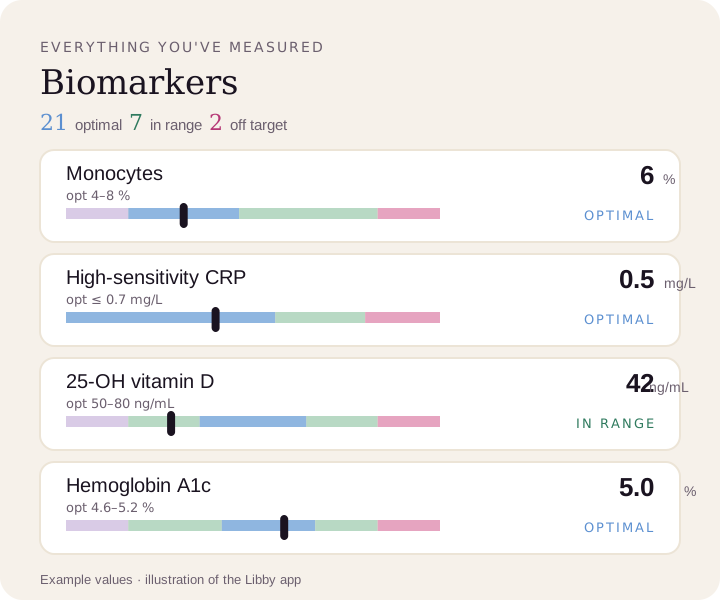
Compare your results to optimal ranges.
Upload a lab PDF or a photo of your report. Libby puts every marker on your lab's range and the optimal range, and tracks your trends over time.
View your monocyte percentage ›