Total and non-HDL cholesterol: normal and optimal levels
Total cholesterol counts it all; non-HDL counts the part that builds plaque. Normal and optimal levels, common causes of high results, and how to read them.
Total cholesterol is all the cholesterol in your blood. Non-HDL cholesterol is that total minus your HDL ("good") cholesterol: the cholesterol carried by LDL and the other particles that can build plaque in your arteries. Your lab gets it by simple subtraction. It tracks heart risk better than total cholesterol, and in people on statins it tracked risk slightly better than LDL did.123
The short version
- Normal: for adults, the U.S. desirable levels are total cholesterol under 200 mg/dL and non-HDL under 130 mg/dL. For people 19 and younger they're under 170 and under 120.45
- High is common. A total of 240 or more counts as high, and about 1 in 9 U.S. adults is there.56 The usual reasons are diet, extra weight, insulin resistance and the genes you inherited; less often an underactive thyroid, kidney disease or a medicine.45
- Very high (non-HDL 220 or more, or LDL 190 or more) often means an inherited condition such as familial hypercholesterolemia. See a clinician soon, and your close relatives should get tested too.15
- Read the two together. A high total with a normal non-HDL usually means your HDL is high. A high non-HDL is the number linked to heart attacks and strokes.47
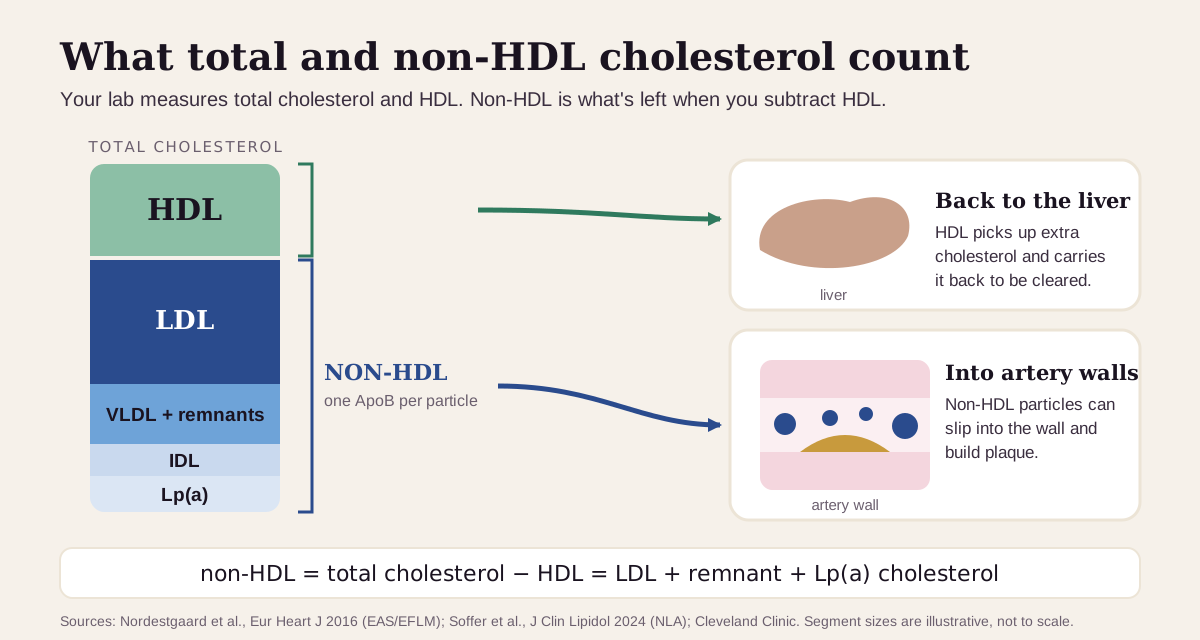
What total and non-HDL cholesterol are
Cholesterol is a waxy fat your body uses to build cell walls and hormones. It travels through your blood inside particles called lipoproteins, and your lipid panel sorts them into two families.4
- HDL (high-density lipoprotein) picks up extra cholesterol and carries it back to your liver. That's why it's called "good" cholesterol.9
- Everything else carries cholesterol out into the body: LDL, VLDL, IDL, the leftover "remnants" of triglyceride-rich particles, and Lp(a). Each of these particles carries exactly one ApoB protein, and each can push cholesterol into an artery wall.89
Total cholesterol adds up both families. Non-HDL cholesterol keeps only the second one:
non-HDL = total cholesterol − HDL
Labs measure total cholesterol, HDL and triglycerides directly, so non-HDL costs nothing extra.1 It's the same as LDL cholesterol plus the cholesterol in remnants and Lp(a).1 That's its advantage: when triglycerides run high, extra cholesterol rides in VLDL and remnants that the LDL number misses. U.S. guidelines made non-HDL a second treatment target for exactly that reason, in people with triglycerides of 200 mg/dL or more.5
What's a normal total and non-HDL cholesterol?
Start with the flag on your own report. Then know this: for cholesterol, "normal" means healthy, not typical. Most lab tests are flagged when they fall outside the middle 95% of a reference group. Lipid experts ask labs to flag cholesterol at the "desirable" levels set by heart guidelines instead, and in much of Europe a typical level is already past that line.1
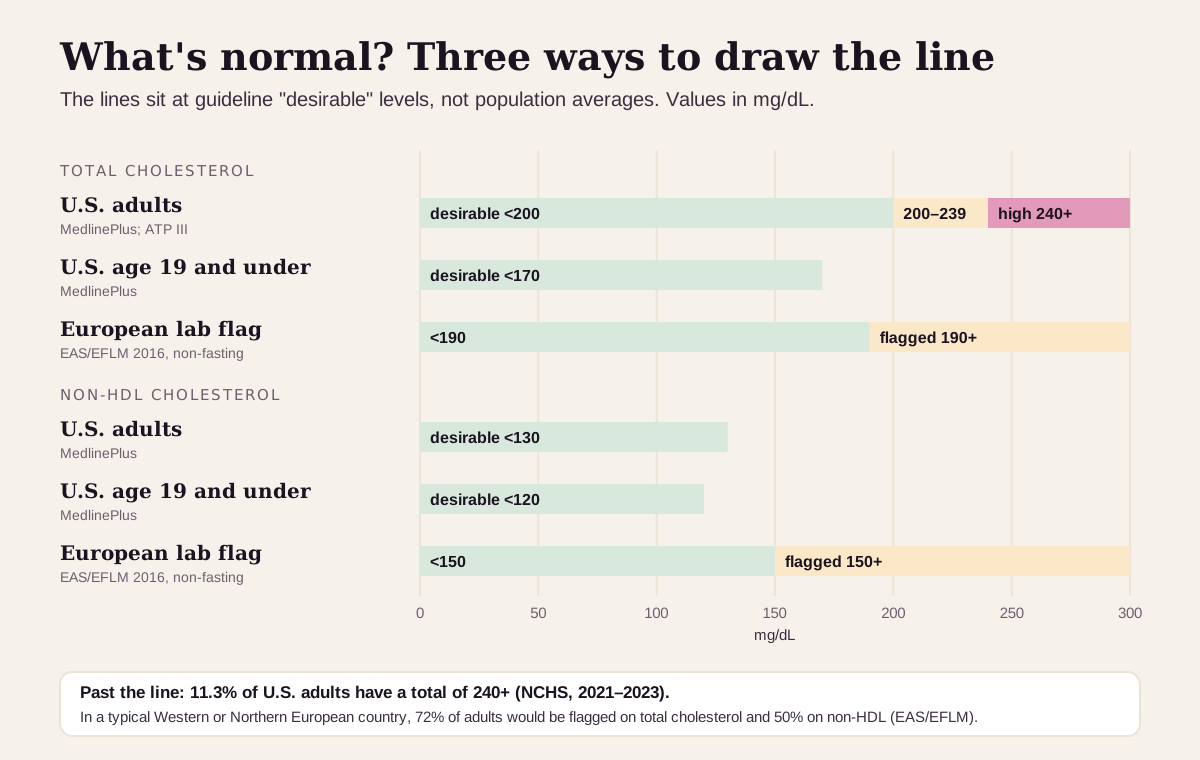
- U.S. desirable levels for adults are a total under 200 mg/dL and a non-HDL under 130 mg/dL. For people 19 and younger they're under 170 and under 120.4 The National Cholesterol Education Program calls a total of 200–239 borderline high and 240 or more high.5 In 2021–2023, 11.3% of U.S. adults had a total of 240 or more.6
- European lab flags draw the lines a little differently: a total of 190 mg/dL or more and a non-HDL of 150 or more on a non-fasting test. In a typical Western or Northern European country, 72% of adults would get a flag on total cholesterol and 50% on non-HDL.1
Men and women differ over a lifetime. Cholesterol tends to rise with age. Between 20 and 39, men are more likely than women to have a high total; after menopause, a woman's risk goes up.4
"Optimal" total and non-HDL cholesterol: what health optimizers aim for
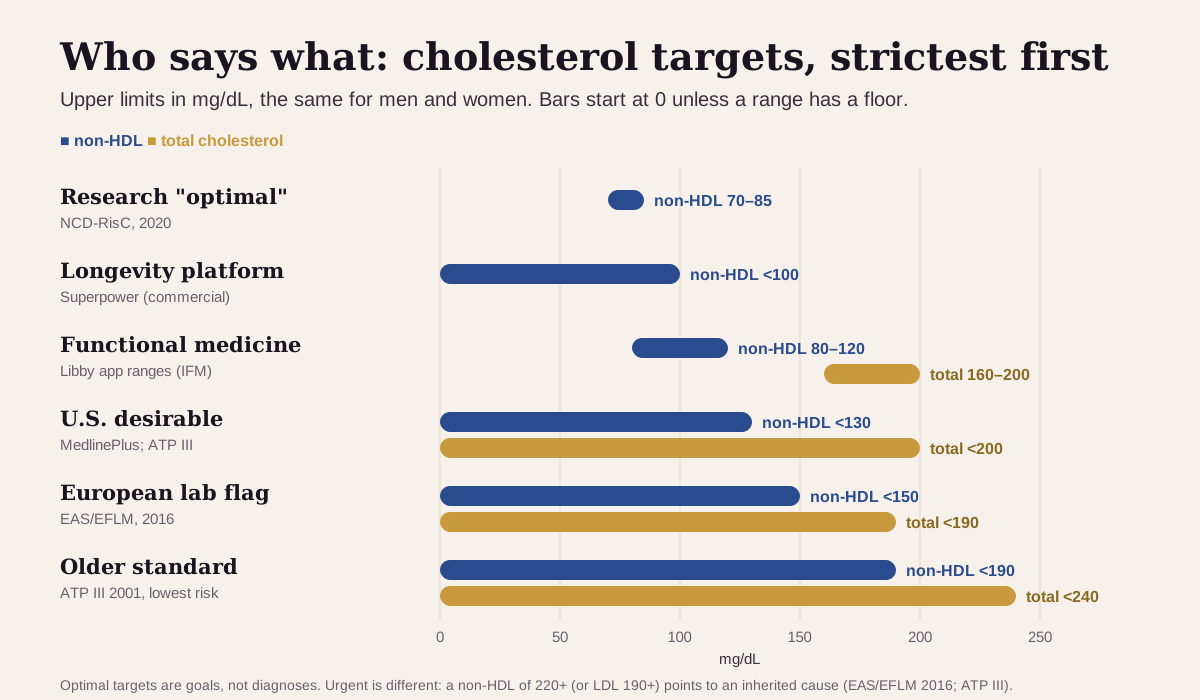
For non-HDL, optimizers and cardiologists agree on the direction: lower is better. They differ on how low to go. Here's the ladder, from strictest to loosest non-HDL target. The targets are the same for men and women.
| Target | Non-HDL | Total cholesterol | Who uses it |
|---|---|---|---|
| Research "optimal" | 70–85 mg/dL | no separate target | The level the NCD Risk Factor Collaboration treats as optimal when it counts deaths caused by cholesterol10 |
| Strictest (longevity platform) | under 100 mg/dL | no separate target | Superpower's guide, for "longevity-focused goals"11 |
| Functional medicine | 80–120 mg/dL | 160–200 mg/dL | The optimal ranges shown in the Libby app, whose catalog credits them to the Institute for Functional Medicine12 |
| U.S. desirable | under 130 mg/dL | under 200 mg/dL | MedlinePlus and the National Cholesterol Education Program (ATP III)45 |
| European lab flag | under 150 mg/dL | under 190 mg/dL | EAS/EFLM, on a non-fasting test1 |
| Older standard | under 190 mg/dL | under 240 mg/dL | ATP III's non-HDL goal for people with 0–1 risk factors; 240 is where a total counts as high5 |
| Urgent | 220 mg/dL or more | not used | See a clinician soon: a clue to an inherited or secondary cause15 |
Your own goal depends on your risk. For people already at high risk, such as those with heart disease or diabetes, U.S. guidelines as summarized by the National Lipid Association act on a non-HDL above 100 mg/dL, and above 85 at very high risk.8
Why the low targets hold up:
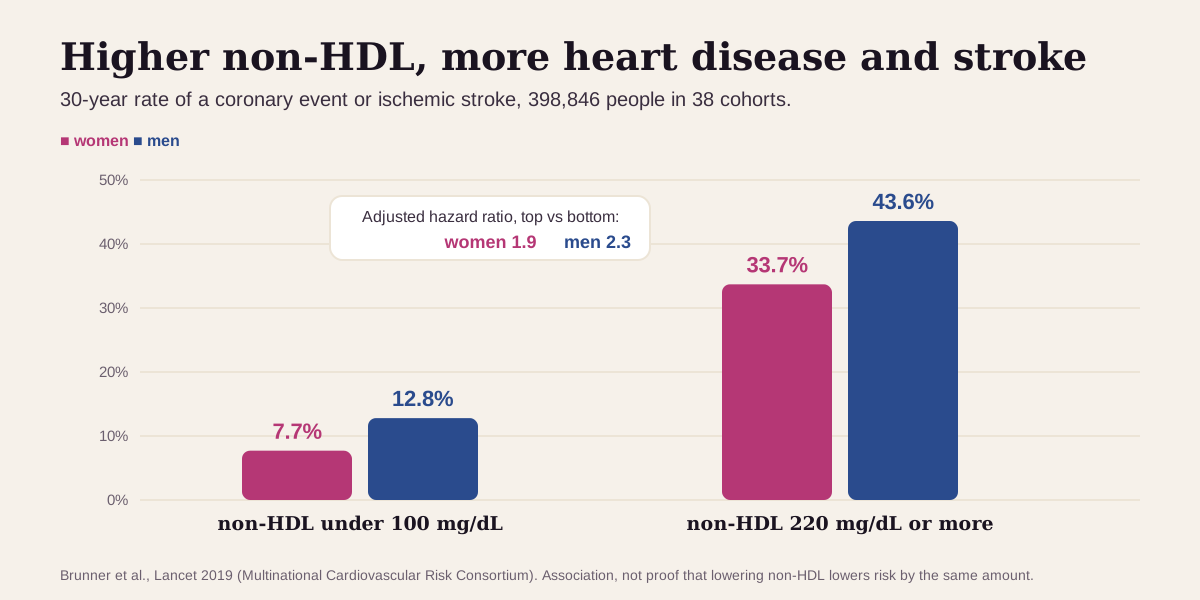
- In 398,846 people from 38 cohorts, followed for up to 43 years, the 30-year rate of a coronary event or ischemic stroke climbed from 7.7% to 33.7% in women and from 12.8% to 43.6% in men between a non-HDL under 100 and one of 220 or more. Only 5.1% of the participants were under 100.7
- In almost 900,000 adults, each 39 mg/dL (1 mmol/L) lower total cholesterol went with about half the risk of dying of heart disease at ages 40–49, a third less at 50–69 and a sixth less at 70–89, with no threshold where the benefit stopped.2
- Worldwide, high non-HDL cholesterol caused an estimated 3.9 million deaths in 2017, a third of all deaths from coronary heart disease and ischemic stroke.10
Keep "optimal" in perspective: these are targets, not diagnoses. A non-HDL of 145 is a reason to look at your diet, weight, blood sugar and family history. The app's functional band for total cholesterol has a floor: a total under 160 shows as in range, not optimal.12 Lower isn't better for everything, either. In the same 900,000 adults, at ages 70–89 and in people with a systolic blood pressure over about 145, a higher total went with fewer deaths from bleeding strokes.2
What a high total or non-HDL usually means
The size of the rise is the first clue. U.S. guidelines set a non-HDL goal 30 mg/dL above each LDL goal, on the premise that up to 30 mg/dL of VLDL cholesterol is normal. Adding that 30 to the LDL categories gives a scale for non-HDL.5
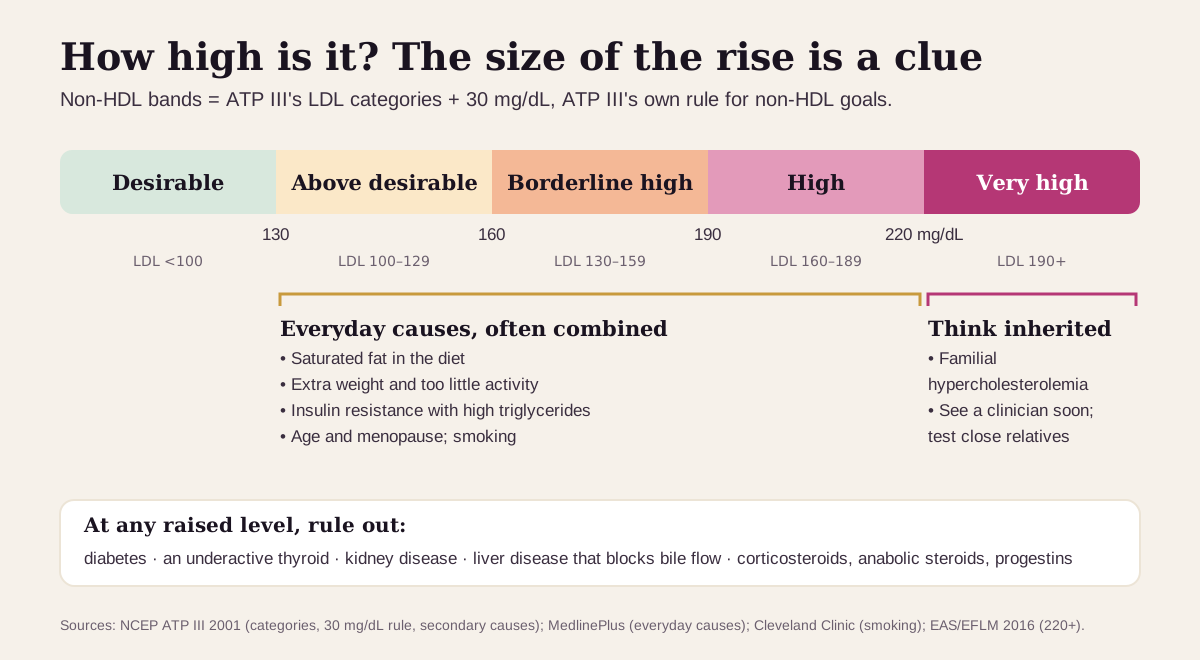
The usual suspects
- Diet. Saturated fat is the main driver. It's high in red meat, full-fat dairy, some baked goods, and fried and processed foods.4
- Extra weight, too little activity and insulin resistance. Weight tends to push cholesterol up. High triglycerides show up most often with the metabolic syndrome, and that pattern raises non-HDL more than it raises LDL.458
- Genes. High cholesterol runs in families.4 The strongest inherited form, familial hypercholesterolemia, affects about 1 in 311 people.13
- Age and menopause. Levels rise with age, and a woman's go up after menopause.4
- Smoking raises non-HDL.9
Less common: other conditions and medicines
Guidelines ask clinicians to check for these before treating a high result: diabetes, an underactive thyroid, liver disease that blocks bile flow, chronic kidney disease, and medicines such as corticosteroids, anabolic steroids and progestins. Estrogens, retinoids and higher doses of beta-blockers mainly raise triglycerides.5 An underactive thyroid slows the liver's LDL clearance. In one study of 8,795 patients, about 1 in 20 of those with high cholesterol had a high TSH.14 Don't stop a prescribed medicine on your own. Bring your full list to your clinician.
Very high (non-HDL 220 or more): think inherited
People with an LDL of 190 mg/dL or more usually have a genetic form of high cholesterol, and family testing is important.5 European lab experts ask labs to refer these results on, and a non-HDL of 220 or more is a clue to an inherited or secondary cause.1
Get care now for chest pain or pressure, shortness of breath, or pain spreading to your arm, back, neck or jaw: call 911, even if you're unsure it's a heart attack.15 See a clinician soon for a non-HDL of 220 or more, an LDL of 190 or more, or triglycerides over 880 mg/dL, which raise the risk of pancreatitis.1
Is a low result a problem?
Usually not, at least for your arteries. The large cohort data found no threshold below which lower total cholesterol stopped tracking lower heart-disease death.2 The one known trade-off is the bleeding-stroke finding in older adults with high blood pressure, above.2
Total and non-HDL read best next to their neighbors
The pattern across your lipid panel usually says more than either number alone:58
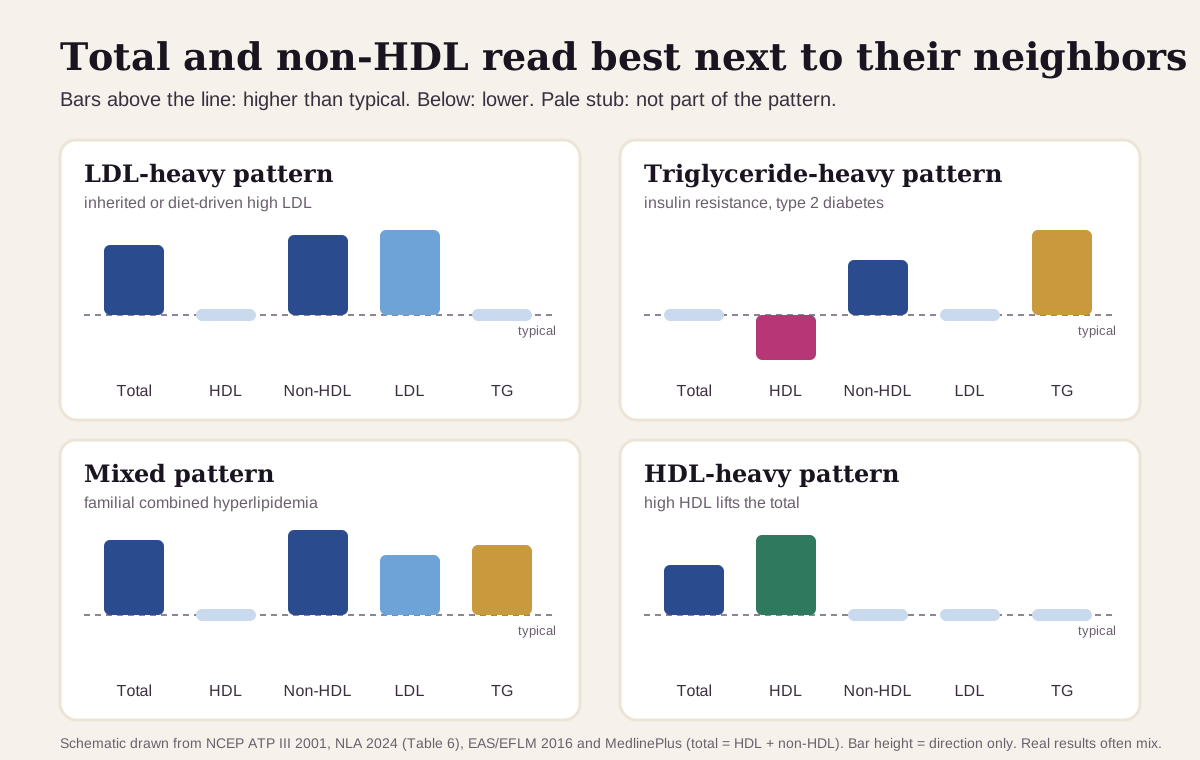
| If you see… | It often points to… |
|---|---|
| Total, non-HDL and LDL up, triglycerides normal | an LDL-heavy pattern: diet and genes; an LDL of 190 or more suggests familial hypercholesterolemia |
| Non-HDL and triglycerides up, HDL low, LDL ordinary or even low | a triglyceride-rich pattern: insulin resistance, extra weight around the middle, high fasting blood sugar or type 2 diabetes |
| Most things up: total, non-HDL, LDL and triglycerides | a mixed pattern, including familial combined hyperlipidemia; also check thyroid, kidneys and medicines |
| Total up only because HDL is high, non-HDL normal | the extra cholesterol is in HDL; your plaque-building cholesterol is where the non-HDL says it is |
When LDL and non-HDL disagree, heart risk usually follows the non-HDL or an ApoB test, which counts the plaque-building particles directly.8
How fast cholesterol changes
Cholesterol moves on three clocks: hours, days and weeks.
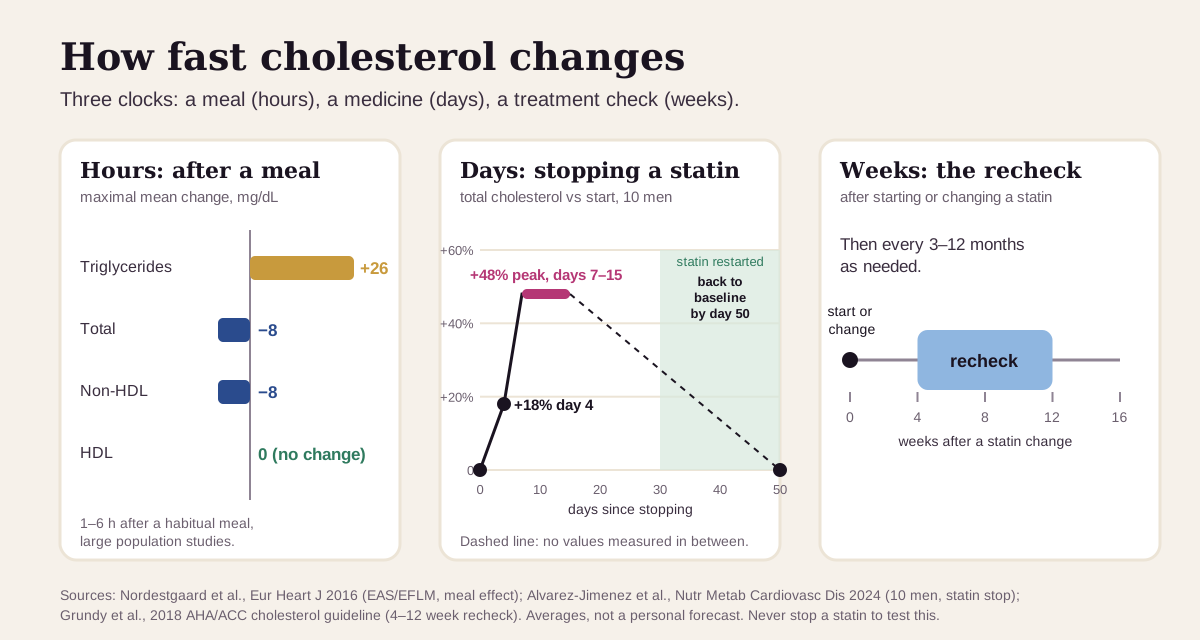
- Hours: a meal barely moves it. In large population studies, total and non-HDL were at most about 8 mg/dL lower 1–6 hours after a normal meal, and triglycerides about 26 higher. The small drop comes from the fluid you drink. Most people can be tested without fasting.1
- Days: medicines work fast. In a small study of 10 men who stopped their statin, total cholesterol was 18% higher by day 4 and 48% higher by days 7–15. It was back to baseline within 20 days of restarting.16 Don't stop a statin to "test" this.
- Weeks: the recheck window. U.S. guidelines recheck lipids 4 to 12 weeks after starting or changing a statin, then every 3 to 12 months as needed.17
- Trends beat snapshots. Note whether each test was fasting: a meal moves triglycerides about three times as much as it moves cholesterol.1
Going deeper: the arithmetic inside your lipid panel
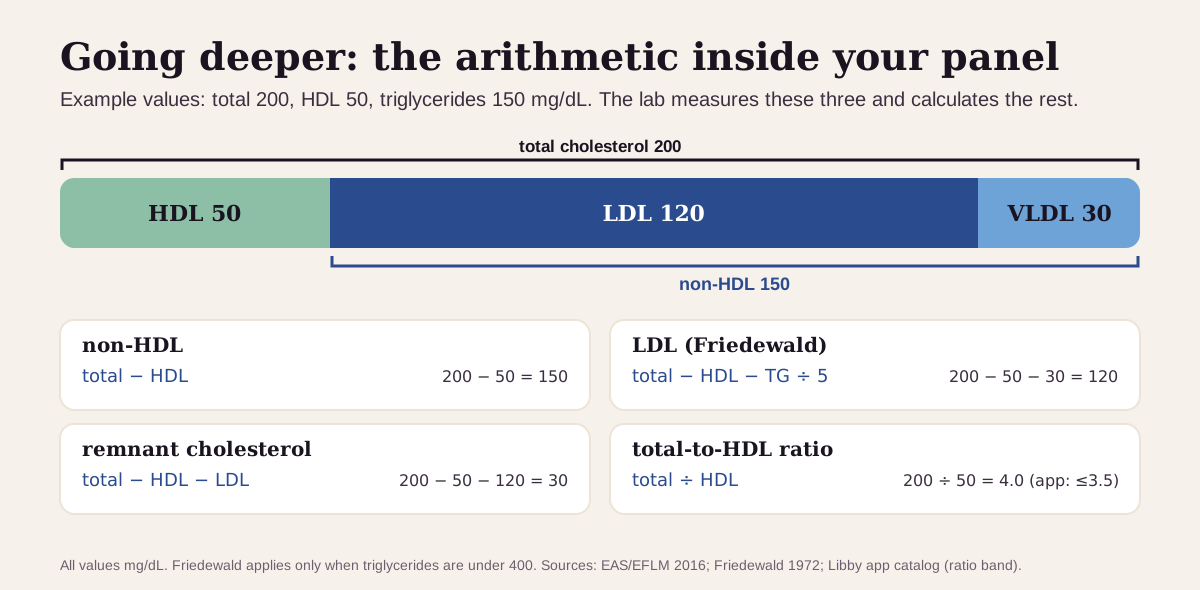
Your lab measures three things (total cholesterol, HDL and triglycerides) and calculates the rest:1
non-HDL = total − HDL
LDL (Friedewald) = total − HDL − triglycerides ÷ 5
The triglycerides ÷ 5 term estimates the cholesterol in VLDL. Newer LDL formulas handle high triglycerides better, because the cholesterol load of VLDL varies.8 Non-HDL skips that estimate entirely.
Remnant cholesterol is total − HDL − LDL: the cholesterol in the triglyceride-rich particles.1 Lp(a) cholesterol (about 30% of Lp(a)'s mass) is counted inside total, non-HDL and LDL alike.1
The total-to-HDL ratio was the single strongest cholesterol predictor of heart-disease death in the 900,000-adult analysis: 40% more informative than non-HDL and more than twice as informative as total cholesterol.2 The Libby app shows it with an optimal band of 3.5 or less.12
ApoB versus non-HDL. Each plaque-building particle carries one ApoB, so ApoB counts particles while non-HDL weighs their cholesterol. With high triglycerides, extra weight or insulin resistance, LDL particles get smaller and carry less cholesterol. Then LDL can look fine while ApoB stays high.8
Questions worth asking
- What is my non-HDL goal, given my own heart risk?
- Is my total high because of my HDL or because of my non-HDL?
- What do my triglycerides and LDL show next to it, and would an ApoB test help?
- Should I be checked for diabetes, thyroid or kidney problems?
- Could this be inherited, and should my family be tested?
- When should we recheck it, and does it need to be fasting?
FAQ
What is a normal non-HDL cholesterol? Under 130 mg/dL for adults and under 120 for people 19 and younger. People at high heart risk usually aim lower.48
Is non-HDL cholesterol better than total cholesterol? For heart risk, yes. Total includes HDL, and in a study of about 900,000 adults, non-HDL and the total-to-HDL ratio both predicted heart-disease death better than total cholesterol did.2
Do I need to fast for a cholesterol test? Usually no. A normal meal lowers total and non-HDL by at most about 8 mg/dL on average. Your clinician may still ask you to fast, for example after a triglyceride result over 440.1
Can my total cholesterol be high while my non-HDL is normal? Yes. Total includes HDL, so a high HDL can push the total over 200 while the plaque-building part stays in range.4
This guide is for education. It can't diagnose you or replace care from a clinician who knows your history.
Footnotes
-
Nordestgaard BG, Langsted A, Mora S, et al. Fasting is not routinely required for determination of a lipid profile: clinical and laboratory implications including flagging at desirable concentration cut-points. A joint consensus statement from the European Atherosclerosis Society and European Federation of Clinical Chemistry and Laboratory Medicine. Eur Heart J. 2016;37(25):1944–1958. The European lab flags, the meal effect, the life-threatening referral levels and the lipid-panel formulas. PMC ↩ ↩2 ↩3 ↩4 ↩5 ↩6 ↩7 ↩8 ↩9 ↩10 ↩11 ↩12 ↩13 ↩14 ↩15 ↩16 ↩17 ↩18 ↩19 ↩20 ↩21 ↩22 ↩23 ↩24
-
Prospective Studies Collaboration, Lewington S, Whitlock G, Clarke R, et al. Blood cholesterol and vascular mortality by age, sex, and blood pressure: a meta-analysis of individual data from 61 prospective studies with 55,000 vascular deaths. Lancet. 2007;370(9602):1829–1839. Almost 900,000 adults. PubMed ↩ ↩2 ↩3 ↩4 ↩5 ↩6 ↩7
-
Boekholdt SM, Arsenault BJ, Mora S, et al. Association of LDL cholesterol, non-HDL cholesterol, and apolipoprotein B levels with risk of cardiovascular events among patients treated with statins: a meta-analysis. JAMA. 2012;307(12):1302–1309. 38,153 statin-treated patients. PubMed ↩
-
National Library of Medicine. Cholesterol Levels: What You Need to Know. MedlinePlus. Updated August 20, 2026. The U.S. desirable levels by age, what total and non-HDL include, and the everyday causes. MedlinePlus ↩ ↩2 ↩3 ↩4 ↩5 ↩6 ↩7 ↩8 ↩9 ↩10 ↩11 ↩12 ↩13 ↩14 ↩15 ↩16 ↩17
-
Expert Panel on Detection, Evaluation, and Treatment of High Blood Cholesterol in Adults. Executive Summary of the Third Report of the National Cholesterol Education Program (NCEP) Expert Panel (Adult Treatment Panel III). JAMA. 2001;285(19):2486–2497. The U.S. total-cholesterol categories, the non-HDL goal of LDL goal + 30 mg/dL, and the list of secondary causes. NHLBI executive summary · At-A-Glance · PubMed ↩ ↩2 ↩3 ↩4 ↩5 ↩6 ↩7 ↩8 ↩9 ↩10 ↩11 ↩12 ↩13 ↩14 ↩15 ↩16 ↩17 ↩18
-
Carroll MD, Fryar CD, Gwira JA, Iniguez M. Total and High-density Lipoprotein Cholesterol in Adults: United States, August 2021–August 2023. NCHS Data Brief No. 515. National Center for Health Statistics; November 2024. CDC ↩ ↩2 ↩3
-
Brunner FJ, Waldeyer C, Ojeda F, et al. Application of non-HDL cholesterol for population-based cardiovascular risk stratification: results from the Multinational Cardiovascular Risk Consortium. Lancet. 2019;394(10215):2173–2183. 398,846 people in 38 cohorts from 19 countries. PMC ↩ ↩2 ↩3
-
Soffer DE, Marston NA, Maki KC, et al. Role of apolipoprotein B in the clinical management of cardiovascular risk in adults: an Expert Clinical Consensus from the National Lipid Association. J Clin Lipidol. 2024;18(5):e647–e663. One ApoB per particle, LDL–non-HDL discordance, risk-based non-HDL thresholds (Table 4) and lipid phenotypes (Table 6). PMC ↩ ↩2 ↩3 ↩4 ↩5 ↩6 ↩7 ↩8 ↩9 ↩10
-
Cleveland Clinic. Non-HDL Cholesterol. Medically reviewed, updated January 9, 2026. Plain-language list of the particles non-HDL counts. Cleveland Clinic ↩ ↩2 ↩3 ↩4
-
NCD Risk Factor Collaboration (NCD-RisC). Repositioning of the global epicentre of non-optimal cholesterol. Nature. 2020;582(7810):73–77. 1,127 population studies of 102.6 million people; optimal non-HDL defined as a mean of 1.8–2.2 mmol/L (70–85 mg/dL). PMC ↩ ↩2 ↩3
-
Superpower. Non-HDL Cholesterol: All Your Atherogenic Lipids, Summed. Published November 15, 2025; updated August 31, 2026. Says "for cardiovascular and longevity-focused goals, many clinicians consider levels below 100 mg/dL to be more favorable." A commercial source, listed as what the optimizer community uses. superpower.com ↩ ↩2
-
Institute for Functional Medicine. Clinical practice guidelines and Advanced Practice Modules (range as recorded in the Libby app's marker catalog; member-only modules not opened for this article). The app's optimal bands: total cholesterol 160–200 mg/dL, non-HDL 80–120 mg/dL, total-to-HDL ratio 3.5 or less. https://www.ifm.org ↩ ↩2 ↩3 ↩4
-
Hu P, Dharmayat KI, Stevens CAT, et al. Prevalence of familial hypercholesterolemia among the general population and patients with atherosclerotic cardiovascular disease: a systematic review and meta-analysis. Circulation. 2020;141(22):1742–1759. Pooled prevalence 1 in 311. PubMed ↩
-
Duntas LH, Brenta G. A renewed focus on the association between thyroid hormones and lipid metabolism. Front Endocrinol (Lausanne). 2018;9:511. PMC ↩
-
National Library of Medicine. Heart Attack. MedlinePlus. Updated September 10, 2026. Warning signs and when to call 911. MedlinePlus ↩
-
Alvarez-Jimenez L, Morales-Palomo F, Moreno-Cabañas A, et al. Time-course atherogenic blood lipid response to statin discontinuation in dyslipidemic adults. Nutr Metab Cardiovasc Dis. 2024;34(10):2334–2343. A small study of 10 men. PubMed ↩ ↩2
-
Grundy SM, Stone NJ, Bailey AL, et al. 2018 AHA/ACC multisociety Guideline on the Management of Blood Cholesterol. Circulation. 2019;139(25):e1082–e1143. The 4–12 week recheck. Replaced in 2026 by the ACC/AHA multisociety dyslipidemia guideline (PubMed). PMC ↩ ↩2
-
Friedewald WT, Levy RI, Fredrickson DS. Estimation of the concentration of low-density lipoprotein cholesterol in plasma, without use of the preparative ultracentrifuge. Clin Chem. 1972;18(6):499–502. The original LDL formula. PubMed ↩
Educational content, not medical advice. Libby is a personal record tool, not a medical service — it doesn't diagnose, treat, or prescribe. Reference ranges vary by lab and by person. Talk to a qualified healthcare professional about your results.
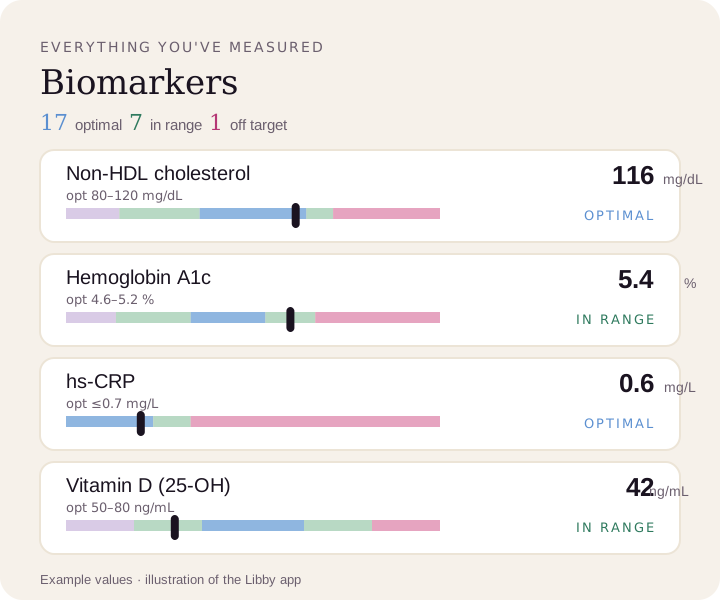
Compare your results to optimal ranges.
Upload a lab PDF or a photo of your report. Libby puts every marker on your lab's range and the optimal range, and tracks your trends over time.
View your cholesterol ›