Total protein blood test: normal range, low and high causes
Total protein is albumin plus globulins. Here's the normal range, what a high or low result usually means, how to read it with albumin, and when it's urgent.
Total protein is the combined amount of protein in the liquid part of your blood: albumin, which your liver makes, plus a mixed group called globulins, which includes your antibodies.1 Because it's a sum, the most useful question is which part moved. A high total usually comes from concentrated blood (dehydration) or extra antibodies from inflammation, infection or liver disease. A low total usually means low albumin, from liver disease, protein lost through the kidneys or gut, or extra fluid.23
The short version
- Normal: most labs print about 6.0 to 8.5 g/dL. MedlinePlus lists 6.5 to 8.1. The optimal range shown in the Libby app is a narrower 7.0 to 7.5 g/dL, the same for men and women.234
- High usually means dehydration or extra antibodies from liver disease, autoimmune disease or chronic infection. Rarely, it's one overgrown antibody, as in myeloma.25
- Low usually means low albumin: liver disease, protein leaking into urine, gut losses, serious illness or extra fluid. Under 4.0 g/dL with swelling needs prompt care, and so does a high result with nosebleeds, blurry vision or confusion.267
- Read albumin next to it. Albumin can fall while globulins rise, so a normal total can hide a real change underneath.8
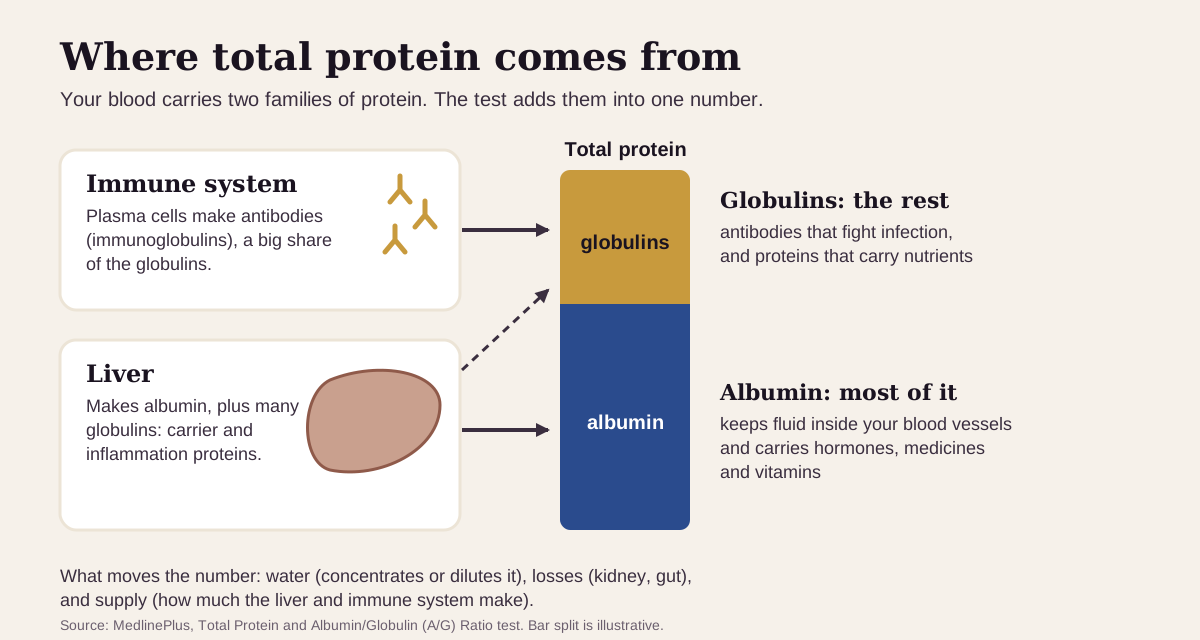
What total protein is
Total protein adds up two families of protein in your blood:1
- Albumin makes up most of it. Your liver makes it. It keeps fluid inside your blood vessels and carries hormones, medicines and vitamins around your body.
- Globulins are the rest. Some are made by the liver: carrier and inflammation proteins. Others are antibodies (immunoglobulins), made by the immune system's plasma cells.8
Most labs measure total protein and albumin directly, then work out the globulins by subtraction and the A/G ratio (albumin divided by globulins) by division. On one Labcorp sample report, a total of 6.0 and an albumin of 3.8 give a globulin of 2.2 and an A/G ratio of 1.7.2 (More on the arithmetic at the end.)
Total protein comes with the comprehensive metabolic panel (CMP), so most people first see it on a routine checkup, with nothing wrong at all.1
What's a normal total protein?
Start with the range printed on your report. Labs use different methods and reference groups, so their ranges differ a little.3
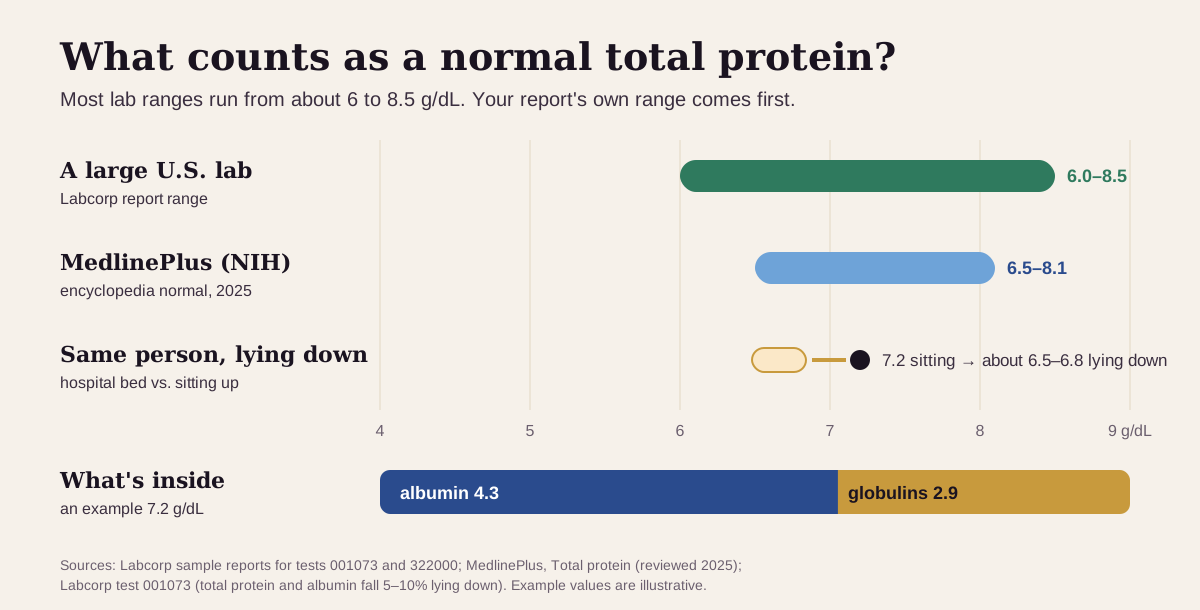
- Labcorp, a large U.S. commercial lab, prints 6.0 to 8.5 g/dL.2
- MedlinePlus, the National Library of Medicine's health site, lists 6.5 to 8.1 g/dL.3
Men and women share one range. When Canadian researchers built reference ranges from about 12,000 people in the Canadian Health Measures Survey, total protein was one of the few markers that needed no split by sex.9
How you're sitting matters. Lying down pulls water back into your blood and lowers total protein and albumin by 5 to 10%, which is one reason hospital results run lower.2 A 7.2 measured sitting up would read about 6.5 to 6.8 lying down.
"Optimal" total protein: what health optimizers aim for
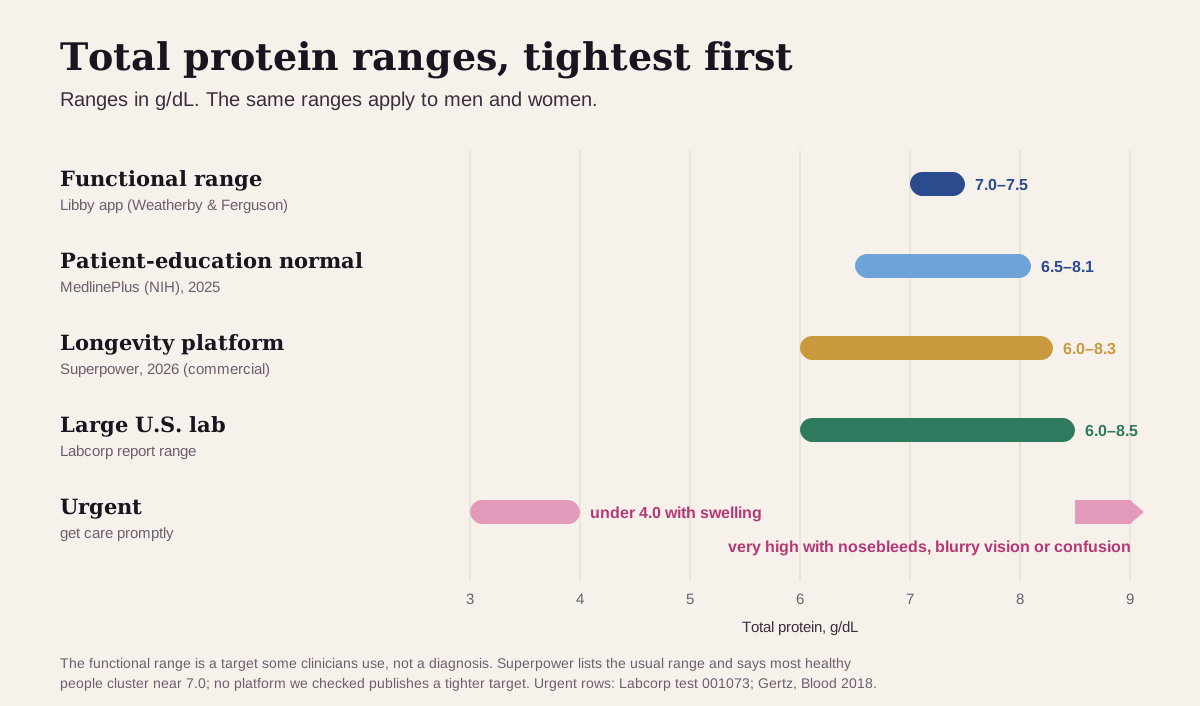
Functional-medicine practitioners aim for a narrow middle band rather than the whole lab range. Here's the ladder, from tightest to loosest:
| Target | Men and women | Who uses it |
|---|---|---|
| Functional medicine (tightest) | 7.0–7.5 g/dL | The optimal range shown in the Libby app, recorded in the app's marker catalog from Weatherby & Ferguson's functional-medicine textbook4 |
| Patient-education "normal" | 6.5–8.1 g/dL | MedlinePlus, National Library of Medicine3 |
| Longevity platform | 6.0–8.3 g/dL | Superpower lists this usual range and says most healthy people cluster near 7.010 |
| Large U.S. lab | 6.0–8.5 g/dL | Labcorp's printed range2 |
| Urgent | under 4.0 g/dL with swelling, or very high with nosebleeds, blurry vision or confusion | Labcorp (swelling);2 a hematology review of thick blood (hyperviscosity)7 |
Why a middle band, and not just "anywhere in range":
- In 12,260 U.S. adults in the National Health and Nutrition Examination Survey (NHANES), researchers split people by globulin (total protein minus albumin). The 5-year death rate was 4.2% with a globulin of 2.8–3.0 g/dL and 7.8% at 3.3 or higher. After adjusting for other risks, a globulin of 3.1 g/dL or more carried a 30% higher risk of death.11
- In 26,974 healthy Korean adults, an A/G ratio under 1.0 carried 6.7 times the risk of death of a ratio of 1.5 or higher, and a higher rate of cancer.12
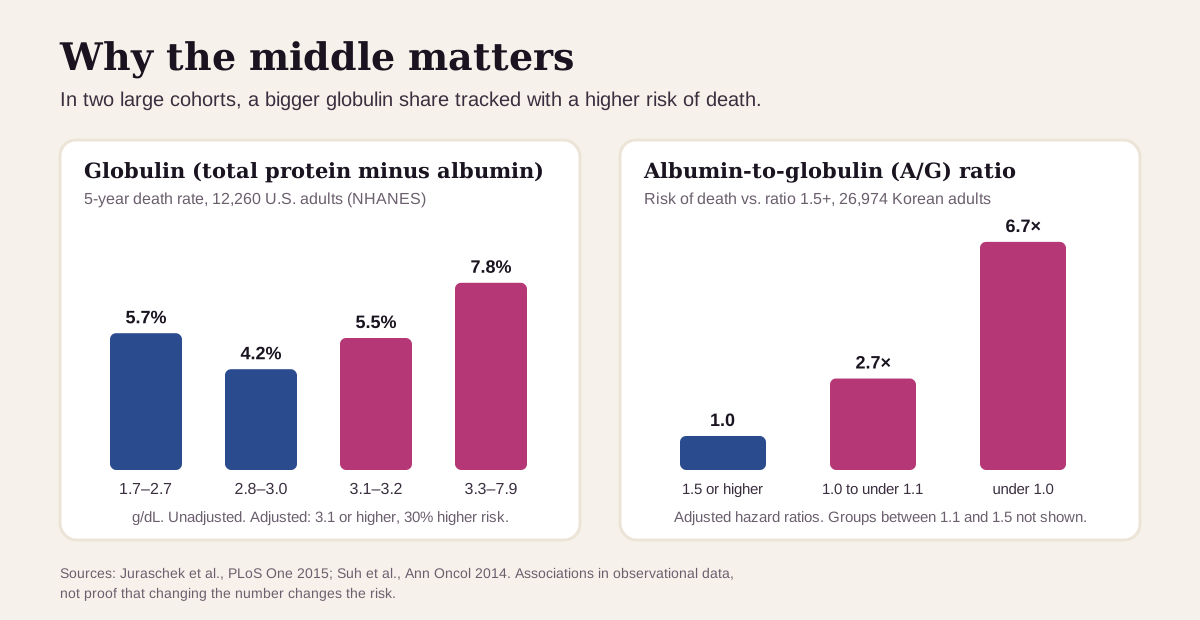
Keep "optimal" in perspective: the 7.0–7.5 band is a practitioner target, and the studies above describe whole populations. A total of 6.8 or 7.8 is a reason to look at albumin, globulins and how hydrated you were, rather than a diagnosis. The low side matters too: in the NHANES data, the lowest globulin group (1.7–2.7 g/dL) had a higher 5-year death rate, 5.7%, than the group just above it.11
What a high total protein usually means
A high total comes from one of two things: less water in your blood, or more globulin. Albumin alone rarely drives it up.68
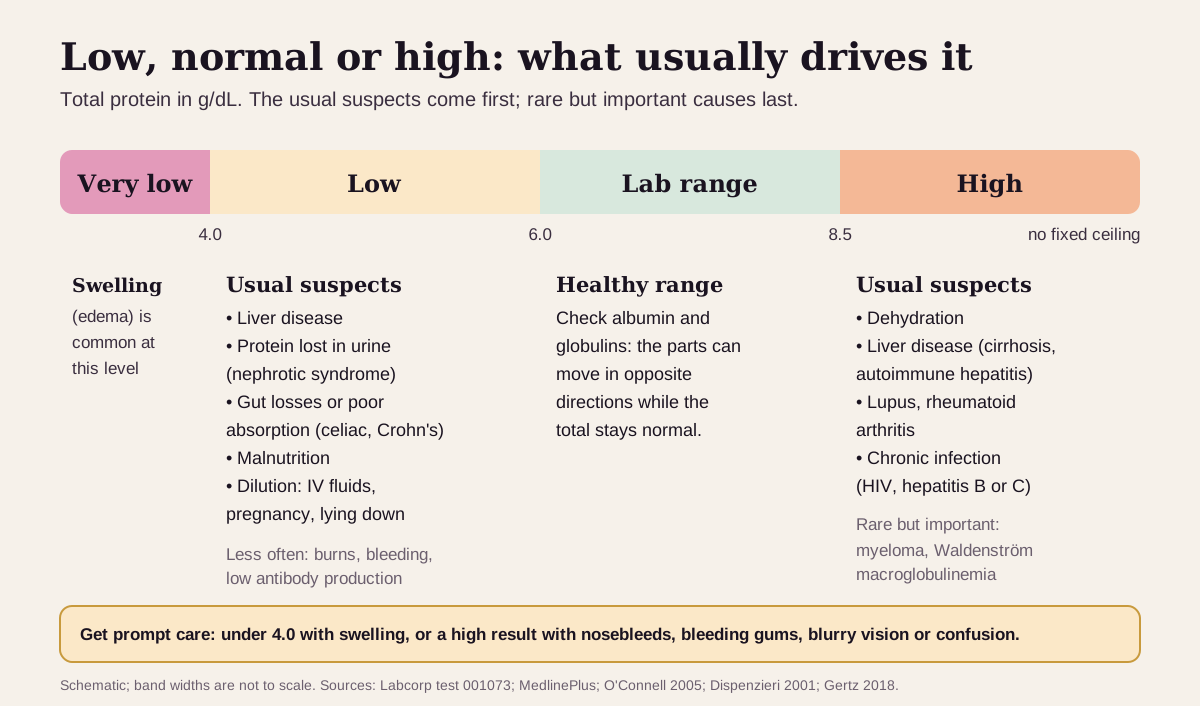
The usual suspects:
- Dehydration. Losing water from vomiting, diarrhea, heat or not drinking enough concentrates everything in your blood, so albumin and globulins rise together.2 Dehydration is the only common cause of a high albumin.6 A hard workout does the same thing briefly (see how fast it changes).13
- Liver disease. Cirrhosis and autoimmune hepatitis push antibody levels up while albumin falls.8 In a Mayo Clinic study of 148 people with markedly high antibody levels (gamma globulin 3.0 g/dL or more), liver disease was the cause in 61% of the 130 with a single diagnosis.5
- Autoimmune diseases such as lupus and rheumatoid arthritis were the cause in 22% of that group.5
- Chronic infections, including HIV and hepatitis B or C.3 They made up 6% of the Mayo group.5
Rare but important: one antibody clone
In multiple myeloma and Waldenström macroglobulinemia, a single clone of plasma cells floods the blood with one antibody, called a monoclonal or M protein.8 Its harmless-for-now precursor, MGUS (monoclonal gammopathy of undetermined significance), turns up in 3.2% of people over 50 and 5.3% of people over 70. In 63.5% of them the M protein is under 1.0 g/dL, a small addition to a total of around 7.14 A test called serum protein electrophoresis (SPEP) finds these proteins: it showed a band in 82% of people newly diagnosed with myeloma at the Mayo Clinic, and immunofixation found one in 93%.15
Get prompt care if your total protein is very high and you have nosebleeds or bleeding gums, blurry vision, or new confusion or sleepiness. Those are signs of thick blood (hyperviscosity), a rare complication of very high antibody levels.7 Get care too for a total under 4.0 g/dL with new swelling of your legs, belly or face.2
What a low total protein usually means
Low total protein usually tracks low albumin, the biggest part.1 The usual suspects:
- Liver disease. A scarred or failing liver makes less albumin. This is the best-understood cause of a long-running low albumin.6
- Protein leaking into urine. In nephrotic syndrome, the kidneys lose more than 3.5 g of protein a day, most of it albumin.6 A urine protein test shows it.
- Gut losses or poor absorption, as in celiac disease, Crohn's disease or protein-losing enteropathy.13
- Serious illness. With sepsis or major trauma, albumin leaks out of blood vessels into the tissues, so the blood level drops within days.6 The American Society for Parenteral and Enteral Nutrition (ASPEN) calls albumin a marker of inflammation and illness, rather than of how much protein you eat.16
- Extra fluid. IV fluids and pregnancy dilute the blood, and so does lying in a hospital bed.2
- Less common: extensive burns, bleeding, severe malnutrition, and very low antibody production (agammaglobulinemia), which lowers the globulins instead of albumin.3
Total protein reads best next to its neighbors
The pattern across albumin, globulins and a couple of other routine tests usually says more than the total does alone:8
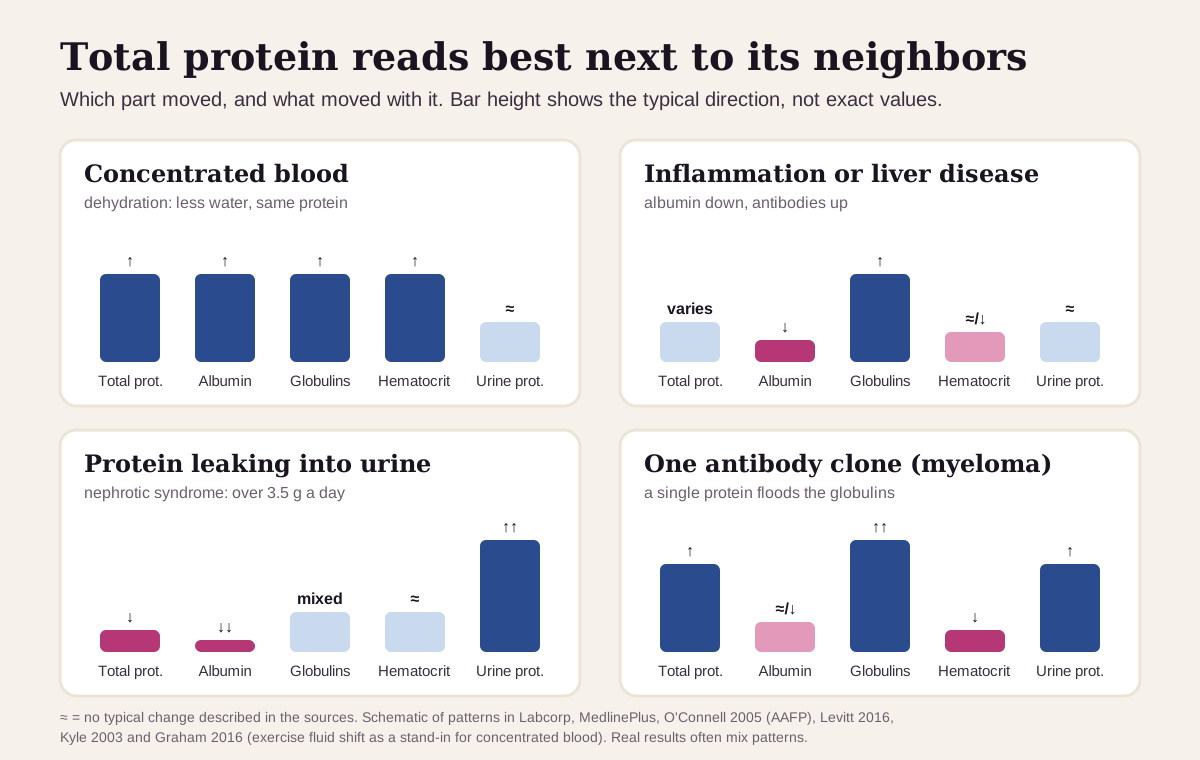
| If you see… | It often points to… |
|---|---|
| Total, albumin and globulins all up, hematocrit up too | concentrated blood: dehydration is the most common cause of a high hematocrit |
| Albumin down, globulins up, low A/G ratio (the total can go either way) | liver disease, autoimmune disease or chronic infection |
| Albumin well down, lots of protein in the urine | protein leaking through the kidneys (nephrotic syndrome) |
| Globulins up out of proportion to albumin, often with anemia | worth an SPEP to look for a single antibody (M protein); light chains often show up in urine |
| Total and globulins low | low antibody production: ask about immunoglobulin levels |
The table draws on the same sources: dehydration from Labcorp, Levitt and MedlinePlus;2617 the protein patterns of inflammation, liver disease and low antibodies from O'Connell;8 the low A/G ratio from MedlinePlus;1 nephrotic syndrome from Levitt;6 and myeloma, where anemia was present in 73% and a urine light chain in 78%, from Kyle.15
How fast total protein changes
Water moves it within minutes. Real changes in albumin take weeks.
- Posture. Sitting up after lying in bed raised serum proteins about 6.5% within 15 minutes in one study of 40 healthy adults; an hour of lying down undid it.18
- Exercise. In 12 young men, total protein rose 0.7 to 1.2 g/dL right after one hard cycling session and was back near baseline within hours.13
- Albumin itself. Albumin has a half-life of about 17 days, so a real rise or fall builds and fades over weeks.6
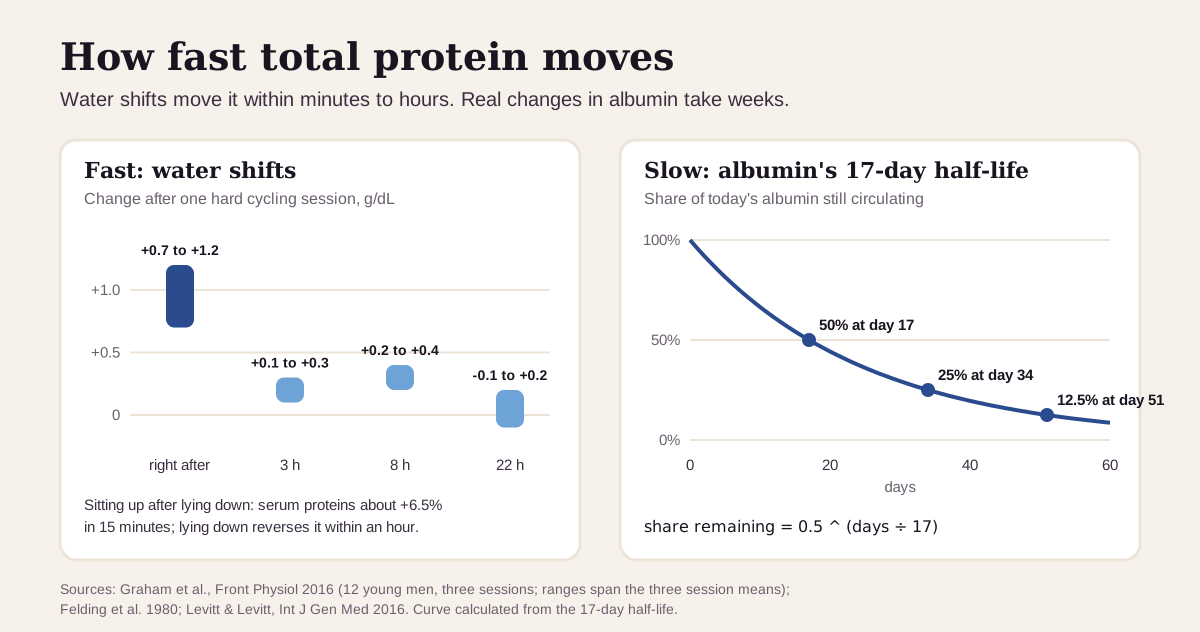
What that means in practice:
- One slightly-off result can reflect the day. Mention recent vomiting or diarrhea, a hard workout, a new illness or IV fluids when you get tested.132
- Trends beat snapshots. With a 17-day half-life, a low albumin that stays low across repeat tests points to something that has been going on for weeks; a single dip can come from water shifts or a sudden illness.6 Comparing results works best from the same lab, sitting the same way each time.32
Going deeper: the arithmetic, and what it misses
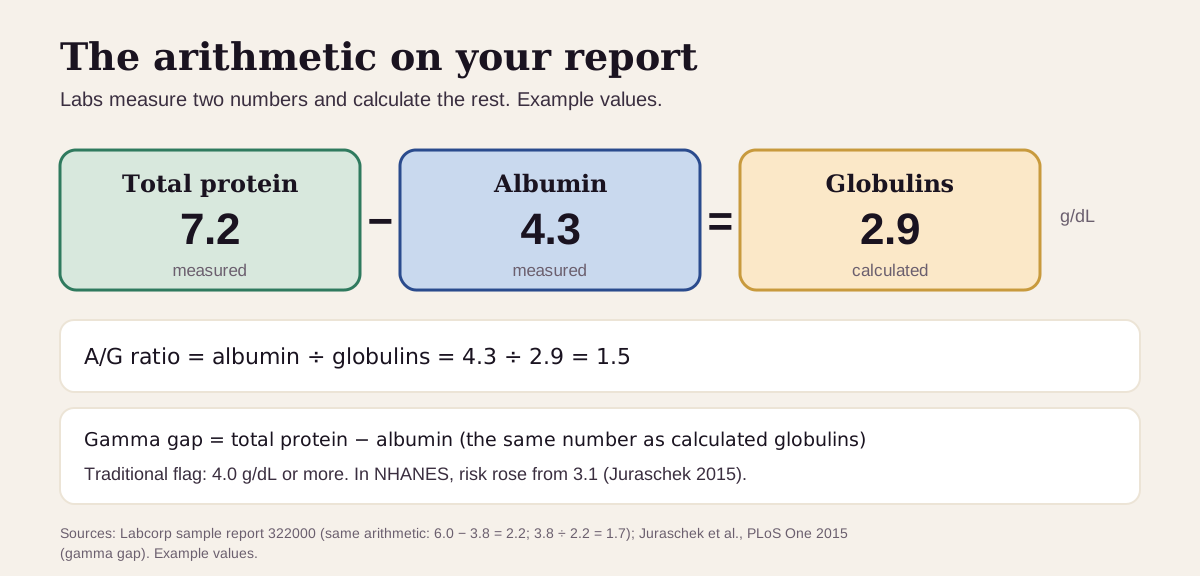
Your lab measures total protein and albumin. Everything else on that part of the report is arithmetic:2
Globulins = total protein − albumin
A/G ratio = albumin ÷ globulins
Clinicians call the first number the gamma gap. The traditional flag is 4.0 g/dL or more; in the NHANES data, risk of death was already higher from 3.1.11
Both numbers are blunt screens for an M protein. In 7,946 South African patients tested for one, a gamma gap cutoff of 4.6 g/dL caught only 35% of cases, and an A/G ratio cutoff of 0.85 caught 44%.19 SPEP and immunofixation look at the protein bands directly, which is why they're the follow-up tests when a clone is the question.15
A low A/G ratio can come from either side of the fraction: less albumin (liver or kidney disease) or more globulin (autoimmune disease, chronic infection, myeloma).1 Reading albumin and globulins separately tells you which.
Questions worth asking
- Which part moved: albumin, globulins, or both?
- Was I dehydrated, unwell or fresh from a workout when my blood was drawn?
- Should I have a urine protein test?
- If my globulins are high, would an SPEP help?
- Could my liver be involved, and what do my liver enzymes show?
- When should we repeat it, and at the same lab?
FAQ
What is a normal total protein level? Most labs use about 6.0 to 8.5 g/dL, and MedlinePlus lists 6.5 to 8.1. The optimal range shown in the Libby app is 7.0 to 7.5.234
What causes a high total protein? Dehydration, and extra antibodies from liver disease, autoimmune disease or chronic infection. Rarely, it's a single antibody clone such as myeloma.25
Does low total protein mean I'm not eating enough protein? Rarely. It mostly reflects low albumin from liver disease, protein loss through the kidneys or gut, illness or extra fluid. ASPEN calls albumin a marker of inflammation and illness, rather than of protein intake.16
When is total protein an emergency? A total under 4.0 g/dL with swelling, or a very high result with nosebleeds, blurry vision or confusion, needs prompt care.27
This guide is for education. It can't diagnose you or replace care from a clinician who knows your history.
Footnotes
-
National Library of Medicine. Total Protein and Albumin/Globulin (A/G) Ratio. MedlinePlus. What albumin and globulins are, where they're made, and common causes of low or high results and a low A/G ratio. MedlinePlus ↩ ↩2 ↩3 ↩4 ↩5 ↩6 ↩7 ↩8 ↩9
-
Labcorp, a commercial laboratory. Protein, Total (test 001073): causes of high and low results, very low total protein (<4 g/dL) with edema, and a 5–10% fall on lying down. Sample reports print 6.0–8.5 g/dL (tests 001073 and 322000); the 322000 report shows total protein 6.0, albumin 3.8, globulin 2.2 and A/G ratio 1.7. Test 001073 · Sample report 322000 ↩ ↩2 ↩3 ↩4 ↩5 ↩6 ↩7 ↩8 ↩9 ↩10 ↩11 ↩12 ↩13 ↩14 ↩15 ↩16 ↩17 ↩18 ↩19 ↩20 ↩21 ↩22 ↩23 ↩24
-
National Library of Medicine. Total protein. MedlinePlus Medical Encyclopedia. Reviewed May 19, 2025. Normal range 6.5–8.1 g/dL (65–81 g/L), ranges vary by lab, and the causes of high and low results. MedlinePlus ↩ ↩2 ↩3 ↩4 ↩5 ↩6 ↩7 ↩8 ↩9 ↩10 ↩11 ↩12 ↩13 ↩14
-
Weatherby D, Ferguson S. Blood Chemistry and CBC Analysis: Clinical Laboratory Testing from a Functional Perspective. Bear Mountain Publishing. ISBN 978-0976136712. A widely used functional-medicine reference; the Libby app's marker catalog records its optimal total protein as 7.0–7.5 g/dL (book not opened for this article). ↩ ↩2 ↩3 ↩4
-
Dispenzieri A, Gertz MA, Therneau TM, Kyle RA. Retrospective cohort study of 148 patients with polyclonal gammopathy. Mayo Clin Proc. 2001;76(5):476–487. Gamma globulin 3.0 g/dL or more; of the 130 with a single diagnosis: liver disease 61%, connective tissue disease 22%, chronic infection 6%. PubMed ↩ ↩2 ↩3 ↩4 ↩5 ↩6
-
Levitt DG, Levitt MD. Human serum albumin homeostasis: a new look at the roles of synthesis, catabolism, renal and gastrointestinal excretion, and the clinical value of serum albumin measurements. Int J Gen Med. 2016;9:229–255. The 17-day albumin half-life, dehydration as the only cause of high albumin, nephrotic syndrome (>3.5 g/day of urine protein), liver disease, and albumin leaking out of vessels in sepsis and trauma. PMC ↩ ↩2 ↩3 ↩4 ↩5 ↩6 ↩7 ↩8 ↩9 ↩10 ↩11 ↩12
-
Gertz MA. Acute hyperviscosity: syndromes and management. Blood. 2018;132(13):1379–1385. Hyperviscosity is rare; its most reliable signs are nose or gum bleeding and visual changes, with neurological symptoms. PMC ↩ ↩2 ↩3 ↩4 ↩5 ↩6
-
O'Connell TX, Horita TJ, Kasravi B. Understanding and interpreting serum protein electrophoresis. Am Fam Physician. 2005;71(1):105–112. Albumin rises only with dehydration; the protein patterns of inflammation, liver disease, nephrotic syndrome, low antibodies and monoclonal gammopathy. AAFP · PubMed ↩ ↩2 ↩3 ↩4 ↩5 ↩6 ↩7 ↩8 ↩9
-
Adeli K, Higgins V, Nieuwesteeg M, et al. Biochemical marker reference values across pediatric, adult, and geriatric ages: establishment of robust pediatric and adult reference intervals on the basis of the Canadian Health Measures Survey. Clin Chem. 2015;61(8):1049–1062. About 12,000 Canadians aged 3–79; total protein needed no sex partition. PubMed ↩
-
Superpower. Protein, Total. Published November 15, 2025; last updated August 31, 2026. Lists a normal adult range of 6.0–8.3 g/dL and says most healthy people cluster near 7.0 g/dL. A commercial source, listed as what an optimizer platform prints. superpower.com ↩ ↩2
-
Juraschek SP, Moliterno AR, Checkley W, Miller ER 3rd. The Gamma Gap and All-Cause Mortality. PLoS One. 2015;10(12):e0143494. 12,260 NHANES participants; 5-year death rates of 5.7%, 4.2%, 5.5% and 7.8% across gamma-gap quartiles; adjusted HR 1.30 at 3.1 g/dL or more, versus the traditional 4.0 g/dL. PMC ↩ ↩2 ↩3 ↩4 ↩5
-
Suh B, Park S, Shin DW, et al. Low albumin-to-globulin ratio associated with cancer incidence and mortality in generally healthy adults. Ann Oncol. 2014;25(11):2260–2266. 26,974 adults; A/G under 1.0 vs 1.5 or higher, adjusted HR 6.71 for death. PubMed ↩ ↩2
-
Graham MJ, Lucas SJ, Francois ME, et al. Low-Volume Intense Exercise Elicits Post-exercise Hypotension and Subsequent Hypervolemia, Irrespective of Which Limbs Are Exercised. Front Physiol. 2016;7:199. 12 untrained young men (protein data from 11); right after exercise, plasma total protein rose 7–12 g/L and albumin 4–7 g/L (Table 2), so the non-albumin proteins rose too. An exercise fluid shift, used here as a stand-in for concentrated blood. PMC ↩ ↩2 ↩3 ↩4 ↩5
-
Kyle RA, Therneau TM, Rajkumar SV, et al. Prevalence of monoclonal gammopathy of undetermined significance. N Engl J Med. 2006;354(13):1362–1369. 21,463 residents of Olmsted County, Minnesota, aged 50 or older. PubMed ↩
-
Kyle RA, Gertz MA, Witzig TE, et al. Review of 1027 patients with newly diagnosed multiple myeloma. Mayo Clin Proc. 2003;78(1):21–33. Anemia in 73%; SPEP band in 82%; immunofixation M protein in 93%; urine light chain in 78%. PubMed ↩ ↩2 ↩3 ↩4
-
Evans DC, Corkins MR, Malone A, et al. The Use of Visceral Proteins as Nutrition Markers: An ASPEN Position Paper. Nutr Clin Pract. 2021;36(1):22–28. Albumin and prealbumin reflect inflammation and illness, not nutrition status or body protein. PubMed ↩ ↩2
-
National Library of Medicine. Hematocrit Test and Hemoglobin Test. MedlinePlus. Dehydration is the most common cause of a high hematocrit; liver disease and multiple myeloma are among the causes of a low hemoglobin or hematocrit. Hematocrit · Hemoglobin ↩ ↩2
-
Felding P, Tryding N, Hyltoft Petersen P, Hørder M. Effects of posture on concentrations of blood constituents in healthy adults. Scand J Clin Lab Invest. 1980;40(7):615–621. 40 adults; about 6.5% higher serum proteins sitting than lying, reversed after 1 hour of lying down. PubMed ↩ ↩2
-
Khumalo N, Francis CA, Baloyi SM, Rusch JA. Gamma gap and albumin-globulin ratio show poor sensitivity for monoclonal gammopathy screening in South Africa. Afr J Lab Med. 2025;14(1):2505. 7,946 patients; gamma gap 46 g/L sensitivity 35%, A/G 0.85 sensitivity 44%. PMC ↩
Educational content, not medical advice. Libby is a personal record tool, not a medical service — it doesn't diagnose, treat, or prescribe. Reference ranges vary by lab and by person. Talk to a qualified healthcare professional about your results.
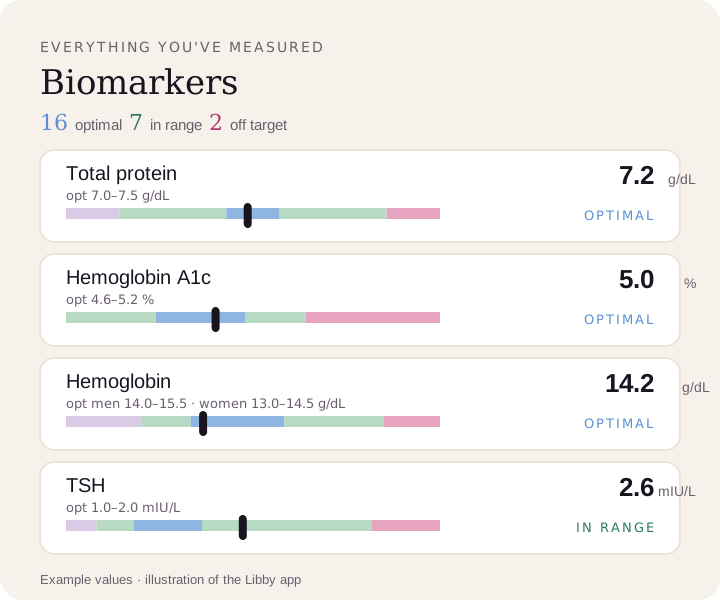
Compare your results to optimal ranges.
Upload a lab PDF or a photo of your report. Libby puts every marker on a standard lab range and, where one exists, the optimal range, and tracks your trends over time.
View your total protein ›