Urine protein test: what trace, 1+ and 2+ mean
Protein on a urinalysis is graded negative to 4+. What each grade means, the common temporary causes, when it points to kidney disease, and when it's urgent.
Urine protein is a dipstick reading of how much protein is in your urine, and healthy urine has almost none. Your kidneys' filters keep protein in your blood, so the expected result is negative. A trace or 1+ is common and often temporary, from a hard workout, a fever or a concentrated sample. Protein that keeps showing up on repeat tests is one of the earliest signs of kidney disease, often before any symptoms.12
The short version
- Normal: negative. In a screening of 17.3 million Korean adults, 96.7% had a negative morning dipstick.3 Healthy people pass less than 150 mg of protein a day.2
- Trace to 2+ is common and often temporary. The usual reasons are hard exercise, fever, dehydration, stress and standing all day. The usual next step is a repeat test on a morning sample.24
- Positive on repeat tests means persistent protein loss. The most common causes are diabetes and high blood pressure,5 and it's confirmed with a measured protein- or albumin-to-creatinine ratio.6
- 3+ or 4+, especially with swelling of the legs or around the eyes, or foamy urine, can mean heavy protein loss (nephrotic syndrome). See a clinician promptly.47
What urine protein is
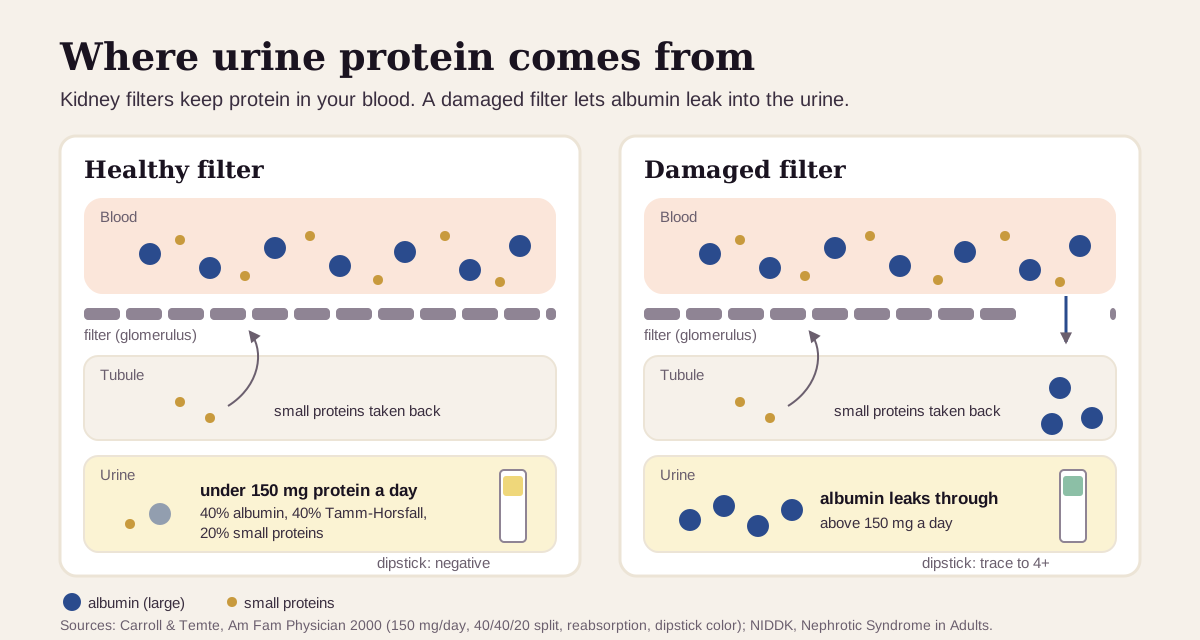
Your kidneys are made of about a million filtering units. Each one has a filter, the glomerulus, and a tubule that takes back what the body needs.7 The filter lets water and small molecules through but holds back large proteins such as albumin. The few small proteins that slip through are mostly reabsorbed by the tubule.2
So healthy urine carries very little protein: under 150 mg a day. About 40% of it is albumin, 40% is a protein the kidney tubules make themselves (Tamm-Horsfall protein), and 20% is small proteins such as immunoglobulin fragments.2
The urine protein result on a routine urinalysis comes from a dipstick: a test pad that turns from yellow toward green as protein rises. It reads albumin best.2 You'll usually see it on a checkup urinalysis, or when a clinician is checking your kidneys because of diabetes, high blood pressure or symptoms.1
Why it matters: when the filters are damaged, albumin leaks through. Protein in the urine over time may be the first sign that kidney disease has damaged them.1
What's a normal urine protein?
Negative. That means your urine had no more protein than expected when you were tested.1 Nearly everyone lands there:
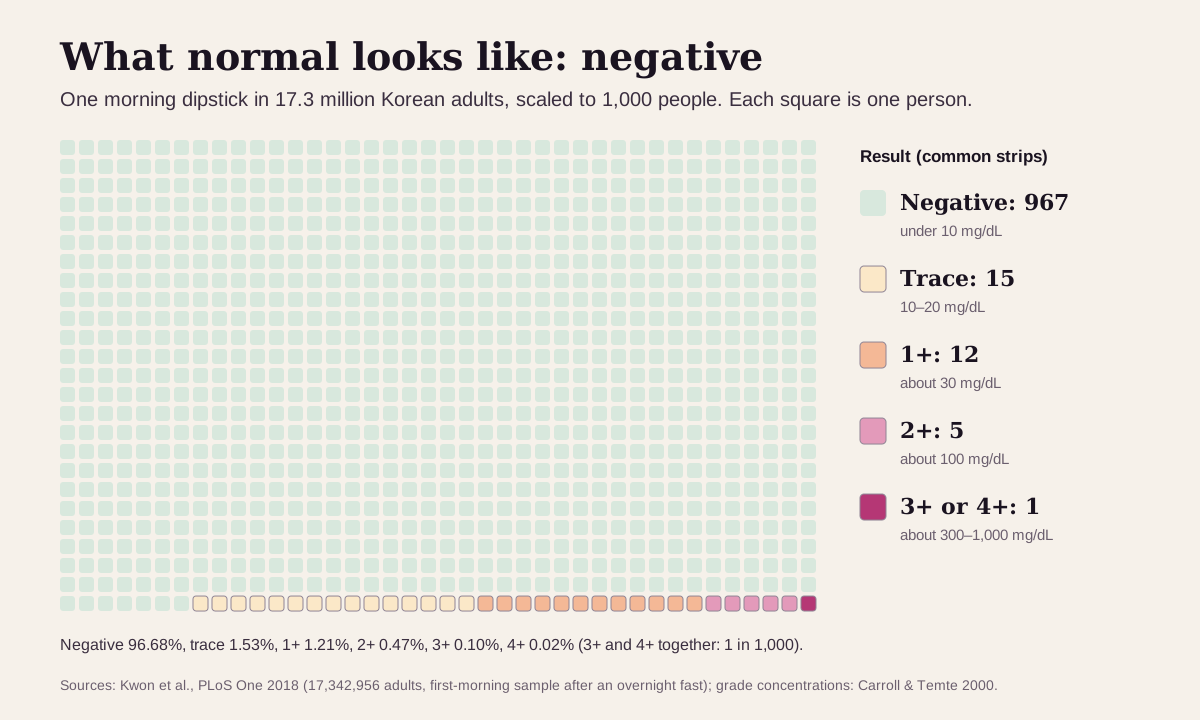
- In the Korean national screening, using a first-morning sample after an overnight fast, 96.7% were negative, 1.5% trace, 1.2% 1+, 0.5% 2+ and about 0.1% 3+ or 4+.3
- A Japanese screening of 69,021 adults found much the same: 2.4% trace and 1.2% at 1+ or more.8
Trace sits right on the line. On common strips it means about 10–20 mg/dL,2 the concentration that matches the 150 mg-a-day definition of proteinuria.4 The KDIGO kidney guideline counts "negative to trace" as normal to mildly increased.9
A dipstick measures concentration, so hydration moves it. Concentrated or very alkaline urine can push a result up; very dilute urine can hide protein.24
"Optimal" urine protein: negative, and where each line is drawn
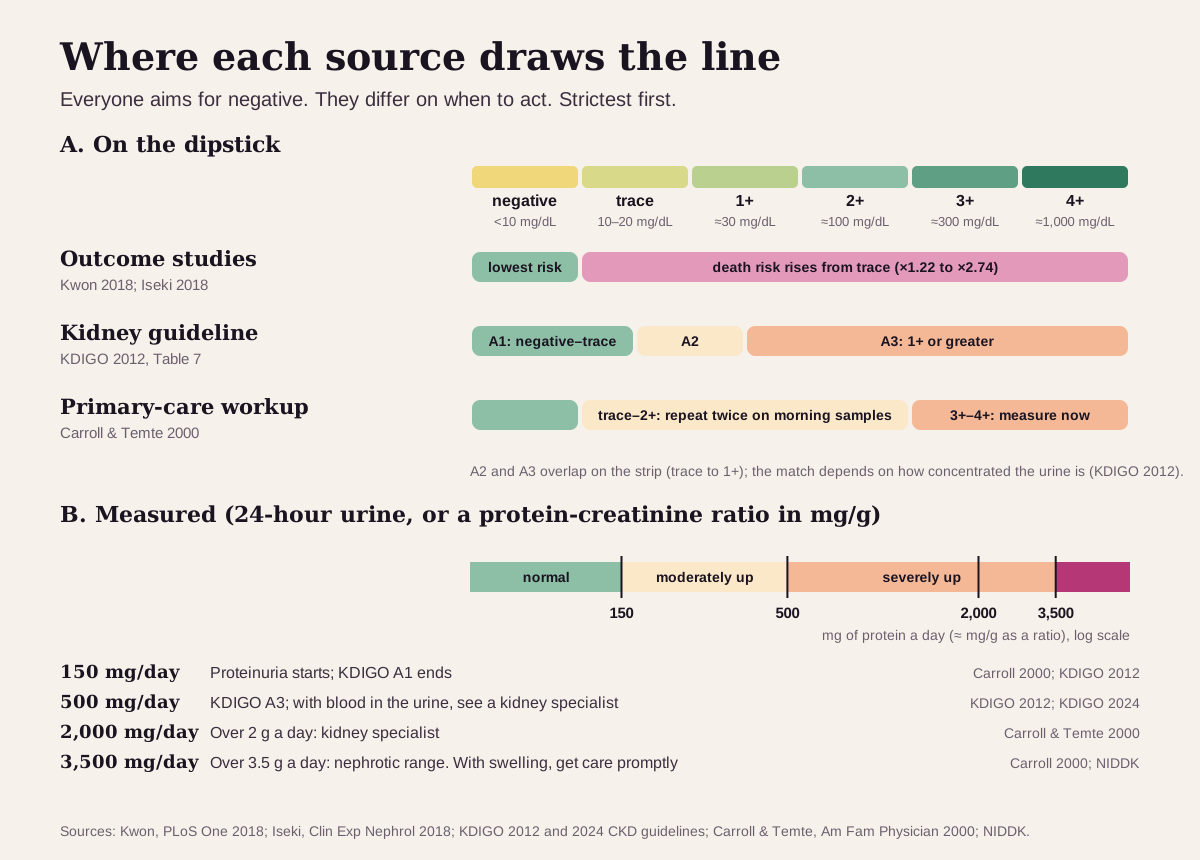
For urine protein, everyone's goal is the same: negative. We found no published functional-medicine or longevity target for it, and the Libby app has no optimal band for it. The app shows your result against your lab's expected value (negative) and flags trace or higher. What the sources disagree on is where to start acting. From strictest to loosest:
| Line | Dipstick | Measured equivalent | Who draws it |
|---|---|---|---|
| Strictest (outcome data) | negative | none published | Death risk is already about 22% higher at trace in 17.3 million adults3 |
| Guideline "normal to mildly increased" | negative to trace | under 150 mg/day, or a protein-creatinine ratio under 150 mg/g | KDIGO (category A1)9 |
| Guideline "moderately increased" | trace to 1+ | 150–500 mg/day | KDIGO (A2)9 |
| Primary-care workup | trace to 2+: repeat on morning samples. 3+ or 4+: measure it now | protein-creatinine ratio or 24-hour urine | Carroll & Temte, American Family Physician2 |
| Kidney specialist | persistent | over 2 g/day; or 500 mg/g or more with blood in the urine | Carroll & Temte;2 KDIGO referral criteria6 |
| Urgent | confirm with a measured test | over 3.5 g/day (nephrotic range) | Heavy protein loss with low blood albumin and swelling: get care promptly27 |
Why the strict line holds up:
- In 17.3 million Korean adults followed for about 9 years, the fully adjusted risk of death rose with every grade: 1.22 times at trace, 1.47 at 1+, 1.81 at 2+, 2.32 at 3+ and 2.74 at 4+, compared with a negative result.3
- In 140,761 Japanese adults, the pattern matched: 1.26 at trace, 1.44 at 1+, 2.20 at 2+ and 2.22 at 3+ or more.10
- In 106,177 Okinawans followed for 17 years, a 1+ at screening raised the odds of later kidney failure 1.93 times (men) and 2.42 times (women).11
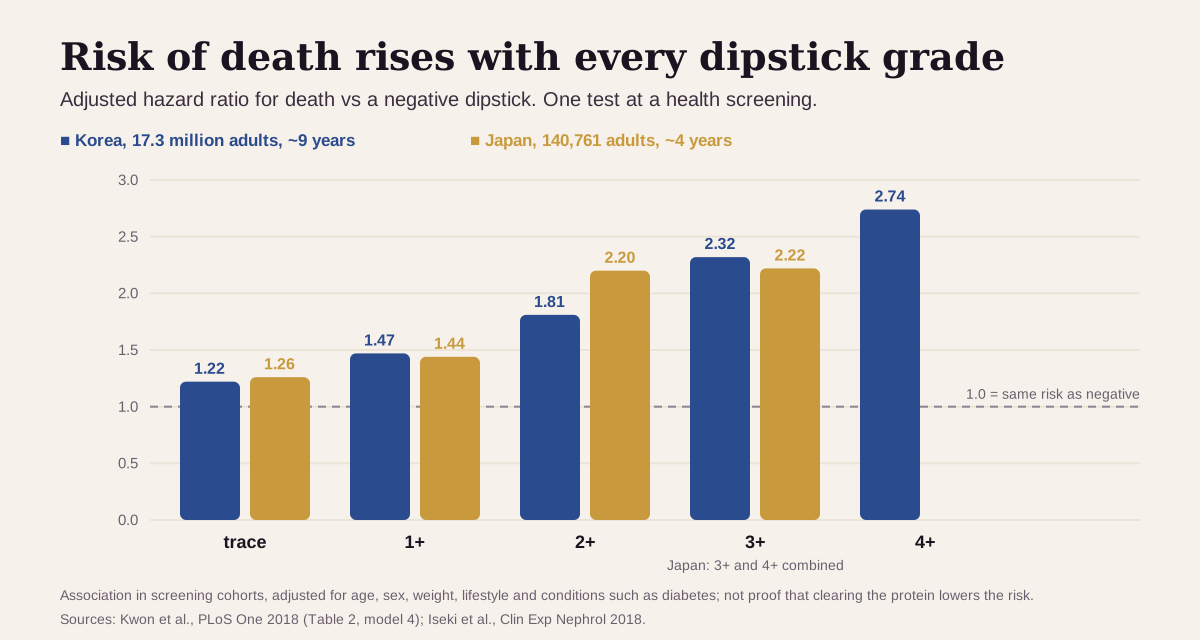
Keep this in perspective: these come from one dipstick in large screening programs, and most positive dipsticks come from temporary, harmless causes.2 Japanese researchers note that more than half of positive dipsticks in the general population later turn negative.12 Even a one-time positive carries some signal, though: in 338,094 adults, a 1+ that later cleared was linked to about 2 to 3 times the risk of cardiovascular death, with no significant rise in overall deaths.12 The practical target is a negative result that stays negative.
What a positive urine protein usually means
The first question is whether it's still there on a repeat test. Most positive dipsticks come from temporary causes, and fewer than 2% of people with a positive screen turn out to have a serious, treatable urinary tract problem.2 Clinicians sort the causes into transient and persistent, with positional protein as a harmless kind of transient.4
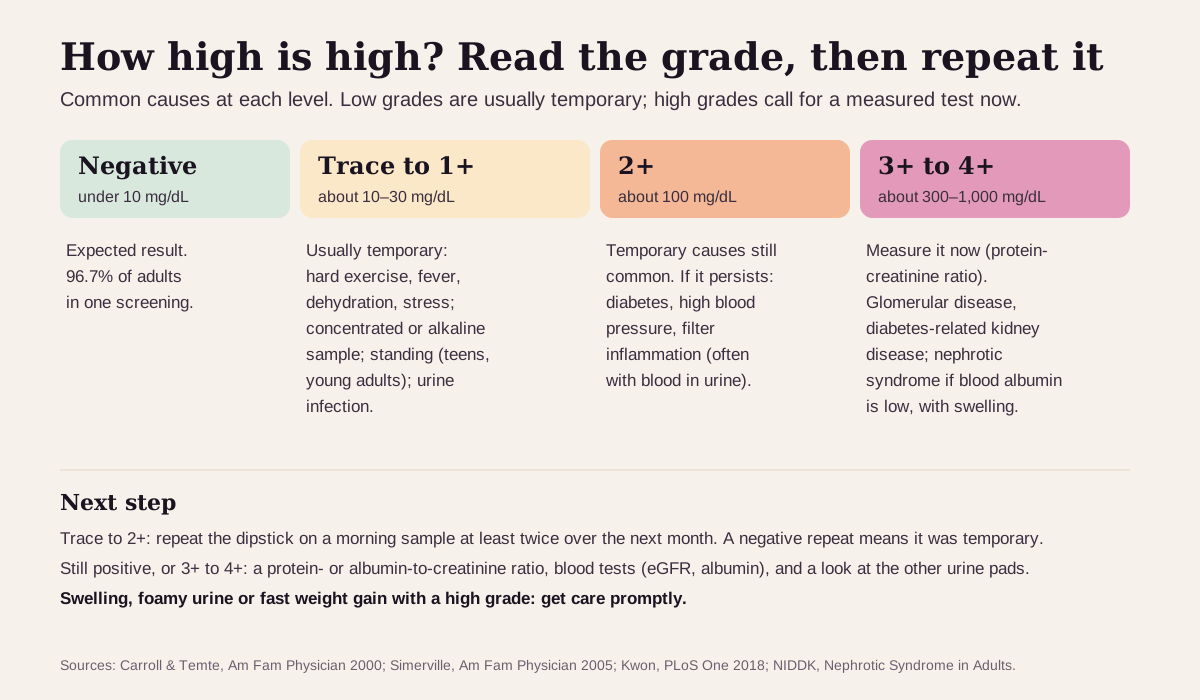
Temporary: the most common
The usual suspects:
- Hard exercise. Albumin is the main protein lost after exercise. In 20 marathon runners, the urine albumin-creatinine ratio rose from 6.4 to 22 mg/g after the race; in 17 ultramarathon runners, from 5.4 to 49.6.13 The ADA lists exercise in the previous 24 hours among the things that raise urine albumin.14
- Fever, acute illness, dehydration and emotional stress. All are classic causes of a short-lived rise, along with heat injury, seizures and heart failure.24
- The sample itself. Very concentrated urine, alkaline urine (pH above 7.5), visible blood, semen, vaginal secretions or pus can turn the pad positive.2
- A urine infection. A symptomatic urinary infection raises urine protein.6 Clinicians treat it, then repeat the dipstick.2
- Pregnancy and diet can raise it for a short time too.1
Positional (orthostatic): only when you're upright
About 3–5% of teens and young adults leak extra protein while standing and normal amounts while lying down. It's benign: people followed for 20 to 50 years kept normal kidney function.2 A negative sample after eight hours lying down confirms it.4
Persistent: a kidney cause until shown otherwise
Protein that keeps coming back on repeat tests is persistent, and it's measured next with a protein-to-creatinine ratio or a 24-hour urine.26 The common causes:
- Diabetes and high blood pressure, the two most common causes of chronic kidney disease in adults.5 Kidney disease develops in 20–40% of people with diabetes.14
- Glomerular diseases, where the filters themselves are inflamed or scarred: IgA nephropathy, lupus nephritis, membranous nephropathy, minimal change disease and others. Some leak red blood cells as well as protein.154
- Medicines, including long-term use of NSAIDs such as ibuprofen and naproxen.14 Don't stop a prescribed medicine on your own. Bring your full list, supplements included, to your clinician.
- Less common causes: multiple myeloma and other "overflow" causes, tubular diseases, amyloidosis, and infections such as HIV and hepatitis.4
Get prompt care if protein in your urine comes with swelling of your legs, ankles or around your eyes, foamy urine, or fast weight gain from fluid. Heavy protein loss can lead to blood clots, infections and kidney failure.71 If you're pregnant (after 20 weeks) or gave birth in the past few weeks, contact your provider right away for protein in the urine with a severe headache, vision changes, pain under the right ribs, or new swelling of your face or hands.16
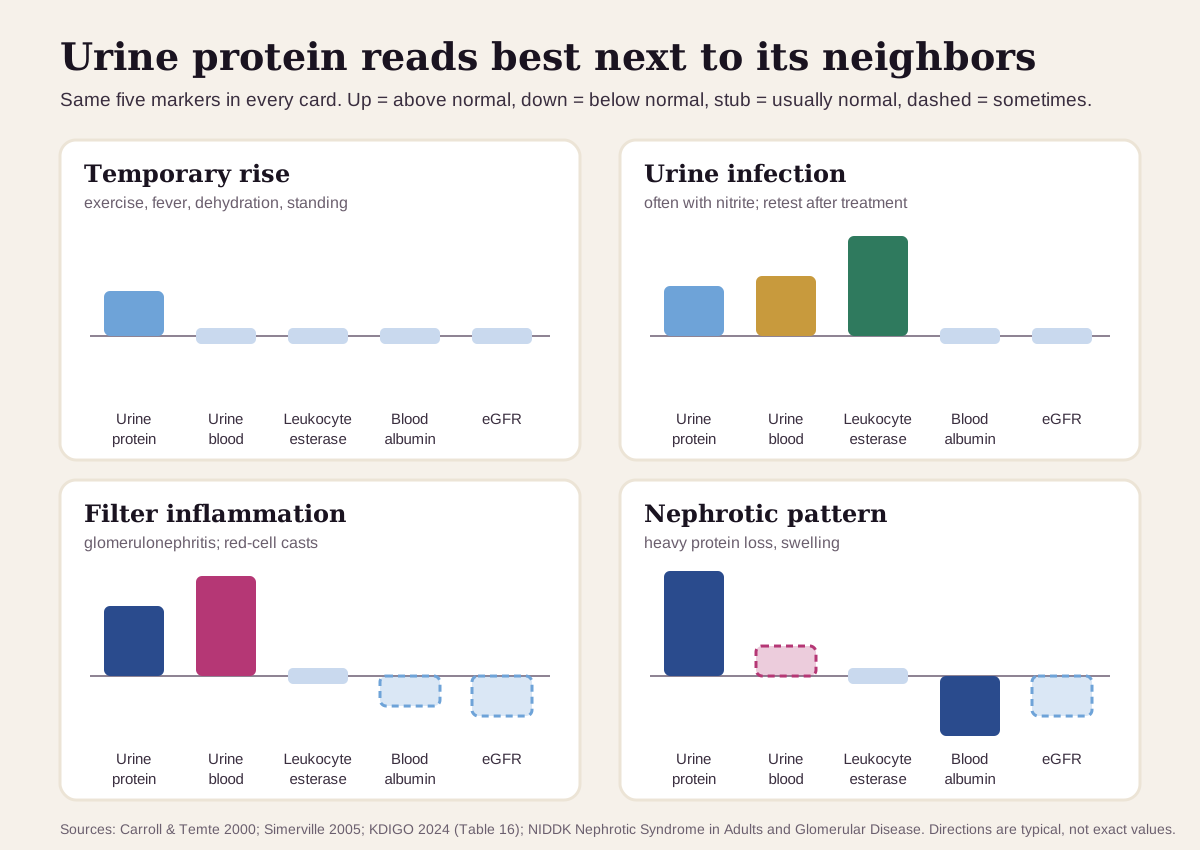
Urine protein reads best next to its neighbors
A dipstick protein result is one pad on a panel. The pads next to it, plus two blood tests, usually show where the protein is coming from:
| If you see… | It often points to… |
|---|---|
| Protein trace to 1+, the other pads negative, negative on a morning retest | a temporary rise (exercise, fever, dehydration) or positional protein24 |
| Protein plus leukocyte esterase, often with nitrite or blood | a urinary tract infection. Treat it, then retest42 |
| Protein plus blood, especially red-cell casts on microscopy | inflammation of the kidney filters (glomerulonephritis)42 |
| Protein high (often 3+ or 4+), low blood albumin, swelling | nephrotic syndrome724 |
| Protein that persists, with diabetes or high blood pressure | the most common kinds of chronic kidney disease. In diabetes, a yearly albumin-creatinine ratio tracks it514 |
| Dipstick negative, but a measured protein test high | proteins the dipstick reads poorly, such as the light chains of multiple myeloma2 |
How fast urine protein changes
Fast. Exercise, fever or a dehydrated morning can raise a dipstick within a day,1413 and a temporary rise clears on a repeat test.2 That's why a single positive is a reason to retest, not a diagnosis.
What that means in practice:
- Repeat before you worry. For trace to 2+, a common approach is to repeat the dipstick on a morning sample at least twice over the next month. A negative repeat means it was temporary.2
- Confirm a real positive with a measured test. KDIGO recommends following a positive strip with a protein- or albumin-to-creatinine ratio, preferably on a first-morning sample.6
- Time the retest. Skip hard exercise the day before, and mention a fever, a urine infection or your period.146
- "Persistent" means months. Chronic kidney disease is defined by changes lasting at least 3 months.6
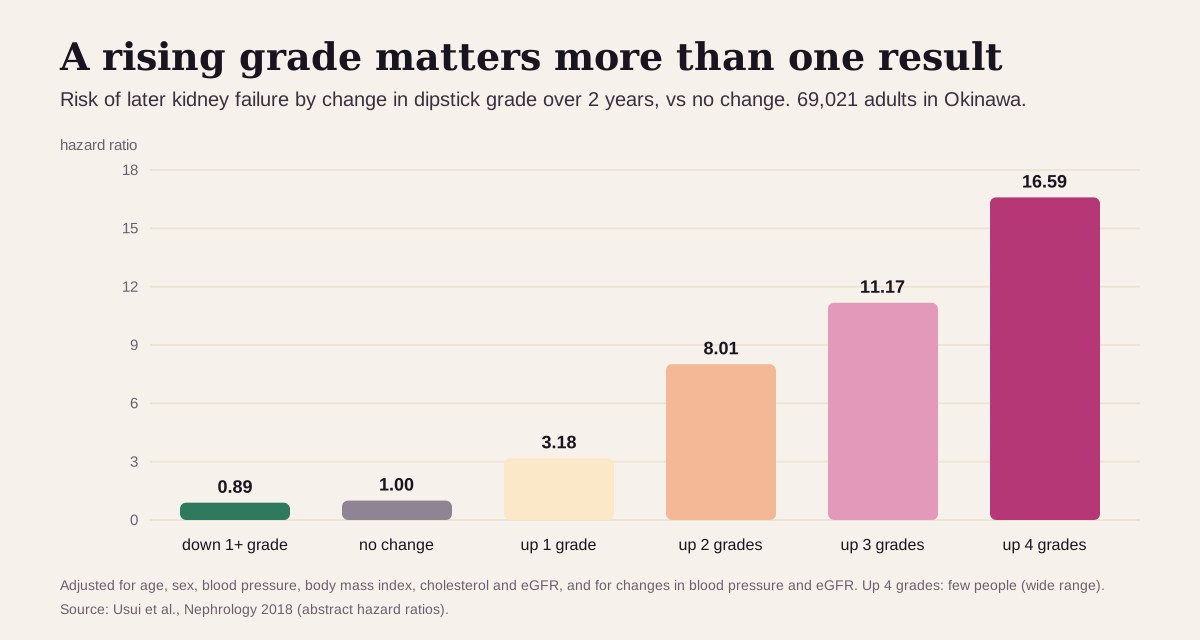
- Trends beat snapshots. In 69,021 Okinawan adults, a dipstick that rose one grade over two years tripled the later risk of kidney failure, and a two-grade rise made it about eight times higher.8
Going deeper: what the dipstick actually sees
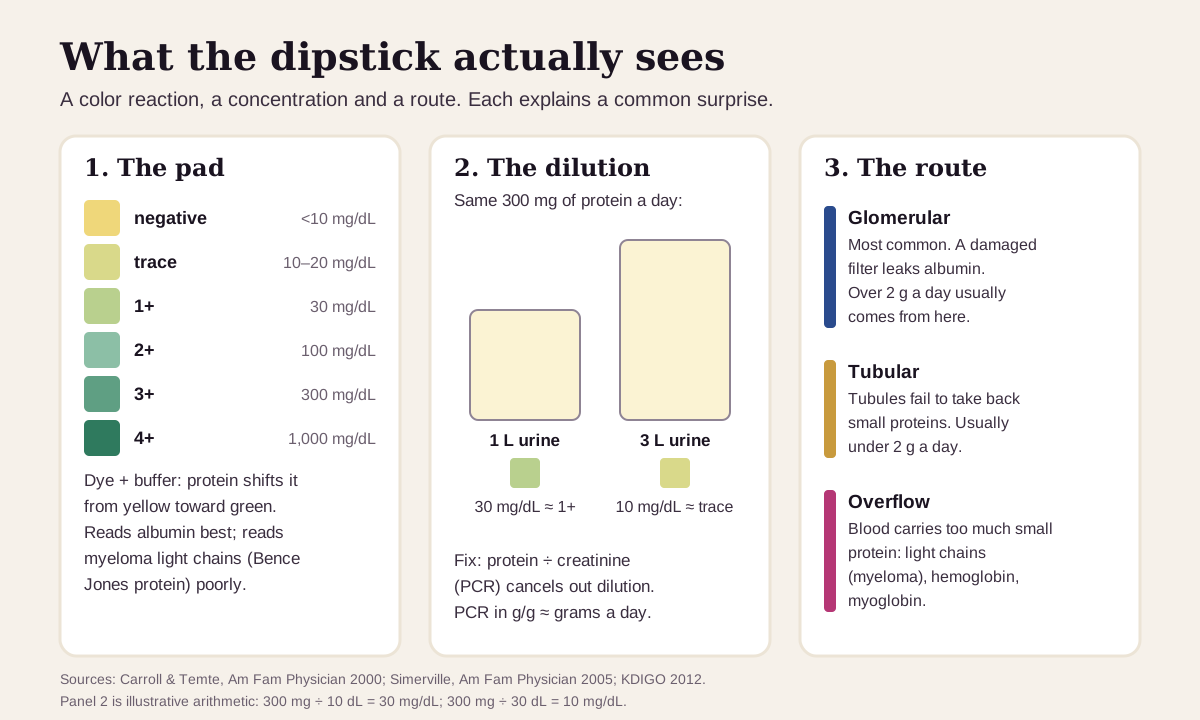
The protein pad holds a dye and a buffer. Protein in the urine shifts the dye's color from yellow toward green, and the depth of green sets the grade.2 The dye reacts most with albumin. It picks up far less of the small proteins, such as the immunoglobulin light chains (Bence Jones protein) made in multiple myeloma. A sulfosalicylic acid test, which picks up those proteins too, down to about 4 mg/dL, catches them.2
A dipstick measures concentration, not the daily amount. Spread through a day's urine, the same 300 mg of protein reads about 30 mg/dL (1+) in 1 liter and about 10 mg/dL (trace) in 3 liters. That's why the confirmation test is a protein-to-creatinine ratio: dividing by creatinine cancels out dilution, and the ratio in grams per gram roughly equals grams of protein per day. Carroll and Temte call a ratio under 0.2 normal and 3.5 nephrotic range;2 KDIGO's normal category is under 0.15 (150 mg/g).9
Three routes into the urine:24
- Glomerular, the most common: a damaged filter lets albumin through. Losses above 2 g a day usually come from here.
- Tubular: the tubules fail to reabsorb the small proteins that normally slip through. Usually under 2 g a day.
- Overflow: the blood carries so much of a small protein (light chains in myeloma, hemoglobin, myoglobin) that the tubules are overwhelmed.
Dipstick vs the albumin test. A strip turns positive reliably only once albumin loss passes about 300 mg a day; smaller early rises (30–300 mg a day) show up on a urine albumin-creatinine ratio.9 That's why the ADA recommends an albumin-creatinine ratio at least once a year for everyone with type 2 diabetes.14
Questions worth asking
- Was this a first-morning sample, and should we repeat it after a rest day?
- Did the rest of my urinalysis show blood, white cells or nitrite?
- Should we measure it with a protein- or albumin-to-creatinine ratio?
- What are my eGFR and blood albumin?
- Could any of my medicines, such as NSAIDs, be involved?
- If it stays positive, should I see a kidney specialist?
FAQ
What does trace protein in urine mean? Trace is about 10–20 mg/dL on common strips.2 It's often temporary, from exercise, fever or a concentrated sample, and a repeat morning test sorts it out. KDIGO counts negative to trace as normal to mildly increased.9
Is 1+ protein in urine bad? It's worth a repeat test. A 1+ is about 30 mg/dL.2 If it keeps coming back, it needs a measured test: in large screening studies, a 1+ was linked to higher risks of kidney failure and death.113
Can exercise cause protein in urine? Yes. Urine albumin roughly tripled after a marathon and rose about ninefold after a 100 km race.13 Skip hard exercise for a day before a repeat test.14
When is protein in urine an emergency? When it comes with swelling of the legs or around the eyes, foamy urine or fast weight gain,7 or during or just after pregnancy with a severe headache, vision changes or pain under the right ribs.16
This guide is for education. It can't diagnose you or replace care from a clinician who knows your history.
Footnotes
-
National Library of Medicine. Protein in Urine. MedlinePlus. Plain-language overview, temporary causes and symptoms of kidney disease. MedlinePlus ↩ ↩2 ↩3 ↩4 ↩5 ↩6 ↩7
-
Carroll MF, Temte JL. Proteinuria in adults: a diagnostic approach. Am Fam Physician. 2000;62(6):1333–1340. The primary-care review behind the dipstick grades (trace 10–20, 1+ 30, 2+ 100, 3+ 300, 4+ 1,000 mg/dL), the 150 mg/day definition, the causes of false positives, the repeat-test workup and orthostatic proteinuria. AAFP · PubMed ↩ ↩2 ↩3 ↩4 ↩5 ↩6 ↩7 ↩8 ↩9 ↩10 ↩11 ↩12 ↩13 ↩14 ↩15 ↩16 ↩17 ↩18 ↩19 ↩20 ↩21 ↩22 ↩23 ↩24 ↩25 ↩26 ↩27 ↩28 ↩29 ↩30 ↩31 ↩32 ↩33 ↩34 ↩35 ↩36 ↩37
-
Kwon Y, Han K, Kim YH, et al. Dipstick proteinuria predicts all-cause mortality in general population: a study of 17 million Korean adults. PLoS One. 2018;13(6):e0199913. 17,342,956 adults, one morning dipstick, median follow-up 9.3 years. PMC ↩ ↩2 ↩3 ↩4 ↩5 ↩6 ↩7 ↩8
-
Simerville JA, Maxted WC, Pahira JJ. Urinalysis: a comprehensive review. Am Fam Physician. 2005;71(6):1153–1162. Transient, orthostatic and persistent causes, false positives and negatives, and the 3+ work-up threshold. AAFP · PubMed ↩ ↩2 ↩3 ↩4 ↩5 ↩6 ↩7 ↩8 ↩9 ↩10 ↩11 ↩12 ↩13 ↩14 ↩15 ↩16 ↩17 ↩18
-
National Institute of Diabetes and Digestive and Kidney Diseases. Causes of Chronic Kidney Disease. NIH. Diabetes and high blood pressure are the most common causes in adults. NIDDK ↩ ↩2 ↩3
-
Kidney Disease: Improving Global Outcomes (KDIGO) CKD Work Group. KDIGO 2024 Clinical Practice Guideline for the Evaluation and Management of Chronic Kidney Disease. Kidney Int. 2024;105(4S):S117–S314. The current international guideline: first-morning samples, confirming a positive strip with a ratio, the 3-month rule, causes of falsely high results and referral criteria. PubMed ↩ ↩2 ↩3 ↩4 ↩5 ↩6 ↩7 ↩8 ↩9
-
National Institute of Diabetes and Digestive and Kidney Diseases. Nephrotic Syndrome in Adults. NIH. The four features (protein in urine, low blood albumin, swelling, high cholesterol) and symptoms. NIDDK ↩ ↩2 ↩3 ↩4 ↩5 ↩6 ↩7 ↩8 ↩9
-
Usui T, Kanda E, Iseki C, et al. Observation period for changes in proteinuria and risk prediction of end-stage renal disease in general population. Nephrology (Carlton). 2018;23(9):821–829. 69,021 adults; risk by change in dipstick grade over 1–3 years. PMC ↩ ↩2 ↩3
-
Kidney Disease: Improving Global Outcomes (KDIGO) CKD Work Group. KDIGO 2012 Clinical Practice Guideline for the Evaluation and Management of Chronic Kidney Disease. Kidney Int Suppl. 2013;3(1):1–150. Table 7 maps dipstick grades to the A1–A3 categories and protein-creatinine ratios. KDIGO ↩ ↩2 ↩3 ↩4 ↩5 ↩6 ↩7 ↩8
-
Iseki K, Konta T, Asahi K, et al. Dipstick proteinuria and all-cause mortality among the general population. Clin Exp Nephrol. 2018;22(6):1331–1340. 140,761 Japanese health-check participants. PubMed ↩ ↩2 ↩3
-
Iseki K, Ikemiya Y, Iseki C, Takishita S. Proteinuria and the risk of developing end-stage renal disease. Kidney Int. 2003;63(4):1468–1474. 106,177 people screened in Okinawa, followed for 17 years. PubMed ↩ ↩2
-
Nagai K, Yamagata K, Iseki K, et al. Cause-specific mortality in the general population with transient dipstick-proteinuria. PLoS One. 2019;14(10):e0223005. 338,094 adults with at least two annual checkups. PMC ↩ ↩2
-
Wołyniec W, Ratkowski W, Kasprowicz K, et al. Factors influencing post-exercise proteinuria after marathon and ultramarathon races. Biol Sport. 2020;37(1):33–40. PMC ↩ ↩2 ↩3
-
American Diabetes Association Professional Practice Committee for Diabetes. 11. Chronic Kidney Disease and Risk Management: Standards of Care in Diabetes—2026. Diabetes Care. 2026;49(Suppl 1):S246–S260. Annual albumin-creatinine screening, the 20–40% figure, and what raises urine albumin temporarily. PMC ↩ ↩2 ↩3 ↩4 ↩5 ↩6 ↩7
-
National Institute of Diabetes and Digestive and Kidney Diseases. Glomerular Disease. NIH. How damaged filters leak protein and red blood cells. NIDDK ↩ ↩2
-
National Library of Medicine. Preeclampsia. MedlinePlus Medical Encyclopedia. Warning symptoms during and after pregnancy. MedlinePlus ↩ ↩2
Educational content, not medical advice. Libby is a personal record tool, not a medical service — it doesn't diagnose, treat, or prescribe. Reference ranges vary by lab and by person. Talk to a qualified healthcare professional about your results.
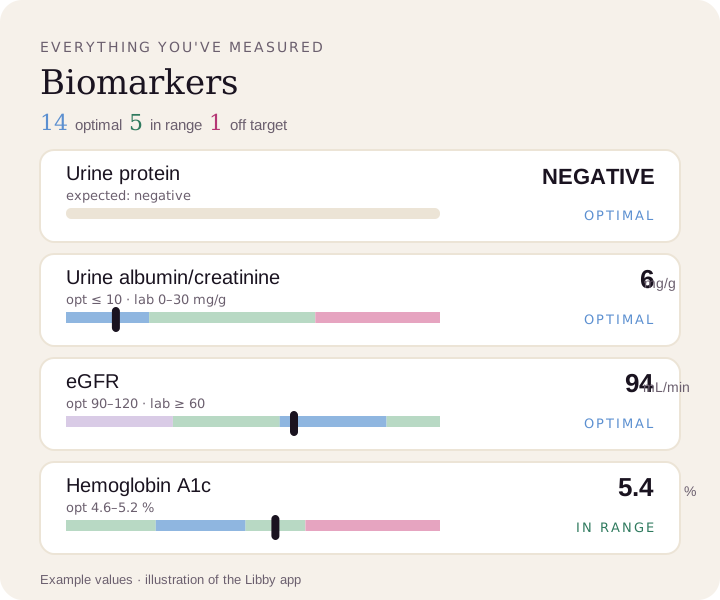
See every result against your lab's range.
Upload a lab PDF or a photo of your report. Libby shows every result next to your lab's range, flags what's off, and tracks each marker over time.
View your urine protein ›