UACR urine test: normal range, high causes, next steps
UACR shows albumin leaking from your kidneys into urine. What's normal, what optimal looks like, the common causes of a high result, and when to act.
The urine albumin-creatinine ratio (UACR) measures how much albumin, the main protein in your blood, is leaking into your urine. Healthy kidney filters hold almost all of it back. That makes a rising UACR one of the earliest signs of kidney damage, often before blood tests of kidney function change,1 and a marker of heart and blood-vessel risk too.2
The short version
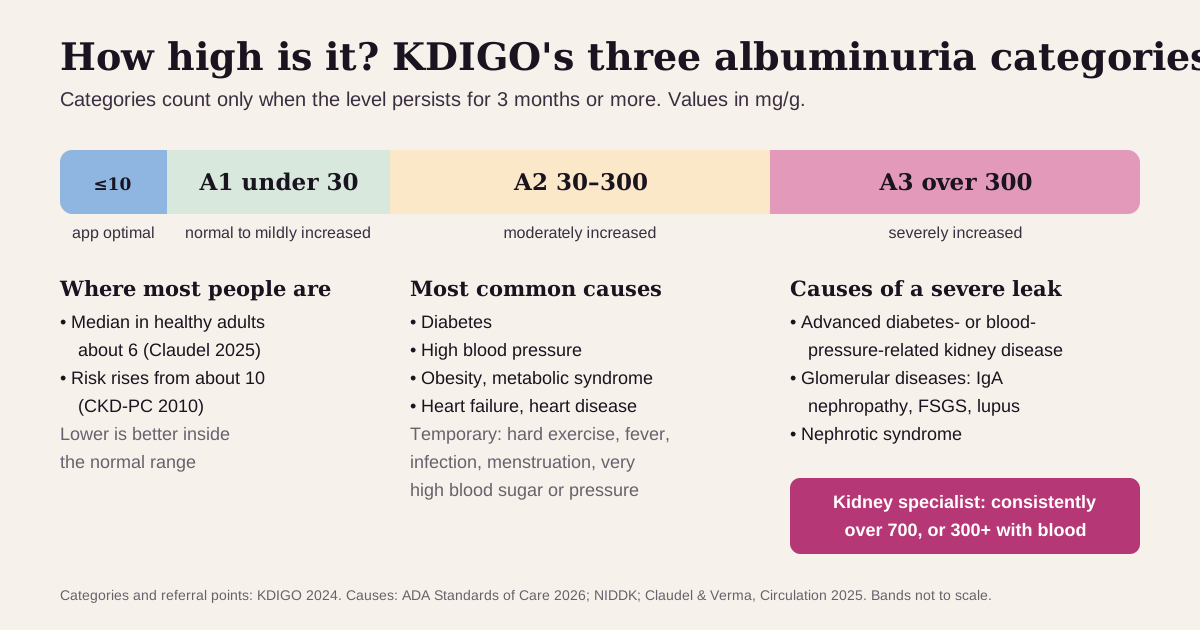
- Normal: under 30 mg/g, which KDIGO calls "normal to mildly increased".3 Healthy adults sit much lower, at a median of about 6 mg/g,4 and the optimal range in the Libby app is 10 mg/g or less.5
- High: 30–300 mg/g is moderately increased and over 300 is severely increased. The most common causes are diabetes and high blood pressure.36
- One high result needs a repeat. Exercise in the past 24 hours, fever, infection, menstruation, very high blood sugar or blood pressure, and heart failure can all push it up for a while. It counts when two of three tests over 3 to 6 months are high.1
- Get care promptly for swelling in your legs, ankles or around your eyes, foamy urine, or pink or cola-colored urine.78
What UACR is
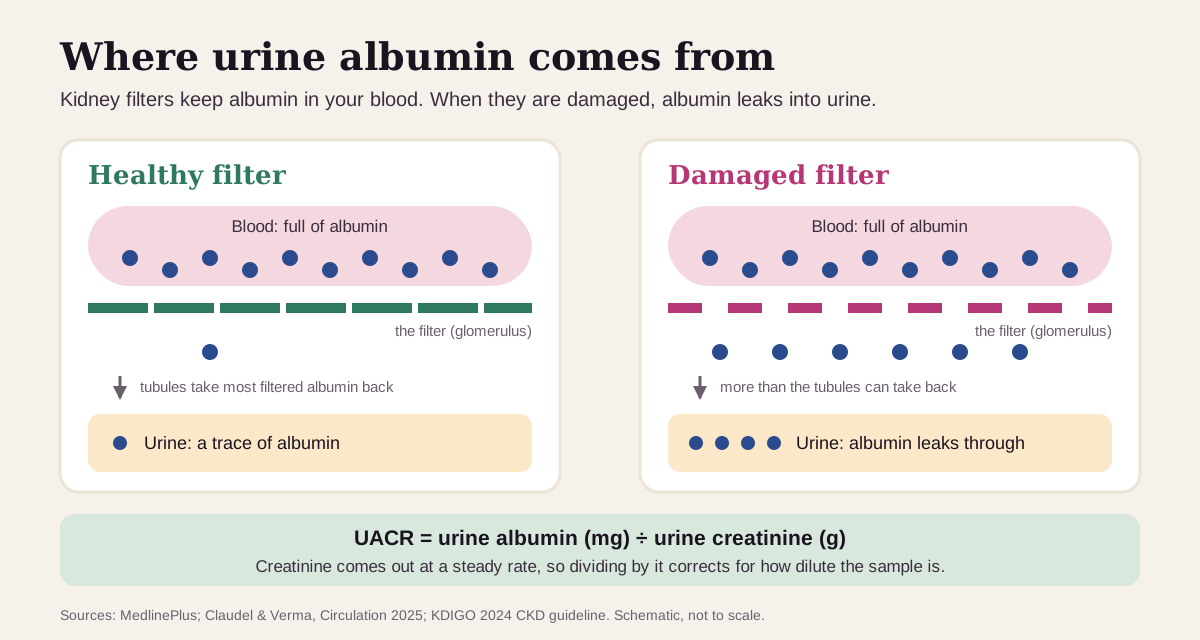
Albumin is the most plentiful protein in your blood. Your kidneys are made up of about a million filtering units, each with a tiny filter called a glomerulus that keeps the proteins your body needs in the blood.7 Some albumin does slip through each day, but the tubules downstream take nearly all of it back into the blood.2 So healthy urine holds only a trace.9
When the filters are damaged, by years of high blood sugar, by high pressure inside the filter, or by inflammation, more albumin gets through and shows up in your urine.2 That leak can appear before your eGFR, the blood-test estimate of how well your kidneys filter, starts to fall.1
A single urine sample can be dilute or concentrated, depending on what you drank. So the lab also measures creatinine, a waste product from your muscles that the kidneys clear at a steady rate. Dividing albumin by creatinine corrects for dilution and estimates how much albumin you'd lose over a whole day.910
Who gets tested. The American Diabetes Association recommends a UACR and an eGFR at least once a year for everyone with type 2 diabetes, and for people who have had type 1 diabetes for 5 years or more.1 Doctors also check it in people with high blood pressure, heart disease, a family history of kidney disease, obesity, smoking, or age over 50.9 You may see it on your report as "microalbumin" or "albumin/creatinine ratio".9
What's a normal UACR?
Labs and guidelines use one cutoff: under 30 mg/g. KDIGO (Kidney Disease: Improving Global Outcomes), the international kidney guideline group, calls this range A1, "normal to mildly increased".3 The American Diabetes Association uses the same line.1 The NIH's kidney institute puts it simply: the less albumin in your urine, the better.10
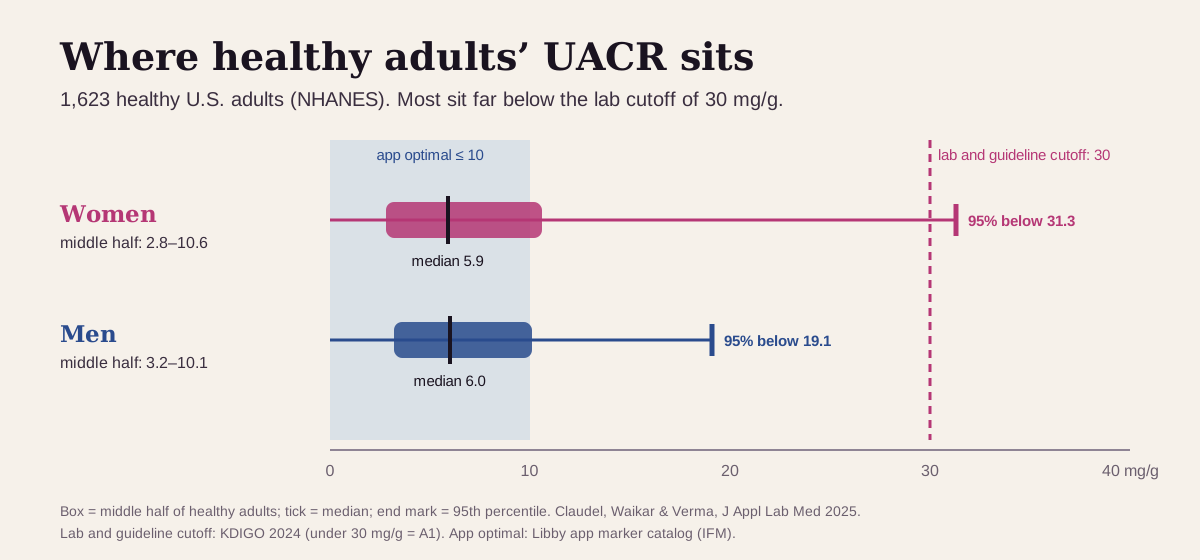
- In 1,623 healthy U.S. adults (no diabetes, high blood pressure, excess weight, smoking or reduced kidney function), the median UACR was 5.9 mg/g in women and 6.0 mg/g in men. Ninety-five percent sat below 31.3 mg/g (women) and 19.1 mg/g (men).4
- The 30 cutoff comes from early diabetes research. It traces back to a 1982 study of 63 people with type 1 diabetes, which measured overnight albumin loss rather than a ratio. In 1999 the National Kidney Foundation adopted a ratio of 30 mg/g or more to define "microalbuminuria".4
Women run higher on the ratio than men because they make less creatinine, while their albumin loss is similar. In a national U.S. sample, urine albumin was about the same in men and women, but men's urine creatinine was higher.11 Low body weight has the same effect as being female: less creatinine, a higher ratio. A high-protein diet or hard exercise raises creatinine output and pulls the ratio down.3
"Optimal" UACR: what health optimizers aim for
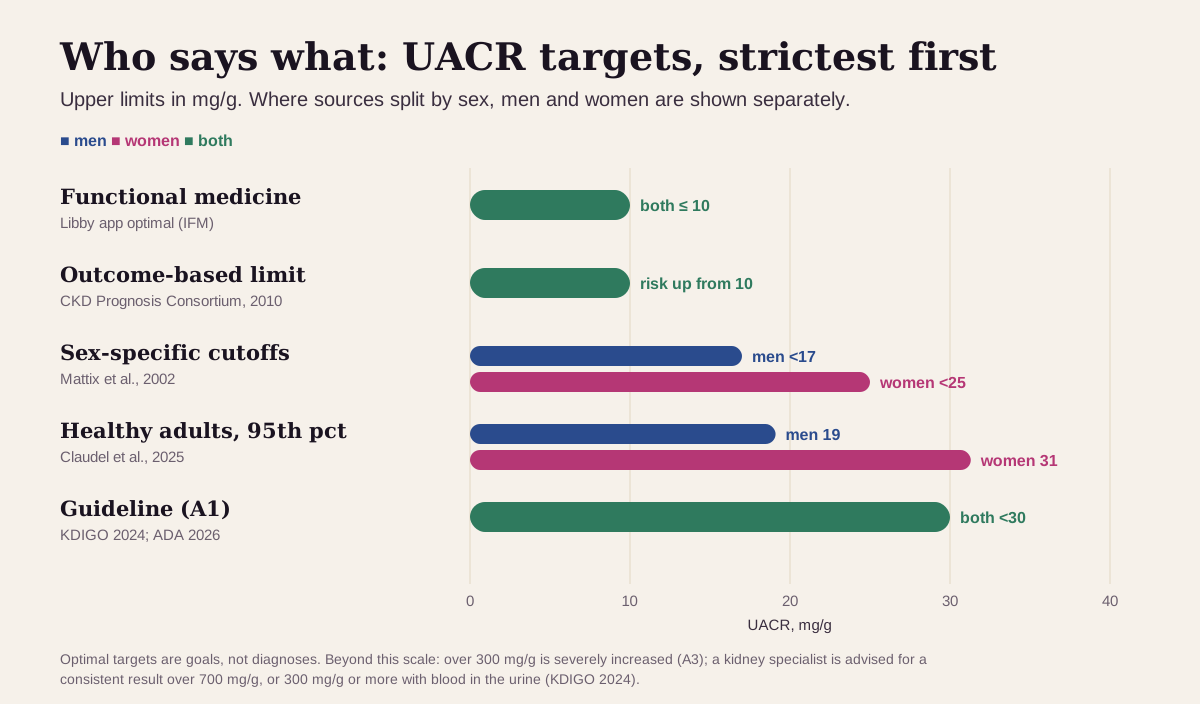
Functional-medicine practitioners aim well under the lab's 30. For this marker, the outcome research lines up with them: risk starts rising around 10 mg/g. Here's the ladder, from strictest to loosest:
| Target | Men | Women | Who uses it |
|---|---|---|---|
| Functional medicine | 10 mg/g or less | 10 mg/g or less | The optimal range shown in the Libby app, from the Institute for Functional Medicine5 |
| Outcome-based limit | 10 mg/g | 10 mg/g | CKD Prognosis Consortium: a UACR of 10 or more independently predicted death in 14 general-population cohorts12 |
| Sex-specific cutoffs | under 17 mg/g | under 25 mg/g | Mattix and colleagues, to account for men's higher creatinine11 |
| Healthy-adult 95th percentile | 19 mg/g | 31 mg/g | 1,623 healthy U.S. adults4 |
| Guideline range (A1) | under 30 mg/g | under 30 mg/g | KDIGO and the American Diabetes Association; the same 30 as the 1999 "microalbuminuria" cutoff314 |
| See a kidney specialist | over 700 mg/g, or 300+ with blood in the urine | same | KDIGO3 |
Why the low targets hold up:
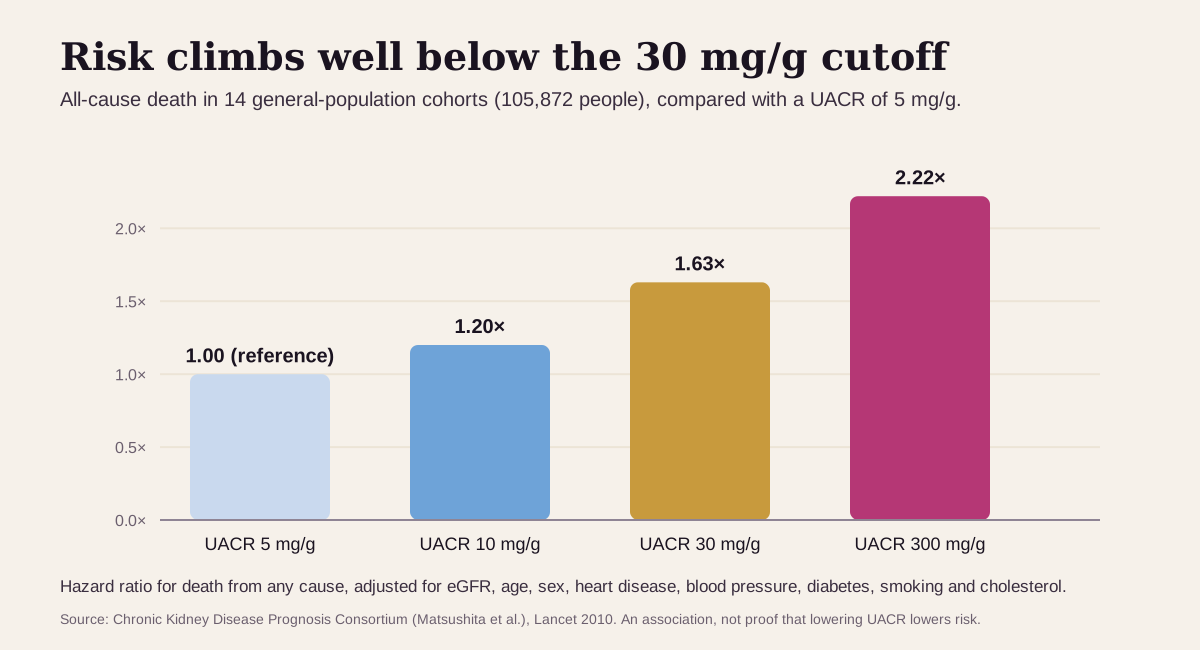
- The CKD Prognosis Consortium pooled 105,872 people from 14 general-population cohorts. Compared with a UACR of 5 mg/g, the risk of death from any cause was 1.20 times higher at 10 mg/g, 1.63 times at 30 and 2.22 times at 300, after accounting for eGFR, blood pressure, diabetes, smoking and cholesterol. Risk climbed steadily, with no threshold effect.12
- The authors of the healthy-adult study put it this way: the statistical upper limit of normal is 20 to 30 mg/g, but the clinical upper limit "could be as low as 7 to 10 mg/g".4
- Albuminuria in the "normal" range has been linked to later high blood pressure, heart failure and coronary artery disease.2
Keep "optimal" in perspective: it's a target, not a diagnosis. A UACR of 18 sits inside the normal range, and one reading can swing widely from test to test (see below). Guidelines save kidney-protecting medicines for results of 30 or more, and no trials have tested treating lower levels.4 The things that lower albuminuria are the familiar list: blood sugar and blood-pressure control, weight loss, activity, less salt and quitting smoking.1
What a high UACR usually means
The level is the first clue. KDIGO sorts albuminuria into three categories, and a result only counts as kidney disease when it lasts 3 months or more.3
First, check for a temporary rise
A single high UACR can be short-lived. The ADA lists exercise in the past 24 hours, infection, fever, heart failure, very high blood sugar, menstruation and very high blood pressure as things that raise it without kidney damage.1 Urinary tract infections and gum infections can do it too.9 That's why a high result is repeated, ideally on a first-morning sample.3 KDIGO also lists menstruation, exercise, a urinary infection and blood in the urine as things that raise the reading.3
The usual suspects
- Diabetes. It's the most common cause of chronic kidney disease worldwide.2 Kidney disease develops in 20–40% of people with diabetes, and it can be present at the diagnosis of type 2 diabetes.1
- High blood pressure. Together with diabetes, it's the most common cause of chronic kidney disease in adults.6 High pressure inside the filters pushes albumin through.2
- Obesity and metabolic syndrome. Belly fat is linked to albuminuria even without diabetes, and so is fatty liver disease.2
- Heart disease and heart failure. About 32% of U.S. adults with heart failure have a UACR of 30 or more.2
- Smoking. It's a listed risk factor, and quitting is one of the ADA's measures that lower albuminuria.91
Less common, more serious: diseases of the filters
- Glomerular diseases, in which the filters themselves are inflamed or scarred, such as IgA nephropathy and focal segmental glomerulosclerosis (FSGS), and autoimmune diseases such as lupus.6 IgA nephropathy shows up in about 1 in 10 U.S. kidney biopsies and leaks both blood and protein into the urine.8
- Nephrotic syndrome: heavy protein loss in the urine, low albumin in the blood, swelling, and high cholesterol.7
- In people with diabetes, blood or white cells in the urine, a UACR that climbs fast, or an eGFR that drops fast suggest another cause, and the ADA advises seeing a kidney specialist.1
Get prompt care if you have puffy eyelids or swelling in your legs, ankles, feet or belly, foamy urine, sudden weight gain from fluid, or pink or cola-colored urine.78 KDIGO advises a kidney specialist for a UACR that stays over 700 mg/g, or 300 or more with blood in the urine.3
UACR reads best next to its neighbors
UACR measures leak. eGFR measures filtering. KDIGO defines chronic kidney disease by either one and stages it by both,3 and each adds to the other's risk.12 The pattern across a few more tests usually says more than UACR alone:
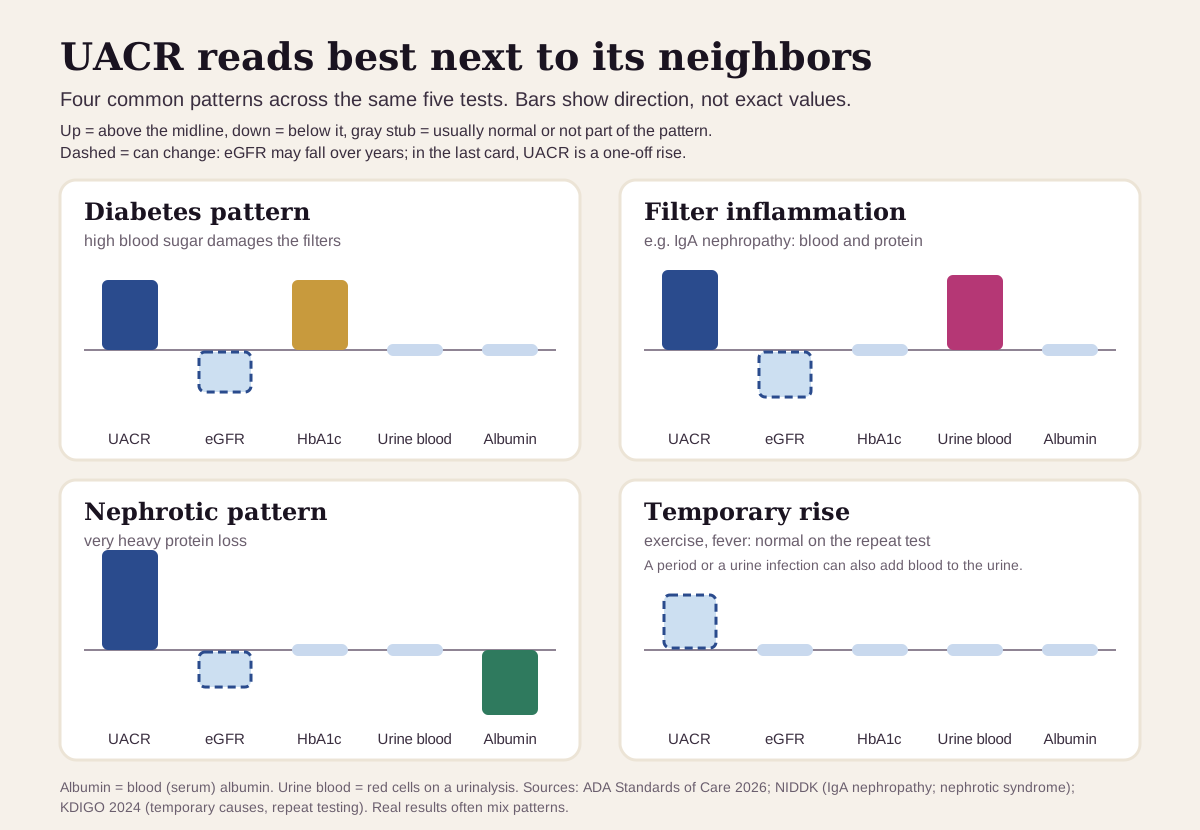
| If you see… | It often points to… |
|---|---|
| UACR and HbA1c both up, no blood in the urine, eGFR normal or slowly falling | diabetes-related kidney disease, the most common pattern126 |
| UACR up with high blood pressure, HbA1c normal | blood-pressure damage to the kidney's filters62 |
| UACR up with blood in the urine, eGFR sometimes falling | inflammation of the filters, such as IgA nephropathy; KDIGO advises a kidney specialist for 300+ with blood813 |
| UACR very high with low blood albumin, often with swelling and high cholesterol | nephrotic syndrome, which calls for a kidney specialist71 |
| One high UACR, normal on the repeat | a temporary rise from exercise, fever, infection or menstruation; the last two can also put blood in the urine13 |
Low eGFR with a normal UACR happens too, and it's getting more common in diabetes.1 That's why guidelines check both tests together each year.13
How fast UACR changes
UACR moves a lot from sample to sample. In a study of 50 people with stable kidney disease tested repeatedly over less than 4 weeks, a random urine UACR varied by about 30% from sample to sample. Blood creatinine varied by about 5%.13 In diabetes-related kidney disease, a repeat can land anywhere from 25% to 375% of the first value.2
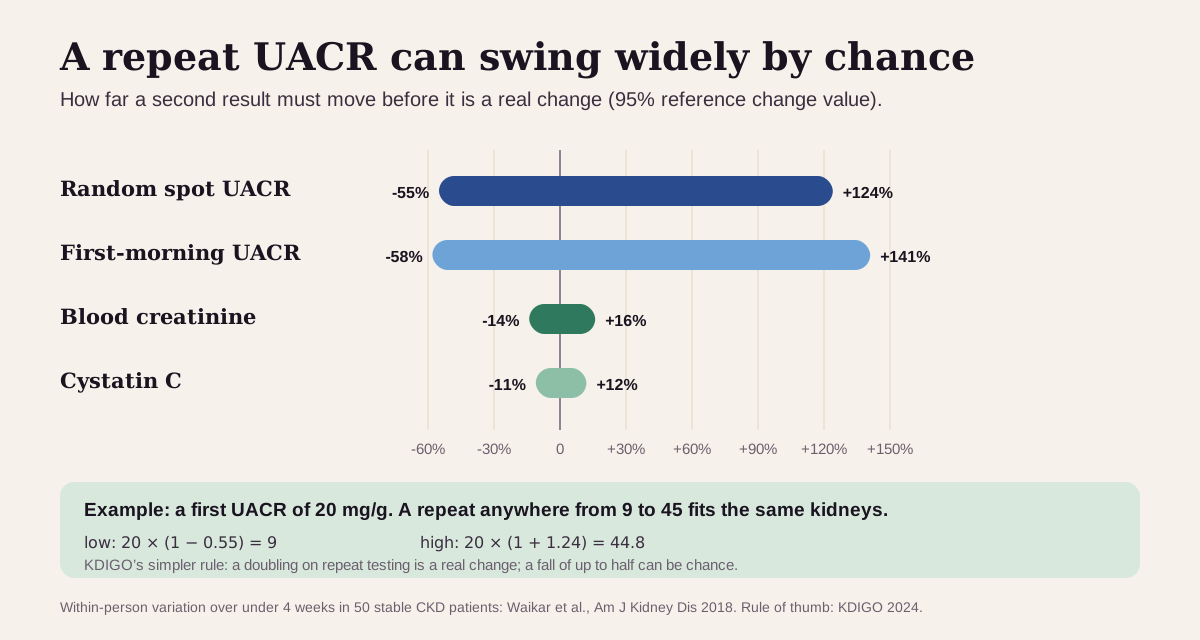
What that means in practice:
- Repeat before you react. A high result counts when two of three tests over 3 to 6 months are high.1 Skip hard exercise the day before, and test when you're well.91
- Only big moves are real. KDIGO treats a doubling on repeat testing as a real change and a fall of up to half as possible chance.3
- Trends still matter. A UACR that doubles within 2 years comes with a 50–100% higher risk of kidney failure.3 In the other direction, a 30% drop over 2 years went with a 17% lower risk (hazard ratio 0.83) in 28 cohorts.14
- It responds to treatment. The ADA lists blood sugar and blood-pressure control, ACE inhibitors or ARBs, quitting smoking, weight loss, less salt, physical activity, and newer drugs (SGLT2 inhibitors, GLP-1 receptor agonists, MRAs) as ways to lower it. For a UACR of 300 or more it aims for a drop of at least 30%.1 Medicine choices belong with your clinician.
Going deeper: why the ratio uses creatinine
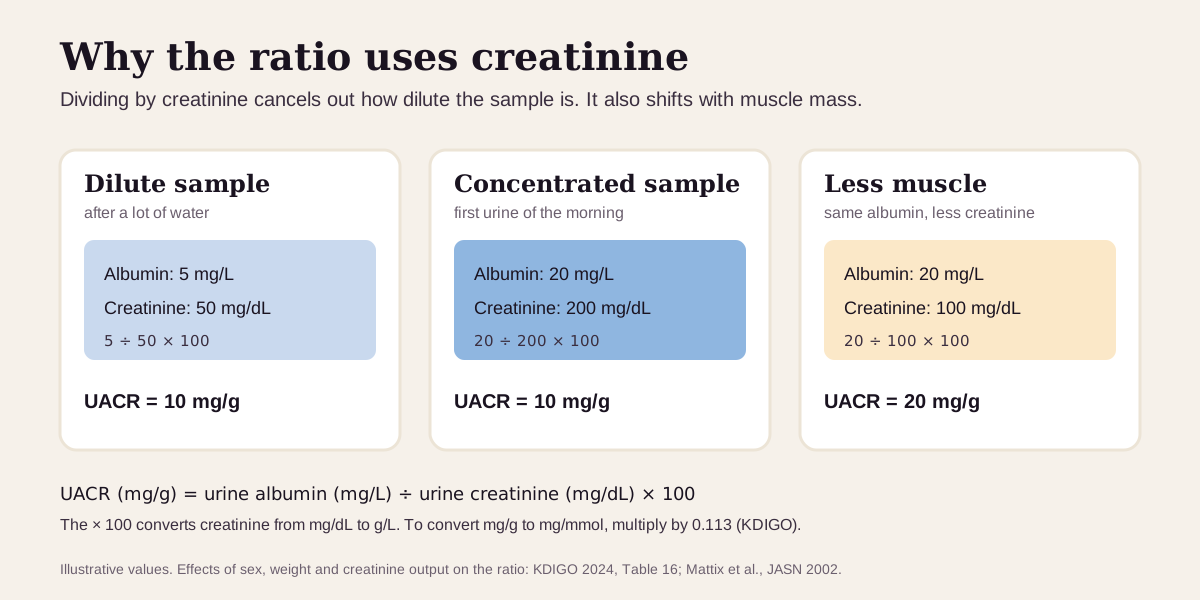
The ratio works because albumin and creatinine get diluted by the same water. Drink a lot and both concentrations fall together, so the ratio holds. That's why a spot ratio can stand in for a 24-hour urine collection, the most accurate way to measure albumin loss.109
The weak spot is the denominator. KDIGO lists what shifts creatinine output: women and people with low body weight make less, which pushes the ratio up; a high-protein diet, exercise or higher body weight means more, which pulls it down.3 That's the case for sex-specific cutoffs.11
Why the filters start to leak: in kidney disease the podocytes, the cells that wrap the filter's outer surface, flatten and pull back, and the filter's basement membrane loosens. In high blood pressure, raised pressure inside the filter forces albumin through, and damage to the lining of the filter's capillaries adds to the leak.2 The same blood-vessel lining damage elsewhere in the body may be one reason UACR tracks heart risk.2
Questions worth asking
- Was this a first-morning sample, and should we repeat it before drawing conclusions?
- Did anything temporary (exercise, fever, an infection, my period) happen in the day before the test?
- What are my eGFR and HbA1c, and what category does that put me in?
- Is there blood or protein on my urinalysis too?
- Is my blood pressure where it should be for my kidneys?
- How often should we recheck, and what change would alter the plan?
FAQ
What is a normal UACR? Under 30 mg/g is normal by the KDIGO and ADA guidelines.31 Healthy adults have a median near 6 mg/g, and the Libby app's optimal range is 10 mg/g or less.45
What is the most common cause of a high UACR? Diabetes and high blood pressure. A single high result can also come from exercise, fever, infection or menstruation, so it's repeated before it counts.61
Can exercise raise UACR? Yes. Exercise within 24 hours of the test can raise it, which is why labs suggest skipping hard workouts beforehand.19
When is a high UACR urgent? When it comes with swelling, foamy urine, or pink or cola-colored urine, get care promptly. A UACR that stays over 700 mg/g, or is 300 or more with blood in the urine, calls for a kidney specialist.783
This guide is for education. It can't diagnose you or replace care from a clinician who knows your history.
Footnotes
-
American Diabetes Association Professional Practice Committee for Diabetes. 11. Chronic Kidney Disease and Risk Management: Standards of Care in Diabetes—2026. Diabetes Care. 2026;49(Suppl 1):S246–S260. The U.S. diabetes guideline: yearly UACR testing, the two-of-three rule, temporary causes, the 20–40% figure and the interventions that lower albuminuria. PMC ↩ ↩2 ↩3 ↩4 ↩5 ↩6 ↩7 ↩8 ↩9 ↩10 ↩11 ↩12 ↩13 ↩14 ↩15 ↩16 ↩17 ↩18 ↩19 ↩20 ↩21 ↩22 ↩23 ↩24 ↩25 ↩26
-
Claudel SE, Verma A. Albuminuria in Cardiovascular, Kidney, and Metabolic Disorders: A State-of-the-Art Review. Circulation. 2025;151(10):716–732. How albumin is filtered and reclaimed, why filters leak, the causes of albuminuria, and its links to heart disease. PMC ↩ ↩2 ↩3 ↩4 ↩5 ↩6 ↩7 ↩8 ↩9 ↩10 ↩11 ↩12 ↩13 ↩14
-
Kidney Disease: Improving Global Outcomes (KDIGO) CKD Work Group. KDIGO 2024 Clinical Practice Guideline for the Evaluation and Management of Chronic Kidney Disease. Kidney Int. 2024;105(4S):S117–S314. The international kidney guideline: the A1–A3 categories (Table 3), the 0.113 mg/g-to-mg/mmol factor, the causes of false highs and lows (Table 16), the doubling rule (Practice Point 2.1.5) and the referral criteria (Figure 48). PubMed · KDIGO PDF ↩ ↩2 ↩3 ↩4 ↩5 ↩6 ↩7 ↩8 ↩9 ↩10 ↩11 ↩12 ↩13 ↩14 ↩15 ↩16 ↩17 ↩18 ↩19 ↩20 ↩21 ↩22 ↩23 ↩24 ↩25 ↩26
-
Claudel SE, Waikar SS, Verma A. Albuminuria References Ranges in Healthy US Adults. J Appl Lab Med. 2025;10(3):767–771. 1,623 healthy NHANES adults; medians of 5.9 (women) and 6.0 (men) mg/g and 95th percentiles of 31.3 and 19.1 mg/g; the history of the 30 mg/g cutoff. PMC ↩ ↩2 ↩3 ↩4 ↩5 ↩6 ↩7 ↩8 ↩9 ↩10
-
Institute for Functional Medicine. Clinical practice guidelines and Advanced Practice Modules (range as recorded in the Libby app's marker catalog; member-only modules not opened for this article). The source of the app's optimal UACR range of 10 mg/g or less. https://www.ifm.org ↩ ↩2 ↩3 ↩4
-
National Institute of Diabetes and Digestive and Kidney Diseases. Causes of Chronic Kidney Disease in Adults. NIH. Last reviewed February 2025. Diabetes and high blood pressure as the most common causes; glomerular diseases. NIDDK ↩ ↩2 ↩3 ↩4 ↩5 ↩6 ↩7
-
National Institute of Diabetes and Digestive and Kidney Diseases. Nephrotic Syndrome in Adults. NIH. The four features of nephrotic syndrome and its symptoms. NIDDK ↩ ↩2 ↩3 ↩4 ↩5 ↩6 ↩7
-
National Institute of Diabetes and Digestive and Kidney Diseases. IgA Nephropathy. NIH. Blood and protein in the urine; about 1 in 10 U.S. kidney biopsies. NIDDK ↩ ↩2 ↩3 ↩4 ↩5 ↩6
-
National Library of Medicine. Microalbumin Creatinine Ratio. MedlinePlus. Updated May 27, 2025. What the test measures, who gets it, how to prepare, and temporary causes of a high result. MedlinePlus ↩ ↩2 ↩3 ↩4 ↩5 ↩6 ↩7 ↩8 ↩9
-
National Institute of Diabetes and Digestive and Kidney Diseases. Chronic Kidney Disease Tests and Diagnosis. NIH. The UACR test and its 30 mg/g cutoff, in plain language. NIDDK ↩ ↩2 ↩3
-
Mattix HJ, Hsu CY, Shaykevich S, Curhan G. Use of the albumin/creatinine ratio to detect microalbuminuria: implications of sex and race. J Am Soc Nephrol. 2002;13(4):1034–1039. A nationally representative U.S. sample: similar urine albumin in men and women, higher urine creatinine in men; sex-specific cutoffs of 17 (men) and 25 (women) mg/g. PubMed ↩ ↩2 ↩3 ↩4 ↩5
-
Chronic Kidney Disease Prognosis Consortium; Matsushita K, van der Velde M, Astor BC, et al. Association of estimated glomerular filtration rate and albuminuria with all-cause and cardiovascular mortality in general population cohorts: a collaborative meta-analysis. Lancet. 2010;375(9731):2073–2081. 105,872 people in 14 cohorts with ACR measurements; hazard ratios of 1.20, 1.63 and 2.22 at 10, 30 and 300 mg/g versus 5 mg/g. PMC ↩ ↩2 ↩3 ↩4 ↩5
-
Waikar SS, Rebholz CM, Zheng Z, et al. Biological Variability of Estimated GFR and Albuminuria in CKD. Am J Kidney Dis. 2018;72(4):538–546. Within-person variation in 50 stable outpatients with kidney disease; random spot UACR 29.7% (reference change +124%/−55%), serum creatinine 5.4%. PMC ↩ ↩2
-
Coresh J, Heerspink HJL, Sang Y, et al. Change in albuminuria and subsequent risk of end-stage kidney disease: an individual participant-level consortium meta-analysis of observational studies. Lancet Diabetes Endocrinol. 2019;7(2):115–127. 28 cohorts; a 30% fall in ACR over 2 years had a hazard ratio of 0.83 for kidney failure. PMC ↩
Educational content, not medical advice. Libby is a personal record tool, not a medical service — it doesn't diagnose, treat, or prescribe. Reference ranges vary by lab and by person. Talk to a qualified healthcare professional about your results.
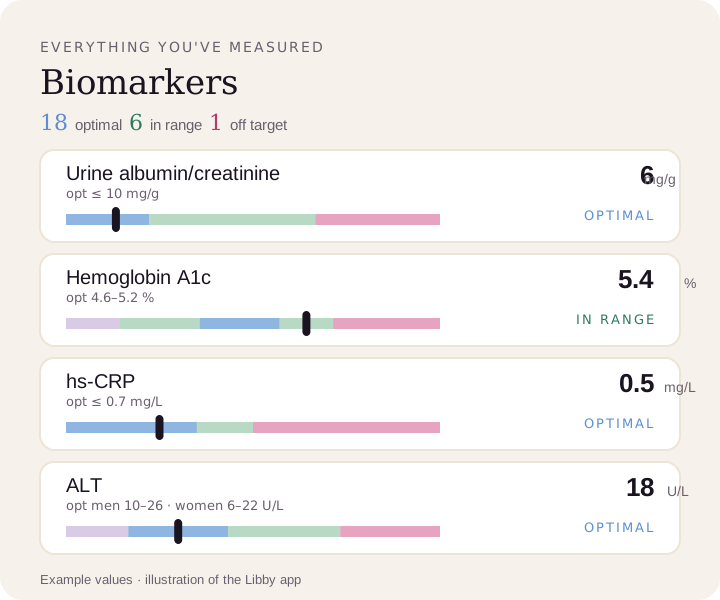
Compare your results to optimal ranges.
Upload a lab PDF or a photo of your report. Libby puts every marker on your lab's range and the optimal range, and tracks your trends over time.
View your UACR ›