Urine creatinine test: normal levels and what they mean
Urine creatinine shows how dilute a sample is, whether a 24-hour collection is complete, and anchors urine ratios. What's normal and why it runs low or high.
Urine creatinine measures a waste product your muscles make at a steady pace, and labs use it mostly as a yardstick for the urine itself. Because your body puts out a fairly constant amount of creatinine each day, the level tells the lab how dilute or concentrated a sample is and whether a 24-hour collection caught everything. It's also the "per gram of creatinine" in the albumin-creatinine and protein-creatinine ratios.12
The short version
- Normal: a spot sample usually lands between about 30 and 300 mg/dL, and a full 24-hour collection holds about 500 to 2,000 mg. Men, younger adults and more muscular people run higher.32
- Low or high usually reflects how much you drank. Below 20 mg/dL usually means a very dilute sample. Healthy volunteers who drank about a quart of fluid an hour dropped below 20 in about 1.5 hours.45
- A 24-hour total that's too low for your weight (under about 0.7 of what your weight predicts) usually means some urine was missed. That happened in 6% to 47% of collections across studies.6
- Urgent: urine creatinine itself is rarely an emergency. Very little or no urine, or dark, cola-colored urine with muscle pain, needs prompt care.78
What urine creatinine is
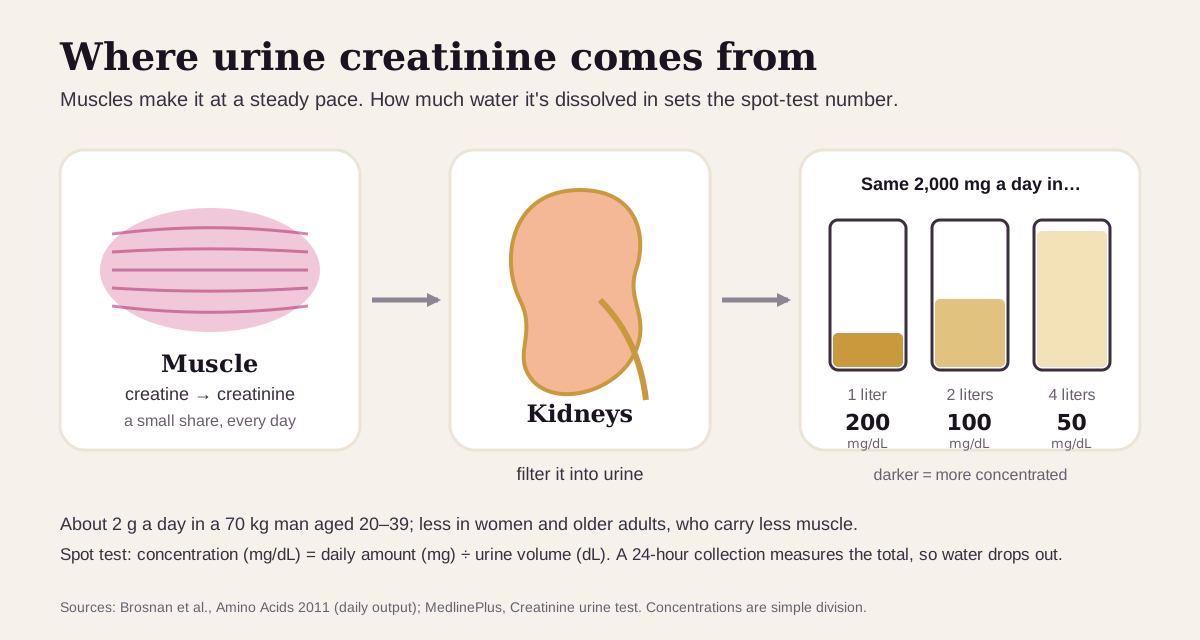
Your muscles store energy as creatine. A small share of it breaks down every day, on its own, into creatinine, which your kidneys pass into your urine. Young men of about 70 kg lose around 2 g of creatinine a day. Women and older adults lose less, because they carry less muscle.10
That steady output is what makes creatinine useful. Almost all of it leaves through your urine.211 Researchers have long used the daily total as a gauge of muscle: each gram of creatinine a day corresponds to roughly 17 to 22 kg of muscle.12
You'll see urine creatinine in two forms:
- A spot (random) sample gives a concentration in mg/dL. It moves with how much water is in your urine: the same daily output reads 200 mg/dL in 1 liter of urine and 50 mg/dL in 4 liters.
- A 24-hour collection gives a total in mg per day. Water drops out of the picture, so the number tracks muscle, diet and whether the collection was complete.213
Labs measure it for three jobs: checking that a spot sample is usable, checking that a 24-hour collection is complete, and dividing other urine results by it. The albumin-creatinine ratio (UACR) and protein-creatinine ratio are the best-known examples.521
What's a normal urine creatinine?
For a spot sample, most results fall between about 30 and 300 mg/dL. A reference study from CDC researchers measured spot samples from 22,245 people in the U.S. national health survey (NHANES III, 1988–1994):3
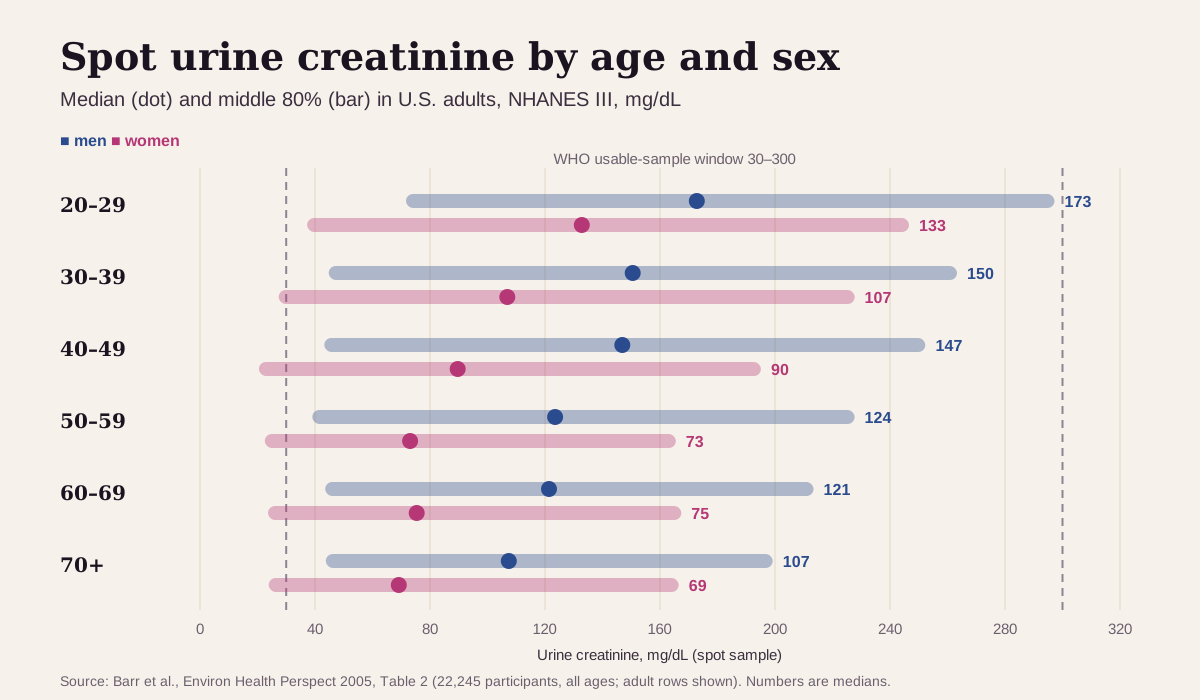
- The middle 80% ran from 50 to 254 mg/dL in males and 27 to 218 mg/dL in females (ages 6 to 90), with medians of 137 and 99.3
- It falls with age. The median was 173 mg/dL in men aged 20–29 and 107 at 70 and older. For women it was 133 and 69.3
- Bigger bodies run higher. Each point of body mass index added about 1.3 mg/dL, and fat-free mass predicted it too. Morning samples ran slightly higher than afternoon or evening ones.3
The Libby app compares a spot result with a range of 28–259 mg/dL for men and 16–250 for women. The commercial lab Labcorp prints no reference range for urine creatinine concentration on its sample reports ("Not Estab.").13
For a 24-hour collection, MedlinePlus puts the normal total at 500 to 2,000 mg a day. Scaled to body weight, that's 14 to 26 mg per kg a day for men and 11 to 20 for women.2 Labcorp's sample report prints 800–1,800 mg per 24 hours.13
"Optimal" urine creatinine: no target, but clear lines
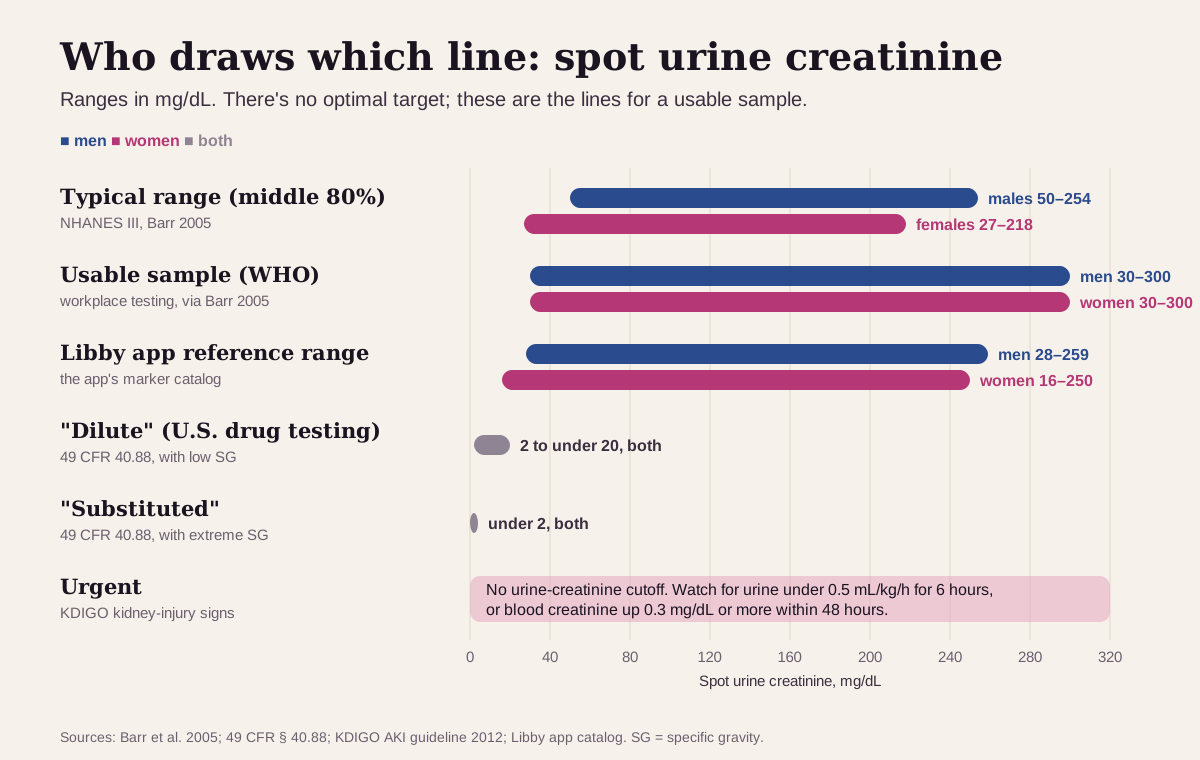
Urine creatinine has no "healthy target" of its own. We found no functional-medicine or longevity range for it, and the Libby app shows it on your lab's range with no optimal band. What the sources do draw are lines for when a spot sample is too dilute or too concentrated to trust. From the strictest to the loosest:
| Line | Men | Women | Who draws it |
|---|---|---|---|
| Typical range (middle 80%) | 50–254 mg/dL | 27–218 mg/dL | NHANES III, ages 6 to 903 |
| Usable sample for workplace testing | 30–300 mg/dL | 30–300 mg/dL | The World Health Organization's rule, as described by CDC researchers: outside it, collect another sample3 |
| Reference range in the Libby app | 28–259 mg/dL | 16–250 mg/dL | The app's marker catalog. Labcorp prints no spot range13 |
| "Dilute" (U.S. drug testing) | 2 to under 20 mg/dL | 2 to under 20 mg/dL | With a specific gravity above 1.0010 and below 1.00305 |
| "Substituted" | under 2 mg/dL | under 2 mg/dL | With a specific gravity of 1.0010 or less, or 1.0200 or more: judged not consistent with human urine5 |
| Urgent | no urine-creatinine cutoff | no urine-creatinine cutoff | The urgent signs are little or no urine, or a fast rise in blood creatinine (KDIGO kidney-injury criteria)9 |
The 30-to-300 window excludes more women. In NHANES, 11% of women's samples fell under 30 mg/dL versus 4% of men's. The CDC authors argued the WHO window may have been set on a less diverse workforce and should be revisited.3
Where "more" does track with health: the 24-hour total. A full-day total reflects muscle, and low muscle predicts worse outcomes:
- In 903 people with heart disease followed for 6 years, those in the lowest third of 24-hour creatinine output (under 1,068 mg a day for men, under 766 for women) had 2.30 times the risk of death of those in the highest third, after adjusting for age, kidney function, body mass index and heart risk factors.11
- In 8,092 Dutch adults from the general population followed for 7.5 years, every doubling of 24-hour creatinine output went with roughly half the risk of death (hazard ratio 0.52 in women, 0.45 in men).14
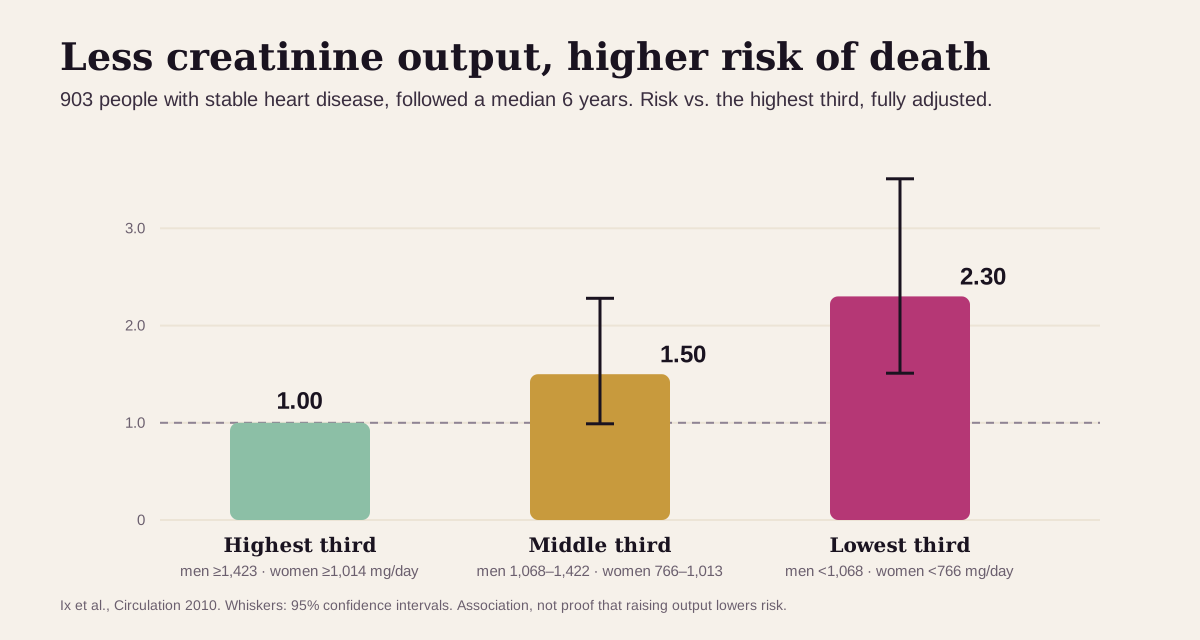
Keep this in perspective. A high spot result usually means a concentrated sample, and a meat meal raises the total collected that day, so a higher number is no goal in itself.113 The outcome studies used full 24-hour collections as a stand-in for muscle. The Heart and Soul authors called for studies of resistance exercise and nutrition to see whether building muscle changes the risk.11
What a low or high urine creatinine usually means
On a spot sample, the first question is water. A single number mostly tells you how dilute the sample was. A 24-hour total is the one that speaks to muscle, diet and collection.13
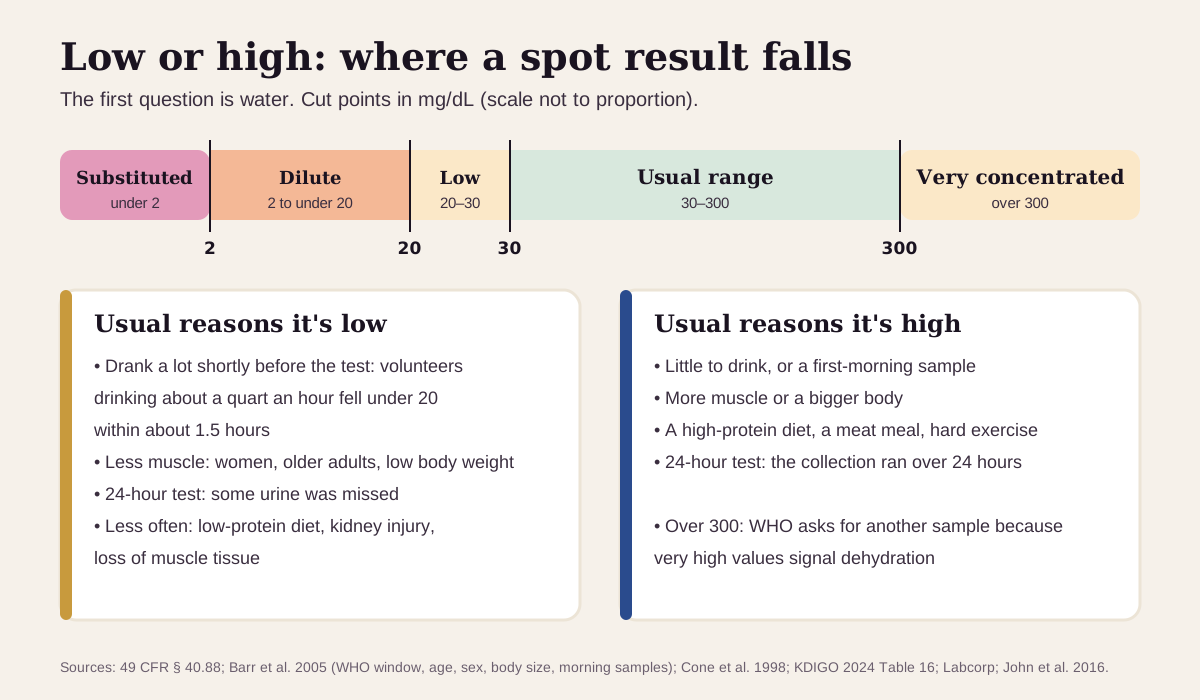
Low: usually a dilute sample, less muscle, or missed urine
The usual suspects, most common first:
- A dilute sample. Drinking a lot shortly before the test is the classic cause. In a National Institute on Drug Abuse study, volunteers who drank about a quart of fluid an hour made urine under 20 mg/dL within about 1.5 hours, and it took 8 to 10 hours to return to their usual level.4 In NHANES, 7.7% of all samples were under 30.3
- Less muscle. Women, older adults and people with low body weight make less creatinine, so both their spot values and their 24-hour totals run lower.3101
- A 24-hour collection that missed some urine. Checked against a marker pill (PABA), 6% to 47% of collections were incomplete across studies.6 See the check below.
- Less common: a low-protein diet, kidney injury, and loss of muscle tissue.12
Below 2 mg/dL, together with an extreme specific gravity, U.S. drug-testing labs report the sample as "substituted": its values fall outside what human urine shows.5
High: usually a concentrated sample or more muscle
- A concentrated sample. Little to drink or a first-morning sample pushes it up. The WHO's upper line of 300 mg/dL exists because very high values signal dehydration.3
- More muscle or a bigger body. Men and people with more fat-free mass run higher.3
- A high-protein diet, a meat meal or hard exercise raise creatinine output. Labcorp notes that eating meat raises urine creatinine as well as blood creatinine.113
- A 24-hour collection that ran long. Collecting for more than 24 hours inflates the total. KDIGO lists over-collection as a common error.1
The 24-hour check: did the collection catch everything?
A complete collection should hold about what your weight predicts. One common check, the creatinine index, compares what you collected with 24 mg per kg for men and 21 mg per kg for women. An index under 0.7 flags a likely incomplete collection.6
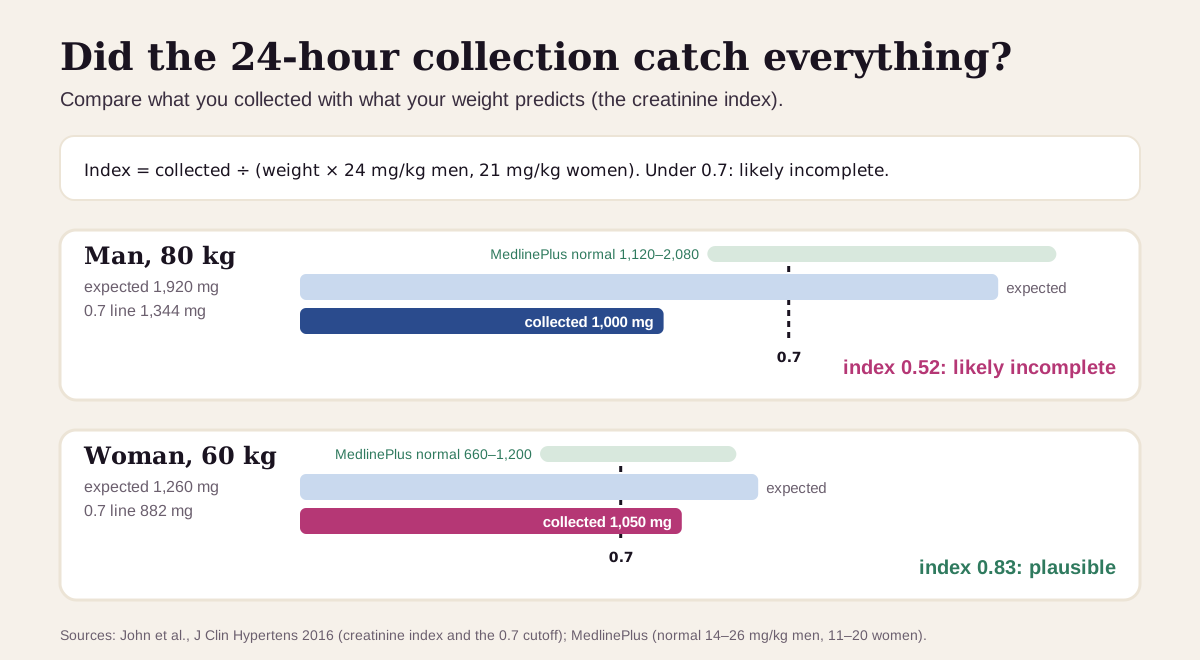
The check catches only part of the problem. Against the marker-pill standard, creatinine criteria caught between 6% and 63% of incomplete collections.6 One reason is natural wobble: healthy men who each collected 54 to 97 full days of urine varied by 10.5% to 14.4% (one standard deviation) from day to day.15 Research teams guard against errors directly. The Heart and Soul Study repeated any collection under 1 liter or over 3 liters.11
Get prompt care if you're making very little urine or none, or if dark, red or cola-colored urine comes with muscle pain or weakness, for example after a crush injury or extreme exertion.78
Urine creatinine reads best next to its neighbors
A urine creatinine result makes sense once you set it beside specific gravity, the ratios, your blood creatinine and, if you have one, a 24-hour total:
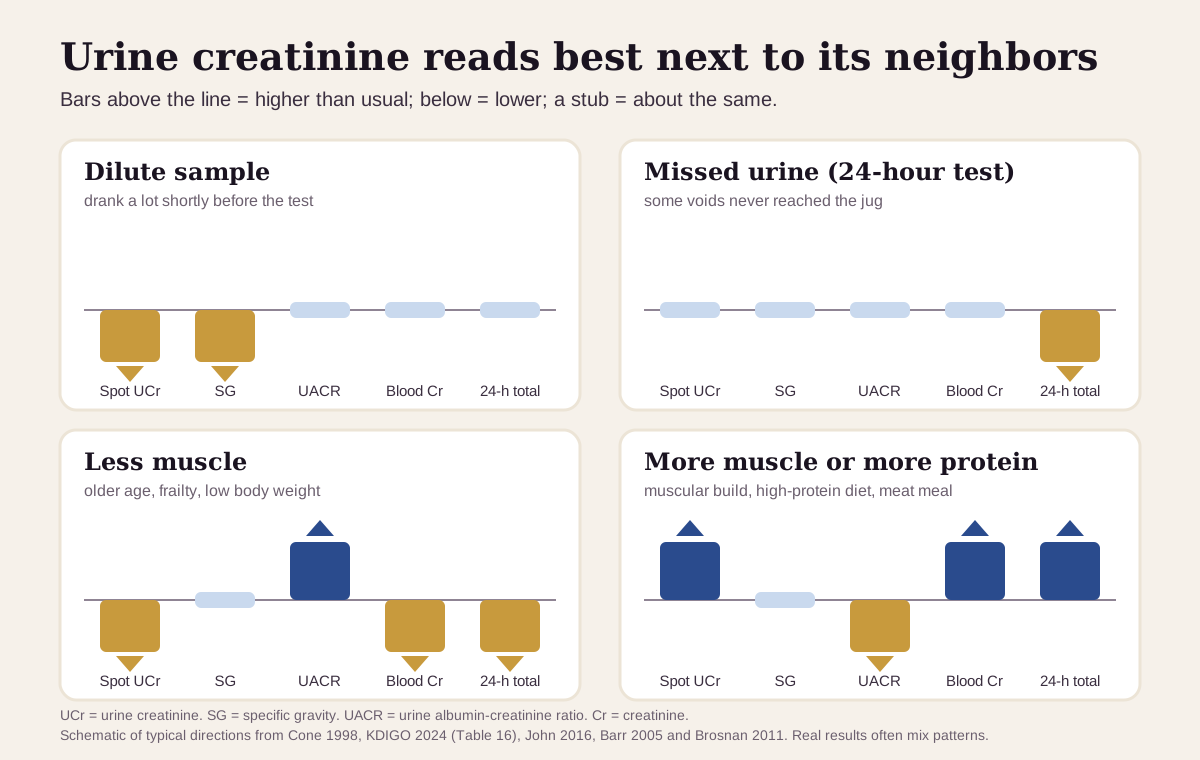
| If you see… | It often points to… |
|---|---|
| Spot creatinine and specific gravity both low, ratios in line with past results | a dilute sample: the ratio corrects for most of the water, but a normal UACR on a very dilute sample is worth confirming on a first-morning sample, especially if you're at risk for kidney disease41 |
| A 24-hour total well under what your weight predicts, blood creatinine normal | missed urine: repeat the collection before trusting anything calculated from it61 |
| Low 24-hour output, low blood creatinine, UACR higher than expected | less muscle, as often happens with age: the small denominator can inflate the ratio110 |
| High 24-hour output, higher blood creatinine, UACR lower than expected | more muscle, a high-protein diet or a recent meat meal113 |
| Blood creatinine rising while the 24-hour output holds steady | the kidneys clearing creatinine more slowly: a lower creatinine clearance1611 |
How fast urine creatinine changes
A spot value can swing within an hour; the daily total moves far less.
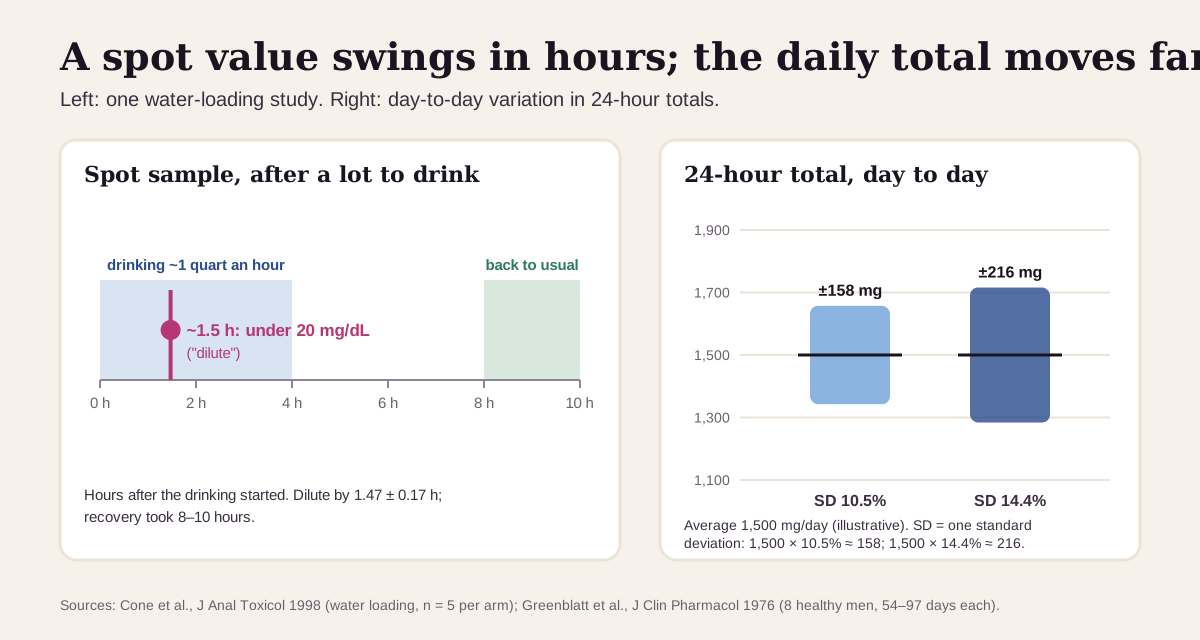
What that means in practice:
- Compare like with like. A morning sample reads higher than an evening one, and a sample after a big drink reads far lower.34
- Watch the meal before a test. A cooked-meat meal raises blood creatinine by about 0.23 mg/dL, peaking 2 to 4 hours later. KDIGO suggests waiting 12 hours after meat or fish before a blood creatinine test.1
- Trends beat snapshots. A single 24-hour total wobbles by 10% to 15% from day to day, so a steady drift down across several well-collected tests says more than one low result.15 In the heart-disease study, lower output tracked with higher risk.11
Going deeper: creatinine clearance and the "per gram" ratios
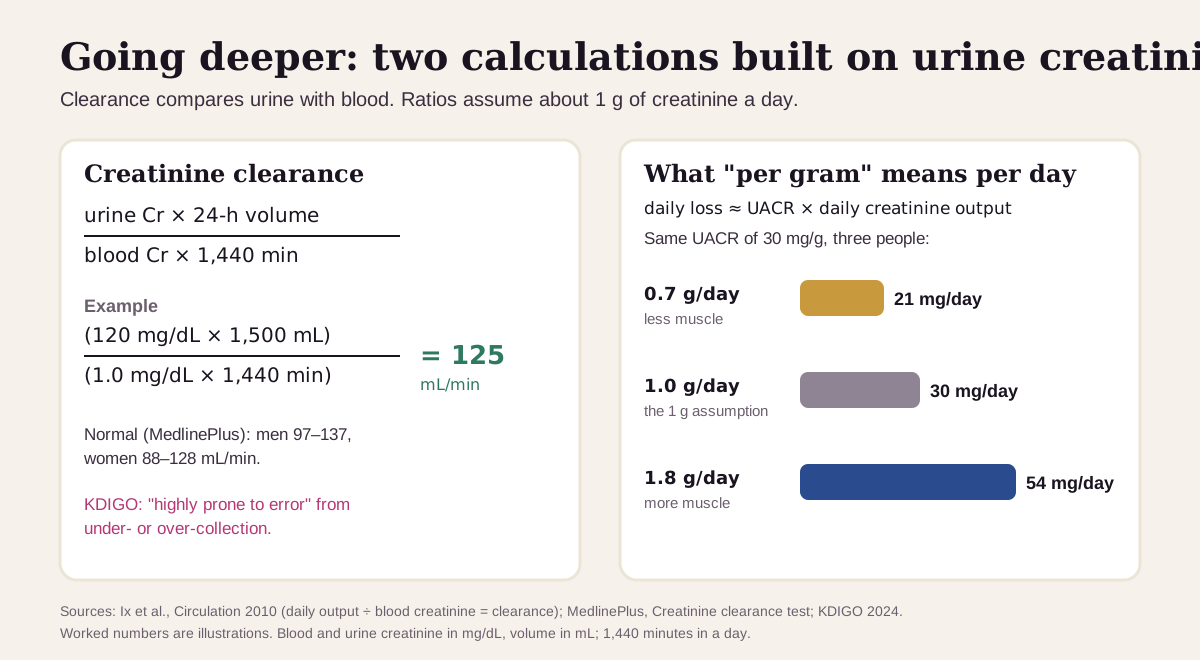
Creatinine clearance compares how much creatinine reaches your urine with how much is in your blood. It estimates your glomerular filtration rate, the amount of fluid your kidneys filter each minute:1611
Clearance (mL/min) = (urine creatinine × 24-hour urine volume) ÷ (blood creatinine × 1,440)
MedlinePlus gives normal clearance as 97–137 mL/min for men and 88–128 for women.16 KDIGO still calls a measured clearance "highly prone to error" from under- or over-collection. In one study, a quarter of 24-hour clearances were at least 18% below the measured filtration rate and another quarter at least 23% above it. KDIGO reserves the test for when better measures are unavailable.1
The ratios lean on a 1-gram assumption. A UACR in mg/g reads as roughly mg per day because the average adult puts out about 1 g of creatinine a day. For someone far from average, KDIGO describes multiplying the ratio by an estimate of their own daily output. At a UACR of 30 mg/g, that works out to about 21 mg a day for someone who makes 0.7 g of creatinine and 54 mg a day for someone who makes 1.8 g.1
Questions worth asking
- Was this a spot sample or a 24-hour collection, and which range applies to it?
- Could the sample have been dilute or concentrated, and should we repeat it on a first-morning sample?
- Does my 24-hour total fit my body weight, or was urine likely missed?
- How do my blood creatinine and eGFR look next to it?
- Given my muscle mass, could my albumin- or protein-creatinine ratio be reading high or low?
- If we need an exact kidney-function number, would a supervised collection or a cystatin C test be better?
FAQ
What is a normal urine creatinine level? For a spot sample, most people fall between about 30 and 300 mg/dL. For a 24-hour collection, about 500 to 2,000 mg a day, or 14 to 26 mg per kg for men and 11 to 20 for women.32
What does a low urine creatinine mean? Most often a dilute sample from drinking a lot before the test. Less muscle and, for a 24-hour test, missed urine are the other common reasons.46
Why is creatinine measured with albumin or protein in urine? Creatinine comes out at a fairly steady daily rate, so dividing by it corrects for how dilute the sample is. The result reads as roughly milligrams per day.1
Can drinking water lower urine creatinine? Yes, within an hour or two. In one study, drinking about a quart an hour pushed it below 20 mg/dL in about 1.5 hours.4
This guide is for education. It can't diagnose you or replace care from a clinician who knows your history.
Footnotes
-
Kidney Disease: Improving Global Outcomes (KDIGO) CKD Work Group. KDIGO 2024 Clinical Practice Guideline for the Evaluation and Management of Chronic Kidney Disease. Kidney Int. 2024;105(4S):S117–S314. The international kidney guideline: why ratios correct for dilution and the 1 g/day creatinine assumption, the factors that shift creatinine excretion (Table 16), the error in timed creatinine clearance (Practice Point 1.2.2.8) and the meat-meal effect (Practice Point 1.2.2.4). PubMed · KDIGO PDF ↩ ↩2 ↩3 ↩4 ↩5 ↩6 ↩7 ↩8 ↩9 ↩10 ↩11 ↩12 ↩13 ↩14 ↩15 ↩16 ↩17 ↩18 ↩19
-
National Library of Medicine. Creatinine urine test. MedlinePlus Medical Encyclopedia. Reviewed July 1, 2025. The 24-hour normal range (500–2,000 mg/day; 14–26 mg/kg/day for men, 11–20 for women), what the test is used for, and causes of abnormal results. MedlinePlus ↩ ↩2 ↩3 ↩4 ↩5 ↩6 ↩7 ↩8 ↩9
-
Barr DB, Wilder LC, Caudill SP, Gonzalez AJ, Needham LL, Pirkle JL. Urinary creatinine concentrations in the U.S. population: implications for urinary biologic monitoring measurements. Environ Health Perspect. 2005;113(2):192–200. CDC analysis of 22,245 NHANES III participants: percentiles by age and sex (Table 2), the share outside the WHO 30–300 mg/dL window (Table 3), and the effects of body mass index, fat-free mass and time of day. PMC ↩ ↩2 ↩3 ↩4 ↩5 ↩6 ↩7 ↩8 ↩9 ↩10 ↩11 ↩12 ↩13 ↩14 ↩15 ↩16 ↩17 ↩18 ↩19
-
Cone EJ, Lange R, Darwin WD. In vivo adulteration: excess fluid ingestion causes false-negative marijuana and cocaine urine test results. J Anal Toxicol. 1998;22(6):460–473. A National Institute on Drug Abuse study: 1 gallon of fluid, 1 quart an hour for 4 hours, brought creatinine under 20 mg/dL in 1.5–2.0 hours, with recovery over 8–10 hours. DOI ↩ ↩2 ↩3 ↩4 ↩5 ↩6 ↩7 ↩8 ↩9
-
U.S. Department of Transportation. 49 CFR § 40.88: What criteria do laboratories use to establish that a urine specimen is dilute or substituted? Electronic Code of Federal Regulations, as amended May 2, 2023. Dilute: creatinine 2 to under 20 mg/dL with specific gravity above 1.0010 and below 1.0030. Substituted: creatinine under 2 mg/dL with specific gravity of 1.0010 or less, or 1.0200 or more. eCFR ↩ ↩2 ↩3 ↩4 ↩5 ↩6 ↩7
-
John KA, Cogswell ME, Campbell NR, et al. Accuracy and usefulness of select methods for assessing complete collection of 24-hour urine: a systematic review. J Clin Hypertens (Greenwich). 2016;18(5):456–467. CDC-led review: 6–47% of collections incomplete by PABA recovery; creatinine criteria sensitivity 6–63%, specificity 57–99.7%; the creatinine index with expected output of 24 mg/kg (men) and 21 mg/kg (women) and a cutoff of 0.7. PMC ↩ ↩2 ↩3 ↩4 ↩5 ↩6 ↩7 ↩8
-
National Library of Medicine. Acute kidney failure. MedlinePlus Medical Encyclopedia. Reviewed May 6, 2024. Symptoms, including little or no urine, and when to contact a provider. MedlinePlus ↩ ↩2
-
National Library of Medicine. Rhabdomyolysis. MedlinePlus Medical Encyclopedia. Reviewed September 2, 2025. Dark, red or cola-colored urine with muscle pain or weakness; causes include crush injuries and severe exertion. MedlinePlus ↩ ↩2
-
Kidney Disease: Improving Global Outcomes (KDIGO) Acute Kidney Injury Work Group. KDIGO Clinical Practice Guideline for Acute Kidney Injury. Kidney Int Suppl. 2012;2(1):1–138. Recommendation 2.1.1: acute kidney injury is a blood creatinine rise of 0.3 mg/dL (26.5 µmol/L) within 48 hours, a rise to 1.5 times baseline within 7 days, or urine output under 0.5 mL/kg/h for 6 hours. KDIGO PDF ↩ ↩2
-
Brosnan JT, da Silva RP, Brosnan ME. The metabolic burden of creatine synthesis. Amino Acids. 2011;40(5):1325–1331. Creatine converts spontaneously to creatinine; creatinine loss averages about 2 g a day in 70 kg men aged 20–39 and is lower in women and older adults because of lower muscle mass. DOI ↩ ↩2 ↩3 ↩4 ↩5
-
Ix JH, de Boer IH, Wassel CL, Criqui MH, Shlipak MG, Whooley MA. Urinary creatinine excretion rate and mortality in persons with coronary artery disease: the Heart and Soul Study. Circulation. 2010;121(11):1295–1303. 903 outpatients with stable coronary disease; fully adjusted hazard ratios 1.50 (middle third) and 2.30 (lowest third) versus the highest third. Also the daily-output and clearance arithmetic. PMC ↩ ↩2 ↩3 ↩4 ↩5 ↩6 ↩7 ↩8 ↩9 ↩10
-
Heymsfield SB, Arteaga C, McManus C, Smith J, Moffitt S. Measurement of muscle mass in humans: validity of the 24-hour urinary creatinine method. Am J Clin Nutr. 1983;37(3):478–494. The "creatinine equivalence" of 17–22 kg of muscle per gram of urinary creatinine a day. PubMed ↩
-
Labcorp. Creatinine, 24-Hour Urine (test 003012): test page and sample report. Accessed September 23, 2026. A commercial laboratory. The sample reports print 800–1,800 mg/24 hr for the 24-hour total and "Not Estab." for urine creatinine concentration; the page calls the test a crude marker of 24-hour completeness and notes that meat raises urine creatinine. labcorp.com · sample report ↩ ↩2 ↩3 ↩4 ↩5 ↩6 ↩7 ↩8
-
Oterdoom LH, Gansevoort RT, Schouten JP, de Jong PE, Gans RO, Bakker SJ. Urinary creatinine excretion, an indirect measure of muscle mass, is an independent predictor of cardiovascular disease and mortality in the general population. Atherosclerosis. 2009;207(2):534–540. PREVEND cohort, 4,044 women and 4,048 men, 7.5 years of follow-up. PubMed ↩
-
Greenblatt DJ, Ransil BJ, Harmatz JS, Smith TW, Duhme DW, Koch-Weser J. Variability of 24-hour urinary creatinine excretion by normal subjects. J Clin Pharmacol. 1976;16(7):321–328. Eight healthy men, 54 to 97 collections each; day-to-day standard deviations of 10.5–14.4% of the mean. PubMed ↩ ↩2 ↩3
-
National Library of Medicine. Creatinine clearance test. MedlinePlus Medical Encyclopedia. Reviewed July 1, 2025. How the test compares urine and blood creatinine, normal values (97–137 mL/min for men, 88–128 for women) and causes of a low result. MedlinePlus ↩ ↩2 ↩3
Educational content, not medical advice. Libby is a personal record tool, not a medical service — it doesn't diagnose, treat, or prescribe. Reference ranges vary by lab and by person. Talk to a qualified healthcare professional about your results.
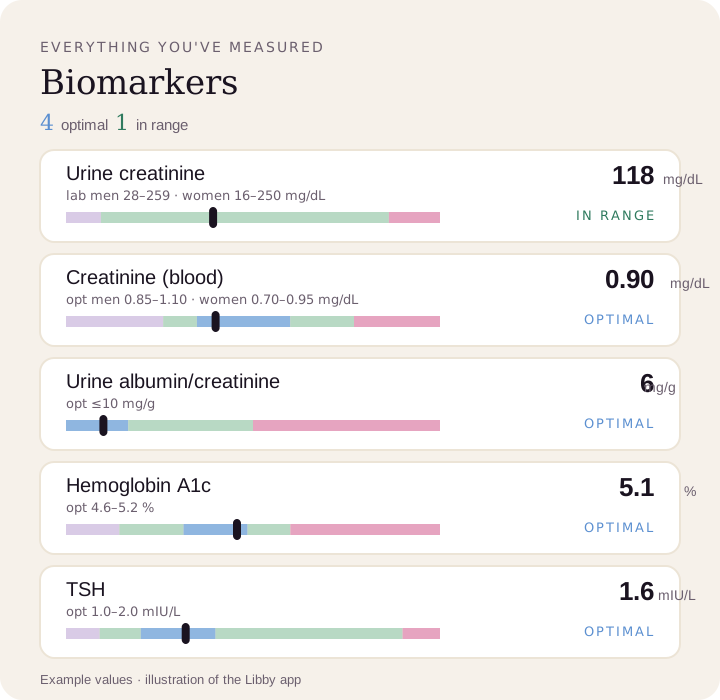
See every result against your lab's range.
Upload a lab PDF or a photo of your report. Libby shows every result next to your lab's range, flags what's off, and tracks each marker over time.
View your urine creatinine ›