Crystals in urine: calcium oxalate, amorphous and more
Most urine crystals are harmless and form after the sample cools. What calcium oxalate and amorphous crystals mean, which types matter, and when to act.
Urine crystals are minerals and acids that have come out of solution in your urine, and a few of them on a urinalysis are normal. Most form after you pee: the sample cools and sits, and whatever the urine was carrying settles out. How concentrated your urine was, how acidic it was, and what you ate shape which kind you see and how many.123 A handful of types carry real meaning: cystine, crystals from certain medicines, and large numbers of calcium oxalate in someone who is very ill.452
The short version
- Normal: none to a few. Labcorp's reference interval for crystals is "None seen", and MedlinePlus says a few small crystals are normal and usually cause no problems.23
- Usually harmless: a few calcium oxalate or uric acid crystals, and amorphous sediment: fine granules of urate (in acidic urine) or phosphate (in alkaline urine). In one lab study, 56 of 210 urine samples (27%) formed amorphous urates.641
- Always abnormal: cystine crystals, the sign of cystinuria (about 1 in 10,000 people), and crystals from certain medicines, such as sulfa antibiotics, acyclovir and some HIV drugs.475
- Urgent: many calcium oxalate crystals in someone who seems drunk or very sick after swallowing an unknown liquid can mean antifreeze (ethylene glycol) poisoning. Call 911 or Poison Help at 1-800-222-1222.28
What urine crystals are
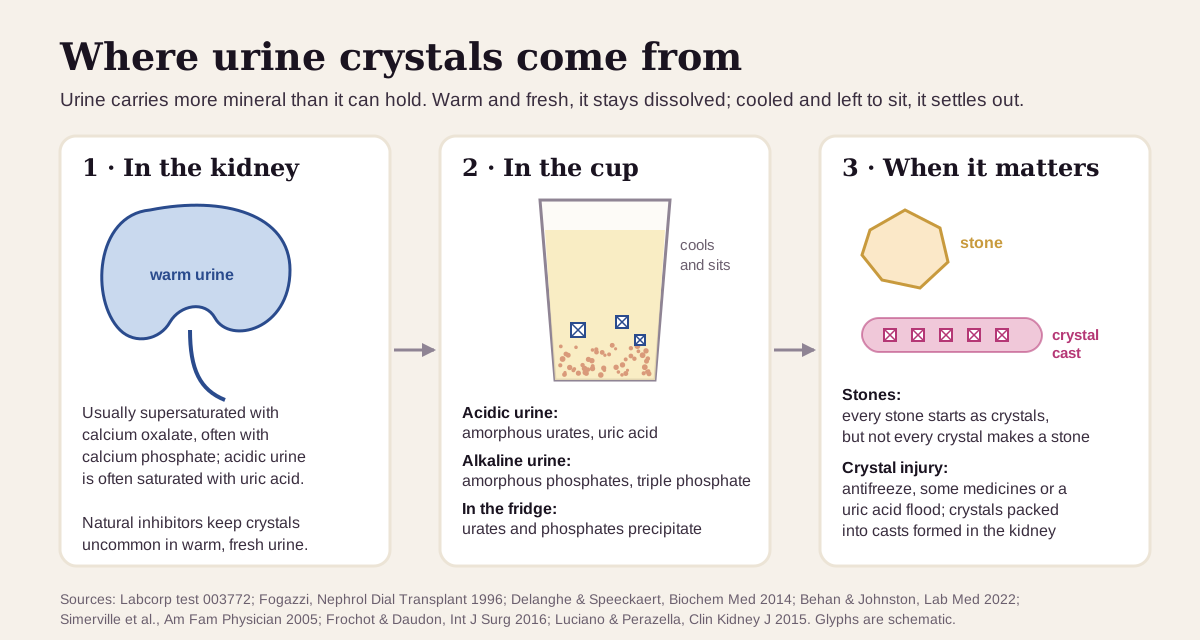
Your urine carries dissolved minerals and acids your body is getting rid of. When there's more of one than the urine can hold, it clumps into solid crystals. That usually happens when the urine is concentrated, or when it is too acidic or too alkaline for that substance.3
In fact, urine is usually supersaturated with calcium oxalate, often with calcium phosphate, and acidic urine is often saturated with uric acid. Crystals are still uncommon in warm, fresh urine, because urine holds natural crystal inhibitors and crystals need a seed and time to grow.2 Give a sample time to cool and sit, and they appear.
A lab tech spins the urine down and names each crystal by its shape under the microscope:413
- Calcium oxalate: clear, square "envelopes".
- Uric acid: yellow to orange-brown diamonds or barrels.
- Triple phosphate (struvite): colorless "coffin lids".
- Cystine: colorless hexagons.
- Amorphous crystals have no shape at all: a fine, grainy sediment.
Urine pH decides which ones form. Uric acid and amorphous urates form in acidic urine; triple phosphate and amorphous phosphates form in alkaline urine.4612 (More on that in our guide to urine pH.)
What's a normal result?
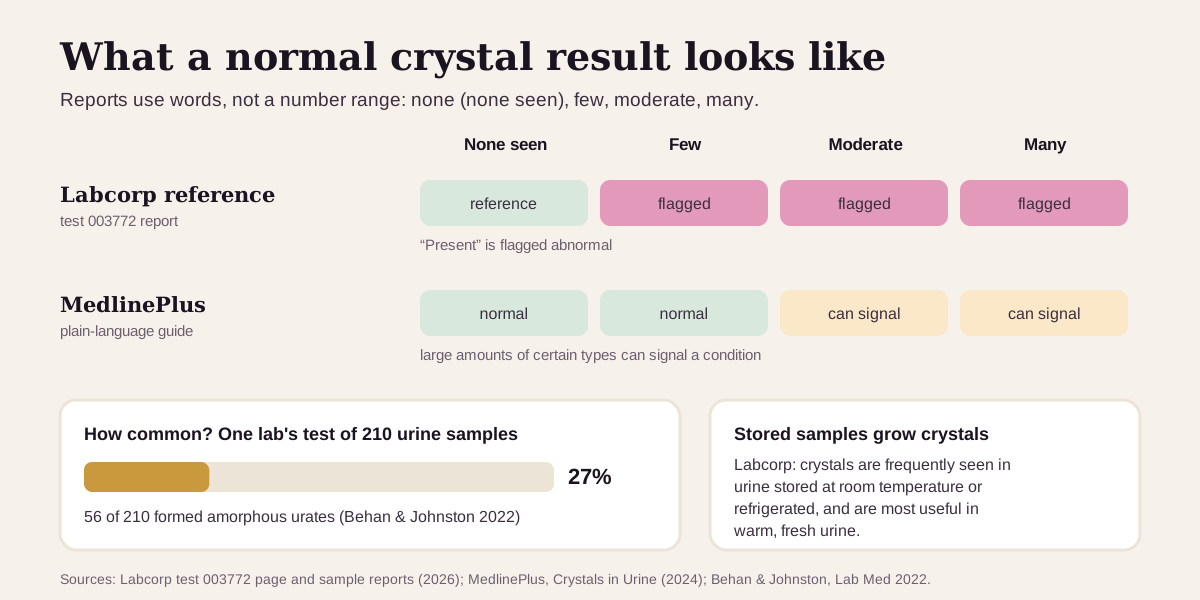
None to a few. Labcorp prints "None seen" as the reference interval for crystals, flags "Present" as abnormal, and names the type on the next line.2 MedlinePlus puts it more gently: a few small crystals are normal and usually cause no problems, while large amounts of certain types can be a sign of a condition that needs treatment.3 A review in American Family Physician notes that crystals may be seen in the urine of healthy people.4
They're common. In one lab's test of 210 urine samples, 56 formed amorphous urates.6 Labcorp notes that crystals are frequently found in urine that was stored at room temperature or refrigerated.2
"Optimal" crystals: none or a few of the harmless kinds
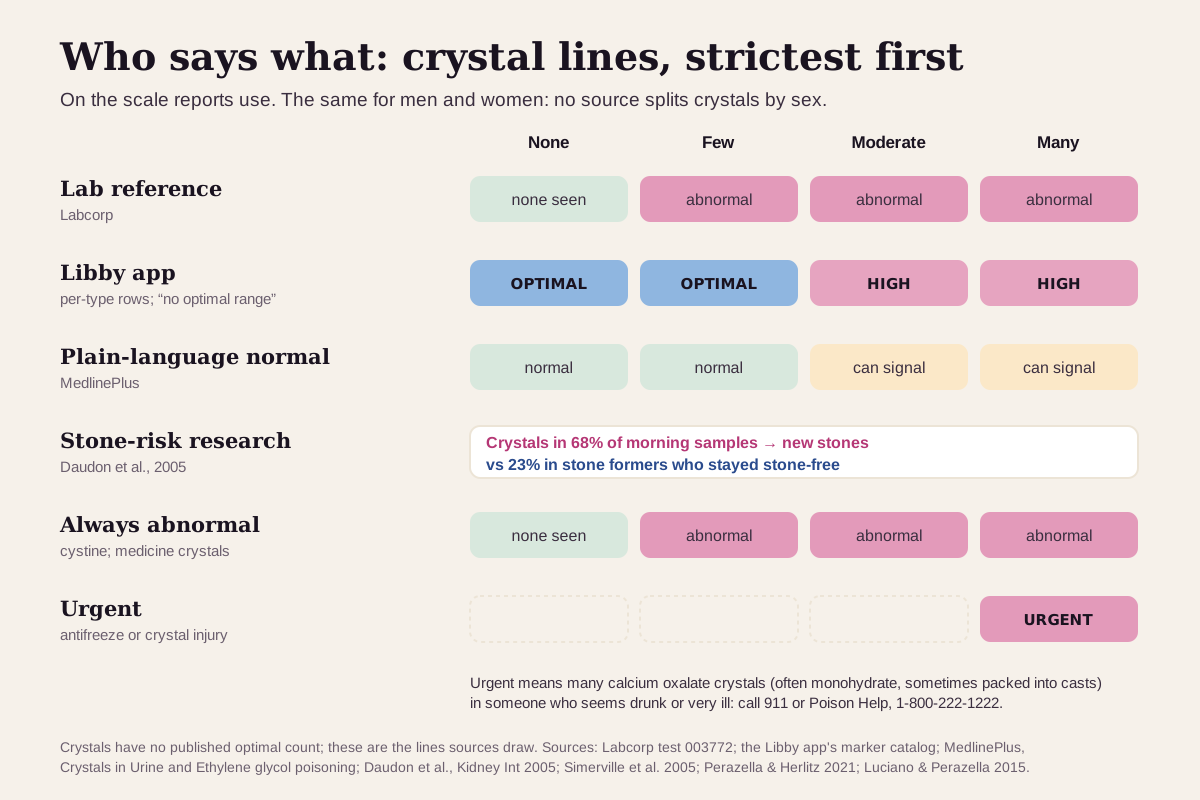
Crystals have no published optimal count. The lab standard is "none seen", and the evidence that matters is about which type you have and how often it keeps showing up. Here's the ladder, from strictest to loosest. It's the same for men and women: no source we found splits crystals by sex.
| Line | What counts as fine (men and women) | Who uses it |
|---|---|---|
| Strictest (lab reference) | none seen | Labcorp's reference interval; "Present" is flagged abnormal2 |
| Libby app | none or few of a common type | The app reads each type on its none/few/moderate/many scale: none or few shows as optimal, moderate or many as high. It prints "no optimal range" for these rows. If your report gives one overall crystal count, the app reads 0 or 1 as in range and 2 or more as high; a word like "Present" takes your lab's own flag |
| Plain-language normal | a few small crystals | MedlinePlus3 |
| Stone-risk research | crystals in fewer of your morning samples | In calcium stone formers, crystals in 68% of first-morning samples went with new stones, versus 23% in those who stayed stone-free14 |
| Always abnormal | none seen; any amount is abnormal | Cystine crystals (cystinuria) and drug crystals4155 |
| Urgent | many calcium oxalate crystals, often the monohydrate form, sometimes packed into casts, in a very ill person | Possible antifreeze poisoning or crystal injury to the kidney: emergency care2128 |
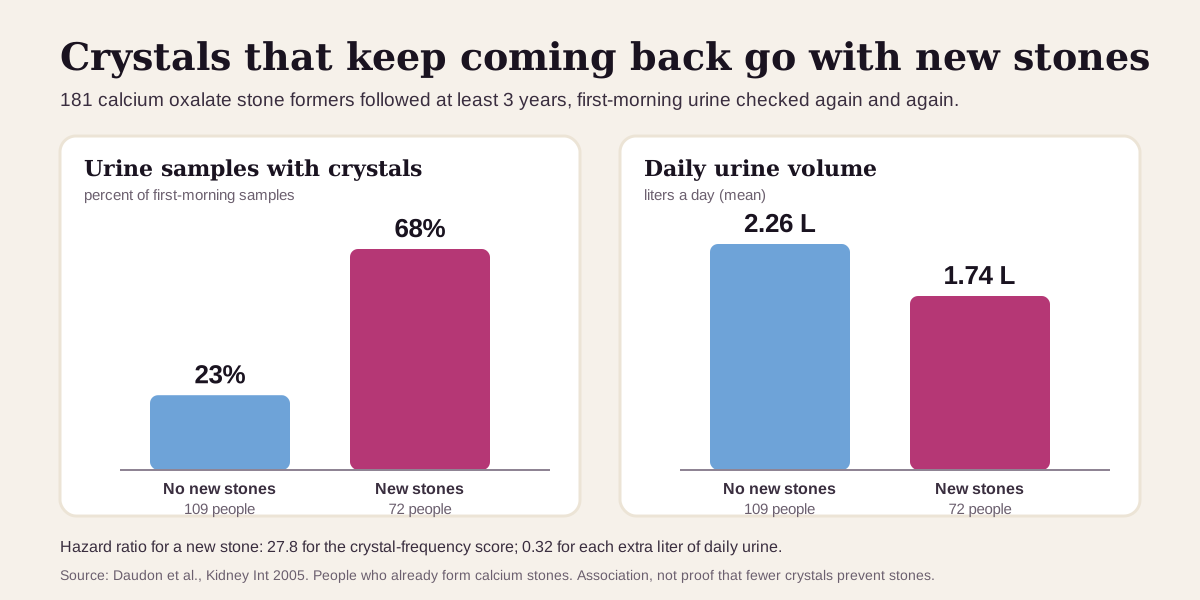
Why fewer, repeated, matters: a French team followed 181 people who had formed calcium oxalate stones for at least 3 years, checking first-morning urine again and again.14
- The 72 who formed new stones had crystals in 68% of their samples. The 109 who didn't had crystals in 23%.
- The stone formers also made less urine: 1.74 versus 2.26 liters a day. Each extra liter of daily urine went with about a two-thirds lower risk of a new stone (hazard ratio 0.32).
- Crystals found again and again in morning urine were "highly predictive" of new stones (hazard ratio 27.8 for their crystal-frequency score).
Keep "optimal" in perspective. Every kidney stone starts as crystals, but crystals alone don't make a stone: a few small ones are normal and usually cause no problems.113 A single urinalysis tells you about one cup of urine, and crystals mean most when a lab sees them in warm, fresh urine.2 In the Libby app, amorphous urates or phosphates reported as "moderate" or "many" show up as high, even though they usually mean the sample cooled or sat.1 The app shows "few" as optimal, which is looser than Labcorp's "None seen". Read the badge with the crystal type next to it.
What crystals on your urinalysis usually mean
Start with the type, then the amount. Most crystals come from the sample itself: the urine was concentrated, it cooled, or its pH changed as it sat. Fewer come from a condition: kidney stones, a uric acid overload, poisoning or a medicine.1
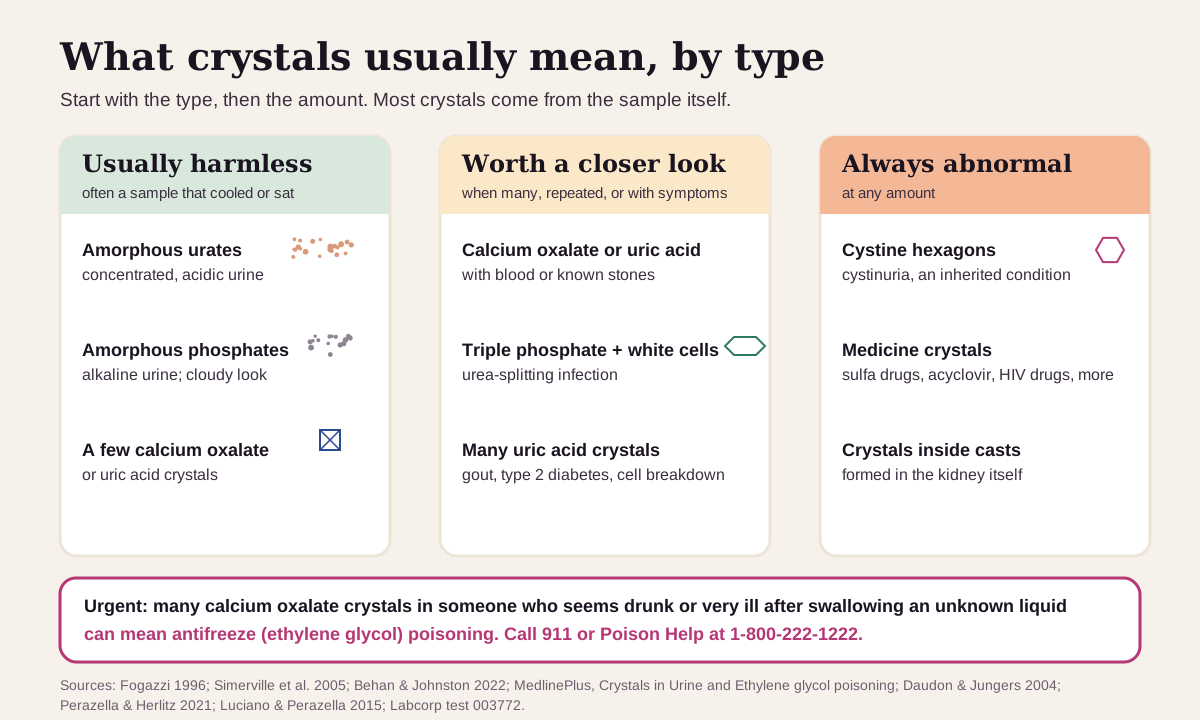
Amorphous urates and phosphates: usually the sample
This is the "amorphous sediment" on some reports. It turns up often: in one lab's test, more than a quarter of samples formed amorphous urates.6
- Amorphous urates form in concentrated, acidic urine. They can cover up bacteria and yeast on the slide. Warming the sample to 60 °C for 90 seconds dissolved most of them in one lab study.6
- Amorphous phosphates form in alkaline urine. Precipitated phosphate is a common reason for cloudy urine, though white cells (pyuria) can also cloud it.4 (Our guide to urine color and appearance covers cloudiness.)
- Cold makes both worse. Refrigerating a sample makes urates and phosphates settle out, so a review of urine handling advises keeping a separate, unrefrigerated portion when crystals need to be judged.10
Calcium oxalate: common, occasionally a clue
A few calcium oxalate crystals are a common, usually passing finding.13 Labs split them into two forms: the dihydrate, shaped like a double pyramid, and the monohydrate, shaped like ovals, dumbbells or rods.5 More on why that matters below.
- Food and fluid. Some of the oxalate in urine comes from food. The National Institute of Diabetes and Digestive and Kidney Diseases (NIDDK) lists spinach, rhubarb, nuts, peanuts and wheat bran as high-oxalate foods for people who've had calcium oxalate stones.16 MedlinePlus adds a diet heavy in animal protein and not drinking enough fluid as reasons for large amounts of crystals.3
- Kidney stones. Calcium oxalate and calcium phosphate are the most common stone-forming crystals.3 The link is real but loose: stones always start as crystals, but crystals don't always lead to a stone.11 What predicted new stones was crystals turning up again and again in first-morning urine, in people who already made stones.14 A 24-hour collection gives a fuller picture, because crystals and other substances in urine vary through the day.3 (Our guide to urine calcium covers that test.)
- Rare but urgent: antifreeze. Ethylene glycol, the sweet-tasting chemical in antifreeze, breaks down into oxalic acid, which turns up as calcium oxalate crystals, mostly monohydrate, in the urine.1217 Labcorp notes that abundant calcium oxalate crystals may suggest it, especially with drunk-seeming behavior and other neurologic signs.2 In one man, the urine microscopy pointed to the poisoning before the blood test came back.12
Uric acid crystals: acidic urine
Uric acid crystals form in acidic urine, the same urine in which uric acid stones form.412 MedlinePlus lists gout and type 2 diabetes as conditions that can make urine acidic enough for large amounts.3 A sudden flood of uric acid, as when a large number of cancer cells break down at once, can pack the kidney with them.1213 (See our guide to blood uric acid.)
Triple phosphate (struvite): think infection
"Coffin lid" crystals can be normal, but in alkaline urine they're often linked to a urinary tract infection with bacteria that split urea (typically Proteus). Those infections can build large "staghorn" stones.4 MedlinePlus notes that repeated infections can cause large amounts of struvite crystals.3
Always abnormal: cystine and drug crystals
- Cystine hexagons in acidic urine are diagnostic of cystinuria, an inherited condition in which the kidneys fail to reabsorb the amino acid cystine.47 It affects about 1 in 10,000 people and causes stones.7 Finding cystine crystals is diagnostic by itself.15
- Medicines can crystallize in urine: sulfa antibiotics (sulfadiazine and sulfamethoxazole), the antiviral acyclovir (mainly at high doses or with a fast IV infusion), the HIV drugs atazanavir, indinavir and darunavir, amoxicillin, ciprofloxacin and methotrexate. Ciprofloxacin crystals are rare: 2 in 63,000 patients in one report.5 Don't stop a prescribed medicine on your own; bring your list to your clinician.
- Rarer types a lab may name include bilirubin, leucine, tyrosine and xanthine. Cystine and xanthine both point to rare inherited disorders.13
Crystals inside casts: a kidney signal
Casts are tube-shaped plugs that form inside the kidney's tubules. When crystals are packed into them, the crystals formed inside the kidney, not in the cup. In a series of five patients (antifreeze, uric acid, methotrexate, sulfadiazine and a myeloma protein), crystal casts identified the cause of kidney injury, in several cases without a kidney biopsy.12
Get care now. Call 911 or Poison Help (1-800-222-1222) right away if someone may have swallowed antifreeze or another unknown liquid, especially if they seem drunk with no smell of alcohol, or are vomiting, very drowsy or having seizures.8 See a clinician promptly for sharp pain in your side, back, belly or groin, blood in your urine, fever and chills, or if you can pee only a little or not at all.3
Crystals read best next to their neighbors
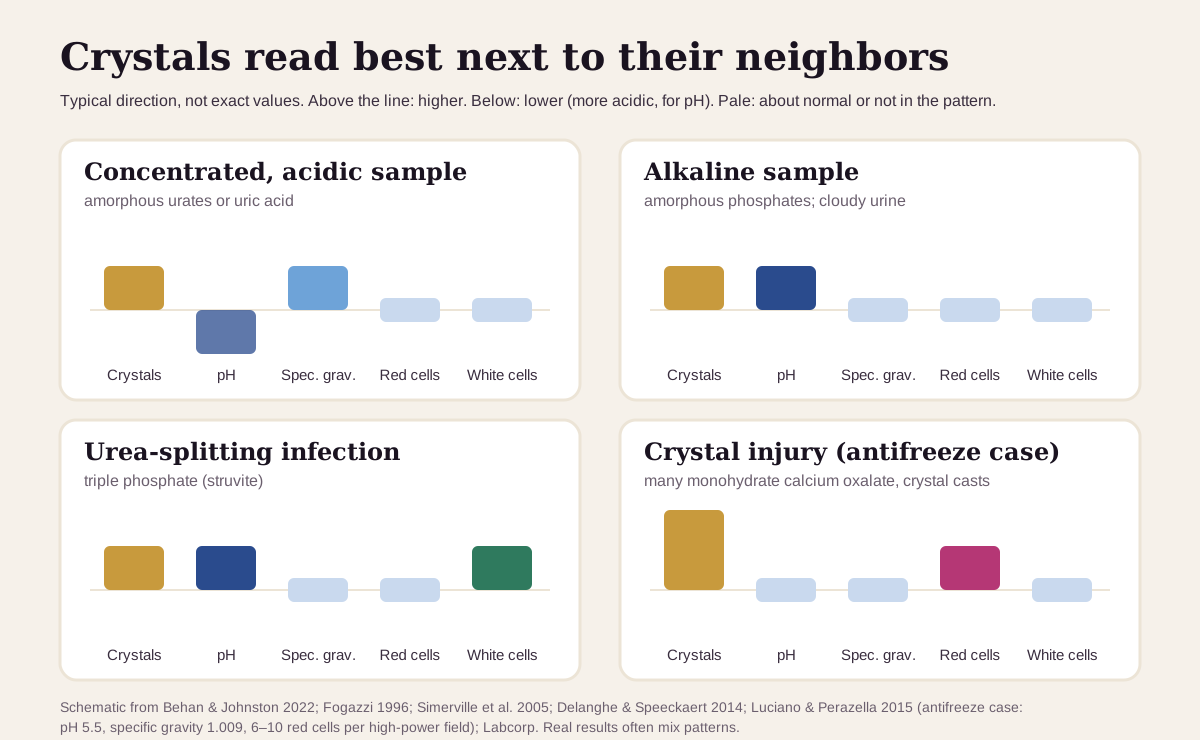
The crystal type tells you what settled out. The rest of the urinalysis tells you why:
| If you see… | It often points to… |
|---|---|
| Amorphous urates or uric acid crystals, acidic pH, high specific gravity, nothing else | concentrated urine, or a sample that cooled: usually harmless |
| Amorphous phosphates, alkaline pH, cloudy urine, no white cells | an alkaline sample: usually harmless |
| Triple phosphate crystals, alkaline pH, white cells | a urinary infection with urea-splitting bacteria such as Proteus |
| Many calcium oxalate or uric acid crystals with red cells | a stone-forming tendency or a passing stone, especially with side pain; crystals have been linked to microscopic blood in urine2314 |
| Monohydrate calcium oxalate, crystals inside casts, in a very ill person | crystals forming inside the kidney, as with antifreeze poisoning or certain medicines: an emergency128 |
| Cystine hexagons, any number | cystinuria, an inherited stone condition47 |
Specific gravity is the quickest check on concentration: a high value goes with the concentrated urine that grows urate and oxalate crystals (see our guide to urine specific gravity).614
How fast crystals change
Crystals belong to one cup of urine, and they change within hours. A review in American Family Physician advises examining urine within 2 hours of collection.4 European urinalysis guidelines say within 1 hour at room temperature, or within 4 hours if refrigerated, but cold itself precipitates urates and phosphates.10 That's why Labcorp calls crystals useful mainly in warm, fresh urine.2
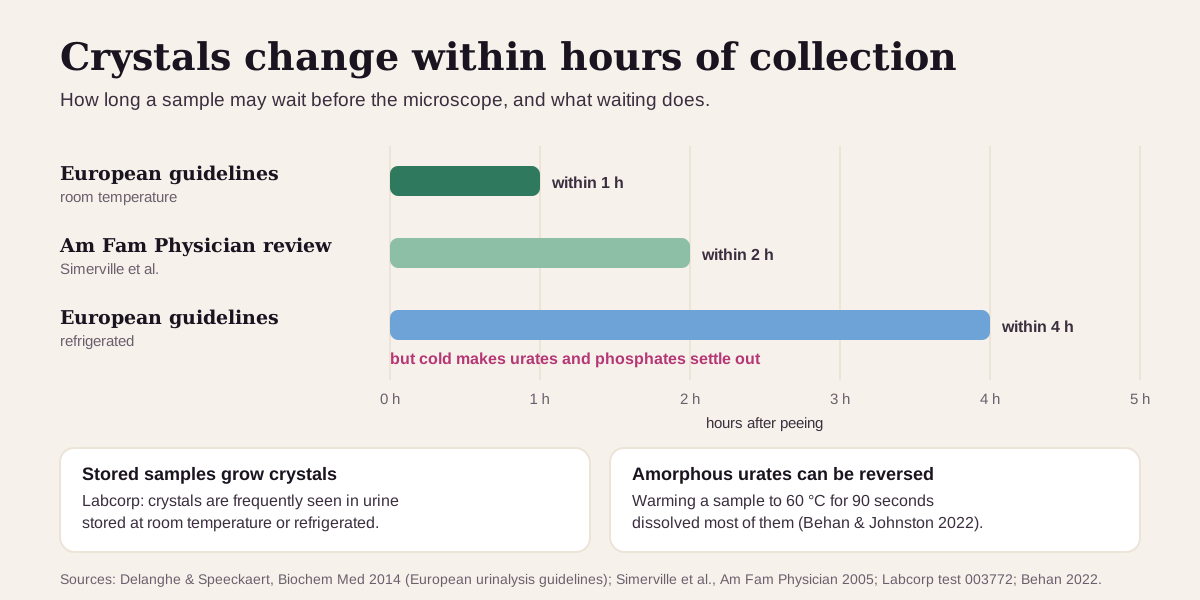
What that means in practice:
- A sample that waited or was chilled can grow its own crystals. A fresh sample, examined quickly at room temperature, gives a truer read.102
- Repeated findings carry the weight. In stone formers, crystals that kept appearing in first-morning urine were highly predictive of new stones.14
- In poisoning, crystals can lag. In two people with ethylene glycol poisoning, crystals were absent on arrival and appeared later; the authors advise repeating the microscopy.17
Going deeper: the two calcium oxalates
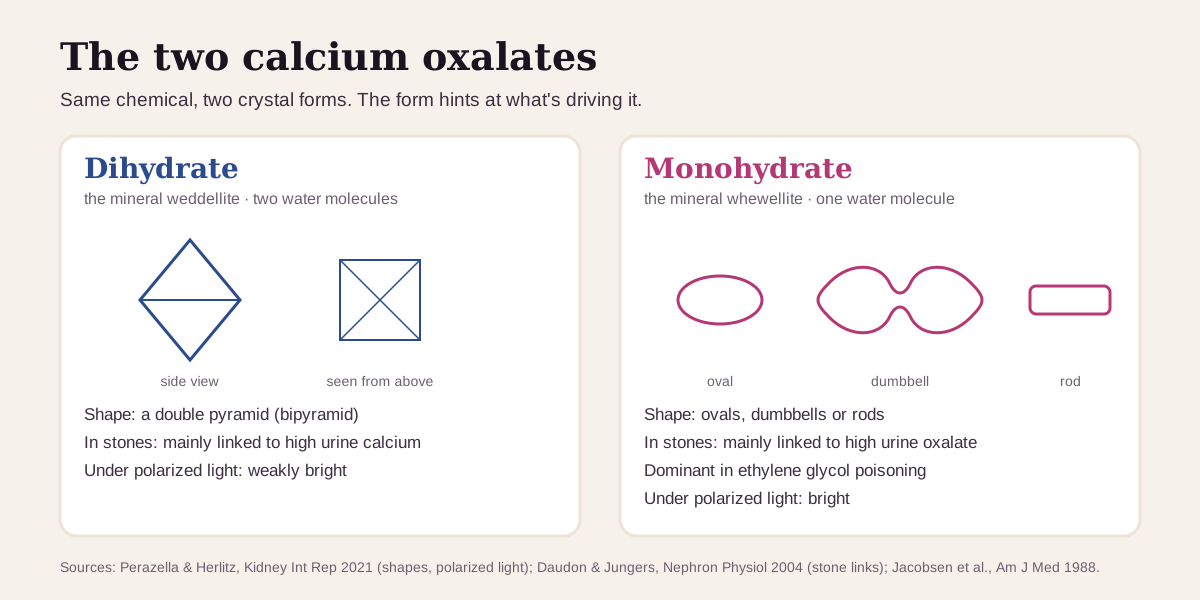
Calcium oxalate crystallizes with either two water molecules (dihydrate, the mineral weddellite) or one (monohydrate, whewellite).15 Both light up under polarized light.5
The form hints at the chemistry. In stones, mostly-monohydrate calcium oxalate goes mainly with too much oxalate in the urine, and mostly-dihydrate with too much calcium. That split helps steer the workup.15 In ethylene glycol poisoning, monohydrate crystals dominated; in one patient they followed a short run of dihydrate.17
Reading crystals well takes a protocol. Specialist labs ask for a proper sample (often the first urine of the morning), measure its pH, use a polarizing microscope, and count and size the crystals; unusual ones get infrared spectroscopy.1114
Questions worth asking
- Which crystal type was seen, and how many?
- How long did my sample sit, and was it refrigerated before it was examined?
- What were my urine pH and specific gravity on the same sample?
- Should we repeat it on a fresh or first-morning sample?
- Could any of my medicines cause crystals?
- If I've had kidney stones, would a 24-hour urine test or a stone analysis help?
FAQ
Are crystals in urine normal? A few usually are. Labcorp's reference is "None seen", but MedlinePlus says a few small crystals are normal, and most form after the sample cools or sits.231
What does amorphous sediment in urine mean? It's fine, shapeless crystal: urates in acidic urine or phosphates in alkaline urine. It usually reflects a concentrated or cooled sample, and warming or a fresh sample often clears it.6410
Do calcium oxalate crystals mean I have kidney stones? Usually not. Every stone starts as crystals, but a few small crystals are normal and usually cause no problems. Crystals that keep showing up in morning urine matter more, especially if you've had stones before.11314
When are crystals in urine an emergency? When many calcium oxalate crystals show up in someone who may have swallowed antifreeze, or who seems drunk, confused or very ill. Call 911 or Poison Help at 1-800-222-1222.28
This guide is for education. It can't diagnose you or replace care from a clinician who knows your history.
Footnotes
-
Fogazzi GB. Crystalluria: a neglected aspect of urinary sediment analysis. Nephrol Dial Transplant. 1996;11(2):379–387. Most crystals come from transient supersaturation, food, or temperature and pH changes after voiding. PubMed ↩ ↩2 ↩3 ↩4 ↩5 ↩6 ↩7 ↩8 ↩9
-
Labcorp. Urinalysis, Complete With Microscopic Examination (test 003772), test page and sample reports (date reported May 18, 2026). Reference interval for Crystals: "None seen"; "Present" flagged abnormal; notes on stored samples, supersaturation and ethylene glycol. A national commercial lab's published range. Labcorp ↩ ↩2 ↩3 ↩4 ↩5 ↩6 ↩7 ↩8 ↩9 ↩10 ↩11 ↩12 ↩13 ↩14 ↩15 ↩16 ↩17 ↩18 ↩19 ↩20 ↩21 ↩22 ↩23
-
National Library of Medicine. Crystals in Urine. MedlinePlus. Last updated December 19, 2024. A few small crystals as normal, the common types and their causes, and symptoms of a kidney stone. MedlinePlus ↩ ↩2 ↩3 ↩4 ↩5 ↩6 ↩7 ↩8 ↩9 ↩10 ↩11 ↩12 ↩13 ↩14 ↩15 ↩16 ↩17 ↩18 ↩19 ↩20
-
Simerville JA, Maxted WC, Pahira JJ. Urinalysis: a comprehensive review. Am Fam Physician. 2005;71(6):1153–1162. Crystal shapes, cloudy urine from phosphate, triple phosphate with infection, cystine in cystinuria, and the two-hour rule. AAFP ↩ ↩2 ↩3 ↩4 ↩5 ↩6 ↩7 ↩8 ↩9 ↩10 ↩11 ↩12 ↩13 ↩14 ↩15 ↩16 ↩17 ↩18 ↩19
-
Perazella MA, Herlitz LC. The Crystalline Nephropathies. Kidney Int Rep. 2021;6(12):2942–2957. Crystal shapes by type, and the medicines that crystallize in urine. PMC ↩ ↩2 ↩3 ↩4 ↩5 ↩6 ↩7 ↩8 ↩9
-
Behan KJ, Johnston MA. Protocols to Dissolve Amorphous Urate Crystals in Urine. Lab Med. 2022;53(3):e63–e68. 210 specimens; 56 formed amorphous urates, in concentrated acidic urine; prewarming to 60 °C for 90 seconds dissolved most. DOI ↩ ↩2 ↩3 ↩4 ↩5 ↩6 ↩7 ↩8 ↩9 ↩10 ↩11 ↩12
-
National Library of Medicine. Cystinuria. MedlinePlus Genetics. About 1 in 10,000 people. MedlinePlus ↩ ↩2 ↩3 ↩4
-
National Library of Medicine. Ethylene glycol poisoning. MedlinePlus Medical Encyclopedia. Review date January 8, 2025. Symptoms, and when to call for help. MedlinePlus ↩ ↩2 ↩3 ↩4 ↩5 ↩6
-
Function Health. Urine biomarkers. Accessed September 24, 2026. Lists "Calcium Oxalate Crystals, Urine" and "Amorphous Sediment, Urine" among its urine tests, with no optimal target. A commercial source, cited only for the result names. functionhealth.com ↩
-
Delanghe J, Speeckaert M. Preanalytical requirements of urinalysis. Biochem Med (Zagreb). 2014;24(1):89–104. European guideline time limits and the effect of refrigeration on urates and phosphates. PMC ↩ ↩2 ↩3 ↩4 ↩5 ↩6 ↩7
-
Frochot V, Daudon M. Clinical value of crystalluria and quantitative morphoconstitutional analysis of urinary calculi. Int J Surg. 2016;36(Pt D):624–632. "If the formation of stones is always preceded by crystalluria, the reverse is not true." PubMed ↩ ↩2 ↩3 ↩4 ↩5
-
Luciano RL, Perazella MA. Crystalline-induced kidney disease: a case for urine microscopy. Clin Kidney J. 2015;8(2):131–136. Five cases, including ethylene glycol with numerous monohydrate calcium oxalate crystals and crystal casts. PMC ↩ ↩2 ↩3 ↩4 ↩5 ↩6 ↩7 ↩8 ↩9 ↩10 ↩11 ↩12
-
Cleveland Clinic. Crystals in Urine. Last updated November 16, 2021. The crystal types a lab may report, including amorphous crystals, and cystine and xanthine as signs of rare inherited disorders. Cleveland Clinic ↩ ↩2 ↩3
-
Daudon M, Hennequin C, Boujelben G, Lacour B, Jungers P. Serial crystalluria determination and the risk of recurrence in calcium stone formers. Kidney Int. 2005;67(5):1934–1943. 181 calcium oxalate stone formers followed at least 3 years. PubMed ↩ ↩2 ↩3 ↩4 ↩5 ↩6 ↩7 ↩8 ↩9 ↩10 ↩11
-
Daudon M, Jungers P. Clinical value of crystalluria and quantitative morphoconstitutional analysis of urinary calculi. Nephron Physiol. 2004;98(2):p31–p36. Monohydrate with high urine oxalate, dihydrate with high urine calcium; cystine crystals diagnostic by themselves. DOI ↩ ↩2 ↩3 ↩4 ↩5 ↩6
-
National Institute of Diabetes and Digestive and Kidney Diseases. Eating, Diet, & Nutrition for Kidney Stones. NIH. Last reviewed May 2017. High-oxalate foods listed for people who have had calcium oxalate stones. NIDDK ↩
-
Jacobsen D, Hewlett TP, Webb R, Brown ST, Ordinario AT, McMartin KE. Ethylene glycol intoxication: evaluation of kinetics and crystalluria. Am J Med. 1988;84(1):145–152. Two patients; monohydrate crystals dominated and were absent on admission. PubMed ↩ ↩2 ↩3 ↩4
Educational content, not medical advice. Libby is a personal record tool, not a medical service — it doesn't diagnose, treat, or prescribe. Reference ranges vary by lab and by person. Talk to a qualified healthcare professional about your results.
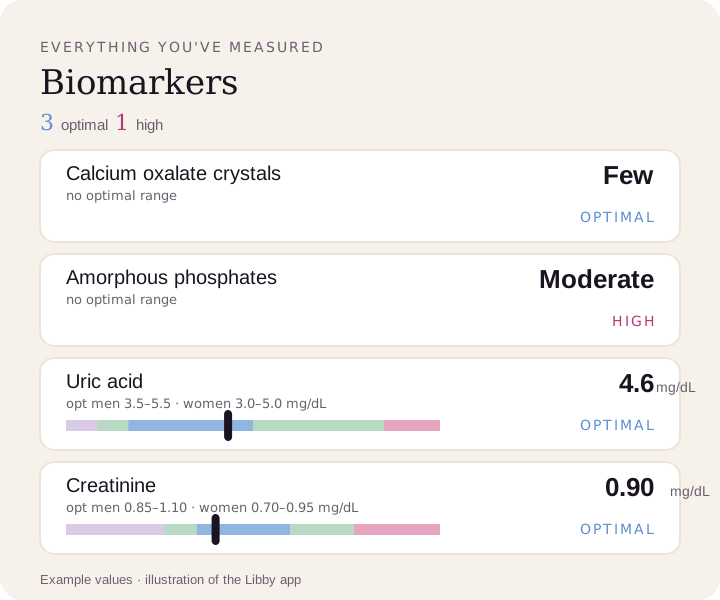
See every result against your lab's range.
Upload a lab PDF or a photo of your report. Libby shows each crystal type, your urine pH and specific gravity against your lab's range, and tracks every urinalysis over time.
View your urine crystals ›