Urine color and appearance: what your urinalysis means
What yellow, amber, red, brown or cloudy urine means on a urinalysis, why hydration drives most color change, and which colors need prompt care.
Urine color and appearance are the "look" part of a urinalysis: before any chemical test runs, the lab records what color your urine is and how clear it is. Normal urine runs from almost colorless to dark yellow.1 Most shade changes come from how concentrated your urine is. A different hue, such as red, brown, orange or blue-green, means an extra pigment is present: blood, muscle protein, bile, a food or a medicine.23
The short version
- Normal: "Yellow" and "Clear". Labcorp, a commercial lab, prints exactly those words as its reference for both results.4
- Darker yellow usually means more concentrated urine. In a pooled study of 238 adults, urine turned 2 shades darker on an 8-shade chart when people drank about 1.1 liters less a day.5
- Cloudy urine often comes from phosphate crystals in alkaline urine or from white blood cells in an infection.6 Red cells, bacteria, mucus and fat can also do it.3
- Get prompt care for pink, red or cola-colored urine with no food or medicine to explain it, or for clear, dark-brown urine.3 Among 10,896 people referred for blood in the urine, visible blood was the strongest single predictor of a urinary tract cancer.7
What urine color and appearance are
A urinalysis has three parts: looking at the sample, testing it with a chemical dipstick, and checking it under a microscope. The first part asks two questions. Is it clear or cloudy? Is it pale, dark yellow or another color?1 Labcorp runs color and appearance on every routine urinalysis.4
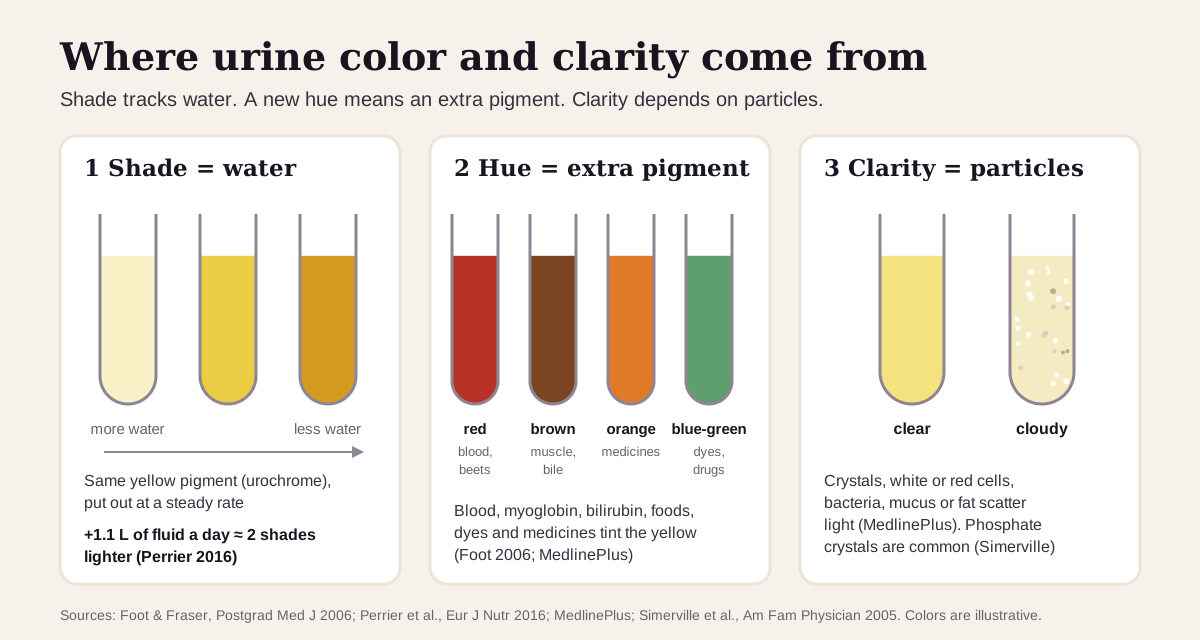
Color comes mostly from one pigment. The normal yellow is urochrome, which your body puts out at a steady rate. So the shade mainly tracks how much water it's dissolved in: pale when you drink plenty, darker when your kidneys are saving water.2 Other pigments change the hue. Red cells and hemoglobin turn urine pink to red. Myoglobin from damaged muscle and bilirubin from the liver turn it brown. Foods, dyes and medicines add orange, red, green or blue.296
Appearance, also called clarity, is about particles. Clear urine has little floating in it. Crystals, white or red blood cells, bacteria, mucus or fat scatter light and make it cloudy or milky.3 A review in American Family Physician names two common causes: phosphate crystals that come out of solution in alkaline urine, and white cells from an infection (pyuria).6
What's a normal urine color and appearance?
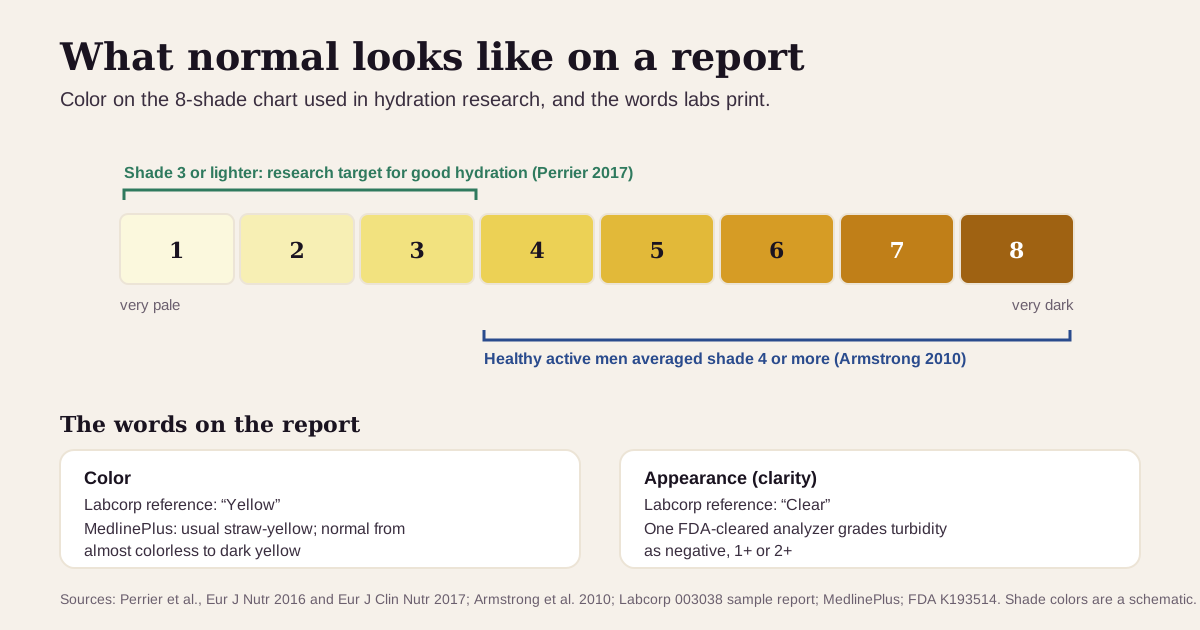
Yellow and clear. Those are the reference words Labcorp prints beside the two results.4 MedlinePlus calls the usual color straw-yellow and puts the normal span at almost colorless to dark yellow.31
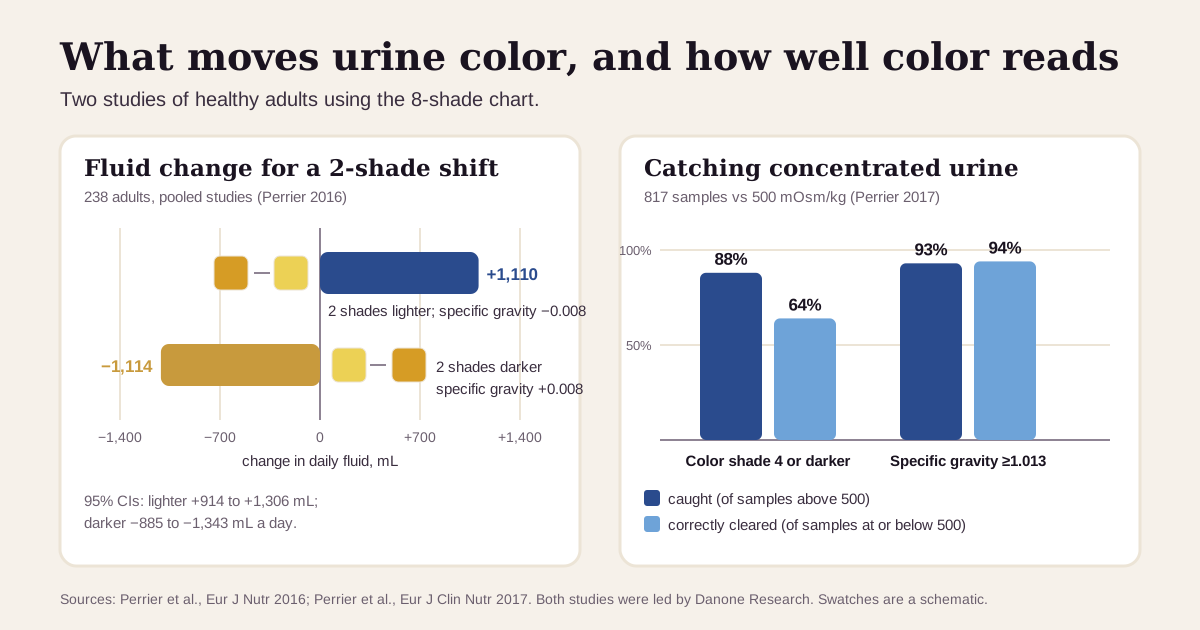
- Paler means more dilute. Across 238 healthy adults, a day with about 1.1 liters more fluid made urine 2 shades lighter, and specific gravity fell by 0.008.5
- Typical is darker than you might think. Healthy, active young men tracked over 12 days averaged a shade of 4 or more, and only 0–2% of their samples reached shade 1.11
- Morning urine runs darker. The first sample of the day is more concentrated than a full-day collection, likely because you go hours without drinking overnight.11
- A little haze can be ordinary. Phosphate crystals in alkaline urine are the classic cause.6 Chilling a sample also makes phosphates and urates settle out.12
Libby shows your color and appearance exactly as your lab wrote them, with your lab's flag when the report prints one.
"Optimal" urine color: what health optimizers aim for
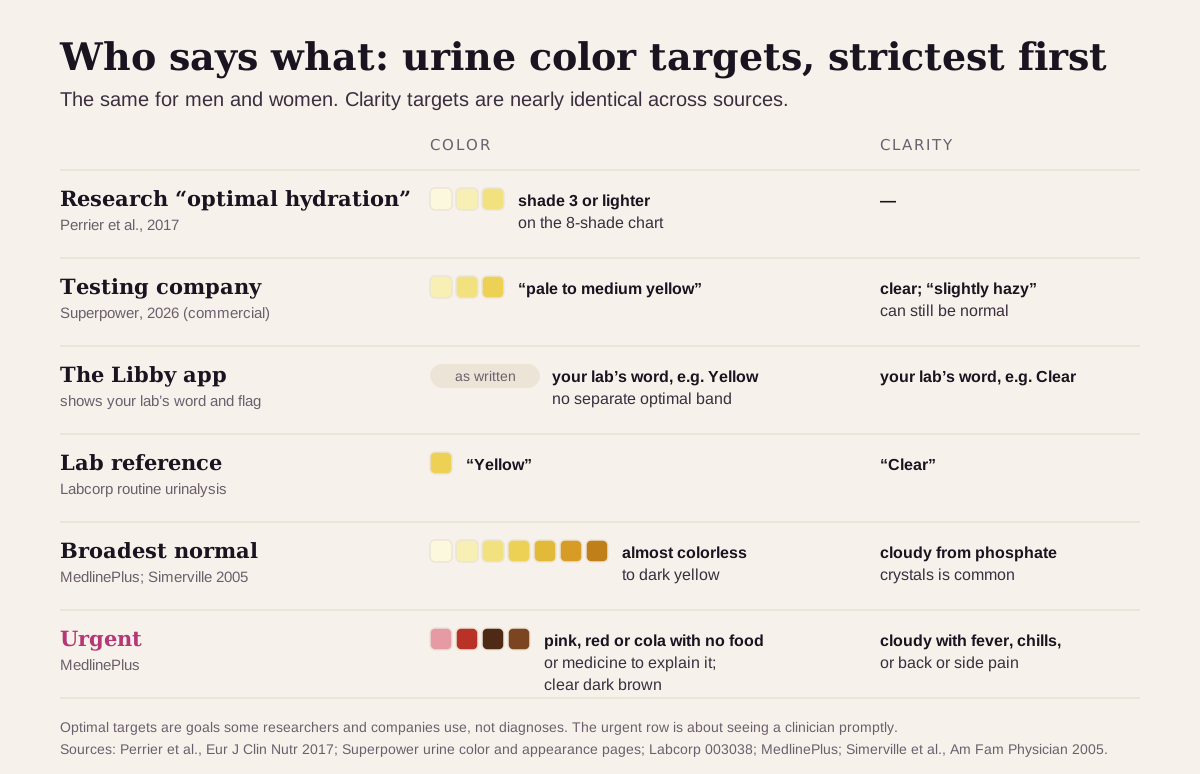
For clarity, every source lands in the same place: clear. For color, the "optimal" discussion is about hydration, and the targets differ in how pale they ask you to be. Here's the ladder, from strictest to loosest:
| Target | Color | Clarity | Who uses it |
|---|---|---|---|
| Strictest: research "optimal hydration" | shade 3 or lighter on the 8-shade chart | — | Perrier and colleagues: shade 4 or darker flags urine more concentrated than their proposed ceiling of 500 mOsm/kg10 |
| Testing company | "pale to medium yellow" | clear; "slightly hazy" can still be normal | Superpower's urine color and appearance pages13 |
| The Libby app | your lab's word | your lab's word | Shows the result as written, with your lab's flag if one is printed; no separate optimal band |
| Lab reference | "Yellow" | "Clear" | Labcorp routine urinalysis4 |
| Broadest normal | almost colorless to dark yellow | cloudy from phosphate crystals in alkaline urine is common | MedlinePlus;1 American Family Physician review6 |
| Urgent | pink, red or cola-colored with no food or medicine to explain it; clear dark brown | cloudy with fever, chills, vomiting, or back or side pain | MedlinePlus314 |
Why a pale-yellow target exists:
- Perrier's group proposes keeping a full day's urine below 500 mOsm/kg (a measure of concentration). They tie that ceiling to links between low urine output and recurrent kidney stones, reduced kidney function and blood sugar control.10
- In 817 samples from 82 healthy adults, a self-rated shade of 4 or darker caught 88% of the samples above that ceiling. It also swept in many that were fine: 42% of the samples at shade 4 or darker were below it.10
- A specific gravity of 1.013 or more did better, catching 93% and correctly clearing 94% of dilute samples.10 That's why the specific gravity number is the sharper hydration read.
- Color responds to what you drink. Perrier's analysis predicts that 84% of people with darker urine who add at least 1,260 mL a day will see it lighten by 2 shades.5
Keep "optimal" in perspective. The color chart is a quick field gauge, and it works less well with age: Perrier's team point to a study of patients averaging 79 years old in which neither color nor specific gravity told hydrated from dehydrated people apart.5 A lab's color word is a clue that points to the dipstick and the microscope, which give the answer.
What an unusual color or cloudy urine usually means
The color tells you which kind of pigment or particle to look for. The rest of the urinalysis usually tells you which one it is.
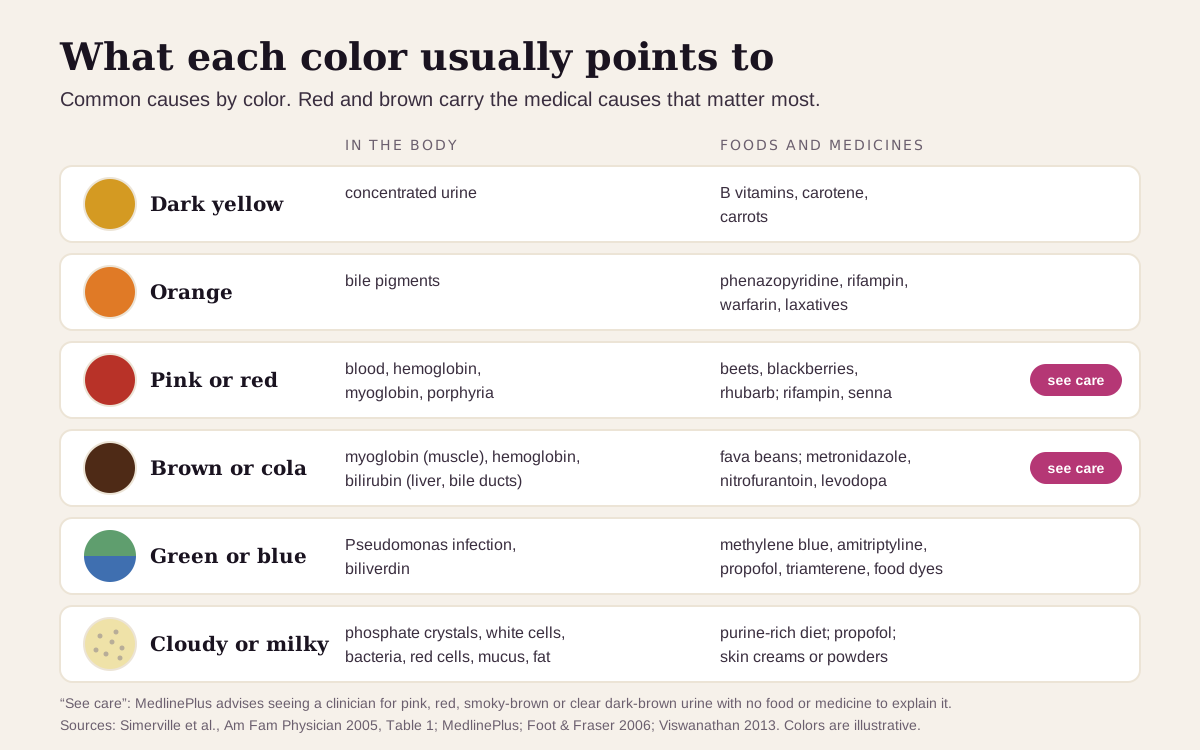
Dark yellow or amber: usually concentration
The usual suspects are simply not drinking enough and first-morning urine.211 B-complex vitamins and carotene can deepen yellow toward orange.3 Your specific gravity on the same report shows how concentrated the sample really was.
Very pale or colorless urine usually means plenty of fluid. Diuretics, alcohol, sugar spilling into the urine (glycosuria) and diabetes insipidus also make large amounts of dilute urine.2
Pink or red: blood first, then look-alikes
- Blood. It can come from anywhere in the urinary tract: an infection, a kidney or bladder stone, an injury, inflammation of the kidney, or a tumor of the bladder or kidney. Blood thinners can add to it.15 As little as 1 mL of blood in a liter of urine visibly changes the color.2 The urine blood test and a red cell count confirm it.
- Why visible blood matters. In the IDENTIFY study of 10,896 people referred to 110 hospitals in 26 countries for blood in the urine, 24.7% had bladder cancer after adjustment. Visible blood carried 3.47 times the odds of a urinary tract cancer compared with blood found only on testing.7
- Look-alikes. Beets, blackberries and rhubarb can turn urine red.6 Red urine after beets is said to happen in 10–14% of people.2 Phenazopyridine, a bladder-pain medicine, turns urine orange to red and can stain.16 Rifampin and senna laxatives are other known causes, and menstrual or vaginal blood can mix into a sample.6215 Red urine with a negative dipstick for blood generally points to a food, a medicine or porphyria.9
Brown, tea or cola: muscle, broken-down blood, or bile
- Myoglobin from muscle breakdown (rhabdomyolysis). Dark, red or cola-colored urine with muscle aches, tenderness or weakness. Causes include severe exertion such as marathon running, crush injuries, severe dehydration, and some drugs, including statins and cocaine.17
- Hemoglobin from red cells breaking down (hemolysis), which gives the same tea-colored look.2
- Bilirubin from the liver or bile ducts. Clear, dark-brown urine can signal hepatitis or cirrhosis.3 Shaken, it makes a yellow foam.2 The urine bilirubin pad on the same strip checks for it.
- Medicines and foods: metronidazole, nitrofurantoin, levodopa, some antimalarials, and fava beans.6
Orange
Phenazopyridine, rifampin, warfarin, recent laxatives and B-complex vitamins are common causes.3 Bile pigments can also show up orange.6
Green or blue
Mostly medicines and dyes: methylene blue, amitriptyline, IV cimetidine, IV promethazine, triamterene and indigo carmine.6 Propofol, a sedative used in anesthesia, can turn urine green.2 So can a Pseudomonas bladder infection and artificial food colors.63 In purple urine bag syndrome, a long-term catheter bag turns purple; its incidence is about 9.8% in institutionalized patients.9
Cloudy or milky
- Phosphate crystals in alkaline urine, a common cause.6
- Infection. White cells and bacteria make urine cloudy, sometimes with a bad smell.314 A white cell count confirms them.
- Less common: red cells, mucus, fat from the lymph system (chyluria), creams or powders from the skin, and a milky look during long propofol anesthesia.32
Get prompt care if you see blood in your urine, even once, if your urine is clear but dark brown, or if it's pink, red or smoky-brown with no food or medicine to explain it.3 Contact your clinician right away if blood comes with fever, chills, vomiting, belly, side or back pain, or blood clots, or if you are unable to urinate.15 Dark, red or cola-colored urine with muscle pain or weakness, after hard exercise, an injury or a new medicine, can be rhabdomyolysis: treatment soon after lowers the risk of lasting kidney damage.17 Cloudy urine with fever, chills, vomiting, or back or side pain can mean a kidney infection, so call right away.14
Urine color reads best next to its neighbors
The color word narrows the question. The dipstick and microscope on the same report usually answer it:6
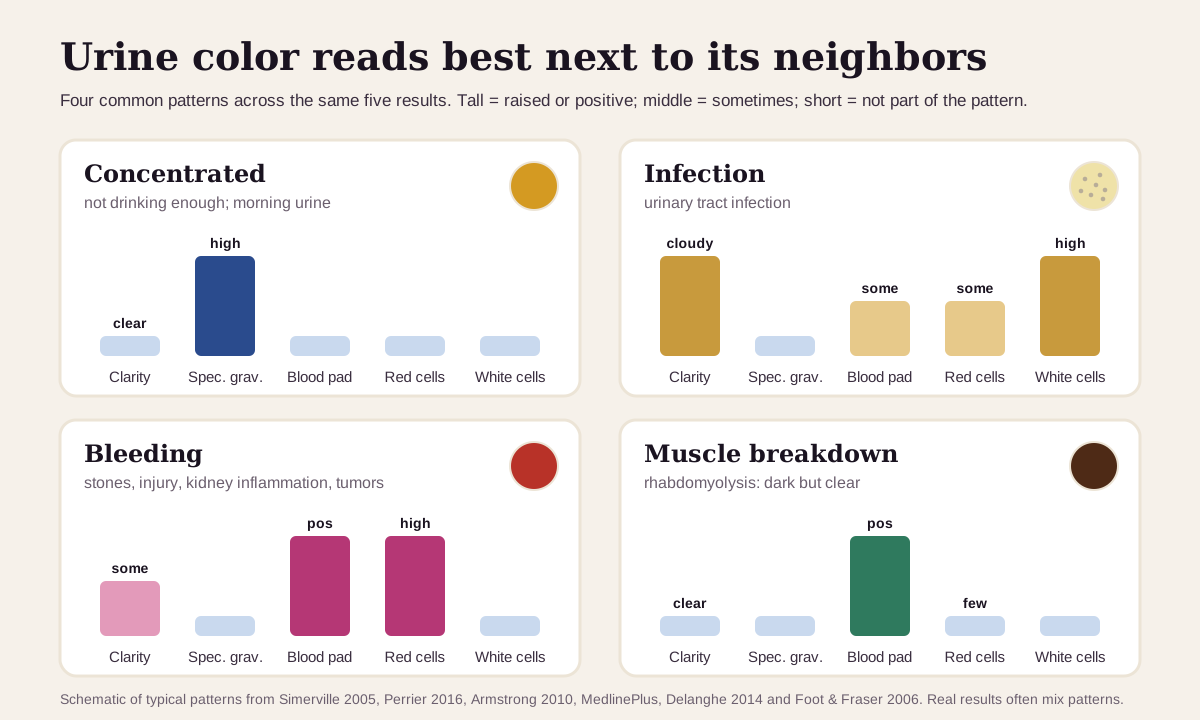
| If you see… | It often points to… |
|---|---|
| Dark yellow, clear, specific gravity high | concentrated urine: more fluid lightens it, about 2 shades per 1.1 liters a day |
| Cloudy, white cells or leukocyte esterase up, sometimes blood | a urinary tract infection |
| Pink or red, dipstick blood positive, red cells seen | bleeding somewhere in the urinary tract |
| Red-brown or cola, dipstick blood positive, few or no red cells | myoglobin from muscle breakdown, or hemoglobin from red cells breaking down |
| Dark brown, clear, bilirubin positive | bile pigment: a liver or bile-duct problem |
| Red or orange, dipstick blood negative | a food (beets, blackberries), a medicine (phenazopyridine, rifampin) or porphyria |
| Cloudy, no excess white cells, alkaline pH | phosphate crystals |
The dipstick blood pad reacts to red cells, free hemoglobin and myoglobin alike, so the microscope is what separates bleeding from pigment.6 A strongly positive pad with no matching red cells in grossly bloody urine suggests red cells breaking down in the bloodstream or rhabdomyolysis.12 Color can also fool the strip: bilirubin and beet pigment can make the white cell pad read falsely positive.12 Concentration matters too: dehydration is a known cause of a falsely positive blood pad, and a high specific gravity can make the same pad read falsely negative.6
How fast urine color changes
Your urine follows your drinking from day to day. Most of the comparisons in Perrier's pooled studies were between back-to-back 24-hour collections, and about 1.1 liters more fluid a day made urine 2 shades lighter.5 Food and medicine colors usually fade once the food or drug is stopped.9
The sample changes in hours. That's why labs set time limits:
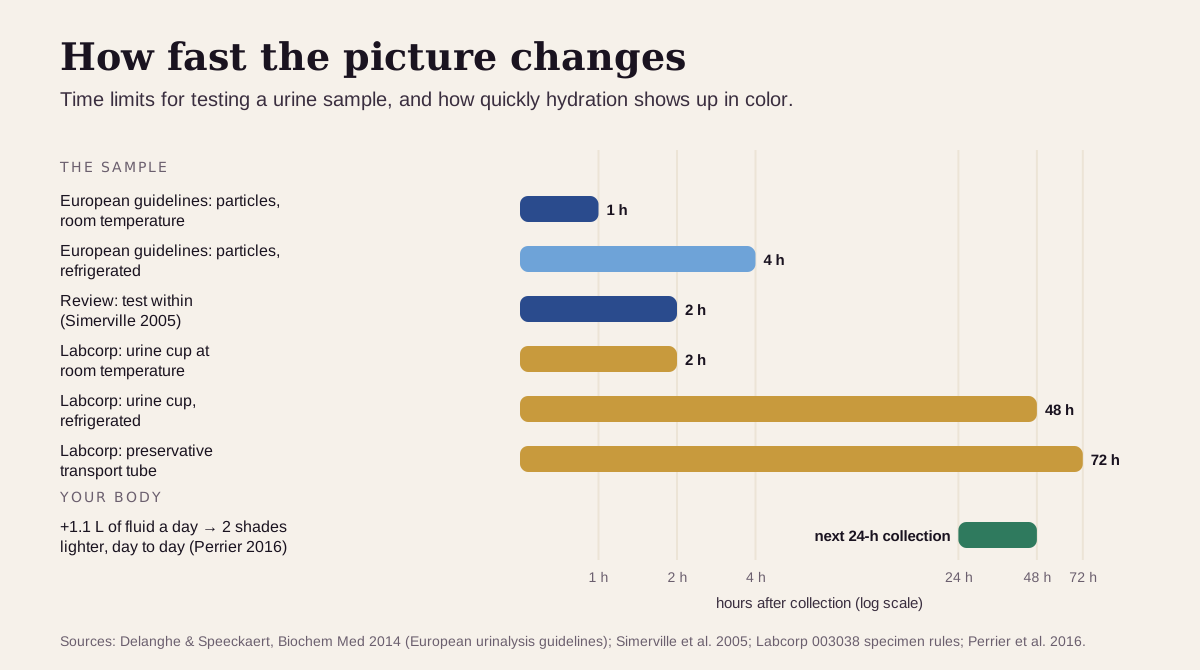
- Delays blur the picture. Delays of more than 2 hours between collection and testing often make results unreliable.6 Labcorp rejects a urine cup kept at room temperature for more than 2 hours or refrigerated for more than 48 hours.4
- Cold samples can cloud. Refrigeration makes phosphates and urates settle out, so a chilled sample can look cloudy for a reason unrelated to your body.12
- Some pigments darken on standing. Urine from people with porphyria or alkaptonuria can leave the body a normal color and darken in light and air.2
- Trends beat snapshots. One dark morning sample is common. A color that stays abnormal with no food or medicine to explain it is a reason to see your clinician.3
Going deeper: how a lab calls a color
Some labs read color and clarity by eye.1 Others use an analyzer that shines red, green and blue light through the sample and measures what comes out. One FDA-cleared system reports 8 colors at three intensities, 22 combinations in all, and grades turbidity from scattered light.8
Even machines disagree at the pale end. In the FDA review, a newer analyzer and its predecessor from the same maker read the same urine samples:
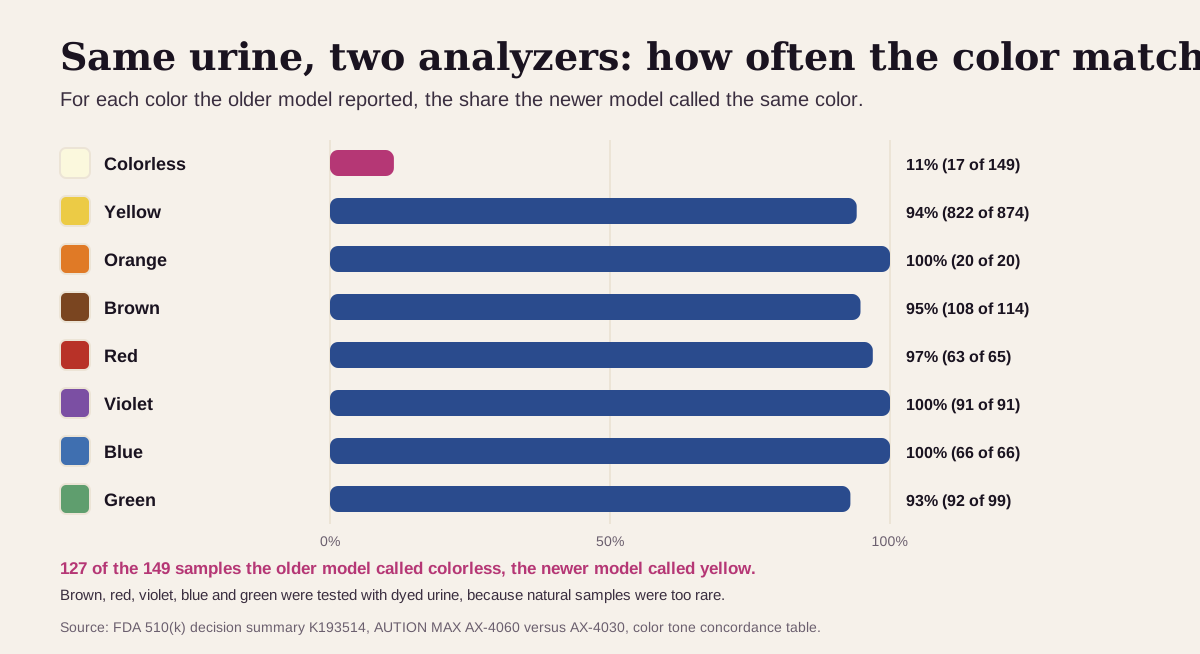
- Of 149 samples the older model called colorless, the newer one called 127 yellow. Of 874 it called yellow, the newer one called 52 orange.8
- The unusual colors matched well (93–100%), but they were rare enough that the reviewers had to dye normal urine to test them.8
- Reading by eye depends on the reader. MedlinePlus notes that anyone reading a home strip has to tell colors apart against a chart.1
Colored urine can also skew the dipstick. That analyzer corrects the bilirubin, urobilinogen and ketone pads for the sample's own color.8 Labcorp notes that phenazopyridine breakdown products can interfere with its dipstick by adding color.4
Questions worth asking
- Did the lab flag my color or appearance, or just describe it?
- What did the dipstick blood pad and the microscope show?
- Could a food, supplement or medicine I take explain the color?
- Should we repeat it on a fresh sample tested promptly?
- If I saw red or brown urine, do I need a urine culture, a CK test or liver tests?
- Given my age and smoking history, do I need my bladder checked for visible blood?
FAQ
What color should urine be? Pale to dark yellow and clear. Labcorp's reference words are "Yellow" and "Clear", and MedlinePlus puts the normal span at almost colorless to dark yellow.41
Why is my urine cloudy? Often phosphate crystals in alkaline urine or white cells from an infection.6 Red cells, bacteria, mucus and fat are other causes.3 A chilled sample can also turn cloudy on the way to the lab.12
Does dark yellow urine mean I'm dehydrated? Usually it means your urine is concentrated. In healthy adults, about 1.1 liters more fluid a day made urine 2 shades lighter.5 Specific gravity on the same report gives a sharper read.10
When is urine color an emergency? Blood you can see, cola-colored urine with muscle pain or weakness, and cloudy urine with fever or back pain all need prompt care.151714
This guide is for education. It can't diagnose you or replace care from a clinician who knows your history.
Footnotes
-
National Library of Medicine. Urinalysis. MedlinePlus Medical Encyclopedia. Reviewed January 1, 2025. The physical exam of color and appearance; normal from almost colorless to dark yellow; medicines that change urine color; home strips read against a color chart. MedlinePlus ↩ ↩2 ↩3 ↩4 ↩5 ↩6 ↩7 ↩8 ↩9
-
Foot CL, Fraser JF. Uroscopic rainbow: modern matula medicine. Postgrad Med J. 2006;82(964):126–129. doi:10.1136/pgmj.2005.037598. Urochrome, dilution, 1 mL of blood per liter, beeturia, tea-colored hemoglobin and myoglobin, bilirubin foam, propofol, porphyria and alkaptonuria. PMC ↩ ↩2 ↩3 ↩4 ↩5 ↩6 ↩7 ↩8 ↩9 ↩10 ↩11 ↩12 ↩13 ↩14 ↩15 ↩16
-
National Library of Medicine. Urine - abnormal color. MedlinePlus Medical Encyclopedia. Reviewed July 1, 2025. Usual straw-yellow; causes of cloudy, dark-brown, red, orange and green-blue urine; when to see a clinician. MedlinePlus ↩ ↩2 ↩3 ↩4 ↩5 ↩6 ↩7 ↩8 ↩9 ↩10 ↩11 ↩12 ↩13 ↩14 ↩15 ↩16 ↩17 ↩18 ↩19
-
Labcorp. Urinalysis, Routine (test 003038) and its sample report dated 05/18/2026. Color and appearance on every routine urinalysis; reference "Yellow" and "Clear"; specimen stability; phenazopyridine color interference. A commercial laboratory, cited for its own published test details. Labcorp · Sample report ↩ ↩2 ↩3 ↩4 ↩5 ↩6 ↩7 ↩8 ↩9 ↩10
-
Perrier ET, Johnson EC, McKenzie AL, Ellis LA, Armstrong LE. Urine colour change as an indicator of change in daily water intake: a quantitative analysis. Eur J Nutr. 2016;55(5):1943–1949. doi:10.1007/s00394-015-1010-2. Pooled data from 238 adults on the 8-shade chart; the lead author worked for Danone Research. PMC ↩ ↩2 ↩3 ↩4 ↩5 ↩6 ↩7 ↩8 ↩9 ↩10 ↩11
-
Simerville JA, Maxted WC, Pahira JJ. Urinalysis: a comprehensive review. Am Fam Physician. 2005;71(6):1153–1162. Table 1 (causes of abnormal urine color), cloudy urine from phosphate crystals or pyuria, the 2-hour testing window, and the blood pad's reaction to hemoglobin and myoglobin. AAFP · PubMed ↩ ↩2 ↩3 ↩4 ↩5 ↩6 ↩7 ↩8 ↩9 ↩10 ↩11 ↩12 ↩13 ↩14 ↩15 ↩16 ↩17 ↩18 ↩19 ↩20 ↩21 ↩22
-
Khadhouri S, Gallagher KM, MacKenzie KR, et al. The IDENTIFY study: the investigation and detection of urological neoplasia in patients referred with suspected urinary tract cancer - a multicentre observational study. BJU Int. 2021;128(4):440–450. doi:10.1111/bju.15483. 10,896 patients, 110 hospitals, 26 countries. PubMed ↩ ↩2
-
U.S. Food and Drug Administration. 510(k) decision summary K193514: AUTION MAX AX-4060 Urinalysis System. Color tone (8 colors, 22 contrast and hue indications), turbidity blocks, the color and turbidity concordance tables, and color correction. FDA ↩ ↩2 ↩3 ↩4 ↩5 ↩6 ↩7
-
Viswanathan S. Urine bag as a modern day matula. ISRN Nephrol. 2013;2013:215690. doi:10.5402/2013/215690. A review of urine colors and their causes; red urine with a negative blood dipstick; purple urine bag syndrome in about 9.8% of institutionalized patients. PMC ↩ ↩2 ↩3 ↩4 ↩5
-
Perrier ET, Bottin JH, Vecchio M, Lemetais G. Criterion values for urine-specific gravity and urine color representing adequate water intake in healthy adults. Eur J Clin Nutr. 2017;71(4):561–563. doi:10.1038/ejcn.2016.269. 817 samples from 82 adults; the authors are Danone Research employees and Danone funded the study. PMC ↩ ↩2 ↩3 ↩4 ↩5 ↩6 ↩7 ↩8
-
Armstrong LE, Pumerantz AC, Fiala KA, et al. Human hydration indices: acute and longitudinal reference values. Int J Sport Nutr Exerc Metab. 2010;20(2):145–153. doi:10.1123/ijsnem.20.2.145. 59 healthy, active men observed 5 times over 12 days. PubMed ↩ ↩2 ↩3 ↩4 ↩5
-
Delanghe J, Speeckaert M. Preanalytical requirements of urinalysis. Biochem Med (Zagreb). 2014;24(1):89–104. doi:10.11613/BM.2014.011. Refrigeration precipitates phosphates and urates; European timing guidance; dipstick interference from colored urine; blood pad positive without red cells. PMC ↩ ↩2 ↩3 ↩4 ↩5 ↩6 ↩7
-
Superpower. Urine Color and Urine Appearance biomarker pages. Last updated September 1, 2026. "Pale yellow urine usually means urine is diluted and hydration is balanced"; "Normal urine is usually clear and pale to medium yellow"; "'Slightly hazy' can still be normal." A commercial source, listed as what the optimizer community uses. Color · Appearance ↩ ↩2
-
National Library of Medicine. Urinary tract infection - adults. MedlinePlus Medical Encyclopedia. Reviewed July 23, 2024. Cloudy or bloody urine with a bladder infection; kidney-infection warning signs. MedlinePlus ↩ ↩2 ↩3 ↩4 ↩5 ↩6
-
National Library of Medicine. Urine - bloody. MedlinePlus Medical Encyclopedia. Reviewed July 1, 2025. Causes of blood in the urine and when to contact a clinician right away. MedlinePlus ↩ ↩2 ↩3 ↩4 ↩5
-
National Library of Medicine. Phenazopyridine hydrochloride tablet label. DailyMed. "Phenazopyridine Hydrochloride produces an orange to red color in the urine and feces, and may cause staining." DailyMed ↩
-
National Library of Medicine. Rhabdomyolysis. MedlinePlus Medical Encyclopedia. Reviewed September 2, 2025. Dark, red or cola-colored urine, causes, and why early treatment matters. MedlinePlus ↩ ↩2 ↩3
Educational content, not medical advice. Libby is a personal record tool, not a medical service — it doesn't diagnose, treat, or prescribe. Reference ranges vary by lab and by person. Talk to a qualified healthcare professional about your results.
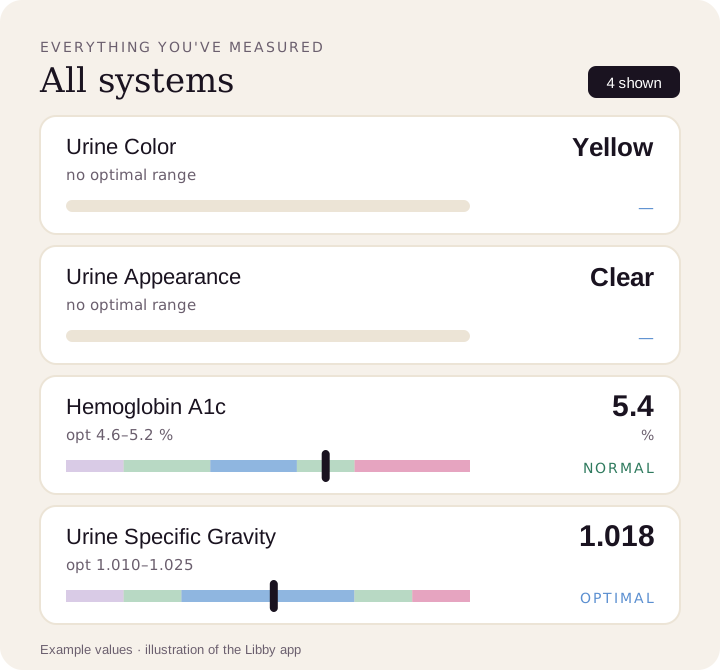
See every result against your lab's range.
Upload a lab PDF or a photo of your report. Libby keeps your urine color and appearance exactly as your lab wrote them, shows each number on your lab's range, and tracks every result over time.
View your urine color ›