Urine bilirubin test: what negative and positive mean
Bilirubin in urine points to the liver or bile ducts. What normal is, the common causes of a positive, how to read it with other tests, and when it's urgent.
Urine bilirubin is bilirubin that has spilled from your blood into your urine, and a normal result is negative. Only the processed, water-soluble form (conjugated bilirubin) fits through the kidney's filter. It reaches the urine when the liver or the bile ducts fall behind at clearing it, so a positive test points to the liver or bile ducts, sometimes before your eyes turn yellow.12
The short version
- Normal: negative. Healthy urine carries too little bilirubin to measure.3 Strips start to flag it at about 0.2–0.5 mg/dL.41
- Positive most often means liver-cell injury (viral hepatitis, alcohol or a medicine) or slowed or blocked bile flow, such as a gallstone in the bile duct.25
- Urgent: bilirubin in your urine with yellow skin or eyes plus fever, belly pain, confusion or easy bleeding needs care the same day.56
- Key distinction: a high blood bilirubin with a negative urine test usually means the unprocessed form, as in Gilbert syndrome or fast red-cell breakdown. Albumin holds that form in the blood.36
What urine bilirubin is
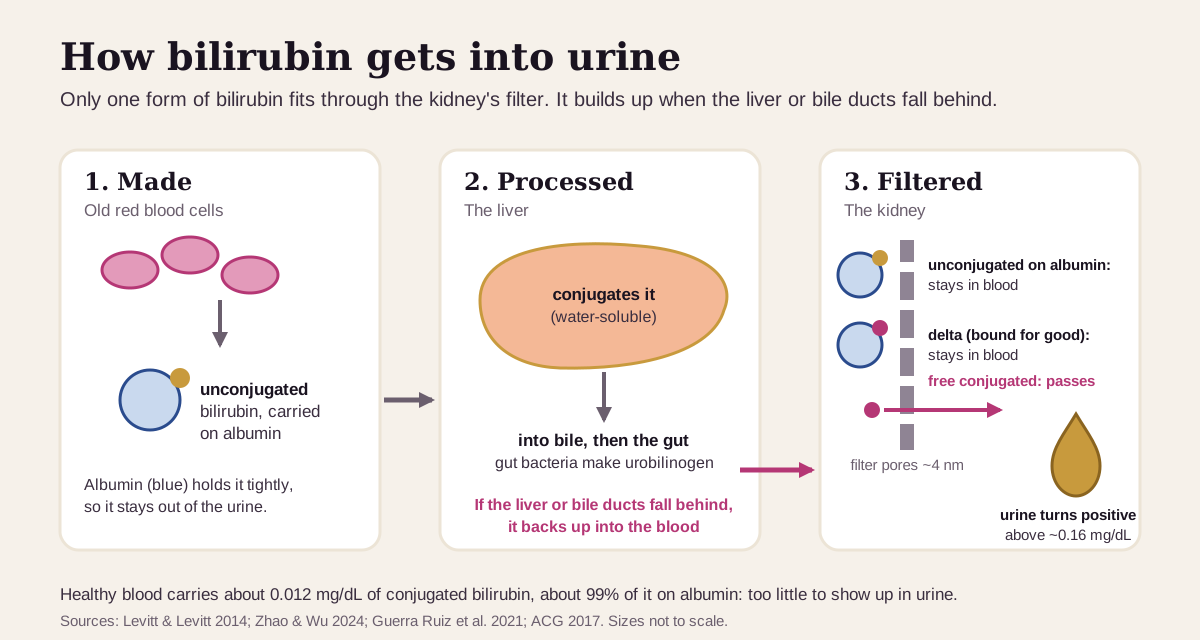
Bilirubin is the yellow pigment left over when your body recycles old red blood cells. It starts out in an unprocessed (unconjugated) form that dissolves poorly in water, so it rides through the blood stuck to the protein albumin. The liver attaches glucuronic acid, a sugar-like molecule, to it (conjugation), which makes it water-soluble, and sends it out in bile. In the gut, bacteria turn it into urobilinogen, and a small share of that (2–5%) reaches the urine.1
The kidney's filter only lets small, free molecules through. Albumin holds unprocessed bilirubin so tightly that it stays in the blood, even in people who are visibly yellow from it.3 Processed (conjugated) bilirubin is different: its free fraction is small enough to filter. In healthy blood there is almost none of it, about 0.012 mg/dL, and about 99% of that is loosely bound to albumin, so urine bilirubin is unmeasurable.3
When the liver or bile ducts fall behind, conjugated bilirubin backs up into the blood. Once blood levels pass roughly 0.16 mg/dL, the kidneys start filtering it into the urine, though that threshold varies from person to person.8 The urine turns dark or brown.9
The test itself is one pad on a routine urine dipstick. Bilirubin reacts with a dye-forming chemical on the pad (a diazonium salt) and turns it tan to reddish-brown, either read by eye against a color chart or by an analyzer.47
What's a normal urine bilirubin?
Negative. Bilirubin normally isn't found in urine, according to MedlinePlus, and FDA-reviewed strip labeling says it should be undetectable in healthy people.24
"Negative" means below what the test can see. Every method has a floor:
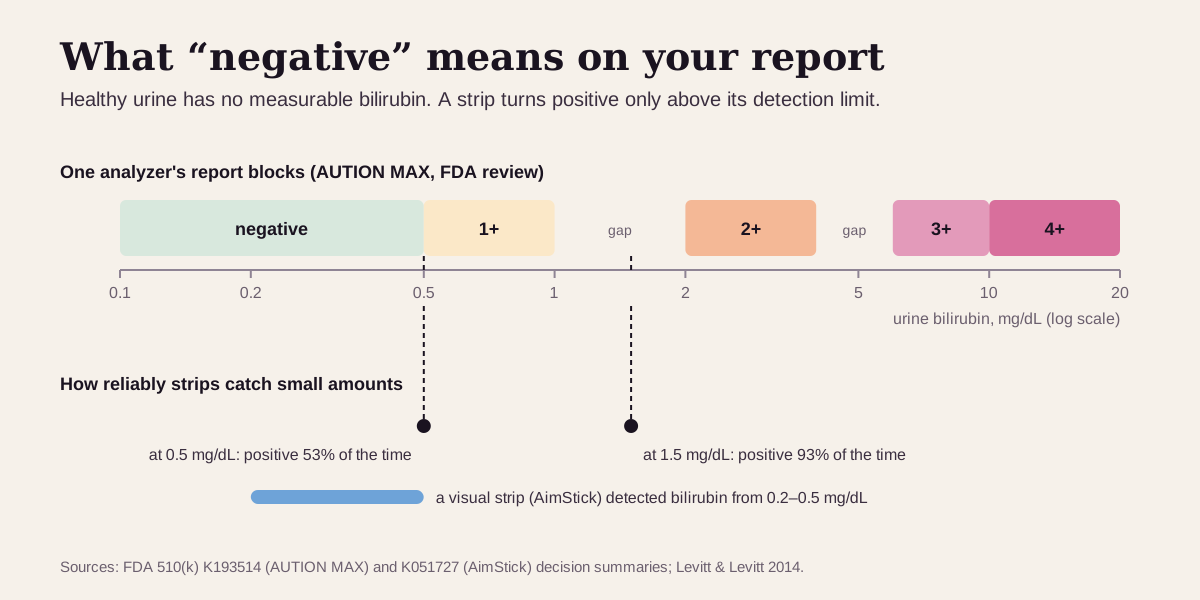
- A visual strip reviewed by the FDA (AimStick) detected bilirubin from 0.2–0.5 mg/dL.4
- A 2021 lab-medicine review puts the typical strip's limit at 0.5 mg/dL.1
- On an automated analyzer (AUTION MAX), samples at 0.5 mg/dL read positive only 53% of the time. At 1.5 mg/dL, it was 93%.7 So a result right at the edge can flip between negative and 1+ on a repeat test.
Negative is the expected result for men and women alike. Libby files urine bilirubin under your liver markers, with your lab's result and flag.
"Optimal" urine bilirubin: what health optimizers aim for
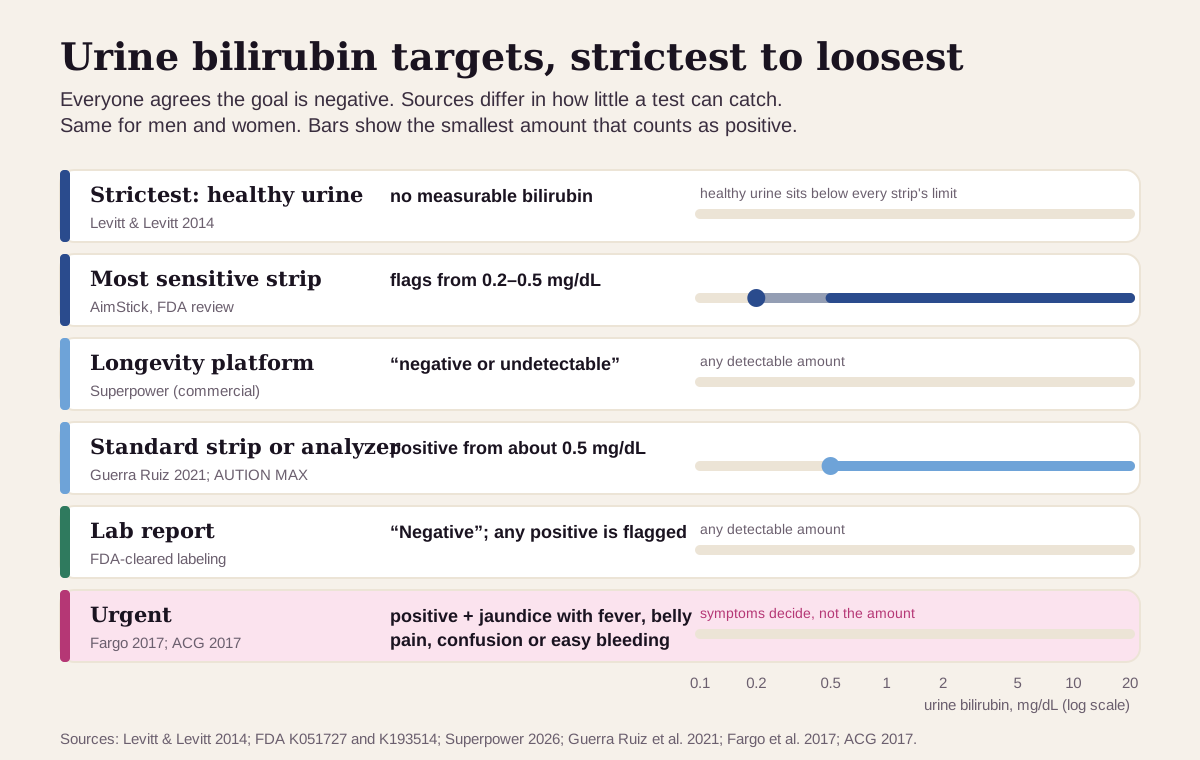
For urine bilirubin, every source agrees on the goal: negative. They differ in how small an amount a test can catch and when a result calls for action. Here's the ladder, from strictest to loosest:
| Target | Men and women | Who uses it |
|---|---|---|
| Strictest: healthy urine | no measurable bilirubin | Levitt and Levitt's review of bilirubin handling3 |
| Most sensitive strip | flags from 0.2–0.5 mg/dL | AimStick strip, FDA review4 |
| Longevity platform | "negative or undetectable" | Superpower's published optimal; trace or positive calls for follow-up blood tests10 |
| Standard strip or analyzer | positive from about 0.5 mg/dL | Lab-medicine review;1 AUTION MAX 1+ block (0.5–1.0 mg/dL)7 |
| Lab report | "Negative"; any positive is flagged | FDA-cleared labeling: positive findings should be investigated7 |
| Urgent | positive, with yellow skin or eyes plus fever, belly pain, confusion or easy bleeding | Get care the same day56 |
The Libby app shows your urine bilirubin the way your lab reported it, with your lab's flag. It sets no separate optimal band for this marker.
Why a positive result deserves a follow-up:
- In one health system, only 831 of 241,929 urine bilirubin tests (0.3%) came back positive over 20 months.11
- 60% of those positives came from people whose liver blood tests were already abnormal. Of the 40% that were unexpected, 80% got liver tests within 2 weeks, and 85% of those were abnormal.11
- Bilirubin can show up in urine early. The kidneys start passing it at roughly 0.16 mg/dL of conjugated bilirubin,8 while visible jaundice usually needs a total bilirubin above about 2.5–3 mg/dL.15 That's why MedlinePlus calls it a possible early sign of liver damage, sometimes before any symptoms.2
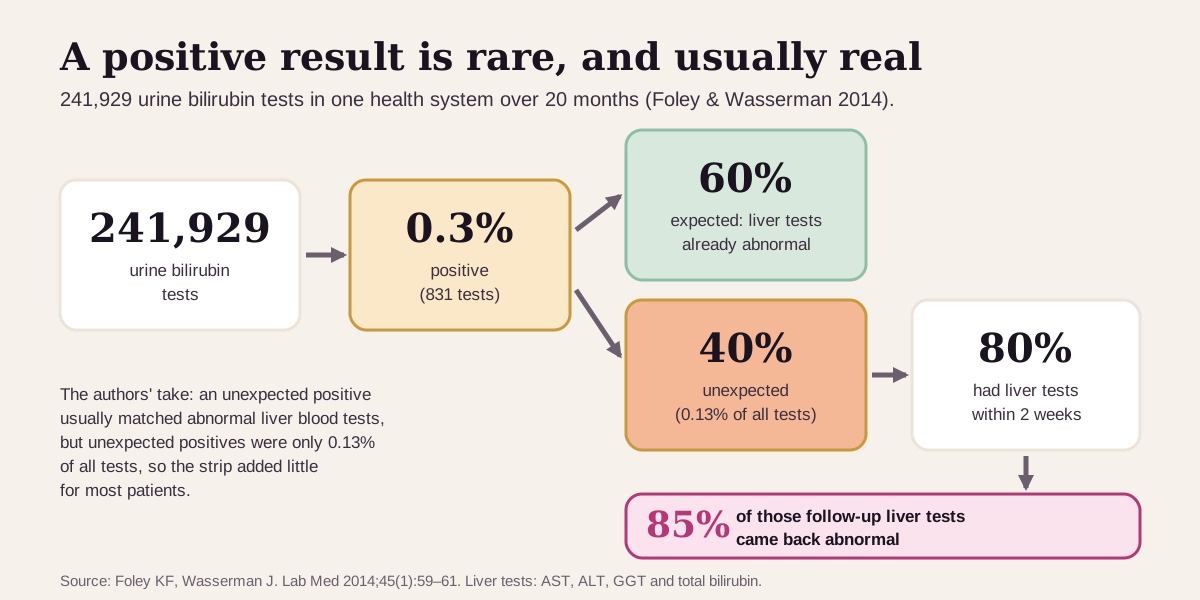
Keep "optimal" in perspective. A negative strip is reassuring but coarse: the same authors concluded that urine bilirubin adds little to the diagnosis of most patients.11 Blood tests (fractionated bilirubin, ALT, AST, ALP and GGT) are what clinicians use to work up jaundice.5 The urine strip is an early flag that tells you when to look.2
What a positive urine bilirubin usually means
A positive test means conjugated bilirubin in your blood has climbed past the kidney's threshold. Which conditions do that, and which don't, explains most of what the test can tell you:
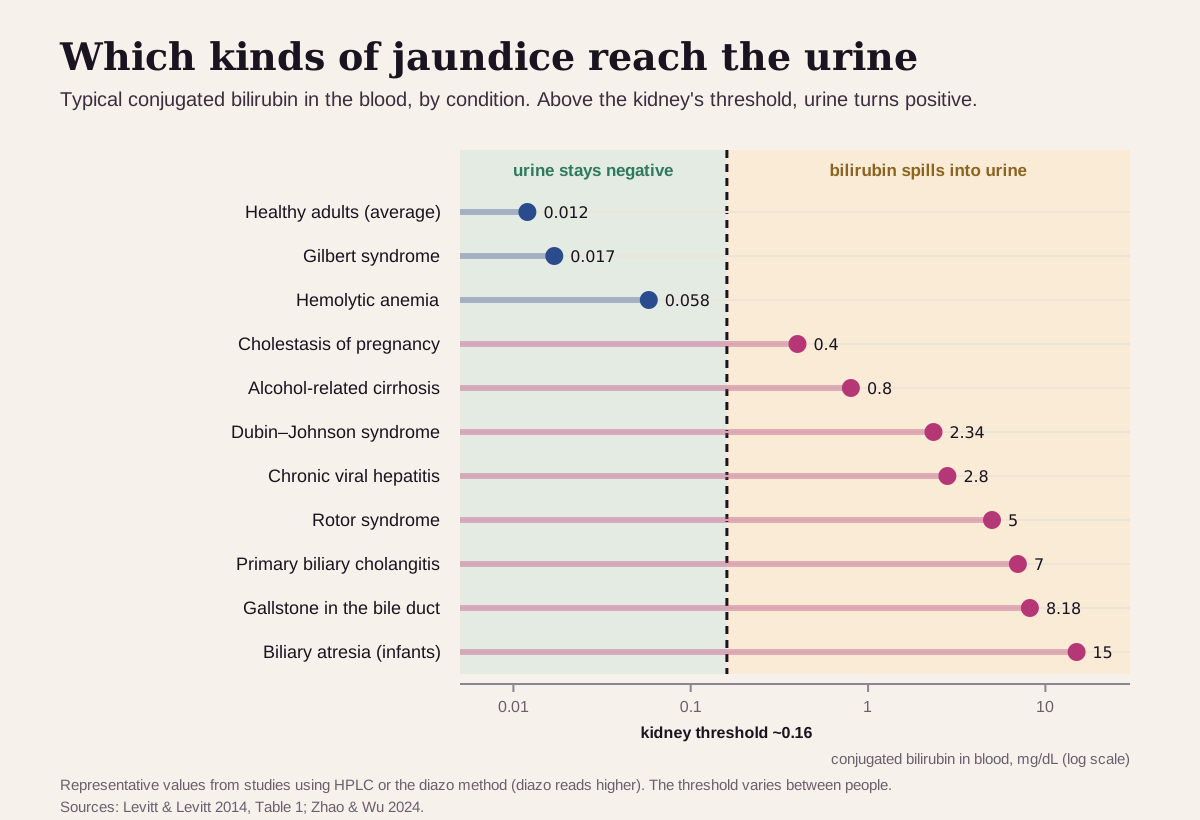
In a study of more than 700 adults with acute jaundice, 55% of cases came from inside the liver and 45% from outside it.5 For a positive urine test, the usual suspects are:
- Liver-cell injury (hepatitis). The causes inside the liver include viral hepatitis, alcohol-related liver disease and drug-induced liver injury.5 In chronic viral hepatitis, conjugated bilirubin averages about 2.8 mg/dL, far above the kidney's threshold.3 ALT and AST usually rise more than ALP.6
- A blocked bile duct. Gallstones in the common bile duct cause 14% of new jaundice, and tumors about 6%.5 Blockage pushes conjugated bilirubin very high (about 8 mg/dL with a duct stone in one series), often with pale stools, itching and an ALP that rises more than ALT.356
- Slowed bile flow inside the liver. Medicines, primary biliary cholangitis, primary sclerosing cholangitis and cholestasis of pregnancy all belong here.163 Don't stop a prescribed medicine on your own. Bring your full list, supplements included, to your clinician.
- Cirrhosis. In alcohol-related cirrhosis, conjugated bilirubin averages about 0.8 mg/dL, several times the kidney's threshold.382
- Rare but benign: Dubin–Johnson and Rotor syndromes. These inherited conditions keep conjugated bilirubin high over the long term, with normal liver enzymes.1
Look-alikes. Some things fool the strip:
- False positives: phenazopyridine (a bladder-pain medicine that turns urine orange), metabolites of the pain reliever etodolac, and indican.1213
- False negatives: urine left in the light or tested late (bilirubin breaks down to a form the pad misses), large doses of vitamin C, high nitrite from a urinary infection, and expired strips.121
A negative urine test with a high blood bilirubin usually means the unprocessed form is up. The most common cause is Gilbert syndrome, a harmless inherited slowdown in bilirubin processing that affects 3–7% of Americans.614 Fast red-cell breakdown (hemolysis) is the other classic cause.6
Get prompt care if bilirubin in your urine comes with yellow skin or eyes plus fever or belly pain, which can mean a blocked bile duct or an infection.5 Go right away for confusion, unusual sleepiness or easy bleeding, which can signal acute liver failure.6 In a baby, jaundice that appears or lasts after 2–3 weeks, dark urine or pale, clay-colored stools need a prompt call: biliary atresia surgery works best before 8 weeks of age.15
Urine bilirubin reads best next to its neighbors
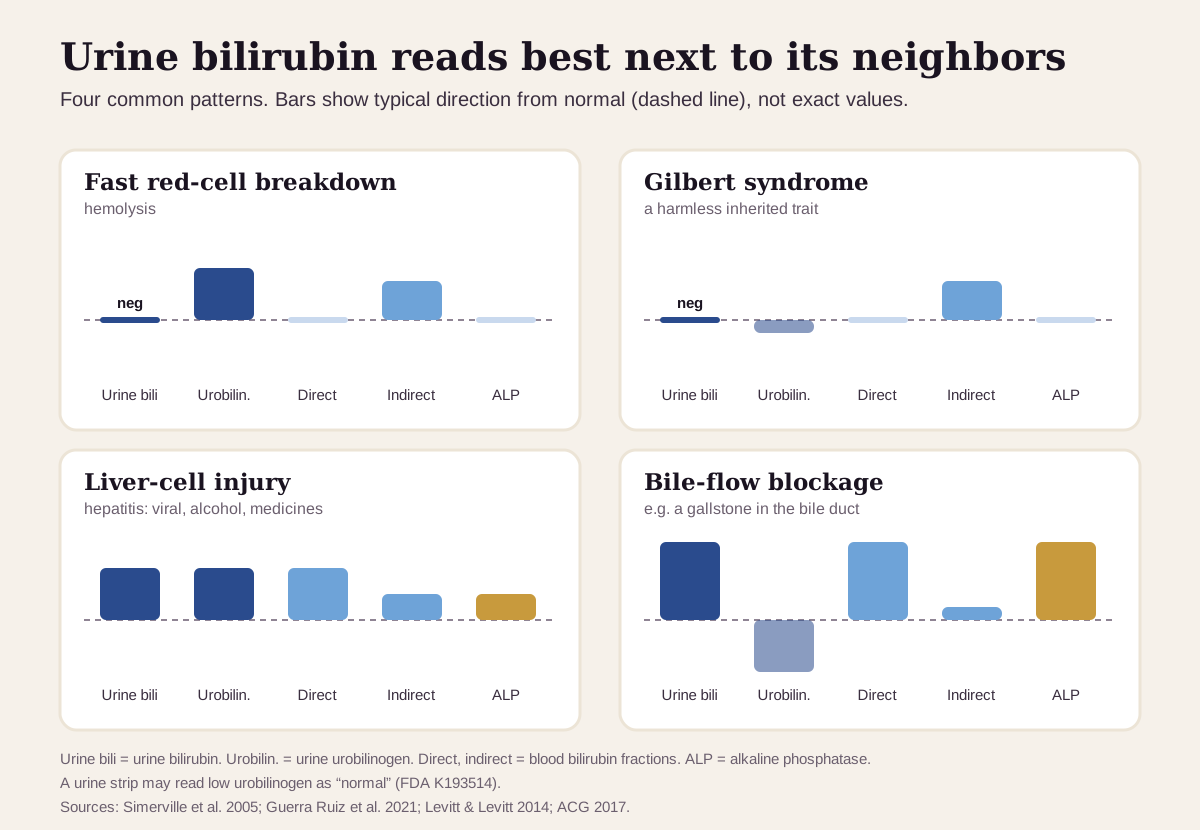
A urine strip carries two bile pigments, bilirubin and urobilinogen. Read together with your blood bilirubin fractions and ALP, they sort the common causes of jaundice:131
| If you see… | It often points to… |
|---|---|
| Urine bilirubin negative, urobilinogen up, indirect bilirubin up, ALP normal | fast red-cell breakdown (hemolysis) |
| Urine bilirubin negative, only indirect bilirubin mildly up, ALP normal | Gilbert syndrome |
| Urine bilirubin positive, urobilinogen up, direct bilirubin up, ALT and AST up more than ALP | liver-cell injury, such as hepatitis |
| Urine bilirubin positive, urobilinogen low (a strip may read low as "normal"), direct bilirubin and ALP up the most | slowed or blocked bile flow, such as a gallstone in the bile duct |
The urobilinogen clue works because gut bacteria make urobilinogen from the bilirubin in bile. Up to 20% of it is absorbed back into the blood, the liver sends most of that back into bile, and only 2–5% reaches the urine.1 Hemolysis and liver-cell disease raise urine urobilinogen. A blocked bile duct and antibiotics lower it.13
How fast urine bilirubin changes
The sample changes in hours. Bilirubin breaks down in light and at room temperature, which can turn a true positive negative.116 Urine should be examined within 2 hours of collection.13
Your body clears it in hours to days. When the liver can excrete it, conjugated bilirubin has a half-life of about 2–4 hours. Some of it, though, bonds permanently to albumin during a long backup. That form, delta bilirubin, lasts as long as albumin does, with a half-life of 17–21 days, and it's too big to filter into urine.8
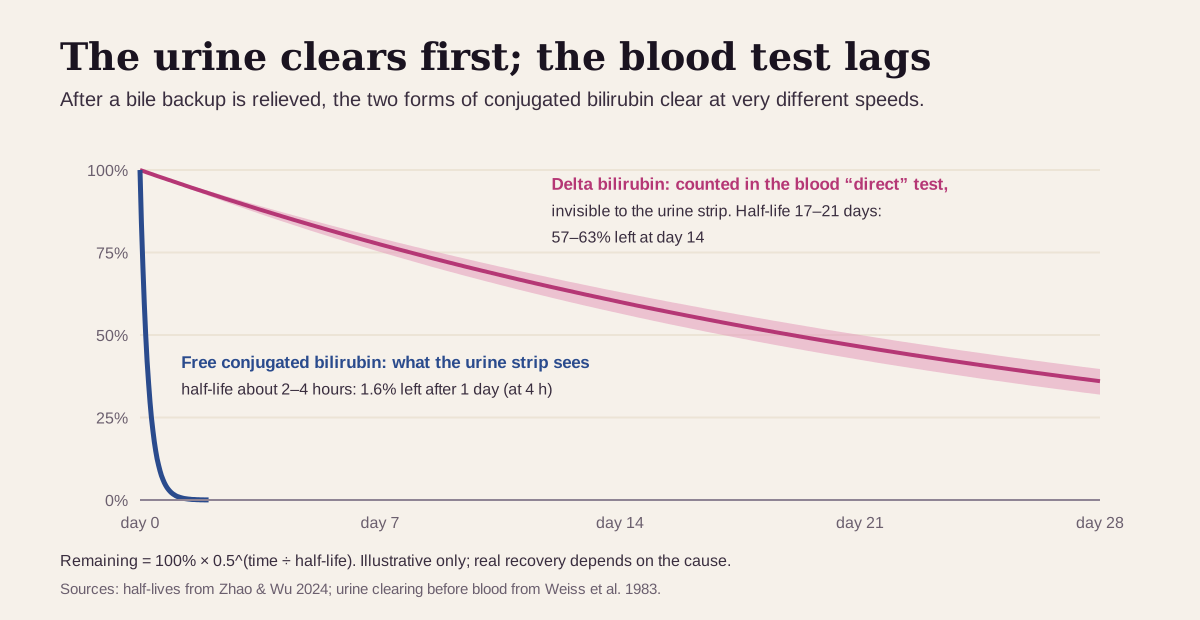
What that means in practice:
- Urine often clears before the blood. In a study of 200 people with jaundice, delta bilirubin made up 8–90% of the total and kept bilirubin in the blood after it had disappeared from the urine.17 A negative urine test with a still-high direct bilirubin can simply mean recovery.
- Repeat an edge result. A single "small" or 1+ can flip on a repeat, especially near the strip's limit.7 Fresh urine, tested promptly, gives the fairest reading.13
- Trends beat snapshots. A urine result moving from moderate to negative, next to a falling blood bilirubin, tells a different story than one that keeps coming back positive.
Going deeper: the kidney as a backup exit
Normally the liver handles almost all bilirubin removal. The kidney becomes a backup exit only when conjugated bilirubin backs up:
- At a blood conjugated bilirubin of 2.34 mg/dL, the kidneys excrete about 30 mg of bilirubin a day, roughly 12% of daily production.3
- When the bile ducts are completely closed, as in infants with biliary atresia, urine becomes the main route: those babies excreted 45–71% of a labeled bilirubin dose in their urine over 10 days.3
- The filter's pores are about 4 nm across. Albumin-bound delta bilirubin is about 14 nm, so less than 1% of it filters.8
On the strip, bilirubin couples with a diazonium salt in a strongly acid pad to form a colored azo dye, the same basic diazo reaction labs use for blood bilirubin.41 Analyzers read the color by reflectance, and some correct for naturally dark urine.7
Questions worth asking
- Was my urine bilirubin positive, and how strongly (small, moderate, large)?
- What do my blood total and direct bilirubin, ALT, AST and ALP show?
- Does my urobilinogen point toward a blockage or toward the liver itself?
- Could any of my medicines or supplements cause a false positive?
- Should we repeat the urine test on a fresh sample?
- Do I need an ultrasound of my liver and bile ducts?
FAQ
What does bilirubin in urine mean? It means conjugated bilirubin has built up in your blood past the kidney's threshold. The most common causes are liver-cell injury, such as hepatitis, and slowed or blocked bile flow, such as a gallstone in the bile duct.25
Is a small amount of bilirubin in urine normal? Bilirubin normally isn't found in urine, so any positive result is flagged for follow-up.27 A borderline result can be a test-edge effect, so a repeat on fresh urine often comes next.7
Why is my urine bilirubin negative when my blood bilirubin is high? Usually because the unprocessed form is up, as in Gilbert syndrome or hemolysis. Albumin holds it in the blood. During recovery from jaundice, delta bilirubin can also keep the blood level up after the urine clears.317
Does dark urine always mean bilirubin? No. Concentrated urine looks deep yellow, and brown urine can also come from muscle breakdown (myoglobin), fava beans, or medicines such as metronidazole and nitrofurantoin.13 Dark urine with yellow eyes or pale stools is the combination that needs a call.9
This guide is for education. It can't diagnose you or replace care from a clinician who knows your history.
Footnotes
-
Guerra Ruiz AR, Crespo J, López Martínez RM, et al. Measurement and clinical usefulness of bilirubin in liver disease. Adv Lab Med. 2021;2(3):352–372. doi:10.1515/almed-2021-0047. A lab-medicine society review: only conjugated bilirubin is filtered into urine; strips detect about 0.5 mg/dL; light and room temperature degrade it; urobilinogen (2–5% reaches urine); jaundice above about 2.5 mg/dL; conditions that raise conjugated bilirubin. PMC ↩ ↩2 ↩3 ↩4 ↩5 ↩6 ↩7 ↩8 ↩9 ↩10 ↩11 ↩12 ↩13 ↩14 ↩15 ↩16
-
National Library of Medicine. Bilirubin in Urine. MedlinePlus. Normally absent from urine; a possible early sign of liver damage; hepatitis, cirrhosis and bile duct blockage as causes. MedlinePlus ↩ ↩2 ↩3 ↩4 ↩5 ↩6 ↩7 ↩8
-
Levitt DG, Levitt MD. Quantitative assessment of the multiple processes responsible for bilirubin homeostasis in health and disease. Clin Exp Gastroenterol. 2014;7:307–328. doi:10.2147/CEG.S64283. Albumin binding, why urine bilirubin is unmeasurable in health, kidney excretion at 2.34 mg/dL, and Table 1's representative bilirubin values by condition. PMC ↩ ↩2 ↩3 ↩4 ↩5 ↩6 ↩7 ↩8 ↩9 ↩10 ↩11 ↩12 ↩13 ↩14 ↩15 ↩16 ↩17
-
U.S. Food and Drug Administration. 510(k) decision summary K051727: AimStick Urine Reagent Strips. Diazotized dichloroaniline chemistry, bilirubin sensitivity of 0.2–0.5 mg/dL, and bilirubin not detectable in healthy people. FDA ↩ ↩2 ↩3 ↩4 ↩5 ↩6 ↩7 ↩8
-
Fargo MV, Grogan SP, Saguil A. Evaluation of jaundice in adults. Am Fam Physician. 2017;95(3):164–168. Causes of new jaundice (55% intrahepatic, 45% extrahepatic; bile duct stones 14%; tumors 6.2%), jaundice above 3 mg/dL, and warning symptoms of obstruction. AAFP · PubMed ↩ ↩2 ↩3 ↩4 ↩5 ↩6 ↩7 ↩8 ↩9 ↩10 ↩11 ↩12
-
Kwo PY, Cohen SM, Lim JK. ACG Clinical Guideline: Evaluation of Abnormal Liver Chemistries. Am J Gastroenterol. 2017;112(1):18–35. doi:10.1038/ajg.2016.517. Unconjugated bilirubin is not excreted in urine; Gilbert syndrome (3–7% of the U.S.); hepatocellular versus cholestatic patterns; urgent evaluation of acute liver failure. PubMed ↩ ↩2 ↩3 ↩4 ↩5 ↩6 ↩7 ↩8 ↩9 ↩10 ↩11 ↩12
-
U.S. Food and Drug Administration. 510(k) decision summary K193514: AUTION MAX AX-4060 Urinalysis System. Bilirubin report blocks (1+ 0.5–1.0, 2+ 2.0–4.0, 3+ 6.0–10.0, 4+ over 10.0 mg/dL), detection of 53% at 0.5 mg/dL and 93% at 1.5 mg/dL, color correction, and "positive findings should be diagnostically and clinically investigated." FDA ↩ ↩2 ↩3 ↩4 ↩5 ↩6 ↩7 ↩8 ↩9 ↩10 ↩11 ↩12
-
Zhao D, Wu GY. Prolonged direct hyperbilirubinemia following acute hepatitis: when not to worry? J Clin Transl Hepatol. 2024;12(12):985–987. doi:10.14218/JCTH.2024.00265. The kidney threshold (about 0.16 mg/dL), pore and delta-bilirubin sizes, and half-lives of conjugated (2–4 hours) and delta bilirubin (17–21 days). PMC ↩ ↩2 ↩3 ↩4 ↩5 ↩6 ↩7 ↩8
-
National Library of Medicine. Jaundice. MedlinePlus Medical Encyclopedia. Dark or brown urine, pale stools and itching with jaundice. MedlinePlus ↩ ↩2
-
Superpower. Urine Bilirubin: Best Biomarkers. Last updated September 1, 2026. States that the expected "optimal" result is "negative or undetectable" and that trace or positive results typically warrant follow-up blood testing. A commercial source, listed as what the optimizer community uses. superpower.com ↩ ↩2
-
Foley KF, Wasserman J. Are unexpected positive dipstick urine bilirubin results clinically significant? A retrospective review. Lab Med. 2014;45(1):59–61. doi:10.1309/LML85XX1QBERCIRN. 241,929 tests over 20 months in one health system. PubMed ↩ ↩2 ↩3 ↩4
-
Delanghe J, Speeckaert M. Preanalytical requirements of urinalysis. Biochem Med (Zagreb). 2014;24(1):89–104. doi:10.11613/BM.2014.011. False positives (indican, etodolac, phenazopyridine, chlorpromazine) and lower sensitivity (vitamin C, nitrite, light, expired strips) on the bilirubin pad. PMC ↩ ↩2
-
Simerville JA, Maxted WC, Pahira JJ. Urinalysis: a comprehensive review. Am Fam Physician. 2005;71(6):1153–1162. Bilirubin and urobilinogen on the dipstick, the 2-hour examination window, and false-positive causes. AAFP · PubMed ↩ ↩2 ↩3 ↩4 ↩5 ↩6 ↩7
-
National Library of Medicine. Gilbert syndrome. MedlinePlus Genetics. Affects an estimated 3–7% of Americans. MedlinePlus ↩
-
National Library of Medicine. Biliary atresia. MedlinePlus Medical Encyclopedia. Jaundice 2–3 weeks after birth, dark urine, pale stools, and better surgical results before 8 weeks. MedlinePlus ↩
-
National Library of Medicine. Bilirubin - urine. MedlinePlus Medical Encyclopedia. Reviewed July 13, 2025. Bilirubin breaks down in light; deliver the sample promptly. MedlinePlus ↩
-
Weiss JS, Gautam A, Lauff JJ, et al. The clinical importance of a protein-bound fraction of serum bilirubin in patients with hyperbilirubinemia. N Engl J Med. 1983;309(3):147–150. doi:10.1056/NEJM198307213090305. 200 patients: delta bilirubin was 8–90% of total and kept bilirubin in plasma after it disappeared from urine. PubMed ↩ ↩2
Educational content, not medical advice. Libby is a personal record tool, not a medical service — it doesn't diagnose, treat, or prescribe. Reference ranges vary by lab and by person. Talk to a qualified healthcare professional about your results.
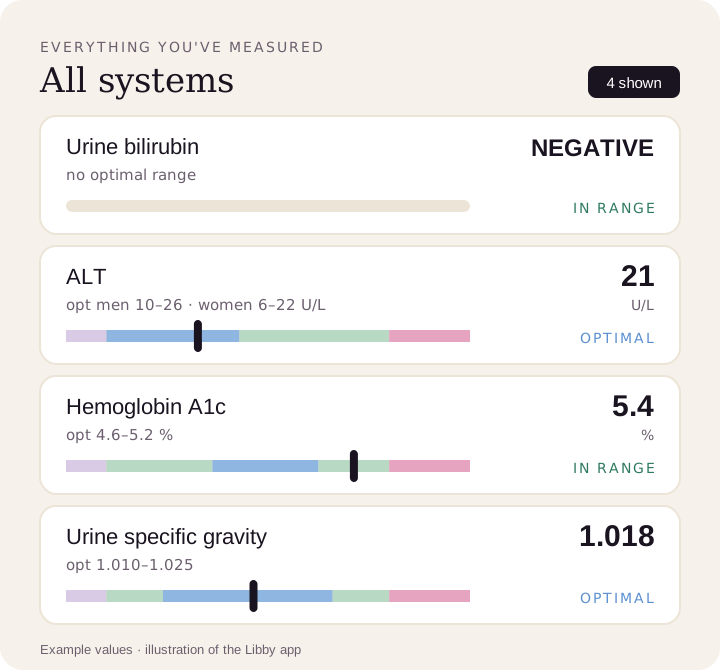
See every result against your lab's range.
Upload a lab PDF or a photo of your report. Libby shows each result with your lab's range or flag, files urine bilirubin with your liver markers, and tracks every marker over time.
View your urine bilirubin ›