Urine nitrite test: what positive and negative mean
Nitrite on a urinalysis points to bacteria in the bladder. What a positive result means, why a negative one can miss an infection, and when it's urgent.
Urine nitrite is a dipstick check for bacteria growing in your bladder, and healthy urine has none. Many of the bacteria that cause urinary tract infections (UTIs), led by E. coli, turn nitrate, a normal chemical in urine, into nitrite. So a positive result usually means bacteria are multiplying in your urine. A negative result is weaker evidence: the pad catches only about half of infections.123
The short version
- Normal: negative. Nitrite is normally absent from urine.2
- Positive: bacteria are usually present. With UTI symptoms (burning, urgency, peeing often) an infection is likely: in family practice, about 84% of positives were infections.34 Without symptoms it's usually harmless bacteria in the bladder (asymptomatic bacteriuria), treated only in pregnancy or before certain urologic procedures.5
- Negative still leaves room for an infection: the pad picks up only 45–60% of them.3 With symptoms, a urine culture settles it.
- Urgent: a UTI with fever, chills, back or side pain, or vomiting can be a kidney infection. Get care right away.6
What urine nitrite is
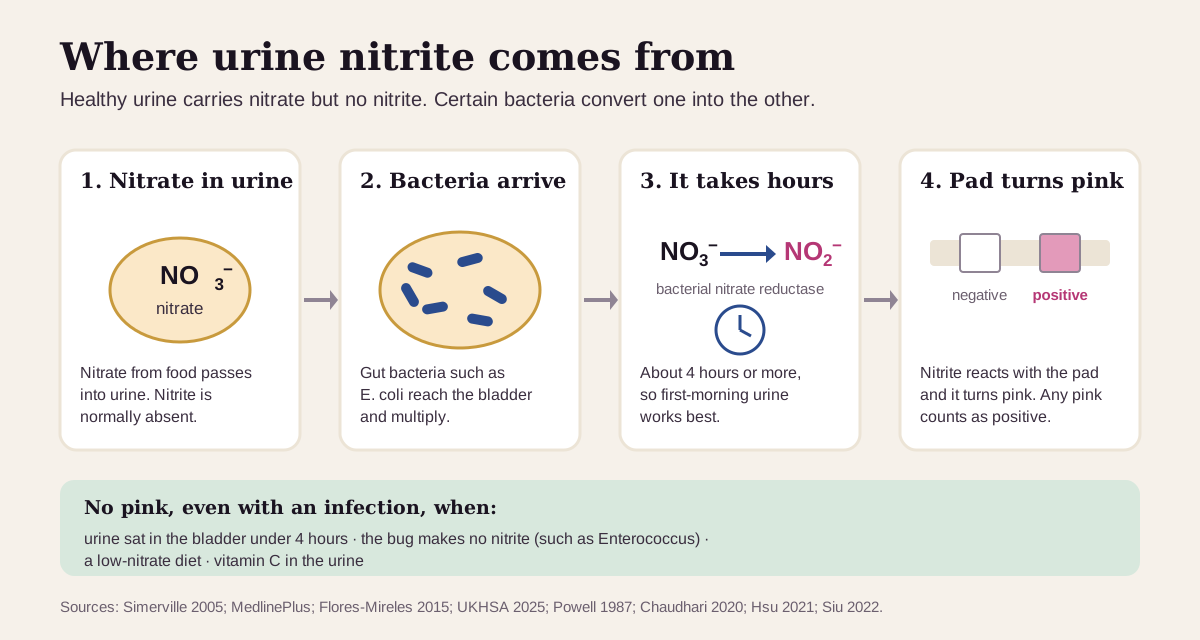
Your urine normally carries nitrate, which comes from food. Nitrite is normally absent. Many bacteria carry an enzyme, nitrate reductase, that converts nitrate into nitrite; they include many gram-negative bacteria and some gram-positive ones. When those bacteria grow in your bladder, nitrite builds up in the urine.21
The usual source is your own gut. A UTI typically starts when gut bacteria reach the urethra and climb into the bladder.8 E. coli is the most common cause by far, followed by Klebsiella, Staphylococcus saprophyticus, Enterococcus, Proteus and others.8 In a Swedish study of 1,070 women with UTI symptoms, E. coli caused 81% of the confirmed infections.12
The test is one pad on a urine dipstick, part of a routine urinalysis. It turns from white to pink when nitrite is present.7 You may see it on a checkup urinalysis, or when you have symptoms of a UTI. Home UTI test strips check the same pad, usually next to a pad for white blood cells.1
What's a normal urine nitrite?
Negative. Nitrite is normally absent from urine, so any positive means something produced it.2 Most of the time that something is bacteria, and the question is whether they're causing an infection.
Bacteria in the urine without symptoms is common, and it can turn the pad positive too.4 Doctors call it asymptomatic bacteriuria: at least 100,000 bacteria per mL of urine with no UTI symptoms, whether or not white cells are present.5
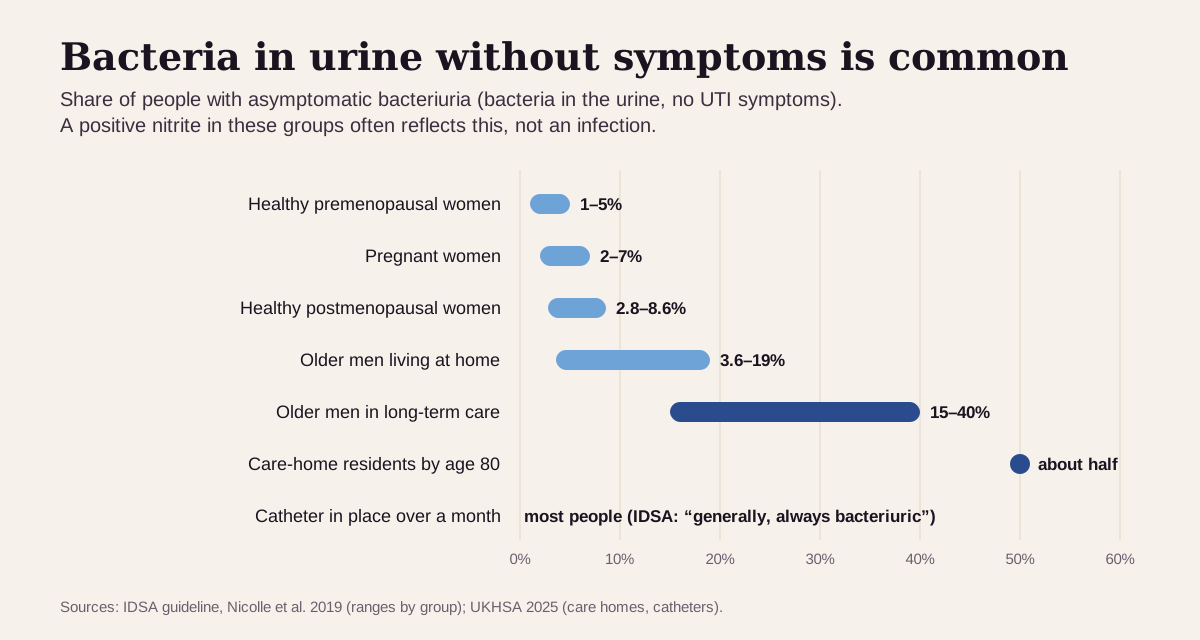
- The Infectious Diseases Society of America (IDSA) puts it at 1–5% of healthy premenopausal women, 2.8–8.6% of healthy postmenopausal women and 2–7% of pregnant women. In older men it's 3.6–19% at home and 15–40% in long-term care.5
- UK primary-care guidance notes that by age 80, about half of care-home residents carry bacteria in their urine without infection, and most people with a catheter for over a month do too. For these groups it advises against dipstick testing altogether.4
Age, pregnancy and catheters change what a positive means. A positive nitrite in a healthy young woman with burning is very different from the same result in a care-home resident with no urinary symptoms.45
"Optimal" urine nitrite: negative, and where each line is drawn
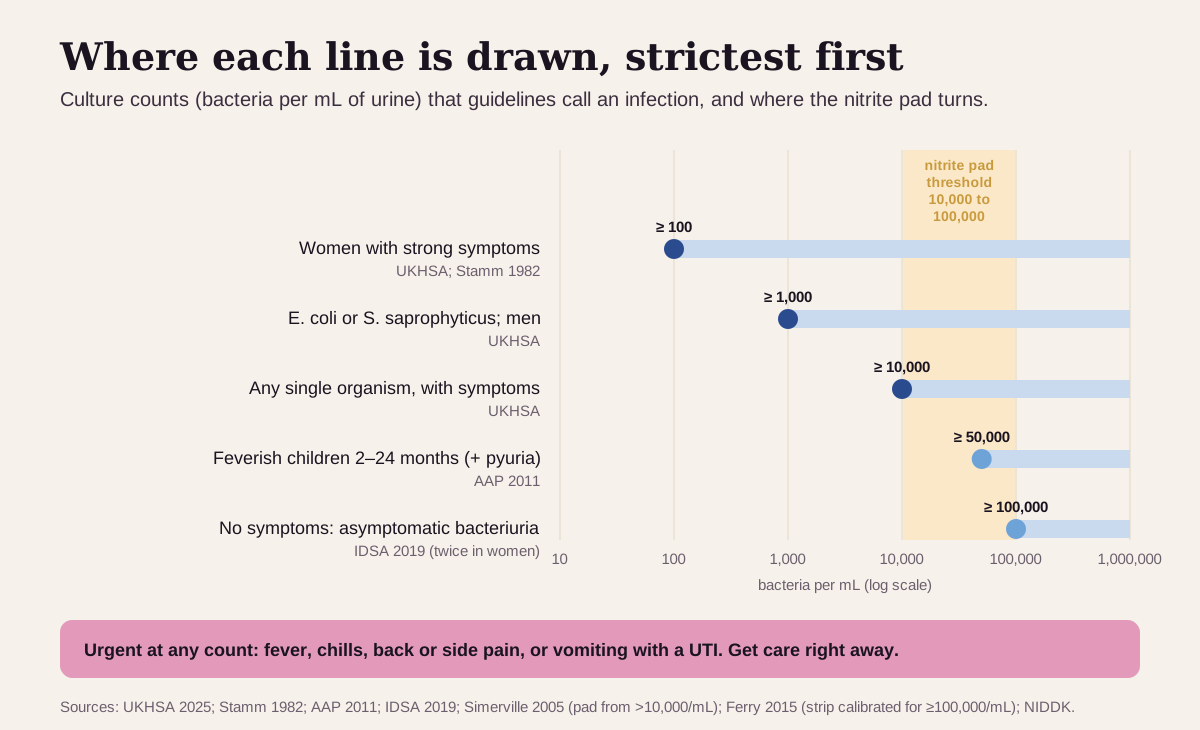
For nitrite, every source agrees on the goal: negative. We found no functional-medicine or longevity target for it, and the Libby app shows your result against your lab's range, which expects negative. What sources disagree on is how many bacteria count as an infection. That's measured with a urine culture, which counts colony-forming units (bacteria) per mL. From strictest to loosest:
| Line | Where it's drawn | Who draws it |
|---|---|---|
| Expected result | nitrite negative | Healthy urine has no nitrite2 |
| Strictest: strong symptoms | culture of 100 or more per mL | UK Health Security Agency (UKHSA), for women with strong symptoms;4 the cutoff Stamm's 1982 study found most accurate13 |
| Common UTI bacteria, and men | 1,000 or more per mL | UKHSA, for E. coli or S. saprophyticus, and for men4 |
| Any single organism | 10,000 or more per mL | UKHSA, with symptoms4 |
| Feverish children, 2–24 months | 50,000 or more per mL of one organism, plus white cells | American Academy of Pediatrics14 |
| No symptoms | 100,000 or more per mL, on two samples in women | IDSA's definition of asymptomatic bacteriuria5 |
| Urgent | any count, with fever, chills, back or side pain, or vomiting | Possible kidney infection: get care right away64 |
Where the nitrite pad fits: a primary-care review puts its threshold above 10,000 bacteria per mL, and one strip maker calibrated it for 100,000.212 Time in the bladder matters more than the count, though: in one study the pad caught 60% of E. coli infections at 1,000 per mL and 67% at 100,000 or more.12
Why the low lines exist:
- In a classic study of women with painful urination, the traditional 100,000-per-mL cutoff caught only 51% of women whose bladder urine grew coliform (E. coli-type) bacteria. A cutoff of 100 per mL caught 95%, with 85% specificity.13
- Across 70 publications, the nitrite pad caught 45–60% of infections, and it rarely turned positive without one (specificity 85–98%).3
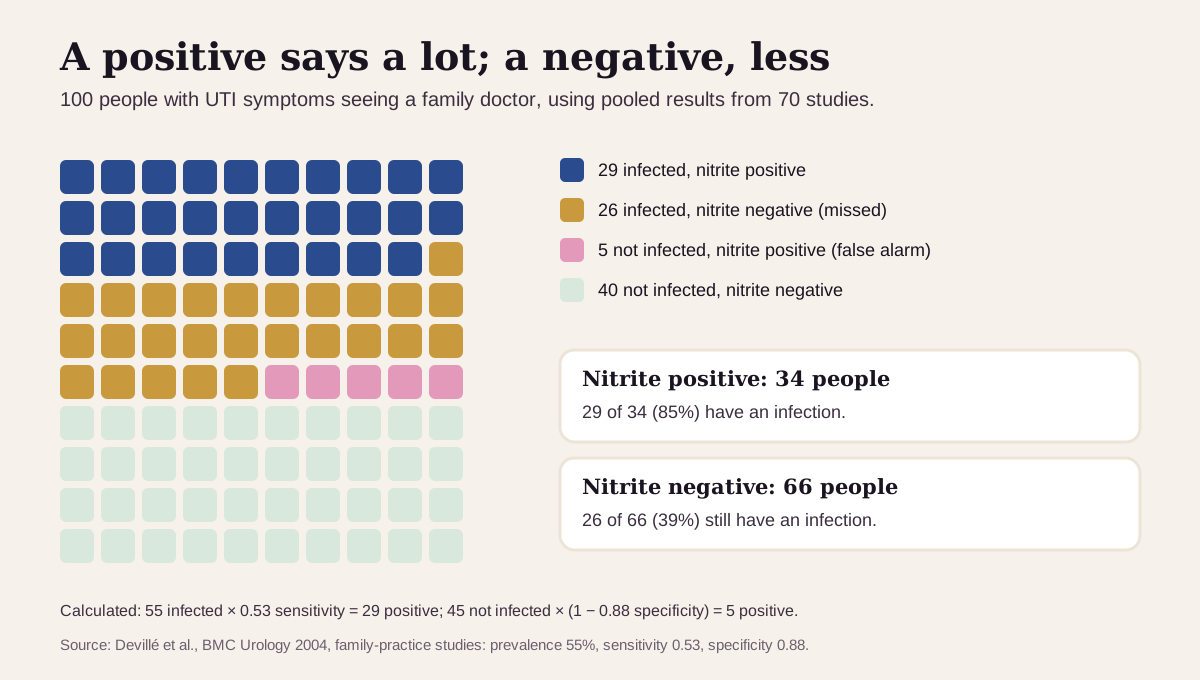
In practice, at a family doctor's office, a positive nitrite was an infection about 84% of the time. A negative one still left about 4 in 10 people with an infection.3 The pad did best in older adults (it caught 71%) and was most specific in pregnancy (98%).3
Keep "optimal" in perspective. Negative is the goal, but a positive with no symptoms is usually nothing to treat. The IDSA recommends against screening for or treating it in healthy women, older adults in long-term care or with functional impairment, people with diabetes and people with catheters.5 The US Preventive Services Task Force also recommends against screening non-pregnant adults.15 Pregnancy is the exception: the task force recommends screening pregnant people with a urine culture. In older trials of pregnant women with bacteriuria, treatment cut kidney infections from 20–35% to 1–4%.155
What a positive nitrite usually means
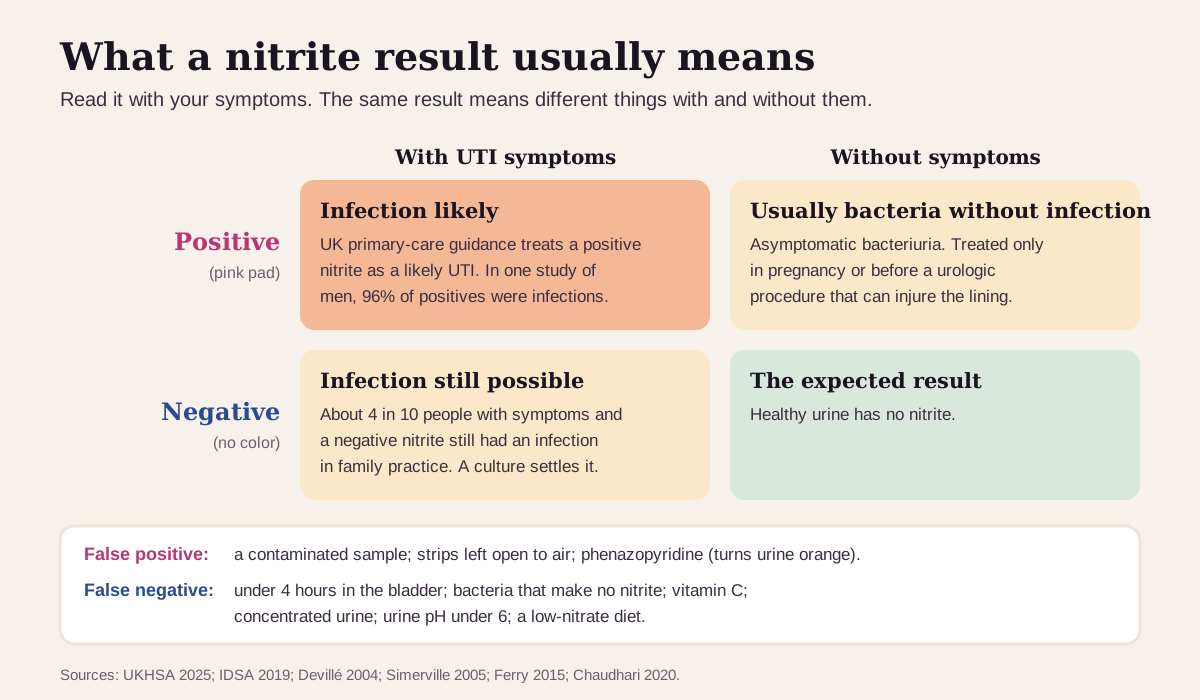
The first clue is whether you have symptoms. The same result means different things with and without them.45
With symptoms: usually a bladder infection
With symptoms, a positive nitrite usually means a urinary tract infection, most often in the bladder (cystitis).1 Typical symptoms are frequent urges to pee, pain or burning when you pee, and dark, cloudy, reddish or bad-smelling urine. Older adults may only seem weak, tired or confused.1
- UK primary-care guidance counts a positive nitrite in a woman under 65 with symptoms as a likely UTI.4
- In one study of men with symptoms that the guidance cites, 96% of positive nitrites were infections.4
- A urine culture names the bacteria and the antibiotics that work on them. Results usually take a couple of days.1 UK guidance sends one when you're pregnant or at risk of a resistant infection.4
Without symptoms: usually bacteria living quietly
A positive nitrite with no urinary symptoms most often means asymptomatic bacteriuria, especially in older adults, care-home residents and people with catheters.54 It's common, it often clears on its own (10–60% of women with one positive culture have a negative repeat), and treating it brings antibiotic side effects without benefit.515 The two exceptions the IDSA recommends screening and treating are pregnancy and the time before a urologic procedure through a scope that can injure the lining of the urinary tract.5 In an older adult with bacteria in the urine who becomes confused or falls, with no urinary symptoms or fever, the IDSA recommends looking for other causes and watching closely rather than treating the bacteria.5
Less common: a false positive
- A contaminated or stale sample. Contamination can turn the pad positive, and a sample tested more than two hours after collection without refrigeration gives unreliable results.2
- Old strips. The nitrite pad reacts with air. In a bottle left open, 1 in 3 strips read falsely positive after one week and 3 in 4 after two weeks.2
- Phenazopyridine (Pyridium), a medicine that turns urine orange, can make the pad read positive.2
Get care right away if UTI symptoms come with fever and chills, pain in your back, side or groin, or nausea and vomiting: these point to a kidney infection. It can lead to sepsis, which is life threatening; its signs include confusion, rapid breathing and heart rate, severe pain and shortness of breath.6 If you're pregnant, call your provider about any positive nitrite or UTI symptoms: bacteria in the urine is treated in pregnancy.45 In a child under 2, a high fever may be the only sign of a kidney infection.6
What a negative nitrite means
Without symptoms, it's the expected result. With symptoms, it's only part of the answer, because an infection can leave the pad white:32
- Not enough time. Bacteria need about 4 hours or more in the bladder to make detectable nitrite, which is why first-morning urine is the most reliable sample.4 A UTI makes you pee often, so the urine may not sit long enough.9
- Bacteria that make no nitrite. Enterococcus makes none: in 7,599 young children tested for a UTI, every enterococcal infection had a negative nitrite.10 In another large study of children, a negative nitrite raised the odds that the infection was gram-positive, such as Enterococcus or S. saprophyticus, about fourfold.11
- What's in the urine. Vitamin C, very concentrated urine, acidic urine (pH under 6) and a low-nitrate diet can all hold the result down.2
Most nitrite-negative infections still involve ordinary nitrite-making bacteria. In the same study of young children, 95.6% of nitrite-negative UTIs were caused by gram-negative bacteria, the group that includes E. coli.10 So a negative nitrite rarely means an unusual bacterium. When the white-cell pad is positive and nitrite is negative, UK guidance rates a UTI as likely as any other cause and recommends a culture.4
Urine nitrite reads best next to its neighbors
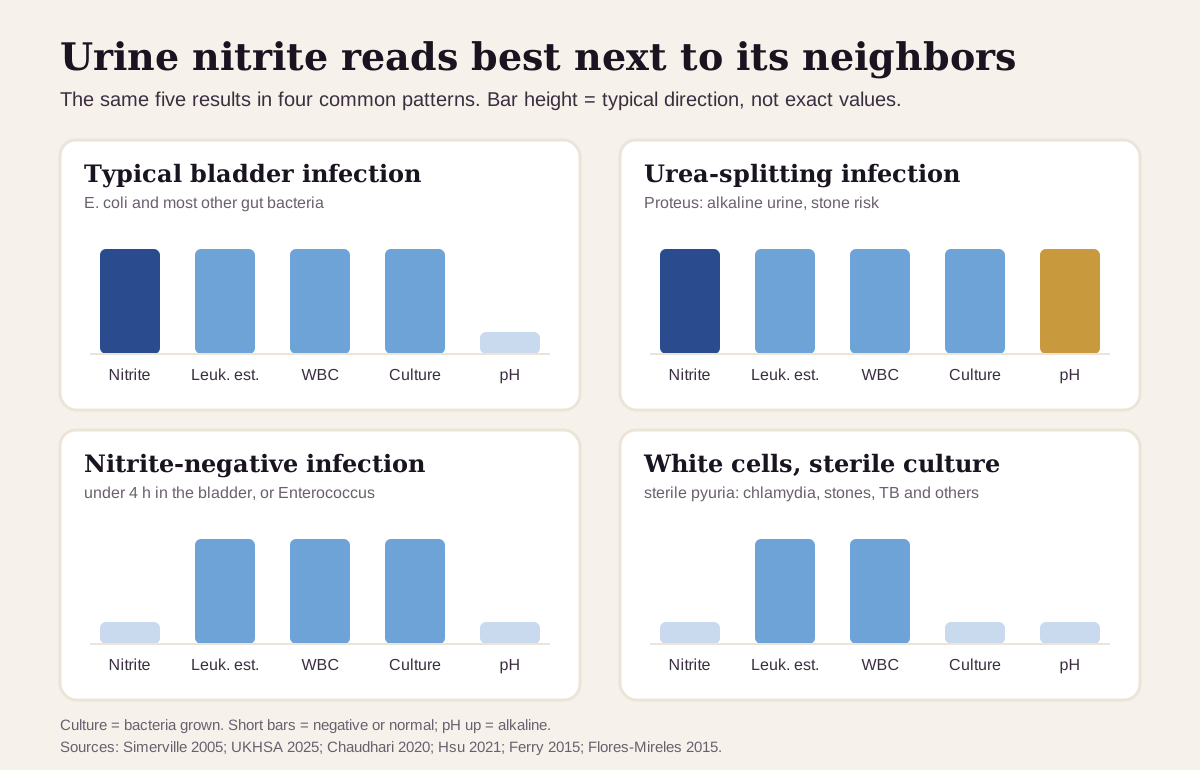
Nitrite is one pad of several. Read with the white-cell results, the urine culture and the urine pH, it usually says much more:24
| If you see… | It often points to… |
|---|---|
| Nitrite and leukocyte esterase both positive, with white cells and bacteria on microscopy | a bladder infection with E. coli or another gut bacterium42810 |
| Nitrite positive with alkaline urine (high pH), sometimes with "triple phosphate" crystals | a urea-splitting bacterium such as Proteus, which can also form stones28 |
| Nitrite negative, leukocyte esterase positive, bacteria seen or grown | often an ordinary gut-bacterium infection in urine that spent under 4 hours in the bladder; less often a bacterium that makes no nitrite, such as Enterococcus4121011 |
| White cells, but a urine culture that grows nothing (sterile pyuria) | chlamydia or other genital infections, kidney stones, tuberculosis and other causes24 |
| Nitrite positive, no symptoms | asymptomatic bacteriuria, common with age, in care homes and with catheters54 |
| Many squamous (skin) cells | can mean a contaminated sample; a clean-catch repeat helps214 |
How fast urine nitrite changes
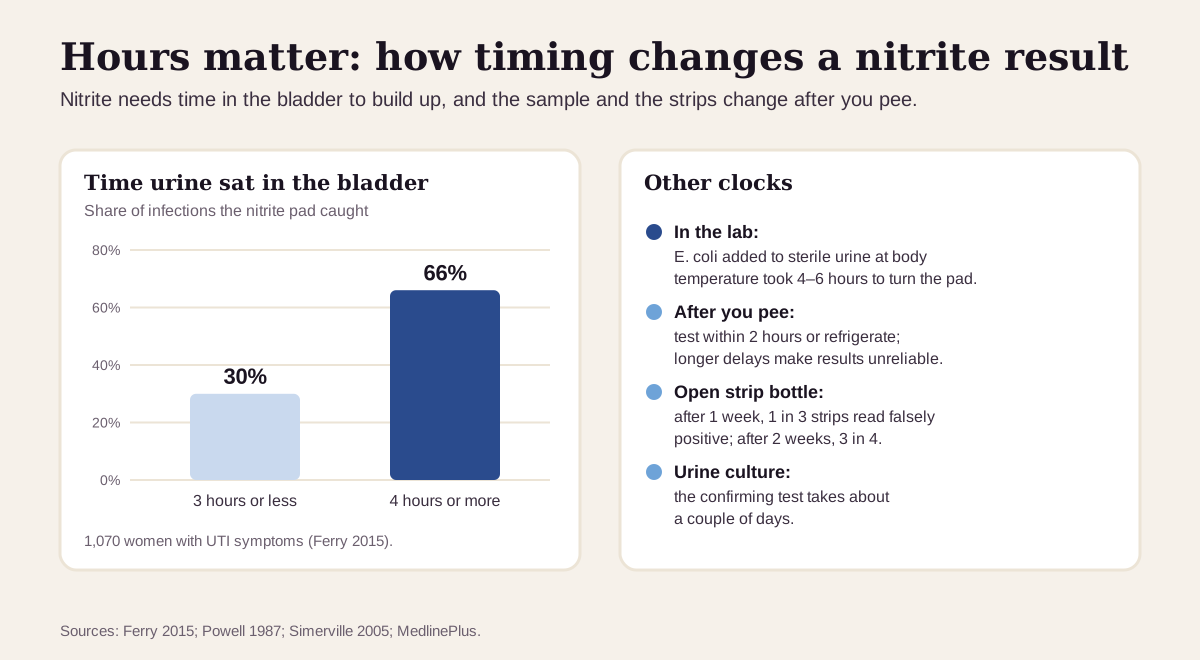
Nitrite builds up over hours. In 1,070 women with UTI symptoms, the pad caught 30% of infections when the urine had been in the bladder 3 hours or less, and 66% at 4 hours or more. When positive, it was right 97–98% of the time either way.12
What that means in practice:
- Use first-morning urine when you can. Overnight urine has had the longest time in the bladder.49 In the lab, E. coli added to sterile urine at body temperature took 4–6 hours to turn the pad positive.9
- Get the sample tested quickly. Within 2 hours, or refrigerate it.2
- Frequent peeing lowers the odds of a positive. In 200 children with UTI symptoms, only 52% had a positive nitrite, compared with 83 of 100 outpatients with mostly symptom-free infections seen in a follow-up clinic.9
- Trends beat snapshots. Bacteria without symptoms often come and go, so the IDSA confirms asymptomatic bacteriuria in women with a second culture, ideally within 2 weeks.5 Keeping results side by side shows whether a positive was a one-off.
Going deeper: the chemistry on the pad
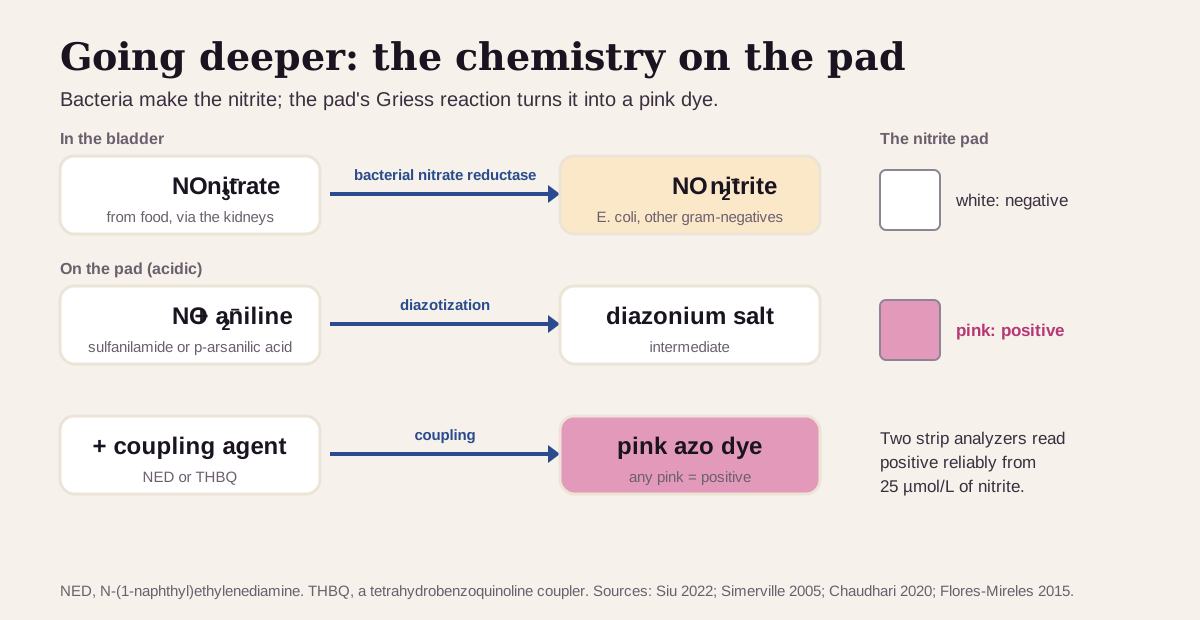
The nitrite pad runs the Griess reaction, a standard chemistry test for nitrite. In the acidic pad, nitrite reacts with an aniline compound (sulfanilamide or p-arsanilic acid) to form a diazonium salt. That salt joins a coupling agent to make a pink azo dye. Roche and Siemens strips use different pairs of these reagents.7
In lab tests, two strip analyzers flagged nitrite reliably from 25 micromoles per liter and up. Because healthy urine has no nitrite, any pink counts as positive.7
The same chain explains the false results. The pad needs nitrate in the urine to start with, so a low-nitrate diet blunts it. Vitamin C, concentrated urine and acidic urine hold the result down, and phenazopyridine can push it up.2
The pad reads a chemical, not the bacteria. That's why the culture is the reference test: it counts and names the bacteria, and shows which antibiotics work on them.1
Questions worth asking
- Was this a first-morning sample, or had I peed within the last few hours?
- What did my leukocyte esterase, white cells and bacteria show next to it?
- Should we send a urine culture, and when will it be back?
- If I have no symptoms, does this need treatment at all?
- Does pregnancy, a catheter or an upcoming urologic procedure change the plan?
- Could a medicine such as phenazopyridine, or vitamin C, have affected the result?
FAQ
What does a positive nitrite in urine mean? It usually means bacteria that make nitrite, most often E. coli, are growing in your urine. With UTI symptoms, an infection is likely; without symptoms, it's often harmless asymptomatic bacteriuria.45
Can you have a UTI with a negative nitrite? Yes. The pad catches only about 45–60% of infections.3 Urine that spent under 4 hours in the bladder and bacteria such as Enterococcus are common reasons.1210 A culture settles it.
Does a positive nitrite always need antibiotics? No. Without symptoms, guidelines treat it only in pregnancy or before certain urologic procedures.5 With symptoms, your clinician decides, often with a culture.4
When is a positive nitrite an emergency? When a UTI comes with fever, chills, back or side pain, nausea or vomiting, which can mean a kidney infection. Confusion or fast breathing can signal sepsis and needs emergency care.6
This guide is for education. It can't diagnose you or replace care from a clinician who knows your history.
Footnotes
-
National Library of Medicine. Nitrites in Urine. MedlinePlus. What the test is, UTI symptoms, home strips and urine culture timing. MedlinePlus ↩ ↩2 ↩3 ↩4 ↩5 ↩6 ↩7 ↩8 ↩9 ↩10
-
Simerville JA, Maxted WC, Pahira JJ. Urinalysis: a comprehensive review. Am Fam Physician. 2005;71(6):1153–1162. The primary-care review behind the nitrite threshold (more than 10,000 bacteria per mL), its sensitivity and specificity, the false positives (contamination, air-exposed strips, phenazopyridine) and false negatives (vitamin C, concentrated or acidic urine, nitrate-reductase-negative bacteria, low-nitrate diet), the 2-hour testing window, and sterile pyuria. AAFP · PubMed ↩ ↩2 ↩3 ↩4 ↩5 ↩6 ↩7 ↩8 ↩9 ↩10 ↩11 ↩12 ↩13 ↩14 ↩15 ↩16 ↩17 ↩18 ↩19 ↩20 ↩21 ↩22 ↩23 ↩24
-
Devillé WL, Yzermans JC, van Duijn NP, Bezemer PD, van der Windt DA, Bouter LM. The urine dipstick test useful to rule out infections. A meta-analysis of the accuracy. BMC Urol. 2004;4:4. 70 publications; pooled nitrite sensitivity and specificity by setting and population, with post-test probabilities. PMC ↩ ↩2 ↩3 ↩4 ↩5 ↩6 ↩7 ↩8 ↩9 ↩10
-
UK Health Security Agency. Diagnosis of urinary tract infections: quick reference tools for primary care. Updated 7 July 2025. How UK primary care uses nitrite, leukocyte and blood pads, the 4-hour rule, culture thresholds, and when to skip dipsticks (over 65, catheters). GOV.UK ↩ ↩2 ↩3 ↩4 ↩5 ↩6 ↩7 ↩8 ↩9 ↩10 ↩11 ↩12 ↩13 ↩14 ↩15 ↩16 ↩17 ↩18 ↩19 ↩20 ↩21 ↩22 ↩23 ↩24 ↩25 ↩26 ↩27 ↩28 ↩29 ↩30
-
Nicolle LE, Gupta K, Bradley SF, et al. Clinical Practice Guideline for the Management of Asymptomatic Bacteriuria: 2019 Update by the Infectious Diseases Society of America. Clin Infect Dis. 2019;68(10):e83–e110. The definition (100,000 per mL, two samples in women), prevalence by group, and who should and shouldn't be screened and treated. PubMed · IDSA ↩ ↩2 ↩3 ↩4 ↩5 ↩6 ↩7 ↩8 ↩9 ↩10 ↩11 ↩12 ↩13 ↩14 ↩15 ↩16 ↩17 ↩18 ↩19 ↩20
-
National Institute of Diabetes and Digestive and Kidney Diseases. Symptoms & Causes of Kidney Infection (Pyelonephritis). NIH. Kidney-infection and sepsis symptoms and when to seek care. NIDDK ↩ ↩2 ↩3 ↩4 ↩5 ↩6
-
Siu VS, Lu M, Hsieh KY, et al. Toward a quantitative colorimeter for point-of-care nitrite detection. ACS Omega. 2022;7(13):11126–11134. The Griess chemistry on Roche and Siemens strips, and the 25 µmol/L level at which strip analyzers read positive reproducibly. PMC ↩ ↩2 ↩3 ↩4 ↩5 ↩6
-
Flores-Mireles AL, Walker JN, Caparon M, Hultgren SJ. Urinary tract infections: epidemiology, mechanisms of infection and treatment options. Nat Rev Microbiol. 2015;13(5):269–284. Which bacteria cause UTIs, how they reach the bladder, and how Proteus urease raises urine pH. PMC ↩ ↩2 ↩3 ↩4 ↩5 ↩6 ↩7
-
Powell HR, McCredie DA, Ritchie MA. Urinary nitrite in symptomatic and asymptomatic urinary infection. Arch Dis Child. 1987;62(2):138–140. Nitrite positive in 52% of 200 symptomatic children vs 83 of 100 largely asymptomatic ones; E. coli needed 4–6 hours in urine to turn the test. PubMed ↩ ↩2 ↩3 ↩4 ↩5 ↩6
-
Chaudhari PP, Monuteaux MC, Bachur RG. Should the absence of urinary nitrite influence empiric antibiotics for urinary tract infection in young children? Pediatr Emerg Care. 2020;36(10):481–485. 7,599 children under 2; every enterococcal UTI was nitrite negative, and 95.6% of nitrite-negative UTIs were gram-negative. PubMed ↩ ↩2 ↩3 ↩4 ↩5 ↩6 ↩7 ↩8 ↩9
-
Hsu YL, Chang SN, Lin CC, et al. Clinical characteristics and prediction analysis of pediatric urinary tract infections caused by gram-positive bacteria. Sci Rep. 2021;11(1):11010. 3,783 children with a first UTI; a negative nitrite was linked to gram-positive causes (odds ratio 4.13). PMC ↩ ↩2 ↩3 ↩4 ↩5
-
Ferry SA, Holm SE, Ferry BM, Monsen TJ. High diagnostic accuracy of nitrite test paired with urine sediment can reduce unnecessary antibiotic therapy. Open Microbiol J. 2015;9:150–159. 1,070 women with UTI symptoms in Swedish primary care; nitrite accuracy by bladder incubation time and the bacteria behind each infection. PMC ↩ ↩2 ↩3 ↩4 ↩5 ↩6 ↩7 ↩8 ↩9 ↩10
-
Stamm WE, Counts GW, Running KR, Fihn S, Turck M, Holmes KK. Diagnosis of coliform infection in acutely dysuric women. N Engl J Med. 1982;307(8):463–468. The study that set the 100-per-mL threshold for women with symptoms. PubMed ↩ ↩2 ↩3
-
Subcommittee on Urinary Tract Infection, Steering Committee on Quality Improvement and Management; Roberts KB. Urinary tract infection: clinical practice guideline for the diagnosis and management of the initial UTI in febrile infants and children 2 to 24 months. Pediatrics. 2011;128(3):595–610. Diagnosis needs pyuria plus at least 50,000 colonies per mL of one organism. PubMed ↩ ↩2
-
US Preventive Services Task Force; Owens DK, Davidson KW, Krist AH, et al. Screening for asymptomatic bacteriuria in adults: US Preventive Services Task Force recommendation statement. JAMA. 2019;322(12):1188–1194. Screen pregnant people with a urine culture (B); don't screen non-pregnant adults (D). PubMed ↩ ↩2 ↩3
Educational content, not medical advice. Libby is a personal record tool, not a medical service — it doesn't diagnose, treat, or prescribe. Reference ranges vary by lab and by person. Talk to a qualified healthcare professional about your results.
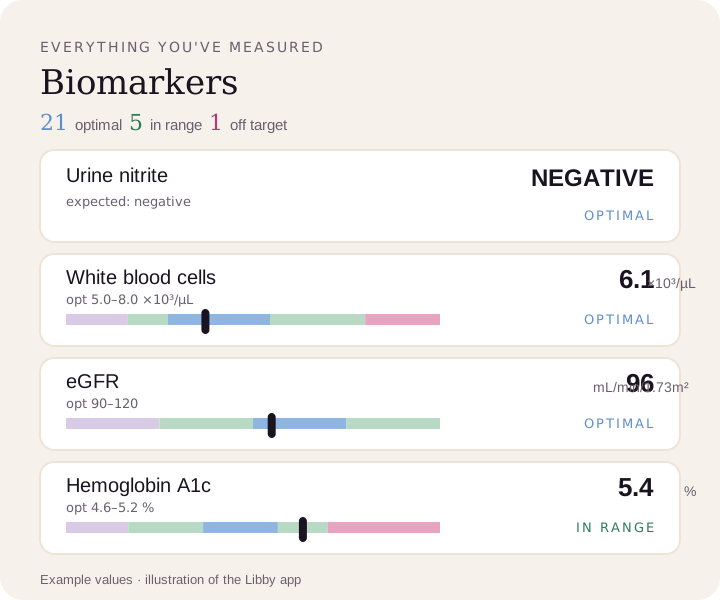
See every result against your lab's range.
Upload a lab PDF or a photo of your report. Libby flags a positive nitrite, shows your other results on your lab's range, and keeps every urinalysis on one timeline.
View your urine nitrite ›