White blood cells in urine: normal range and causes
White blood cells in urine usually signal infection or inflammation. Here's the normal count, the common causes, what to read beside it, and when it's urgent.
White blood cells in your urine are infection-fighting cells, mostly neutrophils, that have crossed from your bloodstream into your urinary tract. A few are normal. More than about 5 per high-power field (HPF) is called pyuria, and it usually means infection or inflammation somewhere between the kidneys and the urethra. In people with urinary symptoms, the usual reason is a urinary tract infection (UTI), most often in the bladder.123
The short version
- Normal: most reports print 0–5 white cells per HPF. Labcorp's range is 0–5.4 A widely cited review puts normal at under 2 per HPF for men and under 5 for women.1
- High (more than 5 per HPF) usually means a bladder infection. The other common reasons are a contaminated sample, a recently treated UTI, chlamydia, a kidney stone or a catheter.51
- Urgent: white cells plus fever, chills, back or side pain, or vomiting can mean a kidney infection. Get care the same day.6
- White cells show inflammation; a urine culture shows which bacteria are there. White cells with a negative culture are called "sterile pyuria", and that has its own list of causes.25
What urine white blood cells are
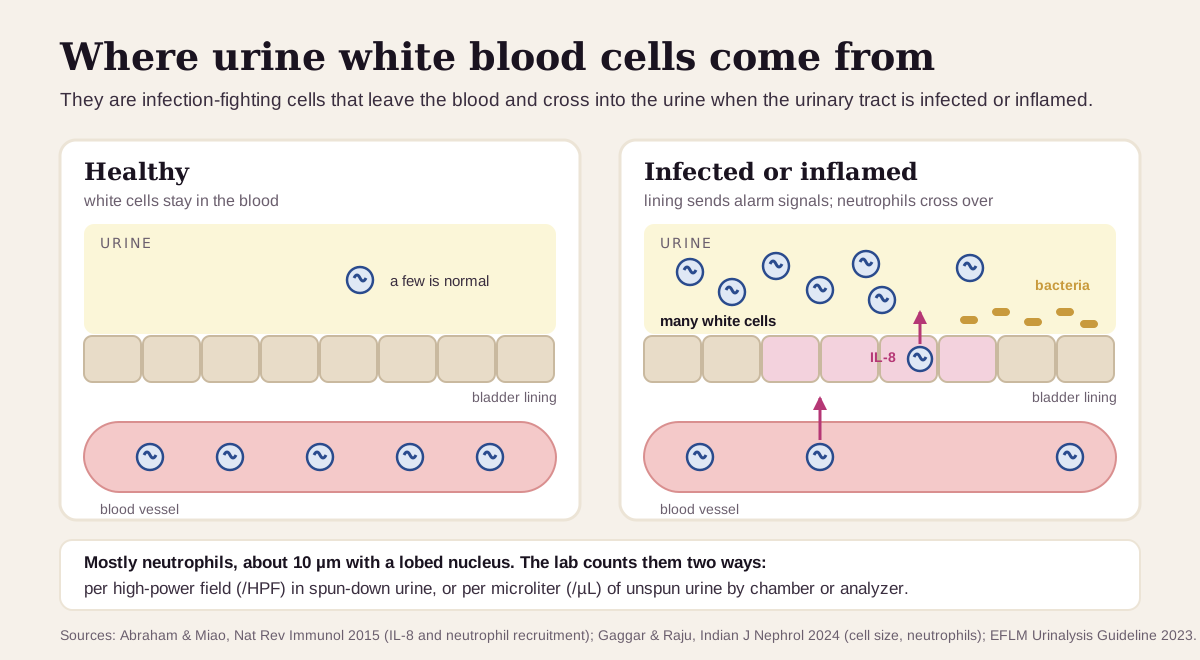
White blood cells are your immune system's first responders. The ones found in urine are mostly neutrophils: round cells about 10 micrometers across with a lobed nucleus.9 They normally stay in your blood.
When bacteria reach the bladder, most often E. coli from the gut, the cells lining the bladder release alarm signals such as interleukin-8. Those signals call neutrophils out of nearby blood vessels, across the lining and into the urine, where they attack the bacteria.8 Kidney inflammation, a stone or a catheter can bring them in too.5
You see this number on the microscopic part of a urinalysis. The lab counts white cells in one of two ways:7
- Per high-power field (HPF): a technician spins the urine in a centrifuge, pours off the top, and counts cells in the sediment under the microscope. Labcorp's report and the classic U.S. reviews use this scale.41
- Per microliter (µL): a counting chamber or an automated analyzer counts cells in unspun urine. Analyzers use flow cytometry or digital imaging.10
The dipstick on the same report has its own white-cell test, leukocyte esterase, which detects an enzyme that neutrophils make.1 The microscope counts whole cells; the dipstick detects their chemistry. The two usually agree, and when they disagree, time is often why (see how fast it changes).
What's a normal urine white blood cell count?
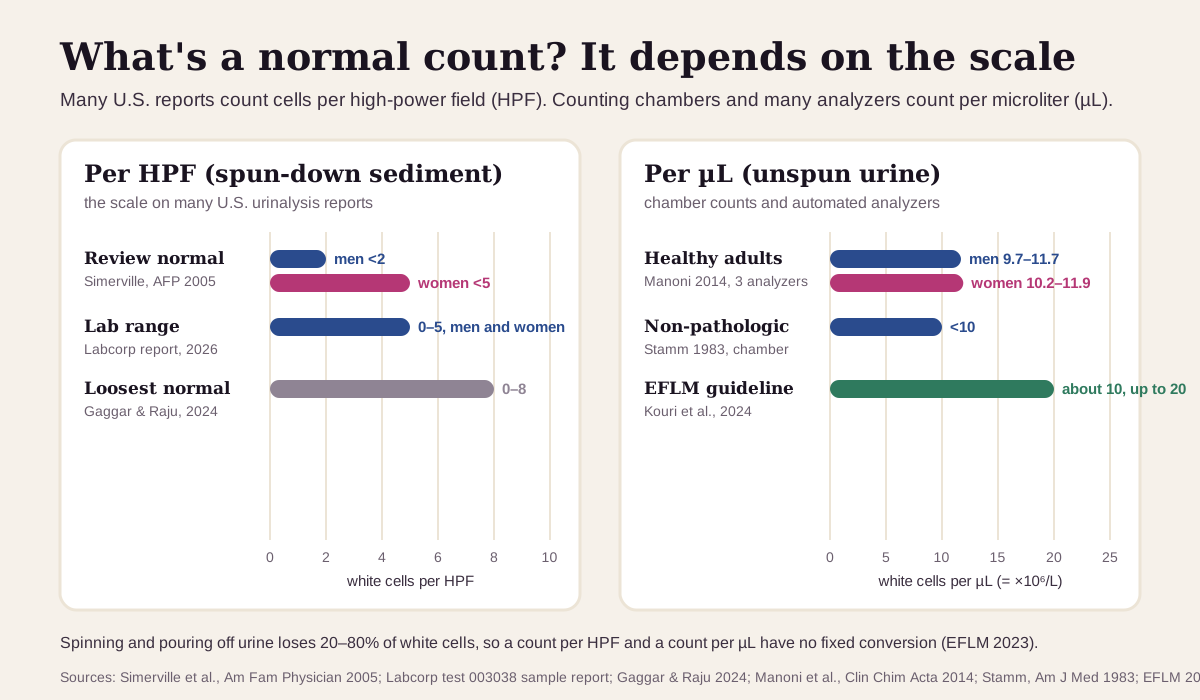
Start with the range on your own report, because methods differ from lab to lab.11 On the per-HPF scale:
- Labcorp prints 0–5 per HPF for its routine urinalysis.4
- A widely cited American Family Physician review puts normal at under 2 per HPF for men and under 5 for women.1
- A 2024 kidney-microscopy review allows up to 8 per HPF, or 10 per µL.9
On the per-µL scale, the numbers cluster around 10:
- The European Federation of Clinical Chemistry and Laboratory Medicine (EFLM) puts the healthy upper limit at about 10 per µL, up to 20, in a midstream morning sample.7
- An Italian study of 863 healthy adults on three analyzers found upper limits of 9.7 to 11.9 per µL, with no difference between men and women.12
- In classic counting-chamber studies, fewer than 10 per µL was the non-disease range.2
Why do women's ranges run higher? Collection is the usual suspect. Vaginal secretions can add white cells to the cup, and contamination of samples from women is common.57 With careful midstream collection, the Italian study found the same upper limit for both sexes.12
Why the two scales differ. Spinning and pouring off urine loses 20–80% of the white cells, so a count per HPF depends on how each lab spins and reads its samples.7 Stamm, who found per-HPF counts poorly reproducible, recommended counting per µL of unspun urine.2
"Optimal" urine white blood cells: what health optimizers aim for
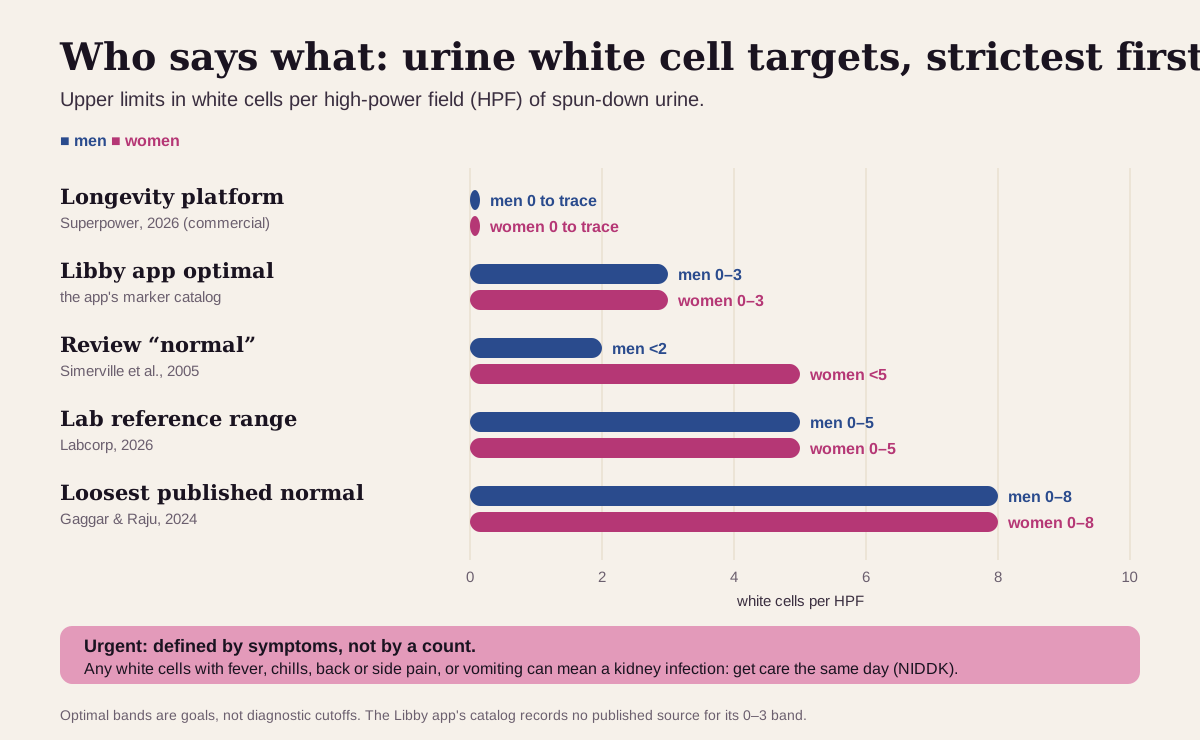
Most "optimal" talk is about blood markers, but some platforms rate urine white cells too, and they aim low. Here's the ladder, strictest to loosest, all per HPF:
| Target | Men | Women | Who uses it |
|---|---|---|---|
| Strictest (longevity platform) | zero to trace | zero to trace | Superpower's page: "ideally zero to trace amounts"13 |
| Libby app optimal | 0–3 per HPF | 0–3 per HPF | The optimal range shown in the Libby app. The app's catalog records no published source for this band |
| Review "normal" | under 2 per HPF | under 5 per HPF | Simerville et al., American Family Physician1 |
| Lab reference range | 0–5 per HPF | 0–5 per HPF | Labcorp's routine urinalysis4 |
| Loosest published normal | up to 8 per HPF | up to 8 per HPF | Gaggar and Raju's kidney-microscopy review9 |
| Urgent | any count with fever, chills, back or side pain, or vomiting | same | Possible kidney infection: get care the same day6 |
Why the low cut-offs matter:
- In classic counting-chamber studies, 10 or more white cells per µL showed up in fewer than 1% of people without symptoms or bacteria in their urine, and in more than 96% of people with symptoms and a positive culture.2
- Against culture, more than 5 per HPF caught 90–96% of UTIs, but only 47–50% of people without a UTI tested negative. A high count is sensitive, not specific.1
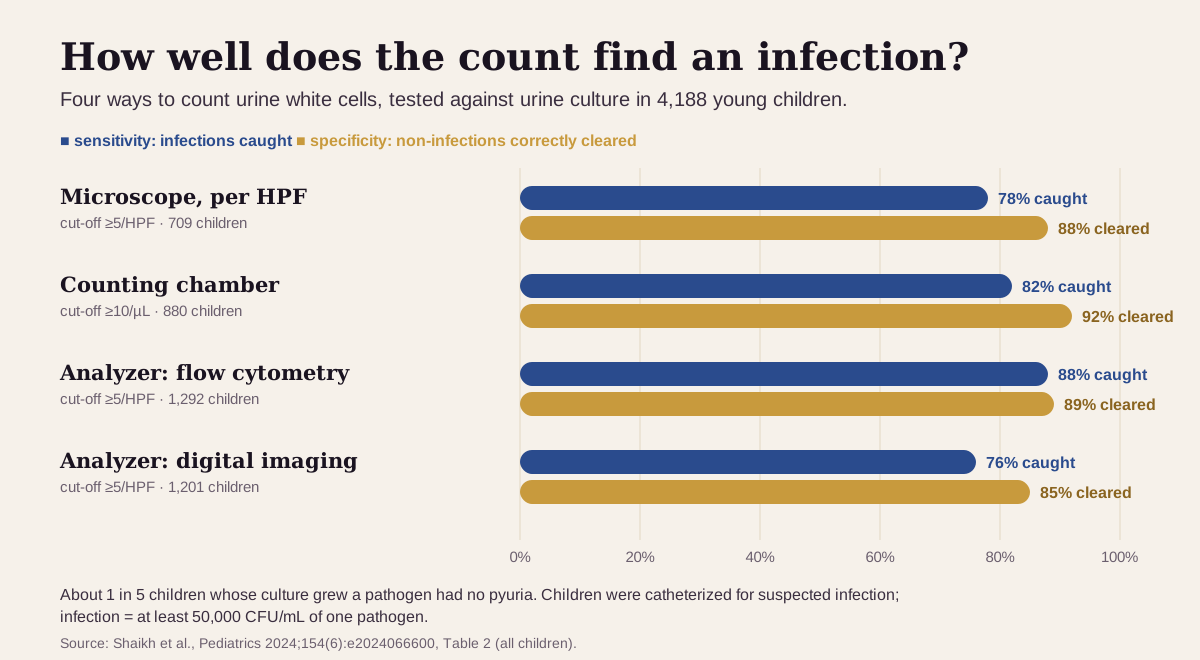
- In a 2024 study of 4,188 young children tested for a UTI, every counting method caught 76–88% of infections at its usual cut-off, and correctly cleared 85–92% of children without one. About 1 in 5 children with a positive culture had no pyuria at all.10
Keep "optimal" in perspective. It's a target, not a diagnosis, and zero is rarely the real goal: a few white cells are normal. In 104 healthy young women prone to UTIs and tested daily for three months, a dipstick showed pyuria on 25% of days without an infection, and 78% had at least one such day. Pyuria predicted E. coli in the urine only 4% of the time.14 A single mildly high count with no symptoms is common. The Infectious Diseases Society of America advises against treating bacteria in the urine without symptoms, with or without pyuria, in most people other than pregnant women and people about to have urologic surgery.15
What a high urine white blood cell count usually means
The size of the count is a clue. The EFLM guideline describes a grey zone about ten times wide: under 10 per µL has no link to infection, while acute UTIs usually bring 100–200 per µL or more.7
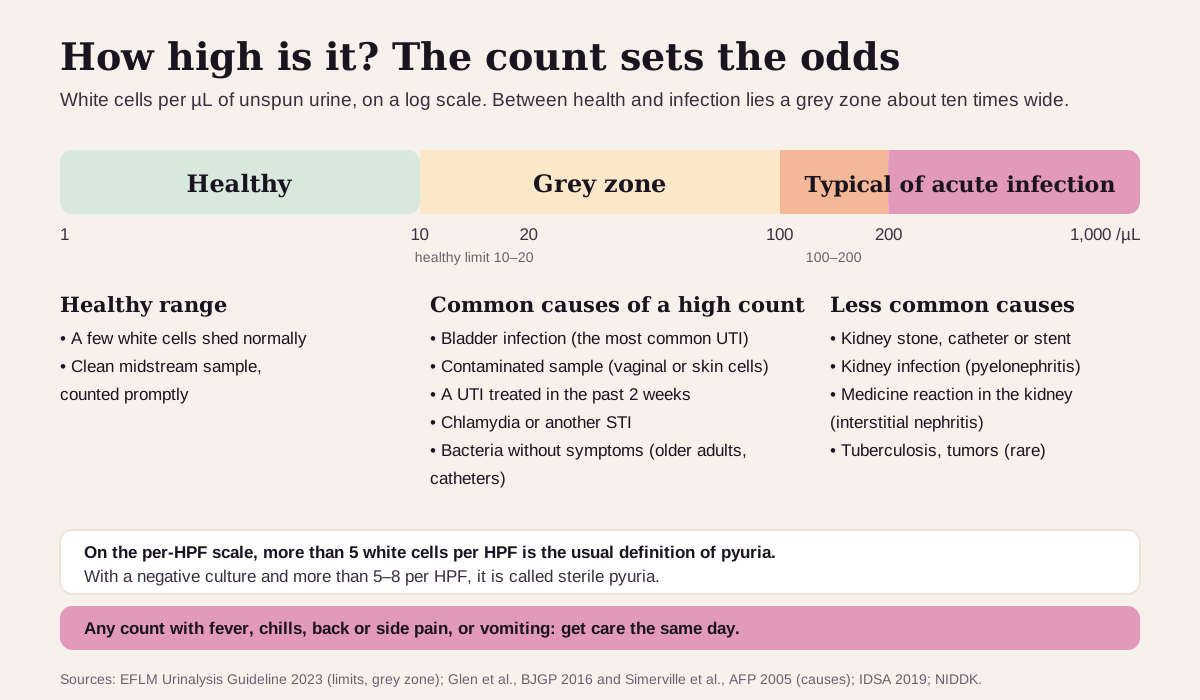
The usual suspects
- A bladder infection (cystitis). The most common type of UTI. About half of all women get one in their lifetime; men under 50 rarely do.3 It usually brings burning when you pee, frequent or urgent trips, lower-belly pain, and cloudy, bloody or strong-smelling urine.3
- A contaminated sample. White cells from the vagina or skin get into the cup. This is common.5 Squamous epithelial cells on the report, large flat cells from the skin, point to contamination.1 In one study, 29–32% of clean-catch samples were contaminated, with or without cleansing first.1
- A recently treated UTI. An infection treated in the past 2 weeks, even with a single dose of antibiotics, can leave white cells behind with a negative culture.5
- Chlamydia and other sexually transmitted infections. In younger, sexually active people with white cells and a negative culture, chlamydia is the organism most often found.5 It needs its own test on a first-void (first part of the stream) sample.7
- Bacteria without symptoms. Common in older adults and people with catheters. In nursing-home residents, white cells fail to tell a harmless colonization from a true infection.15
- A catheter, stent, recent scope, or kidney stone. All irritate the lining and bring in white cells.5
Less common causes: a kidney infection (pyelonephritis);6 interstitial nephritis, a reaction in the kidney to medicines such as penicillin-type antibiotics, NSAID pain relievers or proton pump inhibitors;59 and, rarely, tuberculosis of the urinary tract, bladder tumors, or nearby inflammation such as appendicitis.51
Get care the same day if white cells in your urine come with fever or chills, pain in your back, side or groin, or nausea and vomiting. These can mean a kidney infection. Seek care right away for confusion, fast breathing or heart rate, or severe pain, which can be signs of sepsis.6
White cells with a negative culture: sterile pyuria
More than 5–8 white cells per HPF with no growth on culture is called sterile pyuria. It turned up in 9% of people who saw a family doctor with urinary symptoms and a suspected UTI.5 The first step is usually a clean repeat sample, because repeat cultures often turn positive. Then the usual suspects above: recent antibiotics, chlamydia, a stone, a catheter or a medicine.5
Urine white cells read best next to their neighbors
White cells rarely come alone. The rest of the microscopy report usually tells you where they came from:19
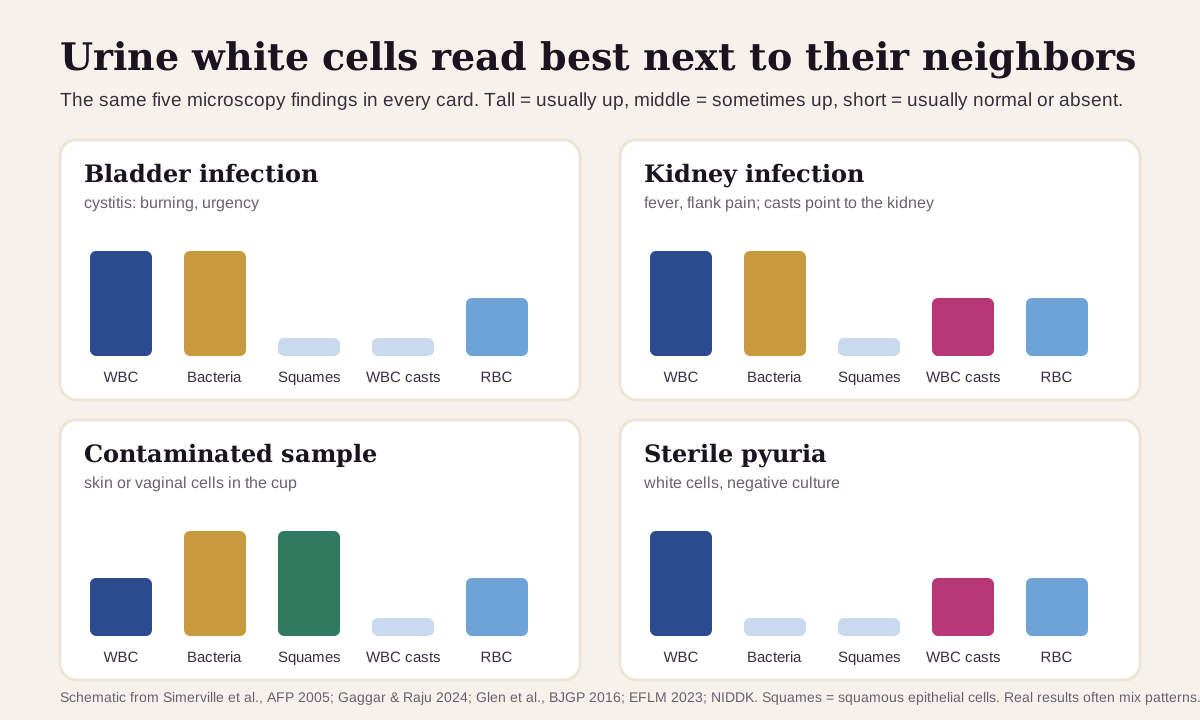
| If you see… | It often points to… |
|---|---|
| White cells and bacteria up, few squamous cells, burning or urgency | a bladder infection |
| White cells plus white-cell casts, often with fever or flank pain | inflammation inside the kidney: a kidney infection, or interstitial nephritis from a medicine |
| Many squamous cells and bacteria, sometimes white cells too | a contaminated sample; the usual next step is a careful midstream repeat |
| White cells up, no bacteria, negative culture | sterile pyuria: a recently treated UTI, chlamydia, a stone, a catheter or a medicine |
Two dipstick results sit beside the microscopy. Leukocyte esterase tracks the same white cells. Nitrite turns positive when certain bacteria convert nitrate in the urine; a positive result is specific for a UTI, while a negative one leaves infection possible.1
How fast urine white cells change
In the cup, within hours. Once urine leaves your body, its white cells start to break apart, faster in alkaline, dilute or warm urine.16 In one study, 35% of samples that were positive at the bedside read negative when a lab recounted them about 3 hours later.17
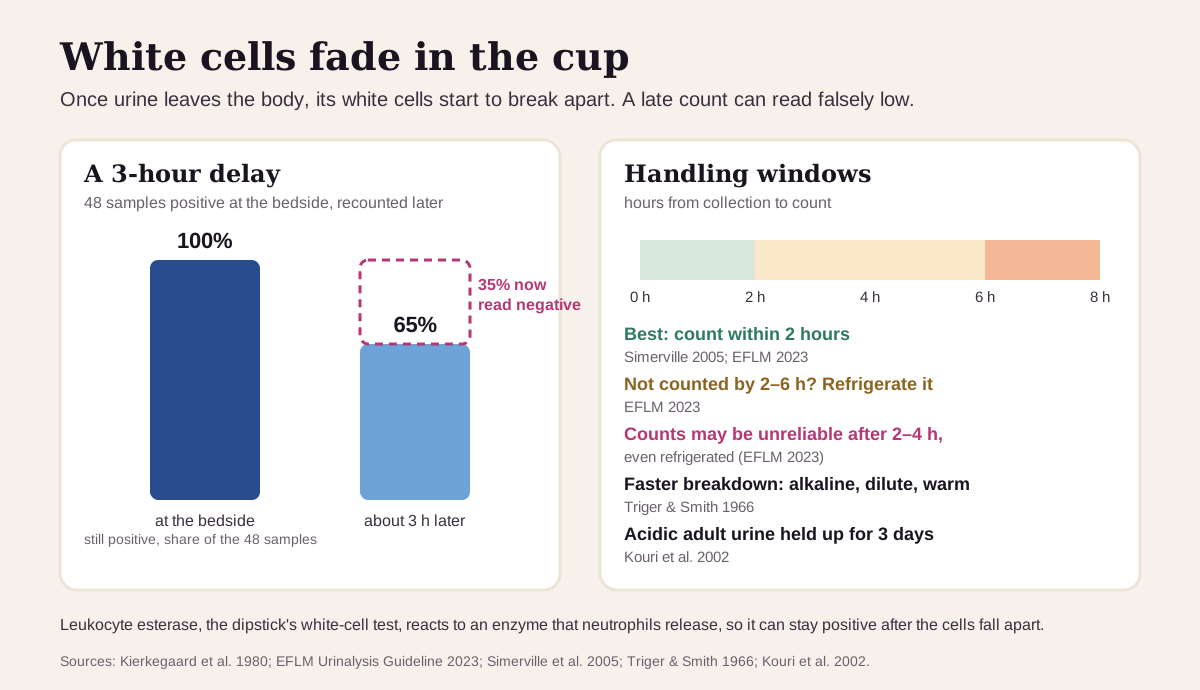
- The two-hour rule. Samples should be examined within about 2 hours or refrigerated.17 Acidic adult urine holds up better: in one study its white cells survived 3 days of storage.18
- Your collection matters. A clean midstream sample, ideally from a morning pee, is the standard. Menstrual blood and vaginal secretions can contaminate the cup, so mention your period if you're on it.7
- Day to day, it moves a lot. In the daily-testing study above, most women had at least one day with pyuria, yet the typical woman had it on only 7% of days. The authors concluded that pyuria without symptoms in healthy, non-pregnant women should be neither screened for nor treated.14
- Trends beat snapshots. Compare results from the same lab and the same method, because a count per HPF and a count per µL are different scales.7
Going deeper: why the same urine can give different counts
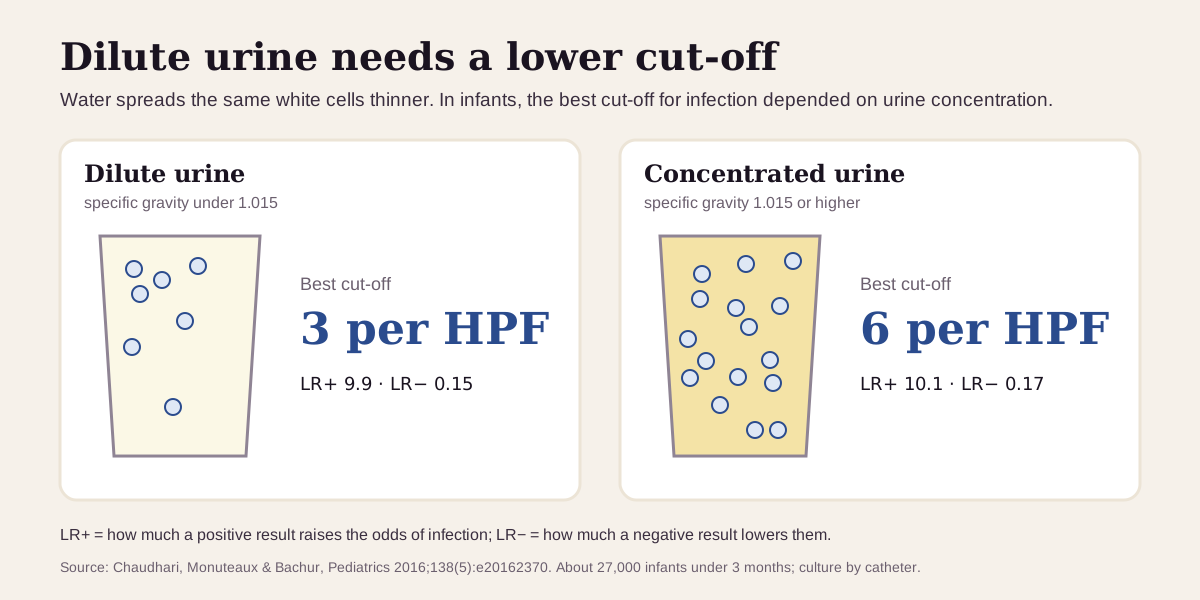
Water spreads the cells thinner. In a study of about 27,000 infants under 3 months, the best cut-off for a UTI was 3 white cells per HPF in dilute urine (specific gravity under 1.015) but 6 per HPF in concentrated urine.19 Each cut-off raised the odds of infection about tenfold when positive.19 That's why EFLM asks labs to report urine concentration beside any cell count.7
Spinning and reading add error. Centrifuging loses 20–80% of white cells.7 Stamm's classic review found per-HPF counts poorly reproducible and recommended counting per µL of unspun urine instead.2 Automated analyzers do that, but in the 2024 children's study the authors concluded that automation had not improved accuracy.10
Swollen "glitter cells". In dilute urine, white cells swell and their granules shimmer under the microscope. Labs call them glitter cells.9 They're still white cells.
Why labs pair white cells with a culture. Bacteria in urine can mean a harmless colonization or an infection. Stamm argued that pyuria is the most readily available sign of the body fighting back, which is how it helps separate the two.2 In nursing-home residents, that signal is less reliable.15
Questions worth asking
- How many white cells per HPF (or per µL) did I have, and what's this lab's range?
- Were there squamous cells or mixed bacteria that suggest a contaminated sample?
- Should we send a culture, or repeat the test with a clean midstream sample?
- If the culture is negative, should I be tested for chlamydia or gonorrhea?
- Could any of my medicines be involved, or a stone or catheter?
- Were there white-cell casts, protein or blood that point to the kidney?
FAQ
What is a normal white blood cell count in urine? Most labs print 0–5 per high-power field. A widely cited review puts normal at under 2 for men and under 5 for women.41
Does a high urine WBC always mean a UTI? No. A UTI is the most common cause, but a contaminated sample, a recently treated infection, chlamydia, a stone or a catheter can raise it too.5
Why would I have white cells in my urine but no infection? That's sterile pyuria. The usual reasons are recent antibiotics, a sexually transmitted infection such as chlamydia, a kidney stone, a catheter or a medicine reaction. A repeat culture often turns positive.5
When are white cells in urine an emergency? When they come with fever or chills, back or side pain, or vomiting, which can mean a kidney infection. Confusion or fast breathing can be a sign of sepsis and needs care right away.6
This guide is for education. It can't diagnose you or replace care from a clinician who knows your history.
Footnotes
-
Simerville JA, Maxted WC, Pahira JJ. Urinalysis: a comprehensive review. Am Fam Physician. 2005;71(6):1153–1162. The source for normal counts by sex (under 2 per HPF for men, under 5 for women), the accuracy of more than 5 WBC per HPF (sensitivity 90–96%, specificity 47–50%), squamous cells as a sign of contamination, the 29–32% contamination rate, leukocyte casts, nitrite, and the 2-hour rule. AAFP ↩ ↩2 ↩3 ↩4 ↩5 ↩6 ↩7 ↩8 ↩9 ↩10 ↩11 ↩12 ↩13 ↩14 ↩15 ↩16 ↩17 ↩18 ↩19 ↩20 ↩21
-
Stamm WE. Measurement of pyuria and its relation to bacteriuria. Am J Med. 1983;75(1B):53–58. Fewer than 10 leukocytes per mm³ (µL) is non-pathologic; 10 or more occurs in under 1% of asymptomatic people without bacteriuria and in over 96% of symptomatic people with significant bacteriuria; per-HPF counts are poorly reproducible. PubMed ↩ ↩2 ↩3 ↩4 ↩5 ↩6 ↩7 ↩8
-
National Institute of Diabetes and Digestive and Kidney Diseases. Definition & Facts of Bladder Infection in Adults; Symptoms & Causes of Bladder Infection in Adults. NIH. Bladder infection as the most common UTI, lifetime risk for women, and symptoms. NIDDK · Symptoms ↩ ↩2 ↩3
-
Labcorp. Urinalysis, Routine With Microscopic Examination on Positives (test 003038), sample patient report dated May 18, 2026: WBC reference interval 0–5 /hpf. Labcorp is a commercial laboratory; its printed range is cited as a typical lab range. Labcorp · Sample report ↩ ↩2 ↩3 ↩4 ↩5 ↩6 ↩7
-
Glen P, Prashar A, Hawary A. Sterile pyuria: a practical management guide. Br J Gen Pract. 2016;66(644):e225–e227. Definition (more than 5–8 WBC per HPF with negative cultures), the 9% figure, and the causes: recently treated UTI, chlamydia, instrumentation, catheters, stones, tuberculosis, drugs, vaginal contamination. PMC ↩ ↩2 ↩3 ↩4 ↩5 ↩6 ↩7 ↩8 ↩9 ↩10 ↩11 ↩12 ↩13 ↩14 ↩15 ↩16
-
National Institute of Diabetes and Digestive and Kidney Diseases. Symptoms & Causes of Kidney Infection (Pyelonephritis). NIH. Kidney-infection and sepsis symptoms, and when to seek care right away. NIDDK ↩ ↩2 ↩3 ↩4 ↩5 ↩6 ↩7 ↩8
-
Kouri TT, Hofmann W, Falbo R, et al. The EFLM European Urinalysis Guideline 2023. Clin Chem Lab Med. 2024;62(9):1653–1786. The European laboratory-medicine guideline: health-associated upper limit of about 10 (to 20) ×10⁶ WBC/L, the tenfold grey zone, acute UTI at 100–200 ×10⁶/L or more, 20–80% losses on centrifugation, the 2-hour and 2–6-hour handling windows, first-void samples for chlamydia, and contamination by vaginal secretions or menstrual blood. DOI ↩ ↩2 ↩3 ↩4 ↩5 ↩6 ↩7 ↩8 ↩9 ↩10 ↩11 ↩12 ↩13 ↩14 ↩15 ↩16 ↩17
-
Abraham SN, Miao Y. The nature of immune responses to urinary tract infections. Nat Rev Immunol. 2015;15(10):655–663. Most UTIs come from gut E. coli; bladder cells release IL-1, IL-6 and IL-8, which recruit neutrophils. PMC ↩ ↩2
-
Gaggar P, Raju SB. Diagnostic Utility of Urine Microscopy in Kidney Diseases. Indian J Nephrol. 2024;34(3):213–221. Neutrophils as the main urine white cell (about 10 µm), normal up to 8 per HPF or 10 per µL, glitter cells, white-cell casts in pyelonephritis and interstitial nephritis, and sterile pyuria in 60–80% of interstitial nephritis. PMC ↩ ↩2 ↩3 ↩4 ↩5 ↩6 ↩7 ↩8 ↩9 ↩10 ↩11
-
Shaikh N, Campbell EA, Curry C, et al. Accuracy of Screening Tests for the Diagnosis of Urinary Tract Infections in Young Children. Pediatrics. 2024;154(6):e2024066600. 4,188 catheterized children aged 1–36 months; sensitivity and specificity of each white-cell counting method. PMC ↩ ↩2 ↩3 ↩4
-
National Library of Medicine. Urinalysis. MedlinePlus Medical Encyclopedia. White blood cells are not normally found in urine, and normal ranges vary among labs. MedlinePlus ↩
-
Manoni F, Gessoni G, Alessio MG, et al. Gender's equality in evaluation of urine particles: results of a multicenter study of the Italian Urinalysis Group. Clin Chim Acta. 2014;427:1–5. 863 healthy people on three analyzers; WBC upper limits 9.7–11.9 per µL with no gender-related difference. PubMed ↩ ↩2 ↩3
-
Superpower. WBC, Urine (biomarker page). Last updated September 1, 2026. States that optimal urine white cells sit "at the very low end, ideally zero to trace amounts." A commercial source, listed as what the optimizer community uses. superpower.com ↩ ↩2
-
Hooton TM, Roberts PL, Stapleton AE. Asymptomatic Bacteriuria and Pyuria in Premenopausal Women. Clin Infect Dis. 2021;72(8):1332–1338. 104 women with recurrent UTIs tested daily for 3 months: pyuria (by leukocyte-esterase strip) on 25% of non-UTI days, in 78% of evaluable women; positive predictive value for E. coli bacteriuria 4%. PMC ↩ ↩2
-
Nicolle LE, Gupta K, Bradley SF, et al. Clinical Practice Guideline for the Management of Asymptomatic Bacteriuria: 2019 Update by the Infectious Diseases Society of America. Clin Infect Dis. 2019;68(10):e83–e110. Defines asymptomatic bacteriuria irrespective of pyuria, recommends against treating it in most groups, and notes pyuria fails to separate it from symptomatic UTI. IDSA ↩ ↩2 ↩3 ↩4
-
Triger DR, Smith JW. Survival of urinary leucocytes. J Clin Pathol. 1966;19(5):443–447. White cells disintegrate faster at higher pH, lower osmolarity and higher temperature. PMC ↩ ↩2
-
Kierkegaard H, Feldt-Rasmussen U, Hørder M, et al. Falsely negative urinary leucocyte counts due to delayed examination. Scand J Clin Lab Invest. 1980;40(3):259–261. Of 48 samples positive at the bedside, 35% read negative about 3 hours later. PubMed ↩ ↩2
-
Kouri T, Vuotari L, Pohjavaara S, Laippala P. Preservation of urine for flow cytometric and visual microscopic testing. Clin Chem. 2002;48(6 Pt 1):900–905. Leukocytes were well preserved over 3 days by all five storage methods in acidic adult urine. PubMed ↩ ↩2
-
Chaudhari PP, Monuteaux MC, Bachur RG. Urine Concentration and Pyuria for Identifying UTI in Infants. Pediatrics. 2016;138(5):e20162370. About 27,000 infants under 3 months: best cut-offs of 3 WBC per HPF in dilute urine (LR+ 9.9, LR− 0.15) and 6 per HPF in concentrated urine (LR+ 10.1, LR− 0.17). PubMed ↩ ↩2
Educational content, not medical advice. Libby is a personal record tool, not a medical service — it doesn't diagnose, treat, or prescribe. Reference ranges vary by lab and by person. Talk to a qualified healthcare professional about your results.
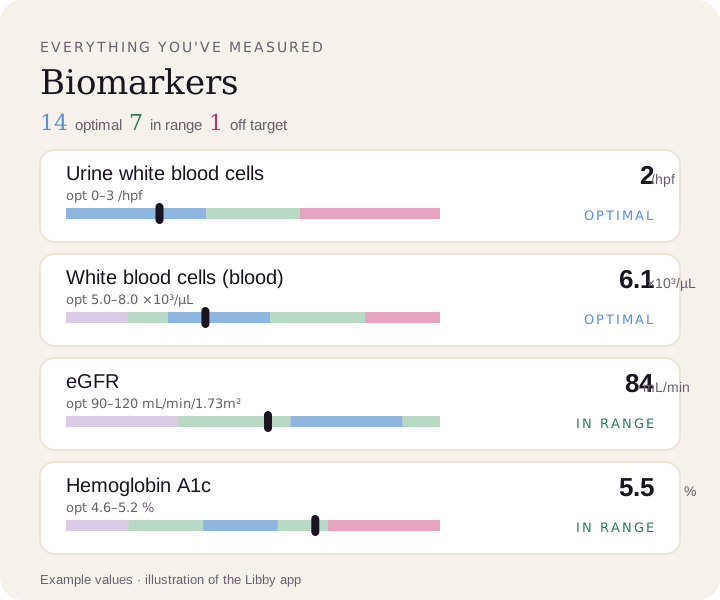
Compare your results to optimal ranges.
Upload a lab PDF or a photo of your report. Libby puts every marker on your lab's range and the optimal range, and tracks your trends over time.
View your urine WBC ›