Bacteria in urine: what few, moderate and many mean
Bacteria on a urinalysis often mean a contaminated sample or harmless bacteriuria. Here's how it's graded, how it relates to a culture, and when it matters.
Bacteria in urine are bacteria the lab sees when it looks at your urine under a microscope, and a well-collected sample usually shows none or few. What they mean depends on two things outside the microscope's view: how the sample was collected, and whether you have symptoms. Bacteria with burning, urgency or fever point to a urinary tract infection (UTI). Bacteria with no symptoms usually mean either a contaminated sample or asymptomatic bacteriuria, a quiet colonization that guidelines leave untreated in most people.12
The short version
- Normal: "none seen" or "few". That's Labcorp's reference interval. Labs grade bacteria on a word scale (none, few, moderate, many), and the grading varies from lab to lab.34
- Bacteria plus many squamous (skin) cells usually means a contaminated sample: skin and vaginal bacteria got into the cup. The usual fix is a new midstream clean-catch sample.15
- Bacteria with no symptoms is usually asymptomatic bacteriuria: it turns up in 1–5% of healthy premenopausal women, 15–40% of older men in nursing homes, and nearly everyone with a long-term catheter. The Infectious Diseases Society of America (IDSA) recommends screening and treating it only in pregnancy and before endoscopic urologic procedures that injure the lining of the urinary tract.2
- Get care now if bacteria come with a fever above 101°F (38.3°C), chills, side or back pain, or vomiting. Those are signs the infection may have reached your kidneys.6
What bacteria in urine are
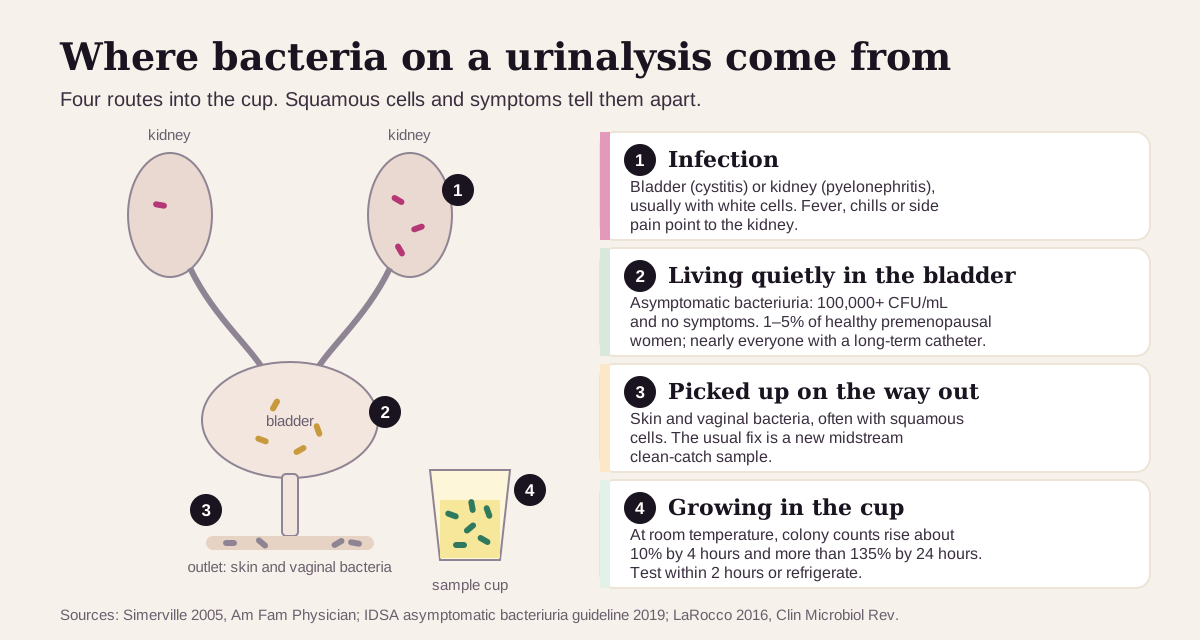
Urine starts out in the kidneys and waits in the bladder. On the way out it passes the urethra and the skin around it, where bacteria live normally. Urine samples easily pick up bacteria from the skin around the urethra, the vagina and the anus.7
The count comes from the microscopic part of a urinalysis. The lab spins 10–15 mL of fresh urine in a centrifuge, pours off the top, and looks at a drop of the sediment. At high magnification, rod-shaped gram-negative bacteria look different from the round streptococci and staphylococci.1
Bacteria can reach the cup four ways:
- From the outlet, picked up on the way into the cup (contamination).
- From the bladder, where they can live without causing symptoms (asymptomatic bacteriuria, or ASB).
- From an infection in the bladder or kidneys, usually with white cells.
- From the cup itself, when a sample sits at room temperature and the bacteria multiply.72
What's a normal result?
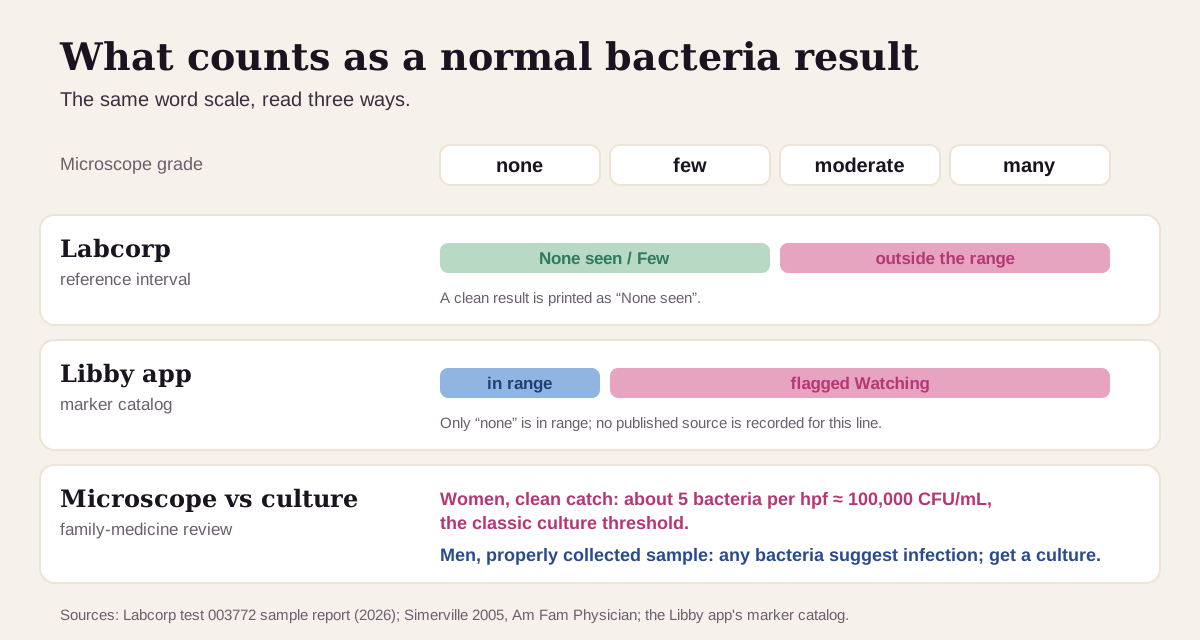
"None seen" or "few" is normal, going by the report from Labcorp, a national commercial lab. Its reference interval for bacteria is None seen/Few, and a clean result reads "None seen".3 Other labs use the same kind of word scale: none, few, moderate, many. Many labs still read the sediment by hand with non-standardized methods, which leaves wide uncertainty in the results.4
One rule of thumb links the microscope to a culture. In clean-catch samples from women, about 5 bacteria per hpf corresponds to roughly 100,000 CFU/mL, the classic culture threshold.1
Men and women read differently. Clean-catch samples from women are often contaminated by vaginal bacteria, so a few bacteria are common. In a properly collected sample from a man, any bacteria suggest infection, and a culture is the next step.1
The microscope is a good rule-in test and a poor rule-out test. Against a culture-confirmed UTI, seeing any bacteria had a sensitivity of 46–58% and a specificity of 89–94%. More than 5 white cells per hpf was the reverse: sensitivity 90–96%, specificity 47–50%.1
"Optimal" bacteria: none, and what each threshold means
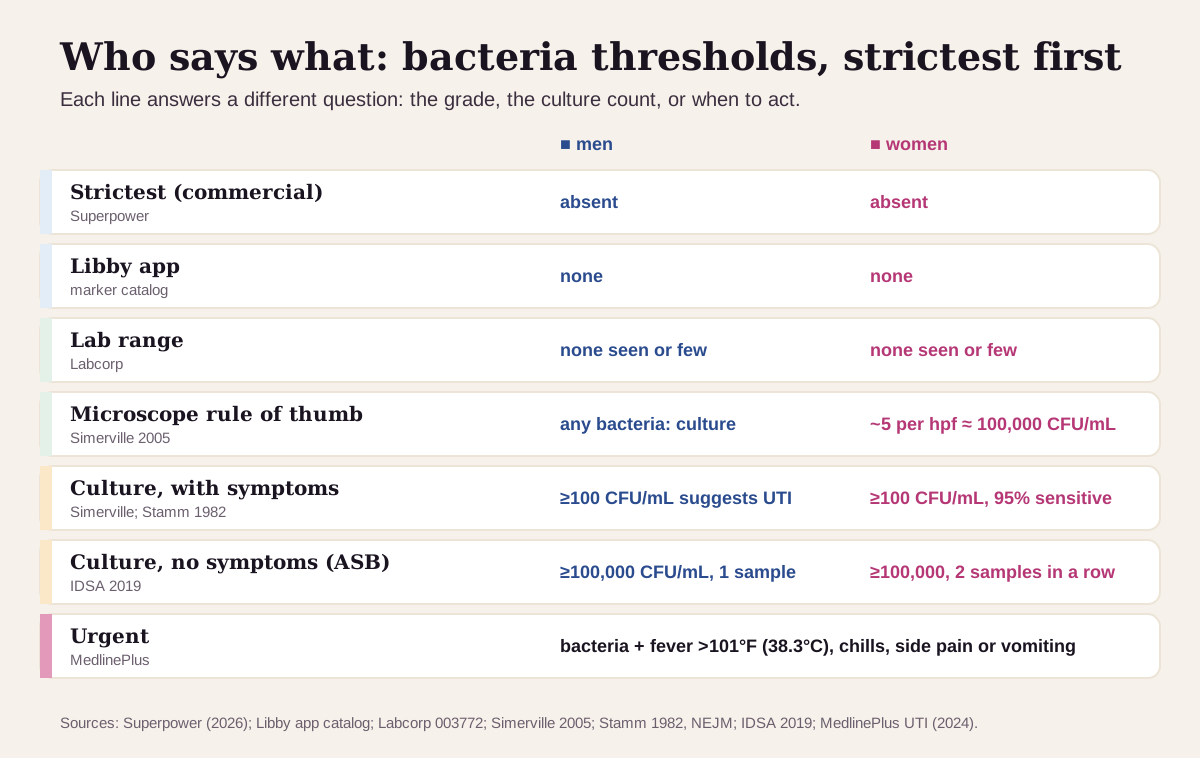
For bacteria, "optimal" is simple: none. The Libby app marks "none" as in range and flags few, moderate or many as Watching. The harder question is which amount of bacteria counts, and that depends on the test and on your symptoms. Here's the full ladder, from strictest to loosest:
| Line | Men | Women | Who uses it |
|---|---|---|---|
| Strictest (commercial) | absent | absent | Superpower's published optimal8 |
| Libby app | none | none | The app marks "none" as in range and flags few, moderate or many as Watching. The app's catalog records no published source for this line |
| Lab range | none seen or few | none seen or few | Labcorp's reference interval3 |
| Microscope rule of thumb | any bacteria: get a culture | about 5 per hpf ≈ 100,000 CFU/mL | Simerville et al., a family-medicine review1 |
| Culture, with symptoms | 100 CFU/mL or more suggests UTI | 100 CFU/mL or more (95% sensitive, 85% specific) | Simerville;1 Stamm et al. in women with painful urination9 |
| Culture, no symptoms (ASB) | 100,000 CFU/mL or more, 1 sample | 100,000 CFU/mL or more, 2 samples in a row | IDSA 2019 guideline2 |
| Urgent | bacteria + fever over 101°F (38.3°C), chills, side or back pain, vomiting | same | Signs of a kidney infection6 |
Why bacteria without symptoms are usually left alone:
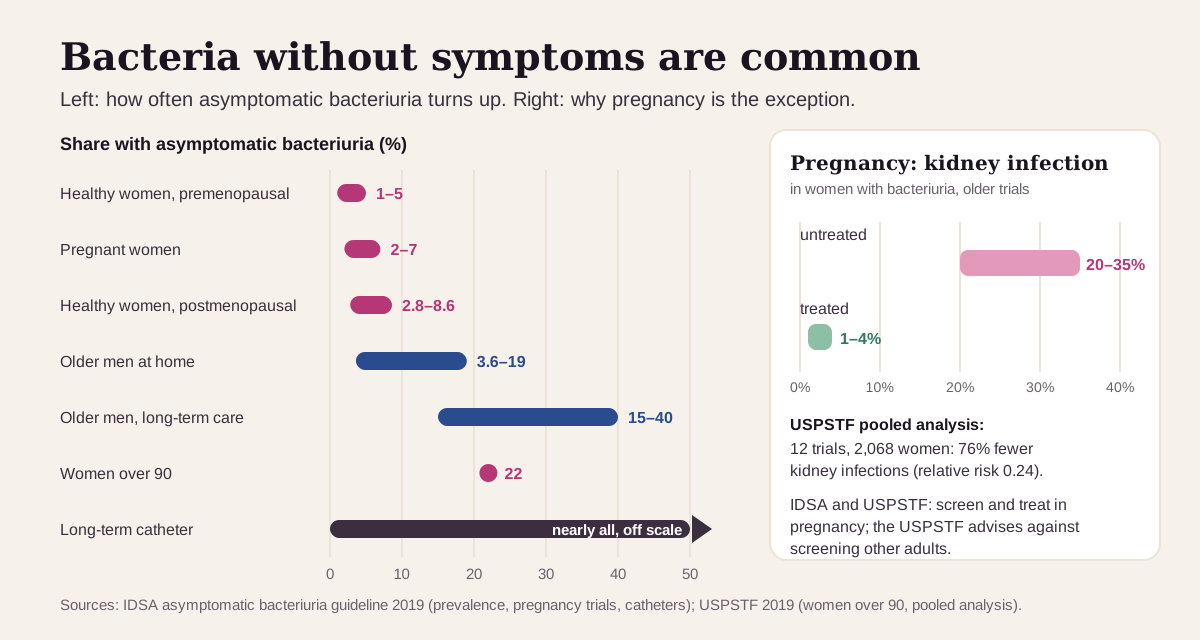
- They're common, and more so with age. ASB turns up in 1–5% of healthy premenopausal women, 2.8–8.6% of healthy postmenopausal women, 3.6–19% of older men living at home and 15–40% of older men in long-term care. People with long-term catheters are almost always bacteriuric.2 The U.S. Preventive Services Task Force (USPSTF) puts it at 22% of women older than 90.10
- Treating them can backfire. In a trial of 673 young women with past UTIs, those treated for ASB were about 3 times as likely to get a symptomatic UTI in the next year (hazard ratio 3.09).2 In one report on nursing-home residents with advanced dementia and bacteria in their urine, only 16% met the minimum criteria for a UTI, and antibiotics gave no survival benefit.2
- Pregnancy is the big exception. In older trials, treating ASB in pregnancy cut kidney infections from 20–35% to 1–4%.2 The USPSTF's pooled analysis of 12 trials found a 76% reduction (relative risk 0.24). It recommends screening pregnant people with a urine culture (grade B) and recommends against screening other adults (grade D).10
Keep "optimal" in perspective: "none" describes a clean sample from a bladder that happens to be free of bacteria right now, not a health score. For many people, keeping urine free of bacteria is out of reach anyway: the IDSA guideline notes that "efforts to maintain sterile urine were often futile" in the groups where ASB is common.2 The two questions that matter are whether the sample was clean and whether you have symptoms.
What bacteria on your urinalysis usually mean
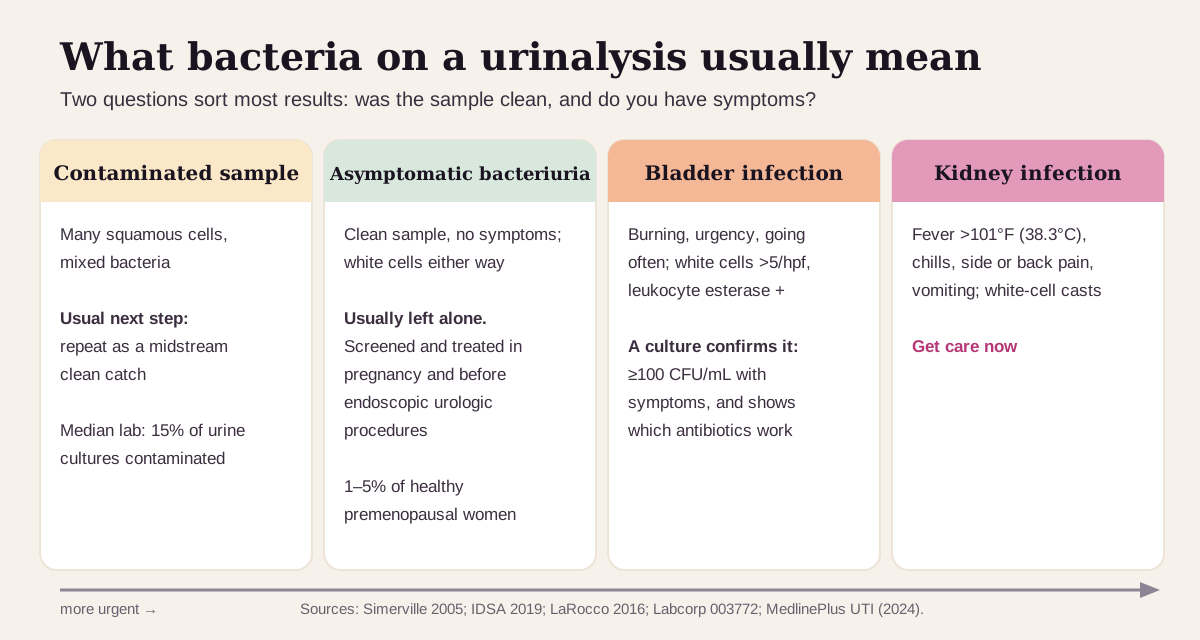
Start with two questions: was the sample clean, and do you have symptoms? The answers sort most results into one of four groups.
The usual suspects
- A contaminated sample. This is very common. In a College of American Pathologists survey of labs, the median lab had 15% of urine cultures contaminated, and the lowest-performing tenth 41.7%.7 The usual tell is squamous epithelial cells, flat skin cells from the outlet (see our guide to epithelial cells in urine). They're an imperfect tell, but they do mark a less trustworthy urinalysis: in 19,328 emergency department urinalyses, the usual urine signs predicted bacteria in the urine far better with no squamous cells than with more than 8 per lpf (positive likelihood ratio 4.98 vs 2.35).11 The fix is a new midstream clean catch, described below.
- Asymptomatic bacteriuria. Bacteria living in the bladder, with or without white cells, and no symptoms.2 It's most common in older adults, people with catheters and people with spinal cord injury. For most of the other groups it reviewed, the IDSA recommends against screening for it or treating it, including people with diabetes and kidney transplants more than a month old.2
- A bladder infection (cystitis). Bacteria plus symptoms: burning or pain when you pee, needing to go often and urgently, pressure low in the belly, and cloudy or strong-smelling urine.6 It usually comes with white cells and a positive leukocyte esterase or nitrite test. A culture confirms it and shows which antibiotics work.112
Less common
- A catheter. In one study of 1,497 newly catheterized patients, 14.9% developed bacteriuria, at an average of 6.4 days. Only 7.7% of those who could be asked had any symptoms. Long-term catheters are almost always colonized.2
- A sample that sat too long. Bacteria keep growing in the cup. Urine should be looked at within 2 hours, or refrigerated.17
- A kidney infection (pyelonephritis). The same bacteria, higher up, with fever, chills, side or back pain, nausea or vomiting.6 White-cell casts in the sediment point to the kidney.3
Older adults need a careful read. Confusion can be the only sign of a UTI in older people.6 But bacteria are so common at older ages that the IDSA recommends looking for other causes first. That applies when an older person with bacteria has delirium or a fall but no urinary symptoms, fever or drop in blood pressure.2
How to give a clean catch, per MedlinePlus:5
- Wash your hands. With a vagina, spread the labia and wipe front to back. With a penis, wipe the head, pulling back the foreskin first.
- Start peeing into the toilet, stop, then catch the middle of the stream in the cup until it's about half full.
- If you can, give the sample when urine has been in your bladder for 2 to 3 hours.
Technique helps less than you'd think for women: wiping first made no difference to contamination (32% vs 29% in one study), and the CDC-backed evidence review agrees. For men, a midstream sample cut contamination a lot compared with the first stream when men cleansed first and caught the middle of the stream.17
Get care now if bacteria in your urine come with a fever above 101°F (38.3°C), chills or shaking, pain in your side, back or groin, or nausea and vomiting. Those are signs of a kidney infection. Pregnancy with a fever is one of the reasons a kidney infection may need hospital care.6
Bacteria read best next to their neighbors
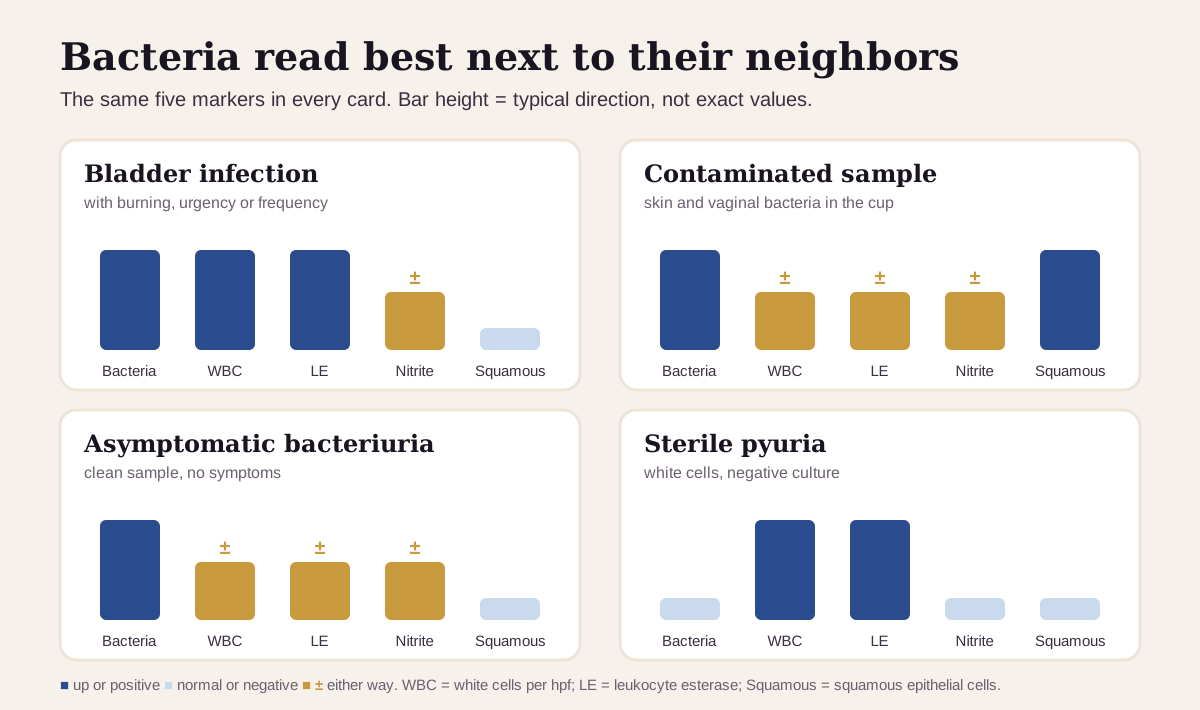
Bacteria alone can leave you guessing which of these you have. The four markers around them on the same report, together with your symptoms, usually point to the group you're in:
| If you see… | It often points to… |
|---|---|
| Bacteria, white cells over 5 per hpf and a positive leukocyte esterase, few squamous cells | a bladder infection, especially with burning or urgency. Nitrite is positive in about a fifth to half of cases16 |
| Bacteria with many squamous cells, white cells either way | a contaminated sample: repeat it as a midstream clean catch113 |
| Bacteria in a clean sample, no symptoms, white cells either way | asymptomatic bacteriuria, common with age and catheters2 |
| White cells and leukocyte esterase, no bacteria, negative culture | sterile pyuria, from causes such as a recently treated UTI, chlamydia, a kidney stone or a catheter131 |
| Bacteria with white-cell casts, fever or side pain | a kidney infection36 |
The neighbors each have their own guide: leukocyte esterase (the white-cell enzyme), nitrite (a positive result means nitrate-converting bacteria are likely present at more than 10,000 per mL, though a negative result leaves infection possible),1 and white blood cells on the microscope.
How fast it changes
In the cup, bacteria multiply within hours. In the evidence review for the CDC, colony counts rose about 10% after 4 hours at room temperature and by more than 135% after 24 hours or more. Refrigeration or a boric acid preservative held samples for up to 24 hours.7
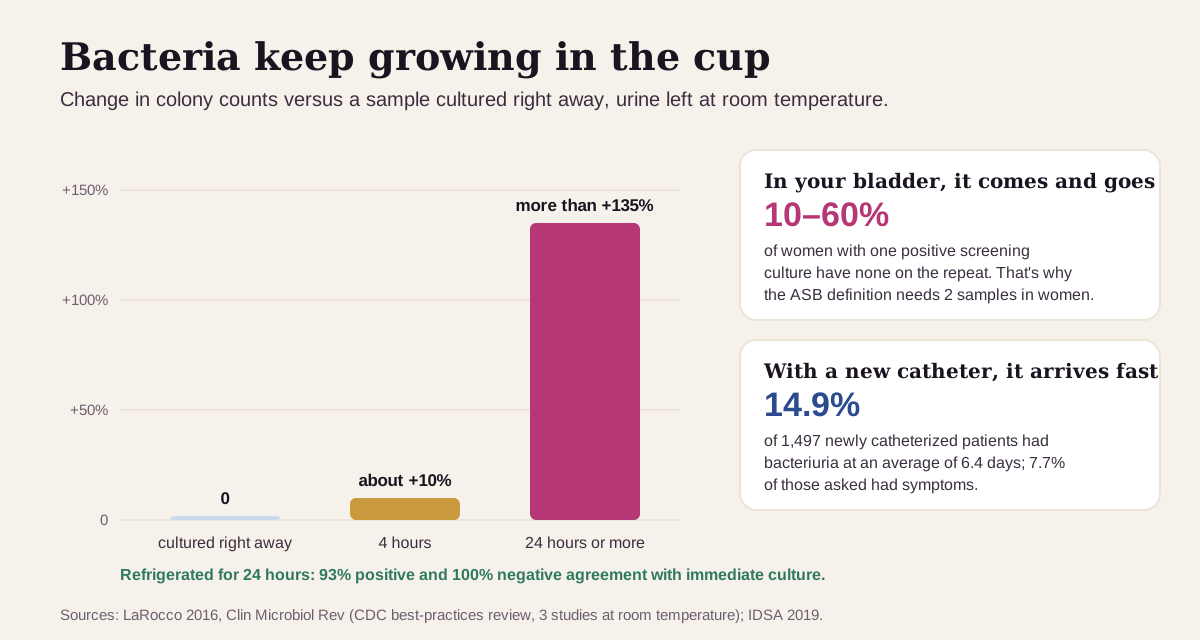
In your bladder, bacteria come and go. Between 10% and 60% of women with one positive screening culture have no bacteriuria on the repeat. That's why the IDSA definition of ASB in women needs two samples in a row, ideally within 2 weeks.2
With treatment, symptoms settle fast. Bladder infection symptoms usually go away within 24 to 48 hours of starting treatment. A kidney infection can take a week or longer.6
Trends beat snapshots. One "few" next to many squamous cells is a collection story. The same finding on repeat clean samples, with or without symptoms, is a different one.12
Going deeper: from the microscope to the culture plate
A urine culture grows whatever bacteria are in the sample, which takes 24 to 48 hours. "Normal growth" means no infection. Further tests can name the species and show which antibiotics will work.12
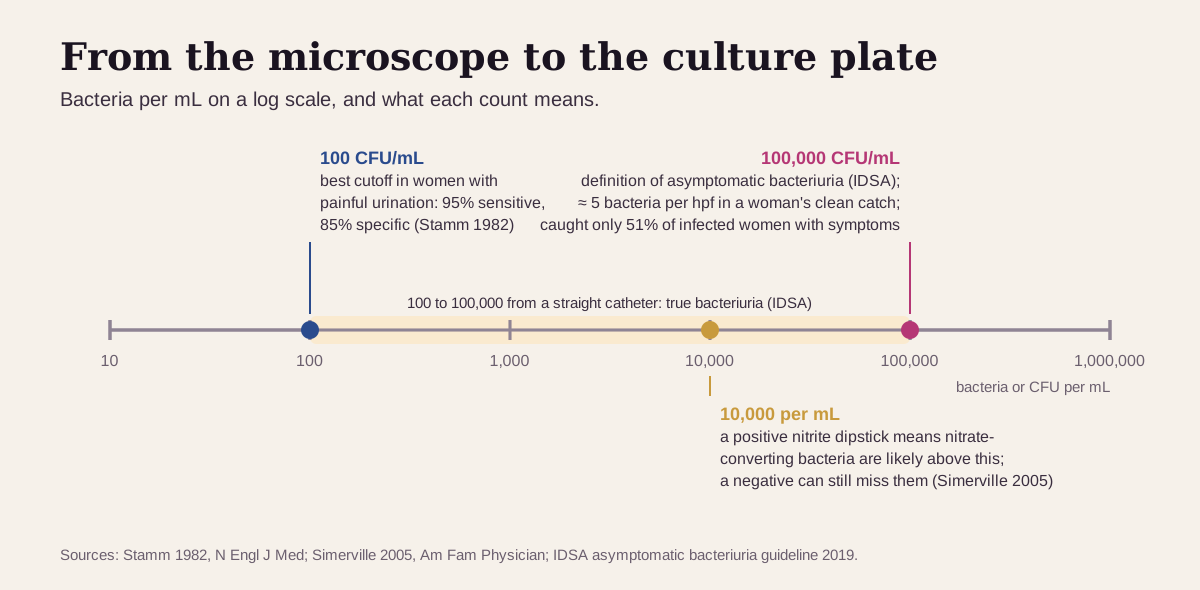
The famous 100,000 was built for people without symptoms. In a classic study of women with painful urination, the old cutoff of 100,000 CFU/mL found only 51% of women whose bladder urine grew coliform (E. coli-type) bacteria. A cutoff of 100 CFU/mL was the best fit, with a sensitivity of 95% and a specificity of 85%.9 The IDSA still uses 100,000 to define ASB, and it treats 100–100,000 CFU/mL from a straight-catheter sample as a sign of true bacteriuria.2
Machines count bacteria less reliably than cells. Automated urine analyzers do well with red and white cells, but images of bacteria, yeasts and casts still need a trained person at the microscope.4 Superpower describes its bacteria result as an automated count per hpf.8
Questions worth asking
- Were there squamous cells on the same report, and should I repeat the test as a clean catch?
- Do I have any symptoms that make this an infection rather than bacteriuria?
- Was a urine culture sent, and what did it grow, at what count?
- What did my white cells, leukocyte esterase and nitrite show?
- Am I pregnant or about to have a urologic procedure, the two times screening is recommended?
- If I use a catheter, what signs should prompt a call?
FAQ
Is "few bacteria" in urine normal? Usually, yes. Labcorp's reference interval for bacteria is "None seen/Few", and clean-catch samples from women often pick up a few vaginal bacteria.31
Can a urine test show bacteria without a UTI? Yes, often. A contaminated sample or asymptomatic bacteriuria both show bacteria with no infection. ASB affects 15–40% of older men in long-term care, and the median lab sees 15% of urine cultures contaminated.27
Should asymptomatic bacteriuria be treated? The IDSA and USPSTF recommend screening and treatment in pregnancy. The IDSA also recommends it before urologic procedures that injure the lining. For most other adults, both recommend against screening.210
What does bacteria in urine with a fever mean? Bacteria with a fever above 101°F (38.3°C), chills, side or back pain, or vomiting can mean a kidney infection, which needs prompt care.6
This guide is for education. It can't diagnose you or replace care from a clinician who knows your history.
Footnotes
-
Simerville JA, Maxted WC, Pahira JJ. Urinalysis: a comprehensive review. Am Fam Physician. 2005;71(6):1153–1162. The 5-bacteria-per-hpf rule, the male-specimen rule, microscope accuracy (Table 3), the 2-hour window and the cleansing study. AAFP ↩ ↩2 ↩3 ↩4 ↩5 ↩6 ↩7 ↩8 ↩9 ↩10 ↩11 ↩12 ↩13 ↩14 ↩15 ↩16 ↩17 ↩18 ↩19 ↩20 ↩21 ↩22 ↩23
-
Nicolle LE, Gupta K, Bradley SF, et al. Clinical Practice Guideline for the Management of Asymptomatic Bacteriuria: 2019 Update by the Infectious Diseases Society of America. Clin Infect Dis. 2019;68(10):e83–e110. The U.S. infectious-diseases society's guideline: the ASB definition, prevalence by group, who should and shouldn't be screened, pregnancy outcomes and catheter data. IDSA · PubMed ↩ ↩2 ↩3 ↩4 ↩5 ↩6 ↩7 ↩8 ↩9 ↩10 ↩11 ↩12 ↩13 ↩14 ↩15 ↩16 ↩17 ↩18 ↩19 ↩20 ↩21 ↩22 ↩23 ↩24 ↩25 ↩26
-
Labcorp. Urinalysis, Complete With Microscopic Examination (test 003772), test page and sample report (date reported May 18, 2026). Reference interval for Bacteria: None seen/Few; white-cell casts in pyelonephritis. A national commercial lab's published range. Labcorp ↩ ↩2 ↩3 ↩4 ↩5 ↩6 ↩7 ↩8
-
İnce FD, Ellidağ HY, Koseoğlu M, et al. The comparison of automated urine analyzers with manual microscopic examination for urinalysis automated urine analyzers and manual urinalysis. Pract Lab Med. 2016;5:14–20. Non-standardized manual sediment methods, and bacteria as the hardest element for analyzers. PMC ↩ ↩2 ↩3
-
National Library of Medicine. Clean catch urine sample. MedlinePlus Medical Encyclopedia. Review date July 23, 2024. MedlinePlus ↩ ↩2
-
National Library of Medicine. Urinary tract infection - adults. MedlinePlus Medical Encyclopedia. Review date July 23, 2024. Bladder and kidney infection symptoms, when to call, and how fast symptoms settle. MedlinePlus ↩ ↩2 ↩3 ↩4 ↩5 ↩6 ↩7 ↩8 ↩9 ↩10 ↩11 ↩12 ↩13
-
LaRocco MT, Franek J, Leibach EK, et al. Effectiveness of Preanalytic Practices on Contamination and Diagnostic Accuracy of Urine Cultures: a Laboratory Medicine Best Practices Systematic Review and Meta-analysis. Clin Microbiol Rev. 2016;29(1):105–147. The CDC Laboratory Medicine Best Practices review of collection, storage and contamination rates. PMC ↩ ↩2 ↩3 ↩4 ↩5 ↩6 ↩7 ↩8 ↩9 ↩10 ↩11
-
Superpower. Bacteria (Urine). Last updated September 1, 2026. States that "low or absent bacteria typically indicate a sterile or near-sterile urinary tract, which is the expected and optimal state." A commercial source, listed as what an optimizer platform says. superpower.com ↩ ↩2 ↩3
-
Stamm WE, Counts GW, Running KR, et al. Diagnosis of coliform infection in acutely dysuric women. N Engl J Med. 1982;307(8):463–468. The study behind the 100 CFU/mL threshold in women with symptoms. PubMed ↩ ↩2 ↩3 ↩4
-
US Preventive Services Task Force, Owens DK, Davidson KW, et al. Screening for Asymptomatic Bacteriuria in Adults: US Preventive Services Task Force Recommendation Statement. JAMA. 2019;322(12):1188–1194. Grade B for screening in pregnancy, grade D for other adults; prevalence and the pooled 76% reduction in pyelonephritis. USPSTF ↩ ↩2 ↩3 ↩4
-
Mohr NM, Harland KK, Crabb V, et al. Urinary Squamous Epithelial Cells Do Not Accurately Predict Urine Culture Contamination, but May Predict Urinalysis Performance in Predicting Bacteriuria. Acad Emerg Med. 2016;23(3):323–330. 19,328 emergency department records. DOI ↩
-
National Library of Medicine. Urine culture. MedlinePlus Medical Encyclopedia. Review date October 9, 2024. MedlinePlus ↩ ↩2
-
Glen P, Prashar A, Hawary A. Sterile pyuria: a practical management guide. Br J Gen Pract. 2016;66(644):e225–e227. Causes of white cells without bacteria, and vaginal white cells as a contaminant. PMC ↩ ↩2 ↩3
Educational content, not medical advice. Libby is a personal record tool, not a medical service — it doesn't diagnose, treat, or prescribe. Reference ranges vary by lab and by person. Talk to a qualified healthcare professional about your results.
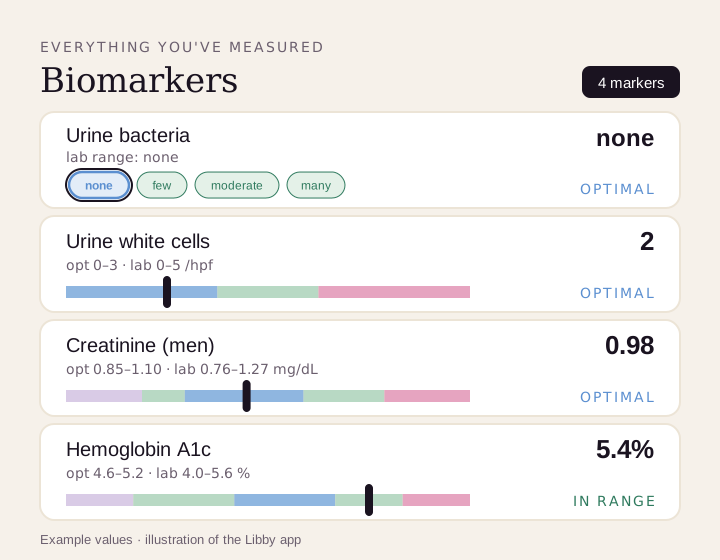
See every result against your lab's range.
Upload a lab PDF or a photo of your report. Libby puts every marker on your lab's range and lists each urinalysis by date, so you can see what changed.
View your urine bacteria ›