Urine leukocyte esterase: what a positive result means
Leukocyte esterase flags white blood cells in your urine. Here's what a positive means, the usual causes, how to read it with nitrite, and when to get care.
Leukocyte esterase is an enzyme carried by white blood cells, and the urine dipstick turns purple when it finds it. A positive result means white cells are in your urine. That usually points to inflammation somewhere in the urinary tract, most often a urinary tract infection (UTI).12
The short version
- Normal: negative. Labcorp's reference interval is "Negative", and MedlinePlus calls a negative test normal. Any grade above negative, even trace, is outside that range.32
- Positive usually means a bladder infection or a sample that picked up cells from the skin or vagina. Sexually transmitted infections, kidney stones and hard exercise can do it too.124
- Positive with a fever above 101°F (38.3°C), chills, back or side pain, or vomiting can mean a kidney infection. Contact a clinician right away.5
- Read it with nitrite. Leukocyte esterase finds white cells; nitrite finds certain bacteria. Both negative makes an infection much less likely, and a positive is a reason to look closer, often with a urine culture.61
What leukocyte esterase is
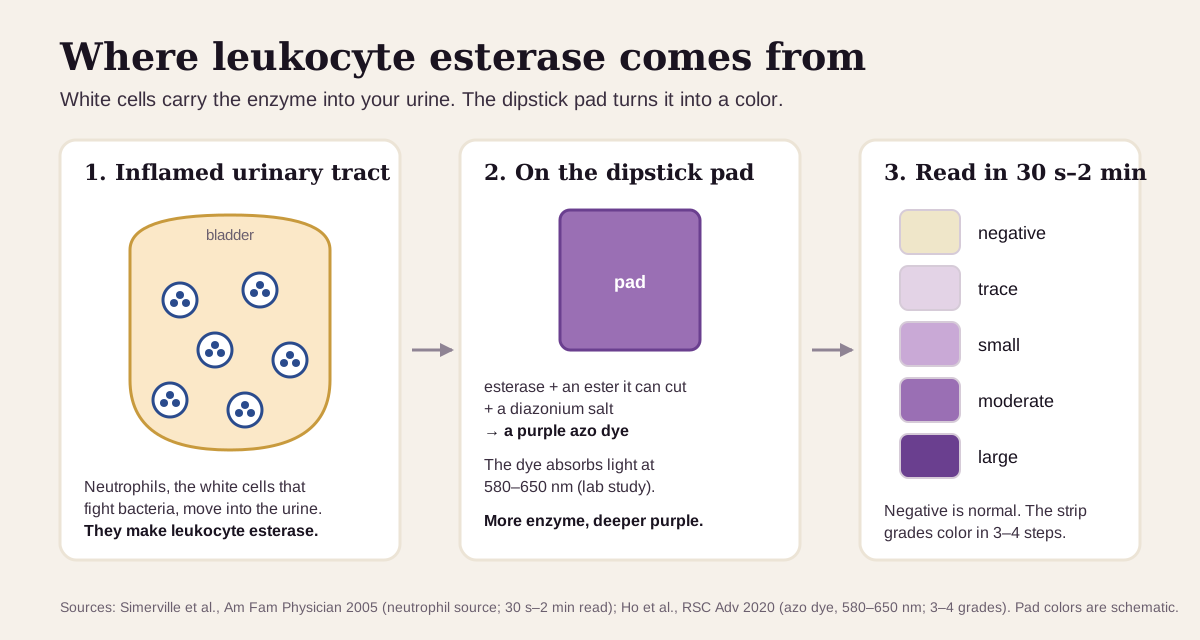
"Leukocyte" is the medical word for a white blood cell. Neutrophils, the white cells that rush to a bacterial infection, make an enzyme called leukocyte esterase.17 When the lining of your bladder, urethra or kidneys is inflamed, neutrophils move into the urine and bring the enzyme with them.
The test is one pad on the urine dipstick, the strip of colored squares used in a routine urinalysis. The pad changes color when the esterase acts on it, and the strip sorts that color into 3 or 4 grades.27 (More on the chemistry at the end.)
If the pad is positive, the next step is usually a look under the microscope for the white cells themselves, and often a urine culture to grow and name any bacteria.21
What's a normal result?
Negative. That's the reference interval Labcorp, a national commercial lab, prints on its standard urinalysis, and MedlinePlus lists a negative test as normal.32 Any color change, even trace, is outside it.
The dipstick is one of two ways to measure white cells in urine. The other is to count them under a microscope, and the normal counts come with numbers:
- A widely used family-medicine review puts normal at fewer than 2 white cells per high-power field (hpf) for men and fewer than 5 for women.1
- Labcorp's reference interval is 0–5 per hpf.3
- The research standard counts cells in a chamber instead: fewer than 10 per microliter of urine that hasn't been spun down. Walter Stamm found 10 or more in under 1% of people with no symptoms and no bacteria in their urine, and in more than 96% of people with symptoms and a true infection.8
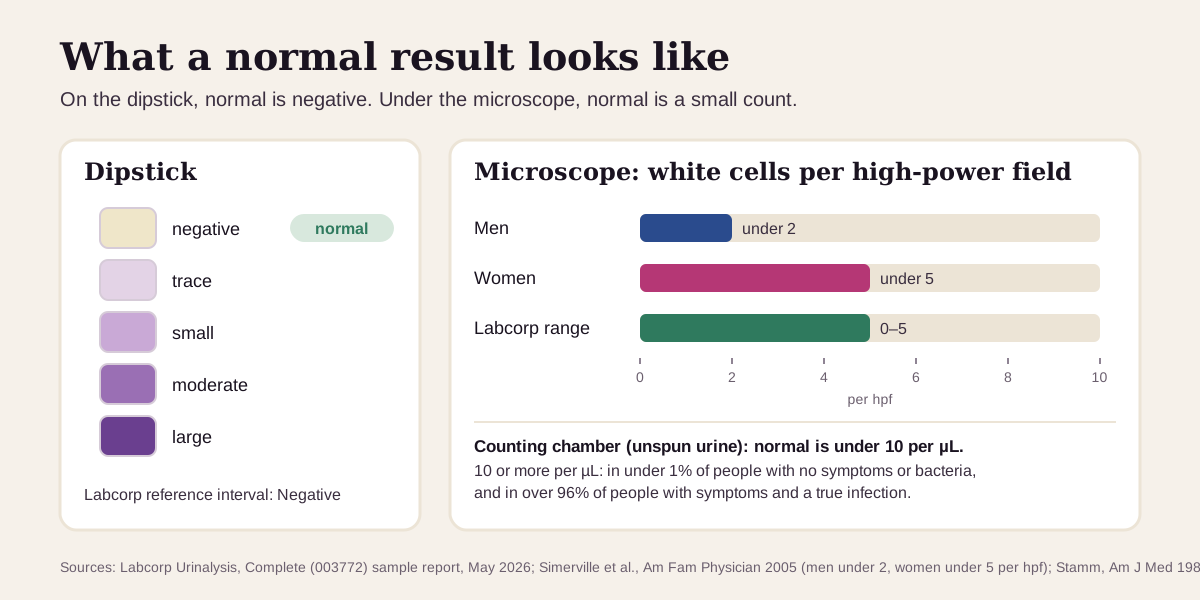
Women's normal limit is higher than men's. Vaginal secretions can also turn the pad positive, which is why labs ask for a midstream clean-catch sample.12
"Optimal" leukocyte esterase: negative, and where the lines fall
For most markers, health optimizers aim tighter than the lab. For leukocyte esterase, negative is already the tightest possible result, so the useful question is where each source draws the line between "clear" and "look closer". The Libby app shows your result against your lab's range: negative. Here's the ladder, from strictest to loosest:
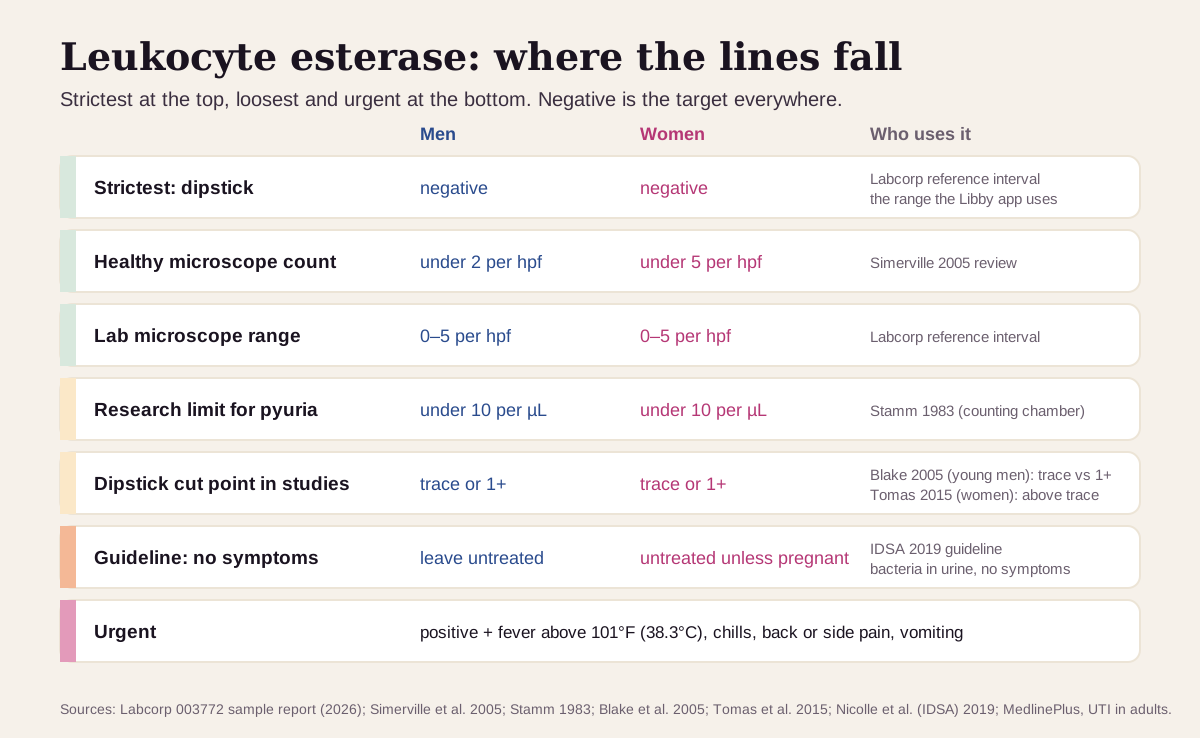
| Line | Men | Women | Who uses it |
|---|---|---|---|
| Strictest: dipstick | negative | negative | Labcorp's reference interval, and the range the Libby app shows your result against3 |
| Healthy microscope count | under 2 per hpf | under 5 per hpf | A family-medicine review of urinalysis1 |
| Lab microscope range | 0–5 per hpf | 0–5 per hpf | Labcorp's reference interval3 |
| Research limit for pyuria | under 10 per µL | under 10 per µL | Stamm's counting-chamber limit8 |
| Dipstick cut point in studies | trace or 1+ | trace or 1+ | Studies differ, not the sexes. In young men screened for chlamydia, trace caught more infections and 1+ gave fewer false alarms.9 An emergency department study of women counted results above trace as abnormal4 |
| Guideline: no symptoms | leave untreated | leave untreated unless pregnant | Infectious Diseases Society of America, for bacteria in the urine without symptoms10 |
| Urgent | positive plus fever, chills, back pain or vomiting | same | Signs of a kidney infection: get care right away5 |
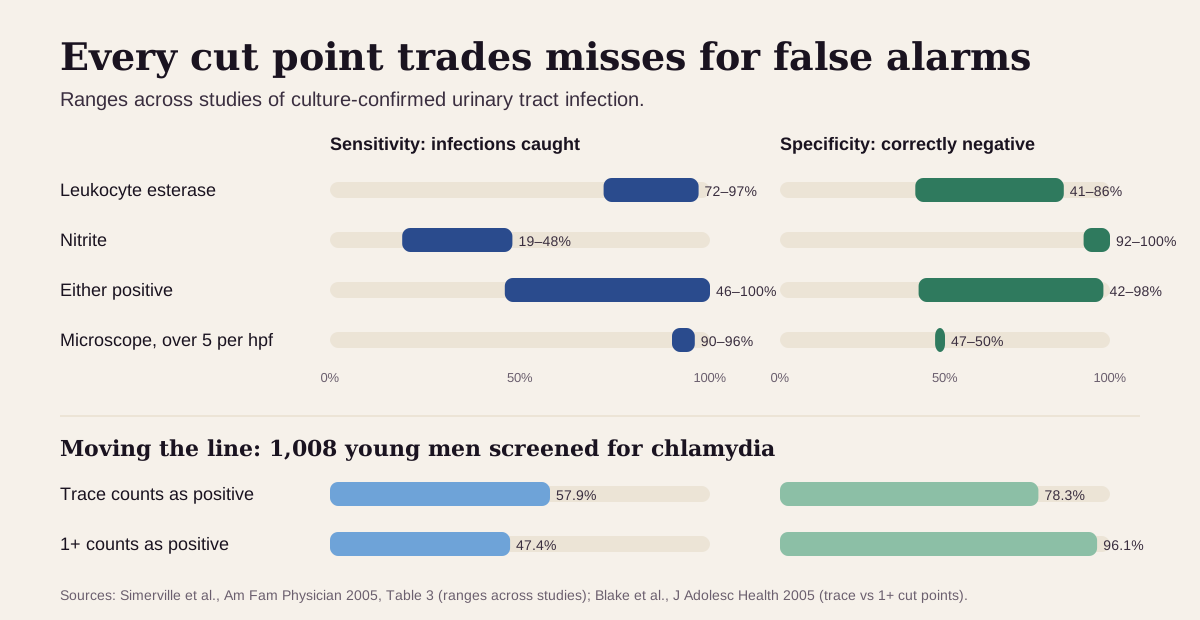
Why the line matters: every cut point trades misses for false alarms.
- In a review of dipstick studies, leukocyte esterase caught 72–97% of culture-confirmed infections but was correctly negative in only 41–86% of people without one. Nitrite was the opposite: it caught 19–48% but was correctly negative in 92–100%.1
- In 1,008 young men screened for chlamydia, counting trace as positive caught 57.9% of infections with 78.3% specificity. Moving the line to 1+ caught 47.4% with 96.1% specificity.9
- A meta-analysis of 70 papers concluded that a dipstick with both leukocyte esterase and nitrite negative is useful to rule out infection, while a positive result needs confirming.6
Keep "negative" in perspective: it's the target, and a positive is a finding, not a diagnosis. Symptoms carry more weight than the strip. In women with burning and frequent urination and no vaginal discharge or irritation, the chance of a UTI is over 90% on symptoms alone, and a dipstick can't reliably rule one out once symptoms are present.11
What a positive leukocyte esterase usually means
Start with the context, not the grade. The strip sorts color into only 3 or 4 steps,7 so the cause comes from the rest of the picture: your symptoms, how the sample was collected, and the other results on the urinalysis.16
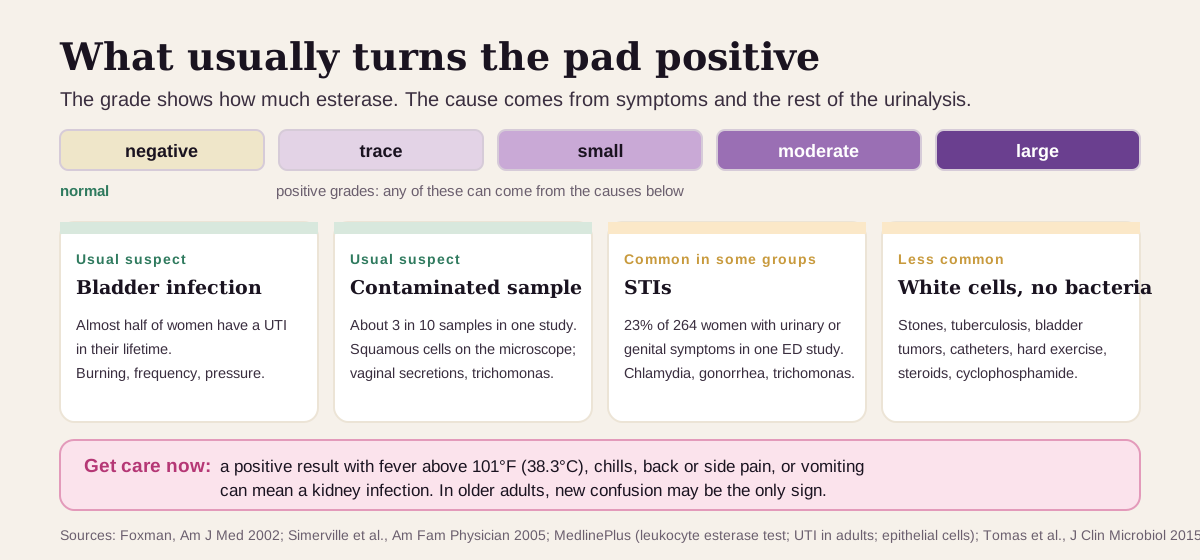
The usual suspects:
- A bladder infection (cystitis). UTIs are among the most common bacterial infections, and almost half of women have at least one in their lifetime.12 Women get them more often than men, partly because the urethra is shorter. The typical symptoms are burning when you pee, needing to go often, and pressure low in the belly.5
- A contaminated sample. Cells from the skin or vagina can get into the cup. Squamous (skin-type) epithelial cells on the microscope report are the tell-tale sign.113 Vaginal secretions and trichomonas infection also turn the pad positive.2 Contamination is common: in one study about 3 in 10 samples were contaminated, whether or not people cleaned first.1
- Sexually transmitted infections. Chlamydia, gonorrhea and trichomonas can inflame the urethra and bring white cells into the urine. In an emergency department study of 264 women with urinary or genital symptoms, 23% had an STI, and 14 of the 22 who missed STI treatment were diagnosed with a UTI instead.4 Stamm found that most women with symptoms and white cells, but few bacteria, had either a low-count infection or chlamydia.8
- Less common: white cells with no bacteria on a standard culture. Clinicians call this sterile pyuria. Causes include kidney stones, tuberculosis, bladder tumors, viral infections, a catheter or other foreign body, kidney inflammation (glomerulonephritis), recent hard exercise, and medicines such as corticosteroids and cyclophosphamide.1
Get care right away if a positive result comes with fever, chills, back or side pain, or nausea and vomiting. Those can mean the infection has reached your kidneys. In older adults, new confusion may be the only sign. Pregnancy with a fever needs prompt care too.5
When the pad reads negative but you have symptoms
The pad can miss white cells. Concentrated urine, sugar, ketones or protein in the urine, vitamin C, and some antibiotics (cephalexin, nitrofurantoin, tetracycline, gentamicin) can all push it toward negative.12 In a study of 479 women with suspected UTIs, 18.9% of the samples that grew bacteria had passed a negative dipstick screen.14 That's why symptoms, a microscope count and a culture outrank a single negative pad.11
Leukocyte esterase reads best next to its neighbors
The pad rarely comes alone. The pattern across the dipstick and the microscope report usually says more than leukocyte esterase does by itself:18
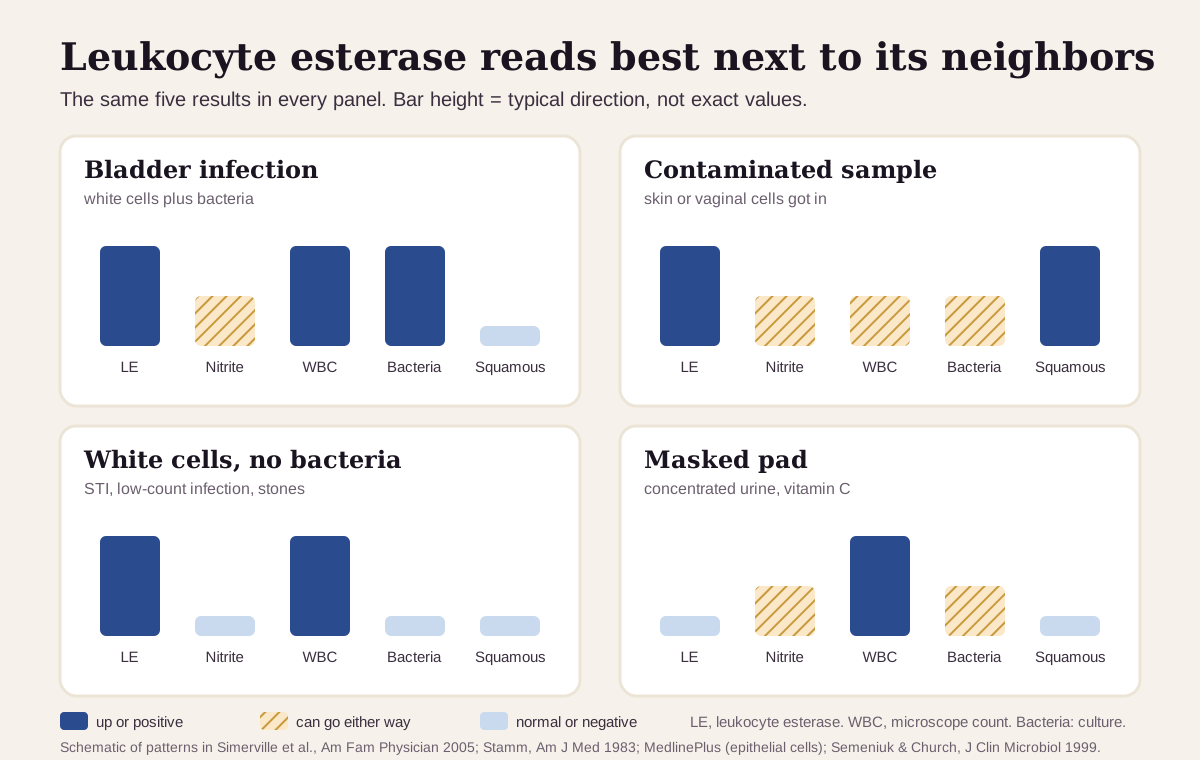
| If you see… | It often points to… |
|---|---|
| Leukocyte esterase and nitrite both positive, white cells on the microscope, bacteria on culture | a bacterial urinary tract infection, usually in the bladder: a positive nitrite means bacteria in significant numbers (more than 10,000 per mL) |
| Leukocyte esterase positive with many squamous epithelial cells | a contaminated sample: repeat it as a midstream clean catch |
| Leukocyte esterase positive, nitrite negative, no significant growth on a standard culture | white cells without a standard infection: chlamydia or another STI, a low-count infection, stones or medicines |
| Leukocyte esterase negative, but white cells on the microscope | a masked pad: concentrated urine, vitamin C, sugar or protein in the urine, or some antibiotics |
Nitrite is the pad to check first. It's specific but misses many infections, because some bacteria never make nitrite, and a low-nitrate diet can keep it negative too.1 White-cell casts, tube-shaped clumps of white cells on the microscope report, place the inflammation in the kidney rather than the bladder.1
How fast it changes
Leukocyte esterase reflects the urine in the cup, right now. It moves on a scale of minutes to days:
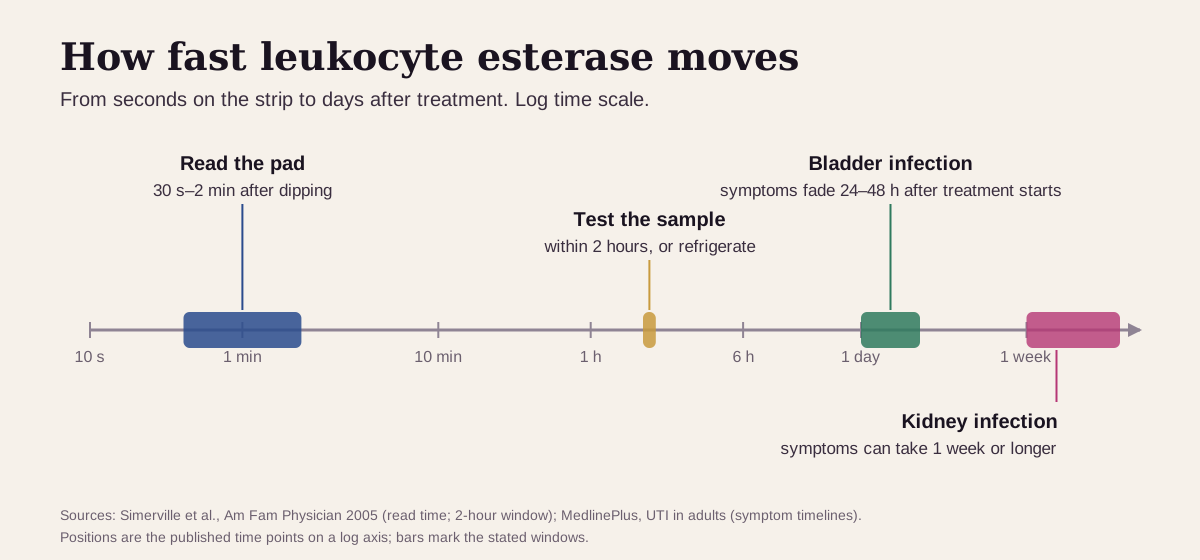
- Minutes: the pad needs 30 seconds to 2 minutes to change color, depending on the brand.1
- Hours: test the sample within 2 hours or refrigerate it. Longer delays often make the whole urinalysis unreliable.1
- Days: after treatment starts, bladder-infection symptoms usually fade within 24–48 hours. A kidney infection can take a week or longer.5 Symptoms that come back soon after treatment are a reason to call your clinician again.5
Trends beat snapshots. A single trace result after a workout or a rushed collection means less than a pad that stays positive on careful repeats. White cells that persist with no bacteria are worth a workup for the less common causes above.18
Going deeper: how the pad works
The color comes from chemistry. In one lab study, leukocyte esterase reacted with an ester (a molecule the enzyme can cut) and a diazonium salt to form a purple azo dye that absorbs light at 580–650 nm. The same study notes the standard strip's limits: only 3–4 grades, and weak sensitivity to low enzyme levels.7
Leukocyte esterase comes only from white cells. In an early emergency department study of 203 patients, the pad caught 100% of infections with 100,000 or more bacteria per mL, with 76% specificity. Nitrite in the same samples was 99% specific but only 27% sensitive.15
Why the microscope count and the chamber count disagree. Most labs spin the urine down and count cells per high-power field. Stamm showed that this method gives poorly reproducible counts that track neither the true rate of white cells leaving the body nor the counting-chamber result, and he argued for reporting cells per cubic millimeter (the same as per µL) of unspun urine.8
Where the test works best depends on who's tested. In the 70-study meta-analysis, leukocyte esterase was most accurate in urology patients and most sensitive in family medicine (86%), where its false positives were also common.6 In a review of adult studies, when leukocyte esterase and nitrite were both negative, the pooled chance of infection afterward was about 5%.16
Bacteria without symptoms is a separate question. The Infectious Diseases Society of America defines asymptomatic bacteriuria as bacteria growing at 100,000 or more per mL "irrespective of the presence of pyuria". It's found in 1–5% of healthy premenopausal women, 2.8–8.6% of postmenopausal women, 2–7% of pregnant women, and 3.6–19% of older men in the community. The guideline recommends against screening or treating it in healthy women and older adults, with pregnancy and urologic procedures as the exceptions.10
Questions worth asking
- Was this a clean-catch sample, and did the microscope report show squamous epithelial cells?
- What did the nitrite pad and the microscope white-cell count show?
- Do my symptoms fit a bladder infection, and should we send a urine culture?
- Should I be tested for chlamydia, gonorrhea or trichomonas?
- If I had no symptoms, does this result need any follow-up?
- If it stays positive with no bacteria, what else should we look for?
FAQ
What does a positive leukocyte esterase mean? It means white blood cells are in your urine. The most common reasons are a urinary tract infection and a sample contaminated by skin or vaginal cells. STIs, kidney stones and hard exercise can also cause it.21
Can you have a UTI with a negative leukocyte esterase? Yes. In one study, 18.9% of samples that grew bacteria had a negative dipstick screen.14 Concentrated urine, vitamin C and some antibiotics can mask the pad, so symptoms still count.111
What does trace leukocyte esterase mean? Trace is the lowest grade above negative. It can come from an infection or from a contaminated sample, so a repeat clean-catch sample and the microscope count help. In screening studies, counting trace as positive catches more infections but brings more false alarms.19
Does a positive result mean I need antibiotics? A positive result plus UTI symptoms often leads to treatment. Without symptoms, the IDSA recommends against treating bacteria in the urine for most adults, with pregnancy as the main exception.101
This guide is for education. It can't diagnose you or replace care from a clinician who knows your history.
Footnotes
-
Simerville JA, Maxted WC, Pahira JJ. Urinalysis: a comprehensive review. Am Fam Physician. 2005;71(6):1153–1162. A widely used family-medicine review: the neutrophil source of the enzyme, read time, normal white-cell counts by sex, dipstick accuracy (Table 3), false positives and negatives (Table 2), sterile-pyuria causes and the 2-hour testing window. AAFP · PubMed ↩ ↩2 ↩3 ↩4 ↩5 ↩6 ↩7 ↩8 ↩9 ↩10 ↩11 ↩12 ↩13 ↩14 ↩15 ↩16 ↩17 ↩18 ↩19 ↩20 ↩21 ↩22 ↩23 ↩24 ↩25 ↩26 ↩27 ↩28 ↩29 ↩30 ↩31
-
National Library of Medicine. Leukocyte esterase urine test. MedlinePlus Medical Encyclopedia. Reviewed July 13, 2025. Normal result, what can cause a false positive (trichomonas, vaginal secretions) and a false negative (high protein, vitamin C). MedlinePlus ↩ ↩2 ↩3 ↩4 ↩5 ↩6 ↩7 ↩8 ↩9 ↩10 ↩11
-
Labcorp. Urinalysis, Complete (test 003772), sample patient report, reported May 18, 2026. Reference intervals: WBC esterase "Negative", nitrite "Negative", WBC 0–5 /hpf. A commercial source (a national reference lab), cited for the ranges printed on its report. files.labcorp.com ↩ ↩2 ↩3 ↩4 ↩5 ↩6 ↩7
-
Tomas ME, Getman D, Donskey CJ, Hecker MT. Overdiagnosis of urinary tract infection and underdiagnosis of sexually transmitted infection in adult women presenting to an emergency department. J Clin Microbiol. 2015;53(8):2686–2692. 264 women; 23% had an STI. PMC ↩ ↩2 ↩3 ↩4
-
National Library of Medicine. Urinary tract infection - adults. MedlinePlus Medical Encyclopedia. Reviewed July 23, 2024. Bladder and kidney infection symptoms, when to contact a provider, and how long symptoms take to clear. MedlinePlus ↩ ↩2 ↩3 ↩4 ↩5 ↩6 ↩7 ↩8 ↩9
-
Devillé WL, Yzermans JC, van Duijn NP, Bezemer PD, van der Windt DA, Bouter LM. The urine dipstick test useful to rule out infections. A meta-analysis of the accuracy. BMC Urol. 2004;4:4. 70 studies of nitrite and leukocyte esterase against urine culture. PMC ↩ ↩2 ↩3 ↩4
-
Ho ML, Liu WF, Tseng HY, et al. Quantitative determination of leukocyte esterase with a paper-based device. RSC Adv. 2020;10(45):27042–27049. The ester-plus-diazonium reaction, the purple azo dye (580–650 nm), and the strip's 3–4 grades. PMC ↩ ↩2 ↩3 ↩4 ↩5
-
Stamm WE. Measurement of pyuria and its relation to bacteriuria. Am J Med. 1983;75(1B):53–58. The counting-chamber limit (under 10 white cells per mm³), how often 10 or more appears with and without infection, and why per-field counts are unreliable. PubMed ↩ ↩2 ↩3 ↩4 ↩5 ↩6 ↩7 ↩8 ↩9 ↩10
-
Blake DR, Lemay CA, Gaydos CA, Quinn TC. Performance of urine leukocyte esterase in asymptomatic male youth: another look with nucleic acid amplification testing as the gold standard for Chlamydia detection. J Adolesc Health. 2005;36(4):337–341. 1,008 young men; sensitivity and specificity at the trace and 1+ cut points. PubMed ↩ ↩2 ↩3 ↩4 ↩5
-
Nicolle LE, Gupta K, Bradley SF, et al. Clinical Practice Guideline for the Management of Asymptomatic Bacteriuria: 2019 Update by the Infectious Diseases Society of America. Clin Infect Dis. 2019;68(10):e83–e110. The U.S. infectious-disease society's guideline on bacteria in the urine without symptoms, with prevalence by group. PubMed · IDSA ↩ ↩2 ↩3 ↩4
-
Bent S, Nallamothu BK, Simel DL, Fihn SD, Saint S. Does this woman have an acute uncomplicated urinary tract infection? JAMA. 2002;287(20):2701–2710. Symptom combinations that push the chance of a UTI above 90%. PubMed ↩ ↩2 ↩3
-
Foxman B. Epidemiology of urinary tract infections: incidence, morbidity, and economic costs. Am J Med. 2002;113 Suppl 1A:5S–13S. Almost half of all women have a UTI in their lifetime. PubMed ↩ ↩2
-
National Library of Medicine. Epithelial Cells in Urine. MedlinePlus Medical Tests. Updated November 12, 2024. Squamous epithelial cells as a sign of a contaminated sample. MedlinePlus ↩ ↩2
-
Semeniuk H, Church D. Evaluation of the leukocyte esterase and nitrite urine dipstick screening tests for detection of bacteriuria in women with suspected uncomplicated urinary tract infections. J Clin Microbiol. 1999;37(9):3051–3052. 479 women; 18.9% of culture-positive samples screened negative. PMC ↩ ↩2 ↩3
-
Chernow B, Zaloga GP, Soldano S, et al. Measurement of urinary leukocyte esterase activity: a screening test for urinary tract infections. Ann Emerg Med. 1984;13(3):150–154. 203 emergency patients; leukocyte esterase 100% sensitive and 76% specific. PubMed ↩
-
St John A, Boyd JC, Lowes AJ, Price CP. The use of urinary dipstick tests to exclude urinary tract infection: a systematic review of the literature. Am J Clin Pathol. 2006;126(3):428–436. Pooled post-test probability of 5% after a negative leukocyte esterase and nitrite. PubMed ↩
Educational content, not medical advice. Libby is a personal record tool, not a medical service — it doesn't diagnose, treat, or prescribe. Reference ranges vary by lab and by person. Talk to a qualified healthcare professional about your results.
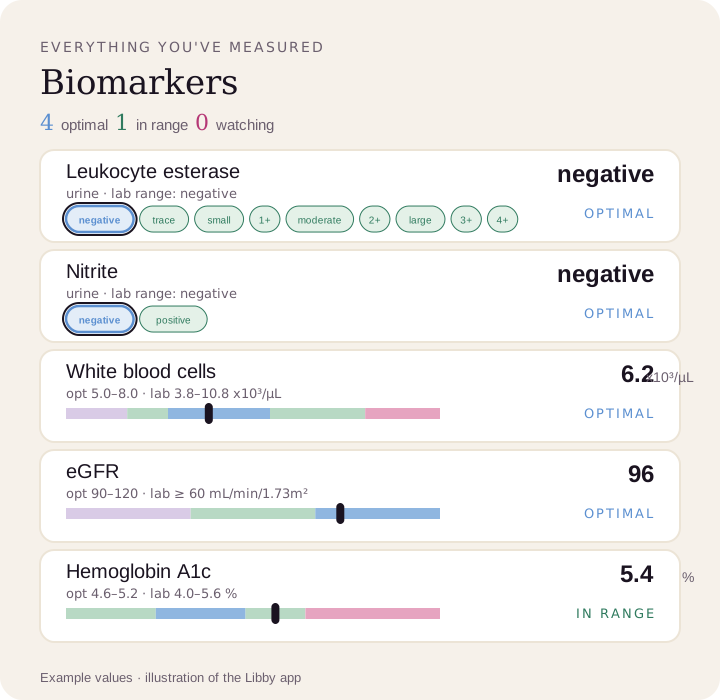
See every result against your lab's range.
Upload a lab PDF or a photo of your report. Libby shows each result against your lab's range, flags any positive urine pad, and tracks every urinalysis over time.
View your leukocyte esterase ›