Urine pH test: normal range, what low or high means
Urine pH shows how much acid your kidneys are clearing. What's normal, the optimal band, why urine runs acidic or alkaline, and when it matters.
Urine pH measures how acidic or alkaline your urine is. It's mostly a readout of what you ate and how much acid your kidneys are clearing. Healthy urine can range from about 4.5 to 8, and it usually sits slightly acidic, around 5.5 to 6.5.1
The short version
- Normal: Labcorp's reference range is 5.0 to 7.5.2 Healthy urine can swing from 4.5 to 8 over a day.1
- Acidic urine (below about 5.5) most often follows a diet heavy in meat, fish or cheese. It also tracks with insulin resistance, and it's the main driver of uric-acid kidney stones.345
- Alkaline urine (above about 7) usually follows a diet heavy in fruit and vegetables or an alkalinizing medicine. With a urinary infection it points to a urea-splitting germ such as Proteus.31
- The pH number alone is rarely the emergency. Its companions are: ketones with vomiting or fruity breath, or fever with side or back pain. Those need care the same day.67
What urine pH is
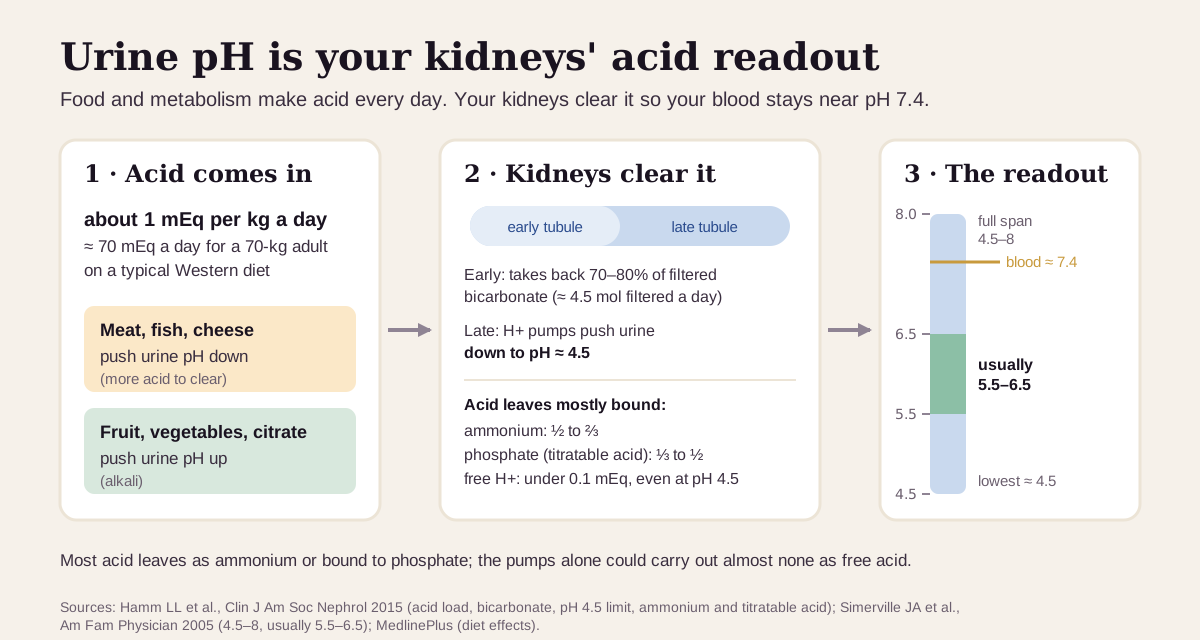
Your body makes acid every day. A typical Western diet, heavy in animal protein, plus normal metabolism produces about 1 mEq of acid per kilogram of body weight a day, roughly 70 mEq for a 70-kg adult.8 Your blood has to stay near pH 7.4, so your kidneys move that acid out.
They do it in two steps. First they take back almost all the bicarbonate (the blood's main acid buffer) that they filter. Then pumps in the last stretch of the kidney tubule push acid into the urine, down to a pH of about 4.5.8 Most of that acid leaves bound to ammonia (as ammonium) or to phosphate, because free acid alone would carry away almost nothing.8
So urine pH moves with your plate. Meat, fish and cheese push it down. Fruit, vegetables and citrate push it up.31 Urine pH generally follows the blood's acid balance, with one key exception, a kidney condition called renal tubular acidosis (more below).1
Urine pH is on every routine urinalysis. Labcorp's standard urinalysis reports it next to specific gravity, protein, glucose, ketones, blood, leukocyte esterase and nitrite.2
What's a normal urine pH?
Start with the range printed on your report. Labs differ a little:
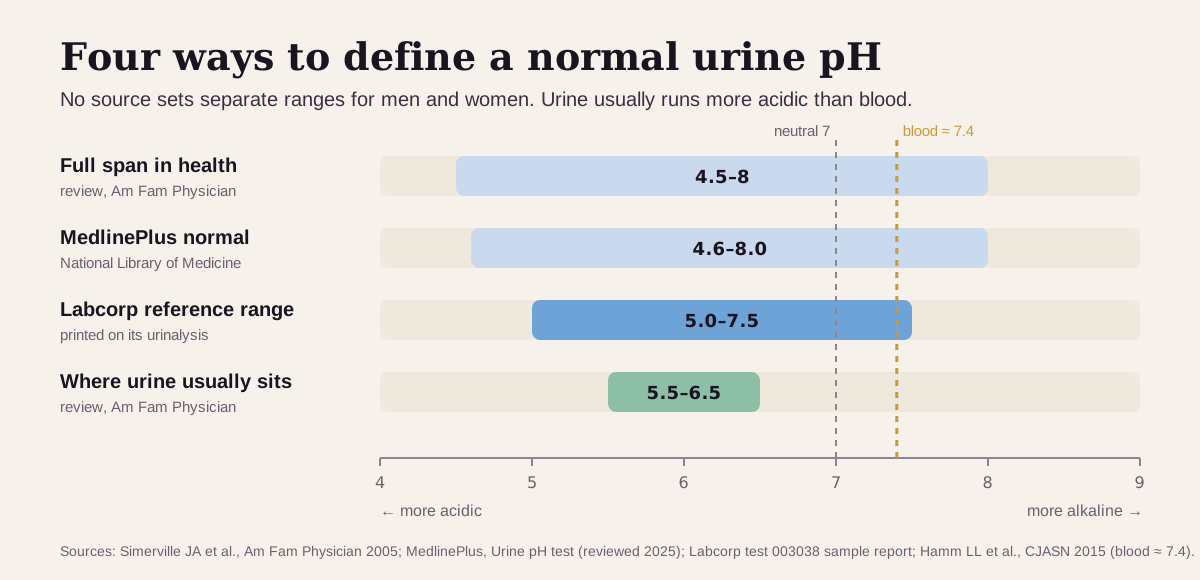
- Labcorp prints a reference range of 5.0 to 7.5.2
- MedlinePlus, the National Library of Medicine's health site, gives 4.6 to 8.0.3
- A review in American Family Physician puts the full span at 4.5 to 8, with urine normally slightly acidic, 5.5 to 6.5.1
Even the lowest urine pH is far more acidic than your blood, which stays near 7.4. That gap is the kidney's pumps at work.8 None of these sources sets a separate range for men and women.
"Optimal" urine pH: a middle band, not a floor
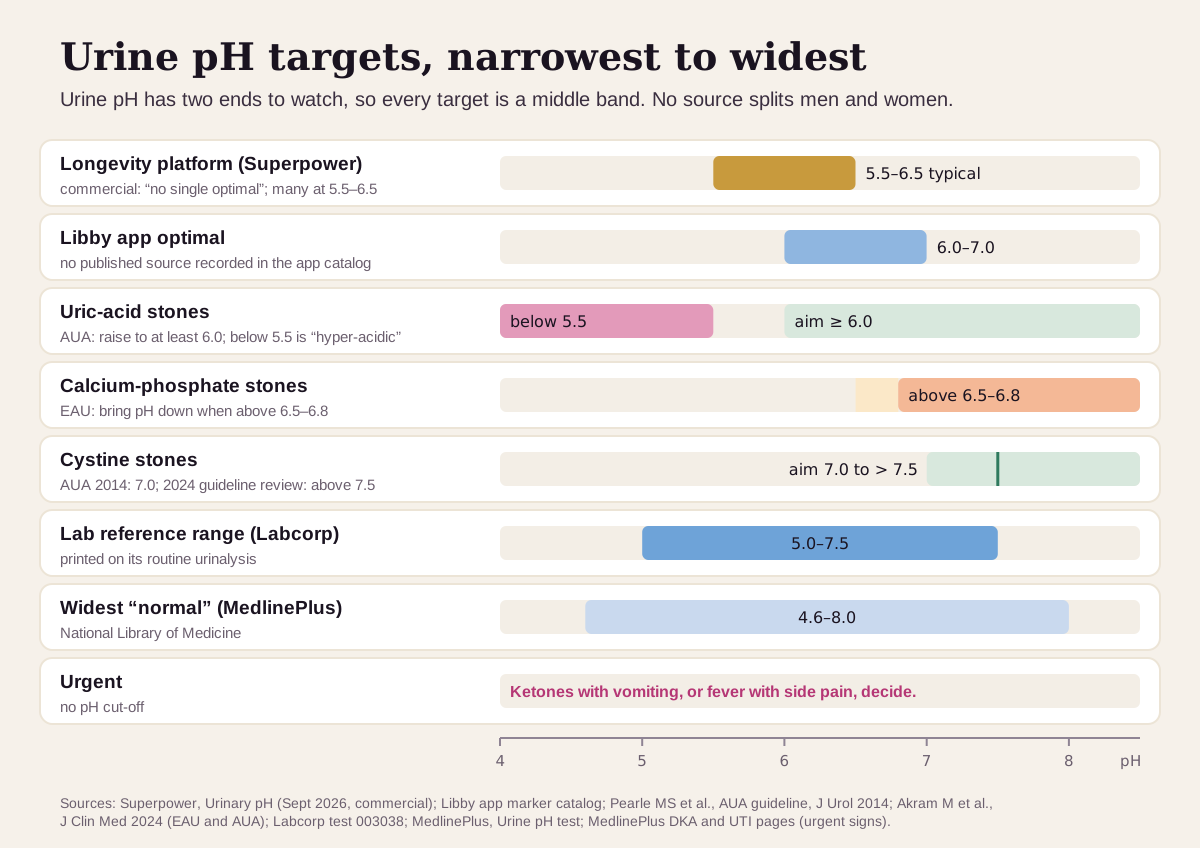
For most markers, optimizers push toward one end. Urine pH has two ends to watch. Acidic urine helps uric-acid and cystine stones form; alkaline urine helps calcium-phosphate and infection (struvite) stones form.19 So the targets sit in the middle. Here's the full ladder, from the narrowest band to the widest:
| Target | Urine pH (men and women) | Who uses it |
|---|---|---|
| Longevity platform | around 5.5–6.5, "no single optimal" | Superpower says many healthy people fall around 5.5–6.5 and that there's no one optimal value10 |
| Libby app optimal | 6.0–7.0 | The optimal range shown in the Libby app. The app's catalog records no published source for this band |
| Uric-acid stones | raise to at least 6.0 | The American Urological Association (AUA). Stone guidelines call urine below 5.5 "hyper-acidic"59 |
| Calcium-phosphate stones | bring down when above 6.5–6.8 | The European Association of Urology (EAU)9 |
| Cystine stones | 7.0 (AUA) to above 7.5 | AUA 2014; a 2024 review of the stone guidelines59 |
| Lab reference range | 5.0–7.5 | Labcorp2 |
| Widest "normal" | 4.6–8.0 | MedlinePlus3 |
| Urgent | no pH cut-off | Ketones with vomiting, or fever with side pain, decide the urgency67 |
Why the middle band matters:
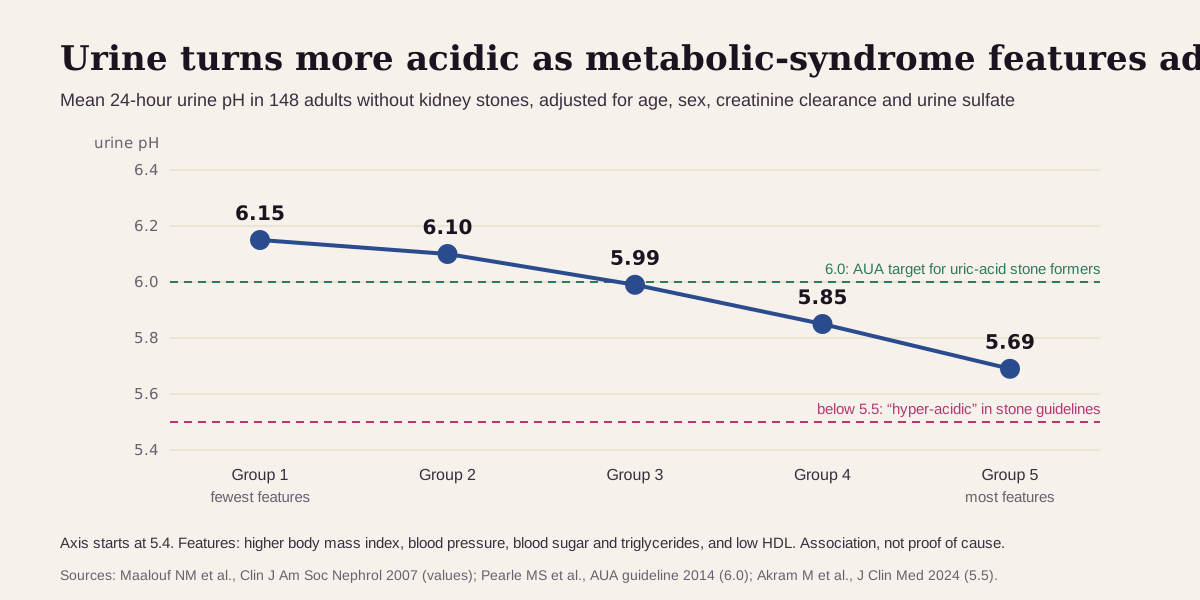
- In 148 adults with no kidney stones, 24-hour urine pH fell step by step as metabolic-syndrome features (higher body mass index, blood pressure, blood sugar and triglycerides, and low HDL) added up: 6.15, 6.10, 5.99, 5.85, then 5.69. The more insulin-resistant people were, the more acidic their urine.4
- That matters because low urine pH, more than high uric acid, drives most uric-acid stones. The AUA's first-line treatment is to raise urine pH to about 6.0 with potassium citrate.5
Keep "optimal" in perspective. A pH of 5.5 the morning after a steak dinner is your kidneys doing their job. Higher isn't better either: above 6.5 to 6.8 is where calcium-phosphate stones form, and an infection can push urine alkaline on its own.91 A target band matters most if you've had kidney stones, and then your clinician picks the number by stone type.5
What a low or high urine pH usually means
Direction comes first, then the company it keeps. Below 5.5 counts as acidic in stone guidelines, and above 6.5 is past the usual range.91
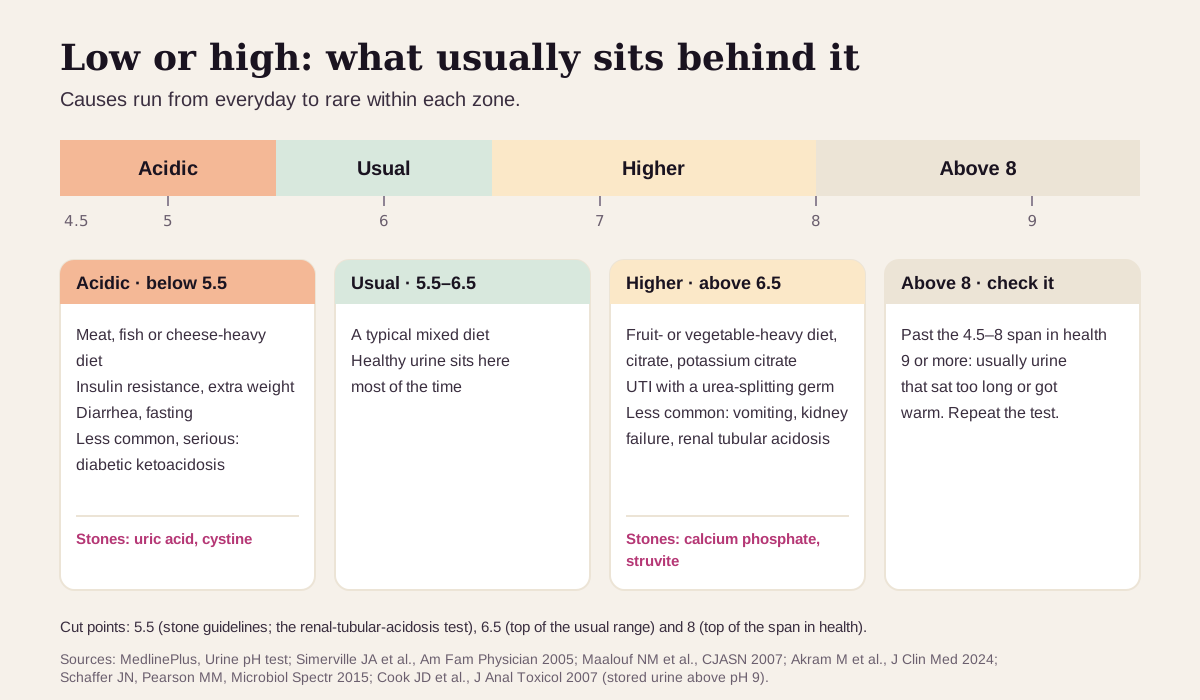
Acidic urine (below about 5.5)
The usual suspects:
- Your diet. A diet high in meat, fish or cheese lowers urine pH.3 In one analysis of common foods, some hard cheeses topped the acid-load scale at about 23.6 mEq per 100 g.12
- Insulin resistance and extra weight. Urine pH drops as metabolic-syndrome features add up (see the figure above).4
- Diarrhea and fasting. Both can make urine more acidic.3
- Less common but serious: diabetic ketoacidosis (DKA). In diabetes, sometimes not yet diagnosed, ketones and acid can build up in the blood. Urine turns acidic and ketones show on the dipstick.313
Acidic urine is where uric-acid stones form, and cystine crystals in acidic urine point to cystinuria, an inherited stone condition.1
Alkaline urine (above about 7)
The usual suspects:
- Your diet. A diet high in fruit, vegetables or non-cheese dairy raises urine pH, and citrate-rich foods do too.31
- Medicines. Potassium citrate raises urine pH on purpose.5 Acetazolamide, ammonium chloride, methenamine, sodium bicarbonate and thiazide diuretics can also shift the result, so bring your medicine list. Don't stop a prescribed medicine on your own.3
- A sample that sat. Urine should be tested within two hours or refrigerated.1 Left warm, stored urine drifts alkaline and can pass pH 9.11
- A urinary infection with a urea-splitting germ. Bacteria such as Proteus mirabilis make urease, which turns urea into ammonia and raises the pH. Proteus causes 1–10% of all urinary infections and 10–44% of long-term catheter infections.14 Alkaline urine in someone with a UTI points to this kind of germ, which can build large struvite ("staghorn") stones.1
- Less common: vomiting or stomach suction, kidney failure, and renal tubular acidosis, a kidney condition that leaves urine alkaline even when the blood turns acidic.315
Get care the same day if your urinalysis shows ketones with vomiting, fruity breath, deep fast breathing or confusion, whether or not you've been told you have diabetes: DKA is a medical emergency, and it's sometimes the first sign of diabetes.6 Also get prompt care if urinary symptoms come with fever, chills, side or back pain, or vomiting, the signs of a possible kidney infection.7
Urine pH reads best next to its neighbors
A pH number on its own often reflects what you've eaten over the last few days.316 The urinalysis dipsticks next to it, plus the bicarbonate (CO2) on a blood panel, help sort out which story you're in:11315
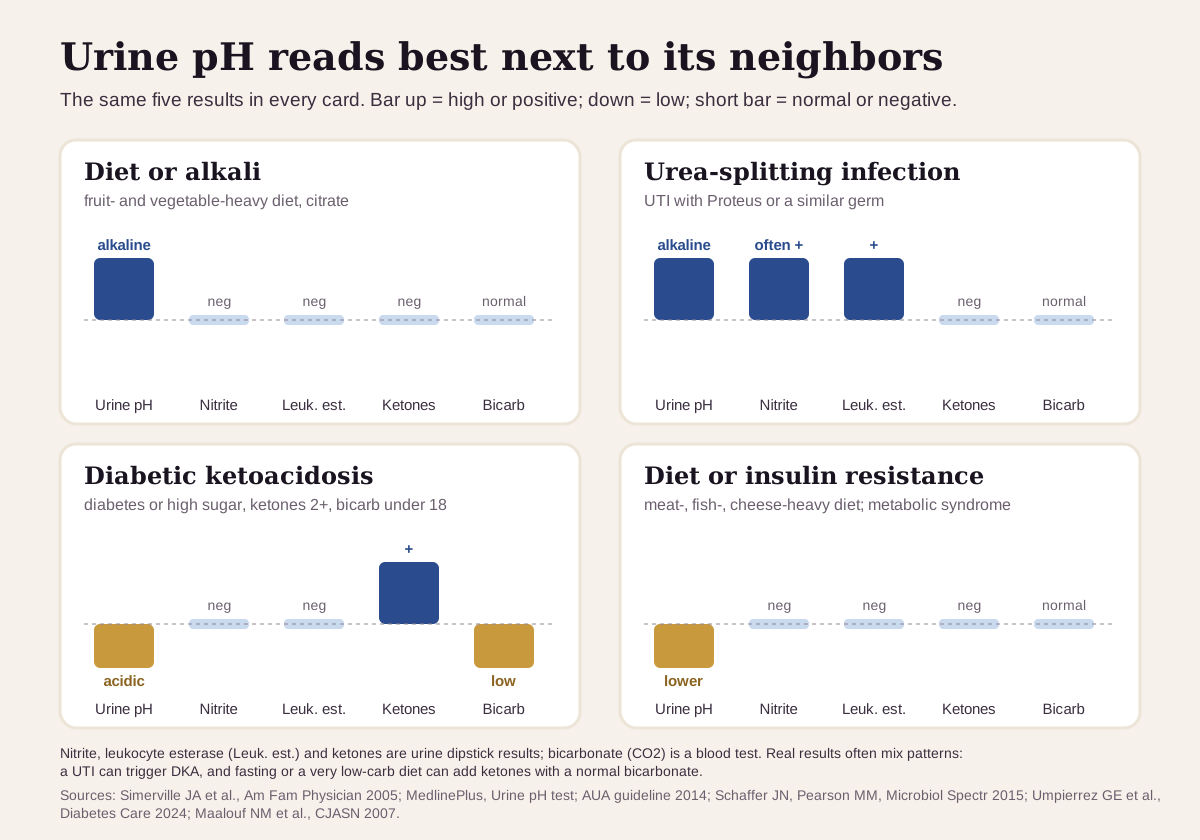
| If you see… | It often points to… |
|---|---|
| Alkaline pH, dipsticks negative, bicarbonate normal | a fruit- and vegetable-heavy diet, citrate or another alkalinizing medicine |
| Alkaline pH with positive nitrite and/or leukocyte esterase | a urinary infection; the alkaline pH suggests a urea-splitting germ such as Proteus |
| Acidic pH, ketones 2+ or more, blood bicarbonate under 18 | diabetic ketoacidosis, in diabetes or high blood sugar (it can be the first sign of diabetes): an emergency |
| Lower-than-usual pH, dipsticks negative, bicarbonate normal | a meat-, fish- or cheese-heavy diet, or insulin resistance |
| pH stays above about 5.5 even after an overnight fast (and no urinary infection), with low blood bicarbonate | distal renal tubular acidosis: the blood turns acidic but the urine stays alkaline |
| pH of 9 or more, nothing else off | a sample that sat too long or got warm; a fresh sample tested within two hours settles it |
Two overlaps are worth knowing. A urinary infection is a common trigger of DKA, so nitrite and leukocyte esterase can be positive in that pattern too.13 And ketones with a normal bicarbonate can come from fasting or a very low-carb diet, which is why the low bicarbonate is what points to DKA.13
The table draws on MedlinePlus and Maalouf 2007 for the diet rows and the AUA guideline for citrate,345 the review in American Family Physician for the infection, renal tubular acidosis and two-hour rules,1 a renal tubular acidosis review for its bicarbonate of 10–20 mmol/L,15 the 2024 diabetes consensus for the ketoacidosis numbers,13 and a storage study for the old-sample row.11
How fast urine pH changes
Urine pH answers to your diet within a day. In one study, healthy female students switched from their usual food to a protein-rich "acid" diet or a fruit-and-vegetable "alkaline" diet. Their urine was already clearly apart on day 1, and it settled by day 3 at about 5.9 on the acid diet and 6.7 on the alkaline one.16
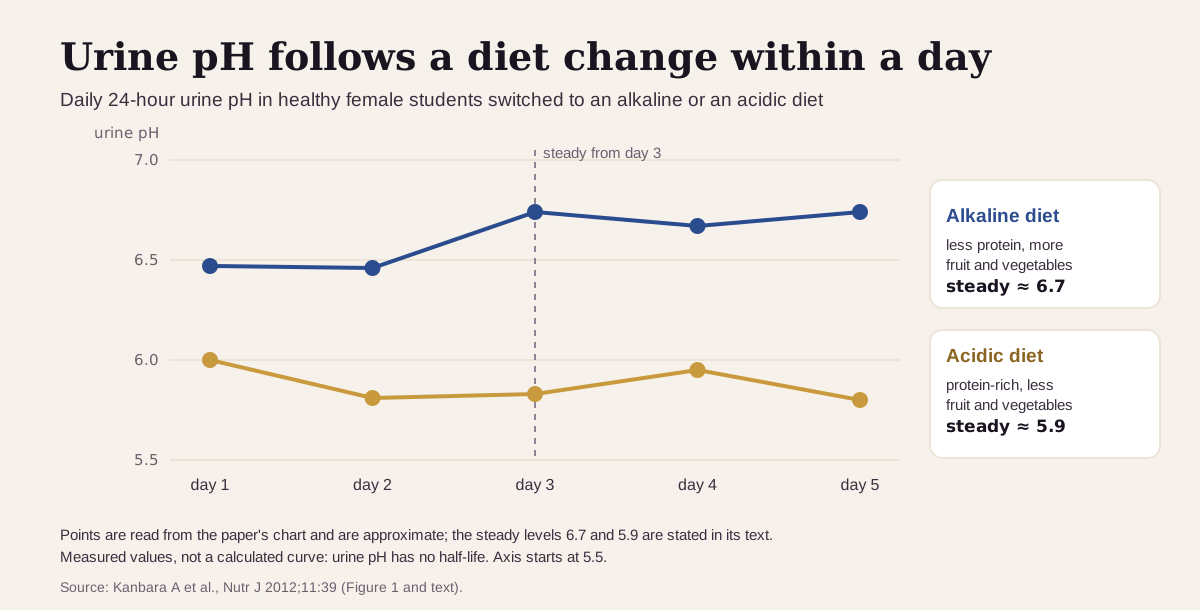
What that means in practice:
- Eat normally for a few days before the test. MedlinePlus gives exactly that advice, because diet moves the number.3
- Timing and handling matter. A sample should be tested within two hours or kept cold, and warm storage pushes pH up.111
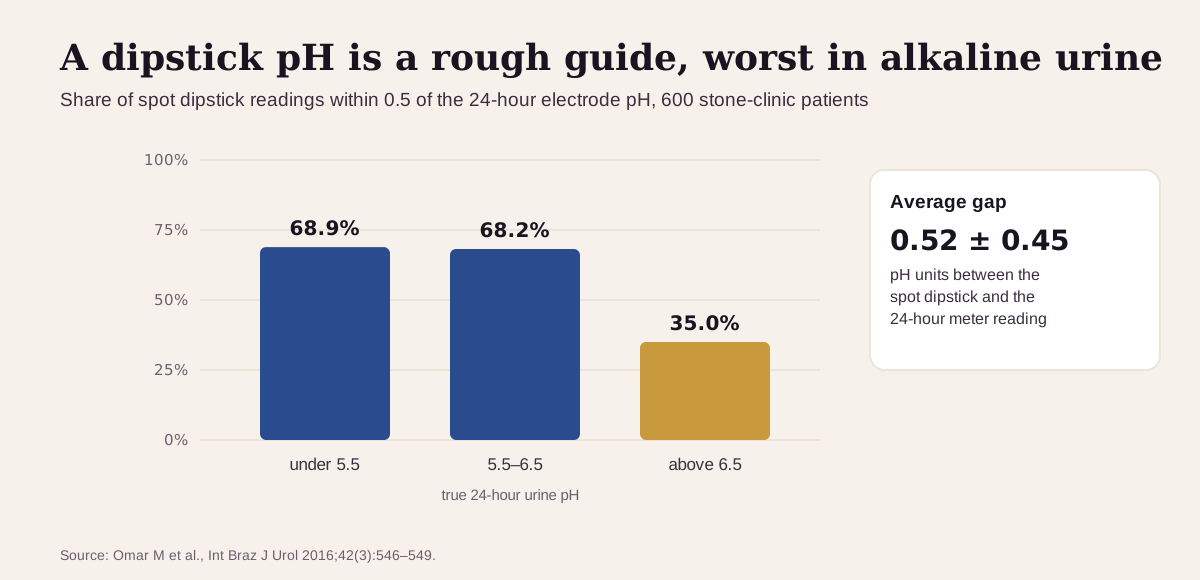
- One dipstick is a rough snapshot. In 600 stone-clinic patients, a spot dipstick pH differed from the 24-hour meter reading by 0.52 pH units on average.17 Stone clinics measure your usual pH with one or two 24-hour urine collections.5
- Trends beat snapshots. A pH that runs below 5.5 across repeat tests is what stone guidelines call "hyper-acidic" urine; one acidic sample after a big steak dinner is more likely the dinner.93
Going deeper: how the kidney acidifies urine
Each day your kidneys filter about 4.5 moles of bicarbonate. The first part of the tubule takes back 70–80% of it, and later segments reclaim the rest, so normal urine carries almost none.8
To get rid of acid, the kidney then makes new bicarbonate by excreting acid, in two forms. One-third to one-half leaves bound to buffers, mostly phosphate (called "titratable acid"). One-half to two-thirds leaves as ammonium, and that is the part the kidney can ramp up during an acid load. Even at pH 4.5, free acid in the urine is under 0.1 mEq, which is why the buffers matter.8
Food sets the load. Remer and Manz scored the "potential renal acid load" of common foods: about +23.6 mEq per 100 g for some hard cheeses, 0 for fats and oils, and about −3 for fruits, juices and vegetables. The daily net acid the kidneys excreted tracked urine pH closely (r = 0.83).12
The dipstick has quirks of its own. Alkaline urine can make the protein pad read falsely positive, and urine below pH 6.0 can hide a positive nitrite result.1 Dipsticks also do worst in alkaline urine: accuracy fell to 35% above pH 6.5.17
Questions worth asking
- Was my urine pH acidic or alkaline, and does that fit what I ate the day before?
- Were nitrite, leukocyte esterase or ketones positive on the same test?
- Should we check my blood bicarbonate (CO2) or repeat the urinalysis?
- I've had a kidney stone: do we know its type, and what urine pH should I aim for?
- Would a 24-hour urine collection tell us more than a dipstick?
- Could any of my medicines or supplements be shifting my urine pH?
FAQ
What is a normal urine pH? Labcorp's reference range is 5.0 to 7.5, and MedlinePlus gives 4.6 to 8.0. Most of the time urine sits slightly acidic, around 5.5 to 6.5.231
What makes urine acidic? Most often a diet heavy in meat, fish or cheese. Insulin resistance, diarrhea, fasting and, less often, diabetic ketoacidosis lower it too.34
What does alkaline urine mean? Usually a diet rich in fruit and vegetables or an alkalinizing medicine. With a urinary infection it points to a urea-splitting germ such as Proteus, and a sample left sitting also turns alkaline.3111
What urine pH helps prevent kidney stones? It depends on the stone. The AUA raises urine to about 6.0 for uric-acid stones and 7.0 for cystine stones, while calcium-phosphate stones form more easily above 6.5 to 6.8.59
This guide is for education. It can't diagnose you or replace care from a clinician who knows your history.
Footnotes
-
Simerville JA, Maxted WC, Pahira JJ. Urinalysis: a comprehensive review. Am Fam Physician. 2005;71(6):1153–1162. The source for the 4.5–8 span and the usual 5.5–6.5, diet effects, renal tubular acidosis, urea-splitting infections, uric-acid and cystine stones, the two-hour rule and the dipstick quirks. AAFP ↩ ↩2 ↩3 ↩4 ↩5 ↩6 ↩7 ↩8 ↩9 ↩10 ↩11 ↩12 ↩13 ↩14 ↩15 ↩16 ↩17 ↩18 ↩19 ↩20 ↩21 ↩22 ↩23 ↩24
-
Labcorp. Urinalysis, Routine With Microscopic Examination on Positives (test 003038). The pH reference interval of 5.0–7.5 is printed on the test's linked sample report (reported May 18, 2026). A commercial lab, cited for its published range. labcorp.com ↩ ↩2 ↩3 ↩4 ↩5 ↩6 ↩7
-
National Library of Medicine. Urine pH test. MedlinePlus Medical Encyclopedia. Reviewed July 13, 2025. Normal 4.6–8.0, the causes of high and low urine pH, the medicines that shift it, and the diet advice before testing. MedlinePlus ↩ ↩2 ↩3 ↩4 ↩5 ↩6 ↩7 ↩8 ↩9 ↩10 ↩11 ↩12 ↩13 ↩14 ↩15 ↩16 ↩17 ↩18 ↩19 ↩20 ↩21 ↩22 ↩23 ↩24
-
Maalouf NM, Cameron MA, Moe OW, Adams-Huet B, Sakhaee K. Low urine pH: a novel feature of the metabolic syndrome. Clin J Am Soc Nephrol. 2007;2(5):883–888. 148 adults free of kidney stones; 24-hour urine pH measured by electrode. DOI ↩ ↩2 ↩3 ↩4 ↩5 ↩6 ↩7 ↩8
-
Pearle MS, Goldfarb DS, Assimos DG, et al. Medical management of kidney stones: AUA guideline. J Urol. 2014;192(2):316–324. Raise urine pH to 6.0 for uric-acid stones and 7.0 for cystine stones with potassium citrate; most uric-acid stones come from low urine pH. The AUA published an update in 2026. PubMed ↩ ↩2 ↩3 ↩4 ↩5 ↩6 ↩7 ↩8 ↩9 ↩10 ↩11
-
National Library of Medicine. Diabetic ketoacidosis. MedlinePlus Medical Encyclopedia. Reviewed January 10, 2025. Symptoms, when to go to the emergency room, and that DKA is sometimes the first sign of type 1 diabetes. MedlinePlus ↩ ↩2 ↩3
-
National Library of Medicine. Urinary tract infection - adults. MedlinePlus Medical Encyclopedia. Reviewed July 23, 2024. Signs that an infection has reached the kidneys. MedlinePlus ↩ ↩2 ↩3
-
Hamm LL, Nakhoul N, Hering-Smith KS. Acid-Base Homeostasis. Clin J Am Soc Nephrol. 2015;10(12):2232–2242. How the kidney reclaims bicarbonate and excretes the day's acid (about 1 mEq/kg/day), the H+ pump that lowers urine to about pH 4.5, and the titratable acid and ammonium split. PMC ↩ ↩2 ↩3 ↩4 ↩5 ↩6 ↩7 ↩8
-
Akram M, Jahrreiss V, Skolarikos A, et al. Urological Guidelines for Kidney Stones: Overview and Comprehensive Update. J Clin Med. 2024;13(4):1114. Side-by-side EAU and AUA recommendations: "hyper-acidic" urine below 5.5 for uric-acid stones, pH above 6.5–6.8 for calcium-phosphate stones, and above 7.5 for cystine. PMC ↩ ↩2 ↩3 ↩4 ↩5 ↩6 ↩7 ↩8 ↩9
-
Superpower. Urinary pH: Best Biomarkers to Monitor. Published September 1, 2026. States that "many healthy people commonly" fall around 5.5 to 6.5 and that "there isn't one single 'optimal' value." A commercial source, listed as what an optimizer platform says. superpower.com ↩ ↩2
-
Cook JD, Strauss KA, Caplan YH, Lodico CP, Bush DM. Urine pH: the effects of time and temperature after collection. J Anal Toxicol. 2007;31(8):486–496. Warmer, longer storage raised urine pH above 9. PubMed ↩ ↩2 ↩3 ↩4 ↩5
-
Remer T, Manz F. Potential renal acid load of foods and its influence on urine pH. J Am Diet Assoc. 1995;95(7):791–797. The food acid-load scores and the r = 0.83 link to urine pH. PubMed ↩ ↩2
-
Umpierrez GE, Davis GM, ElSayed NA, et al. Hyperglycemic Crises in Adults With Diabetes: A Consensus Report. Diabetes Care. 2024;47(8):1257–1275. DKA requires high glucose (200 mg/dL or more) or known diabetes, raised ketones (urine ketones 2+ or more) and metabolic acidosis (bicarbonate under 18 mmol/L); 6–21% of adults with type 1 diabetes are first diagnosed during DKA, and infection, often urinary, is its most common trigger. PMC ↩ ↩2 ↩3 ↩4 ↩5
-
Schaffer JN, Pearson MM. Proteus mirabilis and Urinary Tract Infections. Microbiol Spectr. 2015;3(5). A Gram-negative, urease-positive germ; urease raises urine pH and drives struvite stones; 10–44% of long-term catheter infections. PMC ↩ ↩2
-
Palmer BF, Kelepouris E, Clegg DJ. Renal Tubular Acidosis and Management Strategies: A Narrative Review. Adv Ther. 2021;38(2):949–968. In distal RTA the kidneys cannot acidify urine despite metabolic acidosis: urine pH above 5.3, blood bicarbonate 10–20 mmol/L, low potassium, and calcium-phosphate stones. PMC ↩ ↩2 ↩3
-
Kanbara A, Miura Y, Hyogo H, Chayama K, Seyama I. Effect of urine pH changed by dietary intervention on uric acid clearance mechanism of pH-dependent excretion of urinary uric acid. Nutr J. 2012;11:39. Healthy female students on 5-day acid and alkaline diets; urine pH steady by day 3. PMC ↩ ↩2 ↩3
-
Omar M, Sarkissian C, Jianbo L, Calle J, Monga M. Dipstick spot urine pH does not accurately represent 24 hour urine pH measured by an electrode. Int Braz J Urol. 2016;42(3):546–549. 600 stone-clinic patients. PMC ↩ ↩2 ↩3
Educational content, not medical advice. Libby is a personal record tool, not a medical service — it doesn't diagnose, treat, or prescribe. Reference ranges vary by lab and by person. Talk to a qualified healthcare professional about your results.
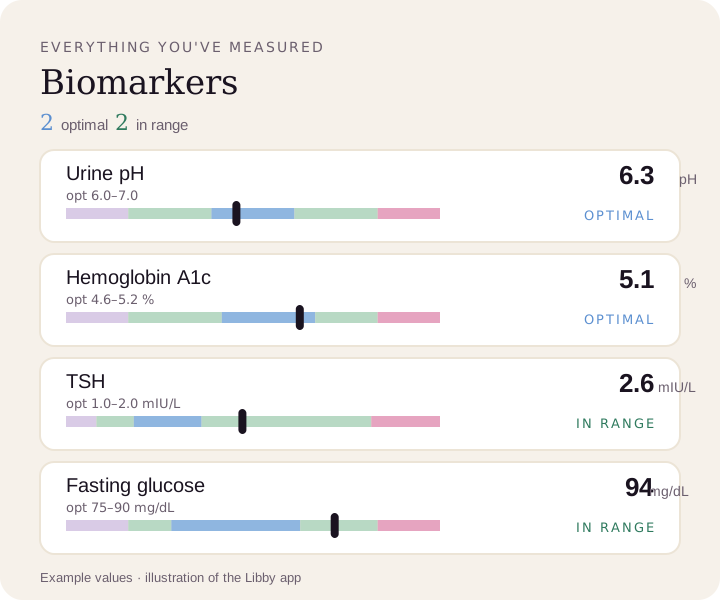
Compare your results to optimal ranges.
Upload a lab PDF or a photo of your report. Libby puts each marker on a reference range and, where one exists, the optimal range, and tracks your trends over time.
View your urine pH ›