Urine potassium test: 24-hour vs spot, and what it means
Urine potassium shows how much potassium your kidneys let go. Normal 24-hour ranges, spot ratios, and what low or high means when blood potassium is off.
Urine potassium measures how much potassium your kidneys are letting go. Most of the potassium you eat leaves in your urine, so a 24-hour collection is a good readout of your diet. When your blood potassium is off, the urine answers the key question: are your kidneys holding on to potassium, or losing it?12
The short version
- Normal (24-hour urine): Labcorp's range is 20–116 mmol a day for men and 14–95 for women aged 18–80; ARUP's is 25–125. The typical U.S. adult passes about 61 (men) or 45 (women).345
- Spot vs 24-hour: a single spot sample gives a concentration that swings with how dilute your urine is, and ARUP sets no normal range for it. The potassium-to-creatinine ratio corrects for dilution.42
- With low blood potassium, a low urine potassium (under about 15–20 mmol a day, or a spot ratio under 13 mEq per gram of creatinine) means the kidneys are holding on: think diarrhea, a thin diet or a shift into cells. Higher values mean the kidneys are losing it: water pills, vomiting, too much aldosterone or low magnesium.132
- Urgent: urine potassium has no emergency cut-off. Blood potassium does: under 2.5 mmol/L is severe, and weakness, palpitations or trouble breathing need care right away.16
What urine potassium is
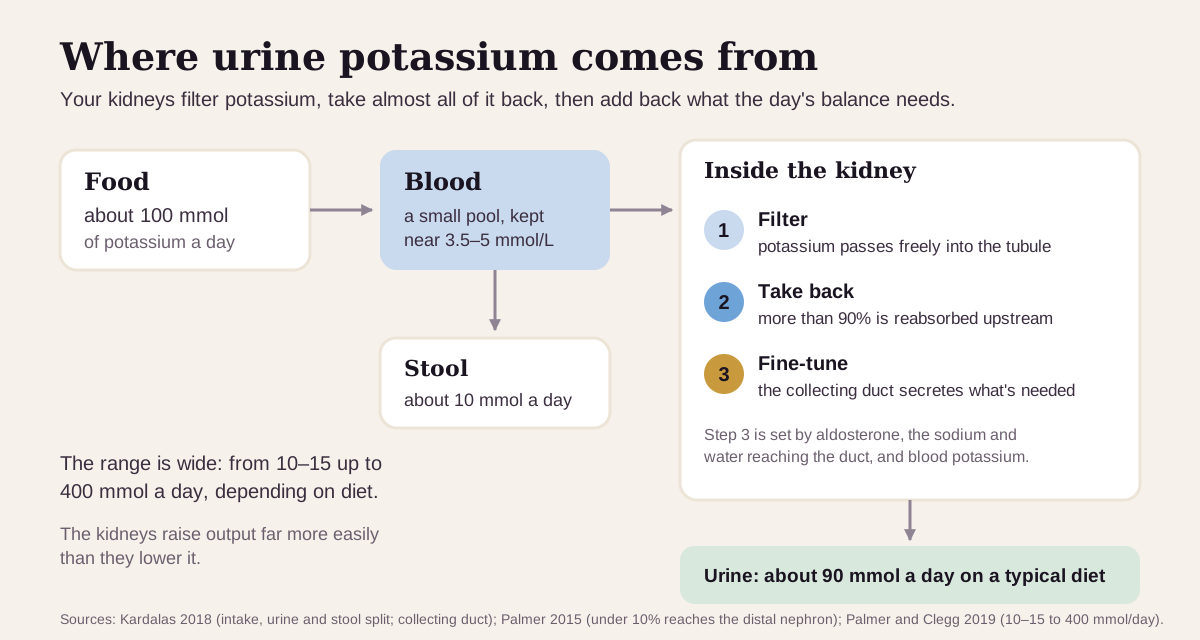
On a typical diet you take in about 100 mmol of potassium a day. About 90 leaves in your urine and about 10 in your stool.1 Your blood holds only a small pool, so the kidneys have to match output to intake every day.
They do it in two steps. First they filter potassium freely and take almost all of it back: less than 10% of what's filtered reaches the last stretch of the kidney tubule.9 Then the collecting ducts secrete what the day's balance needs. Two dials set that amount: aldosterone, the adrenal hormone that tells the kidney to keep sodium and let potassium go, and how much sodium and water reach the duct.1
The result can range from 10–15 mmol a day to as much as 400, depending on what you eat.2 The kidneys are much better at raising output than at cutting it, which is why a diet very low in potassium can slowly drain your stores.1
Clinicians usually order a urine potassium when a blood potassium is off, or with vomiting, diarrhea or dehydration, or to look into a kidney or adrenal problem.7 Researchers use the 24-hour version to measure how much potassium people eat.108
It comes in three forms:
- 24-hour urine potassium (mmol per day): everything you pass in a full day. This is the best measure of the kidneys' output.1
- Spot urine potassium (mmol/L): the concentration in one sample.
- Spot potassium-to-creatinine ratio: the spot potassium divided by the spot creatinine, which corrects for how concentrated the sample is.2
What's a normal urine potassium?
Start with the range printed on your report. For a 24-hour collection:
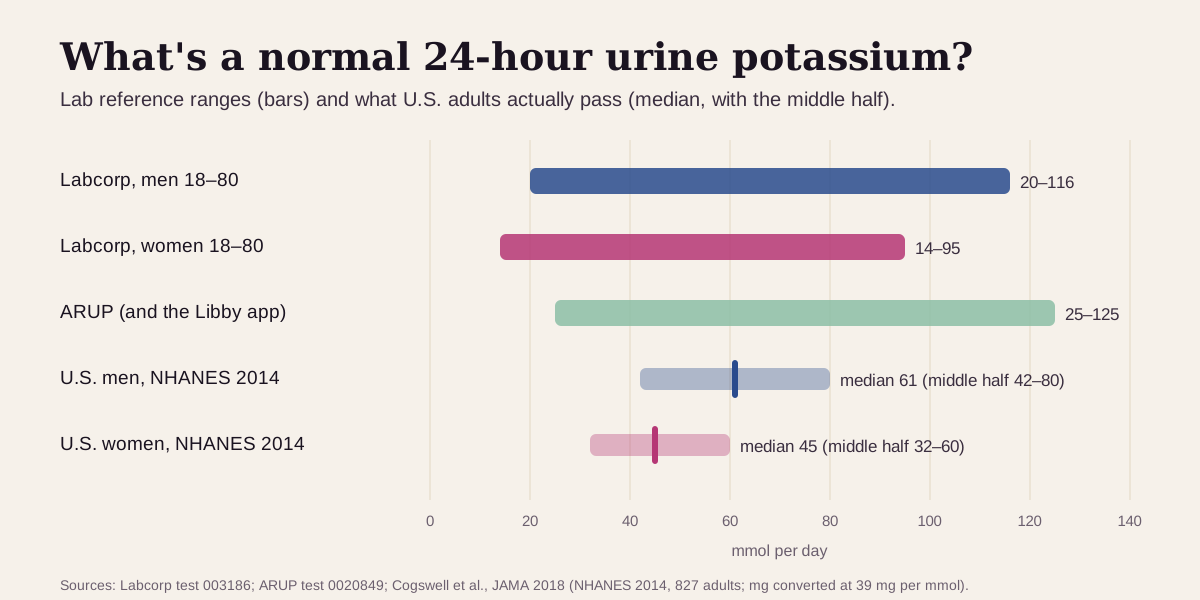
- Labcorp sets its range by sex and age: 20–116 mmol a day for men and 14–95 for women aged 18–80, with lower ranges for children and for adults over 80.3
- ARUP, another large U.S. reference lab, uses 25–125 mmol a day for everyone, and MedlinePlus gives the same numbers as a typical range.47
- For a spot sample, ARUP says a reference range has not been established. MedlinePlus gives 15–40 mmol/L as an example.47
In a national survey of 827 U.S. adults with a full 24-hour collection, the median was 2,363 mg (about 61 mmol) a day for men and 1,740 mg (about 45) for women. Adults aged 45–69 passed less than adults aged 20–44.5
Here is the part that matters most: urine electrolytes have usual ranges, not "normal" values. Kidney specialists Kamel and Halperin give the example of 60 mmol a day. That sits inside the usual range, yet it means the kidneys are wasting potassium in someone with a low blood potassium, and failing to clear it in someone with a high one.11 Your blood potassium gives the urine number its meaning.
"Optimal" urine potassium: more is usually better, with healthy kidneys
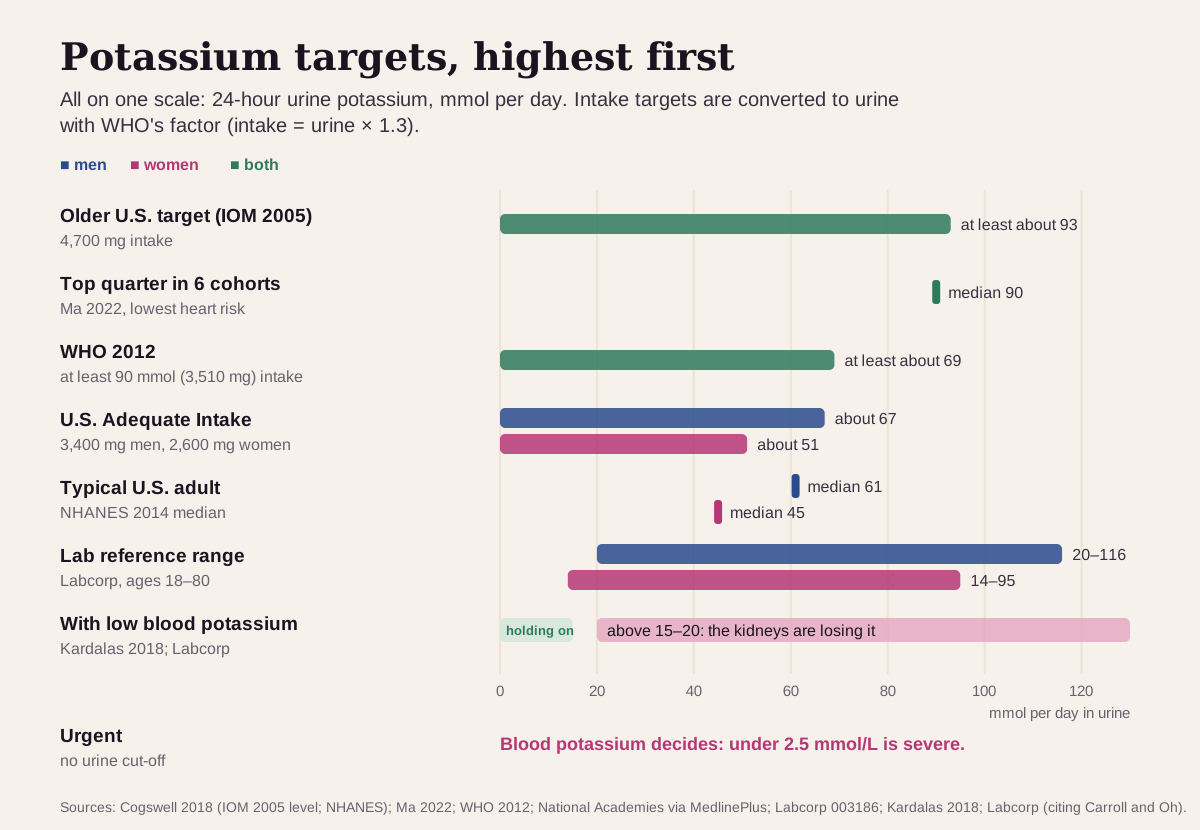
We found no functional-medicine or longevity target for urine potassium itself, and the Libby app shows your result against your lab's range. What does exist are diet targets, and the 24-hour urine is how researchers check them. The World Health Organization converts a 24-hour urine to intake by multiplying by 1.3; most of the rest leaves in stool.81 Here's the ladder, from the highest target down:
| Target | Men | Women | Who sets it |
|---|---|---|---|
| Older U.S. intake target | 4,700 mg intake (about 93 in urine) | same | The Institute of Medicine's 2005 level5 |
| Lowest-risk group in research | median 90 mmol/day in urine | same (pooled) | Top quarter of 10,709 adults in six cohorts12 |
| World Health Organization | at least 90 mmol (3,510 mg) intake, about 69 in urine | same | WHO 2012 guideline8 |
| U.S. Adequate Intake | 3,400 mg intake (about 67 in urine) | 2,600 mg intake (about 51 in urine) | National Academies, via MedlinePlus13 |
| Typical U.S. adult | median 61 mmol/day | median 45 mmol/day | NHANES 20145 |
| Lab reference range | 20–116 mmol/day | 14–95 mmol/day | Labcorp, ages 18–803 |
| Low blood potassium | above 15–20 mmol/day points to kidney loss | same | Kardalas 2018; Labcorp13 |
| Urgent | no urine cut-off | no urine cut-off | Blood potassium under 2.5 mmol/L is severe1 |
Why the high targets exist:
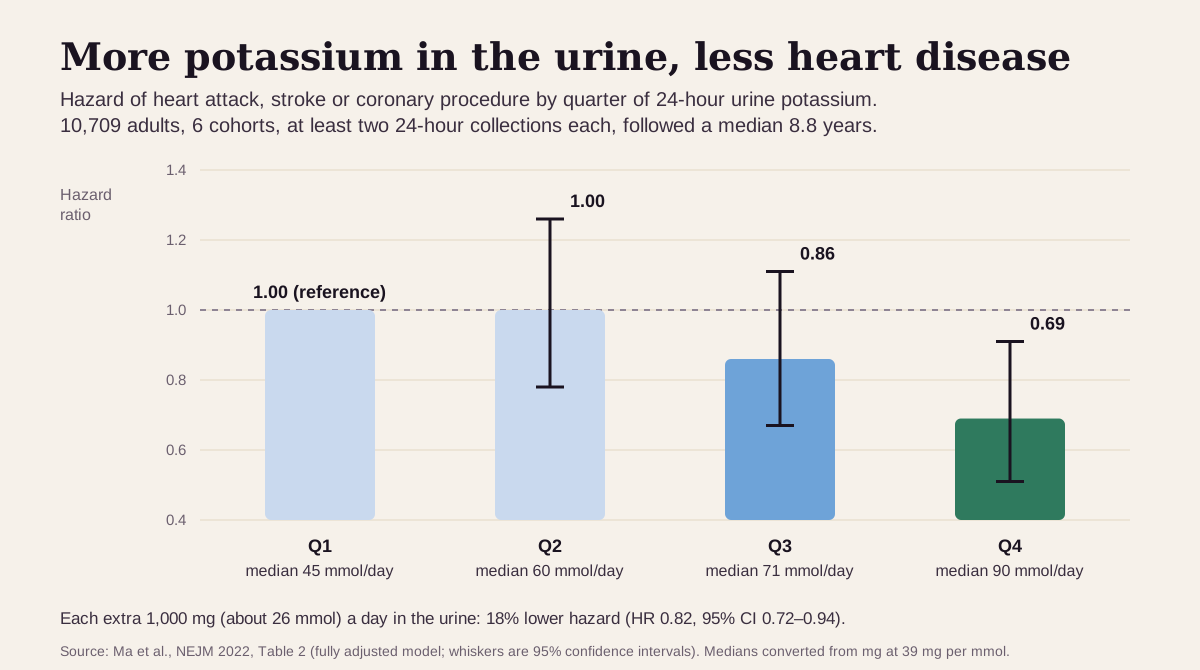
- In 10,709 adults from six U.S. and European cohorts, each with at least two 24-hour collections and followed for a median 8.8 years, the top quarter of urine potassium (median 3,501 mg, about 90 mmol a day) had a 31% lower hazard of heart attack, stroke or a coronary procedure than the bottom quarter (median 1,755 mg, about 45 mmol). Each extra 1,000 mg a day went with an 18% lower hazard.12
- WHO's review found that an intake of at least 90 mmol a day went with about 30% less stroke than a lower intake (relative risk 0.70), in low-quality evidence from four studies.8
- Americans fall short on average: mean urine potassium in the national survey was 46% of the older 4,700 mg target, though urine catches only part of what people eat.5
Keep "optimal" in perspective. These are targets for potassium from food, in people whose kidneys clear potassium normally. WHO's guideline leaves out people with impaired urinary potassium excretion.8 If you have kidney disease, or take medicines that hold potassium in (ACE inhibitors, ARBs, spironolactone), talk with your clinician before taking potassium supplements.13 And one day's urine swings with one day's meals, so a single collection says more about that day than about your usual diet.5
What a low or high urine potassium usually means
Read the blood potassium first. With a low blood potassium, the urine says which way the potassium went.1 The three common forms of the test use different lines:
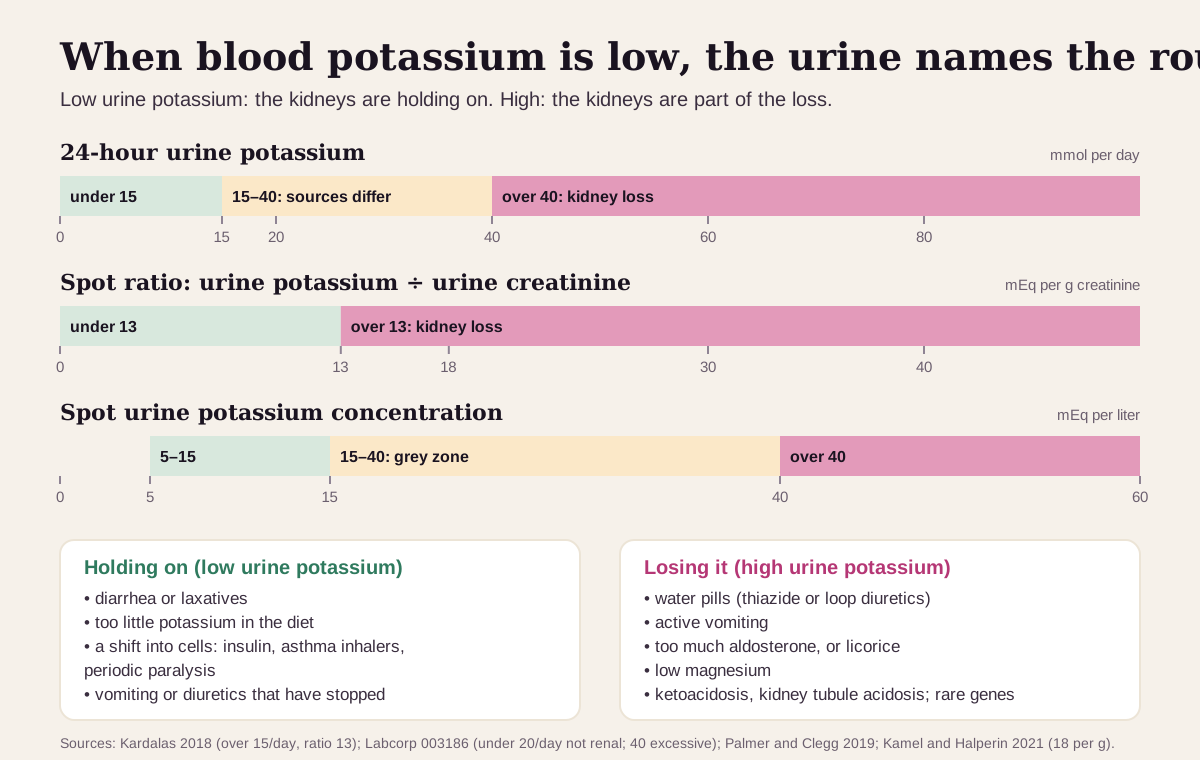
- 24-hour urine: a review in Endocrine Connections counts anything above 15 mmol a day as inappropriate kidney loss.1 Labcorp calls under 20 evidence that the loss came from outside the kidneys, and 40 or more excessive when blood potassium is under 3.3
- Spot ratio: under 13 mEq per gram of creatinine fits an appropriate response; higher points to the kidneys.21
- Spot concentration: 5–15 mEq/L fits a loss outside the kidneys and over 40 favors a kidney cause, though dilute or concentrated urine can mislead in either direction.2
Low blood potassium, low urine potassium: the kidneys are holding on
The usual suspects:
- Diarrhea or laxatives. Stool carries potassium out, and the kidneys hold on. The blood usually turns acidic (a low CO2 on your metabolic panel), though people who overuse laxatives often show little acid change.111
- A shift into cells. Insulin, asthma inhalers such as albuterol, an overactive thyroid and inherited periodic paralysis all push potassium from the blood into cells, with no net loss.114
- Too little potassium in the diet, over time.1
- A loss that has stopped. After vomiting stops or a water pill wears off, the kidneys switch back to saving potassium, so the urine can read low even though the kidneys caused the loss.11
Low blood potassium, high urine potassium: the kidneys are losing it
The usual suspects:
- Water pills. Thiazide and loop diuretics very frequently cause low potassium, by sending more sodium and fluid to the collecting duct while raising aldosterone.15 Don't stop a prescribed medicine on your own; bring your full list to your clinician.
- Active vomiting. Losing stomach acid loads the blood with bicarbonate, which drags potassium into the urine.215
- Too much aldosterone. Primary aldosteronism, classically from an aldosterone-making adrenal tumor, causes high blood pressure with low potassium.15 The Endocrine Society recommends screening people with high blood pressure and low potassium with an aldosterone-renin ratio.161 Real licorice (glycyrrhizin) can mimic it.111
- Low magnesium. Magnesium deficiency lets more potassium leak out in the collecting duct and makes low potassium hard to correct with potassium alone.17
- Less common: diabetic ketoacidosis, renal tubular acidosis (a kidney acid-handling problem), some antibiotics, and inherited conditions such as Bartter, Gitelman and Liddle syndromes.172
High blood potassium: is the urine low?
When blood potassium is high, healthy kidneys should push more out. A low urine potassium then points to kidneys that fall behind: kidney disease, low aldosterone (as in Addison disease), or medicines such as ACE inhibitors, ARBs, potassium-sparing diuretics, trimethoprim and NSAIDs.731 Kamel and Halperin add that in long-standing high potassium, the useful question is whether a big potassium intake is adding to it, and that because output swings over the day, it takes a full 24-hour collection to answer.11
Get care right away if your blood potassium is under 2.5 mmol/L or very high, or if a low or high potassium comes with muscle weakness, cramps or paralysis, palpitations or an irregular heartbeat, or trouble breathing.16
Urine potassium reads best next to its neighbors
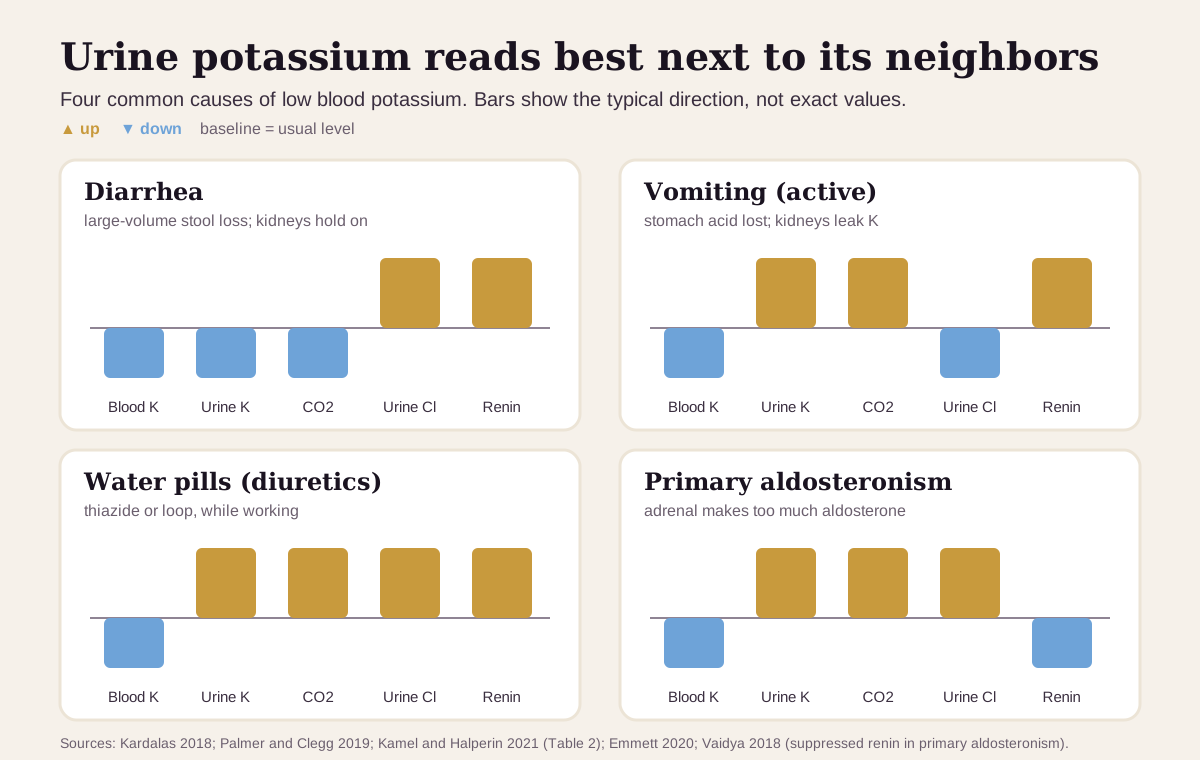
A urine potassium rarely settles the question alone. Kidney specialists read it with the blood acid-base picture (the CO2 or bicarbonate on a metabolic panel), urine chloride and, when blood pressure is high, renin and aldosterone:111
| If you see… | It often points to… |
|---|---|
| Low blood K, low urine K, low CO2, urine chloride high | large-volume diarrhea: potassium and bicarbonate lost in stool (laxative overuse often leaves CO2 near normal)1211 |
| Low blood K, low urine K, normal CO2 | a shift into cells (insulin, albuterol, periodic paralysis); laxative overuse or a low-potassium diet can look the same1112 |
| Low blood K, high urine K, high CO2, low urine chloride | active vomiting211 |
| Low blood K, high urine K, high CO2, high urine chloride, normal blood pressure | a diuretic that is still working, or an inherited salt-wasting condition (Bartter or Gitelman syndrome)111 |
| Low blood K, high urine K, high blood pressure, low renin | too much aldosterone (primary aldosteronism) or something that acts like it1518 |
| High blood K, low urine K | kidneys not clearing it: kidney disease, low aldosterone, or medicines1173 |
How fast urine potassium changes
Your urine potassium tracks the last few hours and the last few meals. The kidneys adjust their potassium output over several hours after a change, and even with steady meals, output runs lower at night and in the early morning and higher in the afternoon.9
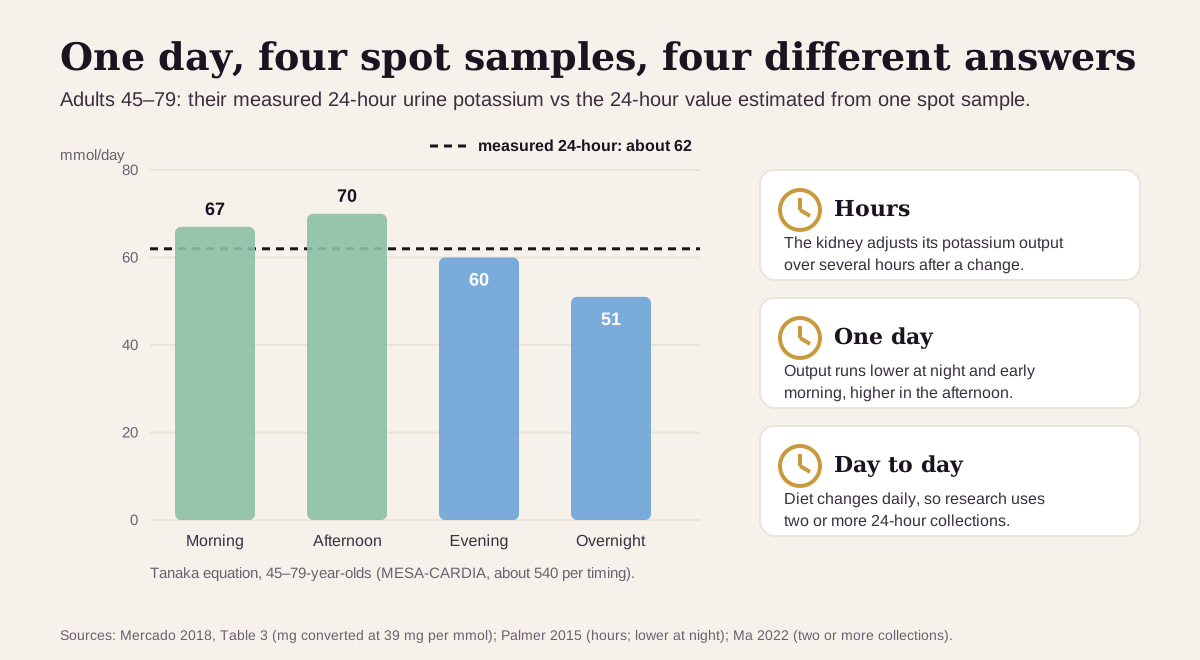
That daily rhythm is why a spot sample makes a shaky stand-in for a full day. In a U.S. study that collected every void for 24 hours, equations that estimate a day's potassium from one spot sample misplaced 61–75% of people by at least one 500-mg band, and an overnight sample ran low.10
What that means in practice:
- Collect exactly 24 hours. Labcorp's instructions: pass urine at 8 AM and throw it away, then collect everything, including the 8 AM sample the next morning, and note the total volume.3
- The creatinine checks your collection. Researchers treat a collection as possibly incomplete when its creatinine is 70% or less of what's expected for your size and sex.5
- One day is one day. Potassium swings less from day to day than sodium does, but a single collection still reflects that day's meals.5 The large outcome study averaged at least two 24-hour collections per person.12
- Tell your clinician about vomiting, diarrhea, water pills, potassium supplements and recent diet changes, since all of them move the number.7
Going deeper: the ratio and the TTKG
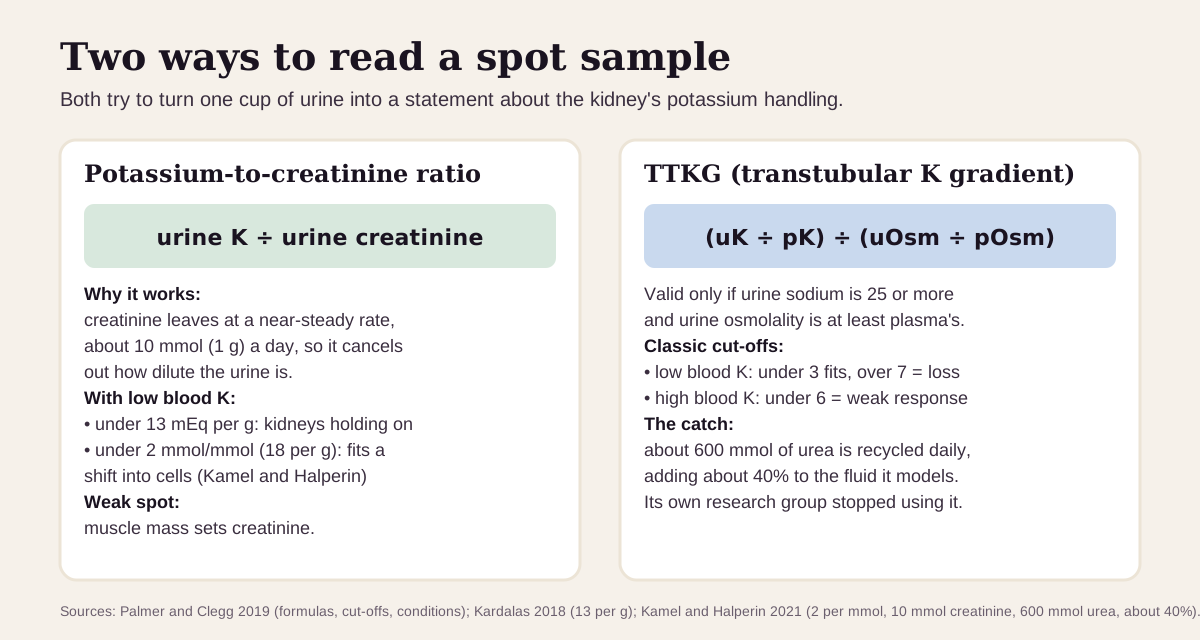
The potassium-to-creatinine ratio works because creatinine leaves your body at a nearly steady rate, about 10 mmol (1 gram) a day. Dividing by it cancels out how dilute the sample is.11 Its weak spot is muscle: people with much more or much less muscle than average make more or less creatinine, which shifts the ratio.11
Two thresholds circulate, and they come from different papers. Under 13 mEq per gram of creatinine is the common line for an appropriate response to low potassium.21 Kamel and Halperin expect under 2 mmol per mmol (under 18 per gram) when low potassium comes from a shift into cells.11 The journal that printed one review later added a correction: its 13 mEq per gram and 2.5 mEq per mmol were two separate thresholds from the literature, not a unit conversion.19
The TTKG (transtubular potassium gradient) tries to estimate how hard the collecting duct is pushing potassium out:2
TTKG = (urine K ÷ plasma K) ÷ (urine osmolality ÷ plasma osmolality)
With low blood potassium, under 3 fits an appropriate response and over 7 points to kidney loss; with high blood potassium, under 6 suggests a weak response.2 The problem is urea: about 600 mmol of it is reabsorbed deep in the kidney each day and recycled upstream, adding about 2 liters a day, roughly 40%, to the fluid in the segment the formula models. Kamel and Halperin, whose group published early TTKG work, now leave it out of their assessment of potassium disorders.1120
In one study of 43 people with low potassium and paralysis, the spot ratio and the TTKG both separated those whose potassium had shifted into cells from those with a true loss, while plain urine concentration overlapped. That matters, because 19 of the 30 people with a shift rebounded to high potassium after modest potassium doses.14
Questions worth asking
- Was this a 24-hour collection or a spot sample, and was the collection complete?
- What was my blood potassium at the time, and does my urine result fit it?
- Is my urine potassium low (holding on) or high (losing it) for that blood level?
- What do my CO2, urine chloride and magnesium show next to it?
- Could a water pill, laxative or another medicine be involved?
- If my blood pressure is high too, should I have an aldosterone-renin ratio?
FAQ
What is a normal urine potassium? It depends on the lab. Labcorp's 24-hour range is 20–116 mmol a day for men and 14–95 for women aged 18–80, and ARUP's is 25–125.34
Is a spot urine potassium as good as a 24-hour test? A spot sample is quicker and helps when blood potassium is low, especially as a potassium-to-creatinine ratio. For the day's total, a complete 24-hour collection is the best measure.110
What does low urine potassium mean? With a low blood potassium, it usually means the kidneys are holding on and the loss happened elsewhere, most often diarrhea, a shift into cells, or a low intake. In a healthy person, it often just means a low-potassium diet that day.127
What does high urine potassium mean? With a low blood potassium, it points to kidney loss: water pills, vomiting, too much aldosterone or low magnesium. With a normal blood potassium, it usually reflects a potassium-rich diet.127
This guide is for education. It can't diagnose you or replace care from a clinician who knows your history.
Footnotes
-
Kardalas E, Paschou SA, Anagnostis P, Muscogiuri G, Siasos G, Vryonidou A. Hypokalemia: a clinical update. Endocr Connect. 2018;7(4):R135–R146. doi:10.1530/EC-18-0109. The source for the 100/90/10 mmol daily balance, the two dials on potassium secretion, the over-15-mmol-a-day and 13-mEq-per-gram lines, the causes table, the 2.5 mmol/L severe cut-off and the symptoms. PMC ↩ ↩2 ↩3 ↩4 ↩5 ↩6 ↩7 ↩8 ↩9 ↩10 ↩11 ↩12 ↩13 ↩14 ↩15 ↩16 ↩17 ↩18 ↩19 ↩20 ↩21 ↩22 ↩23 ↩24 ↩25 ↩26 ↩27 ↩28 ↩29 ↩30 ↩31 ↩32 ↩33
-
Palmer BF, Clegg DJ. The Use of Selected Urine Chemistries in the Diagnosis of Kidney Disorders. Clin J Am Soc Nephrol. 2019;14(2):306–316. doi:10.2215/CJN.10330818. Nephrology review: daily output of 10–15 to 400 mEq, spot cut-offs of 5–15 and over 40 mEq/L, the TTKG formula, conditions and cut-offs, the ratio, and urine chloride in vomiting, diuretics, diarrhea and aldosterone excess. PMC ↩ ↩2 ↩3 ↩4 ↩5 ↩6 ↩7 ↩8 ↩9 ↩10 ↩11 ↩12 ↩13 ↩14 ↩15 ↩16 ↩17 ↩18 ↩19 ↩20
-
Labcorp. Potassium, 24-Hour Urine, test 003186. Reference ranges by age and sex (18–80 years: men 20–116, women 14–95 mmol/24 hr), collection instructions, and the under-20 and 40-mmol lines (citing Carroll and Oh). A commercial laboratory's published test page, opened September 23, 2026. labcorp.com ↩ ↩2 ↩3 ↩4 ↩5 ↩6 ↩7 ↩8 ↩9 ↩10 ↩11 ↩12 ↩13
-
ARUP Laboratories. Potassium, Urine, test 0020849. Reference interval 25–125 mmol/day for a 24-hour collection; no established interval for a random sample. A commercial reference laboratory's published test page, opened September 23, 2026. aruplab.com ↩ ↩2 ↩3 ↩4 ↩5 ↩6
-
Cogswell ME, Loria CM, Terry AL, et al. Estimated 24-Hour Urinary Sodium and Potassium Excretion in US Adults. JAMA. 2018;319(12):1209–1220. doi:10.1001/jama.2018.1156. NHANES 2014, 827 adults: medians of 2,363 mg (men) and 1,740 mg (women), the 46%-of-4,700-mg figure, day-to-day variation, and the 70%-of-expected-creatinine completeness check. PMC ↩ ↩2 ↩3 ↩4 ↩5 ↩6 ↩7 ↩8 ↩9 ↩10
-
National Library of Medicine. High potassium level. MedlinePlus Medical Encyclopedia. Reviewed October 1, 2025. Symptoms and when emergency treatment is needed. MedlinePlus ↩ ↩2
-
National Library of Medicine. Potassium urine test. MedlinePlus Medical Encyclopedia. Reviewed July 13, 2025. Typical values (15–40 mEq/L random, 25–125 mEq a day), 1 mEq = 1 mmol, reasons for the test and causes of high and low results. MedlinePlus ↩ ↩2 ↩3 ↩4 ↩5 ↩6 ↩7 ↩8 ↩9 ↩10
-
World Health Organization. Guideline: Potassium intake for adults and children. Geneva: WHO; 2012. Recommends at least 90 mmol (3,510 mg) a day for adults; converts 24-hour urine to intake with a factor of 1.3; stroke relative risk 0.70 at 90 mmol or more. who.int ↩ ↩2 ↩3 ↩4 ↩5 ↩6 ↩7
-
Palmer BF. Regulation of Potassium Homeostasis. Clin J Am Soc Nephrol. 2015;10(6):1050–1060. doi:10.2215/CJN.08580813. Less than 10% of filtered potassium reaches the distal nephron; the kidney adjusts output over several hours; the daily rhythm of excretion. PMC ↩ ↩2 ↩3 ↩4
-
Mercado CI, Cogswell ME, Loria CM, et al. Validity of predictive equations for 24-h urinary potassium excretion based on timing of spot urine collection among adults: the MESA and CARDIA Urinary Sodium Study and NHANES Urinary Sodium Calibration Study. Am J Clin Nutr. 2018;108(3):532–547. doi:10.1093/ajcn/nqy138. Spot-sample estimates by time of day (Table 3); 61–75% misclassified. PMC ↩ ↩2 ↩3 ↩4
-
Kamel KS, Halperin ML. Use of Urine Electrolytes and Urine Osmolality in the Clinical Diagnosis of Fluid, Electrolytes, and Acid-Base Disorders. Kidney Int Rep. 2021;6(5):1211–1224. doi:10.1016/j.ekir.2021.02.003. The 60 mmol/day example, the under-2-mmol-per-mmol ratio, creatinine at about 10 mmol a day, the urea-recycling critique of the TTKG, the urine sodium and chloride table, and the 24-hour requirement in chronic high potassium. PMC ↩ ↩2 ↩3 ↩4 ↩5 ↩6 ↩7 ↩8 ↩9 ↩10 ↩11 ↩12 ↩13 ↩14 ↩15 ↩16 ↩17 ↩18
-
Ma Y, He FJ, Sun Q, et al. 24-Hour Urinary Sodium and Potassium Excretion and Cardiovascular Risk. N Engl J Med. 2022;386(3):252–263. doi:10.1056/NEJMoa2109794. 10,709 adults in six cohorts with at least two 24-hour collections each; hazard ratio 0.69 for the top vs bottom quarter of potassium, 0.82 per 1,000 mg a day. PMC ↩ ↩2 ↩3 ↩4 ↩5 ↩6
-
National Library of Medicine. Potassium in diet. MedlinePlus Medical Encyclopedia. Reviewed April 30, 2026. National Academies intake recommendations for adults (3,400 mg men, 2,600 mg women) and the advice to talk with a provider before potassium supplements with kidney disease. MedlinePlus ↩ ↩2 ↩3
-
Lin SH, Lin YF, Chen DT, Chu P, Hsu CW, Halperin ML. Laboratory tests to determine the cause of hypokalemia and paralysis. Arch Intern Med. 2004;164(14):1561–1566. doi:10.1001/archinte.164.14.1561. 43 patients: the ratio and TTKG separated shifts from losses; 19 of 30 with a shift had rebound high potassium. PubMed ↩ ↩2
-
Emmett M. Metabolic Alkalosis: A Brief Pathophysiologic Review. Clin J Am Soc Nephrol. 2020;15(12):1848–1856. doi:10.2215/CJN.16041219. Diuretics "very frequently" cause low potassium and raise renin and aldosterone; vomiting brings secondary hyperaldosteronism; primary aldosteronism with urine chloride over 20. PMC ↩ ↩2 ↩3 ↩4 ↩5
-
Funder JW, Carey RM, Mantero F, et al. The Management of Primary Aldosteronism: Case Detection, Diagnosis, and Treatment: An Endocrine Society Clinical Practice Guideline. J Clin Endocrinol Metab. 2016;101(5):1889–1916. doi:10.1210/jc.2015-4061. Recommends aldosterone-renin ratio screening in high-risk hypertension and in hypertension with low potassium. PubMed ↩
-
Huang CL, Kuo E. Mechanism of hypokalemia in magnesium deficiency. J Am Soc Nephrol. 2007;18(10):2649–2652. doi:10.1681/ASN.2007070792. Magnesium deficiency increases distal potassium secretion and makes low potassium refractory. PubMed ↩
-
Vaidya A, Mulatero P, Baudrand R, Adler GK. The Expanding Spectrum of Primary Aldosteronism: Implications for Diagnosis, Pathogenesis, and Treatment. Endocr Rev. 2018;39(6):1057–1088. doi:10.1210/er.2018-00139. Primary aldosteronism is aldosterone made independent of renin, screened for in the setting of a suppressed renin. PMC ↩ ↩2
-
Palmer BF, Clegg DJ. Correction. Clin J Am Soc Nephrol. 2019;14(8):1241. The 13 mEq per gram and 2.5 mEq per mmol thresholds are two separate literature values, not a conversion. PMC ↩
-
Kamel KS, Halperin ML. Intrarenal urea recycling leads to a higher rate of renal excretion of potassium: an hypothesis with clinical implications. Curr Opin Nephrol Hypertens. 2011;20(5):547–554. doi:10.1097/MNH.0b013e328349b8f9. Why the TTKG's assumption of no downstream osmole reabsorption fails. PubMed ↩
Educational content, not medical advice. Libby is a personal record tool, not a medical service — it doesn't diagnose, treat, or prescribe. Reference ranges vary by lab and by person. Talk to a qualified healthcare professional about your results.
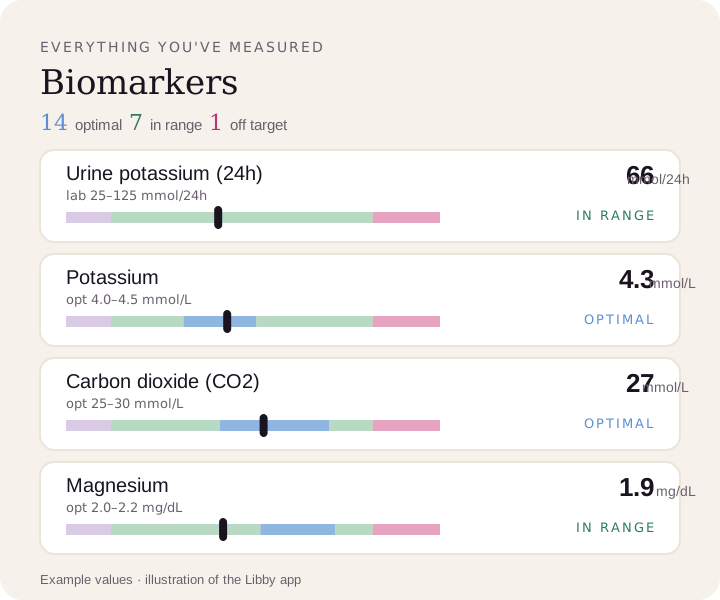
See every result against your lab's range.
Upload a lab PDF or a photo of your report. Libby puts each result on your lab's range, adds the optimal range where one exists, and keeps every collection on one timeline.
View your urine potassium ›