Urine chloride test: normal range, low and high results
Urine chloride shows how much chloride your kidneys let go. The normal range, what under 20 mmol/L means in metabolic alkalosis, and the urine anion gap.
Urine chloride measures how much chloride your kidneys are letting go. Chloride comes in mostly as table salt. Your kidneys filter it and take back more than 99%, so what reaches your urine mostly tracks what you eat.1 A 24-hour urine chloride is a rough gauge of salt intake. A single "spot" urine chloride is a quick test clinicians use to find the cause of metabolic alkalosis, a blood chemistry that has drifted too alkaline.2
The short version
- Normal (24-hour urine): set by your lab and your diet. Labcorp lists 52–264 mmol/day for men and 38–210 for women aged 18–80; ARUP lists 140–250 and MedlinePlus 110–250.345
- The 20 mmol/L rule (spot urine, with metabolic alkalosis): under 20 usually means the body is short on chloride, most often from vomiting or a diuretic that has worn off. Over 20 means the kidneys are letting chloride go, most often from a diuretic still working, or too much aldosterone.26
- Get care now for fainting, a seizure, severe trouble breathing, or symptoms such as confusion or muscle spasms that are getting worse fast, whatever the urine number says.7
- Spot and 24-hour are two different tests. A spot result is a concentration (mmol/L) read against the 20 cut point. A 24-hour result is an amount (mmol/day) read against a lab range.42
What urine chloride is
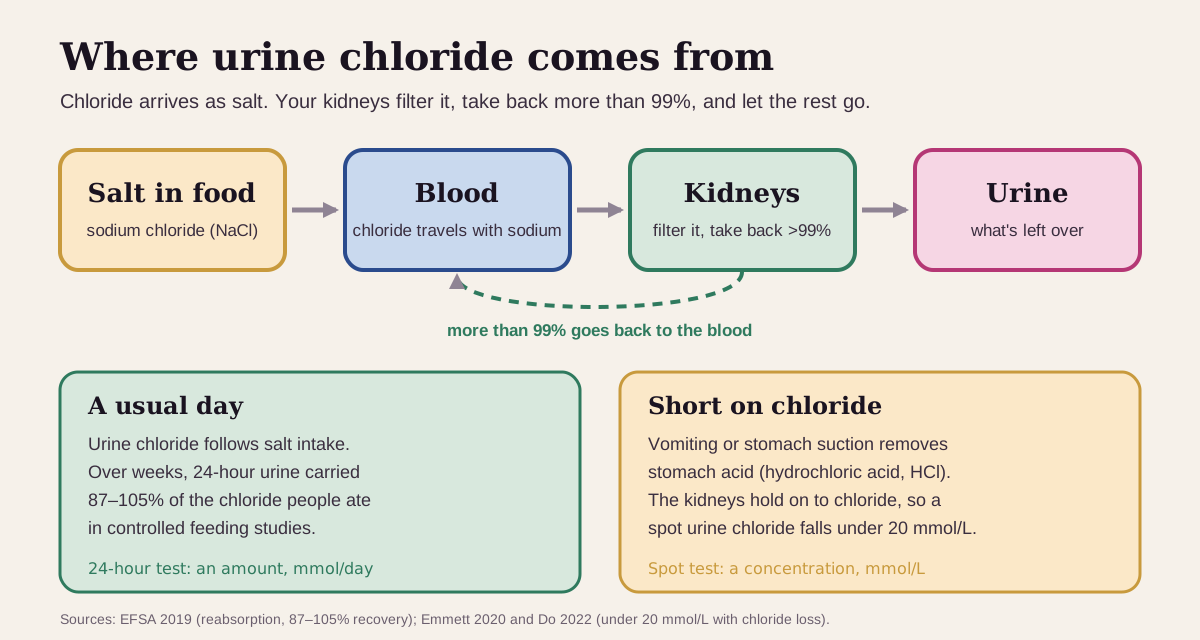
Chloride is a negatively charged salt, and about 88% of your body's supply sits in the fluid outside your cells. In Western diets it comes mostly from sodium chloride, the salt in processed food and the shaker. It rides through the blood with sodium, and your kidneys filter large amounts of both every day. They reabsorb more than 99% of the filtered chloride, most of it in the first stretch of the kidney tubule, and let the rest go.1
Over time, urine carries almost all the chloride you eat. In controlled feeding studies, 24-hour urine recovered 87–90% of dietary chloride over week-long periods and 99–105% over periods longer than a month.1
There are two versions of the test:
- A 24-hour urine chloride collects every drop for a day and reports the total, in mmol/day. It reflects salt intake, fluid losses and how the kidneys handle salt.5
- A spot (random) urine chloride measures a single sample, in mmol/L. ARUP sets no reference range for it.4 Clinicians use it for one main job: sorting out the cause of metabolic alkalosis.2
Labcorp notes that urine chloride is often ordered with urine sodium and potassium, and that it also feeds the urine anion gap, a calculation used when the blood turns acidic (more below).3
What's a normal urine chloride?
Start with the range printed on your own report. For a 24-hour test, the range depends on the lab and on how much salt and fluid you take in.5
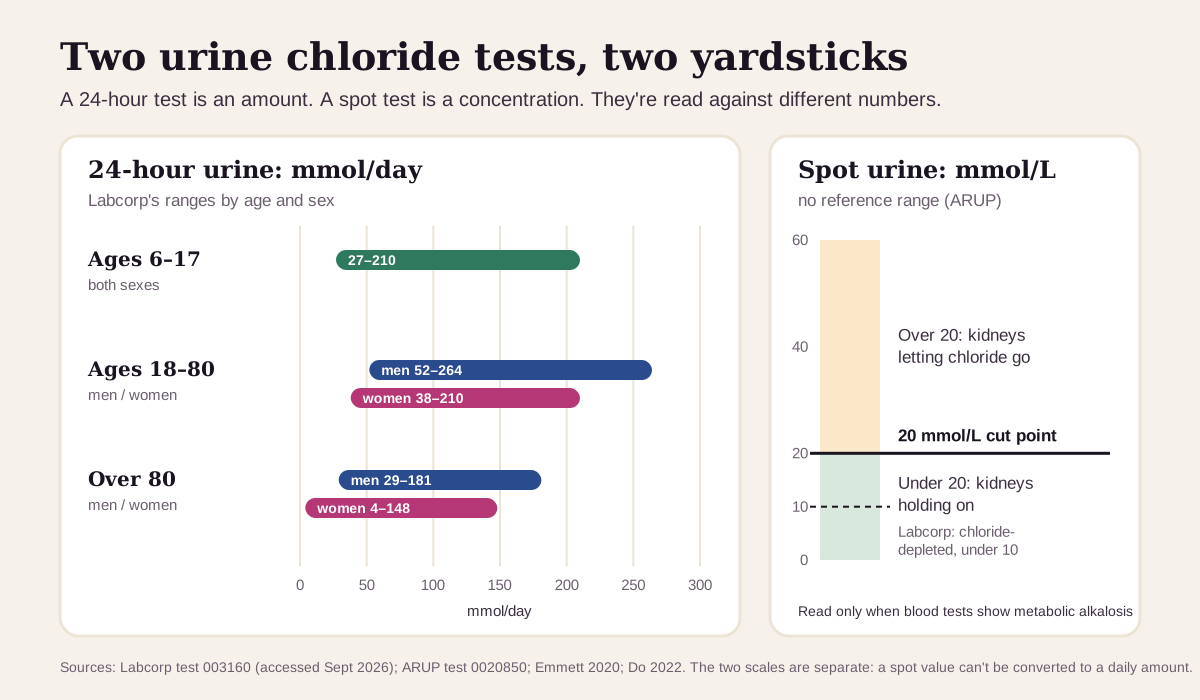
- Labcorp splits its 24-hour range by age and sex: 52–264 mmol/day for men and 38–210 for women aged 18–80, and lower above age 80 (29–181 for men, 4–148 for women).3
- ARUP, a national reference lab, uses 140–250 mmol/day for everyone.4
- MedlinePlus gives 110–250 mmol/day as a common example.5
A spot urine chloride has no normal range of its own. When blood tests show metabolic alkalosis, it is read against 20 mmol/L: under 20 means the kidneys are holding on to chloride, over 20 means they are letting it go.26 Labcorp puts people who are truly chloride-depleted under 10.3
"Optimal" urine chloride: what the targets imply
We found no functional-medicine or longevity target for urine chloride. The Libby app shows your lab's range for it. Function Health, Superpower and InsideTracker list no urine chloride target on their public pages either.8
The closest thing to an "optimal" number comes from salt guidance. The European Food Safety Authority (EFSA) sets 3.1 grams of chloride a day as a safe and adequate intake for adults, matched mole for mole to its sodium value.1 That works out to about 87 mmol/day, and because urine carries nearly all dietary chloride over time, a 24-hour urine chloride near or under 87 is what that intake looks like on the test.
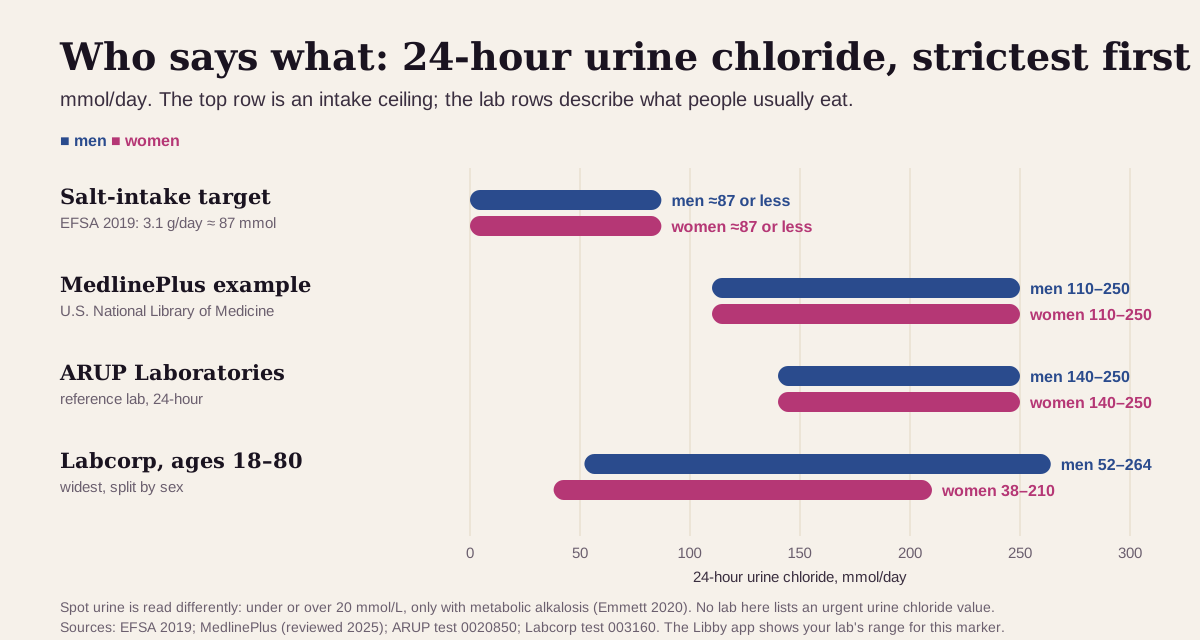
| Target | Men | Women | Who uses it |
|---|---|---|---|
| Strictest (salt-intake target) | about 87 mmol/day or less | about 87 mmol/day or less | EFSA's 3.1 g/day chloride intake, converted1 |
| Common lab example | 110–250 mmol/day | 110–250 mmol/day | MedlinePlus5 |
| Reference lab | 140–250 mmol/day | 140–250 mmol/day | ARUP4 |
| Widest lab range (ages 18–80) | 52–264 mmol/day | 38–210 mmol/day | Labcorp3 |
| Spot-test cut point | under 20 or over 20 mmol/L | under 20 or over 20 mmol/L | Only with metabolic alkalosis26 |
| Urgent | set by symptoms | set by symptoms | None of the labs cited here lists a call-now urine chloride value; confusion, seizures or fainting need care now347 |
Why a salt target at all: EFSA notes that sodium chloride raises blood pressure more than sodium paired with other partners such as citrate or bicarbonate, so chloride is part of salt's effect.1 Lab ranges come from the people each lab tested, on their usual diets, and MedlinePlus notes that the range depends on salt intake.5 Most sit well above 87.
Keep "optimal" in perspective. A low 24-hour urine chloride is good news only when it reflects a lower-salt diet. A spot urine chloride under 20 in someone who has been vomiting means the body is running short, and that needs fixing.2 A single 24-hour collection is also a rough gauge: in a tightly controlled feeding study, one collection misjudged chloride intake 52% of the time.9
What a low or high urine chloride usually means
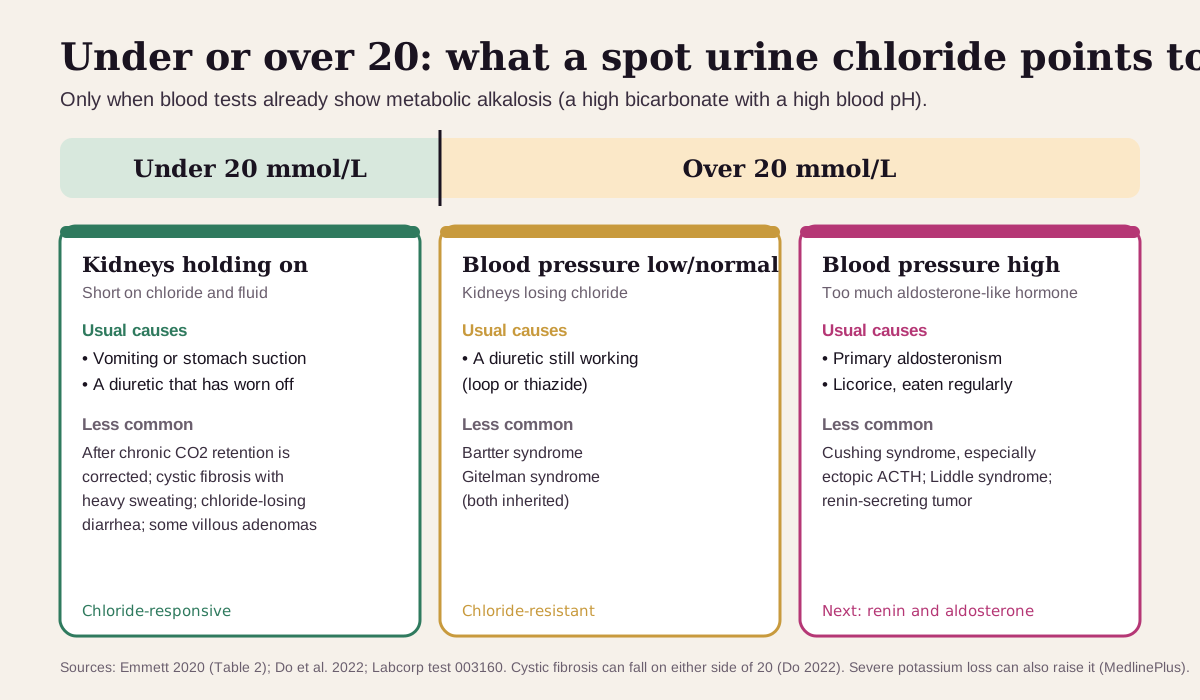
First, which test is it? A spot urine chloride matters most when your blood already shows metabolic alkalosis: a high bicarbonate (reported as CO2) with a blood pH above 7.44.6 Then the 20 mmol/L cut point sorts the causes into three groups.2
Spot under 20 mmol/L: the body is short on chloride
Chloride depletion is the most common cause of metabolic alkalosis.10 The usual suspects:
- Vomiting or stomach suction. Stomach acid is hydrochloric acid, so losing it removes chloride and leaves extra bicarbonate behind. Potassium usually falls too.6 Do and colleagues call vomiting and diuretic overuse the two prototypes of metabolic alkalosis with fluid loss.6
- A diuretic that has worn off. Once a loop or thiazide water pill stops acting, a fluid-depleted body clamps down and urine chloride drops below 20.2
- Less common causes: the quick correction of long-standing carbon dioxide retention (post-hypercapnia), cystic fibrosis with heavy sweating, chloride-losing diarrhea, and some colon polyps called villous adenomas.2
This group is called chloride-responsive: replacing chloride, usually as saline and potassium chloride, corrects it. In studies in people and animals, chloride corrected the alkalosis even while fluid and sodium stayed low.10 A rising urine chloride during treatment is a sign that fluid has been restored.26
Spot over 20 mmol/L: the kidneys are letting it go
Here blood pressure splits the causes.6
- Blood pressure low or normal: most often a diuretic that's still working. Urine chloride swings up and down as each dose waxes and wanes, and widely varying results point to diuretic use.2 Less common: Bartter and Gitelman syndromes, inherited kidney conditions that act like a diuretic you can't switch off. Diagnosing them takes genetic testing.26
- Blood pressure high: too much aldosterone or a hormone that acts like it. Primary aldosteronism is the classic cause; others are eating licorice regularly, Cushing syndrome (especially a tumor making ACTH), and Liddle syndrome.2 The next step is usually a renin and aldosterone test.6
- Severe potassium loss can also push urine chloride up.53
A 24-hour result that's out of range
MedlinePlus lists the usual reasons:5
- High: a salty diet, a very large urine volume, potassium depletion, low adrenal function, or kidney disease that wastes salt.
- Low: a low-salt diet, and fluid lost through vomiting, diarrhea, heavy sweating or stomach suction.
Some medicines change the result, including diuretics, acetazolamide, corticosteroids and anti-inflammatory painkillers (NSAIDs).5 Bromide, another halogen that can turn up in urine, can read as chloride and push the number falsely high.3 Keep taking your prescribed medicines and bring the full list to your clinician.5
Get care now (call 911) for fainting, a seizure, severe trouble breathing, or symptoms that are getting worse fast. Call your clinician promptly for confusion. Muscle twitching or spasms, tingling in the face, hands or feet, and lightheadedness can all come with alkalosis, which prolonged vomiting and some water pills can cause.7
Urine chloride reads best next to its neighbors
Labcorp warns that a urine chloride without urine sodium, urine potassium and blood electrolytes can mislead.3 Read together, they tell the common patterns apart:
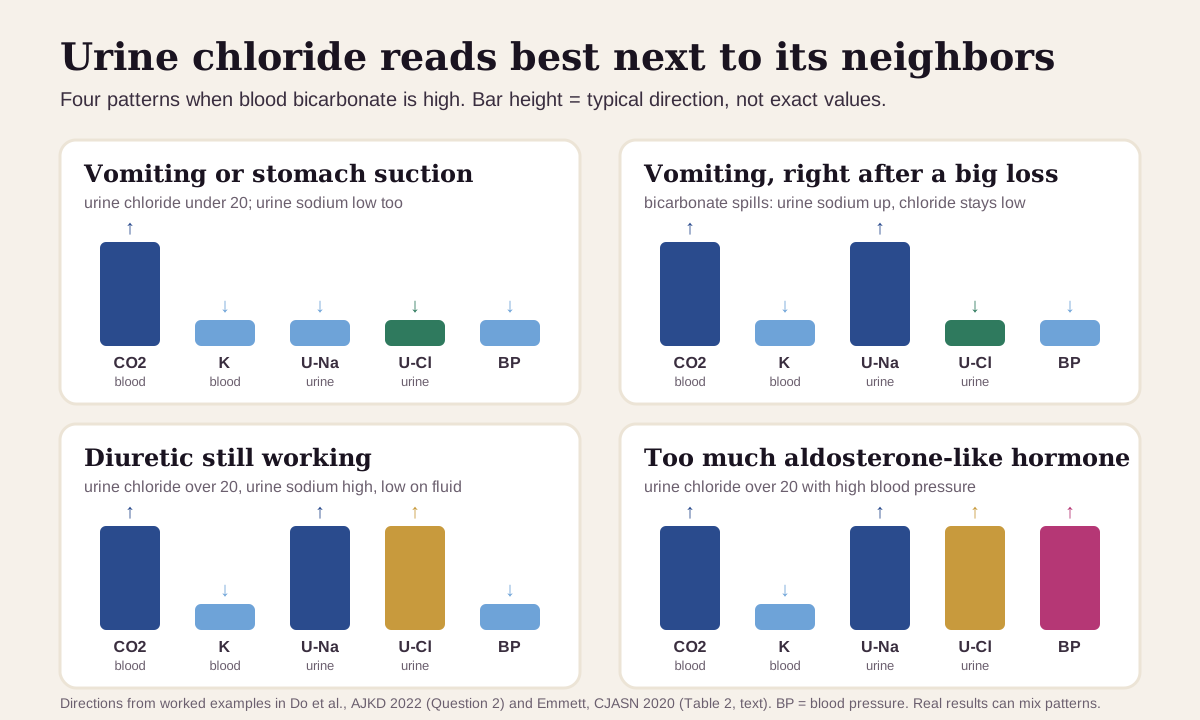
| If you see… | It often points to… |
|---|---|
| High bicarbonate, low potassium, urine chloride under 20, low urine sodium, low blood pressure | chloride and fluid lost from the stomach: vomiting or suction6 |
| The same, but urine sodium briefly rising while urine chloride stays under 20 | recent vomiting: extra bicarbonate spills into the urine and drags sodium with it, while chloride stays low2 |
| High bicarbonate, low potassium, but urine chloride over 20, low or normal blood pressure | a diuretic still working, or Bartter or Gitelman syndrome26 |
| High bicarbonate, low potassium, but urine chloride over 20, high blood pressure | primary aldosteronism or another aldosterone-like excess62 |
| High bicarbonate, with urine chloride swinging above and below 20 across tests | diuretic use, timed against the dose2 |
| Low bicarbonate, normal blood anion gap, urine chloride higher than urine sodium plus potassium | bicarbonate lost from the gut, most often diarrhea1112 |
| Low bicarbonate, normal blood anion gap, urine chloride lower than sodium plus potassium | the kidney failing to excrete acid: distal renal tubular acidosis or low aldosterone1112 |
The second row is why urine chloride is the steadier guide here: right after a bout of vomiting, urine sodium can briefly rise, while urine chloride stays low the whole time.2
How fast urine chloride changes
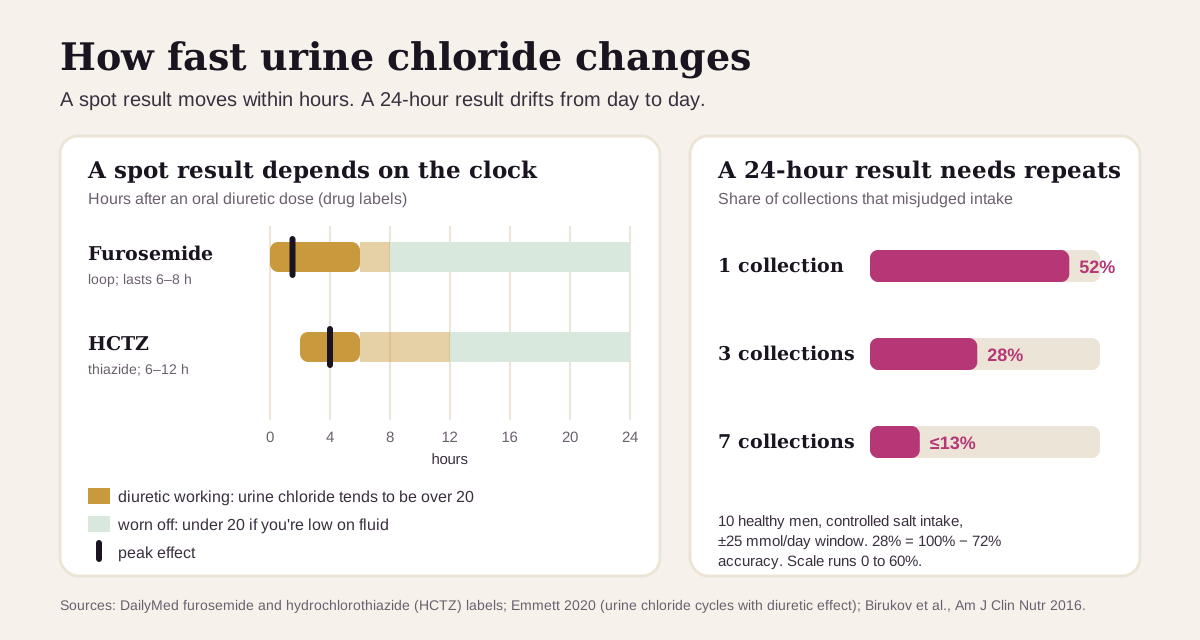
A spot result moves within hours. Oral furosemide starts working within an hour and lasts 6–8 hours; hydrochlorothiazide starts within 2 hours and lasts about 6–12.13 Urine chloride rises and falls with each dose,2 so the time of your last water pill matters as much as the number.
A 24-hour result drifts from day to day. In a study of 10 healthy men on tightly controlled salt intakes for 105 or 205 days, daily chloride output followed a weekly rhythm of its own.9
What that means in practice:
- Note the time of your last diuretic dose when you give a spot sample. A result taken mid-dose and one taken the next morning can land on opposite sides of 20.2
- Collect carefully. A 24-hour test counts only if every drop goes in the container, with the start and finish times written on it.3
- Repeat to judge salt intake. One collection misjudged chloride intake 52% of the time. Any three got it right 72% of the time, and a full week of collections cut the error to 13% or less.9
- Trends beat snapshots. EFSA considers a single 24-hour urine a fair measure of a group's average intake, but a poor one for a single person.1
Going deeper: the urine anion gap
Urine chloride has a second job. When blood tests show a normal-gap metabolic acidosis (low bicarbonate with high blood chloride), clinicians calculate the urine anion gap:12
Urine anion gap = urine sodium + urine potassium − urine chloride
The logic: a healthy kidney gets rid of extra acid as ammonium chloride. Labs rarely measure ammonium, but its chloride shows up, so a kidney pouring out acid makes urine chloride exceed sodium plus potassium and the gap turns negative. A kidney that can't excrete acid leaves the gap positive.1211
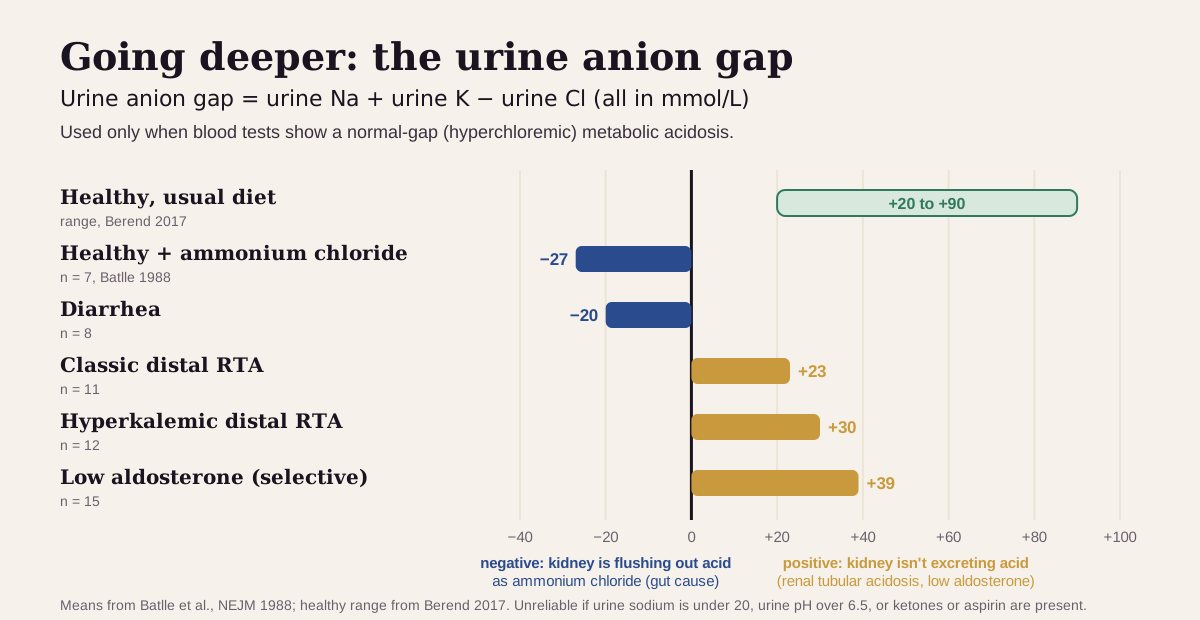
In the classic 1988 study, the gap averaged −20 mmol/L in diarrhea and +23 to +39 in the kidney causes.11 On a usual diet, healthy people run about +20 to +90, because food supplies more sodium and potassium than chloride.12
The gap has real limits. It becomes unreliable when urine sodium is under 20, when urine pH is above 6.5, when urine output is very high, or when other acids such as ketones or aspirin are in the urine.12 In 1,044 people with chronic kidney disease, the standard gap barely tracked measured ammonium (correlation 0.18), and the authors recommend measuring urine ammonium directly in that setting.14
Questions worth asking
- Was this a spot test or a 24-hour collection, and what question was it meant to answer?
- Do my blood tests show metabolic alkalosis or acidosis, and how high is my bicarbonate?
- Where do my urine sodium and potassium sit next to the chloride?
- When did I last take a diuretic, relative to when the sample was taken?
- Could vomiting, diarrhea, heavy sweating or licorice be playing a part?
- If my blood pressure is high, should we check renin and aldosterone?
FAQ
What is a normal urine chloride? For a 24-hour collection it depends on your lab and your salt intake. Labcorp lists 52–264 mmol/day for men and 38–210 for women aged 18–80, and MedlinePlus gives 110–250 as a common example.35
What does a urine chloride under 20 mean? In someone with metabolic alkalosis, a spot urine chloride under 20 mmol/L usually means the body is short on chloride and fluid, most often from vomiting or a diuretic that has worn off. This kind usually responds to saline.26
Does urine chloride show how much salt I eat? Roughly. Over time, urine carries most of the chloride you eat, but a single 24-hour collection misjudged intake about half the time in a controlled study. Three or more collections give a much better picture.19
What is the urine anion gap? It is urine sodium plus potassium minus chloride, used when the blood is acidic with a normal blood anion gap. A negative gap points to bicarbonate lost from the gut, such as diarrhea; a positive gap points to a kidney problem with acid excretion.1112
This guide is for education. It can't diagnose you or replace care from a clinician who knows your history.
Footnotes
-
EFSA Panel on Nutrition, Novel Foods and Food Allergens. Dietary reference values for chloride. EFSA J. 2019;17(9):e05779. The 3.1 g/day adult intake, more than 99% kidney reabsorption, 87–105% urinary recovery, sodium chloride as the main source, and the limits of a single 24-hour urine. PMC ↩ ↩2 ↩3 ↩4 ↩5 ↩6 ↩7 ↩8 ↩9 ↩10
-
Emmett M. Metabolic Alkalosis: A Brief Pathophysiologic Review. Clin J Am Soc Nephrol. 2020;15(12):1848–1856. The three urine-chloride groups (Table 2), the low urine chloride that persists while urine sodium briefly rises after vomiting, urine chloride cycling with diuretic doses, and rising urine chloride as fluid is restored. PMC ↩ ↩2 ↩3 ↩4 ↩5 ↩6 ↩7 ↩8 ↩9 ↩10 ↩11 ↩12 ↩13 ↩14 ↩15 ↩16 ↩17 ↩18 ↩19 ↩20 ↩21 ↩22 ↩23 ↩24 ↩25 ↩26 ↩27
-
Labcorp. Chloride, 24-Hour Urine (test 003160). Test catalog, accessed September 23, 2026. Ranges by age and sex, the under-10 and over-20 statements, bromide interference, collection instructions, and the warning against reading urine chloride alone. A commercial laboratory's published range. labcorp.com ↩ ↩2 ↩3 ↩4 ↩5 ↩6 ↩7 ↩8 ↩9 ↩10 ↩11 ↩12 ↩13 ↩14
-
ARUP Laboratories. Chloride, Urine (test 0020850). Laboratory Test Directory, accessed September 23, 2026. 24-hour interval 140–250 mmol/day; no reference interval for random urine. ARUP describes itself as a national, academic, nonprofit reference laboratory; this interval comes from its commercial test directory, not a guideline. aruplab.com ↩ ↩2 ↩3 ↩4 ↩5 ↩6 ↩7 ↩8
-
National Library of Medicine. Chloride - urine test. MedlinePlus Medical Encyclopedia. Reviewed July 1, 2025. The 110–250 mEq/day (mmol/day) example range, causes of high and low results, and medicines that affect the test. MedlinePlus ↩ ↩2 ↩3 ↩4 ↩5 ↩6 ↩7 ↩8 ↩9 ↩10 ↩11 ↩12 ↩13
-
Do C, Vasquez PC, Soleimani M. Metabolic Alkalosis Pathogenesis, Diagnosis, and Treatment: Core Curriculum 2022. Am J Kidney Dis. 2022;80(4):536–551. The 20 mmol/L split into chloride-sensitive and chloride-resistant alkalosis, worked examples with urine sodium and chloride for vomiting, diuretic overuse and hormone excess, and the pH above 7.44 definition. PMC ↩ ↩2 ↩3 ↩4 ↩5 ↩6 ↩7 ↩8 ↩9 ↩10 ↩11 ↩12 ↩13 ↩14 ↩15 ↩16 ↩17 ↩18
-
National Library of Medicine. Alkalosis. MedlinePlus Medical Encyclopedia. Reviewed November 6, 2025. Symptoms of alkalosis and when to call 911. MedlinePlus ↩ ↩2 ↩3
-
Function Health, What We Test and Urine biomarker pages; Superpower, Biomarkers; InsideTracker, Biomarkers. Checked September 23, 2026: chloride appears only as a blood marker, and none lists a urine chloride target. Commercial sources, named only to show what the optimizer market offers. Function Health · Superpower · InsideTracker ↩
-
Birukov A, Rakova N, Lerchl K, et al. Ultra-long-term human salt balance studies reveal interrelations between sodium, potassium, and chloride intake and excretion. Am J Clin Nutr. 2016;104(1):49–57. Ten healthy men on fixed salt intakes for 105 or 205 days: a weekly rhythm in excretion, 52% misclassification with one 24-hour collection, 72% accuracy with three, 13% or less error with seven. PMC ↩ ↩2 ↩3 ↩4 ↩5
-
Luke RG, Galla JH. It is chloride depletion alkalosis, not contraction alkalosis. J Am Soc Nephrol. 2012;23(2):204–207. Chloride depletion as the commonest cause of metabolic alkalosis, and chloride repletion correcting it despite ongoing fluid and sodium deficits. PMC ↩ ↩2
-
Batlle DC, Hizon M, Cohen E, Gutterman C, Gupta R. The use of the urinary anion gap in the diagnosis of hyperchloremic metabolic acidosis. N Engl J Med. 1988;318(10):594–599. The original study: −27 in healthy volunteers given ammonium chloride, −20 in diarrhea, +23 in classic distal RTA, +30 in hyperkalemic distal RTA and +39 in selective aldosterone deficiency. PubMed ↩ ↩2 ↩3 ↩4 ↩5 ↩6
-
Berend K. Review of the Diagnostic Evaluation of Normal Anion Gap Metabolic Acidosis. Kidney Dis (Basel). 2017;3(4):149–159. The urine anion gap formula, the healthy range of about +20 to +90, negative values in diarrhea, positive values in distal and type 4 renal tubular acidosis, and when the gap is unreliable. PMC ↩ ↩2 ↩3 ↩4 ↩5 ↩6 ↩7 ↩8
-
National Library of Medicine. DailyMed: Furosemide tablet label ("onset of diuresis ... within 1 hour ... duration of diuretic effect is 6 to 8 hours") and Hydrochlorothiazide tablet label ("diuresis begins within 2 hours, peaks in about 4 hours and lasts about 6 to 12 hours"). Furosemide · Hydrochlorothiazide ↩ ↩2
-
Raphael KL, Gilligan S, Ix JH. Urine Anion Gap to Predict Urine Ammonium and Related Outcomes in Kidney Disease. Clin J Am Soc Nephrol. 2018;13(2):205–212. 1,044 AASK participants; the standard gap correlated with measured ammonium at r = 0.18. PMC ↩
Educational content, not medical advice. Libby is a personal record tool, not a medical service — it doesn't diagnose, treat, or prescribe. Reference ranges vary by lab and by person. Talk to a qualified healthcare professional about your results.
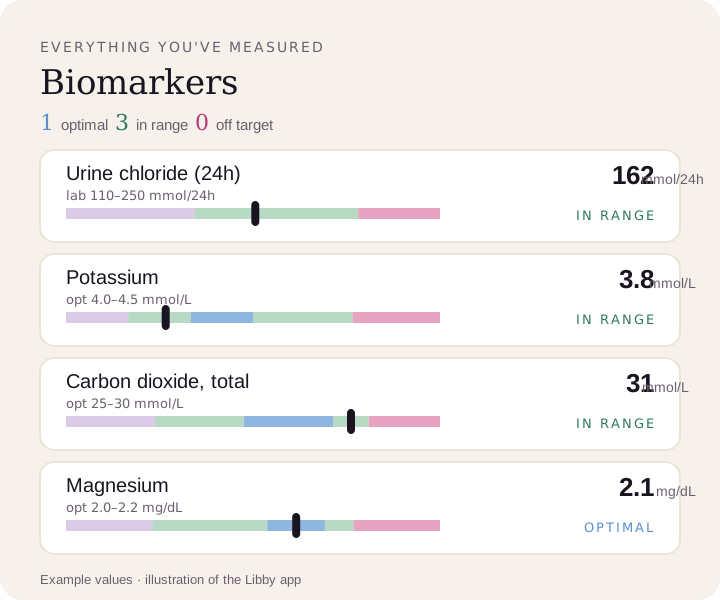
See every result against your lab's range.
Upload a lab PDF or a photo of your report. Libby puts every result on your lab's range, keeps your urine tests next to your blood electrolytes, and tracks your trends over time.
View your urine chloride ›