Blood gas pH: normal range, what low or high means
Blood pH is normally 7.35 to 7.45. Here's what a low or high result usually means, how to read it with pCO2 and bicarbonate, and when it's urgent.
Blood pH measures how acidic or alkaline your blood is, and your body holds it in a very tight window: about 7.35 to 7.45 in arterial blood.1 Your lungs and kidneys do that job together. When pH drifts out of the window, it usually means one of four things: extra acid from your metabolism, carbon dioxide building up from slow breathing, too much bicarbonate, or carbon dioxide being blown off by fast breathing.2
The short version
- Normal: 7.35 to 7.45 on an arterial blood gas.1 A sample from a vein usually reads about 0.03 lower.3
- Low (acidemia) usually comes from a metabolic acid, such as lactate, ketones, kidney failure or bicarbonate lost with diarrhea, or from carbon dioxide building up in lung disease or slowed breathing.24
- High (alkalemia) usually comes from fast breathing (anxiety, pain, fever, altitude, pregnancy) or from vomiting and diuretics.52
- Urgent: in a survey of U.S. hospitals, labs phoned a doctor at about 7.21 or 7.59.6 In intensive care, a pH below 7.20 came with a 57% death rate.7 pH says acidic or alkaline; pCO2 and bicarbonate say why.8
What blood pH is
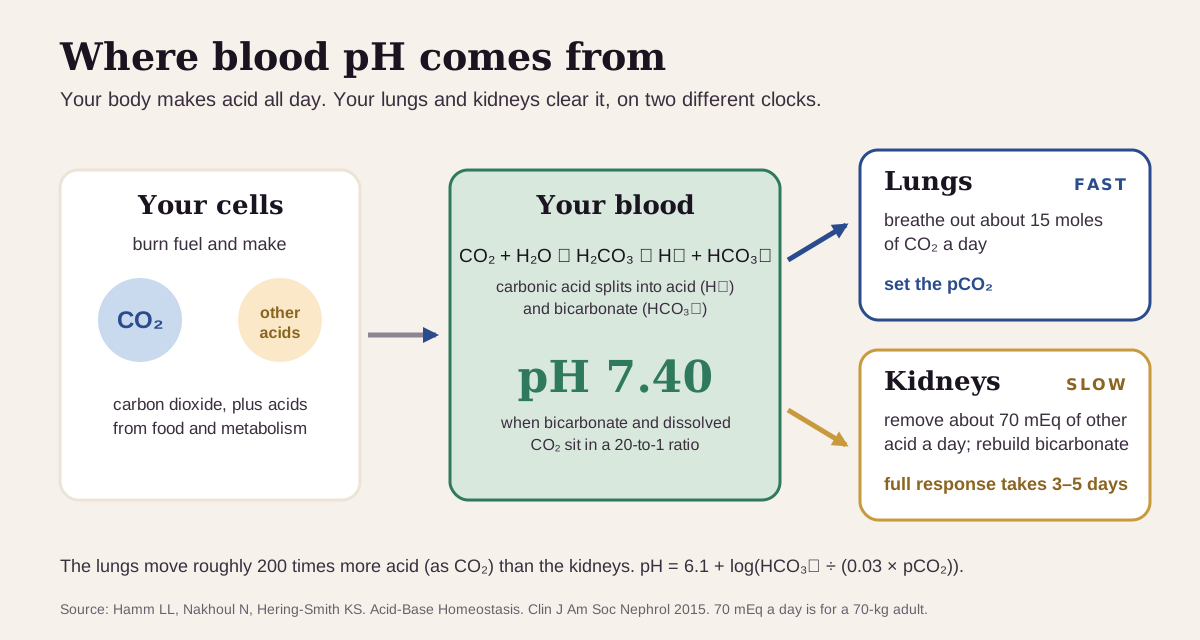
pH is the scale for acidity: lower numbers are more acidic, higher numbers more alkaline. Your blood sits slightly on the alkaline side, near 7.4, while the inside of your cells runs a bit more acidic, near 7.2.8
Holding that number steady is a full-time job, because your body makes acid all day. Burning fuel produces carbon dioxide, which forms carbonic acid in blood. Your lungs breathe out about 15 moles of it a day. Food and metabolism add about 70 mEq of other acids a day for a 70-kg adult, which your kidneys excrete while they rebuild the bicarbonate those acids used up.8 The lungs move roughly 200 times more acid than the kidneys, and they do it faster.
pH is measured on a blood gas, usually from an artery at the wrist (an arterial blood gas, or ABG) or from a vein (a venous blood gas, or VBG). The same report lists pCO2 (carbon dioxide), bicarbonate, and oxygen.1 Most people see one in the emergency room or hospital: blood gases are ordered mainly for serious illness that affects breathing or acid balance.9
What's a normal blood pH?
Start with the range printed on your own report. The common arterial range is 7.35 to 7.45, with pCO2 of 35–45 mmHg and bicarbonate of 22–26 mEq/L.1
A few details change what "normal" means for you:
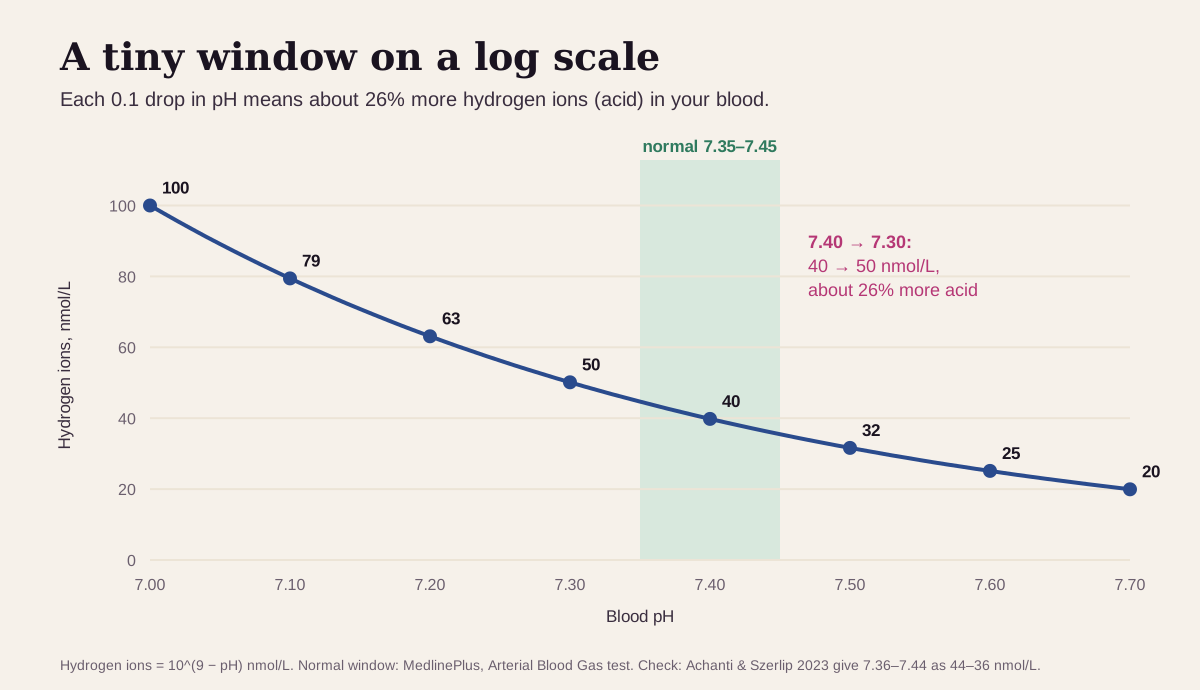
- The window is narrow on purpose. Kidney specialists put normal at 7.36 to 7.44, which is only 36 to 44 nanomoles of hydrogen ions per liter.28 Small decimals are big changes: going from 7.40 to 7.30 means about 26% more acid.
- Vein vs artery. In a pooled analysis of 18 studies and 1,768 adults, arterial pH ran about 0.03 higher than venous pH. pH agreed well between the two; pCO2 and oxygen did not.3
- Women vs men. In healthy adults, women had slightly higher pH and lower pCO2 than men. The gap was small enough that labs use one shared range.10
- Pregnancy. Pregnancy hormones make you breathe more, so pCO2 falls to about 32 mmHg and pH settles at a slightly alkaline 7.40 to 7.47.11
"Optimal" blood pH: why the target is simply 7.40
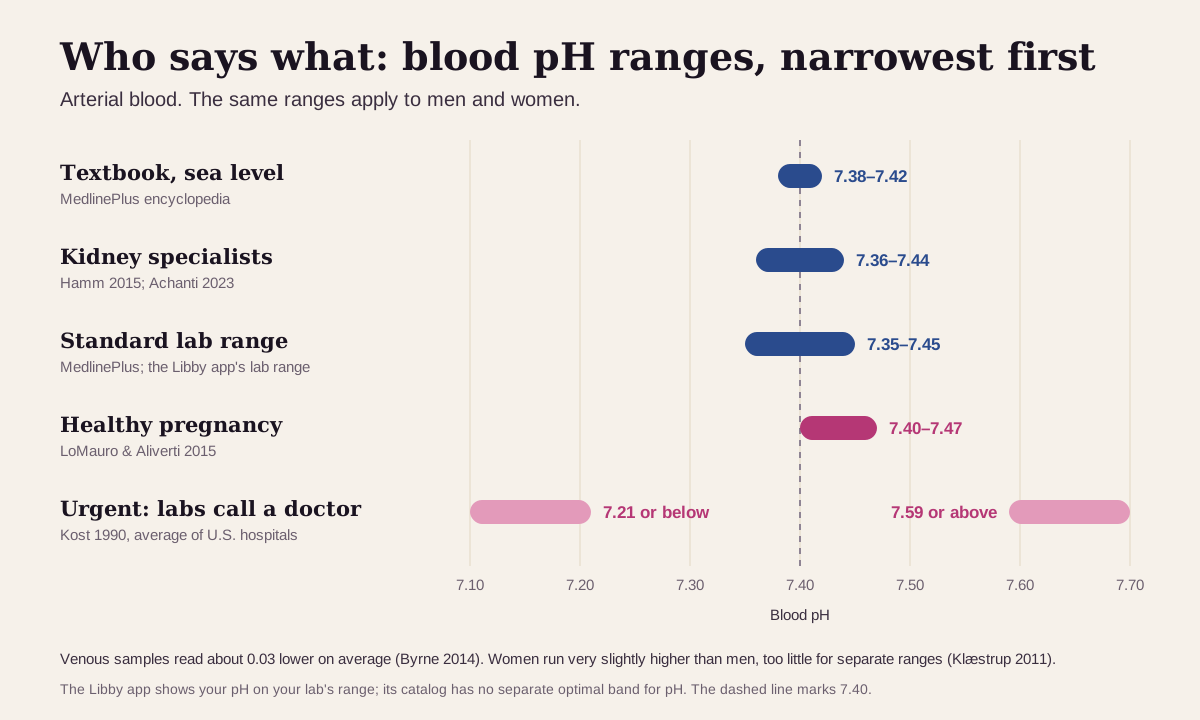
For most markers, health optimizers aim well inside the lab range. Blood pH is different: the tightest textbook range and the loosest lab range sit within a few hundredths of each other, because your lungs and kidneys correct any drift. The Libby app shows your pH against your lab's range; its marker catalog has no separate optimal band for pH.
| Target | Men and women | Who uses it |
|---|---|---|
| Narrowest (textbook, sea level) | 7.38–7.42 | MedlinePlus medical encyclopedia12 |
| Kidney specialists | 7.36–7.44 | Nephrology reviews; below is acidemia, above is alkalemia82 |
| Standard lab range | 7.35–7.45 | The common arterial range,1 and the lab range the Libby app shows |
| Healthy pregnancy | 7.40–7.47 | Faster breathing lowers pCO2 to about 32 mmHg11 |
| Venous sample | about 0.03 lower | Average artery–vein gap across 18 studies3 |
| Urgent | below about 7.21 or above about 7.59 | Average limits at which U.S. hospital labs phone a doctor right away6 |
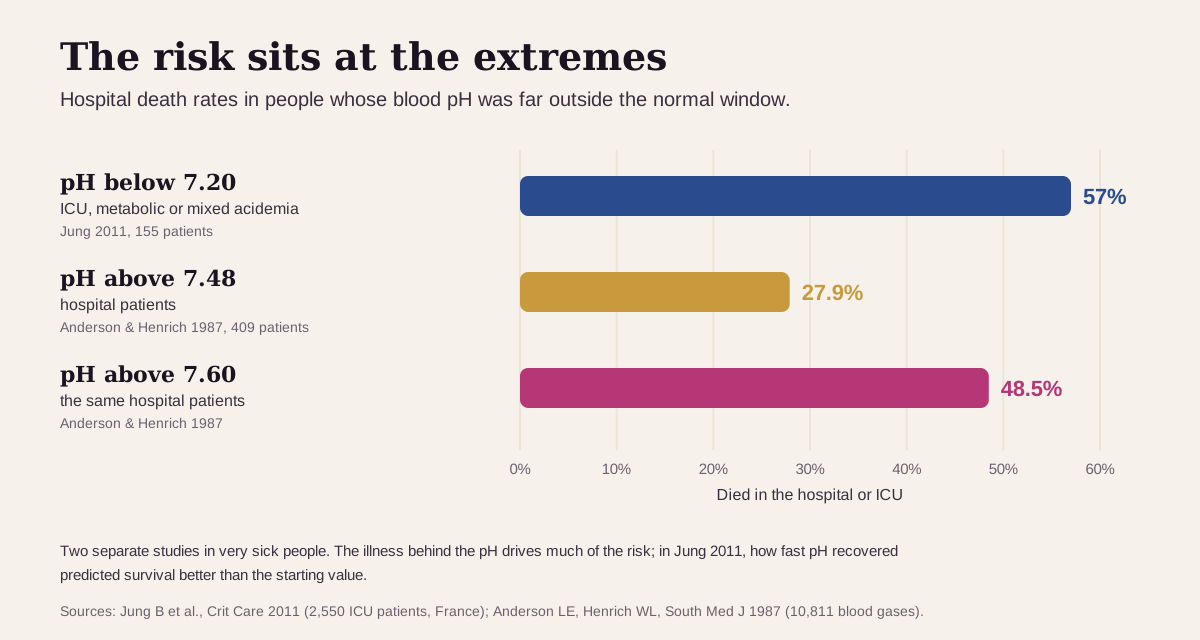
Why the edges matter. The outcome evidence for pH sits at the extremes, in people sick enough to be in the hospital:
- In 2,550 intensive-care patients in France, 8% arrived with a pH below 7.20. Among those with a metabolic or mixed cause, 57% died in the ICU. How quickly the pH recovered predicted survival better than how low it started.7
- In 10,811 hospital blood gases, 23.8% showed a pH above 7.48. Among 409 patients above that line, 27.9% died, rising to 48.5% when the pH was above 7.60.13
Keep "optimal" in perspective: for blood pH it means a number held steady by working lungs and kidneys, not a number you push. Alkaline diets reliably make your urine more alkaline, which is your kidneys at work; in the one supplement study a 2012 review cites, blood pH rose only slightly.14 Your kidneys can make urine about 250 times more acidic than blood (urine pH below 5 against blood at 7.4) to keep blood where it belongs.8
What a low or high pH usually means
First question: acid or base? Second: lungs or metabolism? A low pH is acidemia; a high pH is alkalemia. pCO2 is the lung side of the balance and bicarbonate the metabolic (kidney) side.82
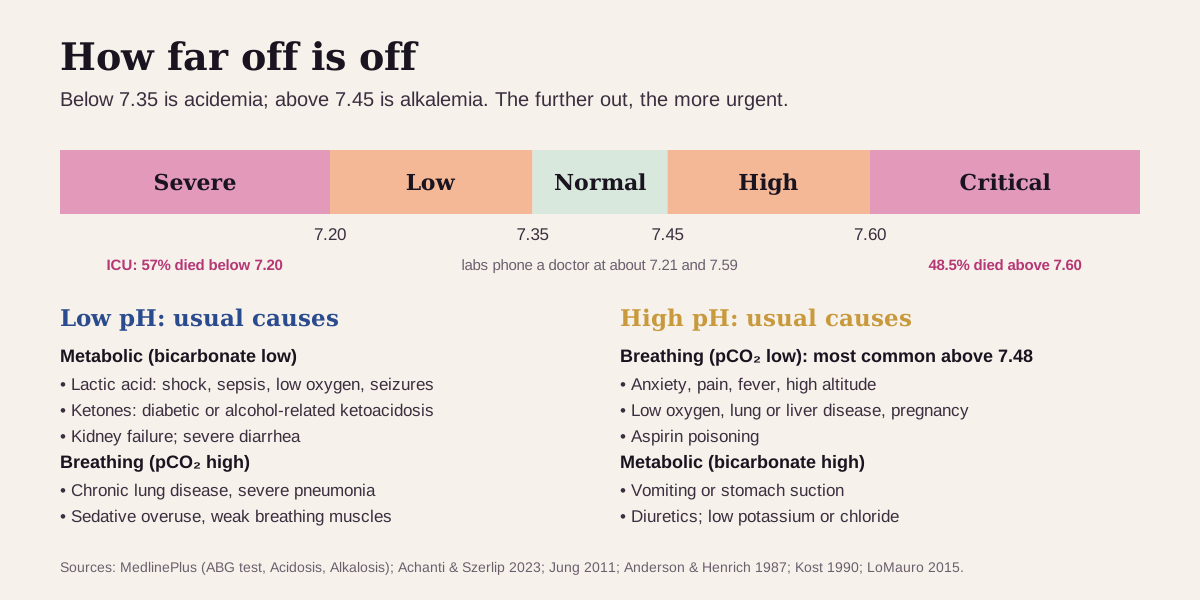
How common is each? In 13,430 hospital blood gases, the most common problem among abnormal results was metabolic alkalemia (51%), then respiratory alkalemia (29%), respiratory acidemia (27%) and metabolic acidemia (12%). Many patients had more than one.15 A 2023 critical-care review still calls metabolic alkalosis the most common acid-base disorder in the ICU.2
High pH (alkalemia, above 7.45)
- Fast or deep breathing (respiratory alkalosis). Breathing off extra carbon dioxide lowers pCO2. The usual triggers are anxiety and pain, fever, high altitude, low oxygen, lung disease, liver disease and pregnancy.5211 Among hospital patients with a pH above 7.48, 62% had pure respiratory alkalosis.13
- Vomiting, stomach suction or diuretics (metabolic alkalosis). Losing stomach acid, or the chloride and potassium that go with it, leaves extra bicarbonate behind.25
- Less common but important: aspirin poisoning, which drives fast breathing.25
Low pH (acidemia, below 7.35)
- Lactic acid. Lactic acidosis is the most common metabolic acidosis in critically ill patients. Shock, sepsis, severe lack of oxygen and seizures are the classic causes; metformin is a rare one.24
- Ketones. Diabetic ketoacidosis (usually type 1 diabetes, though up to 35% of cases occur in type 2) and alcohol-related ketoacidosis.2
- Carbon dioxide build-up (respiratory acidosis). Chronic lung disease is the most common cause in intensive care; severe pneumonia, overuse of sedatives, and weak breathing muscles are others.24
- Kidney failure, when the kidneys fall behind on acid removal, and severe diarrhea, which drains bicarbonate.42
- Less common but important: poisoning with methanol, antifreeze (ethylene glycol) or aspirin.2
Get care now for confusion or passing out, a seizure, severe trouble breathing, or symptoms that are quickly getting worse. Rapid deep breathing, an irregular heartbeat, muscle twitching or cramps, and numbness or tingling in the face, hands or feet can all come with an abnormal pH.15
Blood pH reads best next to its neighbors
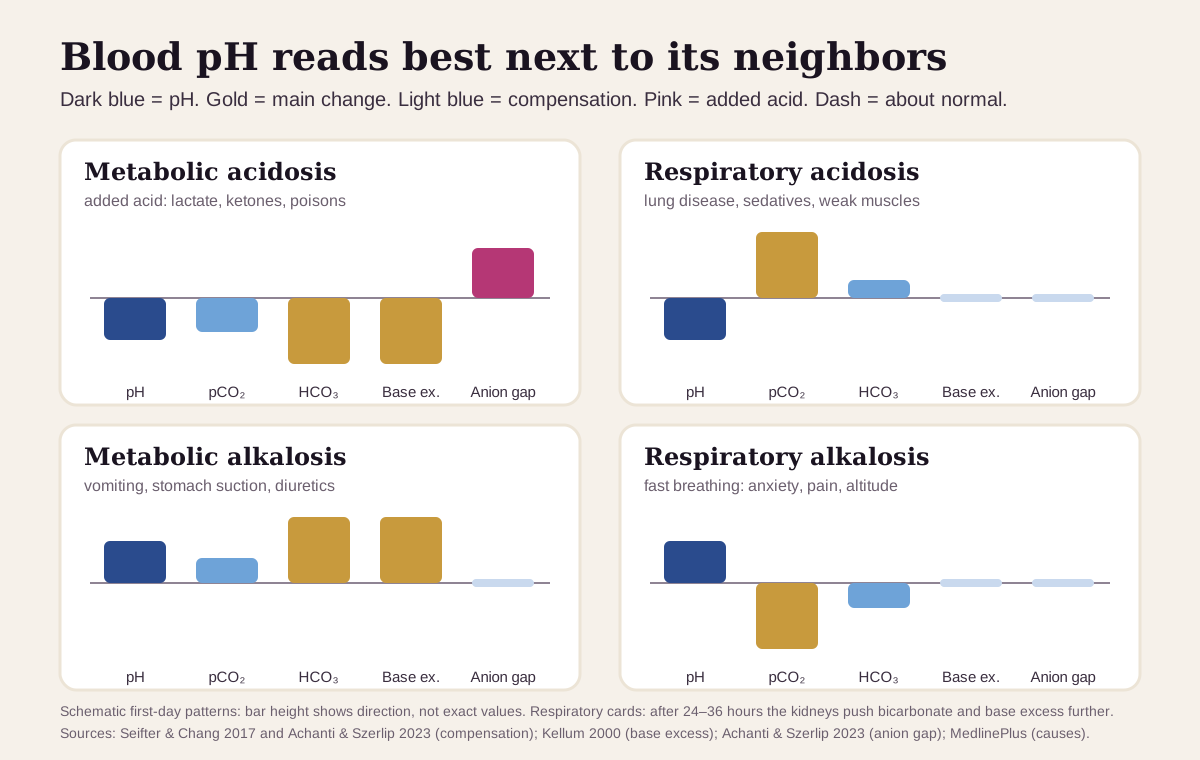
pH tells you the direction. The pattern across pCO2, bicarbonate, base excess and the anion gap tells you the cause:2168
| If you see… | It often points to… |
|---|---|
| pH low, bicarbonate low, pCO2 low, base excess below −5 | metabolic acidosis, with the lungs breathing off carbon dioxide to compensate |
| …and a high anion gap | an added acid: lactate, ketones, a poison, or sometimes kidney failure |
| …and a normal anion gap | bicarbonate lost or diluted: diarrhea, some kidney-tubule problems, kidney failure, or large amounts of IV saline |
| pH low, pCO2 high, bicarbonate normal or a little high (clearly high once chronic) | respiratory acidosis: breathing too weak to clear carbon dioxide |
| pH high, bicarbonate high, base excess above +5 | metabolic alkalosis: vomiting, stomach suction or diuretics |
| pH high, pCO2 low, bicarbonate a little low | respiratory alkalosis: fast breathing |
| pH near normal, but pCO2 and bicarbonate both off | usually a mixed problem: aspirin poisoning, for example, causes both a respiratory alkalosis and an acidosis. Compensation alone rarely brings pH all the way back |
Clinicians check whether the lungs are compensating as expected. For a metabolic acidosis, Winter's formula predicts the pCO2:17
expected pCO2 = 1.5 × bicarbonate + 8 (± 2)
The breathing response takes 12–24 hours to settle.17 After that, a measured pCO2 higher than predicted means a respiratory acidosis is added; lower means a respiratory alkalosis is stacked on top.16
How fast pH changes
The lungs work fast; the kidneys take days. That timing is why the same pCO2 can come with very different pH values.817
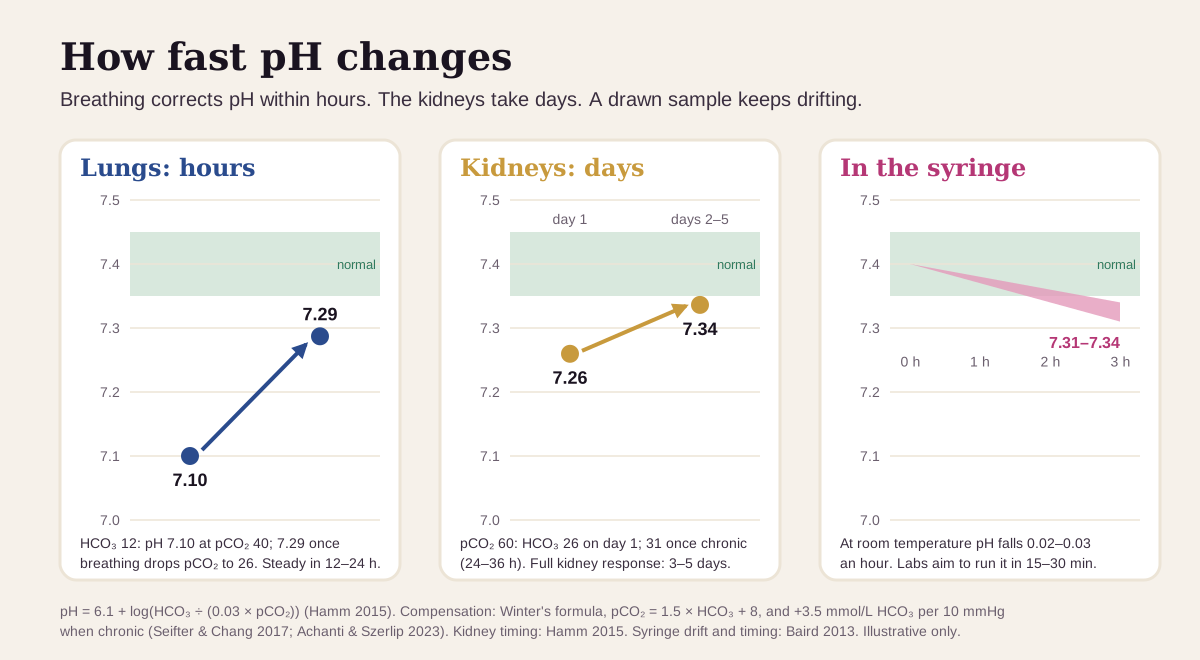
- Minutes to hours: breathing. Changing how fast you breathe changes pCO2 quickly. After a ventilator change, clinicians wait at least 30 minutes before drawing a new blood gas.9 For a metabolic acid load, the breathing response is steady within 12–24 hours.17
- Days: the kidneys. When pCO2 stays high, bicarbonate rises only about 1 mmol/L per 10 mmHg at first and about 3.5 once the kidneys catch up,2 which takes 24–36 hours.17 The kidneys' full response to an acid load takes 3–5 days.8
- In the syringe. Blood keeps making acid after it's drawn: at room temperature pH falls 0.02–0.03 per hour and pCO2 rises about 1 mmHg per hour. An air bubble does the opposite, raising pH. That's why labs aim to run a blood gas within 15–30 minutes.9
- Trends beat snapshots. In the ICU study above, the speed of recovery predicted survival better than the first pH did.7 Comparing pH works best with the same sample type each time, artery with artery or vein with vein.3
Going deeper: pH is a 20-to-1 ratio
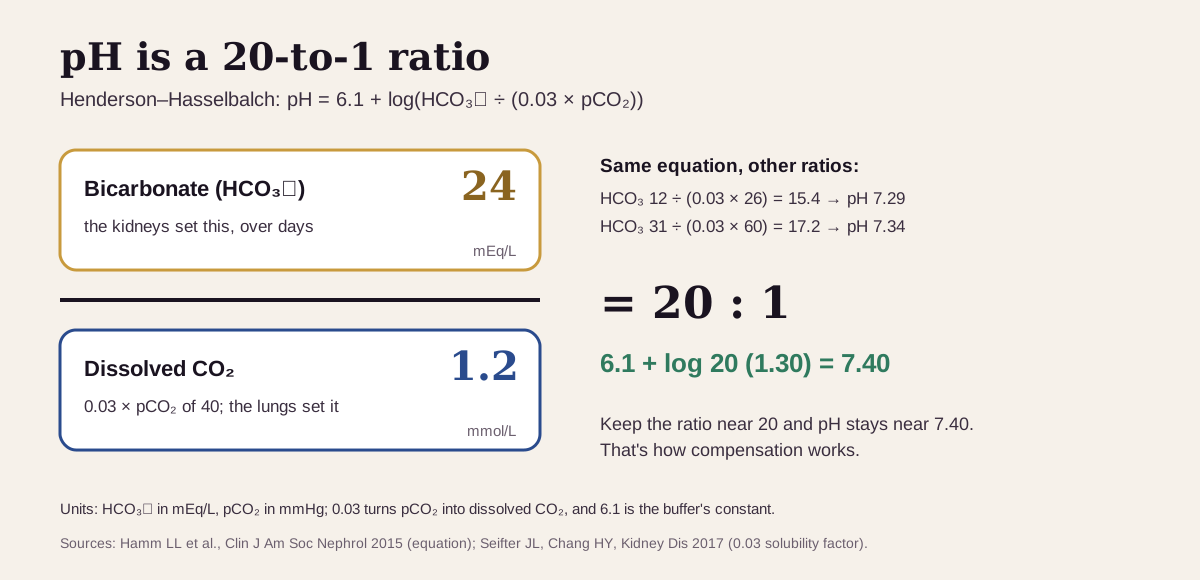
The key equation is Henderson–Hasselbalch:8
pH = 6.1 + log( HCO3 ÷ (0.03 × pCO2) )
With a normal bicarbonate of 24 and pCO2 of 40, the ratio is 24 ÷ 1.2 = 20 to 1, and 6.1 + log(20) = 7.40. Anything that keeps the ratio near 20 keeps pH normal, which is how compensation works: the lungs move the bottom of the ratio and the kidneys move the top.817
Base excess is the same idea from another angle. It estimates how much acid or base the metabolic side has gained, with the carbon dioxide effect stripped out: a standard base excess below −5 mmol/L points to metabolic acidosis, above +5 to metabolic alkalosis, and near 0 to an early breathing problem.16 The anion gap, sodium minus (chloride + bicarbonate), is typically 8–10 mEq/L; it widens when an unmeasured acid such as lactate or ketones builds up.2
Questions worth asking
- Was this sample from an artery or a vein, and what range does my lab use?
- What were my pCO2 and bicarbonate at the same time?
- Is this a metabolic or a breathing problem, or both?
- What's my anion gap, and do I need lactate or ketone tests?
- Is this new, or has my body had days to compensate?
- When should we repeat it, and what would change the plan?
FAQ
What is a normal blood pH? On an arterial blood gas, 7.35 to 7.45.1 Venous samples usually read about 0.03 lower.3
What causes a low blood pH? Most often lactic acid from severe illness, ketones in diabetic or alcohol-related ketoacidosis, kidney failure, diarrhea, or carbon dioxide building up from lung disease or slowed breathing.24
Can an alkaline diet change my blood pH? Very little. Alkaline diets make urine more alkaline; your kidneys and lungs hold blood pH near 7.4.148
When is blood pH an emergency? Hospital labs treat about 7.21 and below, or 7.59 and above, as critical results.6 Passing out, seizures, severe trouble breathing or quickly worsening symptoms need emergency care at any pH.5
This guide is for education. It can't diagnose you or replace care from a clinician who knows your history.
Footnotes
-
National Library of Medicine. Arterial Blood Gas (ABG) Test. MedlinePlus. Last updated June 26, 2025. Normal ranges (pH 7.35–7.45, PaCO2 35–45 mmHg, HCO3 22–26 mEq/L) and symptoms of acidosis and alkalosis. MedlinePlus ↩ ↩2 ↩3 ↩4 ↩5 ↩6 ↩7 ↩8 ↩9 ↩10
-
Achanti A, Szerlip HM. Acid-Base Disorders in the Critically Ill Patient. Clin J Am Soc Nephrol. 2023;18(1):102–112. doi:10.2215/CJN.04500422. Normal pH 7.36–7.44 (44–36 nmol/L), the anion gap, expected compensation, and the common causes of each disorder in hospital care. PMC ↩ ↩2 ↩3 ↩4 ↩5 ↩6 ↩7 ↩8 ↩9 ↩10 ↩11 ↩12 ↩13 ↩14 ↩15 ↩16 ↩17 ↩18 ↩19 ↩20 ↩21 ↩22 ↩23 ↩24
-
Byrne AL, Bennett M, Chatterji R, Symons R, Pace NL, Thomas PS. Peripheral venous and arterial blood gas analysis in adults: are they comparable? A systematic review and meta-analysis. Respirology. 2014;19(2):168–175. doi:10.1111/resp.12225. 18 studies, 1,768 adults; arterial pH about 0.03 higher than venous. PubMed ↩ ↩2 ↩3 ↩4 ↩5
-
National Library of Medicine. Acidosis. MedlinePlus Medical Encyclopedia. Causes of respiratory and metabolic acidosis, including diabetic ketoacidosis, diarrhea, kidney disease and lactic acidosis. MedlinePlus ↩ ↩2 ↩3 ↩4 ↩5 ↩6
-
National Library of Medicine. Alkalosis. MedlinePlus Medical Encyclopedia. Reviewed November 6, 2025. Causes of respiratory and metabolic alkalosis, symptoms, and when to go to the emergency room. MedlinePlus ↩ ↩2 ↩3 ↩4 ↩5 ↩6 ↩7
-
Kost GJ. Critical limits for urgent clinician notification at US medical centers. JAMA. 1990;263(5):704–707. National survey: mean critical limits for pH of 7.21 and 7.59, and for pCO2 of 19 and 67 mmHg. PubMed ↩ ↩2 ↩3 ↩4 ↩5
-
Jung B, Rimmele T, Le Goff C, et al. Severe metabolic or mixed acidemia on intensive care unit admission: incidence, prognosis and administration of buffer therapy. A prospective, multiple-center study. Crit Care. 2011;15(5):R238. doi:10.1186/cc10487. 2,550 ICU patients; 8% had pH below 7.20; 57% ICU mortality in metabolic or mixed acidemia. PMC ↩ ↩2 ↩3 ↩4 ↩5
-
Hamm LL, Nakhoul N, Hering-Smith KS. Acid-Base Homeostasis. Clin J Am Soc Nephrol. 2015;10(12):2232–2242. doi:10.2215/CJN.07400715. The source for the Henderson–Hasselbalch equation, arterial pH 7.36–7.44, about 15 mol of carbon dioxide and 70 mEq of other acid a day, and the 3–5 day kidney response. PMC ↩ ↩2 ↩3 ↩4 ↩5 ↩6 ↩7 ↩8 ↩9 ↩10 ↩11 ↩12 ↩13 ↩14 ↩15 ↩16
-
Baird G. Preanalytical considerations in blood gas analysis. Biochem Med (Zagreb). 2013;23(1):19–27. doi:10.11613/BM.2013.005. Why blood gases are ordered, the 30-minute wait after a ventilator change, air bubbles, and pH drift of 0.02–0.03 per hour in a delayed sample. PMC ↩ ↩2 ↩3 ↩4
-
Klæstrup E, Trydal T, Pedersen JF, Larsen JM, Lundbye-Christensen S, Kristensen SR. Reference intervals and age and gender dependency for arterial blood gases and electrolytes in adults. Clin Chem Lab Med. 2011;49(9):1495–1500. doi:10.1515/CCLM.2011.603. Healthy adults on a modern analyzer: women had slightly higher pH, and the differences were small enough for common ranges. PubMed ↩ ↩2
-
LoMauro A, Aliverti A. Respiratory physiology of pregnancy: Physiology masterclass. Breathe (Sheff). 2015;11(4):297–301. doi:10.1183/20734735.008615. Arterial pCO2 about 32 mmHg and pH 7.40–7.47 in pregnancy. PMC ↩ ↩2 ↩3 ↩4
-
National Library of Medicine. Blood gases. MedlinePlus Medical Encyclopedia. Reviewed August 19, 2024. Sea-level values: arterial pH 7.38–7.42, PaCO2 38–42 mmHg. MedlinePlus ↩ ↩2
-
Anderson LE, Henrich WL. Alkalemia-associated morbidity and mortality in medical and surgical patients. South Med J. 1987;80(6):729–733. doi:10.1097/00007611-198706000-00016. 10,811 arterial blood gases; mortality 27.9% above pH 7.48 and 48.5% above 7.60. PubMed ↩ ↩2 ↩3
-
Schwalfenberg GK. The alkaline diet: is there evidence that an alkaline pH diet benefits health? J Environ Public Health. 2012;2012:727630. doi:10.1155/2012/727630. Blood pH is tightly controlled near 7.4; alkaline diets make urine more alkaline. PMC ↩ ↩2
-
Hodgkin JE, Soeprono FF, Chan DM. Incidence of metabolic alkalemia in hospitalized patients. Crit Care Med. 1980;8(12):725–728. doi:10.1097/00003246-198012000-00005. 13,430 arterial samples; how often each disorder appeared. PubMed ↩
-
Kellum JA. Determinants of blood pH in health and disease. Crit Care. 2000;4(1):6–14. doi:10.1186/cc644. Standard base excess rules for each acid-base pattern (Table 1). PMC ↩ ↩2 ↩3 ↩4
-
Seifter JL, Chang HY. Disorders of Acid-Base Balance: New Perspectives. Kidney Dis (Basel). 2017;2(4):170–186. doi:10.1159/000453028. Table of expected compensation, including Winter's formula and its 12–24 hour timing. PMC ↩ ↩2 ↩3 ↩4 ↩5 ↩6 ↩7 ↩8
Educational content, not medical advice. Libby is a personal record tool, not a medical service — it doesn't diagnose, treat, or prescribe. Reference ranges vary by lab and by person. Talk to a qualified healthcare professional about your results.
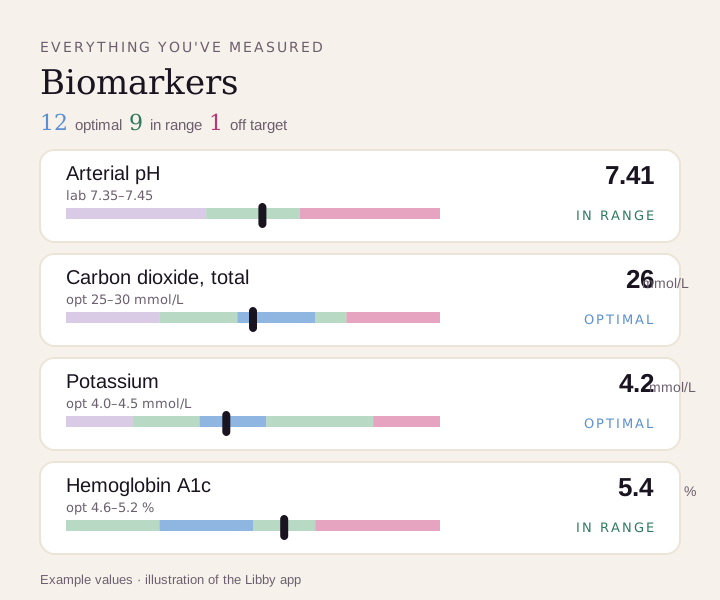
See every result against your lab's range.
Upload a lab PDF or a photo of your report. Libby puts every marker on your lab's range and tracks your trends over time.
View your blood pH ›