Base excess blood test: normal range, low and high causes
Base excess shows the metabolic side of your blood's acid balance. Here's the normal range, what a negative or positive result means, and when it's urgent.
Base excess (BE) shows the metabolic side of your blood's acid balance: how much acid or base your blood has gained or lost, with the effect of your breathing taken out. A negative number means acid has been added or bicarbonate lost. A positive number means acid has been lost or bicarbonate kept. It's calculated from the pH and carbon dioxide on a blood gas, usually in a hospital.12
The short version
- Normal: check the range on your report. The classic range is −2 to +2 mmol/L. A 2026 lab guideline uses −3.0 to +3.0 for artery blood and −2.0 to +4.5 for vein blood.13
- Negative (also called a base deficit: a BE of −6 is a base deficit of 6) means acid added or bicarbonate lost. The usual reasons are lactic acid (shock, blood loss, an all-out workout), ketoacids (uncontrolled diabetes, heavy drinking, starvation), kidney failure and diarrhea.1452
- Positive means acid or chloride lost, or bicarbonate kept: most often vomiting, diuretics, or days of carbon dioxide retention from a lung condition.46
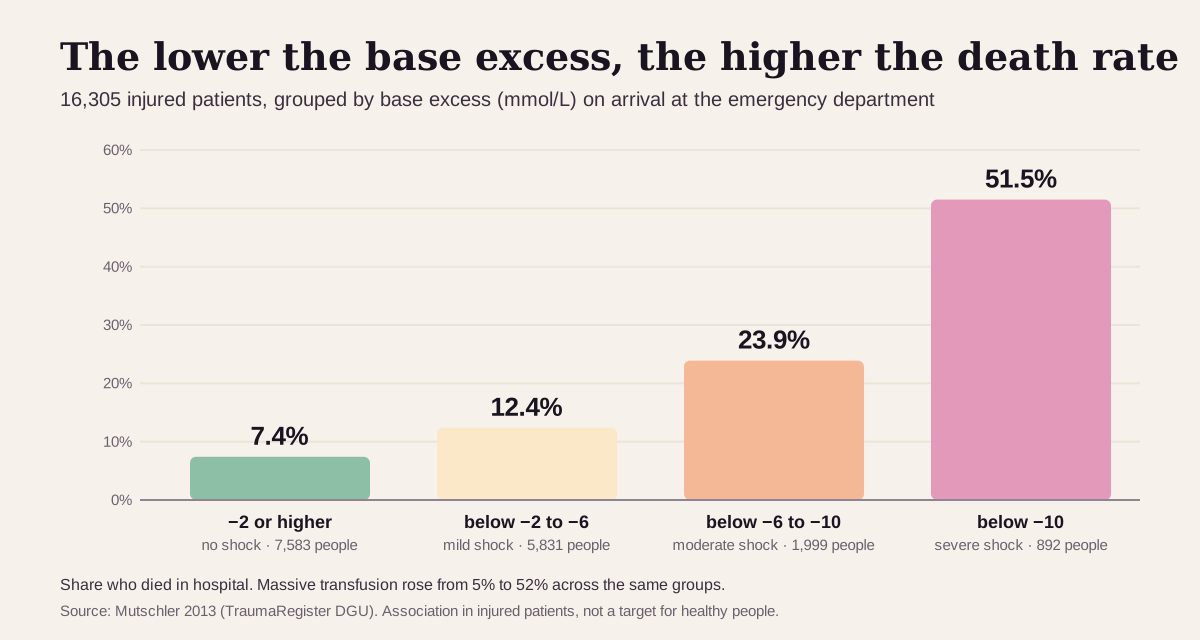
- Very negative can be urgent. Among 16,305 injured patients, 51.5% of those arriving with a BE below −10 died, versus 7.4% at −2 or above.5
What base excess is
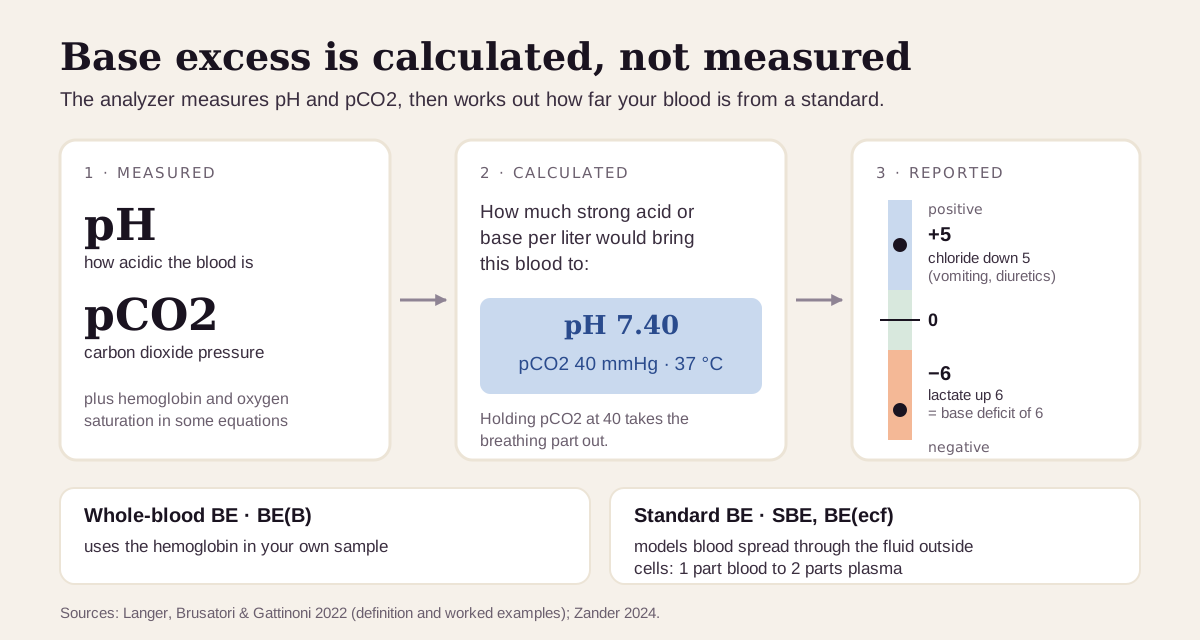
Your blood keeps its acidity in a narrow band. Two systems steer it: your lungs, which breathe out carbon dioxide (an acid once it dissolves in blood), and your kidneys and metabolism, which add or remove other acids and bicarbonate, the body's main base.89 A blood gas measures pH (acidity) and pCO2 (carbon dioxide pressure) directly. Base excess is the analyzer's estimate of the second, non-breathing part.
Technically, BE is the amount of strong acid or base it would take to bring a liter of your blood to pH 7.40 at a pCO2 of 40 mmHg and body temperature (37 °C). Nobody actually adds acid to your sample: the analyzer calculates the answer from your pH and pCO2, and some equations also use hemoglobin and oxygen saturation.12 Because the calculation pins pCO2 at 40, the breathing part drops out.
The sign tells you the direction. In Langer's worked examples, adding 6 mmol/L of lactic acid to otherwise normal blood gives a BE of −6, and losing 5 mmol/L of chloride, as happens with vomiting or loop diuretics, gives a BE of +5.1 Some reports print a negative BE as a positive "base deficit", so BE −6 and base deficit 6 mean the same thing.2
You'll mostly see base excess on a blood gas drawn in a hospital or emergency department, often from the artery at your wrist. Doctors order one to check breathing, kidney problems and acid balance,9 and in injured patients as a quick gauge of shock.5
What's a normal base excess?
Start with the range printed on your own report. Analyzers use different equations, and blood from a vein runs a little differently from blood from an artery.23
- A 2022 critical-care review calls −2 to +2 mmol/L the usual normal range.1 That's also the range in the Libby app's marker catalog.
- The Australasian Association for Clinical Biochemistry and Laboratory Medicine (AACB), in a 2026 guideline endorsed by the Royal College of Pathologists of Australasia, sets adult standard BE at −3.0 to +3.0 mmol/L for artery blood and −2.0 to +4.5 for vein blood.3
- The vein range comes from 134 healthy adults aged 18–70, whose vein blood ran from −1.9 to +4.5 mmol/L.10
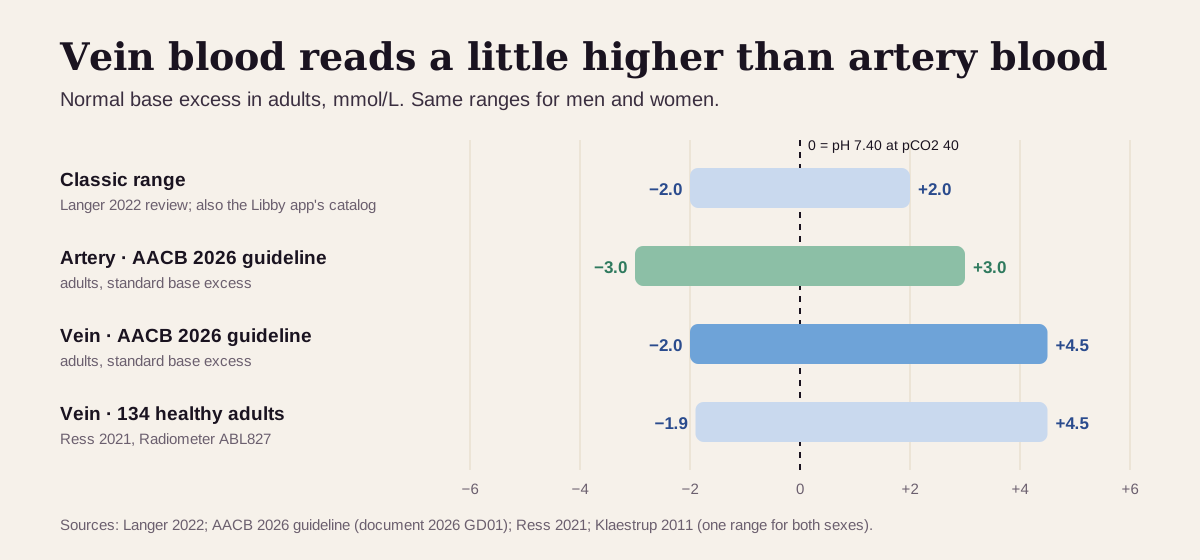
Men and women share one range. In a Danish study of healthy adults aged 20 to 76, women's standard BE ran slightly lower than men's, but the gap was small enough that the researchers set one range for both.11
Newborns are a special case. Standard BE was designed around adult body fluid: a newborn's extracellular fluid is about 40% of body weight, versus 20% in adults, so ask which version and range a baby's report uses.2
"Optimal" base excess: what health optimizers aim for
No longevity platform we checked publishes a base-excess target. Function Health's and Superpower's public test lists include carbon dioxide, but no base excess.12 The Libby app shows your base excess against your lab's range; its marker catalog has no separate optimal band for it. So this ladder runs from the tightest published normal range to the levels linked with danger.
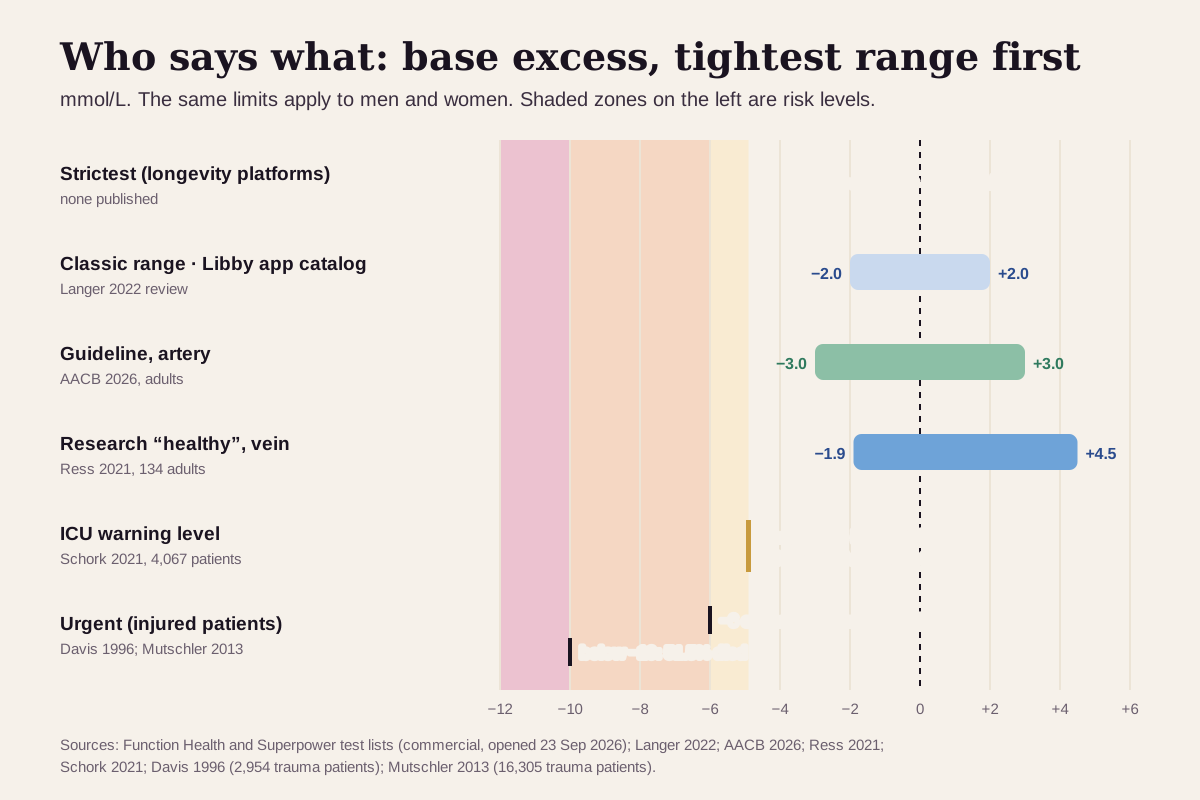
| Target | Men and women | Who uses it |
|---|---|---|
| Strictest (longevity platforms) | none published | Function Health and Superpower list carbon dioxide, not base excess12 |
| Classic range | −2 to +2 mmol/L | A 2022 critical-care review;1 also the range in the Libby app's catalog |
| Guideline, artery | −3.0 to +3.0 mmol/L | AACB 2026 adult guideline3 |
| Research "healthy", vein | −1.9 to +4.5 mmol/L | 134 healthy adults;10 the AACB rounds it to −2.0 to +4.53 |
| ICU warning level | lowest value below −4.9 in the first day | A study cut-off in 4,067 medical ICU patients13 |
| Urgent | −6 or lower; below −10 | Injured patients: blood loss likely at −6,14 severe shock below −105 |
Why the tight range matters:
- In 16,305 injured patients in the German trauma registry, the share who died rose with each step down in BE on arrival: 7.4% at −2 or above, 12.4% from −2 to −6, 23.9% from −6 to −10, and 51.5% below −10. The share needing a massive transfusion rose from 5% to 52%.5
- In 2,954 trauma patients, 72% of those with a BE of −6 or lower needed a blood transfusion within 24 hours, versus 18% above −6.14
- In 4,067 medical ICU admissions, 22% died. A lowest BE below −4.9 in the first 24 hours marked the higher-risk group, although the highest lactate was the strongest single predictor.13
Keep "optimal" in perspective: these numbers come from people who were already injured or in intensive care. For a healthy person, the goal is a result inside your lab's range, read next to pH and pCO2. A value near zero can still hide two problems that cancel out (more below), and a clearly positive BE points to acid loss or bicarbonate being held on to, not to extra health.1
What a negative base excess usually means
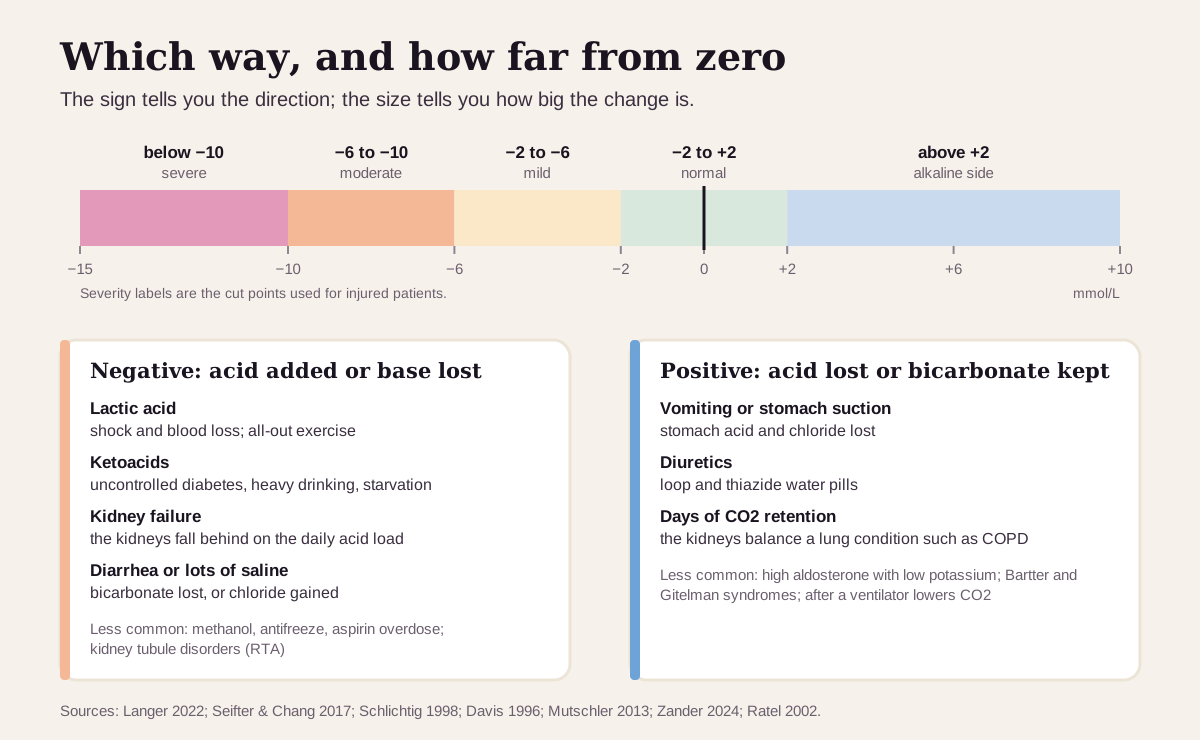
A negative BE means your blood has gained acid or lost bicarbonate. The size tells you how much: in Langer's example, 6 mmol/L of extra lactic acid gives a BE of −6.1 For injured patients, doctors grade it as mild (−2 to −6), moderate (−6 to −10) and severe (below −10).514
The usual suspects
- Lactic acid. Tissues short of blood flow make lactic acid, so BE falls in shock and heavy blood loss.5 Hard exercise does it too: during exercise and recovery, BE falls roughly in step with the rise in lactate,2 and after ten 10-second all-out cycling sprints, men's lactate reached about 15 mmol/L.15
- Ketoacids. Uncontrolled diabetes (diabetic ketoacidosis), heavy drinking and starvation can flood the blood with ketoacids.41
- Kidney failure. Failing kidneys fall behind on clearing the body's daily acid load, so BE drifts down.48
- Diarrhea. Fluid from the gut carries bicarbonate out of the body. BE falls and chloride rises.4
- Large volumes of saline. Salt-water drips add chloride, which pushes chloride up and BE down.4
- Less common causes: poisoning with methanol, antifreeze (ethylene glycol) or an aspirin overdose; kidney tubule disorders (renal tubular acidosis); and some diuretics (carbonic anhydrase inhibitors).4 A sample left sitting too long can also read low, because the blood cells keep making lactic acid in the syringe.16
What a positive base excess usually means
A positive BE means your blood has lost acid or chloride, or your kidneys are holding on to extra bicarbonate.14
- Vomiting or stomach suction. Losing stomach acid lowers chloride and raises BE. In Langer's example, a 5 mmol/L drop in chloride gives a BE of +5 and a pH of 7.47.14
- Diuretics. Loop and thiazide-type water pills cause the same low-chloride pattern.41
- Days of carbon dioxide retention. In a lung condition such as COPD, carbon dioxide builds up and the kidneys slowly hold on to bicarbonate to balance it. Once that's done, BE sits about 0.4 mmol/L higher for every 1 mmHg rise in pCO2.684
- Less common causes: high aldosterone with low potassium; Bartter and Gitelman syndromes; chloride-rich sweat in cystic fibrosis; and a high BE that lingers after a ventilator lowers carbon dioxide quickly.4
Get care right away if an abnormal base excess comes with uncontrolled fast or deep breathing, confusion, an irregular heartbeat, muscle twitching or numbness in your hands, feet or face, or vomiting that won't stop, or after an injury with heavy bleeding.95
Base excess reads best next to its neighbors
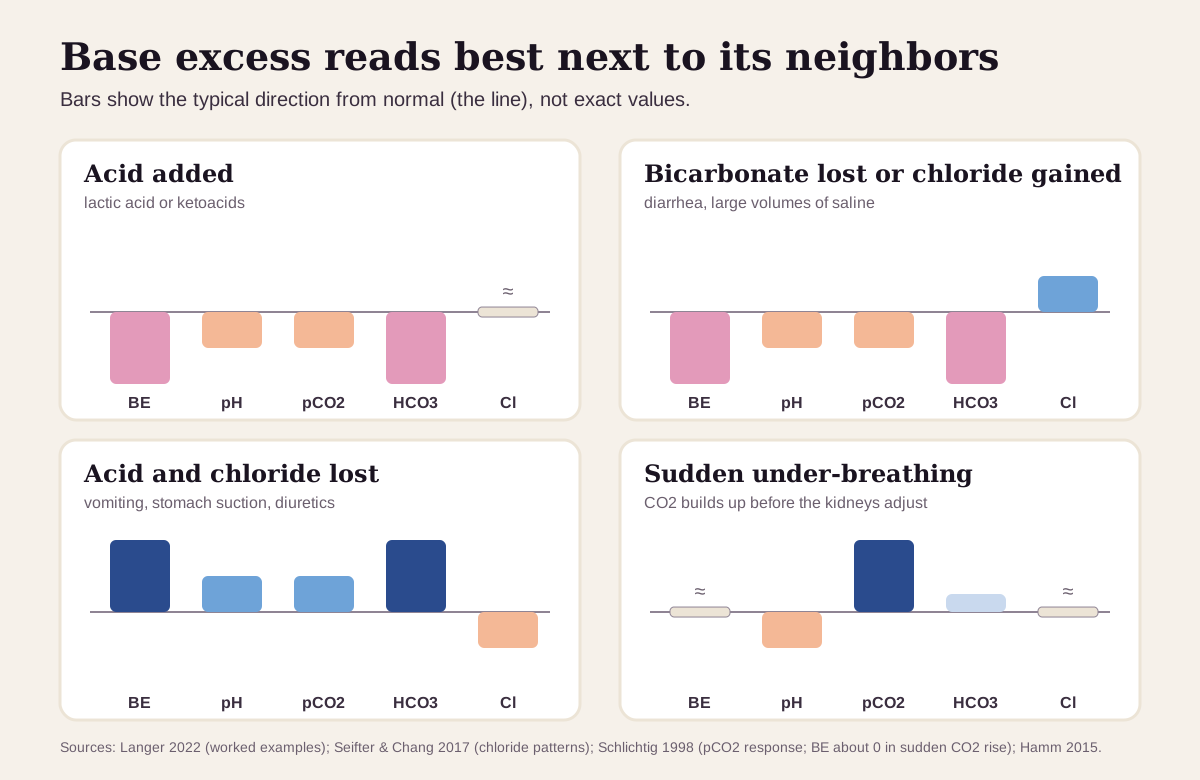
BE tells you that the metabolic side moved and which way. pH, pCO2, bicarbonate and chloride tell you what kind of problem it is:41
| If you see… | It often points to… |
|---|---|
| BE and bicarbonate low, pH low, chloride normal, often lactate or ketones high | acid being added: lactic acid (shock, blood loss, hard exercise)5215 or ketoacids (diabetes, alcohol, starvation)41 |
| BE and bicarbonate low, chloride high | bicarbonate lost or chloride gained: diarrhea, large volumes of saline, kidney tubule disorders |
| BE and bicarbonate high, chloride low, pH high | acid and chloride lost: vomiting, stomach suction, diuretics |
| BE near zero, pH low, pCO2 high | a breathing problem that started recently, before the kidneys have adjusted |
| BE high, pCO2 high, pH low-normal or slightly low | carbon dioxide held in for days (such as COPD), with the kidneys balancing it68 |
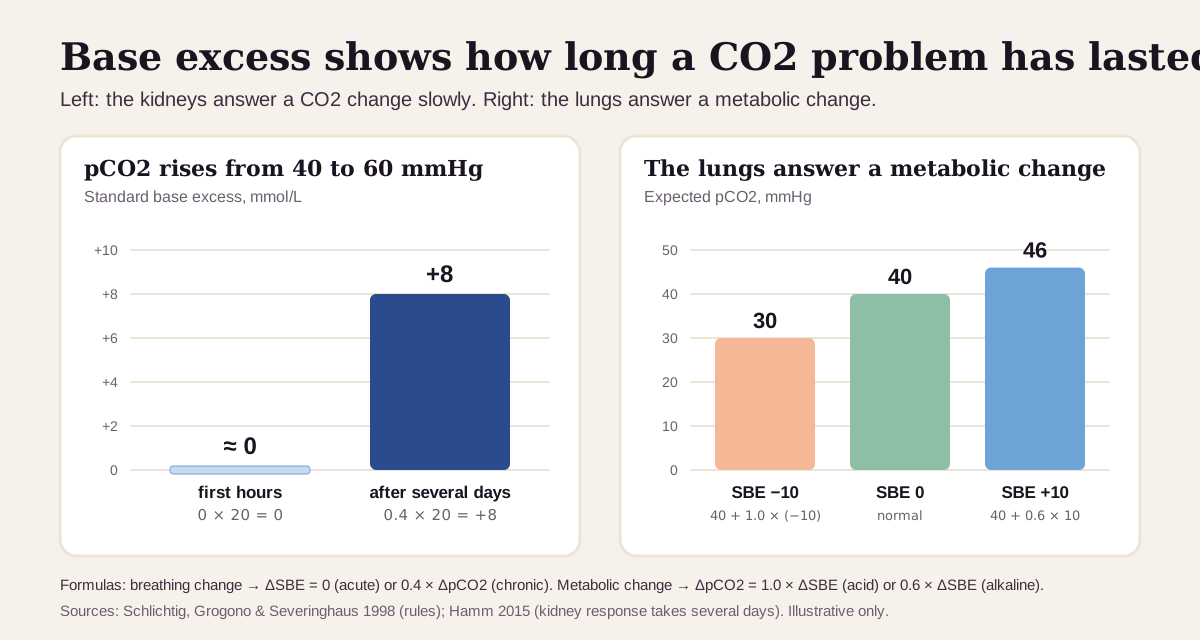
The lungs answer a metabolic change. When standard BE falls, breathing speeds up and pCO2 drops by about 1 mmHg for each mmol/L of BE. When it rises, pCO2 climbs by about 0.6 mmHg for each mmol/L.6 A pCO2 well off those numbers points to a second, breathing problem on top.4
The anion gap names the acid. A negative BE with a high anion gap points to an added acid such as lactate, ketoacids, kidney failure or a poison. A negative BE with high chloride and a normal anion gap points to bicarbonate loss or chloride gain.4
How fast base excess changes
Base excess has no half-life. It's a calculation, so it moves as fast as the acids behind it. In one sprint study, lactate climbed to about 15 mmol/L over ten 10-second sprints spread across about six minutes, and BE tracks lactate that closely.152
The kidneys work on a clock of days. When carbon dioxide builds up suddenly, BE stays near zero at first. Over several days the kidneys hold on to bicarbonate and BE rises.68
What that means in practice:
- BE dates a breathing problem. A BE near zero with a high pCO2 and low pH points to a problem that started recently. A clearly positive BE with a high pCO2 points to one that has lasted days.68
- The sample is on a clock too. Blood keeps making lactic acid in the syringe. International lab guidance calls for analyzing a plastic-syringe sample within 30 minutes (15 if oxygen is being measured), and for waiting at least 30 minutes after a ventilator change before drawing it.16
- Trends beat snapshots. In ICU patients, the lowest value over the first 24 hours predicted outcome better than the value on admission.13 Compare results from the same kind of sample, because vein blood reads higher than artery blood.3
Going deeper: whole-blood versus standard base excess
Reports can show two versions. Whole-blood BE (written BE(B) or cBase(B)) uses the hemoglobin in your sample. Standard BE (SBE, BE(ecf) or cBase(Ecf)) models your blood spread through all the fluid outside your cells, one part blood to two parts plasma, so it uses about a third of the hemoglobin.12 Reviewers generally prefer SBE, and in most people the two numbers land close together.1 Zander points out that SBE fits adults with normal hemoglobin, oxygen and fluid volume: 5 liters of blood spread through 15 liters of extracellular fluid.2
The formula most analyzers build on:1
BE = (HCO3 − 24.8) + β × (pH − 7.40)
Standard BE is a total. Chloride, lactate, albumin, ketoacids and other ions each push it up or down, and two changes can cancel.1 Story and colleagues gave simple formulas for two of the pieces:7
Chloride effect = sodium − chloride − 38
Albumin effect = 0.25 × (42 − albumin in g/L)
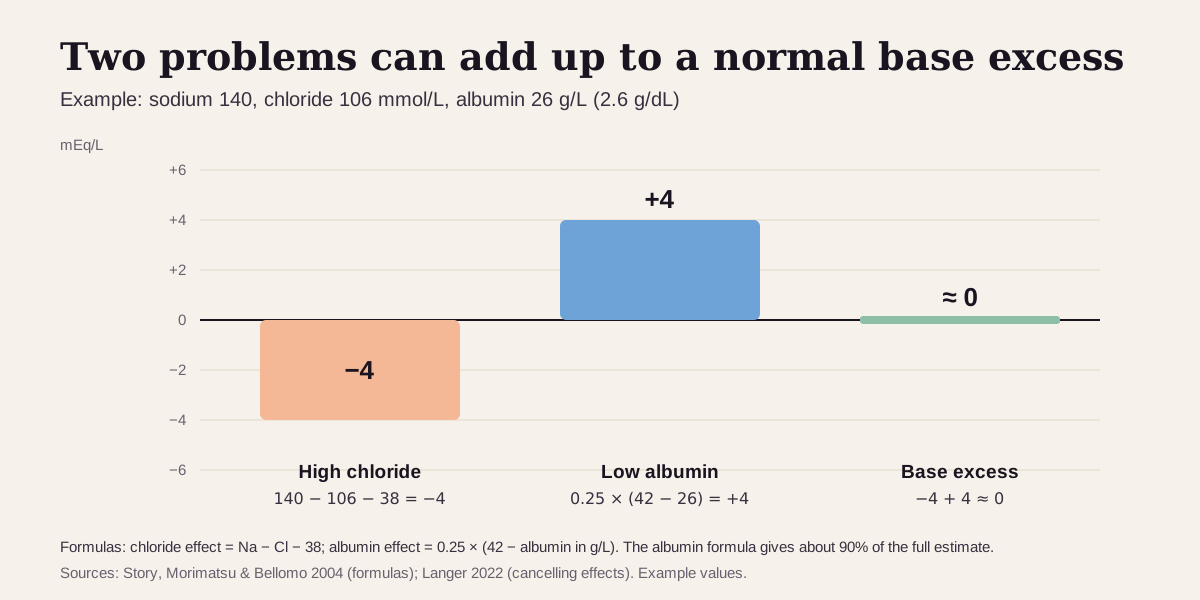
With sodium 140, chloride 106 and albumin 26 g/L, the chloride effect is −4 and the albumin effect is +4. BE reads about 0 even though two things are off.71 That's why a normal BE is best read next to chloride, albumin and lactate.
Questions worth asking
- Was this blood from an artery or a vein, and is it whole-blood or standard BE?
- How far is my base excess from my lab's range, and in which direction?
- What do my pH, pCO2 and bicarbonate show next to it?
- If it's negative: what do my lactate, ketones, anion gap and kidney tests show?
- If it's positive: could vomiting, a diuretic or my lung condition explain it?
- Should we repeat it, and what would change the plan?
FAQ
What is a normal base excess? The classic range is −2 to +2 mmol/L. A 2026 guideline uses −3.0 to +3.0 for artery blood and −2.0 to +4.5 for vein blood. Use the range on your report.13
Is a negative base excess the same as a base deficit? Yes. A BE of −6 is a base deficit of 6. Both mean the blood has gained acid or lost bicarbonate.21
What does a positive base excess mean? Your blood has lost acid or chloride, most often from vomiting or diuretics, or your kidneys are holding extra bicarbonate after days of carbon dioxide retention.46
When is a low base excess dangerous? In injured patients, a BE of −6 or lower often means blood loss that needs a transfusion, and below −10 means severe shock. A low BE with fast breathing, confusion or an irregular heartbeat needs prompt care.1459
This guide is for education. It can't diagnose you or replace care from a clinician who knows your history.
Footnotes
-
Langer T, Brusatori S, Gattinoni L. Understanding base excess (BE): merits and pitfalls. Intensive Care Med. 2022;48(8):1080–1083. The definition (pH 7.40, pCO2 40 mmHg, 37 °C), the "−2 to +2 considered normal" range, the formula, whole-blood versus standard BE, and the worked examples (lactate +6 gives BE −6; chloride −5 gives BE +5, pH 7.47). PMC ↩ ↩2 ↩3 ↩4 ↩5 ↩6 ↩7 ↩8 ↩9 ↩10 ↩11 ↩12 ↩13 ↩14 ↩15 ↩16 ↩17 ↩18 ↩19 ↩20 ↩21 ↩22 ↩23 ↩24 ↩25 ↩26 ↩27
-
Zander R. Base excess (BE): reloaded. Eur J Med Res. 2024;29(1):281. Base deficit as negative BE, which inputs the equations use, standard BE as a model of extracellular fluid (adults only; newborn extracellular fluid 40% of body weight versus 20%), and BE changing in proportion to lactate in athletes. PMC ↩ ↩2 ↩3 ↩4 ↩5 ↩6 ↩7 ↩8 ↩9 ↩10 ↩11 ↩12 ↩13
-
Australasian Association for Clinical Biochemistry and Laboratory Medicine. Guidelines for Harmonised Arterial and Venous Blood Gas Reference Intervals. Document 2026 GD01, April 2026. Endorsed by the Royal College of Pathologists of Australasia Chemical Pathology Advisory Committee. Adults only. Standard base excess −3.0 to +3.0 mmol/L (arterial) and −2.0 to +4.5 mmol/L (venous, taken from the NSW Health Pathology study of 134 adults, PubMed). AACB guideline PDF ↩ ↩2 ↩3 ↩4 ↩5 ↩6 ↩7 ↩8 ↩9
-
Seifter JL, Chang HY. Disorders of Acid-Base Balance: New Perspectives. Kidney Dis (Basel). 2017;2(4):170–186. Causes of anion-gap and high-chloride acidosis and of low-chloride alkalosis (vomiting, diuretics, Bartter and Gitelman syndromes, post-hypercapnia), and the chloride shift from acute to chronic carbon dioxide retention. PMC ↩ ↩2 ↩3 ↩4 ↩5 ↩6 ↩7 ↩8 ↩9 ↩10 ↩11 ↩12 ↩13 ↩14 ↩15 ↩16 ↩17 ↩18 ↩19
-
Mutschler M, Nienaber U, Brockamp T, et al. Renaissance of base deficit for the initial assessment of trauma patients: a base deficit-based classification for hypovolemic shock developed on data from 16,305 patients derived from the TraumaRegister DGU. Crit Care. 2013;17(2):R42. Mortality 7.4%, 12.4%, 23.9% and 51.5% across base-deficit classes of 2 or less, over 2 to 6, over 6 to 10, and over 10 mmol/L; massive transfusion 5% to 52%. PMC ↩ ↩2 ↩3 ↩4 ↩5 ↩6 ↩7 ↩8 ↩9 ↩10 ↩11 ↩12 ↩13
-
Schlichtig R, Grogono AW, Severinghaus JW. Human PaCO2 and standard base excess compensation for acid-base imbalance. Crit Care Med. 1998;26(7):1173–1179. Meta-analysis of 21 reports. Acute ΔSBE = 0; chronic ΔSBE = 0.4 × ΔPaCO2; acidosis ΔPaCO2 = 1.0 × ΔSBE; alkalosis ΔPaCO2 = 0.6 × ΔSBE. PubMed ↩ ↩2 ↩3 ↩4 ↩5 ↩6 ↩7 ↩8 ↩9 ↩10
-
Story DA, Morimatsu H, Bellomo R. Strong ions, weak acids and base excess: a simplified Fencl-Stewart approach to clinical acid-base disorders. Br J Anaesth. 2004;92(1):54–60. Sodium-chloride effect = Na − Cl − 38; albumin effect = 0.25 × (42 − albumin g/L), on average 90% of the full estimate. PubMed ↩ ↩2 ↩3 ↩4
-
Hamm LL, Nakhoul N, Hering-Smith KS. Acid-Base Homeostasis. Clin J Am Soc Nephrol. 2015;10(12):2232–2242. How the lungs and kidneys share the job, and why the kidneys' response to a sustained carbon dioxide change takes several days. PMC ↩ ↩2 ↩3 ↩4 ↩5 ↩6 ↩7 ↩8
-
National Library of Medicine. Arterial Blood Gas (ABG) Test. MedlinePlus. What the test measures, why it's ordered, and the symptoms of acidosis and alkalosis. MedlinePlus ↩ ↩2 ↩3 ↩4
-
Ress KL, Koerbin G, Li L, Chesher D, Bwititi P, Horvath AR. Reference intervals for venous blood gas measurement in adults. Clin Chem Lab Med. 2021;59(5):947–954. 151 volunteers aged 18–70 (134 after exclusions), Radiometer ABL827: venous base excess −1.9 to 4.5 mmol/L. PubMed ↩ ↩2 ↩3 ↩4
-
Klæstrup E, Trydal T, Pedersen JF, et al. Reference intervals and age and gender dependency for arterial blood gases and electrolytes in adults. Clin Chem Lab Med. 2011;49(9):1495–1500. Women had slightly lower standard base excess, but the differences were minor and common reference intervals were set. PubMed ↩ ↩2
-
Function Health, What We Test, and Superpower, Biomarkers, both opened September 23, 2026. Each lists carbon dioxide but no base excess. A commercial source pair, cited only to show that no optimizer target is published. ↩ ↩2 ↩3
-
Schork A, Moll K, Haap M, Riessen R, Wagner R. Course of lactate, pH and base excess for prediction of mortality in medical intensive care patients. PLoS One. 2021;16(12):e0261564. 4,067 admissions, 22% mortality; cut-off for the lowest BE in the first 24 hours −4.9 mmol/L; lactate was the strongest predictor. PMC ↩ ↩2 ↩3 ↩4
-
Davis JW, Parks SN, Kaups KL, Gladen HE, O'Donnell-Nicol S. Admission base deficit predicts transfusion requirements and risk of complications. J Trauma. 1996;41(5):769–774. 2,954 trauma patients: transfusion within 24 hours in 72% with a BD of −6 or lower versus 18% above −6. PubMed ↩ ↩2 ↩3 ↩4 ↩5 ↩6
-
Ratel S, Duche P, Hennegrave A, Van Praagh E, Bedu M. Acid-base balance during repeated cycling sprints in boys and men. J Appl Physiol. 2002;92(2):479–485. Ten 10-second sprints with 30-second rests; lactate 15.4 mmol/L in men after the tenth, with base excess measured after each sprint. PubMed ↩ ↩2 ↩3
-
Baird G. Preanalytical considerations in blood gas analysis. Biochem Med (Zagreb). 2013;23(1):19–27. Blood cells keep making lactate in the syringe; IFCC advice to analyze plastic-syringe samples within 30 minutes (15 when pO2 or saturation is needed) and to wait 30 minutes after a ventilator change. PMC ↩ ↩2
Educational content, not medical advice. Libby is a personal record tool, not a medical service — it doesn't diagnose, treat, or prescribe. Reference ranges vary by lab and by person. Talk to a qualified healthcare professional about your results.
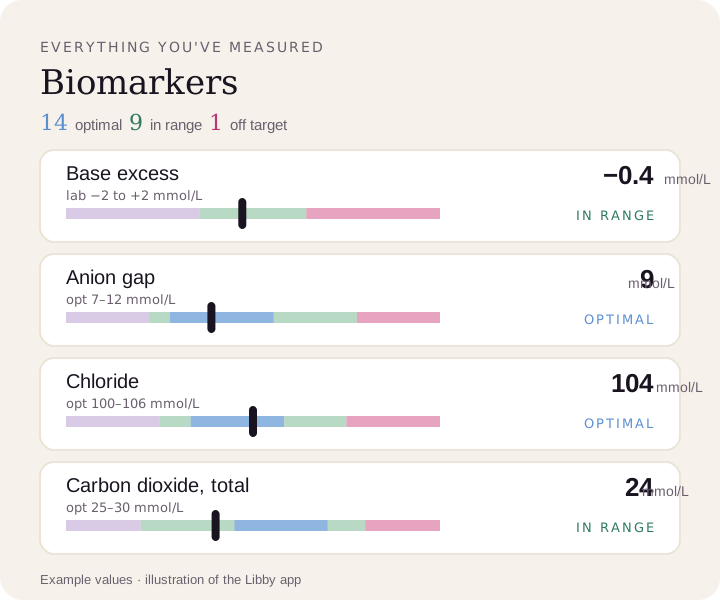
See every result against your lab's range.
Upload a lab PDF or a photo of your report. Libby puts every marker on your lab's range, adds the optimal range where one exists, and tracks your trends over time.
View your base excess ›