Basophil percentage: normal range and what it means
Basophils are about 1% of white cells, so the percentage is noisy. What's normal, why % and count disagree, and when a lasting rise matters.
Your basophil percentage is the share of your white blood cells that are basophils, the rarest white cell type. MedlinePlus puts the normal share at about 0.5–1%, so a typical result is a fraction of a percent.1 Because basophils are so scarce, the number jumps around from test to test, and it shifts whenever your other white cells rise or fall. Read it next to the absolute basophil count, which counts the cells themselves.23
The short version
- Normal: MedlinePlus lists 0.5–1%. Healthy adults in two research studies ran 0.2–1.3%, and the CDC's national health survey uses 0.1–1.6% for men and 0.1–1.7% for women aged 19–65.1456
- Mildly high (above about 1–2%) is common. The usual reasons are fewer other white cells, counting noise, allergy or inflammation. If the absolute count is normal, the basophils themselves held steady.371
- A rise that lasts for weeks, especially with a high white count, high platelets or a swollen spleen, needs a look for a bone-marrow cause such as chronic myeloid leukemia (CML).389
- The key distinction: a percentage is a share. The absolute count (white count × basophil % ÷ 100) tells you how many basophils you have.2
What basophil percentage is
Your white blood cells come in five main types: neutrophils, lymphocytes, monocytes, eosinophils and basophils. A CBC with differential sorts them and reports each type as a percentage of the total, usually next to an absolute count.1 Basophils carry receptors for IgE, the antibody behind allergies, and they are often activated in allergic reactions.3 They are also the smallest group by far.1
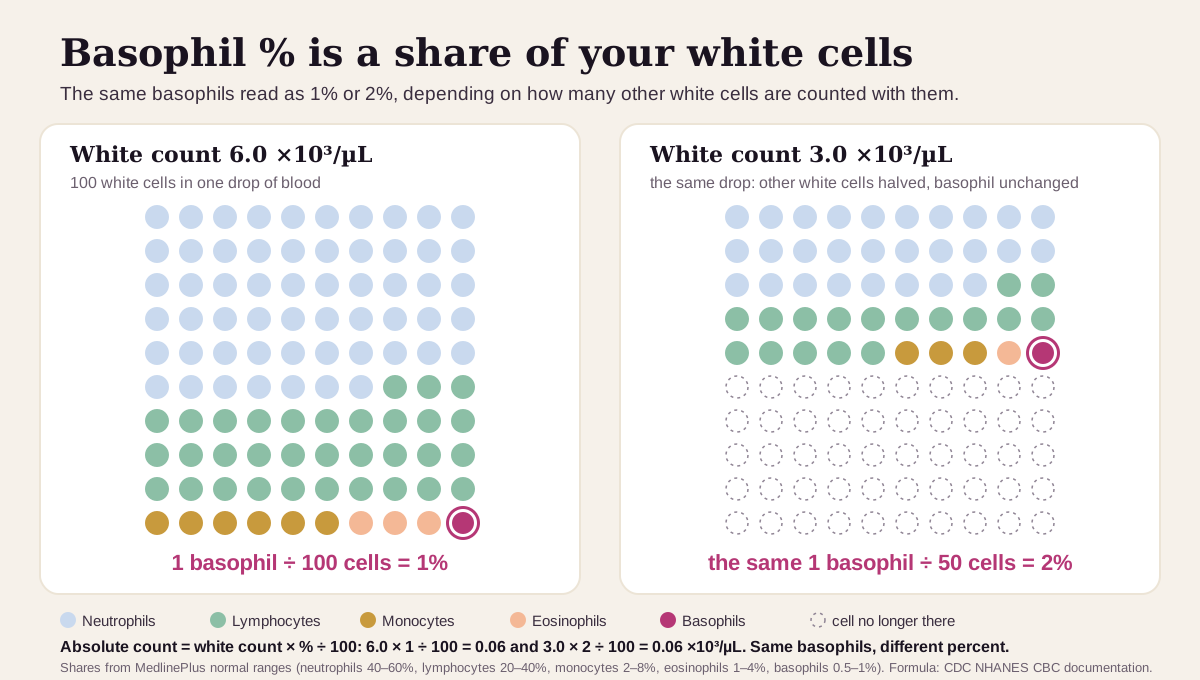
The percentage is simple arithmetic: basophils ÷ all white cells × 100. Its partner, the absolute count, is your total white count × basophil % ÷ 100. That's the exact formula the CDC uses in its national health survey (NHANES).2
Because it's a share, the percentage moves when any other white cell moves. MedlinePlus puts it plainly: an abnormal rise in one type of white cell can lower the percentage of the others.1 The reverse holds too: when neutrophils fall, the basophil share goes up with no new basophils at all. (Our neutrophil percentage guide walks through the same trap for the most common white cell.)
What's a normal basophil percentage?
Start with your own report, and expect that it may print no range for the percentage at all. Labcorp, one of the largest U.S. commercial labs, prints "Not Estab." (not established) next to each white-cell percentage on its sample reports and flags only the absolute counts, with basophils at 0.0–0.2 ×10³/µL.10
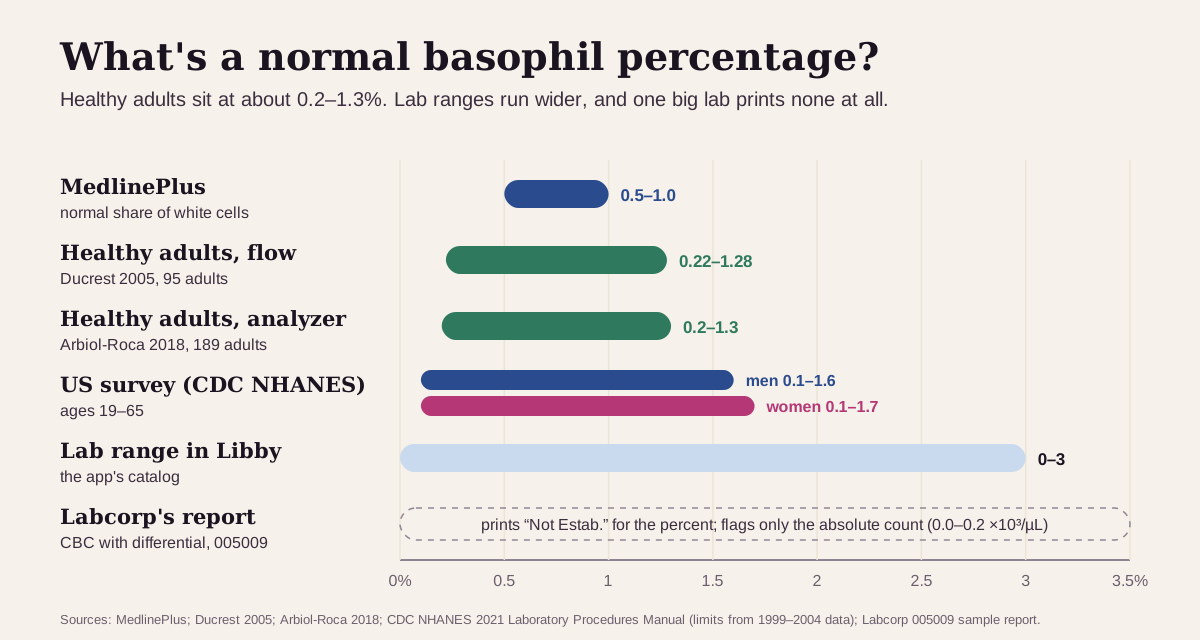
- MedlinePlus lists 0.5–1% as a normal share of white cells.1
- Healthy adults, carefully counted: in 95 adults counted by flow cytometry, a precise antibody-based method, the range was 0.22–1.28%.4 In 189 healthy adults in Barcelona measured on a Sysmex XN analyzer, it was 0.2–1.3%.5
- The CDC's national survey (NHANES) uses 0.1–1.6% for men and 0.1–1.7% for women aged 19–65, and 0.1–2.5% for children aged 1–5. The CDC derived these limits from 1999–2004 survey data.6
- The lab range in the Libby app is 0–3%, wider than any of the healthy-people ranges above.
Men and women are close to identical here: the CDC's upper limits differ by 0.1 point.6
"Optimal" basophil percentage: what health optimizers aim for
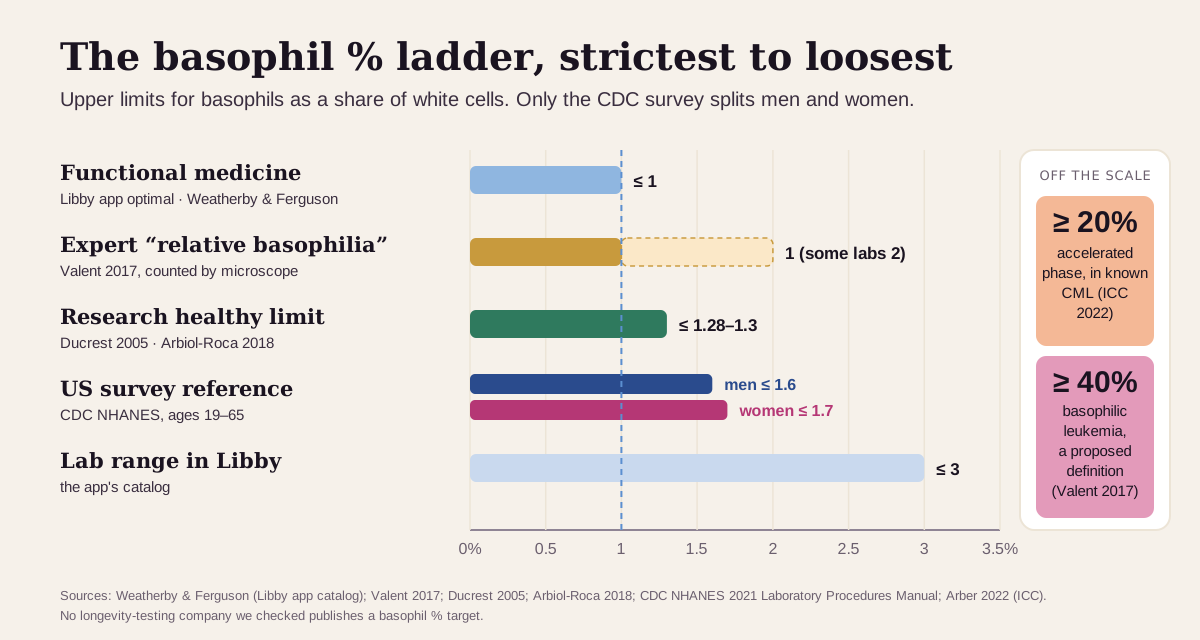
Functional-medicine practitioners aim for the low end. The standard functional-medicine textbook puts optimal basophils at 1% or less, and that's the optimal range the Libby app shows.11 The longevity-testing companies we checked publish no basophil number. Superpower says only that optimal values "typically sit at the low end of the reference range."12 Here's the ladder, from strictest to loosest:
| Target | Basophil % | Who uses it |
|---|---|---|
| Functional medicine (strictest) | 1% or less | The optimal range shown in the Libby app, from the standard functional-medicine textbook11 |
| Expert line for "relative basophilia" | above 1% (some labs 2%) | An international expert group, for counts made by microscope3 |
| Research "healthy" limit | up to 1.28–1.3% | Healthy adults by flow cytometry and on a modern analyzer45 |
| U.S. survey reference | men up to 1.6%, women up to 1.7% | CDC NHANES, ages 19–656 |
| Lab range in the Libby app | 0–3% | The app's catalog; some labs print no percent range at all10 |
| Specialist threshold | 20% or more | In people already diagnosed with CML, one sign of a more advanced ("accelerated") phase13 |
Why the low target? It mirrors where healthy people sit: in both research studies, 97.5% of healthy adults were at or below about 1.3%.45 An international expert group draws its line for a high percentage at 1%, with some labs using 2%.3 We found no outcome study showing that a lower basophil percentage predicts better health in people without a blood disorder.
Keep "optimal" in perspective. A difference of a few tenths of a point sits inside the test's own noise (see Going deeper). Lower also has a floor: in 1,878 Korean adults with COPD followed for 10 years, a higher basophil percentage went with lower mortality (hazard ratio 0.655), and risk rose below about 0.65%.14 The app's optimal band has no lower limit, so a result of 0.2% and one of 0.9% both show as optimal.
What a high basophil percentage usually means
First, look at the absolute count. The percentage and the count answer different questions, and the pair is the first clue:23
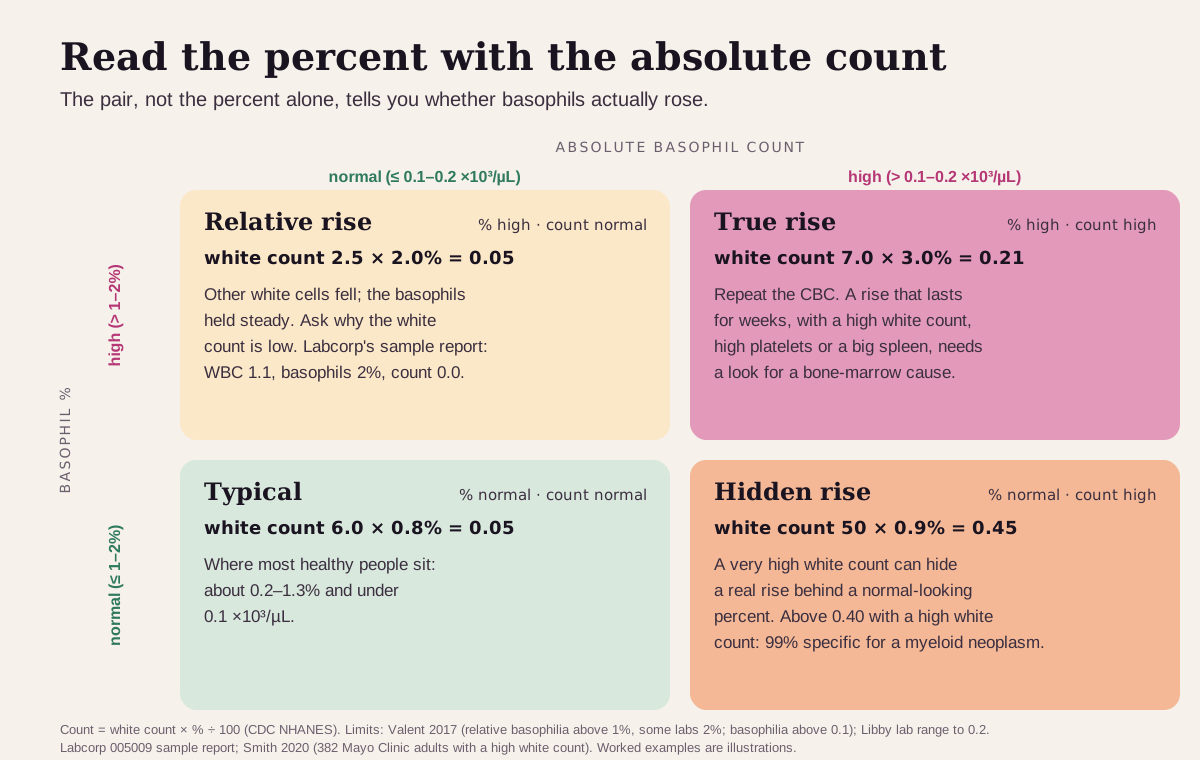
A high percentage with a normal count: usually the denominator
Often the basophils held steady and the other white cells fell. One of Labcorp's own sample reports shows it: a white count of 1.1 ×10³/µL (very low), basophils at 2%, and an absolute basophil count of 0.0, inside the 0.0–0.3 range printed next to it.10 Common reasons for fewer neutrophils include chemotherapy, radiation, and the flu or other viral infections.1 The question to ask is why the white count is low.
A high percentage and a high count: a real rise
The usual suspects:
- Counting noise. In one comparison of three analyzers, repeat runs of the same blood varied by 25–50% for basophils.7 A single mild flag often reads normal on a repeat.
- Allergic reactions and ongoing inflammation, including the connective-tissue diseases doctors call collagen vascular disease.1
- Smoking. In a Mayo Clinic series, tobacco use was one of the most common conditions found alongside a raised basophil count.8
- Less common: life after spleen removal, and infections such as chickenpox.1
- Abnormal cells counted as basophils. Some analyzers overcount basophils when abnormal white cells are present, so a lab may check a blood smear.7
Most reactive rises pass. In the Mayo series, basophil counts settled in more than 75% of people with a reactive cause who had a follow-up blood count.8
When a rise that lasts matters
A rise that persists, especially next to other abnormal counts, is where a bone-marrow cause comes into view. An international expert group separates the two: a passing rise points to a reaction, while a very high count (over 1,000 cells/µL) lasting at least 8 weeks is "highly suspicious" for a neoplastic, usually myeloid, disease, "especially when other blood count abnormalities are also present." The same group recommends further tests for any unexplained rise that persists, even a smaller one.3 (A myeloid neoplasm is a cancer or pre-cancer of the blood-forming cells.)
- In 382 Mayo Clinic adults with a high white count and high basophils who were tested for CML, half had a myeloid neoplasm: CML in 104, and conditions such as essential thrombocythemia, polycythemia vera and myelofibrosis in the rest. An absolute basophil count over 0.40 ×10³/µL was 99% specific for one of them.8
- CML often causes few or no symptoms early on. Most people learn they have it from blood tests done for other reasons, with a high white count and sometimes high platelets.9
- In CML itself, the percentage carries weight. Basophils at 20% or more of blood white cells are one criterion for the accelerated phase under the 2022 International Consensus Classification.13 (The World Health Organization's 2022 edition no longer requires an accelerated phase.)15 The EUTOS score, built from 2,060 people on imatinib, uses the basophil percentage and spleen size to predict treatment response: 5-year progression-free survival was 90% in its low-risk group and 82% in its high-risk group.16
See a clinician promptly if a high basophil percentage comes with a high white count or high platelets, or with fever without an infection, bone pain, night sweats, easy bruising, tiny red spots on the skin, or pressure under your left ribs from a swollen spleen.9
Is a low basophil percentage a problem?
Usually it reflects the arithmetic. On a 100-cell smear count, a true share of 1% reads as 0% about a third of the time (see Going deeper), and a surge of neutrophils dilutes the share further.17 MedlinePlus lists acute infection, cancer and severe injury as causes of a lower basophil percentage.1 In people with COPD, a lower share tracked with higher 10-year mortality.14
Basophil percentage reads best next to its neighbors
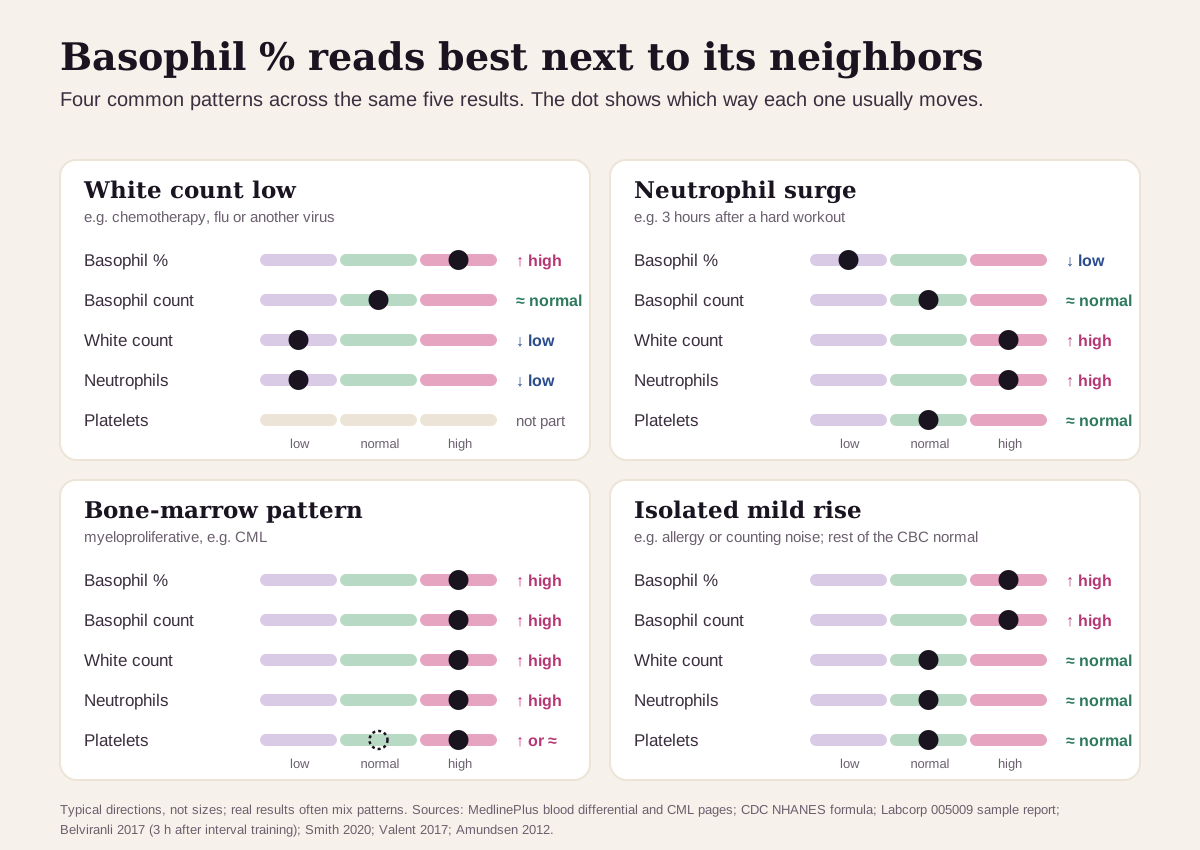
Basophil % rarely moves alone. The pattern across your white-cell results says more than the percentage does by itself:
| If you see… | It often points to… |
|---|---|
| Basophil % up, count normal, white count and neutrophils low | fewer other white cells, e.g. after chemotherapy or a viral infection: the low white count is the real finding1102 |
| Basophil % down, count about normal, white count and neutrophils up | a neutrophil surge: an acute infection, stress, or a hard workout in the past few hours117 |
| Basophil % and count up, with a high white count and neutrophils, platelets high or normal | a bone-marrow (myeloproliferative) pattern, CML most classically: in these conditions basophil numbers regularly rise. Ask about a hematology review9813 |
| Basophil % and count a little up, with the rest of the CBC normal | a mild reactive rise such as allergy, or counting noise: a repeat test usually settles it137 |
| Basophil % normal, count high, white count very high | the percentage is hiding a real rise: read the absolute count28 |
How fast basophil percentage changes
Within hours. A hard workout, an infection or a stress response can reshuffle your white cells between breakfast and dinner:
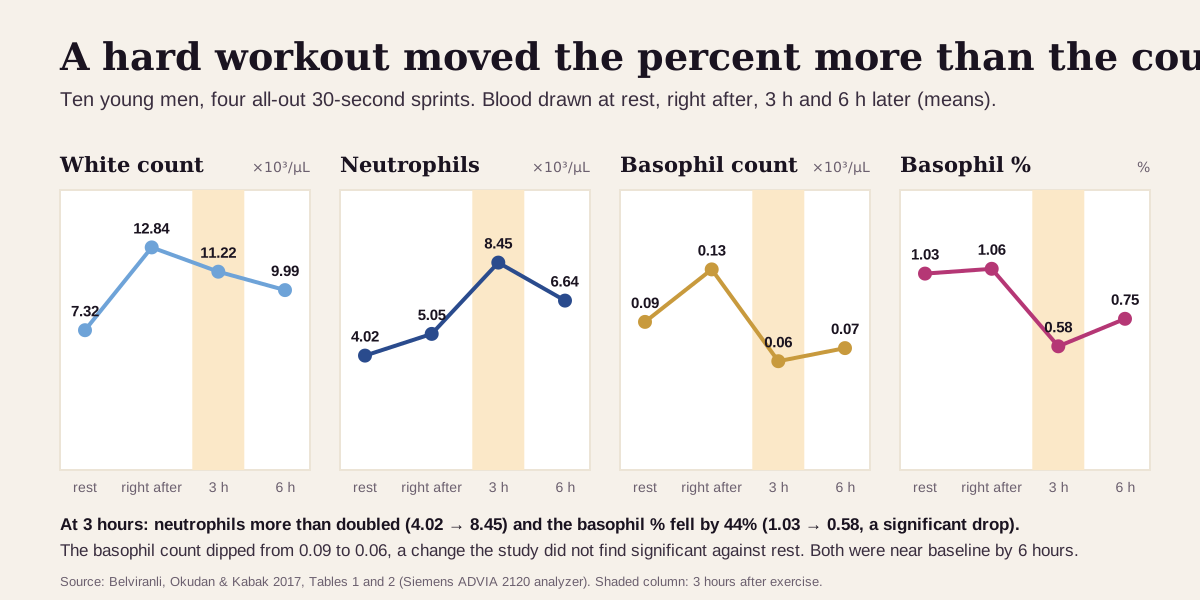
- After a hard workout: in 10 young men who did four all-out 30-second bike sprints, neutrophils more than doubled by 3 hours (4.02 → 8.45 ×10³/µL), and the basophil percentage fell from 1.03% to 0.58%, a significant drop. The basophil count moved from 0.09 to 0.06, a change the study found significant only against the post-exercise peak. By 6 hours the percentage was back near baseline.17
- From run to run: the CDC's survey lab checks its analyzer by running the same person's blood 10 times, and it passes the machine if the highest and lowest basophil results differ by 1.6 percentage points or less. That allowance is wider than the whole healthy-adult range of about 0.2–1.3%.65
What that means in practice:
- A single mild flag is usually repeated. Mention a recent illness, a hard workout, new medicines or an allergy flare when you get retested.171
- Persistence is the point. The expert definition of hyperbasophilia, a very high count, requires it to last at least 8 weeks, because passing reactions come and go.3
- Trends beat snapshots, and the same lab beats a new one. In one study, basophils were the only part of the white-cell differential on which two analyzers correlated poorly (see below).18
Going deeper: why a small percentage is noisy
Basophils are rare, so every count of them rests on a handful of cells.
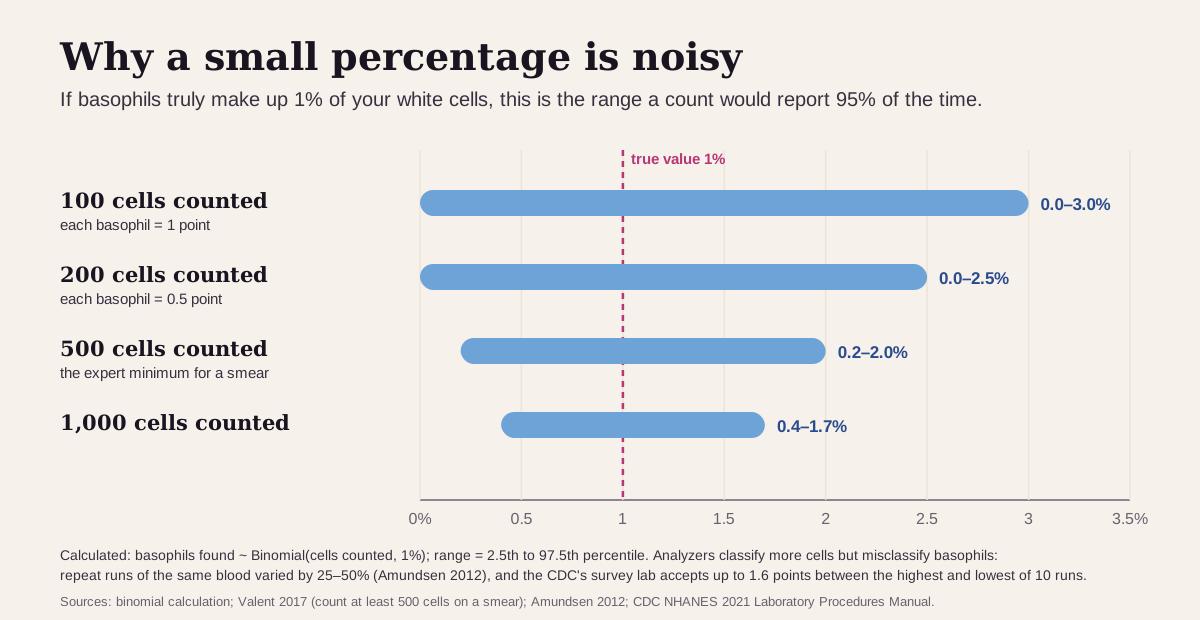
- On a smear. If a technologist counts 100 white cells under the microscope, each basophil found is worth a full percentage point. With a true share of 1%, the report would land anywhere from 0% to 3% by chance alone. That's why an international expert group recommends counting at least 500 cells to set a basophil percentage.3
- On an analyzer. Machines classify far more cells, but basophils are hard for them to recognize. Two widely used analyzers gave basophil counts that showed no correlation with each other in one study.4 In another, two instruments undercounted basophils by about 50% compared with flow cytometry.7
- Machine to machine. When the CALIPER study ran 526 children's samples on two Beckman Coulter analyzers, the basophil percentages barely agreed (correlation 0.12), and one analyzer's healthy range came out at just 0.07–0.51%.18 Every other part of the white-cell differential correlated well between the two machines.
Percent versus count, once more. Absolute count = white count × basophil % ÷ 100. A white count of 50 ×10³/µL with 0.9% basophils means 0.45 ×10³/µL of basophils, a clearly high count behind a normal-looking percentage.28
Questions worth asking
- What's my absolute basophil count, and is it in range?
- Did my total white count or my neutrophils change since the last test?
- Could a recent infection, a hard workout, a new medicine or an allergy flare explain the shift?
- Should we repeat the CBC in a few weeks, on the same lab's analyzer?
- Would a blood smear review help confirm the basophils are real?
- If it stays high, do my platelets, spleen or other counts point toward a BCR-ABL test or a hematology referral?
FAQ
What is a normal basophil percentage? MedlinePlus lists 0.5–1% of white cells. Healthy adults in research studies ran about 0.2–1.3%, and the CDC's survey reference goes up to 1.6% for men and 1.7% for women.1456
Is 2% basophils high? It sits above the healthy-adult range and at the line some labs use for a high share. Check the absolute count first: with a low white count, 2% can mean a normal number of basophils.310
Why is my basophil percentage high but my absolute count normal? Usually because your other white cells, most often neutrophils, are lower than usual. The share of basophils rises even though their number held steady.12
Can a high basophil percentage mean leukemia? It can, usually with other clues: a high white count, high platelets, a swollen spleen, or a rise that lasts for weeks. A mild one-off rise more often reflects noise, allergy or inflammation, and most reactive rises settle on a repeat test.389
This guide is for education. It can't diagnose you or replace care from a clinician who knows your history.
Footnotes
-
National Library of Medicine. Blood differential test. MedlinePlus Medical Encyclopedia. Reviewed February 3, 2025. Normal shares (basophils 0.5–1%), the note that a rise in one white-cell type can lower the percentage of others, and the causes of higher and lower basophil and neutrophil percentages. MedlinePlus ↩ ↩2 ↩3 ↩4 ↩5 ↩6 ↩7 ↩8 ↩9 ↩10 ↩11 ↩12 ↩13 ↩14 ↩15 ↩16 ↩17 ↩18 ↩19 ↩20 ↩21
-
National Center for Health Statistics. Complete Blood Count with 5-Part Differential in Whole Blood (CBC_L), NHANES August 2021–August 2023. CDC; 2024. Absolute basophils = white count × basophil percent ÷ 100. CDC ↩ ↩2 ↩3 ↩4 ↩5 ↩6 ↩7 ↩8 ↩9 ↩10 ↩11
-
Valent P, Sotlar K, Blatt K, et al. Proposed diagnostic criteria and classification of basophilic leukemias and related disorders. Leukemia. 2017;31(4):788–797. International consensus group: basophils share IgE receptors with mast cells and are often activated in allergic patients; their numbers regularly rise in myeloproliferative neoplasms; relative basophilia above 1% (some labs 2%) by microscopy; count at least 500 cells; a count over 1,000/µL lasting at least 8 weeks (hyperbasophilia) is almost always tied to a myeloid neoplasm, transient hyperbasophilia points to a reactive process, and any unexplained persistent basophilia deserves further tests; basophilic leukemia needs 40% or more basophils. PMC ↩ ↩2 ↩3 ↩4 ↩5 ↩6 ↩7 ↩8 ↩9 ↩10 ↩11 ↩12 ↩13 ↩14 ↩15 ↩16 ↩17
-
Ducrest S, Meier F, Tschopp C, Pavlovic R, Dahinden CA. Flowcytometric analysis of basophil counts in human blood and inaccuracy of hematology analyzers. Allergy. 2005;60(11):1446–1450. 95 healthy adults: 95% reference interval 0.22–1.28%; two analyzers showed no correlation with each other. PubMed ↩ ↩2 ↩3 ↩4 ↩5 ↩6 ↩7 ↩8
-
Arbiol-Roca A, Imperiali CE, Montserrat MM, et al. Reference intervals for a complete blood count on an automated haematology analyser Sysmex XN in healthy adults from the southern metropolitan area of Barcelona. EJIFCC. 2018;29(1):48–54. Basophils 0.2–1.3% in 189 healthy adults. PMC ↩ ↩2 ↩3 ↩4 ↩5 ↩6 ↩7 ↩8
-
National Center for Health Statistics. NHANES 2021 Laboratory Procedures Manual. CDC; 2024. Pages 6-44 to 6-45 (analyzer repeatability: basophil percent spread of 1.6 points or less across repeat runs of one donor's blood) and 6-99 to 6-100 (reference ranges from 1999–2004 data: basophils 0.1–1.6% for men and 0.1–1.7% for women aged 19–65, 0.1–2.5% at ages 1–5). CDC ↩ ↩2 ↩3 ↩4 ↩5 ↩6 ↩7 ↩8
-
Amundsen EK, Henriksson CE, Holthe MR, Urdal P. Is the blood basophil count sufficiently precise, accurate, and specific? Three automated hematology instruments and flow cytometry compared. Am J Clin Pathol. 2012;137(1):86–92. 112 patient samples: within-run variation of 25–50%, undercounting by about 50% on two instruments, and overcounting in some samples with abnormal white cells. PubMed ↩ ↩2 ↩3 ↩4 ↩5 ↩6
-
Smith CJ, Kluck LA, Ruan GJ, et al. The differential diagnosis of basophilia in patients undergoing BCR-ABL testing. Am J Hematol. 2020;95(9):E216–E217. 382 Mayo Clinic adults with a high white count and basophilia: 50% had a myeloid neoplasm (CML in 104), a count over 0.40 ×10⁹/L was 99.0% specific, tobacco use was among the most common non-myeloid conditions, and basophilia resolved in 75.4% of retested reactive cases. PMC ↩ ↩2 ↩3 ↩4 ↩5 ↩6 ↩7 ↩8 ↩9 ↩10
-
National Library of Medicine. Chronic myelogenous leukemia (CML). MedlinePlus Medical Encyclopedia. Reviewed January 29, 2026. Most people are diagnosed from blood tests done for other reasons; the CBC shows a high white count and may show high platelets; symptoms of advanced phases. MedlinePlus ↩ ↩2 ↩3 ↩4 ↩5 ↩6
-
Labcorp. Complete Blood Count (CBC) With Differential, Reflex to Peripheral Smear Review, test 005009, sample report. Labcorp is a commercial laboratory; its sample reports print "Not Estab." for the basophil percentage and 0.0–0.2 (one sample 0.0–0.3) ×10³/µL for the absolute count, including a sample with a white count of 1.1, basophils 2% and an absolute count of 0.0. labcorp.com ↩ ↩2 ↩3 ↩4 ↩5 ↩6 ↩7 ↩8
-
Weatherby D, Ferguson S. Blood Chemistry and CBC Analysis: Clinical Laboratory Testing from a Functional Perspective. 2nd ed. Bear Mountain Publishing; 2004. ISBN 978-0976136712. Widely used functional-medicine reference, and the source of the Libby app's optimal basophil range of 1% or less. ↩ ↩2 ↩3
-
Superpower. Basophils (basophils/100 WBC). Last updated September 1, 2026. Says optimal values "typically sit at the low end of the reference range" and gives no number. A commercial source, listed as what the optimizer community uses. superpower.com ↩
-
Arber DA, Orazi A, Hasserjian RP, et al. International Consensus Classification of Myeloid Neoplasms and Acute Leukemias: integrating morphologic, clinical, and genomic data. Blood. 2022;140(11):1200–1228. Table 2: peripheral blood basophils of 20% or more is one criterion for accelerated-phase CML. PMC ↩ ↩2 ↩3
-
Park HJ, Song Y, Kim Y, et al. Low levels of serum albumin and blood basophils as 10-year mortality predictors in a nationwide Korean COPD cohort. Sci Rep. 2025;15(1):43924. 1,878 patients with COPD, mean basophils 0.7%: hazard ratio 0.655 for basophils, with the hazard-ratio curve threshold at 0.65%. PMC ↩ ↩2
-
Khoury JD, Solary E, Abla O, et al. The 5th edition of the World Health Organization Classification of Haematolymphoid Tumours: Myeloid and Histiocytic/Dendritic Neoplasms. Leukemia. 2022;36(7):1703–1719. "Accelerated phase is no longer required" for CML. PMC ↩
-
Hasford J, Baccarani M, Hoffmann V, et al. Predicting complete cytogenetic response and subsequent progression-free survival in 2060 patients with CML on imatinib treatment: the EUTOS score. Blood. 2011;118(3):686–692. Uses the percentage of basophils and spleen size; 5-year progression-free survival 90% (low risk) vs 82% (high risk). PubMed ↩
-
Belviranli M, Okudan N, Kabak B. The effects of acute high-intensity interval training on hematological parameters in sedentary subjects. Med Sci (Basel). 2017;5(3):15. 10 men aged 18–24, four 30-second Wingate tests: Tables 1 and 2 give white count, neutrophils, platelets, basophil count and basophil percent at rest, right after, 3 h and 6 h. PMC ↩ ↩2 ↩3 ↩4 ↩5 ↩6
-
Higgins V, Tahmasebi H, Bohn MK, Hall A, Adeli K. CALIPER Hematology Reference Standards (II). Am J Clin Pathol. 2020;154(3):342–352. 526 paired samples on the Beckman Coulter DxH 520 and 900: basophil percent correlation 0.120; DxH 520 reference interval 0.07–0.51% (ages 0 to under 21). PMC ↩ ↩2
Educational content, not medical advice. Libby is a personal record tool, not a medical service — it doesn't diagnose, treat, or prescribe. Reference ranges vary by lab and by person. Talk to a qualified healthcare professional about your results.
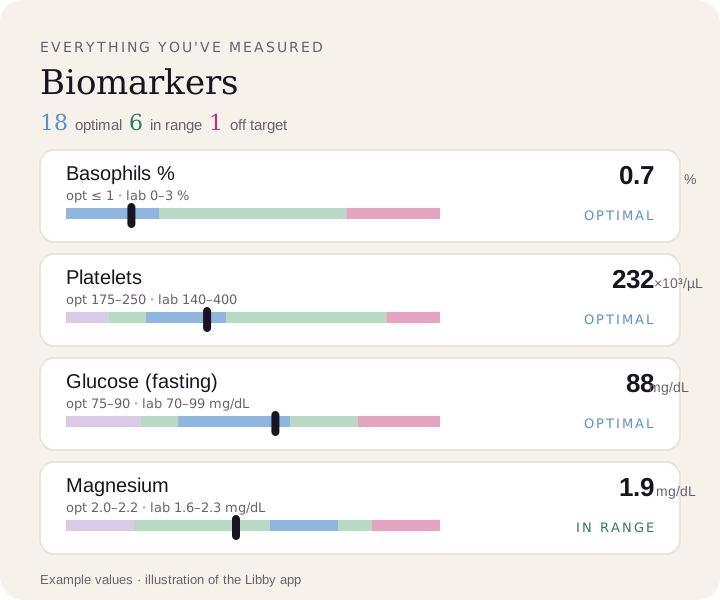
Compare your results to optimal ranges.
Upload a lab PDF or a photo of your report. Libby puts every marker on your lab's range and the optimal range, and tracks your trends over time.
View your basophil % ›