Beta-hydroxybutyrate test: normal range, ketosis and DKA
BHB is the main ketone in your blood. Here's the normal range, what ketosis levels look like, how to tell diet ketosis from DKA, and when a high BHB is urgent.
Beta-hydroxybutyrate (BHB) is the main ketone your liver makes when it burns fat for fuel. After an ordinary meal there's almost none in your blood. It rises within a day of fasting or on a very low-carb diet, and it climbs much higher in diabetic ketoacidosis (DKA), a dangerous shortage of insulin.12 The number tells you how much ketone is in your blood; your bicarbonate and pH tell you whether that ketone has made your blood acidic.
The short version
- Normal: check the range on your report. Labcorp's fasting range is 0.2–2.8 mg/dL, about 0.02–0.27 mmol/L, and in 304 healthy German adults the typical (median) value was 0.05 mmol/L.34
- Mildly high (0.5–3.0 mmol/L) is what diet researchers call "nutritional ketosis." The usual reasons are fasting, a very low-carb (keto) diet, long exercise and ketone drinks.51
- 3.0 mmol/L or more, with high blood sugar or known diabetes and acidic blood (bicarbonate under 18 or pH under 7.3), is DKA. That needs emergency care. About 1 in 10 people with DKA have blood sugar under 200 mg/dL.2
- BHB measures ketones, not acid. Bicarbonate (total CO2), pH and the anion gap are what separate harmless ketosis from ketoacidosis.2
What BHB is
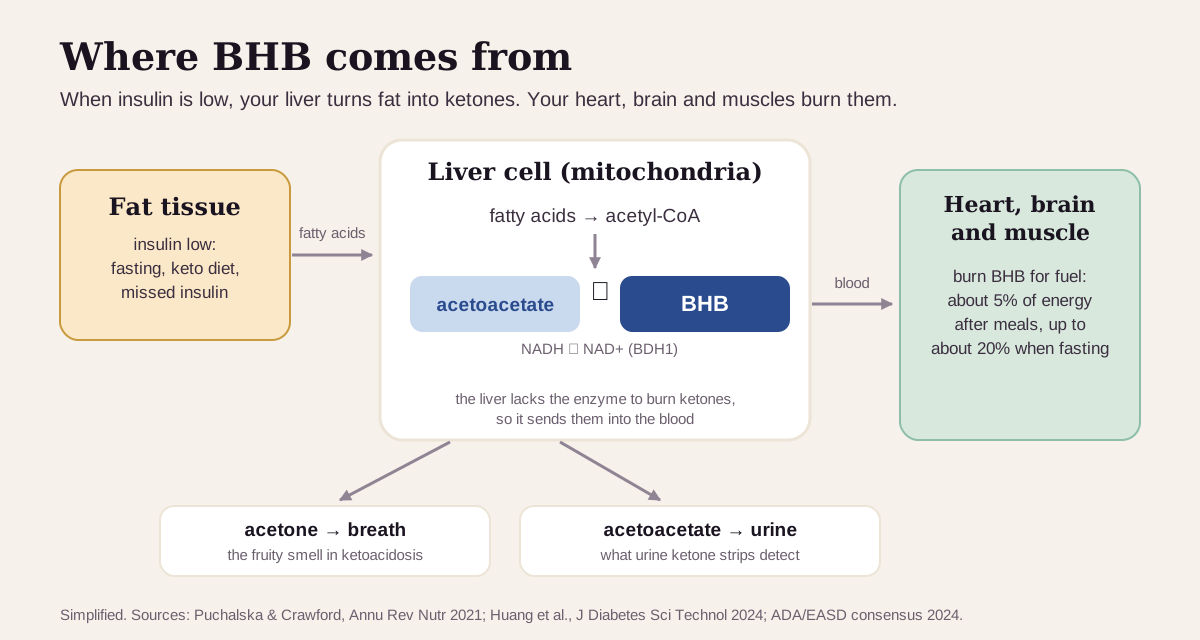
When insulin is low, your fat tissue releases fatty acids. Your liver burns them and turns the leftovers into two related ketones: acetoacetate and BHB. A third, acetone, forms when acetoacetate breaks down, and you breathe it out.17 (More on the chemistry at the end.)
Your heart, brain and muscles take BHB from the blood and burn it for energy. The liver makes ketones but lacks the enzyme to burn them, so it sends them out into the blood.1 In healthy adults, blood ketones drift between about 0.05 and 0.25 mmol/L over a normal day. They supply about 5% of your energy after meals and up to about 20% when you fast.1
BHB is the main ketone in the blood during DKA.2 A lab measures it in serum or plasma, and many diabetes meters measure it from a fingerstick drop.38 Urine ketone strips measure acetoacetate, BHB's partner, so a urine result and a blood BHB can disagree (see Going deeper).27
What's a normal BHB?
Start with the range printed on your own report. Here are the published ones:
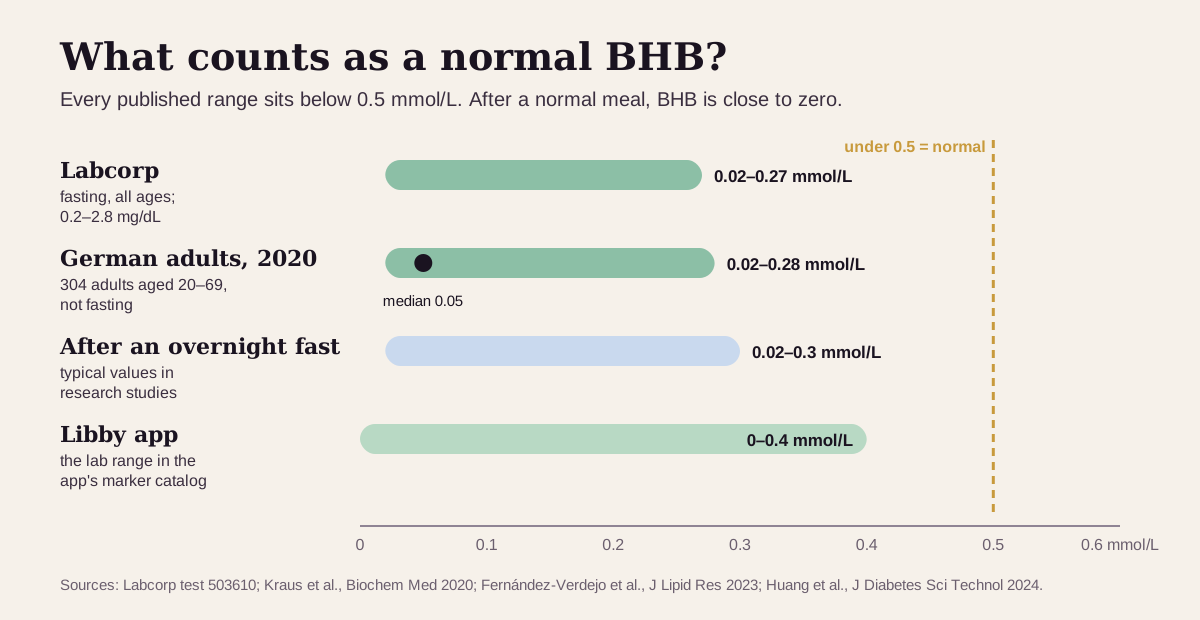
- Labcorp prints 0.2–2.8 mg/dL (about 0.02–0.27 mmol/L) for all ages, fasting.3
- A 2020 study of 304 adults aged 20–69 from the German National Cohort set the reference range at 0.02–0.28 mmol/L. The median was 0.05 mmol/L for both women and men, with no difference between the sexes.4
- Researchers generally call anything under 0.5 mmol/L normal. After an overnight fast, values usually run 0.02–0.3 mmol/L.57
- The Libby app shows BHB against a lab range of 0–0.4 mmol/L, taken from its marker catalog.
Men and women share the same range. In the German study, women and men had the same median,4 and Labcorp uses one range for all ages.3 What moves BHB is what you ate, how long ago, and how hard you exercised, so note your last meal when you get tested.
"Optimal" BHB: what health optimizers aim for
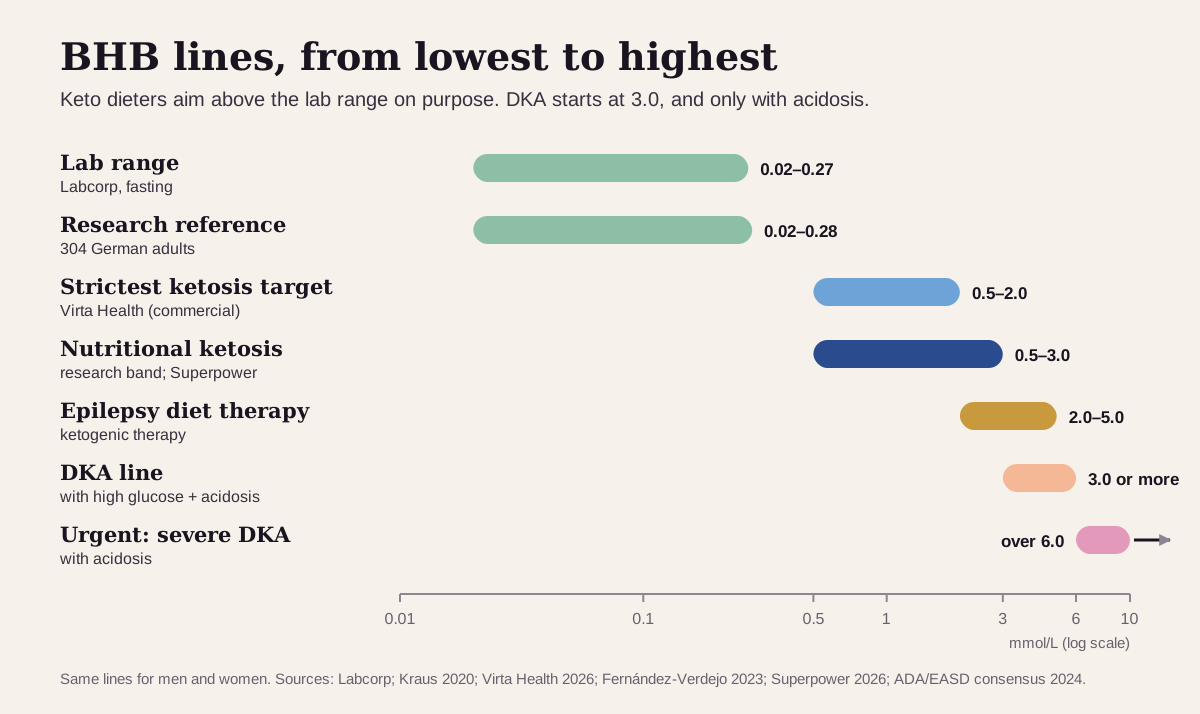
BHB turns the usual optimal story upside down. People on keto diets aim above the lab range on purpose, because a BHB over 0.5 shows their body has switched to burning fat. Here's the ladder, from the lowest line to the highest. The Libby app shows your BHB against your lab's range; its marker catalog has no separate optimal band for BHB.
| Line | Men and women | Who uses it |
|---|---|---|
| Lab range | 0.02–0.27 mmol/L (0.2–2.8 mg/dL) | Labcorp, fasting3 |
| Research reference range | 0.02–0.28 mmol/L | 304 German adults, not fasting4 |
| Strictest ketosis target (commercial) | 0.5–2.0 mmol/L | Virta Health, for most people on its diet9 |
| Research "nutritional ketosis" | 0.5–3.0 mmol/L | Weight-loss trials; a 2023 review calls the band "arbitrary";5 Superpower uses the same band10 |
| Therapeutic ketosis | 2.0–5.0 mmol/L | Ketogenic diet therapy for hard-to-treat epilepsy5 |
| DKA guideline line | 3.0 mmol/L or more | Counts as DKA only with high glucose or known diabetes and acidosis2 |
| Urgent | over 6.0 mmol/L with acidosis | Severe DKA; any DKA needs emergency care2 |
What's behind the ketosis targets:
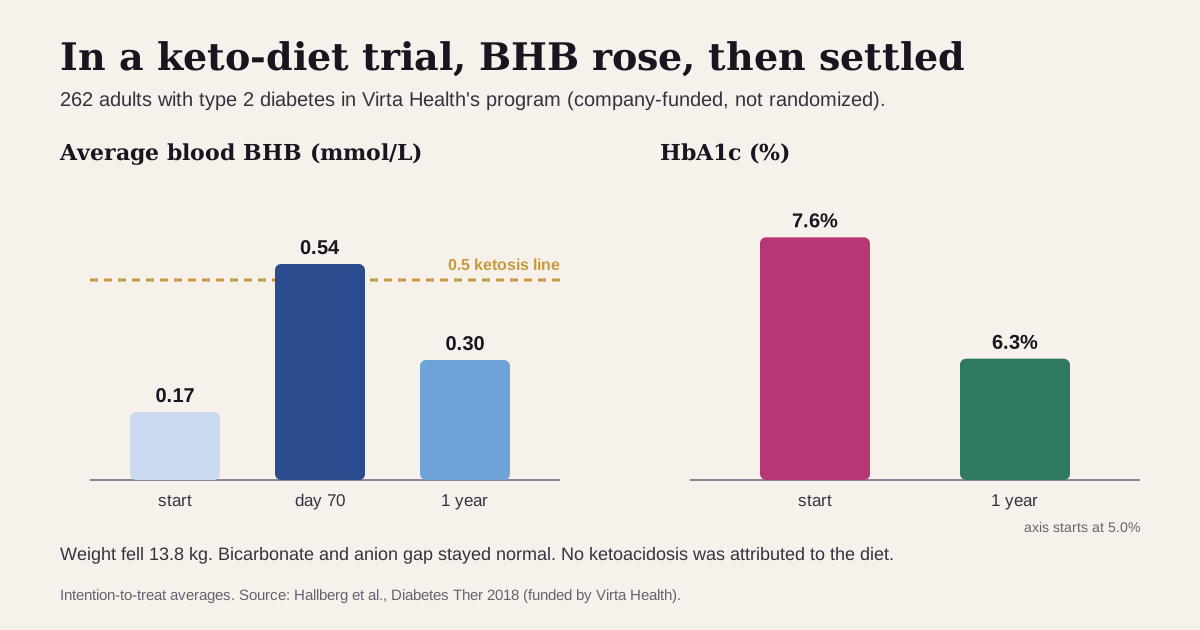
- In Virta's own trial of 262 adults with type 2 diabetes (company-funded and not randomized), average BHB rose from 0.17 to 0.54 mmol/L by day 70 and settled at 0.30 by one year. Over that year, HbA1c fell from 7.6% to 6.3% and weight fell by 13.8 kg. Bicarbonate and the anion gap stayed normal, and no ketoacidosis was attributed to the diet.11
- The other side: in 6,297 Dutch adults followed for 7.9 years, each doubling of fasting total ketones was linked to a 29% higher risk of dying (hazard ratio 1.29). People with signs of fatty liver had higher ketones.12 In the general population, a higher resting ketone level travels with poorer health.
Keep "optimal" in perspective. A BHB of 1.0 on a planned keto diet and a BHB of 1.0 in someone with type 1 diabetes who has missed insulin mean very different things. The number is a sign that you're burning fat, and no guideline treats a ketosis level as a health score. The acid-base tests beside it decide whether it's safe.2
What a high BHB usually means
The level is the first clue, and the acid-base tests are the second. Most raised results come from how you ate or fasted. The dangerous causes come with acidic blood.27
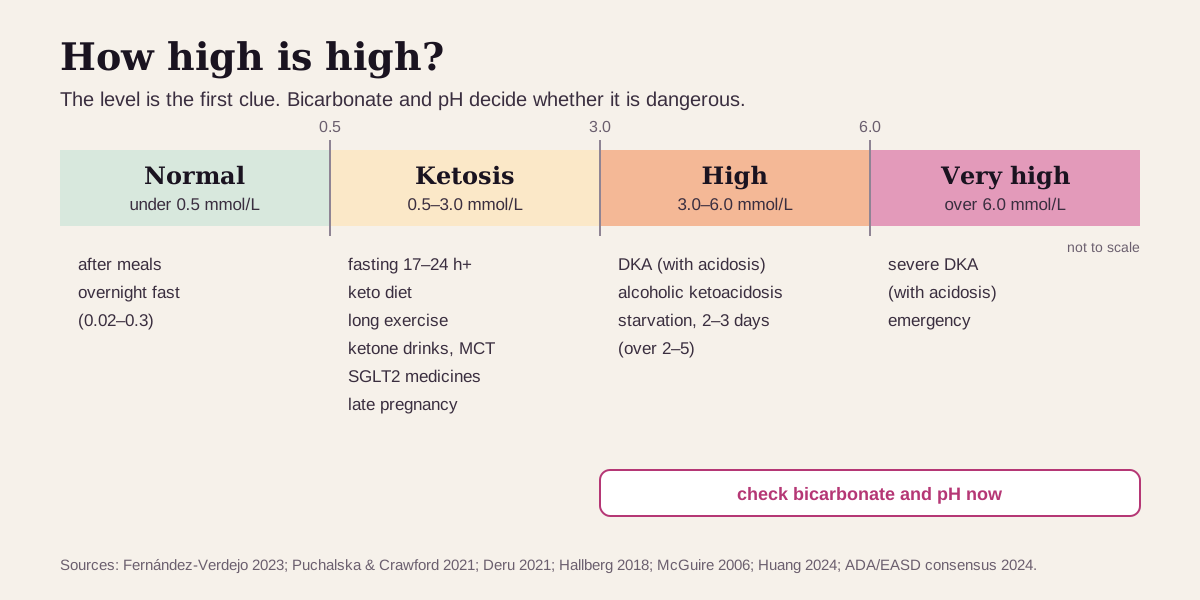
Mildly high (0.5–3.0 mmol/L): common, usually planned
The usual suspects:
- Fasting. In a study of 20 adults on a 36-hour fast, BHB reached 0.5 mmol/L after about 21 hours, or about 17.5 hours when they exercised at the start.13 A 24-hour fast takes it to nearly 1 mmol/L.1
- A keto or very low-carb diet. A ketogenic diet keeps carbohydrate under about 50 grams a day, or 5–10% of calories.5 In the Virta trial, BHB averaged 0.54 mmol/L at day 70.11
- Long or hard exercise. Prolonged exercise can also push ketones to nearly 1 mmol/L.1
- Ketone drinks and MCT oil. Ketone esters raise BHB rapidly, even with carbohydrate on board, and MCT oil gives a short bump.5
- SGLT2 inhibitor medicines (a class of diabetes medicines) raise BHB to around 0.5 mmol/L on their own.11 They also raise the risk of DKA (below).2
- Late pregnancy brings bigger swings in ketones, and so does the newborn period.1
High (3.0 mmol/L or more): think DKA first
- Diabetic ketoacidosis. Without enough insulin, ketone-making runs out of control and the blood turns acidic. The most common triggers are infection and missed insulin.2 A BHB of 3.0 or more lines up with the acid-base changes of DKA with over 90% sensitivity and specificity.2
- DKA with normal-looking sugar. About 10% of people with DKA arrive with glucose under 200 mg/dL ("euglycemic DKA"). SGLT2 inhibitors now cause most of these cases. In one series, 35% of people on these drugs who developed DKA had glucose under 200, and in another, 71% were at 250 or below.2 Low food intake, pregnancy, insulin already given, alcohol and liver failure can do it too.2
- Alcoholic ketoacidosis. Heavy drinking followed by vomiting and not eating. Blood sugar is normal or low, and urine strips often look milder than the blood does.14
- Starvation. After two to three days of eating nothing, BHB runs above 2–5 mmol/L.7 Clinicians suspect starvation ketosis when someone has been eating under 500 calories a day.2
Get emergency care if a high BHB comes with nausea or vomiting, belly pain, fast or deep breathing, a fruity smell on the breath, confusion, extreme thirst, or peeing much more than usual. Ketoacidosis can get worse quickly, even when blood sugar looks normal.82
If you take an SGLT2 inhibitor, ask your prescriber for a sick-day plan. Don't stop a prescribed medicine on your own.
BHB reads best next to its neighbors
BHB tells you how many ketones are in your blood. The markers around it tell you why, and whether they're causing harm:2
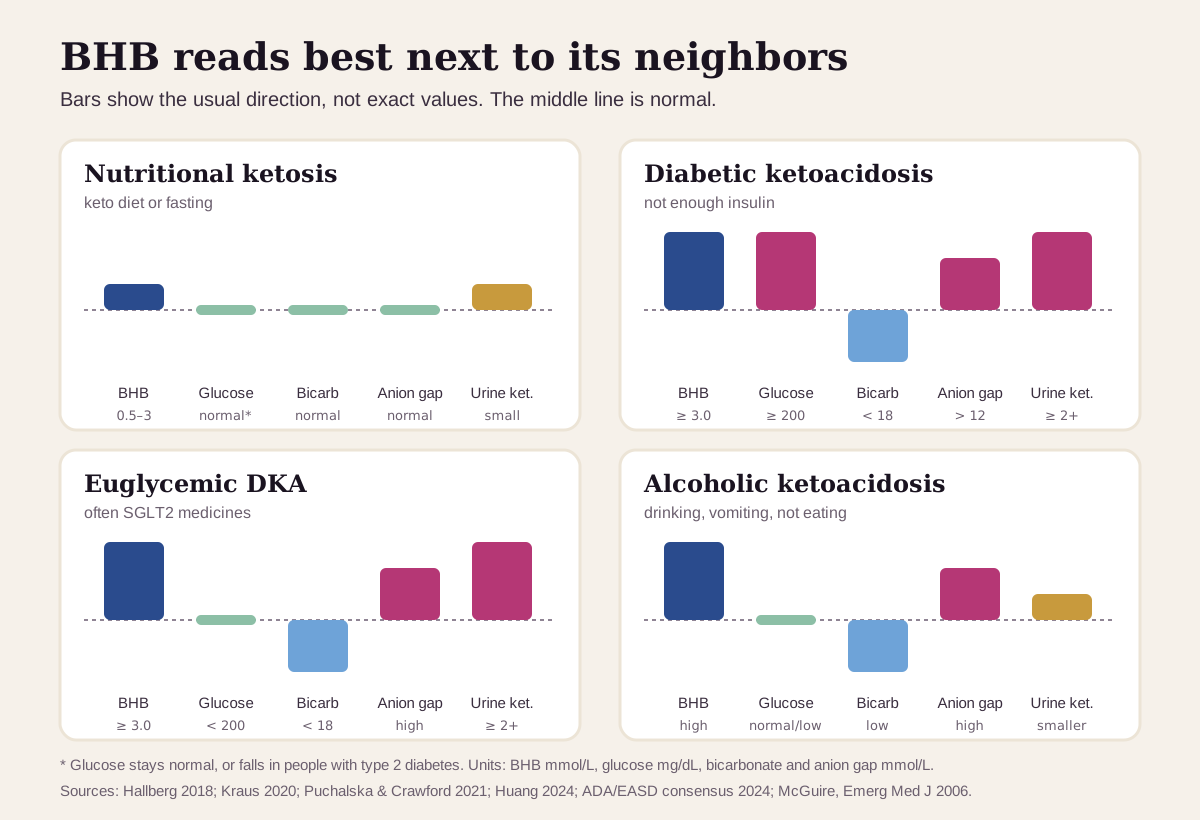
| If you see… | It often points to… |
|---|---|
| BHB 0.5–3.0, normal bicarbonate and anion gap, normal or falling glucose | nutritional ketosis from a keto diet or fasting (a fast of several days can go above 3.0) |
| BHB 3.0 or more, glucose 200 or more, bicarbonate under 18, high anion gap | diabetic ketoacidosis |
| The same acidosis with glucose under 200 | euglycemic DKA, often with an SGLT2 inhibitor, pregnancy or little food |
| High BHB, normal or low glucose, acidosis, after heavy drinking and vomiting | alcoholic ketoacidosis; urine ketones may look smaller than expected |
The anion gap is a clue, and a pH or bicarbonate result from the same blood draw is what confirms acidosis.2
Is a low BHB a problem?
Usually not. A low BHB simply means you've eaten carbohydrate recently: insulin switches ketone-making off.7 It matters in one special situation. When someone has documented low blood sugar, clinicians draw glucose, insulin, C-peptide, proinsulin and BHB during the episode.15 A BHB that stays low while blood sugar is low is one clue that too much insulin is the cause.157
How fast BHB changes
BHB moves in hours. It reflects the last day or two of eating, fasting and exercise, unlike a long-term average such as A1c.113
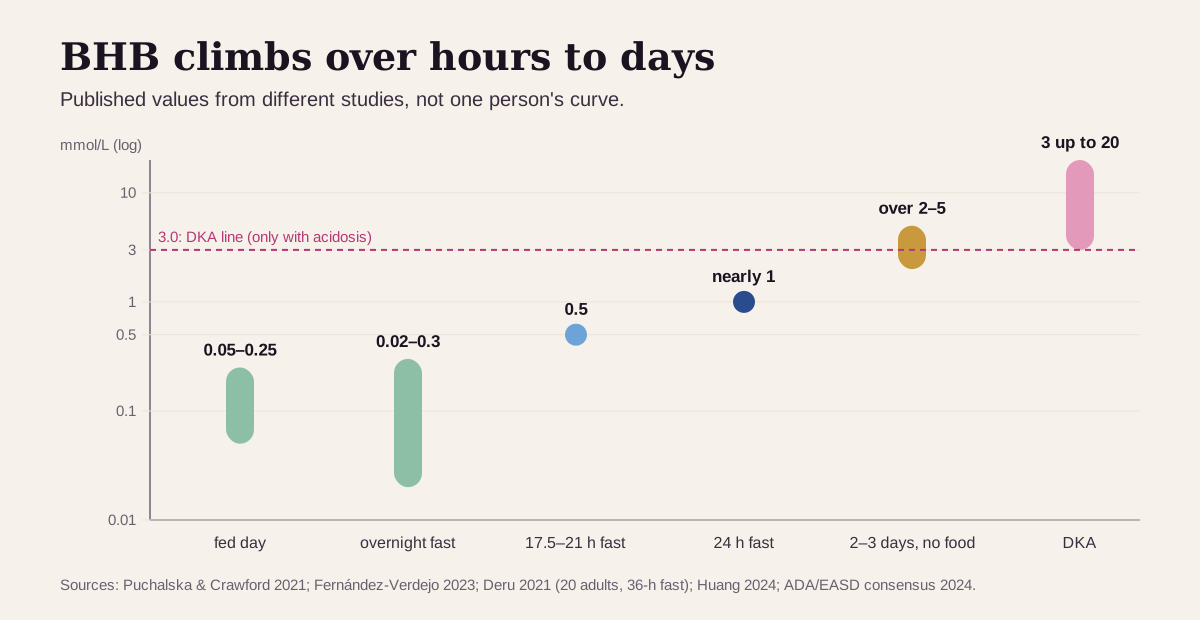
What that means in practice:
- Note your last meal. A 12-hour fast and a 24-hour fast give very different numbers.131
- DKA builds over hours to a few days, so a normal result from last week says little about today.2
- In DKA recovery, blood BHB is the number to watch. Urine strips can turn more positive while BHB falls, because BHB converts back to acetoacetate.7 Hospitals call DKA resolved when BHB is under 0.6 mmol/L and pH is at least 7.3 or bicarbonate at least 18.2
- Trends beat snapshots, and they're easiest to read from the same lab or the same meter each time.
Going deeper: blood BHB vs urine ketones
Urine strips use a nitroprusside reaction, which picks up acetoacetate (and a little acetone) but misses BHB entirely.214 The German reference study compared 190 urine strips with blood BHB from the same patients:4
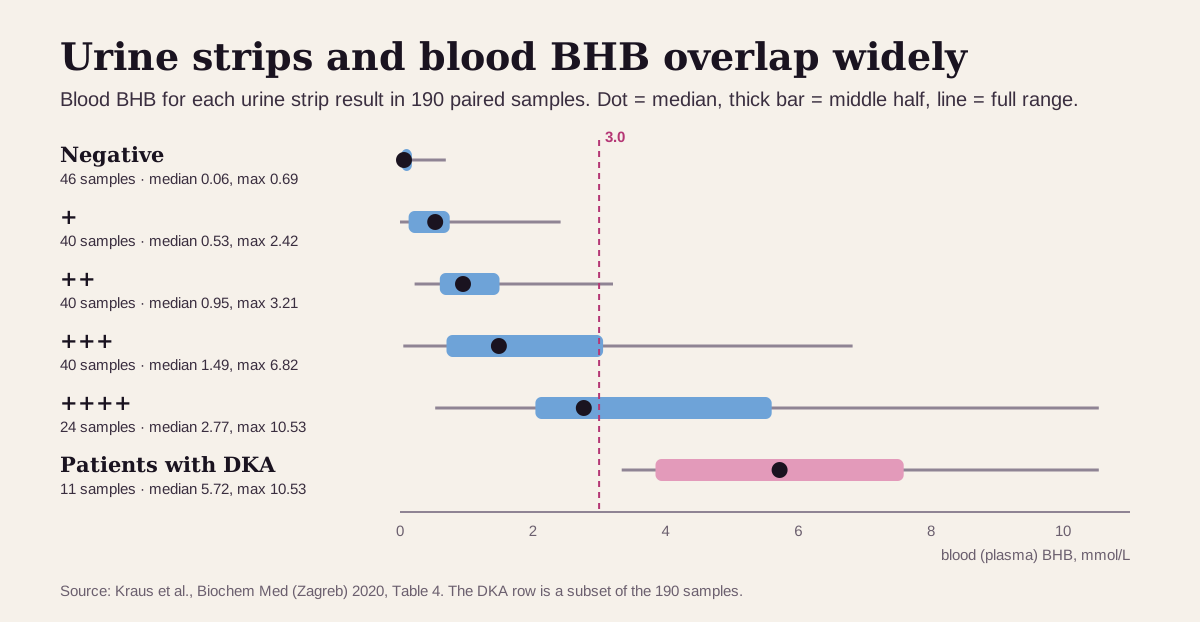
The medians climb with each "+", but the ranges overlap widely. A strip read as "+" came with blood BHB anywhere from 0 to 2.42 mmol/L.4
The mismatch comes from chemistry. Inside the liver, an enzyme (BDH1) converts acetoacetate to BHB, and the balance between the two tracks the cell's NADH, its store of spare electrons.1 Alcohol raises NADH, so in alcoholic ketoacidosis BHB outnumbers acetoacetate about 19 to 1, versus 11 to 1 in DKA with similar BHB levels.14 The strip sees only the smaller partner.
Blood tests have the same trap. In 2020, more than 30% of U.S. labs still measured "blood ketones" with a nitroprusside method, which reads acetoacetate.7 If your report says "ketones" rather than "beta-hydroxybutyrate," ask which one was measured.
Questions worth asking
- Was this a blood BHB, a nitroprusside "ketones" test, or a urine strip?
- Was I fasting, on a low-carb diet, or exercising hard before the test?
- What were my bicarbonate, anion gap and glucose on the same draw?
- Do any of my medicines, such as an SGLT2 inhibitor, raise my DKA risk?
- What BHB level on a home meter should make me call you, and what's my sick-day plan?
- Should we repeat it, and under what conditions?
FAQ
What is a normal BHB level? Check your lab's range. Labcorp's fasting range works out to about 0.02–0.27 mmol/L, and researchers generally call anything under 0.5 mmol/L normal.35
What BHB level means ketosis? Diet researchers use 0.5–3.0 mmol/L as "nutritional ketosis." It's a working definition for studies, and a 2023 review calls it arbitrary.5
What BHB level means DKA? DKA needs three things: BHB of 3.0 mmol/L or more, high glucose or known diabetes, and acidic blood (bicarbonate under 18 or pH under 7.3). Over 6.0 with acidosis is severe.2
Can you have DKA with normal blood sugar? Yes. About 10% of people with DKA have glucose under 200 mg/dL, most often while taking an SGLT2 inhibitor.2
This guide is for education. It can't diagnose you or replace care from a clinician who knows your history.
Footnotes
-
Puchalska P, Crawford PA. Metabolic and Signaling Roles of Ketone Bodies in Health and Disease. Annu Rev Nutr. 2021;41:49–77. Ketone physiology: daily range 50–250 µmol/L, share of energy, 24-hour fast and exercise to nearly 1 mM, DKA up to 20 mM, clearance ceiling near 6 mM, BDH1 and the liver's lack of SCOT. PMC ↩ ↩2 ↩3 ↩4 ↩5 ↩6 ↩7 ↩8 ↩9 ↩10 ↩11 ↩12 ↩13 ↩14 ↩15 ↩16
-
Umpierrez GE, Davis GM, ElSayed NA, et al. Hyperglycaemic crises in adults with diabetes: a consensus report. Diabetologia. 2024;67(8):1455–1479. The joint ADA/EASD/JBDS/AACE/DTS consensus. Source for the three-part DKA definition, the 3.0 and 6.0 mmol/L lines, the >90% sensitivity and specificity, euglycemic DKA (about 10%; 35% and 71% in SGLT2 series), triggers, the anion gap >12, resolution below 0.6 mmol/L, and symptoms. PMC ↩ ↩2 ↩3 ↩4 ↩5 ↩6 ↩7 ↩8 ↩9 ↩10 ↩11 ↩12 ↩13 ↩14 ↩15 ↩16 ↩17 ↩18 ↩19 ↩20 ↩21 ↩22 ↩23 ↩24 ↩25 ↩26 ↩27 ↩28
-
Labcorp. β-Hydroxybutyrate, test 503610. Reference range "All ages (fasting): 0.2−2.8 mg/dL." Accessed September 23, 2026. A commercial laboratory's own test page. labcorp.com ↩ ↩2 ↩3 ↩4 ↩5 ↩6 ↩7 ↩8
-
Kraus FB, Kocijancic M, Kluttig A, Ludwig-Kraus B. Test validation, method comparison and reference range for the measurement of β-hydroxybutyrate in peripheral blood samples. Biochem Med (Zagreb). 2020;30(1):010707. 304 adults aged 20–69 from the German National Cohort; reference range 0.02–0.28 mmol/L; medians 0.05 in women and men; 190 urine strips compared with blood BHB. PMC ↩ ↩2 ↩3 ↩4 ↩5 ↩6 ↩7 ↩8 ↩9 ↩10
-
Fernández-Verdejo R, Mey JT, Ravussin E. Effects of ketone bodies on energy expenditure, substrate utilization, and energy intake in humans. J Lipid Res. 2023;64(10):100442. Under 0.5 mM generally normal; overnight fast 0.02–0.3 mM; "arbitrary" 0.5–3.0 mM nutritional ketosis; 2.0–5.0 mM in epilepsy therapy; ketone esters. PMC ↩ ↩2 ↩3 ↩4 ↩5 ↩6 ↩7 ↩8 ↩9 ↩10 ↩11 ↩12
-
National Center for Biotechnology Information. 3-Hydroxybutyric acid (CID 441). PubChem. Molecular weight 104.10 g/mol. PubChem ↩
-
Huang J, Yeung AM, Bergenstal RM, et al. Update on Measuring Ketones. J Diabetes Sci Technol. 2024;18(3):714–726. Urine strips measure acetoacetate and can rise as DKA resolves; starvation ketosis above 2–5 mM after two to three days; over 30% of U.S. labs used nitroprusside blood tests in 2020. PMC ↩ ↩2 ↩3 ↩4 ↩5 ↩6 ↩7 ↩8 ↩9 ↩10 ↩11 ↩12 ↩13 ↩14
-
National Library of Medicine. Ketones in Blood. MedlinePlus. Lab and fingerstick testing, and symptoms of ketoacidosis. MedlinePlus ↩ ↩2
-
Virta Health. Ketones and Nutritional Ketosis: Basic Terms and Concepts. Last updated July 1, 2026. States that nutritional ketosis runs 0.5–2 mmol/L for most people on its diet. A commercial source, listed as what the optimizer community uses. virtahealth.com ↩ ↩2
-
Superpower. Hyper Ketosis: What It Means and Is It Dangerous? Last updated August 31, 2026. Describes nutritional ketosis as 0.5–3.0 mmol/L. A commercial source, listed as what the optimizer community uses. superpower.com ↩ ↩2
-
Hallberg SJ, McKenzie AL, Williams PT, et al. Effectiveness and Safety of a Novel Care Model for the Management of Type 2 Diabetes at 1 Year: An Open-Label, Non-Randomized, Controlled Study. Diabetes Ther. 2018;9(2):583–612. Funded by Virta Health. BHB 0.17, 0.54 and 0.30 mmol/L (intention-to-treat); HbA1c 7.6% to 6.3%; weight −13.8 kg; no meaningful change in CO2 or anion gap; SGLT2 inhibitors near 0.5 mmol/L. PMC ↩ ↩2 ↩3 ↩4 ↩5 ↩6
-
Post A, Garcia E, van den Berg EH, et al. Nonalcoholic fatty liver disease, circulating ketone bodies and all-cause mortality in a general population-based cohort. Eur J Clin Invest. 2021;51(12):e13627. PREVEND study: 6,297 adults, 7.9 years, hazard ratio 1.29 per doubling of fasting total ketone bodies. PMC ↩
-
Deru LS, Bikman BT, Davidson LE, et al. The Effects of Exercise on β-Hydroxybutyrate Concentrations over a 36-h Fast: A Randomized Crossover Study. Med Sci Sports Exerc. 2021;53(9):1987–1998. 20 adults; time to 0.5 mmol/L 21.07 h without and 17.5 h with exercise. PubMed ↩ ↩2 ↩3 ↩4 ↩5
-
McGuire LC, Cruickshank AM, Munro PT. Alcoholic ketoacidosis. Emerg Med J. 2006;23(6):417–420. Normal or low glucose, raised anion gap, weak nitroprusside readings, and a BHB:acetoacetate ratio of 19:1 versus 11:1 in DKA. PMC ↩ ↩2 ↩3 ↩4 ↩5
-
Cryer PE, Axelrod L, Grossman AB, et al. Evaluation and management of adult hypoglycemic disorders: an Endocrine Society Clinical Practice Guideline. J Clin Endocrinol Metab. 2009;94(3):709–728. Lists BHB among the tests drawn during an episode of low blood sugar. PubMed ↩ ↩2
Educational content, not medical advice. Libby is a personal record tool, not a medical service — it doesn't diagnose, treat, or prescribe. Reference ranges vary by lab and by person. Talk to a qualified healthcare professional about your results.
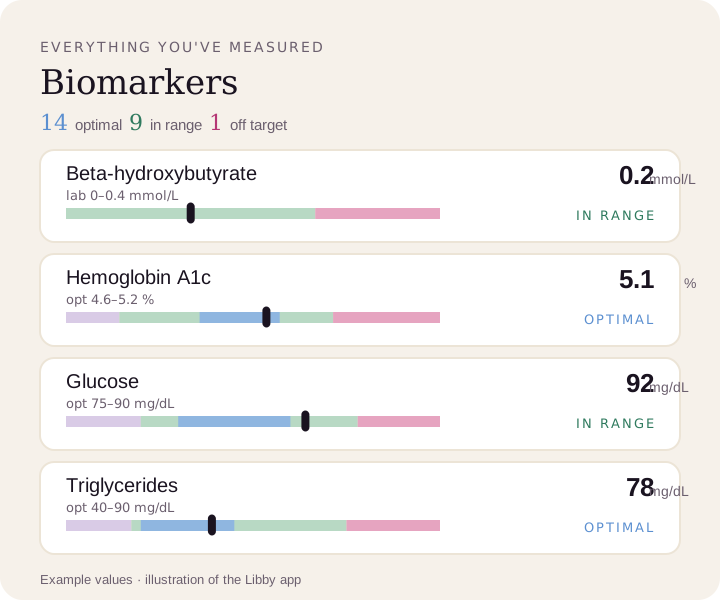
See every result against your lab's range.
Upload a lab PDF or a photo of your report. Libby puts every marker on your lab's range, adds the optimal range where one exists, and tracks your trends over time.
View your BHB ›