pCO2 blood gas test: normal range, high and low causes
pCO2 shows how well your breathing clears carbon dioxide. Here's the normal range, what high and low results usually mean, and when a result is urgent.
pCO2 (the partial pressure of carbon dioxide) measures the carbon dioxide gas in your blood, and it shows how well your breathing is clearing the CO2 your body makes. Breathe too little and pCO2 climbs. Breathe too much and it falls. It comes from a blood gas test, usually alongside pH, oxygen and bicarbonate, and it's the lab's most direct read on your breathing.1
The short version
- Normal: 35–45 mm Hg on an arterial sample in adults, the range MedlinePlus and hospital labs such as the University of Iowa's use.12 Pregnancy runs lower, around 30–32.3
- High means CO2 is building up because breathing isn't keeping pace. The usual causes are COPD or asthma, a chest infection and heart failure. Opioids, sedatives and sleep-related breathing problems are less common.4 Low means you're breathing off extra CO2: pain, anxiety, fever, a lung problem, pregnancy, or your lungs making up for an acid in the blood.5
- Urgent: hospital labs treat results below 20 or above 70 mm Hg as critical values (above 55 in children).2 A high pCO2 with drowsiness, confusion or labored breathing needs emergency care.
- pCO2 is a gas pressure from a blood gas test. The "CO2" on a routine metabolic panel is mostly bicarbonate, in mmol/L. They're different numbers.6
What pCO2 is
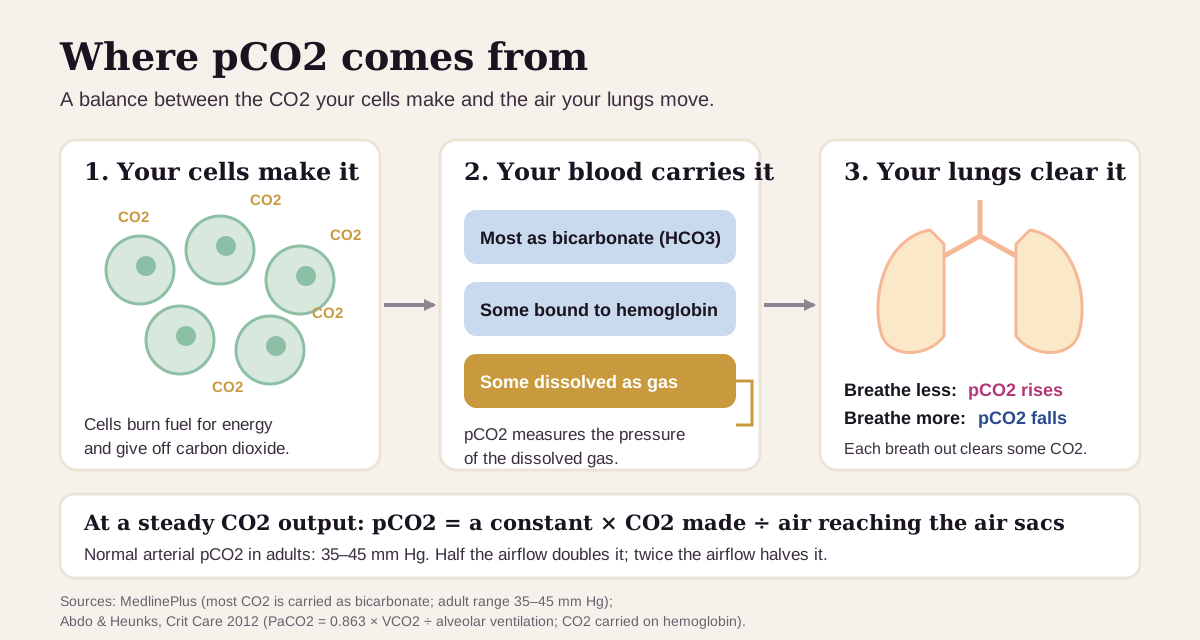
Your cells make carbon dioxide as they burn fuel. Your blood carries it to your lungs in three forms: most of it as bicarbonate, some bound to hemoglobin, and some dissolved as gas.67 pCO2 measures the pressure of that dissolved gas. Every breath out clears some of it.
As long as your body makes CO2 at a steady rate, pCO2 depends on how much fresh air reaches the tiny air sacs of your lungs. Halve that airflow and pCO2 roughly doubles.7 That makes pCO2 the plainest lab signal of whether your breathing is keeping up. (The formula is at the end.)
Most people see pCO2 on an arterial blood gas (ABG), drawn from the artery at your wrist, usually in a hospital or emergency room. In newborns the sample may come from a heel or the umbilical cord.1 Doctors order it for trouble breathing, a flare of COPD or asthma, suspected carbon monoxide poisoning, a head injury that could affect breathing, or to check how oxygen treatment is going.1
What's a normal pCO2?
For adults, an arterial pCO2 of 35–45 mm Hg is normal. MedlinePlus and the University of Iowa's hospital lab both use that range.12 The middle, 40, is the reference point clinicians use in their acid-base rules.58
Age and sex barely move it:
- In 146 healthy adults over 70 in Norway, the average arterial pCO2 was 39.4 mm Hg, with an upper limit of 44.8, the same for men and women. It showed no link to age.9
- A Danish study of healthy adults aged 20 to 76 found women ran slightly lower than men, but the gap was small enough that the authors set one shared range.10
- Children at the University of Iowa have an arterial range of 30–40 from birth to 18.2
- Pregnancy lowers it on purpose. Progesterone makes the breathing center more sensitive to CO2, so arterial pCO2 settles around 32 mm Hg, and pH sits slightly high at 7.40–7.47.3
- Altitude lowers it too, because thin air makes you breathe harder.5 On Mount Everest, climbers at 8,400 meters had an average pCO2 of 13.3 mm Hg.11
The type of sample matters as much as the person. The ranges above are for blood from an artery. Blood from a finger or earlobe tracks the arterial number closely. Blood from an arm vein usually reads higher, by an amount that varies from person to person:
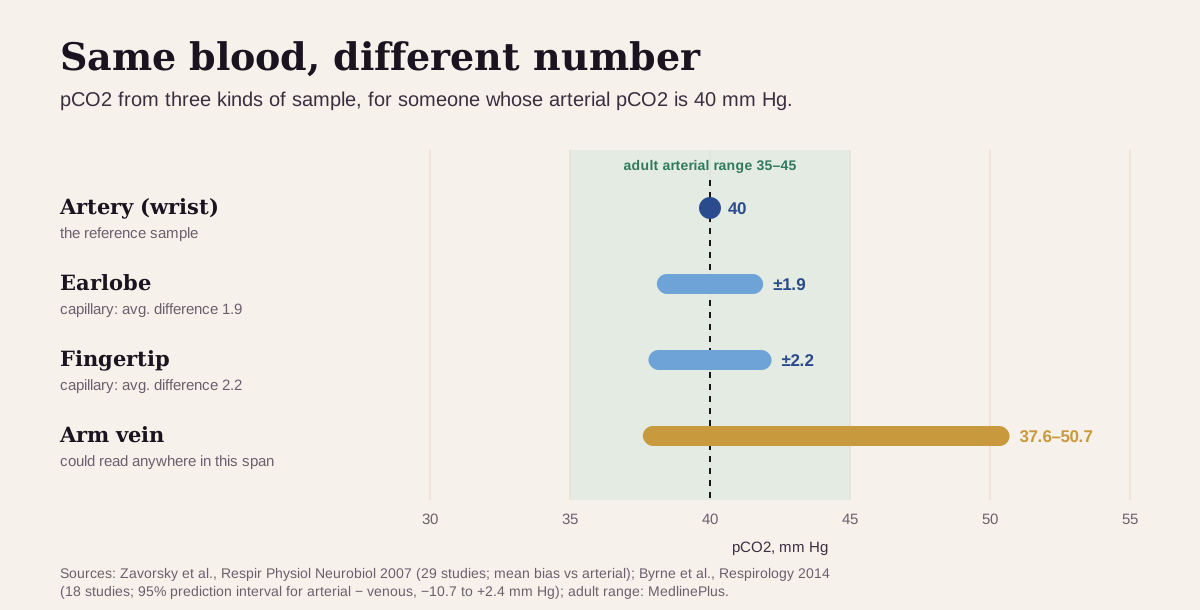
- A meta-analysis of 29 studies found earlobe and fingertip samples came within 1.9 and 2.2 mm Hg of arterial pCO2 on average.12
- A meta-analysis of 18 studies and 1,768 adults found arm-vein pCO2 too variable to swap for arterial. For one person, the arterial number could run 10.7 mm Hg below to 2.4 above the vein number.13 So if your arterial pCO2 were 40, a vein sample drawn at the same moment could read anywhere from about 38 to 51.
When you compare results over time, compare arterial with arterial and vein with vein.
"Optimal" pCO2: is there a target?
We found no wellness or longevity target for pCO2. Longevity testing companies such as Function Health and Superpower list "carbon dioxide" on their panels, but that's the routine chemistry CO2 (mostly bicarbonate), not blood gas pCO2.146 The Libby app's marker catalog has no optimal band for pCO2 either, so the Libby app shows your pCO2 on your lab's range, 35–45 mm Hg.
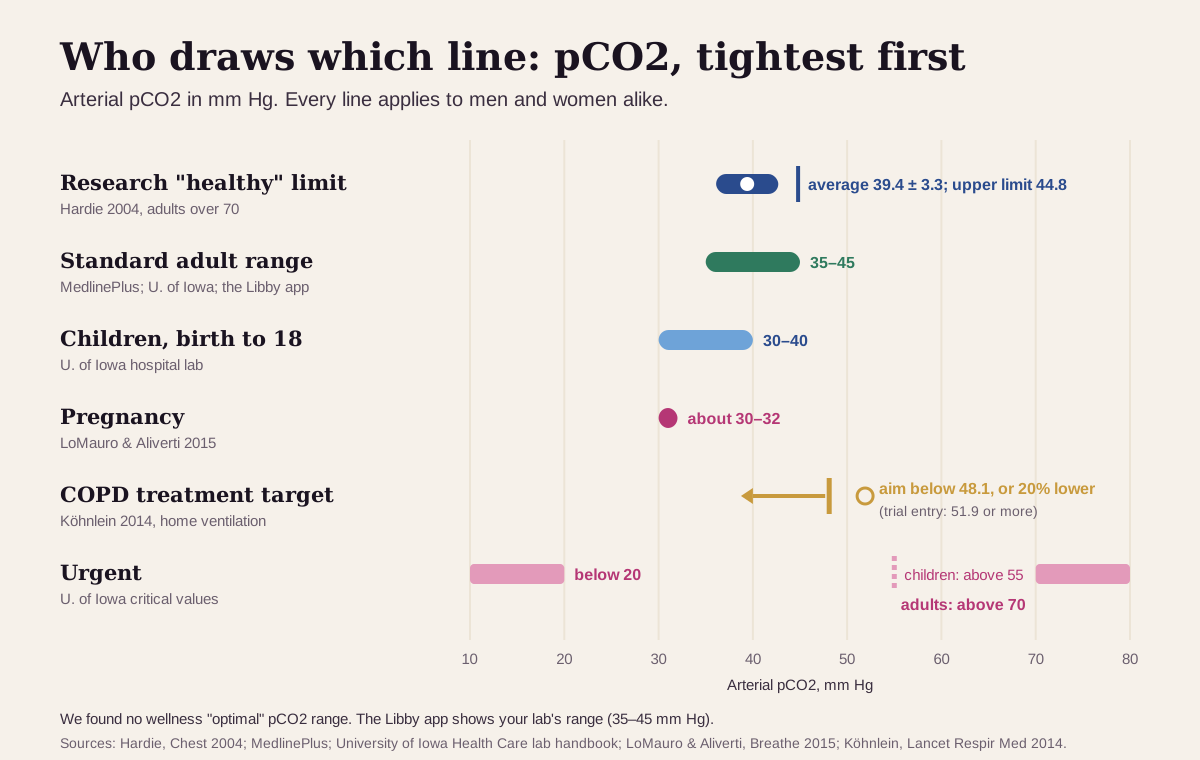
What does exist is a ladder of clinical lines, from the tightest research limit to the point where a lab calls your doctor:
| Line | pCO2 (mm Hg) | Who uses it |
|---|---|---|
| Research "healthy" limit | average 39.4, upper limit 44.8 | Healthy adults over 70, men and women alike9 |
| Standard adult range | 35–45 | MedlinePlus and hospital labs.12 The range the Libby app shows |
| Children, birth to 18 | 30–40 | University of Iowa hospital lab2 |
| Pregnancy | about 30–32 | Expected shift from progesterone-driven breathing3 |
| Treatment target, chronic high-CO2 COPD | below 48.1, or 20% below the starting value | Home-ventilation trial in severe COPD15 |
| Urgent | below 20 or above 70 (above 55 in children) | Critical values at a hospital lab2 |
Why clinicians push a chronically high pCO2 down. The strongest outcome evidence comes from people with severe COPD whose pCO2 stays high between flares:
- In a German and Austrian trial of 195 people with severe, stable COPD and pCO2 of 51.9 mm Hg or more, home noninvasive ventilation (a mask that helps each breath) was set to cut pCO2 by at least 20%. One-year mortality was 12% with it, versus 33% with standard care.15
- In a UK trial of 116 people whose pCO2 stayed above 53 two to four weeks after a hospital stay, adding home ventilation to home oxygen cut the 12-month risk of readmission or death from 80.4% to 63.4%.16
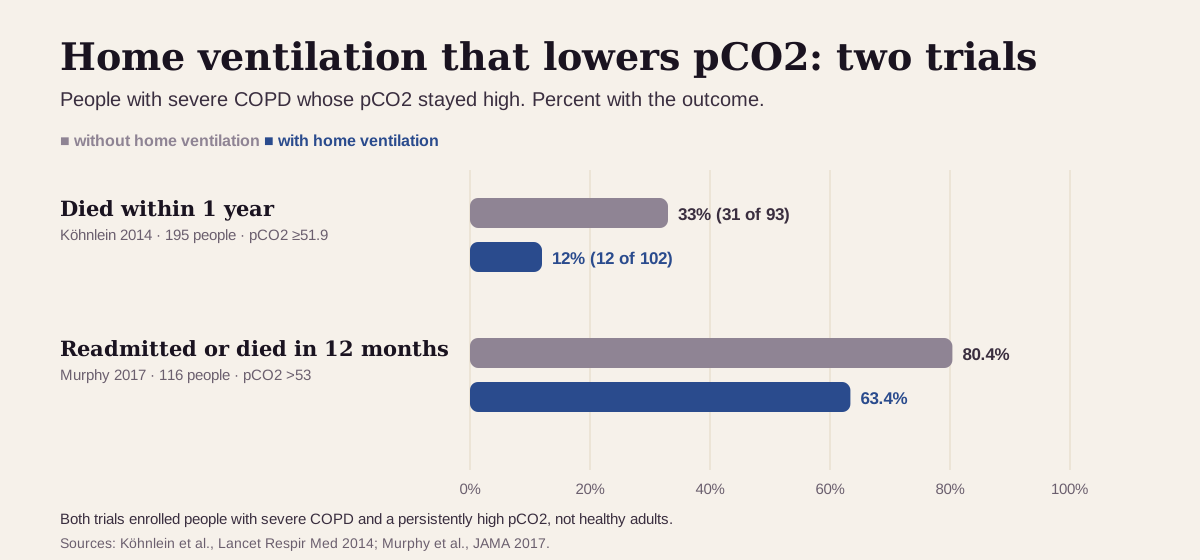
Keep this in perspective: those are treatment targets for people with lung disease, and lower is no better for everyone else. A low pCO2 pushes the blood toward alkalosis, whose symptoms include numbness in the hands, feet or face, muscle twitching or cramps, and confusion.15 In pregnancy, LoMauro and Aliverti advise avoiding extra respiratory alkalosis because it can affect blood flow to the womb and the baby's oxygen.3 The healthy target is the normal range for your sample type, age and situation.
What a high pCO2 usually means
A pCO2 above 45 is called hypercapnia. It means CO2 is reaching your blood faster than your breathing clears it.5
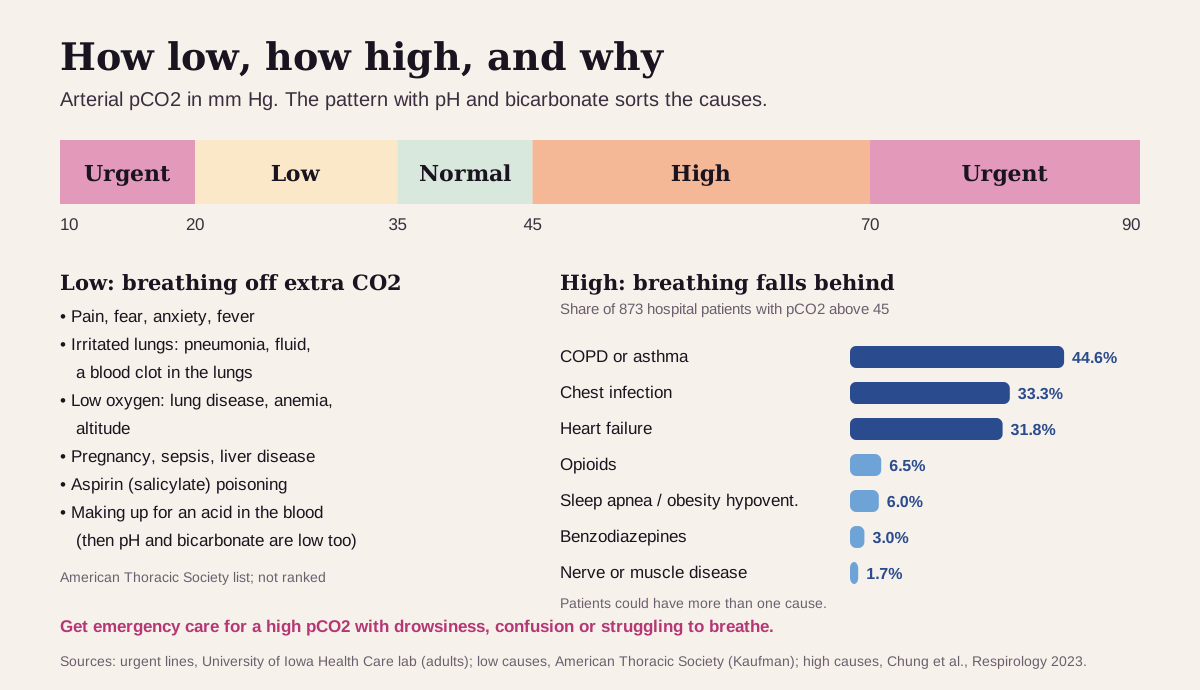
The usual suspects, by how often they show up
An Australian study of 873 hospital patients with a pCO2 above 45 found at least one clear cause in 83%. Many had more than one:4
- COPD or asthma, in 44.6%.
- A chest infection, in 33.3%.
- Heart failure, in 31.8%.
- Opioids, in 6.5%, and benzodiazepines (sedatives such as diazepam), in 3.0%. Both can slow breathing.5 Don't stop a prescribed medicine on your own; bring your full list to your clinician.
- Sleep-related breathing problems, in 6.0%: obstructive sleep apnea and obesity hypoventilation.
- Less common: nerve, muscle and chest-wall diseases that weaken breathing, such as myasthenia gravis,1 in 1.7%. This group had the highest death rate in hospital, 40%.
Your body can also make more CO2 than usual, with shivering, seizures or a very high metabolic rate, and outrun your breathing.5 The average pCO2 in the Australian study was 58 mm Hg, and 12.8% of the patients died in hospital.4
Oxygen can raise pCO2 in severe COPD
In people with severe COPD, high-flow oxygen can push pCO2 up. In one classic study, oxygen at 15 liters a minute raised pCO2 from 8.4 to 11.4 kPa (about 63 to 86 mm Hg) during a flare. The biggest reason is a shift in which parts of the lung get blood and air. Oxygen also loosens CO2 from hemoglobin (the Haldane effect), which explained about 25% of the rise.7
That's why British Thoracic Society guidance sets a lower oxygen target, 88–92% saturation, for people at risk, and checks blood gases within 30–60 minutes.17 Oxygen is still life-saving. The dose is what gets tailored.
Get emergency care if someone is very drowsy, confused, hard to wake, breathing slowly or struggling to breathe, especially with COPD, after opioids or sedatives, or with a nerve or muscle disease.14
What a low pCO2 usually means
A low pCO2 (hypocapnia) means you're breathing off CO2 faster than your body makes it. The American Thoracic Society groups the causes:5
- Something driving your breathing: pain, fear, anxiety, fever, or a brain problem such as a stroke or head injury.
- Irritated lungs: pneumonia, fluid in or around the lungs, a collapsed lung, or a blood clot in the lungs (pulmonary embolism).
- Low oxygen: lung disease, severe anemia, or thin air at altitude.
- Hormones, drugs and illness: pregnancy, progestin medicines, aspirin (salicylate) poisoning, adrenaline-type drugs, an overactive thyroid, liver disease and sepsis.
- A ventilator set to breathe too fast for the patient.
The needle itself can do it. Anxiety about an arterial stick can speed up your breathing and lower the result.18
A low pCO2 can also be the lungs doing their job. When an acid builds up in the blood, as in diabetic ketoacidosis, lactic acidosis or kidney failure, you breathe harder to blow off CO2 and pull pH back toward normal. Then pH and bicarbonate are low too.5 The neighbors below show how to tell the two apart.
pCO2 reads best next to its neighbors
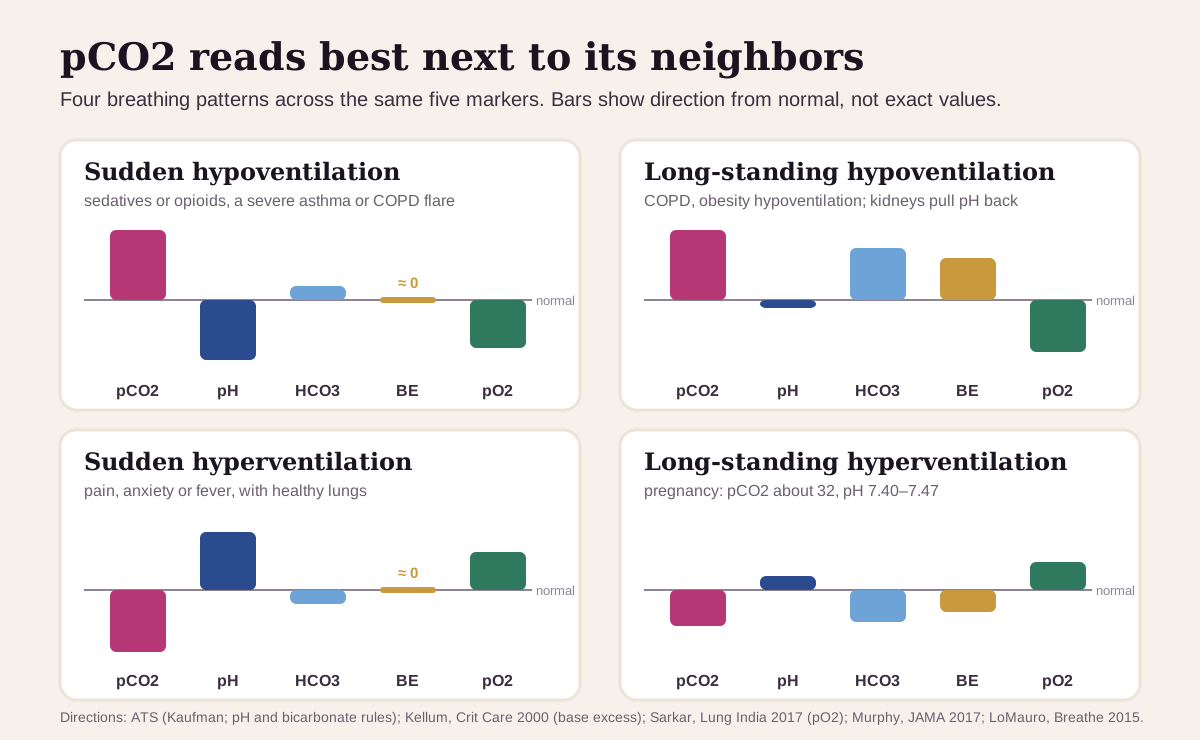
pCO2 tells you what breathing is doing. pH, bicarbonate, base excess and oxygen tell you whether it's new, old or a response to something else:
| If you see… | It often points to… |
|---|---|
| pCO2 high, pH low, bicarbonate barely up | sudden hypoventilation: sedating drugs, a severe asthma or COPD flare. Bicarbonate rises only about 1 mmol/L per 10 mm Hg of pCO2 |
| pCO2 high, pH near normal, bicarbonate clearly high, base excess positive | long-standing hypoventilation, with the kidneys pulling pH back toward normal over 3–5 days: COPD, obesity hypoventilation, nerve or muscle disease. Bicarbonate rises about 3.5 mmol/L per 10 mm Hg |
| pCO2 low, pH high, bicarbonate barely down | sudden hyperventilation: pain, anxiety, fever, a lung problem, a blood clot, altitude |
| pCO2 low, pH near normal or slightly high, bicarbonate low | long-standing hyperventilation, as in pregnancy |
| pCO2 low, pH low, bicarbonate low, base excess below −5 | breathing off a metabolic acid. Expected pCO2 = 1.5 × bicarbonate + 8, give or take 2. See the pH guide |
| pCO2 high, pH high, bicarbonate high | breathing slowed to hold on to acid in metabolic alkalosis, for example after heavy vomiting |
Two rules make the table work. First, in breathing problems pH and pCO2 move in opposite directions; when both fall together, the story starts with an acid.5 Second, base excess stays near zero in a sudden breathing change and only drifts once the kidneys have had days to respond.85
The oxygen column follows from the air sacs: when you under-breathe, CO2 takes up room that oxygen would fill, so pO2 falls. With healthy lungs, over-breathing does the reverse. A blood clot, a lung problem or thin air can drive fast breathing while pO2 stays low.1935
How fast pCO2 changes
pCO2 moves in minutes. Bicarbonate follows over days.
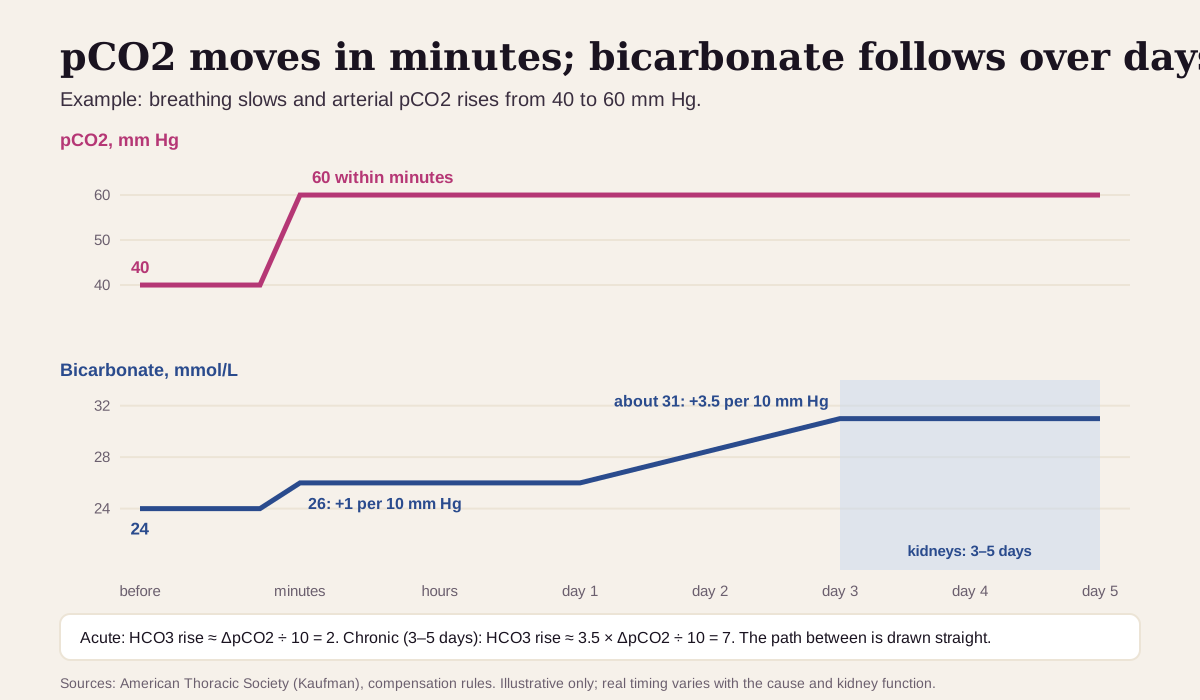
What that means in practice:
- Breathing changes show up fast. That's why, if you use oxygen and can safely breathe without it, the team may turn it off about 20 minutes before an ABG.1 After oxygen is started in someone at risk of CO2 buildup, the recheck comes within 30–60 minutes.17
- Bicarbonate tells you how long it's been. The kidneys need 3–5 days to hold on to extra bicarbonate. A high pCO2 with a big bicarbonate rise has usually been there a while; a high pCO2 with pH already falling is new.5 In the UK home-ventilation trial, people with a steady pCO2 of 59 had a pH of 7.40.16
- The sample can drift after it's drawn. Air bubbles left in the syringe can lower pCO2 and raise pH, so staff push out any air right away. Labs analyze at 37°C unless told your temperature.182
- Trends beat snapshots. A pCO2 that climbs across tests, with pH starting to fall, is a different story from a stable high value with a normal pH. Compare the same sample type each time.13
Going deeper: why breathing sets pCO2
The relationship fits in one formula:7
PaCO2 = (0.863 × CO2 made) ÷ (minute ventilation × (1 − dead space fraction))
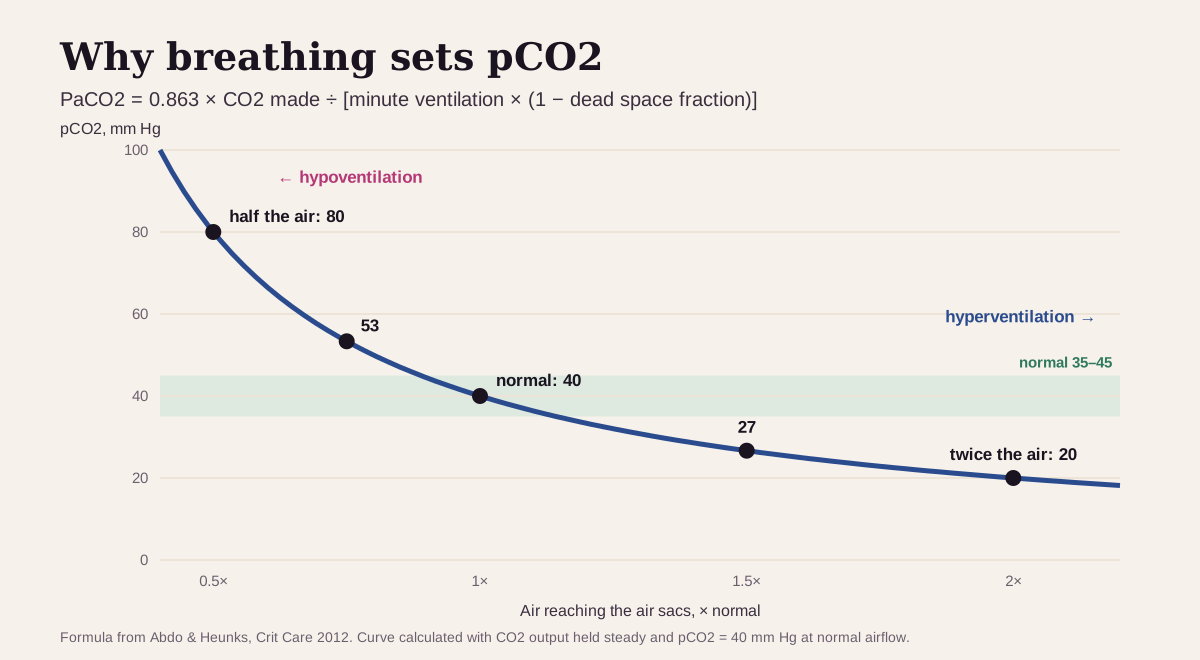
Three things follow:
- pCO2 is inversely proportional to the air reaching your air sacs. Halve it and pCO2 doubles, from 40 to 80. Double it and pCO2 halves, to 20.
- Fast, shallow breathing can still raise pCO2. Dead space is the part of each breath that stays in the airways. When breaths get small, that wasted part becomes a bigger share, so less air reaches the air sacs.7
- Making more CO2 raises pCO2, with shivering, seizures or a fever, unless breathing speeds up to match.57
pCO2 also sets your oxygen. The alveolar gas equation says the oxygen in your air sacs equals the oxygen you breathe in minus pCO2 divided by 0.8.19 On room air, each 10 mm Hg rise in pCO2 costs about 12.5 mm Hg of oxygen in the air sacs. Supplemental oxygen fixes the oxygen without fixing the CO2, so a good pulse-oximeter reading on oxygen can hide a high pCO2.19
Base excess separates breathing from metabolism. In a pure metabolic acidosis, pCO2 should equal about 40 plus the base excess (a base excess of −10 means an expected pCO2 near 30). In a long-standing high pCO2, base excess rises by about 0.4 for each mm Hg above 40.8
Questions worth asking
- Was this an arterial, venous or capillary sample?
- Was I on oxygen when the blood was drawn, and how much?
- Is my pH low, normal or high with this pCO2, and does that mean it's new or long-standing?
- What do my bicarbonate and base excess show?
- Could any of my medicines, such as opioids or sleep or anxiety medicines, be slowing my breathing?
- Should I be checked for sleep apnea or obesity hypoventilation, or would home ventilation help me?
FAQ
What is a normal pCO2 level? For an arterial sample in adults, 35–45 mm Hg.1 Children run a little lower (30–40 at the University of Iowa), and pregnancy lowers it to about 30–32.23
Is pCO2 the same as the CO2 on my metabolic panel? No. pCO2 is the pressure of CO2 gas, in mm Hg, from a blood gas test. The panel's CO2 is total carbon dioxide, mostly bicarbonate, in mmol/L.6
Can anxiety lower pCO2? Yes. Anxiety, pain and fear all speed up breathing, and even anxiety about the blood draw can lower the result.518
If my oxygen level is normal, is my pCO2 normal too? On room air, usually: a normal pulse-oximeter reading means your breathing is clearing CO2 well enough. On supplemental oxygen, your saturation can look fine while pCO2 climbs, so a blood gas is the check.19
This guide is for education. It can't diagnose you or replace care from a clinician who knows your history.
Footnotes
-
National Library of Medicine. Arterial Blood Gas (ABG) Test. MedlinePlus. Updated June 26, 2025. The adult PaCO2 range of 35–45 mm Hg, why the test is ordered, symptoms of acidosis and alkalosis, and turning oxygen off about 20 minutes before the test. MedlinePlus ↩ ↩2 ↩3 ↩4 ↩5 ↩6 ↩7 ↩8 ↩9 ↩10 ↩11 ↩12
-
University of Iowa Health Care, Department of Pathology. Blood Gases (Arterial). Laboratory Services Handbook. A working hospital lab's ranges: adults 35–45 mm Hg, children 0–18 years 30–40; critical values below 20 or above 70 (adults) and above 55 (children); analysis assumes 37°C; air must be expelled at once. uiowa.edu ↩ ↩2 ↩3 ↩4 ↩5 ↩6 ↩7 ↩8 ↩9 ↩10 ↩11
-
LoMauro A, Aliverti A. Respiratory physiology of pregnancy. Breathe (Sheff). 2015;11(4):297–301. Progesterone raises the breathing center's sensitivity to CO2; arterial PCO2 plateaus around 32 mm Hg (about 30 when interpreting blood gases), pH 7.40–7.47, PaO2 106–108 in the first trimester; respiratory alkalosis is best avoided because of effects on uterine blood flow. PMC ↩ ↩2 ↩3 ↩4 ↩5 ↩6 ↩7 ↩8
-
Chung Y, Garden FL, Marks GB, Vedam H. Causes of hypercapnic respiratory failure and associated in-hospital mortality. Respirology. 2023;28(2):176–182. 873 patients with PaCO2 above 45 mm Hg and pH 7.45 or lower; frequency and case-fatality rate of each cause. PMC ↩ ↩2 ↩3 ↩4 ↩5
-
Kaufman DA. Interpretation of Arterial Blood Gases (ABGs). American Thoracic Society, clinical education resources. The stepwise method, the compensation rules (bicarbonate up about 1 mmol/L per 10 mm Hg acutely and 3.5 per 10 over 3–5 days; expected pCO2 = 1.5 × HCO3 + 8 ± 2 in metabolic acidosis) and the lists of causes of high and low pCO2. thoracic.org ↩ ↩2 ↩3 ↩4 ↩5 ↩6 ↩7 ↩8 ↩9 ↩10 ↩11 ↩12 ↩13 ↩14 ↩15 ↩16 ↩17 ↩18
-
National Library of Medicine. Carbon Dioxide (CO2) in Blood. MedlinePlus. Updated November 12, 2024. Most of the body's carbon dioxide is carried as bicarbonate; "total CO2" on a chemistry panel is this bicarbonate-based test. MedlinePlus ↩ ↩2 ↩3 ↩4 ↩5
-
Abdo WF, Heunks LMA. Oxygen-induced hypercapnia in COPD: myths and facts. Crit Care. 2012;16(5):323. The formula PaCO2 = 0.863 × VCO2 ÷ [VE × (1 − VD/VT)], the Aubier oxygen study (PaCO2 8.4 to 11.4 kPa) and the Haldane effect's share (about 25%). PMC ↩ ↩2 ↩3 ↩4 ↩5 ↩6 ↩7
-
Kellum JA. Determinants of blood pH in health and disease. Crit Care. 2000;4(1):6–14. Table 1 gives the observed patterns: standard base excess near 0 in acute respiratory changes, 0.4 × (pCO2 − 40) in chronic ones, and pCO2 ≈ 40 + base excess in metabolic acidosis. PMC ↩ ↩2 ↩3 ↩4
-
Hardie JA, Vollmer WM, Buist AS, Ellingsen I, Mørkve O. Reference values for arterial blood gases in the elderly. Chest. 2004;125(6):2053–2060. 146 healthy Norwegians over 70: mean PaCO2 39.4 mm Hg (SD 3.3), upper limit 44.8, for both sexes, unrelated to age. PubMed ↩ ↩2 ↩3 ↩4
-
Klæstrup E, Trydal T, Pedersen JF, et al. Reference intervals and age and gender dependency for arterial blood gases and electrolytes in adults. Clin Chem Lab Med. 2011;49(9):1495–1500. Healthy adults aged 20–76; women had slightly lower PaCO2, but the differences were minor and common intervals were set. PubMed ↩ ↩2
-
Grocott MPW, Martin DS, Levett DZH, et al. Arterial blood gases and oxygen content in climbers on Mount Everest. N Engl J Med. 2009;360(2):140–149. At 8,400 m, four samples on ambient air had a mean PaCO2 of 13.3 mm Hg (range 10.3–15.7). PubMed ↩
-
Zavorsky GS, Cao J, Mayo NE, Gabbay R, Murias JM. Arterial versus capillary blood gases: a meta-analysis. Respir Physiol Neurobiol. 2007;155(3):268–279. 29 studies; mean pCO2 bias of 1.9 mm Hg (earlobe) and 2.2 mm Hg (fingertip) against arterial. PubMed ↩ ↩2
-
Byrne AL, Bennett M, Chatterji R, Symons R, Pace NL, Thomas PS. Peripheral venous and arterial blood gas analysis in adults: are they comparable? A systematic review and meta-analysis. Respirology. 2014;19(2):168–175. 18 studies, 1,768 adults; the 95% prediction interval for the arterial-minus-venous pCO2 difference ran from −10.7 to +2.4 mm Hg. PubMed ↩ ↩2 ↩3
-
Function Health. What We Test ("Carbon Dioxide" listed under electrolytes), and Superpower. Biomarkers ("Carbon Dioxide, Total"), both public pages retrieved September 23, 2026. A commercial source for each: two consumer testing companies, cited only to show that their panels list total CO2 and publish no blood gas pCO2 target. functionhealth.com · superpower.com ↩
-
Köhnlein T, Windisch W, Köhler D, et al. Non-invasive positive pressure ventilation for the treatment of severe stable chronic obstructive pulmonary disease: a prospective, multicentre, randomised, controlled clinical trial. Lancet Respir Med. 2014;2(9):698–705. 195 patients with PaCO2 of 7 kPa (51.9 mm Hg) or more; ventilation targeted a 20% fall or a PaCO2 below 6.5 kPa (48.1 mm Hg); one-year mortality 12% vs 33%. DOI ↩ ↩2 ↩3 ↩4
-
Murphy PB, Rehal S, Arbane G, et al. Effect of home noninvasive ventilation with oxygen therapy vs oxygen therapy alone on hospital readmission or death after an acute COPD exacerbation: a randomized clinical trial. JAMA. 2017;317(21):2177–2186. 116 patients with PaCO2 above 53 mm Hg (baseline mean 59, PaO2 48, pH 7.40 on room air); 12-month readmission or death 63.4% vs 80.4%. PMC ↩ ↩2 ↩3 ↩4
-
O'Driscoll BR, Howard LS, Earis J, Mak V. British Thoracic Society Guideline for oxygen use in adults in healthcare and emergency settings. BMJ Open Respir Res. 2017;4(1):e000170. Target saturation 88–92% for people at risk of hypercapnic respiratory failure, with blood gases within 30–60 minutes. PMC ↩ ↩2
-
Baird G. Preanalytical considerations in blood gas analysis. Biochem Med (Zagreb). 2013;23(1):19–27. Anxiety over the blood draw can change results by speeding breathing; air in the syringe can lower pCO2 and raise pH. PMC ↩ ↩2 ↩3
-
Sarkar M, Niranjan N, Banyal PK. Mechanisms of hypoxemia. Lung India. 2017;34(1):47–60. Hypoventilation raises PaCO2 and lowers PaO2; the alveolar gas equation (R ≈ 0.8); oxygen corrects the low oxygen while hypoventilation persists, so oximetry on oxygen can miss it. PMC ↩ ↩2 ↩3 ↩4 ↩5
Educational content, not medical advice. Libby is a personal record tool, not a medical service — it doesn't diagnose, treat, or prescribe. Reference ranges vary by lab and by person. Talk to a qualified healthcare professional about your results.
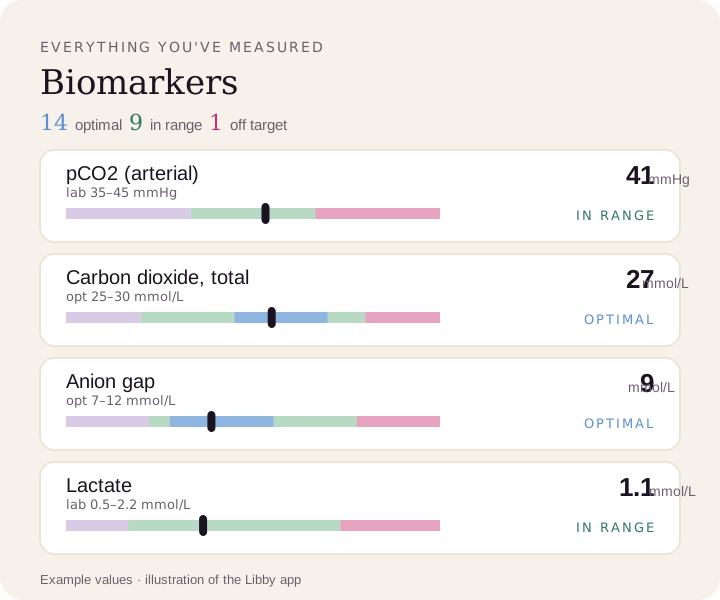
See every result against your lab's range.
Upload a lab PDF or a photo of your report. Libby puts every marker on your lab's range and tracks your trends over time.
View your pCO2 ›