pO2 blood gas: normal range, low causes, and what it means
pO2 is the oxygen pressure in your arterial blood: the normal range, what a low result means, how to read it with its neighbors, and when it's urgent.
pO2 (the partial pressure of oxygen) is the pressure of the oxygen dissolved in your blood, measured on an arterial blood gas. It shows how well your lungs are moving oxygen from the air into your arteries. Most labs call 80–100 mm Hg normal for an adult at sea level, and doctors call a result under 60 hypoxemia: too little oxygen in the blood.123
The short version
- Normal: about 80–100 mm Hg in arterial blood at sea level (MedlinePlus lists 75–100). Healthy young adults average about 100, and it drifts down with age and altitude.243
- Low usually means a lung problem that keeps oxygen from reaching the blood: asthma or COPD flare-ups, pneumonia, a blood clot in the lung. Slow, shallow breathing and high altitude lower it too.25
- Under 60 is hypoxemia. 55 or less at rest is the level where long-term home oxygen helps people with COPD live longer. Under 40 is a critical value at hospital labs such as the University of Iowa's.367
- pO2 is a pressure, not the amount of oxygen. Hemoglobin carries about 98% of it, so anemia or carbon monoxide can starve your tissues while pO2 looks fine.23
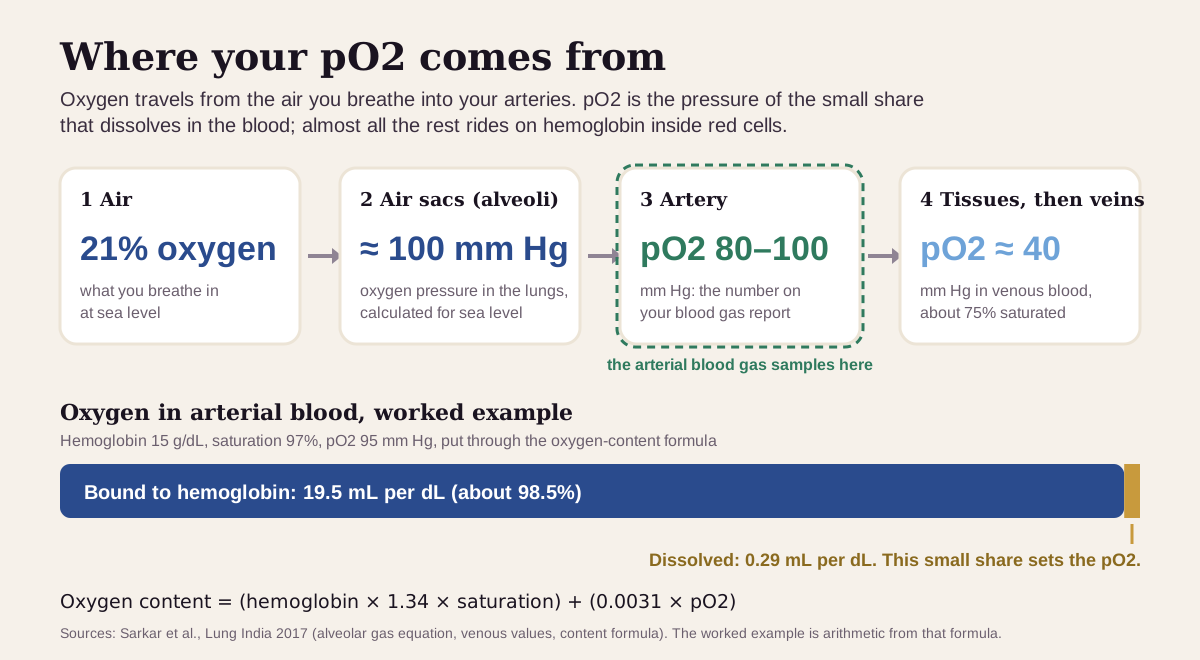
What pO2 is
Every breath brings air that is 21% oxygen into the tiny air sacs of your lungs. At sea level, the oxygen pressure inside them works out to about 100 mm Hg. From there, oxygen crosses into the blood flowing past.2
Once in the blood, oxygen travels two ways. Almost all of it hooks onto hemoglobin inside your red cells. A small share dissolves in the plasma, and that dissolved share sets the pO2.2 Think of pO2 as the pressure that pushes oxygen onto hemoglobin and out into your tissues. By the time blood returns through your veins, its pO2 has fallen to about 40 mm Hg.2
The test is an arterial blood gas (ABG). A clinician takes a small sample from an artery, usually on the inside of your wrist, because arterial blood carries more oxygen than blood from a vein.1 The same report usually lists oxygen saturation, pCO2, pH and bicarbonate.1
Vein samples give a very different number. In a review of 18 studies, arterial pO2 ran on average 36.9 mm Hg higher than venous pO2, with too much spread to convert one into the other.8 The respiratory-care guideline advises against judging oxygen from venous or fingertip (capillary) samples.9
What's a normal pO2?
Start with the range on your report. Many labs print 80–100 mm Hg for adults, the range the Libby app shows. MedlinePlus lists 75–100 at sea level, and the University of Iowa's hospital lab uses 80–90.47
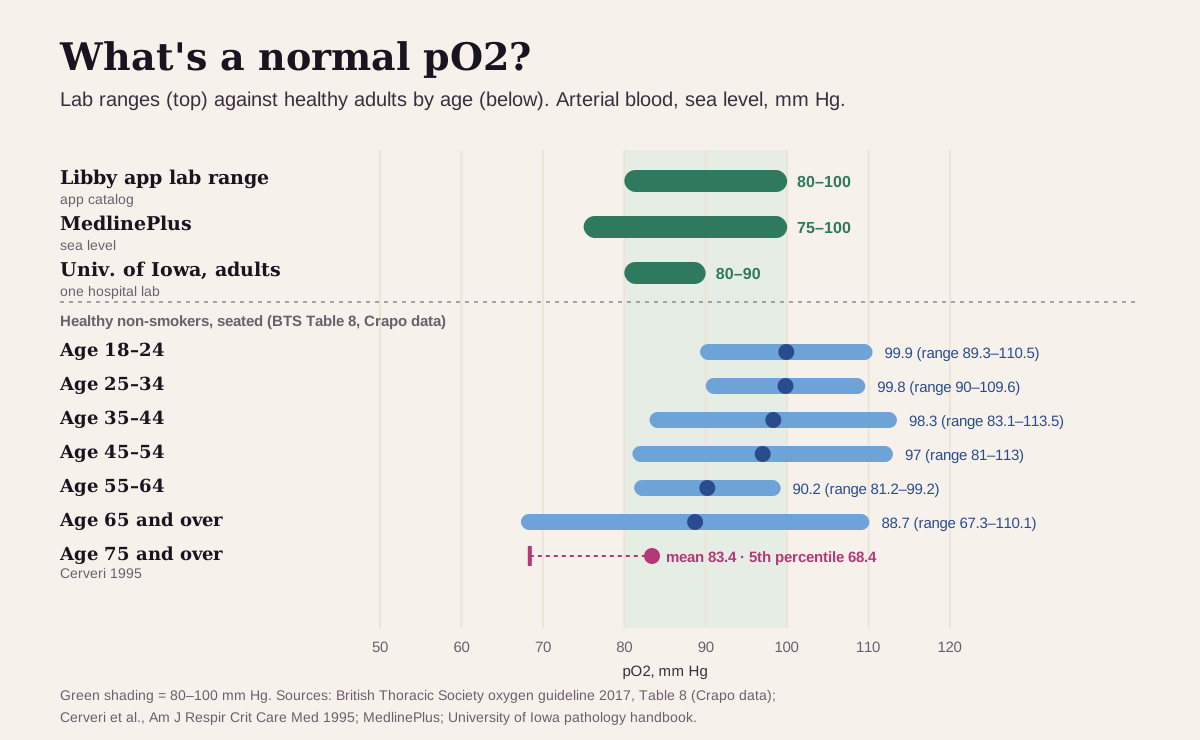
- The British Thoracic Society puts the normal range for young adults at 90–110 mm Hg. In the healthy non-smokers behind its table, the average was about 100 up to age 34 and 89 after 64.3
- Age lowers it. A Danish study of healthy adults found pO2 fell about 2 mm Hg (0.29 kPa) per decade.11 In healthy Italians 75 and older, the average was 83.4, and 1 in 20 was below 68.4.10
- Men and women run about the same. Non-smoking women and men in the Danish study had similar pO2.11
- Altitude lowers it a lot. Across 53 studies, pO2 dropped about 12 mm Hg for every 1,000 meters (3,300 feet) of climb in the first days, then crept back up about 1.2 mm Hg a day as the body adjusted.5 MedlinePlus expects lower values from 900 meters (3,000 feet) up.4
- Lying down lowers it by about 6 mm Hg compared with sitting up.3
- Pregnancy raises it a little, to about 106–108 in the first trimester and 101–104 in the third, because pregnant women breathe more.12
Is there an "optimal" pO2?
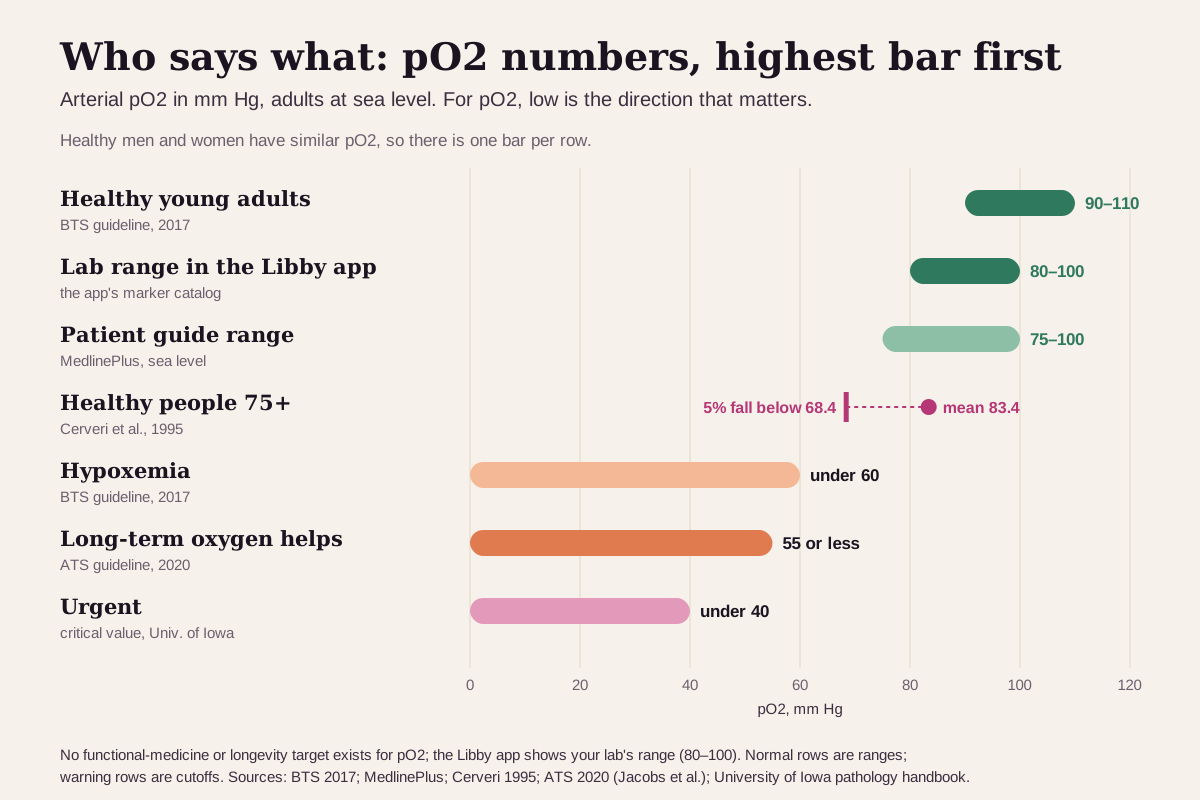
For most markers, health optimizers aim tighter than the lab. pO2 works the other way: the numbers that matter are floors from lung and critical-care guidelines. Functional-medicine and longevity platforms publish no optimal pO2, and the Libby app shows your lab's range (80–100 mm Hg). Here's the ladder, highest bar first:
| Level | Arterial pO2 | Who uses it |
|---|---|---|
| Healthy young adults | 90–110 mm Hg | British Thoracic Society, from healthy non-smokers at sea level3 |
| Lab range | 80–100 mm Hg | The range shown in the Libby app; MedlinePlus lists 75–1004 |
| Healthy people 75+ | 5% fall below 68.4 mm Hg | Cerveri et al., 194 healthy non-smokers aged 40–9010 |
| Hypoxemia | under 60 mm Hg | The definition most authors use, about 90% saturation (British Thoracic Society)3 |
| Long-term oxygen helps | 55 mm Hg or less, at rest | American Thoracic Society, for COPD and interstitial lung disease6 |
| Urgent | under 40 mm Hg | A hospital critical value (University of Iowa)7 |
Why those floors matter:
- In people with COPD whose resting pO2 was 55 or less, oxygen for most of the day cut deaths by 55% over 2 years in the NOTT trial (all-day vs night-only oxygen) and by 59% over 5 years in the MRC trial (oxygen vs none).6
- Just above that line, the benefit fades. At a pO2 of 56–65 (the Górecka trial) or a saturation of 89–93% (the LOTT trial), long-term oxygen made no clear difference to survival.6
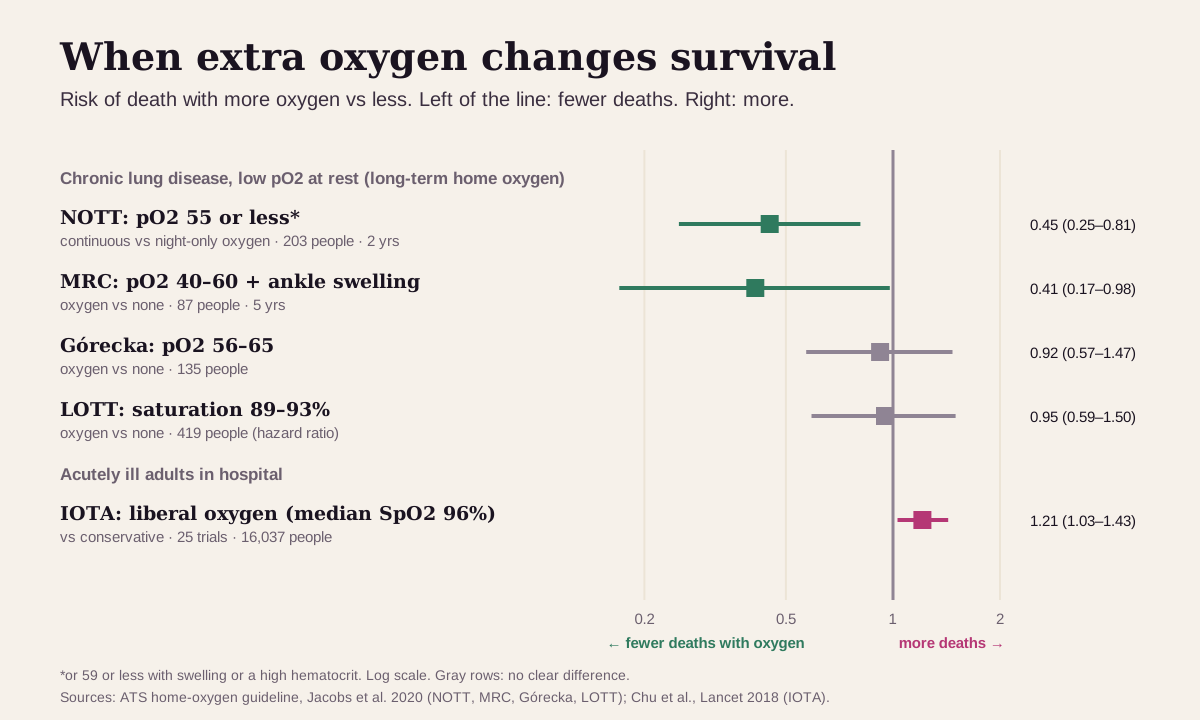
Keep "optimal" in perspective: past a point, more oxygen buys you nothing. Once pO2 is above about 60, hemoglobin is already about 91% full, so extra pressure adds little.214 In a review of 25 trials and 16,037 acutely ill adults, generous oxygen (a median saturation of 96%) raised the risk of dying in the hospital by 21% compared with a more careful approach.13 That's why hospitals aim oxygen at a saturation band, usually 94–98%, or 88–92% for people at risk of carbon dioxide build-up.3
What a low pO2 usually means
How low it is comes first. Clinicians read a low pO2 against a few well-worn cut points, each with a matching oxygen saturation.36714
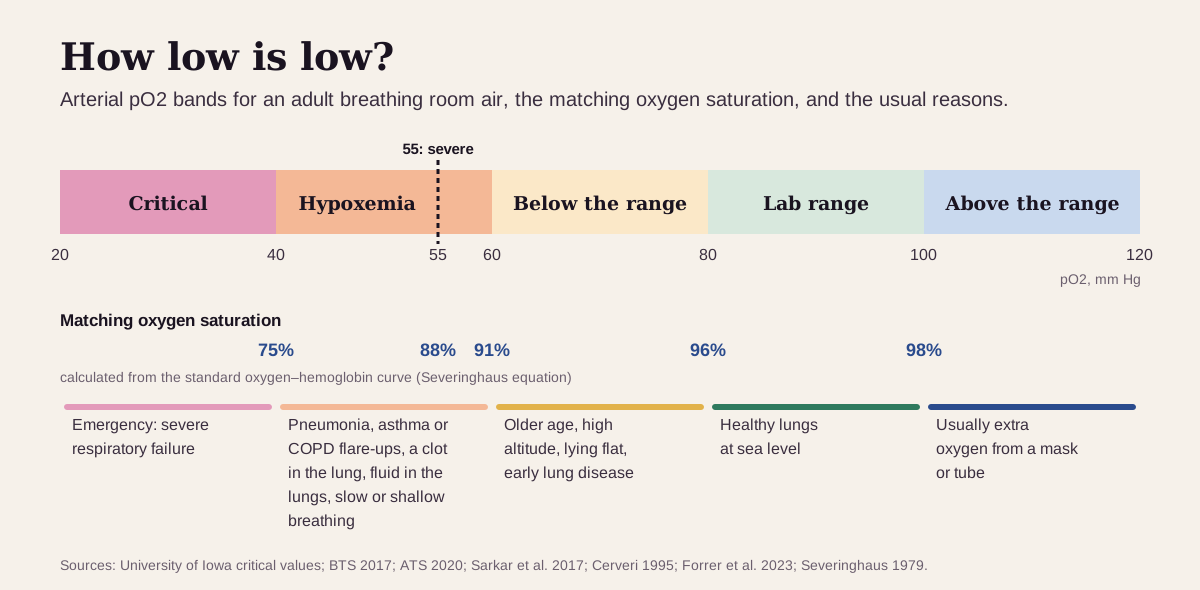
The usual suspects: a lung problem
The most common reason for a low pO2 is ventilation–perfusion (V/Q) mismatch: parts of the lung get blood but too little air, so that blood leaves without its full load of oxygen.2 It's behind the low pO2 in:
- Asthma and COPD flare-ups. Narrowed airways leave some air sacs short of fresh air.2
- Pneumonia, fluid in the lungs, and collapsed lung tissue. Blood flows past air sacs filled with fluid or pus and picks up no oxygen at all. Doctors call that a shunt.2
- A blood clot in the lung (pulmonary embolism). The classic finding is a low pO2 with a low pCO2.2
Other common reasons
- Slow or shallow breathing (hypoventilation). Opioids, sedatives, alcohol or weak breathing muscles let carbon dioxide build up and oxygen fall. The clue is a high pCO2.2 COPD is the most common disease behind a high pCO2, especially during a flare.3
- Altitude. Thinner air starts you off with less oxygen pressure.5
- Age and lying flat. Both lower pO2 a few points in healthy people.113
- A sample problem. An air bubble in the syringe or a slow trip to the lab can skew the result, which is why labs ask for air to be pushed out and the sample delivered right away.7
A high pO2
Breathing extra oxygen, from a mask, a nasal tube or a ventilator, pushes pO2 above the range.2 In the hospital, the question is whether the dose is more than you need, because too much oxygen raised deaths in acutely ill adults.133
Get emergency care for severe shortness of breath, trouble catching your breath or talking, bluish lips, skin or fingernails, confusion, or unusual sleepiness. A pO2 under 40 is on the critical-value list at hospital labs such as the University of Iowa's.157
pO2 reads best next to its neighbors
A pO2 means more next to four other results: the measured oxygen saturation (SaO2), pCO2, hemoglobin (Hb), and carboxyhemoglobin (COHb, hemoglobin tied up by carbon monoxide). Together they sort the common oxygen problems:23
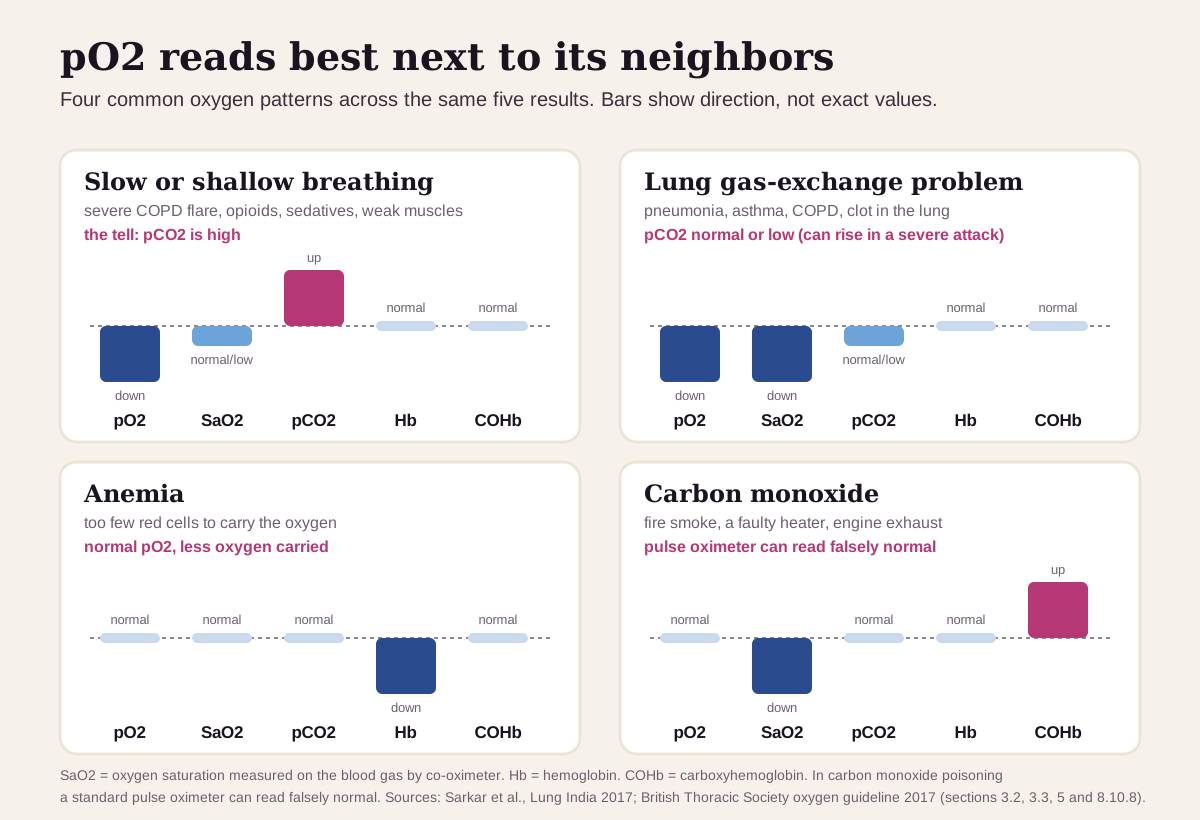
| If you see… | It often points to… |
|---|---|
| Low pO2 with a high pCO2 | slow or shallow breathing (hypoventilation): a severe COPD flare, opioids, sedatives, weak breathing muscles |
| Low pO2 with a normal or low pCO2 | a lung gas-exchange problem (V/Q mismatch or shunt): asthma, COPD, pneumonia, a clot in the lung. Under 60, doctors call this "type 1 respiratory failure". A severe asthma attack or COPD flare can push the pCO2 up too |
| Normal pO2 with a low hemoglobin | anemia: the pressure is fine, but there's less hemoglobin to carry the oxygen |
| Normal pO2, high COHb, low co-oximeter SaO2 | carbon monoxide poisoning: a standard finger pulse oximeter can read falsely normal |
The anemia and carbon-monoxide rows are why a normal pO2 is only half the oxygen story. With hemoglobin at 9 instead of 15 g/dL, the same pO2 of 95 carries about 40% less oxygen (12.0 vs 19.8 mL per dL, from the oxygen-content formula).2 In carbon monoxide poisoning the pO2 stays normal while far less oxygen is bound to hemoglobin, so the carboxyhemoglobin level has to be measured.3
How fast pO2 changes
pO2 moves in minutes. In 25 adults on ventilators, pO2 reached 90% of its new level about 4 minutes after the oxygen was turned up and 5.5 minutes after it was turned down. The authors judged a sample at 5–10 minutes representative.16
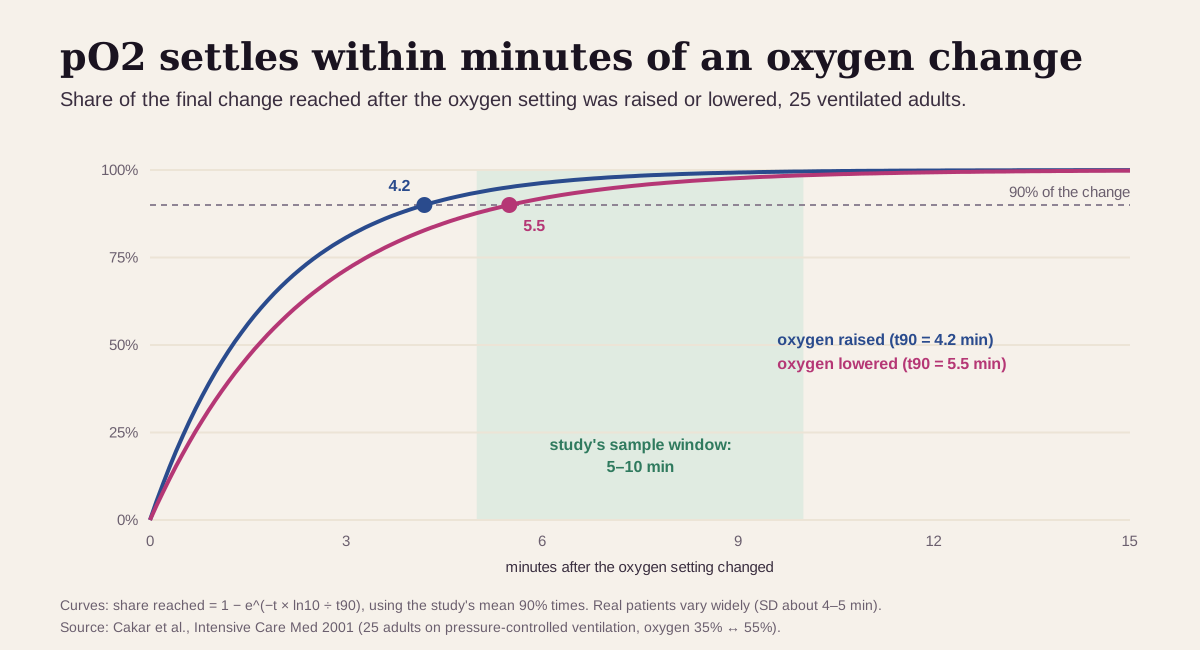
What that means in practice:
- It also wobbles on its own. In stable ICU patients on a fixed oxygen setting, pO2 varied by an average of 5% between samples, and by as much as 45 mm Hg over 50 minutes in one patient. The authors' advice was to act on trends rather than single readings.17
- The details travel with the number. Whether you were lying down, how high you were, and whether you were on oxygen (and how much) can each shift pO2.3516
- Compare like with like: arterial with arterial, on the same oxygen setting.89
Going deeper: from pressure to saturation
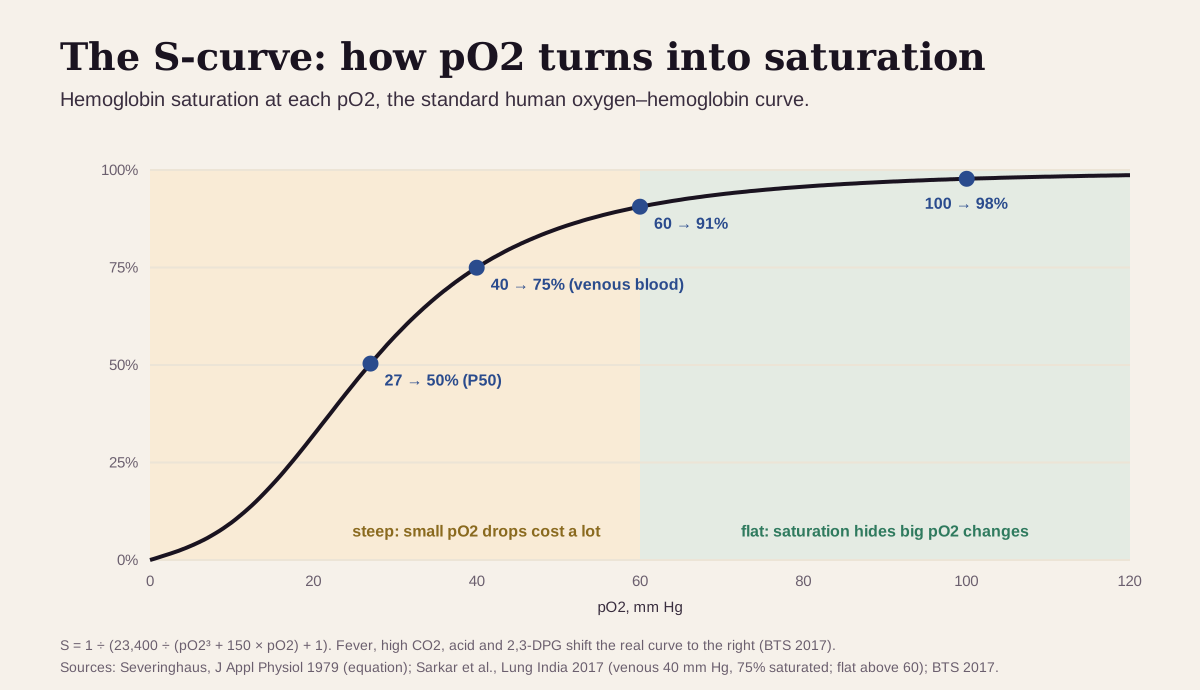
pO2 and saturation are linked by the oxygen–hemoglobin curve, which is S-shaped.14 Above about 60 mm Hg it's flat: pO2 can fall from 100 to 60 while saturation drops only from about 98% to 91%. Below 60 it's steep, so each small drop in pressure costs a lot of saturation.214 That's why 60 is the classic hypoxemia line.3 The real curve also slides to the right with fever, a high pCO2 or acid blood, which helps your tissues pull oxygen off hemoglobin.3
Pulse oximeters estimate saturation with light at your fingertip; they give no pO2.18 Poor circulation, skin pigmentation, cold skin, smoking and nail polish can throw them off.18 In one U.S. study of patients whose oximeter read 92–96%, the blood gas showed a true saturation under 88% in 11.7% of Black patients and 3.6% of White patients.19 A blood gas measures oxygen directly.9
Two numbers doctors build from pO2:
- The A–a gradient compares the oxygen pressure expected in your air sacs with the pO2 in your artery. On room air at sea level, the air-sac value works out to about 100 mm Hg: 0.21 × (760 − 47) − 40 ÷ 0.8. In young people the gap is under 10 mm Hg. A wide gap points to a lung problem (V/Q mismatch, shunt or diffusion); a normal gap with a low pO2 points to slow breathing.2
- The P/F ratio divides pO2 by the fraction of oxygen you're breathing. On room air that's about 100 ÷ 0.21, or 500. Normal runs 300–500, and 300 or less is the mildest band of ARDS (acute respiratory distress syndrome) under the Berlin definition.2
Questions worth asking
- Was this an arterial sample, and was I on room air or extra oxygen?
- What were my pCO2 and oxygen saturation on the same test?
- Is my hemoglobin normal, so my blood can carry the oxygen?
- What's my A–a gradient, and does it point to my lungs or my breathing?
- Should my carboxyhemoglobin be checked, given a gas heater, a fire or smoke?
- Would a repeat test, or an oxygen check while walking, change the plan?
FAQ
What is a normal pO2 level? About 80–100 mm Hg in arterial blood at sea level; MedlinePlus lists 75–100. It runs a little lower with age and at altitude.43
What pO2 is dangerously low? Under 60 mm Hg is hypoxemia, and under 40 is a critical value at hospital labs such as the University of Iowa's. Severe trouble breathing or talking, bluish lips or confusion need emergency care at any number.3715
Is pO2 the same as oxygen saturation? No. pO2 is the pressure of dissolved oxygen; saturation is the share of hemoglobin carrying oxygen. The S-shaped curve links them: a pO2 of 60 is about 91% saturation.214
Can a finger pulse oximeter replace a blood gas? It estimates saturation and gives no pO2. Skin pigmentation, poor circulation and carbon monoxide can make it read higher than the truth.18193
This guide is for education. It can't diagnose you or replace care from a clinician who knows your history.
Footnotes
-
National Library of Medicine. Arterial Blood Gas (ABG) Test. MedlinePlus. What the test measures and how the sample is taken. MedlinePlus ↩ ↩2 ↩3
-
Sarkar M, Niranjan N, Banyal PK. Mechanisms of hypoxemia. Lung India. 2017;34(1):47–60. A clinical review of the five causes of low pO2, the A–a gradient and alveolar gas equation, the oxygen-content formula, venous values (40 mm Hg, 75% saturated) and the P/F ratio. PMC ↩ ↩2 ↩3 ↩4 ↩5 ↩6 ↩7 ↩8 ↩9 ↩10 ↩11 ↩12 ↩13 ↩14 ↩15 ↩16 ↩17 ↩18 ↩19 ↩20 ↩21
-
O'Driscoll BR, Howard LS, Earis J, Mak V; British Thoracic Society Emergency Oxygen Guideline Group. BTS guideline for oxygen use in adults in healthcare and emergency settings. Thorax. 2017;72(Suppl 1):ii1–ii90. The source for the 90–110 mm Hg young-adult range, the age table (from Crapo), the 6 mm Hg posture effect, the under-60 hypoxemia definition, anemia and carbon monoxide, and the 94–98% and 88–92% saturation targets. PubMed · BTS ↩ ↩2 ↩3 ↩4 ↩5 ↩6 ↩7 ↩8 ↩9 ↩10 ↩11 ↩12 ↩13 ↩14 ↩15 ↩16 ↩17 ↩18 ↩19 ↩20 ↩21 ↩22 ↩23 ↩24 ↩25
-
National Library of Medicine. Blood gases. MedlinePlus Medical Encyclopedia. PaO2 75–100 mm Hg (10.0–13.3 kPa); lower from 3,000 feet (900 m). MedlinePlus ↩ ↩2 ↩3 ↩4 ↩5 ↩6 ↩7
-
Forrer A, Gaisl T, Sevik A, et al. Partial Pressure of Arterial Oxygen in Healthy Adults at High Altitudes: A Systematic Review and Meta-Analysis. JAMA Netw Open. 2023;6(6):e2318036. 53 studies, 777 adults; pO2 fell 1.60 kPa (12 mm Hg) per 1,000 m and recovered 0.16 kPa a day. PMC ↩ ↩2 ↩3 ↩4
-
Jacobs SS, Krishnan JA, Lederer DJ, et al. Home Oxygen Therapy for Adults with Chronic Lung Disease. An Official American Thoracic Society Clinical Practice Guideline. Am J Respir Crit Care Med. 2020;202(10):e121–e141. Defines severe (55 mm Hg or less) and moderate (56–60) resting hypoxemia and summarizes the NOTT, MRC, Górecka and LOTT survival results. PMC ↩ ↩2 ↩3 ↩4 ↩5 ↩6 ↩7 ↩8
-
University of Iowa Health Care, Department of Pathology. Blood Gases (Arterial). Laboratory Services Handbook. Adult pO2 80–90 mm Hg; critical value under 40; air must be expelled and the sample delivered immediately. UI Health Care ↩ ↩2 ↩3 ↩4 ↩5 ↩6 ↩7 ↩8 ↩9 ↩10
-
Byrne AL, Bennett M, Chatterji R, Symons R, Pace NL, Thomas PS. Peripheral venous and arterial blood gas analysis in adults: are they comparable? A systematic review and meta-analysis. Respirology. 2014;19(2):168–175. 18 studies, 1,768 people; arterial pO2 averaged 36.9 mm Hg higher than venous. PubMed ↩ ↩2
-
Davis MD, Walsh BK, Sittig SE, Restrepo RD. AARC clinical practice guideline: blood gas analysis and hemoximetry: 2013. Respir Care. 2013;58(10):1694–1703. The American Association for Respiratory Care's guideline on arterial, venous and capillary samples. PubMed ↩ ↩2 ↩3
-
Cerveri I, Zoia MC, Fanfulla F, et al. Reference values of arterial oxygen tension in the middle-aged and elderly. Am J Respir Crit Care Med. 1995;152(3):934–941. 194 healthy non-smokers aged 40–90; at 75 and older, mean 83.4 mm Hg and 5th percentile 68.4. PubMed ↩ ↩2 ↩3 ↩4
-
Klæstrup E, Trydal T, Pedersen JF, et al. Reference intervals and age and gender dependency for arterial blood gases and electrolytes in adults. Clin Chem Lab Med. 2011;49(9):1495–1500. Similar pO2 in healthy men and women; a fall of 0.29 kPa per decade of age. PubMed ↩ ↩2 ↩3 ↩4
-
LoMauro A, Aliverti A. Respiratory physiology of pregnancy. Breathe (Sheff). 2015;11(4):297–301. Arterial pO2 of 106–108 mm Hg in the first trimester and 101–104 in the third. PMC ↩
-
Chu DK, Kim LH, Young PJ, et al. Mortality and morbidity in acutely ill adults treated with liberal versus conservative oxygen therapy (IOTA): a systematic review and meta-analysis. Lancet. 2018;391(10131):1693–1705. 25 trials, 16,037 patients; liberal oxygen raised in-hospital deaths (RR 1.21). PubMed ↩ ↩2 ↩3
-
Severinghaus JW. Simple, accurate equations for human blood O2 dissociation computations. J Appl Physiol Respir Environ Exerc Physiol. 1979;46(3):599–602. The equation behind the S-curve and the saturation values in this guide. PubMed ↩ ↩2 ↩3 ↩4 ↩5 ↩6
-
National Library of Medicine. Respiratory Failure. MedlinePlus. Symptoms of low blood oxygen and when to get emergency care. MedlinePlus ↩ ↩2
-
Cakar N, Tuŏrul M, Demirarslan A, et al. Time required for partial pressure of arterial oxygen equilibration during mechanical ventilation after a step change in fractional inspired oxygen concentration. Intensive Care Med. 2001;27(4):655–659. 25 ventilated adults; 90% of the change in 4.2 min (rise) and 5.5 min (fall). PubMed ↩ ↩2 ↩3
-
Thorson SH, Marini JJ, Pierson DJ, Hudson LD. Variability of arterial blood gas values in stable patients in the ICU. Chest. 1983;84(1):14–18. 29 stable patients on fixed oxygen; pO2 varied by 5.1% on average. PubMed ↩
-
U.S. Food and Drug Administration. Pulse Oximeters. How pulse oximeters estimate saturation and what affects their accuracy. FDA ↩ ↩2 ↩3
-
Sjoding MW, Dickson RP, Iwashyna TJ, Gay SE, Valley TS. Racial Bias in Pulse Oximetry Measurement. N Engl J Med. 2020;383(25):2477–2478. Hidden low oxygen (SaO2 under 88% with SpO2 92–96%) in 11.7% of Black and 3.6% of White patients. PMC ↩ ↩2
Educational content, not medical advice. Libby is a personal record tool, not a medical service — it doesn't diagnose, treat, or prescribe. Reference ranges vary by lab and by person. Talk to a qualified healthcare professional about your results.
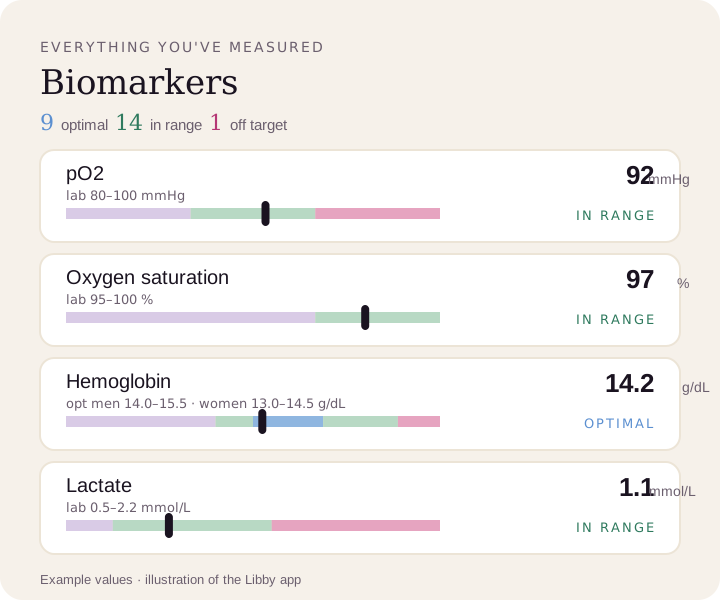
See every result against your lab's range.
Upload a lab PDF or a photo of your report. Libby puts every marker on your lab's range, adds an optimal band where the app has one, and tracks your trends over time.
View your pO2 ›