Blood type (ABO and Rh): what your result means
Your blood type is two results, ABO group and Rh factor. What each type means, how common it is, why labs recheck it, and why Rh matters in pregnancy.
Your blood type is two results read together: your ABO group (A, B, AB or O) and your Rh factor (positive or negative). Both describe markers on the surface of your red blood cells. You also carry antibodies against the ABO markers you lack, which is why a mismatched transfusion is dangerous.1 Every one of the eight types is a normal, healthy result. Your type matters most before a transfusion and during pregnancy.
The short version
- There's no normal range. All eight types are normal. In the U.S., O positive (37.4%) and A positive (35.7%) are the most common and AB negative (0.6%) is the rarest, per Stanford Blood Center.2
- Before a transfusion, the lab types a fresh sample and screens it for other red-cell antibodies, rather than trusting an old card or record.34 In hospitals in 10 countries, about 1 in 2,000 samples had a blood group that differed from the patient's record: blood drawn from the wrong person.5
- In pregnancy, Rh negative matters. About 15% of people in North America are Rh negative. Routine Rh immune globulin cut the share of at-risk pregnancies in which the mother makes anti-Rh antibodies from about 13–16% to 0.14–0.2%.6 Whether you need it is your clinician's call.
- Type O runs about 25% lower von Willebrand factor, a clotting protein. People with A, B or AB have about 1.8 times the odds of a blood clot in a vein.78 The "blood type diet" has no supporting evidence.910
What your blood type is
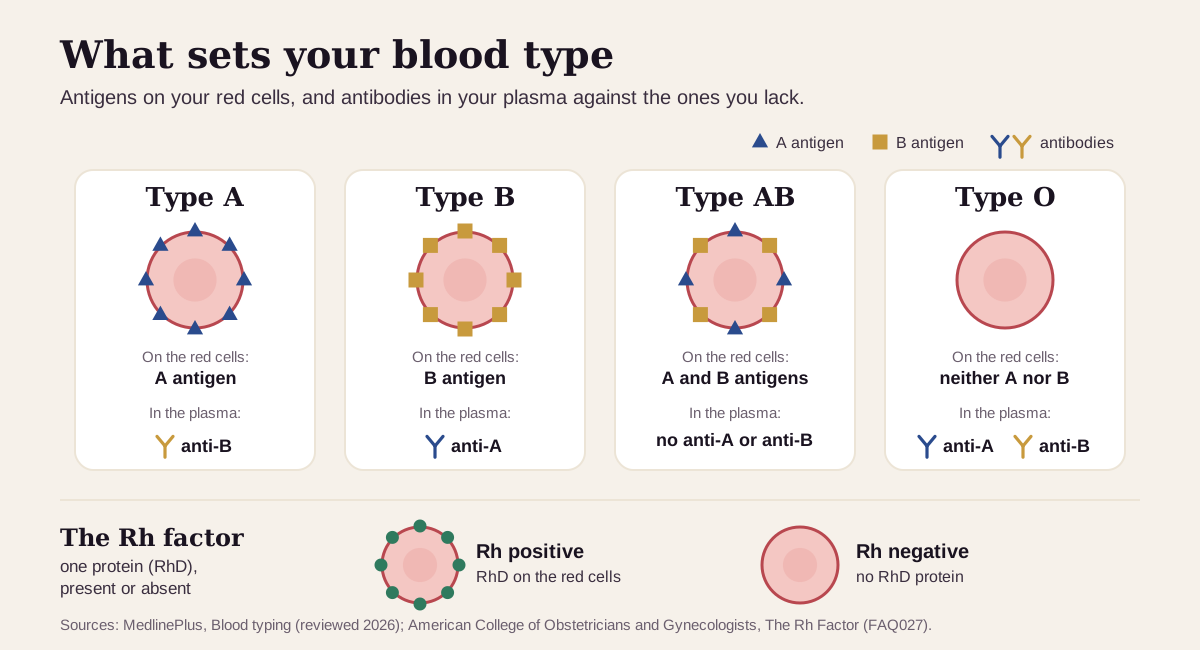
Your red blood cells are covered in molecules your immune system can recognize, called antigens. Two of them set your ABO group: the A antigen and the B antigen. Type A cells carry A, type B cells carry B, type AB cells carry both, and type O cells carry neither.1 Karl Landsteiner found the ABO groups in 1900 by mixing the red cells and serum of himself and his colleagues and watching which combinations clumped.13
The second half of your type is the Rh factor, a protein on the red-cell surface. If your cells carry it, you're Rh positive. If they lack it, you're Rh negative.12
The antibodies are what make it matter. From infancy on, you carry antibodies against whichever of A and B you lack.14 Type A blood carries anti-B, type B carries anti-A, and type O carries both.1 Those antibodies attack mismatched red cells, and an ABO mismatch usually causes a severe reaction.1 Rh works differently: anti-Rh antibodies form after an Rh-negative person meets Rh-positive cells, through a transfusion or a pregnancy.1512
ABO and Rh are the two that matter most, but they're only two of more than 300 known red-cell antigens. A blood type counts as rare when it lacks an antigen that 99% of people carry.16
What's a normal blood type?
All of them. Your blood type is inherited from your parents, like eye color, so there's no reference range and nothing is high or low.16 What varies is how common each type is:
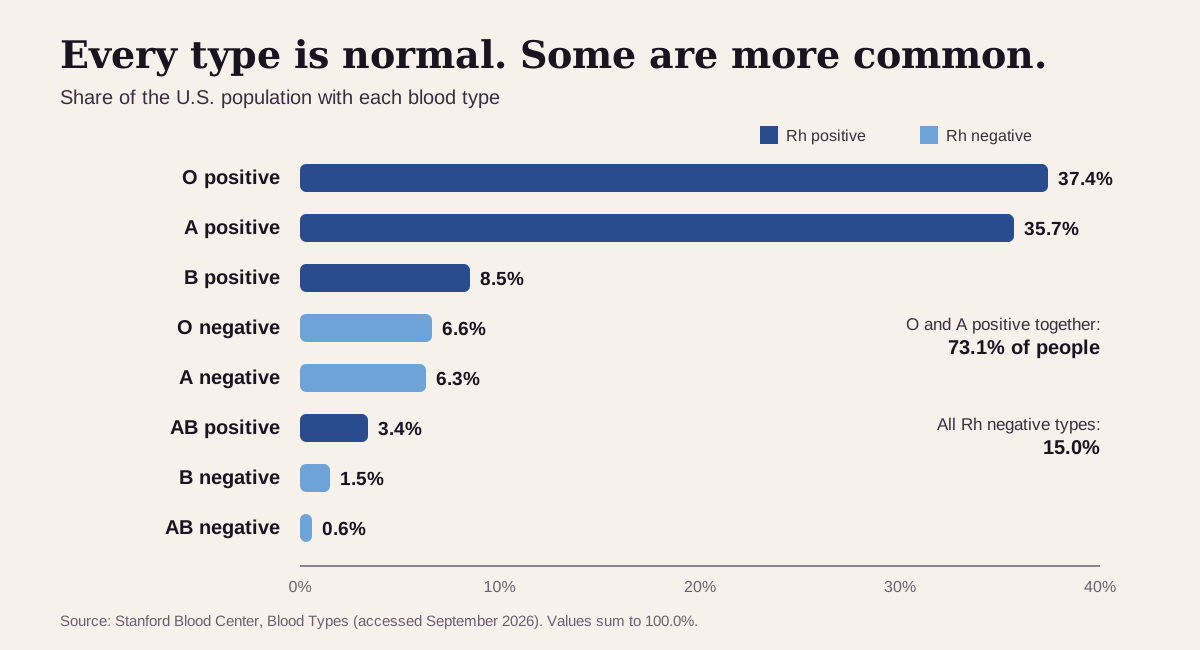
- O positive (37.4%) and A positive (35.7%) together cover nearly three in four people.2
- The four Rh-positive types add up to 85.0%, which leaves 15.0% Rh negative.2
- Type O is the largest ABO group at 44.0%, then A at 42.0%, B at 10.0% and AB at 4.0%.2
The mix differs by ancestry. In records of 3.1 million U.S. donors, 17.3% of white non-Hispanic donors were Rh negative, compared with 7.3% of Hispanic and 7.1% of Black non-Hispanic donors.17 The Red Cross points out that some rare types cluster in particular groups, which is why a donor of African descent may be the best match for a patient with sickle cell disease.16
Is there an "optimal" blood type?
No. There's no better or worse blood type, and none of the eight is a target to aim for. The Libby app has no catalog range for ABO or Rh, so it shows your result exactly as your lab reported it, tagged "Reported as-is." Men and women are typed the same way. What your type does change is practical: whose red cells you can receive, whose you can help, and whether a pregnancy needs extra testing.
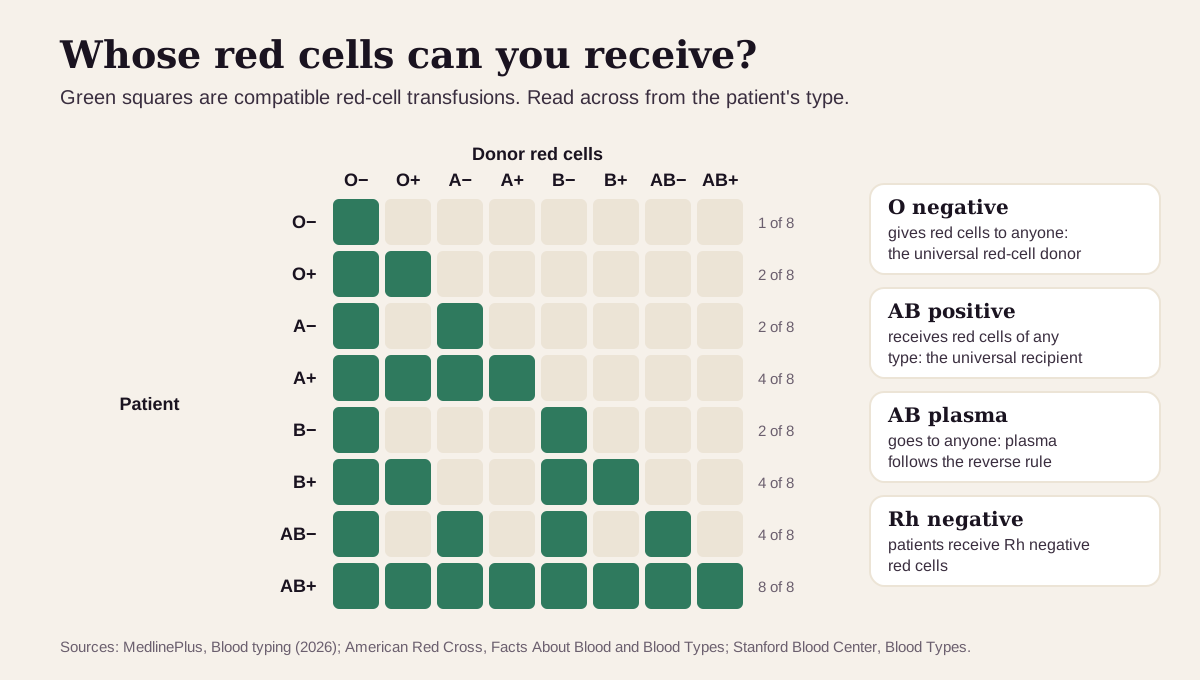
Here are the eight types from most to least common, and what each one changes:
| Result | Share of the U.S. population | What it changes |
|---|---|---|
| O positive | 37.4% | One of the most transfused types. Its red cells can go to any Rh-positive patient2 |
| A positive | 35.7% | Receives red cells from A and O donors21 |
| B positive | 8.5% | Receives red cells from B and O donors21 |
| O negative | 6.6% | The universal red-cell donor, used in emergency transfusions. Receives only O negative red cells161 |
| A negative | 6.3% | Receives A negative and O negative red cells2 |
| AB positive | 3.4% | The universal recipient, able to receive red cells of any type. A universal plasma donor2 |
| B negative | 1.5% | Receives B negative and O negative red cells2 |
| AB negative | 0.6% | The rarest type. A universal plasma donor2 |
| Any Rh-negative type, in pregnancy | about 15% of North Americans are Rh negative | Antibody screening, and a decision with your clinician about Rh immune globulin612 |
| Urgent, any type | Fever, chills, back or flank pain, or bloody urine during or after a transfusion: tell the care team right away15 |
Why type O keeps showing up in studies. The best-established link is a clotting protein:
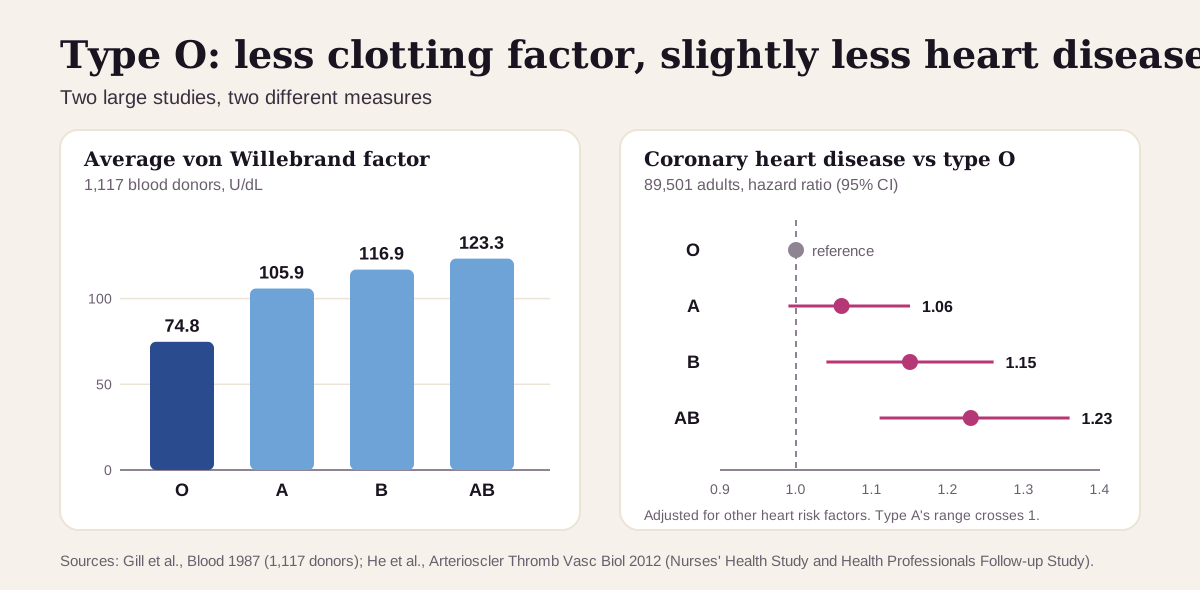
- Von Willebrand factor (VWF). In 1,117 volunteer blood donors, average VWF was 74.8 U/dL in type O, against 105.9 in type A, 116.9 in type B and 123.3 in type AB.18 A 2018 review puts type O about 25% lower than the other types. VWF carries factor VIII and protects it from breakdown, so factor VIII follows: the ABO gene and the VWF gene together explain about half of the person-to-person differences in factor VIII.7
- Why that matters for diagnosis. In the same study, 77% of people diagnosed with type 1 von Willebrand disease were type O, against 45% in the general population. The authors suggested that type O alone may explain the low VWF in some people diagnosed with type 1 disease, and that type AB's higher levels can hide a real defect.18 Our von Willebrand factor guide covers reading that result.
- Blood clots and heart disease. A meta-analysis found the non-O types had 1.79 times the odds of a clot in a vein (venous thromboembolism) and 1.25 times the odds of a heart attack. The heart-attack link faded to 1.01 when only prospective studies were counted.8 In two U.S. cohorts of 89,501 adults followed for more than 20 years, types A, B and AB had 1.06, 1.15 and 1.23 times the rate of coronary heart disease of type O, after adjusting for other risk factors. The type A difference was small enough to be chance.19
- COVID-19. An early 2020 study of 1,610 people with COVID-19 respiratory failure in Italy and Spain found type A at higher risk (odds ratio 1.45) and type O at lower risk (0.65).20 A larger U.S. study of 107,796 people tested at Intermountain Healthcare, more than 11,000 of them infected, found no link between blood type and infection, hospitalization or intensive care.21
- The "blood type diet." A systematic review screened 1,415 references and found no study showing health effects of eating for your ABO type.9 In 1,455 adults in Toronto, the "type A" diet was tied to better cholesterol, blood pressure and insulin, but equally in people of every blood type. Matching the diet to the blood type added nothing.10
Keep these in proportion. Your type is fixed, and the differences above are modest averages across tens of thousands of people. The places your type changes a real decision are reading a VWF result, receiving blood, and pregnancy.
How the lab finds your type, and why it sometimes can't
Two tests, one answer. In forward typing, the lab mixes your red cells with anti-A and anti-B and watches for clumping. In reverse (back) typing, it mixes your plasma with known type A and type B cells. The two should agree: type A cells clump with anti-A, and type A plasma clumps type B cells.1 When they disagree, the result is an ABO discrepancy, which the lab works out before it reports a type.3 Rh typing works like forward typing, using anti-D.1
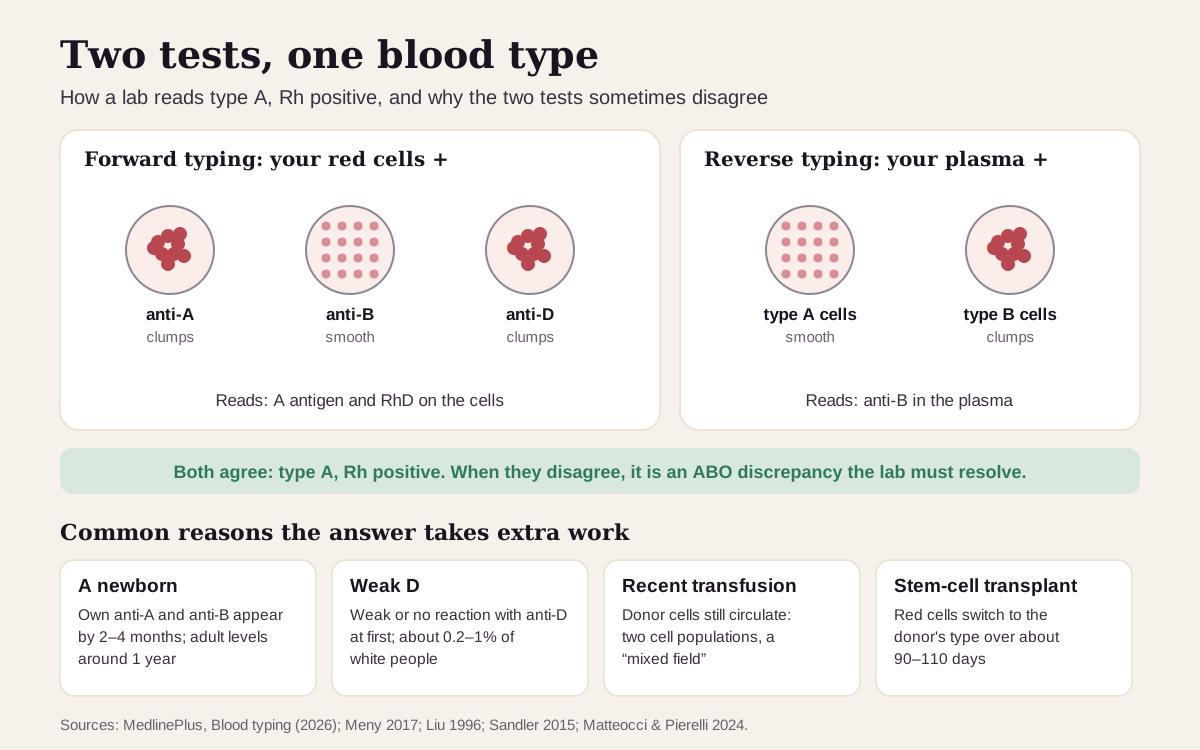
The usual reasons a type takes extra work:
- A newborn. Babies make their own anti-A and anti-B after birth. In a study of 644 people in Taiwan, most infants had them by 2–4 months and reached adult levels around 1 year.14 In the first months, reverse typing has little of the baby's own antibody to confirm.
- Weak D. Some people's red cells carry less RhD than usual, so they react weakly or not at all with anti-D at first and show up only with an extra step. Results can vary with the lab's method and reagent. That's an estimated 0.2–1% of white people.11 A College of American Pathologists work group recommends a gene test (RHD genotyping) to sort it out: about 80% of U.S. weak D results are types 1, 2 or 3, which can be managed as Rh positive. The group estimated that would spare about 24,700 unneeded Rh immune globulin shots a year.11
- A recent transfusion. Donor red cells keep circulating, so the sample holds two populations of cells and forward typing shows a "mixed field."22 Red cells normally last about 120 days.23
- A stem-cell transplant. About 30% of transplants from related donors and up to 50% from unrelated donors cross ABO lines. The patient's red cells gradually switch to the donor's type, which takes about 90–110 days: a type A patient with a type O donor becomes type O.22
Why your type is checked again before every transfusion
Before a transfusion, the lab types a new sample and crossmatches it against the donor blood, and your provider usually checks again that you're receiving the right blood.315 The main hazard is a tube filled from the wrong person. In a study of more than 690,000 samples from hospitals in 10 countries, about 1 in every 2,000 had a blood group that differed from the one on file.5 In 35 French hospitals, most of those mismatches traced back to blood drawn from the wrong patient.24 Comparing each new result with the old one is how the lab catches them, which is why it works from a fresh sample rather than a wallet card.
Get care right away if you have fever, chills, back or flank pain, flushing, dizziness, or bloody urine during or after a transfusion. Most reactions start during or right after it, but some show up days later.15
Rh negative and pregnancy
If an Rh-negative mother carries an Rh-positive baby, a few of the baby's red cells can cross into her blood, most often at delivery, and her body can make anti-Rh antibodies. That's called sensitization. The first pregnancy usually goes fine, but in a later Rh-positive pregnancy those antibodies can cross the placenta and destroy the baby's red cells, causing anemia and jaundice.1225 Our direct antiglobulin test guide covers the newborn side.
The antibody screen is the checkpoint. Blood type and Rh are usually tested at the first prenatal visit. If you're Rh negative, an antibody screen (an indirect Coombs test) looks for antibodies against red cells, often in the first trimester and again at 28 weeks.124 A negative screen means you haven't made anti-Rh antibodies. That matters because Rh immune globulin works only before they form; once they're there, care shifts to watching the baby closely.12
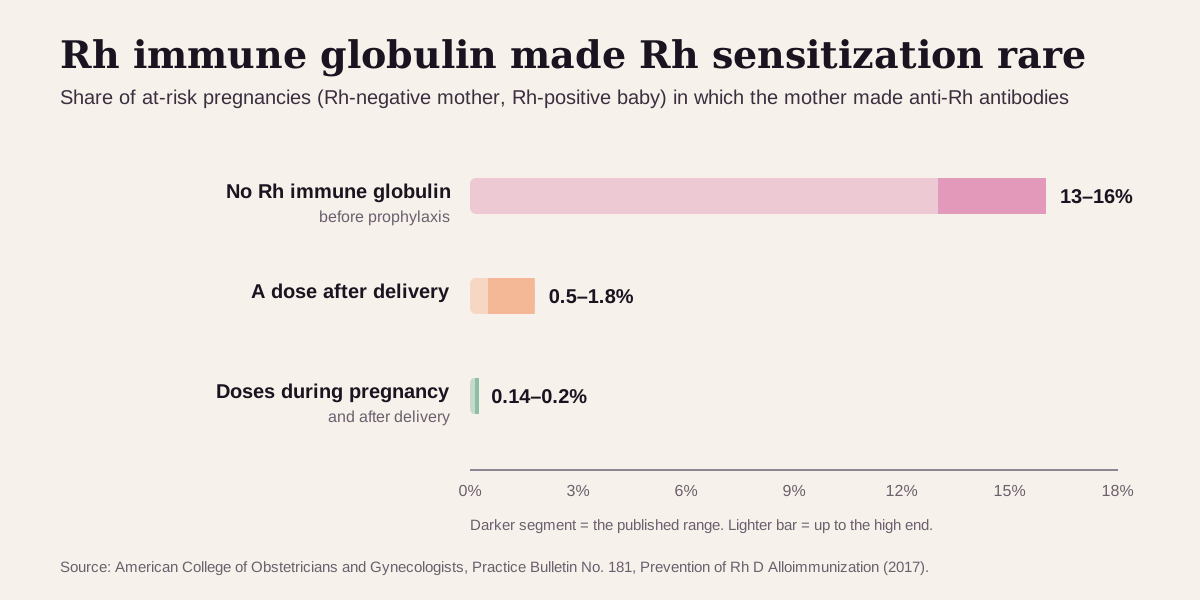
ACOG's guidance covers when Rh immune globulin is offered, including after bleeding in pregnancy, a miscarriage, some prenatal procedures and the birth of an Rh-positive baby.12 Whether you need a dose is your clinician's call.
ABO can matter too, more mildly. A mother and baby with different ABO groups is the most common kind of mismatch behind hemolytic disease of the newborn, and it's usually not severe.23
Blood type reads best next to its neighbors
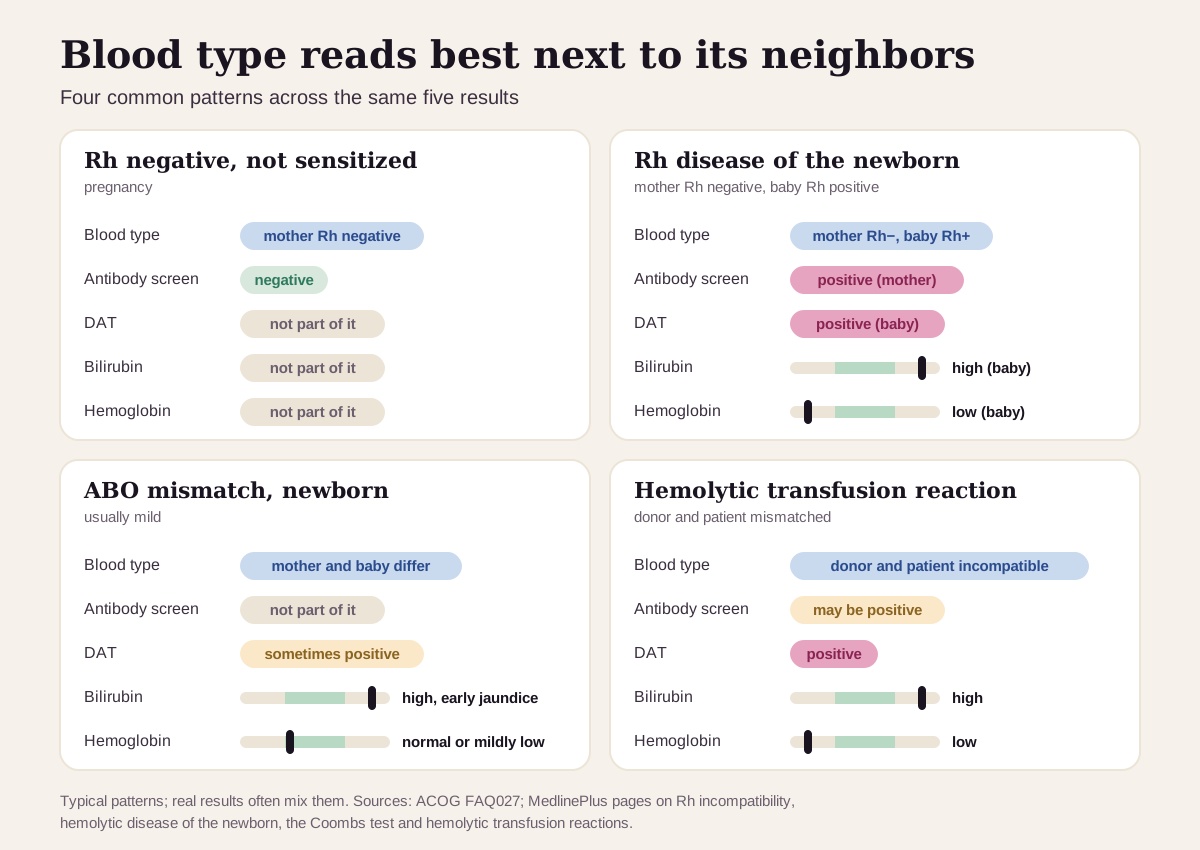
Your type is rarely read alone. In pregnancy, in newborns and after a transfusion, it sits next to the antibody screen, the DAT (direct Coombs test), bilirubin and hemoglobin:
| If you see… | It often points to… |
|---|---|
| Rh negative in pregnancy, antibody screen negative | no sensitization; Rh immune globulin decisions come up12 |
| Rh-negative mother with a positive screen; baby with a positive DAT, high bilirubin and low hemoglobin | Rh disease of the fetus and newborn122523 |
| Mother and baby in different ABO groups, baby jaundiced early, DAT sometimes positive | ABO hemolytic disease of the newborn, usually mild234 |
| A new positive DAT, rising bilirubin and falling hemoglobin after a transfusion | a hemolytic transfusion reaction15425 |
| Forward and reverse typing disagree | an ABO discrepancy: think newborn, recent transfusion or transplant31422 |
| A weak or inconsistent Rh result | weak D, or another RhD variant; RHD genotyping can settle it11 |
How fast it changes
Your red-cell type is set for life. Your antibodies change with age. The A, B and RhD antigens come from genes you inherit, and a newborn's red cells can already be typed.1611 The antibodies follow their own timeline:14
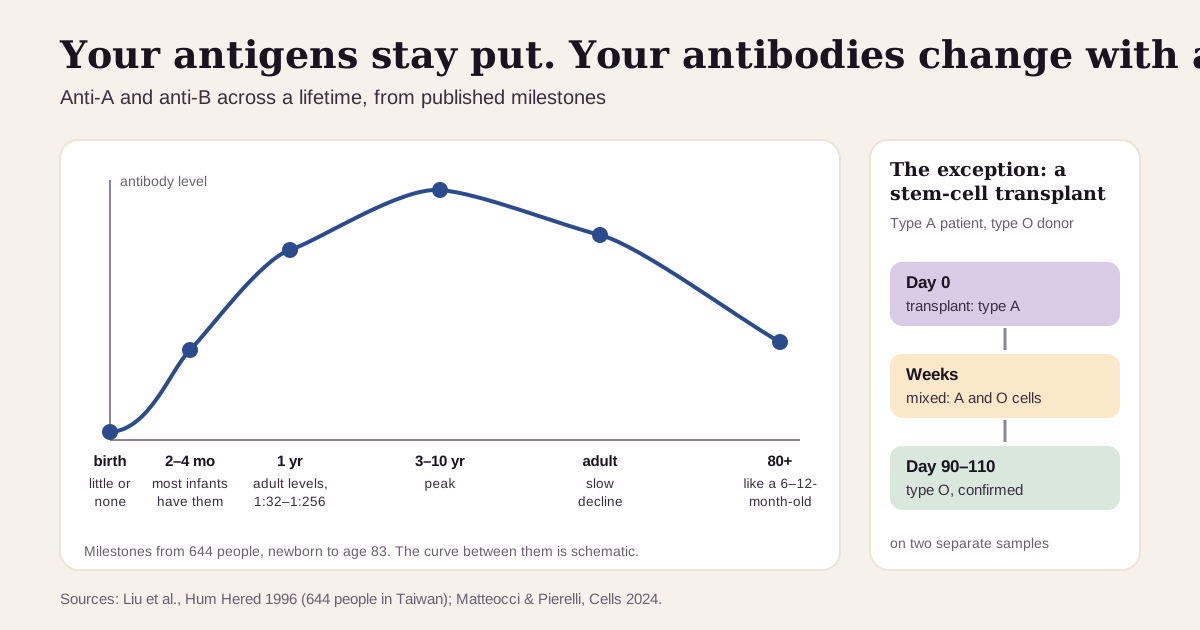
What that means in practice:
- Two different blood types on two reports is a flag, not a mystery. Outside a stem-cell transplant or a recent transfusion, a sample drawn from the wrong patient or a clerical mix-up is the usual explanation.2422 Ask which result is right before it lands in your records.
- After a transplant, the lab confirms the switch with forward and reverse typing on two separate samples before it treats you as the new type.22
- Anti-A and anti-B fade in old age. People 80 and older had levels similar to infants of 6–12 months in the Taiwan study.14
Going deeper: the sugars behind A and B
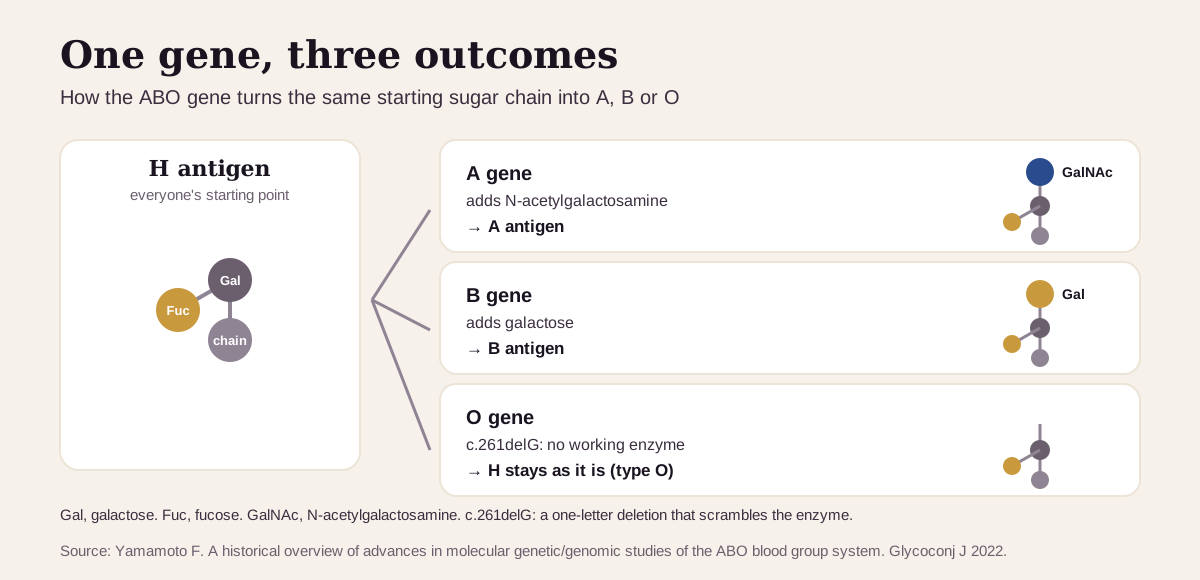
The A and B antigens are short sugar chains. Everyone builds the same base, called the H antigen. The A version of the ABO gene makes an enzyme that adds one sugar (N-acetylgalactosamine) to make A. The B version adds a different sugar (galactose) to make B. The common O versions carry a one-letter deletion (c.261delG) that scrambles the enzyme, so the H antigen stays as it is.13 The ABO gene sits on chromosome 9.22
You inherit one ABO gene from each parent. Because the O gene makes no working enzyme, a type A person can carry a hidden O (genotype AO), and so can a type B person (BO).138 That's how two type A parents can have a type O child. The Red Cross adds that ABO typing alone falls short of proving or disproving who a child's parent is.16
Weak D versus partial D. The common weak D types carry a complete RhD protein, just less of it, because of changes inside or below the cell membrane. Partial D cells are missing pieces of the protein on the surface, so a person with partial D can make anti-D against normal Rh-positive cells. That's why labs want to know which one you have.11
Questions worth asking
- What are my ABO group and Rh type, and did forward and reverse typing agree?
- If I'm Rh negative and pregnant, when is my antibody screen, and will I need Rh immune globulin?
- If my Rh result came back as weak D, would RHD genotyping change how I'm managed?
- Have I ever had a positive antibody screen, and is that in my records for future transfusions?
- I'm type O: should my von Willebrand factor result be read with that in mind?
- Two of my reports show different blood types: which one is right, and why?
FAQ
What is the rarest blood type? AB negative, at about 0.6% of the U.S. population. O positive is the most common at 37.4%.2
Can your blood type change? Almost never. A stem-cell transplant from a donor of another type changes it to the donor's type over about 90–110 days, and a recent transfusion can blur the result for a while.22
What is the universal donor? O negative red cells can go to a patient of any type, which is why they're used in emergencies. AB is the universal plasma donor.16
Should I eat for my blood type? The evidence says no. A systematic review found no study showing health effects of blood-type diets, and in a study of 1,455 adults the diets' links to better heart markers were the same whatever a person's blood type.910
This guide is for education. It can't diagnose you or replace care from a clinician who knows your history.
Footnotes
-
National Library of Medicine. Blood typing. MedlinePlus Medical Encyclopedia. Reviewed January 29, 2026. Forward and back (reverse) typing, which antibodies each type carries, which red cells each type can receive, and why ABO mismatches cause severe reactions. MedlinePlus ↩ ↩2 ↩3 ↩4 ↩5 ↩6 ↩7 ↩8 ↩9 ↩10 ↩11 ↩12
-
Stanford Blood Center. Blood Types. Frequency of each of the eight types in the U.S. population (O+ 37.4%, A+ 35.7%, B+ 8.5%, O− 6.6%, A− 6.3%, AB+ 3.4%, B− 1.5%, AB− 0.6%) and which types each can give to and receive from. A nonprofit blood center. stanfordbloodcenter.org ↩ ↩2 ↩3 ↩4 ↩5 ↩6 ↩7 ↩8 ↩9 ↩10 ↩11 ↩12 ↩13 ↩14
-
Meny GM. Recognizing and resolving ABO discrepancies. Immunohematology. 2017;33(2):76–81. Patient samples are typed for ABO before transfusion using forward and reverse typing; a discrepancy is when the two disagree. PubMed ↩ ↩2 ↩3 ↩4 ↩5
-
National Library of Medicine. Coombs test. MedlinePlus Medical Encyclopedia. Reviewed January 29, 2026. The direct test finds antibodies on red cells; the indirect test finds red-cell antibodies in plasma, mostly before transfusion and in pregnancy. MedlinePlus ↩ ↩2 ↩3 ↩4 ↩5
-
Dzik WH, Murphy MF, Andreu G, et al. An international study of the performance of sample collection from patients. Vox Sang. 2003;85(1):40–47. More than 690,000 samples in hospitals in 10 countries; wrong-blood-in-tube at a median of 1 in 1,986 samples. PubMed ↩ ↩2
-
American College of Obstetricians and Gynecologists. Practice Bulletin No. 181: Prevention of Rh D Alloimmunization. Obstet Gynecol. 2017;130(2):e57–e70. Rh-negative prevalence (about 15% in North America) and sensitization rates of 13–16% without prophylaxis, 0.5–1.8% with a postpartum dose, and 0.14–0.2% with an added antepartum dose. PubMed ↩ ↩2 ↩3
-
Swystun LL, Lillicrap D. Genetic regulation of plasma von Willebrand factor levels in health and disease. J Thromb Haemost. 2018;16(12):2375–2390. Type O about 25% lower VWF; VWF protects factor VIII; ABO and VWF genes explain about half of factor VIII variation. PMC ↩ ↩2
-
Wu O, Bayoumi N, Vickers MA, Clark P. ABO(H) blood groups and vascular disease: a systematic review and meta-analysis. J Thromb Haemost. 2008;6(1):62–69. Pooled odds ratios for non-O blood groups, including genotype groups such as A1O and BO. PubMed ↩ ↩2 ↩3
-
Cusack L, De Buck E, Compernolle V, Vandekerckhove P. Blood type diets lack supporting evidence: a systematic review. Am J Clin Nutr. 2013;98(1):99–104. PubMed ↩ ↩2 ↩3
-
Wang J, García-Bailo B, Nielsen DE, El-Sohemy A. ABO genotype, 'blood-type' diet and cardiometabolic risk factors. PLoS One. 2014;9(1):e84749. 1,455 adults in the Toronto Nutrigenomics and Health study; diet associations were independent of ABO genotype. PMC ↩ ↩2 ↩3
-
Sandler SG, Flegel WA, Westhoff CM, et al. It's time to phase in RHD genotyping for patients with a serologic weak D phenotype. Transfusion. 2015;55(3):680–689. A College of American Pathologists work group: weak D in 0.2–1% of white people, about 80% of U.S. cases are types 1–3, weak versus partial D, and an estimated 24,700 avoidable Rh immune globulin injections a year. PMC ↩ ↩2 ↩3 ↩4 ↩5 ↩6 ↩7
-
American College of Obstetricians and Gynecologists. The Rh Factor: How It Can Affect Your Pregnancy (FAQ027). Updated September 2024. What Rh positive means, how sensitization happens, the antibody screen in the first trimester and at 28 weeks, and when Rh immune globulin is offered. acog.org ↩ ↩2 ↩3 ↩4 ↩5 ↩6 ↩7 ↩8 ↩9 ↩10 ↩11
-
Yamamoto F. A historical overview of advances in molecular genetic/genomic studies of the ABO blood group system. Glycoconj J. 2022;39(2):207–218. Landsteiner's 1900 discovery, the H substance, the A and B transferases, and the c.261delG deletion in common O alleles. PMC ↩ ↩2 ↩3 ↩4
-
Liu YJ, Chen W, Wu KW, Broadberry RE, Lin M. The development of ABO isohemagglutinins in Taiwanese. Hum Hered. 1996;46(4):181–184. 644 people from cord blood to age 83: anti-A and anti-B by 2–4 months, adult titers (1:32–1:256) around 1 year, a peak at 3–10 years, and decline in old age. PubMed ↩ ↩2 ↩3 ↩4 ↩5 ↩6 ↩7
-
National Library of Medicine. Hemolytic transfusion reaction. MedlinePlus Medical Encyclopedia. Reviewed February 3, 2025. Rh-negative people form antibodies after Rh-positive blood; symptoms of a reaction, delayed reactions, the tests that change, and the bedside check before a transfusion. MedlinePlus ↩ ↩2 ↩3 ↩4 ↩5 ↩6
-
American Red Cross. Facts About Blood and Blood Types. The universal red-cell (O negative) and plasma (AB) donors, more than 300 other red-cell antigens and the definition of a rare type, inheritance, and why typing alone can't settle parentage. redcrossblood.org ↩ ↩2 ↩3 ↩4 ↩5 ↩6 ↩7 ↩8 ↩9
-
Garratty G, Glynn SA, McEntire R; Retrovirus Epidemiology Donor Study. ABO and Rh(D) phenotype frequencies of different racial/ethnic groups in the United States. Transfusion. 2004;44(5):703–706. 3.1 million donors at five U.S. blood centers over 10 years; Rh-negative share by self-reported group. PubMed ↩
-
Gill JC, Endres-Brooks J, Bauer PJ, Marks WJ Jr, Montgomery RR. The effect of ABO blood group on the diagnosis of von Willebrand disease. Blood. 1987;69(6):1691–1695. VWF antigen by blood type in 1,117 donors, and blood types among 114 people with type 1 von Willebrand disease. PubMed ↩ ↩2 ↩3
-
He M, Wolpin B, Rexrode K, et al. ABO blood group and risk of coronary heart disease in two prospective cohort studies. Arterioscler Thromb Vasc Biol. 2012;32(9):2314–2320. Nurses' Health Study (62,073 women) and Health Professionals Follow-up Study (27,428 men), 24–26 years of follow-up. PMC ↩ ↩2
-
Severe Covid-19 GWAS Group; Ellinghaus D, Degenhardt F, Bujanda L, et al. Genomewide Association Study of Severe Covid-19 with Respiratory Failure. N Engl J Med. 2020;383(16):1522–1534. 1,610 patients and 2,205 controls from Italy and Spain. PMC ↩
-
Anderson JL, May HT, Knight S, et al. Association of Sociodemographic Factors and Blood Group Type With Risk of COVID-19 in a US Population. JAMA Netw Open. 2021;4(4):e217429. 107,796 people tested at Intermountain Healthcare; blood type was not associated with infection, hospitalization or ICU admission. PMC ↩
-
Matteocci A, Pierelli L. Immuno-Hematologic Complexity of ABO-Incompatible Allogeneic HSC Transplantation. Cells. 2024;13(10):814. How often stem-cell transplants cross ABO lines, mixed fields after transfusion, conversion to the donor's type in 90–110 days confirmed on two samples, and the ABO gene at 9q34. PMC ↩ ↩2 ↩3 ↩4 ↩5 ↩6 ↩7 ↩8 ↩9
-
National Library of Medicine. Hemolytic disease of the newborn. MedlinePlus Medical Encyclopedia. ABO mismatch as the most common and usually milder form, the 120-day red-cell lifespan, and anemia and early jaundice as signs. MedlinePlus ↩ ↩2 ↩3 ↩4 ↩5
-
Chiaroni J, Legrand D, Dettori I, Ferrera V. Analysis of ABO discrepancies occurring in 35 French hospitals. Transfusion. 2004;44(6):860–864. 118 discrepancies against a current or historical sample in 407,769 tests (1 in 3,400), most from blood drawn from the wrong patient. PubMed ↩ ↩2
-
National Library of Medicine. Rh incompatibility. MedlinePlus Medical Encyclopedia. How an Rh-negative mother's antibodies affect an Rh-positive baby: a positive direct Coombs test, high bilirubin and red-cell destruction. MedlinePlus ↩ ↩2 ↩3 ↩4
Educational content, not medical advice. Libby is a personal record tool, not a medical service — it doesn't diagnose, treat, or prescribe. Reference ranges vary by lab and by person. Talk to a qualified healthcare professional about your results.
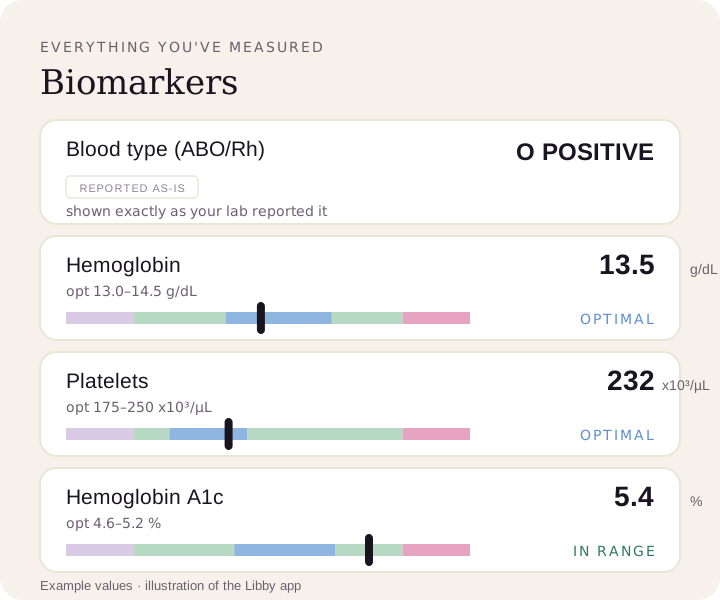
See your blood type next to the rest of your labs.
Upload a lab PDF or a photo of your report. Libby shows your blood type exactly as your lab reported it, puts markers like hemoglobin and platelets on your lab's range and the optimal range, and tracks every result over time.
View your blood type ›