Direct antiglobulin test (DAT): results explained
The direct Coombs test finds antibody or complement stuck to your red cells. What IgG vs C3d means, why positives without hemolysis are common, when to act.
The direct antiglobulin test (DAT), also called the direct Coombs test, checks whether antibody or complement is already stuck to your red blood cells. A positive result means your red cells are coated with IgG antibody, with complement (a protein called C3d), or with both. Its main job is to sort red-cell destruction (hemolysis) into immune and non-immune causes.1 A positive DAT is only half the story: plenty of healthy people have one, so it matters most next to tests that show whether red cells are actually breaking down.2
The short version
- Normal is negative. That's the reference range on a Labcorp report: no clumping, no coating.34
- A positive DAT without hemolysis is common: about 0.01–0.1% of healthy blood donors and 0.3–8% of hospital patients, with no sign of autoimmune hemolytic anemia.2
- With hemolysis, the pattern points to the cause. IgG (often plus C3d) points to warm autoimmune hemolytic anemia. C3d alone points to cold agglutinin disease. Transfusion reactions, a few drugs, and a mother's antibodies in a newborn are the other classic causes.53
- Hemolysis can hide behind a negative DAT in about 5–10% of people with hemolytic anemia.6 Fever, back pain or bloody urine during or after a transfusion needs care right away.7
What the DAT is
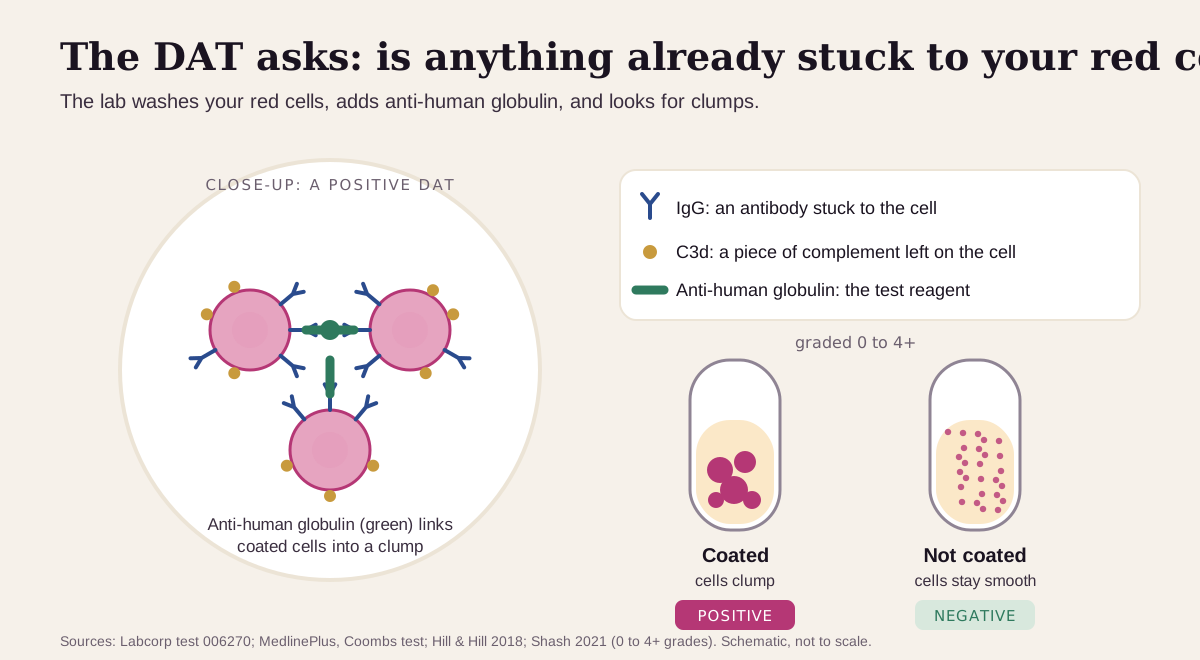
Your immune system sometimes makes antibodies that stick to red blood cells. Some of those antibodies also switch on complement, a set of blood proteins that tags cells for removal. Either one can coat red cells while they're still circulating in your body. The DAT detects that coating.45
The lab washes a sample of your red cells, then adds anti-human globulin, an antibody that grabs human IgG and complement. If your cells are coated, the reagent bridges them together and they clump. That clumping is graded from 0 (none) to 4+ (one solid clump).8
Labs typically start with a polyspecific reagent that picks up both IgG and complement. A positive result then gets split with monospecific reagents, anti-IgG and anti-C3d, to show which is on the cells.36 An international expert group calls that monospecific step mandatory when autoimmune hemolytic anemia is on the table, because treatment depends on the antibody type.9
What's a normal DAT?
Negative. Labcorp, a large commercial lab, prints a reference range of simply "Negative", and MedlinePlus defines a normal result as no clumping of cells.34
A positive result is still fairly common, and how often you see one depends on who's being tested:
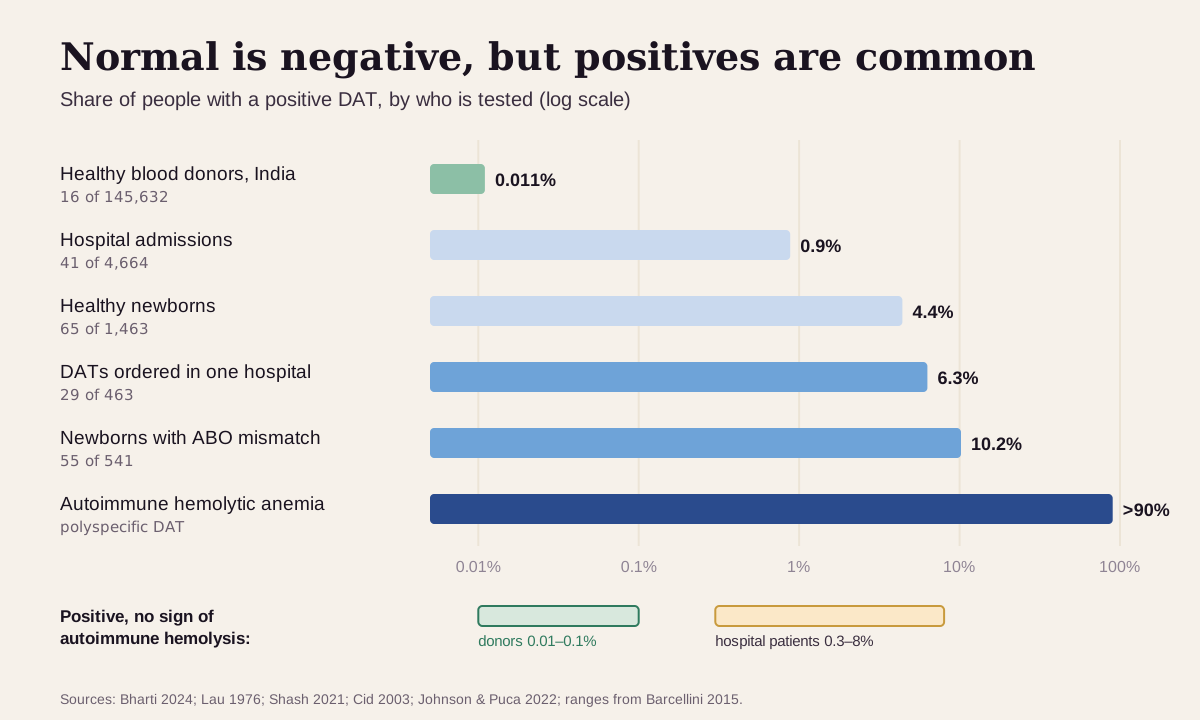
- Healthy blood donors: in a two-year study of 145,632 donors in northern India, 16 (0.011%) had a positive DAT. Earlier donor studies summarized by the same authors ranged from 1 in 1,000 to 1 in 14,000.10
- Hospital patients: 41 of 4,664 (0.9%) medical and surgical patients had a positive DAT on admission in a classic 1976 hospital study. Only 3 of those 41 had any hemolysis.11
- Healthy newborns: 4.4% of 1,463 tested positive in one Saudi hospital, rising to 10.2% when mother and baby had mismatched ABO blood groups.8
- People with autoimmune hemolytic anemia: the polyspecific DAT is positive in more than 90%.6
MedlinePlus adds that a positive DAT sometimes turns up with no clear cause, especially in older people.4 The same result is ordinary in one group and a strong clue in another, which is why the DAT gets read next to hemolysis tests.
Is there an "optimal" DAT result?
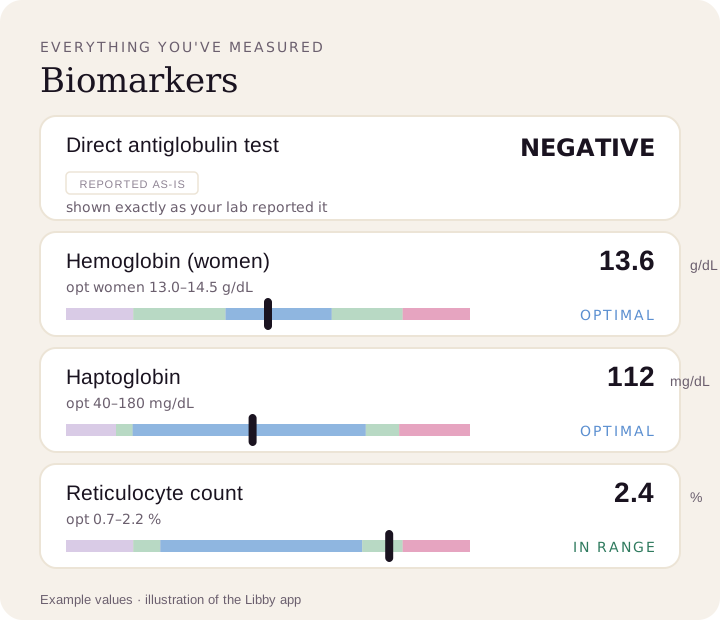
The Libby app has no catalog entry for the DAT, so it shows your result exactly as your lab reported it, tagged "Reported as-is". The best result is simply negative. For a yes/no test, the useful question is how much coating it takes to turn a result positive, and when a positive becomes urgent. The ladder below runs from the most sensitive method to the loosest threshold. It's the same for men and women.
| Where "positive" starts | Threshold | Who uses it |
|---|---|---|
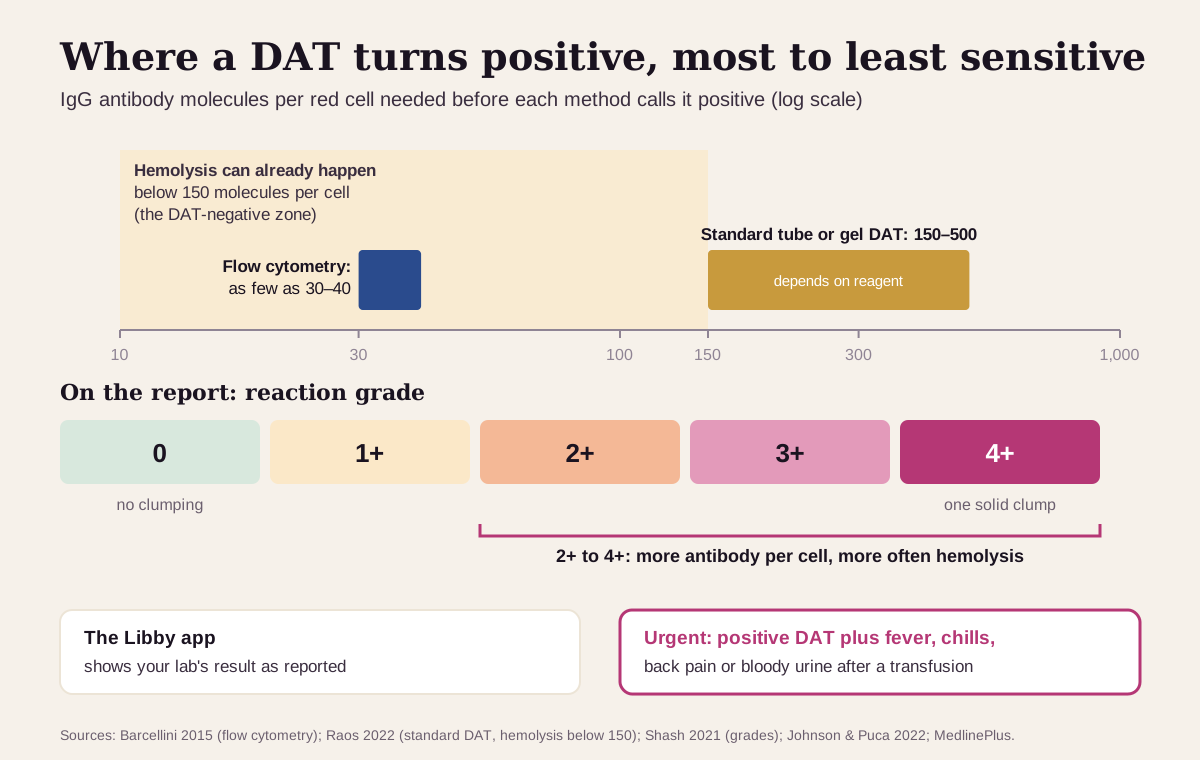
| Strictest: flow cytometry | about 30–40 antibody molecules per red cell | Specialized labs; the most sensitive method2 |
| Standard DAT (tube or gel) | 150–500 IgG molecules per red cell, depending on the reagent | Routine hospital and reference labs13 |
| The Libby app | your lab's own call, shown as reported | There's no catalog range or optimal band for the DAT, so the app shows the result with a "Reported as-is" tag |
| Lab reference range | Negative | Labcorp's printed range3 |
| Stronger positive | 2+ to 4+ | More antibody on each cell; more often tied to hemolysis6 |
| Urgent | any positive DAT with fever, chills, back or flank pain, or bloody urine during or after a transfusion | A possible hemolytic transfusion reaction: get care right away7 |
Why the sensitive end cuts both ways. Hemolysis can start with fewer than 150 IgG molecules per cell, below what a standard DAT sees.13 More sensitive methods catch some of those cases, but they also flag many more people who have no autoimmune hemolysis. In one Taiwanese study of 380 patients, flow cytometry found IgG on the red cells of 47 of 323 people without autoimmune hemolytic anemia, against 9 by the standard tube test:14
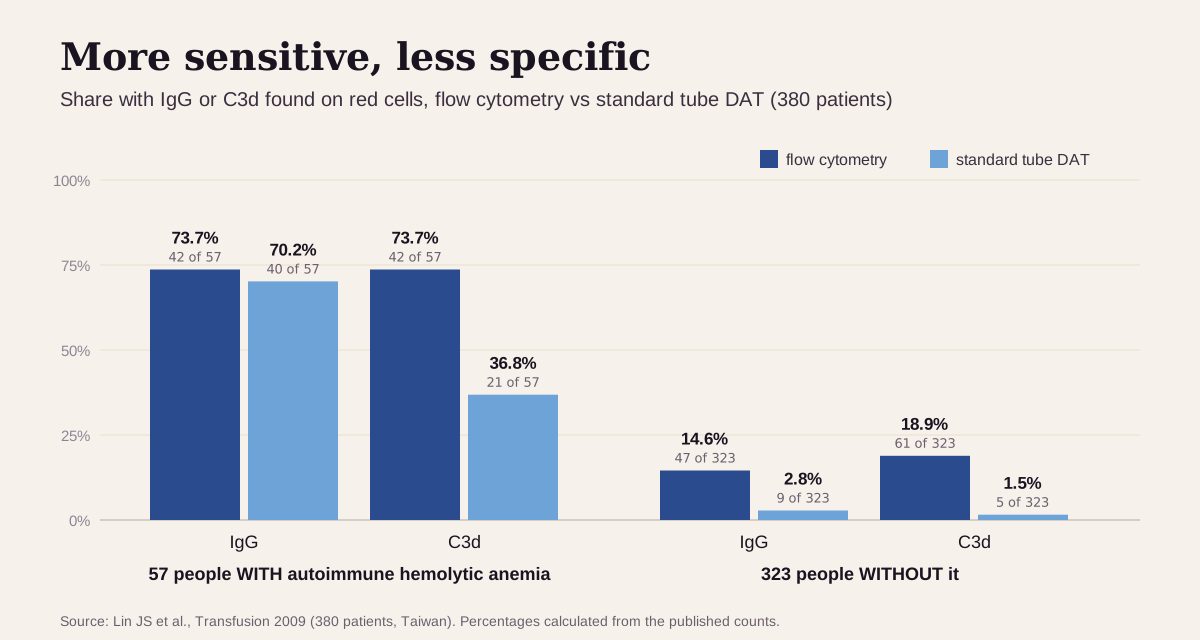
In the same study, a DAT positive for both IgG and C3d had the highest positive predictive value for hemolysis, followed by IgG alone, then C3d alone.14 Stronger reactions (2+ to 4+) mean more antibody per cell and go with hemolysis more often.6
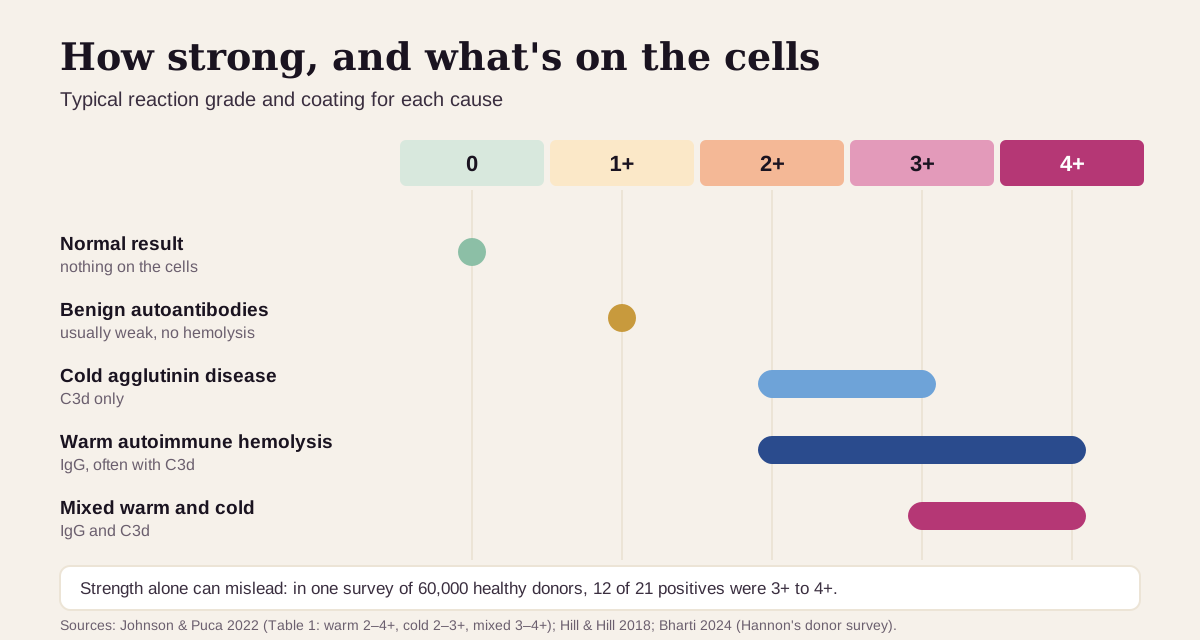
Keep "optimal" in perspective: a negative DAT is the expected result, and a positive one describes coating, not destruction. Strength alone is a weak guide, too. In one survey of 60,000 healthy donors, summarized by Bharti and colleagues, 12 of the 21 positives were a strong 3+ to 4+.10 What makes a positive DAT matter is evidence that red cells are breaking down.
What a positive DAT usually means
The first question is whether red cells are breaking down. The signs are a low hemoglobin, a raised reticulocyte count, raised unconjugated bilirubin, a low haptoglobin and a raised LDH.56 Each of those has its own guide: haptoglobin, LDH, indirect bilirubin and reticulocyte count. The second question is what is on the cells, IgG or C3d.
With hemolysis: the usual suspects
- Warm autoimmune hemolytic anemia (warm AIHA). The most common type: about 60–65% of autoimmune hemolytic anemia.155 The DAT is positive for IgG, more often IgG plus C3d, usually at 2+ to 4+.6 It can come on by itself or alongside conditions such as chronic lymphocytic leukemia or lupus, both on MedlinePlus's list of causes of a positive DAT.4
- Cold agglutinin disease. About 27% of cases in a 308-patient Italian series.15 An IgM antibody grabs red cells in the cooler blood of the hands and feet, switches on complement and lets go again, so the DAT is positive for C3d only, sometimes with a weak IgG.5 A cold agglutinin titer of 1:64 or higher at 4°C supports it.513
- Mixed type and paroxysmal cold hemoglobinuria. Mixed warm-and-cold disease (about 8%) is usually IgG plus C3d.155 Paroxysmal cold hemoglobinuria is under 1% of all cases but about 30% of childhood ones, mostly as a sudden illness in children.2
- A transfusion reaction. If you've had a transfusion, your antibodies can coat the donor's red cells.2 Most reactions show up during or right after the transfusion; a delayed reaction can appear several days later.7 In the hospital study above, two recently transfused patients had anti-K, a red-cell antibody, on their cells.11
- A medicine. Drug-induced immune hemolysis is rare. The drugs most often behind it are the antibiotics cefotetan, ceftriaxone and piperacillin. The DAT can show IgG, complement or both.16 Don't stop a prescribed medicine on your own. Bring the list to your clinician.
- In a newborn: the mother's antibodies. When a group O mother carries a group A or B baby, her anti-A or anti-B can coat the baby's cells. ABO mismatch is now the most common cause of hemolytic disease of the newborn, and 90.8% of positive newborn DATs in one series had group O mothers.8 In a survey of 56 U.S. and Canadian teaching-hospital blood banks, 73% tested newborns with anti-IgG only.17
Without hemolysis: common, usually quiet
About 0.3–8% of hospital patients have a positive DAT with no sign of autoimmune hemolysis.2 Common reasons:
- Treatments that carry antibodies: intravenous immunoglobulin (IVIG), Rh immune globulin, and antilymphocyte or antithymocyte globulin.2
- High antibody levels in the blood, as with raised globulins or a paraprotein.2
- A mother's Rh shot before birth. Rh immune globulin given within about 6 weeks before delivery can make the newborn's DAT positive, sometimes with no hemolysis at all.8
- "Benign" autoantibodies, fairly common and usually weak.6
- The sample itself. A clotted tube can give a false-positive complement result, and strong cold agglutinins can muddy the reading.3 Poor washing or handling in the lab can flip a result either way.1
Negative DAT, but hemolysis anyway
A standard DAT misses immune hemolysis in about 5–10% of people with hemolytic anemia.6 The antibody may be IgA (which standard reagents skip), weakly attached, or present below the test's threshold.52 With extra testing (other reagents, cold washes, sensitive methods), one Italian center brought its "true" DAT-negative rate down to about 3% (9 of 308).2 These atypical cases more often start severely, with hemoglobin at 6 g/dL or below.15
Get care now if a positive DAT or any transfusion comes with fever or chills, back or flank pain, flushing, fainting, or bloody urine. Those can be signs of a hemolytic transfusion reaction.7 In a newborn, jaundice that shows up sooner and deeper than usual is a sign of hemolytic disease: call the baby's clinician promptly.18
Read the DAT with its neighbors
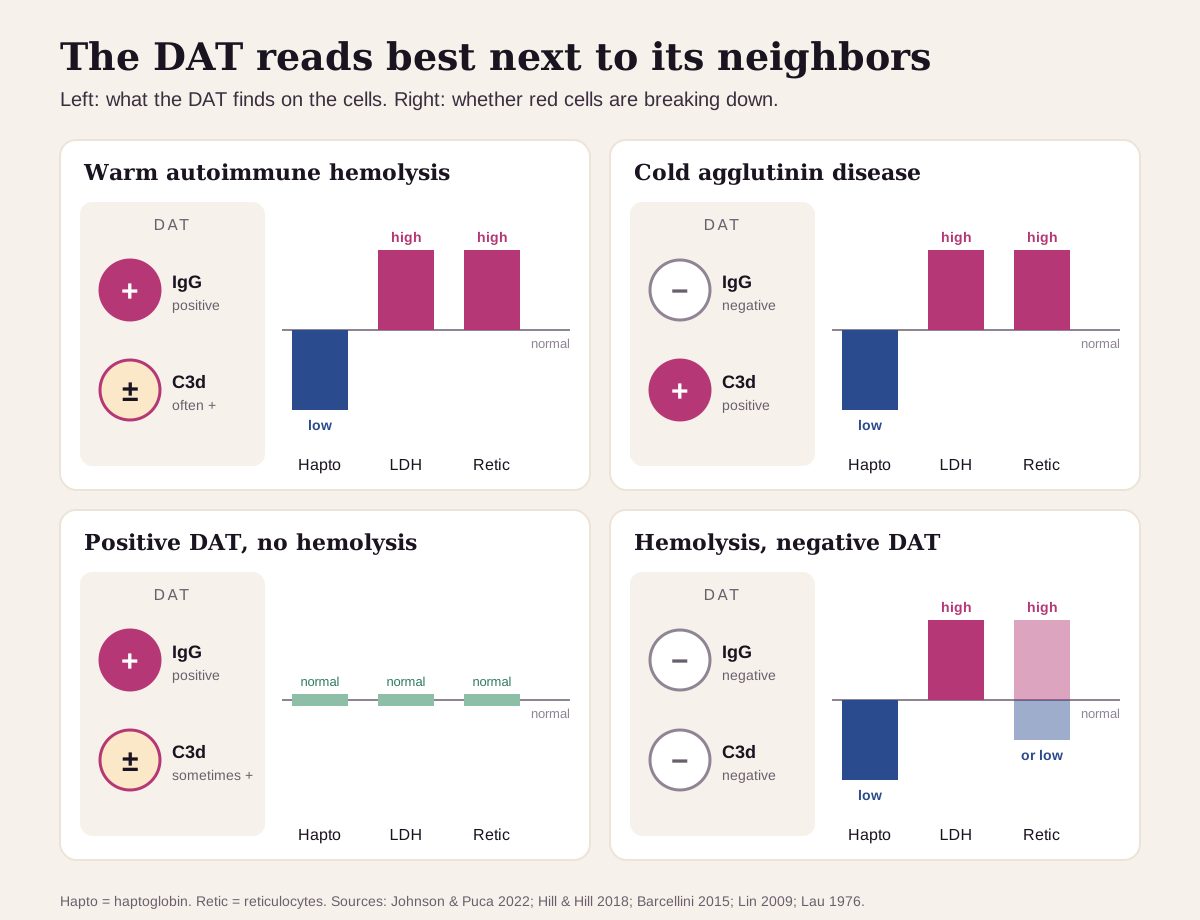
The DAT says whether something coats the red cells. Three everyday tests say whether those cells are being destroyed: haptoglobin falls, LDH rises and reticulocytes (young red cells) rise as the marrow tries to keep up.56 Here's how the five read together in the four most common patterns:
| If you see… | It often points to… |
|---|---|
| IgG positive, often with C3d; haptoglobin low, LDH and reticulocytes high | warm autoimmune hemolytic anemia |
| C3d only; haptoglobin low, LDH and reticulocytes high; symptoms in the cold | cold agglutinin disease; a cold agglutinin titer of 1:64 or more at 4°C supports it |
| A positive DAT with normal haptoglobin, LDH and reticulocytes | coating without destruction: common in hospital patients, after IVIG or Rh immune globulin, or with high globulins |
| Negative DAT, but haptoglobin low and LDH high | hemolysis the standard DAT missed (IgA, low-affinity or low-level antibody), or a non-immune cause |
| A positive DAT days after a transfusion, with signs of hemolysis | a delayed hemolytic transfusion reaction |
| A positive DAT (IgG, C3d or both) after a new antibiotic, with hemolysis | drug-induced immune hemolysis, most often cefotetan, ceftriaxone or piperacillin |
| IgG positive in a newborn of a group O mother | ABO hemolytic disease of the newborn; bilirubin is the number to watch |
In the neighbors, reticulocytes are the one to double-check. About 20% of people with autoimmune hemolytic anemia have a low reticulocyte count at first, as the marrow lags or is itself under attack.5 In the DAT-negative group, 6 of 14 had low or inadequate reticulocytes.2
How fast the DAT changes
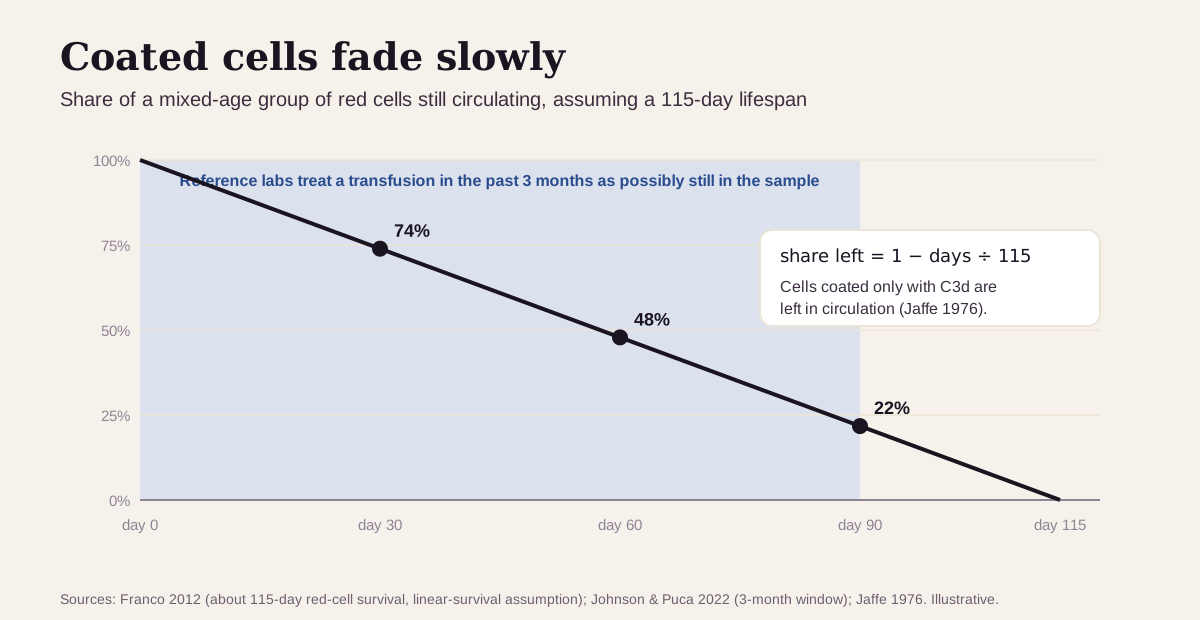
A DAT stays positive as long as coated red cells circulate, and red cells live a long time. Human red cells survive about 115 days and are cleared mostly by age.19 So a batch of coated cells, such as donor cells after a transfusion, fades slowly:
What that means in practice:
- After a transfusion, donor cells linger for months. Reference labs treat a transfusion in the past 3 months as possibly still present in your blood sample.6
- Complement coating can outlast the problem. Red cells coated with C3d are left in circulation and survive normally, so a C3d-positive DAT can persist after active destruction stops.20
- Recovery and the DAT can run on different clocks. The DAT may stay positive in autoimmune hemolytic anemia that's in remission.13
- Newborns are watched by bilirubin. In the Saudi series, every DAT-positive baby had bilirubin checked at 3 and 24 hours of age. Only 2.46% of all the newborns needed light therapy, and none needed an exchange transfusion.8
Going deeper: IgG, complement and where coated cells go
IgG and complement send red cells down different paths. In cold agglutinin disease, IgM binds red cells in the cool periphery and triggers complement. The cells get tagged with C3b and are pulled out by the liver's macrophages.5 In a classic 1976 experiment with labeled red cells, some of those cells came back out of the liver, apparently once C3b was cut down to C3d, and survived normally from then on. Cells coated only with C3d weren't cleared at all.20 That's why a C3d-positive DAT can sit next to normal hemolysis markers.
Method matters. Tube testing, gel columns and solid-phase plates all run the same idea. Gel and solid-phase methods are easier to automate and less subjective to read. In autoimmune hemolytic anemia, though, the authors of one ASH review haven't found them more sensitive than a well-performed tube test, and they call tube testing optimal for C3d.6
The eluate. When the DAT is positive, the lab can strip the antibody off the cells (an elution) and test what it reacts with. A pan-reactive eluate fits an autoantibody. A specific one, like the anti-K in two recently transfused patients, fits a reaction against donor cells.116
Questions worth asking
- Was the DAT positive for IgG, C3d or both, and how strong was it?
- Do my haptoglobin, LDH, bilirubin and reticulocyte count show hemolysis?
- Have I had a transfusion, IVIG or Rh immune globulin in the past 3 months?
- Could any of my medicines, especially recent antibiotics, be involved?
- If the DAT is negative but hemolysis is clear, can a reference lab run a more sensitive DAT?
- Should we look for a cause such as lupus, a lymphoma or an infection?
FAQ
What does a positive direct Coombs test mean? It means antibody (IgG), complement (C3d) or both are stuck to your red cells.3 Whether it matters depends on whether red cells are breaking down: 0.3–8% of hospital patients have a positive DAT without autoimmune hemolysis.2
What is the difference between IgG and C3d on a DAT? IgG, often with C3d, points toward warm autoimmune hemolytic anemia. C3d alone points toward cold agglutinin disease.56
Can you have hemolytic anemia with a negative DAT? Yes. About 5–10% of people with hemolytic anemia have a negative standard DAT, often from IgA or low-level antibody that the standard reagents miss.65
Why is my newborn's Coombs test positive? Most often a group O mother's anti-A or anti-B antibodies have coated the baby's cells. An Rh shot in late pregnancy can do it too, usually without hemolysis. Bilirubin shows whether it's causing trouble.8
This guide is for education. It can't diagnose you or replace care from a clinician who knows your history.
Footnotes
-
Zantek ND, Koepsell SA, Tharp DR Jr, Cohn CS. The direct antiglobulin test: a critical step in the evaluation of hemolysis. Am J Hematol. 2012;87(7):707–709. The DAT's job is to sort hemolysis into immune and non-immune causes; technique errors can give false results. PubMed ↩ ↩2
-
Barcellini W. Pitfalls in the diagnosis of autoimmune haemolytic anaemia. Blood Transfus. 2015;13(1):3–5. Positive DAT without AIHA in 0.01–0.1% of donors and 0.3–8% of hospital patients; flow cytometry detects 30–40 molecules; about 10% of AIHA DAT-negative. PMC ↩ ↩2 ↩3 ↩4 ↩5 ↩6 ↩7 ↩8 ↩9 ↩10 ↩11 ↩12 ↩13 ↩14
-
Labcorp. Coombs', Direct (test 006270). A commercial laboratory's test page. Polyspecific screen with reflex to anti-IgG and anti-complement; reference range "Negative"; clotted samples can give false-positive complement results; "The presence of a positive direct antiglobulin test does not necessarily correlate with a pathological condition." labcorp.com ↩ ↩2 ↩3 ↩4 ↩5 ↩6 ↩7 ↩8
-
National Library of Medicine. Coombs test. MedlinePlus Medical Encyclopedia. Reviewed January 29, 2026. Plain-language definition of the direct and indirect tests, what a normal result is, and common causes of a positive. MedlinePlus ↩ ↩2 ↩3 ↩4 ↩5 ↩6
-
Hill A, Hill QA. Autoimmune hemolytic anemia. Hematology Am Soc Hematol Educ Program. 2018;2018(1):382–389. The diagnostic pathway: hemolysis screen, IgG vs C3d patterns, cold agglutinin titer ≥1:64, reticulocytopenia in about 20%. PMC ↩ ↩2 ↩3 ↩4 ↩5 ↩6 ↩7 ↩8 ↩9 ↩10 ↩11 ↩12 ↩13 ↩14 ↩15 ↩16
-
Johnson ST, Puca KE. Evaluating patients with autoimmune hemolytic anemia in the transfusion service and immunohematology reference laboratory. Hematology Am Soc Hematol Educ Program. 2022;2022(1):96–104. ASH education review: DAT grades by AIHA type, 5–10% DAT-negative, tube vs automated methods, worked cases. PMC ↩ ↩2 ↩3 ↩4 ↩5 ↩6 ↩7 ↩8 ↩9 ↩10 ↩11 ↩12 ↩13 ↩14 ↩15 ↩16 ↩17 ↩18 ↩19
-
National Library of Medicine. Hemolytic transfusion reaction. MedlinePlus Medical Encyclopedia. Reviewed February 3, 2025. Symptoms, timing (usually during or right after; sometimes days later) and the tests that change. MedlinePlus ↩ ↩2 ↩3 ↩4
-
Shash HA, Alkhater SA. Maternal blood group and routine direct antiglobulin testing in neonates: is there a role for selective neonatal testing? Children (Basel). 2021;8(5):426. 4.4% of 1,463 newborns positive (10.2% ABO-incompatible vs 1.1% compatible); anti-D given within 6 weeks before delivery can make the newborn DAT positive; grades 0 to 4+. PMC ↩ ↩2 ↩3 ↩4 ↩5 ↩6 ↩7 ↩8 ↩9
-
Jäger U, Barcellini W, Broome CM, et al. Diagnosis and treatment of autoimmune hemolytic anemia in adults: recommendations from the First International Consensus Meeting. Blood Rev. 2020;41:100648. Monospecific DAT is mandatory in the workup. PubMed ↩
-
Bharti J, Solanki A, Singh A, Agarwal M, Chandra T. Prevalence of direct antiglobulin test positive in whole blood donors: study at a tertiary blood center, Northern India. Asian J Transfus Sci. 2024;18(2):237–241. 16 of 145,632 donors (0.011%); summarizes earlier donor rates of 1 in 1,000 to 1 in 14,000 and Hannon's survey of 60,000 donors (21 positive, 12 at 3–4+). PMC ↩ ↩2 ↩3
-
Lau P, Haesler WE, Wurzel HA. Positive direct antiglobulin reaction in a patient population. Am J Clin Pathol. 1976;65(3):368–375. 41 of 4,664 admissions (0.9%) positive; 3 of 41 with hemolysis; anti-K in eluates after transfusion. PubMed ↩ ↩2 ↩3 ↩4 ↩5
-
Cid J, Ortín X, Beltran V, et al. The direct antiglobulin test in a hospital setting. Immunohematology. 2003;19(1):16–18. 29 of 463 ordered DATs (6.3%) positive. PubMed ↩
-
Raos M, Lukic M, Pulanic D, Vodanovic M, Cepulic BG. The role of serological and molecular testing in the diagnostics and transfusion treatment of autoimmune haemolytic anaemia. Blood Transfus. 2022;20(4):319–328. Standard DAT threshold 150–500 IgG molecules per cell; hemolysis possible below 150; DAT can stay positive in remission. PMC ↩ ↩2 ↩3 ↩4 ↩5
-
Lin JS, Hao TC, Lyou JY, et al. Clinical application of a flow cytometric direct antiglobulin test. Transfusion. 2009;49(7):1335–1346. 380 patients; flow vs tube DAT in people with and without AIHA; IgG plus C3d had the highest predictive value for hemolysis. PubMed ↩ ↩2 ↩3 ↩4
-
Barcellini W, Fattizzo B, Zaninoni A, et al. Clinical heterogeneity and predictors of outcome in primary autoimmune hemolytic anemia: a GIMEMA study of 308 patients. Blood. 2014;124(19):2930–2936. 60% warm, 27% cold, 8% mixed, 5% atypical (mostly DAT-negative). PubMed ↩ ↩2 ↩3 ↩4
-
Garratty G. Drug-induced immune hemolytic anemia. Hematology Am Soc Hematol Educ Program. 2009;2009:73–79. Rare; cefotetan, ceftriaxone and piperacillin are the most frequent causes. PubMed ↩
-
Crowe EP, Goel R, Andrews J, et al. Survey of newborn direct antiglobulin testing practice in United States and Canadian transfusion services. Transfusion. 2021;61(4):1080–1092. 73.2% of 56 services test newborns with anti-IgG only. PubMed ↩
-
National Library of Medicine. Hemolytic disease of the newborn. MedlinePlus Medical Encyclopedia. Reviewed October 3, 2025. Signs include jaundice that occurs sooner and is more severe than normal, and anemia. MedlinePlus ↩
-
Franco RS. Measurement of red cell lifespan and aging. Transfus Med Hemother. 2012;39(5):302–307. Human red cells survive about 115 days and are removed mostly by age. PMC ↩ ↩2
-
Jaffe CJ, Atkinson JP, Frank MM. The role of complement in the clearance of cold agglutinin-sensitized erythrocytes in man. J Clin Invest. 1976;58(4):942–949. C3b-coated cells are held in the liver; C3d-coated cells are not cleared and survive normally. PMC ↩ ↩2
Educational content, not medical advice. Libby is a personal record tool, not a medical service — it doesn't diagnose, treat, or prescribe. Reference ranges vary by lab and by person. Talk to a qualified healthcare professional about your results.
See your DAT next to the tests that explain it.
Upload a lab PDF or a photo of your report. Libby shows your DAT exactly as your lab reported it, puts haptoglobin, LDH and reticulocytes on your lab's range and the optimal range, and tracks every result over time.
View your direct antiglobulin test ›