Indirect bilirubin: normal range and why it runs high
Indirect bilirubin is bilirubin before the liver processes it. Normal ranges, why it runs high (usually Gilbert syndrome), its neighbors and when it's urgent.
Indirect bilirubin is bilirubin before your liver has processed it: the yellow pigment made from old red blood cells, still riding in your blood on its way to the liver. Labs usually get it by subtracting direct bilirubin from total bilirubin. It rises when your body makes more bilirubin than usual (red cells breaking down early) or when your liver handles it slowly. In a healthy adult with normal liver enzymes, the most common reason is Gilbert syndrome, a harmless inherited trait.12
The short version
- Normal: most labs print an indirect bilirubin range of about 0.1 to 0.8–0.9 mg/dL. It's usually about 70% of your total bilirubin.341
- Mildly high, with normal liver enzymes and blood counts: most often Gilbert syndrome, found in 3–7% of Americans. Total bilirubin usually stays under 3 mg/dL, and fasting or illness can push it up 2- to 3-fold.15
- High with anemia, a high reticulocyte count (young red cells) and a low haptoglobin: red cells are breaking down early (hemolysis). Hemolysis on its own rarely pushes bilirubin above 5 mg/dL.16
- Get prompt care for new yellow skin or eyes (jaundice), dark urine, pale stools or belly pain, and for a newborn with jaundice who has a fever, is listless or is feeding poorly.78
What indirect bilirubin is
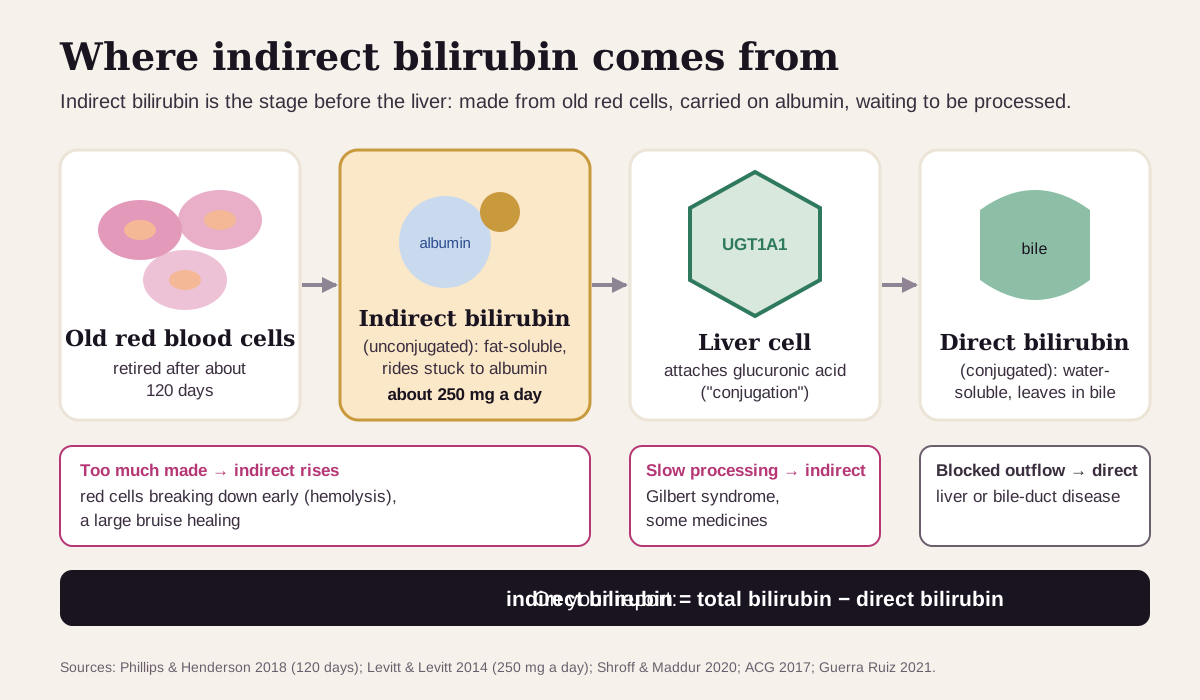
Red blood cells live about 120 days.6 When old ones are retired, the heme in their hemoglobin is broken down into bilirubin, about 250 mg a day in an adult.4 That first form is unconjugated bilirubin. It dissolves in fat, not water, so it rides through the blood stuck to the protein albumin.14
Your liver takes it up, and an enzyme called UGT1A1 attaches glucuronic acid to it. This step, called conjugation, turns it into water-soluble conjugated (direct) bilirubin, which leaves in bile.10 Only the conjugated kind spills into urine, so the unconjugated kind stays out of it.12
The names come from a lab test first described in 1916: conjugated bilirubin reacts with the test chemical right away ("directly"), while unconjugated bilirubin needs an accelerator first. Most labs today measure total bilirubin with the accelerator and direct bilirubin without it, and report indirect bilirubin as the difference.2
What's a normal indirect bilirubin?
Start with the range on your own report. Labcorp, a large commercial lab, prints 0.10–0.80 mg/dL for indirect bilirubin on its fractionated bilirubin report, next to 0.0–1.2 for total and 0.00–0.40 for direct.3 The American College of Gastroenterology (ACG) notes that total bilirubin is usually below 1.1 mg/dL, and that the unconjugated part makes up about 70% of it.1
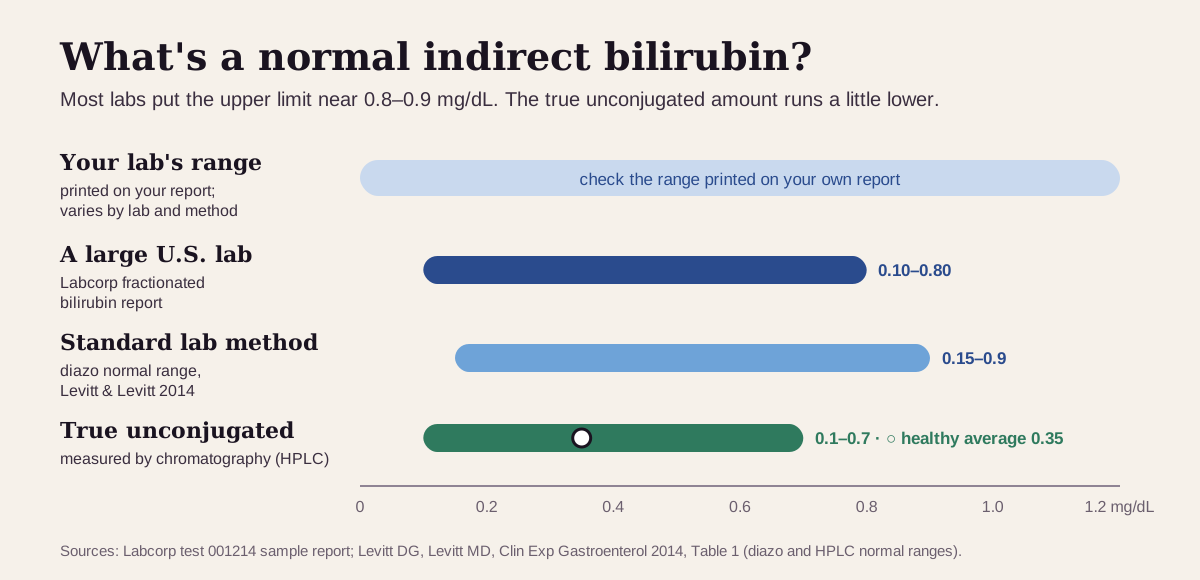
- The standard lab method (the diazo reaction) has a normal range for indirect bilirubin of 0.15–0.9 mg/dL, in a table compiled by Levitt and Levitt.4
- Measured precisely with chromatography (HPLC), a healthy adult's unconjugated bilirubin averages 0.35 mg/dL, within a normal range of 0.1–0.7 mg/dL.4
"Optimal" indirect bilirubin: what health optimizers aim for
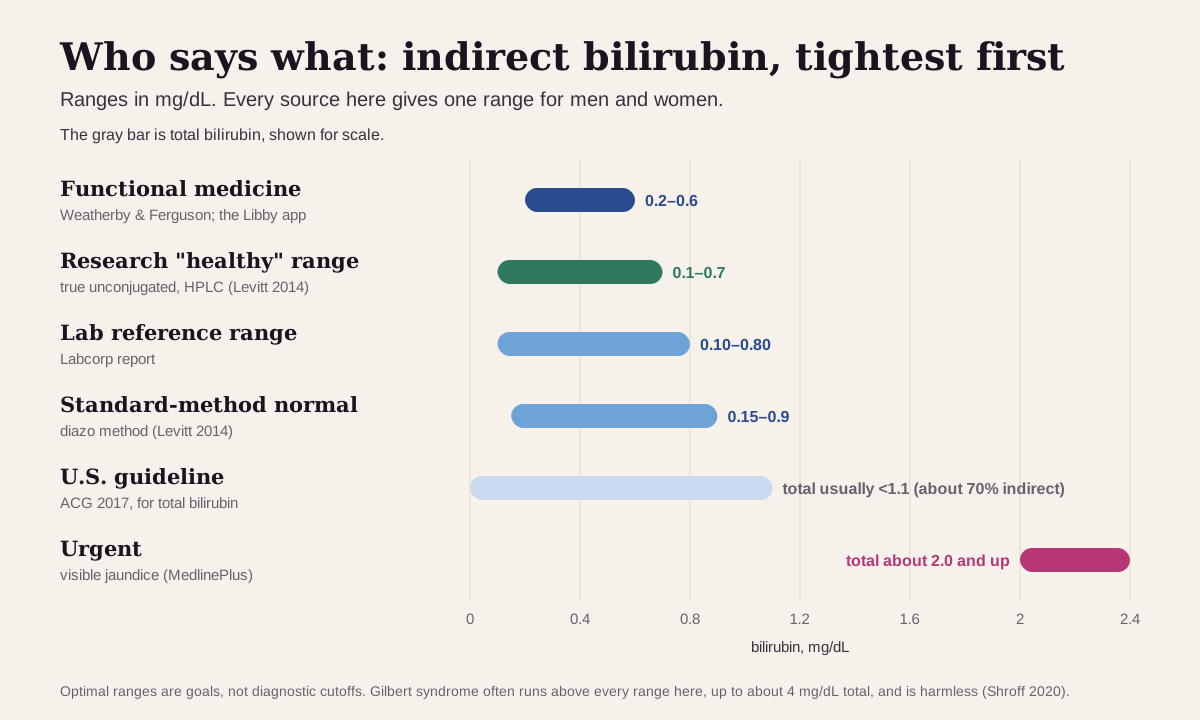
Functional-medicine practitioners aim for a narrower band than a lab's normal. The Libby app shows 0.2–0.6 mg/dL as optimal for indirect bilirubin, the range its marker catalog records from Weatherby and Ferguson's functional-medicine textbook.11 Here's the ladder, from the tightest range to the loosest. Every source here gives one range for men and women.
| Target | Indirect bilirubin | Who uses it |
|---|---|---|
| Functional medicine | 0.2–0.6 mg/dL | The optimal range shown in the Libby app, from the Weatherby & Ferguson textbook11 |
| Research "healthy" range | 0.1–0.7 mg/dL | True unconjugated bilirubin, measured by HPLC in healthy people4 |
| Lab reference range | 0.10–0.80 mg/dL | Labcorp's fractionated bilirubin report3 |
| Standard-method normal range | 0.15–0.9 mg/dL | The diazo method most labs use4 |
| U.S. gastroenterology guideline | total bilirubin usually under 1.1 mg/dL, about 70% of it indirect | American College of Gastroenterology1 |
| Urgent | new jaundice, which can start at a total bilirubin of about 2 mg/dL | Get checked promptly97 |
What the outcome studies say about higher levels:
- In a Czech study, 2% of 50 people over 40 with Gilbert syndrome had heart disease, versus 12.1% of 2,296 people from the general population.12
- In the Framingham Offspring study, the 11% of people who carry two copies of the common Gilbert gene variant (UGT1A1*28) had bilirubin of 1.14 vs 0.69 mg/dL, and about one-third the risk of cardiovascular disease over 24 years (hazard ratio 0.36).13
- A larger genetic analysis of 14,711 heart-disease cases and 60,324 controls found that gene variants that roughly double bilirubin left the risk of heart disease unchanged (odds ratio 1.01).14 That suggests higher bilirubin tracks with heart health rather than causing it.
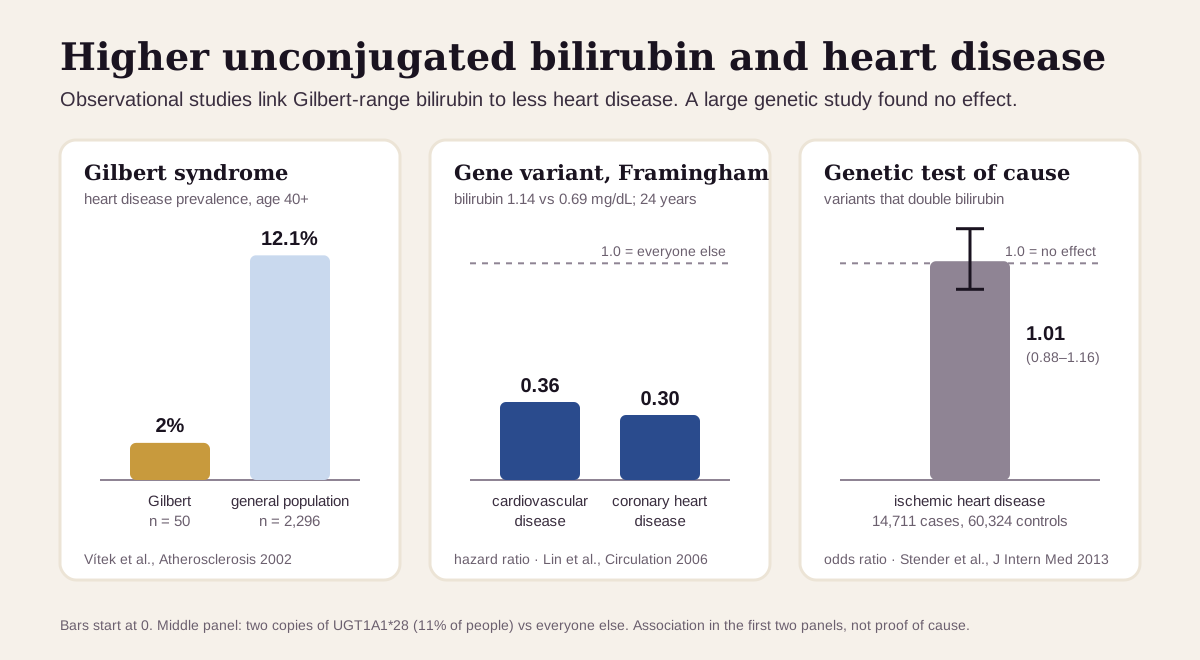
Keep "optimal" in perspective: it's a target, not a diagnosis. An indirect bilirubin of 0.8 with normal liver enzymes and blood counts sits above the app's optimal band, at the top of Labcorp's range and inside the standard-method range. A Gilbert-range total of up to about 3 mg/dL is common and harmless,110 and in the heart studies above, higher values went with less heart disease.1213
What a high indirect bilirubin usually means
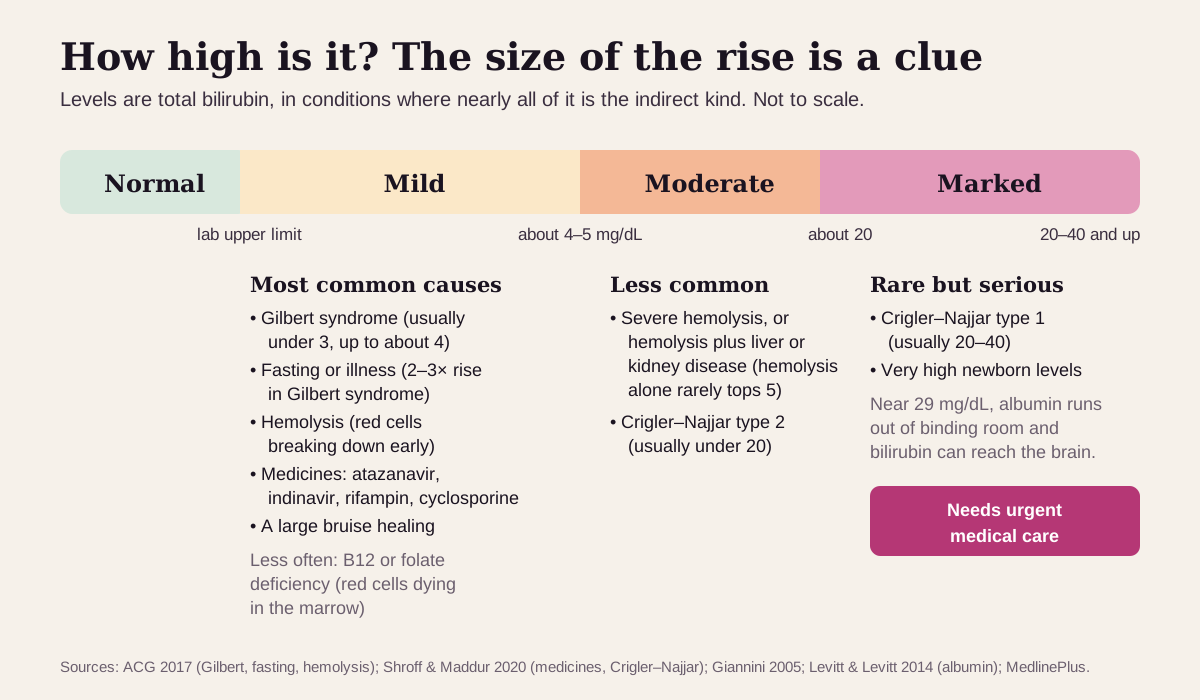
The first clue is whether direct bilirubin is up too. When most of a rise is indirect (the direct part under about 20% of the total), the cause is usually too much bilirubin being made, or slow conjugation. When direct bilirubin climbs as well, the liver or bile ducts are usually involved.101
Mildly high: the usual suspects
- Gilbert syndrome. The most common cause of a high indirect bilirubin, found in 3–7% of Americans.15 A gene change leaves the UGT1A1 enzyme working at about one-third of its usual rate. Total bilirubin usually stays under 3 mg/dL and almost never passes 6.110 It's harmless and needs no treatment. About 30% of people with it have no symptoms at all; in others, bilirubin rises during dehydration, fasting, illness, hard exercise or menstruation.5 For a healthy adult with a mild rise (under 4 mg/dL), no medicine to blame, no signs of hemolysis and normal liver enzymes, the ACG says a presumptive diagnosis of Gilbert syndrome can be made without more testing.1
- Fasting or a sick day. Skipping meals or being ill can raise unconjugated bilirubin 2- to 3-fold, most noticeably in Gilbert syndrome, and eating brings it back down.1
- Red cells breaking down early (hemolysis). Causes include inherited red-cell conditions (abnormal hemoglobin, faulty red-cell membranes), the immune system attacking red cells, some medicines and toxins, infections, and damaged or artificial heart valves.16 Hemolysis usually comes with anemia, a high reticulocyte count and LDH, and a low haptoglobin.61 On its own it rarely pushes bilirubin above 5 mg/dL.1
- Medicines. Some drugs slow the liver's uptake or conjugation of bilirubin: the HIV medicines atazanavir and indinavir, the cancer drug sorafenib, the antibiotic rifampin and the transplant drug cyclosporine.10 Don't stop a prescribed medicine on your own. Bring your full list to your clinician.
- Less common causes: a large bruise (hematoma) being reabsorbed, a massive blood transfusion, and red cells dying in the bone marrow before they're released (ineffective red-cell production), as happens with some vitamin deficiencies.151017
Very high: rare but serious
A mostly indirect bilirubin above about 20 mg/dL points to rare inherited conditions. In Crigler–Najjar syndrome type 1 the UGT1A1 enzyme is missing and bilirubin usually runs 20–40 mg/dL; in type 2 the enzyme works at under 10% and levels usually stay under 20.10 Around 29 mg/dL, albumin runs out of room to carry unconjugated bilirubin, and it can reach the brain (kernicterus). That's mainly a risk for newborns and for people with severe inherited conjugation defects.48
Get prompt care if you notice new yellow skin or eyes, dark urine, pale or clay-colored stools, or belly pain, or if you have anemia symptoms such as shortness of breath, a racing heart or lightheadedness when you stand. For a newborn, jaundice with a fever, listlessness or poor feeding is an emergency.7168
Indirect bilirubin reads best next to its neighbors
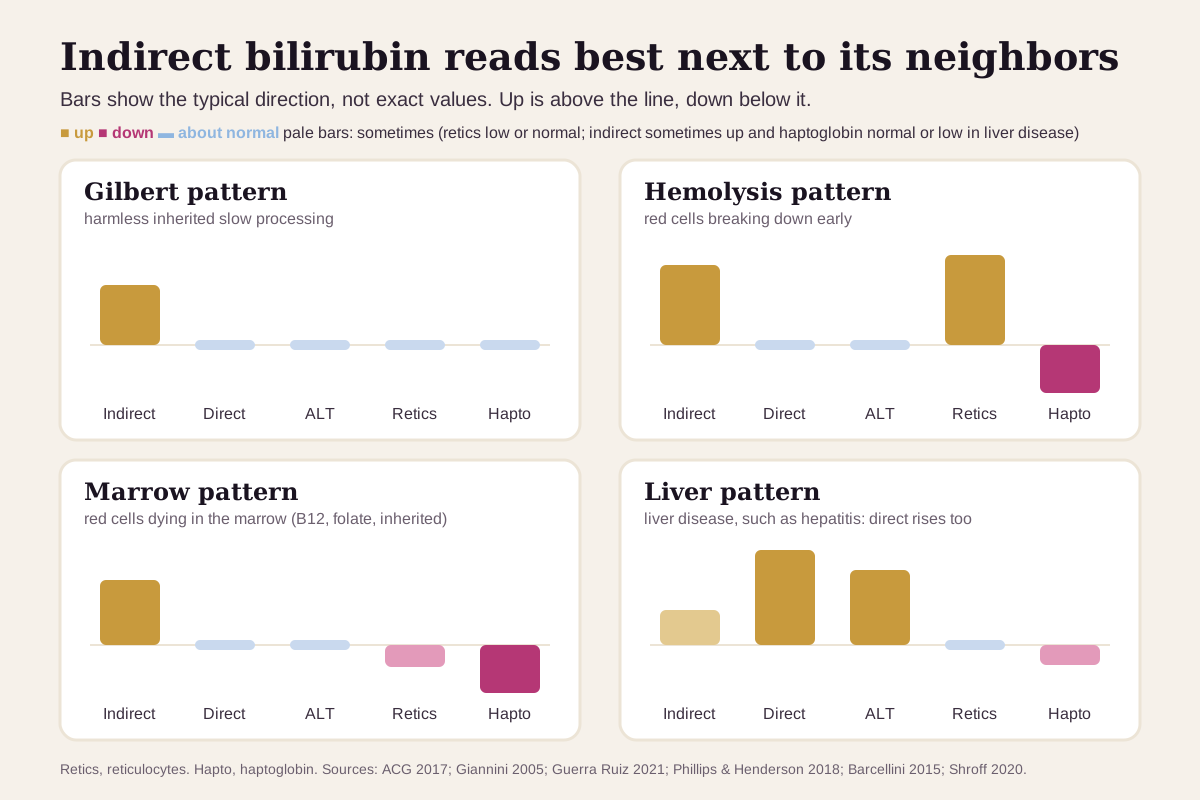
Indirect bilirubin says the most when you read it with four other tests: direct bilirubin, ALT (a liver enzyme), reticulocytes (young red cells, which rise when the marrow speeds up) and haptoglobin (a protein that mops up free hemoglobin and falls when red cells burst).617
| If you see… | It often points to… |
|---|---|
| Indirect bilirubin mildly up (total usually under 3 mg/dL), with direct bilirubin, ALT, reticulocytes and haptoglobin normal | Gilbert syndrome, especially if it rises after fasting or illness |
| Indirect bilirubin up, reticulocytes up, haptoglobin down, often with LDH up and hemoglobin down | red cells breaking down early (hemolysis) |
| Indirect bilirubin up, reticulocytes low or normal, often with haptoglobin down and a very high LDH | red cells dying in the marrow before release, as in vitamin B12 or folate deficiency or some inherited marrow disorders |
| Direct bilirubin up too (more than about 20% of the total), with ALT or ALP up | liver disease (ALT up most) or a bile-duct problem (ALP up most); the indirect part can rise as well |
Haptoglobin has its own traps. It also runs low with liver impairment and malnutrition, and it rises with inflammation and smoking, which can mask hemolysis.17
Is a low indirect bilirubin a problem?
Usually not. MedlinePlus says a low bilirubin is usually no cause for concern, and lists some antibiotics, birth control pills, sleeping pills and seizure medicines as possible reasons.7 In the heart studies above, the people with higher bilirubin had less heart disease, but the genetic analysis points to bilirubin as a marker there rather than a cause.1314
How fast indirect bilirubin changes
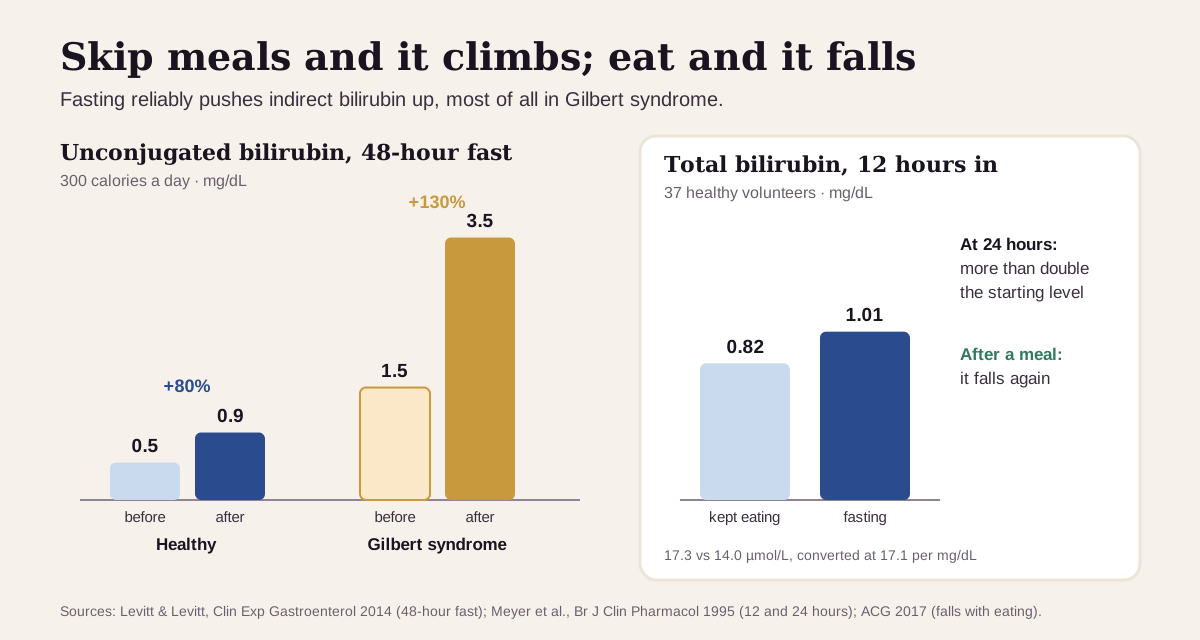
Indirect bilirubin moves within hours. In 37 healthy volunteers, total bilirubin was already higher 12 hours into a fast (about 1.01 vs 0.82 mg/dL on a normal eating day) and had more than doubled by 24 hours.18 After a 48-hour, 300-calorie fast, unconjugated bilirubin rose 80% in healthy people (0.5 to 0.9 mg/dL) and 130% in Gilbert syndrome (1.5 to 3.5 mg/dL).4
What that means in practice:
- Say if you'd been fasting, ill, dehydrated or exercising hard when the blood was drawn. Each can push bilirubin up.57
- A mild rise that falls after normal meals, with normal liver enzymes and blood counts, fits Gilbert syndrome.1
- Compare like with like. Ranges vary between labs, so trends are easiest to read from the same lab.9
Going deeper: what the subtraction hides
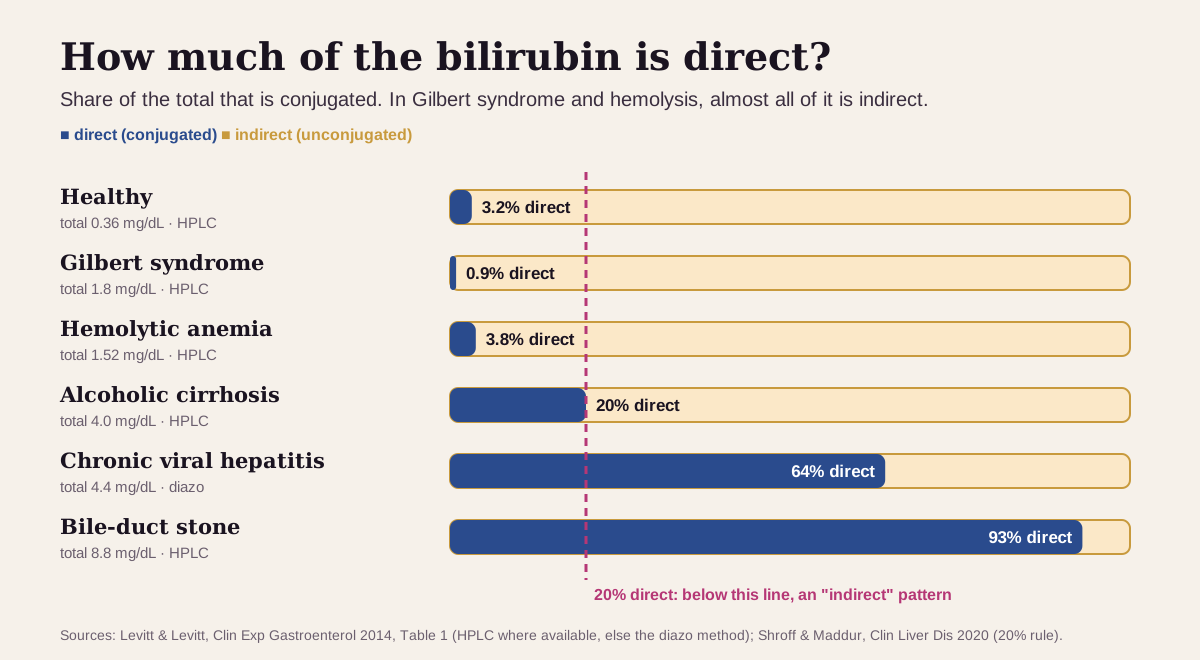
The share that is direct sorts the causes. Measured precisely, only about 3% of a healthy person's bilirubin is conjugated. It's about 1% in Gilbert syndrome and 4% in hemolytic anemia, but 20% in alcoholic cirrhosis and 93% with a stone blocking the common bile duct.4 Clinicians call a rise "indirect" when less than about 20% is direct, and "direct" when more than 70–80% is.10
The everyday lab method reads more of it as direct: the ACG puts the unconjugated share at about 70%, where chromatography finds about 97%.14 Part of the gap is the method itself. A little unconjugated bilirubin reacts in the direct test, and the method is only accurate when that amount stays small.2
The Gilbert gene change sits in the gene's on-switch. The common variant, UGT1A1*28, adds an extra "TA" to the TATAA box at the start of the gene, which lowers how much enzyme the liver makes.13
Questions worth asking
- Is my rise mostly indirect, and what share of my total is direct?
- Are my ALT, AST and ALP normal?
- Should we check a blood count, reticulocytes, LDH and haptoglobin for hemolysis?
- Could any of my medicines raise bilirubin?
- Was I fasting, ill or dehydrated when this was drawn, and should we repeat it after normal meals?
- Does this pattern fit Gilbert syndrome, and would that change anything for me?
FAQ
What is a normal indirect bilirubin? It depends on your lab. Labcorp prints 0.10–0.80 mg/dL, and the standard method's normal range runs up to about 0.9 mg/dL. The Libby app's optimal band is 0.2–0.6 mg/dL.3411
What is the most common cause of high indirect bilirubin? Gilbert syndrome, a harmless inherited trait in 3–7% of Americans. Hemolysis, medicines and fasting are the other common causes.1510
Can fasting raise indirect bilirubin? Yes. Fasting or illness can raise it 2- to 3-fold, most of all in Gilbert syndrome, and it falls again with eating.14
When is a high indirect bilirubin urgent? New jaundice, dark urine, pale stools or belly pain need prompt care, as do anemia symptoms like shortness of breath or a racing heart. In a newborn, jaundice with a fever, listlessness or poor feeding is an emergency.7168
This guide is for education. It can't diagnose you or replace care from a clinician who knows your history.
Footnotes
-
Kwo PY, Cohen SM, Lim JK. ACG Clinical Guideline: Evaluation of Abnormal Liver Chemistries. Am J Gastroenterol. 2017;112(1):18–35. doi:10.1038/ajg.2016.517. The U.S. gastroenterology society's guideline: the unconjugated share (about 70%), total bilirubin usually under 1.1 mg/dL, Gilbert syndrome (3–7%, usually under 3 mg/dL), the 2- to 3-fold fasting rise, and hemolysis rarely above 5 mg/dL. PubMed ↩ ↩2 ↩3 ↩4 ↩5 ↩6 ↩7 ↩8 ↩9 ↩10 ↩11 ↩12 ↩13 ↩14 ↩15 ↩16 ↩17 ↩18 ↩19 ↩20 ↩21 ↩22 ↩23 ↩24 ↩25
-
Guerra Ruiz AR, Crespo J, López Martínez RM, et al. Measurement and clinical usefulness of bilirubin in liver disease. Adv Lab Med. 2021;2(3):352–372. How labs measure direct and indirect bilirubin, and the patterns of too-much-made versus liver disease. PMC ↩ ↩2 ↩3 ↩4 ↩5 ↩6 ↩7
-
Labcorp. Bilirubin, Fractionated (test 001214) and its sample report, which prints indirect 0.10–0.80, direct 0.00–0.40 and total 0.0–1.2 mg/dL. Labcorp is a commercial laboratory, and ranges differ between labs. Test page · Sample report ↩ ↩2 ↩3 ↩4 ↩5 ↩6
-
Levitt DG, Levitt MD. Quantitative assessment of the multiple processes responsible for bilirubin homeostasis in health and disease. Clin Exp Gastroenterol. 2014;7:307–328. Table 1 (normal ranges by method and the conjugated share in each condition), the 250 mg a day production figure, albumin binding, and the 48-hour fasting data. PMC ↩ ↩2 ↩3 ↩4 ↩5 ↩6 ↩7 ↩8 ↩9 ↩10 ↩11 ↩12 ↩13 ↩14 ↩15 ↩16 ↩17 ↩18 ↩19
-
National Library of Medicine. Gilbert syndrome. MedlinePlus Genetics. Frequency (3–7% of Americans), triggers, and the 30% with no symptoms. MedlinePlus ↩ ↩2 ↩3 ↩4 ↩5
-
Phillips J, Henderson AC. Hemolytic Anemia: Evaluation and Differential Diagnosis. Am Fam Physician. 2018;98(6):354–361. The 120-day red-cell life span and the first tests for hemolysis. AAFP ↩ ↩2 ↩3 ↩4 ↩5 ↩6
-
National Library of Medicine. Bilirubin Blood Test. MedlinePlus. Last updated October 27, 2024. Symptoms that call for testing, and causes of high and low results. MedlinePlus ↩ ↩2 ↩3 ↩4 ↩5 ↩6
-
National Library of Medicine. Newborn jaundice. MedlinePlus Medical Encyclopedia. Reviewed January 1, 2025. MedlinePlus ↩ ↩2 ↩3 ↩4 ↩5 ↩6
-
National Library of Medicine. Bilirubin blood test. MedlinePlus Medical Encyclopedia. Reviewed February 13, 2025. Jaundice from about 2.0 mg/dL, unit conversions, and lab-to-lab variation. MedlinePlus ↩ ↩2 ↩3 ↩4 ↩5
-
Shroff H, Maddur H. Isolated Elevated Bilirubin. Clin Liver Dis (Hoboken). 2020;15(4):153–156. The under-20%-direct rule, the medicine list, and Gilbert and Crigler–Najjar bilirubin levels. PMC ↩ ↩2 ↩3 ↩4 ↩5 ↩6 ↩7 ↩8 ↩9 ↩10 ↩11 ↩12 ↩13
-
Weatherby D, Ferguson S. Blood Chemistry and CBC Analysis: Clinical Laboratory Testing from a Functional Perspective. Bear Mountain Publishing. ISBN 978-0976136712. A widely used functional-medicine reference. The 0.2–0.6 mg/dL range is as recorded in the Libby app's marker catalog; the book was not opened for this article. ↩ ↩2 ↩3 ↩4
-
Vítek L, Jirsa M, Brodanová M, et al. Gilbert syndrome and ischemic heart disease: a protective effect of elevated bilirubin levels. Atherosclerosis. 2002;160(2):449–456. PubMed ↩ ↩2 ↩3
-
Lin JP, O'Donnell CJ, Schwaiger JP, et al. Association between the UGT1A1*28 allele, bilirubin levels, and coronary heart disease in the Framingham Heart Study. Circulation. 2006;114(14):1476–1481. 1,780 adults followed for 24 years. PubMed ↩ ↩2 ↩3 ↩4 ↩5
-
Stender S, Frikke-Schmidt R, Nordestgaard BG, et al. Genetically elevated bilirubin and risk of ischaemic heart disease: three Mendelian randomization studies and a meta-analysis. J Intern Med. 2013;273(1):59–68. PubMed ↩ ↩2 ↩3
-
Giannini EG, Testa R, Savarino V. Liver enzyme alteration: a guide for clinicians. CMAJ. 2005;172(3):367–379. Hemolysis and Gilbert syndrome as the most common adult causes; reabsorbed hematomas and ineffective red-cell production as less frequent ones. PMC ↩ ↩2 ↩3
-
National Library of Medicine. Hemolytic anemia. MedlinePlus Medical Encyclopedia. Reviewed January 29, 2026. Causes and symptoms. MedlinePlus ↩ ↩2 ↩3
-
Barcellini W, Fattizzo B. Clinical Applications of Hemolytic Markers in the Differential Diagnosis and Management of Hemolytic Anemia. Dis Markers. 2015;2015:635670. Reticulocytes, LDH, haptoglobin and bilirubin across types of red-cell breakdown, and their confounders. PMC ↩ ↩2 ↩3 ↩4
-
Meyer BH, Scholtz HE, Schall R, et al. The effect of fasting on total serum bilirubin concentrations. Br J Clin Pharmacol. 1995;39(2):169–171. A randomized crossover study in 37 healthy volunteers. PMC ↩ ↩2
Educational content, not medical advice. Libby is a personal record tool, not a medical service — it doesn't diagnose, treat, or prescribe. Reference ranges vary by lab and by person. Talk to a qualified healthcare professional about your results.
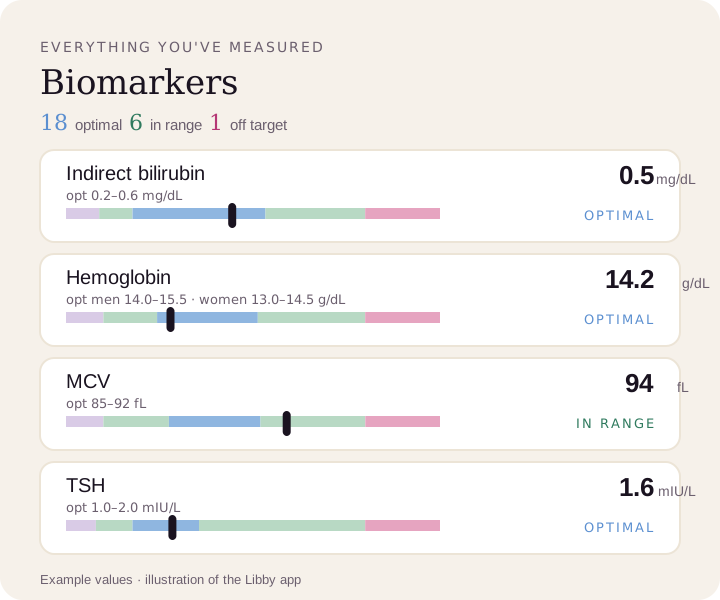
Compare your results to optimal ranges.
Upload a lab PDF or a photo of your report. Libby puts every marker on a lab range and the optimal range, and tracks your trends over time.
View your indirect bilirubin ›