Direct bilirubin: normal range and what a high result means
Direct bilirubin is the form your liver has already processed. Normal levels, why it runs high, how to read it with ALT and ALP, and when it's urgent.
Direct bilirubin is the bilirubin your liver has already processed and is sending out in bile. Healthy people have almost none of it in their blood, because the liver moves it into bile so quickly.1 So a high direct bilirubin points to the liver or the bile ducts: liver cells that are injured, or bile that is blocked from draining.2 That makes it the number that separates liver and bile problems from the common, harmless reasons a total bilirubin runs high, such as Gilbert syndrome.2
The short version
- Normal: most labs print an upper limit of 0.3 mg/dL, and some use 0.4.34 The optimal range in the Libby app is 0–0.2 mg/dL.5
- A little high, with normal ALT, ALP and GGT: the American College of Gastroenterology recommends repeating the test to confirm it before a workup.2
- High, with ALP and GGT up, points to blocked bile flow (a gallstone in a bile duct, a narrowing, some medicines). High, with ALT and AST up, points to injured liver cells (hepatitis, alcohol, medicines).216
- Get prompt care for yellow eyes or skin, dark urine, pale stools, or belly pain with fever. In a baby older than 2 weeks, a direct bilirubin over 1.0 mg/dL needs prompt evaluation.768
What direct bilirubin is
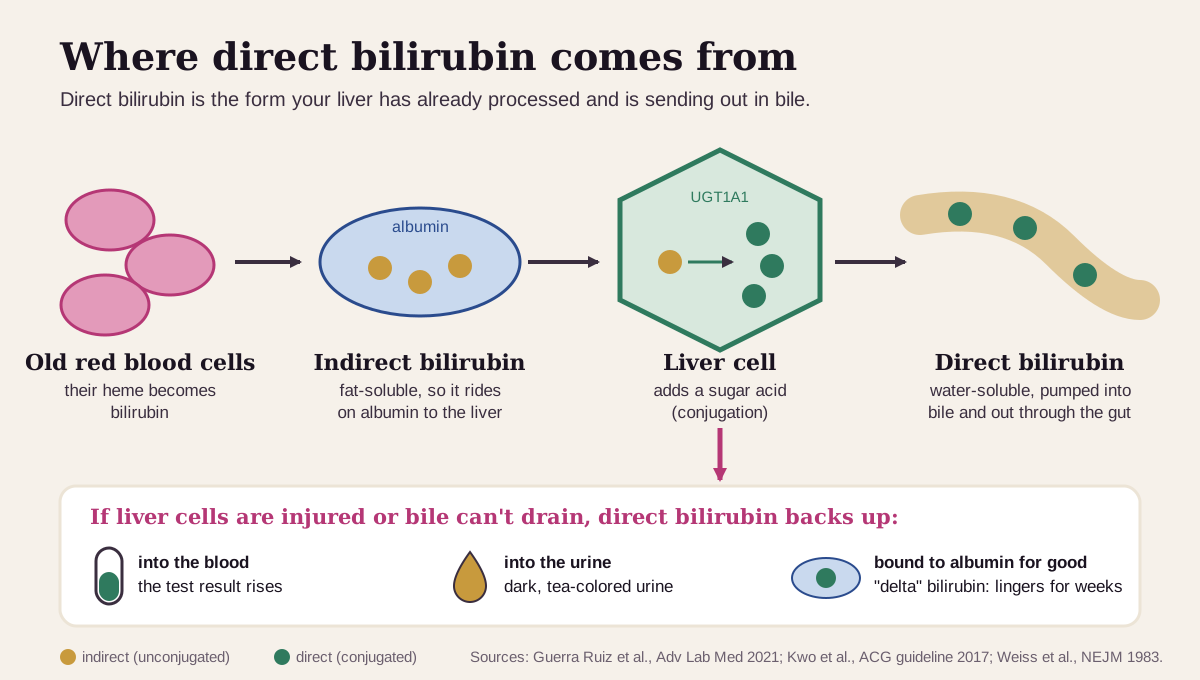
Bilirubin is the yellow pigment left over when your body recycles old red blood cells. The first form, indirect (unconjugated) bilirubin, is fat-soluble, so it rides to the liver stuck to the blood protein albumin.92
Liver cells then attach a sugar acid (glucuronic acid) to it, using an enzyme called UGT1A1. This step, conjugation, makes bilirubin water-soluble. That processed form is direct (conjugated) bilirubin, and the liver pumps it into bile and out through the gut.9
Your report can show three numbers:
- Total bilirubin: everything together.
- Direct bilirubin: the conjugated, processed form. The name comes from a century-old lab test in which this form reacts with the dye "directly".9
- Indirect bilirubin: total minus direct. In healthy people it makes up about 70% of the total.29
Because direct bilirubin dissolves in water, the kidneys can filter it. Bilirubin in the urine, and dark, tea-colored urine, point to a rise in the direct form.9
Direct bilirubin is usually ordered when the total is high. The ACG guideline says a high total should be split into direct and indirect, and that the split helps most when ALT, AST and ALP are normal or close to it.2 Labcorp notes the direct test is usually unnecessary when total bilirubin is under 1.2 mg/dL.4
What's a normal direct bilirubin?
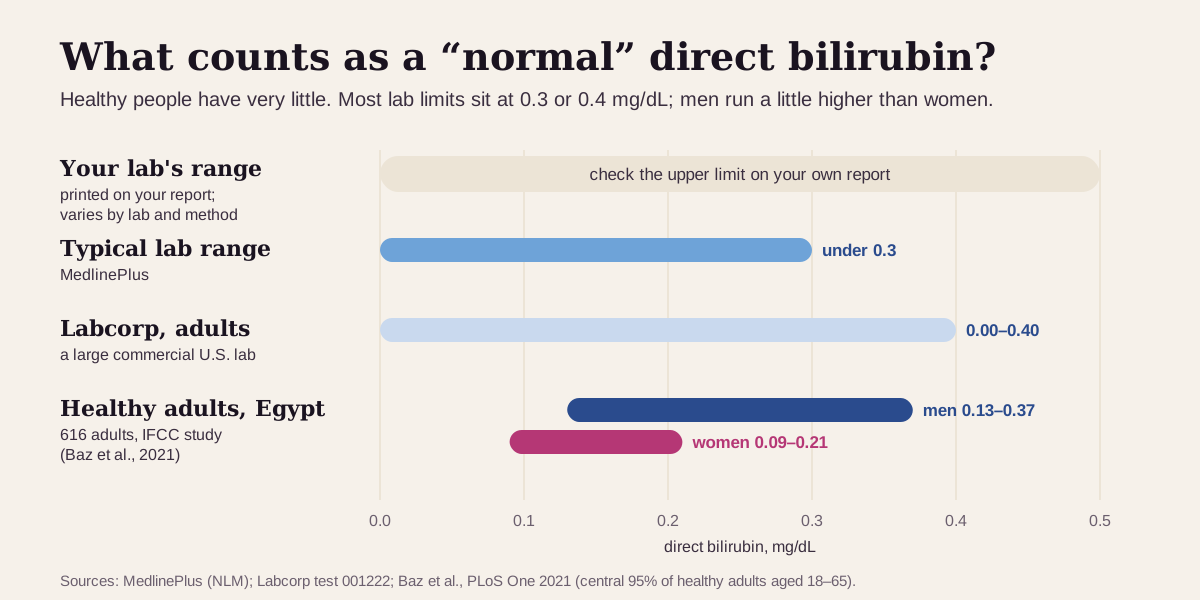
Start with the range printed on your own report. MedlinePlus lists a normal direct bilirubin as less than 0.3 mg/dL (5.1 µmol/L), and notes that ranges vary slightly between labs.3 Labcorp, a large commercial U.S. lab, prints 0.00–0.40 mg/dL for adults and children over 1 month.4
Two things shape what's normal:
- Healthy livers keep it low. A review in the Canadian Medical Association Journal describes conjugated bilirubin as "virtually absent" from the blood of healthy people, because bile secretion is so fast.1
- Men run a little higher. In 616 healthy adults in Egypt, part of an international reference-range project, the middle 95% of results ran 0.13–0.37 mg/dL in men and 0.09–0.21 mg/dL in women.11
"Direct" is defined by a chemical reaction, and labs use different methods, so the same blood can give slightly different numbers at different labs.94 Compare your results from the same lab when you can.
"Optimal" direct bilirubin: what health optimizers aim for
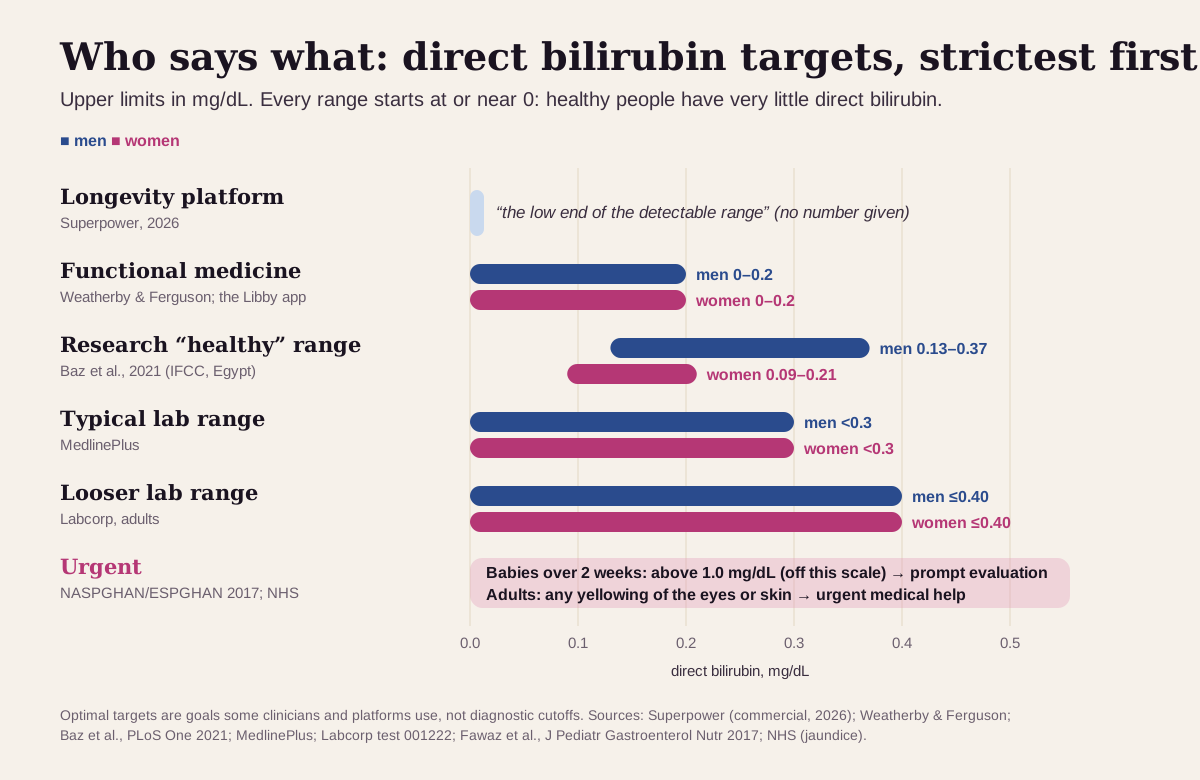
Optimizers treat direct bilirubin as a "lower is better" marker, and every target starts at or near zero. Here's the ladder, from the strictest upper limit to the loosest:
| Target | Men | Women | Who uses it |
|---|---|---|---|
| Strictest (longevity platform) | "the low end of the detectable range" | same | Superpower's published optimal range, which gives no number12 |
| Functional medicine | 0–0.2 mg/dL | 0–0.2 mg/dL | The optimal range shown in the Libby app, which its marker catalog credits to a standard functional-medicine textbook5 |
| Research "healthy" range | 0.13–0.37 mg/dL | 0.09–0.21 mg/dL | Healthy adults in Egypt, international reference-range study11 |
| Typical lab range | under 0.3 mg/dL | under 0.3 mg/dL | MedlinePlus3 |
| Looser lab range | up to 0.40 mg/dL | up to 0.40 mg/dL | Labcorp, adults and children over 1 month4 |
| Urgent | any yellowing of the eyes or skin | same | Get urgent medical help.7 In a baby over 2 weeks old, above 1.0 mg/dL needs prompt evaluation8 |
The American College of Gastroenterology sets no direct-bilirubin number of its own. It treats any raised direct bilirubin as a sign of liver-cell disease or blocked bile flow "in most settings".2
Why the low targets make sense:
- A rise is specific. Because healthy livers clear conjugated bilirubin so fast, an increase is usually a sign of liver disease.1 A lab-medicine review calls a conjugated rise highly specific for liver damage.9
- Small differences inside the normal range track with outcomes, at least in very sick people. In 5,322 Chinese patients with acute coronary syndrome and disease in all three heart arteries, followed for a median of 6.5 years, those in the top quarter of direct bilirubin (above about 0.16 mg/dL) had a 31% higher risk of death than those in the bottom quarter (about 0.09 mg/dL or less), after adjustment. Both cutoffs sit well inside a normal lab range.13
Keep "optimal" in perspective: these are targets, not diagnoses. The heart study shows an association in very ill patients, not proof that pushing a healthy person's direct bilirubin lower helps. A result of 0.25 mg/dL sits inside every lab range; what matters more is the pattern with ALT, ALP and GGT, and whether the number climbs over repeat tests.2
What a high direct bilirubin usually means
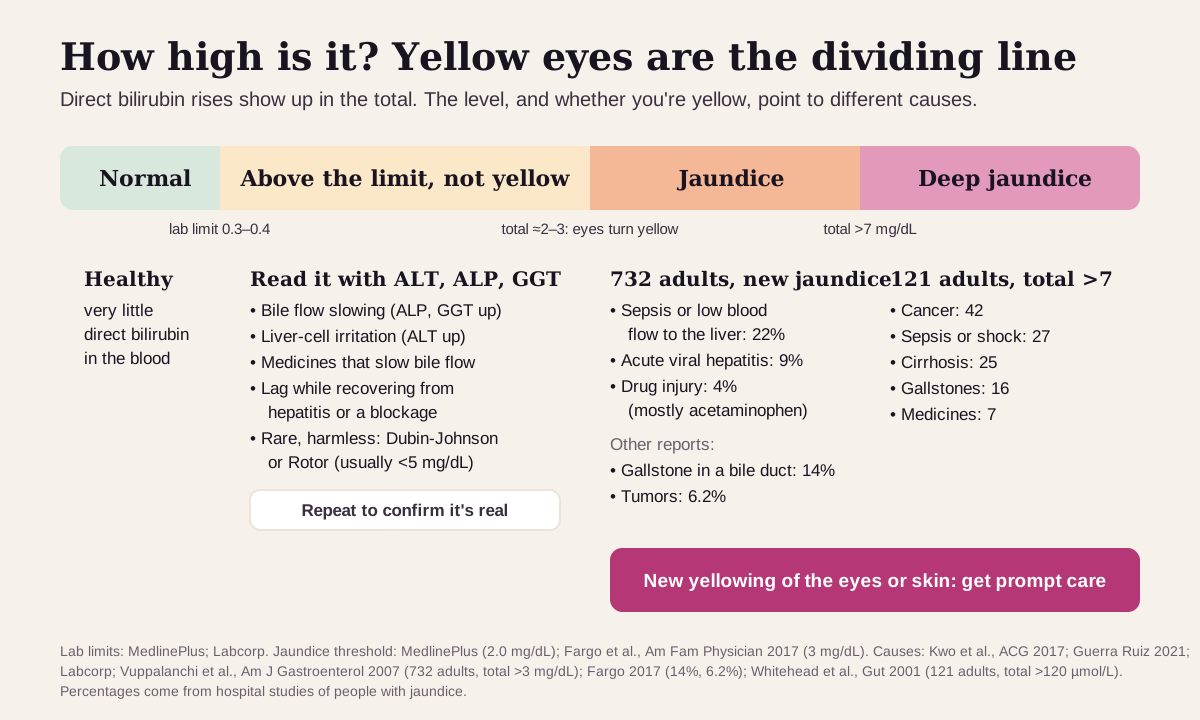
A high direct bilirubin means processed bilirubin is backing up into the blood. Either injured liver cells leak it and struggle to push it into bile, or bile is blocked on its way out.29 Two things narrow it down fast: how high it is, especially whether your eyes or skin have turned yellow, and what ALT, ALP and GGT are doing (see patterns below).
A little above the limit, with no yellowing
If your result is a little over the limit and you feel well, here's what to look at:
- Repeat it. The ACG recommends repeating an abnormal liver panel to confirm it before starting a workup.2
- Read the pattern. ALP and GGT up alongside it points to bile flow; ALT up points to the liver cells themselves.21
- Medicines. Some drugs slow bile flow; oral contraceptives and cyclosporine are examples, and Labcorp lists "cholestatic drug reactions" among the causes.94 Don't stop a prescribed medicine on your own. Bring your full list, supplements included, to your clinician.
- Recent illness or surgery. A bilirubin rise after major surgery usually settles by itself.2 Direct bilirubin also lags for weeks after hepatitis or a blocked duct clears (see how fast it changes).210
- Rare and harmless: Dubin-Johnson and Rotor syndromes. These inherited traits keep direct bilirubin at about half the total, usually under 5 mg/dL, with every other liver test normal.24 A lab-medicine review calls Rotor syndrome a "benign" condition.9
Jaundice: the usual suspects
Once total bilirubin climbs past about 2–3 mg/dL, the whites of the eyes and then the skin turn yellow.36 Among 732 adults with new jaundice at a U.S. community hospital, the single most common cause was sepsis or a drop in blood flow to the liver (22%). Acute viral hepatitis caused 9%, and drug injury 4%, mostly from acetaminophen.14
The causes, grouped by where the backup happens:
- A gallstone blocking a bile duct. It's the most common non-cancer cause of blocked bile, behind 14% of new jaundice cases.6 ALP and GGT usually climb with it, and an ultrasound is the usual first test.926
- Hepatitis. Worldwide, viral hepatitis is the biggest cause of liver disease, mostly hepatitis C. Alcohol-related hepatitis and cirrhosis are the other common ones.6
- Serious whole-body illness. Sepsis disrupts how the liver handles bilirubin, and low blood pressure starves the liver of blood.614
- Medicines and toxins, from an acetaminophen overdose to a drug reaction that slows bile flow.141
- Advanced fatty liver. About 30–40% of people with fatty liver disease develop the inflamed form, and 40–50% of those go on to scarring that can raise bilirubin.6
- Tumors that block the bile ducts, such as cancer of the pancreas or bile ducts: 6.2% of new jaundice overall.6 They dominate when jaundice is deep: in a Welsh study of 121 adults with a total bilirubin above about 7 mg/dL, cancer caused 42 cases, sepsis or shock 27, cirrhosis 25, and gallstones 16.15
- Less common causes: primary biliary cholangitis, primary sclerosing cholangitis, autoimmune hepatitis, and cholestasis of pregnancy.26
Get prompt care if your skin or the whites of your eyes turn yellow, especially with itching, dark urine or pale stools.7 Belly pain, fever or weight loss with those signs can mean a blocked bile duct.6
Babies are different
Many newborns turn yellow in the first days of life from the indirect form, and that's usually harmless.7 A direct rise in a baby is always abnormal: it affects about 1 in 2,500 term infants, and biliary atresia, a blockage of the bile ducts, is the most common cause (25–40%). The North American and European pediatric gastroenterology and liver societies recommend that any baby still yellow after 2 weeks of age get total and direct bilirubin measured, and that a direct bilirubin above 1.0 mg/dL (17 µmol/L) lead to prompt referral.8
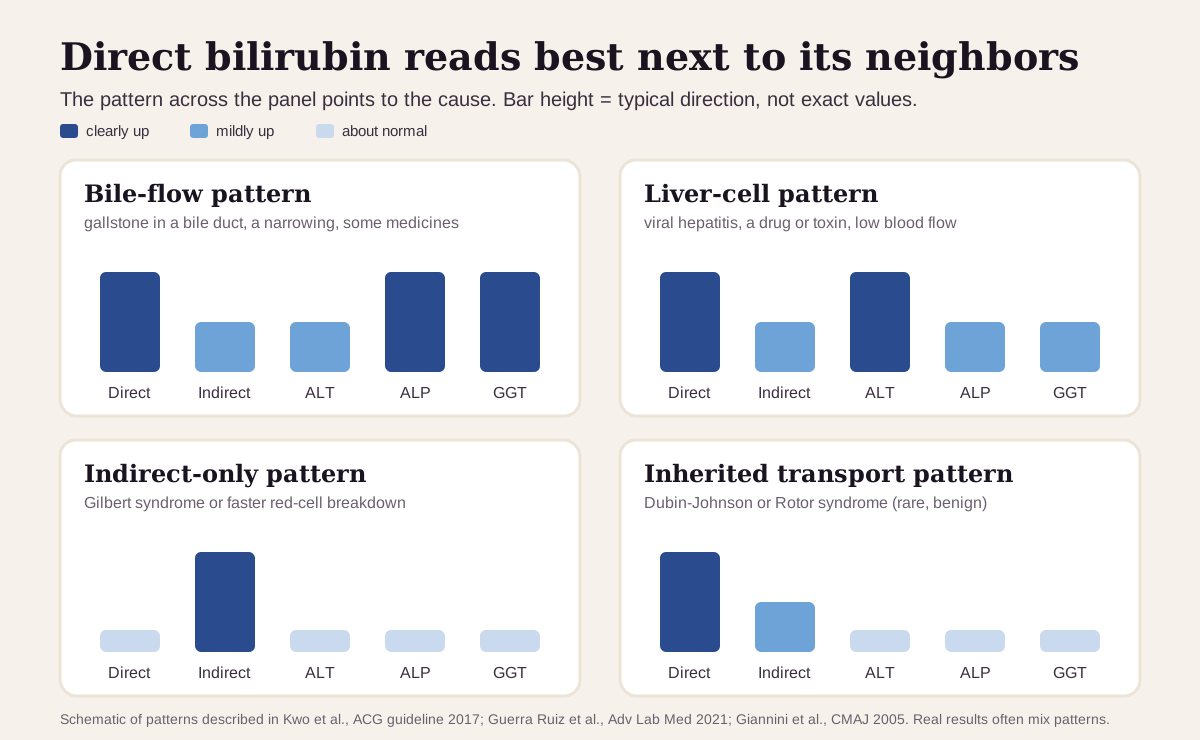
Direct bilirubin reads best next to its neighbors
Direct bilirubin rarely comes alone. The pattern across your liver panel usually says more than the number itself:2
| If you see… | It often points to… |
|---|---|
| Direct bilirubin, ALP and GGT up, ALT only a little | a bile-flow ("cholestatic") pattern: a gallstone in a bile duct, a narrowing, a tumor, or a drug reaction; ultrasound is the usual next step |
| ALT up a lot, direct bilirubin up too | a liver-cell ("hepatocellular") pattern: viral hepatitis, a drug or toxin, or low blood flow. With alcohol, AST usually runs at least twice ALT |
| Indirect bilirubin up (usually mildly), direct and liver enzymes normal | Gilbert syndrome (3–7% of Americans) or faster red-cell breakdown; a blood count, reticulocytes, haptoglobin and LDH tell them apart |
| Direct about half the total, every other liver test normal | Dubin-Johnson or Rotor syndrome: rare, inherited and benign |
| Direct still up for a few weeks while hepatitis or a blockage is clearing | often the expected lag from delta bilirubin |
When the total is high and most of the rise is indirect, the ACG says liver-cell disease is unlikely to be the reason.2
Is a low direct bilirubin a problem?
No. A direct bilirubin of 0.0 or 0.1 mg/dL is the expected healthy result, because the liver clears the processed form into bile so quickly.1 Even a commercial testing company calls values at the low end "normal and expected".12
How fast direct bilirubin changes
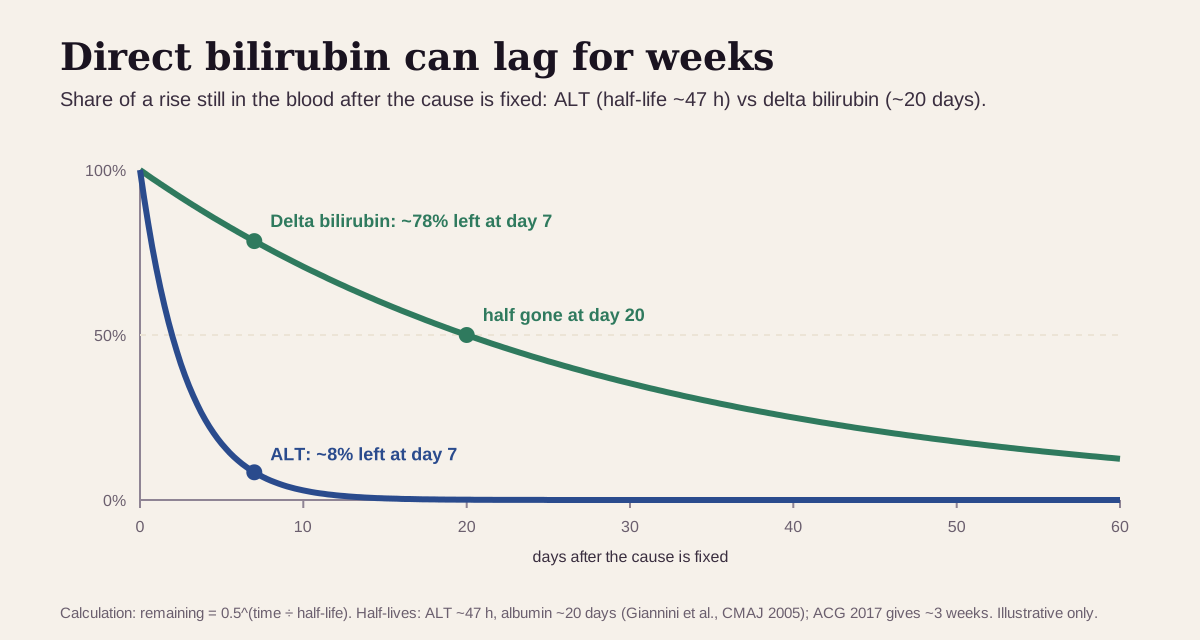
Direct bilirubin falls in two steps. When the cause is fixed, bilirubin drops quickly at first, then slowly. The slow part is delta bilirubin: processed bilirubin that has bonded permanently to albumin. It stays in the blood as long as albumin does, with a half-life of about 20 days (the ACG says 3 weeks).12
What that means in practice:
- Direct bilirubin can stay up after you feel better. In 200 patients with high bilirubin, delta bilirubin made up 8–90% of the total in liver and bile-duct disease. It grew as a share while jaundice faded, and kept bilirubin in the blood after it had cleared from the urine.10
- The lag is normal, and ALT gets there first. ALT's half-life is about 47 hours, so it settles in days while direct bilirubin takes weeks.1
- Trends beat snapshots. A direct bilirubin that climbs over several tests tells a different story than one that drifts down. Compare results from the same lab, because methods differ.9
Going deeper: what "direct" actually measures
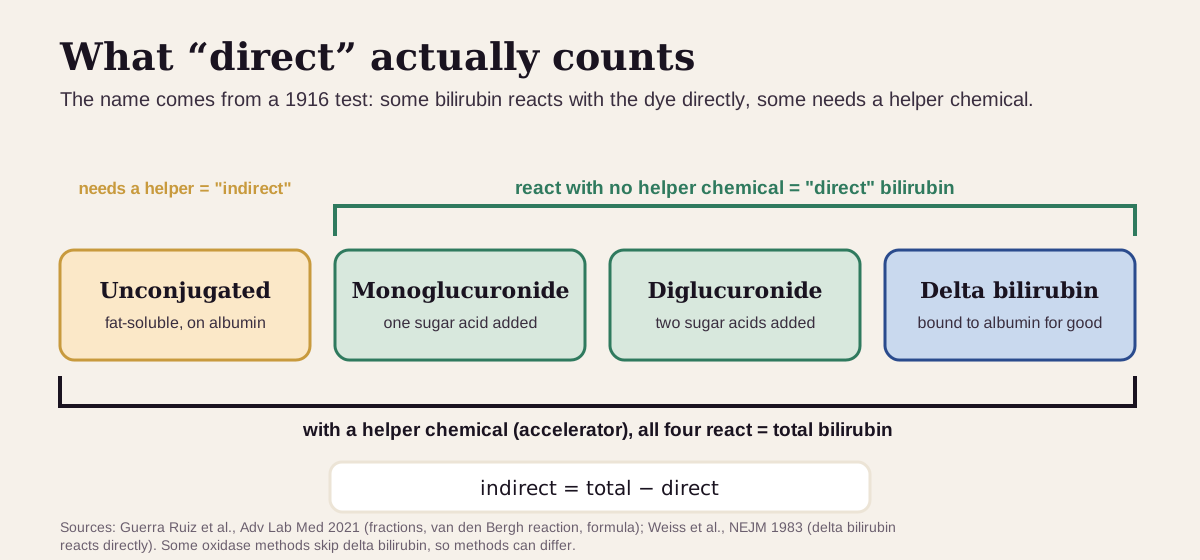
The names "direct" and "indirect" come from a test described in 1916 by van den Bergh and Müller. Conjugated bilirubin reacts with the diazo dye right away. Unconjugated bilirubin reacts only after a helper chemical (an "accelerator") is added, which is why it's called indirect.9
Chemistry separates bilirubin in blood into four forms: unconjugated bilirubin, bilirubin with one sugar acid attached (monoglucuronide), with two (diglucuronide), and delta bilirubin, bonded to albumin.9 Delta bilirubin reacts directly too, which is why it shows up in the direct result and why the result lingers.10
The lab calculates:
indirect bilirubin = total bilirubin − direct bilirubin
The diazo reaction is still the reference method. Some enzyme-based (oxidase) methods skip delta bilirubin, so two labs can report slightly different direct values for the same blood.9 Labcorp also notes that some methods have read direct bilirubin falsely high.4
Questions worth asking
- Is my direct bilirubin high by my lab's range, and what's my total bilirubin?
- What do my ALT, ALP and GGT show next to it?
- Should we repeat it, and at the same lab?
- Could any of my medicines or supplements be slowing bile flow?
- Do I need an ultrasound of my liver and bile ducts?
- If I'm recovering from hepatitis or a blocked duct, how long should it take to come down?
FAQ
What is a normal direct bilirubin? Most labs print less than 0.3 mg/dL, and some go up to 0.4. The optimal range in the Libby app is 0–0.2 mg/dL.345
What's the difference between direct and indirect bilirubin? Direct is the water-soluble form your liver has already processed. Indirect is the form still on its way to the liver. A high direct points to the liver or bile ducts; a high indirect with normal liver enzymes most often means Gilbert syndrome.29
Why is my direct bilirubin still high after I got better? Some of it is bonded to albumin (delta bilirubin), which clears with a half-life of about 3 weeks. It's the expected recovery pattern.210
When is a high direct bilirubin urgent? Yellow eyes or skin, dark urine, pale stools, or belly pain with fever need prompt care. In a baby older than 2 weeks, a direct bilirubin above 1.0 mg/dL needs prompt evaluation.768
This guide is for education. It's no substitute for care from a clinician who knows your history.
Footnotes
-
Giannini EG, Testa R, Savarino V. Liver enzyme alteration: a guide for clinicians. CMAJ. 2005;172(3):367–379. Conjugated bilirubin is "virtually absent" in healthy people; enzyme patterns; the two-step fall; half-lives of ALT (~47 h) and albumin (~20 days). PMC ↩ ↩2 ↩3 ↩4 ↩5 ↩6 ↩7 ↩8 ↩9 ↩10 ↩11
-
Kwo PY, Cohen SM, Lim JK. ACG Clinical Guideline: Evaluation of Abnormal Liver Chemistries. Am J Gastroenterol. 2017;112(1):18–35. The U.S. gastroenterology society's guideline: fractionating bilirubin, the ~70% indirect share, delta bilirubin's 3-week half-life, Dubin-Johnson and Rotor, and the hepatocellular and cholestatic patterns. PubMed ↩ ↩2 ↩3 ↩4 ↩5 ↩6 ↩7 ↩8 ↩9 ↩10 ↩11 ↩12 ↩13 ↩14 ↩15 ↩16 ↩17 ↩18 ↩19 ↩20 ↩21 ↩22 ↩23 ↩24 ↩25 ↩26
-
National Library of Medicine. Bilirubin blood test. MedlinePlus Medical Encyclopedia. Reviewed February 13, 2025. Direct bilirubin less than 0.3 mg/dL (5.1 µmol/L); jaundice from about 2.0 mg/dL. MedlinePlus ↩ ↩2 ↩3 ↩4 ↩5 ↩6 ↩7 ↩8 ↩9
-
Labcorp. Bilirubin, Direct (test 001222). A commercial laboratory's test page, opened September 23, 2026: reference range 0.00–0.40 mg/dL from 1 month of age; Dubin-Johnson and Rotor usually under 5 mg/dL; testing usually unnecessary when total bilirubin is under 1.2 mg/dL. labcorp.com ↩ ↩2 ↩3 ↩4 ↩5 ↩6 ↩7 ↩8 ↩9 ↩10 ↩11 ↩12
-
Weatherby D, Ferguson S. Blood Chemistry and CBC Analysis: Clinical Laboratory Testing from a Functional Perspective. Bear Mountain Publishing. ISBN 978-0976136712. Widely used functional-medicine reference. The Libby app's marker catalog credits its optimal direct bilirubin range of 0–0.2 mg/dL to this book (range as recorded in the catalog; the book was not opened for this article). ↩ ↩2 ↩3 ↩4
-
Fargo MV, Grogan SP, Saguil A. Evaluation of Jaundice in Adults. Am Fam Physician. 2017;95(3):164–168. Jaundice above 3 mg/dL; gallstones in the bile duct (14%) and tumors (6.2%) of new jaundice; signs of a blocked bile duct. PubMed ↩ ↩2 ↩3 ↩4 ↩5 ↩6 ↩7 ↩8 ↩9 ↩10 ↩11 ↩12 ↩13
-
NHS. Jaundice. Last reviewed January 22, 2024. Yellow skin or eyes need urgent medical help; newborn jaundice is common and usually harmless. nhs.uk ↩ ↩2 ↩3 ↩4 ↩5 ↩6
-
Fawaz R, Baumann U, Ekong U, et al. Guideline for the Evaluation of Cholestatic Jaundice in Infants: Joint Recommendations of NASPGHAN and ESPGHAN. J Pediatr Gastroenterol Nutr. 2017;64(1):154–168. The North American and European pediatric liver societies' guideline: test any baby still jaundiced after 2 weeks; refer above 1.0 mg/dL. PubMed ↩ ↩2 ↩3 ↩4 ↩5
-
Guerra Ruiz AR, Crespo J, López Martínez RM, et al. Measurement and clinical usefulness of bilirubin in liver disease. Adv Lab Med. 2021;2(3):352–372. A lab-medicine review of bilirubin forms, the van den Bergh reaction, methods and causes. PMC ↩ ↩2 ↩3 ↩4 ↩5 ↩6 ↩7 ↩8 ↩9 ↩10 ↩11 ↩12 ↩13 ↩14 ↩15 ↩16 ↩17 ↩18 ↩19
-
Weiss JS, Gautam A, Lauff JJ, et al. The clinical importance of a protein-bound fraction of serum bilirubin in patients with hyperbilirubinemia. N Engl J Med. 1983;309(3):147–150. Delta bilirubin in 200 patients: 8–90% of the total in liver and bile-duct jaundice, absent in healthy volunteers. PubMed ↩ ↩2 ↩3 ↩4 ↩5 ↩6
-
Baz H, Ichihara K, Selim M, et al. Establishment of reference intervals of clinical chemistry analytes for the adult population in Egypt. PLoS One. 2021;16(3):e0236772. Part of the IFCC global reference-interval project; direct bilirubin 0.13–0.37 mg/dL in 289 men and 0.09–0.21 mg/dL in 327 women. PMC ↩ ↩2 ↩3 ↩4
-
Superpower. Direct Bilirubin: Best Biomarkers. Last updated September 1, 2026. Says optimal values "sit at the low end of the detectable range" and gives no number. A commercial source, listed as what the optimizer community uses. superpower.com ↩ ↩2 ↩3
-
Liu Y, Zhang C, Jiang L, et al. Direct Bilirubin Levels Predict Long-Term Outcomes in Patients With Acute Coronary Syndrome Under Different Glucose Metabolism Status: A 6.5-Year Cohort Study of Three-Vessel Disease. Front Cardiovasc Med. 2021;8:715539. Top vs bottom quarter: hazard ratio 1.31 (95% CI 1.06–1.62) for death. PMC ↩
-
Vuppalanchi R, Liangpunsakul S, Chalasani N. Etiology of new-onset jaundice: how often is it caused by idiosyncratic drug-induced liver injury in the United States? Am J Gastroenterol. 2007;102(3):558–562. 732 adults with new jaundice (total bilirubin above 3 mg/dL) at a community hospital. PubMed ↩ ↩2 ↩3 ↩4
-
Whitehead MW, Hainsworth I, Kingham JG. The causes of obvious jaundice in South West Wales: perceptions versus reality. Gut. 2001;48(3):409–413. 121 adults with bilirubin above 120 µmol/L (about 7 mg/dL). PMC ↩ ↩2
Educational content, not medical advice. Libby is a personal record tool, not a medical service — it doesn't diagnose, treat, or prescribe. Reference ranges vary by lab and by person. Talk to a qualified healthcare professional about your results.
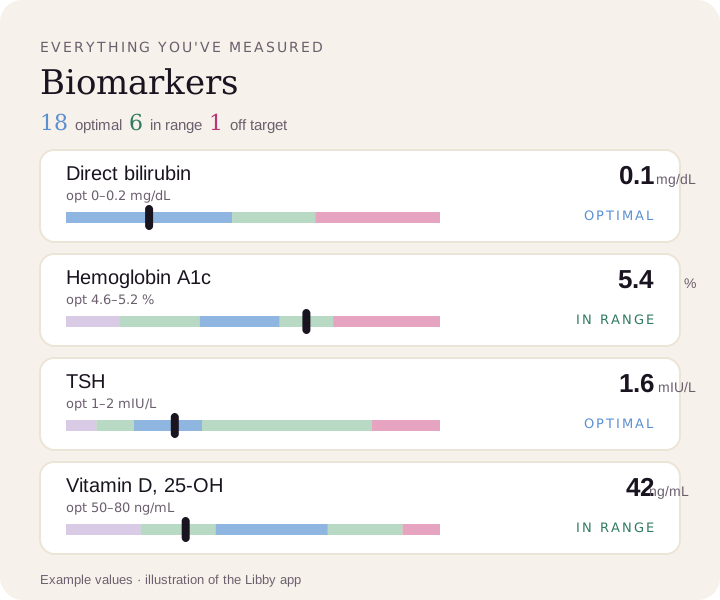
Compare your results to optimal ranges.
Upload a lab PDF or a photo of your report. Libby puts every marker on your lab's range and the optimal range, and tracks your trends over time.
View your direct bilirubin ›