Eosinophil percentage: what a high or low % means
Eosinophil % is the share of your white cells that are eosinophils. Here's a normal %, why a high one can mislead, and when to read the count instead.
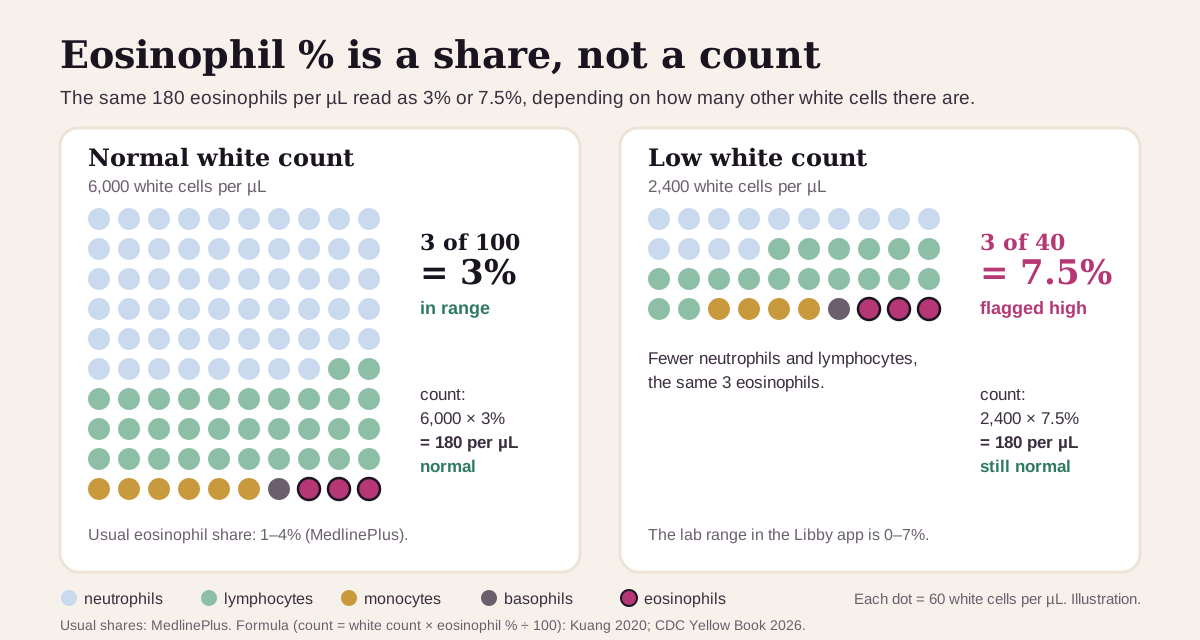
Your eosinophil percentage is the share of your white blood cells that are eosinophils, the white cells tied to allergies, asthma and parasites. Most people run about 1–4%.1 Because it's a share, it rises when your eosinophils rise or when your other white cells fall. That's why doctors grade a high result on the absolute eosinophil count printed next to it, not on the percentage.23
The short version
- Normal: about 1–4% by the MedlinePlus textbook range, and under 5% per an NIH review and the CDC.123 Lab ranges run a little wider; the Libby app uses 0–7%.
- A high percentage is a prompt to check the count. Eosinophilia means an absolute count above 500 cells/µL. A percentage above 6% with a normal count is only "relative" eosinophilia.4 A low total white count makes the percentage look high while the count stays normal.3
- When the count is truly high, the usual reasons are medicines, allergic conditions (asthma, hay fever, eczema) and parasites after travel.25
- Urgency comes from the count and symptoms, not the percentage. A count of 1,500 or more on two tests needs a workup, and a high count with chest pain or shortness of breath needs prompt care.46
What eosinophil percentage is
A complete blood count (CBC) with differential sorts your white blood cells into five types and reports each as a percentage of the total: neutrophils, lymphocytes, monocytes, eosinophils and basophils.1 Eosinophils are a small slice. They become active in allergic diseases and some infections, especially parasitic worms.5
The lab gets your absolute eosinophil count by multiplying the percentage by your total white count:52
absolute count = total white count × eosinophil % ÷ 100
So the two numbers on your report carry different information. The count tells you how many eosinophils are in your blood. The percentage tells you how big a slice they are, and that slice changes whenever any other white cell changes. MedlinePlus puts it plainly: an abnormal increase in one type of white cell lowers the percentage of the others.1 For the full picture of the count itself, see our guide to the absolute eosinophil count.
What's a normal eosinophil percentage?
Start with the range on your own report. The common reference points:
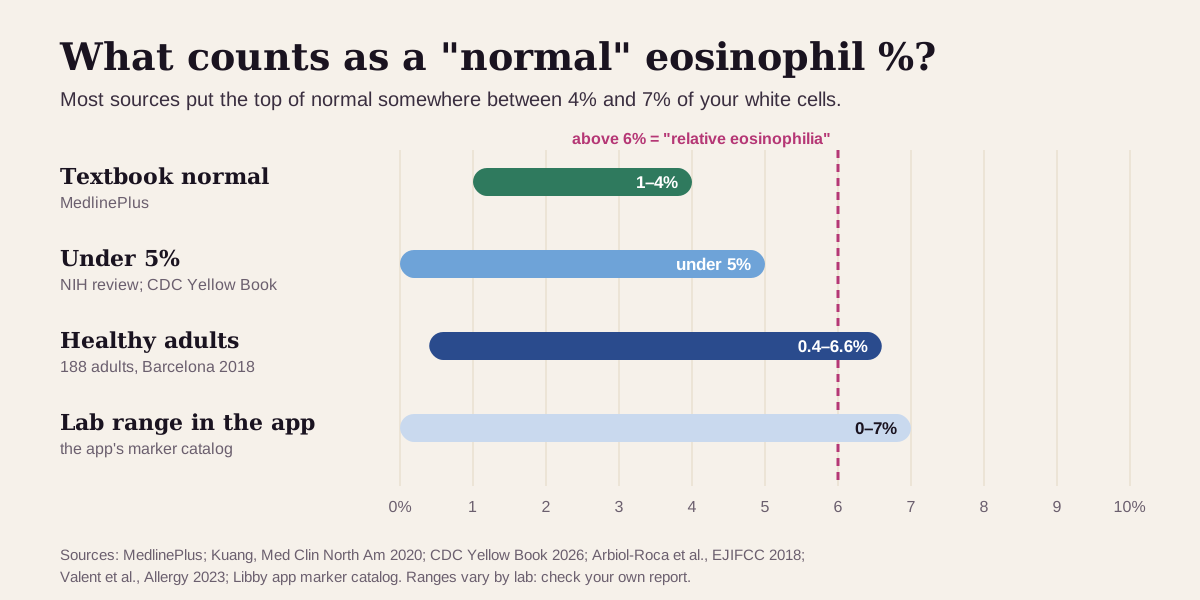
- MedlinePlus, the National Library of Medicine's patient site, lists a normal share of 1–4%.1
- An NIH review calls the typical percentage less than 5%, and the CDC Yellow Book calls under 5% normal.23
- In 188 healthy adults in Barcelona, measured on a modern Sysmex XN analyzer, the central 95% ran from 0.4% to 6.6%. The same study put the healthy count at 30–390 cells/µL.7
- The international consensus on eosinophil disorders calls a share above 6% "relative eosinophilia," and a count above 500 cells/µL "absolute eosinophilia."4
- Some labs print no range for the percentage at all. Labcorp's sample CBC report shows "Not Estab." (not established) next to all five white-cell percentages and gives ranges only for the counts: 0.0–0.4 ×10³/µL for eosinophils.8
The Barcelona group found no difference between men and women worth splitting the eosinophil range for, so one range covers both.7
"Optimal" eosinophil percentage: what health optimizers aim for
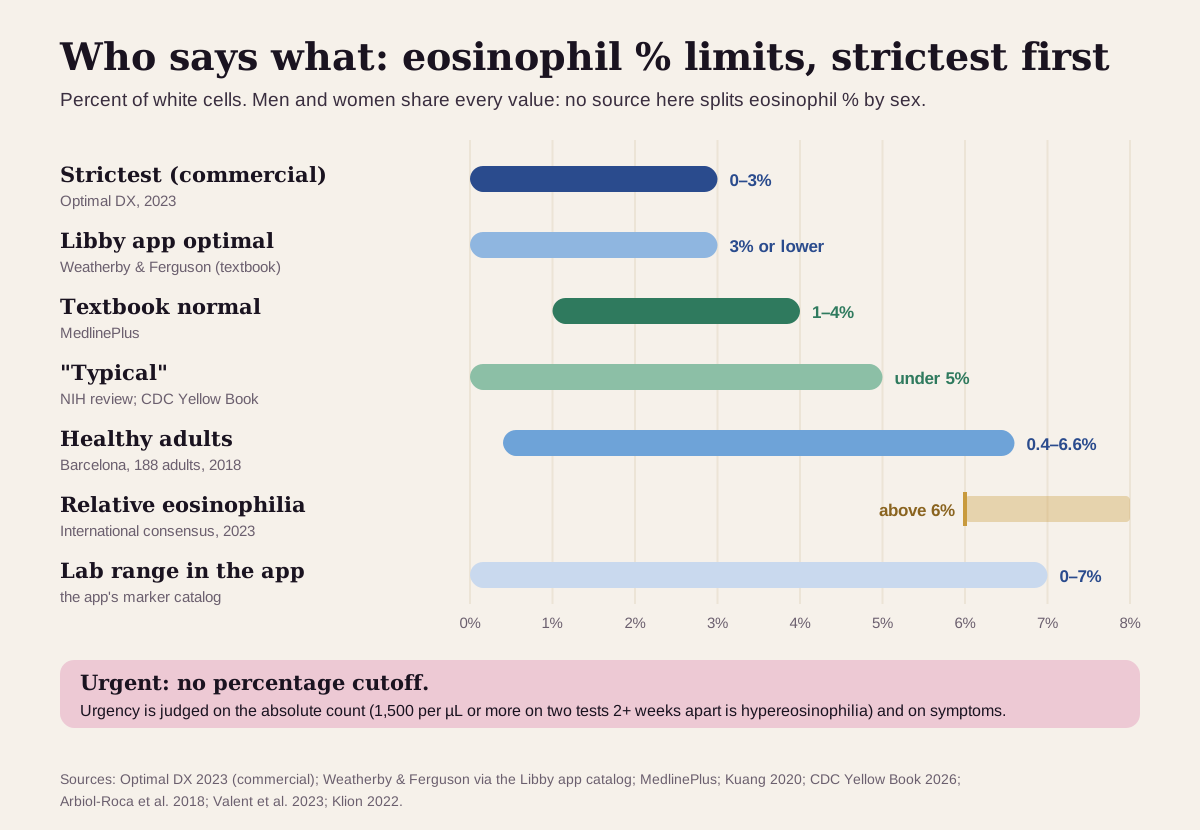
Functional-medicine practitioners aim for the low end of the textbook range. Here's the ladder from strictest to loosest. Every value applies to men and women alike, because none of these sources splits the percentage by sex.
| Target | Men and women | Who uses it |
|---|---|---|
| Strictest (functional-medicine database) | 0–3% | Optimal DX's published range9 |
| Functional medicine | 3% or lower | The optimal range shown in the Libby app, recorded from the Weatherby & Ferguson functional-medicine textbook10 |
| Textbook normal | 1–4% | MedlinePlus1 |
| "Typical" | under 5% | An NIH review and the CDC Yellow Book23 |
| Research "healthy" range | 0.4–6.6% | 188 healthy adults, Barcelona7 |
| Relative eosinophilia | above 6% | International consensus, 20234 |
| Lab range | 0–7% | The reference range in the Libby app's marker catalog; Labcorp's sample report prints none for the percentage8 |
| Urgent | no percentage cutoff | Graded on the count: 1,500 cells/µL or more on two tests at least 2 weeks apart is hypereosinophilia, and heart or clotting symptoms need care now46 |
Why a lower percentage can matter. The clearest outcome data for the percentage itself come from lung disease. In two year-long trials of 3,177 people with COPD, researchers split patients by their starting eosinophil percentage. Flare-up rates climbed with each higher group in people on a bronchodilator alone. Adding an inhaled steroid cut flare-ups by 10% below 2% (a difference that could be chance), 24% at 2–4%, 32% at 4–6% and 42% at 6% or more.11
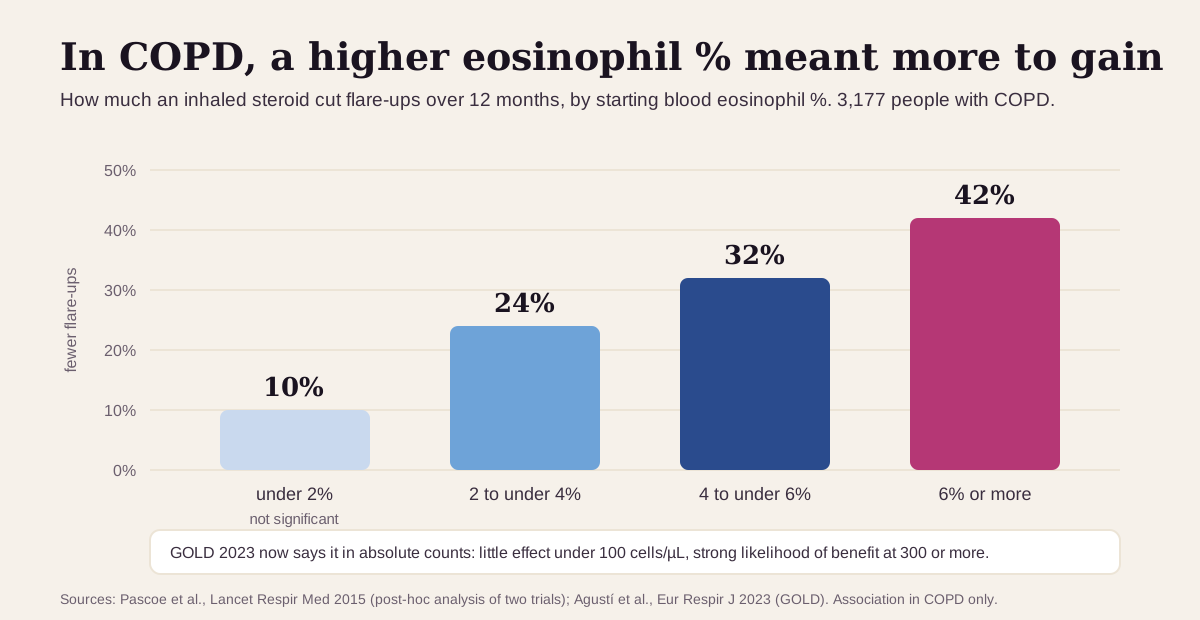
That same idea now lives in the COPD guideline as absolute counts. The Global Initiative for Chronic Obstructive Lung Disease (GOLD) says an inhaled steroid does little below 100 cells/µL and is most likely to help at 300 or more.12 The move from a percentage to a count mirrors this guide: the count is the number guidelines act on.
Keep "optimal" in perspective. These are targets, not diagnoses, and the optimizer ranges come from a textbook, not an outcome study. A 4.5% with a normal count is a reason to think about allergies, asthma control and recent medicines, not a finding in itself. Lower isn't automatically better, either: steroids and acute illness push the percentage toward zero (more below).52
What a high eosinophil percentage usually means
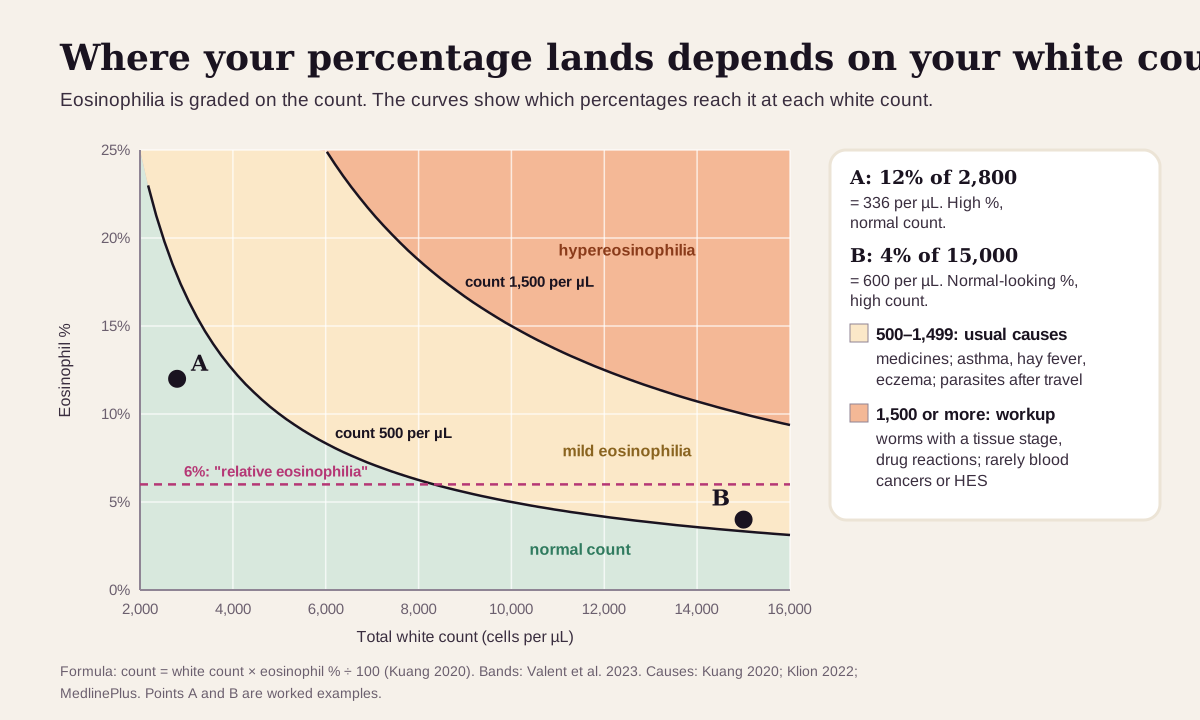
Step one is the absolute count next to it. The CDC's travel-medicine guidance says the degree of eosinophilia should not be set by the percentage, because the percentage moves with the other cell types.3 Where your percentage lands depends on your white count:
High percentage, normal count: a "relative" rise
This is the common false alarm. If your total white count is low, the eosinophils you do have make up a bigger slice.3 The count is the tie-breaker: 12% of a white count of 2,800 is 336 cells/µL, which is normal. MedlinePlus lists the flu and other viral infections, chemotherapy and radiation among the common reasons for a lower neutrophil share.1 If your white count is low, that's the result to follow up, and our white blood cell count guide covers it.
High percentage, high count: true eosinophilia
When the count is above 500 cells/µL, the percentage was telling the truth. The usual suspects (an NIH review ranks medicines first in wealthy countries and parasites first worldwide):2
- Medicines. An NIH review names medicines as the most common cause of eosinophilia in the developed world.2 Some antibiotics, psyllium laxatives and interferon are examples.5 Don't stop a prescribed medicine on your own; bring your full list, supplements included, to your clinician.
- Allergic conditions. Asthma, hay fever and eczema all raise eosinophils.5 (Total IgE, an allergy antibody, is covered in our total IgE guide.)
- Parasites. Worldwide, parasitic infections are the most common cause.2 The American Society of Hematology review singles out worms with a stage that invades tissue.6
- Less common causes: low adrenal function (Addison disease), autoimmune and vasculitis conditions, fungal infections, and blood cancers such as leukemia and lymphoma.51
A count of 1,500 or more on two tests at least 2 weeks apart is hypereosinophilia, and it needs a full workup.4 Specialists start with your prior blood counts, medicines and travel, then tests such as vitamin B12 and tryptase.6
Get prompt care if a high eosinophil count comes with chest pain, shortness of breath, a racing heart or fainting, which can signal heart inflammation (myocarditis),13 or with fever, a spreading rash and facial swelling after starting a new medicine (a delayed drug reaction called DRESS).14 Specialists treat heart involvement and blood clots as urgent.6
Is a low eosinophil percentage a problem?
Usually not. The NIH review's normal count starts at zero, and the healthy Barcelona range starts at 0.4%.27 Steroid medicines and your own stress hormone, cortisol, lower it, and so can alcohol intoxication.5 In 20 healthy volunteers given one IV steroid dose, the eosinophil share fell within 4 hours while the neutrophil share rose.15 Acute bacterial infection can do the same, and steroids or infection can temporarily hide a high count until they pass.2
Eosinophil percentage reads best next to its neighbors
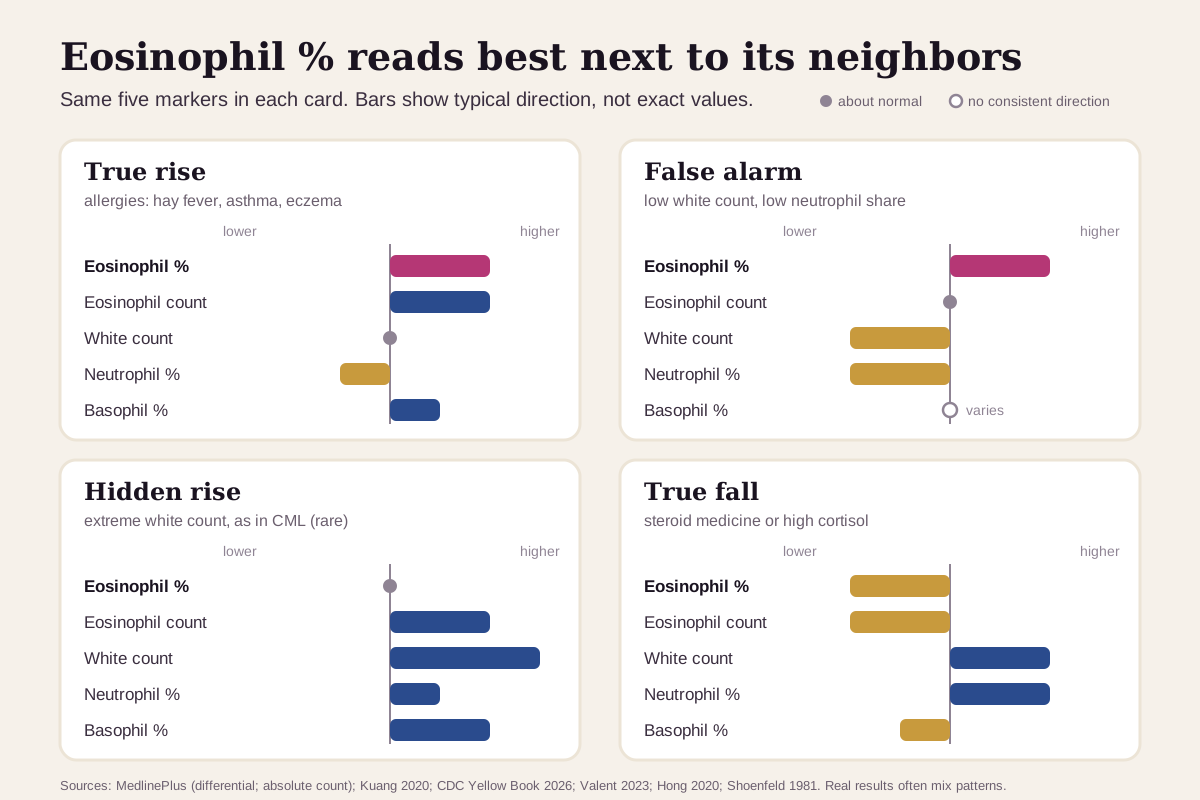
The rest of your differential decides what your percentage means. These four patterns use the same five markers:
| If you see… | It often points to… |
|---|---|
| Eosinophil % and count both up, basophil % up | an allergic condition such as hay fever, asthma or eczema; medicines and parasites raise the count too |
| Eosinophil % up, count normal, white count and neutrophil % down | a false alarm from a low white count; MedlinePlus lists the flu, other viral infections and chemotherapy among causes of a lower neutrophil share |
| Eosinophil % normal-looking, count up, white count far up, neutrophil % and basophil % up | eosinophils hidden inside an extreme white count, as in some myeloid leukemias such as CML (rare) |
| Eosinophil % and count down, white count and neutrophil % up, basophil % down | a steroid medicine such as prednisone, or high levels of your body's own cortisol |
The hidden-rise pattern is the mirror image of the false alarm. In some myeloid leukemias with an extreme white count, the consensus notes eosinophils can reach 1,500 cells/µL or more while making up under 3% of white cells.4 The steroid row comes from studies of the drugs themselves: one IV dose raised the neutrophil share and lowered the eosinophil and basophil shares within 4 hours,15 and prednisone can push the white count past 20,000/mm³ from the first day.16
How fast eosinophil percentage changes
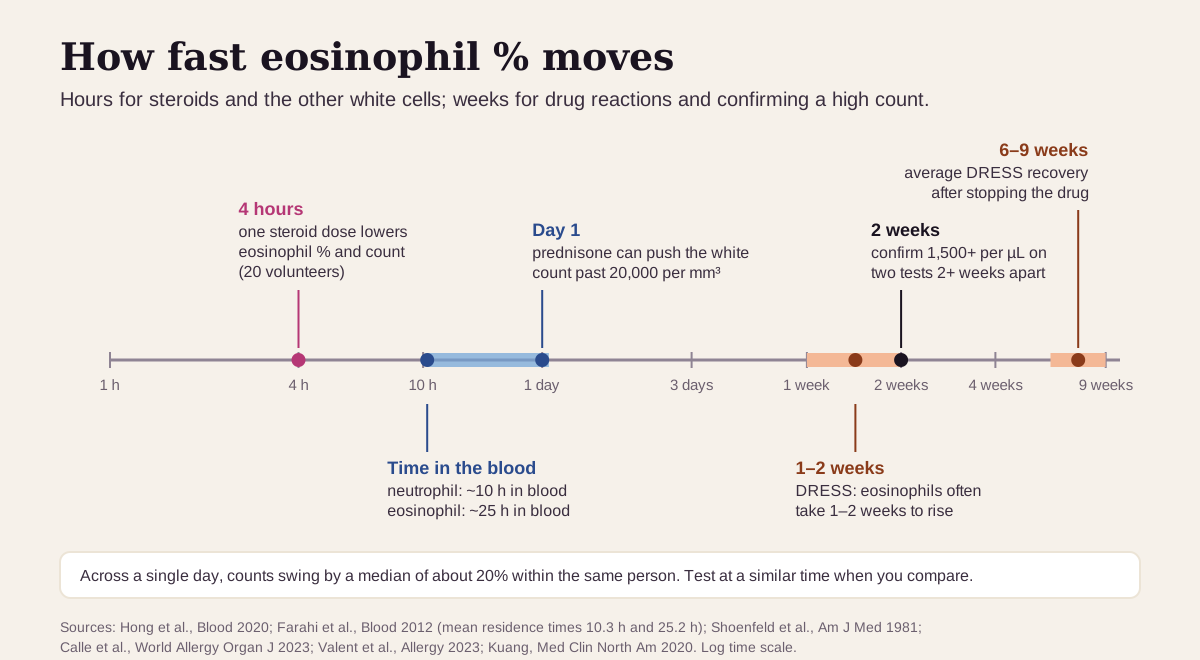
The percentage has two clocks, and one of them belongs to other cells. In a tracer study of healthy volunteers, eosinophils stayed in the blood for about 25 hours on average, neutrophils for about 10.17 Since neutrophils are the largest share of your white cells, a surge or dip in neutrophils can move your eosinophil percentage within a day. Prednisone, for example, can push the white count past 20,000/mm³ on the first day.16
What that means in practice:
- Steroids act within hours. One IV dose lowered the eosinophil share within 4 hours in healthy volunteers.15
- Time of day matters. Counts swing by a median of about 20% within the same person over a day, so compare results drawn at a similar time.2
- Drug reactions are slower. In DRESS, the eosinophil rise often takes 1–2 weeks to appear, and recovery after stopping the drug averages 6–9 weeks.14
- One high result is a starting point. Hypereosinophilia is confirmed on two tests at least 2 weeks apart.4
- Trends beat snapshots, and the count's trend is the one to follow. Specialists start by pulling your prior blood counts.6
Going deeper: when the percentage still matters
Guidelines grade eosinophilia on the count,43 yet the percentage still earns a place in a few specific rules.
When the white count is low. The RegiSCAR score for DRESS gives points for an eosinophil count of 700–1,499/µL (1 point) or 1,500 or more (2 points). If your total white count is under 4,000/µL, it scores the percentage instead: 10–19.9% for 1 point, 20% or more for 2.14 A low white count shrinks the absolute count, so the score leans on the share.
When the white count is extreme. In chronic or acute myeloid leukemia, the consensus defines hypereosinophilia as a count of 1,500 or more and at least 10% eosinophils, both for at least 2 weeks.4 A huge white count can carry a high eosinophil number that's a tiny slice.
In the research that shaped COPD care. The Pascoe analysis of two COPD trials split patients at a 2% cut point.11 Today's GOLD guidance uses 100 and 300 cells/µL instead.12
How the slice is measured. On a manual smear, a technician counts eosinophils per 100 cells.5 With only 100 cells counted, one extra eosinophil moves the result by a full percentage point, so a small difference between two manual counts can be noise.
Read more about the other slices in our neutrophil percentage guide.
Questions worth asking
- What is my absolute eosinophil count, and is it above 500 cells/µL?
- Is my total white count low, and could that explain a high percentage?
- Could any of my medicines or supplements be raising my eosinophils?
- Do my asthma, allergies or eczema explain this level?
- Given where I've lived or traveled, should I be tested for parasites?
- Should we repeat the CBC, at the same time of day and away from any steroid dose?
FAQ
What is a normal eosinophil percentage? About 1–4% by the MedlinePlus textbook range, and under 5% per an NIH review and the CDC. Many lab ranges run to 6–7%.123
Is 7% eosinophils high? It's above many ranges, but check the absolute count. With a low white count, 7% can still be a normal number of eosinophils; eosinophilia means a count above 500 cells/µL.34
Why is my eosinophil percentage high but my absolute count normal? Usually because your other white cells, most often neutrophils, are low. The eosinophils take a bigger slice without growing in number.23
When is a high eosinophil result an emergency? When the count is high and you have chest pain, shortness of breath or fainting, or fever, rash and facial swelling after a new medicine. A count of 1,500 or more on repeat tests needs a workup even without symptoms.613144
This guide is for education. It can't diagnose you or replace care from a clinician who knows your history.
Footnotes
-
National Library of Medicine. Blood differential test. MedlinePlus Medical Encyclopedia. Reviewed February 3, 2025. Normal shares (neutrophils 40–60%, lymphocytes 20–40%, monocytes 2–8%, eosinophils 1–4%, basophils 0.5–1%) and the causes of higher and lower shares. MedlinePlus ↩ ↩2 ↩3 ↩4 ↩5 ↩6 ↩7 ↩8 ↩9 ↩10 ↩11 ↩12 ↩13
-
Kuang FL. Approach to Patients with Eosinophilia. Med Clin North Am. 2020;104(1):1–14. NIH review: the count formula, a typical percentage under 5%, why percentages mislead, medicines as the most common cause in the developed world and parasites worldwide, daily variation, and masking by steroids and infection. PMC ↩ ↩2 ↩3 ↩4 ↩5 ↩6 ↩7 ↩8 ↩9 ↩10 ↩11 ↩12 ↩13 ↩14 ↩15 ↩16 ↩17 ↩18 ↩19 ↩20 ↩21 ↩22
-
Wendt EM, Kamb ML, Montgomery SP. Post-Travel Parasitic Disease Including Evaluation of Eosinophilia. CDC Yellow Book 2026. Updated April 23, 2025. The CDC's guidance that eosinophilia should be graded on the count, since a low white count raises the percentage. CDC ↩ ↩2 ↩3 ↩4 ↩5 ↩6 ↩7 ↩8 ↩9 ↩10 ↩11 ↩12 ↩13 ↩14 ↩15
-
Valent P, Klion AD, Roufosse F, et al. Proposed refined diagnostic criteria and classification of eosinophil disorders and related syndromes. Allergy. 2023;78(1):47–59. The international consensus behind absolute (above 0.5 ×10⁹/L) versus relative (above 6%) eosinophilia, hypereosinophilia on two tests at least 2 weeks apart, and the 10% rule in myeloid leukemias. PMC ↩ ↩2 ↩3 ↩4 ↩5 ↩6 ↩7 ↩8 ↩9 ↩10 ↩11 ↩12 ↩13 ↩14 ↩15 ↩16 ↩17
-
National Library of Medicine. Eosinophil count - absolute. MedlinePlus Medical Encyclopedia. Reviewed January 28, 2025. How the count is calculated from the percentage, the under-500 normal value, and common causes of high and low counts. MedlinePlus ↩ ↩2 ↩3 ↩4 ↩5 ↩6 ↩7 ↩8 ↩9 ↩10 ↩11
-
Klion AD. Approach to the patient with suspected hypereosinophilic syndrome. Hematology Am Soc Hematol Educ Program. 2022;2022(1):47–54. American Society of Hematology education review: the workup, tissue-stage worms, and urgent treatment for heart involvement or blood clots. PMC ↩ ↩2 ↩3 ↩4 ↩5 ↩6 ↩7 ↩8 ↩9
-
Arbiol-Roca A, Imperiali CE, Montserrat MM, et al. Reference intervals for a complete blood count on an automated haematology analyser Sysmex XN in healthy adults from the southern metropolitan area of Barcelona. EJIFCC. 2018;29(1):48–54. 191 healthy adults; eosinophils 0.4–6.6% (n = 188) and 0.03–0.39 ×10⁹/L, one range for both sexes. PMC ↩ ↩2 ↩3 ↩4 ↩5 ↩6
-
Labcorp. Complete Blood Count (CBC) With Differential/Platelet, test 005009: sample patient reports. Eosinophils (and every other white-cell percentage) printed with the reference interval "Not Estab."; Eos (Absolute) 0.0–0.4 ×10³/µL. A commercial lab's own report, cited for what it prints. files.labcorp.com ↩ ↩2
-
Optimal DX. Biomarkers of Immunity: Eosinophils. Published June 27, 2023; updated November 1, 2023. Lists "The ODX Range" for eosinophils as 0.00–3.00%. A commercial source, listed as what the optimizer community uses. optimaldx.com ↩ ↩2
-
Weatherby D, Ferguson S. Blood Chemistry and CBC Analysis: Clinical Laboratory Testing from a Functional Perspective. 2nd ed. Bear Mountain Publishing; 2004. ISBN 978-0976136712. Widely used functional-medicine reference (range as recorded in the Libby app's marker catalog; the book was not opened for this article). The catalog records it as the source of the Libby app's optimal eosinophil range: 3% or lower. ↩ ↩2
-
Pascoe S, Locantore N, Dransfield MT, Barnes NC, Pavord ID. Blood eosinophil counts, exacerbations, and response to the addition of inhaled fluticasone furoate to vilanterol in patients with chronic obstructive pulmonary disease: a secondary analysis of data from two parallel randomised controlled trials. Lancet Respir Med. 2015;3(6):435–442. 3,177 people with COPD, grouped by starting eosinophil percentage. PubMed ↩ ↩2 ↩3
-
Agustí A, Celli BR, Criner GJ, et al. Global Initiative for Chronic Obstructive Lung Disease 2023 Report: GOLD Executive Summary. Eur Respir J. 2023;61(4):2300239. Blood eosinophils under 100 cells/µL predict little inhaled-steroid benefit, 300 or more a strong likelihood of benefit. PMC ↩ ↩2 ↩3
-
National Library of Medicine. Myocarditis. MedlinePlus Medical Encyclopedia. Reviewed January 27, 2026. Symptoms of heart inflammation: chest pain, shortness of breath, rapid heart rate, fainting. MedlinePlus ↩ ↩2
-
Calle AM, Aguirre N, Ardila JC, Cardona Villa R. DRESS syndrome: A literature review and treatment algorithm. World Allergy Organ J. 2023;16(3):100673. DRESS symptoms and timing, and the RegiSCAR score, which uses the eosinophil percentage when the white count is under 4,000/µL. PMC ↩ ↩2 ↩3 ↩4 ↩5
-
Hong SG, Sato N, Legrand F, et al. Glucocorticoid-induced eosinopenia results from CXCR4-dependent bone marrow migration. Blood. 2020;136(23):2667–2678. 20 healthy volunteers, one 250 mg IV dose of methylprednisolone, blood counts before and 4 hours after. PMC ↩ ↩2 ↩3 ↩4 ↩5
-
Shoenfeld Y, Gurewich Y, Gallant LA, Pinkhas J. Prednisone-induced leukocytosis. Influence of dosage, method and duration of administration on the degree of leukocytosis. Am J Med. 1981;71(5):773–778. 80 patients: a neutrophil-driven rise in white count, with fewer eosinophils. PubMed ↩ ↩2 ↩3 ↩4
-
Farahi N, Singh NR, Heard S, et al. Use of 111-Indium-labeled autologous eosinophils to establish the in vivo kinetics of human eosinophils in healthy subjects. Blood. 2012;120(19):4068–4071. Mean time in the blood: 25.2 hours for eosinophils, 10.3 hours for neutrophils. PubMed ↩ ↩2
Educational content, not medical advice. Libby is a personal record tool, not a medical service — it doesn't diagnose, treat, or prescribe. Reference ranges vary by lab and by person. Talk to a qualified healthcare professional about your results.
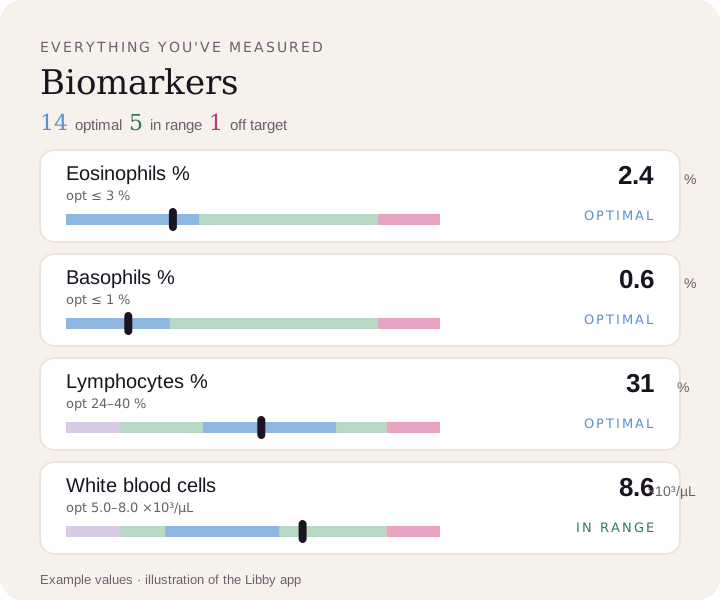
Compare your results to optimal ranges.
Upload a lab PDF or a photo of your report. Libby puts every marker on your lab's range and the optimal range, and tracks your trends over time.
View your eosinophil percentage ›