Total IgE blood test: normal range, high levels, causes
Total IgE is the allergy antibody in your blood. Here's a normal level, the usual causes of a high one, the optimal range, and when a low one matters.
Total IgE (immunoglobulin E) is the amount of IgE antibody in your blood, the antibody behind allergic reactions. IgE works from mast cells in your skin, airways and gut, ready to set off a reaction when it meets something you're sensitized to.12 So a high total IgE most often goes with allergic conditions like asthma, hay fever and eczema. Smoking, parasitic worms and a mold reaction in the lungs called ABPA push it up too.234
The short version
- Normal: check the range on your report. Labcorp's adult range is 6–495 IU/mL, but healthy people without allergies run far lower: a median of about 22 in a U.S. national survey, with a Swedish upper limit of about 118.567
- Mildly high (about 100–500) is common. The usual reasons are allergic conditions (asthma, hay fever, eczema) and smoking. Parasitic worms matter if you've lived in or traveled to places where they're common.682
- 500 or more in someone with asthma is the cut-off to test for ABPA, an allergic reaction to mold growing in the airways. Levels over 2,000 are typical of rare immune conditions such as hyper-IgE syndrome.49
- Total IgE shows how much IgE you make. A specific IgE test shows what it reacts to: pollen, cat, peanut and so on.32
What total IgE is
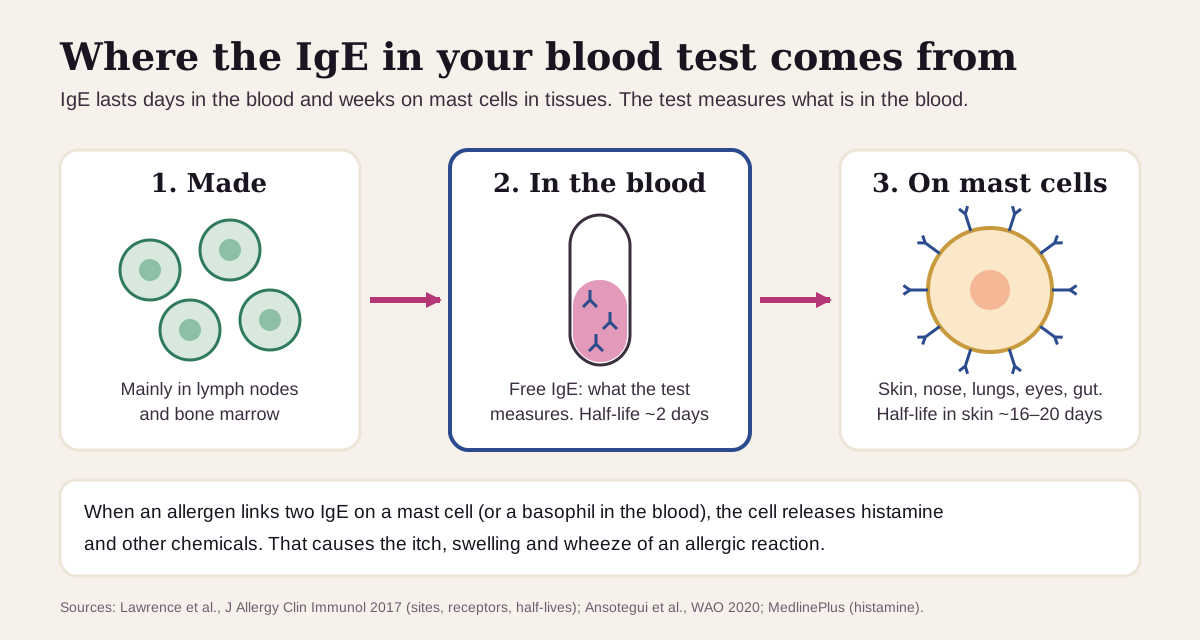
IgE is the antibody your immune system makes against allergens such as pollen and peanuts. It's normal to have a small amount.3 Your lymph nodes and bone marrow are the main places it's made.1
It spends only a short time in the blood. IgE binds tightly to mast cells in your skin, nose, lungs, eyes and gut, and to basophils circulating in the blood, through a receptor called FcεRI.1 When an allergen links two IgE molecules on one of those cells, the cell releases histamine and other chemicals.210 That's the itch, swelling and wheeze of an allergic reaction.
The blood test catches IgE in transit. It adds up IgE against every allergen at once, which is why it's called "total".3 It's ordered while looking into allergies or asthma, when an immune problem is suspected, and before starting omalizumab (Xolair), an asthma and allergy medicine dosed by your IgE level.21112
What's a normal total IgE?
Start with the range printed on your report. Ranges differ between labs, and they depend heavily on age.25
- Labcorp, a large commercial U.S. lab, lists 6–495 IU/mL for everyone aged 17 and older. Children run higher: at age 10, it's 22–1,055 for boys and 12–708 for girls.5
- IgE climbs through childhood to about age 15, then drifts down through adulthood.2 In a U.S. national survey (NHANES 2005–2006, 7,398 people aged 6 and older), the median peaked at 52.7 IU/mL at ages 16–19 and fell to 32.6 at 70 and older.6
- Men run higher than women: a median of 54.8 vs 32.1 IU/mL in the same survey.6
Why are lab ranges so wide? Many are built from general populations, which include lots of people with allergies. In NHANES, 42.5% of people had at least one positive allergy-antibody test.6 Set them aside and "normal" shrinks:
- People with no allergy antibodies had a median total IgE of 21.7 IU/mL (middle half: 10–49). People with at least one had 104 (middle half: 44–268).6
- In Uppsala, Sweden, healthy adults with no allergies had a typical (geometric mean) IgE of 14.2 and an upper limit of 118 IU/mL, almost the same as the 114 that researchers there found in 1974.7
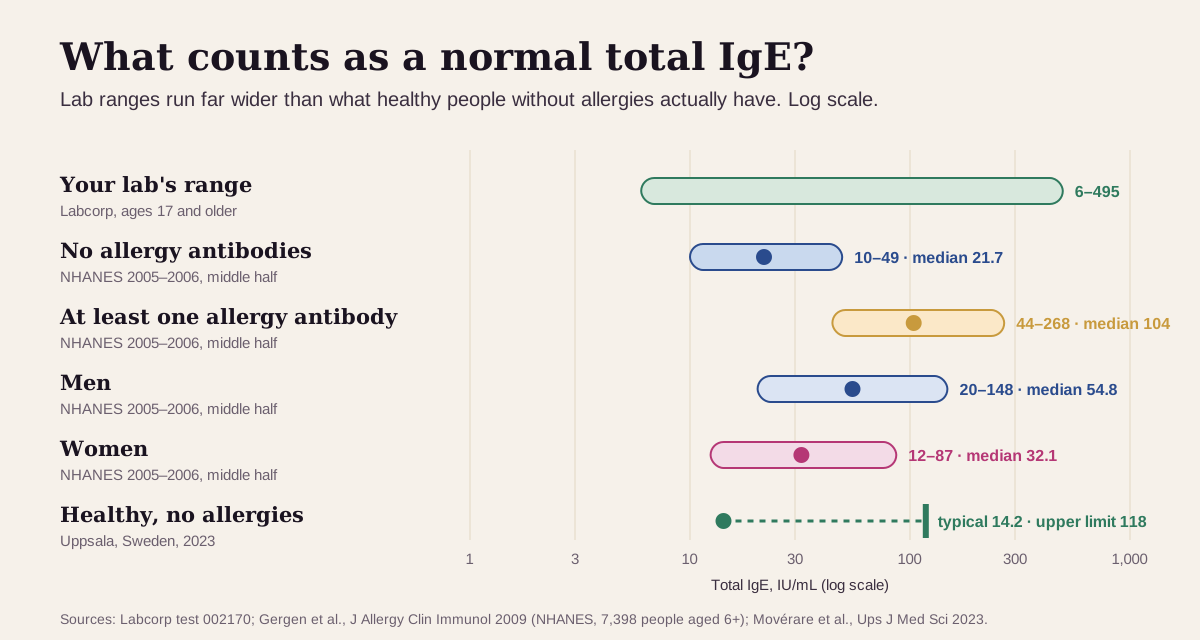
Smoking raises it too. In 6,670 young adults from 10 European countries, the 95th percentile for people with no allergies was 169 IU/mL in men and 148 in women who didn't smoke, and 220 and 194 in those who did.8
"Optimal" total IgE: what health optimizers aim for
Optimal ranges aim far below a lab's upper limit. Here's the full ladder, from strictest to loosest:
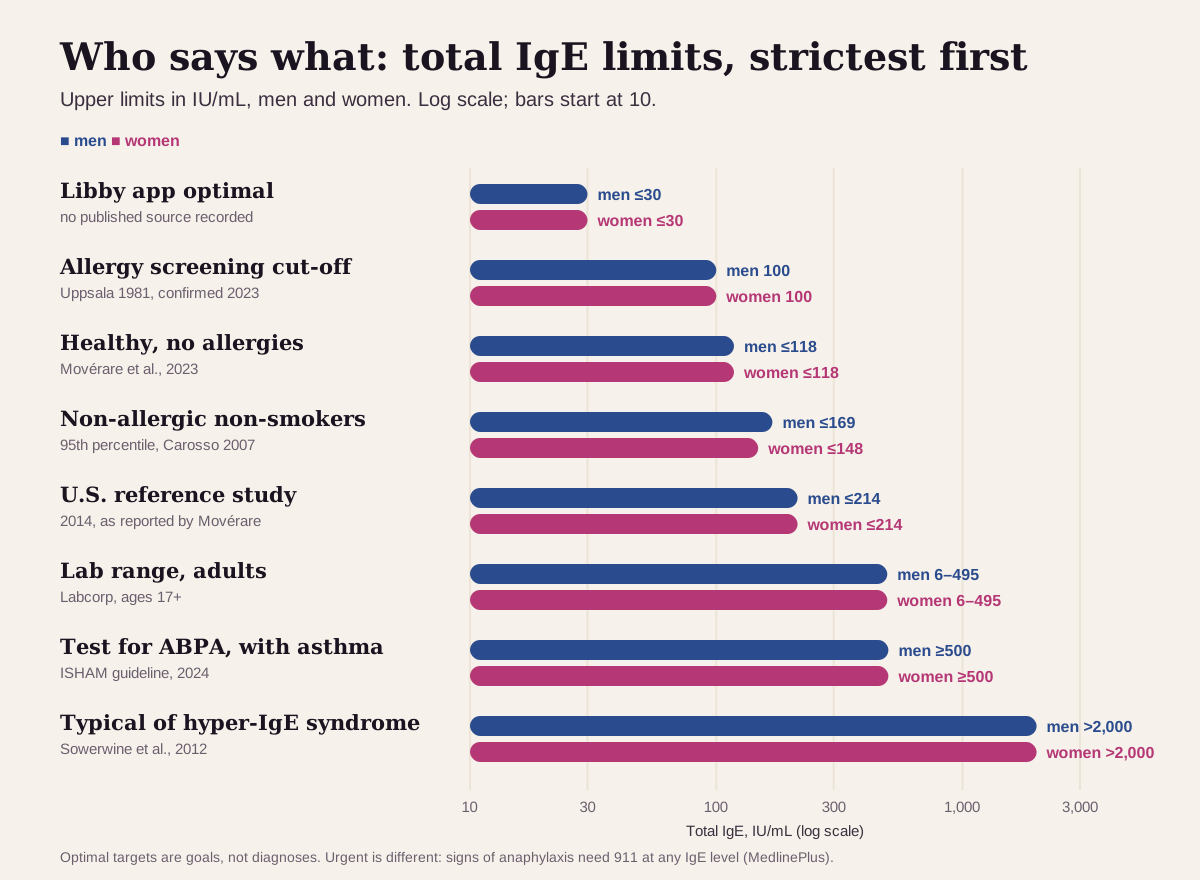
| Target | Men | Women | Who uses it |
|---|---|---|---|
| App optimal | 30 IU/mL or lower | 30 IU/mL or lower | The optimal range shown in the Libby app. The app's catalog records no published source for this band |
| Allergy screening cut-off | 100 IU/mL | 100 IU/mL | Set by Uppsala researchers in 1981 and confirmed in 2023: above it, allergy is likely7 |
| Healthy, no allergies | up to 118 | up to 118 | Uppsala adults with no allergy antibodies, asthma or allergy symptoms7 |
| Non-allergic non-smokers | up to 169 | up to 148 | 95th percentile in 10 European countries8 |
| U.S. reference study | up to 214 | up to 214 | A 2014 study that included people with possible hidden allergies, as reported by Movérare's team7 |
| Lab range | 6–495 | 6–495 | Labcorp, ages 17 and older5 |
| Test for ABPA | 500 or more, with asthma | 500 or more, with asthma | International guideline (ISHAM, 2024)4 |
| Very high | over 2,000 | over 2,000 | Typical of hyper-IgE syndrome9 |
| Urgent | any level, with signs of anaphylaxis | same | Call 911: see the box below10 |
Why the low targets have a basis:
- In NHANES, every 10-fold rise in total IgE (say, from 10 to 100) went with 2.18 times the odds of asthma, after accounting for age, sex, smoking, weight, income and other factors. The link was strong in people with at least one positive allergy-antibody test (2.41) and absent in people with none (1.11, within chance).6
- An earlier U.S. study of 2,657 people from the general population found asthma rose in step with IgE, and none of the 177 people with the lowest IgE for their age and sex had asthma.13
- In the Uppsala study, the cut-offs that best separated people with and without allergy sat at 17–31 IU/mL, far below the usual 100. The app's 30 sits at the top of that window.7
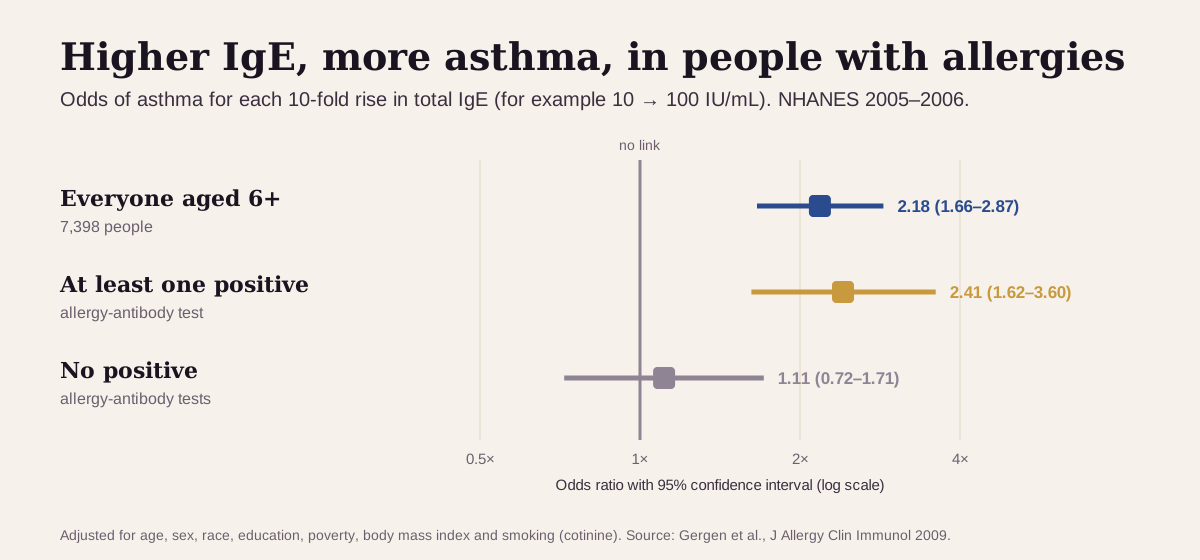
Keep "optimal" in perspective: it's a target, not a diagnosis. Asthma turned up at every IgE level in NHANES, even the lowest.6 Lower isn't always better, either. An IgE too low to measure (under 2 IU/mL) shows up in only about 3% of people, but in about three in four people with common variable immunodeficiency (CVID), an antibody-deficiency disease.11
What a high total IgE usually means
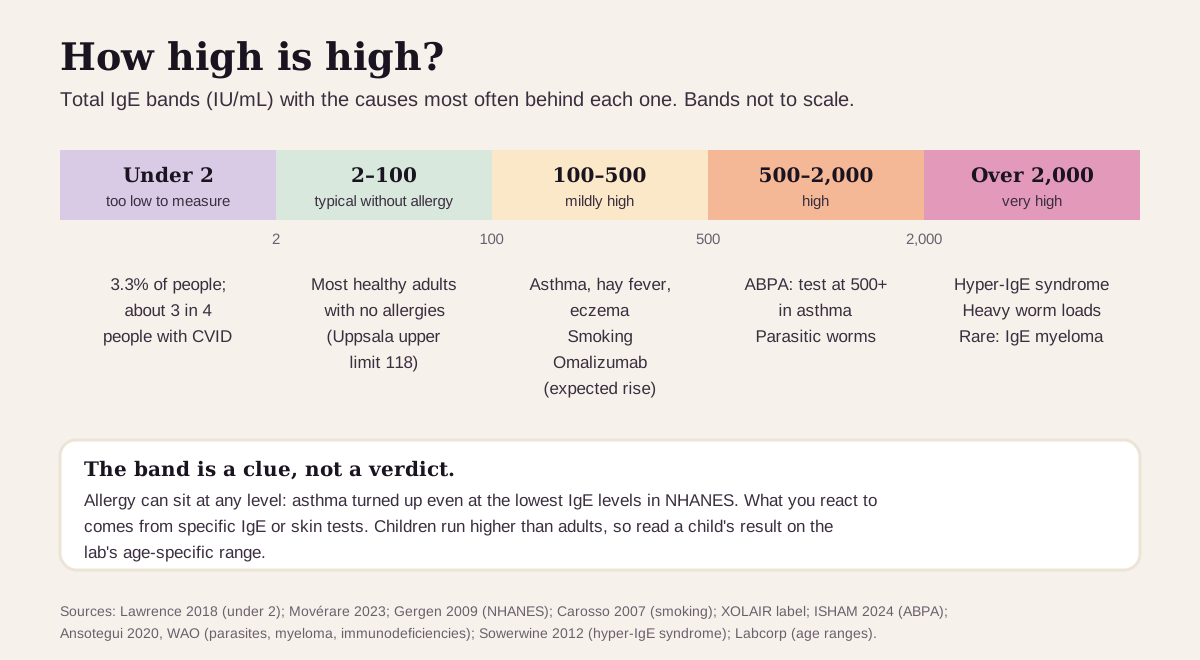
The size of the rise is the first clue. Here are the usual causes, band by band:
Mildly high (about 100–500): common, usually allergy
The usual suspects:
- Allergic conditions. Total IgE runs clearly higher in allergic asthma, hay fever and eczema.7 In NHANES, the middle half of people with allergy antibodies ran 44–268 IU/mL.6 A specific IgE blood test or a skin-prick test shows the trigger.3
- Smoking. It raises total IgE in a share of smokers.28
- Parasitic worms, after travel to or life in places where they're common. They can push IgE very high,2 and they usually raise the eosinophil count too.14
- Omalizumab (Xolair). This medicine binds IgE, and the drug-IgE pairs still count in the test. Total IgE averages five times its starting level 16 weeks in and can stay high for up to a year after stopping.12
500 and up: time for a closer look
- ABPA (allergic bronchopulmonary aspergillosis) is an allergic reaction to the mold Aspergillus growing in the airways, mostly in people with asthma or cystic fibrosis. The 2024 international guideline requires a positive Aspergillus-specific IgE and a total IgE of 500 IU/mL or more, plus supporting findings such as a high eosinophil count. It lowered the cut-off from 1,000 because 500 catches more cases: 98% vs 91%.4
- Rare immune conditions. In hyper-IgE syndrome, IgE is usually over 2,000, with eczema-like rashes, skin abscesses and repeated pneumonias.9 A handful of other inherited immune diseases, and very rarely an IgE-producing myeloma, can also run very high.2
Is a low total IgE a problem?
Usually not. Many healthy people without allergies run low: in the recent Uppsala group, the median was 11.8 IU/mL.7
An IgE too low to measure (under 2 IU/mL) is worth a second look if you also get repeated sinus, ear or chest infections. It turns up in 3.3% of the general population but in 75.6% of people with CVID. Researchers who found this suggest checking IgG, IgA and IgM when an undetectable IgE comes with signs of immune trouble.11
Total IgE reads best next to its neighbors
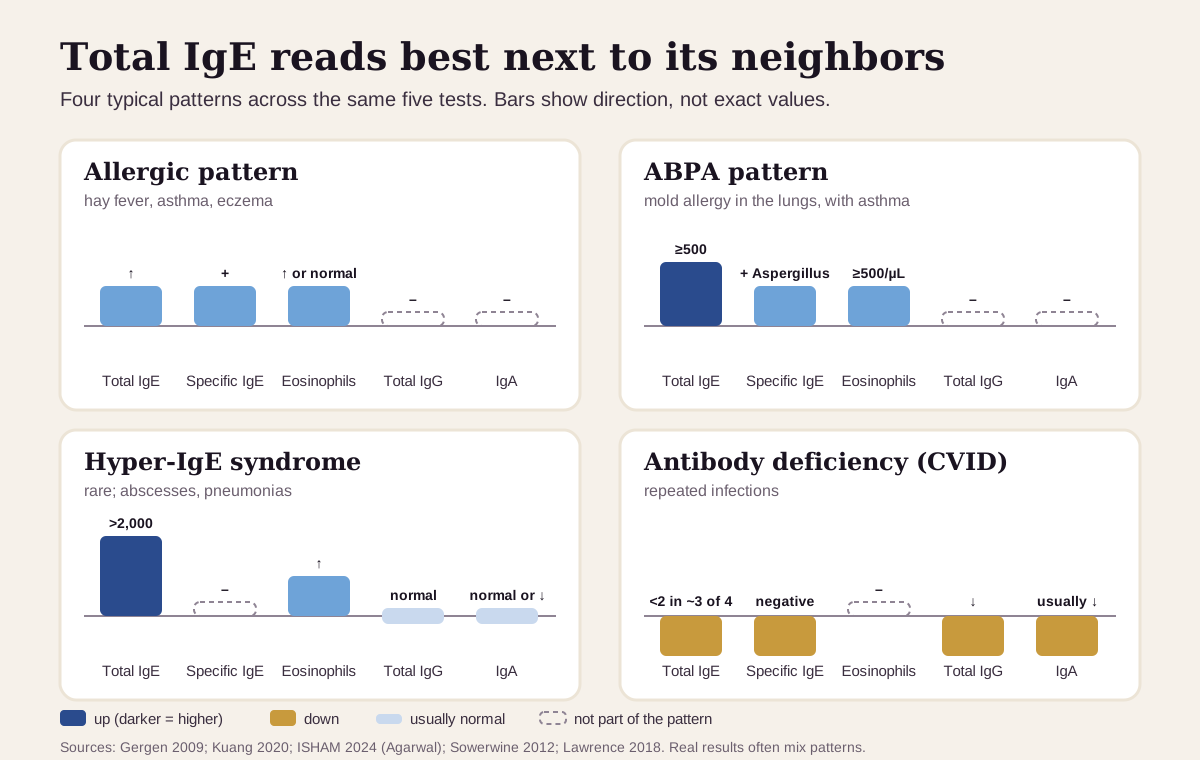
Total IgE is rarely read alone. Next to allergy tests, the eosinophil count and your other antibodies, the pattern usually says more:
| If you see… | It often points to… |
|---|---|
| Total IgE mildly up, specific IgE positive to things you react to, eosinophils normal or up | an allergic condition: hay fever, asthma or eczema615 |
| Total IgE 500 or more, Aspergillus-specific IgE positive, eosinophils 500/µL or more, with asthma | ABPA4 |
| Total IgE high, eosinophils up, after travel or years abroad | parasitic worms214 |
| Total IgE over 2,000, eosinophils up, total IgG normal, with abscesses or pneumonias | hyper-IgE syndrome (rare)9 |
| Total IgE under 2, total IgG low, IgA (or IgM) low, allergy tests negative | an antibody deficiency such as CVID11 |
| Total IgE high while on omalizumab | expected: the test counts IgE bound to the drug12 |
The eosinophil row in allergies comes from a U.S. National Institutes of Health review: asthma, hay fever and eczema can come with a mild to moderate rise.15 In ABPA, the guideline uses an eosinophil count of 500/µL or more as supporting evidence, and a positive Aspergillus-specific IgG (a separate test from total IgG) counts too.4 In CVID, only about 3.5% of those tested (4 of 113) had measurable allergy antibodies to a common-allergen panel.11
How fast total IgE changes
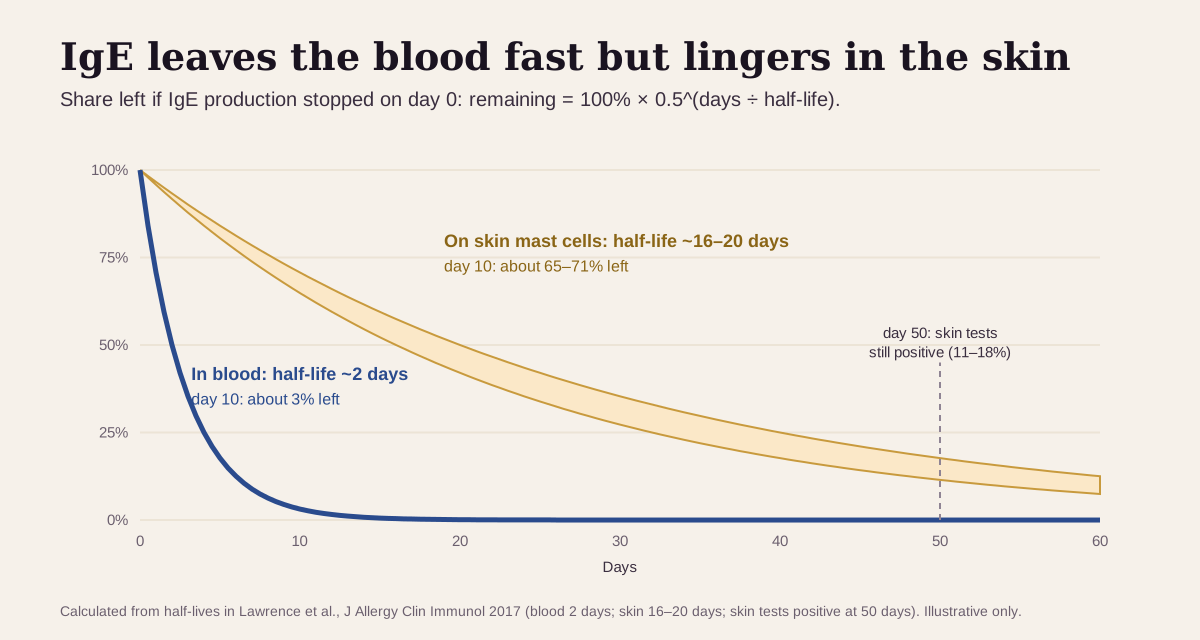
IgE leaves the blood fast but lingers on mast cells. Its half-life in the blood is only about 2 days, against about 23 days for IgG. On mast cells in the skin, it's about 16–20 days: after a single infusion of allergic donor plasma, skin tests stayed positive for at least 50 days.1
What that means in practice:
- Your blood level reflects the past week or two. With a 2-day half-life, five half-lives take about 10 days, so the result mostly shows how much IgE you've been making recently.1
- On omalizumab, total IgE goes up, not down. Free IgE falls by more than 96% within an hour of the first dose, while total IgE rises, so retests during treatment are useless for dosing.12
- In ABPA, IgE tracks the disease. It falls with treatment, and a rise of 50% or more above your stable level signals a flare.4
- Trends beat snapshots. A single mildly high result says less than a steady level, or one that keeps climbing. Compare results from the same lab, since each lab sets its own range.7
Going deeper: total vs specific IgE
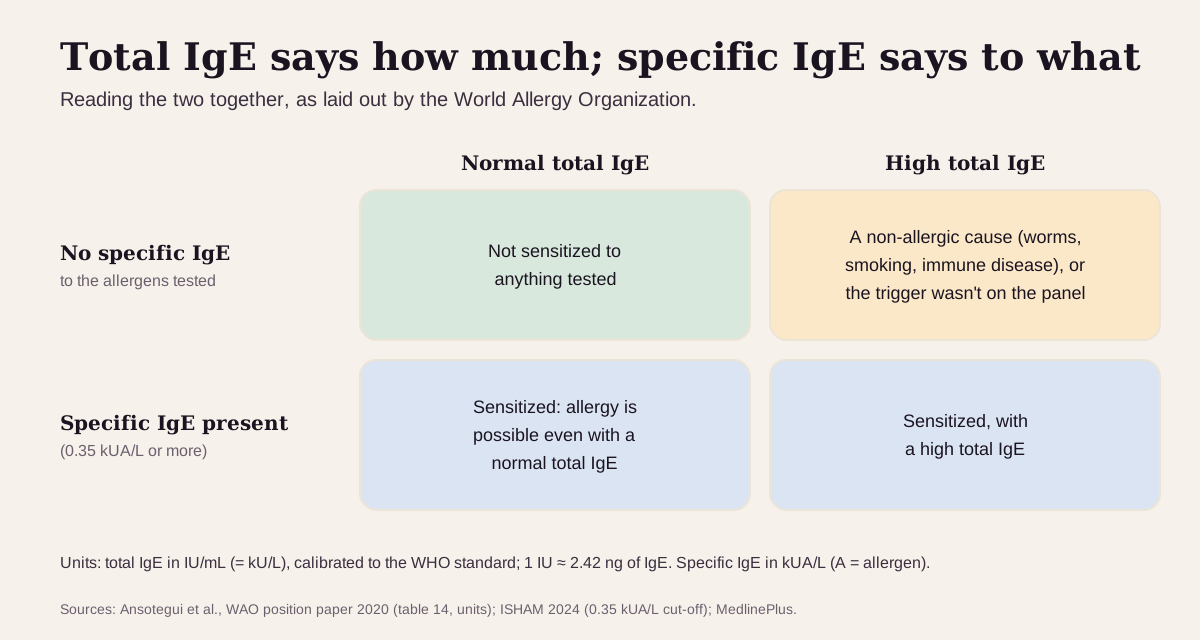
Total IgE is a sum; specific IgE is one line item. A specific IgE test measures IgE against a single allergen, such as cat dander or peanut.3 It's reported in kUA/L, where the "A" stands for allergen, and 0.35 kUA/L is the usual cut-off for a positive test.24
The World Allergy Organization puts the two together in a grid.2 A high total IgE with no positive specific IgE points to a non-allergic cause, or to an allergen that wasn't on the panel. A normal total IgE with a positive specific IgE still means sensitization, so allergy remains possible. That's why allergists order specific tests rather than lean on the total.7
Why IU? Commercial total IgE tests are calibrated to the same World Health Organization standard, so results are reported in international units: 1 IU is about 2.42 ng of IgE.2
Dosing by IgE. Omalizumab's asthma trials enrolled people with a starting total IgE between 30 and 700 IU/mL, and the dose is set by body weight and that starting level.12
Questions worth asking
- Is my total IgE high for my age, on my lab's range?
- Would specific IgE tests or skin tests show what I'm reacting to?
- Could smoking, travel or a medicine like omalizumab explain this level?
- With my asthma, should I be tested for Aspergillus sensitization and ABPA?
- My IgE is too low to measure. Should my IgG, IgA and IgM be checked?
- When would a repeat test change the plan?
FAQ
What is a normal total IgE level? It depends on the lab and your age. Labcorp's adult range is 6–495 IU/mL, but healthy adults without allergies usually run under about 120, with typical values around 14 to 22.576
What is the most common cause of a high total IgE? Allergic conditions such as asthma, hay fever and eczema. Smoking and, after travel or life abroad, parasitic worms are other common causes.682
Does a normal total IgE rule out allergies? No. You can be allergic with a normal total IgE; a specific IgE or skin test is what shows sensitization to a particular allergen.23
When is a high IgE an emergency? The number itself is never the emergency. Trouble breathing, swelling of the face or tongue, or fainting after an exposure are signs of anaphylaxis: call 911.10
This guide is for education. It can't diagnose you or replace care from a clinician who knows your history.
Footnotes
-
Lawrence MG, Woodfolk JA, Schuyler AJ, Stillman LC, Chapman MD, Platts-Mills TA. Half-life of IgE in serum and skin: Consequences for anti-IgE therapy in patients with allergic disease. J Allergy Clin Immunol. 2017;139(2):422–428.e4. Where IgE is made and stored, the FcεRI receptor, blood half-life of about 2 days (IgG about 23), skin half-life of about 16–20 days, and skin tests positive at 50 days. PMC ↩ ↩2 ↩3 ↩4 ↩5 ↩6 ↩7
-
Ansotegui IJ, Melioli G, Canonica GW, et al. IgE allergy diagnostics and other relevant tests in allergy, a World Allergy Organization position paper. World Allergy Organ J. 2020;13(2):100080. The world allergy society's review: total IgE as an unreliable marker of allergy on its own, the rise to age 15 and later decline, very high IgE in parasites, some immunodeficiencies and IgE myeloma, smokers, the WHO standard (1 IU = 2.42 ng), and the total-vs-specific grid (table 14). PMC ↩ ↩2 ↩3 ↩4 ↩5 ↩6 ↩7 ↩8 ↩9 ↩10 ↩11 ↩12 ↩13 ↩14 ↩15 ↩16 ↩17 ↩18 ↩19 ↩20 ↩21
-
National Library of Medicine. Allergy Blood Test. MedlinePlus. Total vs specific IgE, and smoking or parasites as causes of higher IgE. MedlinePlus ↩ ↩2 ↩3 ↩4 ↩5 ↩6 ↩7
-
Agarwal R, Sehgal IS, Muthu V, et al. Revised ISHAM-ABPA working group clinical practice guidelines for diagnosing, classifying and treating allergic bronchopulmonary aspergillosis/mycoses. Eur Respir J. 2024;63(4):2400061. The international guideline: total IgE ≥500 IU/mL (sensitivity 98% vs 91% for ≥1,000), Aspergillus-specific IgE ≥0.35 kUA/L, eosinophils ≥500/µL, and a ≥50% IgE rise as a flare. PMC ↩ ↩2 ↩3 ↩4 ↩5 ↩6 ↩7 ↩8 ↩9 ↩10 ↩11 ↩12
-
Labcorp. Immunoglobulin E, Total (test 002170). Reference ranges by age and sex: 6–495 IU/mL for ages 17–100; 22–1,055 (male) and 12–708 (female) at age 10. Method: Thermo Fisher ImmunoCAP. A commercial lab's published test page, cited for its reference range. labcorp.com ↩ ↩2 ↩3 ↩4 ↩5 ↩6 ↩7
-
Gergen PJ, Arbes SJ Jr, Calatroni A, Mitchell HE, Zeldin DC. Total IgE levels and asthma prevalence in the US population: results from the National Health and Nutrition Examination Survey 2005-2006. J Allergy Clin Immunol. 2009;124(3):447–453. 7,398 people aged 6 and older: medians by age, sex and allergy-antibody status, 42.5% with at least one positive specific IgE, and odds of asthma per 10-fold rise in total IgE. PMC ↩ ↩2 ↩3 ↩4 ↩5 ↩6 ↩7 ↩8 ↩9 ↩10 ↩11 ↩12 ↩13 ↩14 ↩15 ↩16
-
Movérare R, Persson E, Malinovschi A, Janson C. Reference values of serum total IgE in Uppsala - comparison over four decades. Ups J Med Sci. 2023;128:e9892. Healthy non-allergic adults: geometric mean 14.2 and upper limit 118 kU/L (114 in 1974); the 100 kU/L threshold (94.3% specificity for allergy antibodies); best cut-offs of 17–31 kU/L; and the 2014 U.S. study's 214 kU/L. PMC ↩ ↩2 ↩3 ↩4 ↩5 ↩6 ↩7 ↩8 ↩9 ↩10 ↩11 ↩12 ↩13 ↩14
-
Carosso A, Bugiani M, Migliore E, Antò JM, DeMarco R. Reference values of total serum IgE and their significance in the diagnosis of allergy in young European adults. Int Arch Allergy Immunol. 2007;142(3):230–238. 6,670 young adults from 10 Western European countries; 95th percentiles in non-allergic non-smokers (169 men, 148 women) and smokers (220, 194). PubMed ↩ ↩2 ↩3 ↩4 ↩5 ↩6 ↩7
-
Sowerwine KJ, Holland SM, Freeman AF. Hyper-IgE syndrome update. Ann N Y Acad Sci. 2012;1250:25–32. NIH review: peak IgE over 2,000 IU/mL in 97% and eosinophilia in 93%; IgG and IgM usually normal, IgA normal or low; skin abscesses and pneumonias. PMC ↩ ↩2 ↩3 ↩4 ↩5 ↩6 ↩7 ↩8
-
National Library of Medicine. Anaphylaxis. MedlinePlus Medical Encyclopedia. Histamine release, the symptoms of anaphylaxis, and calling 911. MedlinePlus ↩ ↩2 ↩3 ↩4 ↩5
-
Lawrence MG, Palacios-Kibler TV, Workman LJ, et al. Low Serum IgE Is a Sensitive and Specific Marker for Common Variable Immunodeficiency (CVID). J Clin Immunol. 2018;38(3):225–233. IgE under 2 IU/mL in 3.3% of the general population vs 75.6% of people with CVID; low IgG and IgA in CVID; allergy antibodies in only 3.5%. PMC ↩ ↩2 ↩3 ↩4 ↩5 ↩6 ↩7
-
Genentech. XOLAIR (omalizumab) prescribing information, revised 8/2026. DailyMed, U.S. National Library of Medicine. Free IgE down more than 96% within an hour; total IgE about five-fold higher at 16 weeks and raised for up to a year after stopping; asthma trials enrolled people with IgE of 30–700 IU/mL. DailyMed ↩ ↩2 ↩3 ↩4 ↩5 ↩6
-
Burrows B, Martinez FD, Halonen M, Barbee RA, Cline MG. Association of asthma with serum IgE levels and skin-test reactivity to allergens. N Engl J Med. 1989;320(5):271–277. 2,657 people in a general-population study; no asthma among the 177 with the lowest IgE for their age and sex. PubMed ↩
-
O'Connell EM, Nutman TB. Eosinophilia in Infectious Diseases. Immunol Allergy Clin North Am. 2015;35(3):493–522. Parasitic worms as a cause of eosinophilia in travelers and people from places where they're common. PMC ↩ ↩2
-
Kuang FL. Approach to Patients with Eosinophilia. Med Clin North Am. 2020;104(1):1–14. NIH review: atopic dermatitis, allergic rhinitis and asthma are associated with mild to moderate eosinophilia. PMC ↩ ↩2 ↩3
Educational content, not medical advice. Libby is a personal record tool, not a medical service — it doesn't diagnose, treat, or prescribe. Reference ranges vary by lab and by person. Talk to a qualified healthcare professional about your results.
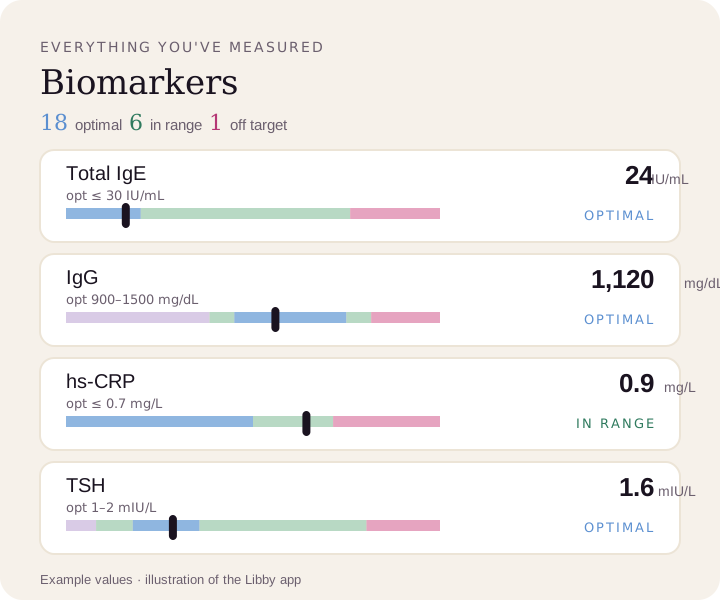
Compare your results to optimal ranges.
Upload a lab PDF or a photo of your report. Libby puts every marker on your lab's range and, where one exists, the optimal range, and tracks your trends over time.
View your total IgE ›