Factor VIII activity: normal range, hemophilia, high levels
Factor VIII helps your blood clot. What a normal level is, how low levels grade hemophilia A, and what a high level means for blood-clot risk.
Factor VIII (eight) is a clotting protein that helps your blood form a clot, and the factor VIII activity test measures how well yours works, as a percent of normal. A low result is the defining sign of hemophilia A and often shows up with von Willebrand disease. A high result has everyday causes, since inflammation, pregnancy, age and blood type all push it up, and a level that stays high is linked to vein clots.12
The short version
- Normal: check your report. Most labs put it around 50–150%. MedlinePlus gives 50–200%, and Labcorp's adult range is 57–177%.32
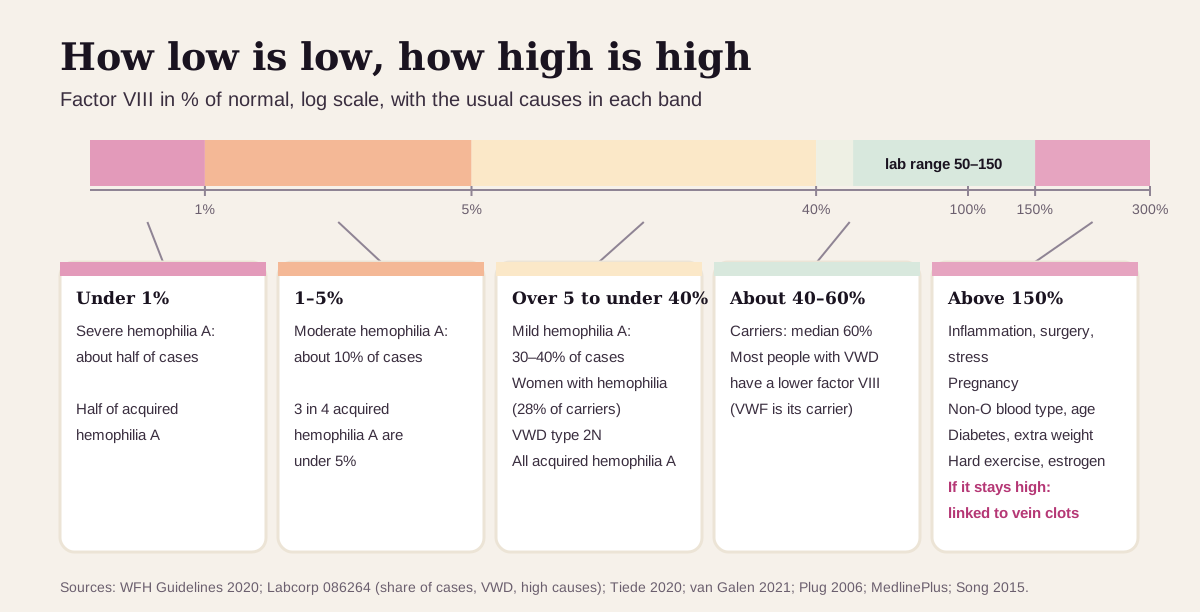
- Low: below 40% is hemophilia by the WFH and ISTH definition: severe <1%, moderate 1–5%, mild >5–<40%. The usual reasons are von Willebrand disease, inherited hemophilia A (including some carriers) and, rarely, an antibody against factor VIII.14
- High: above 150% is common with inflammation, pregnancy, older age and non-O blood types. When it stays high, it's linked to about 5 times the odds of a first vein clot.25
- Urgent: a new low factor VIII with sudden large bruises or a muscle bleed, especially in an older adult or after childbirth, can be acquired hemophilia A. That needs same-day care.6
What factor VIII is
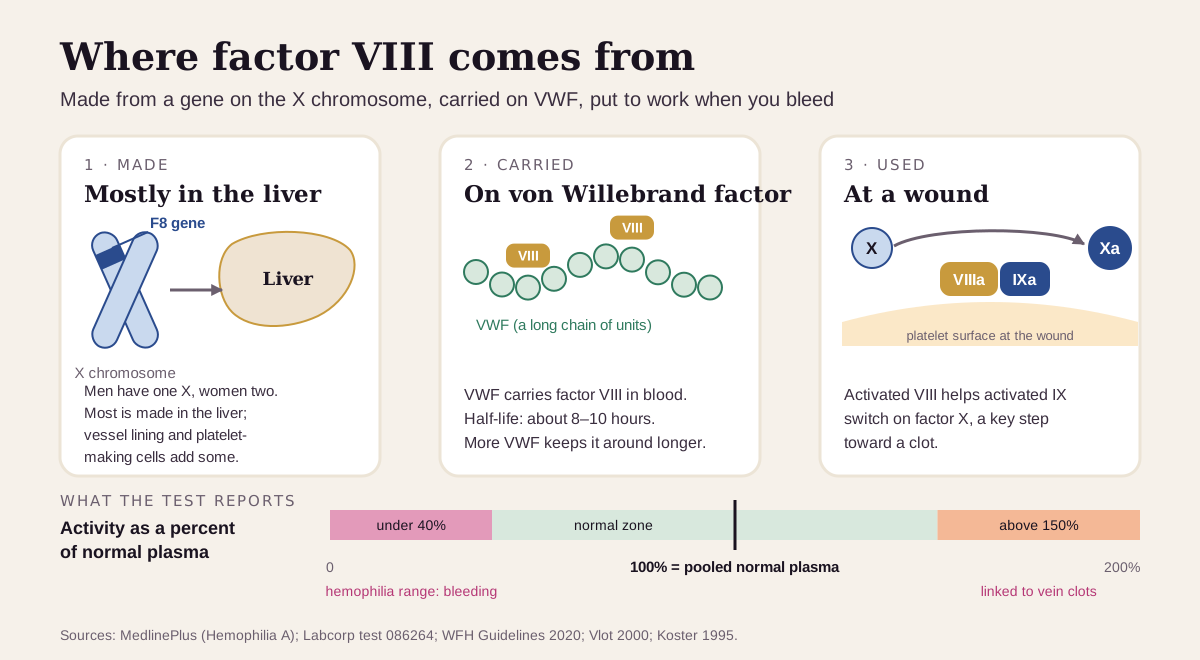
Factor VIII is a helper protein, what biochemists call a cofactor. When you bleed, activated factor VIII lets activated factor IX switch on factor X, a key step on the way to a clot.1 Without enough factor VIII, blood clots slowly and bleeding lasts longer.7
Your liver makes most of it. Smaller amounts come from blood-vessel lining cells and the cells that make platelets. In the blood, factor VIII rides on a much larger carrier protein, von Willebrand factor (VWF), and its half-life is short: about 8 to 10 hours.2 People with more VWF keep factor VIII around longer.8
The factor VIII gene sits on the X chromosome. Men have one X, so one faulty copy causes hemophilia A. Women have two, so a faulty copy usually makes them a carrier: each son of a carrier has a 50% chance of hemophilia A, and each daughter a 50% chance of being a carrier.7
The test is usually ordered to explain a long aPTT (a clotting-time screen) or unusual bleeding, to diagnose and grade hemophilia A, and to help check for von Willebrand disease.2 It reports activity, meaning how well your factor VIII works in a clotting reaction, compared with pooled plasma from healthy people.1
What's a normal factor VIII?
Start with the range on your report. Labs set their ranges against pooled normal plasma, so 100% is the level of an average healthy person, and each lab's range reflects its own method.1
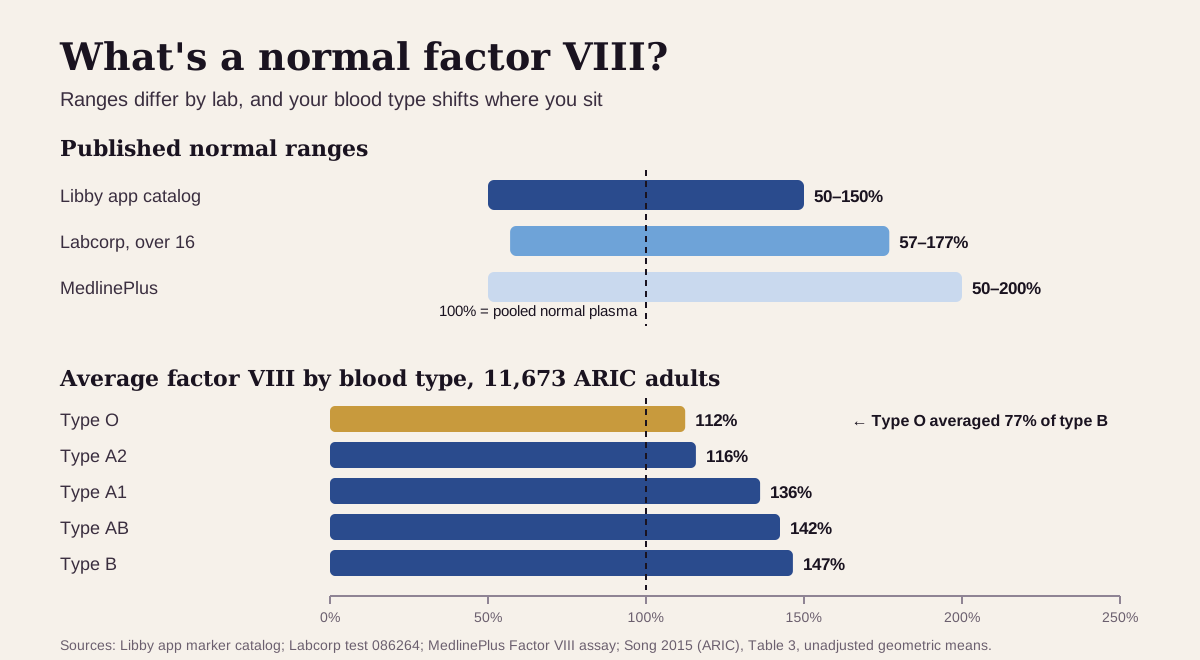
- MedlinePlus lists a normal value of 50% to 200%.3
- Labcorp, a national commercial lab, uses 57–177% for anyone over 16. Newborns and children have their own ranges: on day 1 of life it's 105–329%.2
- The Libby app's marker catalog uses 50–150%.
Blood type moves your baseline. In the ARIC study of 11,673 U.S. adults, average factor VIII was 112% in blood type O, against 136% in type A1, 142% in AB and 147% in type B. Type O averaged 77% of type B's level, mostly because type O carries less VWF.9
Factor VIII also rises with age, ran higher in women than in men in ARIC, and is higher with diabetes and extra weight.10 So the same result can mean slightly different things for different people.
Is there an "optimal" factor VIII?
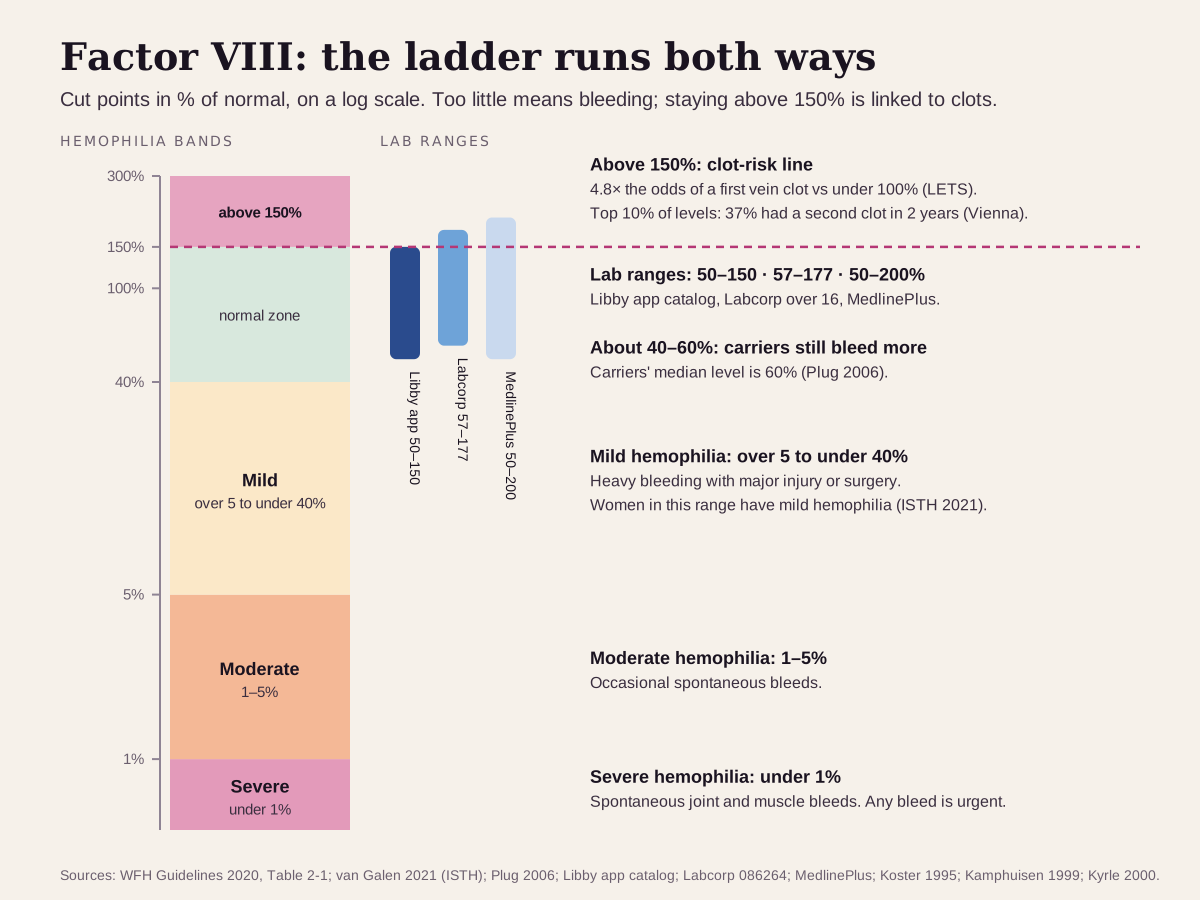
There's no optimal band for factor VIII in the Libby app's marker catalog, so the app shows your factor VIII on the lab range only. That fits the biology. This is a two-sided test: too little means bleeding, and too much is linked to clots. Here is the ladder of cut points, from the lowest to the highest:
| Where the level sits | Cut point | Who uses it |
|---|---|---|
| Urgent | below 1%, or any low level with sudden large bruises or a muscle bleed | Severe hemophilia (WFH).1 Half of people with acquired hemophilia A are below 1% when diagnosed6 |
| Severe hemophilia A | below 1% | WFH and ISTH: bleeding into joints or muscles with no clear cause14 |
| Moderate hemophilia A | 1–5% | WFH and ISTH: occasional spontaneous bleeds, long bleeding after minor injury or surgery14 |
| Mild hemophilia A | above 5% and below 40% | WFH and ISTH: heavy bleeding with major injury or surgery, rare spontaneous bleeds14 |
| Low end of normal, where carriers still bleed more | about 40–60% | Carriers at 41–60% bled more than non-carriers11 |
| Lab range | 50–150% | The range in the Libby app's catalog. The app has no optimal band for factor VIII |
| Lab range, national reference lab | 57–177% | Labcorp, over age 162 |
| Loosest normal range | 50–200% | MedlinePlus3 |
| Clot-risk line | above 150% | Leiden Thrombophilia Study: 4.8 times the odds of a first vein clot, compared with under 100%512 |
Why the high end matters: the clot evidence.
- In the Leiden Thrombophilia Study (LETS), 301 people with a first vein clot were compared with 301 healthy people of the same age and sex. Those with factor VIII above 150% had 4.8 times the odds of a clot compared with those under 100%, after adjusting for blood type and VWF.512 One in four clot patients (25%) had a level above 150%.5
- Was that just inflammation from the clot? In 474 LETS patients and 474 controls, adjusting for CRP, a marker of inflammation, still left about 6 times the risk.12 In 35 patients with a high level after a clot, 94% still had a high level at every follow-up visit over a median of 8 months.13
- Second clots. In Vienna, 360 people were followed for an average of 30 months after stopping blood thinners for a first unprovoked clot. Those in the top 10% of factor VIII levels had a 37% chance of another clot within two years, against 5% for everyone else. Each 10-point rise in factor VIII raised the recurrence risk by 8%.14
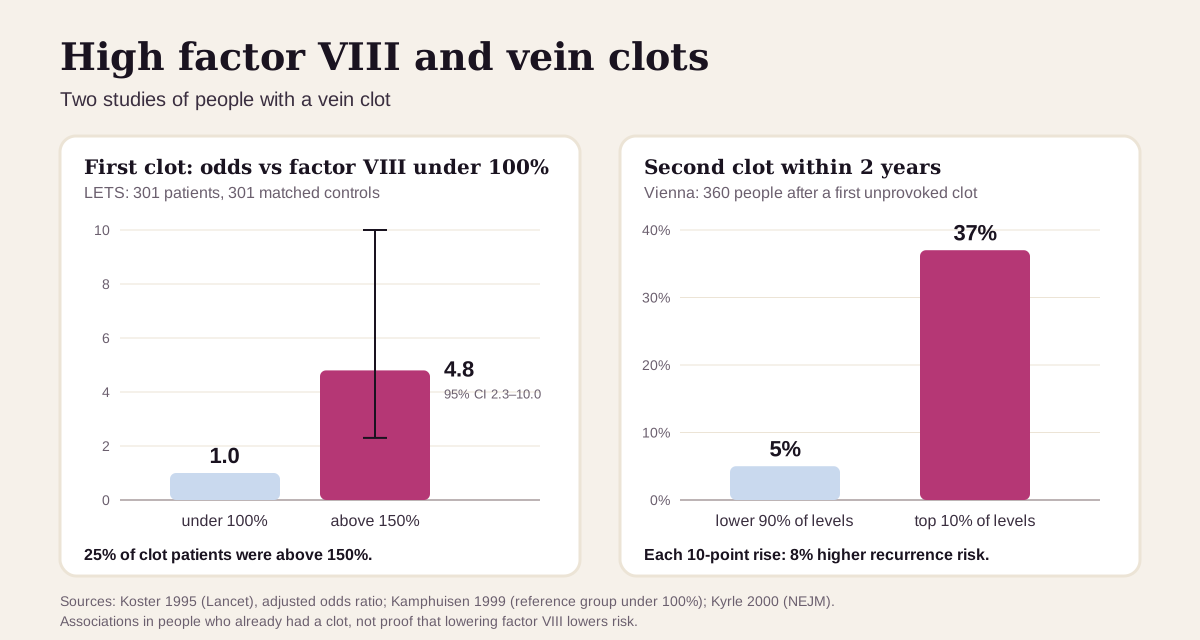
Keep the high end in perspective. These are associations, measured mostly in people who already had a clot. A single high result during a cold, after surgery or in pregnancy is expected; what the studies tracked was a level that stays high when you're well.131
What a low factor VIII usually means
How low it is sets the scale. The World Federation of Hemophilia (WFH) and the International Society on Thrombosis and Haemostasis (ISTH) grade hemophilia A by factor VIII activity: severe below 1%, moderate 1–5%, mild above 5% and below 40%.14
The usual suspects, most common first:
- Von Willebrand disease (VWD). It's the most common inherited bleeding disorder. VWF is factor VIII's carrier, so most people with VWD have a lower factor VIII too.2 The VWF tests make the diagnosis: see our guides to VWF antigen and VWF activity. One form, type 2N (Normandy), looks like mild hemophilia A: VWF is near normal, but factor VIII is low because the faulty VWF lets go of it.21
- Hemophilia A. An inherited shortage of factor VIII, found in about 1 in 5,000 male births. It makes up about 85% of hemophilia, and about half of cases are severe.2 About 30% of cases start with a new gene change, and over half of people newly diagnosed with severe hemophilia have no family history of it.1 Severe hemophilia usually shows up in babies and toddlers. Mild hemophilia can go unnoticed until surgery, a tooth extraction or an injury.7
- Carriers. In a Dutch survey of 274 carriers of hemophilia A or B, the median factor level was 60%, anywhere from 5% to 219%.11 About 28% of carriers are below 40%. Since 2021 the ISTH calls them women with mild, moderate or severe hemophilia, and those at 40% or higher "symptomatic" or "asymptomatic" carriers, depending on bleeding.4 Even levels of 41–60% were linked to more bleeding in carriers.11 Pregnancy, infection and inflammation push the level up, so genetic testing settles carrier status.21
- Acquired hemophilia A: rare, and urgent. The immune system makes an antibody (an "inhibitor") against factor VIII, in someone with no bleeding history. A UK survey counted 1.48 cases per million people a year, with a median age of 78.15 Cases peak in older adults and around pregnancy, and about half come with another condition, most often an autoimmune disease or cancer. Factor VIII is below 1% in half of patients, below 5% in three quarters and below 40% in all. Bleeding into the skin (80%) and muscles (45%) is typical.6
- Less common: DIC (disseminated intravascular coagulation), a disorder in which the clotting system becomes overactive;3 an inhibitor in someone with inherited hemophilia A, which develops in about 30% of previously untreated people once factor VIII treatment starts;1 and lab effects. A lupus anticoagulant can make a clotting-based factor VIII read falsely low, and so can blood thinners that block factor Xa or thrombin.26
Get care now if a low factor VIII comes with any head injury or a bad headache, bleeding in the neck, throat or gut, a painful swollen joint or muscle, or sudden large bruises with no clear injury, especially in an older adult or after childbirth.176
What a high factor VIII usually means
Factor VIII is an acute-phase protein: it rises with stress, after surgery and with inflammation.2 The usual suspects:
- Inflammation, infection, surgery or stress. These raise factor VIII for a while, sometimes enough to lift a mild hemophilia into the normal range.21
- Pregnancy. In 186 women followed through uncomplicated pregnancies, factor VIII rose markedly while the PT and aPTT stayed inside the usual ranges.16 In carriers, factor VIII can fully normalize late in pregnancy.1
- Non-O blood type. Types A1, B and AB averaged 136–147% in ARIC, against 112% for type O.9
- Older age, diabetes and extra weight.103
- Hard exercise and some medicines. Strenuous exercise, epinephrine, desmopressin (DDAVP) and estrogen, including birth control and hormone therapy, all raise it.2
- Other conditions: liver disease, kidney disease, cancer, and after a heart attack or a vein clot.23
When none of those apply and it stays above 150%, the clot evidence above is why clinicians take note.513 Know the signs of a vein clot: pain, swelling, warmth or redness in one leg. Sudden shortness of breath or chest pain that worsens with a deep breath can mean a clot in the lung, which needs treatment right away.17
Factor VIII reads best next to its neighbors
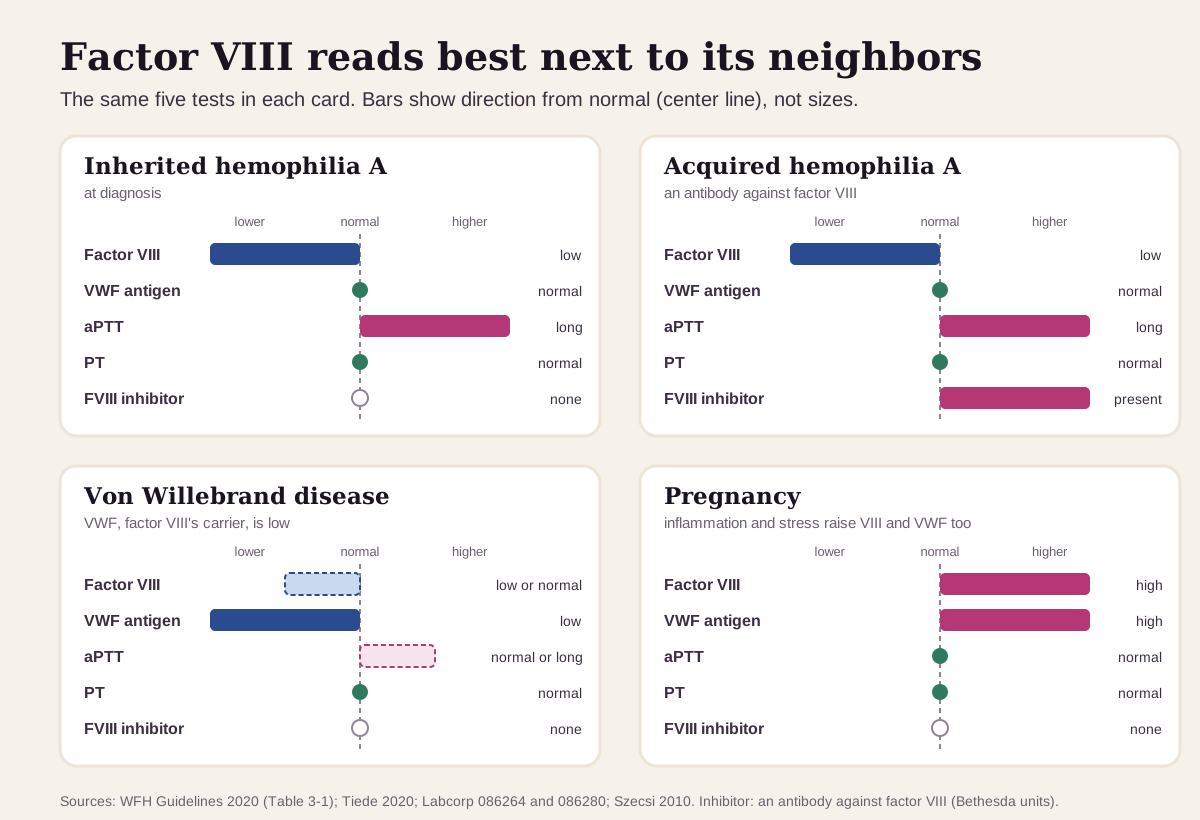
A factor VIII result makes the most sense beside VWF, the screening clotting times and, when it's low, a test for an inhibitor:16
| If you see… | It often points to… |
|---|---|
| Factor VIII low, VWF normal, aPTT long, PT normal | inherited hemophilia A. A factor IX test tells it apart from hemophilia B, which gives the same screening results12 |
| The same, plus a factor VIII inhibitor, in someone who never bled before | acquired hemophilia A, an antibody against factor VIII6 |
| VWF low, factor VIII low or normal | von Willebrand disease. The aPTT can be normal or long1218 |
| Factor VIII and VWF both high, PT and aPTT normal | pregnancy. Inflammation, stress and hard exercise raise factor VIII and VWF too16118 |
The aPTT is the screen that usually points toward factor VIII in the first place; the PT stays normal in hemophilia A.1 At the other end, a short aPTT was linked to 2.4 times the odds of a vein clot in a study of 605 patients and 1,290 controls, partly through high factor VIII.19 For the screening tests themselves, see our guides to the aPTT and PT/INR. For clot-related markers, see fibrinogen and D-dimer.
How fast factor VIII changes
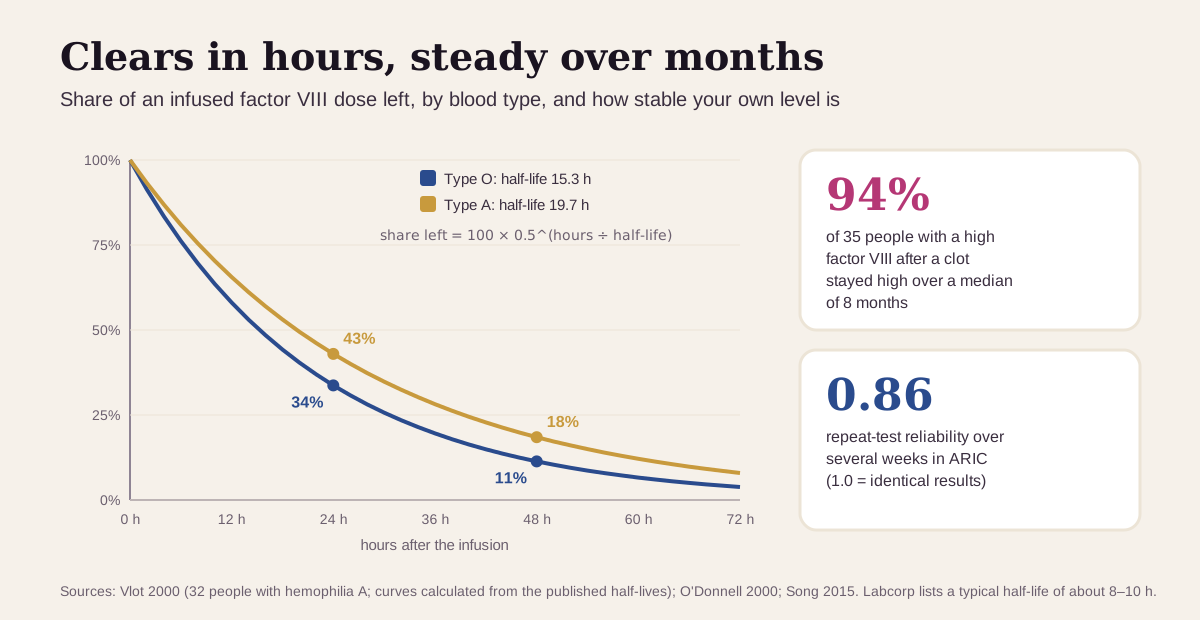
Factor VIII clears in hours, but your baseline is steady. Labcorp gives its half-life as about 8 to 10 hours.2 After an infusion in people with hemophilia A, one study measured 15.3 hours in blood type O and 19.7 hours in type A.8
What that means in practice:
- Short-term bumps are real. Strenuous exercise and stress can lift factor VIII temporarily. The WFH advises avoiding strenuous exercise before a hemophilia test and resting a few minutes before the draw.1
- Your own level is steady when you're well. In ARIC, repeat tests over several weeks agreed closely: the reliability score was 0.86.9 After a clot, a high level tends to stay high: 94% of people stayed high over a median of 8 months, and only 18% showed signs of inflammation at the first test.13
- Trends beat snapshots. A high result during an illness that settles on repeat testing tells a different story from one that stays above 150%. Compare results from the same lab, because methods and calibration plasmas differ.1
Going deeper: one-stage vs chromogenic tests
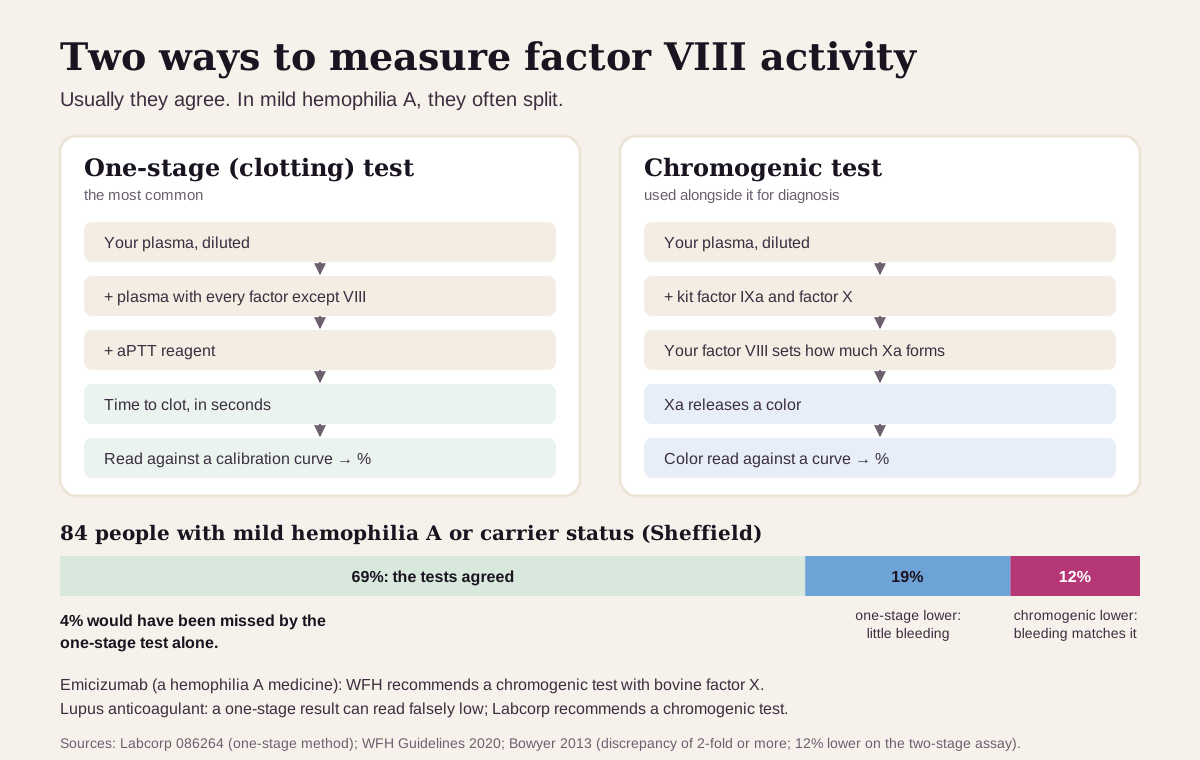
Two kinds of test measure factor VIII activity:
- The one-stage (clotting) assay is the most common. The lab mixes your diluted plasma into plasma that holds every clotting factor except factor VIII, adds an aPTT reagent and times the clot against a calibration curve.21
- The chromogenic assay supplies activated factor IX and factor X. Your factor VIII sets how much factor X gets switched on, and a color reaction reads that out.1
Usually the two agree. In mild hemophilia A, they often split: among 84 people with mild hemophilia A or carrier status tested in Sheffield, 31% had results at least 2-fold apart. In 19% the one-stage result was lower, a type in which little bleeding is reported. In 12% the two-stage or chromogenic result was lower, a type in which bleeding matches the lower number. 4% would have been missed with the one-stage test alone.20 The WFH recommends running both tests when hemophilia A is suspected.1
The chromogenic test also matters for treatment and interference:
- Emicizumab, a hemophilia A medicine that copies factor VIII's helper job, can bring the aPTT into the normal range even when factor VIII is very low. The WFH recommends a chromogenic test that uses bovine (cow) factor X to measure factor VIII in people taking it.1
- A lupus anticoagulant can drag a one-stage result down. Labcorp recommends a chromogenic test in that case.2
Questions worth asking
- Was my result from a one-stage or a chromogenic test, and should the other one be run too?
- Were my VWF antigen and VWF activity checked alongside factor VIII?
- Could a recent illness, pregnancy, hard exercise or estrogen have raised this result, and when should it be repeated?
- If it's low and I've never had bleeding problems, has an inhibitor (Bethesda) test been done?
- If I might be a carrier, should I have genetic testing, and what's my level before surgery or childbirth?
- If it was high after a clot, is it still high months later, when I'm well?
FAQ
What is a normal factor VIII level? Most labs put it around 50–150% of normal. MedlinePlus gives 50–200%, and Labcorp's adult range is 57–177%. Check the range on your own report.32
What factor VIII level means hemophilia? Below 40%. The WFH and ISTH grade hemophilia A as severe below 1%, moderate at 1–5%, and mild above 5% and below 40%.14
Can a woman have a low factor VIII? Yes. Carriers of hemophilia have a median factor level of about 60%, and about 28% are below 40%, which the ISTH now calls hemophilia.114
Is a high factor VIII dangerous? A temporary high from inflammation, pregnancy or stress is common. A level that stays above 150% is linked to about 5 times the odds of a first vein clot, and a very high level to more second clots.514
This guide is for education. It can't diagnose you or replace care from a clinician who knows your history.
Footnotes
-
Srivastava A, Santagostino E, Dougall A, et al. WFH Guidelines for the Management of Hemophilia, 3rd edition. Haemophilia. 2020;26(Suppl 6):1–158. The World Federation of Hemophilia's guideline. Source for the severity bands (Table 2-1: severe <1 IU/dL or <1%, moderate 1–5, mild 5–<40% of normal), screening-test patterns (Table 3-1), the one-stage and chromogenic recommendations, emicizumab testing, carriers' levels, inhibitor incidence (about 30%), and bleeding sites. DOI · WFH PDF ↩ ↩2 ↩3 ↩4 ↩5 ↩6 ↩7 ↩8 ↩9 ↩10 ↩11 ↩12 ↩13 ↩14 ↩15 ↩16 ↩17 ↩18 ↩19 ↩20 ↩21 ↩22 ↩23 ↩24 ↩25 ↩26 ↩27 ↩28 ↩29 ↩30 ↩31 ↩32 ↩33 ↩34 ↩35
-
Labcorp. Factor VIII Activity, test 086264. Opened September 23, 2026. A commercial reference laboratory's test page, cited for its published age-specific ranges (57–177% over age 16), methodology and clinical notes (half-life, prevalence, causes of high and low levels, lupus anticoagulant). labcorp.com ↩ ↩2 ↩3 ↩4 ↩5 ↩6 ↩7 ↩8 ↩9 ↩10 ↩11 ↩12 ↩13 ↩14 ↩15 ↩16 ↩17 ↩18 ↩19 ↩20 ↩21 ↩22 ↩23 ↩24 ↩25 ↩26 ↩27 ↩28
-
National Library of Medicine. Factor VIII assay. MedlinePlus Medical Encyclopedia. Reviewed February 3, 2025. Normal value 50% to 200%, and causes of low and high activity. MedlinePlus ↩ ↩2 ↩3 ↩4 ↩5 ↩6 ↩7 ↩8 ↩9 ↩10
-
van Galen KPM, d'Oiron R, James P, et al. A new hemophilia carrier nomenclature to define hemophilia in women and girls: Communication from the SSC of the ISTH. J Thromb Haemost. 2021;19(8):1883–1887. The ISTH's definitions in IU/mL: mild >0.05 and <0.40, moderate 0.01–0.05, severe <0.01; carriers' median 0.60 IU/mL, with 28% below 0.40. PMC ↩ ↩2 ↩3 ↩4 ↩5 ↩6 ↩7 ↩8 ↩9
-
Koster T, Blann AD, Briët E, Vandenbroucke JP, Rosendaal FR. Role of clotting factor VIII in effect of von Willebrand factor on occurrence of deep-vein thrombosis. Lancet. 1995;345(8943):152–155. The Leiden Thrombophilia Study: 301 patients and 301 controls; factor VIII above 1500 IU/L (150%) gave an adjusted odds ratio of 4.8 (95% CI 2.3–10.0). PubMed ↩ ↩2 ↩3 ↩4 ↩5 ↩6 ↩7 ↩8
-
Tiede A, Collins P, Knoebl P, et al. International recommendations on the diagnosis and treatment of acquired hemophilia A. Haematologica. 2020;105(7):1791–1801. Isolated long aPTT with a normal PT; factor VIII below 1% in 50%, below 5% in 75% and below 40% in all; skin bleeds in 80%, muscle bleeds in 45%. PMC ↩ ↩2 ↩3 ↩4 ↩5 ↩6 ↩7 ↩8 ↩9
-
National Library of Medicine. Hemophilia A. MedlinePlus Medical Encyclopedia. Reviewed January 29, 2026. Inheritance, symptoms and how mild cases surface. MedlinePlus ↩ ↩2 ↩3 ↩4 ↩5
-
Vlot AJ, Mauser-Bunschoten EP, Zarkova AG, et al. The half-life of infused factor VIII is shorter in hemophiliac patients with blood group O than in those with blood group A. Thromb Haemost. 2000;83(1):65–69. 32 patients: 15.3 h in group O vs 19.7 h in group A, and VWF level predicted half-life. PubMed ↩ ↩2 ↩3 ↩4
-
Song J, Chen F, Campos M, et al. Quantitative influence of ABO blood groups on factor VIII and its ratio to von Willebrand factor, novel observations from an ARIC study of 11,673 subjects. PLoS One. 2015;10(8):e0132626. Table 3 gives factor VIII by blood type; repeat-test reliability 0.86. PMC ↩ ↩2 ↩3 ↩4 ↩5
-
Conlan MG, Folsom AR, Finch A, et al. Associations of factor VIII and von Willebrand factor with age, race, sex, and risk factors for atherosclerosis. The Atherosclerosis Risk in Communities (ARIC) Study. Thromb Haemost. 1993;70(3):380–385. Factor VIII rose with age, ran higher in women, and was higher with diabetes and body mass index. PubMed ↩ ↩2
-
Plug I, Mauser-Bunschoten EP, Bröcker-Vriends AH, et al. Bleeding in carriers of hemophilia. Blood. 2006;108(1):52–56. Survey of 546 Dutch women, 274 of them carriers: median factor level 0.60 IU/mL (range 0.05–2.19), with more bleeding even at 0.41–0.60 IU/mL. PubMed ↩ ↩2 ↩3 ↩4 ↩5 ↩6
-
Kamphuisen PW, Eikenboom JC, Vos HL, et al. Increased levels of factor VIII and fibrinogen in patients with venous thrombosis are not caused by acute phase reactions. Thromb Haemost. 1999;81(5):680–683. 474 patients and 474 controls; the 6-fold risk held after adjusting for CRP. PubMed ↩ ↩2 ↩3
-
O'Donnell J, Mumford AD, Manning RA, Laffan M. Elevation of FVIII:C in venous thromboembolism is persistent and independent of the acute phase response. Thromb Haemost. 2000;83(1):10–13. 35 patients with factor VIII above 1.5 IU/mL; 94% stayed high over a median of 8 months. PubMed ↩ ↩2 ↩3 ↩4 ↩5
-
Kyrle PA, Minar E, Hirschl M, et al. High plasma levels of factor VIII and the risk of recurrent venous thromboembolism. N Engl J Med. 2000;343(7):457–462. 360 patients followed a mean of 30 months; recurrence at 2 years 37% above the 90th percentile vs 5% below; relative risk 1.08 per 10 IU/dL. PubMed ↩ ↩2 ↩3
-
Collins PW, Hirsch S, Baglin TP, et al. Acquired hemophilia A in the United Kingdom: a 2-year national surveillance study by the United Kingdom Haemophilia Centre Doctors' Organisation. Blood. 2007;109(5):1870–1877. 172 patients, median age 78, incidence 1.48 per million per year. PubMed ↩
-
Szecsi PB, Jørgensen M, Klajnbard A, et al. Haemostatic reference intervals in pregnancy. Thromb Haemost. 2010;103(4):718–727. Factors VII, VIII and IX rose markedly in pregnancy while the PT and aPTT stayed within non-pregnant ranges. PubMed ↩ ↩2 ↩3
-
National Library of Medicine. Deep Vein Thrombosis; Pulmonary Embolism. MedlinePlus. Symptoms of a leg clot and a lung clot. DVT · PE ↩
-
Labcorp. von Willebrand Factor (vWF) Antigen, test 086280. Updated August 11, 2026. A commercial reference laboratory's test page: the test "is used to diagnose von Willebrand factor (vWF) deficiency", and VWF rises with stress, inflammation, infection, exercise and surgery, and two- to three-fold in later pregnancy. labcorp.com ↩ ↩2 ↩3
-
Tripodi A, Chantarangkul V, Martinelli I, Bucciarelli P, Mannucci PM. A shortened activated partial thromboplastin time is associated with the risk of venous thromboembolism. Blood. 2004;104(12):3631–3634. 605 patients and 1,290 controls; odds ratio 2.4, only partly explained by factor VIII. PubMed ↩
-
Bowyer AE, Van Veen JJ, Goodeve AC, Kitchen S, Makris M. Specific and global coagulation assays in the diagnosis of discrepant mild hemophilia A. Haematologica. 2013;98(12):1980–1987. 84 people with mild hemophilia A: 31% discrepant, 4% missed by the one-stage assay alone. PMC ↩ ↩2
Educational content, not medical advice. Libby is a personal record tool, not a medical service — it doesn't diagnose, treat, or prescribe. Reference ranges vary by lab and by person. Talk to a qualified healthcare professional about your results.
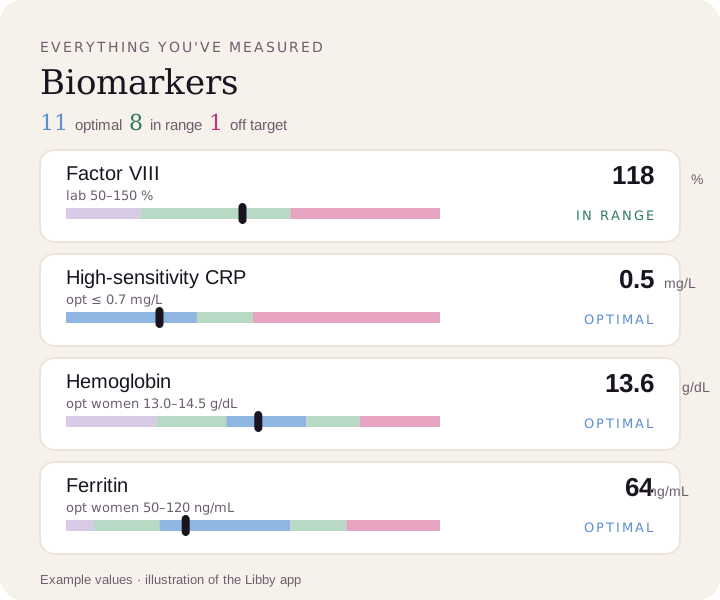
See every result against your lab's range.
Upload a lab PDF or a photo of your report. Libby puts your factor VIII and every other marker on its lab range, and tracks your trends over time.
View your factor VIII ›