Fibrinogen blood test: normal range, high and low causes
Fibrinogen is a clotting protein that rises with inflammation. The normal range, what optimizers aim for, why it runs high or low, and when it's urgent.
Fibrinogen is a clotting protein your liver makes, and its blood level climbs whenever your body is dealing with inflammation. When you bleed, an enzyme called thrombin cuts fibrinogen into fibrin, the sticky threads that hold a clot together.1 So one number tells two stories: how much clot-building material you have on hand, and how much inflammation your body is handling.2
The short version
- Normal: about 200–400 mg/dL (2.0–4.0 g/L), according to MedlinePlus. Ranges vary by lab: Labcorp prints 209–464 mg/dL for adults.32
- High usually means inflammation: an infection, an injury or surgery, or an autoimmune flare. Pregnancy, estrogen, smoking and extra weight push it up too.24
- Low is less common and more serious: clotting factors being used up (DIC), major bleeding, or advanced liver disease. A very low fibrinogen with bleeding needs emergency care.15
- Health optimizers aim for 200–300 mg/dL.6 In 154,211 adults, every 100 mg/dL higher tracked with about 1.8 times the risk of heart disease and stroke after accounting for other risk factors.7
What fibrinogen is
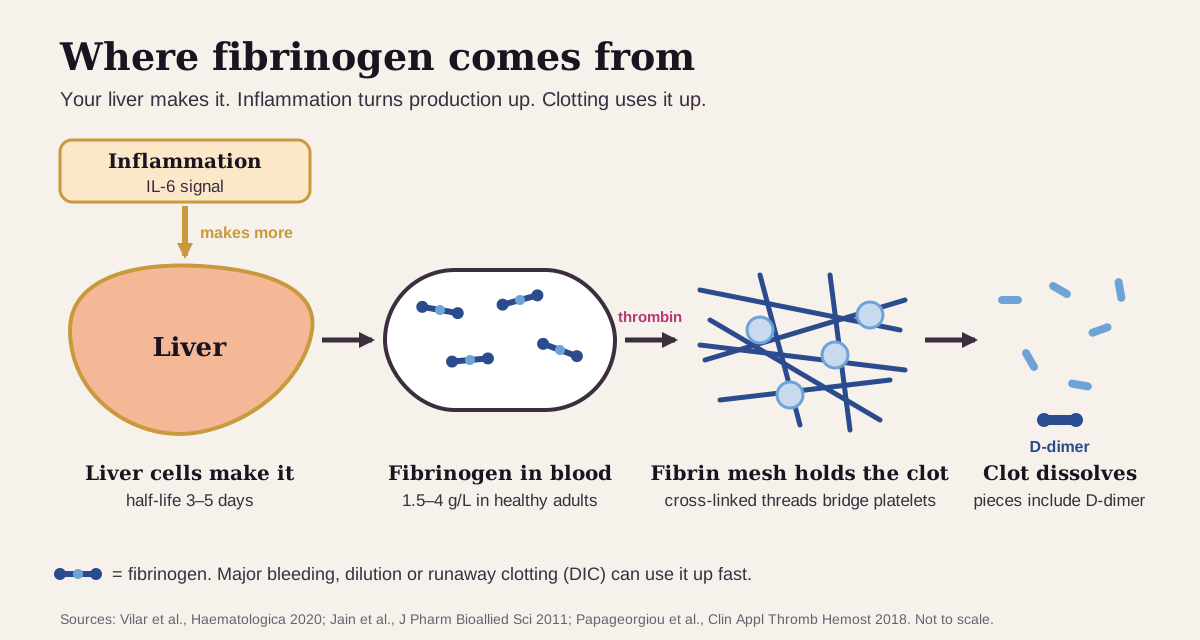
Fibrinogen is a large protein made by your liver cells, and there's a lot of it in your blood: healthy adults carry about 1.5–4 g/L. Its half-life is about 3–5 days.1 It's also called factor I, the first clotting factor.2
When a blood vessel is injured, thrombin snips fibrinogen into fibrin. Fibrin strands join up and cross-link into a mesh that seals the wound, and fibrinogen also bridges activated platelets so they clump together.1 Once the wound heals, your body dissolves the clot. One of the breakdown pieces is D-dimer, a test of its own.8
Fibrinogen is also an acute-phase protein. When you're sick or injured, immune signals (mainly one called IL-6) tell the liver to make more of it, along with CRP.910 That's why fibrinogen appears in two kinds of testing: clotting workups, next to PT/INR and aPTT,2 and heart-risk testing, because higher levels track with heart disease and stroke.7
What's a normal fibrinogen?
Start with the range printed on your own report. Labs use different methods, so their ranges differ:3
- MedlinePlus gives a general range of 200–400 mg/dL.3
- Labcorp, a large U.S. lab, prints 209–464 mg/dL for adults over 16.2
- OHSU, an academic hospital lab, uses 150–393 mg/dL.11
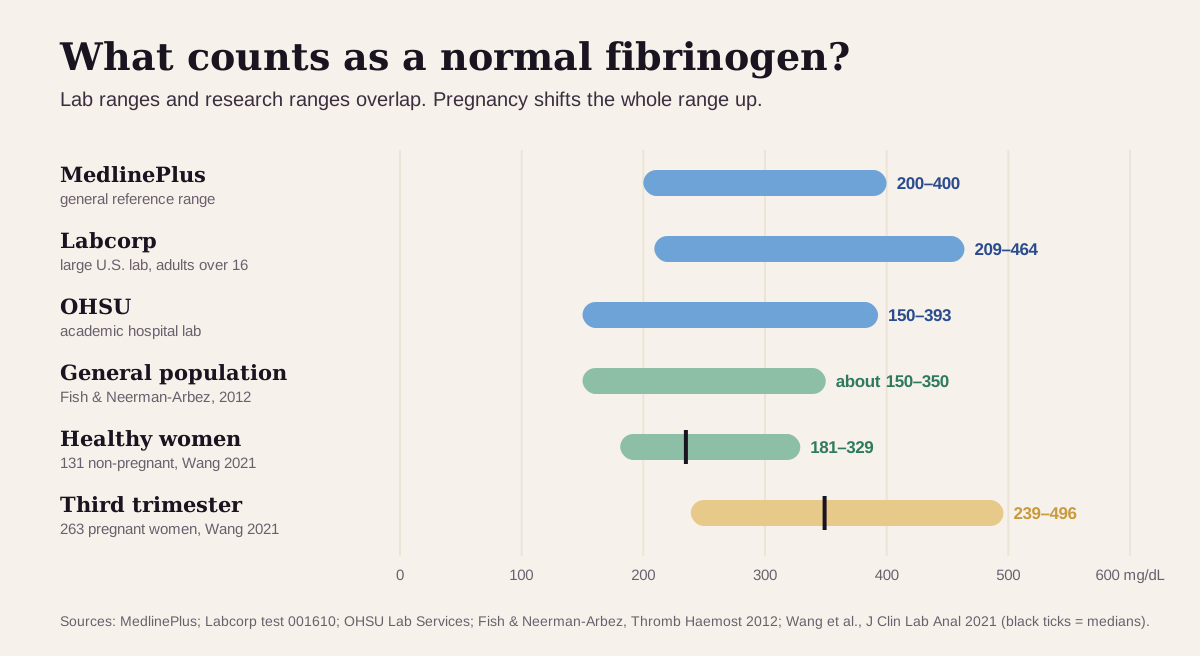
Research on healthy people lands in the same area. A review of fibrinogen genetics puts the general population at about 150–350 mg/dL.10 In 131 healthy non-pregnant women, the middle 95% ran 181–329 mg/dL, with a median of 235.12
Some people run higher by nature. In a pooled analysis of 154,211 adults, fibrinogen rose with age and was modestly higher in women, in Black participants, and in people who smoked, carried more weight, or had lower HDL cholesterol.4
Pregnancy raises it a lot. In the same study of Chinese women, the third-trimester range was 239–496 mg/dL, with a median of 349, compared with 235 before pregnancy.12 That rise is expected.
"Optimal" fibrinogen: what health optimizers aim for
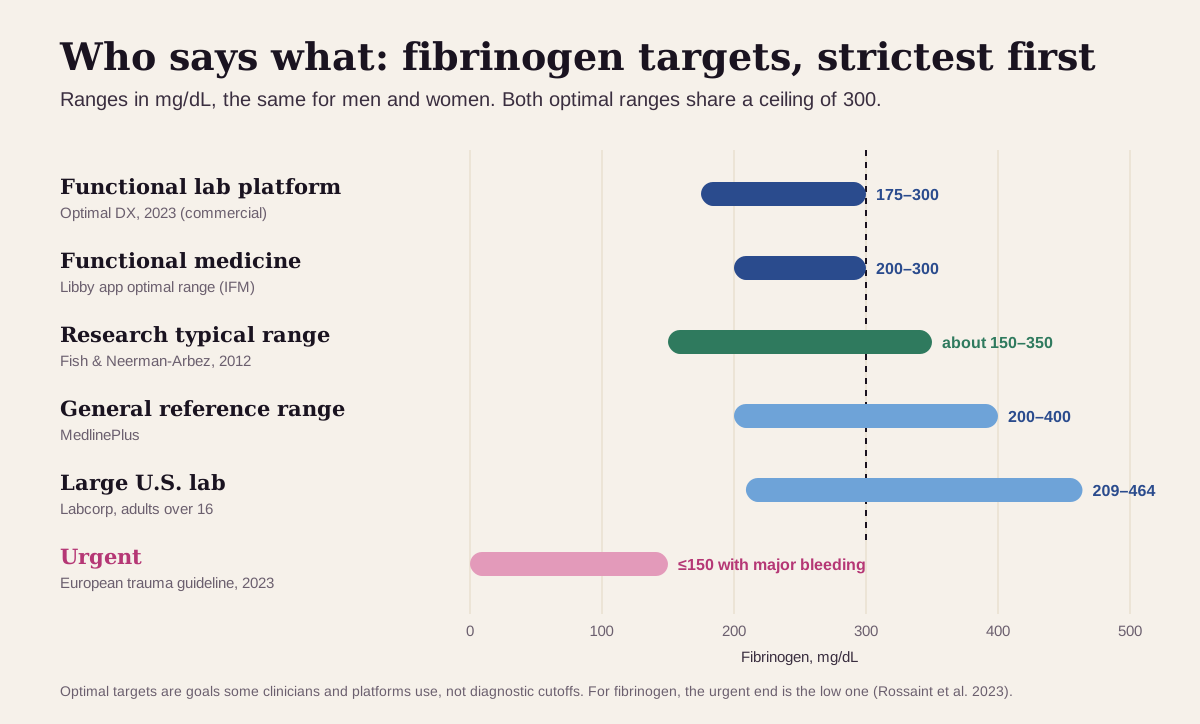
Functional-medicine practitioners aim for the lower part of the lab range. Here's the full ladder, from strictest to loosest. None of these sources splits the range by sex, so the same numbers apply to men and women.
| Target | Range | Who uses it |
|---|---|---|
| Strictest (functional lab platform) | 175–300 mg/dL | Optimal DX's published optimal range, updated in 202313 |
| Functional medicine | 200–300 mg/dL | The optimal range shown in the Libby app, from the Institute for Functional Medicine6 |
| Research "typical" range | about 150–350 mg/dL | General-population range in a review of fibrinogen biology10 |
| General reference range | 200–400 mg/dL | MedlinePlus3 |
| Large U.S. lab | 209–464 mg/dL (adults) | Labcorp's printed range2 |
| Urgent | 150 mg/dL or less with major bleeding | The level at which the European trauma guideline gives fibrinogen5 |
Why the lower targets exist:
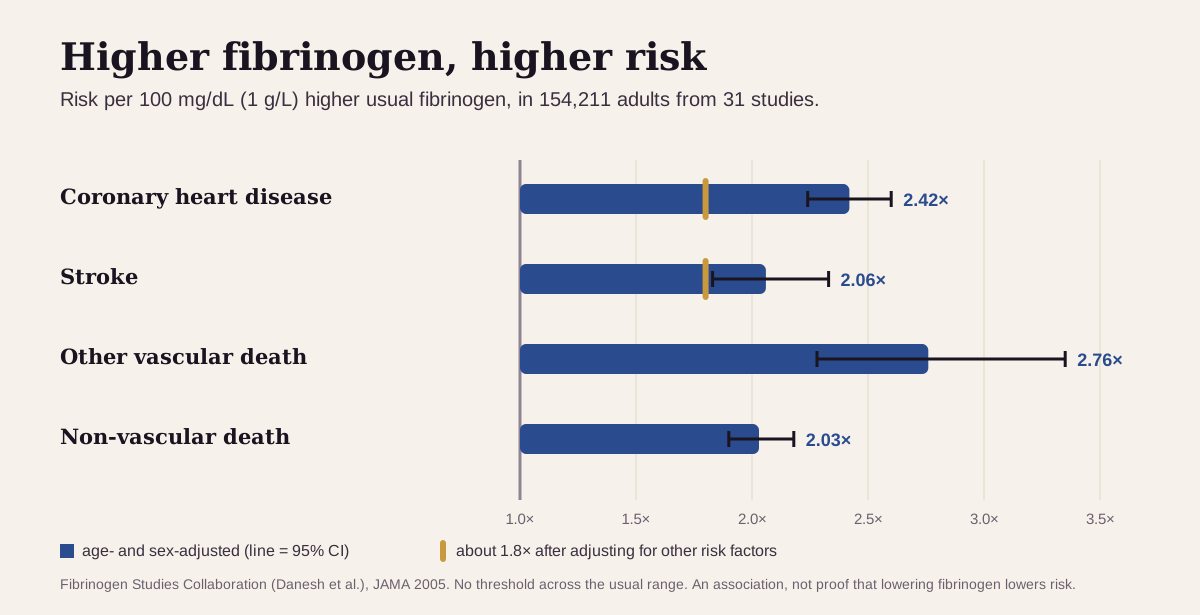
- The Fibrinogen Studies Collaboration pooled 31 studies and 154,211 adults without heart disease. Every 1 g/L (100 mg/dL) of higher usual fibrinogen came with 2.42 times the risk of coronary heart disease and 2.06 times the risk of stroke, adjusted for age and sex. After other risk factors were accounted for, both fell to about 1.8.7
- The same analysis found no threshold: risk climbed steadily across the whole usual range.7 That steady climb is the reasoning behind the 300 mg/dL ceiling.13
- Higher fibrinogen also tracked with more non-vascular deaths (2.03 times per 1 g/L).7
Keep "optimal" in perspective: it's a target, not a diagnosis. Fibrinogen travels with CRP, weight and smoking, so a high reading is often a sign of those.4 In genetic studies of more than 100,000 people, the variants that raise fibrinogen showed no clear link to heart disease or stroke, which suggests fibrinogen is more a marker of risk than a cause of it.14 Adding fibrinogen or CRP to standard risk scores would prevent about one extra heart attack or stroke over 10 years for every 400–500 intermediate-risk people tested.15 And lower only helps up to a point: you need fibrinogen to stop bleeding, and guidelines give it back when it falls to 150 mg/dL during major bleeding.5
What a high or low fibrinogen usually means
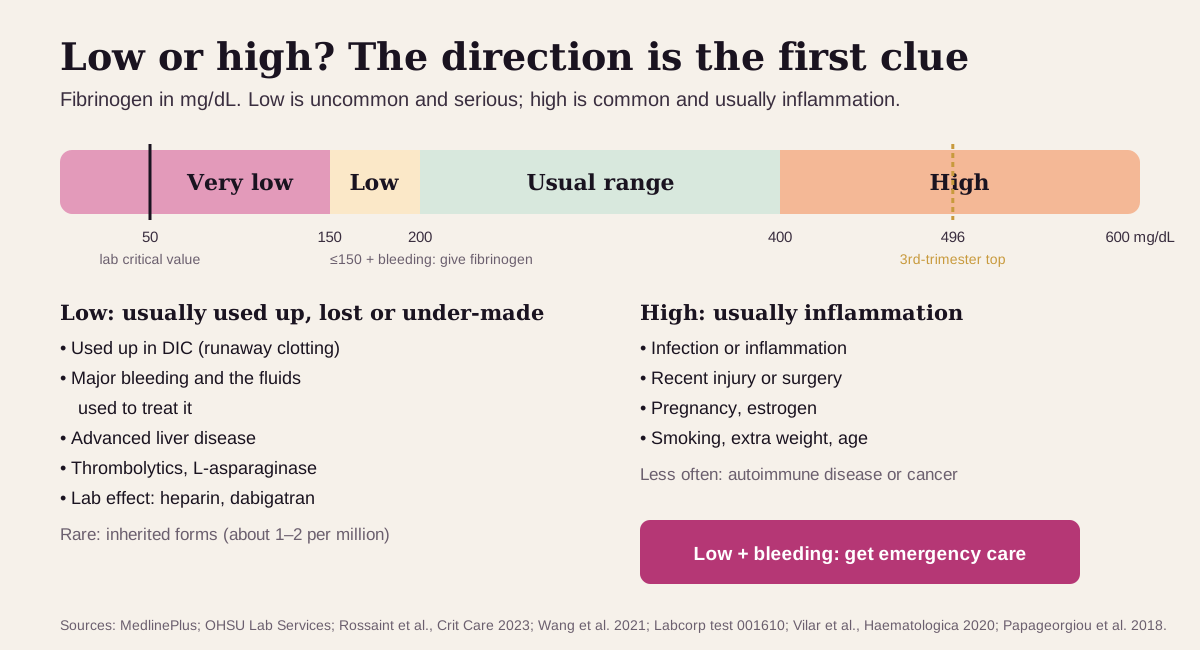
The direction is the first clue. High fibrinogen is common and usually reflects inflammation. Low fibrinogen is uncommon and usually means the body is using it up, losing it, or making too little.21
High fibrinogen: the usual suspects
- Infection or inflammation. Labcorp calls a high result "most consistent with an acute phase response": an infection, inflammation or tissue injury.2 A recent infection counts.
- Recent injury or surgery. Healing tissue drives the same acute-phase response.2
- Pregnancy and estrogen. Fibrinogen climbs through pregnancy and is higher in women taking birth-control pills.122
- Smoking, extra weight and age. In 154,211 adults, fibrinogen rose with smoking, body mass index and age. The weight link was twice as strong in women, and the smoking link was much stronger in men.4
- Less common: autoimmune diseases and cancer, which keep the acute-phase response switched on.2
Low fibrinogen: less common, more serious
Acquired low fibrinogen is far more common than the inherited kind.1
- Clotting factors being used up (DIC). In disseminated intravascular coagulation, the clotting system runs out of control and burns through fibrinogen and platelets.8 Low fibrinogen is typical of the types seen with some leukemias, amniotic fluid embolism and transfusion reactions. In DIC from sepsis, inflammation often keeps fibrinogen normal or high.81
- Major bleeding and the fluids used to treat it. Many badly injured patients arrive at the hospital with fibrinogen already under 150 mg/dL.51
- Advanced liver disease. A struggling liver makes less.161
- Medicines. Clot-dissolving (thrombolytic) drugs and the drug L-asparaginase lower it.2
- A lab effect. Heparin, direct thrombin inhibitors such as dabigatran, and fibrin breakdown products can make the result read falsely low.2 Draw volume matters too: the tube holds liquid anticoagulant, so labs such as OHSU require it filled to the line.11
- Rare inherited forms. Complete absence (afibrinogenemia) affects about 1–2 people per million.1 People who carry one faulty copy usually have no symptoms unless fibrinogen falls under 50 mg/dL.2
Get emergency care for severe bleeding, signs of internal bleeding (black, maroon or bloody stool, or vomit that is bloody or looks like coffee grounds), or signs of shock such as confusion, clammy skin, dizziness and a racing pulse, whatever your last fibrinogen was.17 OHSU's lab flags a result of 50 mg/dL or less as a critical value.11
Fibrinogen reads best next to its neighbors
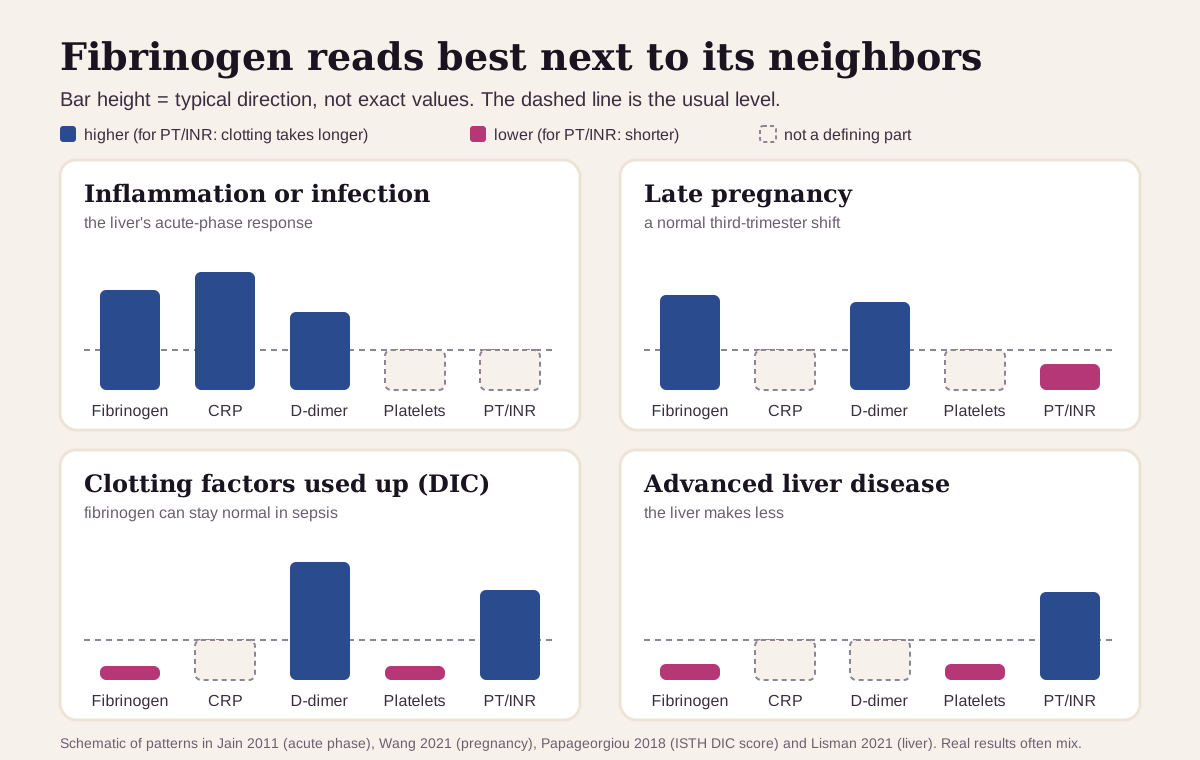
Fibrinogen rarely comes alone. The pattern across CRP, D-dimer, platelets and PT/INR usually says more than fibrinogen does by itself:
| If you see… | It often points to… |
|---|---|
| Fibrinogen and CRP both up, D-dimer often up too | inflammation or infection: the liver's acute-phase response |
| Fibrinogen and D-dimer up, PT a little shorter, in late pregnancy | normal pregnancy: third-trimester fibrinogen runs 239–496 mg/dL |
| Platelets down, D-dimer high, PT long, fibrinogen often down (DIC from sepsis can keep it normal or high) | clotting factors being used up (DIC): usually a hospital problem |
| Fibrinogen and platelets down, PT/INR long | advanced liver disease: the liver makes less |
Fibrinogen also drives your ESR. The erythrocyte sedimentation rate, an old inflammation test, depends heavily on fibrinogen, so the two tend to rise together.2
In DIC, doctors add up platelets, D-dimer, PT and fibrinogen into the ISTH score; a total of 5 or more points means overt DIC.8 In liver disease, low platelets, a long PT and low fibrinogen often appear together, even though the clotting system stays roughly in balance.16
How fast fibrinogen changes
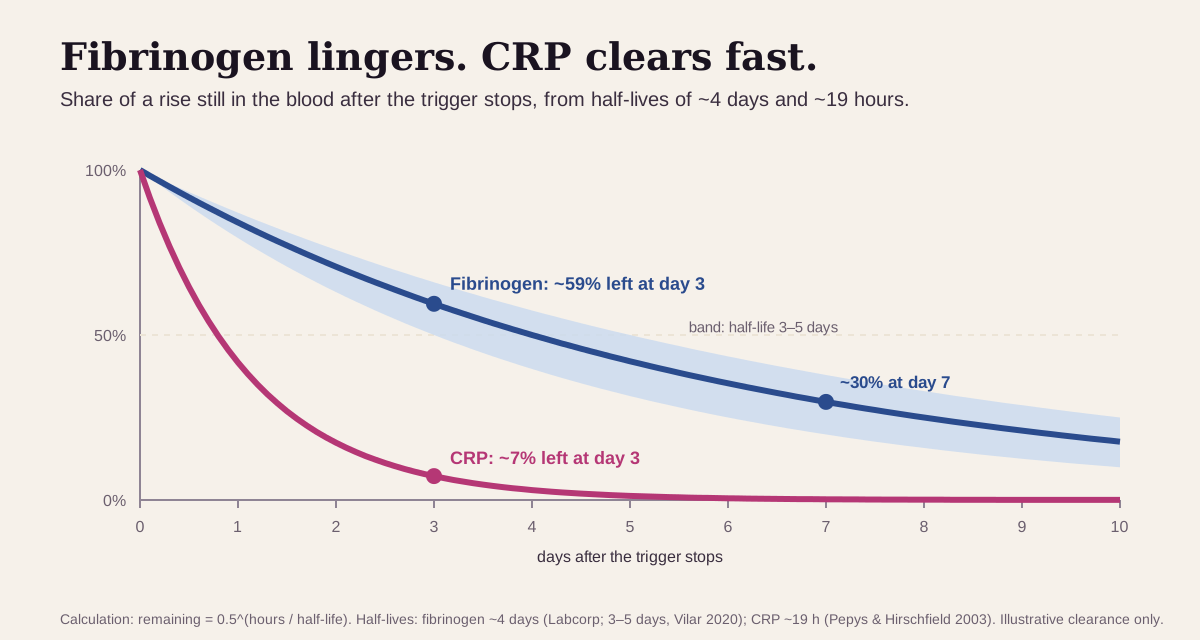
Fibrinogen is slow; CRP is fast. Fibrinogen's half-life in the blood is about 4 days (3–5 days in reviews).21 CRP's is about 19 hours: it rises within 6 hours of an insult and peaks around 48 hours.18 So after an infection settles, CRP falls within days while fibrinogen lingers.
What that means in practice:
- A high result after a recent illness may still be settling. At the 4-day half-life, about 30% of a rise is still there a week after the trigger stops. Mention recent infections, injuries and surgery when you get tested.2
- In bleeding, it can drop fast. Major blood loss and fluid replacement can drop fibrinogen fast, which is why trauma teams recheck it repeatedly.5
- Trends beat snapshots. A fibrinogen that stays high across several calm-period tests tells a different story than one that spikes once. Compare results from the same lab and method, because methods differ.19
Going deeper: how labs measure fibrinogen
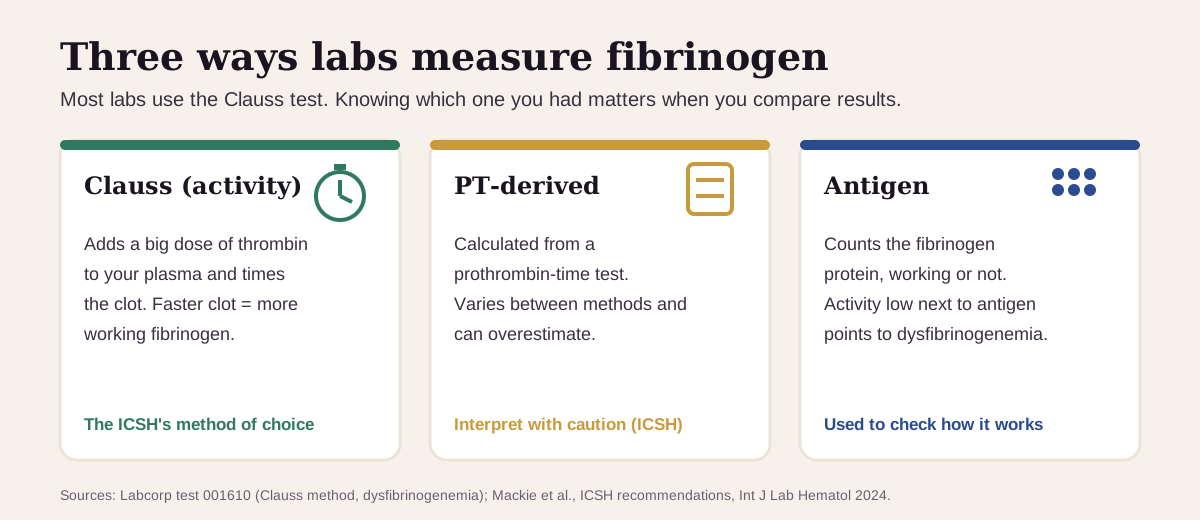
Most labs run the Clauss test. It adds a large dose of thrombin to your citrated plasma and times how fast a clot forms; a faster clot means more working fibrinogen.2 The International Council for Standardization in Haematology calls it the method of choice.19
Some analyzers report a PT-derived fibrinogen, calculated from a prothrombin-time test. The ICSH warns these results vary between methods and can overestimate fibrinogen in some patients.19
An antigen test counts fibrinogen protein, working or not. Comparing it with the Clauss result finds dysfibrinogenemia, an inherited form in which the protein is there but clots poorly: activity comes back low relative to antigen.219
Questions worth asking
- Which method produced my result: Clauss, PT-derived or antigen?
- Was I fighting an infection, injured or recovering from surgery around the test?
- What do my CRP, D-dimer, platelets and PT/INR show next to it?
- If it's high, which of my heart-risk factors (weight, smoking, blood pressure, lipids, blood sugar) are worth working on first?
- If it's low, should we check my liver, repeat it, or look for an inherited cause?
- When should we repeat it, and should it be at the same lab?
FAQ
What is a normal fibrinogen level? Check your lab's range. MedlinePlus gives 200–400 mg/dL (2.0–4.0 g/L), and Labcorp prints 209–464 mg/dL for adults.32
What is the most common cause of high fibrinogen? Inflammation: an infection, injury, surgery or a flare of an inflammatory disease. Pregnancy, estrogen, smoking and extra weight also raise it.24
Is high fibrinogen a heart risk? In 154,211 adults, higher fibrinogen tracked with more heart disease and stroke, about 1.8 times per 100 mg/dL after other risk factors.7 Genetic studies suggest it's mainly a marker of that risk.14
When is a low fibrinogen an emergency? When it comes with heavy bleeding or signs of internal bleeding. Trauma guidelines treat 150 mg/dL or less during major bleeding, and one hospital lab flags 50 mg/dL or less as critical.51117
This guide is for education. It can't diagnose you or replace care from a clinician who knows your history.
Footnotes
-
Vilar R, Fish RJ, Casini A, Neerman-Arbez M. Fibrin(ogen) in human disease: both friend and foe. Haematologica. 2020;105(2):284–296. The source for the liver origin, the 1.5–4 g/L healthy range, the 3–5 day half-life, thrombin cleavage, platelet bridging, and acquired versus inherited low fibrinogen. PMC ↩ ↩2 ↩3 ↩4 ↩5 ↩6 ↩7 ↩8 ↩9 ↩10 ↩11 ↩12 ↩13
-
Labcorp. Fibrinogen Activity, test 001610. Labcorp is a commercial laboratory; its test page gives the adult range (209–464 mg/dL), the Clauss method, the ~4-day half-life, and the causes of high and low results. labcorp.com ↩ ↩2 ↩3 ↩4 ↩5 ↩6 ↩7 ↩8 ↩9 ↩10 ↩11 ↩12 ↩13 ↩14 ↩15 ↩16 ↩17 ↩18 ↩19 ↩20 ↩21 ↩22 ↩23 ↩24 ↩25 ↩26 ↩27
-
National Library of Medicine. Fibrinogen blood test. MedlinePlus Medical Encyclopedia. Reviewed February 3, 2025. The 200–400 mg/dL (2.0–4.0 g/L) range and the main causes of abnormal results. MedlinePlus ↩ ↩2 ↩3 ↩4 ↩5 ↩6 ↩7 ↩8 ↩9
-
Fibrinogen Studies Collaboration; Kaptoge S, White IR, Thompson SG, et al. Associations of plasma fibrinogen levels with established cardiovascular disease risk factors, inflammatory markers, and other characteristics. Am J Epidemiol. 2007;166(8):867–879. 154,211 adults in 31 studies. PubMed ↩ ↩2 ↩3 ↩4 ↩5
-
Rossaint R, Afshari A, Bouillon B, et al. The European guideline on management of major bleeding and coagulopathy following trauma: sixth edition. Crit Care. 2023;27(1):80. Recommends fibrinogen replacement when major bleeding comes with a Clauss fibrinogen of 1.5 g/L or less. PMC ↩ ↩2 ↩3 ↩4 ↩5 ↩6 ↩7 ↩8
-
Institute for Functional Medicine. Clinical practice guidelines and Advanced Practice Modules (range as recorded in the Libby app's marker catalog; member-only modules not opened for this article). The Libby app's optimal fibrinogen range is 200–300 mg/dL. ifm.org ↩ ↩2 ↩3
-
Fibrinogen Studies Collaboration; Danesh J, Lewington S, Thompson SG, et al. Plasma fibrinogen level and the risk of major cardiovascular diseases and nonvascular mortality: an individual participant meta-analysis. JAMA. 2005;294(14):1799–1809. 154,211 participants, 31 prospective studies. PubMed ↩ ↩2 ↩3 ↩4 ↩5 ↩6 ↩7
-
Papageorgiou C, Jourdi G, Adjambri E, et al. Disseminated intravascular coagulation: an update on pathogenesis, diagnosis, and therapeutic strategies. Clin Appl Thromb Hemost. 2018;24(9 suppl):8S–28S. Reproduces the ISTH overt-DIC score and explains when fibrinogen falls in DIC. PMC ↩ ↩2 ↩3 ↩4 ↩5
-
Jain S, Gautam V, Naseem S. Acute-phase proteins: As diagnostic tool. J Pharm Bioallied Sci. 2011;3(1):118–127. Lists fibrinogen, CRP and D-dimer among the proteins that rise in inflammation, with IL-6 as the main signal. PMC ↩ ↩2
-
Fish RJ, Neerman-Arbez M. Fibrinogen gene regulation. Thromb Haemost. 2012;108(3):419–426. Liver production, acute-phase control, and the general-population range of about 1.5–3.5 g/L. PubMed ↩ ↩2 ↩3 ↩4 ↩5
-
Oregon Health & Science University Lab Services. Fibrinogen. A hospital lab's range (150–393 mg/dL), its critical value (50 mg/dL or less), and tube-fill rules. OHSU ↩ ↩2 ↩3 ↩4 ↩5 ↩6
-
Wang W, Long K, Deng F, et al. Changes in levels of coagulation parameters in different trimesters among Chinese pregnant women. J Clin Lab Anal. 2021;35(4):e23724. 760 women; fibrinogen 1.81–3.29 g/L before pregnancy and 2.39–4.96 g/L in the third trimester, with higher D-dimer and shorter PT late in pregnancy. PMC ↩ ↩2 ↩3 ↩4 ↩5 ↩6
-
Optimal DX. Updating the Optimal Range for Fibrinogen. February 28, 2023. States an optimal fibrinogen of 175–300 mg/dL. A commercial source, listed as what the optimizer community uses. optimaldx.com ↩ ↩2 ↩3
-
Sabater-Lleal M, Huang J, Chasman D, et al. Multiethnic meta-analysis of genome-wide association studies in >100 000 subjects identifies 23 fibrinogen-associated loci but no strong evidence of a causal association between circulating fibrinogen and cardiovascular disease. Circulation. 2013;128(12):1310–1324. PMC ↩ ↩2
-
Emerging Risk Factors Collaboration; Kaptoge S, Di Angelantonio E, Pennells L, et al. C-reactive protein, fibrinogen, and cardiovascular disease prediction. N Engl J Med. 2012;367(14):1310–1320. 246,669 participants in 52 studies. PMC ↩
-
Lisman T, Hernandez-Gea V, Magnusson M, et al. The concept of rebalanced hemostasis in patients with liver disease: communication from the ISTH SSC working group on hemostatic management of patients with liver disease. J Thromb Haemost. 2021;19(4):1116–1122. PMC ↩ ↩2 ↩3
-
National Library of Medicine. Bleeding. MedlinePlus Medical Encyclopedia. Reviewed October 14, 2025. Signs of internal bleeding and shock. MedlinePlus ↩ ↩2
-
Pepys MB, Hirschfield GM. C-reactive protein: a critical update. J Clin Invest. 2003;111(12):1805–1812. CRP rises within 6 hours, peaks near 48 hours, and has a half-life of about 19 hours. PMC ↩ ↩2
-
Mackie I, Casini A, Pieters M, et al. International Council for Standardisation in Haematology recommendations on fibrinogen assays, thrombin clotting time and related tests in the investigation of bleeding disorders. Int J Lab Hematol. 2024;46(1):20–32. PubMed ↩ ↩2 ↩3 ↩4 ↩5
Educational content, not medical advice. Libby is a personal record tool, not a medical service — it doesn't diagnose, treat, or prescribe. Reference ranges vary by lab and by person. Talk to a qualified healthcare professional about your results.
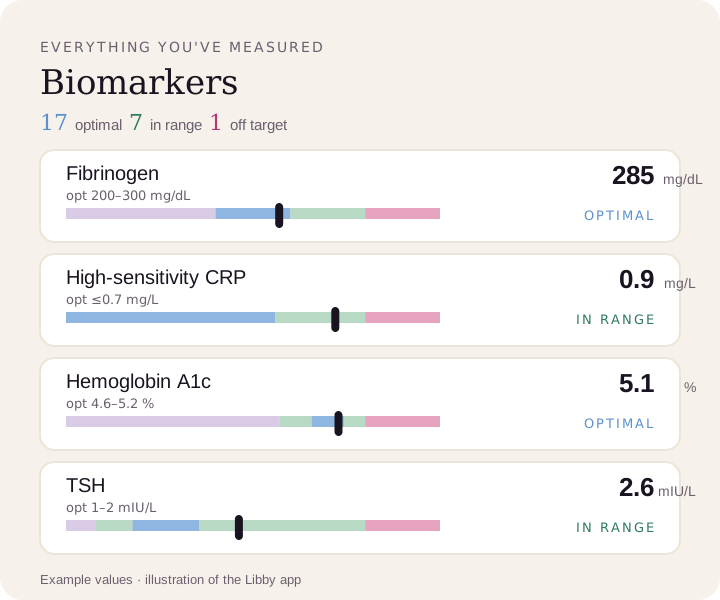
Compare your results to optimal ranges.
Upload a lab PDF or a photo of your report. Libby shows every marker against its reference range and the optimal range, and tracks your trends over time.
View your fibrinogen ›