G6PD test: what your enzyme activity result means
G6PD shields red cells from oxidant damage. What low, intermediate and normal results mean, why women vary, and why a test after hemolysis can mislead.
G6PD (glucose-6-phosphate dehydrogenase) is the enzyme that shields your red blood cells from oxidant damage. Red cells have no other way to make NADPH, the molecule that keeps their antioxidant defenses charged. So when G6PD activity is low, something oxidizing, such as fava beans, certain medicines or an infection, can break red cells apart quickly.1 About 500 million people worldwide have G6PD deficiency, and most of them never have symptoms.2
The short version
- Normal: check the range on your report. Researchers also express the result as a percent of normal: the World Health Organization (WHO) calls above 80% normal, 30–80% intermediate and under 30% deficient.3
- Low almost always means an inherited deficiency. Men with the gene usually test clearly low. Women can land anywhere from low to normal, because each red cell uses only one of their two X chromosomes.34
- A normal result during or soon after a hemolytic episode can be wrong. The oldest, most deficient cells break first, and young cells carry more enzyme. Labcorp advises retesting three months after the episode.5 A recent transfusion can hide a deficiency the same way.6
- Get care now for dark (red or black) urine, yellow eyes or skin, back pain, fever, dizziness or breathlessness after fava beans, a new medicine or an infection.3
What G6PD is
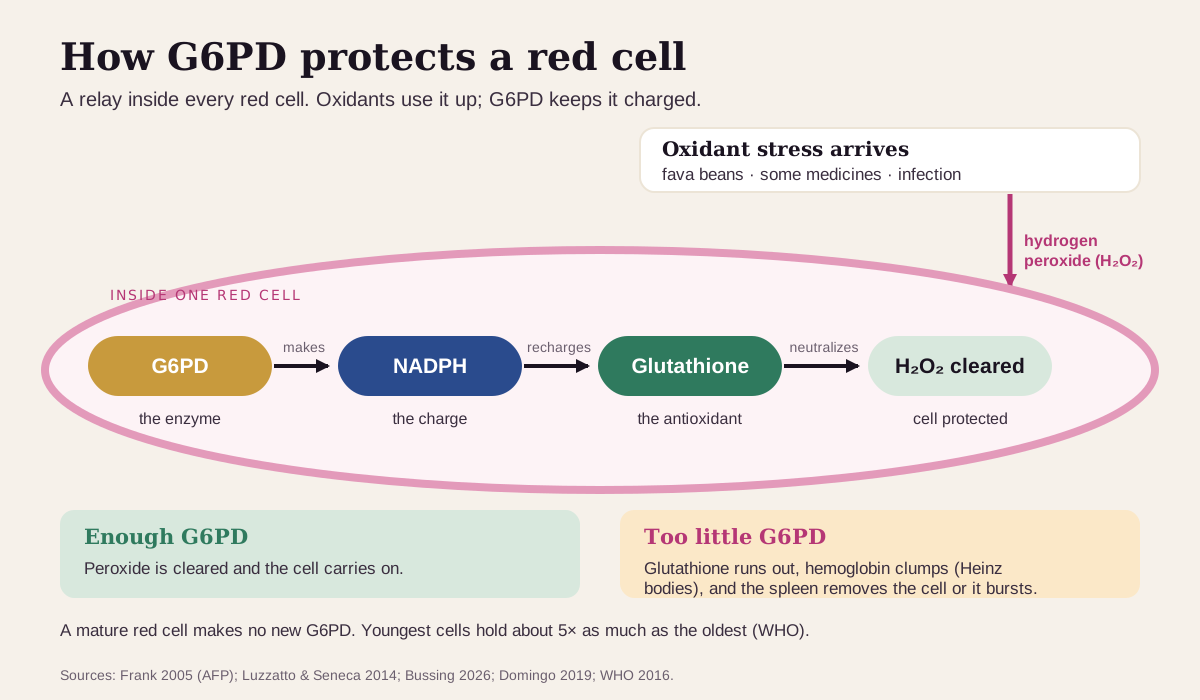
G6PD works in a side pathway of sugar metabolism (the pentose phosphate pathway), where it turns NADP into NADPH. NADPH keeps glutathione, one of the cell's antioxidants, in its active form, and glutathione clears hydrogen peroxide before it can damage the cell.17 Red cells have no nucleus and no mitochondria, so this is their only source of NADPH.8
When the oxidant load outruns the supply, glutathione runs out. Hemoglobin then clumps into small particles called Heinz bodies, the membrane is damaged, and the cell either bursts or is pulled out of circulation by the spleen, which leaves "bite cells" on a blood smear.78 Doctors call this red-cell breakdown hemolysis.
A red cell can't make new G6PD once it matures, so its activity falls as the cell ages.4 The youngest red cells hold about five times as much G6PD as the oldest, by WHO's estimate.3 That single fact explains most of the traps in reading this test.
The G6PD gene sits on the X chromosome. Deficiency is most common where malaria is common: parts of Africa, Asia, the Mediterranean and the Middle East.9
Why people get tested:
- Before certain medicines. The labels for the malaria drugs tafenoquine and primaquine require a G6PD test before prescribing.1011 The label for rasburicase, a drug that lowers uric acid during cancer treatment, rules it out in G6PD deficiency and advises screening people at higher risk first.12 The dapsone label warns that hemolysis can be exaggerated in G6PD deficiency.13
- Newborn jaundice. Newborns with G6PD deficiency are more likely to develop high bilirubin, sometimes early and severe.12
- Unexplained hemolysis, especially after a medicine, an infection or fava beans.51
What's a normal G6PD?
Start with the range printed on your own report. Labs use different methods, so their numbers differ, and research papers convert results to a percent of normal for that reason.14
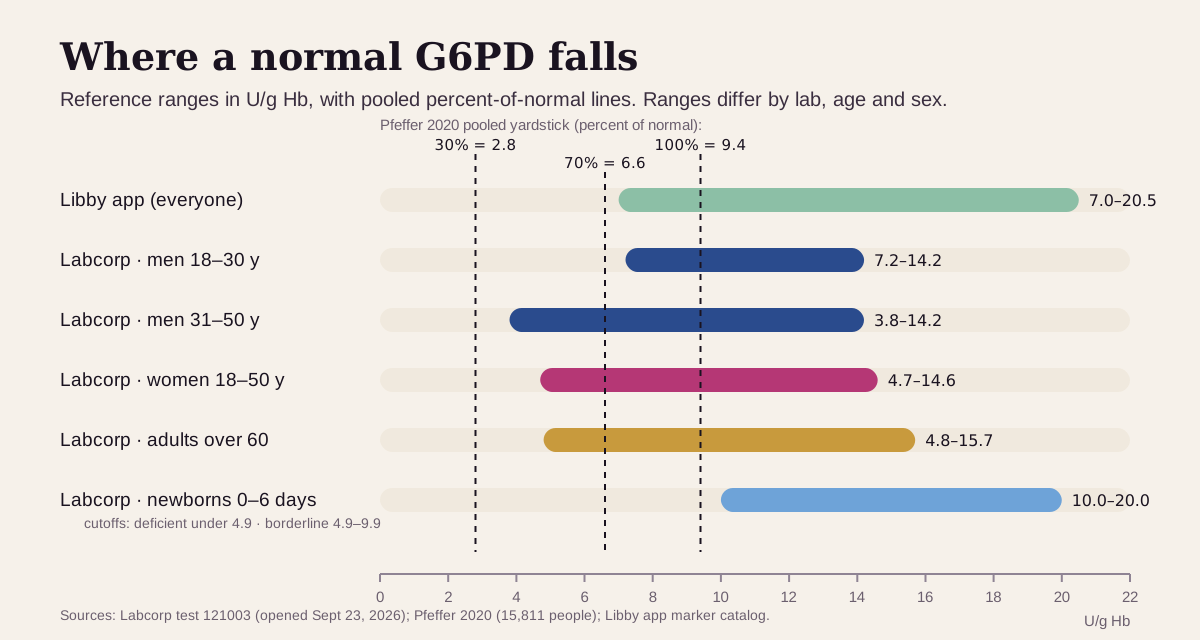
- Labcorp prints ranges by age and sex. For adults aged 18 to 30 they are 7.2–14.2 U/g Hb for men and 4.7–14.6 for women, and newborns in their first six days run higher, at 10.0–20.0.5
- The Libby app shows each G6PD result on a range of 7.0–20.5 U/g Hb, the same for everyone.
- A 2020 pooled analysis of 15,811 people tested by the reference method (spectrophotometry) set a common yardstick: 100% of normal = 9.4 U/g Hb, which puts 70% at 6.6 and 30% at 2.8 U/g Hb. Even among studies using the same test kit, the "100%" point ran from 5.7 to 12.6 U/g Hb, which is why each lab's own normal matters.15
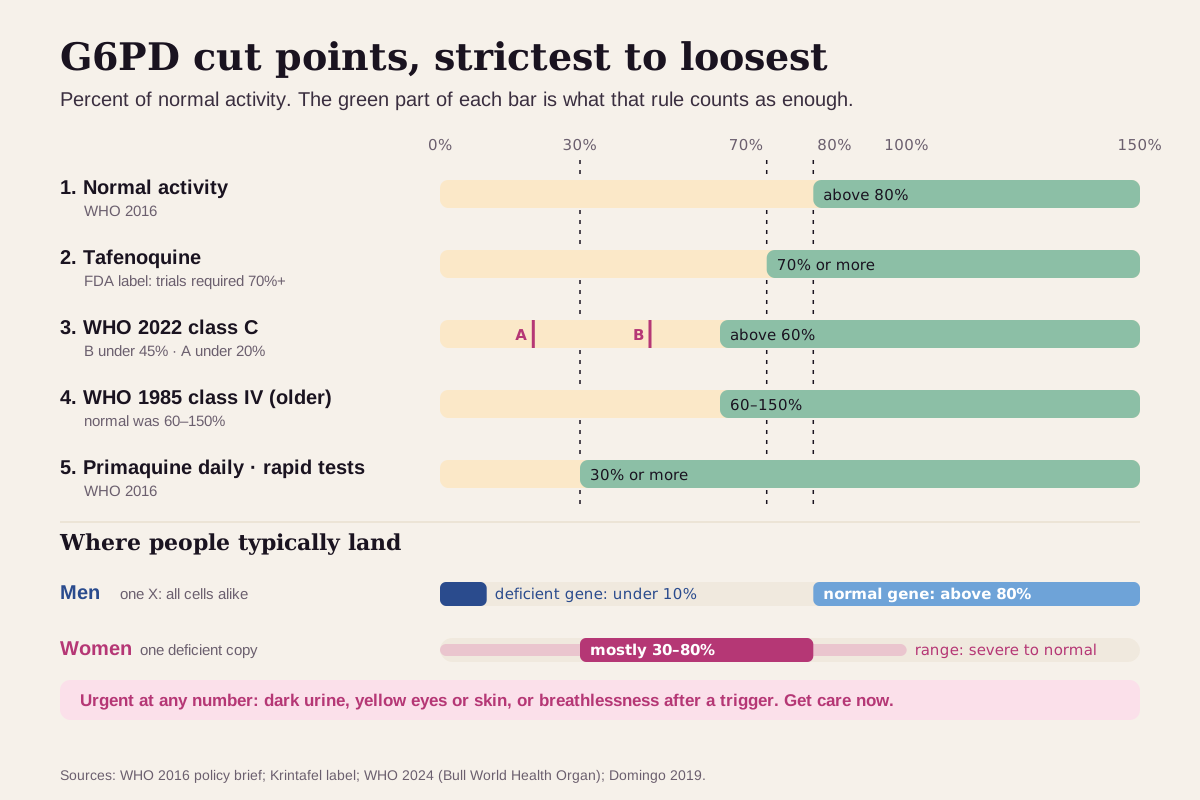
Men and women read differently. A man has one X chromosome, so his red cells are either all normal or all deficient; WHO notes that men with a normal gene typically test above 80%.3 Women with one deficient copy usually land in between, mostly at 30–80% of normal.4
Is there an "optimal" G6PD?
The Libby app has no optimal band for G6PD, so it shows your result on your lab's range. For this test the numbers that matter are cut points in percent of normal: WHO's definition of normal, and the thresholds doctors use before giving an oxidant drug. Here they are from strictest to loosest. They're the same for men and women, but men and women land in different places:
| Cut point | Men | Women | Who uses it |
|---|---|---|---|
| Strictest: normal activity | above 80% | above 80% | WHO's definition of normal G6PD activity3 |
| Tafenoquine | 70% or more | 70% or more | Clinical trials of Krintafel excluded anyone under 70% of the site's normal; the label rules the drug out in deficiency or unknown status10 |
| The Libby app | 7.0–20.5 U/g Hb | 7.0–20.5 U/g Hb | Your result on the lab range in the app's catalog; there's no optimal band for G6PD |
| Variants that cause no hemolysis (WHO class C) | above 60% | above 60% | WHO's 2022 classification of G6PD gene variants2 |
| Older WHO standard (class IV) | 60–150% | 60–150% | The 1985 classification that the 2022 system replaced2 |
| Primaquine, daily course | 30% or more | 30% or more | WHO's threshold, the level rapid spot tests are built to detect3 |
| Urgent | any result, with dark urine, jaundice or breathlessness | same | Possible acute hemolysis: get care right away3 |
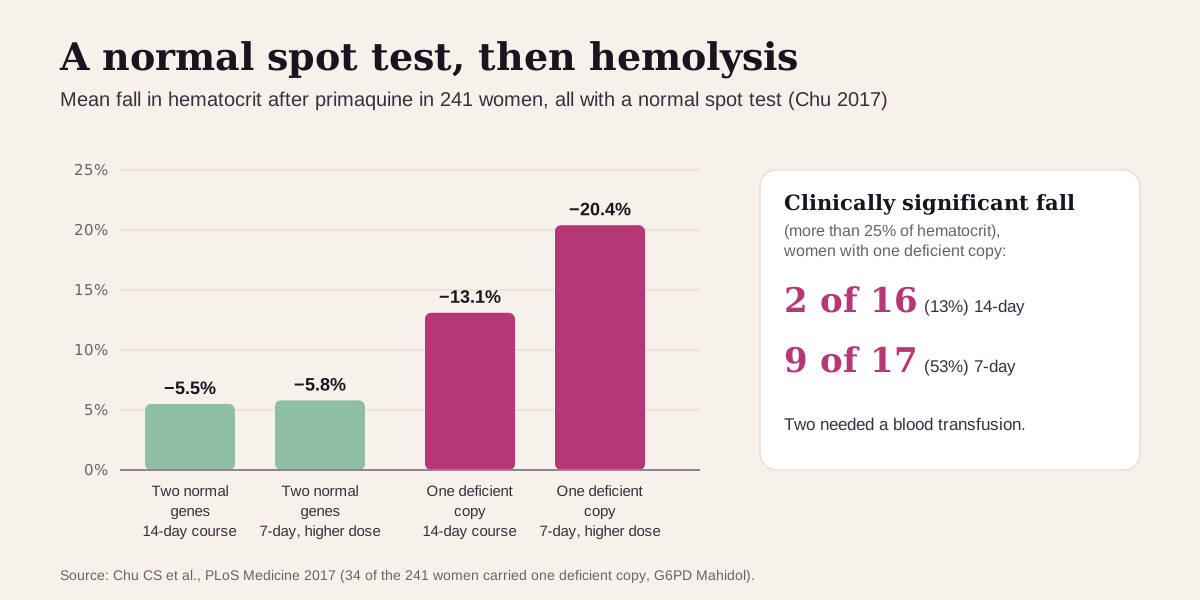
Why the higher cut points exist. Rapid spot tests call anyone above about 30–40% "normal", which misses most women with one deficient copy.4 In one study of 241 women treated with primaquine, all with a normal spot test, the 34 heterozygous women lost far more red cells than the others. On a higher-dose 7-day course, 9 of 17 (53%) had a clinically significant fall (more than a quarter of their hematocrit), against 2 of 16 (13%) on the standard 14-day course. Two needed a blood transfusion.16
Keep "optimal" in perspective: G6PD is inherited, so a higher number isn't a goal to work toward. A result above your lab's range usually means a young red-cell population, often during recovery from hemolysis, and newborns normally run higher than adults.5 What the number tells you is how much protection your red cells have when an oxidant arrives.
What a low G6PD usually means
Where the result falls is the first clue.
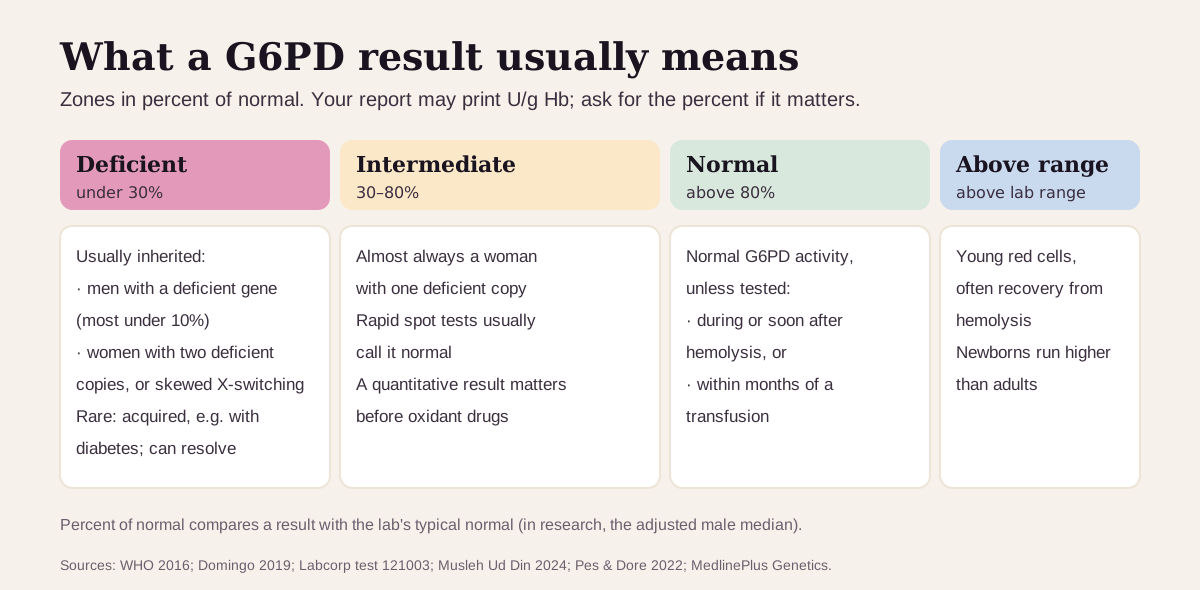
Low (under 30%): an inherited deficiency, most of the time
The usual reason is a deficient G6PD gene. Men who carry one, and women who carry two, test clearly low, and in WHO's words most will "never know they are G6PD deficient" unless something triggers hemolysis.2 Between episodes their blood count is normal.7 A rarer cause is an acquired deficiency, in which another condition, most often diabetes or excess aldosterone, slows the enzyme; it can go away when the cause is treated.17
Intermediate (30–80%): usually a woman with one deficient copy
Almost everyone in this zone is a woman who carries one normal and one deficient gene.3 These women are about twice as common in a population as deficient men and women combined, and rapid tests usually read them as normal.4 If you're in this zone, a quantitative result matters more than a spot test before any of the drugs above.16
What sets off hemolysis
Named by the sources themselves:
- Fava beans (broad beans). Even the pollen can do it; the reaction is called favism.18
- Infections, such as hepatitis A or B, pneumonia and typhoid fever.4
- Certain medicines. A 2014 review lists these as predictably causing hemolysis in G6PD deficiency: primaquine, dapsone, methylene blue, phenazopyridine, rasburicase, nitrofurantoin, some sulfa antibiotics (co-trimoxazole, sulfadiazine) and quinolones such as ciprofloxacin.7 Don't stop a prescribed medicine on your own. Bring your full list to your clinician.
- Naphthalene (mothballs) and henna.54
Hemolysis typically starts 24 to 72 hours after exposure and settles within four to seven days.1
Get care now if you have dark (red or black) urine, yellow skin or eyes, back pain, fever, dizziness or shortness of breath, especially after fava beans, a new medicine or an infection. In a newborn, jaundice that lasts past two weeks needs a check.318
A normal result that may be wrong
- During or right after hemolysis. The oldest, most deficient cells are destroyed first. What's left is young cells with more G6PD, so the result can read normal or even high. Labcorp recommends retesting three months after the episode, once red cells of all ages are back.5 The primaquine label says to postpone the test until recovery from severe anemia.11
- After a red-cell transfusion. The donor's cells carry their own G6PD and can mask a deficiency.6
- In a newborn. Newborns run higher than adults, so read their result against a newborn range.5
G6PD reads best next to its neighbors
A G6PD result is easiest to trust when you see it with the rest of the blood count. These five results sort the common situations:18
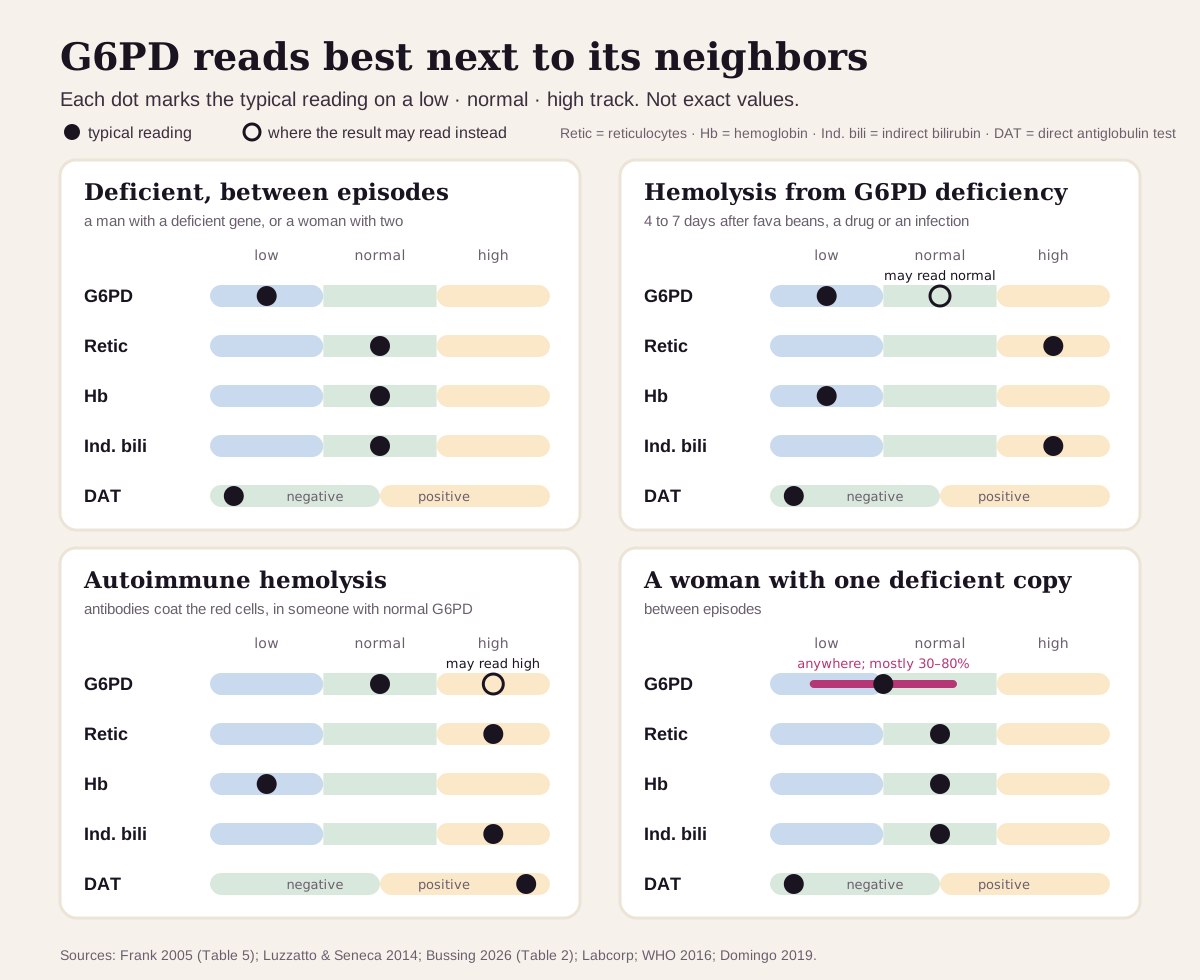
| If you see… | It often points to… |
|---|---|
| G6PD low, blood count normal | an inherited deficiency between episodes |
| G6PD in the intermediate range, blood count normal | a woman carrying one deficient copy |
| Hemoglobin falling, reticulocytes and indirect bilirubin up, DAT negative, a few days after fava beans, a medicine or an infection | hemolysis from G6PD deficiency; the G6PD result itself may read falsely normal now1 |
| The same hemolysis picture with a positive DAT | an immune (autoimmune) cause; a G6PD test now can read high, because young cells dominate85 |
| G6PD normal within months of a transfusion | possibly the donor's cells; ask when to repeat it6 |
| Hemoglobin A1c lower than your glucose readings suggest | G6PD deficiency can pull A1c down: by about 1.3 points in one study of 33 deficient young people with type 1 diabetes19 |
The hemolysis markers have their own guides: haptoglobin, LDH, indirect bilirubin and the reticulocyte count. For how A1c relates to average glucose, see the A1c guide.
How fast G6PD changes
Your G6PD genes are fixed for life, but the measured result moves with the age mix of your red cells. In a classic study, G6PD in normal red cells lost half its activity every 62 days. With the A− variant, common in people of African descent,1 the half-life was 13 days. Young A− cells started with nearly normal activity (8.8 vs 9.7 units), and with the Mediterranean variant, activity was measurable only in the youngest cells.20
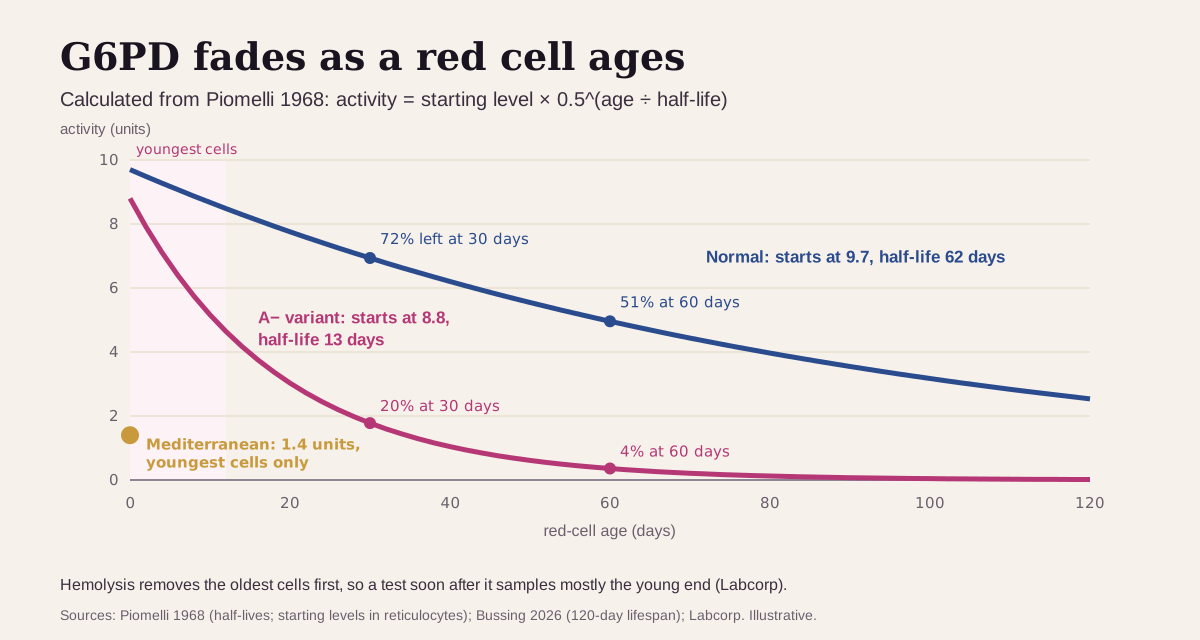
What that means in practice:
- Right after hemolysis, the result runs high. Young replacement cells arrive in force four to seven days after an episode.1 With the A− variant, hemolysis even eases while the drug continues, because those young cells resist it.3
- A retest needs time. Red cells live about 120 days,8 which is why Labcorp suggests waiting three months after an episode.5
- Trends help here. A normal result taken in the middle of an episode and a low result three months later tell one consistent story, and you only see it with both on the same page.
Going deeper: why women's results vary so much
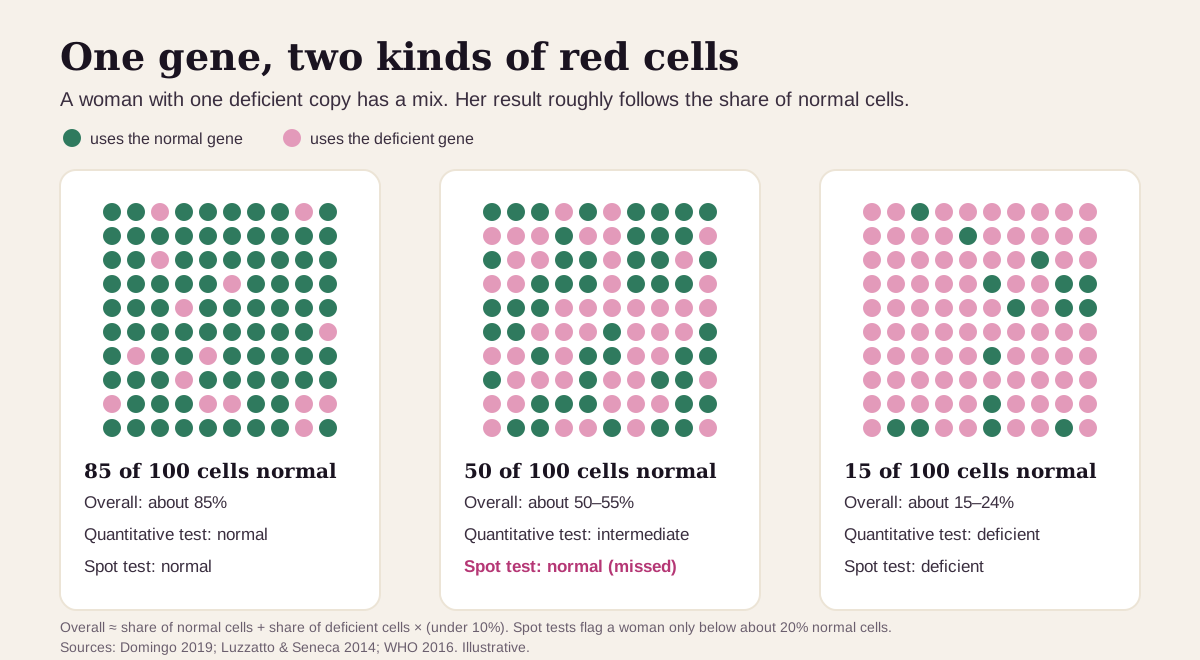
Early in development, each of a woman's cells switches off one of its two X chromosomes at random. A woman with one deficient gene therefore has two populations of red cells, one normal and one deficient.4 The average split is 50:50, but it varies a lot from woman to woman.7 Some women have heavily skewed switching, with the normal copy turned off in most cells, and they can be as deficient as an affected man.9
Her overall result roughly tracks the share of normal cells. Rapid spot tests flag her as deficient only when fewer than about 20% of her red cells use the normal gene.4 That's the gap the higher tafenoquine cut point (about 70–80%) and quantitative testing are meant to close.14
The 2022 WHO reclassification. The older 1985 system split deficient variants into class II (under 10%) and class III (10–60%). Men with the same variant often measured on both sides of 10%, and both classes cause the same problems, so in 2022 WHO merged them into class B. The classes describe gene variants, and WHO's drug advice still rests on each person's measured activity.2
Questions worth asking
- What percent of normal is my result, and is it deficient, intermediate or normal?
- Was I tested during or soon after hemolysis, or within months of a transfusion? Should I repeat it?
- Was this a quantitative test or a screening spot test?
- Which of my current medicines or planned treatments matter with this result?
- If I'm a woman with an intermediate result, would a genetic test help, and should my children or siblings be tested?
- Could G6PD be affecting my hemoglobin A1c?
FAQ
What is a normal G6PD level? It depends on your lab's range and units. Labcorp's adult lower limits run from 3.8 to 7.2 U/g Hb depending on age and sex, and WHO counts anything above 80% of normal as normal activity.53
Can women have G6PD deficiency? Yes. Women with two deficient copies are fully deficient, and women with one copy usually test at 30–80% of normal, though some are as low as affected men.49
Why was my G6PD normal during a hemolytic episode? Hemolysis removes the oldest, most deficient red cells first. The young cells left behind have more G6PD, so the result can read falsely normal. Labcorp suggests retesting three months later.5
Which foods and drugs should people with G6PD deficiency know about? Fava beans are the best-known food trigger. Drugs with predictable hemolysis include primaquine, dapsone, rasburicase and methylene blue, and some antibiotics are on the list too.187
This guide is for education. It can't diagnose you or replace care from a clinician who knows your history.
Footnotes
-
Frank JE. Diagnosis and management of G6PD deficiency. Am Fam Physician. 2005;72(7):1277–1282. The NADPH mechanism, the lab picture of acute hemolysis (Table 5), its timing, newborn jaundice, and false-normal results during hemolysis. AAFP · PubMed ↩ ↩2 ↩3 ↩4 ↩5 ↩6 ↩7 ↩8 ↩9 ↩10 ↩11
-
Luzzatto L, Bancone G, Dugué PA, et al. New WHO classification of genetic variants causing G6PD deficiency. Bull World Health Organ. 2024;102(8):615–617. The 2022 WHO classes (A under 20% with chronic hemolysis, B under 45%, C above 60%, U), the 1985 table they replaced, and the estimate of 500 million people. PMC ↩ ↩2 ↩3 ↩4 ↩5 ↩6 ↩7 ↩8
-
World Health Organization. Testing for G6PD deficiency for safe use of primaquine in radical cure of P. vivax and P. ovale malaria: policy brief. WHO/HTM/GMP/2016.9. Geneva: WHO; 2016. The 30% and 80% cut points, the male and female patterns, the five-fold difference between young and old cells, and the symptom checklist. WHO IRIS ↩ ↩2 ↩3 ↩4 ↩5 ↩6 ↩7 ↩8 ↩9 ↩10 ↩11 ↩12 ↩13 ↩14 ↩15 ↩16
-
Domingo GJ, Advani N, Satyagraha AW, et al. Addressing the gender-knowledge gap in glucose-6-phosphate dehydrogenase deficiency: challenges and opportunities. Int Health. 2019;11(1):7–14. X-inactivation, the 30–80% intermediate range in heterozygous women, what spot tests miss, and common triggers. PMC ↩ ↩2 ↩3 ↩4 ↩5 ↩6 ↩7 ↩8 ↩9 ↩10 ↩11 ↩12 ↩13 ↩14
-
Labcorp. Glucose 6-Phosphate Dehydrogenase (G6PD), Quantitative, Blood and Hemoglobin (test 121003). Reference ranges by age and sex, the false-normal warning after hemolysis, the three-month retest, and newborn levels. A commercial source (a national reference lab), opened September 23, 2026. labcorp.com ↩ ↩2 ↩3 ↩4 ↩5 ↩6 ↩7 ↩8 ↩9 ↩10 ↩11 ↩12 ↩13 ↩14 ↩15
-
Musleh Ud Din S, Shan K, Rehman TU, Ivanov S, Vargas-Madueno FM. Unexpected rasburicase-induced hemolysis in a patient with normal glucose-6-phosphate dehydrogenase activity. J Med Cases. 2024;15(9):231–236. A case report noting that testing after a transfusion can be falsely normal because donor red cells mask the deficiency. PMC ↩ ↩2 ↩3 ↩4
-
Luzzatto L, Seneca E. G6PD deficiency: a classic example of pharmacogenetics with on-going clinical implications. Br J Haematol. 2014;164(4):469–480. The glutathione and Heinz-body mechanism, the normal steady-state blood count, heterozygous mosaicism, and Table I of drugs with predictable hemolysis. PMC ↩ ↩2 ↩3 ↩4 ↩5 ↩6 ↩7 ↩8 ↩9
-
Bussing K, Brehl N, Inman A, Davidson D. Educational Case: Glucose-6-phosphate dehydrogenase (G6PD) deficiency anemia. Acad Pathol. 2026;13(3):100282. Red cells have no other source of NADPH, bite cells, the negative DAT in G6PD hemolysis versus the positive DAT in warm autoimmune hemolysis, and the 120-day red-cell lifespan. PMC ↩ ↩2 ↩3 ↩4 ↩5 ↩6 ↩7 ↩8
-
National Library of Medicine. Glucose-6-phosphate dehydrogenase deficiency. MedlinePlus Genetics. Last updated April 12, 2023. X-linked inheritance, skewed X-inactivation, and where deficiency is most common. MedlinePlus Genetics ↩ ↩2 ↩3
-
GlaxoSmithKline. KRINTAFEL (tafenoquine) tablets, prescribing information. DailyMed, published July 3, 2026. Requires G6PD testing before prescribing; trials excluded people under 70% of the site median. DailyMed ↩ ↩2 ↩3
-
Sanofi-Aventis. Primaquine phosphate tablets, prescribing information. DailyMed, published February 23, 2026. Requires G6PD testing before use and says to postpone the test in severe anemia until recovery. DailyMed ↩ ↩2
-
Sanofi-Aventis. ELITEK (rasburicase), prescribing information. DailyMed, published August 4, 2026. Contraindicated in G6PD deficiency; screen patients at higher risk before starting. DailyMed ↩
-
Sun Pharmaceutical Industries. Dapsone tablets, prescribing information. DailyMed, published March 19, 2026. Hemolysis may be exaggerated in G6PD deficiency. DailyMed ↩
-
Ley B, Bancone G, von Seidlein L, et al. Methods for the field evaluation of quantitative G6PD diagnostics: a review. Malar J. 2017;16(1):361. Why absolute values differ between assays and results are expressed against the adjusted male median. PMC ↩ ↩2
-
Pfeffer DA, Ley B, Howes RE, et al. Quantification of glucose-6-phosphate dehydrogenase activity by spectrophotometry: A systematic review and meta-analysis. PLoS Med. 2020;17(5):e1003084. 15,811 people; a universal 100% of 9.4 U/g Hb, 70% at 6.6 and 30% at 2.8. PMC ↩ ↩2
-
Chu CS, Bancone G, Moore KA, et al. Haemolysis in G6PD heterozygous females treated with primaquine for Plasmodium vivax malaria: a nested cohort in a trial of radical curative regimens. PLoS Med. 2017;14(2):e1002224. 241 women with a normal spot test, 34 of them heterozygous. PMC ↩ ↩2 ↩3
-
Pes GM, Dore MP. Acquired glucose-6-phosphate dehydrogenase deficiency. J Clin Med. 2022;11(22):6689. A narrative review; hyperaldosteronism and diabetes are the most common causes of acquired deficiency, which can resolve. PMC ↩
-
National Library of Medicine. G6PD Test. MedlinePlus. Last updated September 24, 2024. Triggers including fava beans and fava pollen, symptoms of hemolytic anemia, and newborn jaundice lasting past two weeks. MedlinePlus ↩ ↩2 ↩3
-
Ripoli C, Ricciardi MR, Angelo MR, Ripoli D. Quantifying the effect of glucose 6-phosphate dehydrogenase deficiency on glycated hemoglobin values in children and adolescents with type 1 diabetes. Sci Rep. 2024;14(1):7311. 74 young people; in the 33 deficient ones, HbA1c ran an average of 1.3% (14 mmol/mol) lower than their glucose predicted. PMC ↩
-
Piomelli S, Corash LM, Davenport DD, Miraglia J, Amorosi EL. In vivo lability of glucose-6-phosphate dehydrogenase in GdA- and GdMediterranean deficiency. J Clin Invest. 1968;47(4):940–948. Half-lives of 62 days (normal) and 13 days (A−); reticulocyte activity of 9.7 and 8.8 units; Mediterranean activity only in reticulocytes (1.4 units). PMC ↩ ↩2
Educational content, not medical advice. Libby is a personal record tool, not a medical service — it doesn't diagnose, treat, or prescribe. Reference ranges vary by lab and by person. Talk to a qualified healthcare professional about your results.
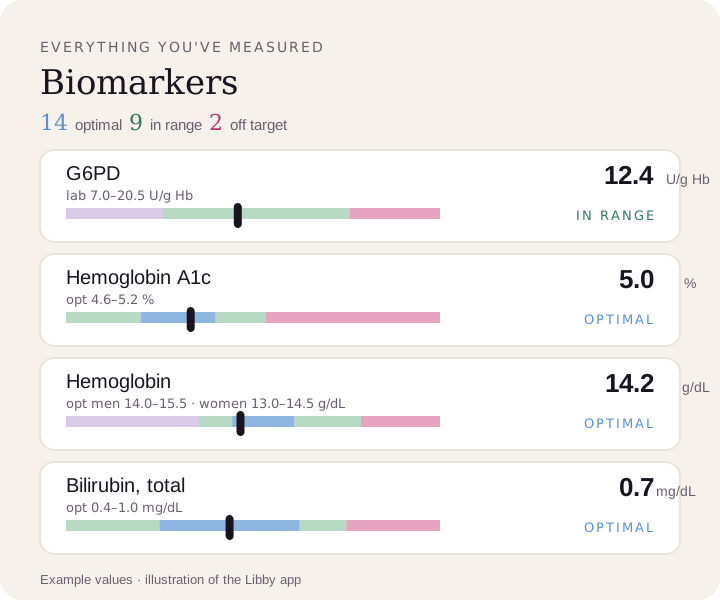
See every result against your lab's range.
Upload a lab PDF or a photo of your report. Libby shows your G6PD on your lab's range, keeps a retest next to the first result, and tracks your blood count over time.
View your G6PD ›