Reticulocyte count: normal range, high and low causes
Reticulocytes are your newest red blood cells. Here's a normal count, what high and low results mean, how to read it with MCV and ferritin, and when to act.
Reticulocytes are your newest red blood cells, released from your bone marrow within the last day or two. Counting them shows how fast your marrow is making red cells right now. A high count usually means the marrow is replacing red cells lost to bleeding or destroyed early. A low count during anemia means the marrow is falling behind.12
The short version
- Normal: about 0.5–2.5% of your red cells in adults (Labcorp prints 0.6–2.6%). As an absolute count, the classic figure is about 25–75 ×10⁹/L (25,000–75,000 per µL). Check the range on your own report.234
- High usually means recent bleeding, red cells breaking down early (hemolysis), or recovery after treatment for iron or B12 deficiency. Low with anemia usually means iron deficiency, inflammation, kidney disease, or B12 or folate deficiency.1567
- Urgent: a low count together with very low white cells or platelets points to failing marrow. A high count with yellow eyes, red or dark urine or breathlessness points to fast red-cell destruction. Both need prompt care.89
- The key distinction: the percentage looks inflated when you're anemic. The absolute count, or a corrected index under 2% with anemia, shows what the marrow is really doing.24
What a reticulocyte is
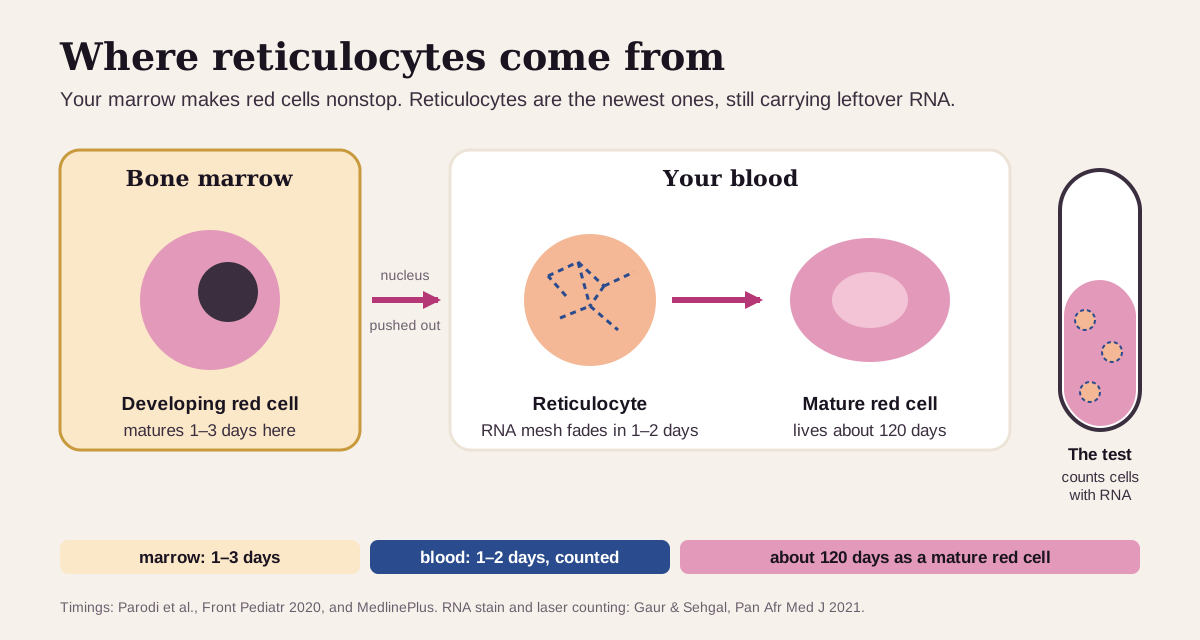
Red blood cells are built in your bone marrow. A developing red cell spends 1 to 3 days maturing there, pushes out its nucleus, and enters the blood as a reticulocyte. For its first 1 to 2 days in circulation it still carries leftover RNA. Then it becomes an ordinary red cell and lives about 120 days.41
That leftover RNA is how the lab finds them. Under a special stain it shows up as a fine mesh (the "reticulum" in the name), and modern analyzers tag it with a fluorescent dye and count the cells with a laser.2
Because each reticulocyte is only counted for a day or two, the result is a snapshot of the last day or two of production. Your hemoglobin, by contrast, reflects red cells made over months.4 Doctors order the count to sort out the type of anemia, to see whether treatment is working, and to check the marrow after chemotherapy or a transplant.1
What's a normal reticulocyte count?
Start with the range printed on your report. Here's how the main sources compare:
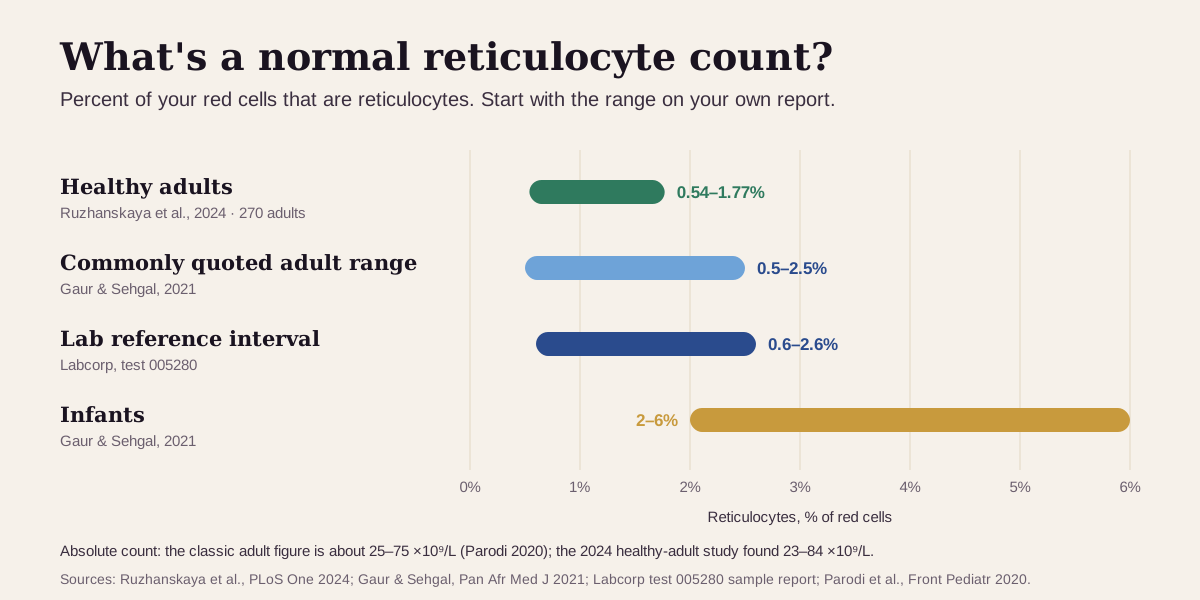
- The commonly quoted adult range is 0.5–2.5%, and 2–6% in infants.2 Labcorp's reference interval is 0.6–2.6%.3
- A 2024 reference study of healthy adults in Russia, which screened out hidden anemia and people with a BMI over 28, set a tighter range: 0.54–1.77%, or 23–84 ×10⁹/L as an absolute count, on a Beckman Coulter DxH 800 analyzer.10
- The classic textbook figure for the absolute count is about 25,000–75,000 per µL, which is 1.0 ± 0.5% of a normal 5 million red cells per µL.4
Men and women share one range. The 2024 study found the sex difference too small to split.10 Body weight matters more: counts rose with BMI in both sexes, enough that the researchers excluded BMI over 28 when setting the range.10
Babies run much higher. The count is higher at birth than at any other time in life, falls over the first days, and settles into the adult range by about 3 months.4 Pregnancy and a move to high altitude can raise the count too, and some medicines push it up or down.1
"Optimal" reticulocyte count: what health optimizers aim for
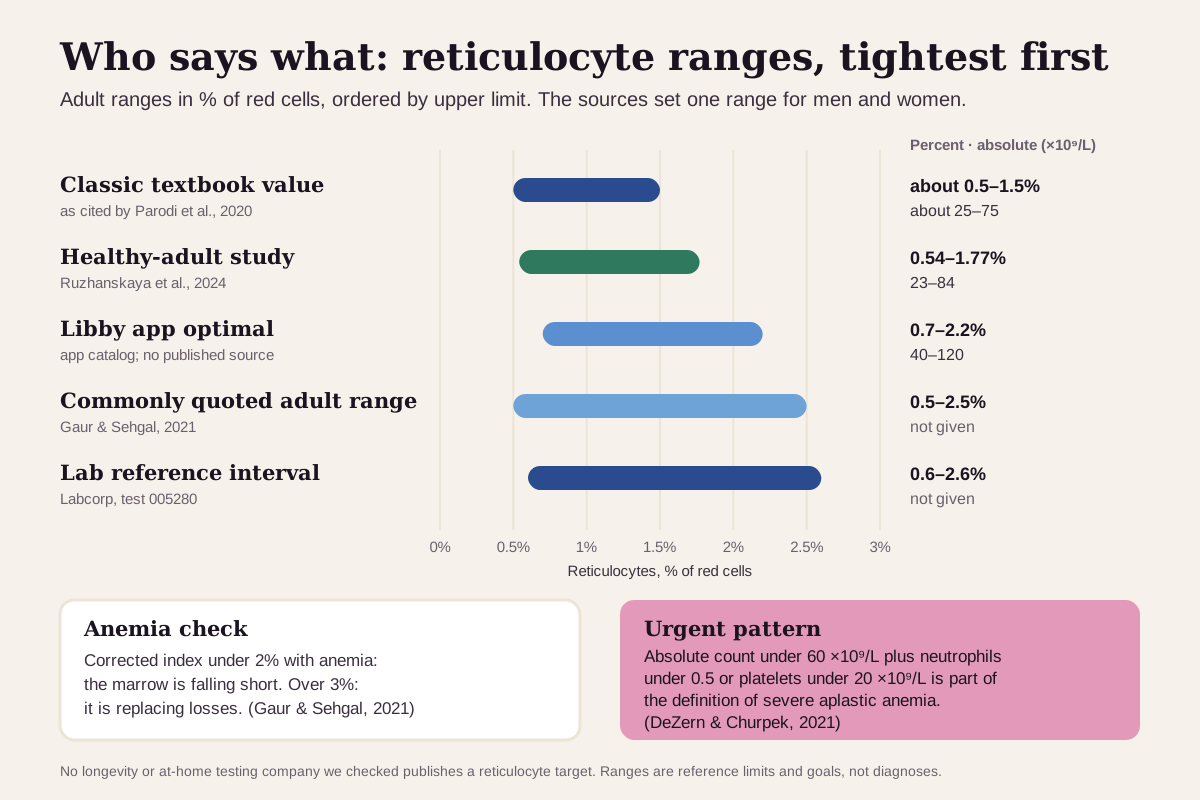
We found no longevity clinic or at-home testing company that publishes a reticulocyte target, so this ladder runs from research ranges to lab ranges, tightest first:
| Target | Percent | Absolute (×10⁹/L) | Who uses it |
|---|---|---|---|
| Classic textbook value | about 0.5–1.5% | about 25–75 | The long-standing hematology figure, as cited by Parodi and colleagues4 |
| Healthy-adult reference study | 0.54–1.77% | 23–84 | 270 healthy adults, hidden anemia and BMI over 28 excluded10 |
| Libby app optimal | 0.7–2.2% | 40–120 | The optimal range shown in the Libby app. The app's catalog records no published source for this band |
| Commonly quoted adult range | 0.5–2.5% | The textbook adult range2 | |
| Lab reference interval | 0.6–2.6% | Labcorp3 | |
| Anemia check | corrected index under 2% | With anemia, the marrow is falling short. Over 3% means it is actively replacing losses2 | |
| Urgent pattern | under 60, plus neutrophils under 0.5 or platelets under 20 | The blood-count part of the definition of severe aplastic anemia: get care promptly8 |
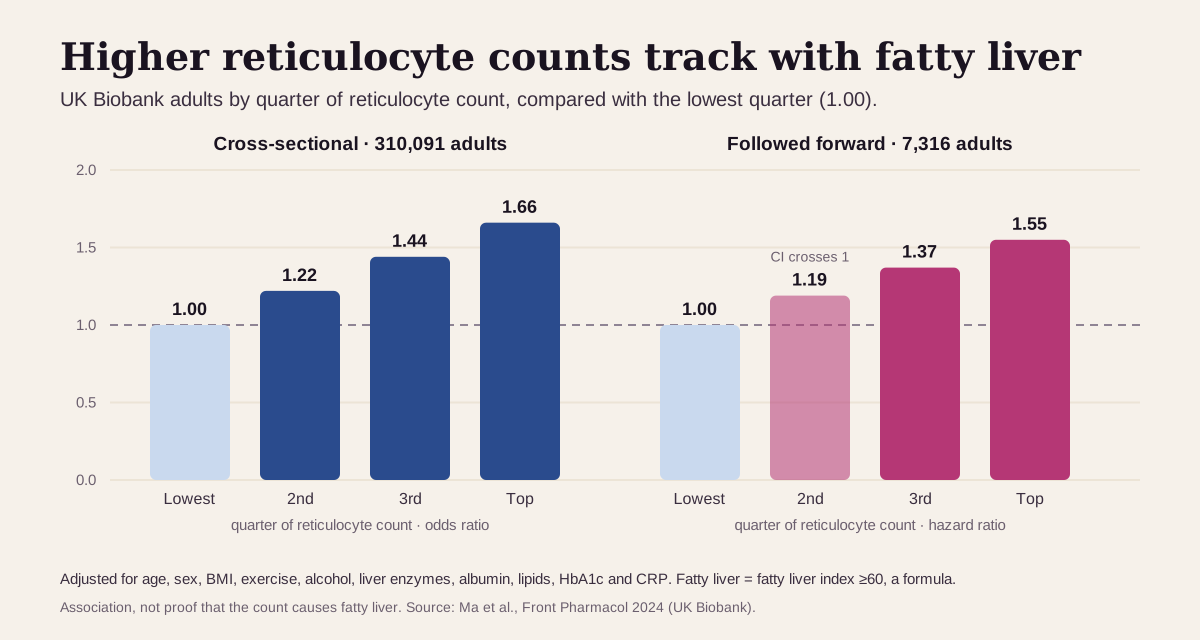
Is a high count ever a warning outside anemia? In 310,091 UK Biobank adults, the odds of fatty liver rose with each quarter of reticulocyte count: 1.22, 1.44 and 1.66 times the lowest quarter, after adjusting for age, sex, BMI, alcohol, exercise, liver enzymes, albumin, lipids, HbA1c and CRP. Among 7,316 people followed forward, the top quarter was 1.55 times as likely to develop it.11
And the low end? In anemia, a low count means the marrow is falling short, and an absolute count under 60 ×10⁹/L alongside very low neutrophils or platelets is part of how doctors define severe aplastic anemia.82
Keep "optimal" in perspective: the reticulocyte count is a response marker. The right number depends on what your marrow is responding to. A high count a week into B12 treatment is the peak your doctor hopes to see;12 a high count with dark urine and yellow eyes points to hemolysis.9 And a count inside the normal range can still be too low for someone who is anemic, because the percentage is measured against a shrunken pool of red cells.4 A mildly high count in a healthy person also tracks with body weight.10
What a high or low count usually means
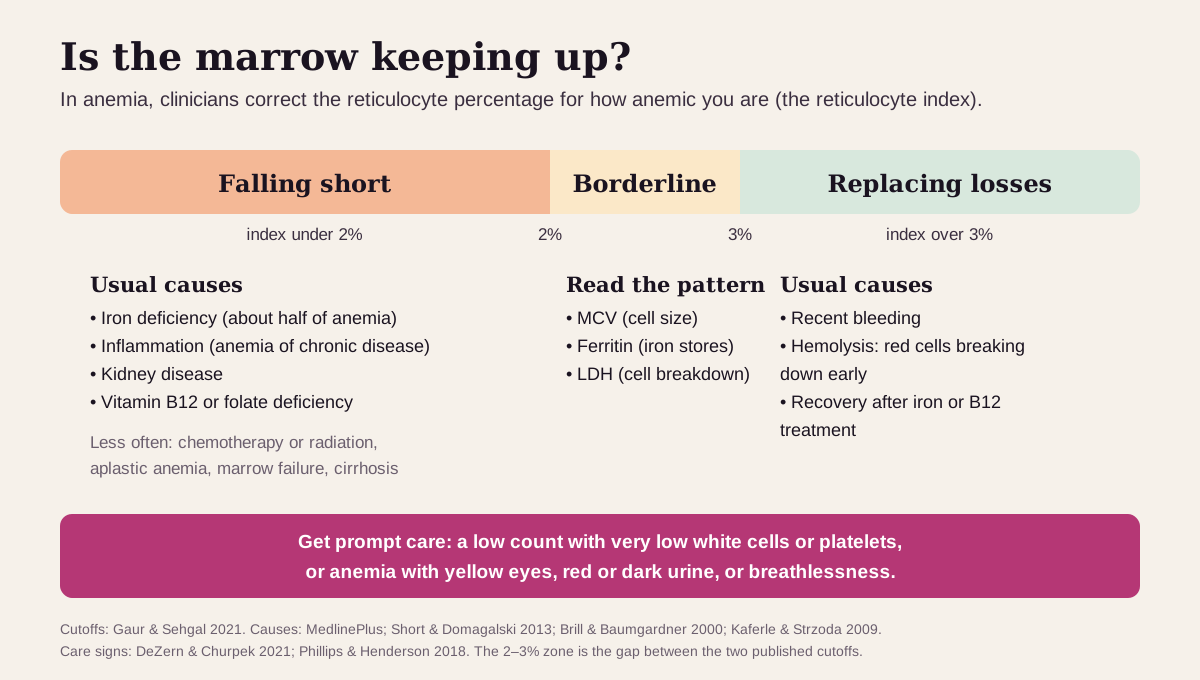
If you're anemic, the first question is whether the marrow is keeping up. Clinicians answer it with a corrected reticulocyte index, which adjusts the percentage for how anemic you are. Under 2% means the marrow is falling short; over 3% means it is working hard to replace losses.27
A high count: the marrow is replacing red cells
The usual reasons:
- Recent bleeding. A stomach or bowel bleed, a wound, or bleeding inside the body after an injury such as a hip fracture. The marrow ramps up to replace what was lost.17
- Recovery after treatment. After B12 is started, the count peaks at about 1 week.12 After iron is started, a rise in the first week signals that it's working.13 Any recovering anemia raises the count.5
- Hemolysis, red cells breaking down early. Causes include inherited conditions (sickle cell disease, hereditary spherocytosis, thalassemia, G6PD deficiency), the immune system attacking red cells, infections such as mycoplasma pneumonia or mono, and some medicines.9 LDH, bilirubin and haptoglobin confirm it.
- Pregnancy and high altitude raise the count, and a newborn's count is naturally high.14
- Higher body weight goes with a modestly higher count in healthy adults.10
A low count with anemia: the marrow is falling short
The usual suspects, most common first:
- Iron deficiency. It accounts for about half of all anemia. Ferritin is the most accurate test for it.6
- Inflammation (anemia of chronic disease). It's the most common anemia with normal-sized red cells and the second most common anemia worldwide. Long-running inflammatory conditions, infections and cancers blunt the marrow and its response to erythropoietin, the hormone that tells it to make red cells.7
- Kidney disease. Waste products that build up in kidney failure slow red-cell production and shorten red-cell life.71
- Vitamin B12 or folate deficiency. B12 deficiency affects about 6% of people under 60 and nearly 20% over 60 in the U.S. and U.K.14 Red cells come out large (high MCV).12
- Less common: chemotherapy or radiation, aplastic anemia, marrow failure from infection or cancer, and cirrhosis.1 In people with a chronic hemolytic condition, parvovirus B19 can shut red-cell production down for a while.4
A recent transfusion also lowers the percentage by diluting your own cells with donor cells.3
Get prompt care if a low count comes with very low white cells or platelets on the same blood count, or if anemia comes with yellow skin or eyes, red or dark urine, shortness of breath, a racing or irregular heartbeat, or dizziness.891
Reticulocytes read best next to their neighbors
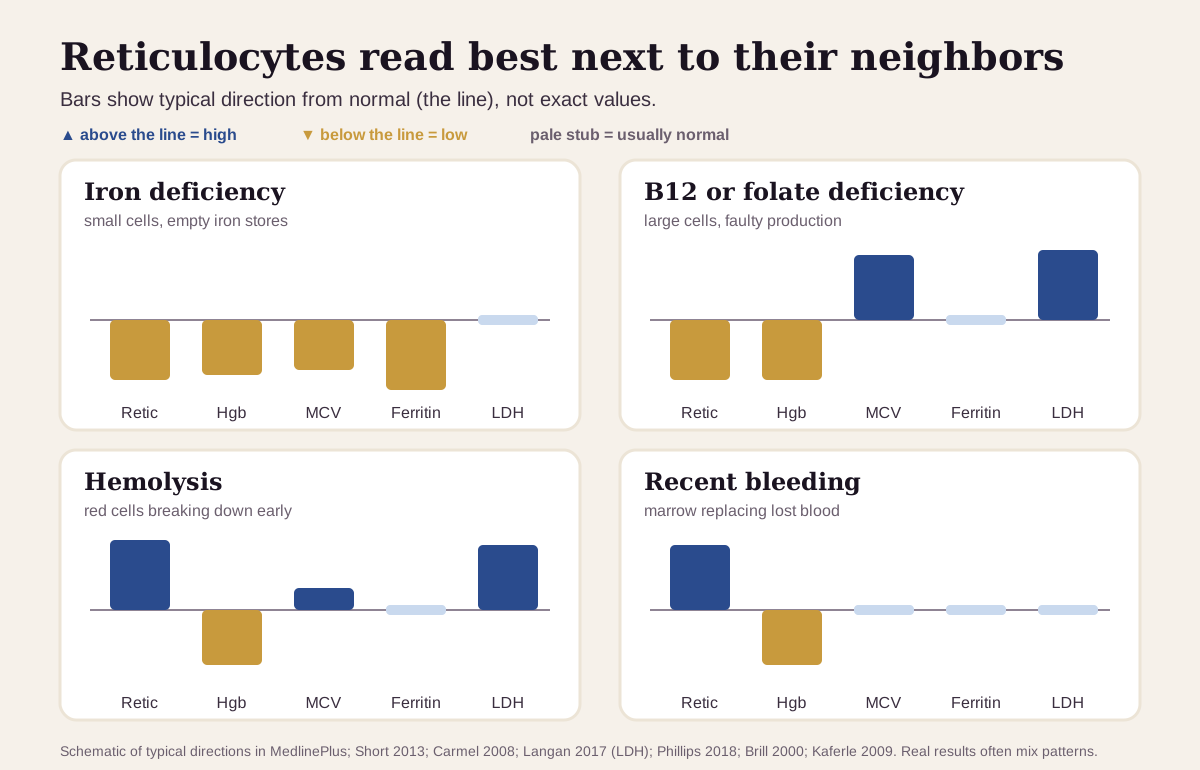
The reticulocyte count tells you whether the marrow is keeping up. The rest of the blood count tells you why. These are the four patterns that come up most:
| If you see… | It often points to… |
|---|---|
| Reticulocytes low, MCV low, ferritin low | iron deficiency, the most common anemia61 |
| Reticulocytes low, MCV high, LDH high | B12 or folate deficiency:112 faulty production raises LDH and shrinks haptoglobin14 |
| Reticulocytes high, LDH and bilirubin high, haptoglobin low | hemolysis: red cells breaking down early9 |
| Reticulocytes high, LDH normal, MCV normal or slightly high | recent bleeding, or a marrow recovering after treatment157 |
| Reticulocytes low, MCV normal, ferritin normal or high | anemia of inflammation; kidney disease gives a similar low count with normal-sized cells71 |
| Reticulocytes low, with low white cells and platelets | a problem in the marrow itself: needs prompt review8 |
Three details make the patterns work. Reticulocytes are slightly larger than mature red cells, so a strong response can nudge MCV up.5 LDH rises when red cells burst,9 which makes it a useful way to tell hemolysis from bleeding, where whole cells are lost from the bloodstream instead of bursting inside it. And patterns mix: iron deficiency often travels with B12 deficiency and can hide its large cells.12
How fast the reticulocyte count changes
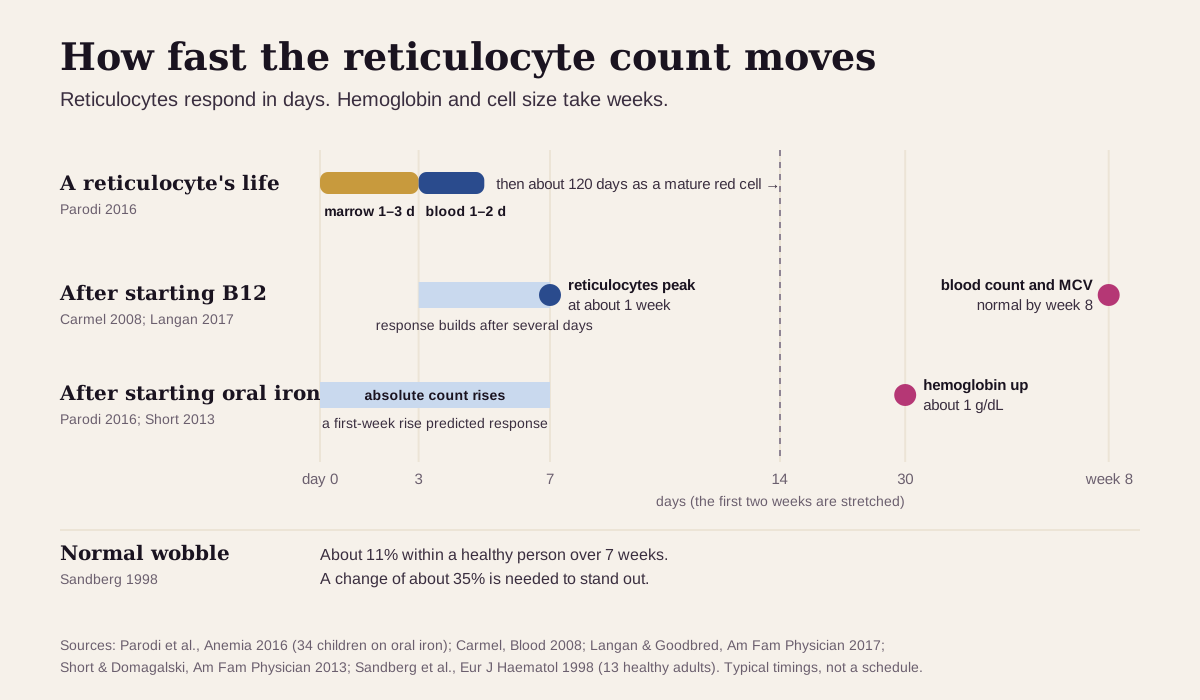
Reticulocytes turn over in days, not months. Each one spends 1 to 3 days in the marrow and 1 to 2 days in the blood before it stops counting as a reticulocyte.131
What that means in practice:
- It responds first. After B12 treatment starts, the response begins within several days and the count peaks at about 1 week; the full blood count, MCV included, should be normal by week 8.1214 In 34 children starting oral iron, a rise in the absolute count within the first week was the strongest predictor of a full response by day 30.13 Hemoglobin moves more slowly: a rise of 1 g/dL after a month of iron confirms the diagnosis.6
- Small wobbles are normal. In 13 healthy people followed for 7 weeks, the count varied about 11% within each person, so a change needed to be around 35% before it clearly meant something.15
- Trends beat snapshots. A count that climbs a week into treatment and then settles tells a clear story. One number on its own is harder to read, especially from different labs.
Going deeper: the percentage problem and the corrected index
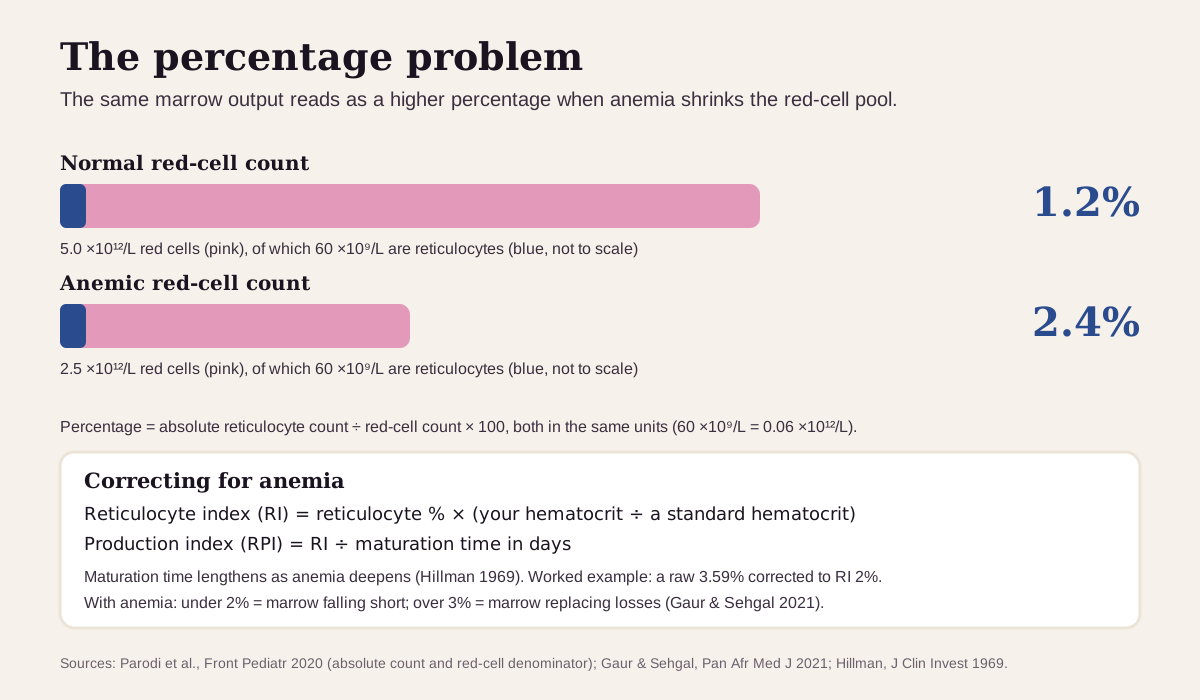
The percentage is reticulocytes divided by all red cells. When anemia shrinks the red-cell pool, the same marrow output fills a bigger share of it. Picture 60 ×10⁹/L reticulocytes: that's 1.2% of a normal red-cell count of 5.0 ×10¹²/L, but 2.4% of an anemic 2.5 ×10¹²/L. The marrow did the same work; the percentage doubled. That's why the absolute count better reflects marrow output.4
Clinicians also correct the percentage for the degree of anemia:2
Reticulocyte index (RI) = your reticulocyte % × (your hematocrit ÷ a standard hematocrit)
Reticulocyte production index (RPI) = RI ÷ reticulocyte maturation time in days
The second step exists because anemia changes the clock. A strongly stimulated marrow releases "shift" reticulocytes early, and they stay recognizable in the blood for longer, which inflates the count.2 Hillman showed in 1969 that this maturation time lengthens as anemia deepens.16 In one worked example, a raw count of 3.59%, which looked like a strong response, corrected to an index of just 2%, well short of the over-3% of a marrow that is replacing losses.2
Some analyzers also report reticulocyte hemoglobin (CHr or RET-He), the hemoglobin packed into the newest cells. It reflects the iron available to the marrow over the previous 3 to 4 days, which makes it an early read on iron supply.13
Questions worth asking
- Am I anemic, and is my reticulocyte response right for that level of anemia?
- What is my absolute count, or my corrected index, not just the percentage?
- What do my MCV, ferritin and B12 show next to it?
- Should LDH, bilirubin and haptoglobin be checked for hemolysis?
- Could recent bleeding, a transfusion, pregnancy, altitude or a medicine explain the result?
- If I'm starting treatment, when should we recheck to see the marrow respond?
FAQ
What is a normal reticulocyte count? About 0.5–2.5% of red cells in adults, depending on your lab; Labcorp uses 0.6–2.6%. Infants run higher, about 2–6%.23
What causes a high reticulocyte count? Most often recent bleeding, red cells breaking down early (hemolysis), or recovery after treatment for iron or B12 deficiency. Pregnancy and high altitude raise it too.15
What does a low reticulocyte count mean? With anemia, it means the marrow is falling short, most often from iron deficiency, inflammation, kidney disease, or B12 or folate deficiency. A low count with low white cells and platelets needs prompt review.678
How fast does the count respond to treatment? Within days. After B12 treatment it peaks at about one week, and after iron a rise in the first week signals a response, well before hemoglobin recovers.1213
This guide is for education. It can't diagnose you or replace care from a clinician who knows your history.
Footnotes
-
National Library of Medicine. Reticulocyte Count. MedlinePlus. What the test measures, why it's ordered, the causes of high and low counts, and the symptoms of anemia. MedlinePlus ↩ ↩2 ↩3 ↩4 ↩5 ↩6 ↩7 ↩8 ↩9 ↩10 ↩11 ↩12 ↩13 ↩14 ↩15 ↩16 ↩17 ↩18 ↩19
-
Gaur M, Sehgal T. Reticulocyte count: a simple test but tricky interpretation! Pan Afr Med J. 2021;40:3. Adult (0.5–2.5%) and infant (2–6%) ranges, the RNA stain, shift reticulocytes, the RI and RPI formulas, and the under-2% and over-3% cutoffs. PMC ↩ ↩2 ↩3 ↩4 ↩5 ↩6 ↩7 ↩8 ↩9 ↩10 ↩11 ↩12 ↩13 ↩14 ↩15 ↩16 ↩17
-
Labcorp. Reticulocyte Count, test 005280, and its sample report (reference interval 0.6–2.6%). Also warns that a recent transfusion can lower the count by dilution. A commercial laboratory, cited for its published range. Labcorp ↩ ↩2 ↩3 ↩4 ↩5 ↩6 ↩7
-
Parodi E, Romano F, Ramenghi U. How We Use Reticulocyte Parameters in Workup and Management of Pediatric Hematologic Diseases. Front Pediatr. 2020;8:588617. The source for the 1–3 day marrow and 1–2 day blood timings, the 120-day red-cell life, the classic absolute range (about 25,000–75,000/µL, 1.0 ± 0.5%), and newborn values. PMC ↩ ↩2 ↩3 ↩4 ↩5 ↩6 ↩7 ↩8 ↩9 ↩10 ↩11 ↩12 ↩13
-
Kaferle J, Strzoda CE. Evaluation of macrocytosis. Am Fam Physician. 2009;79(3):203–208. A high count points to bleeding, hemolysis or recovery; reticulocytes are larger than mature red cells. PubMed ↩ ↩2 ↩3 ↩4 ↩5 ↩6 ↩7
-
Short MW, Domagalski JE. Iron deficiency anemia: evaluation and management. Am Fam Physician. 2013;87(2):98–104. Iron deficiency causes about half of anemia; ferritin is the most accurate test; a 1 g/dL hemoglobin rise after a month confirms the response. PubMed ↩ ↩2 ↩3 ↩4 ↩5 ↩6 ↩7
-
Brill JR, Baumgardner DJ. Normocytic anemia. Am Fam Physician. 2000;62(10):2255–2264. Anemia of chronic disease as the most common normocytic anemia, kidney disease, bleeding, and the corrected reticulocyte index. PubMed ↩ ↩2 ↩3 ↩4 ↩5 ↩6 ↩7 ↩8 ↩9 ↩10
-
DeZern AE, Churpek JE. Approach to the diagnosis of aplastic anemia. Blood Adv. 2021;5(12):2660–2671. Defines severe aplastic anemia by an absolute reticulocyte count under 60 ×10⁹/L, neutrophils under 0.5 or platelets under 20 ×10⁹/L (at least two), and an empty marrow. PMC ↩ ↩2 ↩3 ↩4 ↩5 ↩6 ↩7
-
Phillips J, Henderson AC. Hemolytic Anemia: Evaluation and Differential Diagnosis. Am Fam Physician. 2018;98(6):354–361. The lab signature of hemolysis (high reticulocytes, LDH and bilirubin, low haptoglobin), its symptoms and its causes. PubMed ↩ ↩2 ↩3 ↩4 ↩5 ↩6 ↩7
-
Ruzhanskaya A, Ichihara K, Sukhacheva E, et al. Derivation of Russian-specific reference intervals for complete blood count, iron markers and related vitamins. PLoS One. 2024;19(9):e0304020. Healthy adults screened for hidden anemia, BMI under 28; reticulocytes 0.54–1.77% and 23.0–84.1 ×10⁹/L, one range for both sexes. PMC ↩ ↩2 ↩3 ↩4 ↩5 ↩6 ↩7 ↩8
-
Ma PC, Li QM, Li RN, et al. A high reticulocyte count is a risk factor for the onset of metabolic dysfunction-associated steatotic liver disease: cross-sectional and prospective studies of data of 310,091 individuals from the UK Biobank. Front Pharmacol. 2024;15:1281095. PMC ↩ ↩2
-
Carmel R. How I treat cobalamin (vitamin B12) deficiency. Blood. 2008;112(6):2214–2221. Macrocytic anemia; the reticulocyte peak 1 week after treatment starts; a normal blood count by week 8. PMC ↩ ↩2 ↩3 ↩4 ↩5 ↩6 ↩7 ↩8 ↩9
-
Parodi E, Giraudo MT, Ricceri F, et al. Absolute Reticulocyte Count and Reticulocyte Hemoglobin Content as Predictors of Early Response to Exclusive Oral Iron in Children with Iron Deficiency Anemia. Anemia. 2016;2016:7345835. 34 children; the first-week rise in absolute count predicted a full response by day 30. PMC ↩ ↩2 ↩3 ↩4 ↩5 ↩6
-
Langan RC, Goodbred AJ. Vitamin B12 Deficiency: Recognition and Management. Am Fam Physician. 2017;96(6):384–389. Prevalence (about 6% under 60, nearly 20% over 60), high LDH and low haptoglobin, and the one-week and eight-week recovery landmarks. PubMed ↩ ↩2 ↩3 ↩4 ↩5
-
Sandberg S, Rustad P, Johannesen B, Stølsnes B. Within-subject biological variation of reticulocytes and reticulocyte-derived parameters. Eur J Haematol. 1998;61(1):42–48. 13 healthy people over 7 weeks: about 11% within-person variation and a 35% critical difference. PubMed ↩ ↩2
-
Hillman RS. Characteristics of marrow production and reticulocyte maturation in normal man in response to anemia. J Clin Invest. 1969;48(3):443–453. Reticulocyte maturation time in the blood lengthens as anemia deepens. PMC ↩
Educational content, not medical advice. Libby is a personal record tool, not a medical service — it doesn't diagnose, treat, or prescribe. Reference ranges vary by lab and by person. Talk to a qualified healthcare professional about your results.
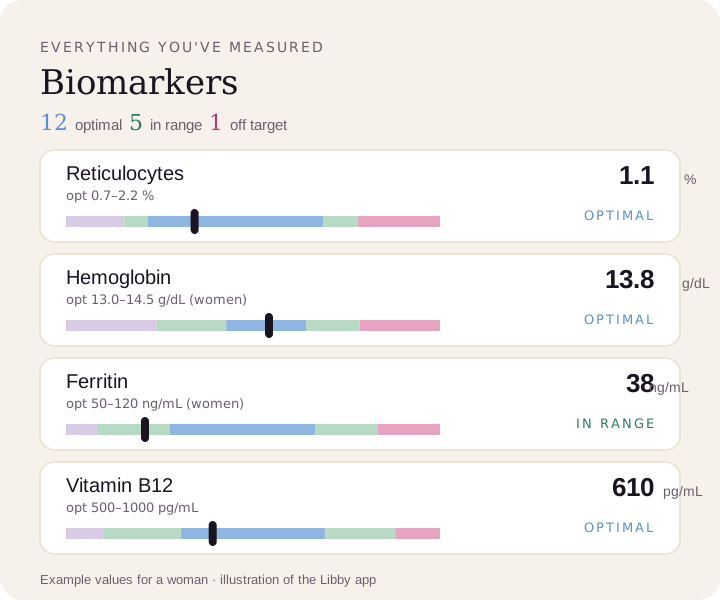
Compare your results to optimal ranges.
Upload a lab PDF or a photo of your report. Libby puts each marker on your lab's range and, where one exists, the optimal range, and tracks your trends over time.
View your reticulocyte count ›