Immature reticulocyte fraction (IRF): ranges and causes
IRF is the share of your reticulocytes that are brand new. Ranges by analyzer, what high and low mean, and how it flags marrow recovery after chemo.
The immature reticulocyte fraction (IRF) is the share of your reticulocytes that your bone marrow released most recently. Reticulocytes are brand-new red blood cells, and the youngest of them still carry a lot of RNA. IRF counts those RNA-rich cells, so it shows how hard your marrow is pushing out red cells right now. It moves before the reticulocyte count does, which makes a rising IRF one of the earliest signs that a marrow is coming back after chemotherapy or a stem-cell transplant.123
The short version
- Normal depends on the machine. Healthy adults measured on a Sysmex XE-5000 ran 1.6–12.1%. Other analyzers put healthy people anywhere from 4–25% to 20–37%. Read your result only against the range on your own report.24
- High usually means the marrow is speeding up: recovery after chemotherapy or a transplant, bleeding or red cells breaking down early (hemolysis), iron or B12 deficiency, or the first days of treatment. Low with anemia means the marrow is under-responding, most often from kidney disease in one classic study.156
- Urgent: IRF has no emergency cutoff of its own. What needs prompt care is the company it keeps: a fever of 100.5°F (38°C) or higher during chemotherapy, very low neutrophils or platelets, or bleeding.78
- The key distinction: IRF shows how new your reticulocytes are; the reticulocyte count shows how many there are. The two read best together.1
What IRF measures
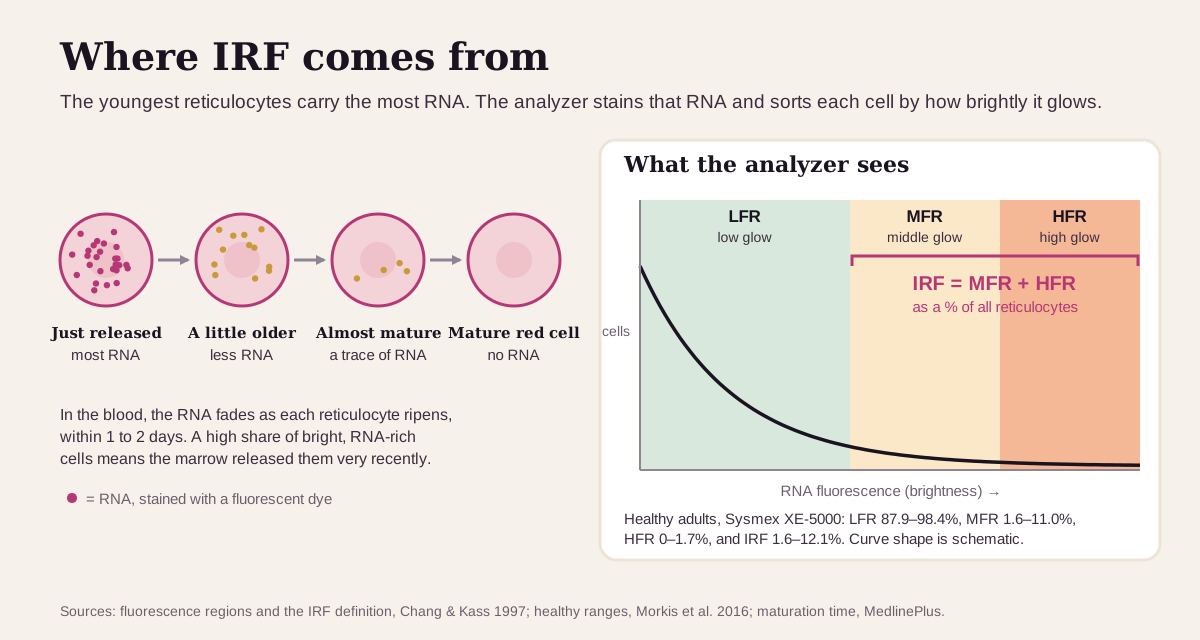
Your marrow releases new red cells as reticulocytes, which still carry leftover RNA. In the blood that RNA fades, and within 1 to 2 days each one matures into an ordinary red cell. (The reticulocyte count guide covers the count itself.)9
Analyzers such as Sysmex's stain that RNA with a fluorescent dye and sort each reticulocyte by how brightly it glows: low (LFR), middle (MFR) or high (HFR) fluorescence. The brighter the cell, the younger it is. IRF is the middle plus high share. In 132 healthy adults on a Sysmex XE-5000, the low-glow, older reticulocytes made up 87.9–98.4% of the total, middle-glow 1.6–11.0% and high-glow 0–1.7%.12
IRF moves fast because a marrow under pressure releases its reticulocytes early, while they are still RNA-rich. In one experiment, a single injection of erythropoietin (EPO, the hormone that drives red-cell production) sent high- and middle-fluorescence reticulocytes into the blood at once, while the older low-fluorescence ones were at first unaffected.10
Clinicians use IRF in two main places: to see whether a marrow is answering an anemia, and to spot recovery after chemotherapy or a bone-marrow or stem-cell transplant.19
What's a normal IRF?
Start with the range printed on your report, and note the analyzer if the report names one. Healthy IRF ranges differ a lot from one machine to the next:
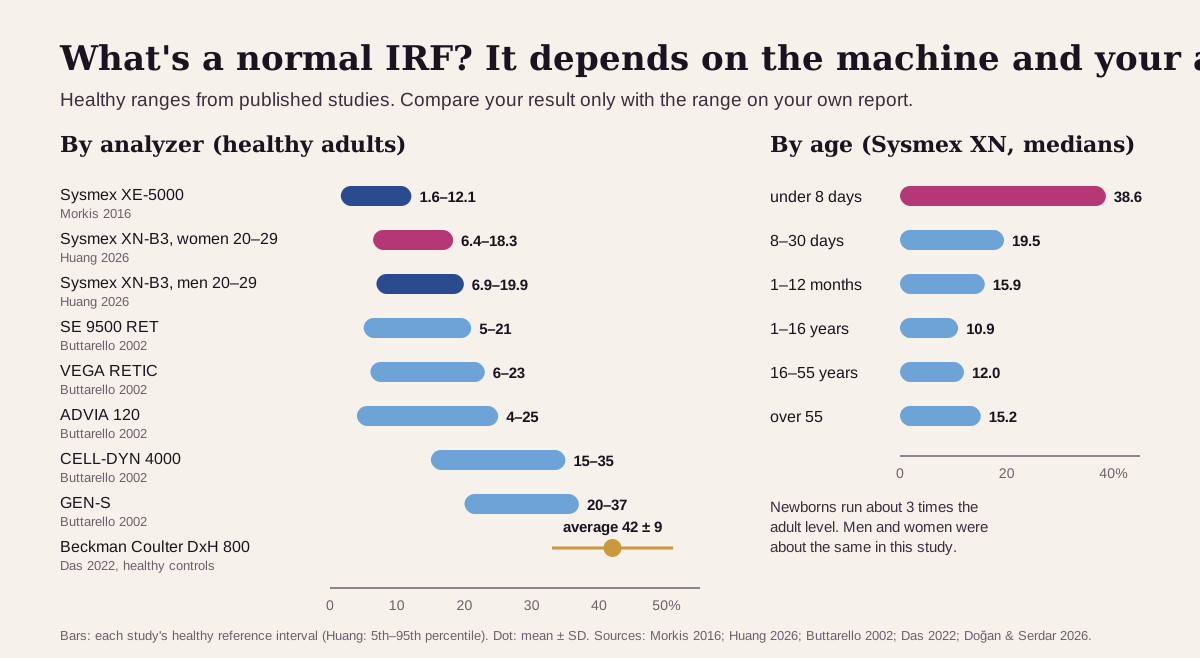
- Sysmex XE-5000: 1.6–12.1% in 132 healthy adults, with a median of 5.3%.2
- Sysmex XN-B3: in 5,692 Chinese adults, the 5th to 95th percentiles at ages 20–29 were 6.4–18.3% for women and 6.9–19.9% for men.11
- Five analyzers in one Italian lab: 4–25% (ADVIA 120), 5–21% (SE 9500 RET), 6–23% (VEGA RETIC), 15–35% (CELL-DYN 4000) and 20–37% (GEN-S). Only three of the five agreed well with each other.4
- Beckman Coulter DxH 800: healthy controls averaged 42%.6
The reason is method. Platforms differ in their analytical principles, reagents and calibration, and the International Council for Standardization in Haematology (ICSH) is still working on shared reference materials and harmonized ranges.13 Until then, compare IRF results only from the same lab and analyzer.
Babies run much higher. On a Sysmex XN, newborns under 8 days had a median IRF of 38.6%, against 12.0% in adults aged 16 to 55. The level falls over the first year and creeps back up after 55 (median 15.2%).12
Men and women are close. Two studies found no meaningful sex difference;212 the large Chinese survey found men about 1 point higher through their 20s to 40s.11
Is there an "optimal" IRF?
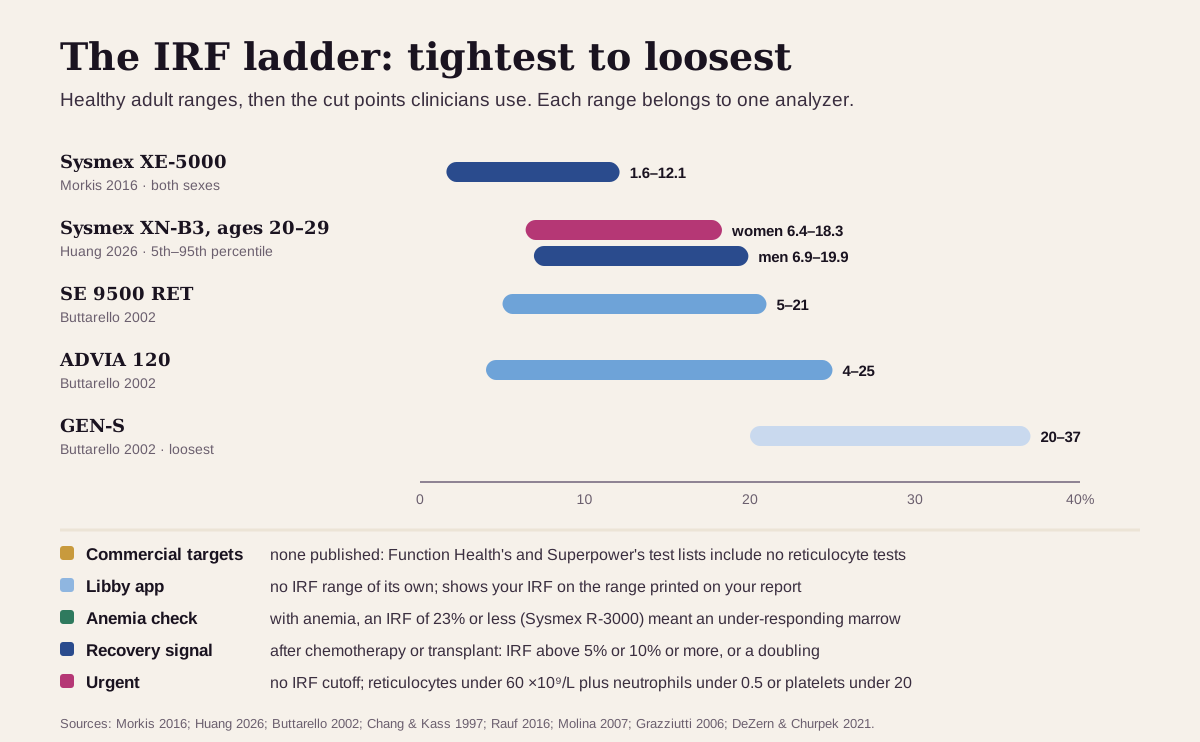
For most markers, longevity clinics aim tighter than the lab. For IRF, no one publishes an optimal target, and the numbers that matter are cut points for specific situations. Here's the full ladder, tightest healthy range first:
| Target | Women | Men | Who uses it |
|---|---|---|---|
| Strictest commercial target | none published | none published | Function Health's and Superpower's public test lists include no reticulocyte tests at all16 |
| Libby app | your report's range | your report's range | The Libby app has no IRF range of its own. It shows your IRF on the range printed on your report |
| Healthy adults, Sysmex XE-5000 | 1.6–12.1% | 1.6–12.1% | Morkis et al., 132 adults, one range for both sexes2 |
| Healthy adults 20–29, Sysmex XN-B3 | 6.4–18.3% | 6.9–19.9% | Huang et al., 5th to 95th percentiles11 |
| Guideline range | none yet | none yet | The ICSH is working toward harmonized ranges13 |
| Older analyzers, one lab | 4–25% up to 20–37% | 4–25% up to 20–37% | Buttarello et al., five machines4 |
| Anemia check (Sysmex R-3000) | 23% or less | 23% or less | With anemia, an IRF this low meant a marrow that was under-responding1 |
| Recovery signal | above 5%, 10% or more, or a doubling | same | Cut points used after chemotherapy or a transplant14153 |
| Urgent | no IRF cutoff | no IRF cutoff | Reticulocytes under 60 ×10⁹/L plus neutrophils under 0.5 or platelets under 20 ×10⁹/L is the blood-count part of severe aplastic anemia8 |
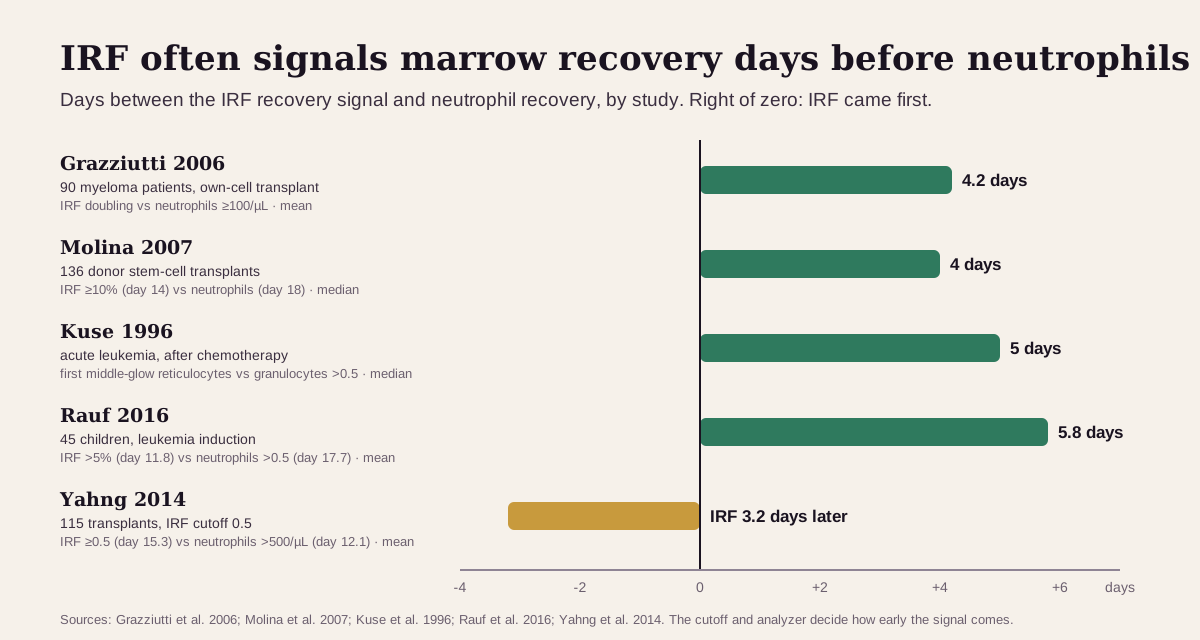
Why the recovery cut points matter: IRF often calls recovery first.
- In 90 people with myeloma after a transplant of their own stem cells, IRF doubled 4.2 days (on average) before neutrophils reached 100 per µL, in 99% of patients. The same held in 216 more patients.3
- In 136 donor stem-cell transplants, IRF reached 10% at a median of day 14, versus day 18 for neutrophils.15
- In 45 children starting leukemia treatment, IRF passed 5% at a mean of day 11.8, versus day 17.7 for neutrophils. IRF came first in 40 of them.14
- The signal depends on the cut point. A Korean study of 115 transplants that used a fixed IRF cutoff of 0.5 saw neutrophils recover first, on day 12.1 versus day 15.3.17
Keep "optimal" in perspective: IRF is a tempo marker, and the right number depends on what your marrow is doing. A climbing IRF two weeks after chemotherapy is the news your care team hopes for;5 the same number with anemia and yellow eyes points to red cells breaking down.118 And in someone who is anemic, an IRF inside the normal range can still mean the marrow is under-responding.1
What a high or low IRF usually means
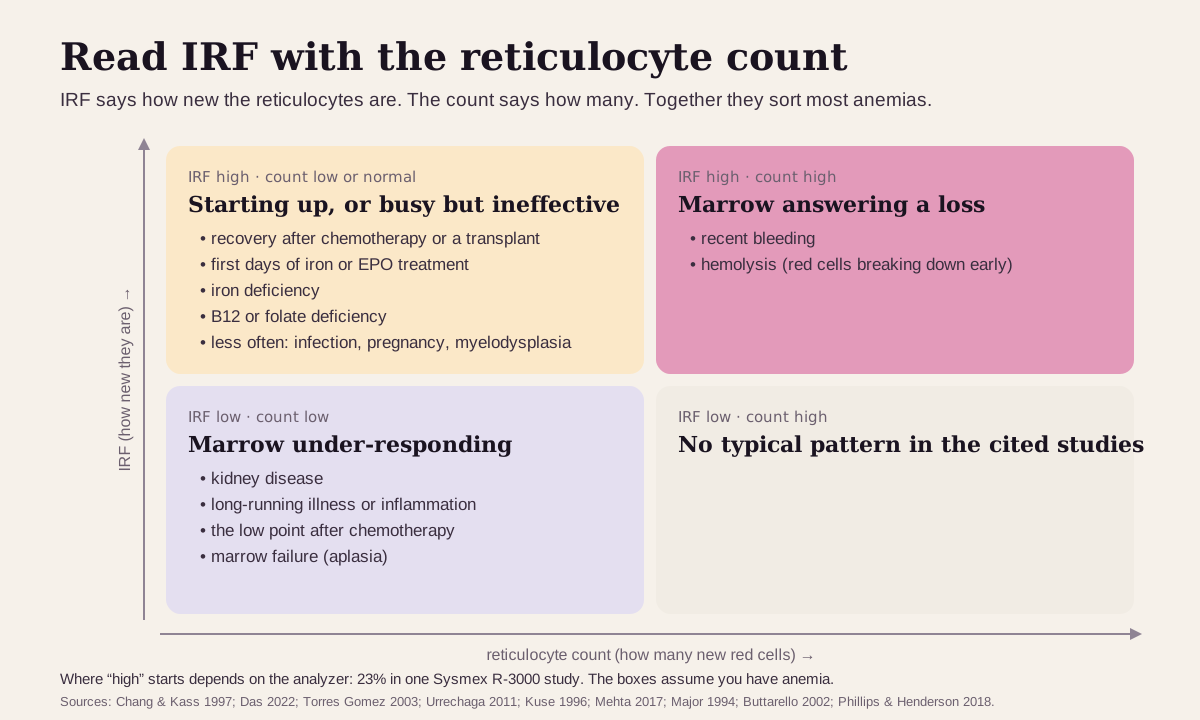
Read IRF next to the reticulocyte count. The count tells you how many new red cells the marrow is making; IRF tells you how new they are. Together they sort most anemias into a few groups:1
A high IRF: the marrow is speeding up
The usual reasons:
- Iron deficiency. IRF climbs as iron deficiency deepens. On a Sysmex XE-5000, healthy people averaged 4.4%, mild iron deficiency 12.9% and severe iron deficiency 16.7%.20 The reticulocyte count often stays normal or low.1
- Recent bleeding or hemolysis. When IRF and the reticulocyte count are both high, the marrow is answering the anemia properly.1 In one study of low blood counts, blood loss produced some of the highest IRF values.6 LDH, bilirubin and haptoglobin confirm hemolysis.18
- Recovery after chemotherapy or a transplant. The first young reticulocytes are the first sign the marrow is back.53
- The first days of treatment. IRF was clearly higher 48 hours after IV iron in 102 people with iron deficiency,21 and an EPO injection releases immature reticulocytes at once.10
- B12 or folate deficiency. IRF runs mildly high while the reticulocyte count stays low: a busy marrow whose red-cell production is ineffective.19 On a Beckman Coulter DxH 800, IRF averaged 52% in this group versus 42% in healthy controls.6
- Less common: acute infection, HIV, sickle cell crisis, pregnancy and myelodysplastic syndrome (a marrow disorder) also came with a raised IRF and a normal or low reticulocyte count in one series.1
A low IRF with anemia: the marrow is under-responding
- Kidney disease. In the classic Sysmex study, nearly every anemic sample with an IRF under 23% came from an under-responding marrow, most often in chronic kidney disease,1 which slows red-cell production.22 A second study found the same low IRF in kidney disease and other long-running illnesses.6
- The low point after chemotherapy. While white cells are at their lowest, only older, low-fluorescence reticulocytes turn up, so IRF sits near zero.5
- Marrow failure (aplasia). IRF helps separate a marrow that is still empty from one in early recovery; how well depends on the analyzer.4
Outside anemia, a low-normal IRF in a healthy person is an ordinary result.
Get prompt care if you're on chemotherapy or recovering from a transplant and you have a fever of 100.5°F (38°C) or higher, bleeding that keeps going after a few minutes, red or pink urine, black or bloody stools, or a bad headache or vision changes.7 The same goes for anemia with yellow skin or eyes, red or dark urine, or tiny purple or red spots on your skin, since hemolysis with low platelets can be an emergency such as thrombotic thrombocytopenic purpura (TTP).187
IRF reads best next to its neighbors
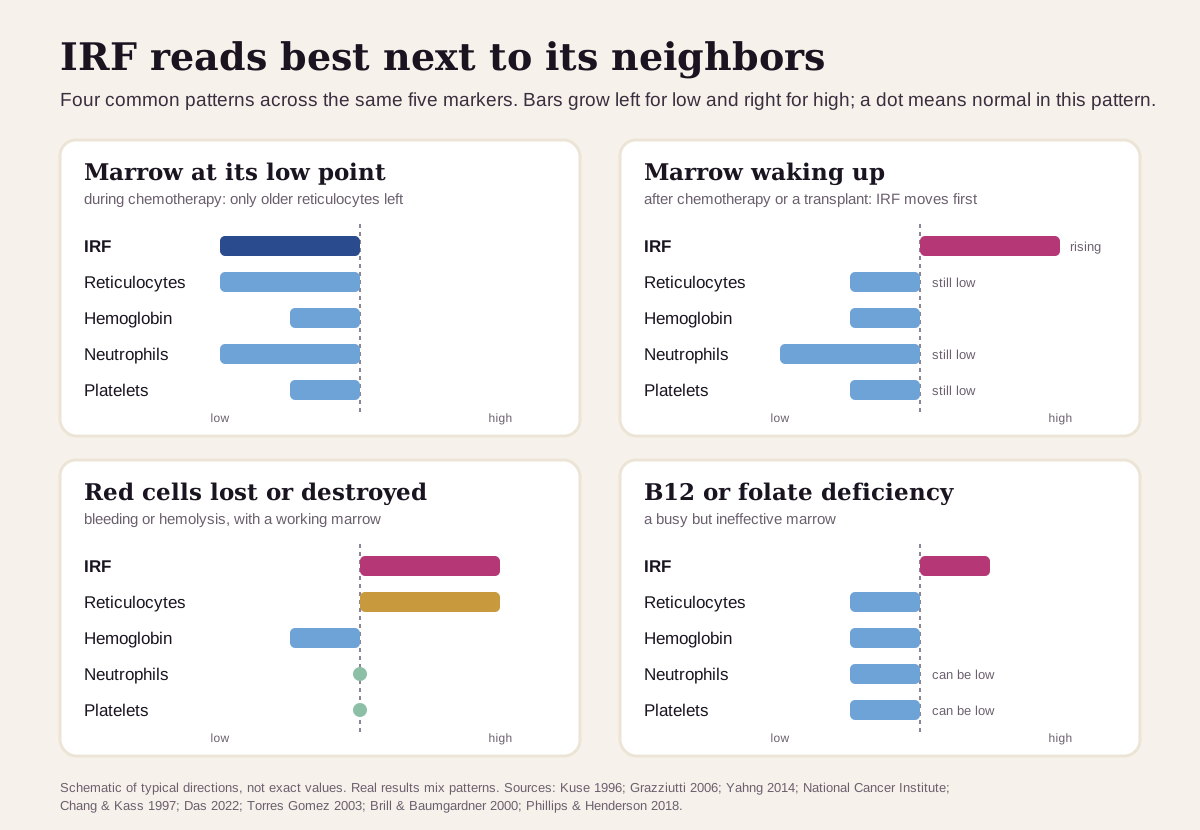
IRF tells you the tempo of red-cell production. The rest of the blood count tells you whether the whole marrow is involved. These are the four patterns that come up most:
| If you see… | It often points to… |
|---|---|
| IRF near zero, with low reticulocytes, neutrophils and platelets | the low point after chemotherapy57 |
| IRF rising while reticulocytes, neutrophils and platelets are still low | a marrow waking up after chemotherapy or a transplant; neutrophils often follow, on average about 4 to 6 days later531514 |
| IRF and reticulocytes both high, white cells and platelets normal | bleeding or hemolysis, with a marrow that is working162218 |
| IRF mildly high, reticulocytes low, white cells or platelets can be low | B12 or folate deficiency619 |
| IRF low, reticulocytes low, with anemia and no recent chemotherapy | kidney disease or another long-running illness16 |
| IRF high, reticulocytes normal or low | iron deficiency, or the first days of iron or EPO treatment1202110 |
Two details make the patterns work. White-cell and platelet counts show whether the marrow as a whole is working.22 But low counts in all three lines have many causes: in one series of 154 people, B12 or folate deficiency led the list, and the highest IRF values came when cells were being lost or destroyed in the bloodstream, as with acute blood loss or an overactive spleen.6 And after a transplant, platelets usually come back after the white cells.17
How fast IRF changes
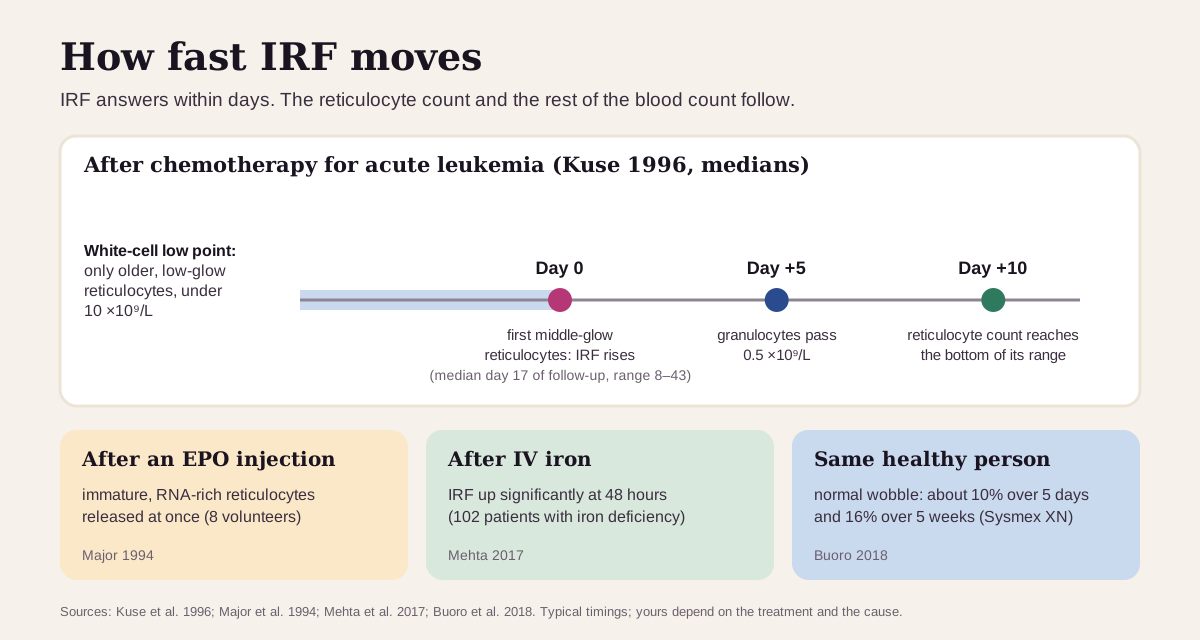
IRF answers within days, and it answers first.
What that means in practice:
- After chemotherapy, it leads the pack. In people treated for acute leukemia, the first middle-glow reticulocytes appeared a median 17 days into follow-up. Granulocytes passed 0.5 ×10⁹/L a median of 5 days later, and the reticulocyte count took about 10 days to reach the bottom of its range.5
- After treatment starts, it moves in hours to days. IRF rose within 48 hours of IV iron,21 and EPO releases immature reticulocytes at once.10
- Small wobbles are normal. In healthy people tested on a Sysmex XN, IRF varied about 10% from day to day over 5 days and 16% from week to week over 5 weeks, the most of any red-cell or reticulocyte measure in the study.23 A doubling stands out; a change of a point or so can be ordinary wobble.
- Trends beat snapshots. A series from the same lab and analyzer tells you far more than one number, which is why recovery is tracked with daily or every-other-day counts.1514
Going deeper: why every analyzer gives a different IRF
IRF (%) = (middle-fluorescence + high-fluorescence reticulocytes) ÷ all reticulocytes × 100
The fluorescence regions are set by each analyzer's method. In the classic Sysmex study, IRF was the middle plus high fluorescence share,1 but platforms differ in their analytical principles, reagents and calibration.13 That's why healthy people averaged about 5% on one analyzer and about 42% on another.26
When five analyzers were run side by side, the fluorescence-based methods were the most robust. Their ability to separate an empty marrow from one in early recovery ranged from an area under the curve of 0.70 on the ADVIA 120 to 0.96 on the SE 9500 RET.4 (An area of 1.0 would be a perfect split; 0.5 is a coin toss.)
Cut points travel badly for the same reason. The 23% anemia check comes from a Sysmex R-3000;1 the 5% recovery cut point from a Sysmex XE-5000;14 and the 0.5 cutoff that lagged behind neutrophils from a different platform.17 A cut point is only as good as the analyzer it was built on.
The same idea applies to platelets. The immature platelet fraction (IPF) counts the newest, RNA-rich platelets. On the Sysmex XE-5000 it is measured with the same reagent, in the same reticulocyte channel, as IRF.2
Questions worth asking
- Which analyzer measured my IRF, and what range does my lab use for it?
- Am I anemic, and is my IRF what you'd expect for that level of anemia?
- What do my reticulocyte count, neutrophils and platelets show next to it?
- If I'm recovering from chemotherapy or a transplant, what IRF rise are you watching for, and how often will you check?
- Could iron, B12 or folate deficiency, recent bleeding or kidney disease explain my result?
- When should we repeat it, and will it be on the same analyzer?
FAQ
What is a normal immature reticulocyte fraction? It depends on the analyzer. Healthy adults measured on a Sysmex XE-5000 ran 1.6–12.1%, while other analyzers put healthy people from 4–25% up to 20–37%. Use the range on your own report.24
What does a high IRF mean? Your marrow is releasing young red cells quickly. Common reasons are recovery after chemotherapy or a transplant, bleeding, hemolysis, iron or B12 deficiency, and the first days of treatment.15206
What does a low IRF mean? With anemia, a low IRF means the marrow is under-responding, most often from kidney disease or another long-running illness, or during the low point after chemotherapy.165
How early does IRF show marrow recovery? Often about 4 to 6 days before neutrophils recover, depending on the cut point and analyzer.31514
This guide is for education. It can't diagnose you or replace care from a clinician who knows your history.
Footnotes
-
Chang CC, Kass L. Clinical significance of immature reticulocyte fraction determined by automated reticulocyte counting. Am J Clin Pathol. 1997;108(1):69–73. 132 specimens from 102 anemic patients on a Sysmex R-3000. Defines IRF as the middle- plus high-fluorescence share, and shows that an IRF of 0.23 or less meant an under-responding marrow, mostly in chronic kidney disease. PubMed ↩ ↩2 ↩3 ↩4 ↩5 ↩6 ↩7 ↩8 ↩9 ↩10 ↩11 ↩12 ↩13 ↩14 ↩15 ↩16 ↩17 ↩18 ↩19 ↩20 ↩21 ↩22 ↩23 ↩24
-
Morkis IV, Farias MG, Scotti L. Determination of reference ranges for immature platelet and reticulocyte fractions and reticulocyte hemoglobin equivalent. Rev Bras Hematol Hemoter. 2016;38(4):310–313. 132 healthy adults on a Sysmex XE-5000: IRF 1.6–12.1% (median 5.3%), with the fluorescence fractions and no sex difference for IRF. PMC ↩ ↩2 ↩3 ↩4 ↩5 ↩6 ↩7 ↩8 ↩9 ↩10 ↩11 ↩12
-
Grazziutti ML, Dong L, Miceli MH, et al. Recovery from neutropenia can be predicted by the immature reticulocyte fraction several days before neutrophil recovery in autologous stem cell transplant recipients. Bone Marrow Transplant. 2006;37(4):403–409. 90 myeloma patients, validated in 216 more. PubMed ↩ ↩2 ↩3 ↩4 ↩5 ↩6 ↩7 ↩8 ↩9
-
Buttarello M, Bulian P, Farina G, et al. Five fully automated methods for performing immature reticulocyte fraction: comparison in diagnosis of bone marrow aplasia. Am J Clin Pathol. 2002;117(6):871–879. The same healthy population on five analyzers, each with its own reference interval. PubMed ↩ ↩2 ↩3 ↩4 ↩5 ↩6 ↩7 ↩8 ↩9
-
Kuse R, Foures C, Jou JM, et al. Automated reticulocyte counting for monitoring patients on chemotherapy for acute leukaemias and malignant lymphomas. Clin Lab Haematol. 1996;18(Suppl 1):39–43. Sysmex R-3000 counts through 87 courses of chemotherapy: only low-fluorescence reticulocytes at the white-cell low point, then middle-fluorescence cells first. PubMed ↩ ↩2 ↩3 ↩4 ↩5 ↩6 ↩7 ↩8 ↩9 ↩10 ↩11 ↩12 ↩13
-
Das J, Khonglah Y, Tiewsoh I, et al. Utility of reticulocyte indices in the diagnosis of pancytopenia. J Family Med Prim Care. 2022;11(4):1335–1340. 154 people with low counts in all three blood-cell lines, measured on a Beckman Coulter DxH 800, with healthy controls. PMC ↩ ↩2 ↩3 ↩4 ↩5 ↩6 ↩7 ↩8 ↩9 ↩10 ↩11 ↩12 ↩13 ↩14 ↩15
-
National Cancer Institute. Anemia and Cancer Treatment; Infection and Neutropenia during Cancer Treatment; Bleeding and Bruising (Thrombocytopenia) and Cancer Treatment. Chemotherapy lowers red cells, neutrophils and platelets, and a fever of 100.5°F (38°C) or higher needs a call to your care team. Anemia · Infection · Bleeding ↩ ↩2 ↩3 ↩4 ↩5
-
DeZern AE, Churpek JE. Approach to the diagnosis of aplastic anemia. Blood Adv. 2021;5(12):2660–2671. Defines severe aplastic anemia by reticulocytes under 60 ×10⁹/L, neutrophils under 0.5 ×10⁹/L or platelets under 20 ×10⁹/L (at least two) and an empty marrow. PMC ↩ ↩2 ↩3
-
National Library of Medicine. Reticulocyte Count. MedlinePlus. Reticulocytes mature into red cells within one to two days, and the test is used to check the marrow after chemotherapy or a transplant. MedlinePlus ↩ ↩2 ↩3
-
Major A, Bauer C, Breymann C, Huch A, Huch R. rh-erythropoietin stimulates immature reticulocyte release in man. Br J Haematol. 1994;87(3):605–608. Eight healthy volunteers given one EPO injection. PubMed ↩ ↩2 ↩3 ↩4 ↩5 ↩6
-
Huang L, Lin B, Zhu G, et al. Age- and sex-specific normative values for reticulocyte indices and their relation to early-stage CKM syndrome. BMC Cardiovasc Disord. 2026;26(1):802. 5,692 adults aged 20–80 from the China National Health Survey, measured on a Sysmex XN-B3. PMC ↩ ↩2 ↩3 ↩4 ↩5
-
Doğan Ö, Serdar MA. Immature reticulocyte fraction (IRF) and its correlation with hematological parameters: a comprehensive analysis across six age groups. Medicine (Baltimore). 2026;105(5):e47414. 853 healthy people from newborns to over 55 on a Sysmex XN. PMC ↩ ↩2 ↩3
-
Zhou H, Huang Y, Zhuang R, et al. Automated reticulocyte counting: advances, standardization challenges, and clinical accessibility. Clin Chem Lab Med. 2026;64(2):269–279. A review of why analyzers disagree and the ICSH's work on harmonized reference materials and ranges. DOI ↩ ↩2 ↩3
-
Rauf SE, Khan SA, Ali N, et al. Immature reticulocyte fraction and absolute neutrophil count as predictor of hemopoietic recovery in patients with acute lymphoblastic leukemia on remission induction chemotherapy. Turk J Haematol. 2016;33(2):131–134. 45 patients on a Sysmex XE-5000, IRF above 5% as the recovery signal. PMC ↩ ↩2 ↩3 ↩4 ↩5 ↩6 ↩7 ↩8
-
Molina JR, Sanchez-Garcia J, Torres A, et al. Reticulocyte maturation parameters are reliable early predictors of hematopoietic engraftment after allogeneic stem cell transplantation. Biol Blood Marrow Transplant. 2007;13(2):172–182. 136 donor transplants, IRF of 10% or more as the recovery signal. PubMed ↩ ↩2 ↩3 ↩4 ↩5 ↩6 ↩7
-
Function Health, "What's included" (https://www.functionhealth.com/whats-included), and Superpower, "Biomarkers" (https://superpower.com/biomarkers), both opened September 23, 2026. Each lists complete-blood-count markers such as hemoglobin and platelets, but no reticulocyte count or IRF. A commercial source, cited only to show the absence of a consumer target. ↩
-
Yahng SA, Lee JW, Kim Y, et al. New proposed guidelines for early identification of successful myeloid and erythroid engraftment in hematopoietic stem cell transplantation. J Clin Lab Anal. 2014;28(6):469–477. 115 transplants; with an IRF cutoff of 0.5, neutrophils recovered first. PMC ↩ ↩2 ↩3 ↩4 ↩5
-
Phillips J, Henderson AC. Hemolytic anemia: evaluation and differential diagnosis. Am Fam Physician. 2018;98(6):354–361. The lab signature of hemolysis and the urgency of TTP. PubMed ↩ ↩2 ↩3 ↩4 ↩5 ↩6
-
Torres Gomez A, Casaño J, Sánchez J, et al. Utility of reticulocyte maturation parameters in the differential diagnosis of macrocytic anemias. Clin Lab Haematol. 2003;25(5):283–288. Anemias from ineffective red-cell production (megaloblastic anemia and myelodysplasia) showed reticulocytes skewed to the immature fractions. PubMed ↩ ↩2 ↩3 ↩4
-
Urrechaga E, Borque L, Escanero JF. Erythrocyte and reticulocyte parameters in iron deficiency and thalassemia. J Clin Lab Anal. 2011;25(3):223–228. Sysmex XE-5000: IRF 4.4% in healthy people, 12.9% in mild and 16.7% in severe iron deficiency. PMC ↩ ↩2 ↩3 ↩4
-
Mehta S, Goyal L, Kaushik D, et al. Reticulocyte hemoglobin vis-à-vis immature reticulocyte fraction, as the earliest indicator of response to therapy in iron deficiency anemia. J Assoc Physicians India. 2017;65(12):14–17. 102 people with iron deficiency anemia, retested 48 hours after IV iron. PubMed ↩ ↩2 ↩3 ↩4 ↩5
-
Brill JR, Baumgardner DJ. Normocytic anemia. Am Fam Physician. 2000;62(10):2255–2264. The corrected reticulocyte index, with the white-cell and platelet counts, shows whether the marrow is working. PubMed ↩ ↩2 ↩3 ↩4
-
Buoro S, Carobene A, Seghezzi M, et al. Short- and medium-term biological variation estimates of red blood cell and reticulocyte parameters in healthy subjects. Clin Chem Lab Med. 2018;56(6):954–963. Healthy volunteers tested daily for 5 days and weekly for 5 weeks on a Sysmex XN. PubMed ↩ ↩2
Educational content, not medical advice. Libby is a personal record tool, not a medical service — it doesn't diagnose, treat, or prescribe. Reference ranges vary by lab and by person. Talk to a qualified healthcare professional about your results.
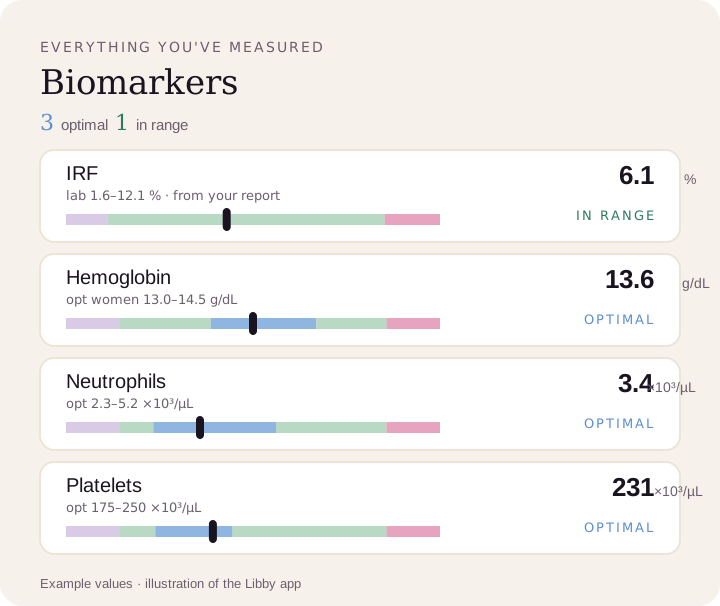
See every result against your lab's range.
Upload a lab PDF or a photo of your report. Libby shows your IRF on the range printed on your report, puts your other markers on your lab's range, and tracks every new test over time.
View your IRF ›