Reticulocyte hemoglobin (Ret-He): what a low result means
Ret-He shows how much iron reached the red cells your marrow made in the past few days. Normal range, study cutoffs, and why it helps when ferritin misleads.
Ret-He (reticulocyte hemoglobin equivalent) measures how much hemoglobin is packed into the red cells your bone marrow made in the last few days. Hemoglobin needs iron, so Ret-He is a near-real-time reading of how much iron your marrow is actually getting. It drops within days of an iron shortage, often while your hemoglobin still looks fine.12
The short version
- Normal: check the range on your report. Mayo Clinic Laboratories lists 30.0–37.6 pg for adults, the same for men and women.3
- Low means your newest red cells were built short on iron. The usual reasons are iron deficiency, then inflammation or kidney disease locking iron away; less often it's thalassemia trait (small red cells from birth, with normal iron).45 Published cutoffs run from 26 to 30 pg; the UK's NICE guideline uses under 29 pg in kidney disease.627
- Urgent is about what's behind it: get prompt care for shortness of breath at rest, black or bloody stools, or heavy bleeding, whatever your Ret-He says.8
- The key distinction: Ret-He covers the last 3–4 days. MCH covers the last 3–4 months, and ferritin can read falsely normal during inflammation. That's why Ret-He catches a shortage early.129
What Ret-He is
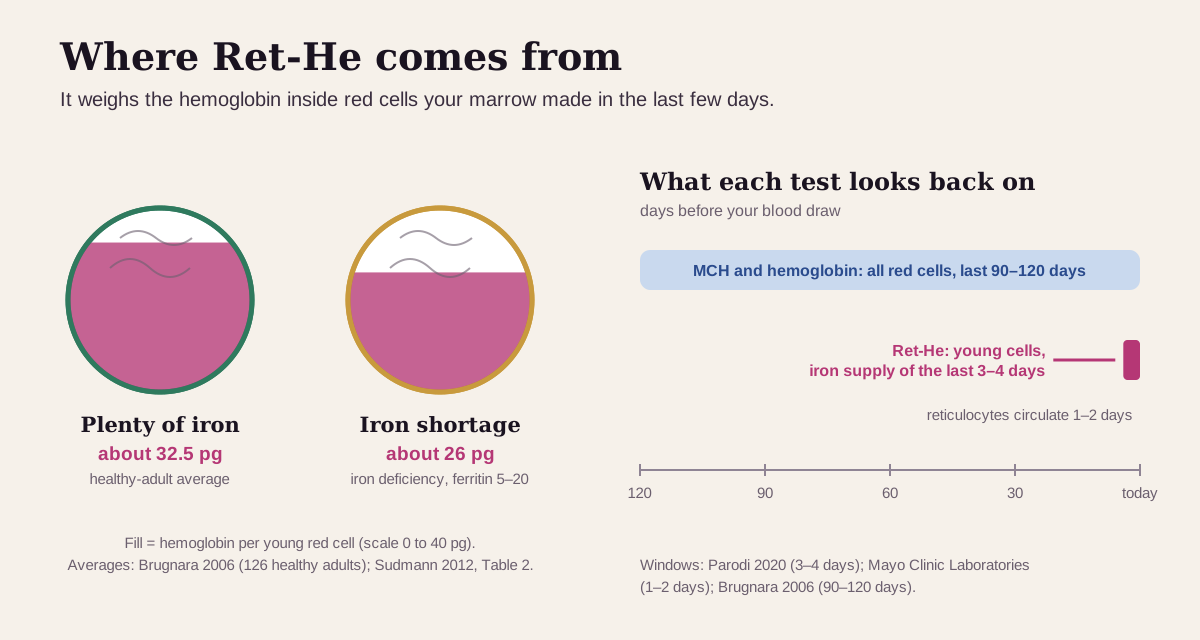
A reticulocyte is a red blood cell fresh out of the bone marrow. It loads its hemoglobin in the marrow, then circulates for 1 to 2 days before it matures into an ordinary red cell that lives about 120 days.310 Ret-He is the average amount of hemoglobin inside those young cells. A cell built while iron is scarce comes out carrying less hemoglobin.32
Because the cells are so young, Ret-He reflects the iron available to your marrow over roughly the previous 3–4 days.1 MCH (mean corpuscular hemoglobin) is the same measurement across all your red cells, so it averages the past 90–120 days.2 That gap is the point of the test: Ret-He moves first, and MCH and hemoglobin follow weeks later.
It comes from the same tube as a complete blood count, on analyzers that also count reticulocytes. Sysmex analyzers report RET-He; Siemens ADVIA analyzers report CHr (reticulocyte hemoglobin content). In a head-to-head comparison the two agreed closely.2 For the count of young cells itself, see the reticulocyte count guide.
What's a normal Ret-He?
Start with the range printed on your report. Ranges are tied to the analyzer, and they vary more between labs than you might expect.11
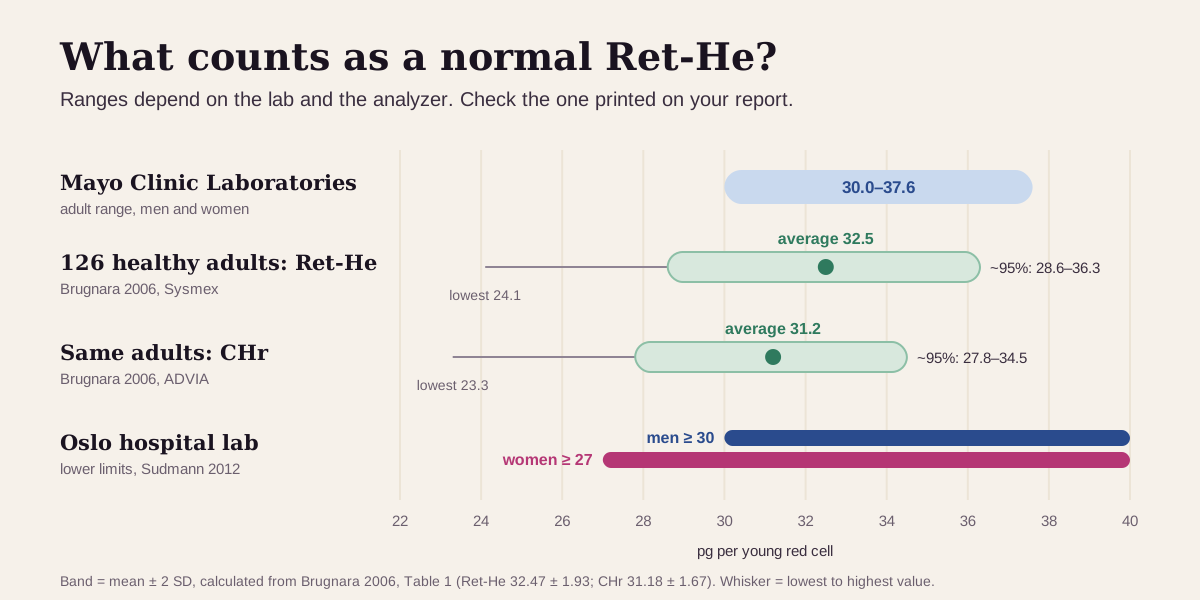
- Mayo Clinic Laboratories lists 30.0–37.6 pg for adults, with the same range for men and women. Children's ranges shift with age: for example 28.7–35.7 pg for boys and 30.1–35.7 pg for girls aged 6 months to 2 years.3
- In 126 healthy young adults, Brugnara's group measured an average Ret-He of 32.5 pg (standard deviation 1.9) and an average CHr of 31.2 pg (SD 1.7).2
- A hospital lab in Oslo used lower limits of 30 pg for men and 27 pg for women.5
Why the analyzer matters: an international comparison of 855 samples on 9 analyzer types found reticulocyte hemoglobin results agreed less well across machines than plain reticulocyte counts did, with correlations as low as 0.68.11 Compare your results within the same lab when you can.
"Optimal" Ret-He: the cutoffs, strictest to loosest
The Libby app shows your Ret-He on your lab's range; its marker catalog has no functional "optimal" band for this test. What the research offers is a ladder of cutoffs: the point below which studies start to see red cells built short on iron.
| Low if under | Test | Who uses it |
|---|---|---|
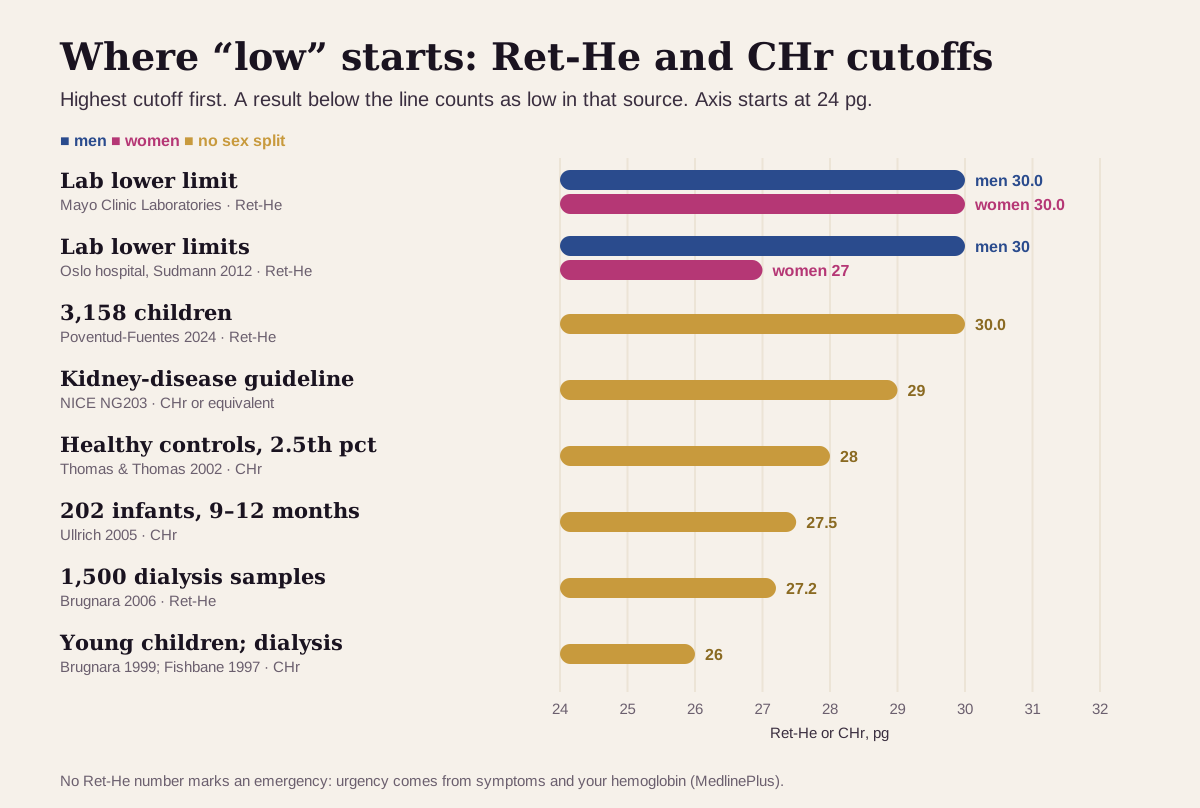
| 30.0 pg (men and women) | Ret-He | Mayo Clinic Laboratories' adult lower limit3 |
| 30 pg (men) / 27 pg (women) | Ret-He | An Oslo hospital lab's lower limits5 |
| 30.0 pg or less | Ret-He | 3,158 children at a U.S. children's hospital: iron deficiency vs healthy controls12 |
| 29 pg | CHr, or an equivalent such as Ret-He | NICE (UK) guideline for anemia in chronic kidney disease6 |
| 28 pg | CHr | The 2.5th percentile of healthy controls, used to mark iron-starved red-cell production13 |
| 27.5 pg | CHr | 202 healthy infants aged 9–12 months7 |
| 27.2 pg | Ret-He | 1,500 samples from dialysis patients2 |
| 26 pg | CHr | 210 young children,14 and dialysis patients before IV iron15 |
| Urgent | none | Set by symptoms and your hemoglobin, not Ret-He: see the box below8 |
Why these cutoffs matter:
- In 202 healthy infants, a CHr under 27.5 pg caught 83% of iron deficiency. A hemoglobin under 11 g/dL, the usual screening test, caught 26%. Infants with a low CHr but no anemia were 9.1 times as likely to be anemic when rechecked in their second year (a small study with a wide confidence interval, 1.04–78.9).7
- In 1,500 dialysis samples, a Ret-He under 27.2 pg identified iron deficiency with 93% sensitivity and 83% specificity.2
- In 78 patients who had a bone-marrow exam, CHr predicted empty marrow iron stores better than ferritin, transferrin saturation or MCV, once people with large red cells were set aside.10
- Mayo's summary of kidney-disease studies puts reticulocyte hemoglobin's accuracy (area under the curve) at 0.74–0.95, versus 0.53–0.63 for ferritin and 0.56–0.76 for transferrin saturation.3
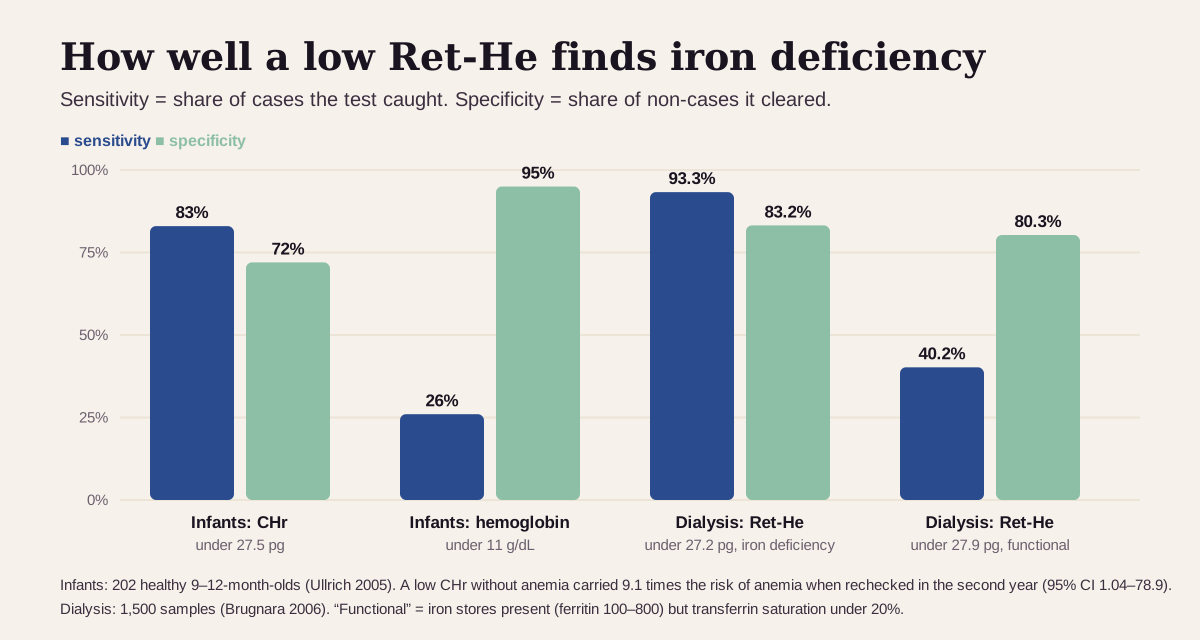
Keep these numbers in perspective. Ret-He is a floor, not a target: above your lab's lower limit, a higher value adds nothing. It's also weaker at some jobs. In the same dialysis study, Ret-He caught only 40% of "functional" iron deficiency (iron stores present but not getting through),2 and in 200 U.S. pregnancies its accuracy was modest (area under the curve 0.65).16 A single reading just under the line can be noise: the analyzer's day-to-day imprecision was about 0.85 pg in one evaluation.2
What a low Ret-He usually means
How far below the line matters. Just under 30 pg sits in a gray zone where published cutoffs disagree. Below about 27 pg nearly every cutoff flags it, and values near 20 pg turn up in thalassemia trait and in severe iron deficiency.526
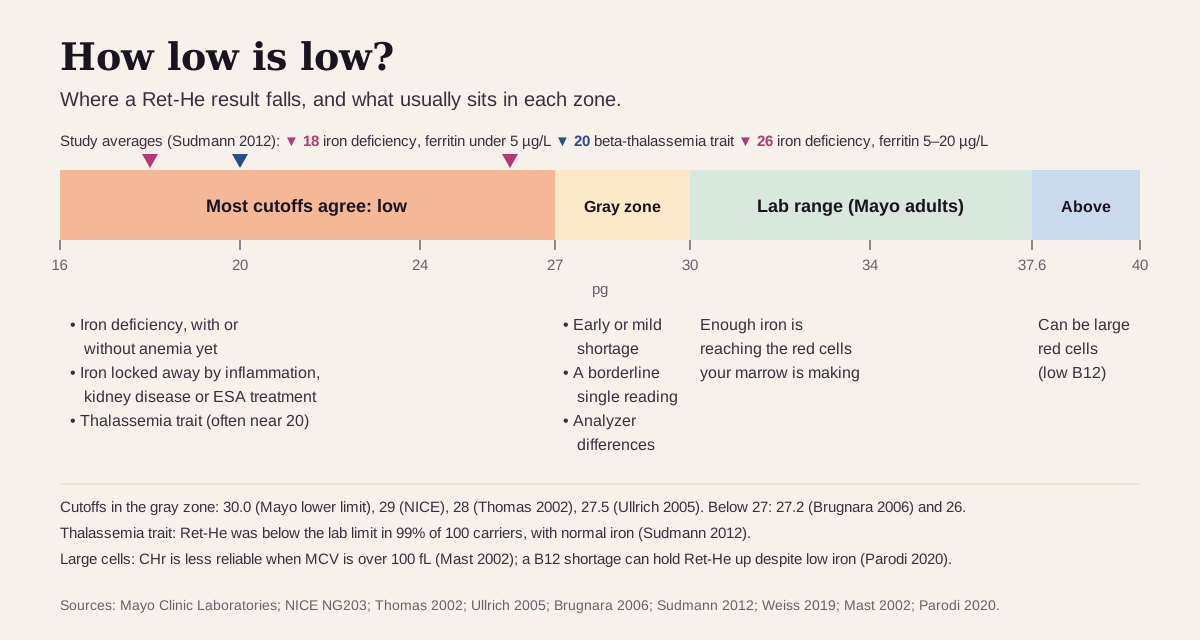
The usual suspects, most common first:
- Iron deficiency. It's the most common anemia worldwide.4 Iron runs short when you lose more than you take in: heavy, long or frequent periods, bleeding from the stomach or gut (ulcers, long-term aspirin or ibuprofen, and cancers of the esophagus, stomach or colon), too little iron in the diet or poor absorption, or higher needs in pregnancy and breastfeeding.8 Your ferritin and iron panel confirm it.
- Inflammation or kidney disease locking iron away. Anemia of inflammation is the second most common anemia, and the most common one in people who are chronically ill or in hospital.4 Inflammation raises hepcidin, a liver hormone that traps iron inside the cells that recycle old red cells, the source of over 90% of the iron your marrow uses each day.4 Stores can be full while the marrow starves. People on dialysis who take erythropoietin-type drugs (ESAs) hit the same wall, because the drug raises the marrow's iron needs beyond what gets delivered.2
- Thalassemia trait. An inherited change in hemoglobin makes red cells small while iron stays normal.1 In 100 people with beta-thalassemia trait, Ret-He was below the lab's lower limit in 99%, and their red cell count was above the upper limit in 83%.5 That's why NICE tells clinicians to use transferrin saturation and ferritin instead in people with thalassemia or thalassemia trait.6
Less common: other inherited hemoglobin disorders that make small red cells, and a recent transfusion or chemotherapy, which Mayo lists as context for reading the result.3 Iron deficiency mixed with low vitamin B12 can hide behind a normal Ret-He, because the B12 shortage makes cells bigger.1
Get prompt care if a low result comes with shortness of breath during light activity or at rest, feeling lightheaded when you stand, black or tar-colored stools or blood in your stool, or heavy menstrual bleeding.8
When ferritin can't settle it: where Ret-He helps most
Ferritin is the standard test for iron stores, and in otherwise healthy people it works well.9 Ret-He earns its place in the situations where ferritin reads falsely reassuring:
- Inflammation. Ferritin rises with infection and inflammation, so the World Health Organization moves the iron-deficiency cutoff for adults with inflammation up to under 70 µg/L.9 In one hospital study, the ferritin level that marked iron-starved red-cell production climbed from 20.8 µg/L without an inflammatory response to 61.7 µg/L with one.13 Ret-He reads the marrow's supply directly.
- Chronic kidney disease, dialysis and ESA treatment. NICE advises against relying on transferrin saturation or ferritin alone here, and uses CHr under 29 pg (or an equivalent test such as Ret-He) to diagnose iron deficiency and above 29 pg as a treatment goal.6
- Children. In 210 young children, CHr was the strongest predictor of iron deficiency, and ferritin had no predictive value.14 In 3,158 children, Ret-He was best at confirming iron-deficiency anemia (27.4 pg cutoff, 90% sensitivity, 81% specificity) and weaker for iron deficiency without anemia.12
- Pregnancy. The evidence is mixed. In 200 U.S. pregnancies, Ret-He picked out iron-deficiency anemia but was poor at spotting milder iron deficiency, and the authors preferred ferritin where it's available.16 When Sudmann's group wrote in 2012, pregnancy Ret-He limits hadn't been established, so they borrowed the MCH limits.5
For another reading of how iron-hungry your marrow is, see soluble transferrin receptor.
Ret-He reads best next to its neighbors
A low Ret-He says your newest red cells came out short on hemoglobin. Four other results say why. (Inflammation lowers Ret-He only when it actually holds iron back from the marrow, which is why Ret-He catches some of these cases and misses others.2)
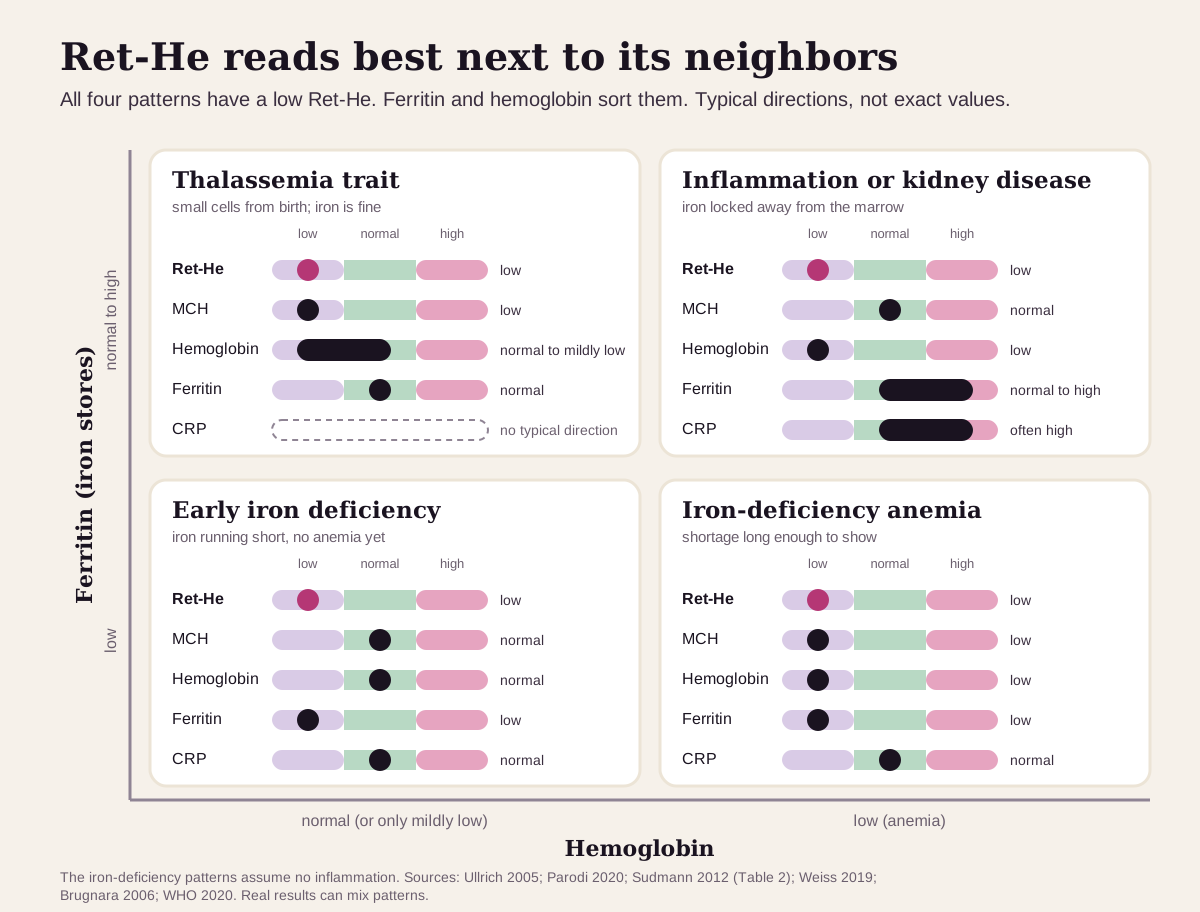
| If you see… | It often points to… |
|---|---|
| Ret-He low, MCH usually still normal, hemoglobin normal, ferritin low | iron running short, caught before anemia shows719 |
| Ret-He and MCH both low, hemoglobin low, ferritin low | established iron-deficiency anemia5 |
| Ret-He low, ferritin normal or high, CRP high or known kidney disease | iron locked away by inflammation or kidney disease42 |
| Ret-He and MCH very low, ferritin normal, red cell count high | thalassemia trait, with iron that's fine5 |
One more clue sits on some reports: RBC-He, the same measurement across all red cells.2 When Ret-He falls below it, the shortage is recent. In one dialysis study, the 12% of patients whose CHr sat below the mature-cell value had recently had their ESA dose raised.15
Is a high Ret-He a problem?
A value above your lab's upper limit (37.6 pg at Mayo)3 can come from large red cells. CHr is less reliable when red cells are large (MCV over 100 fL),10 and large cells from a B12 shortage can push Ret-He up even when iron is short.1
How fast Ret-He changes
Ret-He is one of the first results to move when iron supply changes. When iron reaches the marrow, the next wave of young cells carries more hemoglobin within days.1
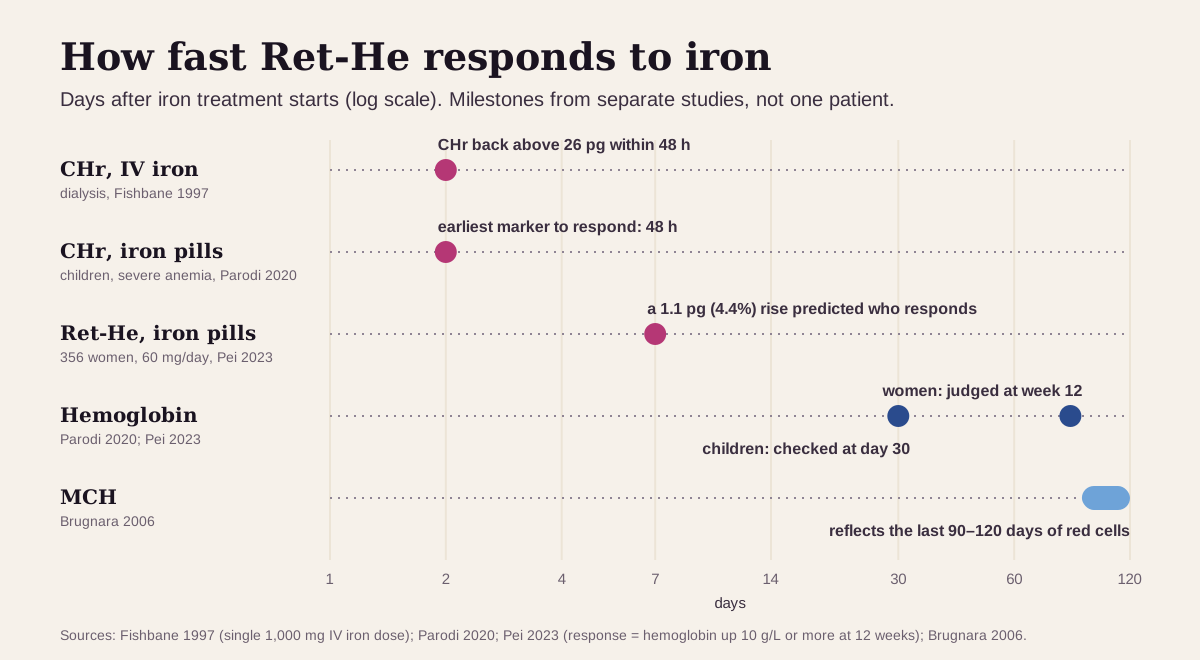
- After IV iron: in dialysis patients, a single infusion corrected CHr to above 26 pg within 48 hours.15
- After iron pills: in children with severe iron-deficiency anemia, CHr was the earliest marker to respond, at 48 hours.1 In 356 Cambodian women taking 60 mg of iron a day, a Ret-He rise of about 1.1 pg (4.4%) after one week predicted who would raise their hemoglobin by 12 weeks.17
- Hemoglobin and MCH lag. Hemoglobin responses are judged over weeks (day 30 in children, week 12 in the Cambodian trial), and MCH reflects the past 90–120 days.1172
What that means in practice:
- Trends beat snapshots. In the Cambodian trial, a single Ret-He reading predicted the hemoglobin response poorly, while the change over one week did well (area under the curve 0.81).17
- Use the same lab. Reticulocyte hemoglobin results differ between analyzer brands.11
- A delayed sample is fine. Ret-He held steady in blood samples kept 48 hours at room temperature or in the fridge.2
Going deeper: Ret-He vs CHr
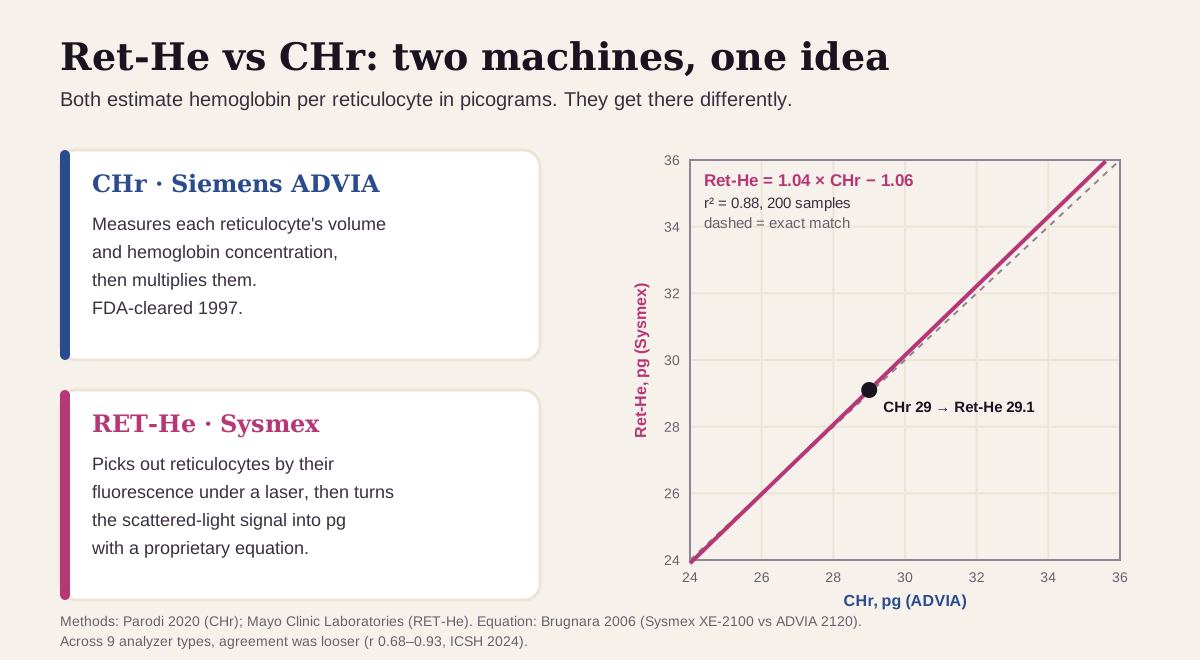
The two names come from two ways of measuring the same thing:
- CHr (Siemens ADVIA, formerly Bayer) measures each reticulocyte's volume and its hemoglobin concentration, and multiplies the two.1 The U.S. FDA cleared it in 1997.2
- RET-He (Sysmex) picks out reticulocytes by their fluorescence under a laser, then converts their scattered-light signal into picograms with a proprietary equation.3 Older Sysmex reports called it Ret-Y.5
In 200 patient samples, Brugnara's group found Ret-He = 1.04 × CHr − 1.06 (r² = 0.88), so at the cutoffs that matter the two read almost the same: a CHr of 29 pg corresponds to a Ret-He of about 29.1 pg. Above 30 pg, Ret-He tends to read a little higher.2 That's why NICE lets labs use either.6 Across a wider set of analyzers the match is looser, which is why the ICSH working group called for better harmonization.11
Why a mismatch between Ret-He and MCH is useful. A reticulocyte takes a snapshot of the last few days; the whole red cell population is a 3–4 month average. When Ret-He is low and MCH is normal, the shortage is new. When both are low, it has been going on long enough to change most of your red cells.215
Questions worth asking
- Was my result reported as RET-He or CHr, and which range does this lab use?
- Could inflammation or my kidney function be making my ferritin look better than my iron supply really is? What does my CRP show?
- Do my MCH, MCV and red cell count fit iron deficiency, or should thalassemia trait be checked?
- If I start iron, should we recheck Ret-He after about a week to see if it's working?
- Where could I be losing iron: periods, stomach, or gut?
- When should my hemoglobin and ferritin be repeated?
FAQ
What is a normal Ret-He level? It depends on the lab and analyzer. Mayo Clinic Laboratories uses 30.0–37.6 pg for adults, the same for men and women.3
Is Ret-He the same as CHr? Nearly. Ret-He comes from Sysmex analyzers and CHr from Siemens ADVIA analyzers. In one comparison, Ret-He = 1.04 × CHr − 1.06, so they read almost the same at the usual cutoffs.2
Can Ret-He be low when ferritin is normal? Yes. Inflammation or kidney disease can keep ferritin normal or high while locking iron away from the marrow, and thalassemia trait lowers Ret-He with normal iron stores.45
How fast does Ret-He go up after iron? Within about 2 days of IV iron in dialysis patients, and within the first week of iron pills in the studies so far.15117
This guide is for education. It can't diagnose you or replace care from a clinician who knows your history.
Footnotes
-
Parodi E, Romano F, Ramenghi U. How We Use Reticulocyte Parameters in Workup and Management of Pediatric Hematologic Diseases. Front Pediatr. 2020;8:588617. CHr reflects iron available over the previous 3–4 days; CHr = cell volume × hemoglobin concentration; earliest response to oral iron at 48 hours; limits with microcytic hemoglobin disorders and combined iron and B12 deficiency. PMC ↩ ↩2 ↩3 ↩4 ↩5 ↩6 ↩7 ↩8 ↩9 ↩10 ↩11 ↩12 ↩13 ↩14 ↩15 ↩16
-
Brugnara C, Schiller B, Moran J. Reticulocyte hemoglobin equivalent (Ret He) and assessment of iron-deficient states. Clin Lab Haematol. 2006;28(5):303–308. Sysmex XE-2100 vs Bayer ADVIA 2120 (Ret-He = 1.04 × CHr − 1.06, r² 0.88); 126 healthy adults (Ret-He 32.47 ± 1.93 pg, CHr 31.18 ± 1.67 pg); 1,500 dialysis samples (cutoff 27.2 pg, sensitivity 93.3%, specificity 83.2%; functional iron deficiency at 27.9 pg, sensitivity 40.2%); MCH reflects the preceding 90–120 days; imprecision SD 0.85 pg; 48-hour stability. PMC ↩ ↩2 ↩3 ↩4 ↩5 ↩6 ↩7 ↩8 ↩9 ↩10 ↩11 ↩12 ↩13 ↩14 ↩15 ↩16 ↩17 ↩18 ↩19 ↩20 ↩21 ↩22 ↩23 ↩24 ↩25 ↩26 ↩27 ↩28 ↩29 ↩30 ↩31
-
Mayo Clinic Laboratories. Reticulocyte Profile, Blood (RETB): Clinical & Interpretive and Performance tabs. Test catalog, accessed September 23, 2026. A commercial reference laboratory's published range: adult reticulocyte hemoglobin 30.0–37.6 pg for males and females, pediatric ranges by age, the 1–2 day reticulocyte lifespan, the kidney-disease accuracy summary, the thalassemia caution and the Sysmex XN method. mayocliniclabs.com ↩ ↩2 ↩3 ↩4 ↩5 ↩6 ↩7 ↩8 ↩9 ↩10 ↩11 ↩12 ↩13 ↩14 ↩15
-
Weiss G, Ganz T, Goodnough LT. Anemia of inflammation. Blood. 2019;133(1):40–50. Iron-deficiency anemia is the most prevalent anemia and anemia of inflammation the second; hepcidin traps iron in macrophages, whose recycling supplies over 90% of daily iron needs; anemia of inflammation is normochromic and normocytic with normal or raised ferritin. PMC ↩ ↩2 ↩3 ↩4 ↩5 ↩6 ↩7
-
Sudmann ÅA, Piehler A, Urdal P. Reticulocyte hemoglobin equivalent to detect thalassemia and thalassemic hemoglobin variants. Int J Lab Hematol. 2012;34(6):605–613. 443 samples in Oslo; adult Ret-He lower limits 30 pg (men) and 27 pg (women); Table 2 means (beta-thalassemia trait: Ret-He 20 pg, MCH 19 pg, ferritin 110 µg/L; iron deficiency with ferritin 5–20 µg/L: Ret-He 26 pg); Ret-He low in 99% and red cell count high in 83% of beta-thalassemia trait. PMC ↩ ↩2 ↩3 ↩4 ↩5 ↩6 ↩7 ↩8 ↩9 ↩10 ↩11 ↩12 ↩13 ↩14 ↩15
-
National Institute for Health and Care Excellence. Chronic kidney disease: assessment and management (NG203). Published August 25, 2021; last updated November 24, 2021. Recommendations 1.7.3–1.7.4 and 1.9.17–1.9.20: CHr under 29 pg or an equivalent test such as reticulocyte Hb equivalent; above 29 pg as the treatment goal; transferrin saturation and ferritin in thalassemia or thalassemia trait. NICE ↩ ↩2 ↩3 ↩4 ↩5 ↩6 ↩7 ↩8
-
Ullrich C, Wu A, Armsby C, et al. Screening healthy infants for iron deficiency using reticulocyte hemoglobin content. JAMA. 2005;294(8):924–930. 202 infants aged 9–12 months; CHr under 27.5 pg: sensitivity 83%, specificity 72%; hemoglobin under 11 g/dL: sensitivity 26%, specificity 95%; risk ratio 9.1 (95% CI 1.04–78.9) for later anemia. PubMed ↩ ↩2 ↩3 ↩4 ↩5 ↩6 ↩7
-
National Library of Medicine. Iron deficiency anemia; Anemia. MedlinePlus Medical Encyclopedia. Causes of iron loss and symptoms that need a clinician. Iron deficiency anemia; Anemia ↩ ↩2 ↩3 ↩4
-
World Health Organization. WHO guideline on use of ferritin concentrations to assess iron status in individuals and populations. Geneva: WHO; 2020. Ferritin is a good marker of iron stores in otherwise healthy people; with infection or inflammation, under 70 µg/L in adults and under 30 µg/L in children may indicate iron deficiency. WHO ↩ ↩2 ↩3 ↩4 ↩5
-
Mast AE, Blinder MA, Lu Q, Flax S, Dietzen DJ. Clinical utility of the reticulocyte hemoglobin content in the diagnosis of iron deficiency. Blood. 2002;99(4):1489–1491. 78 patients with a bone-marrow exam; reticulocytes circulate 1–2 days; limits with MCV over 100 fL and thalassemia. PubMed ↩ ↩2 ↩3
-
Obstfeld AE, Davis BH, Han JY, Urrechaga E. Report of the International Council for Standardization in Haematology working group for standardization of reticulocyte parameters. Int J Lab Hematol. 2024;46(2):266–274. 855 samples, 6 sites, 9 analyzer types; reticulocyte hemoglobin correlations 0.680–0.927. PubMed ↩ ↩2 ↩3 ↩4 ↩5
-
Poventud-Fuentes I, Chong TH, Dowlin M, Devaraj S, Curry CV. Reticulocyte hemoglobin equivalent as a marker to assess iron deficiency: A large pediatric tertiary care hospital study. Int J Lab Hematol. 2024;46(1):148–155. 3,158 patients aged 15 days to 19 years; cutoffs 30.0 pg (iron deficiency), 27.4 pg (iron-deficiency anemia) and 30.8 pg (iron deficiency without anemia). PubMed ↩ ↩2 ↩3
-
Thomas C, Thomas L. Biochemical markers and hematologic indices in the diagnosis of functional iron deficiency. Clin Chem. 2002;48(7):1066–1076. 596 patients; CHr 2.5th percentile of 28 pg in controls; ferritin cutoffs of 20.8 µg/L without and 61.7 µg/L with an acute-phase response. PubMed ↩ ↩2 ↩3
-
Brugnara C, Zurakowski D, DiCanzio J, Boyd T, Platt O. Reticulocyte hemoglobin content to diagnose iron deficiency in children. JAMA. 1999;281(23):2225–2230. 210 children; CHr under 26 pg was the optimal cutoff; ferritin had no predictive value. PubMed ↩ ↩2 ↩3
-
Fishbane S, Galgano C, Langley RC Jr, Canfield W, Maesaka JK. Reticulocyte hemoglobin content in the evaluation of iron status of hemodialysis patients. Kidney Int. 1997;52(1):217–222. 164 hemodialysis patients; CHr under 26 pg predicted iron deficiency (sensitivity 100%, specificity 80%); CHr below mature-cell CH after ESA dose increases; correction within 48 hours of IV iron. PubMed ↩ ↩2 ↩3 ↩4 ↩5 ↩6 ↩7
-
Haizler-Cohen L, Saeed H, Quiett V, et al. Utility of Reticulocyte Hemoglobin Equivalent in Screening for Iron Deficiency in Pregnancy. Am J Perinatol. 2025;42(7):834–841. 200 pregnant participants in a U.S. cohort; AUC 0.65 for iron deficiency (ferritin under 30 ng/mL); lower in iron-deficiency anemia than iron deficiency alone. PubMed ↩ ↩2
-
Pei LX, Kroeun H, Karakochuk CD. Reticulocyte haemoglobin equivalent (RET-He) as an early marker of responsiveness to oral iron supplementation. J Clin Pathol. 2023;76(6):407–412. 356 Cambodian women, 60 mg iron daily for 12 weeks; a 1-week rise of about 1.1 pg (4.4%) predicted a hemoglobin response (AUC 0.81); baseline AUC 0.70. PubMed ↩ ↩2 ↩3 ↩4 ↩5
Educational content, not medical advice. Libby is a personal record tool, not a medical service — it doesn't diagnose, treat, or prescribe. Reference ranges vary by lab and by person. Talk to a qualified healthcare professional about your results.
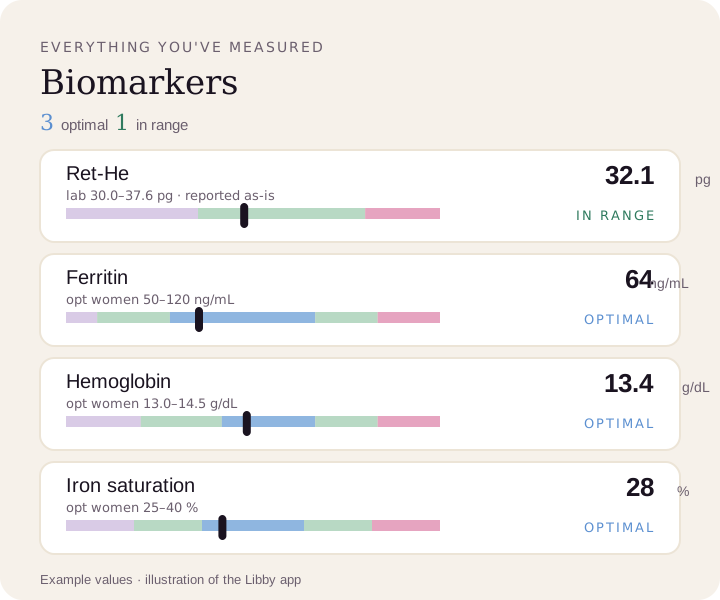
See every result against your lab's range.
Upload a lab PDF or a photo of your report. Libby shows your Ret-He on the range printed on your report, lines it up with your ferritin, iron saturation and hemoglobin, and tracks each result over time.
View your Ret-He ›