Transferrin saturation: normal, low, high and optimal
Transferrin saturation is the share of your iron carriers holding iron. Here's what's normal, optimal, what low and high mean, and when to recheck it.
Transferrin saturation (TSAT) is the percentage of your blood's iron carriers that are loaded with iron. It's calculated from two numbers on an iron panel: serum iron divided by total iron-binding capacity (TIBC).1 A low saturation means too little iron is reaching your bone marrow, usually because of iron deficiency or inflammation. A saturation that stays high is the earliest blood sign of hemochromatosis, an inherited iron-overload condition.23
The short version
- Normal: check the range on your report. MedlinePlus lists 20–50% for men and 15–45% for women, and Labcorp prints 15–55%.45
- Low (under 20%) means your iron supply is restricted.2 The usual reasons are iron deficiency and inflammation. Ferritin tells them apart, and saturation settles it when inflammation, heart failure or kidney disease pushes ferritin up.62
- High (over 45% in women, over 50% in men) is the European liver society's flag.3 First rule out an iron pill in the hours before the test. If it stays high with a high ferritin, the next step is usually a gene test for hemochromatosis.73
- A suspected iron overdose is an emergency at any lab value, especially in a child. Call Poison Control at 1-800-222-1222 or 911.89
What transferrin saturation is
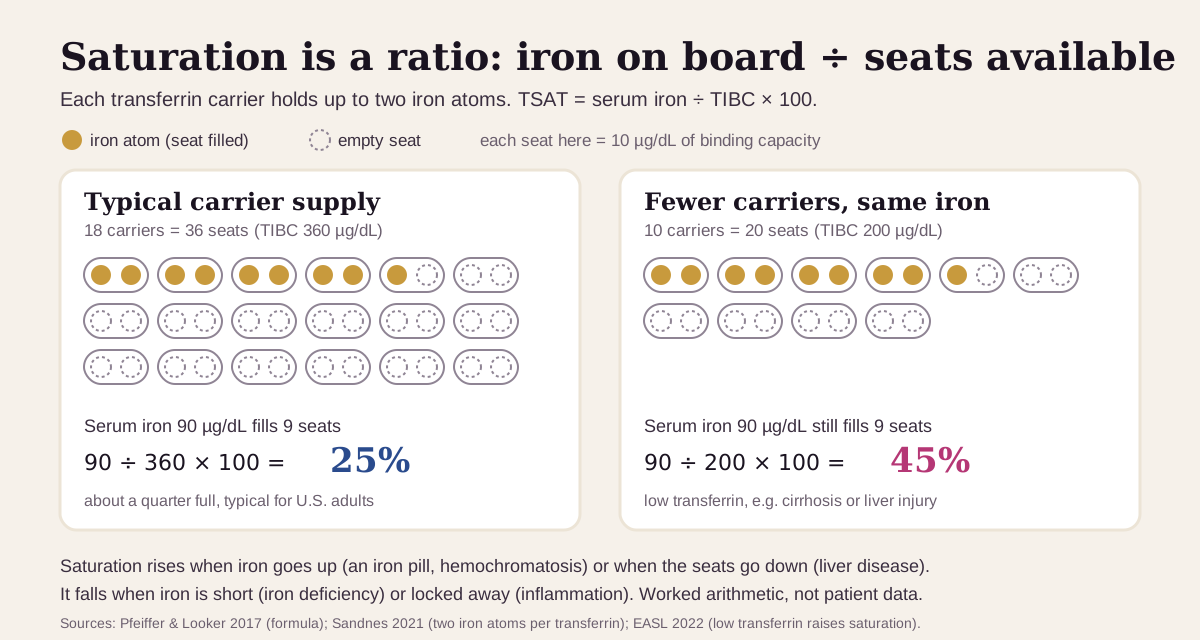
Transferrin is the protein that carries iron through your blood. The liver makes it, and each molecule can hold only two iron atoms.10 Your bone marrow takes iron off transferrin to build hemoglobin, the protein in red cells that carries oxygen.6
Saturation is the share of those seats that are filled:1
TSAT (%) = serum iron ÷ TIBC × 100
Most seats are empty most of the time. In 15,823 U.S. adults from a national health survey, half had a saturation between 17.5% and 31.3%.11 The empty seats are a safety margin: when nearly all of them fill, iron starts to circulate unbound, a reactive form that lodges in the liver, heart and pancreas.10
Because it's a ratio, saturation can move from either end:
- The top number, serum iron, swings a lot from day to day.12 How much iron enters the blood is set by hepcidin, a liver hormone. Inflammation raises hepcidin, which locks iron inside cells, so saturation falls.6 In hemochromatosis hepcidin is too low, so iron pours in and saturation climbs.3
- The bottom number, TIBC, is steadier. It rises when iron runs short and falls with inflammation or liver disease.16 A low transferrin can push saturation up with no extra iron at all, which is why cirrhosis and acute liver injury can mimic an iron-overload result.310
What's a normal transferrin saturation?
Start with the range printed on your own report. Labs set their own ranges, and they differ.4
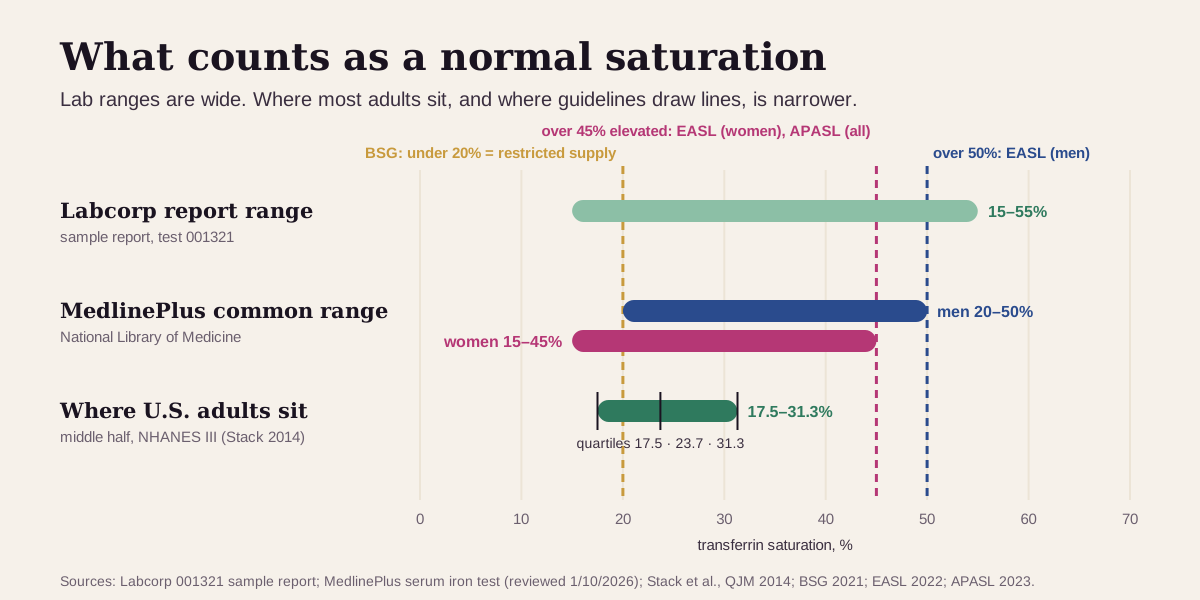
- Labcorp, a commercial lab, prints 15–55% on its sample report for this test.5
- MedlinePlus, the National Library of Medicine's patient site, lists 20–50% for men and 15–45% for women as common ranges.4
- In U.S. adults, half fall between 17.5% and 31.3%; a quarter are below 17.5%.11
Ranges and cut points are usually set higher for men than for women.43
Two guideline lines matter more than the printed range. The British Society of Gastroenterology (BSG) says a saturation under 20% indicates restricted iron supply.2 The European Association for the Study of the Liver (EASL) defines over 45% in women and over 50% in men as elevated.3 Its Asia-Pacific counterpart, APASL, uses over 45% for everyone.13
"Optimal" transferrin saturation: what health optimizers aim for
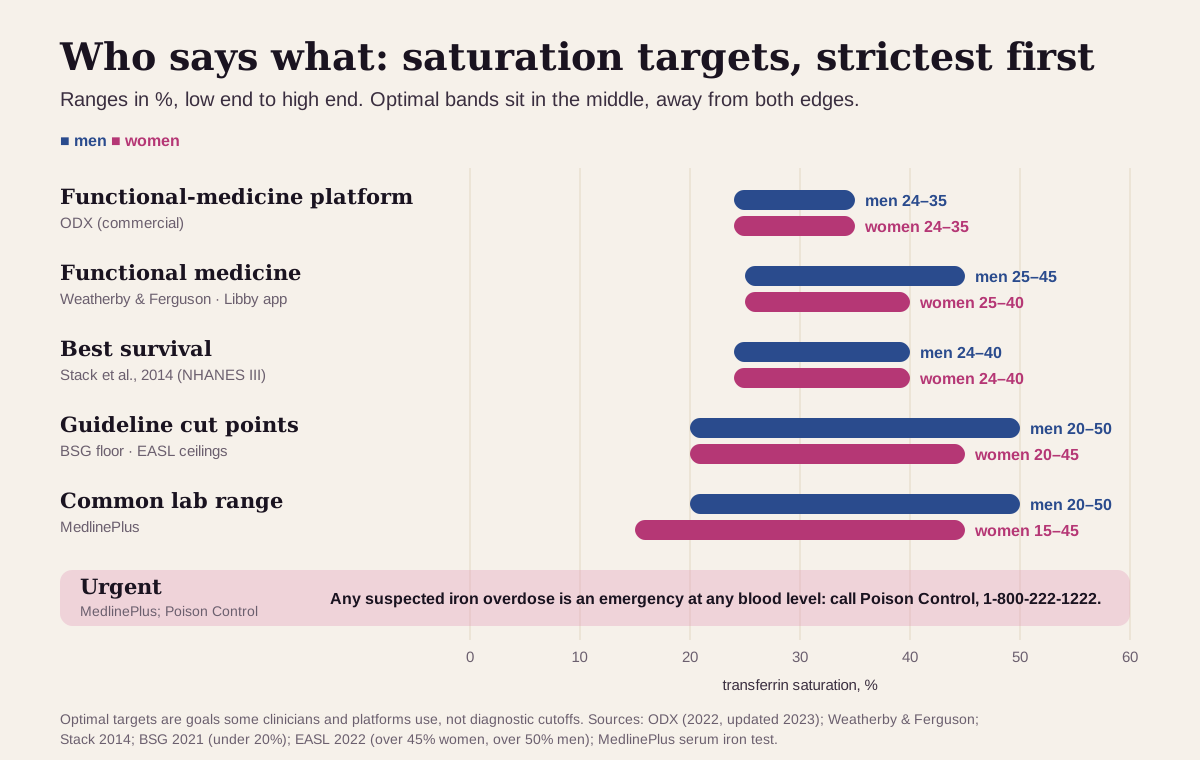
Functional-medicine practitioners and testing companies aim for the middle of the lab range, away from both edges. Here's the ladder from strictest to loosest:
| Target | Men | Women | Who uses it |
|---|---|---|---|
| Strictest (functional-medicine platform) | 24–35% | 24–35% | ODX's published range14 |
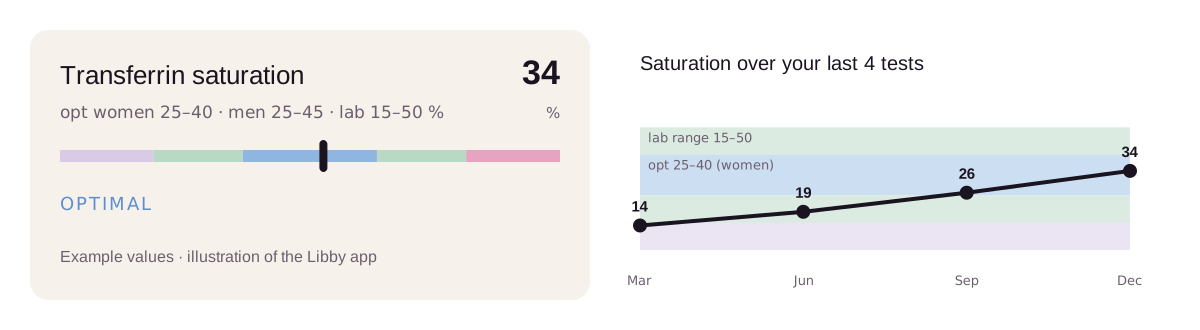
| Functional medicine | 25–45% | 25–40% | The optimal range shown in the Libby app, from Weatherby & Ferguson's functional blood-chemistry textbook15 |
| Best-survival range | 24–40% | 24–40% | Stack et al., 15,823 U.S. adults followed to 200611 |
| Guideline cut points | 20–50% | 20–45% | Under 20% is restricted iron supply (BSG);2 over 50% in men or 45% in women is elevated (EASL)3 |
| Common lab range | 20–50% | 15–45% | Typical ranges listed by MedlinePlus4 |
| Urgent | any suspected iron overdose | any suspected iron overdose | An emergency at any blood level: call Poison Control89 |
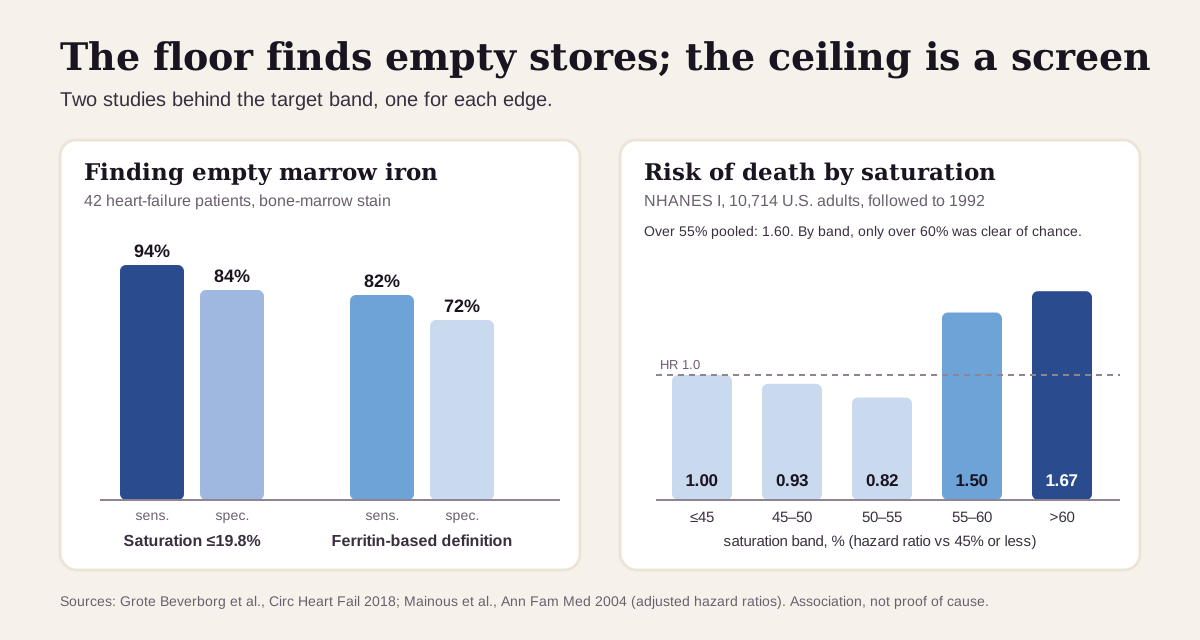
Why the floor sits near 20%: in 42 people with heart failure who had a bone-marrow iron stain, the gold standard for iron stores, a saturation of 19.8% or less found marrow iron deficiency with 94% sensitivity and 84% specificity. The usual ferritin-based definition managed 82% and 72%. In 387 heart-failure outpatients, a low saturation, and not ferritin, was linked to a higher risk of death.16
Why the ceiling is a screening line, not a cliff: in a national U.S. survey (NHANES I) of 10,714 adults followed to 1992, the risk of death at 45–55% was no higher than at 45% or less (hazard ratios 0.93 and 0.82). Risk rose above that: 1.50 at 55–60% and 1.67 above 60%. Taken together, people above 55% had 1.60 times the risk, a rise clear of chance. About 2% of U.S. adults were above 55%.17 A later survey found that both ends carry risk, with the best survival at 24–40%.11
Keep "optimal" in perspective: these are targets, not diagnoses. Saturation varies about 28% from one day to the next in the same person, so a single value just inside or outside a band means less than a steady trend.12 The floor matters too: when saturation runs low, red-cell production is starved of iron before hemoglobin drops.1
What a low or high saturation usually means
The direction is the first clue, and the size is the second. The lines below come from guidelines; the share of U.S. adults above each high line comes from NHANES I.
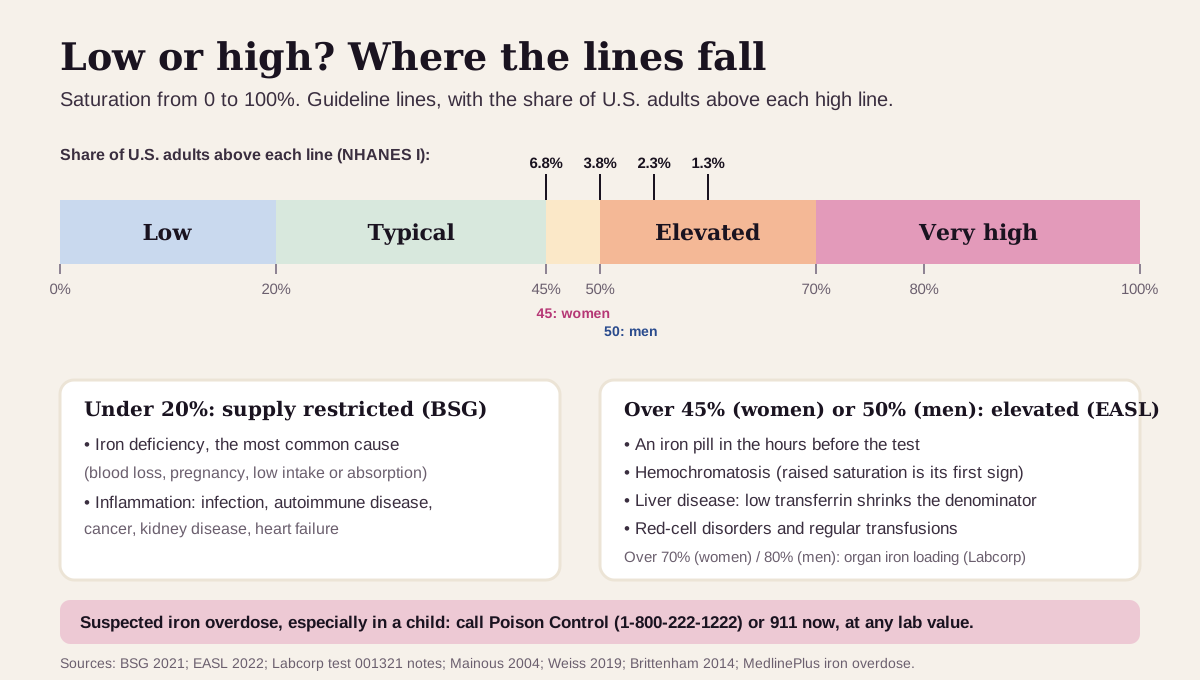
Low saturation (under 20%)
The usual suspects, most common first:
- Iron deficiency is the most common cause of anemia worldwide.6 Saturation falls, TIBC rises and ferritin falls.1 The main reasons are blood loss (heavy periods, slow bleeding from the gut), pregnancy, and low intake or poor absorption.42
- Inflammation is the second most common cause of anemia.6 Infection, autoimmune disease, cancer, kidney disease and heart failure raise hepcidin, which locks iron away. Saturation falls, but TIBC falls too, and ferritin is normal or high.61
Where saturation beats ferritin. Ferritin rises with inflammation, so a "normal" ferritin can hide iron deficiency.2 Guidelines lean on saturation in exactly those settings:
- Heart failure: 40–70% of people have some iron deficiency by a ferritin under 100 and/or a saturation under 20%.2 A saturation of 19.8% or less beat ferritin at finding empty marrow stores.16
- Chronic kidney disease: absolute iron deficiency is a saturation of 20% or less with a ferritin of 100 µg/L or less (200 or less on hemodialysis).2
- Inflammatory bowel disease: a ferritin up to 100 µg/L can still mean iron deficiency, so saturation helps.2
Low iron can cause weakness or tiredness, dizziness, shortness of breath and an irregular heartbeat.18
High saturation (over 45–50%)
Common causes, starting with the easiest to check (the sources give no ranking by frequency):
- An iron pill before the test. In 32 healthy women given a 60 mg dose, saturation peaked 2–4 hours later and was still above baseline at 8 hours.7 Ask whether to take your iron after the blood draw, and keep taking prescribed iron unless your clinician says otherwise.
- Hemochromatosis. A raised saturation is its first blood sign, because hepcidin, the hormone that limits absorption, is too low.3 The main form, HFE hemochromatosis, affects about 0.5% of northern Europeans.10 EASL cites a large primary-care screening study in which 84% of men and 73% of women with two copies of the C282Y gene variant had a high saturation.3
- Liver disease. A damaged liver makes less transferrin, which shrinks the denominator. Alcohol-related liver disease, cirrhosis and acute liver injury can all raise saturation without iron overload.310
- Red-cell disorders and transfusions. Anemias in which red cells break down early (hemolytic anemias) or the marrow makes them faultily, and regular transfusions, raise saturation.35
Very high values. Labcorp's test notes describe saturations over 70% in women and 80% in men as the level at which iron loads into organs, while warning that swings in serum iron can make such cut points misleading.5 APASL lists a saturation of 50% or more for long periods as a risk factor for hemochromatosis arthritis.13
Too much iron can cause tiredness, joint pain (often in the knees or hands), belly pain, low sex drive or erectile dysfunction, and gray or bronze skin.18
Get care now for any suspected iron overdose, especially a child who swallowed adult or prenatal vitamins. Call 911 or Poison Control at 1-800-222-1222, or use the Poison Control online tool. Early signs include nausea, vomiting (sometimes blood), diarrhea, and black or bloody stools.89
A high saturation with a high ferritin calls for a planned workup, not an emergency visit.3
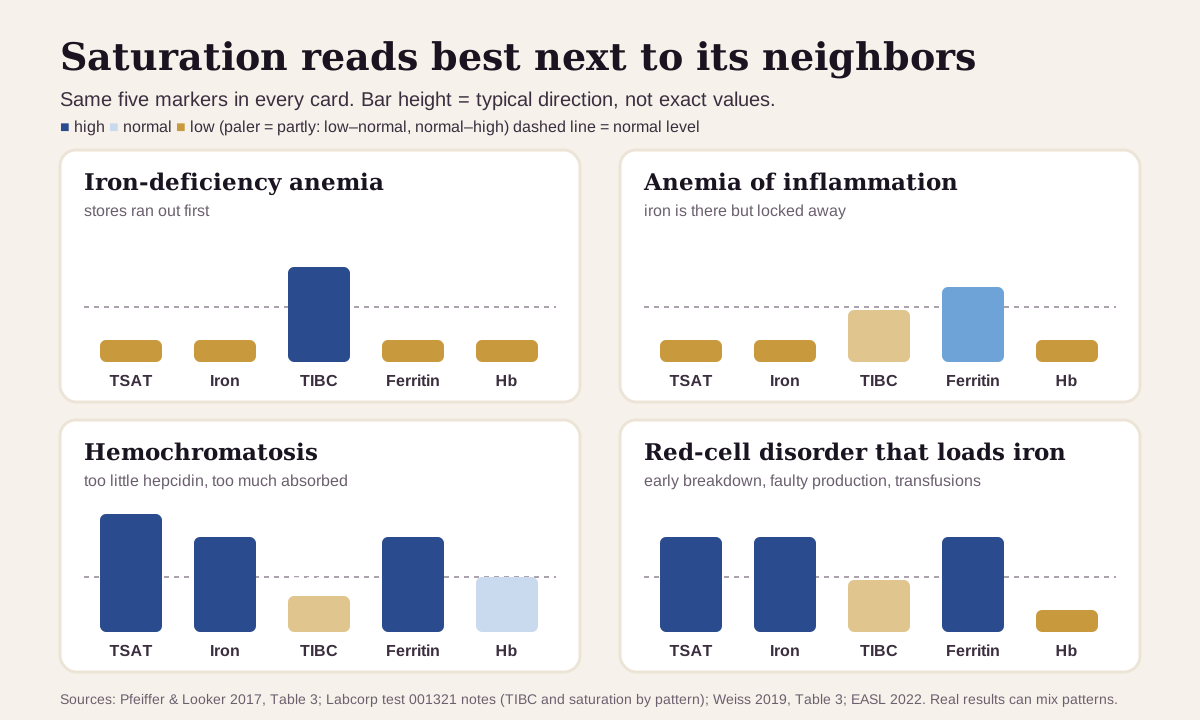
Transferrin saturation reads best next to its neighbors
Saturation tells you whether iron is getting through. Its neighbors usually help tell you why. Read it with serum iron, TIBC, ferritin and hemoglobin:1
| If you see… | It often points to… |
|---|---|
| Low saturation, high TIBC, low ferritin, hemoglobin low or heading there | iron deficiency: stores ran out15 |
| Low saturation, low or normal TIBC, normal or high ferritin, with signs of inflammation | inflammation: the iron is there but locked away615 |
| High saturation, high ferritin, normal hemoglobin | iron overload such as hemochromatosis; the next step is usually an HFE gene test13 |
| High saturation, high ferritin, low hemoglobin | a red-cell disorder that loads iron, or regular transfusions: check the blood count and reticulocytes63 |
| High saturation with a low TIBC in someone with chronic liver disease | a damaged liver making less transferrin, which can push saturation up without iron overload; hemochromatosis can also upset liver tests, so it still needs a workup310 |
| High ferritin, normal saturation | usually inflammation, fatty liver, metabolic syndrome or alcohol: only about 10% of high ferritins in practice come from iron overload, though a normal saturation leaves some chance of it10 |
| Raised serum iron and saturation a few hours after an iron pill | the pill: saturation peaks 2–4 hours after a dose and stays up for most of the day, so ask whether to take iron after the draw75 |
How fast transferrin saturation changes
Saturation is the jumpiest number on an iron panel. In 13 healthy people tested over five weeks, serum iron varied 28.5% from day to day within each person and saturation 28.0%, while TIBC varied only 4.8% and ferritin 14.5%.12 Saturation inherits the swings of its top number.
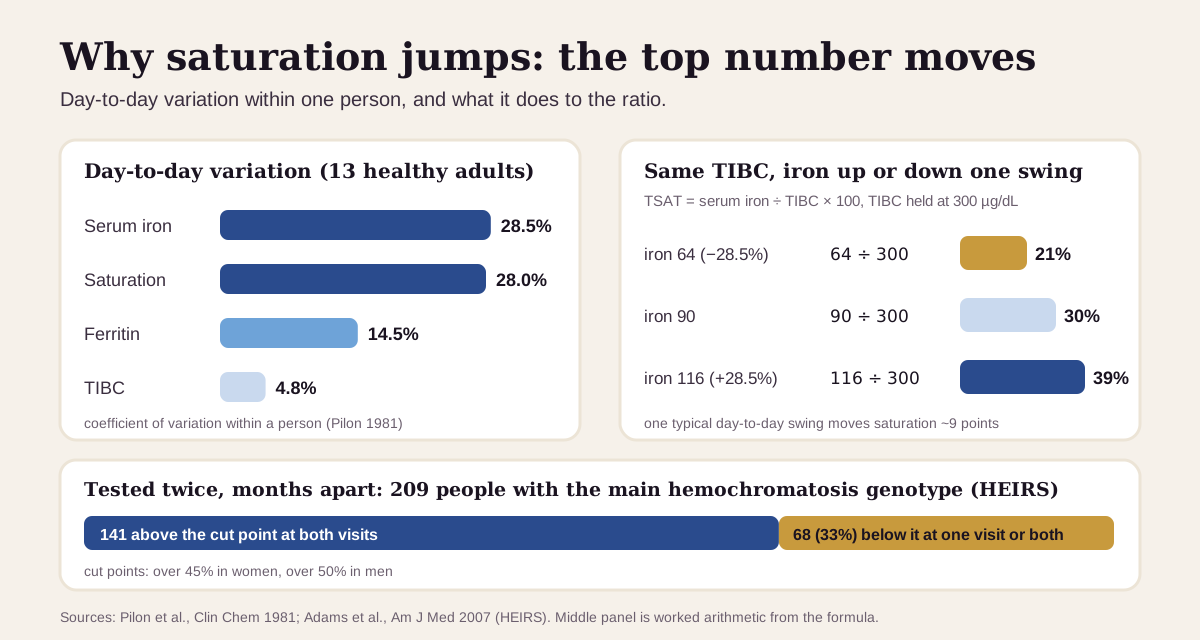
What that means in practice:
- Confirm a high result before acting on it. In a large primary-care screening study of 101,168 adults (HEIRS), 209 people with the main hemochromatosis genotype were tested twice, months apart. 68 of them (33%) fell below the cut point (45% for women, 50% for men) at one visit or both.19 Guidelines look for a saturation that stays high.310
- Fasting matters less than you'd think. HEIRS found no advantage to fasting samples. EASL recommends a morning sample and says fasting adds nothing to its usefulness.193 Your lab may still ask you to fast for 12 hours, so follow its instructions.18
- Iron pills act within hours. A dose can lift saturation for most of the day.7
- Some things pull it down for a while. An acute infection, a period or a recent blood donation can bring a high saturation back into range temporarily, even with iron overload.10
- Trends beat snapshots. In Danish adults with two copies of C282Y and a normal saturation, only 15 of 24 still had a normal saturation about 10 years later.20 Compare results from the same lab, because TIBC methods differ.21
Going deeper: the denominator and unbound iron
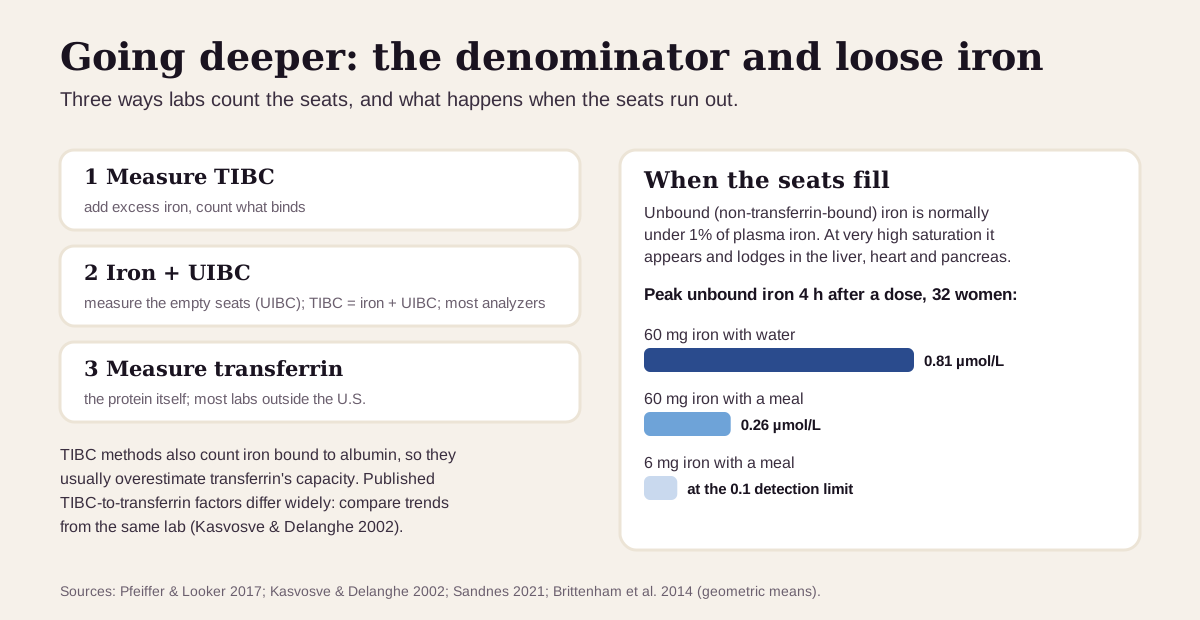
Labs build the denominator in one of three ways:1
- Measure TIBC directly.
- Measure UIBC, the empty seats, and add serum iron: TIBC = iron + UIBC. Most clinical analyzers do this, because UIBC is easier to automate.
- Measure transferrin itself. Outside the United States, transferrin has mostly replaced UIBC and TIBC.
TIBC and transferrin track each other, but they're not interchangeable. TIBC methods also count iron stuck to other proteins, mainly albumin, so they usually overestimate transferrin's true capacity, and published conversion factors between the two vary widely.21 Birth-control pills raise TIBC and transferrin while saturation stays normal.5
When the seats fill, iron comes loose. Normally, iron that isn't bound to transferrin is under 1% of the iron in plasma.1 When saturation runs very high, carrier capacity is exceeded and this unbound iron enters the liver, heart and pancreas, where it damages cells.10 Even a single supplement can do it briefly: after 60 mg of iron taken with water, healthy women's unbound iron peaked at 4 hours (0.81 µmol/L on average), against 0.26 µmol/L when the same dose came with a meal.7
Questions worth asking
- Is my saturation low, typical or high, and by whose cut point?
- What do my ferritin, TIBC and hemoglobin show next to it?
- Did I take iron or a multivitamin before this test, and should we repeat it?
- If my saturation is low but my ferritin looks normal, could inflammation, heart failure or kidney disease be hiding iron deficiency?
- If it's high, should we confirm it with a morning repeat and then check for hemochromatosis?
- Could a liver problem be lowering my transferrin?
FAQ
What is a normal transferrin saturation? MedlinePlus lists 20–50% for men and 15–45% for women, and Labcorp prints 15–55%. Guidelines treat under 20% as restricted iron supply and over 45% (women) or 50% (men) as elevated.4523
What does a low transferrin saturation mean? Usually iron deficiency or inflammation, and ferritin tells them apart. With heart failure, kidney disease or inflammation, a saturation under 20% can reveal iron deficiency even when ferritin looks normal.216
Can a high transferrin saturation be temporary? Yes. An iron pill can raise it within 2–4 hours.7 It also swings about 28% from day to day, so a high result is usually repeated, ideally on a morning sample.123
Does a high transferrin saturation mean hemochromatosis? Sometimes. A saturation that stays high with a high ferritin usually leads to an HFE gene test. Liver disease, red-cell disorders, transfusions and a recent iron pill can also raise it.37
This guide is for education. It can't diagnose you or replace care from a clinician who knows your history.
Footnotes
-
Pfeiffer CM, Looker AC. Laboratory methodologies for indicators of iron status: strengths, limitations, and analytical challenges. Am J Clin Nutr. 2017;106(Suppl 6):1606S–1614S. The saturation formula and how labs get the denominator, the Table 3 patterns behind the neighbors figure, iron-deficient red-cell production before hemoglobin falls, and unbound iron under 1% of plasma iron. PMC ↩ ↩2 ↩3 ↩4 ↩5 ↩6 ↩7 ↩8 ↩9 ↩10 ↩11 ↩12 ↩13 ↩14 ↩15
-
Snook J, Bhala N, Beales ILP, et al. British Society of Gastroenterology guidelines for the management of iron deficiency anaemia in adults. Gut. 2021;70(11):2030–2051. Saturation under 20% as restricted iron supply; the heart-failure (40–70%), kidney-disease and inflammatory-bowel-disease definitions. PMC ↩ ↩2 ↩3 ↩4 ↩5 ↩6 ↩7 ↩8 ↩9 ↩10 ↩11 ↩12 ↩13 ↩14 ↩15
-
European Association for the Study of the Liver. EASL Clinical Practice Guidelines on haemochromatosis. J Hepatol. 2022;77(2):479–502. Saturation over 50% (men) and 45% (women) defined as elevated; raised saturation as the first sign of hemochromatosis; morning samples, no benefit from fasting; low transferrin, cirrhosis, liver injury and red-cell disorders as other causes. DOI ↩ ↩2 ↩3 ↩4 ↩5 ↩6 ↩7 ↩8 ↩9 ↩10 ↩11 ↩12 ↩13 ↩14 ↩15 ↩16 ↩17 ↩18 ↩19 ↩20 ↩21 ↩22 ↩23 ↩24 ↩25 ↩26 ↩27
-
National Library of Medicine. Serum iron test. MedlinePlus Medical Encyclopedia. Reviewed January 10, 2026. Common ranges for iron saturation (20–50% men, 15–45% women), units, and causes of low iron. MedlinePlus ↩ ↩2 ↩3 ↩4 ↩5 ↩6 ↩7 ↩8 ↩9 ↩10
-
Labcorp. Iron and Total Iron-binding Capacity (TIBC), test 001321, and its sample report (reference interval for iron saturation 15–55%). Test notes on hemochromatosis, hemolytic anemias, oral contraceptives and the 70%/80% organ-loading description. Labcorp is a commercial laboratory. Test page · Sample report ↩ ↩2 ↩3 ↩4 ↩5 ↩6 ↩7 ↩8 ↩9 ↩10 ↩11 ↩12
-
Weiss G, Ganz T, Goodnough LT. Anemia of inflammation. Blood. 2019;133(1):40–50. Hepcidin, why inflammation lowers serum iron and transferrin, iron deficiency as the most common anemia and inflammation as the second, and Table 3 (high saturation and ferritin in iron-loading anemias). PMC ↩ ↩2 ↩3 ↩4 ↩5 ↩6 ↩7 ↩8 ↩9 ↩10 ↩11
-
Brittenham GM, Andersson M, Egli I, et al. Circulating non-transferrin-bound iron after oral administration of supplemental and fortification doses of iron to healthy women: a randomized study. Am J Clin Nutr. 2014;100(3):813–820. 32 women; after 60 mg of iron, saturation peaked at 2–4 hours and had not returned to baseline by 8 hours; unbound iron peaked at 4 hours. PMC ↩ ↩2 ↩3 ↩4 ↩5 ↩6 ↩7 ↩8 ↩9
-
National Library of Medicine. Iron overdose. MedlinePlus Medical Encyclopedia. Reviewed October 14, 2025. Danger to children from adult and prenatal vitamins, early symptoms, and when to call 911 or Poison Control. MedlinePlus ↩ ↩2 ↩3
-
National Capital Poison Center. Iron poisoning: A simple but serious mistake. Poison Control. Call 1-800-222-1222 or use the online tool if someone swallows too much iron. poison.org ↩ ↩2 ↩3
-
Sandnes M, Ulvik RJ, Vorland M, Reikvam H. Hyperferritinemia: A Clinical Overview. J Clin Med. 2021;10(9):2008. Transferrin holds only two iron atoms; unbound iron when capacity is exceeded; low transferrin in liver disease; about 10% of high ferritins from iron overload; HFE hemochromatosis in about 0.5% of northern Europeans; infection, periods and blood donation can lower saturation temporarily. PMC ↩ ↩2 ↩3 ↩4 ↩5 ↩6 ↩7 ↩8 ↩9 ↩10 ↩11 ↩12
-
Stack AG, Mutwali AI, Nguyen HT, et al. Transferrin saturation ratio and risk of total and cardiovascular mortality in the general population. QJM. 2014;107(8):623–633. 15,823 adults from NHANES III (1988–94), quartile cut points at 17.5%, 23.7% and 31.3%, best survival at 24–40%. PMC ↩ ↩2 ↩3 ↩4 ↩5 ↩6
-
Pilon VA, Howanitz PJ, Howanitz JH, Domres N. Day-to-day variation in serum ferritin concentration in healthy subjects. Clin Chem. 1981;27(1):78–82. 13 healthy people over five weeks: within-person variation of 14.5% (ferritin), 28.5% (serum iron), 4.8% (TIBC) and 28.0% (saturation). PubMed ↩ ↩2 ↩3 ↩4 ↩5
-
Crawford DHG, Ramm GA, Bridle KR, et al. Clinical practice guidelines on hemochromatosis: Asian Pacific Association for the Study of the Liver. Hepatol Int. 2023;17(3):522–541. "A transferrin saturation over 45% in both males and females is considered elevated"; saturation of 50% or more for long periods as an arthritis risk factor. PMC ↩ ↩2
-
Optimal DX (ODX Research). Biomarkers of Iron Status: Transferrin Saturation. Published October 16, 2022; updated November 1, 2023. States "The ODX Range: 24 - 35%" against a standard range of 20–48%. A commercial source, listed as what the optimizer community uses. optimaldx.com ↩ ↩2
-
Weatherby D, Ferguson S. Blood Chemistry and CBC Analysis: Clinical Laboratory Testing from a Functional Perspective. Bear Mountain Publishing. ISBN 978-0976136712. Widely used functional-medicine reference, recorded in the Libby app's marker catalog as the source of its optimal saturation bands (men 25–45%, women 25–40%; range as recorded in the catalog, book not opened for this article). ↩ ↩2
-
Grote Beverborg N, Klip IT, Meijers WC, et al. Definition of Iron Deficiency Based on the Gold Standard of Bone Marrow Iron Staining in Heart Failure Patients. Circ Heart Fail. 2018;11(2):e004519. 42 bone-marrow stains; saturation of 19.8% or less had 94% sensitivity and 84% specificity; linked to death in 387 outpatients. PubMed ↩ ↩2 ↩3 ↩4
-
Mainous AG 3rd, Gill JM, Carek PJ. Elevated serum transferrin saturation and mortality. Ann Fam Med. 2004;2(2):133–138. NHANES I (1971–74) followed to 1992, 10,714 adults; adjusted hazard ratios by saturation band and the share of adults above 45%, 50%, 55% and 60%. PMC ↩ ↩2 ↩3
-
National Library of Medicine. Iron Tests. MedlinePlus. Last updated April 10, 2024. Symptoms of low and high iron, and test preparation (fasting up to 12 hours, morning draw). MedlinePlus ↩ ↩2 ↩3
-
Adams PC, Reboussin DM, Press RD, et al. Biological variability of transferrin saturation and unsaturated iron-binding capacity. Am J Med. 2007;120(11):999.e1–999.e7. HEIRS: 68 of 209 C282Y homozygotes (33%) below the 45%/50% cut points at one of two visits; no advantage from fasting. PMC ↩ ↩2 ↩3
-
Mottelson M, Helby J, Nordestgaard BG, et al. Mortality and risk of diabetes, liver disease, and heart disease in individuals with haemochromatosis HFE C282Y homozygosity and normal concentrations of iron, transferrin saturation, or ferritin: prospective cohort study. BMJ. 2024;387:e079147. Of 24 C282Y homozygotes with a normal saturation, 15 still had a normal saturation about 10 years later. PMC ↩
-
Kasvosve I, Delanghe J. Total iron binding capacity and transferrin concentration in the assessment of iron status. Clin Chem Lab Med. 2002;40(10):1014–1018. TIBC counts iron bound to other proteins, mainly albumin; conversion factors between TIBC and transferrin differ widely. PubMed ↩ ↩2 ↩3
Educational content, not medical advice. Libby is a personal record tool, not a medical service — it doesn't diagnose, treat, or prescribe. Reference ranges vary by lab and by person. Talk to a qualified healthcare professional about your results.
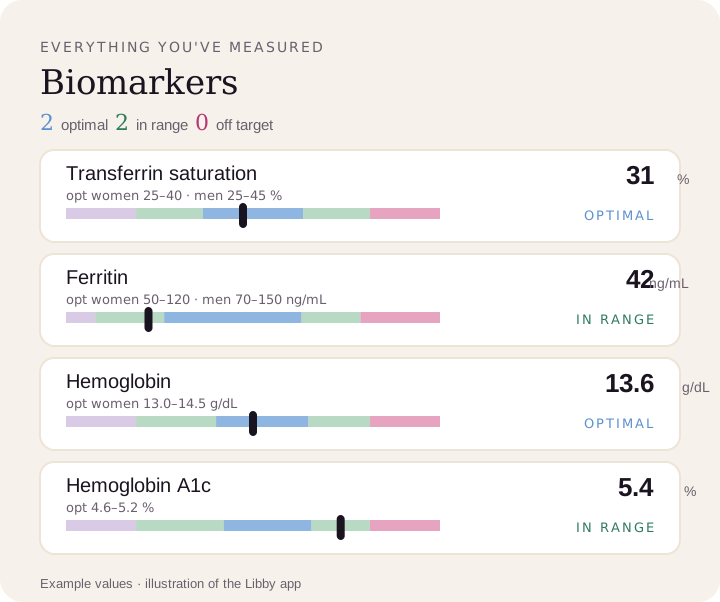
Compare your results to optimal ranges.
Upload a lab PDF or a photo of your report. Libby puts every marker on your lab's range and the optimal range, and tracks your trends over time.
View your transferrin saturation ›