Uric acid blood test: normal levels, high causes, and gout
Uric acid is your body's purine waste. What a normal level is, the targets optimizers aim for, why it runs high, and how it links to gout.
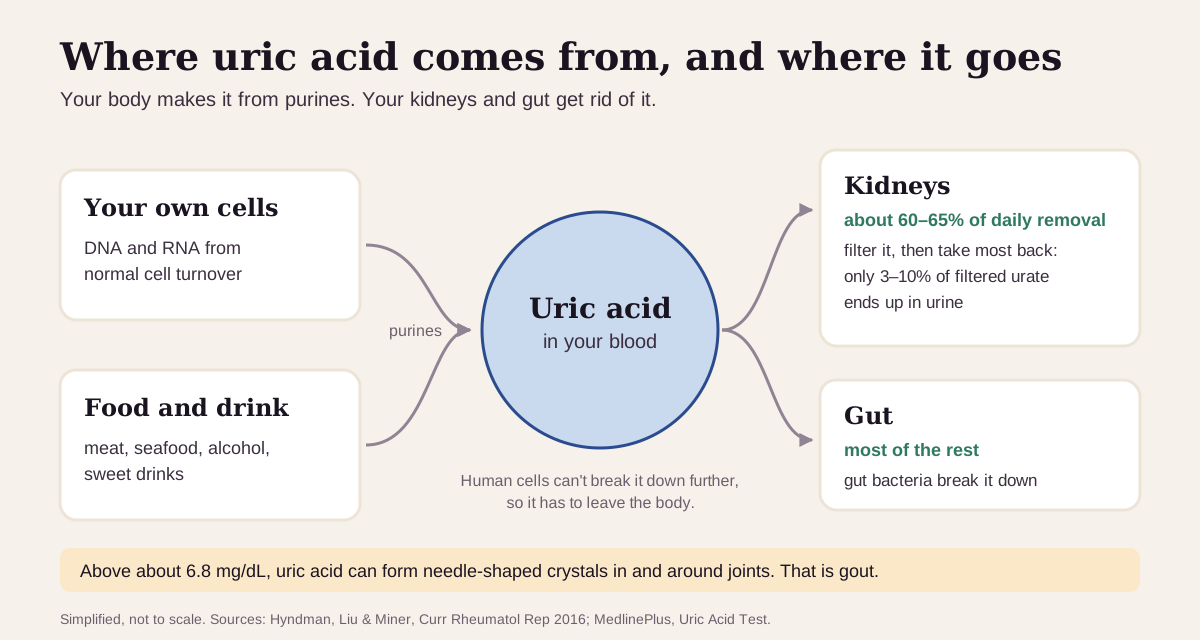
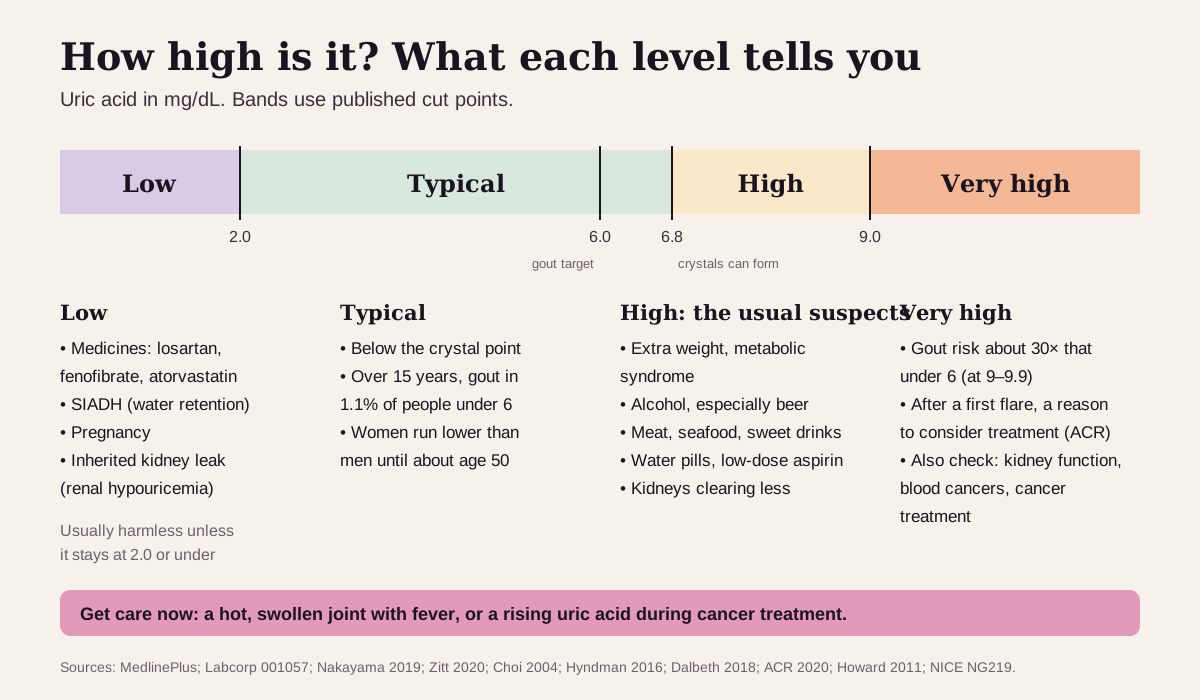
Uric acid is the waste your body makes when it breaks down purines, the building blocks of DNA in your own worn-out cells and in food. Your kidneys clear most of it. When your body makes too much or clears too little, it builds up in the blood, and above about 6.8 mg/dL it can form the needle-shaped crystals that cause gout.12
The short version
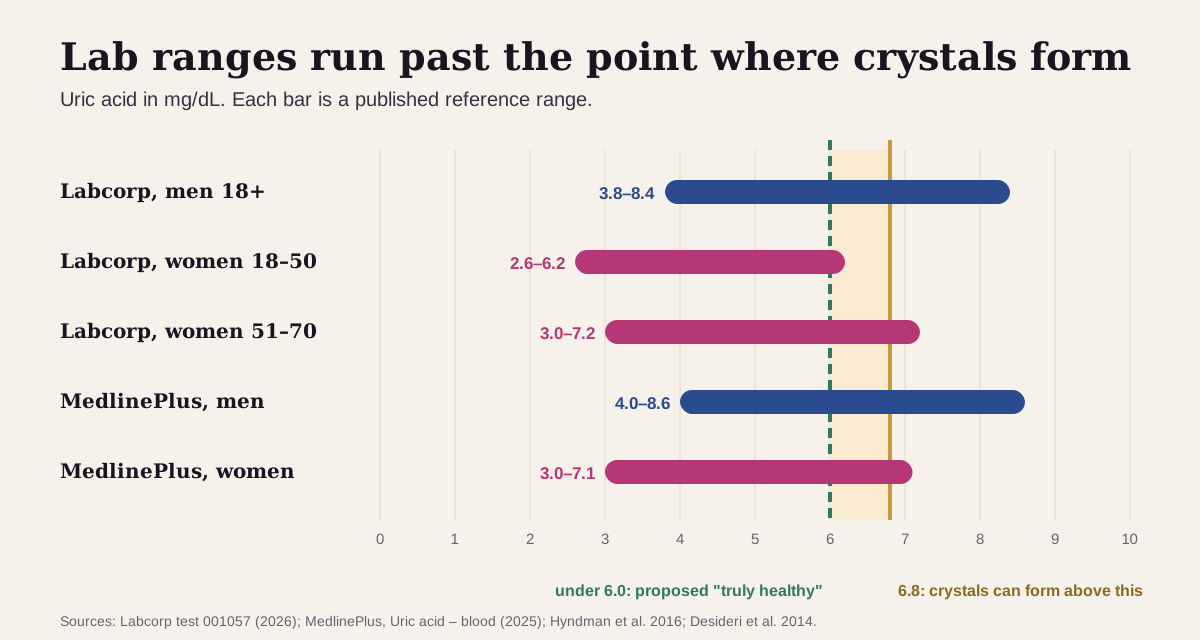
- Normal: check the range on your report. Labcorp's adult range runs 3.8–8.4 mg/dL for men and 2.6–6.2 mg/dL for women aged 18–50.3 Crystals can start forming above about 6.8, which is why a group of Italian experts proposed under 6.0 as the truly healthy limit.14
- High is common. The usual reasons are extra body weight and the metabolic syndrome, alcohol (especially beer), meat, seafood and sweet drinks, water pills, and kidneys that clear less.567
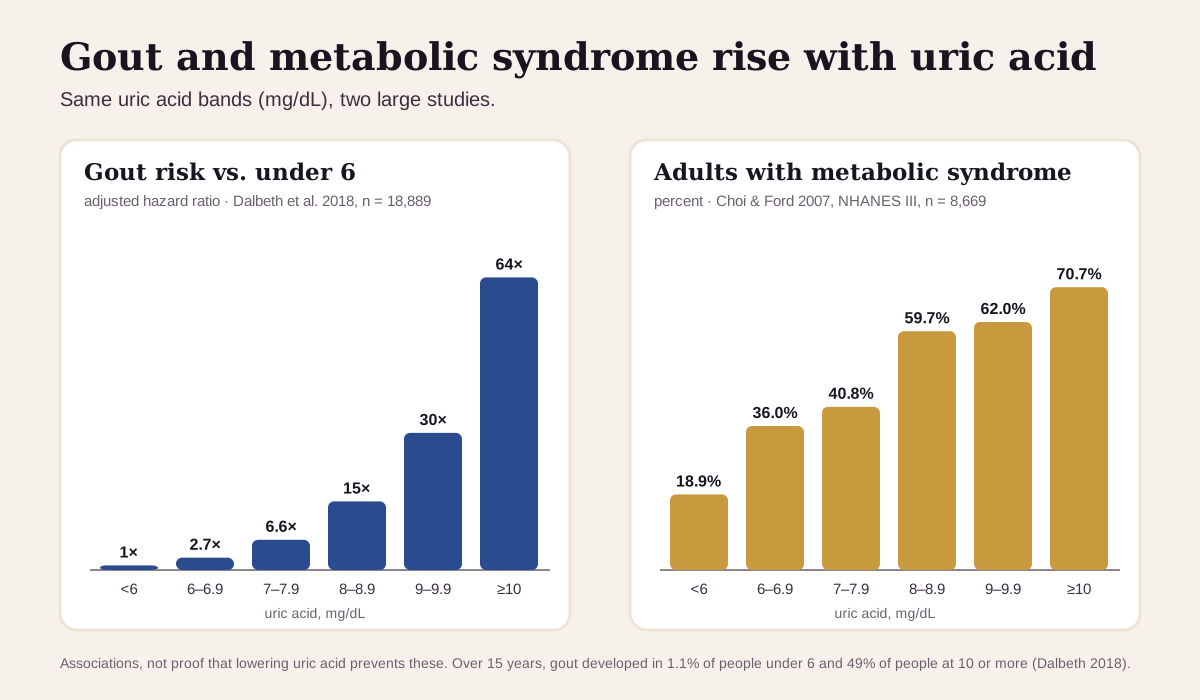
- High uric acid and gout are different things. Over 15 years, gout developed in 1.1% of people under 6 mg/dL and 49% of people at 10 or more. Most people with a high level never get it.8
- Get care now for a hot, swollen, painful joint with a fever, or a rising uric acid during cancer treatment.91011
What uric acid is
Purines are part of the DNA and RNA in every cell. When old cells break down, and when you digest purine-rich food, your body turns those purines into uric acid. Human cells have no way to break uric acid down any further, so it has to leave the body.1 Most other mammals carry an enzyme, uricase, that turns it into allantoin, which is easily flushed out in urine. Humans have no working uricase.12
Your kidneys handle about 60–65% of the daily removal. They filter uric acid out of the blood, then take most of it back: only 3–10% of what they filter ends up in your urine. Most of the rest leaves through the gut, where bacteria break it down.1
That makes the blood level a balance: how much you make versus how well your kidneys let it go. Doctors order the test to look for gout, to watch people having cancer treatment, and in people with the metabolic syndrome or who take water pills (diuretics).2
What's a normal uric acid?
Start with the range printed on your report. Labs differ:
- Labcorp, a large commercial US lab, uses 3.8–8.4 mg/dL for men 18 and older. For women it uses 2.6–6.2 at ages 18–50, 3.0–7.2 at 51–70, and 3.1–7.9 from 71.3
- MedlinePlus, the National Library of Medicine's site, lists 4.0–8.6 mg/dL for men and 3.0–7.1 for women.5
Women run lower than men until menopause. In 146,873 Austrian adults, the average was about 5.3 mg/dL in men and 4.1 in women. Women's levels held steady until about age 50, then rose by about 22 µmol/L (0.4 mg/dL) per decade.6
Here's the twist: most lab ranges reach past 6.8 mg/dL, the point where uric acid stops dissolving and can form crystals.1 Ranges come from people without gout, but a high level can deposit crystals silently. That's why Desideri and colleagues argued that under 6.0 mg/dL better describes a truly healthy person, for everyone.4
"Optimal" uric acid: what health optimizers aim for
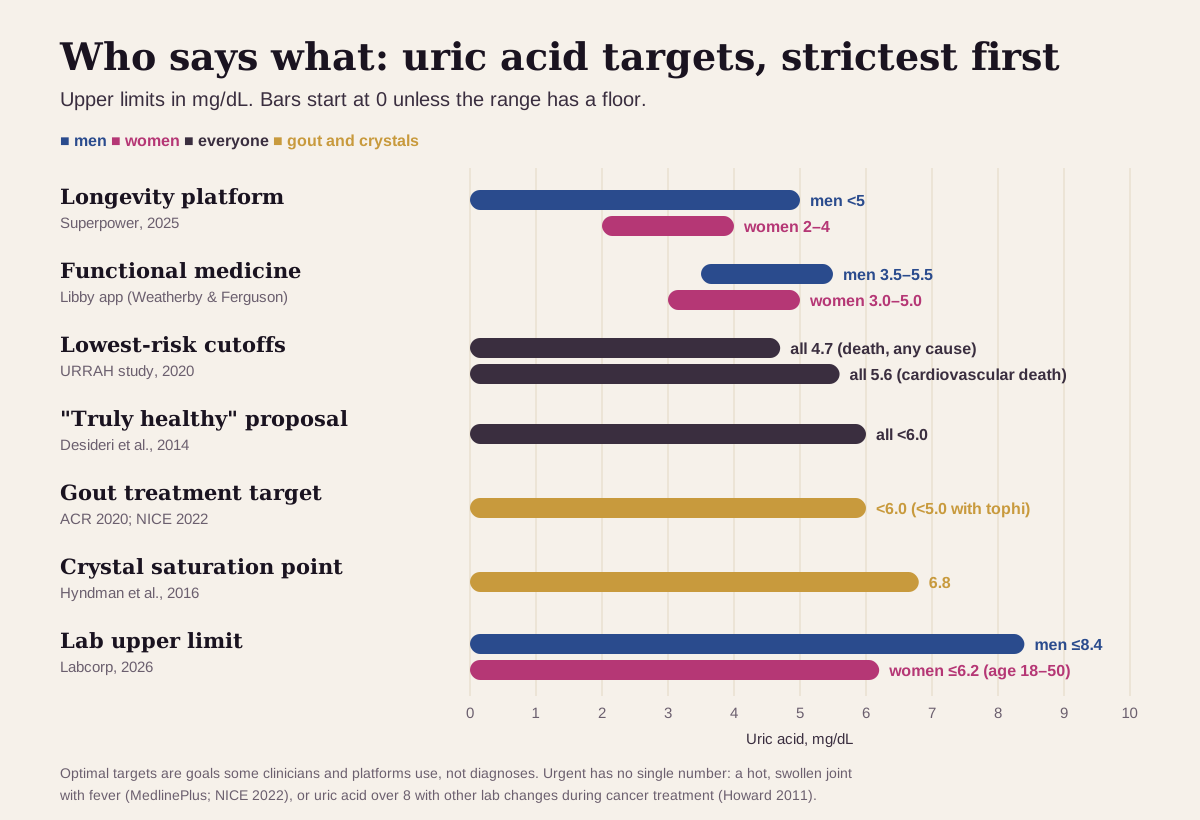
Longevity clinics and functional-medicine practitioners aim well below a lab's upper limit. Here's the full ladder, from strictest to loosest:
| Target | Men | Women | Who uses it |
|---|---|---|---|
| Strictest (longevity platform) | under 5 mg/dL | 2–4 mg/dL | Superpower's published optimal range13 |
| Functional medicine | 3.5–5.5 mg/dL | 3.0–5.0 mg/dL | The optimal range shown in the Libby app, which its marker catalog credits to the Weatherby & Ferguson functional-medicine textbook14 |
| Research: lowest-risk cutoffs | 4.7 (death from any cause), 5.6 (cardiovascular death) | same | The URRAH study of 22,714 Italian adults15 |
| Research: "truly healthy" proposal | under 6.0 mg/dL | under 6.0 mg/dL | Desideri et al.4 |
| Gout treatment target | under 6.0 (under 5.0 with tophi or frequent flares) | same | American College of Rheumatology and NICE, for people with gout on treatment1610 |
| Crystal point | 6.8 mg/dL | 6.8 mg/dL | Where uric acid stops dissolving1 |
| Lab upper limit | 8.4 mg/dL | 6.2 (ages 18–50) to 7.9 (71+) | Labcorp3 |
| Urgent | a hot, swollen joint with fever; or over 8 with other lab changes during cancer treatment | same | NICE; the tumor lysis criteria1011 |
Why the low targets exist:
- Gout risk climbs steeply with the number. Pooling 18,889 adults from four US cohorts, Dalbeth and colleagues found that, compared with under 6 mg/dL, gout risk was 2.7 times higher at 6.0–6.9, 6.6 at 7.0–7.9, 15 at 8.0–8.9, 30 at 9.0–9.9 and 64 at 10 or more.8
- The metabolic syndrome travels with it. In a national US survey of 8,669 adults, it affected 18.9% of people under 6 mg/dL, 36.0% at 6–6.9 and 70.7% at 10 or more.17
- Some risk shows up inside the lab range. In the URRAH study, death from any cause rose above about 4.7 mg/dL and cardiovascular death (heart attack, stroke, sudden cardiac death or heart failure) above about 5.6. Both are lower than the levels usually used to define high uric acid.15
Keep "optimal" in perspective: it's a target, not a diagnosis. Uric acid clearly causes gout, but its link to heart and metabolic disease looks more like a fellow traveler. A genetic study found that genes raising uric acid raised gout risk (odds ratio 5.84 per standard deviation) with no rise in type 2 diabetes, coronary heart disease, stroke or heart failure.18 In trials, lowering uric acid with allopurinol left kidney decline unchanged in people with chronic kidney disease19 or type 1 diabetes,20 and heart attacks, strokes and cardiovascular deaths unchanged in older people with heart disease.21 So the American College of Rheumatology advises against urate-lowering drugs for a high level with no gout flares or tophi (a conditional recommendation).16 A number above the optimal band is a reason to look at weight, alcohol and sweet drinks, not to start a pill. Lower isn't always better, either: a level that stays at 2.0 mg/dL or less can signal a kidney that leaks uric acid.22
What a high uric acid usually means
The level is the first clue. Mild rises mostly track everyday causes: in a national US survey, more than a third of adults at 6–6.9 mg/dL and 70.7% at 10 or more had the metabolic syndrome.17 Kidney failure and fast cell breakdown, as in blood cancers and their treatment, can push it much higher.211
Mildly high: the usual suspects
- Extra weight and the metabolic syndrome. In the Austrian cohort, high uric acid went with obesity, high triglycerides and a high GGT (a liver enzyme) in both men and women.6 The link between high uric acid and insulin resistance is well known.17
- Alcohol, especially beer. In 47,150 men followed for 12 years, each daily beer raised gout risk by 49% and each daily shot of spirits by 15%. Moderate wine showed no rise.7
- Food and drink. Men who ate the most meat had 1.41 times the gout risk of those who ate the least, and the most seafood 1.51 times. Dairy went the other way (0.56), and purine-rich vegetables showed no link.23 Sodas and sweets made with high-fructose corn syrup raise it too.2
- Medicines. Water pills (thiazide and loop diuretics) cut how much uric acid the kidneys let go.1 Low-dose aspirin, niacin, cyclosporine and tacrolimus can raise it as well.5 Don't stop a prescribed medicine on your own. Bring your full list to your clinician.
- Kidneys clearing less. Because the kidneys do most of the work, reduced kidney function raises uric acid.31
- Less common causes: psoriasis, polycythemia vera, lead exposure, an underactive thyroid, preeclampsia in pregnancy, and fasting or rapid weight loss.53
Very high: kidneys or fast cell breakdown
Kidney failure, leukemia, multiple myeloma and cancer that has spread can all raise uric acid.2 When cancer treatment kills a lot of cells at once, they release purines in a flood. That is tumor lysis syndrome, defined in part by a uric acid over 8.0 mg/dL alongside a high potassium or phosphate or a low calcium.11
Get care now if you have a sudden, hot, swollen, very painful joint with a fever. An infected joint looks like gout and needs urgent treatment.910 Also get care for sharp pain in your side or back with blood in your urine, or fever and chills (signs of a kidney stone), or if a rising uric acid comes with little or no urine during cancer treatment.211
Uric acid reads best next to its neighbors
Uric acid rarely moves alone. The markers around it on your results usually say more than uric acid does by itself:
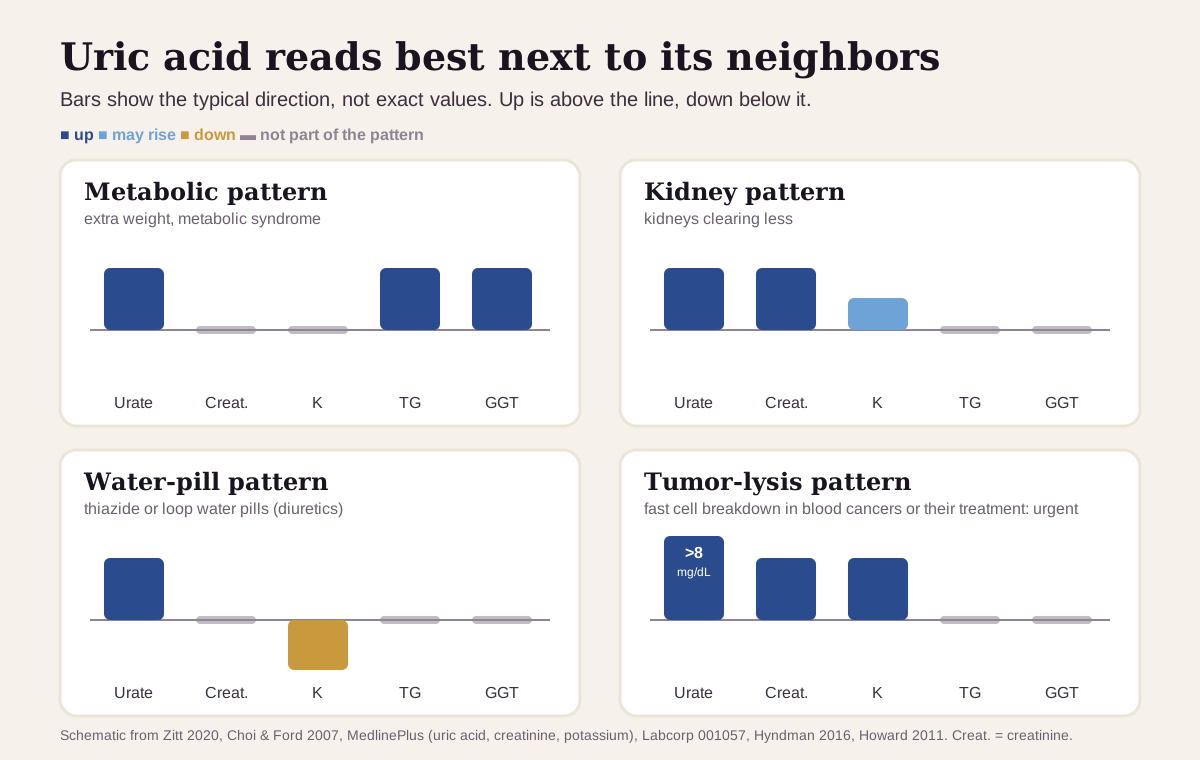
| If you see… | It often points to… |
|---|---|
| Uric acid, triglycerides and GGT up together | the metabolic pattern: extra weight and the metabolic syndrome that travels with it617 |
| Uric acid and creatinine up, potassium sometimes up too | kidneys clearing less32524 |
| Uric acid up, potassium down | a thiazide or loop water pill (diuretic)1524 |
| Uric acid over 8.0 mg/dL with a high potassium and a rising creatinine, around the start of cancer treatment | tumor lysis syndrome, an emergency11 |
| Uric acid at 2.0 mg/dL or less on repeat tests | a kidney that leaks uric acid, SIADH (the body holding too much water), pregnancy or a medicine225 |
Is a low uric acid a problem?
Usually not. Low uric acid is uncommon and rarely causes trouble on its own.2 Several medicines lower it, including losartan, fenofibrate, atorvastatin and probenecid.5
A level that stays at 2.0 mg/dL or less deserves a closer look. One inherited cause, renal hypouricemia, affects about 0.2% of men and 0.4% of women in Japan. The kidney leaks uric acid into the urine, and it raises the risk of kidney stones and of sudden kidney injury after hard exercise.22
How fast uric acid changes
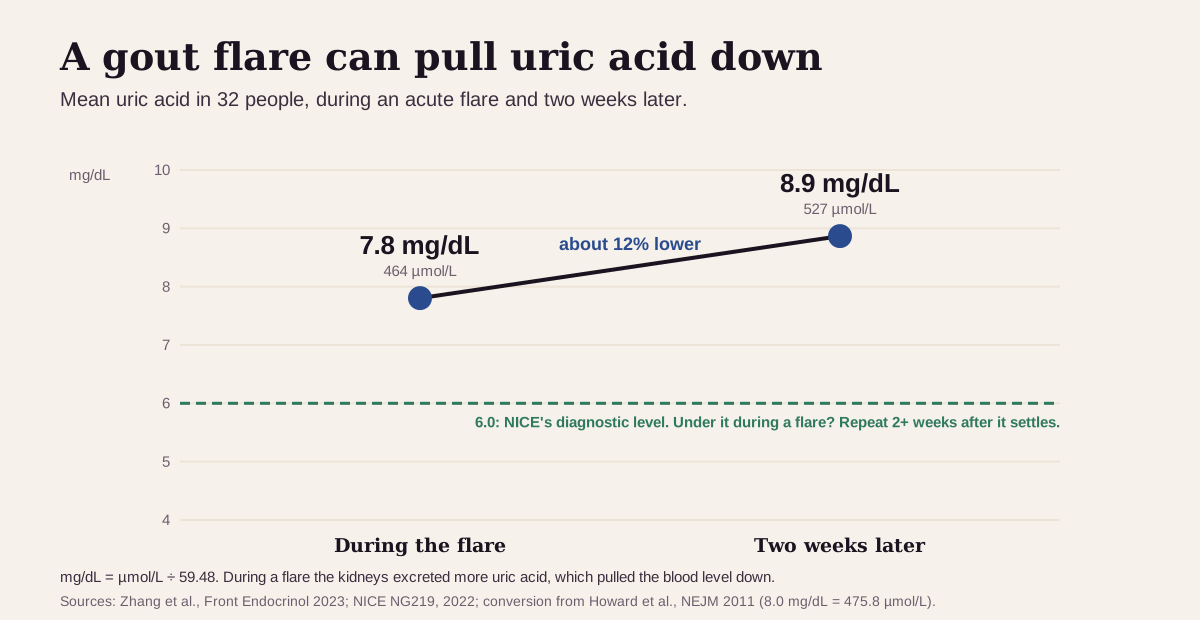
A gout flare can pull the number down. In 32 people with an acute flare, uric acid averaged 7.8 mg/dL during the flare and 8.9 two weeks later, and the kidneys were flushing out more of it during the flare.26 That's why NICE, the UK's guideline body, advises repeating the test at least 2 weeks after a flare settles if it reads under 6 during the flare.10
What that means in practice:
- On treatment, the number guides the dose. The American College of Rheumatology recommends starting urate-lowering medicine at a low dose and raising it based on repeat tests until uric acid is under 6 mg/dL.16 In one trial, allopurinol took the average from 6.1 to 3.9 mg/dL.20
- Trends beat snapshots. A level that creeps up over several tests tells a different story than one that bounces around the same place. Compare results from the same lab when you can, because ranges differ between labs.5
Going deeper: how the body handles uric acid
Allopurinol and febuxostat, the main urate-lowering medicines, block xanthine oxidase, an enzyme your body uses to make uric acid.161
The kidney side is where most of the variation between people lives. A transporter called URAT1 pulls filtered uric acid back into the blood. Probenecid and losartan lower uric acid by blocking it, while lactate and nicotinate (niacin) raise it by speeding it up. Water pills probably raise uric acid through the same route.1
Clinicians can measure how well the kidneys let uric acid go with the fractional excretion of urate (FEUA), the share of filtered uric acid that ends up in the urine:1
FEUA = (urine uric acid × blood creatinine) ÷ (blood uric acid × urine creatinine)
Healthy people average 6–8%. People with gout usually run 3–5%: their kidneys hold on to more of it. In the inherited leak of URAT1, it can reach 40–100%.1 It's a good example of uric acid making sense only next to the kidney numbers around it.
Questions worth asking
- Where does my uric acid sit against 6.0 and 6.8 mg/dL, not just my lab's range?
- Do my triglycerides, glucose, GGT or creatinine point to a pattern?
- Could any of my medicines, including a water pill or low-dose aspirin, be raising it?
- Was my test taken during or right after a gout flare, and should we repeat it?
- If I have gout, what's my target, and how often should we recheck?
- What would change the plan: joint pain, a kidney stone, or a rising trend?
FAQ
What is a normal uric acid level? It depends on your lab. Labcorp uses 3.8–8.4 mg/dL for adult men and 2.6–6.2 mg/dL for women aged 18–50.3 Crystals can form above about 6.8, so some experts consider under 6 healthier.14
Does high uric acid mean I have gout? Usually not. Over 15 years, about half of people at 10 mg/dL or more developed gout, and far fewer at lower levels.8 Gout is diagnosed from joint symptoms plus this blood test, sometimes with a joint-fluid test.10
What raises uric acid the most? Extra weight and the metabolic syndrome, alcohol (beer most of all), meat, seafood and sweet drinks, water pills, and reduced kidney function.67235
Can uric acid be normal during a gout flare? Yes. It often drops during a flare. NICE advises repeating the test at least 2 weeks after the flare settles.2610
This guide is for education. It can't diagnose you or replace care from a clinician who knows your history.
Footnotes
-
Hyndman D, Liu S, Miner JN. Urate Handling in the Human Body. Curr Rheumatol Rep. 2016;18(6):34. The source for kidney handling (about 60–65% of daily removal, 3–10% of filtered urate excreted), the 6.8 mg/dL solubility limit, URAT1 and FEUA. PMC ↩ ↩2 ↩3 ↩4 ↩5 ↩6 ↩7 ↩8 ↩9 ↩10 ↩11 ↩12 ↩13 ↩14 ↩15 ↩16 ↩17 ↩18 ↩19
-
National Library of Medicine. Uric Acid Test. MedlinePlus. What the test is used for, purine-rich foods and drinks, conditions linked to high levels, and kidney-stone symptoms. MedlinePlus ↩ ↩2 ↩3 ↩4 ↩5 ↩6 ↩7 ↩8 ↩9
-
Labcorp. Uric Acid, test 001057. Reference ranges by age and sex (men 18 and older 3.8–8.4 mg/dL; women 18–50 2.6–6.2, 51–70 3.0–7.2, 71 and older 3.1–7.9) and causes of high and low levels. Labcorp is a commercial laboratory. labcorp.com ↩ ↩2 ↩3 ↩4 ↩5 ↩6 ↩7 ↩8 ↩9 ↩10 ↩11
-
Desideri G, Castaldo G, Lombardi A, et al. Is it time to revise the normal range of serum uric acid levels? Eur Rev Med Pharmacol Sci. 2014;18(9):1295–1306. Argues that under 6.0 mg/dL better identifies truly healthy people. PubMed ↩ ↩2 ↩3 ↩4 ↩5 ↩6
-
National Library of Medicine. Uric acid – blood. MedlinePlus Medical Encyclopedia. Review date April 1, 2025. Normal values (men 4.0–8.6, women 3.0–7.1 mg/dL) and the lists of causes of high and low levels, including medicines. MedlinePlus ↩ ↩2 ↩3 ↩4 ↩5 ↩6 ↩7 ↩8 ↩9 ↩10 ↩11 ↩12
-
Zitt E, Fischer A, Lhotta K, Concin H, Nagel G. Sex- and age-specific variations, temporal trends and metabolic determinants of serum uric acid concentrations in a large population-based Austrian cohort. Sci Rep. 2020;10(1):7578. 146,873 adults. PMC ↩ ↩2 ↩3 ↩4 ↩5 ↩6 ↩7
-
Choi HK, Atkinson K, Karlson EW, Willett W, Curhan G. Alcohol intake and risk of incident gout in men: a prospective study. Lancet. 2004;363(9417):1277–1281. PubMed ↩ ↩2 ↩3 ↩4
-
Dalbeth N, Phipps-Green A, Frampton C, et al. Relationship between serum urate concentration and clinically evident incident gout: an individual participant data analysis. Ann Rheum Dis. 2018;77(7):1048–1052. 18,889 adults from four US cohorts. DOI ↩ ↩2 ↩3 ↩4 ↩5
-
National Library of Medicine. Septic arthritis. MedlinePlus Medical Encyclopedia. Review date May 12, 2025. Symptoms come on quickly: fever, swelling usually in one joint, and intense pain. MedlinePlus ↩ ↩2
-
National Institute for Health and Care Excellence. Gout: diagnosis and management (NG219). 2022. The 360 µmol/L (6 mg/dL) diagnostic level and target, the 300 µmol/L (5 mg/dL) target for tophi or frequent flares, the repeat test after a flare, and urgent referral for a possibly infected joint. nice.org.uk ↩ ↩2 ↩3 ↩4 ↩5 ↩6 ↩7 ↩8 ↩9 ↩10 ↩11
-
Howard SC, Jones DP, Pui CH. The Tumor Lysis Syndrome. N Engl J Med. 2011;364(19):1844–1854. The laboratory criteria (uric acid over 8.0 mg/dL, or 475.8 µmol/L, in adults, with high potassium or phosphate or low calcium) and the kidney-injury criterion. PMC ↩ ↩2 ↩3 ↩4 ↩5 ↩6 ↩7 ↩8 ↩9
-
Maiuolo J, Oppedisano F, Gratteri S, Muscoli C, Mollace V. Regulation of uric acid metabolism and excretion. Int J Cardiol. 2016;213:8–14. Uric acid as the end product of purine breakdown in humans, and uricase in other mammals. PubMed ↩
-
Superpower. Optimal Uric Acid: The impact on Inflammation, Cardiovascular, Metabolic Health. Last updated December 4, 2025. States an optimal range of below 5 mg/dL for men and 2–4 mg/dL for women. A commercial source, listed as what the optimizer community uses. superpower.com ↩ ↩2
-
Weatherby D, Ferguson S. Blood Chemistry and CBC Analysis: Clinical Laboratory Testing from a Functional Perspective. 2nd ed. Bear Mountain Publishing; 2004. ISBN 978-0976136712. Widely used functional-medicine reference. The Libby app's marker catalog credits its optimal uric acid ranges (men 3.5–5.5, women 3.0–5.0 mg/dL) to this book. ↩ ↩2
-
Virdis A, Masi S, Casiglia E, et al. Identification of the Uric Acid Thresholds Predicting an Increased Total and Cardiovascular Mortality Over 20 Years. Hypertension. 2020;75(2):302–308. The URRAH study, 22,714 adults. Cutoffs of 4.7 mg/dL for death from any cause and 5.6 mg/dL for cardiovascular death. PubMed ↩ ↩2 ↩3
-
FitzGerald JD, Dalbeth N, Mikuls T, et al. 2020 American College of Rheumatology Guideline for the Management of Gout. Arthritis Care Res (Hoboken). 2020;72(6):744–760. The under-6 mg/dL treatment target, dose titration, and the recommendation against drug treatment for high uric acid without gout. PMC ↩ ↩2 ↩3 ↩4 ↩5 ↩6
-
Choi HK, Ford ES. Prevalence of the metabolic syndrome in individuals with hyperuricemia. Am J Med. 2007;120(5):442–447. 8,669 adults in NHANES III. Also notes the link between high uric acid and insulin resistance. PubMed ↩ ↩2 ↩3 ↩4 ↩5 ↩6
-
Keenan T, Zhao W, Rasheed A, et al. Causal Assessment of Serum Urate Levels in Cardiometabolic Diseases Through a Mendelian Randomization Study. J Am Coll Cardiol. 2016;67(4):407–416. PMC ↩
-
Badve SV, Pascoe EM, Tiku A, et al. Effects of Allopurinol on the Progression of Chronic Kidney Disease. N Engl J Med. 2020;382(26):2504–2513. The CKD-FIX trial, 363 people with stage 3 or 4 kidney disease. PubMed ↩
-
Doria A, Galecki AT, Spino C, et al. Serum Urate Lowering with Allopurinol and Kidney Function in Type 1 Diabetes. N Engl J Med. 2020;382(26):2493–2503. The PERL trial; allopurinol lowered mean uric acid from 6.1 to 3.9 mg/dL. PMC ↩ ↩2
-
Mackenzie IS, Hawkey CJ, Ford I, et al. Allopurinol versus usual care in UK patients with ischaemic heart disease (ALL-HEART). Lancet. 2022;400(10359):1195–1205. 5,721 people aged 60 and older, no history of gout. PubMed ↩
-
Nakayama A, Matsuo H, Ohtahara A, et al. Clinical practice guideline for renal hypouricemia (1st edition). Hum Cell. 2019;32(2):83–87. The 2.0 mg/dL cutoff, prevalence, exercise-induced kidney injury and the list of other causes of low uric acid. PMC ↩ ↩2 ↩3 ↩4
-
Choi HK, Atkinson K, Karlson EW, Willett W, Curhan G. Purine-rich foods, dairy and protein intake, and the risk of gout in men. N Engl J Med. 2004;350(11):1093–1103. PubMed ↩ ↩2 ↩3
-
National Library of Medicine. Potassium Blood Test. MedlinePlus. Kidney disease can raise potassium; prescription diuretics can lower it (the page also lists some diuretics among causes of high potassium). MedlinePlus ↩ ↩2 ↩3
-
National Library of Medicine. Creatinine Test. MedlinePlus. A high creatinine can be a sign of kidney disease or kidney failure. MedlinePlus ↩ ↩2
-
Zhang J, Sun W, Gao F, et al. Changes of serum uric acid level during acute gout flare and related factors. Front Endocrinol (Lausanne). 2023;14:1077059. 32 people followed from an acute flare to two weeks later. PMC ↩ ↩2 ↩3
Educational content, not medical advice. Libby is a personal record tool, not a medical service — it doesn't diagnose, treat, or prescribe. Reference ranges vary by lab and by person. Talk to a qualified healthcare professional about your results.
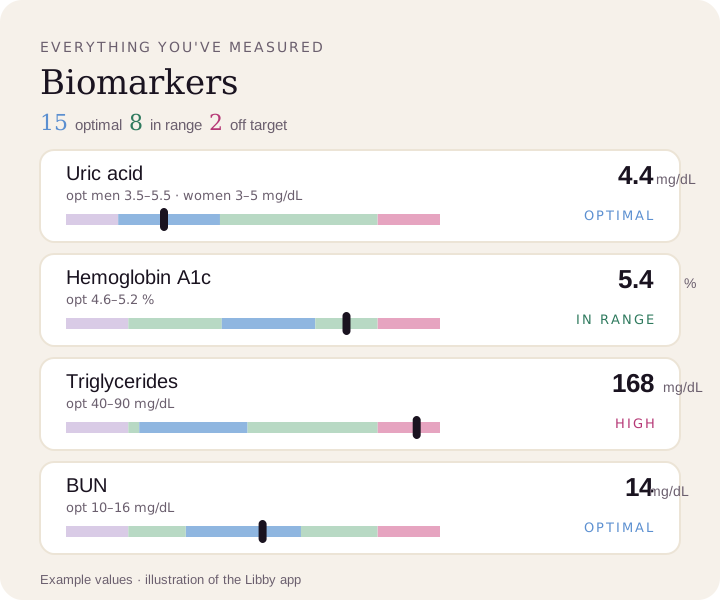
Compare your results to optimal ranges.
Upload a lab PDF or a photo of your report. Libby puts every marker on your lab's range and the optimal range, and tracks your trends over time.
View your uric acid ›