Transferrin blood test: normal range, high and low causes
Transferrin is the protein that carries iron in your blood. Here's the normal range, why it runs high or low, and how to read it with ferritin and iron.
Transferrin is the protein that carries iron through your blood. Your liver makes it, and it makes more when your iron runs low. That makes a high transferrin one of the classic signs of low iron stores, while a low transferrin most often comes with inflammation, liver disease or iron overload.12
The short version
- Normal: check the range on your report. Adult ranges run from about 170 to 364 mg/dL. Labcorp prints 177–329 mg/dL for men and 192–364 for women aged 18 to 80.34
- High usually means your iron stores are running low and your liver is making extra carrier to catch every bit of iron. Late pregnancy and birth control pills can raise it too.156
- Low usually comes with inflammation or infection, liver disease, protein loss through the kidneys, or iron overload.157
- Transferrin is the carrier. Ferritin shows your iron stores, and transferrin saturation shows how full the carrier is. Read the three together.1
What transferrin is
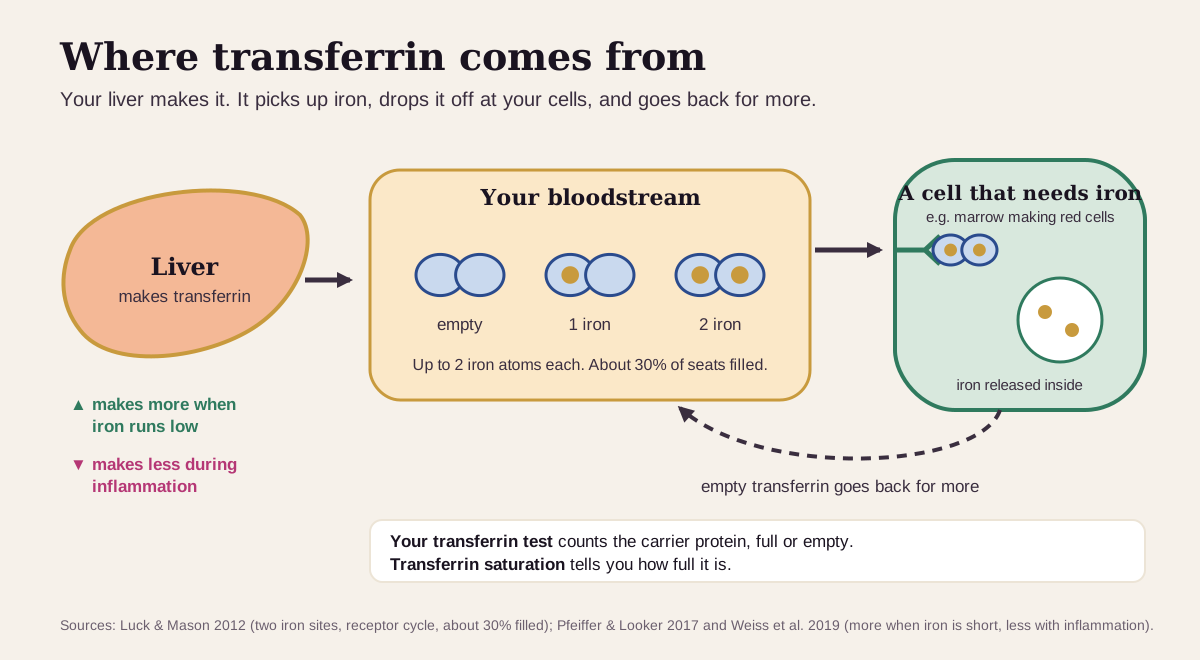
Transferrin is iron's delivery truck. Your liver makes it and releases it into the blood. Each molecule has two halves, or lobes, and each lobe holds one iron atom. A loaded transferrin docks on a matching receptor on a cell, the cell pulls it inside, a drop in acidity frees the iron, and the empty transferrin goes back out to collect more.8
Most of that iron is recycled. Scavenger cells break down old red blood cells and hand their iron back to transferrin, and that recycled iron covers more than 90% of what your bone marrow needs each day to build new red cells.2 At any moment only about 30% of transferrin's iron seats are filled. The empty seats are a buffer that can soak up a sudden load of iron.8
Transferrin shows up on the iron panel, next to serum iron, total iron-binding capacity (TIBC) and ferritin.9 Your liver adjusts how much it makes: more when your iron supply runs short, less during inflammation. That is why the level carries information.12
What's a normal transferrin?
Start with the range printed next to your result. Labs use different methods, so their ranges differ:
- Labcorp, a large commercial U.S. lab, prints 177–329 mg/dL for men and 192–364 mg/dL for women aged 18 to 80, and 149–313 mg/dL for everyone over 80.3
- Oxford University Hospitals in the UK uses 1.7–3.6 g/L (170–360 mg/dL) for men and women alike.4
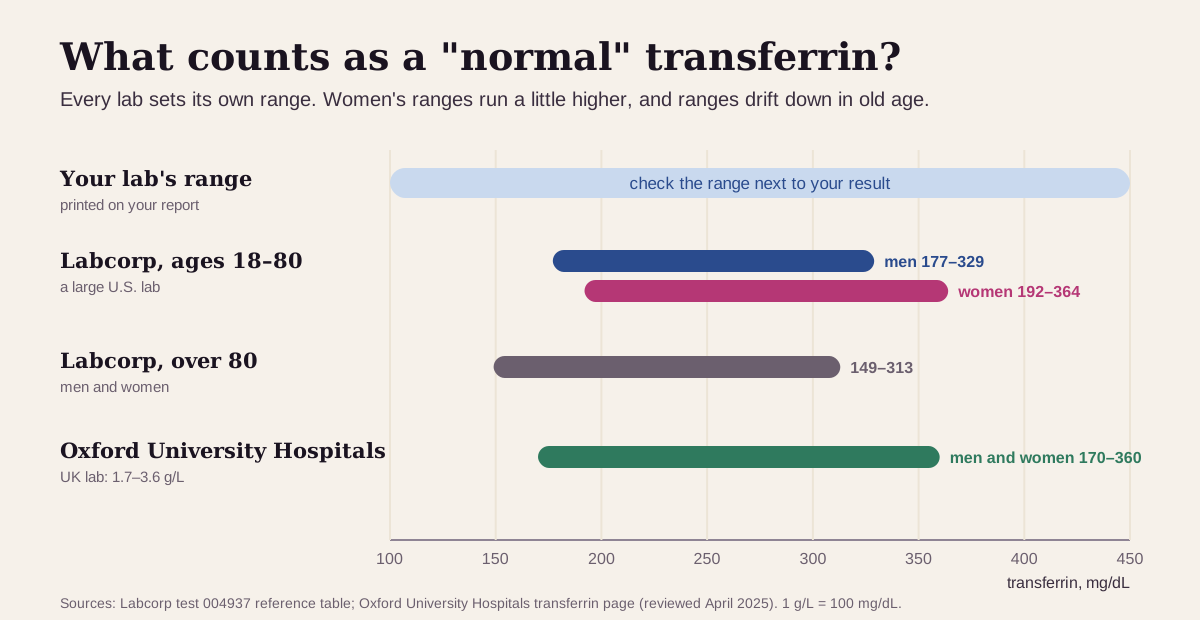
Women run a little higher than men. In a study of more than 124,000 people from northern New England, with anyone showing inflammation left out, transferrin rose into the teens or 20s and then slowly fell with age. From age 10 on, women's levels were increasingly higher than men's, about 7% higher at age 20.10
Pregnancy raises it, especially late in pregnancy, and so do birth control pills.56 Children have their own ranges, so a child's result belongs next to the lab's pediatric range.3
"Optimal" transferrin: what health optimizers aim for
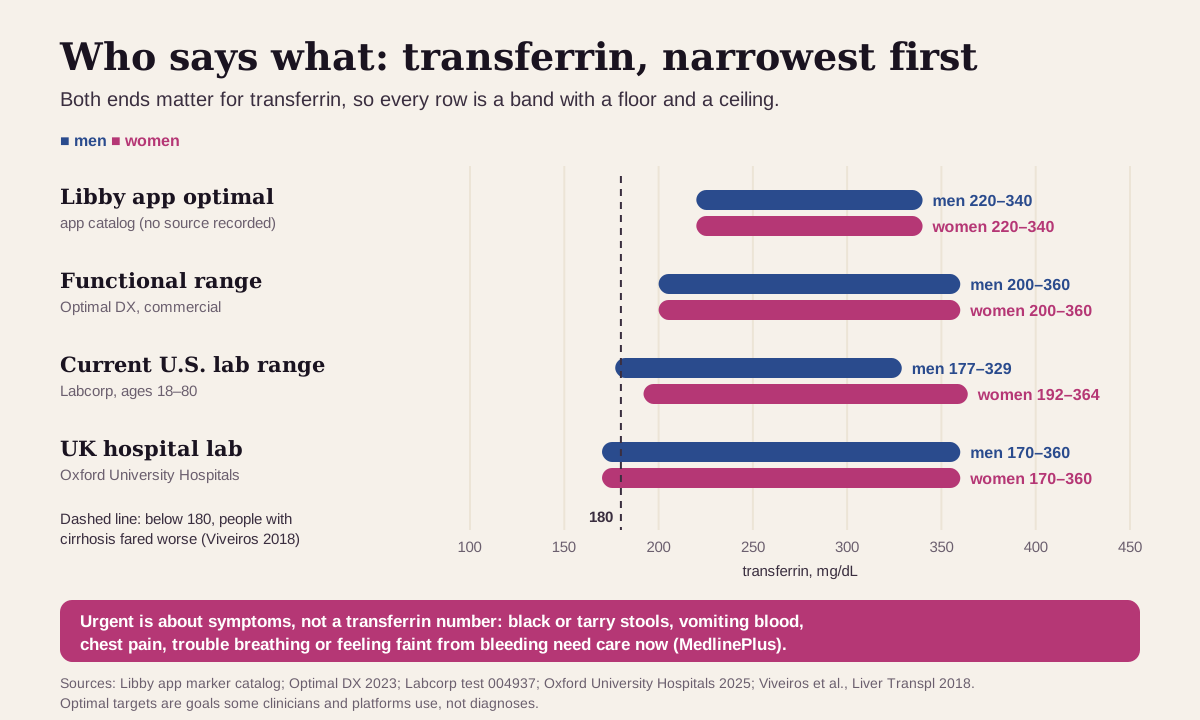
For most markers, optimizers push for lower. Transferrin is different: a high value points to low iron and a low value points to inflammation or liver trouble, so the target is a middle band. Here's the ladder, from narrowest to widest:
| Target | Men | Women | Who uses it |
|---|---|---|---|
| Narrowest (Libby app optimal) | 220–340 mg/dL | 220–340 mg/dL | The optimal range shown in the Libby app. The app's catalog records no published source for this band |
| Functional range (commercial) | 200–360 mg/dL | 200–360 mg/dL | Optimal DX's "ODX range", against a standard range of 200–39011 |
| Current U.S. lab range | 177–329 mg/dL | 192–364 mg/dL | Labcorp, ages 18 to 803 |
| UK hospital lab range | 170–360 mg/dL | 170–360 mg/dL | Oxford University Hospitals4 |
| Risk cut point in cirrhosis | below 180 mg/dL | below 180 mg/dL | Viveiros et al., people with cirrhosis12 |
| Urgent | symptoms, not a number | symptoms, not a number | Black stools, vomiting blood, chest pain or fainting: get care now13 |
Why a middle band makes sense:
- The low end. In 1,255 people with cirrhosis followed in Innsbruck, those with transferrin below 180 mg/dL had transplant-free survival of 79.0% at 1 year and 30.5% at 5 years, versus 95.5% and 68.0% at 180 or above. Transferrin predicted survival on top of the standard liver score (MELD-Na) and CRP.12 In 111 people with type 2 diabetes and kidney disease, those with the lowest transferrin (115 mg/dL or less) had 7.4 times the risk of kidney failure of those with the highest (165 or more).14
- The high end. A high transferrin is the liver's response to a short iron supply; in iron-deficiency anemia it sits at the upper limit of normal.2 In a French study of 1,277 adults, a higher transferrin was also linked to developing high blood sugar over the next 3 years.15
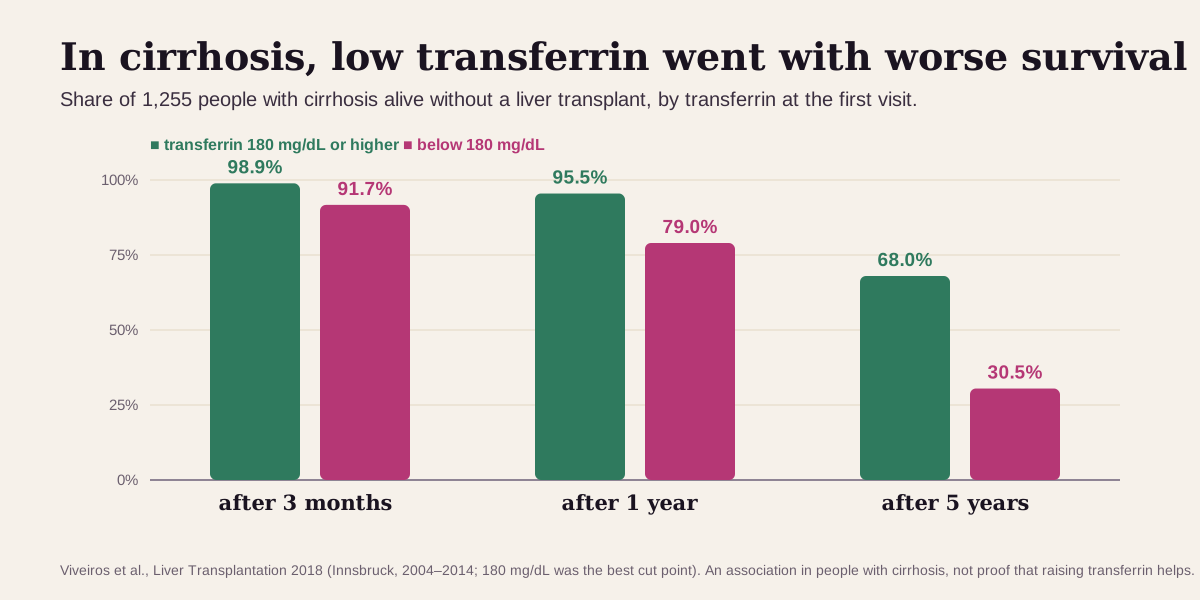
Keep "optimal" in perspective. The outcome studies were done in people who were already sick, and transferrin moves because something else changed: your iron, inflammation or your liver. A result outside 220–340 is a reason to look at ferritin, saturation and CRP, and the fix is aimed at that cause, not at the transferrin number itself.1
What a high or low transferrin usually means
The direction is the first clue. High points toward low iron. Low points toward inflammation, the liver, protein loss or too much iron.15
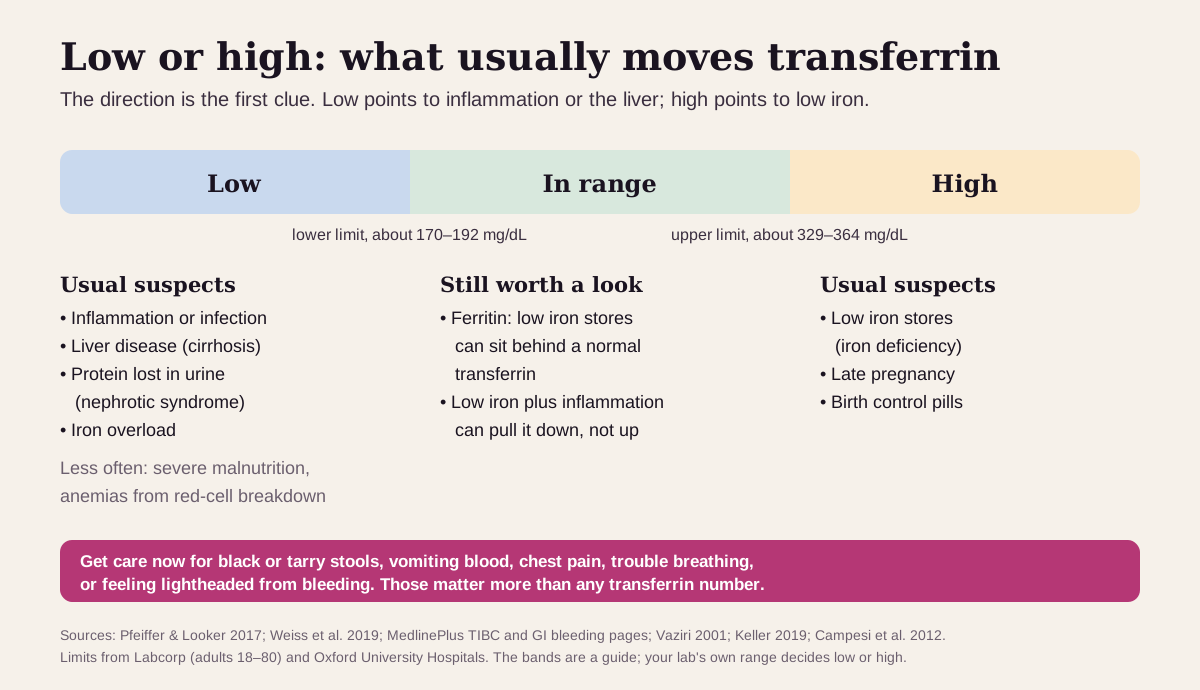
High transferrin: usually low iron
- Iron deficiency. This is the usual reason. As soon as the iron supply for making red cells runs short, the liver makes more transferrin, so a high transferrin can show up before your hemoglobin drops.1 Heavy periods are the usual cause in women who still menstruate. In men and women past menopause, slow bleeding from the gut is a common cause, and about a third of them turn out to have an underlying problem, most often in the digestive tract.17 Celiac disease turns up in 3–5% of people with iron-deficiency anemia.17
- Late pregnancy. Iron-binding capacity, which tracks transferrin, runs high late in pregnancy,5 and pregnancy raises the odds of running low on iron.9
- Birth control pills. Women taking combined oral contraceptives had a higher iron-binding capacity than women who weren't.6
Low transferrin: usually inflammation
- Inflammation and infection. Transferrin is a "negative acute-phase protein": during inflammation the liver makes less of it.12 It can fall fast. In 20 people having major abdominal surgery, transferrin dropped from 2.8 to 1.6 g/L (280 to 160 mg/dL) during the operation and stayed there for 5 days.18
- Liver disease. People with cirrhosis often have a low transferrin, reflecting both a weaker liver and inflammation.125
- Protein loss through the kidneys. In nephrotic syndrome, transferrin spills into the urine and breaks down faster, which can cause a low level and sometimes iron-deficiency anemia.7
- Iron overload. When iron is plentiful, as in hemochromatosis, the liver makes less transferrin.116
- Less common: severe malnutrition, and anemias from red-cell breakdown such as hemolytic or sickle cell anemia.516 Transferrin is a poor gauge of mild malnutrition.16
Get care now if you have black or tarry stools, vomit blood or material that looks like coffee grounds, feel lightheaded or dizzy from bleeding, or have chest pain or trouble breathing.13
Transferrin reads best next to its neighbors
Transferrin is one piece of the iron panel, and the pattern across the panel usually narrows things down:1
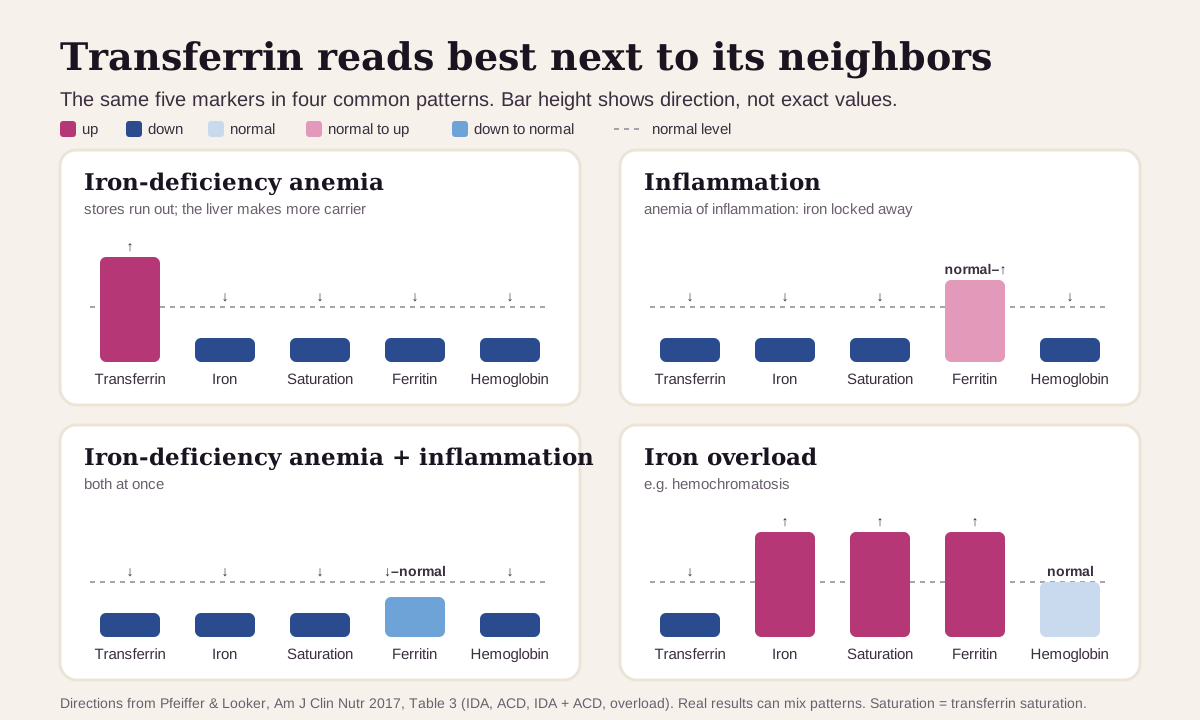
| If you see… | It often points to… |
|---|---|
| High transferrin (or TIBC), low iron, low saturation, low ferritin | iron deficiency: stores are empty and more carrier is being made117 |
| Low transferrin, low iron and saturation, ferritin normal or high | inflammation holding iron back (anemia of inflammation); in that setting ferritin is often over 10012 |
| Low transferrin, low saturation, ferritin low or normal | iron deficiency and inflammation at the same time12 |
| Low transferrin, high iron, high saturation, high ferritin | iron overload1 |
| Low transferrin with a lot of protein in the urine | protein loss through the kidneys (nephrotic syndrome)7 |
| High transferrin (or TIBC) in late pregnancy or on the pill | pregnancy or combined birth control pills raising the carrier56 |
Ferritin is the tie-breaker. A ferritin under 30 ng/mL points to true iron deficiency, while people with anemia of inflammation often have a ferritin over 100 ng/mL.2 Inflammation markers such as CRP help read ferritin when inflammation may be in play.17
How fast transferrin changes
Transferrin moves slowly. Its half-life in the blood is about 10 days, between prealbumin (about 2 days) and albumin (about 20 days).16 Once a cause is fixed, a shift in transferrin fades over weeks.
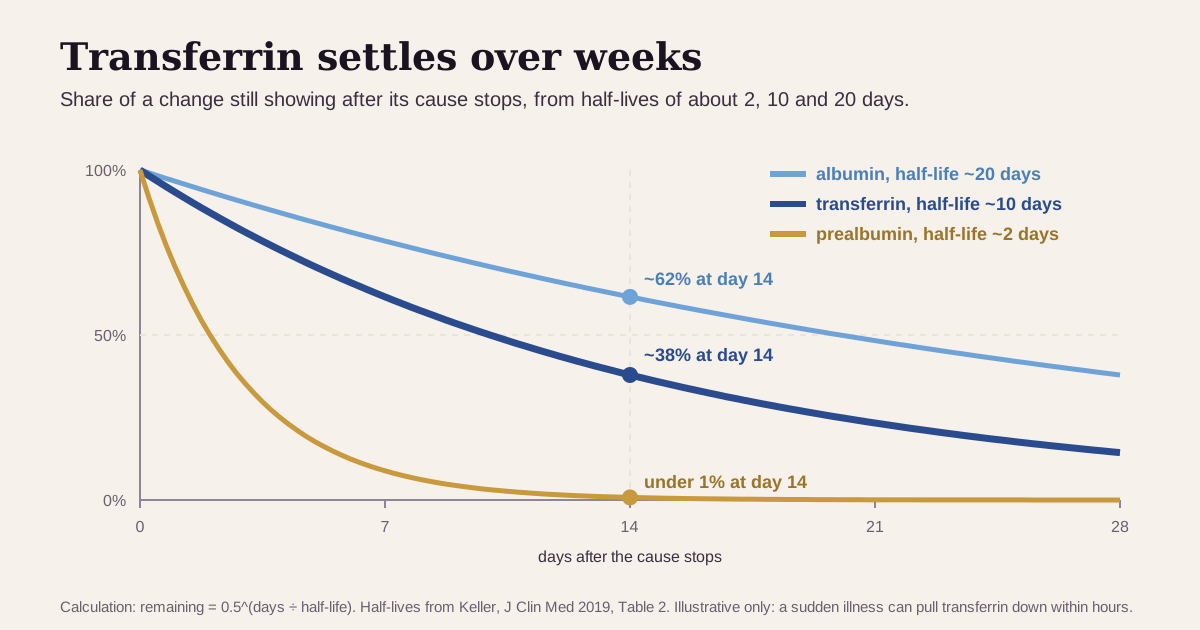
What that means in practice:
- It's steady from hour to hour. In a study of 7 healthy adults sampled around the clock, serum iron and saturation swung with the time of day while transferrin barely moved; meals nudged it down slightly.19 Serum iron varies about 30% within a person, which is why saturation is noisier than transferrin.1
- Recent illness counts. An infection, an inflammatory flare or surgery in the past few weeks can pull it down. Mention it when you get tested.181
- Trends beat snapshots, from the same lab. Methods differ enough that converting transferrin to TIBC has no single formula that works everywhere.20 Compare results from the same lab when you can.
Going deeper: one protein, four forms
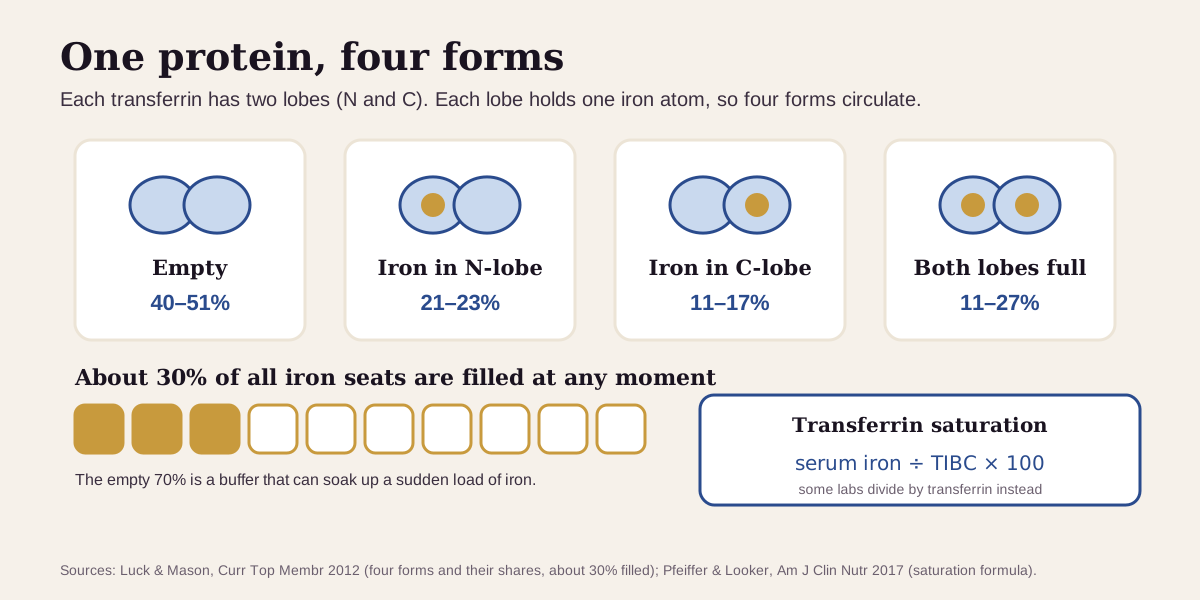
Transferrin's two lobes are called N and C. Each grips one ferric iron atom (Fe³⁺) very tightly, yet lets go inside the cell once the pH drops. Because either lobe can be loaded, four forms circulate: empty (about 40–51%), iron in the N-lobe only (21–23%), iron in the C-lobe only (11–17%) and both lobes full (11–27%).8
Transferrin saturation is the share of those seats that hold iron. Labs calculate it as serum iron divided by TIBC (or by transferrin) times 100.1
TIBC and transferrin measure the same carrier from two angles: transferrin as protein mass (mg/dL), TIBC as the iron it could hold (µg/dL). In a study of 246 people with iron deficiency, iron overload, inflammation and other conditions, a fixed conversion factor gave clearly higher TIBC values than a fitted formula, and no single formula fit every method.20 So keep the lab's own numbers rather than converting one into the other.
Questions worth asking
- Is my transferrin high or low for this lab, and by how much?
- What do my ferritin, serum iron and saturation show next to it?
- Could inflammation be pulling it down? Should we check CRP?
- If it's high, where could I be losing iron, and should I be checked for celiac disease or bleeding from the gut?
- If it's low, do my liver tests, albumin or urine protein need a look?
- When should we repeat it, and at the same lab?
FAQ
What is a normal transferrin level? It depends on your lab. Labcorp uses 177–329 mg/dL for men and 192–364 mg/dL for women aged 18 to 80.3
What does high transferrin mean? Most often, low iron stores: your liver makes more carrier when iron runs short. Late pregnancy and birth control pills can also raise it.156
What does low transferrin mean? Usually inflammation or infection, liver disease, protein loss through the kidneys, or iron overload. Ferritin, iron saturation and CRP help tell them apart.172
Is transferrin the same as TIBC? They measure the same carrier from two angles: transferrin as protein, TIBC as the iron it could bind. Labs convert between them in different ways, so keep your lab's own numbers.201
This guide is for education. It can't diagnose you or replace care from a clinician who knows your history.
Footnotes
-
Pfeiffer CM, Looker AC. Laboratory methodologies for indicators of iron status: strengths, limitations, and analytical challenges. Am J Clin Nutr. 2017;106(Suppl 6):1606S–1614S. The source for the four iron patterns (Table 3), transferrin as a negative acute-phase protein (Table 2), the saturation formula, and serum iron's ~30% within-person variability. PMC ↩ ↩2 ↩3 ↩4 ↩5 ↩6 ↩7 ↩8 ↩9 ↩10 ↩11 ↩12 ↩13 ↩14 ↩15 ↩16 ↩17 ↩18 ↩19 ↩20 ↩21 ↩22 ↩23 ↩24 ↩25
-
Weiss G, Ganz T, Goodnough LT. Anemia of inflammation. Blood. 2019;133(1):40–50. Cytokines cut transferrin production; transferrin sits at the upper limit of normal in iron-deficiency anemia and is reduced in anemia of inflammation; ferritin under 30 versus over 100; recycling covers more than 90% of daily iron needs. PMC ↩ ↩2 ↩3 ↩4 ↩5 ↩6 ↩7 ↩8 ↩9 ↩10 ↩11
-
Labcorp. Transferrin, test 004937: reference range table by age and sex. Accessed September 23, 2026. A commercial laboratory's published reference ranges. labcorp.com ↩ ↩2 ↩3 ↩4 ↩5 ↩6 ↩7
-
Oxford University Hospitals NHS Foundation Trust. Transferrin: clinical biochemistry test catalogue. Last reviewed April 23, 2025. Reference interval 1.7–3.6 g/L for females and males of all ages. ouh.nhs.uk ↩ ↩2 ↩3 ↩4 ↩5
-
National Library of Medicine. Total iron binding capacity. MedlinePlus Medical Encyclopedia. Reviewed January 10, 2026. Lists iron-deficiency anemia and late pregnancy as causes of a high result, and inflammation, liver disease such as cirrhosis, low blood protein, malnutrition, and hemolytic, pernicious and sickle cell anemia as causes of a low one. MedlinePlus ↩ ↩2 ↩3 ↩4 ↩5 ↩6 ↩7 ↩8 ↩9 ↩10
-
Campesi I, Sanna M, Zinellu A, et al. Oral contraceptives modify DNA methylation and monocyte-derived macrophage function. Biol Sex Differ. 2012;3:4. Healthy women using combined oral contraceptives had higher total iron-binding capacity of transferrin than non-users. PMC ↩ ↩2 ↩3 ↩4 ↩5 ↩6
-
Vaziri ND. Erythropoietin and transferrin metabolism in nephrotic syndrome. Am J Kidney Dis. 2001;38(1):1–8. Transferrin lost in the urine and broken down faster causes low transferrin and, in some cases, iron-deficiency anemia. PubMed ↩ ↩2 ↩3 ↩4 ↩5
-
Luck AN, Mason AB. Transferrin-mediated cellular iron delivery. Curr Top Membr. 2012;69:3–35. The two-lobe structure, the receptor cycle, the four circulating forms and the ~30% saturation. PMC ↩ ↩2 ↩3 ↩4 ↩5
-
National Library of Medicine. Iron Tests. MedlinePlus. The tests on an iron panel (serum iron, transferrin, TIBC, ferritin). MedlinePlus ↩ ↩2
-
Ritchie RF, Palomaki GE, Neveux LM, et al. Reference distributions for the negative acute-phase serum proteins, albumin, transferrin and transthyretin: a practical, simple and clinically relevant approach in a large cohort. J Clin Lab Anal. 1999;13(6):273–279. More than 124,000 people, CRP 10 mg/L or higher excluded. PMC ↩
-
Optimal DX (ODX Research). Biomarkers of Iron Status: Transferrin. Published August 4, 2022; updated November 1, 2023. States "Standard Range: 200 - 390 mg/dL" and "The ODX Range: 200 - 360 mg/dL". A commercial source, listed as what the optimizer community uses. optimaldx.com ↩ ↩2
-
Viveiros A, Finkenstedt A, Schaefer B, et al. Transferrin as a predictor of survival in cirrhosis. Liver Transpl. 2018;24(3):343–351. 1,255 people with cirrhosis; 180 mg/dL was the best cut point; survival independent of MELD-Na and CRP. PMC ↩ ↩2 ↩3 ↩4 ↩5
-
National Library of Medicine. Gastrointestinal bleeding. MedlinePlus Medical Encyclopedia. Reviewed January 24, 2025. When to call 911 or go to the emergency room. MedlinePlus ↩ ↩2 ↩3
-
Zhao L, Zou Y, Zhang J, et al. Serum transferrin predicts end-stage renal disease in type 2 diabetes mellitus patients. Int J Med Sci. 2020;17(14):2113–2124. 111 patients with biopsy-proven diabetic kidney disease; lowest versus highest transferrin quartile, adjusted hazard ratio 7.36 (95% CI 1.40–38.65). PMC ↩
-
Fumeron F, Péan F, Driss F, et al. Ferritin and transferrin are both predictive of the onset of hyperglycemia in men and women over 3 years: the data from an epidemiological study on the Insulin Resistance Syndrome (DESIR) study. Diabetes Care. 2006;29(9):2090–2094. PubMed ↩
-
Keller U. Nutritional Laboratory Markers in Malnutrition. J Clin Med. 2019;8(6):775. Half-lives of about 2 days (prealbumin), 10 days (transferrin) and 20 days (albumin); transferrin rises in iron deficiency, falls in iron overload and severe malnutrition, and is unreliable for mild malnutrition. PMC ↩ ↩2 ↩3 ↩4 ↩5 ↩6
-
Snook J, Bhala N, Beales ILP, et al. British Society of Gastroenterology guidelines for the management of iron deficiency anaemia in adults. Gut. 2021;70(11):2030–2051. Causes of iron deficiency by group, the one-in-three rate of underlying disease in men and postmenopausal women, celiac disease in 3–5%, and inflammation markers such as CRP as an aid when ferritin is hard to read. PMC ↩ ↩2 ↩3 ↩4
-
Buttenschoen K, Buttenschoen DC, Berger D, et al. Endotoxemia and acute-phase proteins in major abdominal surgery. Am J Surg. 2001;181(1):36–43. Transferrin fell from 2.8 to 1.6 g/L during surgery and stayed there for 5 days. PubMed ↩ ↩2 ↩3
-
Ridefelt P, Larsson A, Rehman JU, Axelsson J. Influences of sleep and the circadian rhythm on iron-status indices. Clin Biochem. 2010;43(16–17):1323–1328. Seven healthy adults; iron and saturation varied with time of day, transferrin had no or only minor changes. PubMed ↩
-
Gottschalk R, Wigand R, Dietrich CF, et al. Total iron-binding capacity and serum transferrin determination under the influence of several clinical conditions. Clin Chim Acta. 2000;293(1–2):127–138. 246 patients; no universal algorithm for converting transferrin to TIBC. PubMed ↩ ↩2 ↩3
Educational content, not medical advice. Libby is a personal record tool, not a medical service — it doesn't diagnose, treat, or prescribe. Reference ranges vary by lab and by person. Talk to a qualified healthcare professional about your results.
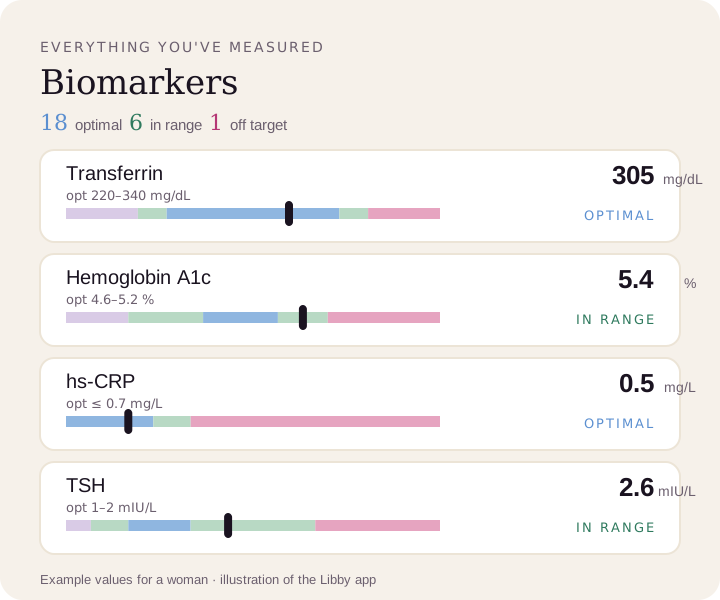
See your iron markers against optimal ranges.
Upload a lab PDF or a photo of your report. Libby puts every marker on a reference range and the optimal range, and tracks your trends over time.
View your transferrin ›