MCH blood test: normal range, low and high causes
MCH is the average amount of hemoglobin in each red blood cell. Here's the normal range, why it runs low or high, and how to read it with MCV and ferritin.
MCH (mean corpuscular hemoglobin) is the average amount of hemoglobin inside each of your red blood cells. Hemoglobin is the iron-rich protein that carries oxygen.1 When iron runs short, your body builds smaller, paler red cells and MCH falls. When red cells grow too large, as with low vitamin B12 or folate, each one holds more and MCH rises.23
The short version
- Normal: a typical lab range is about 27–33 pg for men and 26–33 pg for women. Check the range printed on your report.3
- Low MCH (under about 27 pg) usually means iron deficiency. The other common cause is an inherited thalassemia trait, which is why the UK's antenatal screening program tests for it when MCH is under 27.24
- High MCH (over about 33 pg) usually comes with large red cells. The usual reasons are alcohol, low vitamin B12 or folate, medicines, liver disease and an underactive thyroid.53
- Urgency comes from symptoms, not from MCH. Get care now for black or bloody stools, vomiting blood, feeling faint or dizzy, chest pain or trouble breathing.6
What MCH is
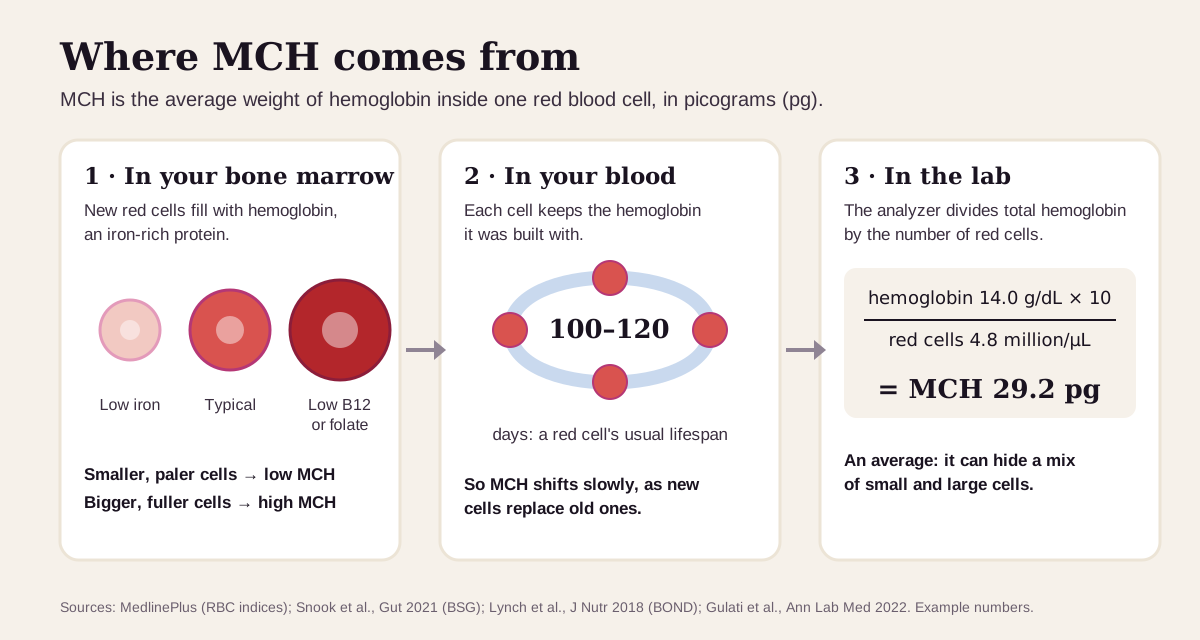
Your red blood cells are made in your bone marrow.1 As each young cell matures, it fills with hemoglobin, and most of the iron moving through your body each day is headed for these developing cells. Once it's released, a red cell circulates for about 100–120 days before it's cleared and its iron recycled.7 The hemoglobin a cell carries is set when it's built, so MCH reflects conditions in your marrow over the past few months.
The lab gets MCH by simple division. The analyzer measures the total hemoglobin in your sample, counts your red cells, and divides:8
MCH (pg) = hemoglobin (g/dL) × 10 ÷ red cell count (millions per µL)
MCH comes on every complete blood count (CBC), next to three close relatives:1
- MCV (mean corpuscular volume): the average size of a red cell.
- MCHC (mean corpuscular hemoglobin concentration): how densely the hemoglobin is packed inside the cell.
- RDW (red cell distribution width): how much the cells vary in size.
Bigger cells usually hold more hemoglobin, so MCH tends to move with MCV. The same conditions that make cells small (iron deficiency, thalassemia) or large (low B12 or folate, liver disease) push MCH the same way.32
What's a normal MCH?
Start with the range printed on your own report. Labs use different machines and reference groups, so their ranges differ.3
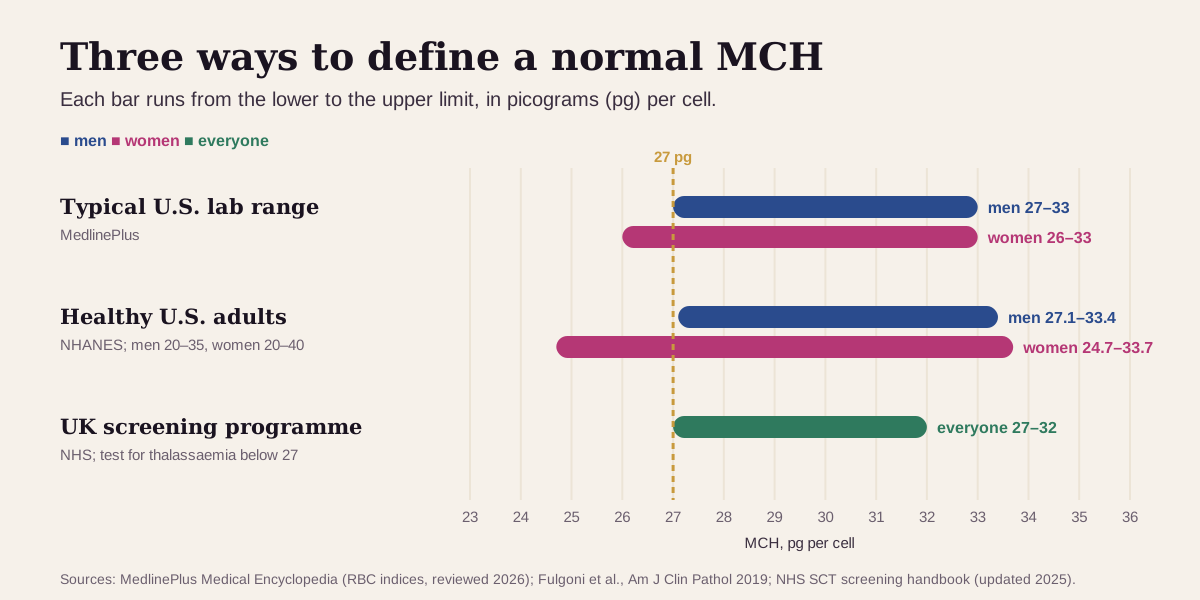
- MedlinePlus, the U.S. National Library of Medicine's patient site, lists 27–33 pg for men and 26–33 pg for women as common lab ranges.3
- A study of 20,497 healthy U.S. adults in the national NHANES survey (1999–2012) set limits of 27.1–33.4 pg for men aged 20–35 and 24.7–33.7 pg for women aged 20–40. The men's upper limit crept up with age, to 34.5 pg at ages 51–75.9
- The NHS antenatal sickle cell and thalassaemia screening program uses a normal range of 27–32 pg, and orders a thalassemia test when MCH is under 27.4
Men and women overlap closely at the top, but women's ranges reach lower. In the NHANES data, the healthy floor for women was 24.7 pg against 27.1 pg for men. Children have their own, age-based ranges too.9
"Optimal" MCH: what health optimizers aim for
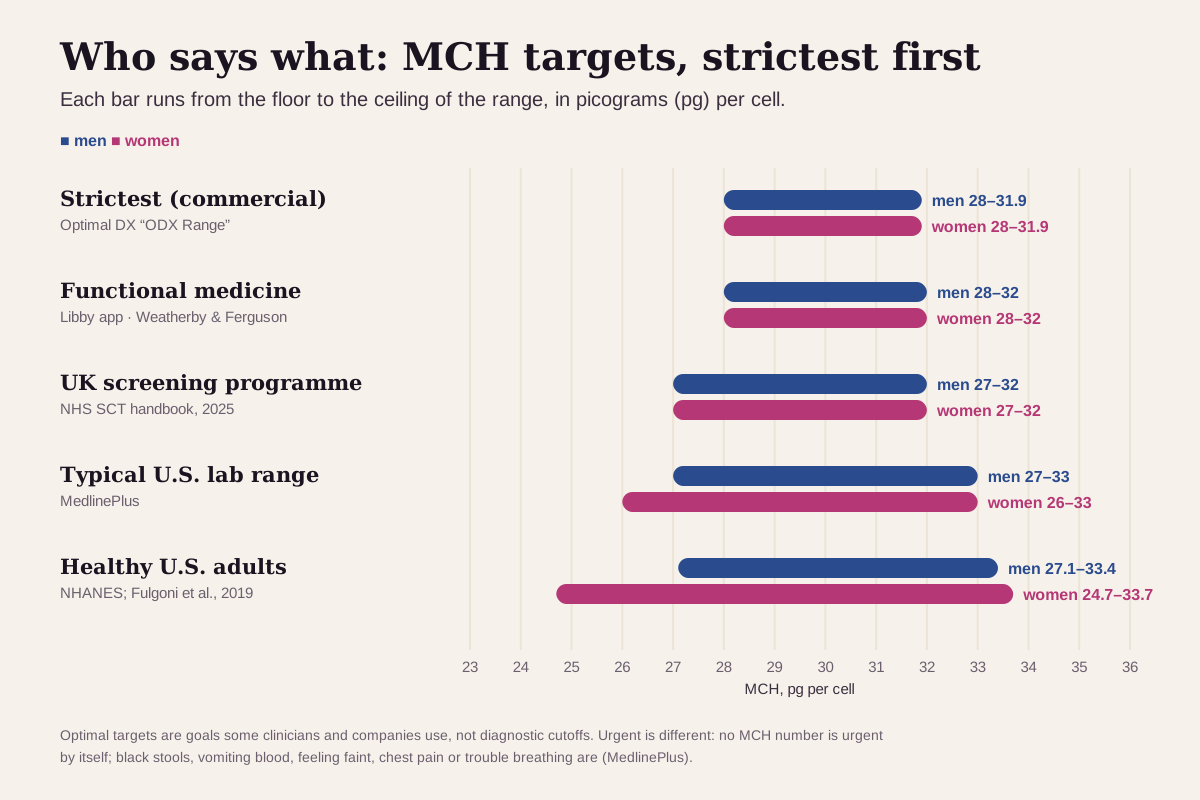
Functional-medicine practitioners and some testing companies aim for the middle of the lab range, trimming a picogram off each end. Here's the full ladder, from strictest to loosest:
| Target | Men | Women | Who uses it |
|---|---|---|---|
| Strictest (commercial) | 28–31.9 pg | 28–31.9 pg | Optimal DX's published "ODX Range"10 |
| Functional medicine | 28–32 pg | 28–32 pg | The optimal range shown in the Libby app, from the functional-medicine textbook by Weatherby & Ferguson11 |
| UK screening program | 27–32 pg | 27–32 pg | NHS; under 27 triggers a thalassemia test4 |
| Typical U.S. lab range | 27–33 pg | 26–33 pg | MedlinePlus3 |
| Healthy U.S. adults | 27.1–33.4 pg (age 20–35) | 24.7–33.7 pg (age 20–40) | NHANES, Fulgoni et al.9 |
| Urgent | no MCH cutoff | no MCH cutoff | Signs of bleeding, such as black stools: get care now6 |
Why the tighter range isn't just a trend:
- MCH is the red-cell number that best tracks iron. The British Society of Gastroenterology calls MCH "probably a more reliable marker of iron deficiency" than MCV, because it depends less on the machine and on how long the sample sat. It may also be more sensitive to iron deficiency than MCV.2
- A slow drift inside the range can mean something. In UK primary-care records of about 940,000 people, the 17,408 who were later diagnosed with colorectal cancer had red-cell trends that split from everyone else's for up to four years before diagnosis. MCH drifted down while staying inside the reference range, and a falling MCH trend was tied to a higher chance of diagnosis.12
- The top end matters too. In one study of hereditary hemochromatosis (inherited iron overload), an MCH of 34 pg or more in men and 33 or more in women picked up about a third of cases (34% and 37%).13
Keep "optimal" in perspective: it's a target, not a diagnosis. An MCH of 27.5 is a reason to look at your ferritin and your RDW, not to start iron. And some people run low for life: about 1.7% of the world's population carries a thalassemia trait, which makes small, low-MCH cells that iron won't change.14
What a low or high MCH usually means
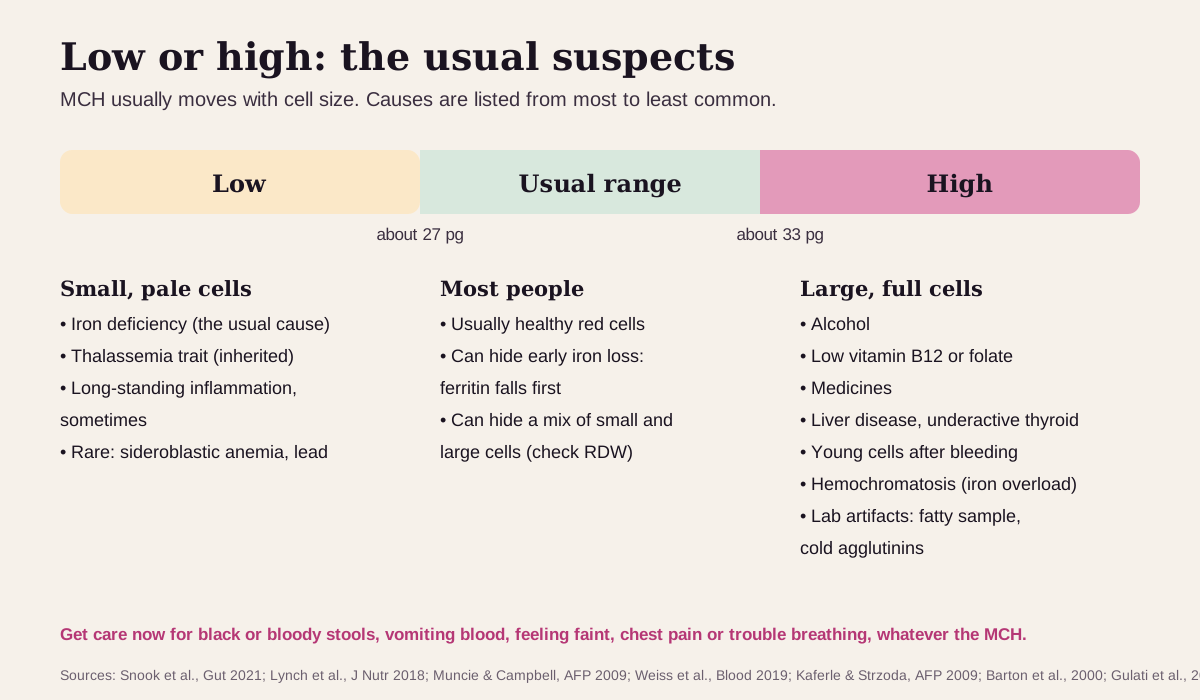
MCH usually moves with cell size. Low MCH comes with small, pale cells (doctors say microcytic and hypochromic). High MCH comes with large ones (macrocytic).3
Low MCH (under about 27 pg): small, pale cells
The usual suspects:
- Iron deficiency. The usual cause, and iron-deficiency anemia is the most common form of anemia.1 It affects 2–5% of adult men and postmenopausal women in wealthy countries and 5–12% of premenopausal women.2 In younger women, menstrual blood loss and pregnancy are the usual reasons. In men and after menopause, it often comes from slow bleeding in the gut, so doctors look there. Celiac disease, a low-iron diet and long-term acid-blocking medicines are other causes.2 A ferritin under 15 means your iron stores are empty, and under 30 usually means they're low.2
- Thalassemia trait. An inherited change in how you make hemoglobin. It's most common in families with Mediterranean, African or Southeast Asian roots, where 5–30% of people carry it. The cells are very small (MCV usually under 75 fL) while ferritin is normal.14 It needs no treatment, but it's worth knowing before a pregnancy.144
- Long-standing inflammation. Anemia from chronic illness usually has normal-size cells, but some cases have small, pale ones.152
- Less common: sideroblastic anemia and lead poisoning.14
High MCH (over about 33 pg): large, full cells
A high MCH almost always travels with a high MCV. Across four studies of large red cells, the usual suspects were, roughly in this order:5
- Alcohol: 15–65% of cases across the four studies, and the top cause in two of them. It usually keeps MCV under 110 fL.
- Low vitamin B12 or folate: 6–28% of cases. Only about 1 in 10 people with low B12 is anemic, so B12 can be low while hemoglobin looks fine.
- Medicines: 2–37% of cases, including some seizure, cancer and HIV drugs.
- Liver disease and an underactive thyroid.
- Young red cells after bleeding or hemolysis (red cells breaking down): new cells are slightly larger than old ones.
- Less common: hemochromatosis,13 marrow disorders,5 and lab artifacts. A very fatty (lipemic) sample, very high bilirubin, or cold agglutinins (antibodies that clump red cells in a cool tube) can all make MCH read falsely high. Labs correct for these, for example by warming the sample to body temperature or replacing the fatty plasma, and running it again.8
Get care now if you have black or tarry stools, a lot of blood in your stool, vomit blood or something like coffee grounds, feel faint or dizzy, or have chest pain or trouble breathing.6
MCH reads best next to its neighbors
MCH rarely tells the story alone. Read it with hemoglobin, MCV, RDW and ferritin, and the common causes sort themselves out:
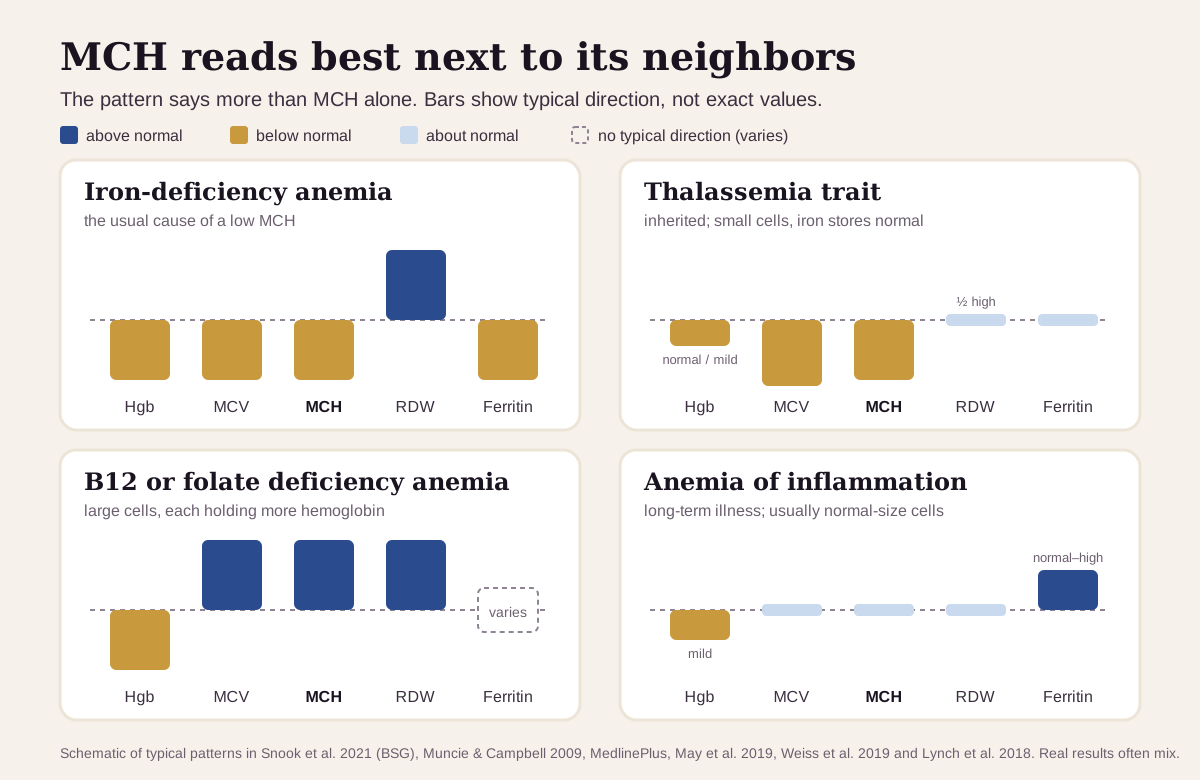
| If you see… | It often points to… |
|---|---|
| Low MCH and MCV, high RDW, low ferritin | iron deficiency: RDW is high in more than 90% of people with it |
| Low MCH and very low MCV, normal RDW and ferritin | thalassemia trait: a microcytic anemia with a normal RDW is almost always thalassemia |
| High MCH and MCV, high RDW | low vitamin B12 or folate |
| Mild anemia, normal MCH, MCV and RDW, normal or high ferritin | anemia of inflammation: ferritin is normal or raised (over 100 in some illnesses) |
| High MCH with a high MCHC or a lab flag | a sample problem, such as a fatty sample or clumped cells |
Table sources: iron and thalassemia rows, Muncie 2009 and BSG 2021;142 B12 and folate, MedlinePlus and May 2019;316 inflammation, Weiss 2019, Muncie 2009 and Lynch 2018;15147 sample problems, Gulati 2022.8 If your cells are small and your iron tests are normal, the BSG recommends hemoglobin electrophoresis, a test for thalassemia, to spare you unnecessary scopes of the stomach and bowel, especially if your family comes from a region where thalassemia is common.2
How fast MCH changes
MCH moves on a red-cell clock. Each cell keeps the hemoglobin it was built with and lives about 100–120 days, so the average shifts only as new cells replace old ones.7
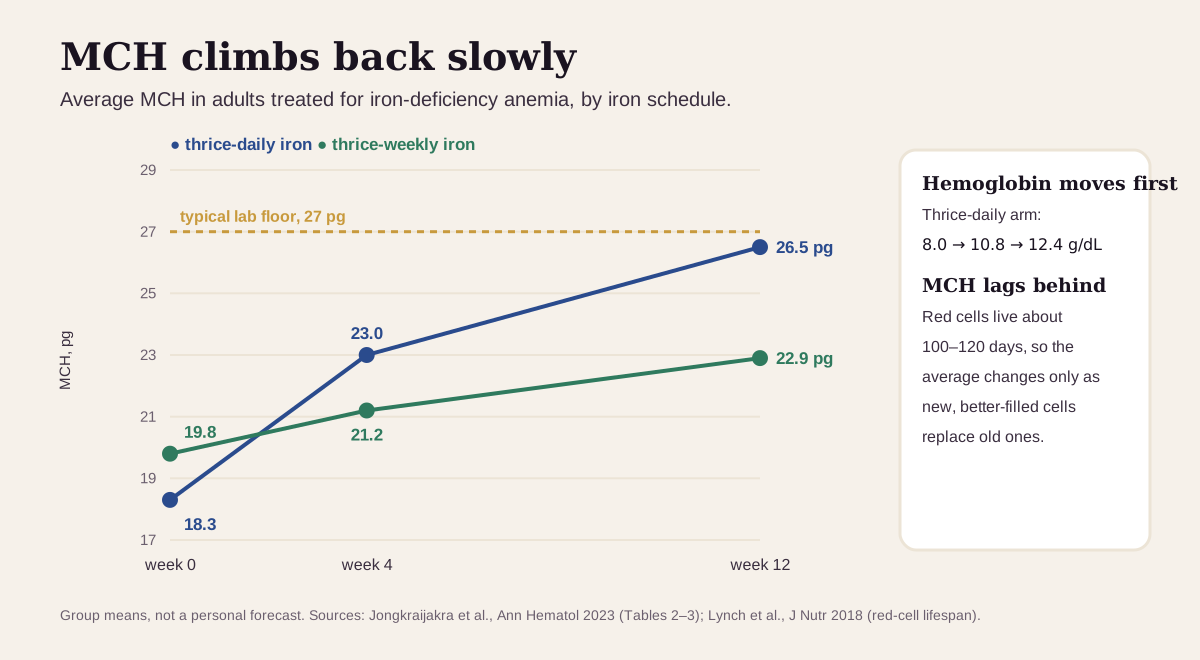
What that means in practice:
- Hemoglobin recovers first. On iron, hemoglobin usually rises within 2 weeks.2 In the trial above, hemoglobin in the thrice-daily group reached 12.4 g/dL by week 12, while MCH was still under 27.17
- Give MCH months, not weeks. With a 100–120 day lifespan, it takes a few months before most of your red cells were built after the fix.717
- Trends beat snapshots. A steady slide over several tests says more than one low-normal number.12 Comparing results works best from the same lab, because ranges and machines differ.3
Going deeper: what the average hides
MCH is an average, so it can hide two populations. If you're low in iron and low in B12, the two pulls can offset each other. The BSG notes that small, pale cells become a less reliable sign of iron deficiency when chronic disease, thalassemia, or B12 or folate deficiency is also present.2 RDW measures the spread of cell sizes, so a high RDW is the usual clue that a normal-looking average is really a mix.16
MCH and MCHC sound alike but measure different things. MCH is the weight of hemoglobin per cell. MCHC is hemoglobin per unit of cell volume:8
MCHC (g/dL) = hemoglobin (g/dL) × 100 ÷ hematocrit (%)
A truly high MCHC is uncommon; hereditary spherocytosis and some hemolytic anemias cause it.1 So when MCH and MCHC are both unusually high, labs suspect the sample first. Lipemia and high bilirubin inflate the hemoglobin reading, cold agglutinins lower the red cell count, and either one inflates the result.8
For children, clinicians sometimes use the Mentzer index, MCV divided by the red cell count. Above 13 points toward iron deficiency, and below 13 toward thalassemia.14
Questions worth asking
- Is my MCH low or high on its own, or does the whole pattern (MCV, RDW, hemoglobin) point the same way?
- What do my ferritin and iron saturation show?
- If my MCH is low and ferritin is normal, should I be tested for thalassemia trait?
- If my MCH is high, should we check B12, folate, thyroid and liver tests?
- Could my medicines, supplements or alcohol be playing a part?
- When should we repeat it, and what change would matter?
FAQ
What is a normal MCH level? A typical lab range is about 27–33 pg for men and 26–33 pg for women. Your own report's range comes first, because labs differ.3
What is the most common cause of a low MCH? Iron deficiency: low MCH is often due to low iron, and iron-deficiency anemia is the most common form of anemia.31 It affects 5–12% of premenopausal women and 2–5% of men and postmenopausal women. Thalassemia trait is the other common cause.214
What does a high MCH mean? Usually that your red cells are larger than average. Alcohol, low vitamin B12 or folate, medicines, liver disease and an underactive thyroid are the common causes.5
How long does it take MCH to improve? Months. Red cells live about 100–120 days, and in one iron trial MCH was still below the lab range after 12 weeks of treatment, even as hemoglobin recovered.717
This guide is for education. It can't diagnose you or replace care from a clinician who knows your history.
Footnotes
-
National Library of Medicine. Red Blood Cell (RBC) Indices. MedlinePlus. Last updated October 7, 2024. Definitions of MCV, MCH, MCHC and RDW; hemoglobin as an iron-rich protein that carries oxygen. MedlinePlus ↩ ↩2 ↩3 ↩4 ↩5 ↩6
-
Snook J, Bhala N, Beales ILP, et al. British Society of Gastroenterology guidelines for the management of iron deficiency anaemia in adults. Gut. 2021;70(11):2030–2051. MCH as the more reliable red-cell marker of iron deficiency, its limits, ferritin cutoffs, prevalence, causes and the 2-week hemoglobin response. PMC ↩ ↩2 ↩3 ↩4 ↩5 ↩6 ↩7 ↩8 ↩9 ↩10 ↩11 ↩12 ↩13 ↩14 ↩15
-
National Library of Medicine. RBC indices. MedlinePlus Medical Encyclopedia. Review date 2/27/2026. Normal MCH of 26–33 pg (women) and 27–33 pg (men); low MCH as hypochromic anemia (often low iron), normal MCH as normochromic anemia (including long-term diseases), high MCH as hyperchromic anemia (low folate or B12, chemotherapy, liver disease); ranges vary by lab. MedlinePlus ↩ ↩2 ↩3 ↩4 ↩5 ↩6 ↩7 ↩8 ↩9 ↩10 ↩11 ↩12 ↩13 ↩14 ↩15
-
NHS England. Sickle cell and thalassaemia screening: programme handbook, antenatal screening. GOV.UK. Updated 11 July 2025. MCH normal range 27–32 pg; HbA2 measured when MCH is under 27 pg. GOV.UK ↩ ↩2 ↩3 ↩4 ↩5 ↩6
-
Kaferle J, Strzoda CE. Evaluation of macrocytosis. Am Fam Physician. 2009;79(3):203–208. Causes of large red cells and their frequency in four populations; only about 10% of people with B12 deficiency are anemic; reticulocytes are larger than mature cells. AAFP ↩ ↩2 ↩3 ↩4 ↩5
-
National Library of Medicine. Gastrointestinal bleeding. MedlinePlus Medical Encyclopedia. Review date 1/24/2025. When to call 911 or go to the emergency room. MedlinePlus ↩ ↩2 ↩3
-
Lynch S, Pfeiffer CM, Georgieff MK, et al. Biomarkers of Nutrition for Development (BOND)—Iron Review. J Nutr. 2018;148(suppl 1):1001S–1067S. Red-cell lifespan of about 100–120 days; red-cell indices as relatively late markers of iron-deficient red-cell production; anemia of chronic disease with normal-size cells and no rise in RDW. PMC ↩ ↩2 ↩3 ↩4 ↩5 ↩6
-
Gulati G, Uppal G, Gong J. Unreliable Automated Complete Blood Count Results: Causes, Recognition, and Resolution. Ann Lab Med. 2022;42(5):515–530. The MCH and MCHC formulas; lipemia, high bilirubin and cold agglutinins as causes of falsely high MCH. PMC ↩ ↩2 ↩3 ↩4 ↩5 ↩6
-
Fulgoni VL 3rd, Agarwal S, Kellogg MD, Lieberman HR. Establishing Pediatric and Adult RBC Reference Intervals With NHANES Data Using Piecewise Regression. Am J Clin Pathol. 2019;151(2):128–142. 20,497 healthy adults, NHANES 1999–2012. PMC ↩ ↩2 ↩3 ↩4 ↩5
-
Optimal DX. CBC Biomarkers: Mean Corpuscular Hemoglobin. Published June 27, 2022; modified November 2, 2023. States a standard range of 27–33 pg and "The ODX Range" of 28–31.9 pg. A commercial source, listed as what the optimizer community uses. optimaldx.com ↩ ↩2
-
Weatherby D, Ferguson S. Blood Chemistry and CBC Analysis: Clinical Laboratory Testing from a Functional Perspective. 2nd ed. Bear Mountain Publishing; 2004. ISBN 978-0976136712. Widely used functional-medicine reference, recorded in the Libby app's marker catalog as the source of its optimal MCH range of 28–32 pg for both sexes. ↩ ↩2
-
Virdee PS, Patnick J, Watkinson P, Birks J, Holt TA. Trends in the full blood count blood test and colorectal cancer detection: a longitudinal, case-control study of UK primary care patient data. NIHR Open Res. 2022;2:32. 399,405 men and 540,544 women, 17,408 diagnosed. PMC ↩ ↩2
-
Barton JC, Bertoli LF, Rothenberg BE. Screening for hemochromatosis in routine medical care: an evaluation of mean corpuscular volume and mean corpuscular hemoglobin. Genet Test. 2000;4(2):103–110. 94 probands and 132 controls; MCH cutoffs of 34 pg (men) and 33 pg (women) had sensitivities of 33.9% and 37.0%. PubMed ↩ ↩2 ↩3
-
Muncie HL Jr, Campbell J. Alpha and beta thalassemia. Am Fam Physician. 2009;80(4):339–344. Prevalence of thalassemia trait (1.7% worldwide, 5–30% in some groups), anemia of chronic disease as "most often a normocytic normochromic mild anemia", MCV usually under 75 fL, RDW high in over 90% of iron deficiency and about 50% of thalassemia, ferritin, and the Mentzer index. AAFP ↩ ↩2 ↩3 ↩4 ↩5 ↩6 ↩7 ↩8 ↩9 ↩10
-
Weiss G, Ganz T, Goodnough LT. Anemia of inflammation. Blood. 2019;133(1):40–50. A mild to moderate normochromic, normocytic anemia with normal or raised ferritin (over 100 µg/L, depending on the underlying condition). PMC ↩ ↩2 ↩3
-
May JE, Marques MB, Reddy VVB, Gangaraju R. Three neglected numbers in the CBC: The RDW, MPV, and NRBC count. Cleve Clin J Med. 2019;86(3):167–172. A high RDW is often found in deficiencies of iron, vitamin B12 and folate. CCJM ↩ ↩2 ↩3
-
Jongkraijakra S, Doungngern T, Sripakdee W, Lekhakula A. A randomized controlled trial of thrice-weekly versus thrice-daily oral ferrous fumarate treatment in adult patients with iron-deficiency anemia. Ann Hematol. 2023;102(6):1333–1340. Group mean MCH and hemoglobin at baseline, week 4 and week 12. PMC ↩ ↩2 ↩3 ↩4
Educational content, not medical advice. Libby is a personal record tool, not a medical service — it doesn't diagnose, treat, or prescribe. Reference ranges vary by lab and by person. Talk to a qualified healthcare professional about your results.
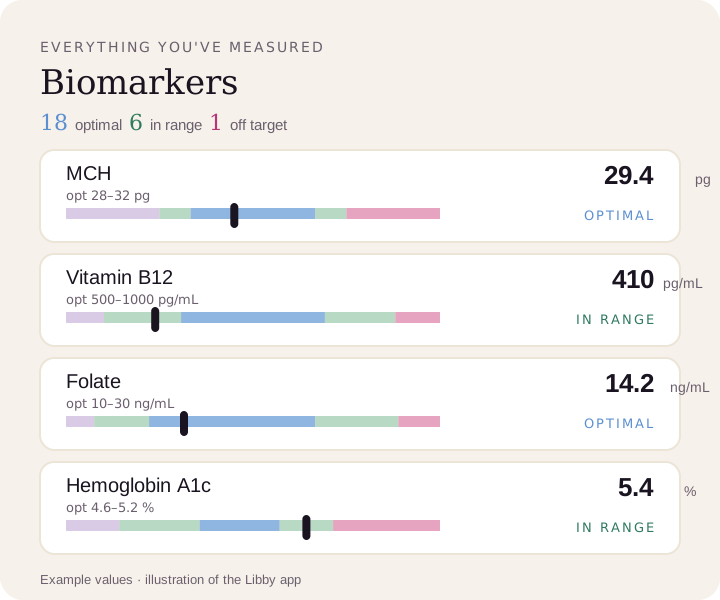
Compare your results to optimal ranges.
Upload a lab PDF or a photo of your report. Libby puts every marker on your lab's range and the optimal range, and tracks your trends over time.
View your MCH ›