von Willebrand factor antigen: normal range, low results
VWF antigen shows how much von Willebrand factor is in your blood: the normal range, the 2021 von Willebrand disease cutoffs, and why levels swing.
Von Willebrand factor antigen (VWF:Ag) measures how much von Willebrand factor is in your blood: the protein that glues platelets to a damaged blood vessel and carries clotting factor VIII. A low level is the main lab sign of von Willebrand disease (VWD), the most common inherited bleeding disorder. It's read together with a VWF activity test and factor VIII, and because blood type, stress and pregnancy move it, a borderline result is often repeated.12
The short version
- Normal: check the range on your report. Labcorp prints 50–150%,3 and in the NHLBI's expert report 95% of people fall between 50 and 200 IU/dL, averaging 100.2 The Libby app shades 70–180% as optimal.
- Low: the 2021 international guideline confirms type 1 VWD at a VWF level below 0.30 IU/mL (30 IU/dL) whatever your bleeding history, or below 0.50 IU/mL (50 IU/dL) if you have abnormal bleeding.1
- It swings: blood type O runs about 25% lower than other types. Stress, hard exercise, inflammation, pregnancy and estrogen push it up and can hide a low baseline, which is why testing is often repeated.2
- Near zero (type 3 VWD: VWF undetectable, factor VIII 1–9 IU/dL) is rare and severe. Whatever the number, bleeding that won't stop needs prompt care.24
What von Willebrand factor antigen is
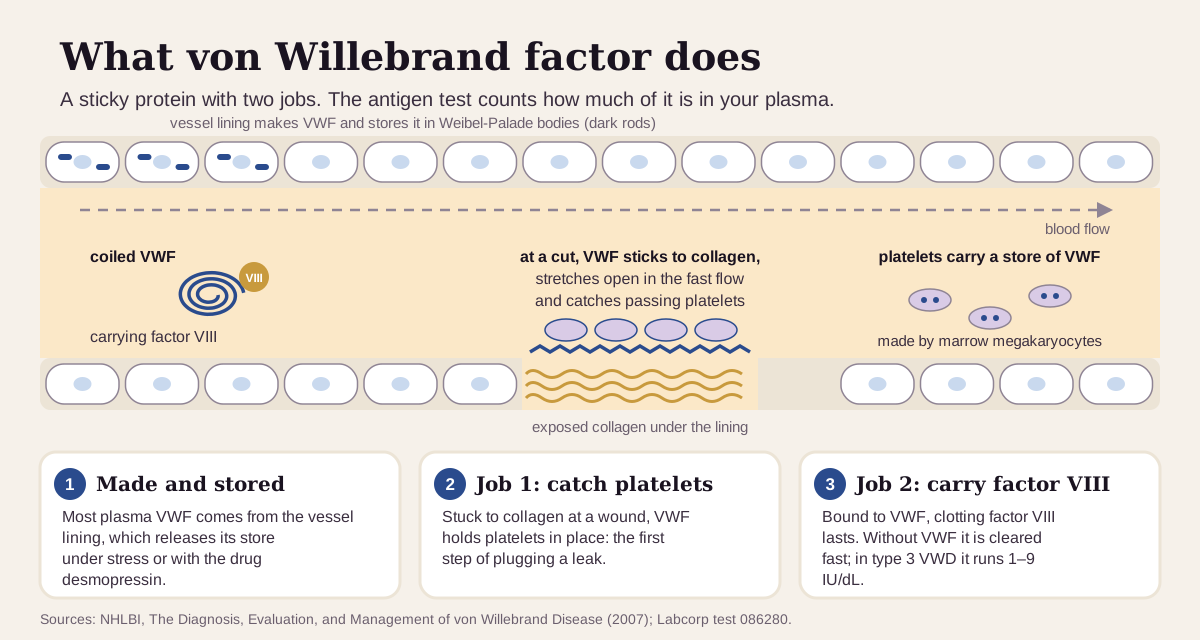
Von Willebrand factor (VWF) is a large, sticky protein made by the cells that line your blood vessels and by megakaryocytes, the bone-marrow cells that make platelets. Most of the VWF in your plasma comes from the vessel lining, which stores it in small packets (Weibel-Palade bodies) and releases it under stress. Platelets carry their own supply.2
VWF has two jobs:2
- It catches platelets. VWF floats loosely coiled in your blood. When a vessel is cut, it sticks to the exposed collagen under the lining, and the fast flow at the wound stretches it open so passing platelets stick to it. That's the first step of plugging a leak.
- It carries factor VIII, a clotting protein. Bound to VWF, factor VIII lasts; without VWF it's cleared quickly. That's why a VWF problem can drag factor VIII down with it.
The antigen test counts VWF protein. At Labcorp, antibody-coated latex beads clump in proportion to the VWF in your plasma, measuring the total amount whatever the molecule's size.3 So the antigen answers how much. Two partner tests answer the rest: a VWF activity test checks whether that protein grabs platelets, and factor VIII shows whether VWF is carrying its cargo. The 2021 guideline defines VWD blood testing as all three together.1 When activity sits well below the antigen (a ratio under 0.7), that points to type 2 VWD; our VWF activity guide covers those tests.1
Clinicians usually order it for easy bruising, nosebleeds, heavy periods, or bleeding after dental work, surgery or childbirth; for a relative with VWD; or after a long aPTT, a clotting screen that runs long when factor VIII is low.12
What's a normal VWF antigen?
Start with the range on your own report. Labcorp, a national commercial lab, prints 50% to 150%.3 The NHLBI's expert panel puts the average at 100 IU/dL, with about 95% of people between 50 and 200 IU/dL.2 The Libby app's default lab range is 50–200%.
Your blood type matters more than anything else. In a classic study of 1,117 blood donors, average VWF antigen was 74.8 U/dL in type O, 105.9 in type A, 116.9 in type B and 123.3 in type AB.5 The middle 95% of type O donors ran from 35.6 to 157 U/dL, so some perfectly healthy type O people sit below 50.2
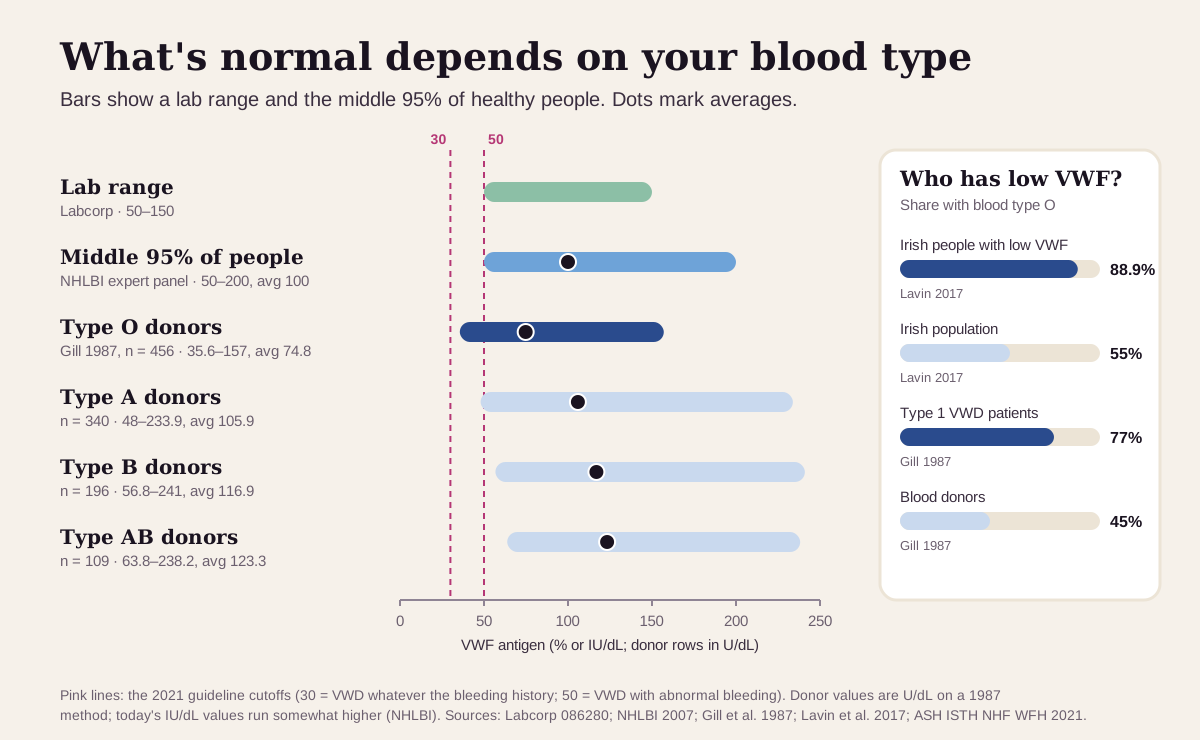
- About 80% of Americans with low VWF have type O blood, according to the NHLBI panel.2 In an Irish study of 126 people with low VWF, 88.9% were type O, against 55% of the population.6
- Even so, the 2021 guideline says blood-type-specific ranges aren't required: labs use one lower limit, and if yours is below 0.50 IU/mL, use your lab's.1
- VWF rises with age. In a Canadian study, average VWF antigen went from 91 U/dL in children and teens to 108 at 30–49 and 142 at 55–87, a 1.56-fold rise, mostly in people with non-O blood types.7
"Optimal" VWF antigen: the middle of the range
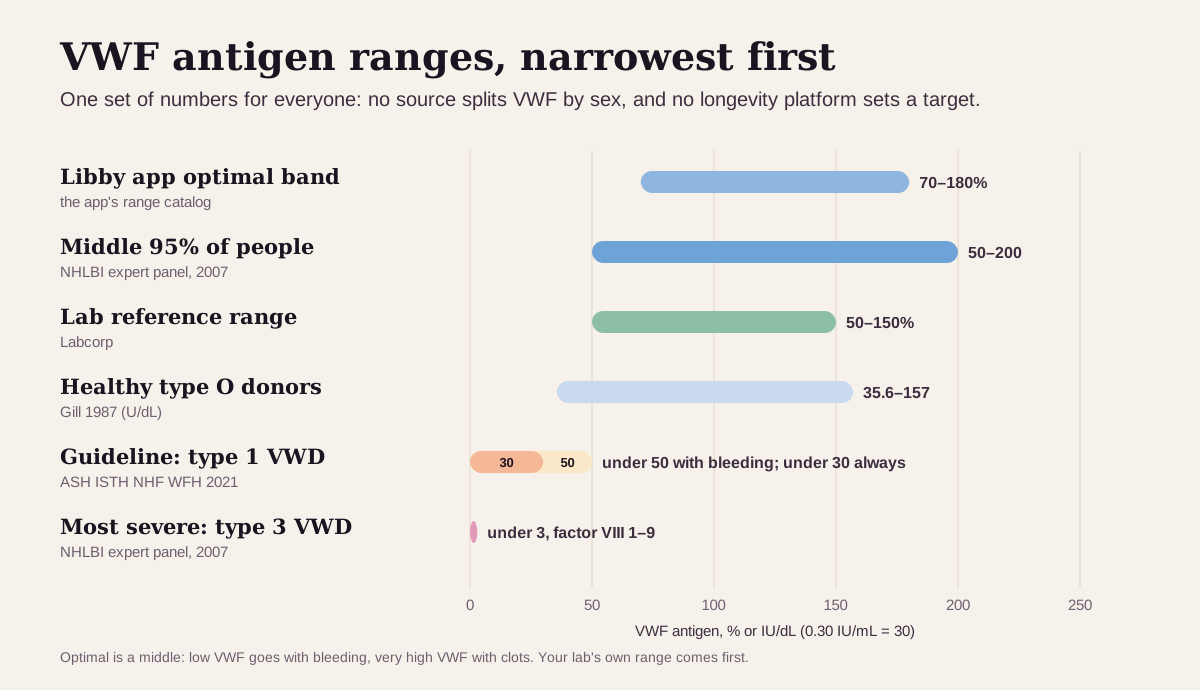
Longevity-testing platforms leave VWF alone: Superpower's public list of tests has no VWF entry.8 So the useful question is which part of the range carries the least trouble. Too low means bleeding; very high tracks with clots. Here is the ladder, from the narrowest band to the loosest cutoff:
| Target | Everyone (no source splits it by sex) | Who uses it |
|---|---|---|
| Libby app optimal band | 70–180% | The optimal range shown in the Libby app, inside the app's default lab range of 50–200% |
| Middle 95% of people | 50–200 IU/dL, average 100 | The NHLBI expert panel's description of the normal population2 |
| Lab reference range | 50–150% | Labcorp, a commercial lab; your own lab's range may differ3 |
| Healthy type O donors | 35.6–157 U/dL (1987 method) | The middle 95% of type O blood donors52 |
| Guideline: type 1 VWD | below 0.50 IU/mL with abnormal bleeding; below 0.30 IU/mL regardless of bleeding | American Society of Hematology (ASH), ISTH, NHF and WFH, 20211 |
| Most severe (type 3 VWD) | undetectable (under 3 IU/dL), factor VIII 1–9 IU/dL | NHLBI expert panel2 |
The evidence behind "the middle":
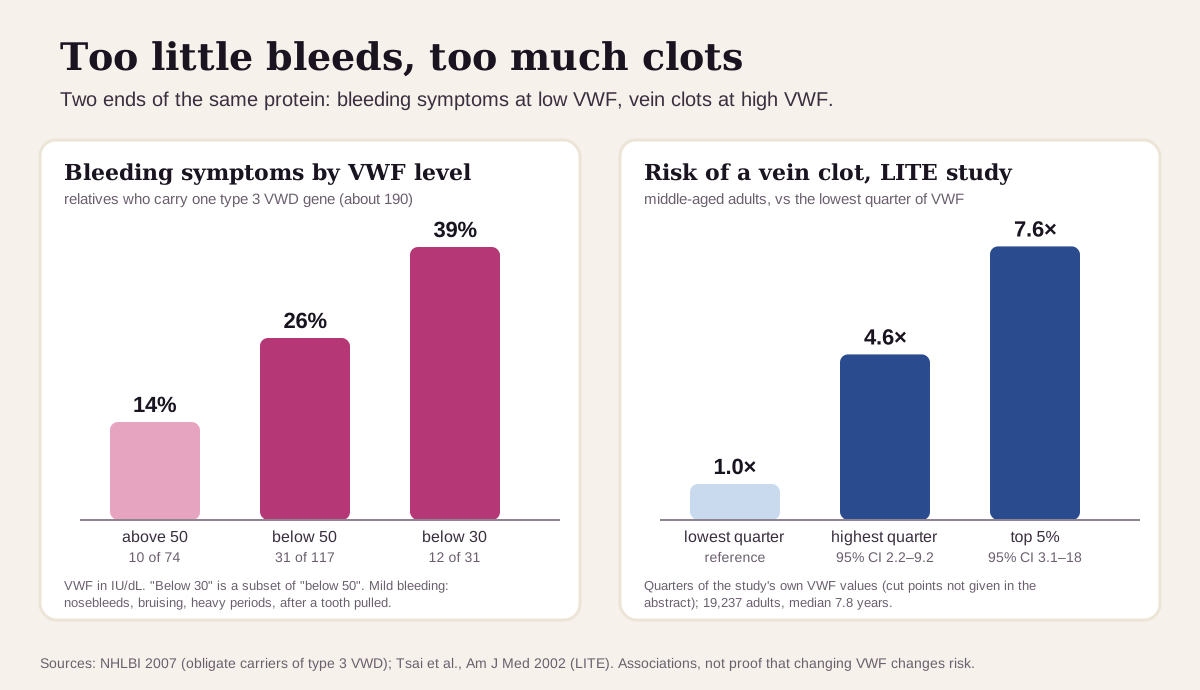
- Low end: bleeding. The NHLBI panel pooled about 190 relatives of people with type 3 VWD. Mild bleeding symptoms (nosebleeds, bruising, heavy periods, bleeding after a tooth pulled) showed up in 14% of those with VWF above 50 IU/dL, 26% of those below 50 and 39% of those below 30.2 In the Irish study of people with VWF of 30–50, 77% of the women had an abnormal bleeding score.6
- High end: clots. In the LITE study of 19,237 adults followed for a median of 7.8 years, middle-aged people in the highest quarter of VWF had 4.6 times the rate of blood clots in the veins of those in the lowest quarter, and the top 5% had 7.6 times.9 In 6,250 Dutch adults aged 55 and over, each step up in VWF (one standard deviation) carried 12% more strokes.10
Keep "optimal" in perspective. It's a middle, not a direction, and it's hard to move by choice: a high VWF usually reflects age, inflammation, pregnancy or stress rather than a separate problem.27 The useful moves are knowing your blood type, testing when you're well, and reading the antigen next to activity and factor VIII.1
What a low VWF antigen usually means
The number sorts the causes. The 2021 guideline and the NHLBI panel draw the lines at 0.30 and 0.50 IU/mL (30 and 50 IU/dL).12
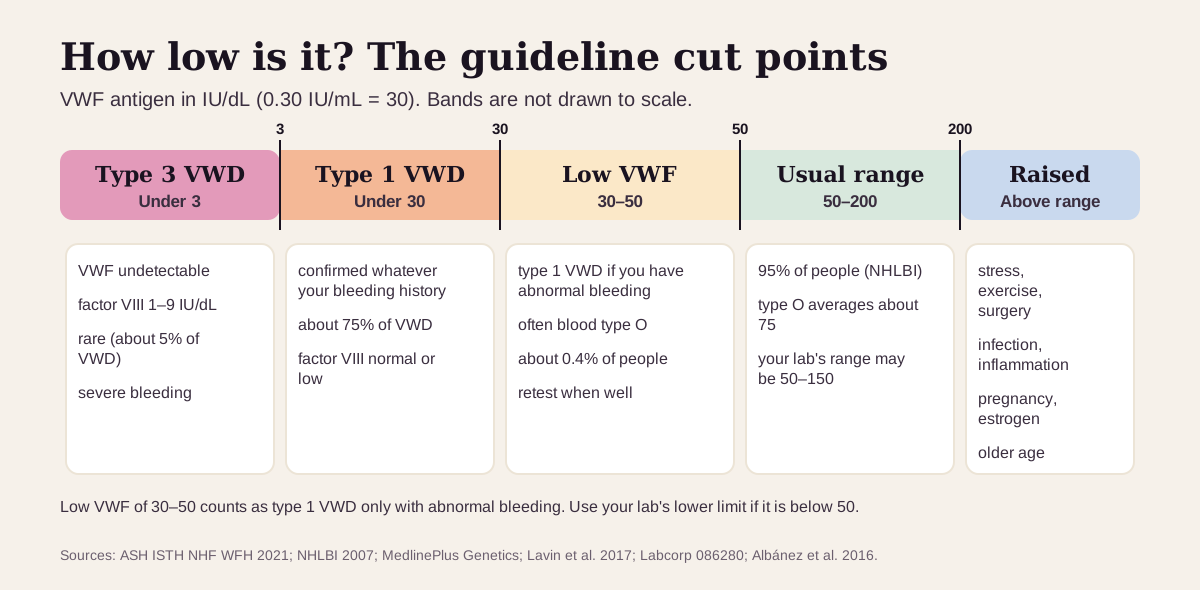
Mildly low (30–50 IU/dL): common, and often blood type
The usual reasons:
- Blood type O. It runs about 25% lower, and a healthy type O person can land in the 40s.25
- "Low VWF." About 0.4% of people have levels of 30–50.6 Some never bleed more than anyone else; others do. The 2021 guideline counts it as type 1 VWD when you also have abnormal bleeding.1
- A result caught at a low point. VWF is lowest on days 1–4 of a menstrual period, though whether timing matters is unsettled. A sample that sat too long, was chilled or wasn't filled properly can mislead too; labs spin it promptly and keep whole blood off ice.23
Below 30 IU/dL: von Willebrand disease
- Type 1 VWD is a partial shortage of normal VWF and makes up about 75% of VWD.211 Below 0.30 IU/mL, the guideline confirms it whatever your bleeding history.1 VWD overall affects somewhere between 1 in 100 and 1 in 10,000 people, depending on how it's counted.1
- Type 2 VWD (about 15%) is VWF that works poorly; the antigen can be low or normal, which is where the activity test comes in.111
- Type 3 VWD (about 5% of VWD) is the rare, severe form: VWF is undetectable and factor VIII usually runs 1–9 IU/dL.112
- Acquired von Willebrand syndrome starts in adulthood alongside another condition, such as a marrow or immune disease or a tight heart valve (aortic stenosis).112
Get prompt care for bleeding that won't stop. The NHLBI panel's warning signs of a bleeding disorder include a nosebleed lasting more than 10 minutes or needing medical help, periods with clots bigger than an inch or soaking a pad or tampon every hour, and bleeding after surgery, childbirth or a tooth pulled.21 If you have VWD, tell every surgeon, dentist and emergency team, and ask before taking aspirin or ibuprofen-type pain relievers, which can make bleeding worse.4
High VWF antigen
A result above your lab's range usually means VWF is doing its acute-phase job: stress, infection or inflammation, recent hard exercise, surgery, estrogen (birth-control pills or hormone therapy), pregnancy or older age.327 High VWF tracks with clots in large studies,9 but the reading that matters most for bleeding is the one that's higher than your true baseline, because it can hide VWD.2
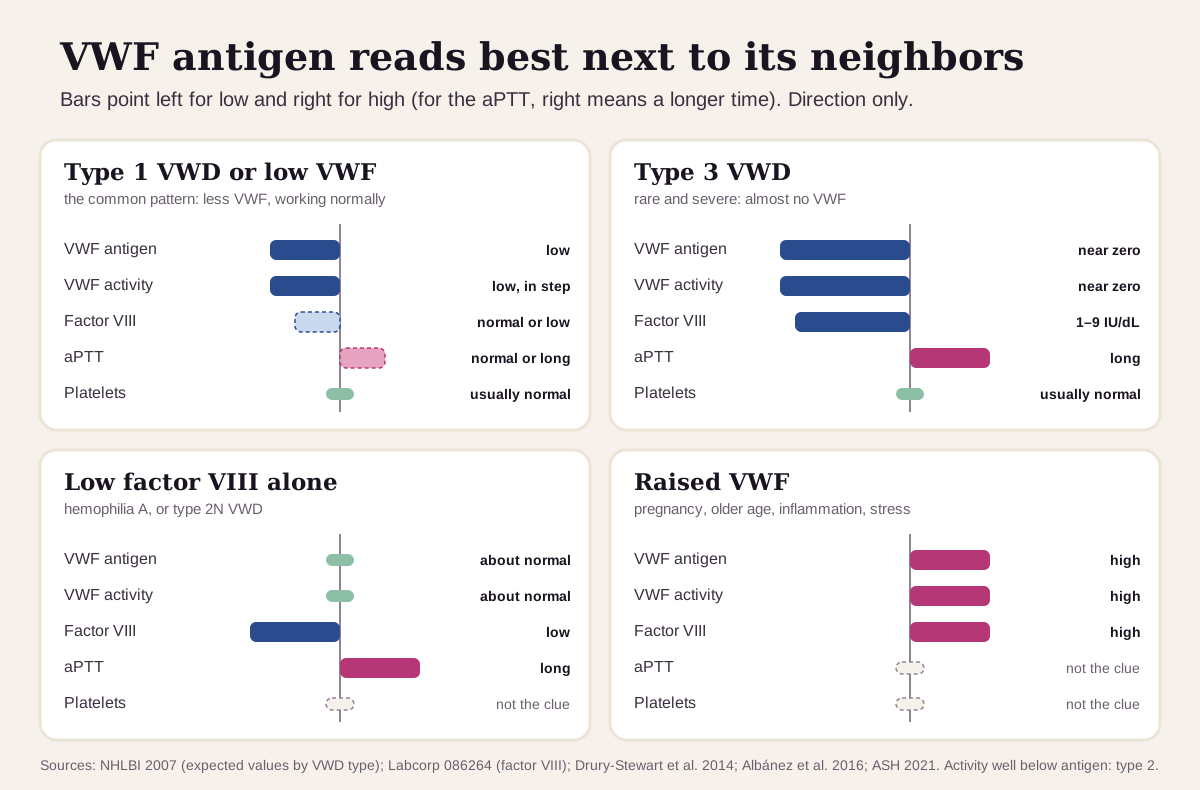
VWF antigen reads best next to its neighbors
VWF antigen is almost always ordered as part of a set. Read with VWF activity, factor VIII, the aPTT and the platelet count, the common patterns separate cleanly:12
| If you see… | It often points to… |
|---|---|
| VWF antigen and activity both low, about in step, factor VIII normal or a bit low | type 1 VWD (below 30), or what the NHLBI panel calls low VWF (30–50), which the 2021 guideline counts as type 1 when bleeding is abnormal; the aPTT is often normal21 |
| Activity well below antigen (ratio under 0.7) | type 2A, 2B or 2M VWD; see the activity guide1 |
| Antigen and activity near zero, factor VIII 1–9 IU/dL | type 3 VWD2 |
| Low factor VIII and a long aPTT, VWF antigen normal or near normal | hemophilia A, or type 2N VWD, where VWF fails to hold on to factor VIII122 |
| Antigen, activity and factor VIII all high | pregnancy, older age, inflammation or stress; in someone with a bleeding history, retest when well13721 |
| Low platelet count alongside a VWF problem | worth a closer look: in VWD the platelet count is usually normal, except in type 2B2 |
Why VWF levels swing, and why testing is repeated
VWF moves on every timescale, which is why the NHLBI panel says repeated testing is sometimes needed to find a low level, and the 2021 guideline asks for testing at your baseline state of health.21
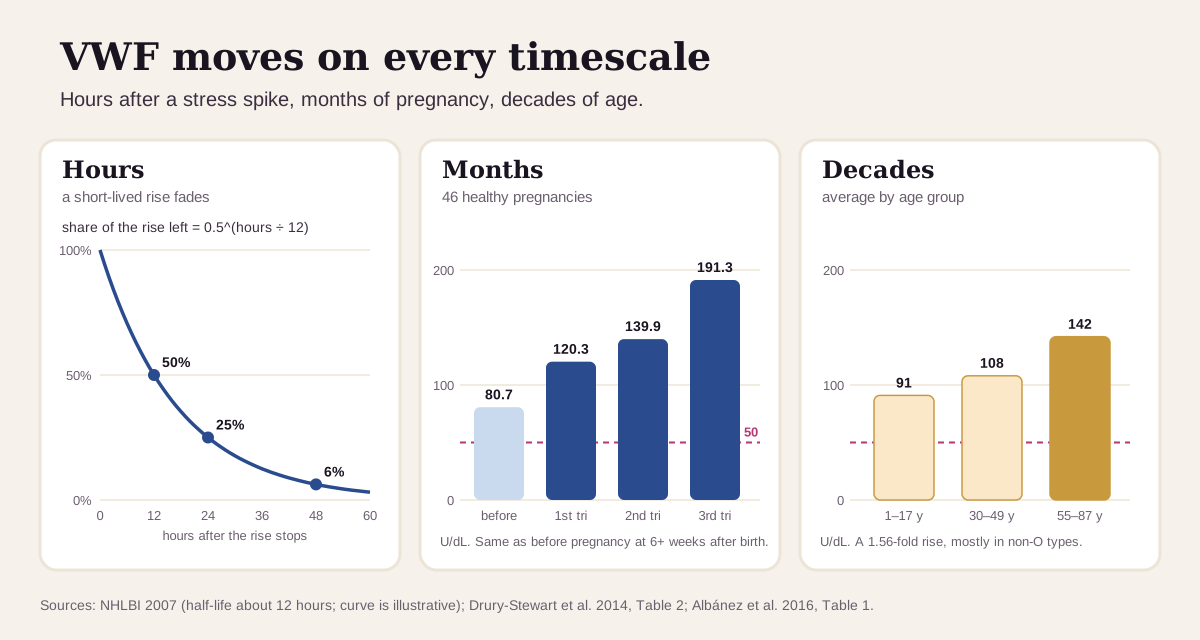
- Hours. VWF's half-life in the blood is about 12 hours (range 9–15).2 Anxiety at the blood draw, a hard workout, surgery, and even a frightened, crying child can push it up and mask a low baseline.2
- Weeks. An infection or inflammatory flare raises VWF and factor VIII together.23
- Months. In 46 healthy pregnancies, average VWF antigen climbed from 80.7 U/dL to 191.3 by the third trimester, about 2.4 times, and matched pre-pregnancy levels 6 or more weeks after delivery.13 The NHLBI panel describes a three- to fivefold rise by the third trimester; Labcorp says two- to threefold in the second and third.23 Estrogen pills and hormone therapy raise it too.3
- Decades. VWF climbs with age,7 and some people with type 1 VWD drift into the normal range. The 2021 guideline suggests reconsidering rather than removing the diagnosis when that happens.1
What that means in practice:
- One borderline result is usually repeated. In the Irish low-VWF study, more than half the patients had been tested five or more times, and even in them the level landed in the low range on about 3 draws in 4.6
- Mention what might have raised it: pregnancy, estrogen, a recent illness, surgery or hard exercise.23
- Compare like with like. Results from the same lab, drawn when you're well and calm, trend best.21
Going deeper: blood type, desmopressin and multimers
Why type O runs low. The NHLBI panel's reading is that type O people make VWF at the usual rate but clear it faster.2 The Canadian age study found the age rise mostly in non-O types, so the gap between O and non-O widens with the years.7 A person with type AB and a real VWF defect can have a level high enough to look normal.5
Desmopressin shows the stores. The drug desmopressin (DDAVP) releases the VWF packed in the vessel lining.2 In the Irish low-VWF study, peak VWF antigen after desmopressin topped 100 IU/dL in 88% of patients.6 For suspected fast-clearance type 1 VWD (type 1C), the 2021 guideline suggests a desmopressin trial with blood tests at 1 and 4 hours, to see how fast the rise fades.1
Size matters, and the antigen counts every size. VWF strings together into chains called multimers, and the biggest are the most active.2 The antigen test counts VWF regardless of chain length,3 so a person can have a normal antigen and still be missing the large, working chains. That's the job of the activity tests and multimer analysis.1
Questions worth asking
- Was my VWF antigen measured with VWF activity and factor VIII?
- What's my blood type, and does it explain a result in the 30s or 40s?
- Was I pregnant, on estrogen, sick, stressed or just back from exercise when it was drawn?
- Is my bleeding history abnormal enough to count a level of 30–50 as type 1 VWD?
- Should we repeat it, and when (for example, early in a period, when I'm well)?
- Would a desmopressin trial or a referral to a hemophilia treatment center help?
FAQ
What is a normal von Willebrand factor antigen level? Labcorp's range is 50–150%, and in the NHLBI's report 95% of people fall between 50 and 200 IU/dL.32 Blood type O runs lower: a healthy type O result can be in the 40s.52
What VWF level means von Willebrand disease? The 2021 international guideline confirms type 1 VWD at a VWF level below 0.30 IU/mL (30 IU/dL) regardless of bleeding, or below 0.50 IU/mL (50 IU/dL) in someone with abnormal bleeding.1
Why was my VWF test repeated? VWF rises with stress, exercise, inflammation, pregnancy and estrogen, which can hide a low baseline. Repeat testing when you're well is common.21
Does blood type affect von Willebrand factor? Yes. Type O averages about 25% lower than other types, and about 80% of Americans with low VWF are type O.2 The 2021 guideline still uses one cutoff for everyone.1
This guide is for education. It can't diagnose you or replace care from a clinician who knows your history.
Footnotes
-
James PD, Connell NT, Ameer B, et al. ASH ISTH NHF WFH 2021 guidelines on the diagnosis of von Willebrand disease. Blood Adv. 2021;5(1):280–300. The current international guideline: the 0.30 and 0.50 IU/mL cutoffs, the three-test workup, testing at baseline health, the 0.7 ratio for type 2, and the age recommendation. PMC ↩ ↩2 ↩3 ↩4 ↩5 ↩6 ↩7 ↩8 ↩9 ↩10 ↩11 ↩12 ↩13 ↩14 ↩15 ↩16 ↩17 ↩18 ↩19 ↩20 ↩21 ↩22 ↩23 ↩24 ↩25 ↩26 ↩27 ↩28 ↩29 ↩30
-
National Heart, Lung, and Blood Institute. The Diagnosis, Evaluation, and Management of von Willebrand Disease. NIH Publication No. 08-5832; December 2007 (summarized in Nichols WL, et al. Haemophilia. 2008;14(2):171–232). The U.S. expert panel's full report: VWF's jobs, the 12-hour half-life, the 50–200 population range, blood-type data, the stress and pregnancy effects, the expected lab values by type, and the bleeding rates in carriers. NHLBI ↩ ↩2 ↩3 ↩4 ↩5 ↩6 ↩7 ↩8 ↩9 ↩10 ↩11 ↩12 ↩13 ↩14 ↩15 ↩16 ↩17 ↩18 ↩19 ↩20 ↩21 ↩22 ↩23 ↩24 ↩25 ↩26 ↩27 ↩28 ↩29 ↩30 ↩31 ↩32 ↩33 ↩34 ↩35 ↩36 ↩37 ↩38 ↩39 ↩40 ↩41 ↩42 ↩43 ↩44 ↩45 ↩46 ↩47 ↩48 ↩49 ↩50 ↩51 ↩52
-
Labcorp. von Willebrand Factor (vWF) Antigen, test 086280 (updated August 11, 2026). Reference range 50% to 150%; latex immunoassay measuring total VWF protein; lists stress, inflammation, infection, exercise, surgery, estrogen and pregnancy (two- to threefold) as raising it. A commercial laboratory's published test catalog. labcorp.com ↩ ↩2 ↩3 ↩4 ↩5 ↩6 ↩7 ↩8 ↩9 ↩10 ↩11 ↩12 ↩13 ↩14 ↩15 ↩16
-
National Library of Medicine. Von Willebrand disease. MedlinePlus Medical Encyclopedia. Reviewed January 29, 2026. When to contact a clinician, and aspirin and NSAIDs. MedlinePlus ↩ ↩2
-
Gill JC, Endres-Brooks J, Bauer PJ, Marks WJ Jr, Montgomery RR. The effect of ABO blood group on the diagnosis of von Willebrand disease. Blood. 1987;69(6):1691–1695. 1,117 blood donors; average VWF antigen by blood type (O 74.8, A 105.9, B 116.9, AB 123.3 U/dL). PubMed ↩ ↩2 ↩3 ↩4 ↩5 ↩6 ↩7
-
Lavin M, Aguila S, Schneppenheim S, et al. Novel insights into the clinical phenotype and pathophysiology underlying low VWF levels. Blood. 2017;130(21):2344–2353. The Low VWF Ireland Cohort: 126 patients with VWF of 30–50 IU/dL, bleeding scores, blood type, repeat testing and desmopressin response. PMC ↩ ↩2 ↩3 ↩4 ↩5 ↩6 ↩7
-
Albánez S, Ogiwara K, Michels A, et al. Aging and ABO blood type influence von Willebrand factor and factor VIII levels through interrelated mechanisms. J Thromb Haemost. 2016;14(5):953–963. VWF antigen of 0.91, 1.08 and 1.42 U/mL in young, middle-aged and older groups. PMC ↩ ↩2 ↩3 ↩4 ↩5 ↩6 ↩7 ↩8
-
Superpower. Biomarkers. Checked September 23, 2026: the list includes platelets but no von Willebrand factor or factor VIII test. A commercial source, cited to show what the optimizer community tests. superpower.com ↩
-
Tsai AW, Cushman M, Rosamond WD, et al. Coagulation factors, inflammation markers, and venous thromboembolism: the longitudinal investigation of thromboembolism etiology (LITE). Am J Med. 2002;113(8):636–642. 19,237 adults followed a median of 7.8 years. PubMed ↩ ↩2 ↩3
-
Wieberdink RG, van Schie MC, Koudstaal PJ, et al. High von Willebrand factor levels increase the risk of stroke: the Rotterdam study. Stroke. 2010;41(10):2151–2156. 6,250 adults aged 55 and over; hazard ratio 1.12 per standard deviation. PubMed ↩
-
National Library of Medicine. Von Willebrand disease. MedlinePlus Genetics. Symptoms, the share of each type (75%, about 15%, about 5%) and acquired von Willebrand syndrome. MedlinePlus ↩ ↩2 ↩3 ↩4 ↩5
-
Labcorp. Factor VIII Activity, test 086264. Adult range 57–177%; factor VIII circulates bound to VWF; suspect a shortage with bleeding, a normal PT and a long aPTT. A commercial laboratory's published test catalog. labcorp.com ↩ ↩2
-
Drury-Stewart DN, Lannert KW, Chung DW, et al. Complex changes in von Willebrand factor-associated parameters are acquired during uncomplicated pregnancy. PLoS One. 2014;9(11):e112935. 46 healthy pregnancies, VWF antigen and factor VIII by trimester. PMC ↩ ↩2 ↩3 ↩4
Educational content, not medical advice. Libby is a personal record tool, not a medical service — it doesn't diagnose, treat, or prescribe. Reference ranges vary by lab and by person. Talk to a qualified healthcare professional about your results.
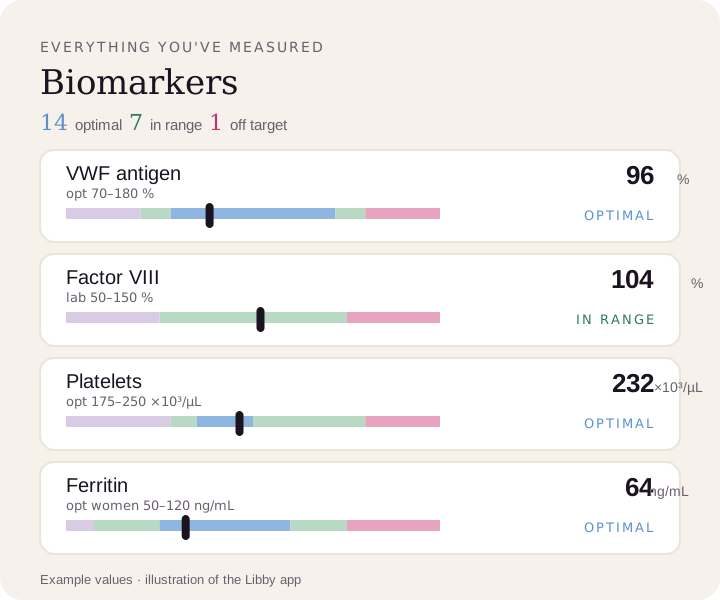
See every result on your lab's range.
Upload a lab PDF or a photo of your report. Libby puts every marker on your lab's range, adds an optimal band where the app has one (it has one for VWF antigen), and tracks your trends over time.
View your VWF antigen ›