Platelet count: normal range, low and high causes
Platelets help your blood clot. Here's a normal count, why it runs low or high, how to read it with your CBC and ferritin, and when it's urgent.
Platelets are tiny cell fragments that plug leaks in your blood vessels, and the platelet count tells you how many are in your blood. Doctors generally call about 150 to 450 thousand per microliter normal.1 A low count usually comes from clumping in the test tube, a medicine, a virus, liver disease or alcohol, pregnancy, or an immune reaction. A high count is usually your body reacting to something else: infection, surgery or injury, inflammation, or low iron.12
The short version
- Normal: about 150–450 (×10⁹/L, the same number as thousands per microliter), though many labs stop at 400. Women run a little higher than men.13
- Mildly low (100–150) is often harmless. In a 10-year study of 217 people with mildly low counts, 64% went back to normal or stayed mildly low with no problems.1 Clumping in the tube explains about 1 in 6 low results in outpatients, so a repeat test comes first.4
- High (450 or more) is a reaction to something else in 88–97% of adults with a high count: infection, surgery or injury, inflammation, cancer, or low iron.2
- Under 10 means a high risk of serious bleeding and needs care right away. So does a low count with bleeding, or a falling count after heparin.1
What platelets are
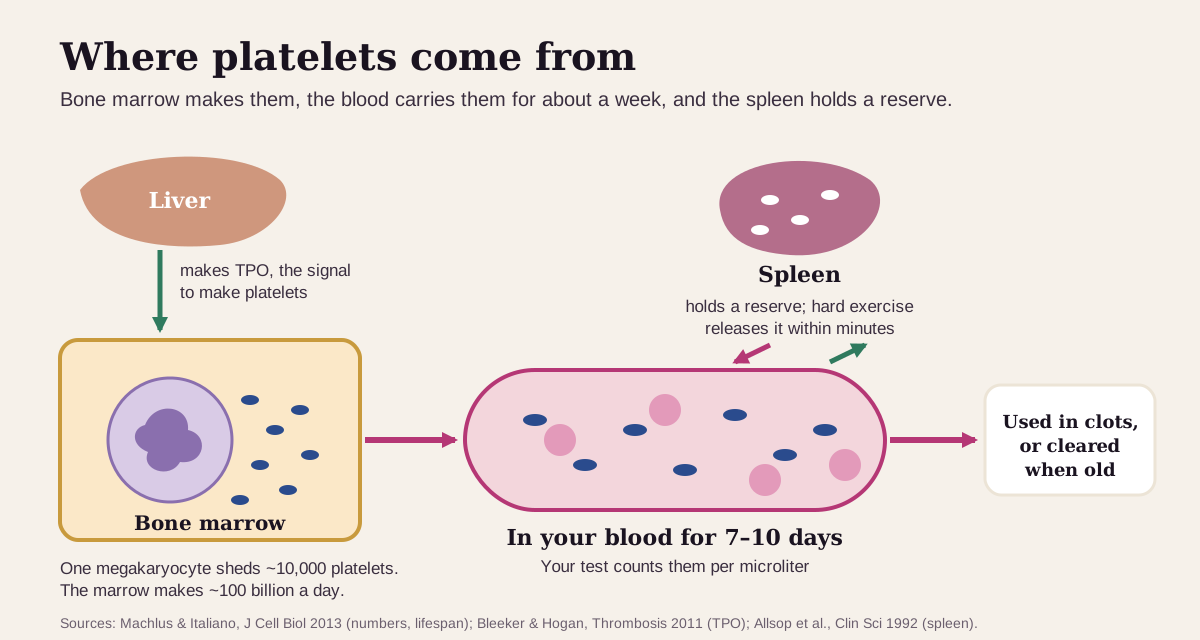
Platelets are small, sticky fragments of a giant bone-marrow cell called a megakaryocyte. Each megakaryocyte sheds about 10,000 of them, and your marrow makes about 100 billion platelets a day.5 When a blood vessel is cut, platelets stick to the edge and to each other, forming the first plug while clotting proteins build a firmer seal.
Each platelet lives about 7–10 days, so the count is a running balance between supply and use.5 Your liver sets the pace by making thrombopoietin (TPO), the main hormone that tells the marrow to make platelets.21 Your spleen holds a reserve: after four minutes of all-out exercise, platelets poured out of the spleen and the blood count peaked 5–10 minutes later.6
The platelet count is part of every complete blood count (CBC), so most people first see it on routine blood work. It measures how many platelets you have. How well they work is a separate test.7
What's a normal platelet count?
Start with the range on your own report. A 2022 review for family physicians puts normal at 150–450 ×10⁹/L and notes that labs vary a little.1 Many labs still use 150–400, a range set by studies from the late 20th century.43
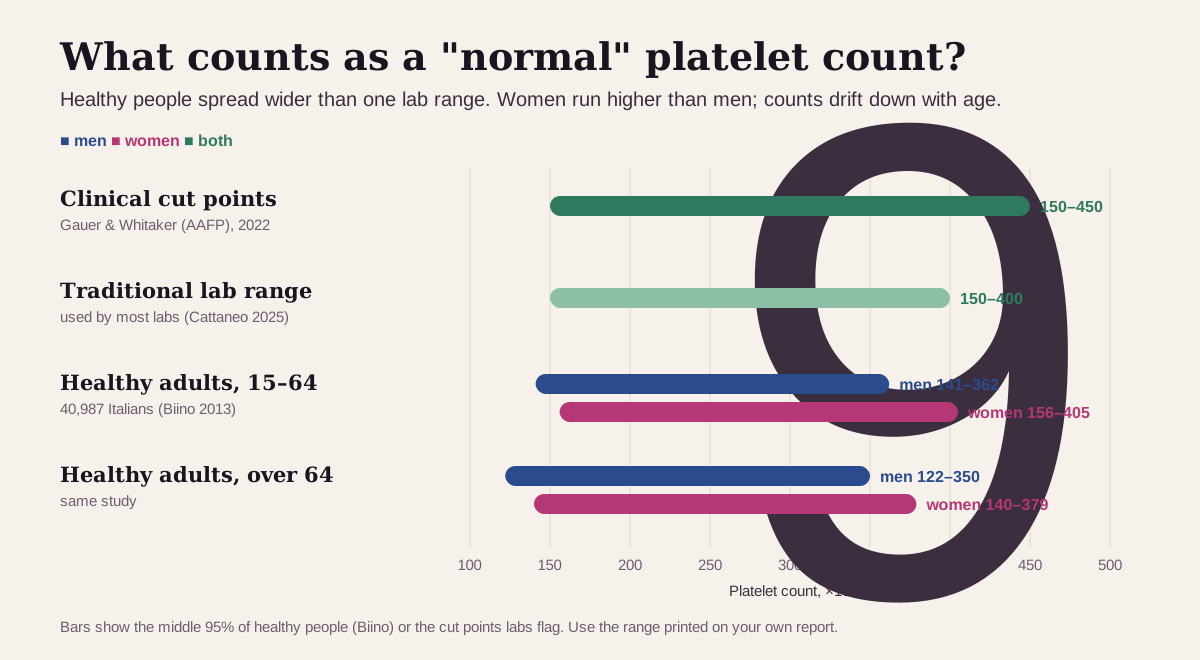
Healthy people spread wider than one range suggests:
- Women run higher than men from their teens on. In a study of 40,987 Italians, the middle 95% of healthy adults aged 15–64 ran 141–362 for men and 156–405 for women.3
- Counts drift down with age. Over 64, the same study found 122–350 for men and 140–379 for women.3 A count slightly under 150 can be normal for an adult.4
- Where you live matters too. A French study of 33,258 people put the lower limit at 161 for men and 187 for women, higher than in Italy.4
Pregnancy lowers the count. In 4,568 uncomplicated pregnancies at one U.S. center, the average fell from 251 in the first trimester to 217 at delivery, against 273 in women who weren't pregnant. It was back to 264 about 7 weeks after birth.8
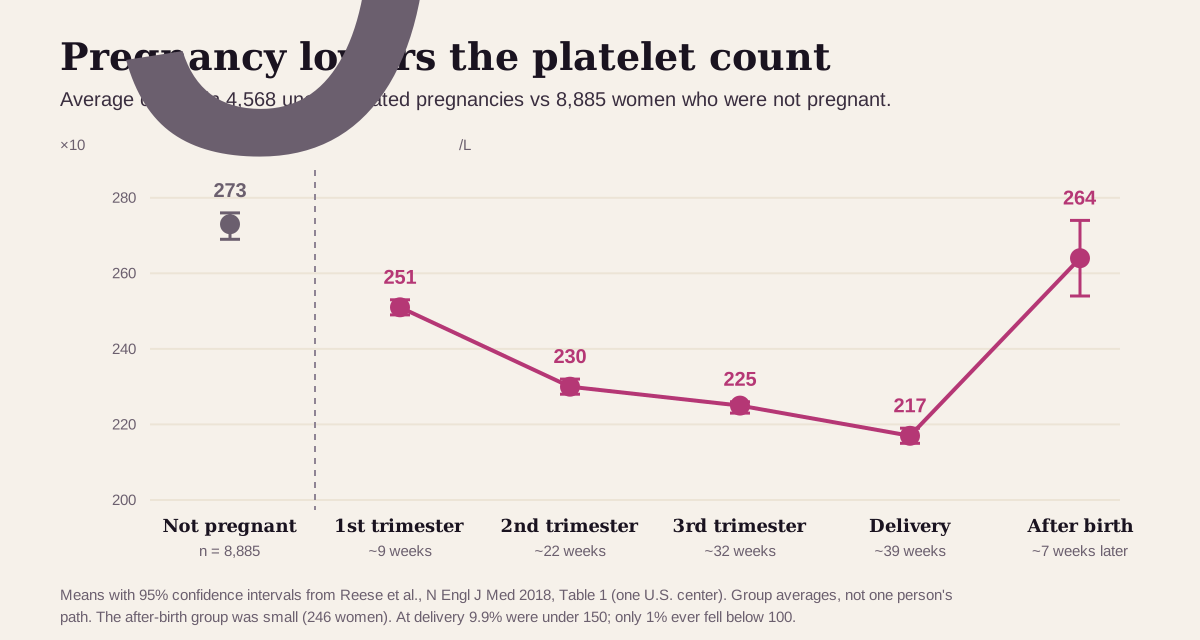
At delivery, 9.9% of those women had a count under 150, and only 1% ever dropped below 100. Below 100, the authors advise looking for a cause other than pregnancy.8
"Optimal" platelet count: what health optimizers aim for
Functional-medicine references aim for the middle of the range, not just anywhere between the lab limits: the optimal band in the Libby app is 175–250.9 Here's the full ladder, from strictest to loosest:
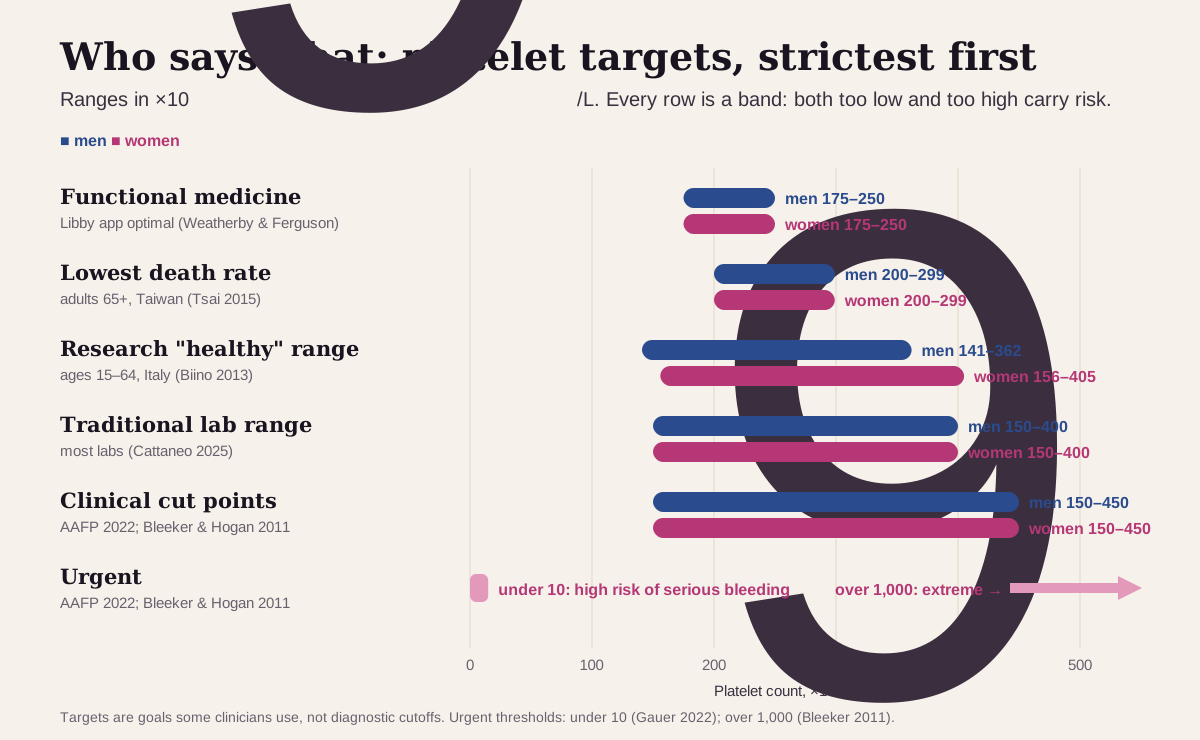
| Target (×10⁹/L) | Men | Women | Who uses it |
|---|---|---|---|
| Strictest (functional medicine) | 175–250 | 175–250 | The optimal range shown in the Libby app, which credits the functional-medicine textbook by Weatherby & Ferguson9 |
| Lowest death rate in a large cohort | 200–299 | 200–299 | 131,308 adults aged 65 and older in Taiwan10 |
| Research "healthy" range, ages 15–64 | 141–362 | 156–405 | The middle 95% of 40,987 healthy Italians3 |
| Traditional lab range | 150–400 | 150–400 | Most labs, from older studies4 |
| Clinical cut points | 150–450 | 150–450 | Low under 150;1 high at 450 or more2 |
| Urgent | under 10, or over 1,000 | under 10, or over 1,000 | Under 10: high risk of serious bleeding.1 Over 1,000: extreme, rare, and linked to bleeding2 |
Why the middle band:
- In 131,308 adults aged 65 and older in Taiwan, followed for about 6 years, death rates were lowest at 200–299. Compared with that band, the adjusted risk of dying was 1.93 times as high under 100, 1.08 times at 100–199, 1.18 times at 300–399 and 1.67 times at 400 or more.10
- In the Women's Health Initiative, 159,746 postmenopausal women followed for a median of 15.9 years, both the lowest and the highest tenths of platelet count carried higher death rates.11
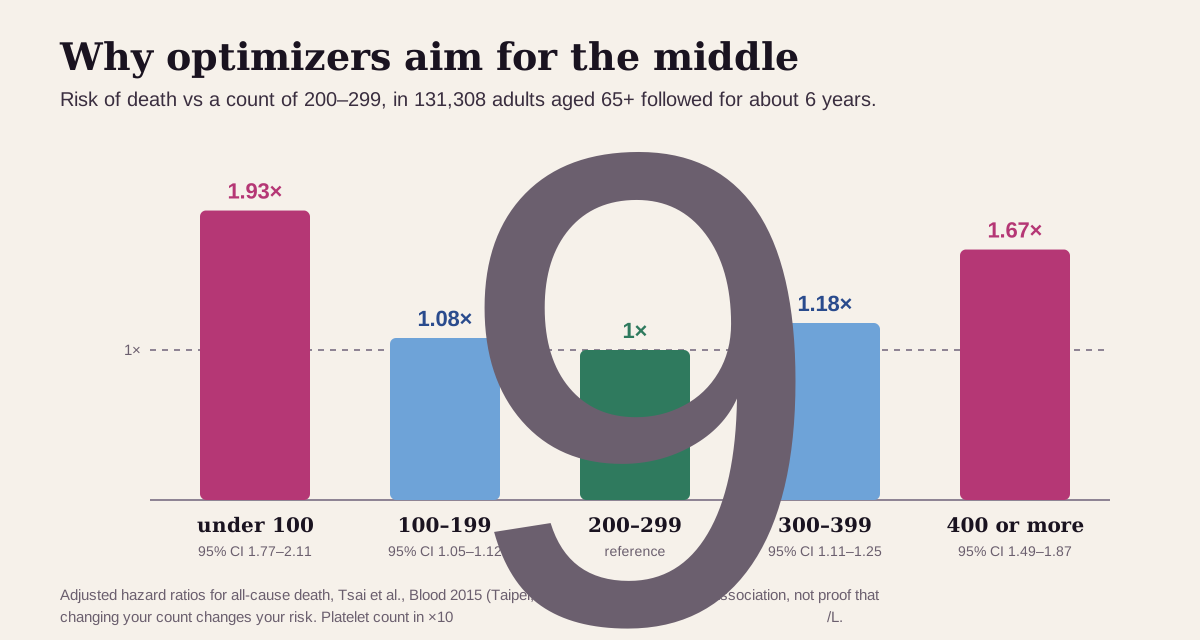
Keep "optimal" in perspective: these are targets, not diagnoses. Plenty of healthy people sit at 160 or 330.3 In the Taiwan study, the extremes carried more deaths from cancer and severe infection,10 so a count outside the middle band is a reason to look at the rest of your results, not to chase the number. Both ends carry risk,11 so every row on the ladder has a floor as well as a ceiling.
What a low platelet count usually means
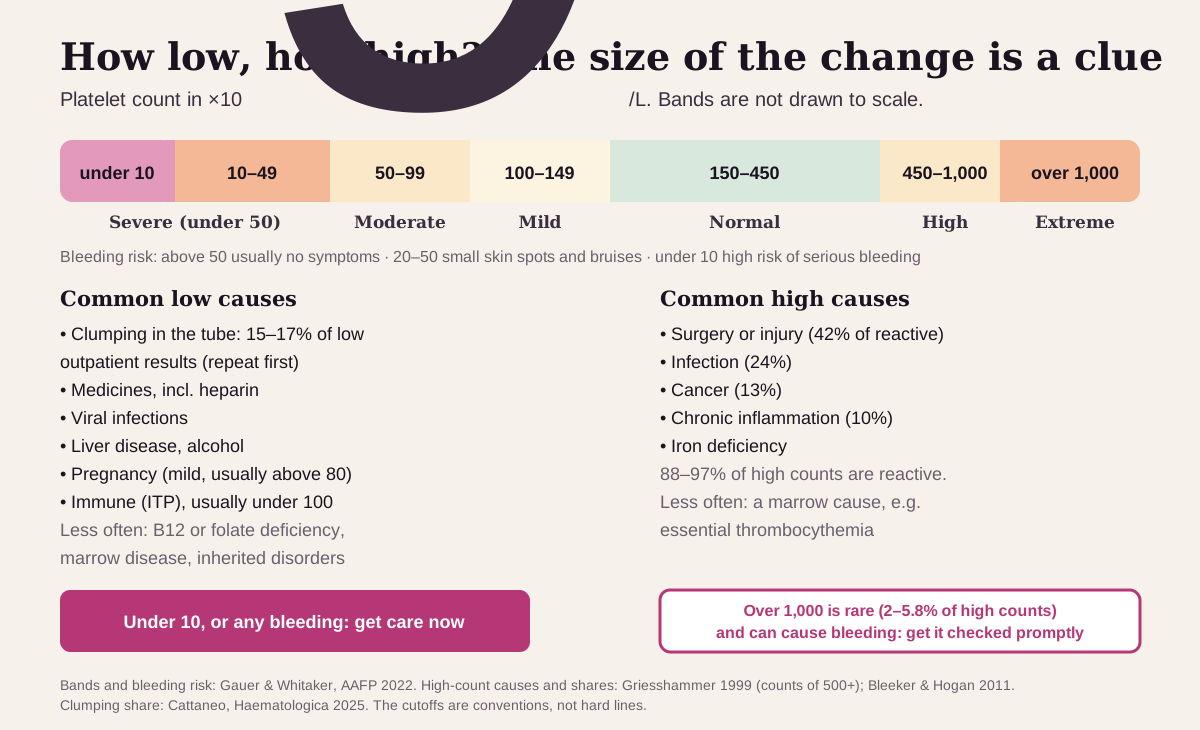
How low it is matters most. Family physicians call 100–150 mild, 50–99 moderate and under 50 severe. Above 50, people usually have no symptoms. At 20–50, small skin spots and bruises can appear. Under 10, the risk of serious bleeding is high.1
The usual suspects
- Clumping in the tube (pseudothrombocytopenia). In about 0.1% of blood samples, platelets clump in the tube after the draw and the analyzer misses them. It explains 15–17% of low results in outpatients, the second most common reason for a low count.4 The usual first step is a repeat count in a different tube (citrate or heparin).1
- Medicines. Heparin, several antibiotics, seizure medicines and others can lower platelets, usually 3–10 days after starting. Counts usually recover 7–10 days after stopping.1 Don't stop a prescribed medicine on your own. Bring your full list, supplements included, to your clinician.
- Viral infections, such as mononucleosis, hepatitis or measles.7
- Liver disease and alcohol. Low platelets show up in 64–84% of people with chronic liver disease: the liver makes less TPO, and an enlarged spleen holds more platelets back. Alcohol also lowers the count directly; 3–43% of people with alcohol dependence have low platelets.1
- Pregnancy. Low counts develop in 5–10% of pregnancies. Most of those (80%) are gestational thrombocytopenia: mild (usually above 80), harmless to mother and baby, and gone after birth.17
- Immune thrombocytopenia (ITP). The immune system tags platelets for removal. It's the most common cause of a low count with an otherwise normal CBC, and the count is usually under 100.1
- Less common causes: vitamin B12 or folate deficiency, bone-marrow diseases such as leukemia or myelodysplasia, and inherited platelet disorders.17
A mildly low count on its own usually stays mild. In the 10-year study of 217 people with counts of 100–150, 64% normalized or stayed mildly low with no problems; about 7% developed ITP and 2% a marrow disorder, all of them older adults.1
Get care now if you have bleeding that won't stop, blood in your urine, stool or vomit, black stool, or a spray of tiny red spots on your skin (petechiae).13 A count under 10, a falling count after recent heparin, or a low count with confusion, new weakness or kidney problems needs same-day hospital care.1 Chest pain or signs of stroke mean calling 911.13
Heparin deserves its own mention. A count that drops 5–10 days after starting heparin can signal heparin-induced thrombocytopenia, and up to a third of people with it develop blood clots.1
What a high platelet count usually means
Most high counts are a reaction, not a platelet disease. In adults, 88–97% of high counts are reactive: the marrow is responding to something else.2 In a German hospital series of 732 people with counts of 500 or more, the reactive causes were:12
- Tissue damage such as surgery or injury: 42%
- Infection: 24%
- Cancer: 13%
- Chronic inflammation, such as inflammatory bowel disease or rheumatoid arthritis:7 10%
Iron deficiency is another common cause, which is why ferritin and iron tests are part of working up a high count.2 Severe blood loss,7 a missing or underactive spleen, and the rebound after the marrow has been suppressed also push the count up.2
Many high counts are temporary. In an Italian cohort of 10,000 people, 99 had a count above 400 on a first test, and only 8 of them still did 8 months later.2 In hospital patients with pneumonia or a urinary or skin infection, high counts were usually mild (median 492) and settled in every survivor after recovery.14
Marrow causes are the minority. In the German series, 12% had a primary cause, most often essential thrombocythemia, and these carried more blood clots in both arteries and veins.12 A count that stays high with a normal CRP and normal iron studies raises that question: in one study, 76% of people with reactive high counts had a raised CRP, versus 10% with a marrow cause.2
Over 1,000 is extreme and rare, 2–5.8% of high counts, and even then 82% were reactive in one series. It can cause bleeding, because the huge number of platelets soaks up von Willebrand factor, a clotting protein.2
Get care now for chest pain, trouble breathing, a painful swollen leg, sudden vision changes, weakness, numbness or slurred speech. With a high count, these can signal a clot. Chest pain or signs of stroke mean calling 911.13
Platelets read best next to their neighbors
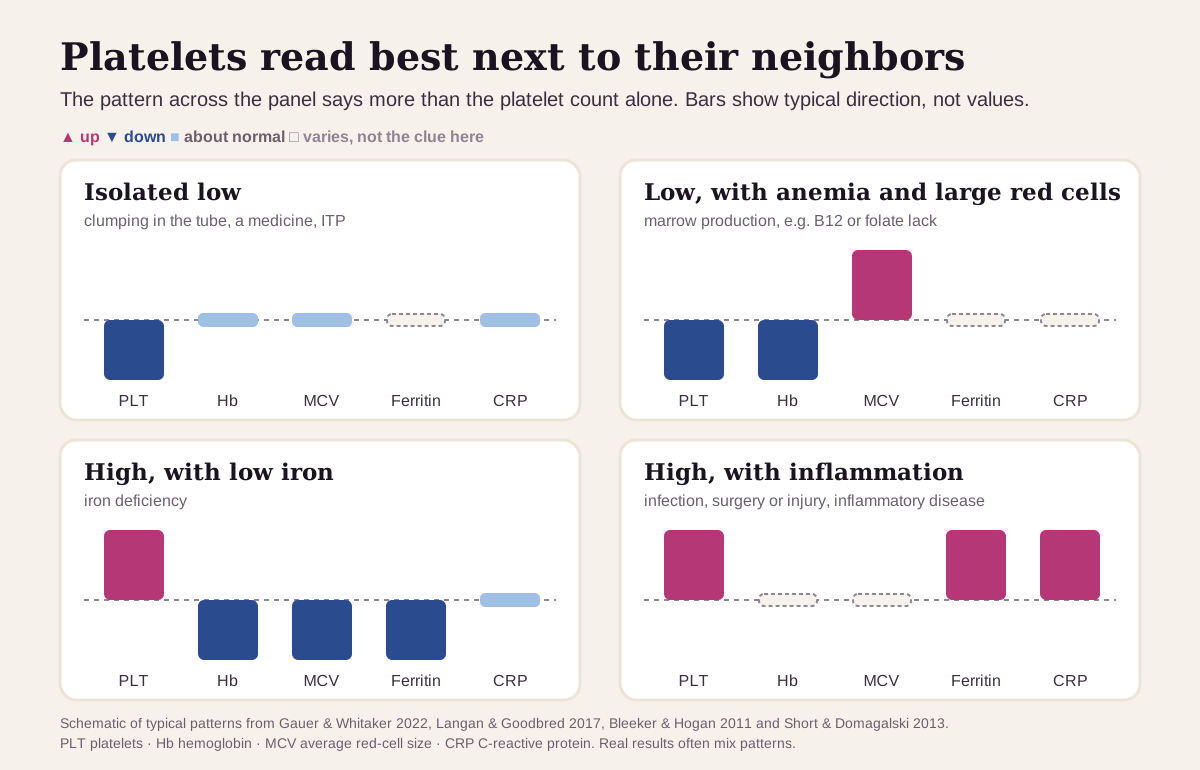
A platelet count rarely comes alone. The rest of your CBC, plus two common add-ons, ferritin and CRP, helps sort many results:12
| If you see… | It often points to… |
|---|---|
| Platelets low, everything else normal | clumping in the tube, a medicine or ITP; in pregnancy, a mild dip is usual |
| Platelets low with low hemoglobin and large red cells (high MCV), sometimes low white cells too | a production problem in the marrow; vitamin B12 deficiency is a treatable example, and folate deficiency is another |
| Platelets high with low hemoglobin, small red cells (low MCV) and low ferritin | iron deficiency: a ferritin under 30 ng/mL points strongly to it |
| Platelets high with high CRP and high ferritin | a reaction to infection or inflammation (ferritin rises with inflammation too, so it's a weaker guide to iron here; under 50 still suggests low iron) |
| Platelets that stay high on a repeat test, with a normal CRP and normal iron studies | worth asking about a marrow cause such as essential thrombocythemia |
The ferritin cutoff of 30 ng/mL catches 92% of iron-deficiency anemia, but in someone with chronic inflammation, a ferritin under 50 already suggests low iron.16 Many reports also print MPV, the average platelet size, next to the count.
How fast platelet counts change
Platelets turn over fast. Each one lives 7–10 days,5 so a real change can show up within days. Some changes are faster still, and some take weeks:
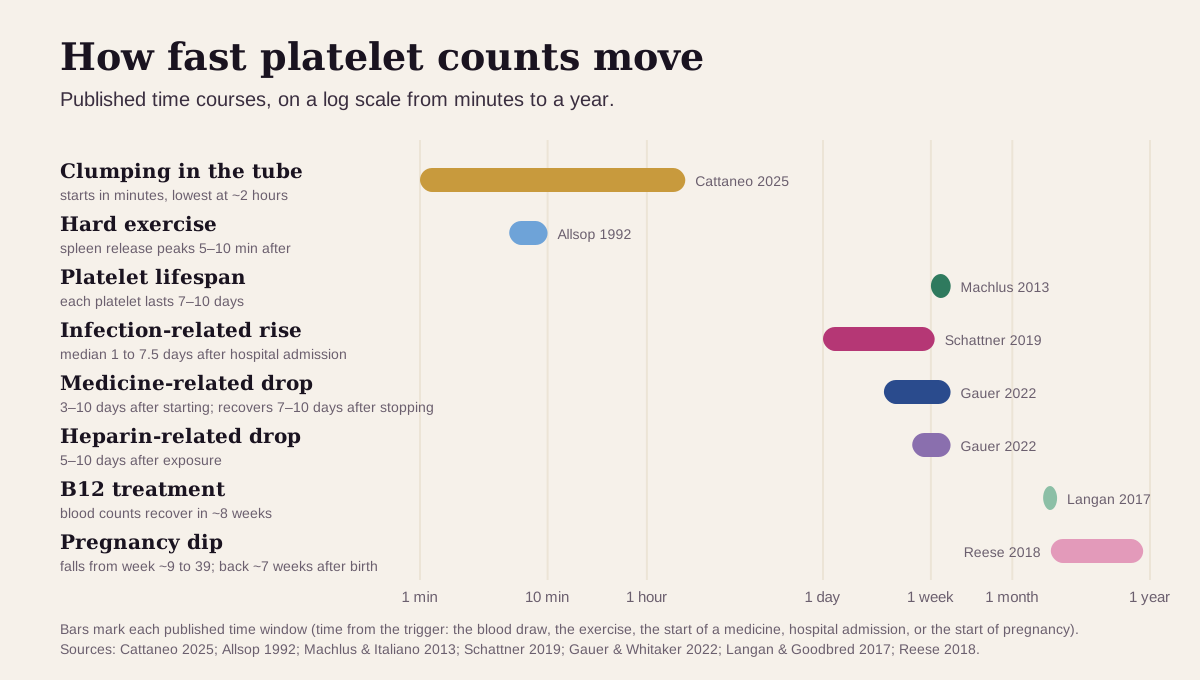
- Minutes: in susceptible samples, clumping in the tube starts within minutes of the draw and bottoms out at about 2 hours.4 Hard exercise pushes spleen platelets into the blood, peaking 5–10 minutes later.6
- Days: medicine-related drops appear 3–10 days after starting and recover 7–10 days after stopping.1 In hospital patients with infections, high counts appeared a median of 1 day (pneumonia) to 7.5 days (skin infection) after admission.14
- Weeks: after vitamin B12 treatment, low blood counts take about 8 weeks to recover.15 Pregnancy lowers the count trimester by trimester.8
What that means in practice:
- A single surprising result is often repeated. Mention recent illness, hard exercise, new medicines, alcohol and pregnancy when you get tested.
- Old results are valuable. Clinicians use earlier counts to tell a new drop from a lifelong baseline. Without them, a low count is treated as new until proven otherwise.1
- Trends beat snapshots. A count drifting down across several tests says more than one value near the line.1
Going deeper: how your body sets the count
TPO is the thermostat. Your liver makes thrombopoietin, and it's the main signal for the marrow to make platelets.2 That's why chronic liver disease lowers the count: less TPO means fewer platelets, and scarring backs blood up into the spleen, which then holds more of them.1
Inflammation turns the dial up. Signaling proteins released in infection and inflammation, most notably interleukin-6 (IL-6), are raised in reactive high counts and push the marrow to make more platelets. CRP and ferritin travel with them, which is why they help separate a reactive rise from a marrow cause.2 Iron deficiency raises platelets by a route that's still unclear: those same signals stay normal in people whose high count comes from low iron.2
Marrow causes run on their own. In essential thrombocythemia and related conditions, an acquired change such as the JAK2 V617F mutation switches on platelet production without the usual signals.2
Clumping is a test-tube effect. Most CBC tubes use EDTA to stop clotting. In a few people, natural antibodies make platelets stick together in EDTA after the draw. Analyzers count only particles in the platelet size range, so the clumps drop out and the result comes out falsely low.4
Questions worth asking
- Was my low count checked for clumping, and should it be repeated in a different tube?
- Is this new, or have my earlier counts always run this way?
- What do my hemoglobin, MCV and white count show next to it?
- Could any of my medicines or supplements be lowering it?
- For a high count: should we check ferritin and CRP?
- When should we repeat it, and what result would change the plan?
FAQ
What is a normal platelet count? Doctors generally use about 150–450 ×10⁹/L (150,000–450,000 per microliter), and many labs stop at 400. Women run a little higher than men.13
What is the most common cause of a high platelet count? A reaction to something else, 88–97% of the time: infection, surgery or injury, inflammation, cancer, or iron deficiency.2
Can a low platelet count be a lab error? Yes. Platelets sometimes clump in the collection tube and go uncounted. That explains 15–17% of low results in outpatients, and a repeat in a different tube settles it.41
When is a low platelet count an emergency? Under 10, or any low count with bleeding that won't stop, blood in the urine or stool, black stool, confusion, or a drop after heparin.113
This guide is for education. It can't diagnose you or replace care from a clinician who knows your history.
Footnotes
-
Gauer RL, Whitaker DJ. Thrombocytopenia: Evaluation and Management. Am Fam Physician. 2022;106(3):288–298. A primary-care review: the 150–450 normal range, severity grades and bleeding risk by count, red flags, the 10-year outlook for mild low counts, and the common causes (clumping, medicines, ITP, liver disease, alcohol, pregnancy, heparin). AAFP · PubMed ↩ ↩2 ↩3 ↩4 ↩5 ↩6 ↩7 ↩8 ↩9 ↩10 ↩11 ↩12 ↩13 ↩14 ↩15 ↩16 ↩17 ↩18 ↩19 ↩20 ↩21 ↩22 ↩23 ↩24 ↩25 ↩26 ↩27 ↩28 ↩29 ↩30 ↩31 ↩32
-
Bleeker JS, Hogan WJ. Thrombocytosis: diagnostic evaluation, thrombotic risk stratification, and risk-based management strategies. Thrombosis. 2011;2011:536062. The share of high counts that are reactive (88–97%), the 450 cutoff, iron deficiency, CRP and ferritin in reactive vs marrow causes, TPO and IL-6, and extreme counts over 1,000. PMC ↩ ↩2 ↩3 ↩4 ↩5 ↩6 ↩7 ↩8 ↩9 ↩10 ↩11 ↩12 ↩13 ↩14 ↩15 ↩16 ↩17 ↩18 ↩19 ↩20 ↩21
-
Biino G, Santimone I, Minelli C, et al. Age- and sex-related variations in platelet count in Italy: a proposal of reference ranges based on 40987 subjects' data. PLoS One. 2013;8(1):e54289. Healthy ranges by sex and age. PMC ↩ ↩2 ↩3 ↩4 ↩5 ↩6 ↩7 ↩8 ↩9
-
Cattaneo M. Pseudothrombocytopenia and other conditions associated with spuriously low platelet counts. Haematologica. 2025;110(8):1677–1692. Clumping in the tube (0.1% of samples, 15–17% of low outpatient counts, nadir at about 2 hours), the traditional 150–400 range, and the French lower limits. PMC ↩ ↩2 ↩3 ↩4 ↩5 ↩6 ↩7 ↩8 ↩9 ↩10 ↩11 ↩12 ↩13
-
Machlus KR, Italiano JE Jr. The incredible journey: From megakaryocyte development to platelet formation. J Cell Biol. 2013;201(6):785–796. About 10¹¹ platelets made a day, a 7–10 day lifespan, and about 10⁴ platelets per megakaryocyte. PMC ↩ ↩2 ↩3 ↩4 ↩5
-
Allsop P, Peters AM, Arnot RN, et al. Intrasplenic blood cell kinetics in man before and after brief maximal exercise. Clin Sci (Lond). 1992;83(1):47–54. Ten healthy people; platelets released from the spleen after 4 minutes of maximal exercise. PubMed ↩ ↩2 ↩3 ↩4
-
National Library of Medicine. Platelet Tests. MedlinePlus. Count vs function tests, and plain-language lists of causes of low and high counts. MedlinePlus ↩ ↩2 ↩3 ↩4 ↩5 ↩6
-
Reese JA, Peck JD, Deschamps DR, et al. Platelet Counts during Pregnancy. N Engl J Med. 2018;379(1):32–43. Platelet counts through 4,568 uncomplicated pregnancies at one U.S. center, compared with 8,885 women who were not pregnant. PMC ↩ ↩2 ↩3 ↩4 ↩5
-
Weatherby D, Ferguson S. Blood Chemistry and CBC Analysis: Clinical Laboratory Testing from a Functional Perspective. 2nd ed. Bear Mountain Publishing; 2004. ISBN 978-0976136712. Widely used functional-medicine reference. The Libby app's marker catalog credits it for the app's optimal platelet range of 175–250 ×10⁹/L (range as recorded in the catalog; the book was not opened for this article). ↩ ↩2 ↩3
-
Tsai MT, Chen YT, Lin CH, et al. U-shaped mortality curve associated with platelet count among older people: a community-based cohort study. Blood. 2015;126(13):1633–1635. 131,308 adults aged 65 and older in Taipei, mean follow-up 5.8 years; adjusted hazard ratios by platelet band. PMC ↩ ↩2 ↩3 ↩4 ↩5
-
Kabat GC, Kim MY, Verma AK, et al. Platelet count and total and cause-specific mortality in the Women's Health Initiative. Ann Epidemiol. 2017;27(4):274–280. 159,746 postmenopausal women followed for a median 15.9 years. PubMed ↩ ↩2
-
Griesshammer M, Bangerter M, Sauer T, et al. Aetiology and clinical significance of thrombocytosis: analysis of 732 patients with an elevated platelet count. J Intern Med. 1999;245(3):295–300. Causes of counts of 500 or more in a German university hospital. PubMed ↩ ↩2 ↩3
-
National Heart, Lung, and Blood Institute. Platelet Disorders: Symptoms. NIH; updated February 18, 2025. Warning signs of low and high counts, and when to call 911. NHLBI ↩ ↩2 ↩3 ↩4
-
Schattner A, Kadi J, Dubin I. Reactive thrombocytosis in acute infectious diseases: Prevalence, characteristics and timing. Eur J Intern Med. 2019;63:42–45. 421 hospital patients with pneumonia, urinary or skin infections; timing and course of high counts. PubMed ↩ ↩2 ↩3
-
Langan RC, Goodbred AJ. Vitamin B12 Deficiency: Recognition and Management. Am Fam Physician. 2017;96(6):384–389. Blood-count effects (large-cell anemia, low white cells, low platelets) and about 8 weeks to recover. AAFP · PubMed ↩ ↩2 ↩3
-
Short MW, Domagalski JE. Iron deficiency anemia: evaluation and management. Am Fam Physician. 2013;87(2):98–104. Ferritin cutoffs (30 ng/mL; 50 with inflammation) and ferritin as an acute-phase protein. AAFP · PubMed ↩ ↩2
Educational content, not medical advice. Libby is a personal record tool, not a medical service — it doesn't diagnose, treat, or prescribe. Reference ranges vary by lab and by person. Talk to a qualified healthcare professional about your results.
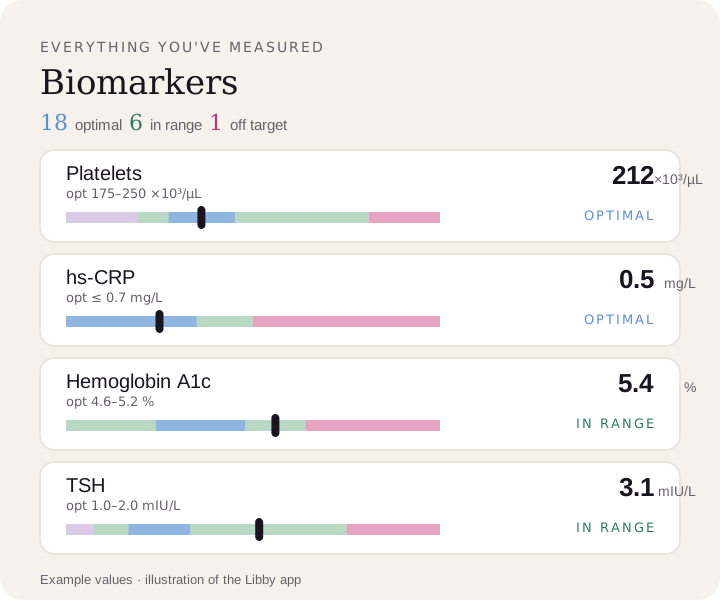
Compare your results to optimal ranges.
Upload a lab PDF or a photo of your report. Libby puts every marker on the lab range and the optimal range, and tracks your trends over time.
View your platelet count ›