MPV blood test: normal range, high and low causes
MPV is the average size of your platelets. What a normal MPV is, what high and low results mean, how to read it with your platelet count, and when to act.
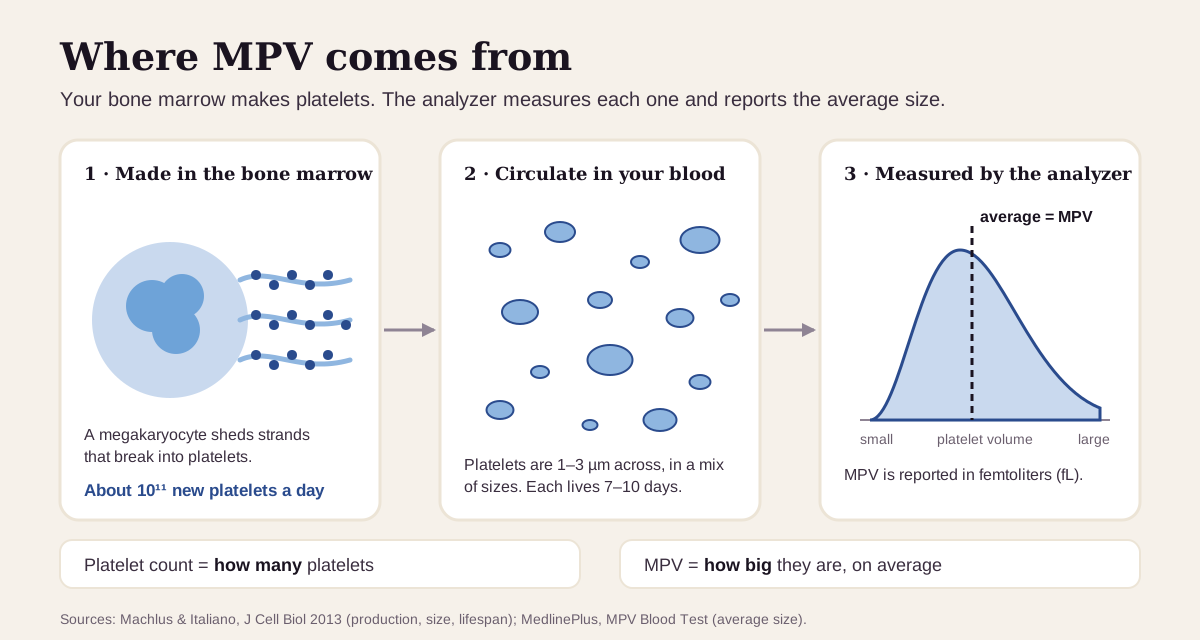
MPV (mean platelet volume) is the average size of your platelets, the tiny cell fragments that plug a bleeding blood vessel. It comes with most complete blood counts (CBCs), right next to the platelet count.1 The count tells you how many platelets you have. MPV tells you how big they are on average, and the two together show whether your bone marrow is keeping up.12
The short version
- Normal: use the range on your report, because MPV depends heavily on the lab's machine. The Libby app uses a lab range of 7.5–12.5 fL and an optimal range of 7.5–10.0 fL. In one study, healthy people's median MPV ran from 7.4 to 10.9 fL depending on the analyzer.34
- High MPV with a low platelet count usually means platelets are being destroyed and replaced quickly, as in immune thrombocytopenia (ITP). A very high MPV with a low count since childhood raises inherited giant-platelet disorders.245
- Low MPV with a low count points toward a bone marrow making too few platelets, as in aplastic anemia.12
- MPV itself has no emergency cutoff. Urgency comes from the platelet count and bleeding: call 911 for bleeding that keeps going when you press on it.6
What MPV is
Platelets are small cell fragments that stick together to stop bleeding. Your bone marrow makes them from giant cells called megakaryocytes: about 10¹¹ (a hundred billion) platelets a day, each of which circulates for 7 to 10 days.7
Platelets come in a range of sizes. The blood-count analyzer measures the volume of each platelet it recognizes and reports the average, and that average is the MPV.1 When platelets are being destroyed quickly, the marrow steps up production and the average size tends to rise. When the marrow itself is failing, the average tends to fall.12 (More on how the machine gets the number at the end.)
That's why MPV is most useful next to the platelet count. A slightly high or low MPV with a normal count says little on its own. Next to a low count, it helps sort out why the count is low.24
What's a normal MPV?
Start with the range printed on your own report. MPV is one of the most machine-dependent numbers on a blood count. Analyzers size platelets in different ways, some by the electrical pulse each platelet makes and some by how it scatters light, and the methods are poorly standardized.8910
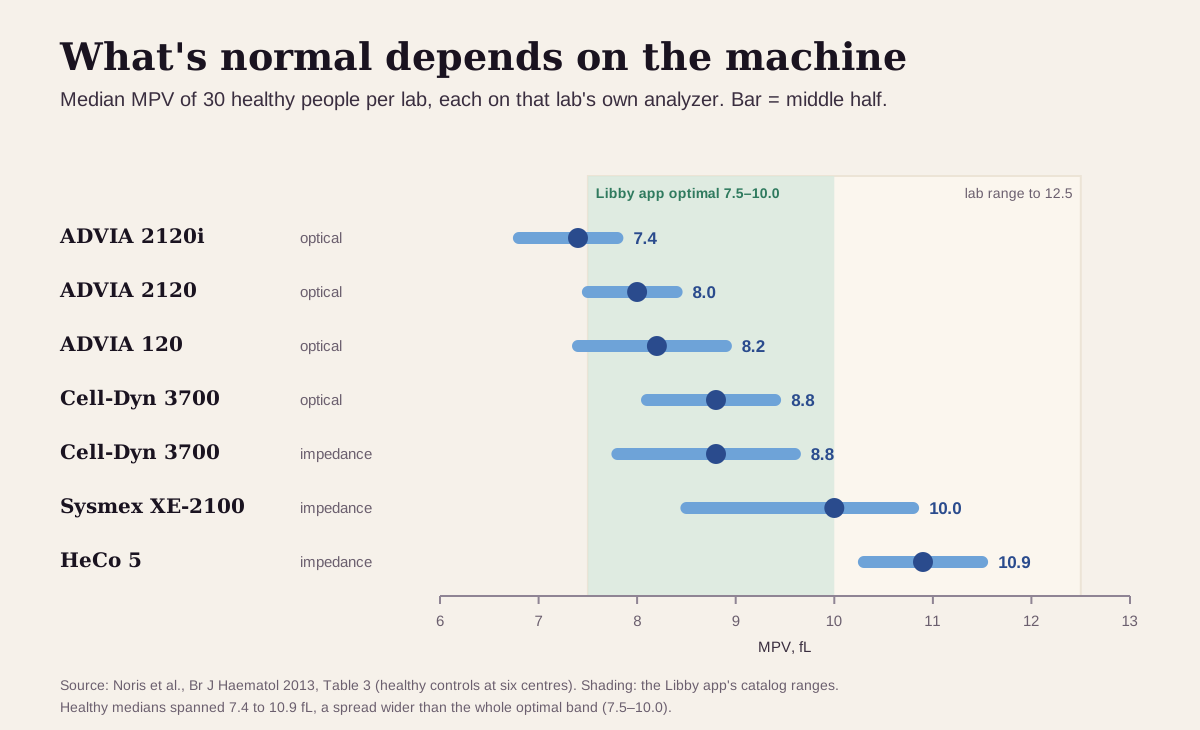
- In an Italian study, 30 healthy people per lab had median MPVs from 7.4 fL (Siemens ADVIA 2120i) to 10.9 fL (HeCo 5), each measured on that lab's own machine.4
- A Korean study of 480 healthy adults on an ADVIA 2120 put the range at 6.7–9.6 fL.9
- A UK study of 2,356 adults on a Sysmex XN-10 put it at 9.1–13.0 fL for men and 9.2–12.8 fL for women.11
Those two ranges barely overlap, and both are right for their machines. The tube matters as well: one study of healthy donors found a range of 7.2–10.8 fL in EDTA (the usual blood-count tube) and 6.1–9.5 fL in citrate.12
Men and women: the UK study found a small sex difference; the Korean study found none.119 MPV also runs a little higher when the platelet count is lower, even in healthy people.13
"Optimal" MPV: what health optimizers aim for
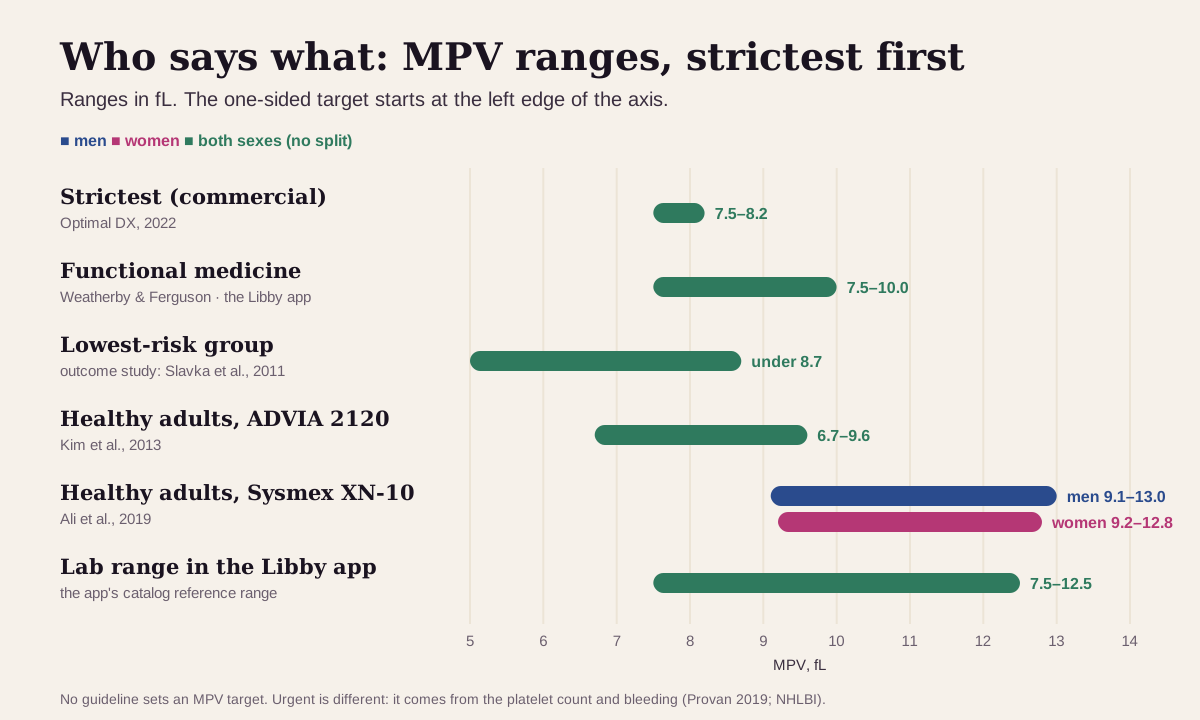
Functional-medicine practitioners and lab-analysis companies aim for the lower part of the lab range. Here's the full ladder, from strictest to loosest:
| Target | Men | Women | Who uses it |
|---|---|---|---|
| Strictest (commercial) | 7.5–8.2 fL | 7.5–8.2 fL | Optimal DX's published "ODX range"14 |
| Functional medicine | 7.5–10.0 fL | 7.5–10.0 fL | The optimal range shown in the Libby app, from the Weatherby & Ferguson functional-medicine textbook3 |
| Lowest-risk group in an outcome study | under 8.7 fL | under 8.7 fL | The reference group in a study of 206,554 hospital patients15 |
| Healthy adults, ADVIA 2120 | 6.7–9.6 fL | 6.7–9.6 fL | Kim et al., Korea9 |
| Healthy adults, Sysmex XN-10 | 9.1–13.0 fL | 9.2–12.8 fL | Ali et al., UK11 |
| Lab range | 7.5–12.5 fL | 7.5–12.5 fL | The reference range in the Libby app3 |
| Guideline | none found | none found | No guideline we found sets an MPV target. The ITP consensus uses MPV only to help tell ITP from inherited platelet disorders5 |
| Urgent | no MPV cutoff | no MPV cutoff | Urgency comes from the platelet count: the risk of major bleeding rises below 20–30 × 10⁹/L5 |
Why the lower targets are more than a trend:
- A 2010 meta-analysis pooled 16 studies of 2,809 people. MPV averaged 9.24 fL in people having a heart attack and 8.48 fL in people who weren't, a pooled difference of 0.92 fL.16
- In 3,184 heart-attack patients, those with an elevated MPV (10.3 fL or more in two studies, above 9 fL in one) died more often: 11.5% versus 7.1% (odds ratio 1.65).16
- In a Vienna study of 206,554 hospital patients, compared with an MPV under 8.7 fL, the risk of dying from ischemic heart disease was 1.2 times higher at 8.71–9.60 fL and 1.8 times higher at 11.01 fL or more. Vascular deaths overall were 1.5 times higher in the top group.15
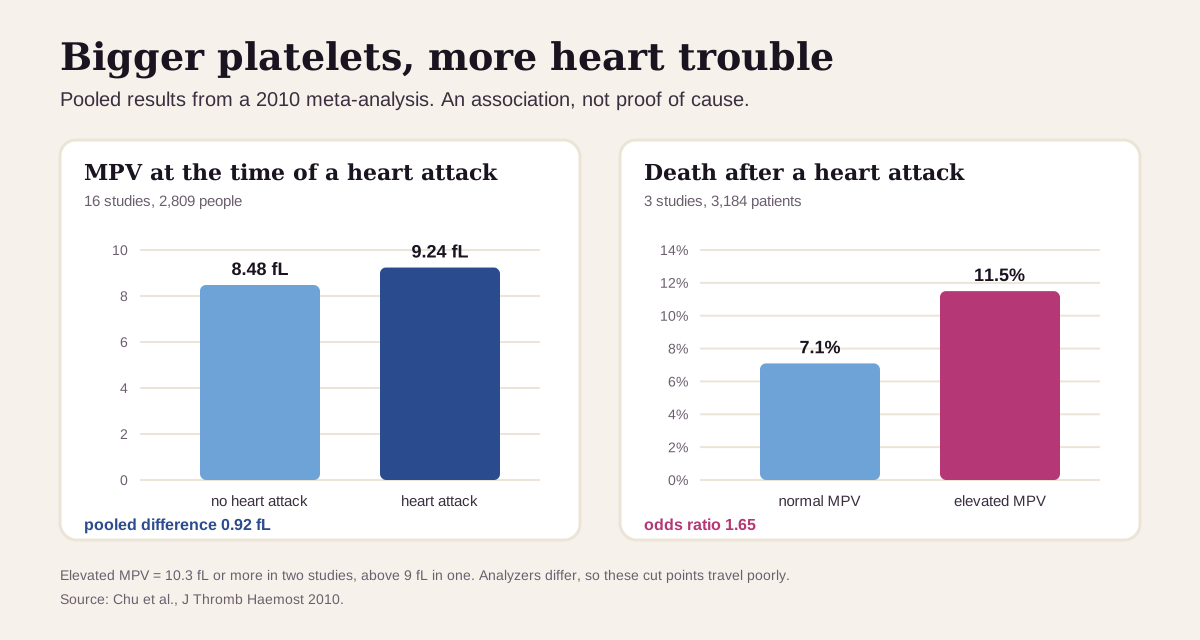
Keep "optimal" in perspective. These are group averages, and the gaps are small next to the gap between machines: healthy people's medians differed by 3.5 fL across analyzers, against 0.92 fL between heart-attack patients and everyone else.416 Italian platelet specialists conclude that "MPV has presently no role in making diagnosis and defining prognosis in any acquired illness."10 Lower isn't automatically better, either. A low MPV goes with a marrow making too few platelets and with very active inflammation, and the app's optimal band starts at 7.5 fL, the bottom of its lab range.1173
What a high or low MPV usually means
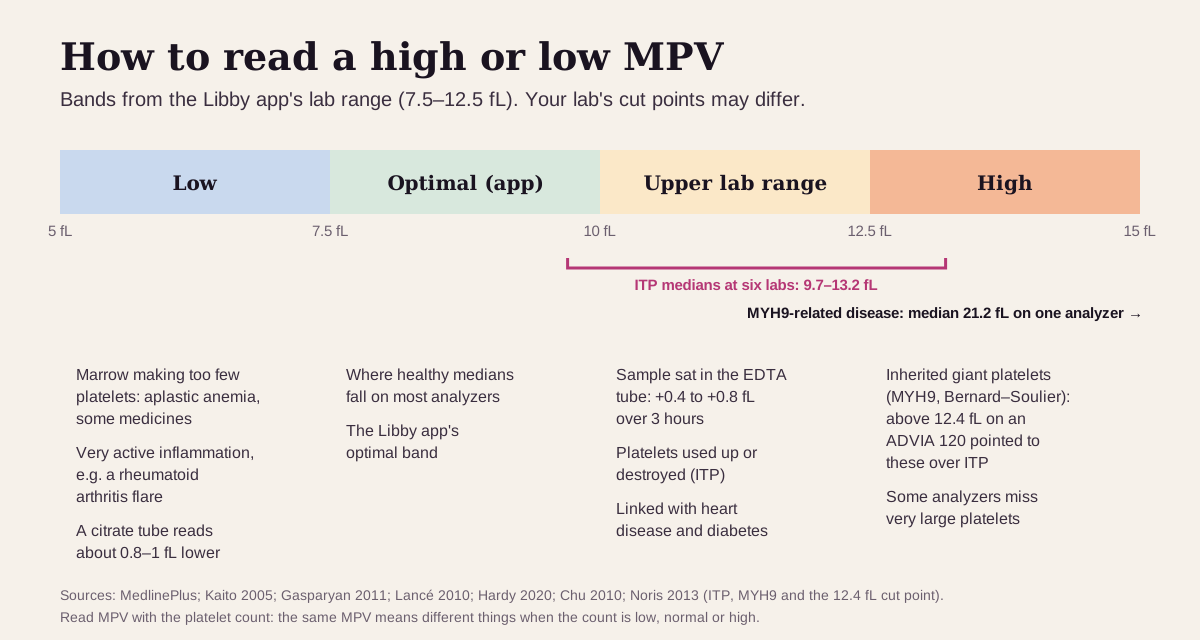
Start with the platelet count. The same MPV means different things when the count is low, normal or high.1
High MPV: larger platelets
The usual suspects:
- The sample and the machine. Platelets swell in the tube after the draw. In healthy volunteers, MPV rose 0.4 fL in the first 30 minutes and 0.8 fL by 3 hours in an EDTA tube.13 A different lab or analyzer can shift it by more than that.4 A mildly high MPV with a normal platelet count is worth rechecking at the same lab before you read much into it.10
- Platelets being destroyed quickly. In immune thrombocytopenia (ITP), platelets are cleared faster than normal and the marrow replaces them. MPV runs higher than in healthy people, and higher than when the marrow is failing.42
- Heart and metabolic risk. Higher MPV shows up with heart disease and diabetes, and in people having a heart attack.116
- Less common: myeloproliferative diseases (blood cancers in which the marrow overproduces cells), preeclampsia in pregnancy, and hemolytic anemia.1
- Rare but important: inherited giant platelets. Conditions such as MYH9-related disease and Bernard–Soulier syndrome combine very large platelets with a low count, often from early life.5 On an ADVIA 120, an MPV above 12.4 fL separated them from ITP with more than 80% sensitivity and specificity in an earlier study. In one lab, MYH9-related disease had a median MPV of 21.2 fL.4 Some impedance analyzers miss very large platelets altogether and report a falsely low count, or no MPV at all.4
Low MPV: smaller platelets
- A marrow making too few platelets. Aplastic anemia, certain cancers and some medicines can lower MPV.1 In one study, MPV was lower in aplastic anemia than in ITP.2
- Very active inflammation. In high-grade inflammatory disease, such as active rheumatoid arthritis or an attack of familial Mediterranean fever, MPV runs low and rises again with treatment.17
- Other links: infections, autoimmune disease, alcohol use disorder and some genetic conditions.1
- The tube. Blood drawn into citrate reads about 0.8–1 fL lower than blood in EDTA.1213
Get prompt care for bleeding that keeps going when you press on it: call 911. See a clinician soon for pinpoint red spots on the skin (petechiae), purple or brown bruise-like spots (purpura), nosebleeds or bleeding gums, blood in your urine or stool, or unusually heavy periods, whatever your MPV.6
MPV reads best next to its neighbors
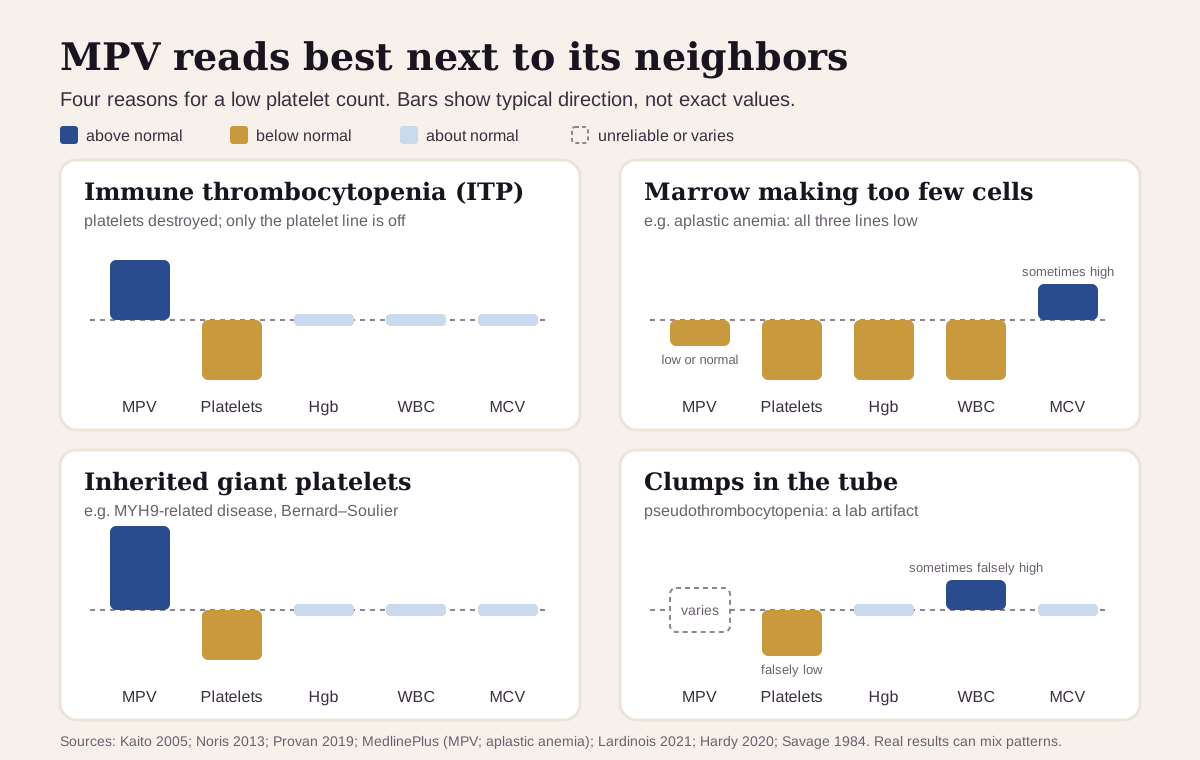
When the platelet count is low, MPV and the rest of the blood count together often point to the reason:245
| If you see… | It often points to… |
|---|---|
| Low platelets and a high MPV, the rest of the blood count usually normal | platelets destroyed faster than normal, as in immune thrombocytopenia (ITP) |
| Low platelets, a low or normal MPV, and low hemoglobin and white cells, sometimes with a high MCV | a marrow making too few cells, as in aplastic anemia |
| Low platelets with a very high MPV, often since early life or in the family | an inherited giant-platelet disorder, such as MYH9-related disease or Bernard–Soulier syndrome |
| Low platelets flagged for clumps, sometimes with a falsely high white count | platelets clumping in the EDTA tube (pseudothrombocytopenia); a redraw in a different tube usually fixes it |
| High platelets with iron-deficiency anemia | a high count that tracks the iron deficiency: in one study, 28% of women with iron-deficiency anemia had a high platelet count, and counts ran higher as MPV ran lower |
Clumping is worth ruling out first. It turns up in 0.03–0.27% of outpatients, but in about 15% of people sent to a clinic for an isolated low platelet count.8 The clumps can also be counted as white cells, which falsely raises the white count.19 The ITP consensus asks clinicians to check a blood smear for clumps and for giant or small platelets before calling a low count ITP.5 The table's last row comes from a study of 86 women with iron-deficiency anemia.20
How fast MPV changes
In the tube, within minutes. After the blood draw, platelets swell. In 20 healthy volunteers, MPV in the usual EDTA tube rose 0.4 fL (3.8%) by 30 minutes and 0.8 fL (7.9%) by 3 hours, with most of the rise in the first 30 minutes. The researchers counted a change of more than 4% as meaningful.13
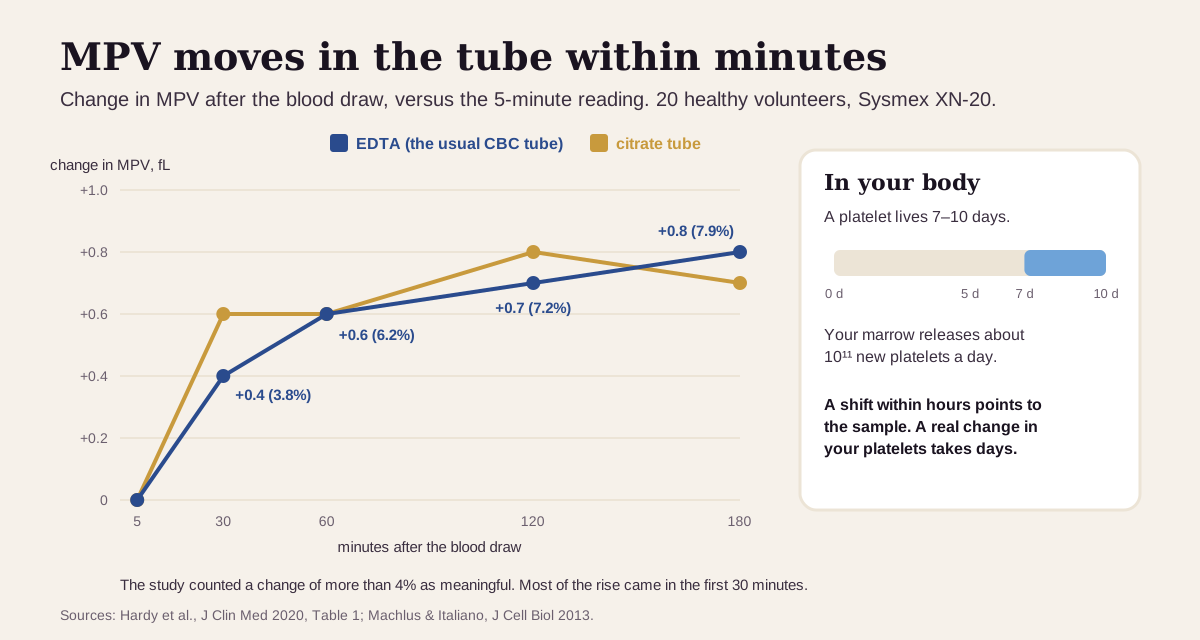
In your body, over days. Each platelet lives 7–10 days, and your marrow releases about 10¹¹ new ones a day.7 So a real change in platelet size builds over days. That lifespan is also why an MPV taken when someone arrives with a heart attack mostly reflects platelets made before the event.16
What that means in practice:
- Compare like with like. Same lab, same tube, similar time from draw to analysis. A new lab can move your MPV more than your body does.413
- Watch the count and MPV together. In people with ITP, MPV stayed high at every stage of the disease in one study, so a steady high MPV beside a steady low count tells a consistent story.4
- Trends beat snapshots. A single mildly high result with a normal count can reflect the sample. The same change on two tests from the same lab is more likely to be real.1310
Going deeper: how the machine gets the number
MPV is a ratio. The analyzer measures how much of your blood volume is platelets (the plateletcrit) and how many platelets there are, then divides one by the other:11
MPV = plateletcrit ÷ platelet count
Machines differ. Impedance counters size each particle by the electrical pulse it makes passing between two electrodes, so particles of similar size can be mixed up.8 Optical counters, such as the ADVIA 2120, use laser light scatter instead.9 In the Italian study, impedance counters struggled most with giant platelets: some skipped the MPV entirely, and one greatly underestimated both the count and the MPV.4
Are big platelets young platelets? Many sources say so, including MedlinePlus.1 A classic tracer study in baboons found otherwise: large platelets were not younger, they lived slightly longer, and their size was set in the marrow when they were made.21 Either way, the practical reading holds: next to a low count, a high MPV points more toward fast platelet destruction than toward a failing marrow.2
Questions worth asking
- What was my platelet count, and has it changed since my last test?
- Did the lab flag clumps, giant platelets or an unreliable result?
- Was my blood looked at under a microscope (a blood smear)?
- Was this run on the same lab and analyzer as my last test?
- If my count is low, does my MPV point toward destruction or low production?
- When should we repeat the blood count, and in which tube?
FAQ
What is a normal MPV? It depends on the lab's analyzer. The Libby app uses a lab range of 7.5–12.5 fL and an optimal range of 7.5–10.0 fL. Healthy people's medians ran from 7.4 to 10.9 fL across machines in one study.34
Is a high MPV dangerous? On its own, usually not. It matters most next to a low platelet count, where it often points to platelets being destroyed and replaced quickly, as in ITP. Large studies link higher MPV with heart attacks, but the differences are small.216
What does a low MPV mean? Next to a low platelet count, it points toward a marrow making too few platelets, as in aplastic anemia. It also shows up with very active inflammation.1217
Why did my MPV change between tests? The sample and the lab can move it. Platelets swell in the tube for hours after the draw, and different analyzers give different numbers for the same kind of blood.134
This guide is for education. It can't diagnose you or replace care from a clinician who knows your history.
Footnotes
-
National Library of Medicine. MPV Blood Test. MedlinePlus. Last updated October 30, 2024. What MPV measures, and the conditions linked with high and low results. MedlinePlus ↩ ↩2 ↩3 ↩4 ↩5 ↩6 ↩7 ↩8 ↩9 ↩10 ↩11 ↩12 ↩13 ↩14 ↩15 ↩16
-
Kaito K, Otsubo H, Usui N, et al. Platelet size deviation width, platelet large cell ratio, and mean platelet volume have sufficient sensitivity and specificity in the diagnosis of immune thrombocytopenia. Br J Haematol. 2005;128(5):698–702. 39 patients with ITP compared with 40 with aplastic anemia: every platelet size index was higher in ITP. PubMed ↩ ↩2 ↩3 ↩4 ↩5 ↩6 ↩7 ↩8 ↩9 ↩10 ↩11 ↩12 ↩13
-
Weatherby D, Ferguson S. Blood Chemistry and CBC Analysis: Clinical Laboratory Testing from a Functional Perspective. 2nd ed. Bear Mountain Publishing; 2004. ISBN 978-0976136712. The source the Libby app's marker catalog records for its optimal MPV range of 7.5–10.0 fL; the catalog pairs it with a lab range of 7.5–12.5 fL. ↩ ↩2 ↩3 ↩4 ↩5 ↩6 ↩7
-
Noris P, Klersy C, Gresele P, et al. Platelet size for distinguishing between inherited thrombocytopenias and immune thrombocytopenia: a multicentric, real life study. Br J Haematol. 2013;162(1):112–119. 130 people with ITP, 113 with inherited thrombocytopenias and 30 healthy controls per centre at six Italian centres. Table 3 gives the medians by analyzer. PMC ↩ ↩2 ↩3 ↩4 ↩5 ↩6 ↩7 ↩8 ↩9 ↩10 ↩11 ↩12 ↩13 ↩14 ↩15 ↩16 ↩17 ↩18
-
Provan D, Arnold DM, Bussel JB, et al. Updated international consensus report on the investigation and management of primary immune thrombocytopenia. Blood Adv. 2019;3(22):3780–3817. The international ITP consensus: an isolated low count, the 20–30 × 10⁹/L bleeding threshold, the smear check, and the role of MPV. PMC ↩ ↩2 ↩3 ↩4 ↩5 ↩6 ↩7
-
National Heart, Lung, and Blood Institute. Thrombocytopenia. National Institutes of Health. When to call 911, and the signs of bleeding from a low platelet count. NHLBI ↩ ↩2
-
Machlus KR, Italiano JE Jr. The incredible journey: from megakaryocyte development to platelet formation. J Cell Biol. 2013;201(6):785–796. About 10¹¹ platelets made a day, a 7–10 day lifespan, and a diameter of 1–3 µm. PMC ↩ ↩2 ↩3 ↩4 ↩5
-
Lardinois B, Favresse J, Chatelain B, Lippi G, Mullier F. Pseudothrombocytopenia: a review on causes, occurrence and clinical implications. J Clin Med. 2021;10(4):594. PMC ↩ ↩2 ↩3 ↩4
-
Kim MJ, Park PW, Seo YH, et al. Reference intervals for platelet parameters in Korean adults using ADVIA 2120. Ann Lab Med. 2013;33(5):364–366. 480 adults aged 19–82. PMC ↩ ↩2 ↩3 ↩4 ↩5 ↩6
-
Noris P, Melazzini F, Balduini CL. New roles for mean platelet volume measurement in the clinical practice? Platelets. 2016;27(7):607–612. PubMed ↩ ↩2 ↩3 ↩4
-
Ali U, Gibbs R, Knight G, Tsitsikas D. Sex-divided reference intervals for mean platelet volume, platelet large cell ratio and plateletcrit using the Sysmex XN-10 automated haematology analyzer in a UK population. Hematol Transfus Cell Ther. 2019;41(2):153–157. 2,356 adults (791 men, 1,565 women). PMC ↩ ↩2 ↩3 ↩4 ↩5
-
Lancé MD, van Oerle R, Henskens YM, Marcus MA. Do we need time adjusted mean platelet volume measurements? Lab Hematol. 2010;16(3):28–31. MPV 8.0 fL in EDTA versus 7.0 fL in citrate, and reference ranges of 7.2–10.8 fL (EDTA) and 6.1–9.5 fL (citrate). PubMed ↩ ↩2 ↩3
-
Hardy M, Lessire S, Kasikci S, et al. Effects of time-interval since blood draw and of anticoagulation on platelet testing (count, indices and impedance aggregometry): a systematic study with blood from healthy volunteers. J Clin Med. 2020;9(8):2515. 20 healthy volunteers, Sysmex XN-20. PMC ↩ ↩2 ↩3 ↩4 ↩5 ↩6 ↩7 ↩8 ↩9 ↩10
-
Optimal DX. CBC Biomarkers: Mean Platelet Volume (MPV). Published June 28, 2022; updated November 6, 2023. States a standard range of 7.5–11.5 fL and an "ODX Range" of 7.5–8.2 fL. A commercial source, listed as what the optimizer community uses. optimaldx.com ↩ ↩2
-
Slavka G, Perkmann T, Haslacher H, et al. Mean platelet volume may represent a predictive parameter for overall vascular mortality and ischemic heart disease. Arterioscler Thromb Vasc Biol. 2011;31(5):1215–1218. 206,554 first admissions to the Vienna General Hospital, analyzed by MPV quintile. PubMed ↩ ↩2 ↩3
-
Chu SG, Becker RC, Berger PB, et al. Mean platelet volume as a predictor of cardiovascular risk: a systematic review and meta-analysis. J Thromb Haemost. 2010;8(1):148–156. PMC ↩ ↩2 ↩3 ↩4 ↩5 ↩6 ↩7 ↩8
-
Gasparyan AY, Ayvazyan L, Mikhailidis DP, Kitas GD. Mean platelet volume: a link between thrombosis and inflammation? Curr Pharm Des. 2011;17(1):47–58. PubMed ↩ ↩2 ↩3 ↩4
-
National Library of Medicine. Aplastic anemia. MedlinePlus Medical Encyclopedia. Review date January 29, 2026. Low red cells, white cells and platelets. MedlinePlus ↩
-
Savage RA. Pseudoleukocytosis due to EDTA-induced platelet clumping. Am J Clin Pathol. 1984;81(3):317–322. PubMed ↩ ↩2
-
Kadikoylu G, Yavasoglu I, Bolaman Z, Senturk T. Platelet parameters in women with iron deficiency anemia. J Natl Med Assoc. 2006;98(3):398–402. 86 women; 24 (27.9%) had a high platelet count. PMC ↩
-
Thompson CB, Love DG, Quinn PG, Valeri CR. Platelet size does not correlate with platelet age. Blood. 1983;62(2):487–494. PubMed ↩
Educational content, not medical advice. Libby is a personal record tool, not a medical service — it doesn't diagnose, treat, or prescribe. Reference ranges vary by lab and by person. Talk to a qualified healthcare professional about your results.
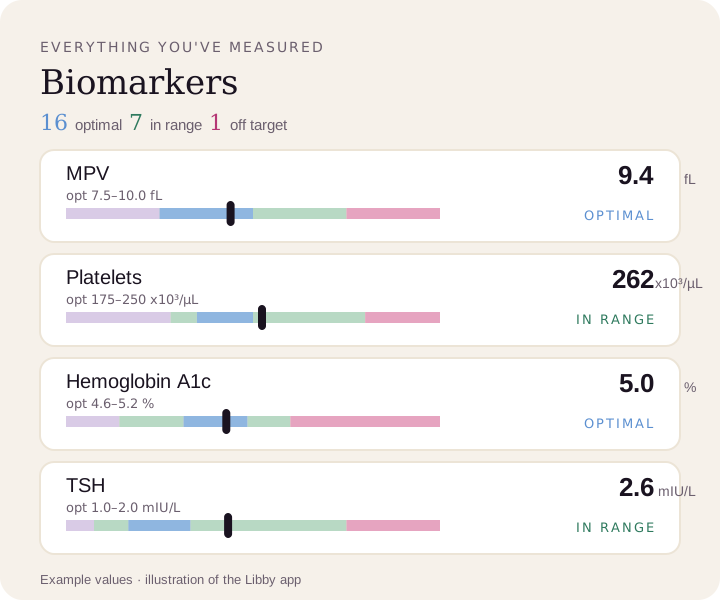
Compare your results to optimal ranges.
Upload a lab PDF or a photo of your report. Libby shows every marker against a lab reference range and the optimal range, and tracks your trends over time.
View your MPV ›