Phosphorus blood test: normal range, low and high causes
Phosphorus is a mineral shared by your bones, cells and kidneys. Here's the normal range, what low and high results usually mean, and when it's urgent.
Phosphorus is a mineral your body stores mostly in bone, and the blood test measures the small amount circulating as phosphate. Your gut absorbs it from food, your bones hold it, and your kidneys decide how much to keep. That makes a phosphorus result a window on your kidneys and on the two hormone systems that manage calcium: parathyroid hormone (PTH) and vitamin D.12
The short version
- Normal: most adult reports print about 2.5–4.5 mg/dL. Women run a little higher than men, and children higher still.34
- Mildly low is common and often harmless. A carb-heavy meal before the draw, alcohol, some antacids or an iron infusion can pull it down. Under 1.0 mg/dL is severe and needs prompt care.51
- High most often points to the kidneys, usually once kidney function has fallen a long way. A blood sample that sat too long before it was spun can also read high.46
- Phosphorus makes the most sense next to calcium and PTH. The pattern across the three points to the kidneys, the parathyroid glands or vitamin D.7
What phosphorus is
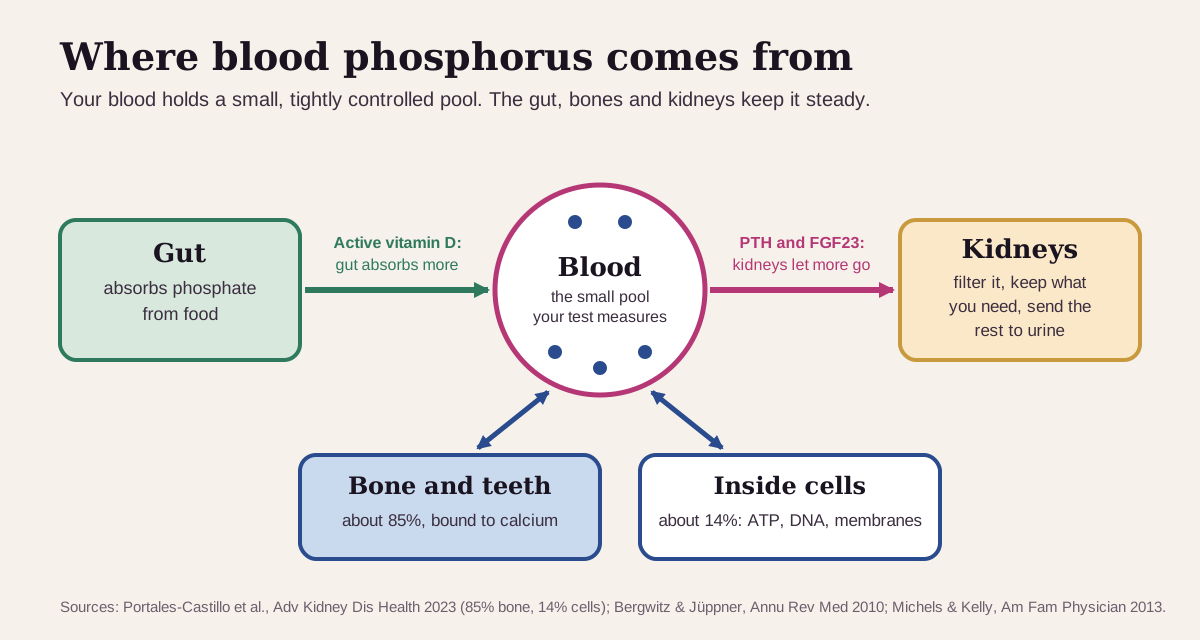
Phosphorus is a mineral, and in your body it travels as phosphate. That's why reports use both names for the same test.1 About 85% of it sits in your bones and teeth, bound to calcium. About 14% is inside your cells, where it helps build DNA, cell membranes and ATP, the molecule cells run on.2 The blood test sees the small share that's left.
Three organs set that level. Your gut absorbs phosphate from food, helped by active vitamin D. Your bones trade phosphate with the blood. Your kidneys filter it and send the extra into urine. Two hormones tell the kidneys to let more go: PTH, from the parathyroid glands in your neck, and FGF23, made by bone cells.79
Clinicians usually order phosphorus alongside calcium, vitamin D and PTH, and they check it regularly in people with moderate or advanced kidney disease.18
What's a normal phosphorus?
Start with the range printed on your report. Most adult ranges sit near 2.5–4.5 mg/dL, the standard used in large population studies.3 Labcorp, a commercial lab, now prints separate adult ranges from its own studies: 2.8–4.1 mg/dL for men and 3.0–4.3 mg/dL for women.4
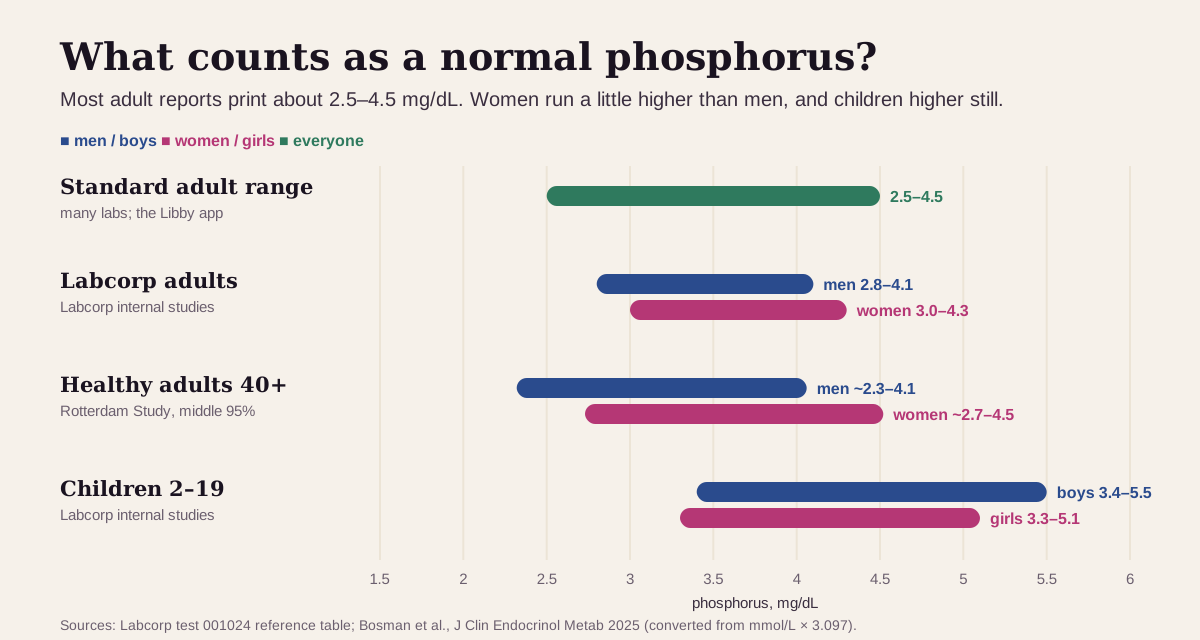
- Women run higher than men. In the Rotterdam Study of 8,837 adults aged 40 and over without kidney disease, the middle 95% of men fell between about 2.3 and 4.1 mg/dL, and of women between about 2.7 and 4.5. Women's levels rose around menopause, and the authors call for separate ranges for men and women over 45.3
- Children run higher because their bones are growing. Labcorp's range for ages 2 to 19 is 3.4–5.5 mg/dL for boys and 3.3–5.1 for girls.41
- Time of day and meals matter. Phosphorus runs lowest in the morning, and a carb-heavy meal lowers it (more below).104
"Optimal" phosphorus: what health optimizers aim for
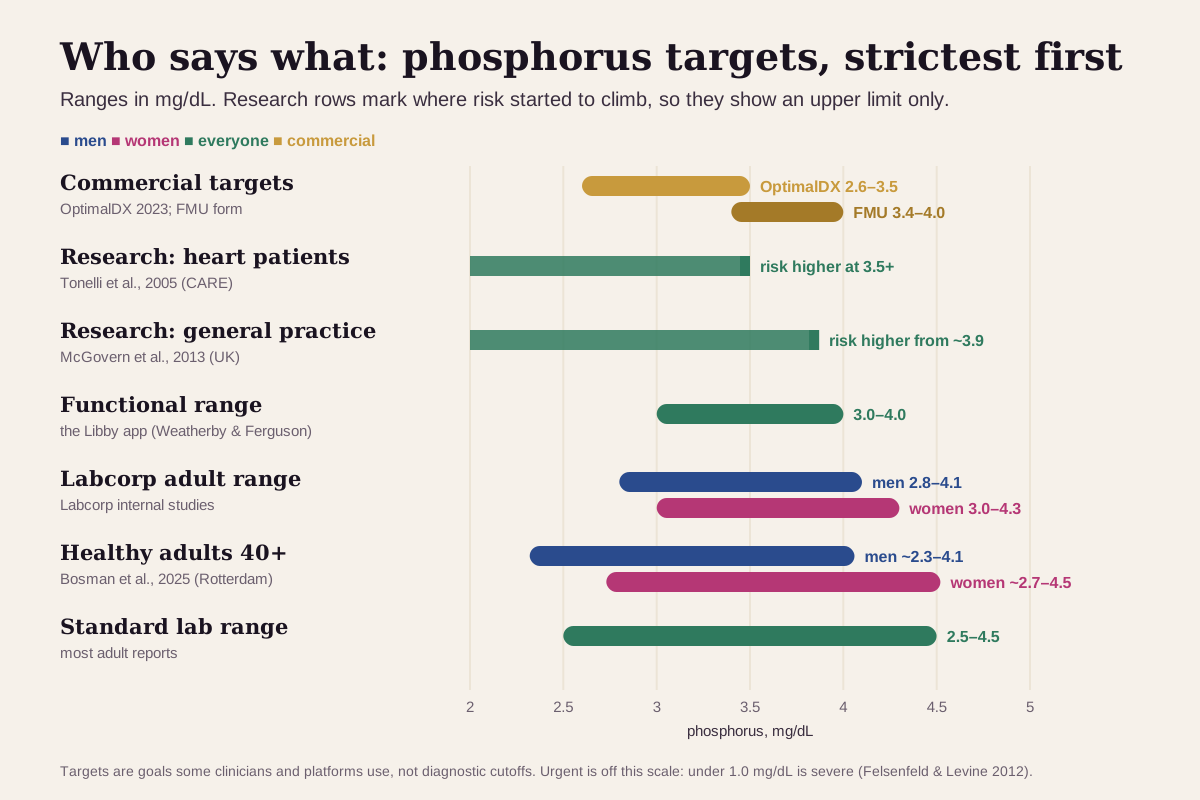
Functional-medicine practitioners and testing companies aim for a narrower band than the lab range, and mostly they trim the top. Here's the ladder, from strictest to loosest:
| Target | Men | Women | Who uses it |
|---|---|---|---|
| Strictest (commercial) | 2.6–3.5 mg/dL | 2.6–3.5 mg/dL | OptimalDX, a functional blood-chemistry software company11 |
| Research risk cut-off | under 3.5 mg/dL | under 3.5 mg/dL | Heart-attack survivors at 3.5 or more had a 27% higher risk of death13 |
| Research risk cut-off | under about 3.9 mg/dL | under about 3.9 mg/dL | UK adults with normal kidneys had higher odds of heart events from about 3.914 |
| Functional medicine | 3.0–4.0 mg/dL | 3.0–4.0 mg/dL | The optimal range shown in the Libby app, which credits the Weatherby & Ferguson textbook15 |
| Another commercial band | 3.4–4.0 mg/dL | 3.4–4.0 mg/dL | Functional Medicine University's tracking form12 |
| Labcorp adult range | 2.8–4.1 mg/dL | 3.0–4.3 mg/dL | Labcorp's own reference studies4 |
| Healthy adults 40+ | about 2.3–4.1 mg/dL | about 2.7–4.5 mg/dL | Rotterdam Study, middle 95%3 |
| Standard lab range | 2.5–4.5 mg/dL | 2.5–4.5 mg/dL | Most adult reports3 |
| Urgent | under 1.0 mg/dL | under 1.0 mg/dL | Severe low: get care promptly5 |
Why the top of the range gets trimmed:
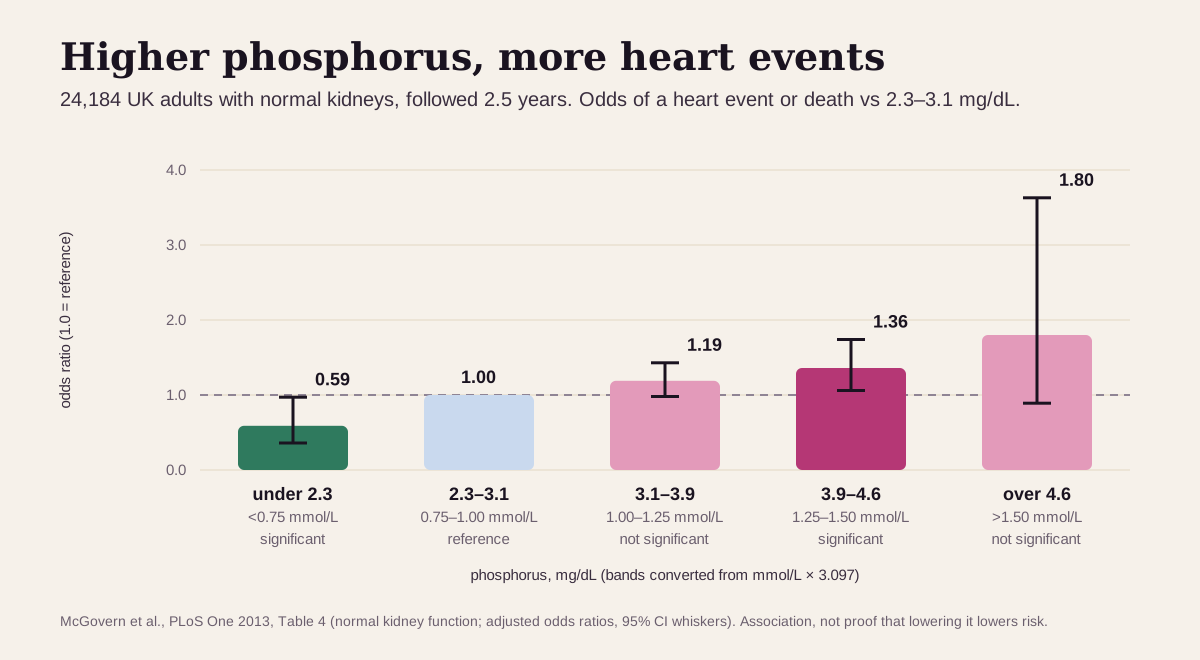
- In 24,184 UK adults with normal kidney function, people at 3.9–4.6 mg/dL had 36% higher odds of a heart event or death over 2.5 years than people at 2.3–3.1. Below 2.3, the odds were 41% lower.14
- In the Framingham Offspring Study (3,368 adults free of heart and kidney disease, followed for 16 years), each 1 mg/dL higher meant 31% more heart disease. The top quarter had 1.55 times the risk of the bottom quarter.16
- In 4,127 heart-attack survivors, most of them inside the normal range, a phosphorus of 3.5 or more carried a 27% higher risk of death.13
Keep "optimal" in perspective: these are targets, not diagnoses. Kidney function, diet and hormones move both phosphorus and heart risk, and the benefit of lowering a normal phosphorus remains unproven in people with healthy kidneys.2 Even in kidney disease, guidelines treat phosphorus only once it is high, and they found an absence of data that holding it in the normal range helps.8 Lower has limits too: a sudden severe drop weakens muscles, including the ones you breathe with, and a long-term shortage softens bones (osteomalacia).25
What a low or high phosphorus usually means
The size and direction of the change are the first clues. Clinicians grade low results by how far they fall below 2.5 mg/dL.5
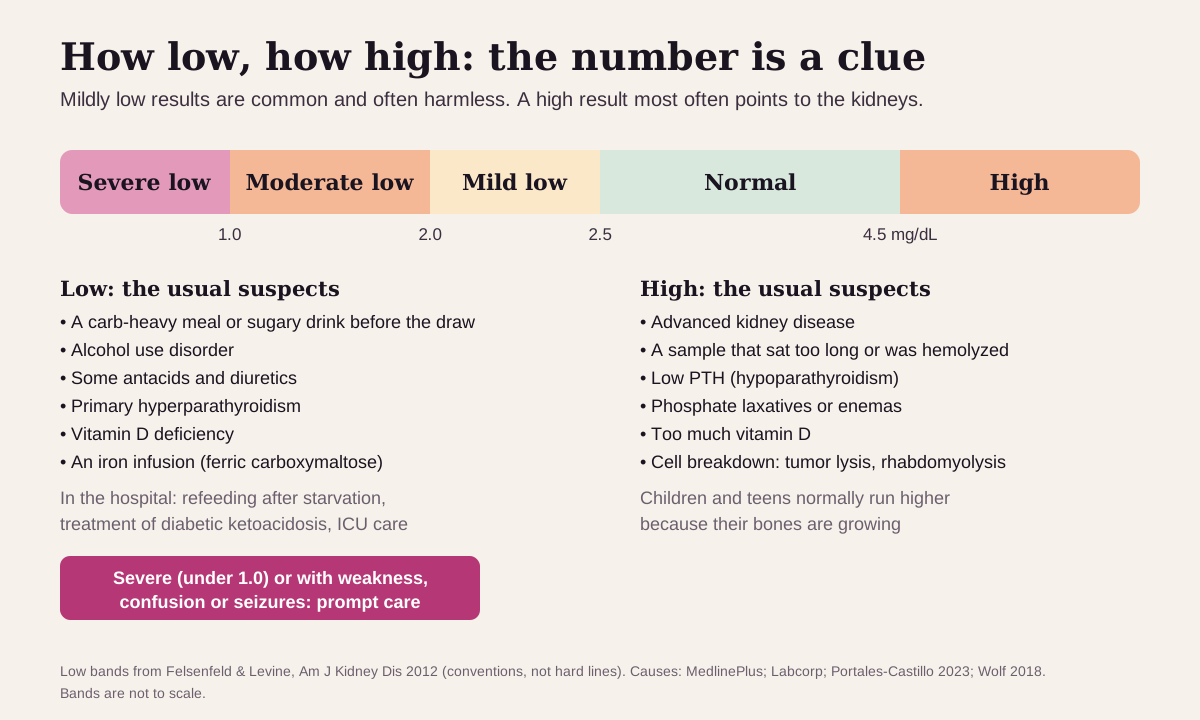
Low (under 2.5 mg/dL): usually mild and short-lived
Mildly low results are common and often cause no symptoms.1 The usual suspects:
- A carb-heavy meal before the draw. Sugar and insulin pull phosphate into cells for a while, and Labcorp notes that recent carbohydrate lowers the result.4 Some labs ask you to fast before the test.1
- Alcohol. Heavy drinking is one of the most frequent findings in people with low phosphorus.45
- Medicines. Antacids made with aluminum, magnesium or calcium carbonate bind phosphate in the gut, and some diuretics can lower it too.12
- An iron infusion. In a trial of nearly 2,000 adults with iron-deficiency anemia, 50.8% of those given ferric carboxymaltose dropped below 2.0 mg/dL, versus 0.9% with ferumoxytol.17
- Primary hyperparathyroidism. Too much PTH makes the kidneys dump phosphate while calcium climbs.17
- Vitamin D deficiency. Less phosphate is absorbed, PTH rises, and over time the bones soften.118
- In the hospital: refeeding after starvation, treatment of diabetic ketoacidosis (DKA), surgery and intensive care are the classic settings for a sudden drop.519
A poor diet alone rarely causes it. Low intake is uncommon in the US, and the kidneys hold on to phosphate when intake falls.12
High (over 4.5 mg/dL): check the kidneys and the sample
High-normal readings are common: about 15% of the general population has a phosphorus of 4.4 mg/dL or more.2 The usual suspects for a truly high result:
- Kidney disease. This is the classic lasting cause. The kidneys compensate for a long time, so phosphorus usually climbs only once kidney function has fallen to about a quarter of normal.142
- The sample. Blood that waits too long before it's spun, or damaged red cells (hemolysis), leaks phosphate into the tube. Labcorp asks for serum to be separated within 45 minutes. In one study, blood left unspun at room temperature for 48 hours read at least 1.5 times higher.46
- Low PTH (hypoparathyroidism). It most often follows neck surgery. Calcium runs low and phosphorus high.71
- Phosphate laxatives and enemas, especially when the kidneys are weak.12
- Too much vitamin D from supplements, which boosts absorption.2
- Cell breakdown. Tumor lysis after cancer treatment and severe muscle breakdown (rhabdomyolysis) spill phosphate out of cells. In tumor lysis syndrome, an adult phosphorus above 4.5 mg/dL is one of the defining lab changes.220
Get prompt care if your phosphorus is under 1.0 mg/dL, or if a low result comes with muscle weakness or pain, confusion or seizures. The same goes for a high result with muscle cramps, seizures or an irregular heartbeat (signs that calcium has dropped), or one that shows up during cancer treatment.5120
Phosphorus reads best next to its neighbors
Phosphorus and calcium answer to the same hormones, so the pair plus PTH usually says far more than phosphorus alone:71
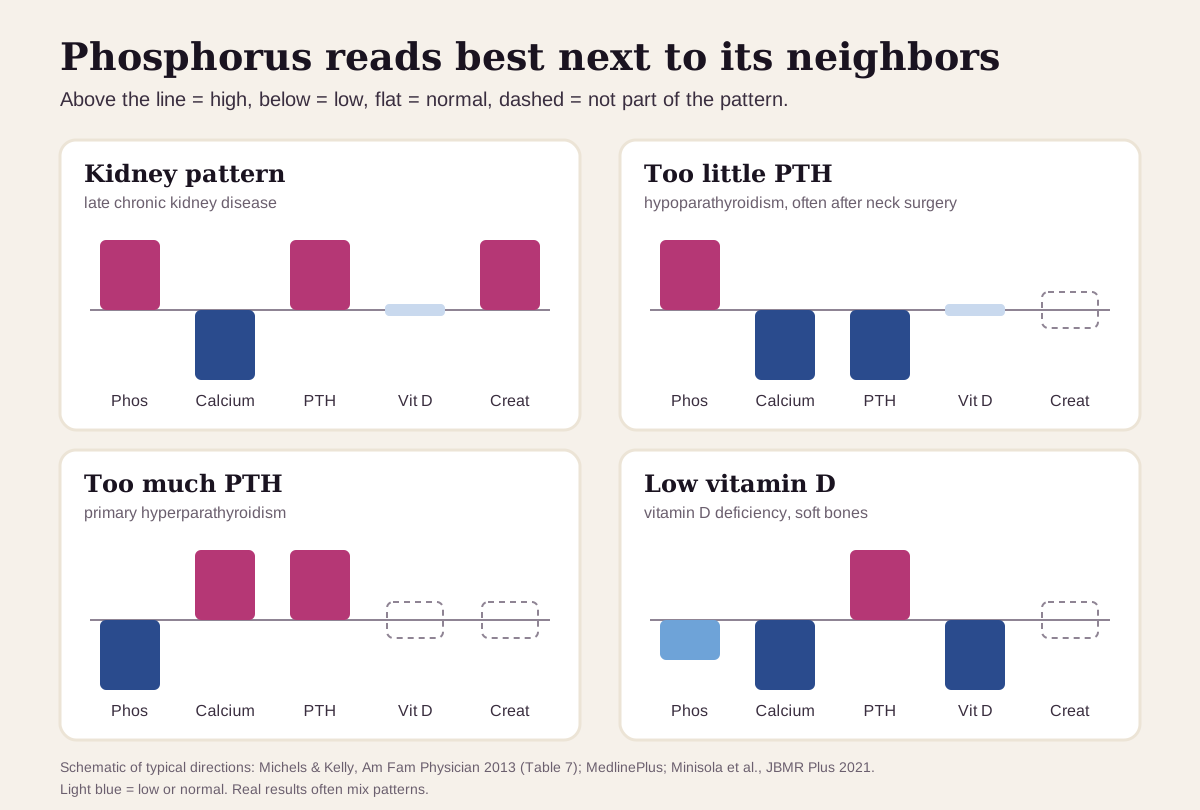
| If you see… | It often points to… |
|---|---|
| Phosphorus high, calcium low, PTH high, creatinine high | kidney disease: the kidneys can no longer clear phosphate, and PTH rises in response (secondary hyperparathyroidism) |
| Phosphorus high, calcium low, PTH low | hypoparathyroidism, most often after neck surgery |
| Phosphorus low, calcium high, PTH high | primary hyperparathyroidism, the most common cause of high calcium in outpatients |
| Phosphorus low or normal, calcium low, PTH high, vitamin D low | vitamin D deficiency; alkaline phosphatase often rises as bones soften |
| Phosphorus, potassium or magnesium falling within 5 days of eating again after starvation | refeeding syndrome |
| Phosphorus, potassium and uric acid high, calcium low, from a few days before to a week after starting cancer treatment | tumor lysis syndrome |
Table sources: kidney, parathyroid and vitamin D rows;7118 refeeding;19 tumor lysis.20 In kidney disease, guidelines read these markers as a set: KDIGO recommends checking calcium, phosphate, PTH and alkaline phosphatase from stage 3a onward, and basing treatment on repeated results considered together.8
How fast phosphorus changes
Phosphorus moves within hours. Labcorp notes it can vary by as much as 2.0 mg/dL over a day.4 In a careful feeding study, people with kidney disease on a high-phosphate diet averaged 4.2 mg/dL at 8 a.m. and 4.5 at 4 p.m., with a second peak overnight. Healthy volunteers showed a similar pattern.10
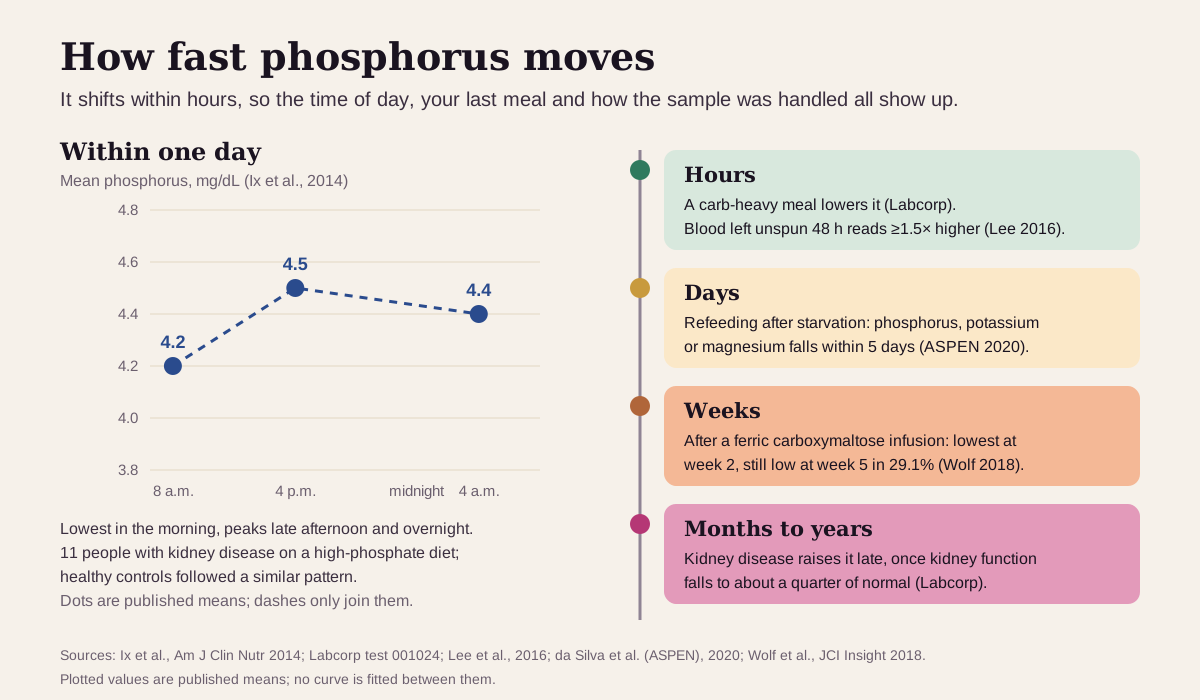
What that means in practice:
- Compare like with like. The 8 a.m. value was the lowest and changed least with diet in that study, so morning draws at a consistent time make for a steadier comparison.10
- Hospital shifts are fast. In refeeding, phosphorus, potassium or magnesium falls within 5 days of eating again.19
- Iron infusions act over weeks. After ferric carboxymaltose, phosphorus bottomed out at week 2 and was still low at week 5 in 29.1% of people.17
- Kidney-related rises build over months to years. That's why kidney guidelines base decisions on repeated results rather than a single value.8
Going deeper: phosphorus, phosphate and the hormones
Phosphorus is the element, with a molar mass of 30.97 g/mol. In the body it exists as phosphate ions, which weigh 94.97 g/mol.2 Labs report the phosphorus content, so unit conversions use the smaller number.
The kidneys do the fine-tuning. Only about 30% of gut absorption is regulated by active vitamin D, so the kidneys set most of the level by deciding how much filtered phosphate to reclaim.9
PTH pulls in two directions. It releases calcium and phosphate from bone, but it also makes the kidneys excrete phosphate. The net effect of high PTH is a lower blood phosphorus with a higher calcium.7
FGF23 is the bone's phosphate signal. Bone cells called osteocytes make more of it when phosphate or active vitamin D rises.9 FGF23 makes the kidneys waste phosphate and lowers active vitamin D. That's the mechanism behind the iron-infusion drop: ferric carboxymaltose raised active FGF23 about fourfold.17 In kidney disease, FGF23 matters most as a compensation that keeps phosphorus normal while kidney function declines.2
Questions worth asking
- Was this a morning, fasting sample, and was it processed promptly?
- What do my calcium, PTH and vitamin D show next to it?
- How is my kidney function (creatinine, eGFR)?
- Could any of my medicines, antacids, supplements or a recent iron infusion be involved?
- If it's high, should we repeat it with a fresh sample first?
- When should we recheck, and at what time of day?
FAQ
What is a normal phosphorus level? Most adult ranges are about 2.5–4.5 mg/dL. Labcorp uses 2.8–4.1 for men and 3.0–4.3 for women, and children run higher.34
What is the most common cause of high phosphorus? Kidney disease, usually once kidney function has fallen a long way. A blood sample that waited too long before processing is another reason for a surprise high.46
What causes low phosphorus? Often a carb-heavy meal before the draw, alcohol, antacids or an iron infusion. Primary hyperparathyroidism and vitamin D deficiency are the classic hormone causes.4117
When is phosphorus an emergency? Under 1.0 mg/dL is severe and needs prompt care. So does a low result with weakness, confusion or seizures, or a high result with cramps, seizures or an irregular heartbeat.51
This guide is for education. It can't diagnose you or replace care from a clinician who knows your history.
Footnotes
-
National Library of Medicine. Phosphate in Blood (last updated October 25, 2023) and Creatinine Test (last updated December 5, 2023). MedlinePlus. Why the test is ordered, symptoms of very low phosphate and of low calcium, the usual causes of low and high results, and creatinine as a kidney marker. Phosphate · Creatinine ↩ ↩2 ↩3 ↩4 ↩5 ↩6 ↩7 ↩8 ↩9 ↩10 ↩11 ↩12 ↩13 ↩14 ↩15 ↩16 ↩17 ↩18 ↩19 ↩20 ↩21
-
Portales-Castillo I, Rieg T, Khalid SB, et al. Physiopathology of Phosphate Disorders. Adv Kidney Dis Health. 2023;30(2):177–188. Body distribution (85% bone, 14% cells), molar masses, causes of low and high phosphate, and the 15% of adults at 4.4 mg/dL or more. PMC ↩ ↩2 ↩3 ↩4 ↩5 ↩6 ↩7 ↩8 ↩9 ↩10 ↩11 ↩12 ↩13 ↩14 ↩15
-
Bosman A, Campos-Obando N, Ramakers C, Zillikens MC. Serum Phosphate in the General Population: A Need for Sex-Specific Reference Intervals. J Clin Endocrinol Metab. 2025;110(6):e1885–e1891. 8,837 Rotterdam Study and 422,443 UK Biobank adults aged 40 and over; population ranges converted here from mmol/L × 3.097. PMC ↩ ↩2 ↩3 ↩4 ↩5 ↩6 ↩7 ↩8
-
Labcorp. Phosphorus (test 001024). Test directory, accessed September 23, 2026. A commercial laboratory's own reference ranges (adults: men 2.8–4.1, women 3.0–4.3 mg/dL; ages 2–19: 3.4–5.5 and 3.3–5.1), daily variation of up to 2.0 mg/dL, the effect of recent carbohydrate, the 45-minute processing rule, and the "about 25% of normal" kidney threshold. labcorp.com ↩ ↩2 ↩3 ↩4 ↩5 ↩6 ↩7 ↩8 ↩9 ↩10 ↩11 ↩12 ↩13 ↩14 ↩15 ↩16 ↩17 ↩18
-
Felsenfeld AJ, Levine BS. Approach to treatment of hypophosphatemia. Am J Kidney Dis. 2012;60(4):655–661. Grades low phosphorus as mild (2–2.5 mg/dL), moderate (1–1.9) or severe (under 1) and lists the settings where it occurs. PubMed ↩ ↩2 ↩3 ↩4 ↩5 ↩6 ↩7 ↩8 ↩9
-
Lee JE, Hong M, Park SK, et al. Inorganic Phosphorus and Potassium Are Putative Indicators of Delayed Separation of Whole Blood. Osong Public Health Res Perspect. 2016;7(2):90–95. Phosphorus rose at least 1.5-fold after a 48-hour delay at room temperature. PMC ↩ ↩2 ↩3 ↩4
-
Michels TC, Kelly KM. Parathyroid disorders. Am Fam Physician. 2013;88(4):249–257. How PTH moves calcium and phosphorus, and Table 7's PTH, phosphorus and vitamin D patterns in hypoparathyroidism, vitamin D deficiency and kidney disease. AAFP ↩ ↩2 ↩3 ↩4 ↩5 ↩6 ↩7 ↩8 ↩9
-
KDIGO CKD-MBD Update Work Group. KDIGO 2017 Clinical Practice Guideline Update for the Diagnosis, Evaluation, Prevention, and Treatment of Chronic Kidney Disease–Mineral and Bone Disorder (CKD-MBD). Kidney Int Suppl. 2017;7(1):1–59. The international kidney guideline: monitoring from stage G3a, reading phosphate, calcium and PTH together, and treating phosphate only when it is high. PMC ↩ ↩2 ↩3 ↩4 ↩5
-
Bergwitz C, Jüppner H. Regulation of phosphate homeostasis by PTH, vitamin D, and FGF23. Annu Rev Med. 2010;61:91–104. How the kidneys, PTH, vitamin D and FGF23 set the level. PMC ↩ ↩2 ↩3 ↩4
-
Ix JH, Anderson CA, Smits G, et al. Effect of dietary phosphate intake on the circadian rhythm of serum phosphate concentrations in chronic kidney disease: a crossover study. Am J Clin Nutr. 2014;100(5):1392–1397. 11 people with kidney disease and 4 healthy controls, sampled every 4 hours. PMC ↩ ↩2 ↩3 ↩4
-
OptimalDX. Mineral Biomarkers: Phosphorus. Published September 14, 2023; updated November 1, 2023. States a standard range of 2.50–4.50 mg/dL and an "ODX Range" of 2.6–3.5 mg/dL. A commercial source, listed as what the optimizer community uses. optimaldx.com ↩ ↩2
-
Functional Medicine University. Blood Test Tracking Form (Adult Ranges). PDF, 2010. Lists phosphorus at 2.5–4.5 mg/dL (standard) and 3.4–4.0 mg/dL (optimal). A commercial source, listed as what the optimizer community uses. functionalmedicineuniversity.com ↩ ↩2
-
Tonelli M, Sacks F, Pfeffer M, et al. Relation between serum phosphate level and cardiovascular event rate in people with coronary disease. Circulation. 2005;112(17):2627–2633. 4,127 people after a heart attack, from the CARE trial. PubMed ↩ ↩2 ↩3
-
McGovern AP, de Lusignan S, van Vlymen J, et al. Serum phosphate as a risk factor for cardiovascular events in people with and without chronic kidney disease: a large community based cohort study. PLoS One. 2013;8(9):e74996. Odds ratios from Table 4, people with normal kidney function. PMC ↩ ↩2 ↩3 ↩4
-
Weatherby D, Ferguson S. Blood Chemistry and CBC Analysis: Clinical Laboratory Testing from a Functional Perspective. 2nd ed. Bear Mountain Publishing; 2004. ISBN 978-0976136712. The Libby app's marker catalog credits this textbook for its 3.0–4.0 mg/dL optimal phosphorus range (range as recorded in the app's catalog; the book was not opened for this article). ↩ ↩2
-
Dhingra R, Sullivan LM, Fox CS, et al. Relations of serum phosphorus and calcium levels to the incidence of cardiovascular disease in the community. Arch Intern Med. 2007;167(9):879–885. 3,368 Framingham Offspring participants, mean follow-up 16.1 years. PubMed ↩
-
Wolf M, Chertow GM, Macdougall IC, et al. Randomized trial of intravenous iron-induced hypophosphatemia. JCI Insight. 2018;3(23):e124486. 1,997 adults randomized to ferric carboxymaltose or ferumoxytol; funded by the maker of ferumoxytol. PMC ↩ ↩2 ↩3 ↩4 ↩5 ↩6
-
Minisola S, Colangelo L, Pepe J, et al. Osteomalacia and Vitamin D Status: A Clinical Update 2020. JBMR Plus. 2021;5(1):e10447. The stages of vitamin D deficiency: PTH and alkaline phosphatase rise, then calcium and phosphate fall. PMC ↩ ↩2 ↩3
-
da Silva JSV, Seres DS, Sabino K, et al. ASPEN Consensus Recommendations for Refeeding Syndrome. Nutr Clin Pract. 2020;35(2):178–195. Defines refeeding syndrome by falls in phosphorus, potassium or magnesium within 5 days of restarting calories. PubMed ↩ ↩2 ↩3 ↩4
-
Howard SC, Jones DP, Pui CH. The tumor lysis syndrome. N Engl J Med. 2011;364(19):1844–1854. Lab criteria, including adult phosphorus above 4.5 mg/dL. PMC ↩ ↩2 ↩3
Educational content, not medical advice. Libby is a personal record tool, not a medical service — it doesn't diagnose, treat, or prescribe. Reference ranges vary by lab and by person. Talk to a qualified healthcare professional about your results.
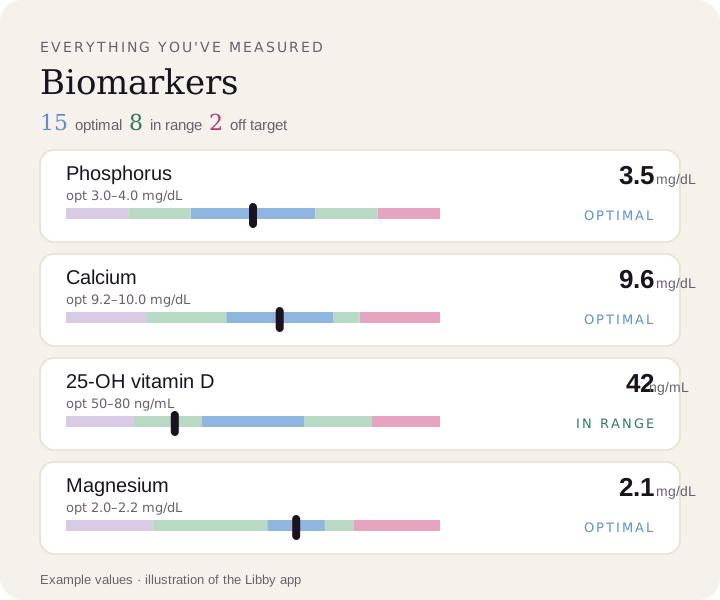
Compare your results to optimal ranges.
Upload a lab PDF or a photo of your report. Libby puts every marker on your lab's range and the optimal range, and tracks your trends over time.
View your phosphorus ›