PTH blood test: normal range, high causes, and calcium
Parathyroid hormone (PTH) sets your blood calcium. The normal range, what a high or low PTH usually means, why it's read with calcium, and when it's urgent.
Parathyroid hormone (PTH) is the signal your body uses to hold blood calcium in a narrow, safe range. Four pea-sized glands in your neck release it when calcium dips, and it pulls calcium back up from your bones, gut and kidneys.1 That's why a PTH result only makes sense next to a calcium drawn at the same time. Together they show whether the glands are overworking on their own or answering a real shortage.23
The short version
- Normal: MedlinePlus gives 10–65 pg/mL, and Labcorp uses 15–65.12 In adults with enough vitamin D, the top of the healthy range sits closer to 45 pg/mL.4
- High PTH with high calcium is primary hyperparathyroidism, usually one benign overgrown gland.5 About 1 in 430 women and 1 in 1,200 men in the U.S. have it.6
- High PTH with normal or low calcium is usually the glands answering a shortage. The common reasons are low vitamin D, kidney disease, too little calcium coming in or too much leaving, and some medicines.57
- Urgent: a calcium of 14 mg/dL or more, or confusion, vomiting, tingling lips or muscle spasms with an abnormal PTH or calcium, needs same-day care.31
What PTH is
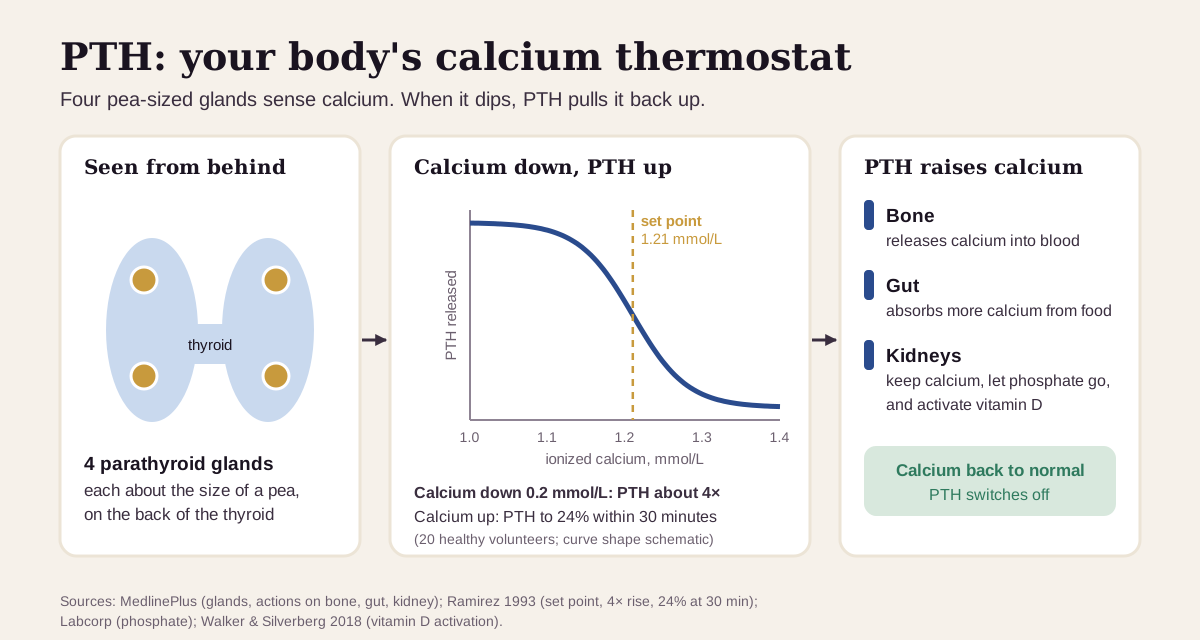
PTH is a small protein, a chain of 84 amino acids, made by the parathyroid glands.2 You have four of them, each about the size of a pea, on or near the back of your thyroid.1 They share the thyroid's neighborhood, not its job.
The glands sense calcium directly and react within minutes. In healthy volunteers, lowering ionized (free) calcium by about 0.2 mmol/L pushed PTH to about 4 times its starting level. Raising calcium cut PTH to 24% of its starting level within 30 minutes.8
PTH raises calcium three ways. It tells your bones to release calcium, helps your gut absorb calcium from food, and has your kidneys keep calcium while letting phosphate go.12 The gut effect runs through vitamin D: PTH switches on the kidney enzyme that turns stored vitamin D into its active form.5
Doctors most often order PTH to find the cause of a high or low calcium. It's also used to follow kidney disease, look into severe osteoporosis or a low phosphate, and check during surgery that an overactive gland is really out.1
What's a normal PTH?
MedlinePlus gives a normal range of 10–65 pg/mL. Labcorp's is 15–65 pg/mL.12 PTH tests differ a lot from one method to another (more at the end), so compare results from the same lab.19
Many labs' upper limits are generous. Their reference groups are usually built without checking vitamin D, and low vitamin D pushes PTH up. When researchers keep only people with enough vitamin D, the limit drops:410
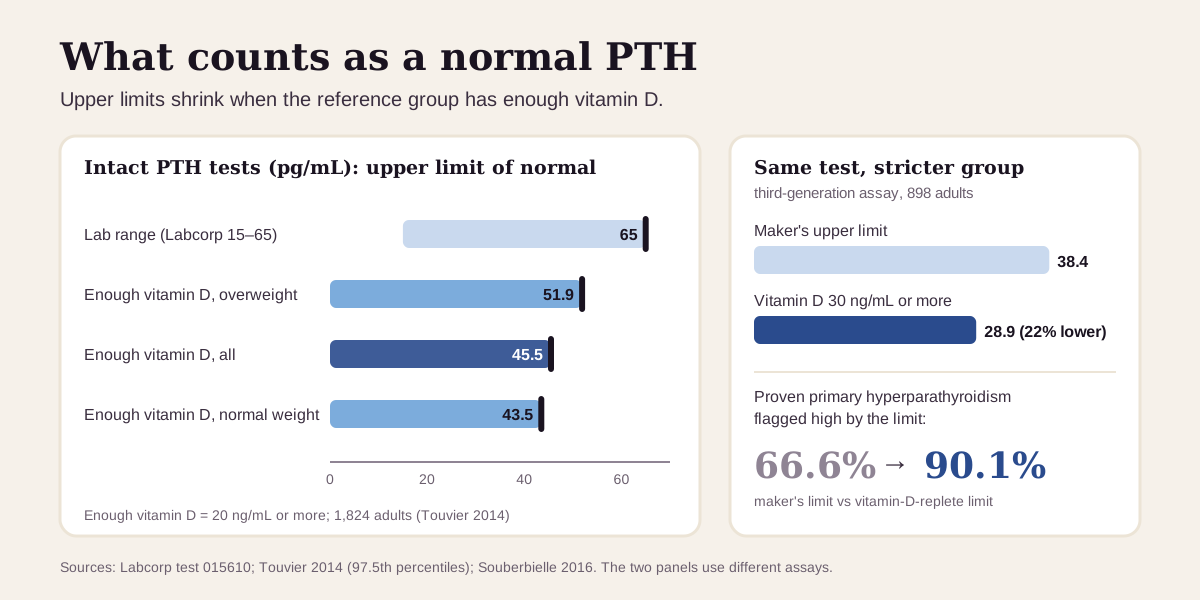
- In 1,824 middle-aged French adults with vitamin D of at least 20 ng/mL, the top of the healthy range (the 97.5th percentile) was 45.5 pg/mL, on an assay whose maker lists 65. It was 51.9 in people with overweight and 43.5 at a normal weight.4
- In 898 healthy French adults, keeping only those with vitamin D of 30 ng/mL or more lowered the upper limit by 22%. With the lower limit, the share of people with surgically proven primary hyperparathyroidism whose PTH read "high" rose from 67% to 90%.10
PTH also runs higher with age. In that French study, healthy people aged 60 and over had higher PTH than younger adults, even with enough vitamin D and normal kidney function.10
"Optimal" PTH: what health optimizers aim for
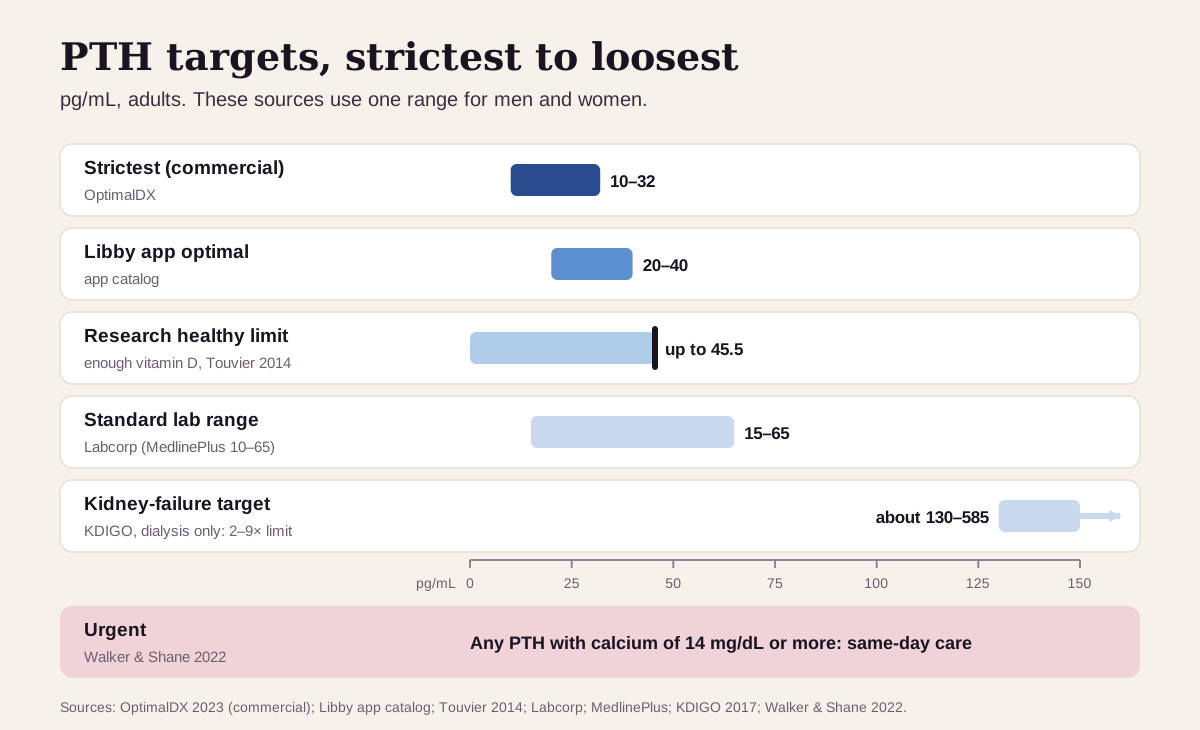
Functional-medicine and longevity sources aim well under a lab's 65. Here's the ladder, from strictest to loosest. These sources use one range for men and women.
| Target | Adults | Who uses it |
|---|---|---|
| Strictest (commercial) | 10–32 pg/mL | OptimalDX's published "ODX range"11 |
| Libby app optimal | 20–40 pg/mL | The optimal range shown in the Libby app. The app's catalog credits it to KDIGO, whose kidney guideline sets PTH targets only for people with chronic kidney disease12 |
| Research "healthy" limit | up to 45.5 pg/mL | Adults with vitamin D of 20 ng/mL or more4 |
| Standard lab range | 15–65 pg/mL (some labs 10–65) | Labcorp; MedlinePlus21 |
| Kidney-failure target | about 2–9× the upper limit (about 130–585 pg/mL on a 65 limit) | KDIGO, for people on dialysis only12 |
| Urgent | any PTH with calcium of 14 mg/dL or more | Severe high calcium: get care the same day3 |
Why the lower targets aren't just a trend:
- In 958 Swedish men around age 71, followed for about 10 years, each standard-deviation step up in PTH came with a 38% higher risk of dying from heart and blood-vessel disease. The link held in men whose PTH, calcium, kidney function and vitamin D were all normal.13
- A 2013 meta-analysis of prospective studies found 1.45 times the risk of cardiovascular events in the highest PTH groups versus the lowest.14
- In 2,312 older U.S. adults, one in four had a PTH of 65 or more. They had a 30% higher risk of heart failure.15
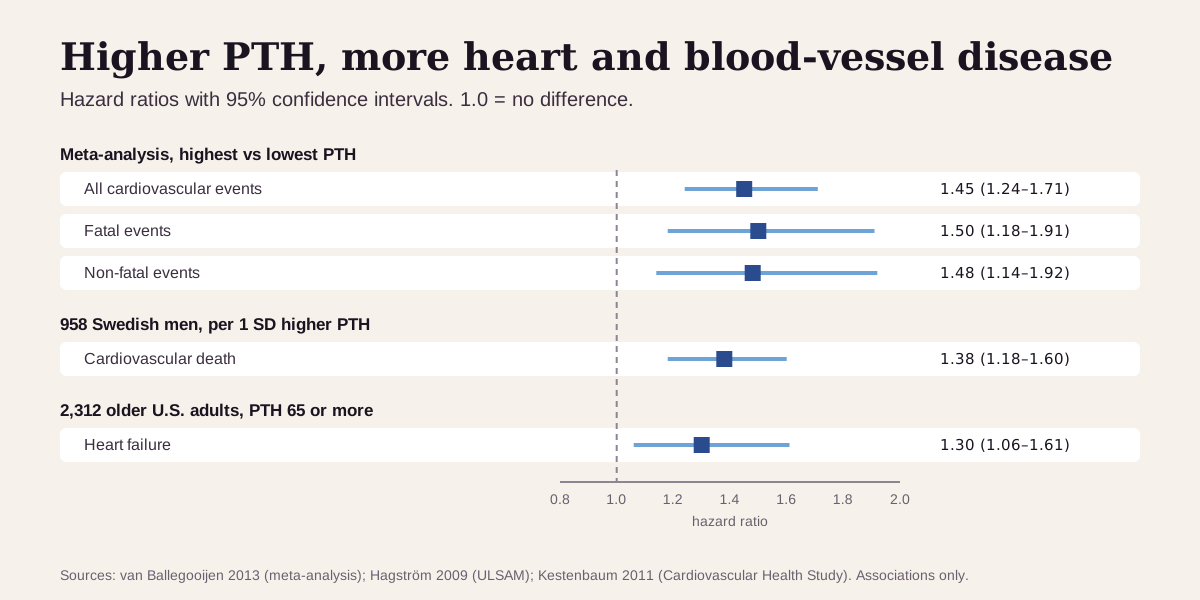
Keep "optimal" in perspective. These studies show a link; whether PTH is a risk you can change is still open, in the Swedish researchers' own words.13 The right PTH also depends on the calcium beside it: a PTH of 40 is unremarkable with a calcium of 9.4 mg/dL, and a reason to look further with a calcium of 10.8, where a healthy gland would have switched off.3 And lower isn't always better: a PTH below the range with a low calcium means the glands are failing (see below).2
What a high or low PTH usually means
Start with the calcium drawn at the same time. Labcorp prints the grid on its report: a PTH over 65 with a calcium over 10.2 mg/dL reads as primary hyperparathyroidism, and a PTH over 65 with a lower calcium as secondary hyperparathyroidism. A PTH under 15 with a calcium under 8.6 reads as hypoparathyroidism.2 Endocrinologists add one refinement: with a high calcium, a PTH anywhere in the normal range still points to the parathyroid. Only a PTH suppressed below about 20 pg/mL (depending on the assay) points to another cause.3
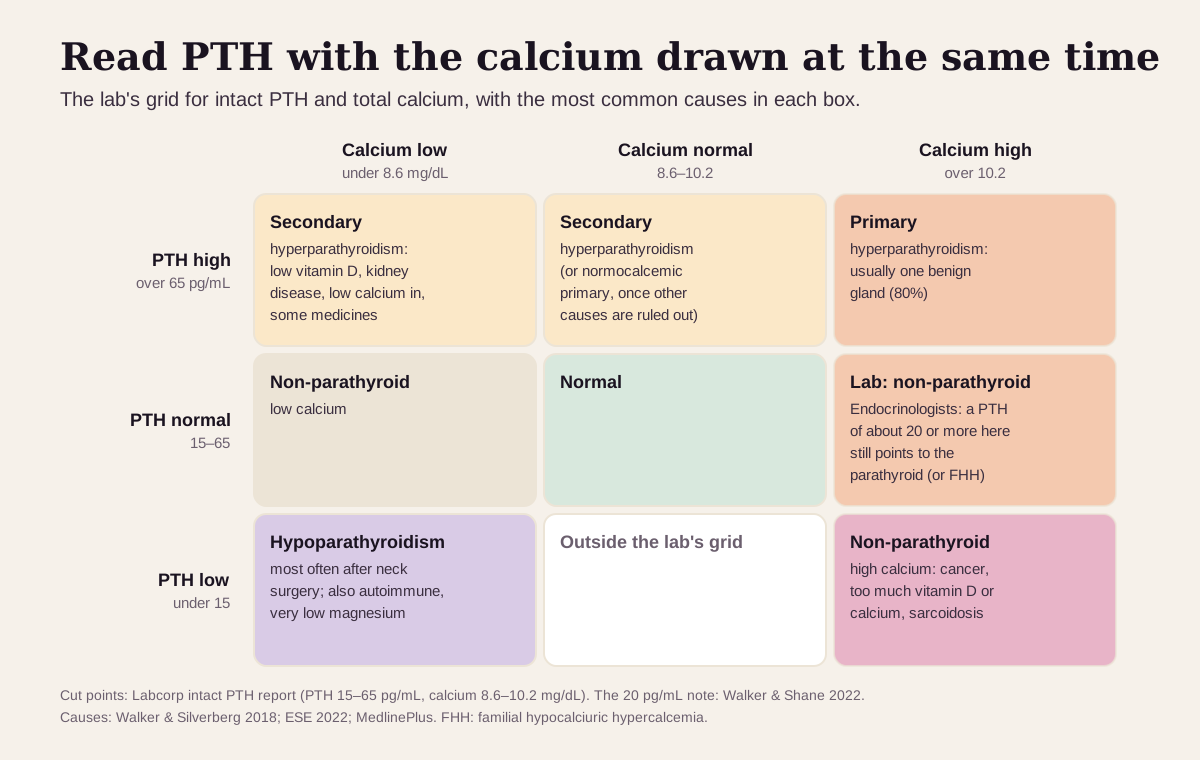
High PTH, normal or low calcium: answering a shortage (most common)
This is secondary hyperparathyroidism: healthy glands working overtime because calcium is hard to come by. The usual suspects:57
- Low vitamin D. European endocrinologists aim for a 25-hydroxy vitamin D of at least 30 ng/mL to avoid it, and note that PTH can stay high for 6–12 months after vitamin D is restored.7
- Kidney disease. As kidney function falls, the kidneys make less active vitamin D, calcium drifts down, and PTH climbs.7 In 1,814 U.S. outpatients in a kidney-disease study, 12% had a PTH over 65 even with an eGFR over 80. Their calcium and phosphorus stayed normal until eGFR fell below 40.16
- Too little calcium in, or too much out: a low-calcium diet; poor absorption from celiac disease, inflammatory bowel disease or bariatric surgery; and kidneys that leak calcium into the urine.7
- Medicines. Loop and other non-thiazide diuretics, lithium, some anticonvulsants, bisphosphonates, denosumab, SGLT2 inhibitors and proton pump inhibitors can all raise PTH.7 Don't stop a prescribed medicine on your own. Bring your full list to your clinician.
High PTH with high calcium: primary hyperparathyroidism
Here a gland makes PTH without waiting for calcium to fall.
- Usually one benign gland. A single adenoma (a benign growth) causes 80% of cases; all four glands enlarge in 10–15%, and cancer is under 1%.5
- Common and usually mild. It affects about 233 in 100,000 U.S. women and 85 in 100,000 men, and more than 1 in 100 women in their 70s.6 Calcium typically sits within 1 mg/dL of the upper limit, and PTH within twice the upper limit.5
- Often found by accident on a routine calcium. It can bring kidney stones (symptoms in about 10–20%) and thinning bones. Long-term lithium use is a known trigger.5
- A look-alike to rule out: familial hypocalciuric hypercalcemia (FHH), an inherited, lifelong mild rise in calcium with a PTH that's usually normal and a low urine calcium (often a calcium-to-creatinine clearance ratio under 0.01). Surgery won't fix it. A PTH over twice the upper limit favors primary hyperparathyroidism instead.75
High PTH, normal calcium, nothing else off
If PTH stays high while calcium is normal on repeat tests, and vitamin D is above 30 ng/mL, eGFR is 60 or more, urine calcium is normal, and medicines and absorption problems have been ruled out, the name is normocalcemic primary hyperparathyroidism.17 It's worth confirming slowly: in one study about 19% went on to a high calcium within 3 years,5 and in another, 75% of first diagnoses weren't confirmed over up to 8 years of follow-up.17
Low PTH
- With low calcium: the glands are failing. That's hypoparathyroidism, and in adults it most often follows neck surgery on the thyroid or parathyroids.7 Autoimmune damage, radiation and a very low magnesium can do it too.1
- With high calcium: the glands have switched off, correctly, because calcium is coming from somewhere else: cancer, too much vitamin D or calcium, or sarcoidosis.31
Get same-day care if your calcium is 14 mg/dL or higher, or if an abnormal PTH or calcium comes with nausea and vomiting, confusion or unusual sleepiness, or with tingling around the lips or in the fingers, muscle cramps or spasms, or a seizure.31
PTH reads best next to its neighbors
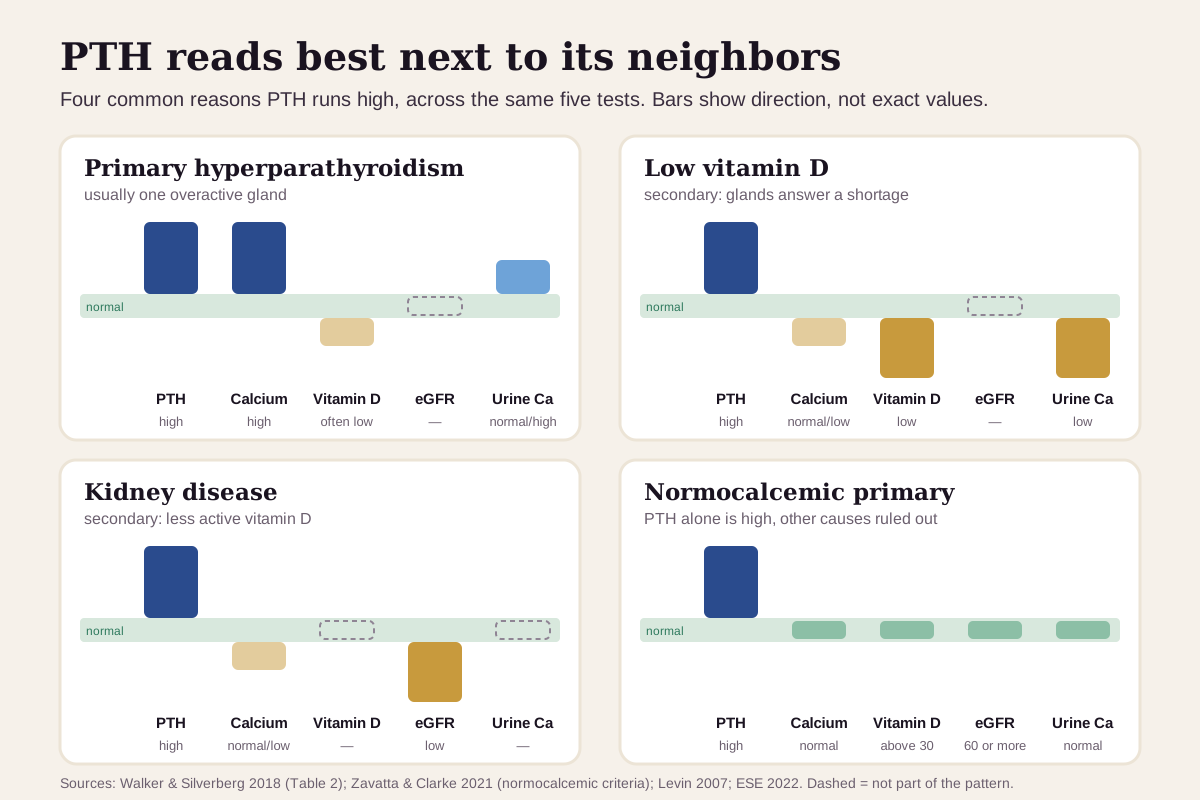
PTH is a reply to calcium, so it's never read alone. Five results sort the common high-PTH patterns:51716
| If you see… | It often points to… |
|---|---|
| PTH high, calcium high, phosphate low or low-normal | primary hyperparathyroidism |
| PTH high, calcium normal or low, vitamin D low, urine calcium low | secondary hyperparathyroidism from low vitamin D |
| PTH high, eGFR low, phosphate high once kidney failure sets in | secondary hyperparathyroidism from kidney disease |
| PTH high on repeat, calcium normal, vitamin D above 30, eGFR 60 or more, urine calcium normal | normocalcemic primary hyperparathyroidism, once medicines and absorption problems are ruled out |
| Calcium high, PTH normal or mildly high, urine calcium low | familial hypocalciuric hypercalcemia (FHH), an inherited look-alike |
| Calcium high, PTH under about 20 | a non-parathyroid cause, such as cancer or too much vitamin D |
| Calcium low, PTH low, phosphate high | hypoparathyroidism |
Sources for the table: Walker 2018 (phosphate and urine calcium by pattern);5 Zavatta 2021 (the normocalcemic criteria);17 ESE 2022 (FHH and hypoparathyroidism);7 Walker & Shane 2022 (the suppressed PTH).3
How fast PTH changes
Whole PTH is gone in minutes. After surgeons removed a single overactive gland, PTH fell with a half-life of about 3.3 minutes, then more slowly (about 96 minutes). It bottomed out 1–3 hours after surgery and was back to normal in most people within 18–40 hours.18
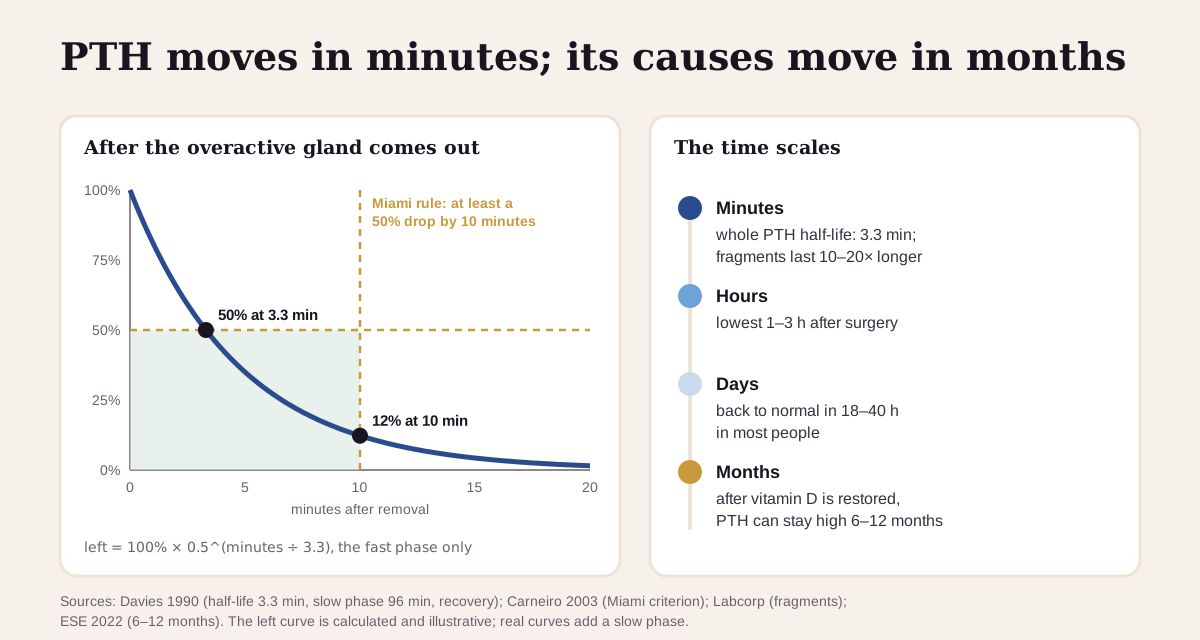
What that means in practice:
- Surgeons use it in the operating room. The "Miami criterion" calls an operation complete when PTH drops by at least 50% within 10 minutes of removing the gland. In 341 patients it predicted the outcome correctly in 329 (96%).19
- Slow causes move slowly. After vitamin D is restored, give PTH 6–12 months before calling it stuck.7 In kidney disease, the trend matters most: KDIGO asks clinicians to look into a PTH that's rising or persistently above the upper limit.12
- Test it cleanly. Get calcium drawn at the same time.1 Labcorp asks people taking high-dose biotin to stop it at least 72 hours before the draw, because it can interfere with the test.2 Some providers ask you to fast or come at a set time of day.1
- Trends beat snapshots, and only from the same lab: kidney guidelines ask labs to report which PTH method they use and any change in it.12
Going deeper: which PTH your lab measures
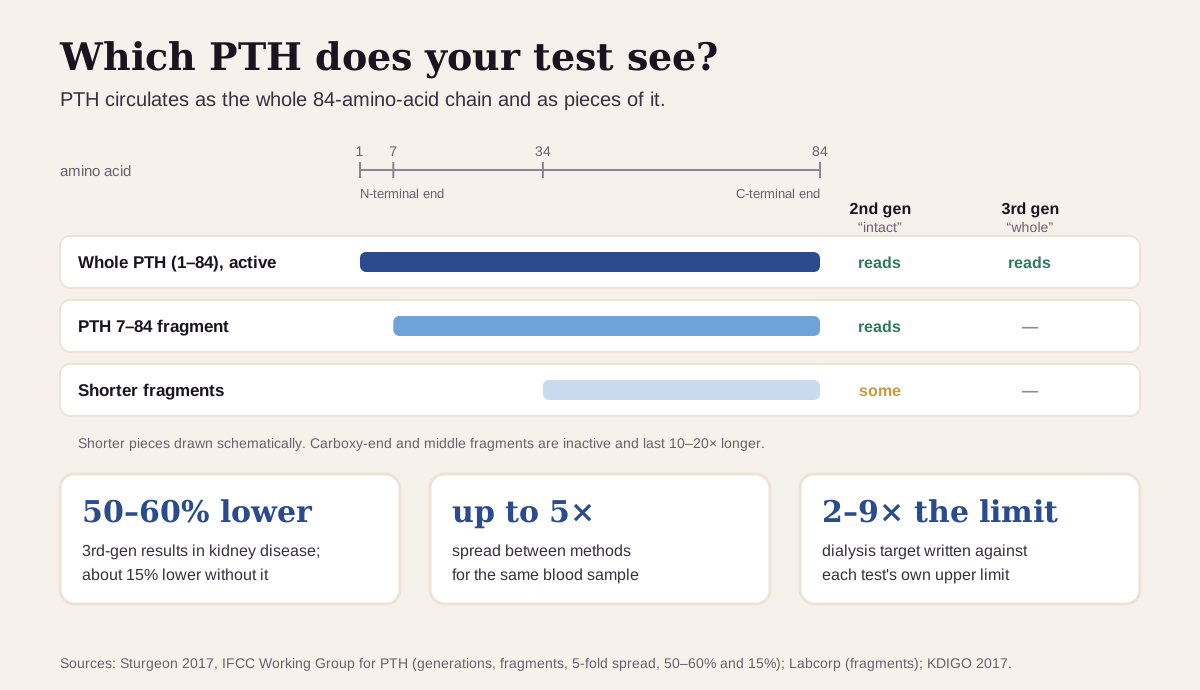
PTH circulates as the whole 84-amino-acid molecule (PTH 1–84) plus pieces of it, such as PTH 7–84 and shorter fragments.9 The carboxy-end and middle fragments are biologically inactive, last 10–20 times longer than whole PTH, and pile up when kidney function is poor.2
Most labs use a second-generation "intact" PTH test. It reads whole PTH plus some fragments, especially 7–84. Third-generation "whole" or "bioactive" tests read only 1–84. They give results about 50–60% lower in people with kidney disease and about 15% lower in people without.9
Even among intact tests, methods disagree: results for the same blood can differ up to 5-fold. In one study of 21 dialysis patients, five methods gave results up to 4.2-fold apart.9 KDIGO writes its dialysis target as a multiple of each test's own upper limit (2–9×) and asks labs to report their method.12 For you, it means a change of lab can look like a change in your PTH.9
Questions worth asking
- Was my calcium measured at the same time, and does my PTH fit it?
- What's my 25-hydroxy vitamin D, and could it explain a high PTH?
- What does my eGFR show, and has my PTH been rising over time?
- Could any of my medicines or supplements, including biotin, be affecting the result?
- If my calcium is high too, should I have a 24-hour urine calcium to rule out FHH?
- When should we repeat PTH and calcium together, and at the same lab?
FAQ
What is a normal PTH level? MedlinePlus gives 10–65 pg/mL; Labcorp uses 15–65.12 In adults with enough vitamin D, the healthy upper limit is closer to 45 pg/mL.4
What are the most common causes of a high PTH? With a normal or low calcium, low vitamin D and kidney disease lead the list. Both push healthy glands to work harder. When calcium is high as well, the usual cause is primary hyperparathyroidism.57
Can a high PTH with normal calcium be serious? It can be an early form of primary hyperparathyroidism, but it's often low vitamin D, kidney disease, low calcium intake or a medicine. Those are checked first, and the tests are repeated.177
When is a PTH result urgent? The calcium beside it decides. A calcium of 14 mg/dL or more, or symptoms such as confusion, vomiting, tingling or muscle spasms, needs same-day care.31
This guide is for education. It can't diagnose you or replace care from a clinician who knows your history.
Footnotes
-
National Library of Medicine. Parathyroid Hormone (PTH) Test. MedlinePlus. Last updated December 4, 2023. Four pea-sized glands; how PTH acts on bone, gut and kidney; why calcium is measured alongside; symptoms of high and low calcium; preparation. MedlinePlus. Also: Parathyroid hormone (PTH) blood test, MedlinePlus Medical Encyclopedia: normal values of 10–65 pg/mL and causes of high and low PTH. MedlinePlus ↩ ↩2 ↩3 ↩4 ↩5 ↩6 ↩7 ↩8 ↩9 ↩10 ↩11 ↩12 ↩13 ↩14 ↩15 ↩16 ↩17
-
Labcorp. Parathyroid Hormone (PTH), Intact (test 015610). Reference range 15–65 pg/mL and the PTH-by-calcium interpretation table; an 84-amino-acid hormone; half-life of whole PTH measured in minutes, fragments 10–20 times longer; EDTA plasma preferred; stop high-dose biotin at least 72 hours before collection. labcorp.com A commercial laboratory's published test page. ↩ ↩2 ↩3 ↩4 ↩5 ↩6 ↩7 ↩8 ↩9 ↩10 ↩11 ↩12 ↩13 ↩14 ↩15 ↩16
-
Walker MD, Shane E. Hypercalcemia: A Review. JAMA. 2022;328(16):1624–1636. Intact PTH as the most important first test in high calcium; a normal or high PTH with high calcium is consistent with primary hyperparathyroidism, and a suppressed PTH (under about 20 pg/mL) points elsewhere; severe hypercalcemia at 14 mg/dL or more. PubMed ↩ ↩2 ↩3 ↩4 ↩5 ↩6 ↩7 ↩8 ↩9 ↩10 ↩11
-
Touvier M, Deschasaux M, Montourcy M, et al. Interpretation of plasma PTH concentrations according to 25OHD status, gender, age, weight status, and calcium intake: importance of the reference values. J Clin Endocrinol Metab. 2014;99(4):1196–1203. 1,824 middle-aged French adults; 97.5th percentile of 45.5 pg/mL with vitamin D of 20 ng/mL or more (51.9 with overweight, 43.5 at normal weight), against the maker's 65. PubMed ↩ ↩2 ↩3 ↩4 ↩5 ↩6 ↩7
-
Walker MD, Silverberg SJ. Primary hyperparathyroidism. Nat Rev Endocrinol. 2018;14(2):115–125. Causes (adenoma 80%, hyperplasia 10–15%, cancer under 1%), typical calcium and PTH levels, lithium, PTH's action on the kidney's vitamin D enzyme, the biochemical table of primary, secondary and normocalcemic hyperparathyroidism and FHH, and the 19% three-year figure. PMC ↩ ↩2 ↩3 ↩4 ↩5 ↩6 ↩7 ↩8 ↩9 ↩10 ↩11 ↩12 ↩13 ↩14 ↩15
-
Minisola S, Arnold A, Belaya Z, et al. Epidemiology, Pathophysiology, and Genetics of Primary Hyperparathyroidism. J Bone Miner Res. 2022;37(11):2315–2329. A task-force report of the Fifth International Workshop; U.S. prevalence of 233 per 100,000 women and 85 per 100,000 men, and 1,110–1,409 per 100,000 women aged 70–79. PMC ↩ ↩2
-
Bollerslev J, Rejnmark L, Zahn A, et al. European Expert Consensus on Practical Management of Specific Aspects of Parathyroid Disorders in Adults and in Pregnancy: Recommendations of the ESE Educational Program of Parathyroid Disorders. Eur J Endocrinol. 2022;186(2):R33–R63. The European Society of Endocrinology's list of the most common causes of secondary hyperparathyroidism and PTH-raising medicines, the 30 ng/mL vitamin D target and 6–12 month lag, FHH testing, and surgery as the most common cause of hypoparathyroidism. PMC ↩ ↩2 ↩3 ↩4 ↩5 ↩6 ↩7 ↩8 ↩9 ↩10 ↩11 ↩12 ↩13 ↩14 ↩15
-
Ramirez JA, Goodman WG, Gornbein J, et al. Direct in vivo comparison of calcium-regulated parathyroid hormone secretion in normal volunteers and patients with secondary hyperparathyroidism. J Clin Endocrinol Metab. 1993;76(6):1489–1494. In 20 healthy volunteers, a 0.21 mmol/L fall in ionized calcium raised PTH to 396% of baseline; calcium infusion cut it to 24% in 30 minutes; set point 1.21 mmol/L. PubMed ↩ ↩2
-
Sturgeon CM, Sprague S, Almond A, et al. Perspective and priorities for improvement of parathyroid hormone (PTH) measurement: A view from the IFCC Working Group for PTH. Clin Chim Acta. 2017;467:42–47. The international lab-medicine federation's working group on PTH tests: assay generations, the fragments each detects, method differences up to 5-fold, and third-generation results 50–60% lower in kidney disease. PMC ↩ ↩2 ↩3 ↩4 ↩5 ↩6
-
Souberbielle JC, Massart C, Brailly-Tabard S, et al. Serum PTH reference values established by an automated third-generation assay in vitamin D-replete subjects with normal renal function: consequences of diagnosing primary hyperparathyroidism and the classification of dialysis patients. Eur J Endocrinol. 2016;174(3):315–323. 898 healthy adults; upper limit 28.9 vs the maker's 38.4 pg/mL (22.4% lower) with vitamin D of 30 ng/mL or more; primary hyperparathyroidism flagged high in 90.1% vs 66.6%; higher PTH at 60 and over. PubMed ↩ ↩2 ↩3 ↩4
-
ODX Research. Hormone Biomarkers: Parathyroid Hormone (PTH). OptimalDX. Published October 4, 2023; updated November 1, 2023. States a standard range of 10–65 pg/mL and an "ODX range" of 10–32 pg/mL. A commercial source, listed as what the optimizer community uses. optimaldx.com ↩ ↩2
-
Kidney Disease: Improving Global Outcomes (KDIGO) CKD-MBD Update Work Group. KDIGO 2017 Clinical Practice Guideline Update for the Diagnosis, Evaluation, Prevention, and Treatment of Chronic Kidney Disease-Mineral and Bone Disorder (CKD-MBD). Kidney Int Suppl. 2017;7(1):1–59. The kidney guideline: optimal PTH unknown before dialysis (act on a rising or persistently high PTH), about 2–9 times the upper limit on dialysis, and labs reporting their PTH method. The Libby app's catalog credits its PTH optimal band to KDIGO. PMC ↩ ↩2 ↩3 ↩4 ↩5 ↩6
-
Hagström E, Hellman P, Larsson TE, et al. Plasma parathyroid hormone and the risk of cardiovascular mortality in the community. Circulation. 2009;119(21):2765–2771. 958 Swedish men, mean age 71, median 9.7 years; hazard ratio 1.38 (95% CI 1.18–1.60) per standard deviation of PTH, also in men with normal PTH and mineral metabolism. PubMed ↩ ↩2 ↩3
-
van Ballegooijen AJ, Reinders I, Visser M, Brouwer IA. Parathyroid hormone and cardiovascular disease events: A systematic review and meta-analysis of prospective studies. Am Heart J. 2013;165(5):655–664. Highest vs lowest PTH: total events 1.45 (1.24–1.71), fatal 1.50 (1.18–1.91), non-fatal 1.48 (1.14–1.92). PubMed ↩ ↩2
-
Kestenbaum B, Katz R, de Boer I, et al. Vitamin D, parathyroid hormone, and cardiovascular events among older adults. J Am Coll Cardiol. 2011;58(14):1433–1441. 2,312 Cardiovascular Health Study participants; 25% with PTH of 65 pg/mL or more, who had 30% (6–61%) higher risk of heart failure. PMC ↩ ↩2
-
Levin A, Bakris GL, Molitch M, et al. Prevalence of abnormal serum vitamin D, PTH, calcium, and phosphorus in patients with chronic kidney disease: results of the study to evaluate early kidney disease. Kidney Int. 2007;71(1):31–38. 1,814 U.S. outpatients; PTH over 65 in 12% at eGFR over 80; calcium and phosphorus normal until eGFR under 40; 25-hydroxy vitamin D similar across kidney function. PubMed ↩ ↩2 ↩3
-
Zavatta G, Clarke BL. Normocalcemic Primary Hyperparathyroidism: Need for a Standardized Clinical Approach. Endocrinol Metab (Seoul). 2021;36(3):525–535. Diagnostic criteria (vitamin D above 30 ng/mL, eGFR 60 or more, no hypercalciuria or interfering medicines) and the 75% of first diagnoses that were not confirmed on follow-up. PMC ↩ ↩2 ↩3 ↩4 ↩5 ↩6
-
Davies C, Demeure MJ, St John A, Edis AJ. Study of intact (1-84) parathyroid hormone secretion in patients undergoing parathyroidectomy. World J Surg. 1990;14(3):355–359. Early half-life 3.3 minutes and late half-life 96.4 minutes after single-gland removal; lowest 1–3 hours after surgery, normal again by 18–40 hours. PubMed ↩ ↩2
-
Carneiro DM, Solorzano CC, Nader MC, Ramirez M, Irvin GL 3rd. Comparison of intraoperative iPTH assay (QPTH) criteria in guiding parathyroidectomy: which criterion is the most accurate? Surgery. 2003;134(6):973–979. The Miami criterion (a drop of 50% or more at 10 minutes), correct in 329 of 341 patients. PubMed ↩ ↩2
Educational content, not medical advice. Libby is a personal record tool, not a medical service — it doesn't diagnose, treat, or prescribe. Reference ranges vary by lab and by person. Talk to a qualified healthcare professional about your results.
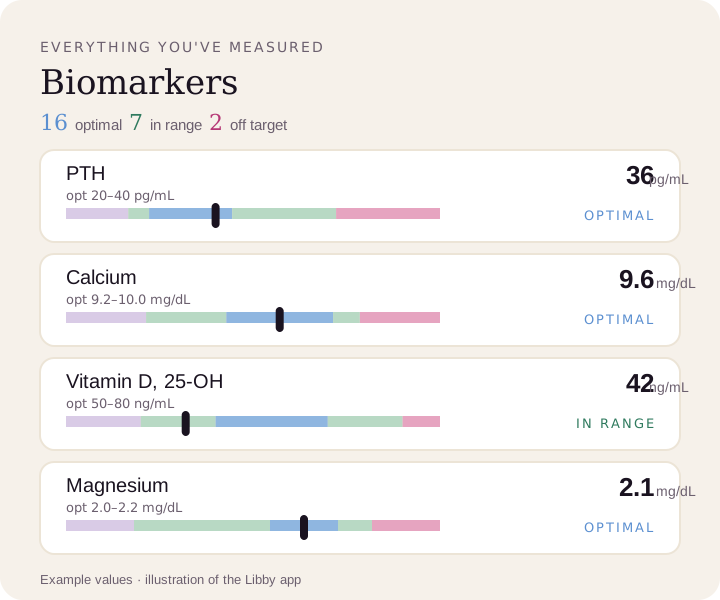
Compare your results to optimal ranges.
Upload a lab PDF or a photo of your report. Libby puts every marker on your lab's range and the optimal range, and tracks your trends over time.
View your PTH ›