Urine calcium test: 24-hour normal range and high causes
A 24-hour urine calcium shows how much calcium your kidneys pass. The normal range, why it runs high, the kidney-stone link, and what a low result means.
Urine calcium is the amount of calcium your kidneys pass into your urine, usually measured over a full 24 hours. Your kidneys filter about 10 grams of calcium a day and take nearly all of it back, so only about 100–200 mg ends up in the urine.1 The test is mostly about kidney stones. Stones made with calcium are the most common kind, and too much calcium in the urine is the most common finding in people who form them.2
The short version
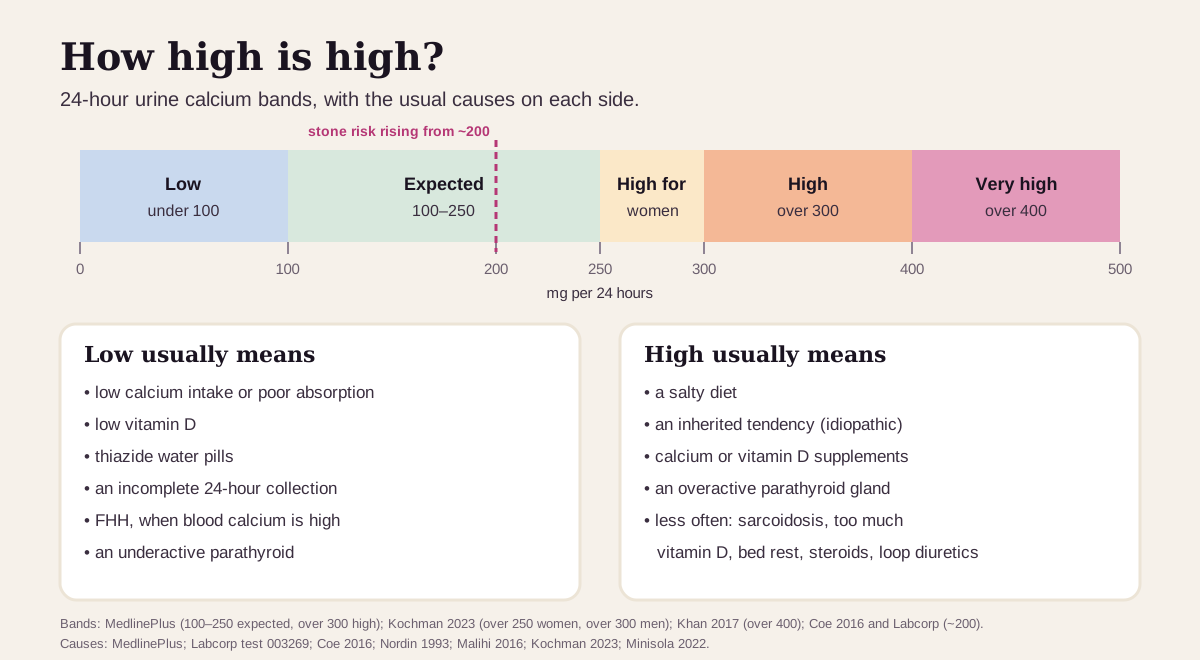
- Normal: about 100–250 mg a day on a usual diet, per MedlinePlus. Lab upper limits run near 300.34 Stone risk starts creeping up from about 200 mg a day.5
- High ("hypercalciuria": over 250 mg a day for women or 300 for men in the international parathyroid guideline) usually comes from a salty diet, an inherited tendency, calcium or vitamin D supplements, or an overactive parathyroid gland.6758
- Low urine calcium with high blood calcium points to FHH (familial hypocalciuric hypercalcemia), a mostly harmless inherited condition that looks like an overactive parathyroid on blood tests. Telling the two apart matters, because FHH needs no surgery.910
- Get care right away for severe pain in your back, side or groin, blood in your urine, or pain with fever and chills. Those can mean a kidney stone.2
What urine calcium is
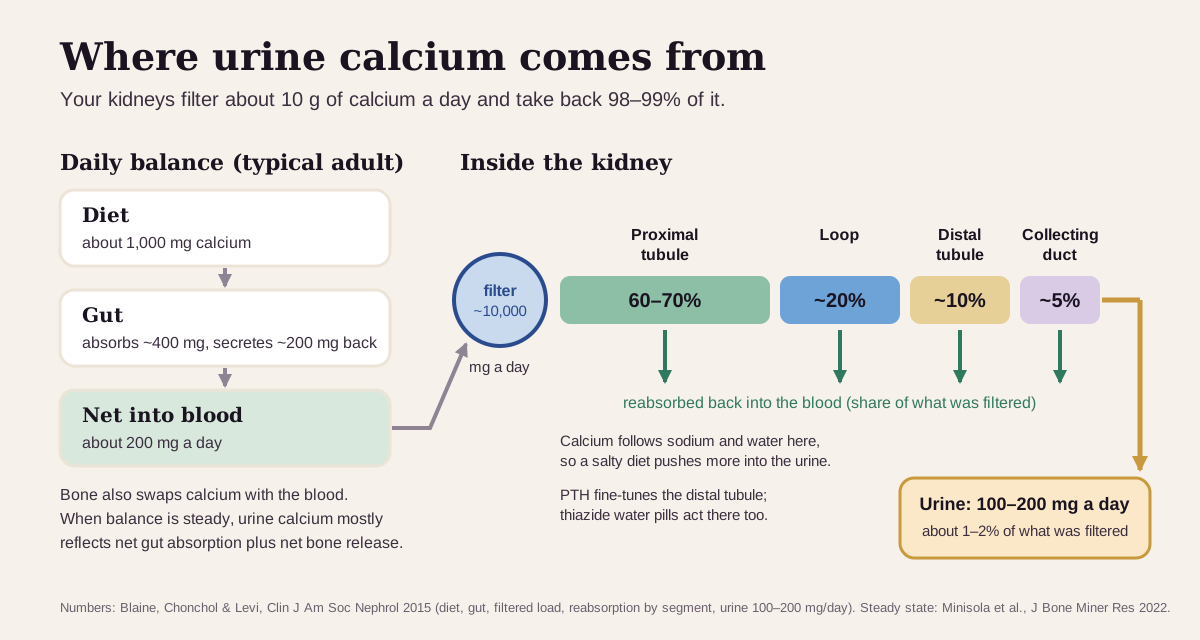
Calcium enters your body through your gut and leaves mainly through your kidneys. On a diet with about 1,000 mg of calcium a day, your gut absorbs roughly 400 mg and releases about 200 mg back, for a net gain of about 200 mg. About that same 200 mg leaves in your urine.1 So when your calcium balance is steady, your 24-hour urine calcium mostly reflects how much calcium your gut takes in plus how much your bones release.10
The kidneys do the fine-tuning. They filter about 10 g of calcium a day and reabsorb 98–99% of it: 60–70% in the first stretch of the tubule, where calcium follows sodium and water, about 20% in the loop, and about 10% in the distal tubule, where parathyroid hormone (PTH) adjusts it.1 That's why a salty diet pushes more calcium into your urine, and why some water pills raise it or lower it.
Doctors order it mainly to work out why someone forms calcium kidney stones, and to follow people with an overactive parathyroid gland.3 About 11% of men and 6% of women in the U.S. have a kidney stone at some point.2 At least 35% of people who form a first stone go on to form another.5
How the 24-hour test works. You empty your bladder into the toilet when you start, then save every drop for the next 24 hours, including the first urine the next morning. Keep the jug cool while you collect.3 Some labs put acid in the jug (Labcorp's holds at least 10 mL of hydrochloric acid), so handle it as the lab instructs.4
Missing even one bathroom trip lowers the total. Many reports also list the 24-hour creatinine from the same jug. It depends mostly on your age and muscle mass: MedlinePlus lists 14–26 mg per kg of body weight a day for men and 11–20 for women.11 A creatinine far below that for your weight is a clue that some urine was missed. And one collection can mislead: in 1,142 stone patients who collected more than once, one day's result often differed from another's by enough to change the diagnosis.12
What's a normal urine calcium?
MedlinePlus puts the expected amount at 100–250 mg a day on a normal diet, and less on a low-calcium diet. It calls a result above 300 mg a day high.3 Labs draw their lines differently: Labcorp, a commercial lab, prints a reference interval of 0–320 mg/24 h on its report.4
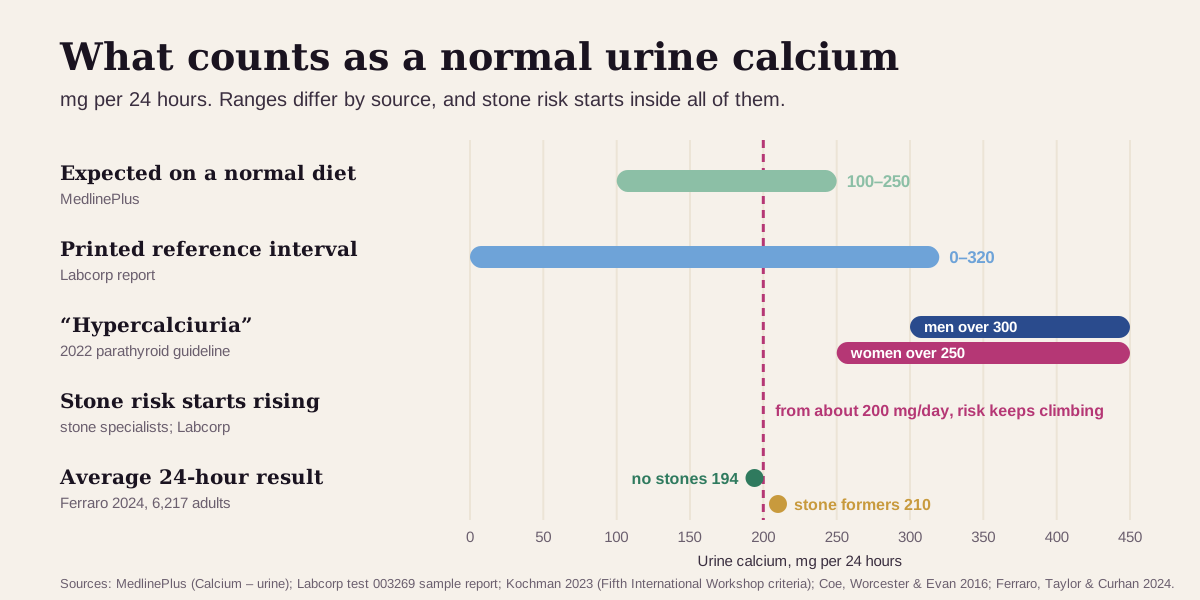
- The classic line for hypercalciuria, used in the 2022 international guideline on overactive parathyroid glands, is over 250 mg a day for women and over 300 for men.6 It's also often defined as 250 mg a day or more for everyone.13
- Stone risk begins to rise at about 200 mg a day, inside the usual lab ranges.54
- In 6,217 nurses and other health professionals, the average urine calcium was 194 mg a day in people without kidney stones and 210 in people who had formed them.13
"Normal" and "high" overlap a lot. In a Harvard study of people who had never had a kidney stone, 14% to 27% met the traditional definition of hypercalciuria anyway.14 Stone specialists now treat urine calcium like blood pressure: a risk that rises steadily across the range, rather than a switch that flips at one number.5
"Optimal" urine calcium: where the lines are drawn
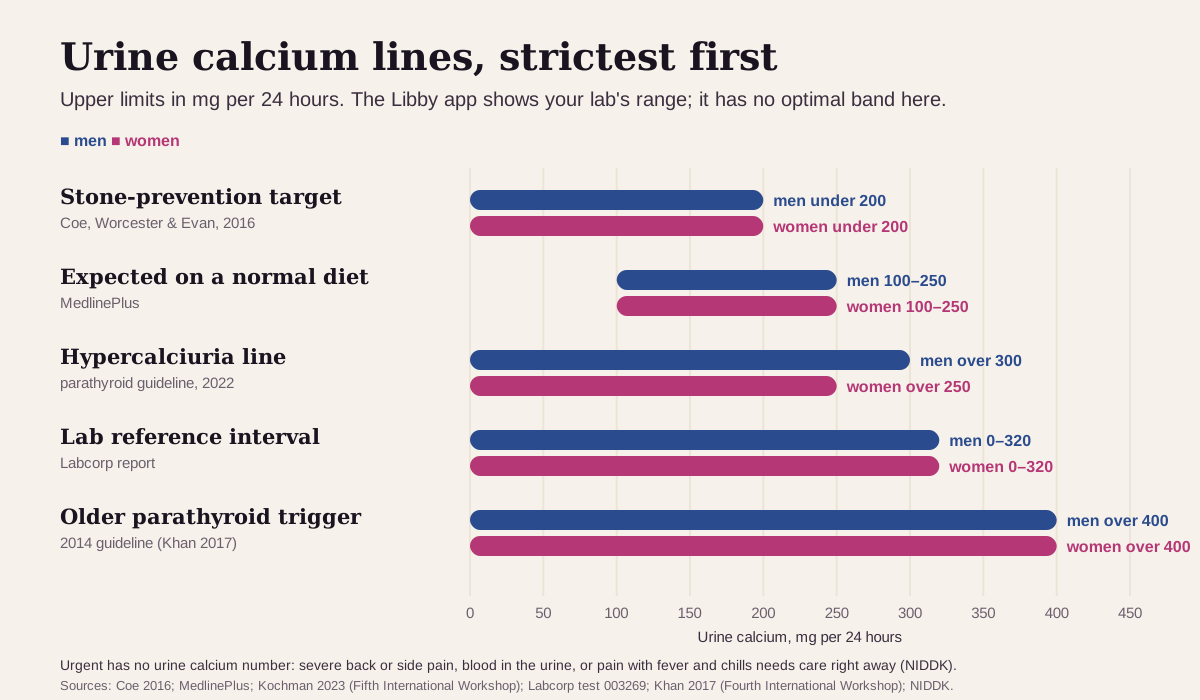
We found no published functional-medicine or longevity target for urine calcium, and the Libby app has no optimal band for it. The app shows your result against your lab's range. The stone research points one way: the lower your urine calcium, the lower your stone risk, in a nearly straight line.13 From strictest to loosest:
| Line | Men | Women | Who draws it |
|---|---|---|---|
| Stone-prevention target | under 200 mg/day | under 200 mg/day | Stone specialists: risk starts rising here, and people who keep forming stones may aim lower5 |
| Expected on a normal diet | 100–250 mg/day | 100–250 mg/day | MedlinePlus3 |
| Hypercalciuria | over 300 mg/day | over 250 mg/day | The 2022 international parathyroid guideline, where it counts toward recommending surgery6 |
| Lab reference interval | 0–320 mg/24 h | 0–320 mg/24 h | Labcorp's printed range4 |
| Older parathyroid trigger | over 400 mg/day | over 400 mg/day | The 2014 international guideline: a full stone-risk workup above this15 |
| Urgent | no set number | no set number | Kidney-stone symptoms: severe back or side pain, blood in the urine, or pain with fever and chills2 |
Why the low line holds up:
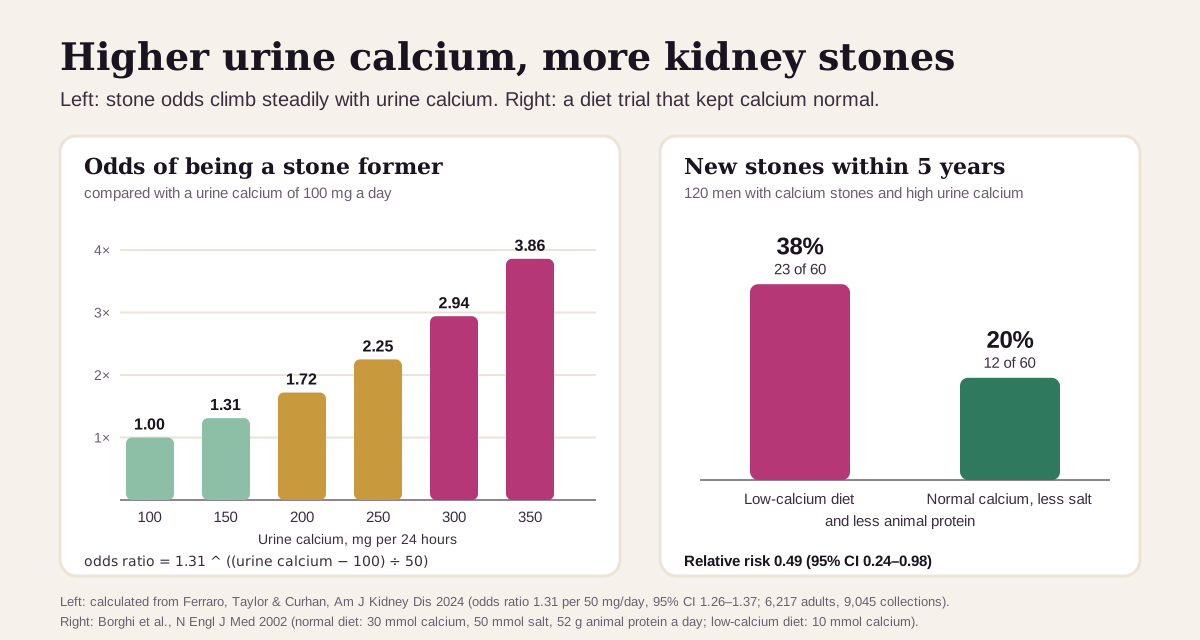
- In 6,217 adults with 9,045 collections, the odds of being a stone former rose 31% with every extra 50 mg a day of urine calcium, in a nearly straight line. Calcium ranked with urine volume and citrate as one of the three strongest urine risk factors.13
- In the earlier Harvard analysis, people whose urine calcium concentration was 200 mg per liter or more had about 4.3 times the stone risk of people under 75 mg per liter (older women and men).14
- In a 5-year trial of 120 men with calcium stones and high urine calcium, a normal-calcium diet with less salt and animal protein cut new stones roughly in half compared with a low-calcium diet: 12 of 60 men vs 23 of 60.16
Keep the targets in perspective. Urine calcium is a stone risk factor, not a diagnosis, and it works together with urine volume, citrate and oxalate.135 Getting to a lower number by cutting calcium backfires: in the Borghi trial, the low-calcium diet raised urine oxalate and did worse, and stone specialists advise people with high urine calcium to get at least 1,200 mg of calcium a day, preferably from food.165
What a high urine calcium usually means
The usual suspects:
- A salty diet. Sodium and calcium leave the kidney together. Every 100 mmol (2,300 mg) of sodium in your urine carries out about 1 mmol (40 mg) more calcium.7 The average in the large Harvard cohorts was 149 mmol of sodium a day.13
- An inherited tendency (idiopathic hypercalciuria). It runs in families and is the most common finding in people who form calcium stones.2 It shows up in up to half of them.5 The gut absorbs a little more of each meal's calcium (about 30% instead of 25%) and the kidneys hold back less, while blood calcium stays in the usual range.5
- Calcium and vitamin D supplements. In the Women's Health Initiative, 36,282 women taking 1,000 mg of calcium plus 400 IU of vitamin D a day had a 17% higher risk of kidney stones than women on placebo.17 Across 14 long-term vitamin D trials, high urine calcium was 1.64 times as common with vitamin D.8 Calcium-based antacids count too.3
- An overactive parathyroid gland (primary hyperparathyroidism). Extra PTH raises blood calcium and helps the gut absorb more, and the excess spills into the urine.6 Urine calcium is high in 30% to 80% of cases.4 Kidney stones affect 5% to 55% of people with it, depending on how severe it is and how closely doctors look.6
- Less common: sarcoidosis, too much vitamin D, long bed rest, steroid treatment, loop diuretics such as furosemide, some kidney tubule disorders, and an overactive thyroid.43
Get care right away if you have sharp pain in your back, side, lower belly or groin; pink, red or brown urine; pain when you urinate or trouble passing urine; or pain with nausea, vomiting, fever or chills. These can be signs of a kidney stone or something more serious.2
What a low urine calcium usually means
A low result has its own short list:
- Low calcium intake or poor absorption from the gut, and low vitamin D.34
- Thiazide water pills (such as hydrochlorothiazide), which help the kidneys hold on to calcium.15
- An incomplete collection. The creatinine check above helps spot it.11
- An underactive parathyroid gland, and the bone disease of advanced kidney failure.34
FHH: low urine calcium with high blood calcium. Familial hypocalciuric hypercalcemia is an inherited change in the calcium sensor on parathyroid and kidney cells.9 People with it have lifelong high blood calcium, a normal or slightly high PTH and low urine calcium, usually with few or no symptoms and no harm to bones or other organs.10 The most common type has an estimated genetic prevalence of 74 per 100,000 people.10 Because its blood tests look like an overactive parathyroid, doctors check urine calcium to rule it out before parathyroid surgery.154 Removing parathyroid glands in FHH leaves the calcium high.1015
Urine calcium reads best next to its neighbors
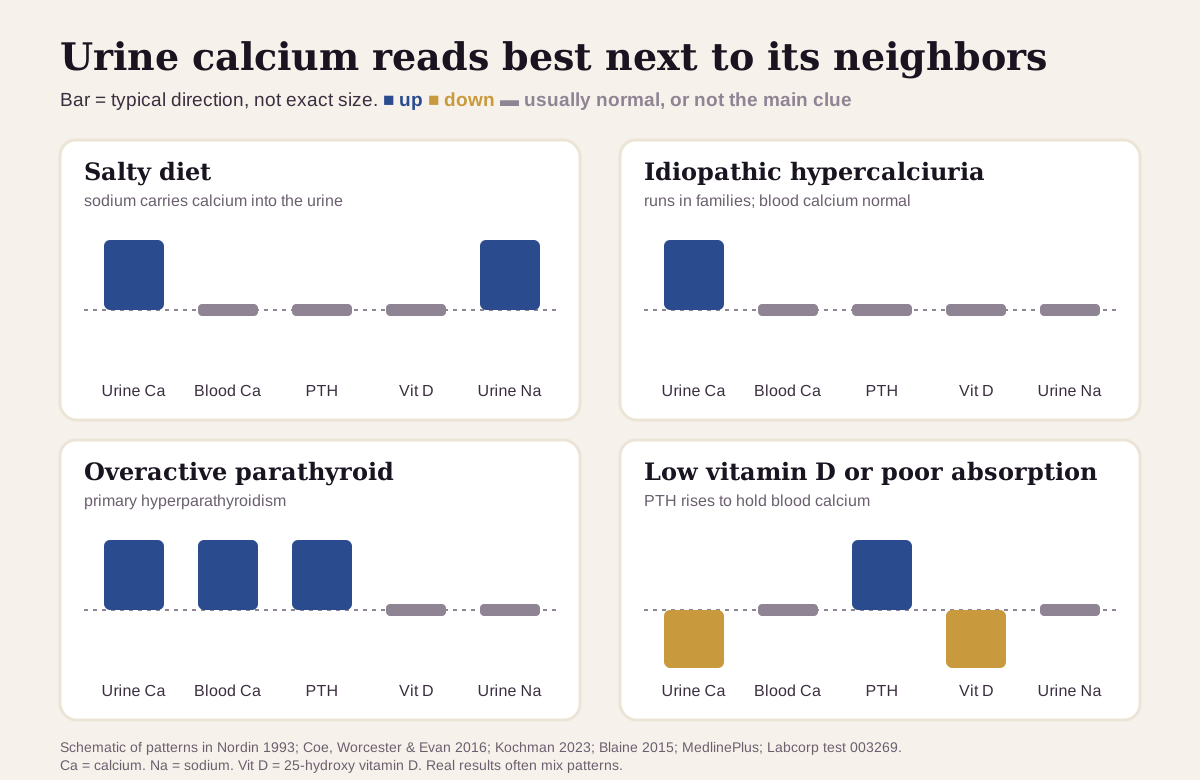
Urine calcium tells you how much; its neighbors tell you why. The pattern across blood calcium, PTH, vitamin D and the urine sodium from the same jug sorts most causes:56
| If you see… | It often points to… |
|---|---|
| High urine calcium and high urine sodium, blood tests normal | a salty diet: sodium carries calcium out75 |
| High urine calcium, with normal blood calcium and urine sodium, and PTH normal or sometimes mildly high | idiopathic hypercalciuria, which runs in families52159 |
| High urine calcium with high blood calcium and a high or "normal" PTH | an overactive parathyroid gland615 |
| High urine calcium with high blood calcium and a suppressed PTH | too much vitamin D, a granuloma disease such as sarcoidosis, or less often cancer164 |
| Low urine calcium, high PTH, low 25-OH vitamin D | vitamin D deficiency or poor calcium absorption639 |
| Low urine calcium with high blood calcium, PTH normal or mildly high | FHH, though an overactive parathyroid can look the same: the calcium/creatinine clearance ratio and relatives' blood calcium help settle it109 |
Start with the urine sodium on the same report. If it's high, cutting salt comes first, and a repeat collection shows how much it helped.75
How fast urine calcium changes
Urine calcium follows your diet and your medicines, so it can move a lot between collections.
- Diet: in the Borghi trial, urine calcium fell by about 170 mg a day on both diets.16 Sodium alone shifts it by about 40 mg for each 2,300 mg of sodium.7
- Medicines: thiazides lower urine calcium, and stone specialists add them when more fluid and less salt fall short.5 European parathyroid experts advise checking for FHH only after at least 1 week off thiazides.9 Labcorp suggests stopping drugs that affect minerals (antacids, diuretics, steroids and others) 2–4 weeks before a collection when possible.4 Stop a prescribed medicine only with your clinician's go-ahead.
- Day to day: results swing enough between collections that the Parks study authors call a single 24-hour urine insufficient before starting stone-prevention treatment.12
- Trends beat snapshots. Compare collections done the same way at the same lab, since ranges vary between labs.3
Going deeper: FHH and the clearance ratio
When blood calcium is high, doctors use the 24-hour urine to calculate the calcium/creatinine clearance ratio (CCCR): roughly, the share of the calcium your kidneys filter that ends up in your urine.9
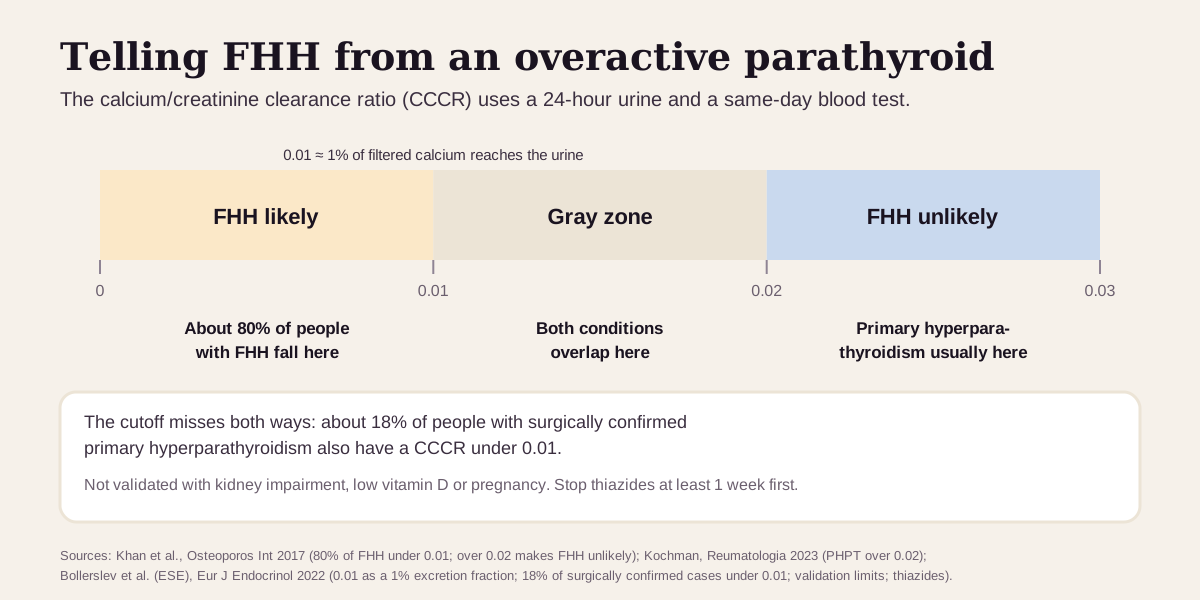
- Under 0.01 suggests FHH: about 80% of people with FHH fall here.15
- Over 0.02 makes FHH unlikely, and it's where primary hyperparathyroidism usually falls. 0.01–0.02 is a gray zone where the two conditions overlap.156
- The cutoff misses both ways: about 18% of people with surgically confirmed primary hyperparathyroidism also have a CCCR under 0.01.9
- The ratio was never validated for people with kidney impairment, low vitamin D or pregnancy, and thiazides push it down.9
That's why FHH is confirmed with genetic testing and by checking blood calcium in close relatives: it runs strongly in families.9
Spot tests. A single urine sample's calcium-to-creatinine ratio is easier than a 24-hour jug. In 74 stone patients, though, spot-based estimates matched the 24-hour calcium only moderately (concordance 0.63).18
Why salt and water pills matter. In the first part of the tubule, calcium is reabsorbed passively along with sodium and water. Loop diuretics block salt uptake in the loop and let more calcium escape. Thiazides act in the distal tubule and leave less calcium in the urine.1
Questions worth asking
- Was my collection complete, and what was the 24-hour creatinine?
- What was the urine sodium in the same jug, and would cutting salt help?
- What are my blood calcium, PTH and vitamin D levels?
- Could my supplements or medicines (calcium, vitamin D, antacids, water pills, steroids) be involved?
- Should we repeat the 24-hour collection before changing anything?
- If my blood calcium is high and my urine calcium is low, should we check the clearance ratio and test my relatives for FHH?
FAQ
What is a normal 24-hour urine calcium? MedlinePlus lists 100–250 mg a day on a normal diet. Lab ranges vary: Labcorp prints 0–320 mg/24 h. Stone risk starts rising at about 200 mg a day.345
What causes high urine calcium? The usual causes are a salty diet, an inherited tendency called idiopathic hypercalciuria, calcium or vitamin D supplements, and an overactive parathyroid gland.7586
Should I eat less calcium if my urine calcium is high? Usually not. In a 5-year trial, men with high urine calcium had about half as many new stones on a normal-calcium diet with less salt and animal protein as on a low-calcium diet.16 Stone specialists advise at least 1,200 mg of calcium a day, preferably from food.5
What does low urine calcium with high blood calcium mean? It's the classic pattern of FHH, an inherited condition that raises blood calcium for life, usually without harm. It needs to be told apart from an overactive parathyroid, because parathyroid surgery leaves the calcium high in FHH.109
This guide is for education. It can't diagnose you or replace care from a clinician who knows your history.
Footnotes
-
Blaine J, Chonchol M, Levi M. Renal control of calcium, phosphate, and magnesium homeostasis. Clin J Am Soc Nephrol. 2015;10(7):1257–1272. A nephrology review; the source for the daily calcium balance, the 10 g filtered load, reabsorption by tubule segment and the effects of thiazide and loop diuretics. PMC ↩ ↩2 ↩3 ↩4 ↩5 ↩6 ↩7 ↩8
-
National Institute of Diabetes and Digestive and Kidney Diseases. Kidney Stones: Definition & Facts, and Symptoms & Causes. NIH; last reviewed May 2017. Calcium stones as the most common type, hypercalciuria as the most common finding in calcium stone formers, lifetime prevalence, and when to seek care. NIDDK · Symptoms ↩ ↩2 ↩3 ↩4 ↩5 ↩6 ↩7 ↩8
-
National Library of Medicine. Calcium – urine. MedlinePlus Medical Encyclopedia; review date July 1, 2025. The 24-hour collection steps, the 100–250 mg/day expected range, the over-300 cutoff and the causes of high and low results. MedlinePlus ↩ ↩2 ↩3 ↩4 ↩5 ↩6 ↩7 ↩8 ↩9 ↩10 ↩11 ↩12 ↩13 ↩14 ↩15 ↩16 ↩17
-
Labcorp. Calcium, 24-Hour Urine (test 003269), test page and sample report. Labcorp is a commercial laboratory; its report prints a reference interval of 0–320 mg/24 h. The page gives collection steps, the 30–80% figure for primary hyperparathyroidism, the rise in stone risk above 200 mg/day and lists of causes. Labcorp · Sample report ↩ ↩2 ↩3 ↩4 ↩5 ↩6 ↩7 ↩8 ↩9 ↩10 ↩11 ↩12 ↩13 ↩14 ↩15 ↩16
-
Coe FL, Worcester EM, Evan AP. Idiopathic hypercalciuria and formation of calcium renal stones. Nat Rev Nephrol. 2016;12(9):519–533. The stone-specialist review behind the ~200 mg/day threshold, the "graded risk" view, gut absorption in idiopathic hypercalciuria, salt, thiazides and the 1,200 mg calcium advice. PMC ↩ ↩2 ↩3 ↩4 ↩5 ↩6 ↩7 ↩8 ↩9 ↩10 ↩11 ↩12 ↩13 ↩14 ↩15 ↩16 ↩17 ↩18 ↩19 ↩20 ↩21 ↩22 ↩23
-
Kochman M. Primary hyperparathyroidism: clinical manifestations, diagnosis and evaluation according to the Fifth International Workshop guidelines. Reumatologia. 2023;61(4):256–263. Reproduces the 2022 surgical criteria (hypercalciuria over 250 mg/24 h in women and over 300 in men), stone prevalence of 5–55%, and the PTH patterns. The guideline itself is Bilezikian JP, et al., J Bone Miner Res 2022;37(11):2293–2314. PMC ↩ ↩2 ↩3 ↩4 ↩5 ↩6 ↩7 ↩8 ↩9 ↩10 ↩11 ↩12 ↩13 ↩14 ↩15 ↩16
-
Nordin BE, Need AG, Morris HA, Horowitz M. The nature and significance of the relationship between urinary sodium and urinary calcium in women. J Nutr. 1993;123(9):1615–1622. "100 mmol of sodium takes out approximately 1 mmol of calcium in the urine." PubMed ↩ ↩2 ↩3 ↩4 ↩5 ↩6 ↩7
-
Malihi Z, Wu Z, Stewart AW, Lawes CM, Scragg R. Hypercalcemia, hypercalciuria, and kidney stones in long-term studies of vitamin D supplementation: a systematic review and meta-analysis. Am J Clin Nutr. 2016;104(4):1039–1051. Hypercalciuria risk ratio 1.64 (95% CI 1.06–2.53) across 14 studies. PubMed ↩ ↩2 ↩3
-
Bollerslev J, Rejnmark L, Zahn A, et al. European Expert Consensus on Practical Management of Specific Aspects of Parathyroid Disorders in Adults and in Pregnancy. Eur J Endocrinol. 2022;186(2):R33–R63. How to tell FHH from primary hyperparathyroidism: the clearance ratio as a 1% excretion fraction, 18% of surgically confirmed cases under 0.01, validation limits, 1 week off thiazides, family and genetic testing, no surgery for FHH. PMC ↩ ↩2 ↩3 ↩4 ↩5 ↩6 ↩7 ↩8 ↩9 ↩10 ↩11 ↩12 ↩13
-
Minisola S, Arnold A, Belaya Z, et al. Epidemiology, Pathophysiology, and Genetics of Primary Hyperparathyroidism. J Bone Miner Res. 2022;37(11):2315–2329. A Fifth International Workshop task-force report: urine calcium at steady state, the features and prevalence of FHH, and why parathyroid surgery is inadvisable in FHH. PMC ↩ ↩2 ↩3 ↩4 ↩5 ↩6 ↩7 ↩8
-
National Library of Medicine. Creatinine urine test. MedlinePlus Medical Encyclopedia; review date July 1, 2025. 24-hour creatinine of 14–26 mg/kg/day in men and 11–20 in women, depending on age and lean mass. MedlinePlus ↩ ↩2
-
Parks JH, Goldfisher E, Asplin JR, Coe FL. A single 24-hour urine collection is inadequate for the medical evaluation of nephrolithiasis. J Urol. 2002;167(4):1607–1612. 1,142 patients from a private practice and a university stone clinic. PubMed ↩ ↩2
-
Ferraro PM, Taylor EN, Curhan GC. 24-Hour Urinary Chemistries and Kidney Stone Risk. Am J Kidney Dis. 2024;84(2):164–169. 6,217 participants of the Health Professionals Follow-up Study and Nurses' Health Studies with 9,045 collections; odds ratio 1.31 per 50 mg/day of urine calcium. PMC ↩ ↩2 ↩3 ↩4 ↩5 ↩6 ↩7 ↩8
-
Curhan GC, Willett WC, Speizer FE, Stampfer MJ. Twenty-four-hour urine chemistries and the risk of kidney stones among women and men. Kidney Int. 2001;59(6):2290–2298. 1,046 men and women; 14–27% of people without stones met the hypercalciuria definition; relative risks of 4.34 and 4.30 for urine calcium concentrations of 200 mg/L or more. PubMed ↩ ↩2
-
Khan AA, Hanley DA, Rizzoli R, et al. Primary hyperparathyroidism: review and recommendations on evaluation, diagnosis, and management. A Canadian and international consensus. Osteoporos Int. 2017;28(1):1–19. Presents the 2014 (Fourth International Workshop) trigger of over 400 mg/day, and the FHH clearance-ratio cutoffs (80% under 0.01; over 0.02 unlikely). PMC ↩ ↩2 ↩3 ↩4 ↩5 ↩6 ↩7 ↩8 ↩9 ↩10
-
Borghi L, Schianchi T, Meschi T, et al. Comparison of two diets for the prevention of recurrent stones in idiopathic hypercalciuria. N Engl J Med. 2002;346(2):77–84. A 5-year randomized trial in 120 men; relative risk 0.49 for the normal-calcium, low-salt, low-animal-protein diet. PubMed ↩ ↩2 ↩3 ↩4 ↩5
-
Jackson RD, LaCroix AZ, Gass M, et al. Calcium plus vitamin D supplementation and the risk of fractures. N Engl J Med. 2006;354(7):669–683. The Women's Health Initiative trial in 36,282 postmenopausal women; kidney stones hazard ratio 1.17 (95% CI 1.02–1.34). PubMed ↩
-
Ferraro PM, Lopez F, Petrarulo M, et al. Estimating 24-hour urinary excretion using spot urine measurements in kidney stone formers. Nephrol Dial Transplant. 2022;37(11):2171–2179. 74 patients; concordance 0.63 for calcium. PMC ↩
Educational content, not medical advice. Libby is a personal record tool, not a medical service — it doesn't diagnose, treat, or prescribe. Reference ranges vary by lab and by person. Talk to a qualified healthcare professional about your results.
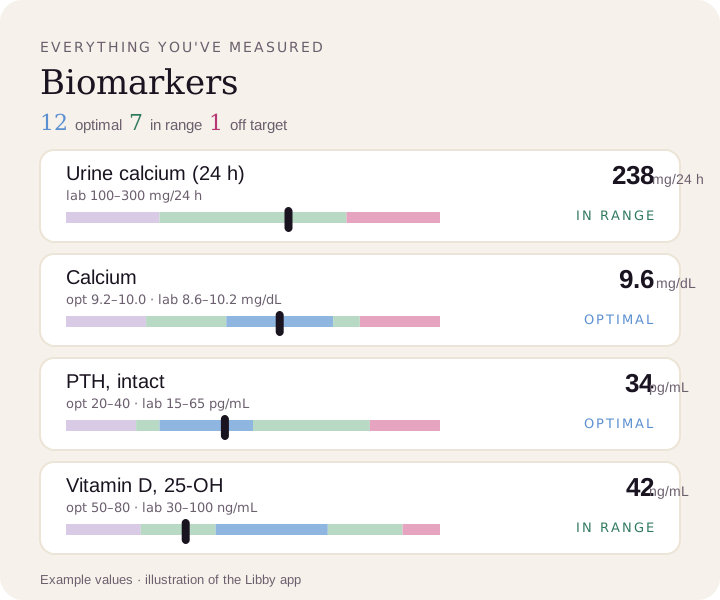
See every result against your lab's range.
Upload a lab PDF or a photo of your report. Libby shows every result next to your lab's range, flags what's off, and tracks each marker over time.
View your urine calcium ›